The Great and Merciful Shepherd

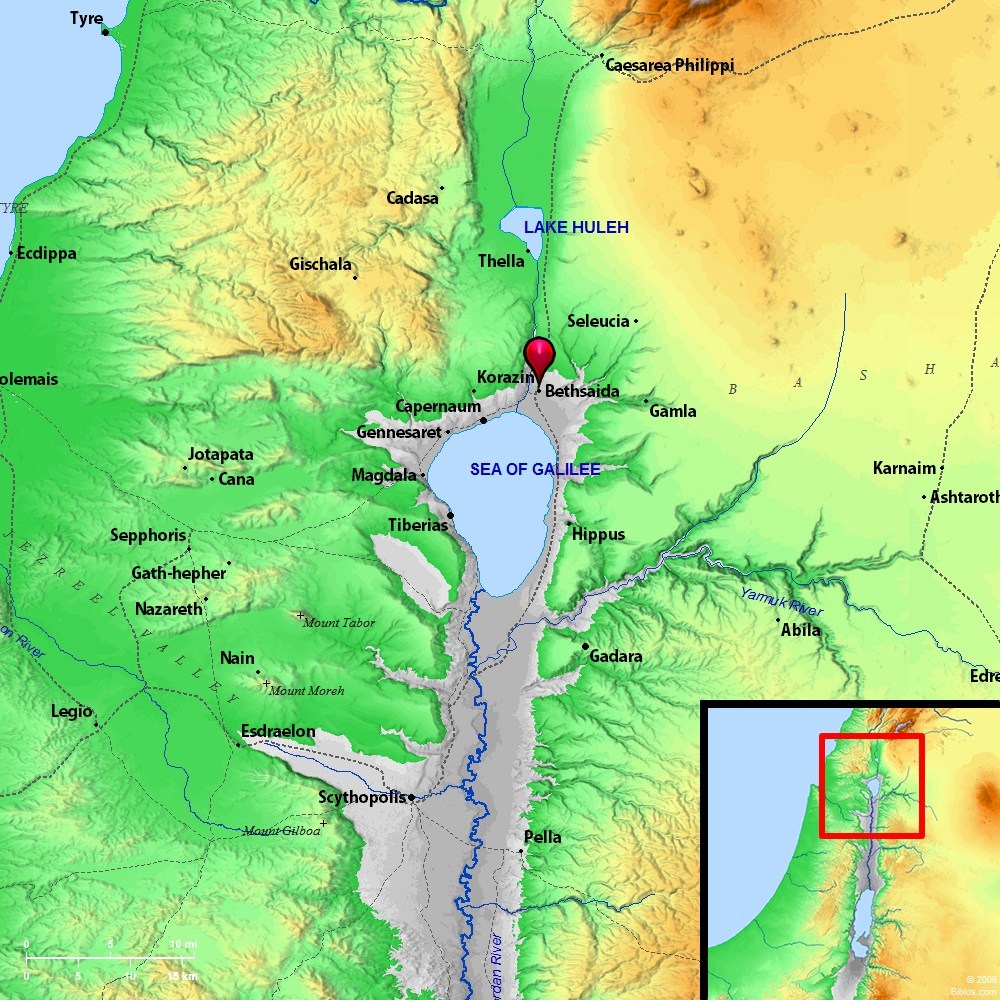
24 And from there he arose and went away to the region of Tyre and Sidon. And he entered a house and did not want anyone to know, yet he could not be hidden. 25 But immediately a woman whose little daughter had an unclean spirit heard of him and came and fell down at his feet. 26 Now the woman was a Gentile, a Syrophoenician by birth. And she begged him to cast the demon out of her daughter. 27 And he said to her, “Let the children be fed first, for it is not right to take the children’s bread and throw it to the dogs.” 28 But she answered him, “Yes, Lord; yet even the dogs under the table eat the children’s crumbs.” 29 And he said to her, “For this statement you may go your way; the demon has left your daughter.” 30 And she went home and found the child lying in bed and the demon gone.

31 Then he returned from the region of Tyre and went through Sidon to the Sea of Galilee, in the region of the Decapolis. 32 And they brought to him a man who was deaf and had a speech impediment, and they begged him to lay his hand on him. 33 And taking him aside from the crowd privately, he put his fingers into his ears, and after spitting touched his tongue. 34 And looking up to heaven, he sighed and said to him, “Ephphatha,” that is, “Be opened.” 35 And his ears were opened, his tongue was released, and he spoke plainly. 36 And Jesus charged them to tell no one. But the more he charged them, the more zealously they proclaimed it. 37 And they were astonished beyond measure, saying, “He has done all things well. He even makes the deaf hear and the mute speak.” – Mark 7:24-37 ESV

After His lengthy, heated debate with the religious leaders over ritual cleansing and defilement, Jesus took His disciples on an unexpected journey outside Israel’s borders. The Jewish Messiah, who had come “to his own, and his own people did not receive him” (John 1:11),  took His message to the Gentiles. In a sense, Jesus was leaving behind the legalistic, self-righteous law-keepers and choosing to align Himself with the unclean and lawless pagans living in the land of Phoenicia.

The scribes and Pharisees were appalled that Jesus and His disciples did not follow the traditional rite of hand-cleansing before eating bread. What would they think when they heard that Jesus had defiled Himself by traveling outside Galilee and associating with non-Jews?

But that seemed to be the point of Jesus’ excursion outside the land of Israel. God had promised Abraham, “in your offspring shall all the nations of the earth be blessed” (Genesis 22:18 ESV). Not long after Jesus’ death and resurrection, the apostle Paul took the gospel message to the people of Galatia, where many of them turned to Christ. Later, in a letter he wrote to the churches he helped to start, he echoed the words of Jesus.

Know then that it is those of faith who are the sons of Abraham. And the Scripture, foreseeing that God would justify the Gentiles by faith, preached the gospel beforehand to Abraham, saying, “In you shall all the nations be blessed.” – Galatians 3:7-8 ESV

Now the promises were made to Abraham and to his offspring. It does not say, “And to offsprings,” referring to many, but referring to one, “And to your offspring,” who is Christ. – Galatians 3:16 ESV

In traveling to the Phoenician cities of Tyre and Sidon, Jesus demonstrated the truth of the Father’s promise to Abraham. Abraham’s “offspring” was about to “bless” the nations.

Mark indicates that, upon arrival, Jesus “entered a house and did not want anyone to know, yet he could not be hidden” (Mark 7:24 ESV). This statement carries great weight. According to Jewish law, by entering the house of a Gentile, Jesus defiled Himself and rendered Himself ceremonially unclean.

“The strict Jew would not enter a Gentile’s house, nor sit on the same couch, nor eat or drink out of the same vessel. The very dust of a heathen city was defiling.” – Ellicott’s Commentary for English Readers

A second-century text called The Book of Jubilees contains the following warning against any association with Gentiles.

“And you also, my son, Jacob, remember my words, and keep the commandments of Abraham, your father. Separate yourself from the Gentiles, and do not eat with them, and do not perform deeds like theirs. And do not become associates of theirs. Because their deeds are defiled, and all their ways are contaminated, and despicable, and abominable.” – Jubilees 22:16

So, Mark’s reference to Jesus entering a Gentile home was meant to shock his readers. Yet rumors about Jesus and His miraculous powers had reached Phoenicia. Mark records, “immediately a woman whose little daughter had an unclean spirit heard of him and came and fell down at his feet” (Mark 7:25 ESV). Matthew calls her “a Canaanite woman” (Matthew 15:22 ESV). The term “Canaanite” was an all-inclusive term for any and all Gentiles who lived in the land originally known as Canaan. This woman was a Gentile, and yet she was willing to seek out the Jewish Messiah in the hopes that He could help her with a pressing problem. Mark wanted his readers to grasp how shocking this encounter was.

Now the woman was a Gentile, a Syrophoenician by birth. And she begged him to cast the demon out of her daughter. – Mark 7:26 ESV

The woman was not a Jew, so she was considered unclean and unholy. To make matters worse, her daughter was possessed by a demon. Everything about this scenario is meant to stress her defilement and to place Jesus in a potentially compromising position. But in his account, Matthew adds an interesting and important detail. In begging Jesus to help her daughter, the woman reveals an uncharacteristic understanding of who Jesus really was.

“Have mercy on me, O Lord, Son of David; my daughter is severely oppressed by a demon.” – Matthew 15:22 ESV

By calling him “Son of David,” she acknowledged her belief that he was the Jew’s long-awaited Messiah, the promised descendant of King David. This wasn’t necessarily an expression of saving faith, but a confession that she believed Jesus was a man of great power and significance. And because she had heard of His many miracles, she begged this powerful man to show her mercy by helping her daughter.

Only Matthew indicates the disciples’ reaction, revealing that these good Jews were appalled at the woman’s unmitigated gall and begged Jesus to get rid of her.

“Send her away, for she is crying out after us.” – Matthew 15:23 ESV

Everything about this trip must have had them shaking their heads in wonder. Why would Jesus drag them on a 30-mile journey to a place like Tyre. It’s likely none of these men had ever ventured outside Israel’s borders, so they might have seen this trip as an adventure. But when Jesus began to interact with the local inhabitants, they must have been surprised and confused. What Jesus says to the woman echoed the disciples’ sentiments.

“Let the children be fed first, for it is not right to take the children’s bread and throw it to the dogs.” – Mark 7:27 ESV

The Jews considered dogs to be unclean. Rarely kept as pets, they were typically used for security, and the streets of most Israelite towns and villages were filled with strays that scavenged for food and could threaten public safety. So, when Jesus referred to this woman as a “dog,” He was expressing the common Jewish perception concerning Gentiles.

According to Matthew, Jesus told the woman, “I was sent only to the lost sheep of the house of Israel” (Matthew 15:24 ESV). He made it clear to her that His original mission was to His own people. But she was not willing to give up so easily; her need was great, and Jesus was her only hope.

Unphased by Jesus’ comments, she responded, “Yes, Lord; yet even the dogs under the table eat the children’s crumbs” (Mark 7:28 ESV). She didn’t debate His assessment of her social standing or take offense at His seeming slight. Instead, she acknowledged her unworthiness and humbly begged for a “crumb” of His goodness and mercy. She knew she was undeserving of His mercy, and was willing to take anything He gave her. And to the disciples’ amazement, Jesus gladly obliged her request.

“For this statement you may go your way; the demon has left your daughter.” – Mark 7:29 ESV

Matthew reveals that the statement itself did not produce her daughter’s miraculous healing; it was the faith that motivated it. Jesus told her, “O woman, great is your faith! Be it done for you as you desire.” And her daughter was healed instantly” (Matthew 15:28 ESV). Her belief in Jesus’ power and authority was rewarded.

And she went home and found the child lying in bed and the demon gone. – Mark 7:30 ESV

When she arrived home, she found her daughter whole and in her right mind. But Jesus and His disciples left Tire, headed north to the city of Sidon, then back through Galilee to Decapolis on the southeastern side of the Sea of Galilee. This long, arduous trip would have taken anywhere from a few weeks to a month. When they arrived in this predominantly Gentile region, Jesus once again found Himself confronted with a request for healing.

…they brought to him a man who was deaf and had a speech impediment, and they begged him to lay his hand on him. – Mark 7:32 ESV

Mark doesn’t say whether this man was a Jew or a Gentile, but like the Canaanite woman, he had a pressing problem that required Jesus’ power. Mark’s description of the man’s condition is critical to understanding this miracle’s meaning. The man suffered from a “speech impediment,” and Mark used a rare Greek word, mogilalos, to describe it. The only other time this word appears is in the Greek Septuagint rendering of Isaiah 35:4-6.

Say to those who have an anxious heart,
    “Be strong; fear not!
Behold, your God
    will come with vengeance,
with the recompense of God.
    He will come and save you.”

Then the eyes of the blind shall be opened,
    and the ears of the deaf unstopped;
then shall the lame man leap like a deer,
and the tongue ofthe mute [mogilalos] sing for joy. – Isaiah 35:4-6

This Messianic passage prophesies the Messiah’s coming and portrays the amazing miracles He would perform upon His arrival. Here, Jesus is given yet another opportunity to reveal His true identity through another supernatural display of His power.

The way this miracle was enacted is truly unique. Jesus “put his fingers into the man’s ears. Then, spitting on his own fingers, he touched the man’s tongue” (Mark 7:33 NLT). None of this was necessary. Mark had just described Jesus healing the Canaanite woman’s daughter from a distance with nothing more than a spoken word. But in this case, Jesus touched the man and, in doing so, became ceremonially defiled. This man’s condition rendered him unclean because the Jews believed that disease and disabilities were the result of sin. Yet, Jesus touched the man’s ears and tongue, then declared, “Be opened” (Mark 7:35 ESV). And immediately, the man’s hearing and speech were fully restored, leaving the onlookers “astonished beyond measure” (Mark 7:37 ESV). Stunned by what they had just witnessed, they responded, “Everything he does is wonderful. He even makes the deaf to hear and gives speech to those who cannot speak” (Mark 7:37 NLT).

Jesus warned them not to tell anyone what they had seen, but they couldn’t help themselves; the news of this miracle spread throughout the region. These two miracles, the healing of the girl in Tyre and the healing of the man in Decapolis, sparked interest in and a hunger for the Messiah among the Gentiles. This matters because, after His resurrection, Jesus commissioned His disciples to be His witnesses “in Jerusalem and in all Judea and Samaria, and to the end of the earth” (Acts 1:8 ESV). When they arrived in places like Phoenicia and Decapolis, they found an audience ready to hear the good news of Jesus, the Messiah. Jesus had primed the pump and prepared the Gentiles’ hearts to receive the message of salvation His disciples would bring. 

The offspring of Abraham had come to bless the nations of the earth. As the seed of David and the Son of God, Jesus was on a mission to restore the lost sheep of the flock of Abraham, but, as He later declared, “I have other sheep, too, that are not in this sheepfold. I must bring them also. They will listen to my voice, and there will be one flock with one shepherd” (John 10:16 NLT). As the Son of God, Jesus came “to seek and save those who are lost” (Luke 19:10 NLT), including people from every tribe, nation, and tongue. 

English Standard Version (ESV) The Holy Bible, English Standard Version. ESV® Permanent Text Edition® (2016). Copyright © 2001 by Crossway Bibles, a publishing ministry of Good News Publishers.

New Living Translation (NLT) Holy Bible, New Living Translation, copyright © 1996, 2004, 2015 by Tyndale House Foundation. Used by permission of Tyndale House Publishers Inc., Carol Stream, Illinois 60188. All rights reserved.
The Hidden Heart Condition

14 And he called the people to him again and said to them, “Hear me, all of you, and understand: 15 There is nothing outside a person that by going into him can defile him, but the things that come out of a person are what defile him.” 17 And when he had entered the house and left the people, his disciples asked him about the parable. 18 And he said to them, “Then are you also without understanding? Do you not see that whatever goes into a person from outside cannot defile him, 19 since it enters not his heart but his stomach, and is expelled?” (Thus he declared all foods clean.) 20 And he said, “What comes out of a person is what defiles him. 21 For from within, out of the heart of man, come evil thoughts, sexual immorality, theft, murder, adultery, 22 coveting, wickedness, deceit, sensuality, envy, slander, pride, foolishness. 23 All these evil things come from within, and they defile a person.” – Mark 7:14-23 ESV

A small contingent of scribes and Pharisees had confronted Jesus with an accusation presented in the form of a question. They were demanding that Jesus explain the “shocking” behavior of His disciples.

“Why do your disciples not walk according to the tradition of the elders, but eat with defiled hands?” – Mark 7:5 ESV

What shocked these pious religious leaders was seeing Jesus’ disciples eat without first properly cleansing their hands.  The word “defiled” translates the Greek word aniptos, meaning “unwashed.”  Mark gives a clue as to what motivated the religious leaders.

For the Pharisees and all the Jews do not eat unless they wash their hands properly, holding to the tradition of the elders… – Mark 7:3 ESV

According to these men, the disciples had violated established protocol. The “tradition of the elders,” or oral law, required all Jews to ceremonially cleanse their hands before eating. Jews were required to wash their hands and say a blessing before any meal that included bread. The ritual, known as netilat yadayim, involved using a cup to pour water onto the hands and letting it flow down to the elbows. The ritual had nothing to do with personal hygiene; it was done for ritual purposes.

According to the Cambridge Bible for Schools and Colleges, this ceremony had little practical value.

“When, therefore, some of the Pharisees remarked that our Lord’s disciples ate with ‘unwashen hands,’ it is not to be understood literally that they did not at all wash their hands, but that they did not wash them ceremonially according to their own practice. And this was expected of them only as the disciples of a religious teacher; for these refinements were not practised by the class of people from which the disciples were chiefly drawn.” – Cambridge Bible for Schools and Colleges

Jesus was well aware of his accusers’ intentions; these men tried to label Him and His disciples as lawbreakers. But Jesus took the opportunity to teach His followers a valuable lesson on hygiene and holiness.

While the Pharisees focused on the outward practice of hand-washing, Jesus took the conversation deeper. In other words, He went to the “heart” of the matter. Gathering the people around Him, Jesus said, “All of you listen…and try to understand. It’s not what goes into your body that defiles you; you are defiled by what comes from your heart” (Mark 7:14-15 NLT). And that was all He said.

As usual, Jesus’ reply was short and succinct, but not exactly clear. Mark indicates that even the 12 disciples struggled to understand the meaning behind Jesus’ abbreviated lesson. When they were alone with Jesus, they asked Him to explain what they understood to be another of His parables. But this was less a parable than it was a moral object lesson. Jesus’ comment was prompted by the scribes’ and Pharisees’ emphasis on ritualistic cleansing. These men cared about appearances and used their lengthy list of man-made rules to promote and prove their own righteousness. Their behavior was a badge of honor. Rule-keeping became their primary measure of righteousness. But Jesus cared more about the inside than the outside. On another occasion, He leveled a stinging accusation against the Pharisees, exposing the farcical nature of their religious rule-keeping.

“You are so careful to clean the outside of the cup and the dish, but inside you are filthy—full of greed and self-indulgence!” – Matthew 23:25 NLT

These attacks on the well-respected religious leaders always left the disciples scratching their heads. Weren’t the scribes and Pharisees meant to be revered for their obvious displays of righteousness? How could Jesus get away with calling them hypocrites and blind guides? Why did He feel the constant need to anger them?

But Jesus was trying to teach His disciples that mankind’s problem was not physical but spiritual. It all had to do with the condition of the heart. No amount of outward cleansing or ritual purification could produce a holy heart. So, He reiterated His original statement one more time, but with further clarification.

“Can’t you see that the food you put into your body cannot defile you? Food doesn’t go into your heart, but only passes through the stomach and then goes into the sewer.” – Mark 7:18 NLT

Food was little more than fuel, taken into the body for energy, then discarded as waste. Washing hands, pots, pans, and the food itself, while beneficial for personal hygiene, had no value for a person’s spiritual condition. Food can give energy to the human heart, but it can do nothing to influence the moral state of the human soul, either positively or negatively. Drinking from a ritually cleansed cup may make one feel purer, but it is nothing more than a facade, an exercise in self-deception.

Mark adds another important parenthetical statement to further clarification.

By saying this, he declared that every kind of food is acceptable in God’s eyes. – Mark 7:19 NLT

This expanded explanation most likely escaped the disciples. But it became clearer to them when Jesus ascended into heaven after His resurrection. In the days after Jesus departed and the Holy Spirit descended, the disciples obeyed His commission and took the gospel to Jerusalem, Judea, and the ends of the earth (Acts 1:8). Even Gentiles accepted the free gift of God’s grace made possible through faith in Jesus Christ. As a result, they received the indwelling presence of the Spirit of God. The addition of Gentile converts to the early church produced an important debate among the disciples about the role of the Mosaic law in the lives of these former pagans.

There were those, like Peter, who believed that any Gentiles who came to faith should be required to keep the Jewish religious laws, just as they did. But Paul, the apostle to the Gentiles, pushed back against this unnecessary requirement. In doing so, he did not denigrate or dismiss God’s law, but simply denied that salvation came by faith alone in Christ alone, with no additional requirements. Paul argued vehemently that the law had no place in these Gentile converts’ lives. The Jewish dietary laws no longer applied, and even the Jewish rite of circumcision was to be set aside.

For no one is a Jew who is merely one outwardly, nor is circumcision outward and physical. But a Jew is one inwardly, and circumcision is a matter of the heart, by the Spirit, not by the letter. His praise is not from man but from God. – Romans 2:28-29 NLT

It was all about the heart, and that was the very point Jesus was trying to make with His disciples. Knowing their hardened hearts (Mark 6:52 made it difficult for them to grasp the meaning behind His teaching, Jesus spoke plainly and simply.

“It is what comes from inside that defiles you. For from within, out of a person’s heart, come evil thoughts, sexual immorality, theft, murder, adultery, greed, wickedness, deceit, lustful desires, envy, slander, pride, and foolishness. All these vile things come from within; they are what defile you.” – Mark 7:20-23 NLT

This less-than-flattering list resembles one in Paul’s letter to the believers in Galatia.

When you follow the desires of your sinful nature, the results are very clear: sexual immorality, impurity, lustful pleasures, idolatry, sorcery, hostility, quarreling, jealousy, outbursts of anger, selfish ambition, dissension, division, envy, drunkenness, wild parties, and other sins like these. Let me tell you again, as I have before, that anyone living that sort of life will not inherit the Kingdom of God. – Galatians 5:19-21 NLT

These ungodly, unholy, and unrighteous actions do not result from unwashed hands but from an unregenerate heart. Man’s heart is wicked and controlled by his sinful nature. It is not the result of poor living conditions, improper hygiene, insufficient education, or failing to keep a list of religious rules.

James reminds us, “Temptation comes from our own desires, which entice us and drag us away. These desires give birth to sinful actions. And when sin is allowed to grow, it gives birth to death” (James 1:14-16 NLT). The prophet Jeremiah adds, “The human heart is the most deceitful of all things, and desperately wicked. Who really knows how bad it is?” (Jeremiah 17:9 NLT).

So Jesus was trying to communicate a deep, abiding truth about the nature of man’s sinful state. No amount of ritual cleansing would solve the problem. The Pharisees cleansed the outside of “the cup,” but missed the real problem. Like all men, they suffered from a serious heart condition that was untreatable by human means. Even their strict adherence to the laws of Moses and their faithful keeping of the traditions of the fathers could do nothing to render their hearts holy and acceptable to God.

As Paul told the Galatian believers, “It is clear that no one can be made right with God by trying to keep the law. For the Scriptures say, ‘It is through faith that a righteous person has life’” (Galatians 3:11 NLT).

This was news to the disciples, and it contradicted everything they had been taught as young boys in the local synagogue. Jesus was letting them know that the problem of sin was far greater and more pervasive than they realized. Man’s defilement and condemnation before God was an internal problem, not an external one, and there was only one solution. And He was standing right in front of them.

English Standard Version (ESV) The Holy Bible, English Standard Version. ESV® Permanent Text Edition® (2016). Copyright © 2001 by Crossway Bibles, a publishing ministry of Good News Publishers.

New Living Translation (NLT) Holy Bible, New Living Translation, copyright © 1996, 2004, 2015 by Tyndale House Foundation. Used by permission of Tyndale House Publishers Inc., Carol Stream, Illinois 60188. All rights reserved.

You Missed the Point

53 When they had crossed over, they came to land at Gennesaret and moored to the shore. 54 And when they got out of the boat, the people immediately recognized him 55 and ran about the whole region and began to bring the sick people on their beds to wherever they heard he was. 56 And wherever he came, in villages, cities, or countryside, they laid the sick in the marketplaces and implored him that they might touch even the fringe of his garment. And as many as touched it were made well. 

2 Now when the Pharisees gathered to him, with some of the scribes who had come from Jerusalem, 2 they saw that some of his disciples ate with hands that were defiled, that is, unwashed. 3 (For the Pharisees and all the Jews do not eat unless they wash their hands properly, holding to the tradition of the elders, 4 and when they come from the marketplace, they do not eat unless they wash. And there are many other traditions that they observe, such as the washing of cups and pots and copper vessels and dining couches.) 5 And the Pharisees and the scribes asked him, “Why do your disciples not walk according to the tradition of the elders, but eat with defiled hands?” 6 And he said to them, “Well did Isaiah prophesy of you hypocrites, as it is written,

“‘This people honors me with their lips,
    but their heart is far from me;
7 in vain do they worship me,
    teaching as doctrines the commandments of men.’

8 You leave the commandment of God and hold to the tradition of men.”

9 And he said to them, “You have a fine way of rejecting the commandment of God in order to establish your tradition! 10 For Moses said, ‘Honor your father and your mother’; and, ‘Whoever reviles father or mother must surely die.’ 11 But you say, ‘If a man tells his father or his mother, “Whatever you would have gained from me is Corban”’ (that is, given to God)— 12 then you no longer permit him to do anything for his father or mother, 13 thus making void the word of God by your tradition that you have handed down. And many such things you do.” – Mark 6:53-7:13 ESV

One can only imagine the conversations that took place in the boat as the disciples made their way to the northwestern shore of the Sea of Galilee. Just minutes earlier, they had been fighting the winds and waves of a ferocious storm when Jesus suddenly appeared to them, walking on the water. Not recognizing their friend and teacher, they thought He was some kind of ghostly apparition. But Jesus spoke to them, entered the boat, and calmed the storm around them. The rest of their trip to the region of Gennesaret must have been filled with whispered discussions about what they had just witnessed.

These men, desperately trying to take in everything that had happened over the last few days, struggled to reconcile their experiences with their expectations. They wanted to believe Jesus was the Messiah, and He had given ample evidence to convince them, but they were still doubtful. Mark indicates that “they still didn’t understand the significance of the miracle of the loaves. Their hearts were too hard to take it in” (Mark 6:52 NLT).

Arriving in Gennesaret, they disembarked and were immediately engulfed by crowds trying to reach Jesus. News of their arrival spread quickly, and before long they found themselves immersed in the circus-like atmosphere that followed Jesus.

Wherever he went—in villages, cities, or the countryside—they brought the sick out to the marketplaces. They begged him to let the sick touch at least the fringe of his robe, and all who touched him were healed. – Mark 6:56 NLT

It seems the people of Gennesaret had heard rumors about the woman who had touched the edge of Jesus’ robe and was healed. This news emboldened people to take matters into their own hands, resulting in Jesus being swarmed as they tried to touch Him to be healed. And Jesus graciously allowed them to invade His personal space so that “all who touched him were healed” (Mark 6:56 NLT).

But others wanted to lay their hands on Jesus, not to be healed but so that they might arrest Him. A contingent of Pharisees and scribes arrived from Jerusalem solely to find evidence to convict Jesus of breaking the law and justify His arrest. As experts in the Mosaic Law, the scribes and Pharisees were well equipped for the task the high priest had given them. Their extensive knowledge of Israel’s written and oral laws gave them a virtual treasure trove of potential rule violations with which to convict Jesus. Surely He was breaking some obscure law they could use as evidence against Him. If nothing else, they hoped to discredit Jesus by portraying Him as ignorant of God’s laws or guilty of willfully ignoring them.

So it is no surprise that they approached Jesus and demanded that He explain his disciples’ questionable behavior.

“Why do your disciples not walk according to the tradition of the elders, but eat with defiled hands?” – Mark 7:6 ESV

To help his readers understand, Mark provides a parenthetical explanation of Jewish purification rites.

The Jews, especially the Pharisees, do not eat until they have poured water over their cupped hands, as required by their ancient traditions. Similarly, they don’t eat anything from the market until they immerse their hands in water. This is but one of many traditions they have clung to—such as their ceremonial washing of cups, pitchers, and kettles. – Mark 7:3-4 NLT

These “ancient traditions” were not part of the Mosaic Law but had been created and passed down by men. Essentially, they were man-made add-ons to God’s law, unrelated to physical cleanliness or hygiene. People followed these rules and rituals to demonstrate and declare their righteousness; it was all about appearances. Jesus would later say of them, “They crush people with unbearable religious demands and never lift a finger to ease the burden. Everything they do is for show” (Matthew 23:4-5 NLT).

He goes on to level serious accusations against these self-ascribed icons of righteousness.

“What sorrow awaits you teachers of religious law and you Pharisees. Hypocrites! For you are so careful to clean the outside of the cup and the dish, but inside you are filthy—full of greed and self-indulgence! You blind Pharisee! First wash the inside of the cup and the dish, and then the outside will become clean, too.

“What sorrow awaits you teachers of religious law and you Pharisees. Hypocrites! For you are like whitewashed tombs—beautiful on the outside but filled on the inside with dead people’s bones and all sorts of impurity. Outwardly you look like righteous people, but inwardly your hearts are filled with hypocrisy and lawlessness.” – Matthew 23:25-28 NLT

Their righteousness was a facade, a carefully crafted image meant to obscure the true condition of their hearts. And when these men confronted Jesus about the unacceptable habits of His disciples, He responded by quoting Scripture.

“You hypocrites! Isaiah was right when he prophesied about you, for he wrote,

‘These people honor me with their lips,
    but their hearts are far from me.
Their worship is a farce,
    for they teach man-made ideas as commands from God.’

For you ignore God’s law and substitute your own tradition.” – Mark 7:6-8 NLT

Jesus used the Old Testament Scriptures against them. Using the writings of one of their revered prophets, Jesus exposed their self-righteous indignation for what it was: nothing more than prideful pretense. They were hypocrites and pretenders. In fact, the Greek word hypokritēs referred to an actor in a play, someone who assumed another’s character.

These men had fooled everyone into believing that they were holy and righteous. But they made their own man-made rules more important than God’s commands. They gave precedence to their “traditions,” even creating loopholes that let them violate God’s laws.

“You skillfully sidestep God’s law in order to hold on to your own tradition.” – Mark 7:9 NLT

Jesus gave specific examples of how they treated God’s laws unfairly.

“For instance, Moses gave you this law from God: ‘Honor your father and mother,’ and ‘Anyone who speaks disrespectfully of father or mother must be put to death.’ But you say it is all right for people to say to their parents, ‘Sorry, I can’t help you. For I have vowed to give to God what I would have given to you.’” – Mark 7:10-11 NLT

Jesus was referring to their law of corban. This man-made law allowed someone to dedicate something as an offering to God without requiring them to relinquish possession of it. As Jesus reveals, it was nothing more than a convenient way to tie up assets so they wouldn’t have to share them with others. This directly violated God’s law. The Ten Commandments made it clear that the Jews were to honor their parents, and in a society that lacked any kind of welfare system, this would have included the provision of financial support. But corban provided a convenient loophole. By dedicating their resources to God, a Jew could avoid providing assistance to their needy parents. But because they weren’t required to turn their dedicated assets over to God immediately, they could use them for their own benefit. Jesus exposed the law of corban for what it was: Lawlessness.

“In this way, you let them disregard their needy parents. And so you cancel the word of God in order to hand down your own tradition.” – Mark 7:12-13 NLT

These men had no right to question Jesus about His disciples’ behavior. In his estimation, they were like whitewashed tombs, clean and pristine on the outside, but full of spiritual decay. Their sanctimonious self-righteousness was little more than a poorly veiled display of moral pretense and hypocrisy.

By trying to judge Jesus, the scribes and Pharisees left themselves open to judgment, and Jesus did not hold back. He wanted His disciples to understand that God’s laws always took precedence over men’s rules and regulations. Jesus came to fulfill every one of the laws given by His Heavenly Father. In His Sermon on the Mount, Jesus declared His God-ordained mission: to fulfill every one of God’s laws.

“Don’t misunderstand why I have come. I did not come to abolish the law of Moses or the writings of the prophets. No, I came to accomplish their purpose. I tell you the truth, until heaven and earth disappear, not even the smallest detail of God’s law will disappear until its purpose is achieved. So if you ignore the least commandment and teach others to do the same, you will be called the least in the Kingdom of Heaven. But anyone who obeys God’s laws and teaches them will be called great in the Kingdom of Heaven.” – Matthew 5:17-19 NLT

The scribes and Pharisees ignored God’s law and replaced it with their own. This fateful decision made them the least in the Kingdom of Heaven. Their desire to appear righteous before men rendered them unrighteous before God. These men cared more about their reputations than about honoring God. Obsessed with making and keeping their own set of religious standards, they lost sight of God’s will for their lives. Centuries earlier, the prophet Micah had accused the people of Israel of succumbing to the same self-righteous, short-sighted mindset.

What can we bring to the Lord?
    Should we bring him burnt offerings?
Should we bow before God Most High
    with offerings of yearling calves?
Should we offer him thousands of rams
    and ten thousand rivers of olive oil?
Should we sacrifice our firstborn children
    to pay for our sins?

No, O people, the Lord has told you what is good,
    and this is what he requires of you:
to do what is right, to love mercy,
    and to walk humbly with your God. – Micah 6:6-8 NLT

They had missed the forest for the trees. In their vain attempt to appear righteous, they worked diligently to keep God’s laws, but failed to understand God’s heart. Jesus summed up the whole intent of God’s law when He said, “‘You must love the Lord your God with all your heart, all your soul, and all your mind.’ This is the first and greatest commandment. A second is equally important: ‘Love your neighbor as yourself.’ The entire law and all the demands of the prophets are based on these two commandments” (Matthew 22:37-40 NLT).

English Standard Version (ESV) The Holy Bible, English Standard Version. ESV® Permanent Text Edition® (2016). Copyright © 2001 by Crossway Bibles, a publishing ministry of Good News Publishers.

New Living Translation (NLT) Holy Bible, New Living Translation, copyright © 1996, 2004, 2015 by Tyndale House Foundation. Used by permission of Tyndale House Publishers Inc., Carol Stream, Illinois 60188. All rights reserved.

“Take Heart, It Is I”

45 Immediately he made his disciples get into the boat and go before him to the other side, to Bethsaida, while he dismissed the crowd. 46 And after he had taken leave of them, he went up on the mountain to pray. 47 And when evening came, the boat was out on the sea, and he was alone on the land. 48 And he saw that they were making headway painfully, for the wind was against them. And about the fourth watch of the night he came to them, walking on the sea. He meant to pass by them, 49 but when they saw him walking on the sea they thought it was a ghost, and cried out, 50 for they all saw him and were terrified. But immediately he spoke to them and said, “Take heart; it is I. Do not be afraid.” 51 And he got into the boat with them, and the wind ceased. And they were utterly astounded, 52 for they did not understand about the loaves, but their hearts were hardened. – Mark 6:45-52 ESV

Three of the four gospels include this story, and all three indicate that it happened immediately after the miracle of the bread and the fish. Context is essential to understanding what happens and offers much-needed insight into Mark’s rather condemning conclusion: “they still didn’t understand the significance of the miracle of the loaves. Their hearts were too hard to take it in.” (Mark 6:52 NLT).

Mark’s harsh-sounding critique seems to paint the disciples in an unflattering light, but in context, it gives the reader a fair and honest assessment of their ongoing spiritual transformation. They were works in progress. Their comprehension of Jesus’ true identity was in a constant state of flux, and complicated by their own personal agendas and expectations. Their concepts of the Messiah were shaped by their Hebrew roots and strongly influenced by the religious indoctrination they received as young boys at the local synagogue in their hometowns. Their experiences with Jesus were informative and instructive, but also confusing and at odds with their preconceived notions of the coming Messiah.

Jesus didn’t operate according to their expectations. His miracles, though powerfully impressive, didn’t seem to usher in the Kingdom the disciples had long anticipated. His words, while spoken with authority and filled with interesting stories and fascinating parables, didn’t always make sense. He spoke cryptically and about subjects that seemed out of keeping with someone who had come to be King of Israel.

So, this particular story must be viewed within the immediate context of the surrounding events. Mark indicates that as soon as the disciples finished gathering the 12 baskets of leftover loaves and fish, Jesus instructed them to take a boat to the village of Bethsaida. Jesus then dismissed the crowd and went to a secluded spot for some time alone with God the Father. Mark provides no details concerning this divine conversation between Father and Son, but it is safe to assume that it mirrored the other prayers of Jesus recorded in the gospels. These moments of isolation and intimate communion with His Heavenly Father were important to Jesus. During these occasions, Jesus shared His heart and received instructions. Perhaps He prayed for the disciples, sharing His frustration that they could not grasp the meaning of His messages and miracles. Jesus knew God had given these men to Him, but He also knew they struggled to understand who He truly was and the real purpose behind His incarnation.

After Jesus finished His time in prayer, He made His way back to the shoreline, where He saw the disciples “making headway painfully, for the wind was against them” (Mark 6:48 ESV). John indicates that “they had rowed about three or four miles” (John 6:29 ESV). 

Don’t minimize the circumstances surrounding this scene. It was around 3:00 a.m.; the sky was pitch black, the wind howled furiously, and white-capped waves pounded against the sides of the small fishing boat. The disciples, four of whom were professional fishermen, struggled to keep the boat afloat as it headed to their final destination. And Jesus witnessed all of this from the safety of the shoreline.

But then He did something extraordinary and unexpected. He stepped out into the sea and began to walk on the water, and Mark adds a very important detail to his narrative.

Jesus came toward them, walking on the water. He intended to go past them… – Mark 6:48 NLT

Jesus walked toward the disciples but was fully intending to walk right past them and on to Bethsaida. He wanted them to see Him and take hope and confidence in Him. If He could walk on the waves in the midst of the storm, they had no reason to fear. Just the sight of Jesus walking calmly and confidently on the tops of the waves should have instilled peace in the disciples’ hearts. Instead, they reacted with fear.

…but when they saw him walking on the water, they cried out in terror, thinking he was a ghost. They were all terrified when they saw him. – Mark 6:49-50 NLT

They hadn’t been looking for Jesus, so when He suddenly appeared, they didn’t recognize Him because they weren’t expecting Him to show up in that inhospitable context. It’s interesting that the disciples showed no fear until Jesus appeared unexpectedly. There’s no indication that the disciples feared the storm. They were simply struggling against the wind and waves, trying to make their way to Bethsaida as Jesus had instructed. But their demeanor quickly shifted from focused determination to abject fear when they spotted this strange figure walking toward them amid the storm’s darkness and violence.

Sensing their terror, Jesus quickly identified Himself to the frightened men.

“Take heart; it is I. Do not be afraid.” – Mark 6:50 ESV

They had not recognized Him because they had not expected Him. In fact, no one in the boat had called out to Him. In the midst of their difficulty, they had forgotten all about Jesus. They were so consumed with the task at hand that they forgot the very one who had sent them on this storm-tossed, ill-fated excursion. Seeing Jesus calmly walking on the water amid the storm should have been enough to remind them of His power and authority. They had just seen Him feed thousands of men, women, and children with nothing more than five small loaves and two fish. They had returned from a recent missionary journey, having cast out demons and performed other healing miracles. But in the wee hours of the morning, amid a storm-tossed sea, no one thought of miracles or the Messiah. They just wanted to survive.

In a characteristic act of mercy and grace, Jesus changed His plans and joined the disciples in their struggle. Rather than walk by, He entered the boat with them, and as soon as His foot touched the deck, “the wind ceased” (Mark 6:51 ESV). His presence brought peace, and the disciples “were utterly astounded” (Mark 6:51 ESV). Mark uses the Greek word existēmi, which literally means they were beside themselves. One has to ask why this particular miracle had such an impact on them. Had they not seen Jesus do other incredible, mind-blowing miracles? What was it about this one that left them “beside themselves” in wonder?

Mark provides the answer:  “for they did not understand about the loaves, but their hearts were hardened” (Mark 6:51 ESV). They had not connected the dots. The bow of the boat likely held the 12 baskets of leftovers they had gathered. But they still could not understand the significance of the miracle Jesus had performed. By transforming five loaves and two fish into enough food to feed an army, Jesus had clearly demonstrated His divine power and authority over the creation. He had done the impossible. Yet, the disciples did not understand. They fully grasped the reality of the miracle because they had seen it happen, but they were blind to the message it was intended to send: Jesus was God.

Mark notes that their hearts were calloused and hardened. In their fallen human state, they couldn’t discern the message behind Jesus’ miracles. They failed to connect the dots and see the picture being revealed right before their eyes. But step by step, miracle by miracle, Jesus continued to disclose Himself to these men. He patiently and persistently displayed His power and authority so that, eventually, their beliefs about Him would align with God’s will, not their own.

They believed Jesus was their long-awaited Messiah, but He was demonstrating His identity as the Son of God, the second person of the Trinity. Jesus wasn’t just a man whom God had anointed as David’s seed and the rightful heir to his throne; He was God in human flesh and possessed all the power, rights, and privileges of deity. The apostle Paul explained Jesus’ divine identity in powerful terms.

Though he was God,
    he did not think of equality with God
    as something to cling to.
Instead, he gave up his divine privileges;
    he took the humble position of a slave
    and was born as a human being.
When he appeared in human form,
   he humbled himself in obedience to God
    and died a criminal’s death on a cross. – Philippians 2:6-8 NLT

The disciples didn’t understand. Even when they had previously witnessed Jesus calm the storm, they were forced to ask, “Who then is this, that even the wind and the sea obey him?” (Mark 4:41 ESV). His power was evident but inexplicable. This Rabbi from Nazareth could control the winds and the waves, but the disciples couldn’t grasp His true identity. Jesus was God, but because of their hardened hearts, the disciples failed to recognize Him. Yet, they would have been familiar with Psalm 46.

God is our refuge and strength,
    always ready to help in times of trouble.
So we will not fear when earthquakes come
    and the mountains crumble into the sea.
Let the oceans roar and foam.
    Let the mountains tremble as the waters surge!

“Be still, and know that I am God!
    I will be honored by every nation.
    I will be honored throughout the world.”

The Lord of Heaven’s Armies is here among us;
    the God of Israel is our fortress. – Psalm 46:1-3, 10-11 NLT

English Standard Version (ESV) The Holy Bible, English Standard Version. ESV® Permanent Text Edition® (2016). Copyright © 2001 by Crossway Bibles, a publishing ministry of Good News Publishers.

New Living Translation (NLT) Holy Bible, New Living Translation, copyright © 1996, 2004, 2015 by Tyndale House Foundation. Used by permission of Tyndale House Publishers Inc., Carol Stream, Illinois 60188. All rights reserved.

Incomparable Power and Compassion

30 The apostles returned to Jesus and told him all that they had done and taught. 31 And he said to them, “Come away by yourselves to a desolate place and rest a while.” For many were coming and going, and they had no leisure even to eat. 32 And they went away in the boat to a desolate place by themselves. 33 Now many saw them going and recognized them, and they ran there on foot from all the towns and got there ahead of them. 34 When he went ashore he saw a great crowd, and he had compassion on them, because they were like sheep without a shepherd. And he began to teach them many things. 35 And when it grew late, his disciples came to him and said, “This is a desolate place, and the hour is now late. 36 Send them away to go into the surrounding countryside and villages and buy themselves something to eat.” 37 But he answered them, “You give them something to eat.” And they said to him, “Shall we go and buy two hundred denarii worth of bread and give it to them to eat?” 38 And he said to them, “How many loaves do you have? Go and see.” And when they had found out, they said, “Five, and two fish.” 39 Then he commanded them all to sit down in groups on the green grass. 40 So they sat down in groups, by hundreds and by fifties. 41 And taking the five loaves and the two fish, he looked up to heaven and said a blessing and broke the loaves and gave them to the disciples to set before the people. And he divided the two fish among them all. 42 And they all ate and were satisfied. 43 And they took up twelve baskets full of broken pieces and of the fish. 44 And those who ate the loaves were five thousand men. – Mark 6:30-44 ESV

After a brief diversion to inform his readers about John the Baptist’s fate, Mark brings the focus of his narrative back to the 12 disciples. Jesus had sent them in pairs to preach the gospel of the Kingdom and call the people to repentance. To validate their message, He gave them the power to perform miracles. Mark gives no hint of the length of this missionary journey, but simply states, “The apostles returned to Jesus and told him all that they had done and taught” (Mark 6:30 ESV). 

This anticlimactic description of their return leaves much to the imagination. There is no sense of excitement, and Mark reveals nothing about their exploits. But we can assume these men had stories to tell and were eager to share them with one another. Luke provides an idea of the kinds of reports these men would have given to Jesus upon their return. He recalls another occasion when Jesus sent out 72 additional disciples and gave them the same instructions He had given the 12.

“Heal the sick in it and say to them, ‘The kingdom of God has come near to you.’” – Luke 10:9 ESV

When these disciples returned from their mission, they eagerly shared what had happened with Jesus. The focus of their report reveals much about their takeaway from their experience:

The seventy-two returned with joy, saying, “Lord, even the demons are subject to us in your name!” – Luke 10:17 ESV

They mentioned nothing about the message of the Kingdom or the peoples’ response to it. They were blown away by their ability to cast out demons, just as Jesus had done. They focused on the more sensational aspect of their mission. But to bring their egos back to earth and refocus their attention on what was truly important, Jesus responded, “Nevertheless, do not rejoice in this, that the spirits are subject to you, but rejoice that your names are written in heaven” (Luke 10:20 ESV).

So, when the 12 disciples returned from their missionary journey, they likely shared similar stories about casting out demons and healing the sick and the lame. Recognizing that these men were excited yet worn out from their journey, Jesus led them to a remote place where they might get some much-needed rest. But isolation and alone time were difficult to come by for Jesus and His disciples. Everywhere they went, they encountered large crowds and constant attention, and this time would be no different.

Mark indicates that they crossed the Sea of Galilee by boat and headed to a desolate area near the town of Bethsaida (Luke 9:10). But the crowds watched their every move. So, as Jesus and His disciples made their way by boat, the people ran along the shoreline, trying to guess where they were headed. When the boat reached shore, Jesus and the disciples found themselves surrounded again. The weary disciples were probably frustrated by this turn of events. They had just returned from a long, arduous trip and looked forward to some much-needed R&R, but it was not to be. Mark indicates that Jesus saw the crowd and “had compassion on them, because they were like sheep without a shepherd” (Mark 6:34 ESV).

This statement sets up a subtle contrast between Jesus and His disciples that becomes clearer as the story unfolds. Jesus was moved by the people’s helpless, hopeless state. The very fact that they kept following Him revealed their desperate desire for leadership and direction. There were people in the crowd who were hurting emotionally and physically. Others were poor and needy, lacking the resources to meet basic necessities. Luke indicates that Jesus “taught them about the Kingdom of God, and he healed those who were sick” (Luke 9:11 NLT). 

It’s interesting to note that Jesus did for these people exactly what He had commanded the disciples to do on their recent missionary excursion. Yet the text doesn’t mention the disciples teaching the people or performing any acts of healing. It is almost as if they were taking the day off. They had done their part, and now it was time to relax. One can almost sense their eagerness to bring this long day to a close in what they said to Jesus.

“This is a remote place, and it’s already getting late. Send the crowds away so they can go to the nearby farms and villages and buy something to eat.” – Mark 6:35-36 NLT

Those words show little compassion. The disciples were ready for the crowds to disperse so they could finally get the rest they so richly deserved. Their feigned concern for the people’s well-being was nothing more than a way to get rid of them. Yet Jesus, always aware of what was on the hearts and minds of those around Him, simply said, “You give them something to eat” (Mark 6:37 ESV).

The ludicrous nature of this command is easy to miss because we don’t know how many people Jesus is actually referring to. Mark doesn’t reveal the crowd’s size until later in the story. But the disciples could see the problem with their own eyes. As they heard Jesus speak those words, the disciples stared at thousands of men, women, and children. And don’t forget that when Jesus sent these men on their missionary journey, He told them to “take nothing for their journey except a walking stick—no food, no traveler’s bag, no money” (Mark 6:8 NLT).

They had just returned and had no resources to fulfill Jesus’ command, and you can sense their confusion and frustration in their sarcastic response.

“With what?” they asked. “We’d have to work for months to earn enough money to buy food for all these people!” – Mark 6:37 NLT

They estimated it would take at least 200 denarii to buy enough bread to feed a crowd that size. A denarius was a day’s wage for a common laborer. Their quick calculation was meant to show how impossible Jesus’ request was; they didn’t have those resources. In fact, they were broke. To expose the true nature of their insufficiency, Jesus had them take an inventory of the food on hand.

“How much bread do you have?” he asked. “Go and find out.” – Mark 6:38 NLT

Don’t miss what happened next. Jesus sent the men among the crowd, just as He had sent them into the towns and villages of Galilee. But this time, they came back with a less-than-thrilling report. After canvassing the crowd, the disciples returned with a miserly five loaves of bread and two fish. It was not good news.

But Jesus was nonplussed. As the disciples watched, He told the people to sit in groups of 100 or less. This would have required some organizational planning on the disciples’ part. When their work was complete, Jesus “took the five loaves and two fish, looked up toward heaven, and blessed them. Then, breaking the loaves into pieces, he kept giving the bread to the disciples so they could distribute it to the people. He also divided the fish for everyone to share” (Mark 6:41 NLT).

It seems the disciples acted as waiters, distributing the food to the various groups of people. As Jesus broke the bread and fish, the disciples kept returning to find more food to hand out. They brought back an empty basket, only to be handed another full of bread and fish. To stress the truly miraculous nature of this scene, Mark holds off the most important detail until the end.

A total of 5,000 men and their families were fed. – Mark 6:44 NLT

Even that large number is a bit misleading. It is safe to assume many of those men were married, and their families had at least one or two children. So, the actual number of people fed that day was likely twice what Mark reported; it could have been as many as 15,000. Yet, as Mark makes clear, “They all ate as much as they wanted” (Mark 6:42 NLT). No one remained hungry. No one went without or left wanting, including the disciples.

But the truly amazing fact is that when the crowd had dispersed, the disciples picked up 12 baskets of leftovers. They had shown up that day with no food, but each man walked away with a basket filled to the brim with bread and fish. It is no coincidence that when Jesus had sent them on their missionary journey, He had told them to “take nothing for their journey except a staff—no bread, no bag, no money in their belts” (Mark 6:8 ESV). 

These men, who lacked compassion for the people, received a once-in-a-lifetime lesson in God’s power to provide for the needs of the helpless and hopeless. When Jesus looked at the crowd, He saw sheep without a shepherd. But the disciples saw only a problem with no solution, and sadly, they had no desire to find one. Despite their success in casting out demons, healing the sick, and preaching the gospel of the Kingdom, these men failed to learn the most important lesson of all: that with God, all things are possible.

The man with whom they had linked their lives was God in human flesh, fully capable of meeting mankind’s physical, emotional, and spiritual needs. Yes, He could provide bread, but He had come to be the Bread of Life. He could fill stomachs, but He had come to satisfy mankind’s hunger and thirst for righteousness. As these men walked away with baskets brimming with bread and fish, their hearts and minds still lacked full assurance of who Jesus was and what He had come to do. But they were learning.

English Standard Version (ESV) The Holy Bible, English Standard Version. ESV® Permanent Text Edition® (2016). Copyright © 2001 by Crossway Bibles, a publishing ministry of Good News Publishers.

New Living Translation (NLT) Holy Bible, New Living Translation, copyright © 1996, 2004, 2015 by Tyndale House Foundation. Used by permission of Tyndale House Publishers Inc., Carol Stream, Illinois 60188. All rights reserved.

Misunderstanding the Messiah

14 King Herod heard of it, for Jesus’ name had become known. Some said, “John the Baptist has been raised from the dead. That is why these miraculous powers are at work in him.” 15 But others said, “He is Elijah.” And others said, “He is a prophet, like one of the prophets of old.” 16 But when Herod heard of it, he said, “John, whom I beheaded, has been raised.” 17 For it was Herod who had sent and seized John and bound him in prison for the sake of Herodias, his brother Philip’s wife, because he had married her. 18 For John had been saying to Herod, “It is not lawful for you to have your brother’s wife.” 19 And Herodias had a grudge against him and wanted to put him to death. But she could not, 20 for Herod feared John, knowing that he was a righteous and holy man, and he kept him safe. When he heard him, he was greatly perplexed, and yet he heard him gladly.

21 But an opportunity came when Herod on his birthday gave a banquet for his nobles and military commanders and the leading men of Galilee. 22 For when Herodias’s daughter came in and danced, she pleased Herod and his guests. And the king said to the girl, “Ask me for whatever you wish, and I will give it to you.” 23 And he vowed to her, “Whatever you ask me, I will give you, up to half of my kingdom.” 24 And she went out and said to her mother, “For what should I ask?” And she said, “The head of John the Baptist.” 25 And she came in immediately with haste to the king and asked, saying, “I want you to give me at once the head of John the Baptist on a platter.” 26 And the king was exceedingly sorry, but because of his oaths and his guests he did not want to break his word to her. 27 And immediately the king sent an executioner with orders to bring John’s head. He went and beheaded him in the prison 28 and brought his head on a platter and gave it to the girl, and the girl gave it to her mother. 29 When his disciples heard of it, they came and took his body and laid it in a tomb. – Mark 6:14-29 ESV

In the middle of his account of Jesus’ commissioning and sending of the 12 disciples on their first official missionary journey, Mark inserts the story of John the Baptist’s death. At first glance, placing this event here in his gospel narrative seems odd and out of place, but it offers important insight into the atmosphere surrounding Jesus and His ministry.

Jesus had warned His 12 disciples that they would encounter a wide range of reactions as they preached and performed miracles throughout Galilee. Some would gladly receive them, while others would refuse to have anything to do with them. Although Jesus’ reputation had spread throughout the region, confusion and even conflict over His identity remained. Some believed He was their long-anticipated Messiah. Others concluded that He must be a prophet sent by God, with some declaring that He was actually Elijah. According to 2 Kings, Elijah did not die but was taken up to heaven by God (2 Kings 2:11-12, so some assumed that Elijah had simply reappeared on earth.

Then there was the rumor that Jesus was actually the resurrected John the Baptist. This is why Mark mentions John’s death at this point in his narrative. To make the rumor of John’s return make sense, Mark had to explain how John died. Mark’s last mention of John the Baptist was in Chapter 1.

John appeared, baptizing in the wilderness and proclaiming a baptism of repentance for the forgiveness of sins. And all the country of Judea and all Jerusalem were going out to him and were being baptized by him in the river Jordan, confessing their sins. – Mark 1:4-5 ESV

In that same chapter, Mark recounts John baptizing Jesus but never mentions him again until this point. The apostle John revealed that John the Baptist knew his ministry and mission were short-term in nature. He had been given the divine privilege of announcing the coming of the Messiah, but once Jesus appeared, John the Baptist knew his job was done. He even rejoiced in the diminishing nature of his role.

“I am filled with joy at his success. He must become greater and greater, and I must become less and less.” – John 3:29-30 NLT

But John the Baptist didn’t just hang up his camel-hair coat and retire; God decommissioned him, and Mark details his fate. To explain why people assumed Jesus was John the Baptist returned from the dead, Mark had to reveal how Mark died in the first place. As the story makes clear, John’s death was tragic and unexpected.

At this point, Mark introduces Herod Antipas, the tetrarch of Galilee and Perea. Herod was the Roman-appointed ruler of northern Israel. Mark calls Herod a king, which was not uncommon at the time. But Herod was not a descendant of David, and most Jews did not recognize him as Israel’s official king. He was little more than a puppet king, who served at the discretion of Caesar. As the story unfolds, this pseudo-sovereign would later play a significant role in Jesus’ life.

Herod was a wicked man who coveted power and would do anything to solidify and maintain his lofty position. He was one of the sons of Herod the Great, who ruled over Israel when Jesus was born. After Herod the Great’s death, the Romans appointed Herod Antipas and his brother, Philip, to rule over their father’s former lands. In a sense, the brothers became competitors, each vying for Caesar’s favor and hoping to expand and solidify their power and influence. The Jewish historian Josephus records that Herod Antipas fell in love with his brother’s wife, Herodias. He divorced his own wife and convinced Herodias to leave Philip and marry him instead. This kind of behavior by a “king” of Israel was unacceptable, and John the Baptist publicly called out Herod for this and other indiscretions.

John also publicly criticized Herod Antipas, the ruler of Galilee, for marrying Herodias, his brother’s wife, and for many other wrongs he had done. So Herod put John in prison, adding this sin to his many others. – Luke 3:19-20 NLT

John the Baptist accused Herod of violating God’s laws concerning divorce and remarriage.

“It is against God’s law for you to marry her.” – Matthew 14:4 NLT

But his outspoken criticism of this powerful man resulted in his imprisonment. Herod had heard enough from John and decided to curtail his criticism by locking him away.

Matthew’s gospel states that this turn of events left John confused and questioning the very nature of Jesus’ identity. He began to doubt whether Jesus was who he had thought Him to be. He even sent some of his disciples to seek clarification.

John the Baptist, who was in prison, heard about all the things the Messiah was doing. So he sent his disciples to ask Jesus, “Are you the Messiah we’ve been expecting, or should we keep looking for someone else?” – Matthew 11:2-3 NLT

John had believed Jesus was the long-awaited Messiah, but his sudden and unexpected imprisonment seems to have caught him off guard. Perhaps John didn’t think things would end this way. If Jesus was the  King of Israel, would He not defeat the Romans and remove Herod from power? John was having a difficult time reconciling his imprisonment with his belief that Jesus was the anointed one of God. But all of this was part of God’s sovereign plan. In His wisdom and according to His providential will, God orchestrated every event in John’s life. Unbeknownst to him, John was living out his very statement: “I must become less and less.” Little did John know he would sacrifice his life so his ministry would not be a distraction. His role was to herald the Messiah’s arrival. But now that Jesus was here, John’s job was complete, and God would call him home.

John’s death reveals volumes about the decadence and immoral nature of Herod and his unlawful wife. This woman was furious with John over his humiliating comments about her, and she longed to see him dead. When she discovered that her husband had imprisoned John, she began to scheme how to take advantage of the situation and ensure that John never left the prison alive. Her chance came when Herod threw a lavish birthday party for himself and invited “his court officials, military commanders, and leaders of Galilee” (Mark 6:21 NLT). Part of the night’s entertainment was a dance performed by his own stepdaughter, Salome. It seems likely that her mother set this young girl up. It was part of a carefully orchestrated plot to eliminate John the Baptist. Pleased by Salome’s dancing, Herod offered her a reward,

“Ask me for whatever you want and I will give it to you.” He swore to her, “Whatever you ask I will give you, up to half my kingdom.” – Mark 6:22-23 NLT

When Salome sought her mother’s input, Herodias told her to request the head of John the Baptist on a platter. The queen saw her chance to seek revenge and took full advantage. She knew Herod would have to keep his word, having made his brash, unwise offer in front of all his guests. Reluctantly, Herod gave in to Salome’s strange request. He immediately ordered John’s execution and had his head placed on a platter and presented to his stepdaughter as a reward for her dancing. Ultimately, Herodias received the gruesome gift.

This brings Mark’s little diversion full circle. The death of John the Baptist must have haunted Herod for some time. When he heard rumors about Jesus, he began to wonder whether John had returned from the dead.

“John, whom I beheaded, has been raised!” – Mark 6:26 NLT

This statement is filled with fear and foreboding. Herod must have had nightmares about his unlawful execution of John. He had ordered the death of a man for speaking the truth. As a convert to Judaism, Herod knew his marriage to Herodias was unlawful. Yet, due to his own pride and arrogance, Herod made a rash vow and unintentionally sealed the fate of this innocent man. Now he had to live with the consequences.

But this entire section of Mark’s gospel is less about Herod’s actions and John’s death than about Jesus’ identity. Sometime later, Jesus would ask His disciples, “Who do people say that the Son of Man is?” (Matthew 16:13 ESV). Their response reflects the diversity of opinions about Jesus, including Herod’s. 

“Some say John the Baptist, others say Elijah, and others Jeremiah or one of the prophets.” – Matthew 16:14 ESV

But when Jesus asked for their opinion, only Peter spoke up, proclaiming, “You are the Christ, the Son of the living God” (Matthew 16:16 ESV). Jesus blessed Peter for his bold assertion but didn’t credit him for answering correctly. Instead, His Heavenly Father revealed His identity to Peter. One disciple gave the right response, but Jesus commanded all of them to keep it to themselves. 

Then he strictly charged the disciples to tell no one that he was the Christ. – Matthew 16:20 ESV

This prohibition against proclaiming His true identity seems strange. Why would Jesus prevent His disciples from declaring who He was? The answer is simple: they misunderstood the Messiah’s role. They expected a conquering king who would lead them to victory over the Romans and reestablish the Davidic dynasty and Israel’s dominance in the region. So, when Jesus began to reveal the truth about His mission, the disciples became conflicted.

From that time Jesus began to show his disciples that he must go to Jerusalem and suffer many things from the elders and chief priests and scribes, and be killed, and on the third day be raised. – Matthew 16:21 ESV

This news confused His disciples because it didn’t fit their narrative about the Messiah. Dismayed by Jesus’ words, Peter “took him aside and began to rebuke him, saying, ‘Far be it from you, Lord! This shall never happen to you’” (Matthew 16:22 ESV). Peter didn’t like what he heard. Jesus’ talk of death didn’t track with Peter’s understanding of the Messiah’s role. After Jesus had blessed Peter for his correct answer, he had to rebuke him for his lack of understanding. 

“Get behind me, Satan! You are a hindrance to me. For you are not setting your mind on the things of God, but on the things of man.” – Matthew 16:23 ESV

Herod had misidentified Jesus, but so had Peter. Their understanding of Him was either incorrect or incomplete because they were using human reasoning to determine His identity. Herod didn’t want to consider Jesus to be a king because that would make Him a competitor for the throne. Peter refused to accept Jesus’ talk of death because He had no use for a dead Messiah. Everyone had opinions about Jesus, but no one understood who He was. Peter had given the right answer, but still had a long way to go before He understood what it meant.

English Standard Version (ESV) The Holy Bible, English Standard Version. ESV® Permanent Text Edition® (2016). Copyright © 2001 by Crossway Bibles, a publishing ministry of Good News Publishers.

New Living Translation (NLT) Holy Bible, New Living Translation, copyright © 1996, 2004, 2015 by Tyndale House Foundation. Used by permission of Tyndale House Publishers Inc., Carol Stream, Illinois 60188. All rights reserved.

A Taste of Things To Come

7 And he called the twelve and began to send them out two by two, and gave them authority over the unclean spirits. 8 He charged them to take nothing for their journey except a staff—no bread, no bag, no money in their belts— 9 but to wear sandals and not put on two tunics. 10 And he said to them, “Whenever you enter a house, stay there until you depart from there. 11 And if any place will not receive you and they will not listen to you, when you leave, shake off the dust that is on your feet as a testimony against them.” 12 So they went out and proclaimed that people should repent. 13 And they cast out many demons and anointed with oil many who were sick and healed them. – Mark 6:7-13 ESV

In the closing half of verse 6, Mark reveals that Jesus “went about among the villages teaching.” At this point in His ministry, Jesus concentrates His energies on the region of Galilee. After being rejected by the citizens of His hometown of Nazareth, Jesus moves on, taking His message of the Kingdom to other towns and villages where He will find a more receptive audience.

In this section, Jesus, as Master and Teacher, begins to prepare His disciples for the role they will play when the time comes for Him to return to His Father’s side in heaven. God handpicked these men (John 17:6) and assigned them to serve by Jesus’ side, but their greater contribution to the Kingdom would come after the Son’s eventual departure.

For some time, they have witnessed Jesus cast out demons, heal the sick, minister to the needy, display His power over the elements of nature, and confound people with His preaching and parables. But now, they were going to become participants rather than spectators. These men would be given an opportunity to practice what Jesus had preached. Instead of standing in the background safely observing His ministry, they will find themselves on the front lines declaring the arrival of the kingdom of heaven. To validate their message, they will be given unprecedented power to perform miracles, just like their Lord and Master.

Jesus sends them out in pairs, likely in keeping with Old Testament teaching on witnesses. Since these men would be declaring the news of the kingdom’s arrival and Jesus as the long-awaited Messiah, a second witness would validate that message. And Jesus knew that these men would need the strength and encouragement that comes with companionship. In keeping with the teaching found in the Book of Ecclesiastes, Jesus paired up His disciples.

Two people are better off than one, for they can help each other succeed. If one person falls, the other can reach out and help. But someone who falls alone is in real trouble. Likewise, two people lying close together can keep each other warm. But how can one be warm alone? A person standing alone can be attacked and defeated, but two can stand back-to-back and conquer. – Ecclesiastes 4:9-12 NLT

This entire enterprise was meant to benefit the disciples. While their message and ministry were vital, Jesus gave them this assignment to prepare them. As He has been doing all along, Jesus was attempting to strengthen their faith. Despite their constant exposure to His teaching and their front-row seats to His amazing displays of power, they still struggled to comprehend His true identity. Even after witnessing Him calm the winds and waves on the Sea of Galilee, they expressed shock and uncertainty.

“Who then is this, that even the wind and the sea obey him?” – Mark 4:41 ESV

Jesus knew His disciples remained unconvinced about who He was. They wanted to believe He was the Messiah of Israel, but so much of what He said and did seemed to contradict their expectations and aspirations. They couldn’t deny His power, and the crowds that followed Him wherever He went made it clear that Jesus was growing in popularity. But His ongoing disputes with the religious leaders confused the disciples. How could He unite the people and lead them to victory over the Romans if He kept alienating the most powerful men in the nation?

But the disciples still had much to learn about the Kingdom and the Messiah’s reign. They had to repent of their preconceived ideas about God’s plans for His people. They had their own visions of the future, and when Jesus didn’t do things the way they expected, they wrestled with doubt.

So this brief mission was meant to put them on the front lines of the battle and strengthen their belief in Jesus’ identity as the Son of God. As He prepared to send them, He gave them “authority over the unclean spirits” (Mark 6:8 ESV). They would possess the same power He had displayed, the power that allowed Him to cast out the demons from the Gadarene demoniac (Mark 5:1-20). But while they would have access to great power, they were to place themselves under God’s mercy and provision. Jesus instructed them to travel light and to trust God for all their needs.

He told them to take nothing for their journey except a walking stick—no food, no traveler’s bag, no money. He allowed them to wear sandals but not to take a change of clothes. – Mark 6:9 NLT

Matthew shows that Jesus gave strict instructions about the disciples’ destination. They were to focus their efforts on the Jews and were prohibited from ministering among the Gentiles and Samaritans.

“Go nowhere among the Gentiles and enter no town of the Samaritans, but go rather to the lost sheep of the house of Israel. And proclaim as you go, saying, ‘The kingdom of heaven is at hand.’ Heal the sick, raise the dead, cleanse lepers, cast out demons.” – Matthew 9:5-8 ESV

Their message was clear; they were to declare the same news that John the Baptist preached in the wilderness of Judea. It was the same kingdom message Jesus had been spreading throughout Galilee, and to give their words authority, they were given the power to perform the same kind of miracles Jesus did. These signs and wonders would prove that their message came from God and was to be heard and heeded.

Jesus warns that if anyone refuses to listen to their message, the disciples are to walk away. They are not to waste time on those who reject the kingdom message and the call to repentance. Instead, they are to “shake off the dust that is on your feet as a testimony against them” (Mark 6:11 ESV). This symbolic act was meant to condemn the unrepentant Jews as unbelieving, defiled, and subject to divine judgment. Jesus knew many Jews would refuse to listen to His disciples, and these men would experience the same level of rejection He had encountered in Nazareth.

All of this aligns with the words of John in the opening chapter of his gospel.

He came to his own, and his own people did not receive him. But to all who did receive him, who believed in his name, he gave the right to become children of God, who were born, not of blood nor of the will of the flesh nor of the will of man, but of God. – John 1:11-13 ESV

Sadly, those Jews who believed themselves to be the children of God but who refused to accept Jesus as the Son of God would find themselves rejected by God.

Equipped with divine power and a clear message, the disciples went into the far reaches of Galilee. They called the people to repentance and “cast out many demons and anointed with oil many who were sick and healed them” (Mark 6:13 ESV). This brief but eventful venture would do wonders for the disciples’ confidence and go a long way in solidifying their faith in Jesus. It would give them a glimpse of the future day when their resurrected Lord and Savior would give them His Great Commission.

“I have been given all authority in heaven and on earth. Therefore, go and make disciples of all the nations, baptizing them in the name of the Father and the Son and the Holy Spirit. Teach these new disciples to obey all the commands I have given you. And be sure of this: I am with you always, even to the end of the age.” – Matthew 28:18-20 NLT

The day was coming when Jesus would depart and turn over the gospel ministry to these very same men. But the message would be slightly different. Rather than declaring that the Kingdom was near and repentance was needed, they would be teaching that the King had come and given His life as an atonement for sin. The Messiah had appeared, not as a conquering warrior, but as a suffering servant and sacrificial lamb. Jesus came to conquer sin, death, and the grave, not the Romans. He came to reconcile unrepentant sinners to a holy God. Their message would be the same one that Jesus delivered to Martha: “I am the resurrection and the life. Anyone who believes in me will live, even after dying. Everyone who lives in me and believes in me will never ever die” (John 11:25-26 NLT).

After Jesus’ miraculous resurrection, they would take the good news of salvation to the ends of the earth. But for now, they were being given a taste of what was to come. This missionary excursion was like a dress rehearsal for their future role as His ambassadors. But on this occasion, they would cast out many demons and heal many diseases, but find few converts. They had the power to heal, but they were missing the power of the resurrection. Jesus had not yet died and been raised back to life, so the sins of men had not yet been paid for. That is why Jesus later told His disciples, “Now the time has come for the Son of Man to enter into his glory. I tell you the truth, unless a kernel of wheat is planted in the soil and dies, it remains alone. But its death will produce many new kernels—a plentiful harvest of new lives” (John 12:23-24 NLT).

The disciples didn’t understand that their Messiah had come to die. Over time, Jesus tried to explain that His mission was not to set up an earthly kingdom, but to sacrifice His life for mankind’s sins. At His trial before Pilate, He would declare, “My Kingdom is not an earthly kingdom. If it were, my followers would fight to keep me from being handed over to the Jewish leaders. But my Kingdom is not of this world” (John 18:36 NLT). He would go on to tell Pilate, “You say I am a king. Actually, I was born and came into the world to testify to the truth. All who love the truth recognize that what I say is true” (John 18:37 NLT). 

The disciples would experience the thrill of performing miracles, but they would see no lasting life change. Their efforts would be temporary, and any change they produced would be physical, not spiritual. They were missing resurrection power, the kind of power that would raise Jesus from the dead and make possible forgiveness of sins and eternal life. For now, their message was incomplete, and their power was limited. But the day would come when, filled with the Holy Spirit, they would go into the world and declare the reality of Jesus’ death and resurrection, and God’s gracious offer of salvation by grace alone through faith alone in Christ alone.

English Standard Version (ESV) The Holy Bible, English Standard Version. ESV® Permanent Text Edition® (2016). Copyright © 2001 by Crossway Bibles, a publishing ministry of Good News Publishers.

New Living Translation (NLT) Holy Bible, New Living Translation, copyright © 1996, 2004, 2015 by Tyndale House Foundation. Used by permission of Tyndale House Publishers Inc., Carol Stream, Illinois 60188. All rights reserved.

The Scandal of Disbelief

1 He went away from there and came to his hometown, and his disciples followed him. 2 And on the Sabbath he began to teach in the synagogue, and many who heard him were astonished, saying, “Where did this man get these things? What is the wisdom given to him? How are such mighty works done by his hands? 3 Is not this the carpenter, the son of Mary and brother of James and Joses and Judas and Simon? And are not his sisters here with us?” And they took offense at him. 4 And Jesus said to them, “A prophet is not without honor, except in his hometown and among his relatives and in his own household.” 5 And he could do no mighty work there, except that he laid his hands on a few sick people and healed them. 6 And he marveled because of their unbelief. And he went about among the villages teaching. – Mark 6:1-6 ESV

After healing the woman with a discharge of blood and raising Jairus’ daughter from the dead, Jesus and His disciples went to Nazareth. But there is one last thing we need to look at before leaving these two amazing miracles behind. In recording the events of these miracles, Mark provides two details that, at first glance, seem unimportant. First, when describing the medical condition of the woman who touched Jesus’ robe, Mark states that she “had had a discharge of blood for twelve years” (Mark 5:25 ESV). One might assume that he included this detail simply to emphasize the long-term and hopeless nature of the woman’s condition.

But then, just a few verses later, in describing the healing of Jairus’ young daughter, Mark adds another interesting detail.

And immediately the girl got up and began walking (for she was twelve years of age)… – Mark 5:42 ESV

Why did Mark feel the need to provide the girl’s age? Perhaps he did so to explain her ability to walk when commanded. But why did he think it was important to share her exact age? Even a toddler could have responded when Jesus called out, “Little girl, I say to you, arise” (Mark 5:41 ESV).

Did Mark use these two references to years to connect these two miracles? Consider the fact that the very year the woman’s debilitating medical condition began would have been the same year the young girl had been born. While this woman spent the next 12 years visiting physicians and spending all her financial resources seeking a cure, Jairus’s young daughter would have lived a protected, privileged life. After all, her father was a well-respected leader in the local synagogue. For 12 years, the woman’s life would have been marked by pain and suffering, while the young girl most likely experienced a happy and carefree existence. But to the surprise of her family and friends, her young life ended suddenly and tragically in death. No one saw it coming. Although her anxious father sought out the miracle worker Jesus, his efforts proved futile. It was too little, too late.

It would be natural to expect the older woman, who suffered from an incurable medical condition, to be the first to die, but she was spared because she placed her faith in Jesus. Her condition was fatal, and she was close to death; however, she was delivered from death’s door. But the young girl, whose best years were ahead of her, ended up surrounded by mourners grieving her premature and pointless death. But because of her father’s faith, Jesus raised her back to life. Upon hearing the devastating news that his daughter had died, Jairus was told by Jesus, “Do not fear, only believe” (Mark 5:36 ESV). Jesus didn’t tell Jairus why or what he should believe. But the distraught father followed Jesus and witnessed his 12-year-old daughter be miraculously restored to life.

Two women, one old and one young, one sick and the other whole. One anticipated death, and the other was completely surprised by it. And yet, both women were delivered from death by the same man. The one who was near death was prevented from having to experience it. The one who experienced death was brought back from it through the power and authority of Jesus. This reminds us of the words He spoke to Martha just before He raised her brother, Lazarus, from the dead.

“I am the resurrection and the life. Whoever believes in me, though he die, yet shall he live, and everyone who lives and believes in me shall never die. Do you believe this?” – John 11:25-26 ESV

When we read the words, “…though he die, yet shall he live,” we should think of the 12-year-old girl. When we read the words, “everyone who lives and believes in me shall never die,” we should think of the woman who had been sick for 12 long years. These two women provide us with living proof of Jesus’ statement. Yes, both would end up dying at some later date. But, in healing them and delivering them from death when He did, Jesus was demonstrating for His disciples that He had power over death and the grave. And, one day, He would prove it with His own death and resurrection.

But back to today’s passage. Jesus and His disciples made their way to Nazareth, the town where He grew up. This is where Mary and Joseph had settled and raised their family. After Jesus’ birth, they had additional children who, unlike their older brothers, all chose to remain in Nazareth.

The next Sabbath, Jesus and His disciples went to the local synagogue, where Jesus was honored as a visiting Rabbi or teacher. He was given the opportunity to address the congregation, and what He said that day made a strong impression on those in the room. But His words received mixed reviews.

“Where did he get all this wisdom and the power to perform such miracles?” Then they scoffed, “He’s just a carpenter, the son of Mary and the brother of James, Joseph, Judas, and Simon. And his sisters live right here among us.” – Mark 6:2-3 NLT

Some marveled at His eloquence and His ability to perform such amazing miracles. News of His most recent demonstrations of power had likely reached Capernaum. But others in the crowd that day were unimpressed because they saw Jesus as nothing more than a common carpenter. They knew His family and were probably aware that even His own brothers thought He had lost His mind (Mark 3:21). His own family refused to believe He was the Messiah of Israel (John 7:5). It seems likely that Jesus’ siblings shared their opinions about their famous brother, and this negative publicity appears to have jaded the minds of those who had known Jesus since He was a child. Mark reveals that the naysayers’ opinion prevailed that day.

They were deeply offended and refused to believe in him. – Mark 6:3 NLT

“‘Offense’ comes from the Greek root word skandalizo. It means a stumbling block that causes someone to sin or to distrust another. Jesus expounds on this theme in Matthew. There, He calls Himself a capstone on God’s plan of salvation that the religious leaders stumble on, making it impossible for them to receive Him (Matthew 21:42-46). Luke explains that the people of Nazareth aren’t just doubtful; they try to push Jesus off a cliff (Luke 4:28-30).” – https://www.bibleref.com/Mark/6/Mark-6-3

They were “scandalized” by Jesus’ words and actions. They found Him offensive and off-putting, not someone worthy of their belief and trust.  Mark goes on to note that Jesus “marveled because of their unbelief” (Mark 6:6 ESV). Those who knew Him best rejected His message and refused to believe the rumors that He was the long-awaited Messiah. They knew the rumors about His miracles, and when they heard Him speak, they were amazed at His wisdom. But they couldn’t get past the fact that this was the same man whom they had seen running and playing in the streets of Nazareth as a boy. How could the local carpenter’s son be the long-awaited Messiah? The old adage, “familiarity breeds contempt,” comes to mind. They knew too much, and their knowledge blinded them to the truth.

Sensing their disbelief and outright rejection of His message and ministry, Jesus said, “A prophet is honored everywhere except in his own hometown and among his relatives and his own family” (Mark 6:4 NLT). Even the Old Testament prophets found it hard to get those who knew them best to listen. Their claims to be spokesmen for God went unheeded, and their calls to repentance fell on deaf ears. Jesus joins the rejected and disrespected prophets of God. He was in good company and experienced the same bad outcome.

Their refusal to accept Jesus as the Son of God prevented them from experiencing God’s power. Jesus’ miracles would remain nothing more than rumors. The healings they had heard about would not take place in their community. The sick would find no relief. The demon-possessed would experience no release. The blind would remain sightless and doomed to walk in darkness. The disbelieving citizens of Nazareth would allow the Light of the world to walk away, leaving them wandering in the darkness of their own sin.

Mark paints a pathetic, pitiable picture of the scene as Jesus prepared to leave His hometown.

…because of their unbelief, he couldn’t do any miracles among them except to place his hands on a few sick people and heal them. – Mark 6:5 NLT

The entire town of Nazareth lacked faith. Despite all they had heard and seen, they couldn’t get past the fact that this was Jesus, the son of Joseph and Mary. He was just a man and no better than them. So, why should they honor Him? Why should they believe Him? Sadly, the Messiah, the anointed one of God, had grown up among them, but their stubborn pride and sin would prevent them from recognizing Him. While Jesus would mercifully heal a few, the rest would be left to die in their sins. Their refusal to believe would have dire, deadly consequences. The real scandal was that the people of Nazareth missed the opportunity to receive new life from the Light of life. Standing outside Lazarus’ grave, Jesus told Martha, “Whoever believes in me, though he die, yet shall he live,  and everyone who lives and believes in me shall never die” (John 11:25-26 ESV). Then he asked her, “Do you believe this?” (John 11:26 ESV). 

The two women in Chapter 4 were living witnesses of Jesus’ authority and power, and could testify to His identity as the Son of God. They would have been scandalized by the people of Nazareth’s disbelief. Who, in their right mind, would reject the words and works of someone like Jesus? What could justify such dismissive treatment of the one who could prevent death and restore life? But Jesus, while amazed at the disbelief of His family, friends, and neighbors, was not deterred from His mission. Mark says He “went about among the villages teaching” (Mark 6:6 ESV). He remained committed to His Father’s will and determined to finish what He came to do. The apostle Paul describes Jesus’ unwavering dedication to His Father’s plan. 

Christ Jesus, who, though he was in the form of God, did not count equality with God a thing to be grasped, but emptied himself, by taking the form of a servant, being born in the likeness of men. And being found in human form, he humbled himself by becoming obedient to the point of death, even death on a cross. – Philippians 2:5-8 ESV

Jesus Himself described how He would fulfill that plan and demonstrate His Father’s love for sinful humanity.

“…the Son of Man must be lifted up, so that everyone who believes in him will have eternal life. For this is how God loved the world: He gave his one and only Son, so that everyone who believes in him will not perish but have eternal life.” – John 3:14-16 NLT

God showed His love by sending His Son to die for sinful men; that is the real scandal. Choosing to disbelieve that truth is not only shocking but sad. By rejecting Jesus, the people of Nazareth made a fateful decision with eternal implications. The apostle John offers a sobering reminder that disbelief has consequences, but so does belief.

He came into the very world he created, but the world didn’t recognize him. He came to his own people, and even they rejected him. But to all who believed him and accepted him, he gave the right to become children of God. They are reborn—not with a physical birth resulting from human passion or plan, but a birth that comes from God. – John 1:10-13 NLT

English Standard Version (ESV) The Holy Bible, English Standard Version. ESV® Permanent Text Edition® (2016). Copyright © 2001 by Crossway Bibles, a publishing ministry of Good News Publishers.

New Living Translation (NLT) Holy Bible, New Living Translation, copyright © 1996, 2004, 2015 by Tyndale House Foundation. Used by permission of Tyndale House Publishers Inc., Carol Stream, Illinois 60188. All rights reserved.

Only Believe

35 While he was still speaking, there came from the ruler’s house some who said, “Your daughter is dead. Why trouble the Teacher any further?” 36 But overhearing what they said, Jesus said to the ruler of the synagogue, “Do not fear, only believe.” 37 And he allowed no one to follow him except Peter and James and John the brother of James. 38 They came to the house of the ruler of the synagogue, and Jesus saw a commotion, people weeping and wailing loudly. 39 And when he had entered, he said to them, “Why are you making a commotion and weeping? The child is not dead but sleeping.” 40 And they laughed at him. But he put them all outside and took the child’s father and mother and those who were with him and went in where the child was. 41 Taking her by the hand he said to her, “Talitha cumi,” which means, “Little girl, I say to you, arise.” 42 And immediately the girl got up and began walking (for she was twelve years of age), and they were immediately overcome with amazement. 43 And he strictly charged them that no one should know this, and told them to give her something to eat. – Mark 5:35-43 ESV

While reading Mark’s narrative about the woman’s miraculous healing, it is easy to forget about Jairus. This poor man was forced to bide his time and wait for Jesus to finish His conversation with the woman. Witnessing her miraculous healing must have bolstered his faith in Jesus, but it was probably hard for him to hide his frustration at the unexpected delay. As a concerned father, he would have seen his daughter’s circumstance as more pressing and immediate. The woman had lived with her chronic condition for 12 years, and she could have waited a bit longer. After all, his daughter was dying.

But the chronology of these two events is critical. The woman’s decision to touch Jesus’ garment caused what appeared to be an unexpected delay that seems to have compromised Jesus’ plans and placed Him in a difficult situation. While He had been dealing with the woman, the young girl had died. Mark records that the news of her death came abruptly and bluntly.

While he was still speaking to her, messengers arrived from the home of Jairus, the leader of the synagogue. They told him, “Your daughter is dead. There’s no use troubling the Teacher now.”– Mark 5:35 NLT

The delay had been costly. Yes, the woman received healing from her debilitating medical condition, but it had been at the expense of the young girl’s life. It seems Mark wanted his readers to wrestle with the conflicting emotions this sad scene stirred up. Immediately, one is forced to ask what would have happened if the woman had not touched the edge of Jesus’ garment. What if she hadn’t been able to force her way through the crowd and touch Jesus? There would have been no delay, and the young girl might still be alive. What thoughts must have been running through Jairus’ mind as he was forced to process this devastating news? Was he angry with Jesus? Did he blame the woman?

Mark gives no answers; he simply mentions that Jesus overheard the messengers delivering the fateful news to Jairus. But rather than expressing His sorrow over Jairus’ loss or apologizing for the untimely delay, Jesus told the grieving father, “Do not fear, only believe” (Mark 5:36 ESV).

Let the weight of this statement sink in. Jairus has just heard that his 12-year-old daughter is dead, and the one man whom he believed could heal her is telling him not to believe. In a sense, Jesus encouraged Jairus not to allow this news to frighten or upset him, but to replace his fear with faith.

But Jairus had believed. He came to Jesus, knelt at His feet, and begged Him to help his dying daughter.

“My little daughter is dying,” he said. “Please come and lay your hands on her; heal her so she can live.” – Mark 5:23 NLT

He had believed that Jesus could do something about her condition, but now, it was too late. She was dead, and Jairus must have struggled to control his frustration and anger at this callous-sounding comment from Jesus. The time for believing was gone.

This scene is similar to one John records in his gospel. He tells of another delay that resulted in death. Jesus had been called to the home of His dear friend Lazarus. Mary and Martha, Lazarus’s sisters, sent Jesus a message saying Lazarus was ill. But upon hearing this news, Jesus delayed His departure for two days, then informed His disciples, “Lazarus has died,  and for your sake I am glad that I was not there, so that you may believe. But let us go to him” (John 11:14-15 ESV).

When Jesus finally arrived in Bethany, He was told that Lazarus’s body had been in the tomb for four days. Martha, Lazarus’ sister, expressed her disappointment and frustration with Jesus.

“Lord, if you had been here, my brother would not have died.” – John 11:21 ESV

Mary echoed her feelings.

 Now when Mary came to where Jesus was and saw him, she fell at his feet, saying to him, “Lord, if you had been here, my brother would not have died.” – John 11:32 ESV

But what did Jesus tell His disciples when He heard the news of Lazarus’ passing?

“…for your sake I am glad that I was not there, so that you may believe.” – John 11:15 ESV

Jesus delayed His departure on purpose; two days had been more than enough time for Lazarus to die and be buried. Jesus deliberately created an apparently hopeless scenario that even His disciples would have viewed as beyond His power to remedy. But Jesus had delayed so that they might believe. He wasn’t surprised by the news of Lazarus’ death, and He wasn’t concerned that, after four days, the body of Lazarus would have already begun to decay. He stepped up to the tomb, commanded the stone to be rolled away, and confidently shouted, “Lazarus, come out” (John 11:43 ESV), and John records, “the dead man came out, his hands and feet bound in graveclothes, his face wrapped in a headcloth” (John 11:44 NLT). The words Jesus spoke to Martha just before this incredible event must have been ringing in her ears.

“Didn’t I tell you that you would see God’s glory if you believe?” – John 11:40 NLT

So, when Jesus told Jairus, “Do not fear, only believe,” He meant it, because He knew what He was about to do. If Jairus continued to believe despite the circumstances, he too would see God’s glory.

Amazingly, the grieving father faithfully accompanied Jesus and three of His disciples to his home. When they arrived, they found a scene of great sorrow with “people weeping and wailing loudly” (Mark 5:38 ESV). The mourning process had already begun, and the funeral preparations were already well underway. But Jesus interrupted the proceedings with a question and a comment: “Why all this commotion and weeping? The child isn’t dead; she’s only asleep” (Mark 5:39 ESV).

His words must have come across as either painfully callous and insensitive or simply misinformed. Either way, the people responded with derisive laughter. But Jesus ignored their reaction and had them removed. Then, accompanied by the deceased girl’s parents and His three disciples, Jesus entered her room. As Jairus and his wife wept and the disciples watched in disbelief, Jesus took the little girl’s hand and spoke to her. “Talitha koum,” which means “Little girl, get up!” (Mark 5:41 NLT).

And according to Mark’s account, the transformation was instantaneous.

And the girl, who was twelve years old, immediately stood up and walked around! They were overwhelmed and totally amazed. – Mark 5:42 NLT

She went from being fully dead to being fully alive — in an instant. And her amazing transformation was as if she had simply been awakened from sleep. For Jesus, restoring the dead girl to life had been no more difficult than waking someone up. It’s no coincidence that Jesus used the waking-sleeping analogy in both of these death-to-life scenarios. Even though Jesus knew Lazarus had died, He told His disciples, “Our friend Lazarus has fallen asleep, but I go to awaken him” (John 11:11 ESV).

For Jesus, death was no obstacle. As John wrote in his gospel account, “In him was life, and the life was the light of men” (John 1:4 ESV). Jesus would later refer to Himself as “the way, the truth, and the life” (John 14:6 NLT). As the Son of God, Jesus was the author of all life. He was the Creator-God who gave life to all things, and He would soon prove Himself to be the conqueror of death.

These two events were meant to encourage His disciples to believe that He was who He claimed to be. As impressed as they were by His calming of the storm and His exorcism of the demons, this miracle must have left them completely shocked. Mark simply says they were overcome with amazement.

They couldn’t believe their eyes because they had just witnessed Jesus do the impossible. Peter, James, and John must have been eager to tell their companions what they had just seen. But before they could rush out the door and spread the news of this amazing miracle, Jesus cooled their enthusiasm. He commanded them not to tell anyone what they had seen, and this prohibition applied to the parents as well.

Jesus gave them strict orders not to tell anyone what had happened, and then he told them to give her something to eat. – Mark 5:43 NLT

Jesus operated on a divine timeline, and His mission followed a tightly orchestrated schedule that was part of God’s preordained plan. As a student of human nature, Jesus knew that if news of this miracle got out, people would attempt to make Him their king. It would prove He was the long-awaited Messiah who possessed the power to raise the dead to life and would have no problem defeating the Romans. But Jesus’ hour had not yet come. He had more ministry to accomplish and much more training to complete with His disciples.

This incredible miracle was meant to give His disciples undeniable proof of His power and authority, and to clarify the nature of His mission. He had not come to be their King, at least, not yet. He had not come to destroy the Romans or restore Israel’s political fortunes. No, He came to restore the spiritually dead to new life, and that was the message He communicated to Martha just before restoring her brother to life.

“I am the resurrection and the life. Whoever believes in me, though he die, yet shall he live, and everyone who lives and believes in me shall never die. Do you believe this?” – John 11:25-26 ESV

Thanks to Jesus, the young girl and Lazarus were alive. But their new lives were temporary and not permanent. They would both face death again, which meant that they needed to experience the new birth Jesus described to Nicodemus.

“Truly, truly, I say to you, unless one is born again [from above]  he cannot see the kingdom of God.” – John 3:3 ESV

The real resurrection from death to life was yet to come. But it would require Jesus to sacrifice His life as payment for men’s sins. Jesus didn’t want news of this miracle to spread because He was on a mission to provide resurrection life, not just restoration from death. Both the young girl and Lazarus received new life from Jesus, but it wasn’t the kind of life He came to provide. Because of their sins, they were still under the condemnation of eternal separation from God. But Jesus changed that when He willfully went to the cross as the sinless sacrifice that satisfied the just demands of His Holy Father. The author of Hebrews wrote, “Without the shedding of blood, there is no forgiveness” (Hebrews 9:22 NLT). But the apostle Paul explained, “Sin is the sting that results in death, and the law gives sin its power. But thank God! He gives us victory over sin and death through our Lord Jesus Christ” (1 Corinthians 14:56-57 NLT).

Jesus came not just to provide new life, but eternal life — a never-ending, uninterrupted existence with God the Father and His Son. This new existence would not become available until Jesus completed His mission by giving His life as atonement for mankind’s sins. His death, burial, and resurrection would be the means by which sinful men and women could be restored to new life, but it would require belief, just as Jesus had told Martha: “I am the resurrection and the life. Whoever believes in me, though he die, yet shall he live, and everyone who lives and believes in me shall never die” (John 11:25-26 NLT). But the question that needs to be answered is, “Do you believe this?”

“For it is my Father’s will that all who see his Son and believe in him should have eternal life. I will raise them up at the last day.” – John 6:40 NLT

English Standard Version (ESV) The Holy Bible, English Standard Version. ESV® Permanent Text Edition® (2016). Copyright © 2001 by Crossway Bibles, a publishing ministry of Good News Publishers.

New Living Translation (NLT) Holy Bible, New Living Translation, copyright © 1996, 2004, 2015 by Tyndale House Foundation. Used by permission of Tyndale House Publishers Inc., Carol Stream, Illinois 60188. All rights reserved.

Healing Faith

21 And when Jesus had crossed again in the boat to the other side, a great crowd gathered about him, and he was beside the sea. 22 Then came one of the rulers of the synagogue, Jairus by name, and seeing him, he fell at his feet 23 and implored him earnestly, saying, “My little daughter is at the point of death. Come and lay your hands on her, so that she may be made well and live.” 24 And he went with him.

And a great crowd followed him and thronged about him. 25 And there was a woman who had had a discharge of blood for twelve years, 26 and who had suffered much under many physicians, and had spent all that she had, and was no better but rather grew worse. 27 She had heard the reports about Jesus and came up behind him in the crowd and touched his garment. 28 For she said, “If I touch even his garments, I will be made well.” 29 And immediately the flow of blood dried up, and she felt in her body that she was healed of her disease. 30 And Jesus, perceiving in himself that power had gone out from him, immediately turned about in the crowd and said, “Who touched my garments?” 31 And his disciples said to him, “You see the crowd pressing around you, and yet you say, ‘Who touched me?’” 32 And he looked around to see who had done it. 33 But the woman, knowing what had happened to her, came in fear and trembling and fell down before him and told him the whole truth. 34 And he said to her, “Daughter, your faith has made you well; go in peace, and be healed of your disease.” – Mark 5:21-34 ESV

The disciples sailed back to the opposite shore with their minds filled with the images of the herd of demon-possessed swine plummeting over the cliff into the sea and the former demoniac sitting calmly at the feet of Jesus. It had been a whirlwind 24 hours. They had witnessed Jesus calm a violent storm and restore a demon-possessed man to sanity. In addition, they had heard those demons refer to their master as the “Jesus, Son of the Most High God” (Mark 5:7 ESV). With the demons’ testimony still ringing in their ears, they had unknowingly received the answer to the question they had posed earlier. After witnessing the miracle of Jesus calming the storm, they asked, “Who then is this, that even the wind and the sea obey him?” (Mark 4:41 ESV).

They had their answer, but Jesus was not done revealing His true identity. More God-ordained encounters in the days ahead would provide further proof that Jesus was who He claimed to be and who the demons confessed Him to be.

After their brief but eventful trip to the region of Decapolis, Jesus and His disciples found themselves immediately surrounded by a large crowd. Mark gives the impression that, before Jesus could even disembark from the boat, the masses had lined the shoreline. Luke supports that idea by adding, “they were all waiting for him” (Luke 8:40 ESV).

Still standing by the sea and surrounded by a crowd, Jesus was approached by a man named Jairus, a ruler in the local synagogue. This man was not a professional priest, but a layman responsible for conducting Sabbath services and overseeing the synagogue’s ongoing care. His role would have made him a recognized and well-respected member of the local community. His high-visibility position likely gave him familiarity with the Pharisees and other religious rulers of Israel. So, when he kneeled at the feet of Jesus before a large gathering of his own neighbors and friends, he was taking a great risk, not only personally but professionally.

We know from John’s gospel that the religious leaders of Israel were intensifying their efforts to discredit Jesus and prevent the people from following Him. John records an occasion when Jesus healed a man who had been blind from birth. The Pharisees interrogated the man’s parents, questioning whether their son had really been blind at all. Racked with fear, they responded, “We know that this is our son and that he was born blind. But how he now sees we do not know, nor do we know who opened his eyes. Ask him; he is of age. He will speak for himself” (John 9:20-21 ESV). John provides color commentary that explains their cautious response.

His parents said these things because they feared the Jews, for the Jews had already agreed that if anyone should confess Jesus to be Christ, he was to be put out of the synagogue. – John 9:22 ESV

The religious leaders refused to believe that Jesus was the Christ, yet Jairus, a ruler in the local synagogue, knelt before Jesus and begged Him to heal His daughter.

“My little daughter is at the point of death. Come and lay your hands on her, so that she may be made well and live.” – Mark 5:23 ESV

Mark conveys the intensity of the man’s desperation when he writes, “he fell at his feet and implored him earnestly” (Mark 5:22-23 ESV). Mark uses the Greek word parakaleō, the same one he used to describe how the demons begged Jesus not to torment them, but to cast them into the swine. He used the same word to describe the fearful townspeople begging Jesus to leave their community. It is an emotionally intense word that conveys earnest begging or beseeching.  

This man was emotionally distraught and willing to do anything to save the life of his dying daughter. She meant far more to him than his career or reputation. If expressing faith in Jesus could preserve her life, the loss of his job was a price he was willing to pay. To his relief, Jesus agreed to go with him, but they didn’t go alone. Mark reports that “a great crowd followed him and thronged about him” (Mark 5:24 ESV). The crowd moved en masse, pressing in on Jesus and the anxious father as they made their way to the man’s home. But before they reached their destination, something else happened.

Another individual was in the crowd that day. But unlike the ruler of the synagogue, this person held no high position in the community. She was an obscure, unnamed woman who had made her way to the seashore that day, hoping to be healed by a man named Jesus. But she was just one among many, struggling through the crowd to get close enough to touch the hem of Jesus’ garment.

This woman had what appears to be an incurable medical condition that Mark describes as “a discharge of blood” (Mark 5:25 ESV). She had suffered with it for 12 long years. Not only that, she had exhausted all her resources seeking a cure through traditional medical treatments, but nothing had worked. In fact, her condition had grown worse, leaving her in a state of desperation. But unlike Jairus, the crowd would not part and let her to Jesus. She had to fight and claw her way through the sea of humanity to get close enough to see Jesus. But what stands out is the woman’s faith. She fully believed that if she touched Jesus’ robe, she would be healed.

“If I touch even his garments, I will be made well.” – Mark 5:28 ESV

Jairus was convinced that if Jesus would only touch his daughter, she would be made well. This woman believed that if she could just touch Jesus, she would be made whole. Both believed that Jesus was the solution.

Somehow, this frail and physically weakened woman forced her way through the crowd and touched the edge of Jesus’ robe. Mark describes that “Immediately the bleeding stopped, and she could feel in her body that she had been healed of her terrible condition.” (Mark 5:29 NLT). Her healing was immediate, and she knew it. But no one else in the crowd even noticed her or realized a miracle had taken place. Yet, Jesus knew.

Jesus realized at once that healing power had gone out from him, so he turned around in the crowd and asked, “Who touched my robe?” – Mark 5:30 NLT

Luke reports that Jesus informed His disciples, “Someone touched me, for I perceive that power has gone out from me” (Luke 8:46 ESV). Jesus likely knew the woman’s identity. He could have said nothing and simply let the woman walk away unnoticed, rejoicing in her renewed health. But He wanted His disciples to know what had happened, and He was willing to postpone his trip to Jairus’ house to reveal the miracle that had just taken place.

Suddenly exposed and unable to extricate herself from the crowd, the woman timidly and guiltily stepped forward. She “came in fear and trembling and fell down before him and told him the whole truth” (Mark 5:33 ESV). Her confession was not for Jesus’ benefit; He already knew what had happened. This woman’s remarkable testimony was meant to encourage the disciples and provide them with further proof of who Jesus was. It also illustrated the kind of faith they were supposed to have. In response to her confession, Jesus said, “Daughter, your faith has made you well; go in peace, and be healed of your disease” (Mark 5:34 ESV).

Jesus had not spoken a word or touched the woman, yet she stood before Him completely whole. Her faith brought about her remarkable transformation, but Jesus wanted to correct a dangerous misconception in her thinking. She had reasoned that Jesus was a powerful healer whose power was transferable. But Jesus insisted her healing resulted from faith, not superstition or some kind of supernatural force field.

As incredible as it may sound, the moment the woman touched the edge of His robe, Jesus knew she was there and why she had come, and He willingly released His power to heal her. This was not some automatic outflow of energy outside Jesus’ control or volition. Countless people touched Him that day, many of whom longed to receive healing, but only this woman received what she hoped for. Jesus described her action as an example of faith.

The author of Hebrews describes faith as “the assurance of things hoped for, the conviction of things not seen” (Hebrews 11:1 ESV). This woman hoped to be healed and was fully assured it would happen if she could only get close enough to touch the edge of Jesus’ robe. She didn’t need to talk to Him; she believed His power was so great that a simple touch of His garment could do what countless physicians had been unable to do. And her faith was rewarded.

When Jesus said, “Be healed of your disease,” He confirmed the truth of her testimony and the source of her healing; it had been Him. His words conveyed the reality and permanence of her healing. Her faith in Jesus had made her whole.

But before the crowds could take in what had happened or the disciples could ask any questions, the mood would take a dramatically dark turn. The focus would shift from healing to death, from joy to sorrow, and from hope to despair. But Jesus was far from done.

English Standard Version (ESV) The Holy Bible, English Standard Version. ESV® Permanent Text Edition® (2016). Copyright © 2001 by Crossway Bibles, a publishing ministry of Good News Publishers.

New Living Translation (NLT) Holy Bible, New Living Translation, copyright © 1996, 2004, 2015 by Tyndale House Foundation. Used by permission of Tyndale House Publishers Inc., Carol Stream, Illinois 60188. All rights reserved.