Laws For Living

16 “‘Honor your father and your mother, as the Lord your God commanded you, that your days may be long, and that it may go well with you in the land that the Lord your God is giving you.

17 “‘You shall not murder.

18 “‘And you shall not commit adultery.

19 “‘And you shall not steal.

20 “‘And you shall not bear false witness against your neighbor.

21 “‘And you shall not covet your neighbor’s wife. And you shall not desire your neighbor’s house, his field, or his male servant, or his female servant, his ox, or his donkey, or anything that is your neighbor’s.’”  – Deuteronomy 5:16-21 ESV

The first four of the Ten Commandments are focused on man’s relationship with God. Yet, while they are vertical in their orientation, they have a horizontal aspect to them. In other words, they are intended to impact man’s earthly life.

The Israelites were prohibited from worshiping other gods. The fact that these false gods were non-existent should have made this command a no-brainer, but mankind has been in the habit of replacing God substitutes and stand-ins ever since the fall. And the Israelites had even been so bold as to have made a golden calf while Moses had been up on the mountain receiving the Ten Commandments from God.

The prohibition on worshiping false gods was accompanied by a command against creating idols of those gods. This was a particular temptation for the people of Israel, because their God was invisible. But while their God was unseen, His character was not. God had revealed Himself in a variety of ways and had proven His power, holiness, love, and trustworthiness. That is why the third commandment prohibits using His name in vain. This is not a ban on using profanity, but a demand that the people of God protect the integrity of God’s reputation. We can profane God’s name by speaking falsely about Him by questioning His love, reliability, power, or presence. To say, “God does not care” is to treat His character with contempt. To imply that God is unfair or unjust is to drag His holy name through the mud.

The fourth command centers around the keeping of the Sabbath. While the emphasis appears to be on rest from labor, the Sabbath is tied directly to the creation account found in the book of Genesis and the creation of Israel as a nation, as described in the book of Exodus. By setting aside this one day out of seven as a day of rest and contemplation, God was requiring that the Israelites reflect on His role as the Creator-God, the maker of all things. In all the activity and busyness of life, they were not to forget that their very existence was totally dependent upon God.

The second set of commands are more horizontal in nature, focusing on mankind’s interpersonal relationships. The first of these commands covers the family unit, a God-ordained institution that was to be treated with reverence and respect. He commands children to honor their parents, treating them with dignity and seeing them as the God-appointed overseers of the household. Headship and authority are essential for life to function properly. Without it, there is anarchy. And because God is  invisible and unseen, He has provided tangible expressions of His divine authority through human agents, such as mothers and fathers, pastors and elders, and governmental leaders. Our ability to show honor to those we can see is ultimately a form of showing honor to the One we cannot see.

The next command takes a dramatically negative turn, with God explicitly banning the taking of another person’s life. But the context is murder and it harkens all the way back to the days following the fall, when Cain killed his brother, Abel. In a fit of anger, fueled by jealousy, Cain took his brother’s life. In doing so, he set himself up as God, becoming the arbiter of his brother’s fate. If we turn back and look at the details surrounding that fateful event, we see that Cain and Abel had brought offerings to God, but that God did not accept the offering made by Cain.

In the course of time Cain brought to the Lord an offering of the fruit of the ground, and Abel also brought of the firstborn of his flock and of their fat portions. And the Lord had regard for Abel and his offering, but for Cain and his offering he had no regard. So Cain was very angry, and his face fell. – Genesis 4:3-4 ESV

And it was God’s rejection that that angered Cain and caused him to lash out against his brother. He offered an unacceptable offering to God, which is most likely a statement about the condition of his heart, not the quality of his offering. And the true nature of his heart was revealed in how he reacted to God’s rejection. He played God and removed the one whom God had approved. Murder is man playing God. It is an attempt to diminish the value of that which God has made – human life – by determining another person’s right to exist. It is the most egregious expression of idolatry that a human being can commit.

The next command covers another God-ordained institution: Marriage. The Israelites were to respect marriage by refraining from adultery. Tied into this is the idea of covenant faithfulness and commitment. Just as a child’s honoring of their parents is ultimately an expression of honor to God, so the husband and wife who honor their marriage covenant are expressing their reverence for God. In a world where unfaithfulness was ubiquitous, God was demanding faithfulness and fidelity.

In a sense, adultery is a form of theft. It is taking what does not rightfully belong to you. And God takes this ban on stealing to another level by banning it outright. The prohibition on stealing was intended to teach the Israelites to honor the rights of their neighbors, but it was also meant to teach reliance upon God. The motivation behind stealing is usually discontentment. James put it this way: “You want what you don’t have, so you scheme and kill to get it. You are jealous of what others have, but you can’t get it, so you fight and wage war to take it away from them” (James 4:2 NLT). Stealing is nothing more than rewarding yourself with that which you think you deserve, but which God has chosen to deny you. It is the taking of what rightfully belongs to someone else, and along with material things, we can steal someone’s reputation.

And this sets up the next command. Lying is a form of hatred toward others that supplies disinformation in order to place self-preservation over anything and everything.  It is meant to deceive and distort the truth for personal gain. We lie to protect ourselves or to inflate our perceived worth. We fabricate facts that make us look good. We make up false narratives intended to make others look bad. Lying can murder another person’s reputation. It is a purposeful attempt to misrepresent the facts in order to alter outcomes or improve outlooks. But God is a God of truth. And as Numbers 23:19 reminds us, “God is not a man, so he does not lie. He is not human, so he does not change his mind. Has he ever spoken and failed to act? Has he ever promised and not carried it through?”

The final command involves an insidious and invisible cancer that infects each and every human being: Covetousness. This is less an action than an attitude. It is an expression of the heart. It can remain hidden from those around us, but all the while it is spreading in our hearts like a deadly infection. Covetousness is ultimately selfish and self-centered, placing our own desires ahead of God’s will and the needs of others. It drives so many of the other behaviors banned by the other commands. Adultery takes place when we covet that which is not ours. Murder occurs when one person places more value on their desire for revenge than another person’s life. Stealing is the ultimate expression of covetousness. It is coveting consummated. But at its core, covetousness is a dissatisfaction with God. It is an expression of disfavor with God and His ability to provide for our needs. His gifts are not enough. His goodness is not good enough. We have to have more.

The law is good and holy. But as we saw yesterday, the law could only prescribe and prohibit. It could command and demand, but it could not force compliance. God made it perfectly clear what He expected of His people. But they were going to have to choose to obey. They could not claim ignorance, but in time, they would display their obstinance. Their knowledge of God’s law would be of little value if they failed to live in compliance with it.

English Standard Version (ESV) The Holy Bible, English Standard Version. ESV® Permanent Text Edition® (2016). Copyright © 2001 by Crossway Bibles, a publishing ministry of Good News Publishers.

New Living Translation (NLT) Holy Bible, New Living Translation, copyright © 1996, 2004, 2015 by Tyndale House Foundation. Used by permission of Tyndale House Publishers Inc., Carol Stream, Illinois 60188. All rights reserved.

The Message (MSG) Copyright © 1993, 1994, 1995, 1996, 2000, 2001, 2002 by Eugene H. Peterson
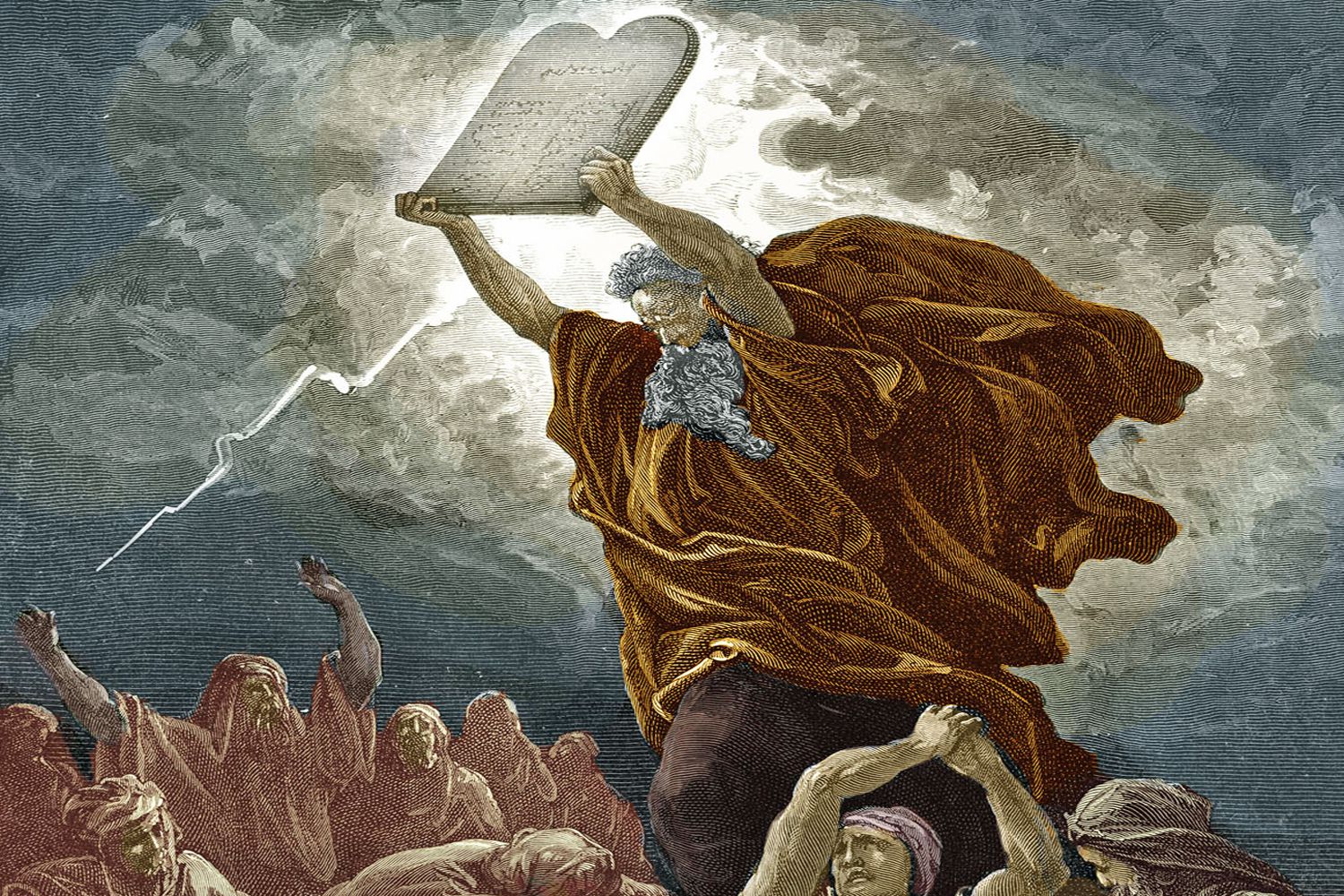


Learning to Love the Law

1 And Moses summoned all Israel and said to them, “Hear, O Israel, the statutes and the rules that I speak in your hearing today, and you shall learn them and be careful to do them. 2 The Lord our God made a covenant with us in Horeb. 3 Not with our fathers did the Lord make this covenant, but with us, who are all of us here alive today. 4 The Lord spoke with you face to face at the mountain, out of the midst of the fire, 5 while I stood between the Lord and you at that time, to declare to you the word of the Lord. For you were afraid because of the fire, and you did not go up into the mountain. He said:

6 “‘I am the Lord your God, who brought you out of the land of Egypt, out of the house of slavery.

7 “‘You shall have no other gods before me.

8 “‘You shall not make for yourself a carved image, or any likeness of anything that is in heaven above, or that is on the earth beneath, or that is in the water under the earth. 9 You shall not bow down to them or serve them; for I the Lord your God am a jealous God, visiting the iniquity of the fathers on the children to the third and fourth generation of those who hate me, 10 but showing steadfast love to thousands of those who love me and keep my commandments.

11 “‘You shall not take the name of the Lord your God in vain, for the Lord will not hold him guiltless who takes his name in vain.

12 “‘Observe the Sabbath day, to keep it holy, as the Lord your God commanded you. 13 Six days you shall labor and do all your work, 14 but the seventh day is a Sabbath to the Lord your God. On it you shall not do any work, you or your son or your daughter or your male servant or your female servant, or your ox or your donkey or any of your livestock, or the sojourner who is within your gates, that your male servant and your female servant may rest as well as you. 15 You shall remember that you were a slave in the land of Egypt, and the Lord your God brought you out from there with a mighty hand and an outstretched arm. Therefore the Lord your God commanded you to keep the Sabbath day.” – Deuteronomy 5:1-15 ESV

The Ten Commandments. We’re all vaguely familiar with them, even if we can’t recite them from memory. And we all have an image that comes to mind when we think of Moses holding the two tablets of stone containing the hand-carved code of conduct given by God to the people of Israel. But those commands seem distant and somewhat antiquated to most of us. And for many Christians, we operate as if the Ten Commandments no longer apply to us because we live under grace, not law. After all, the apostle Paul tells us, “Christ has rescued us from the curse pronounced by the law. When he was hung on the cross, he took upon himself the curse for our wrongdoing” (Galatians 3:13 NLT).

It’s easy to read a passage like that one and assume that the Ten Commandments are out-of-date and no longer apply. And Paul seems to support that conclusion with his words to the Christians in Rome.

For Christ is the end of the law for righteousness to everyone who believes. – Romans 10:4 ESV

But before we jump to conclusions, we have to recall the words of Jesus.

“Don’t misunderstand why I have come. I did not come to abolish the law of Moses or the writings of the prophets. No, I came to accomplish their purpose.” – Matthew 5:17 NLT

Jesus claimed to have come to earth in order to accomplish the purpose behind the law of Moses and the writings of the prophets. We would tend to say that Jesus came to earth to save the lost, and we would be right. Because that is exactly what the law foreshadowed and the prophecies of the Old Testament foretold. The apostle Paul tells us exactly why the law was given.

Why, then, was the law given? It was given alongside the promise to show people their sins. But the law was designed to last only until the coming of the child who was promised. – Galatians 3:19 NLT

God gave the law to the people of Israel in order that they might know just how holy He was and just how sinful they truly were. With God’s detailed list of all the dos and don’ts, shalls, and shall-nots provided for them, the people of Israel could not claim ignorance when it came to God’s expectations of them. But while His rules established clear guidelines for living, they also revealed man’s inability to live up to those guidelines. The Ten Commandments are holy, righteous, and just, providing man with a detailed list of God’s non-negotiable requirements for maintaining a right relationship with Him. But, once again, Paul reminds us that the law could never make anyone right with God because no one was capable of living up to God’s holy standard.

For no one can ever be made right with God by doing what the law commands. The law simply shows us how sinful we are. – Romans 3:20 NLT

The author of Hebrews adds that “the law never made anything perfect” (Hebrews 7:19 NLT). In other words, God’s giving of His holy law was intended to provide the Israelites with a clear standard or set of guidelines for living. But the presence of the law did not empower the people to obey. It told them what God expected of them, but did not provide them with the capacity to live up to those expectations. In a sense, the law could only condemn, not save.

Think of it this way: A speed limit sign is a government-sanctioned law declaring the legally established maximum rate of travel for a motor vehicle. It lets drivers know just how fast they are allowed to go on a particular section of highway. It cannot force them to travel at that speed. It does not limit their capacity to drive slower or faster. It simply sets the rules of conduct for that driving on that patch of road. But if the posted speed limit is 65 and you are traveling 75, every time you pass one of those signs declaring the speed limit, you will be condemned as guilty. All the sign can do is confirm if we are living up to the established standard or condemn us if we are not.

The apostle Paul describes the law as our guardian, tutor, or instructor.

Before the way of faith in Christ was available to us, we were placed under guard by the law. We were kept in protective custody, so to speak, until the way of faith was revealed.

Let me put it another way. The law was our guardian until Christ came; it protected us until we could be made right with God through faith. And now that the way of faith has come, we no longer need the law as our guardian. – Galatians 3:23-25 NLT

The law was given so that man might learn just how holy God is and just how sinful they could be. So, as Moses delivered the Ten Commandments to the next generation of Israelites, he was reminding them of the holiness of their God. They were to take God’s commands seriously and to treat them with the reverence they deserved. He warned them to “learn them and be careful to do them” (Deuteronomy 5:1 ESV). Because breaking God’s laws would break their fellowship with Him. Failing to keep His commands would place them under a curse.

The Jews would live under the guardianship or tutelage of the law for generations. From the time they entered the land of Canaan to the day that Jesus Christ took on human flesh, the Jews would be required by God to live according to His law. And, as Paul put it, the law would protect them as long as they obeyed it. It functioned as the speed limit sign on the highway of life. But when Jesus came, the law became unnecessary, because He provided a way for sinful men to be made right with a holy God. Rather than trying to keep God’s holy and righteous standards through human effort, they could place their faith in Christ. The Son of God became a man so that He might live a sinless life, keeping God’s law perfectly. He obeyed every single command given by God, accomplishing what no other man had ever been able to do before.

And it was because Jesus was perfectly obedient, that He was able to be the spotless sacrifice whose life was given as payment for mankind’s sin debt. He was the one who John described as “the Lamb of God, who takes away the sin of the world!” (John 1:29 ESV).  And He was the one who made forgiveness of sin possible. In other words, He provided a way for man to receive permanent forgiveness for every single violation of God’s holy law. The law revealed man’s sinfulness, but only Jesus could remove it. The law could condemn man as guilty, but only Jesus could pronounce man as innocent and righteous. And one day Paul explained this wonderful reality to a group of Jews who had gathered to hear him speak.

“Brothers, listen! We are here to proclaim that through this man Jesus there is forgiveness for your sins. Everyone who believes in him is made right in God’s sight—something the law of Moses could never do.” – Acts 13:38-39 NLT

So, as Moses unpacks God’s law to the people of Israel, it’s essential that we understand just how blessed we are. We live on this side of the cross, where the curse of the law has been replaced by the blessing of salvation through faith alone in Christ alone. We no longer live under the burden of trying to earn God’s favor through law-keeping. That does not mean the law is null-and-void and no longer applicable. It simply means we have been given a righteousness from Christ that makes it possible for us to live in obedience to God’s commands, not based on human effort but through the indwelling power of the Holy Spirit. And rather than viewing the law as our task-master, we can see it the way Paul did: “the law itself is holy, and its commands are holy and right and good” (Romans 7:12 NLT).

English Standard Version (ESV) The Holy Bible, English Standard Version. ESV® Permanent Text Edition® (2016). Copyright © 2001 by Crossway Bibles, a publishing ministry of Good News Publishers.

New Living Translation (NLT) Holy Bible, New Living Translation, copyright © 1996, 2004, 2015 by Tyndale House Foundation. Used by permission of Tyndale House Publishers Inc., Carol Stream, Illinois 60188. All rights reserved.

The Message (MSG) Copyright © 1993, 1994, 1995, 1996, 2000, 2001, 2002 by Eugene H. Peterson


A Place of Refuge

Then Moses set apart three cities in the east beyond the Jordan, that the manslayer might flee there, anyone who kills his neighbor unintentionally, without being at enmity with him in time past; he may flee to one of these cities and save his life: Bezer in the wilderness on the tableland for the Reubenites, Ramoth in Gilead for the Gadites, and Golan in Bashan for the Manassites.

This is the law that Moses set before the people of Israel. These are the testimonies, the statutes, and the rules, which Moses spoke to the people of Israel when they came out of Egypt, beyond the Jordan in the valley opposite Beth-peor, in the land of Sihon the king of the Amorites, who lived at Heshbon, whom Moses and the people of Israel defeated when they came out of Egypt. And they took possession of his land and the land of Og, the king of Bashan, the two kings of the Amorites, who lived to the east beyond the Jordan; from Aroer, which is on the edge of the Valley of the Arnon, as far as Mount Sirion (that is, Hermon), together with all the Arabah on the east side of the Jordan as far as the Sea of the Arabah, under the slopes of Pisgah. – Deuteronomy 4:41-49 ESV

Moses wrapped up his history lesson regarding God’s faithfulness and Israel’s unfaithfulness with a final word of challenge:

“Therefore you shall keep his statutes and his commandments, which I command you today, that it may go well with you and with your children after you, and that you may prolong your days in the land that the Lord your God is giving you for all time.” – Deuteronomy 4:40 ESV

While Moses would not be leading the  people into the land of Canaan, he still desired that they fulfill the will of God and enjoy all the blessings God had in store for them as part of the promise He made to Abraham.

The conquering of the region east of the Jordan River, sometimes referred to as the Transjordan, was complete. The two tribes of Gad and Reuben, along with half the tribe of Mannasah, were already beginning to make themselves at home in the towns and villages they had taken as plunder from the Amorites. Moses had allowed these three tribes to settle east of the Jordan because they had vowed to fight alongside the rest of the tribes until the land of Canaan was conquered and fully settled.

Almost as if he was trying to remind the three tribes of Gad, Reuben, and Mannasah of their unbroken relationship with Israel, Moses designates three cities of refuge within their territory. The creation of these cities was an essential part of God’s plan for the Israelites. We know from the book of Numbers, that God had a specific purpose for these cities. They would be partly located on either side of the Jordan and would be occupied by the tribe of Levi. God had set apart the Levites and given them the responsibility to care for and transport the tabernacle. They would be allotted no land in Canaan but were to receive 48 cities, located within the boundaries of the other tribes. Six of these were to be cities of refuge.

“Six of the towns you give the Levites will be cities of refuge, where a person who has accidentally killed someone can flee for safety. In addition, give them forty-two other towns. In all, forty-eight towns with the surrounding pastureland will be given to the Levites. These towns will come from the property of the people of Israel. The larger tribes will give more towns to the Levites, while the smaller tribes will give fewer. Each tribe will give property in proportion to the size of its land.” – Numbers 35:6-8 NLT

God knows His creation well. He was fully aware of what was going to happen when the people of Israel settled in the land. While He had set them apart as His own, He knew they were incapable of living holy lives. Which is why He had given them the sacrificial system. It was a gracious and undeserved gift from God that provided a means for having their inevitable sins forgiven and their relationship with Him restored. They were going to sin. The Law, given by God, provided a non-negotiable code of conduct meant to express His expectations and expose any violators of those expectations as guilty.

One of the ten commandments God had given to the people of Israel was a prohibition against murder. This was a clear reference to premeditated murder, the taking of someone else’s life out of anger or revenge. But what about those cases in which a life was taken accidentally? God had a plan for that, and it involved the cities of refuge.

“Anyone who assaults and kills another person must be put to death. But if it was simply an accident permitted by God, I will appoint a place of refuge where the slayer can run for safety.” – Exodus 21:12-13 NLT

But if anyone committed premeditated murder, the penalty was to be death.

“However, if someone deliberately kills another person, then the slayer must be dragged even from my altar and be put to death.” – Exodus 21:14 NLT

So, God provided a plan for protecting the innocent and to prevent the unnecessary taking of life. He knew that the natural response of someone who’s loved one had been murdered, either willingly or accidentally, would be to seek revenge. But, in order to prevent the avenger from killing an innocent individual, God provided these six cities as places where the murderer could seek asylum.

“…designate cities of refuge to which people can flee if they have killed someone accidentally. These cities will be places of protection from a dead person’s relatives who want to avenge the death. The slayer must not be put to death before being tried by the community. Designate six cities of refuge for yourselves, three on the east side of the Jordan River and three on the west in the land of Canaan. These cities are for the protection of Israelites, foreigners living among you, and traveling merchants. Anyone who accidentally kills someone may flee there for safety.” – Numbers 35:11-15 NLT

God was in no way minimizing the taking a human life. Even in the cases of accidental, un-premeditated murder, there was still a consequence associated with the act. The guilty party was to remain in the city of refuse for the rest of their life, or until the death of the high priest, in which case they were to be released as a free man. As long as they remained within the walls of the city, they were protected from the avenger. But if they ever ventured outside, their assylum was waived and they became fair game for anyone seeking vengeance.

God knew that sin would be inevitable and unavoidable for the people of Israel. And the Law was designed to expose all that God considered to be a sin. Any violation of His Law was a sin. Any failure to live up to His holy standards was a sin. And every one of the people of Israel would be guilty of sin. But they could find refuge in God. The individual who accidentally took the life of another had a place where he could find rescue and relief for his crime. The man or woman who sinned against God could find forgiveness and cleansing through the sacrificial system.

God was never surprised by the sinfulness of mankind. In fact, He had planned for mankind’s redemption long before Adam and Eve ate the forbidden fruit in the garden. He had formulated His plan for providing refuge from the guilt of sin even before He created the universe into which sin came. Paul points this out in his letter to the Ephesians.

Even before he made the world, God loved us and chose us in Christ to be holy and without fault in his eyes. God decided in advance to adopt us into his own family by bringing us to himself through Jesus Christ. This is what he wanted to do, and it gave him great pleasure. – Ephesians 1:4-5 NLT

And the apostle Peter tells us that God had planned for Jesus, His Son, to become our refuge long before the world was ever made. Before sin ever entered the scene, God had prepared for His Son to become a city of refuge for sinful mankind.

God chose him as your ransom long before the world began… – 1 Peter1:20 NLT

The Israelites had not yet entered the land of promise. The three tribes had not fully taken possession of the land east of the Jordan. But God was making preparations for the sins of His people by providing cities of refuge.

God was not light on sin. The sacrificial system revealed just how seriously He took any transgressions of His Law. Death was required. Blood had to be spilled. The innocent had to die in the place of the guilty. As the author of Hebrews states, “without the shedding of blood, there is no forgiveness” (Hebrews 9:22 NLT). And just prior to that statement, we read, “according to the law of Moses, nearly everything was purified with blood” (Hebrews 9:22 NLT).

So, as Moses prepares to review God’s Law to the people of Israel, it will serve as a sobering reminder that their inevitable breaking of the Law was going to require the shedding of blood. Their transgressions would demand an atoning sacrifice. Holiness was going to be difficult, but it was also going to be costly. Failure to obey God’s Law was going to come with a stiff penalty: Death. And escape from that penalty was going to require that someone satisfy the just demands of a holy God. But God provided a means for the guilty to find refuge. They could find help and hope in the mercy of God.

English Standard Version (ESV) The Holy Bible, English Standard Version. ESV® Permanent Text Edition® (2016). Copyright © 2001 by Crossway Bibles, a publishing ministry of Good News Publishers.

New Living Translation (NLT) Holy Bible, New Living Translation, copyright © 1996, 2004, 2015 by Tyndale House Foundation. Used by permission of Tyndale House Publishers Inc., Carol Stream, Illinois 60188. All rights reserved.

The Message (MSG) Copyright © 1993, 1994, 1995, 1996, 2000, 2001, 2002 by Eugene H. Peterson


That You Might Know

32 “For ask now of the days that are past, which were before you, since the day that God created man on the earth, and ask from one end of heaven to the other, whether such a great thing as this has ever happened or was ever heard of. 33 Did any people ever hear the voice of a god speaking out of the midst of the fire, as you have heard, and still live? 34 Or has any god ever attempted to go and take a nation for himself from the midst of another nation, by trials, by signs, by wonders, and by war, by a mighty hand and an outstretched arm, and by great deeds of terror, all of which the Lord your God did for you in Egypt before your eyes? 35 To you it was shown, that you might know that the Lord is God; there is no other besides him. 36 Out of heaven he let you hear his voice, that he might discipline you. And on earth he let you see his great fire, and you heard his words out of the midst of the fire. 37 And because he loved your fathers and chose their offspring after them and brought you out of Egypt with his own presence, by his great power, 38 driving out before you nations greater and mightier than you, to bring you in, to give you their land for an inheritance, as it is this day, 39 know therefore today, and lay it to your heart, that the Lord is God in heaven above and on the earth beneath; there is no other. 40 Therefore you shall keep his statutes and his commandments, which I command you today, that it may go well with you and with your children after you, and that you may prolong your days in the land that the Lord your God is giving you for all time.” – Deuteronomy 4:32-40 ESV

Ever since the day God had appeared to Abraham and called him to leave his ancestral homeland and travel to the land of Canaan, God has been revealing Himself to the descendants of Abraham. Time and time again, the invisible God made Himself known in miraculous ways. It was while Abraham was in Haran, that God spoke audibly to him and said, “Go from your country and your kindred and your father’s house to the land that I will show you. And I will make of you a great nation, and I will bless you and make your name great, so that you will be a blessing” (Genesis 12:1-2 ESV).

And while Abraham was never given the privilege of seeing God with his own eyes, he would regularly hear God’s voice and even receive visions from the Almighty. And through it all, Abraham was learning to trust in God’s invisible, yet unmistakable presence and power. His repeated encounters with God ended up solidifying his trust in and reliance upon God. So much so, that when God told Abraham, “Look toward heaven, and number the stars, if you are able to number them.…So shall your offspring be,” that Abraham “believed the Lord, and he [God] counted it to him as righteousness” (Genesis 15:5-6 ESV).

Abraham believed God, even though his wife was barren and the two of them were  well-advanced in years. He believed God because he had seen God – not with his eyes, but as he watched God work in and around his life in countless, miraculous ways. And the same would be true for Isaac and Jacob. These men would also have personal encounters with the invisible God. They would never look upon Him with their eyes, but they would experience His presence and power as God manifested Himself in a variety of miraculous and inexplicable ways.

This pattern of God revealing Himself to the descendants of Abraham would continue throughout the years. And God would eventually show up in the land of Midian, in the form of a burning bush, in order to issue His call to Moses to deliver the people of Israel out of slavery in Egypt. This amazing scene is recorded for us in the book of Exodus.

Moses stared in amazement. Though the bush was engulfed in flames, it didn’t burn up. “This is amazing,” Moses said to himself. “Why isn’t that bush burning up? I must go see it.”

When the Lord saw Moses coming to take a closer look, God called to him from the middle of the bush, “Moses! Moses!”

“Here I am!” Moses replied.

“Do not come any closer,” the Lord warned. “Take off your sandals, for you are standing on holy ground. I am the God of your father—the God of Abraham, the God of Isaac, and the God of Jacob.” When Moses heard this, he covered his face because he was afraid to look at God. – Exodus 3:2-6 NLT

This would be the first of many extraordinary encounters between Moses and God. And each of them were intended to prove the reality and reliability of God. Moses was learning the invaluable lesson that, while God could not be seen, He could be known.

And when God informed Moses of His plan to release the Israelites from their captivity in Egypt, He revealed one of the important outcomes:

“When I raise my powerful hand and bring out the Israelites, the Egyptians will know that I am the Lord.” – Exodus 7:5 NLT

The ten plagues that God would command Moses to bring upon the people of Egypt would eventually leave them fully convinced that the god of the Israelites was not a figment of their corporate imagination. He was real and very powerful. And He was greater than every one of the false gods they worshiped.

But from the day the Israelites had walked out of Egypt and crossed over the Red Sea on dry ground, God had been revealing Himself in countless ways. He had been demonstrating His power and presence, appearing in the form of a cloud by day and a pillar of fire by night. He had shown up on Mount Sinai, accompanied by smoke, fire, thunder, and lightning. And Moses reminded the people of Israel of their unique status as the only nation privileged to experience God’s presence in such spectacular fashion.

“Has any nation ever heard the voice of God speaking from fire—as you did—and survived? Has any other god dared to take a nation for himself out of another nation by means of trials, miraculous signs, wonders, war, a strong hand, a powerful arm, and terrifying acts? Yet that is what the Lord your God did for you in Egypt, right before your eyes.” – Deuteronomy 4:33-34 NLT

And Moses made it painfully clear why God had chosen to reveal Himself to His chosen people.

“He showed you these things so you would know that the Lord is God and there is no other.” – Deuteronomy 4:35 NLT

These miraculous displays of His power were intended to convince the people of Israel that their God was real and fully reliable. He may have been unseen, but He was far from nonexistent. They didn’t need an idol or some kind of man-made representation of God to prove that He existed. He had proven His reality “by means of trials, miraculous signs, wonders, war, a strong hand, a powerful arm, and terrifying acts.”

By this time in their faith journey, the people of Israel should have had more than enough proof that their God was real and reliable. He had proven Himself so, time and time again. And yet, Moses felt compelled to tell them, “So remember this and keep it firmly in mind: The Lord is God both in heaven and on earth, and there is no other” (Deuteronomy 4:37 NLT).

As they prepared to enter the land of Canaan, they needed to be convinced of God’s pervasive presence and power. The days ahead were going to be filled with countless obstacles. The enemies in the land were real and formidable. The temptations to doubt God’s presence and question His power were going to be constant. So, they were going to have to place their faith in their invisible, but highly powerful God.

The author of Hebrews, discussing the faith of the Hebrew patriarchs like Abraham, Isaac, Jacob, Joseph, and Moses, wrote: “it is impossible to please God without faith. Anyone who wants to come to him must believe that God exists and that he rewards those who sincerely seek him” (Hebrews 11:6 NLT).

One of the greatest dangers the Israelites faced as they prepared to enter the land of Canaan was not the enemy forces that occupied the land. It was the temptation to lose faith in God. Moses knew that the first time the Israelites encountered a circumstance where the odds were stacked against them, they would assume that God was not with them. As soon as they found themselves in a situation that appeared hopeless, they would be tempted to see themselves as helpless and their God as powerless.

But they had no reason to doubt God. He had proven Himself to be trustworthy. He had displayed His power in countless ways. And all God asked in return was that they believe He exists and that He rewards those who sincerely seek Him and faithfully serve Him. Which is why Moses challenged them:

“If you obey all the decrees and commands I am giving you today, all will be well with you and your children. I am giving you these instructions so you will enjoy a long life in the land the Lord your God is giving you for all time.” – Deuteronomy 4:40 NLT

English Standard Version (ESV) The Holy Bible, English Standard Version. ESV® Permanent Text Edition® (2016). Copyright © 2001 by Crossway Bibles, a publishing ministry of Good News Publishers.

New Living Translation (NLT) Holy Bible, New Living Translation, copyright © 1996, 2004, 2015 by Tyndale House Foundation. Used by permission of Tyndale House Publishers Inc., Carol Stream, Illinois 60188. All rights reserved.

The Message (MSG) Copyright © 1993, 1994, 1995, 1996, 2000, 2001, 2002 by Eugene H. Peterson


Bearing God’s Image

15 “Therefore watch yourselves very carefully. Since you saw no form on the day that the Lord spoke to you at Horeb out of the midst of the fire, 16 beware lest you act corruptly by making a carved image for yourselves, in the form of any figure, the likeness of male or female, 17 the likeness of any animal that is on the earth, the likeness of any winged bird that flies in the air, 18 the likeness of anything that creeps on the ground, the likeness of any fish that is in the water under the earth. 19 And beware lest you raise your eyes to heaven, and when you see the sun and the moon and the stars, all the host of heaven, you be drawn away and bow down to them and serve them, things that the Lord your God has allotted to all the peoples under the whole heaven. 20 But the Lord has taken you and brought you out of the iron furnace, out of Egypt, to be a people of his own inheritance, as you are this day. 21 Furthermore, the Lord was angry with me because of you, and he swore that I should not cross the Jordan, and that I should not enter the good land that the Lord your God is giving you for an inheritance. 22 For I must die in this land; I must not go over the Jordan. But you shall go over and take possession of that good land. 23 Take care, lest you forget the covenant of the Lord your God, which he made with you, and make a carved image, the form of anything that the Lord your God has forbidden you. 24 For the Lord your God is a consuming fire, a jealous God.

25 “When you father children and children’s children, and have grown old in the land, if you act corruptly by making a carved image in the form of anything, and by doing what is evil in the sight of the Lord your God, so as to provoke him to anger, 26 I call heaven and earth to witness against you today, that you will soon utterly perish from the land that you are going over the Jordan to possess. You will not live long in it, but will be utterly destroyed. 27 And the Lord will scatter you among the peoples, and you will be left few in number among the nations where the Lord will drive you. 28 And there you will serve gods of wood and stone, the work of human hands, that neither see, nor hear, nor eat, nor smell. 29 But from there you will seek the Lord your God and you will find him, if you search after him with all your heart and with all your soul. 30 When you are in tribulation, and all these things come upon you in the latter days, you will return to the Lord your God and obey his voice. 31 For the Lord your God is a merciful God. He will not leave you or destroy you or forget the covenant with your fathers that he swore to them.” – Deuteronomy 4:15-31 ESV

As the day drew near when the people would make their long-delayed entry into the land of promise, it meant that Moses was fast-approaching the day of his own death. This section of his address contains his reminder to the people of his permanent ban from entering the land, placed on him by God for his striking of the rock at Meribah.

“But the Lord was angry with me because of you. He vowed that I would not cross the Jordan River into the good land the Lord your God is giving you as your special possession. You will cross the Jordan to occupy the land, but I will not. Instead, I will die here on the east side of the river.” – Deuteronomy 4:21-22 NLT

With his death imminent and his time as the leader of Israel coming to a close, Moses increases the intensity of his instructions to them, in a final effort to prepare them for this next phase in their journey as God’s people. He knew his people well and was fully aware that they were going to face a myriad of temptations as they crossed over the Jordan. And one of the greatest temptations would be that of idolatry.

In recounting that momentous occasion when God gave the Law at Mount Sinai, Moses pointed out that the people had “heard the sound of his [God’s] words but didn’t see his form; there was only a voice” (Deuteronomy 4:12 NLT). Yes, there had been smoke, thunder, and lightning, and the people had clearly felt the presence of God, but He had remained invisible to them.

And Moses warned the next generation of Israelites who were preparing to enter the land to “be very careful! You did not see the Lord’s form on the day he spoke to you from the heart of the fire at Mount Sinai. So do not corrupt yourselves by making an idol in any form” (Deuteronomy 4:5 NLT). This was a repetition of the first of the Ten Commandments that God had given to Moses on Mount Sinai.

“I am the Lord your God, who rescued you from the land of Egypt, the place of your slavery.

“You must not have any other god but me.

“You must not make for yourself an idol of any kind or an image of anything in the heavens or on the earth or in the sea. You must not bow down to them or worship them, for I, the Lord your God, am a jealous God who will not tolerate your affection for any other gods.” – Exodus 19:2-5 NLT

But why was Moses placing so much emphasis on this particular commandment? What was his point in stressing God’s ban on idolatry? It would appear that Moses knew that the people were going to struggle with the invisible nature of God. Their inability to see God with their eyes was going to cause them to doubt God in their hearts. He would become out-of-sight, out-of-mind. Their natural tendency would be to replace the invisible God with something more tangible and palpable. And Moses had seen first-hand just how quickly the people of Israel could turn their backs on the one true God.

All the way back at Sinai, when the people had seen the display of God’s glory and power on the mountain, they had trembled in fear. But while Moses was on top of the mountain receiving the Law from God, the people had decided that they needed a god they could see. Their leader was gone and their God, while powerful, was intangible and indiscernible. And the book of Exodus records what they did next.

When the people saw how long it was taking Moses to come back down the mountain, they gathered around Aaron. “Come on,” they said, “make us some gods who can lead us. We don’t know what happened to this fellow Moses, who brought us here from the land of Egypt.”

So Aaron said, “Take the gold rings from the ears of your wives and sons and daughters, and bring them to me.”

All the people took the gold rings from their ears and brought them to Aaron. Then Aaron took the gold, melted it down, and molded it into the shape of a calf. When the people saw it, they exclaimed, “O Israel, these are the gods who brought you out of the land of Egypt!” – Exodus 32:1-4 NLT

While Moses was on top of the mountain receiving the Ten Commandments from God, the first of which was a prohibition against idol worship, the people were busy making and worshiping an idol. And 40 years later, Moses was well aware that the people of Israel had not outgrown their infatuation with false gods.

This tendency to worship that which we can see is hardwired into mankind. Paul addresses it in his letter to the Romans.

For although they knew God, they did not glorify him as God or give him thanks, but they became futile in their thoughts and their senseless hearts were darkened. Although they claimed to be wise, they became fools and exchanged the glory of the immortal God for an image resembling mortal human beings or birds or four-footed animals or reptiles. – Romans 1:21-23 NLT

And Moses warned the Israelites about making replacement gods out “of a man or a woman, an animal on the ground, a bird in the sky, a small animal that scurries along the ground, or a fish in the deepest sea,” and he added, “when you look up into the sky and see the sun, moon, and stars—all the forces of heaven—don’t be seduced into worshiping them” (Deuteronomy 4:16-19 NLT). Because God is unseen, man’s natural tendency is to focus his attention on that which he can see. Man’s finiteness makes it difficult for him to grasp the infinite nature of God.

But God’s ban on idol worship seems to have a much more important aspect to it than first meets the eye. Moses warns the Israelites, “The Lord your God is a devouring fire; he is a jealous God” (Deuteronomy 4:24 NLT). But there is more to this statement than God being jealous of other gods. God knows there are no such thing as “other gods.” They don’t exist. But the Israelites do. And they belong to Him. They were to be His chosen possession, and He had given them His Law as a written code of conduct. Their behavior as His chosen people was not up to their discretion, but carefully articulated in His Law. 

Which is why Moses warned them, “So do not corrupt yourselves by making an idol in any form” (Deuteronomy 4:16 NLT). The Hebrew word for “corrupt” is shachath, and it means to mar or spoil. By making and worshiping false gods, the people of Israel would be damaging their ability to mirror the image of God. Not only would the be violating His Law, they would be acting just like all the other nations. Their distinctiveness as His people would be destroyed. Their uniqueness as His possession would be lost.

God had warned the Israelites, “if you will obey me and keep my covenant, you will be my own special treasure from among all the peoples on earth; for all the earth belongs to me. And you will be my kingdom of priests, my holy nation” (Exodus 19:5-6 NLT).

But idol worship would mar the image of God in the lives of His people. They would no longer reflect His distinctiveness and display His glory among the nations. Rather than displaying their one-of-a-kind status as God’s chosen people, they would profane His reputation as the great and glorious God by behaving just like all the other nations around them. And hundreds of years later, when God’s people were languishing in captivity in Babylon, the prophet Ezekiel would declare the words of God:

“I am doing it to protect my holy name, on which you brought shame while you were scattered among the nations. I will show how holy my great name is—the name on which you brought shame among the nations.” – Ezekiel 36:22-23 NLT

God had chosen the nation of Israel and had set them apart for His glory. They were to have been His image-bearers on earth, living according to His Law and displaying His glory as they faithfully trusted in Him – the invisible, yet invincible God.

English Standard Version (ESV) The Holy Bible, English Standard Version. ESV® Permanent Text Edition® (2016). Copyright © 2001 by Crossway Bibles, a publishing ministry of Good News Publishers.

New Living Translation (NLT) Holy Bible, New Living Translation, copyright © 1996, 2004, 2015 by Tyndale House Foundation. Used by permission of Tyndale House Publishers Inc., Carol Stream, Illinois 60188. All rights reserved.

The Message (MSG) Copyright © 1993, 1994, 1995, 1996, 2000, 2001, 2002 by Eugene H. Peterson


Live Out My Law

9 “Only take care, and keep your soul diligently, lest you forget the things that your eyes have seen, and lest they depart from your heart all the days of your life. Make them known to your children and your children’s children— 10 how on the day that you stood before the Lord your God at Horeb, the Lord said to me, ‘Gather the people to me, that I may let them hear my words, so that they may learn to fear me all the days that they live on the earth, and that they may teach their children so.’ 11 And you came near and stood at the foot of the mountain, while the mountain burned with fire to the heart of heaven, wrapped in darkness, cloud, and gloom. 12 Then the Lord spoke to you out of the midst of the fire. You heard the sound of words, but saw no form; there was only a voice. 13 And he declared to you his covenant, which he commanded you to perform, that is, the Ten Commandments, and he wrote them on two tablets of stone. 14 And the Lord commanded me at that time to teach you statutes and rules, that you might do them in the land that you are going over to possess.” – Deuteronomy 4:9-14 ESV

Moses knew what the Israelites were going to need if they were to be successful in conquering and possessing the land of Canaan. This was not going to be about strength of numbers, military prowess, or well-planned battle strategies. Their only hope of possessing the land and enjoying the many benefits it offered was tied to their relationship with God. And Moses knew that they were going to struggle with faithfulness and obedience. After all, as their leader for the last four decades, he had watched them repeatedly dishonor and disobey God. Moses realized that their entrance into the land would be only the first phase of their journey. God had commanded them to take full possession of the land, which would require that they completely dispossess all its current occupants. There were to be no exceptions, no treaties, and no compromises.

But the people of Israel had a track record of doing things their way. They had a penchant for taking the easy path and doing so always required a compromise of their convictions and a disregard of God’s commands.

So, Moses reminds them of the day when God gave them His Law – the Ten Commandments. It took place at Horeb or Mount Sinai. It was there, in the early days after their exodus from Egypt, that God delivered to them a legally binding set of rules designed to establish His expectations of them. These laws would establish for them a black-and-white, non-negotiable code of conduct – a set of regulations and requirements that would set them apart from all the other nations on the earth.

But before God delivered His Law to Moses, He gave him the following message for the people of Israel:

“Thus you shall say to the house of Jacob, and tell the people of Israel: ‘You yourselves have seen what I did to the Egyptians, and how I bore you on eagles’ wings and brought you to myself. Now therefore, if you will indeed obey my voice and keep my covenant, you shall be my treasured possession among all peoples, for all the earth is mine; and you shall be to me a kingdom of priests and a holy nation.’ These are the words that you shall speak to the people of Israel.”– Exodus 19:3-6 ESV

God had delivered them from their slavery in Egypt and had set them apart as His own. But it was not because they were unique or special in any way. They had not earned His mercy and they did not deserve their unique status as His treasured possession. In fact, Moses would later clarify the undeserved nature of their status as God’s chosen people.

“For you are a holy people, who belong to the LORD your God. Of all the people on earth, the LORD your God has chosen you to be his own special treasure. The LORD did not set his heart on you and choose you because you were more numerous than other nations, for you were the smallest of all nations! Rather, it was simply that the LORD loves you, and he was keeping the oath he had sworn to your ancestors. That is why the LORD rescued you with such a strong hand from your slavery and from the oppressive hand of Pharaoh, king of Egypt. Understand, therefore, that the LORD your God is indeed God.” – Deuteronomy 7:6-8 NLT

God had made a covenant with Abraham and the fulfillment of that covenant involved the Israelites – the descendants of Abraham. By rescuing the people of Israel from their slavery in Egypt, God was keeping the commitment He had made to Abraham hundreds of years earlier.

“You can be sure that your descendants will be strangers in a foreign land, where they will be oppressed as slaves for 400 years. But I will punish the nation that enslaves them, and in the end they will come away with great wealth. (As for you, you will die in peace and be buried at a ripe old age.) After four generations your descendants will return here to this land…” – Genesis 15:13-16 NLT

God had been faithful. He had done all that He had promised to do, but the people of Israel were still on the wrong side of the Jordan River. They needed to cross over and take possession of the land. Which is why Moses took the time to remind them of that momentous day at Mount Sinai, when God delivered His to them His Law.

Most of the people to whom Moses was speaking would not been alive at the time this event took place. They were the new generation of Israelites. So, Moses went out of his way to describe for them the scene on Mount Sinai that day. And the book of Exodus provides us with even greater details.

On the morning of the third day there were thunders and lightnings and a thick cloud on the mountain and a very loud trumpet blast, so that all the people in the camp trembled. Then Moses brought the people out of the camp to meet God, and they took their stand at the foot of the mountain. Now Mount Sinai was wrapped in smoke because the Lord had descended on it in fire. The smoke of it went up like the smoke of a kiln, and the whole mountain trembled greatly. And as the sound of the trumpet grew louder and louder, Moses spoke, and God answered him in thunder. The Lord came down on Mount Sinai, to the top of the mountain. And the Lord called Moses to the top of the mountain, and Moses went up. – Exodus 19:16-20 ESV

It was at the top of that mountain that God met with Moses and delivered to him the Ten Commandments, carved into tablets of stone by the very finger of God Himself. And while Moses had been at the top of the mountain, the people of Israel had stood at the base, watching a spectacular display of God’s power. Moses says, “the mountain burned with fire to the heart of heaven, wrapped in darkness, cloud, and gloom” (Deuteronomy 4:11 ESV).

The people of Israel heard the voice of God, but God Himself remained invisible to them. And Moses recounts the content of what God had to say to the people that day.

“You heard the sound of words, but saw no form; there was only a voice. And he declared to you his covenant, which he commanded you to perform, that is, the Ten Commandments, and he wrote them on two tablets of stone.” – Deuteronomy 4:12-13 ESV

God had demanded that the people keep the commands He was giving them. These were to be binding commands, not helpful suggestions. They were not up for debate. And Moses makes it clear that God had given him the responsibility to teach these commands to the people, “that you might do them in the land that you are going over to possess” (Deuteronomy 4:14 ESV).

In other words, the commands written on tablets of stone were to make their way into the hearts of the people, transforming the way they lived their lives. They were to be the guiding force in their lives, determining their relationship with God and with one another. While the God of Israel was invisible, His regulations regarding their conduct were not. They were carved into stone. And these laws were not man-made, but God-ordained. Therefore, they were righteous and holy.

While the people of Israel could not see their holy God, they could demonstrate His glory through their own holy conduct. By living according to His revealed Law, the people of Israel could display His glory and goodness to the nations around them. Their compliance to His Law would set them apart from all the other people groups on the face of the earth. They could make the invisible God visible by living in accordance to His commands. And, as Moses stated earlier, by watching Israel live in obedience to God’s commands, the nations would express their awe and wonder. Which is why Moses called the people to obey them willingly and completely.

“Obey them completely, and you will display your wisdom and intelligence among the surrounding nations. When they hear all these decrees, they will exclaim, ‘How wise and prudent are the people of this great nation!’ For what great nation has a god as near to them as the Lord our God is near to us whenever we call on him? And what great nation has decrees and regulations as righteous and fair as this body of instructions that I am giving you today?” – Deuteronomy 4:6-8 NLT

English Standard Version (ESV) The Holy Bible, English Standard Version. ESV® Permanent Text Edition® (2016). Copyright © 2001 by Crossway Bibles, a publishing ministry of Good News Publishers.

New Living Translation (NLT) Holy Bible, New Living Translation, copyright © 1996, 2004, 2015 by Tyndale House Foundation. Used by permission of Tyndale House Publishers Inc., Carol Stream, Illinois 60188. All rights reserved.

The Message (MSG) Copyright © 1993, 1994, 1995, 1996, 2000, 2001, 2002 by Eugene H. Peterson


A God Who Is Near

1 “And now, O Israel, listen to the statutes and the rules that I am teaching you, and do them, that you may live, and go in and take possession of the land that the Lord, the God of your fathers, is giving you. 2 You shall not add to the word that I command you, nor take from it, that you may keep the commandments of the Lord your God that I command you. 3 Your eyes have seen what the Lord did at Baal-peor, for the Lord your God destroyed from among you all the men who followed the Baal of Peor. 4 But you who held fast to the Lord your God are all alive today. 5 See, I have taught you statutes and rules, as the Lord my God commanded me, that you should do them in the land that you are entering to take possession of it. 6 Keep them and do them, for that will be your wisdom and your understanding in the sight of the peoples, who, when they hear all these statutes, will say, ‘Surely this great nation is a wise and understanding people.’ 7 For what great nation is there that has a god so near to it as the Lord our God is to us, whenever we call upon him? 8 And what great nation is there, that has statutes and rules so righteous as all this law that I set before you today?” – Deuteronomy 4:1-8 ESV

God had just reconfirmed that Moses would not be leading the people of Israel into the land of promise. With his little display of self-aggrandizement in the Wilderness of Zin, Moses had angered God by attempting to steal glory from God. In his anger with the people of Israel, Moses had disobeyed God’s commands and attempted to grandstand before the people, leaving them to believe that it was he who was supplying their need for water. Moses was out to win the respect of the people, when he should have been leading the people to honor, glorify, and revere God.

Yet, in spite of the news that he would not be entering into the promised land along with the rest of the people, Moses didn’t shirk his leadership responsibilities. He continued to perform the task assigned to him by God all those years ago in the land of Midian. While Moses had been caring for his father-in-laws flocks, God had appeared to him in the form of a burning bush, telling him:

“I have surely seen the affliction of my people who are in Egypt and have heard their cry because of their taskmasters. I know their sufferings, and have come down to deliver them out of the hand of the Egyptians and to bring them up out of that land to a good and broad land, a land flowing with milk and honey, to the place of the Canaanites, the Hittites, the Amorites, the Perizzites, the Hivites, and the Jebusites. And now, behold, the cry of the people of Israel has come to me, and I have also seen the oppression with which the Egyptians oppress them. Come, I will send you to Pharaoh that you may bring my people, the children of Israel, out of Egypt.” – Exodus 3:7-10 ESV

God was going to deliver the people of Israel from their captivity in Egypt and He was going to use Moses to make it happen. But God’s deliverance of His people would include a deliverance to and not just from something.

“I have observed you and what has been done to you in Egypt, and I promise that I will bring you up out of the affliction of Egypt to the land of the Canaanites, the Hittites, the Amorites, the Perizzites, the Hivites, and the Jebusites, a land flowing with milk and honey.” – Exodus 3:16-17 ESV

Now, more than four decades later, the people had arrived at their final destination: The land of promise. And while Moses would be denied the joy and pleasure of leading them into the land, he was going to make sure that were well-informed as to their obligations to God once the arrived in the land.

God had personally given His laws to Moses on the top of Mount Sinai, and Moses had delivered them to the people of Israel. Those laws remained binding upon the people and were intended to regulate their conduct once they arrived in the promised land. They were not suggestions, but were irrevocable laws that required willful obedience on the part of the people. So, Moses wanted to make sure that the new generation of Israelites, who would be the first to enter the land, would know and obey the commands of God.

“…listen carefully to these decrees and regulations that I am about to teach you. Obey them so that you may live, so you may enter and occupy the land that the Lord, the God of your ancestors, is giving you.” – Deuteronomy 4:1 NLT

Moses was taking no chances. He was not going to assume that the parents of these people had been affective in passing on the laws and statutes of God. Moses knew that ignorance of God’s laws would be just as deadly as choosing to ignore them. And he also knew that God would not tolerate any alterations or additions to His law.

“Do not add to or subtract from these commands I am giving you. Just obey the commands of the Lord your God that I am giving you.” – Deuteronomy 4:2 NLT

God would not tolerate any deviation from His law. His commands were not up for debate or open to interpretation. And, just to make sure the people understood the gravity of their situation, Moses reminded them of one of the many times when their parents had failed to keep God’s commands. It had happened on the plains of Moab at a place called Shittim. When the people of Israel entered the Moabite territory, Balak, the king of Moab, had attempted to hire a local diviner named Balaam to place a curse on them. But when Balaam discovered that God would not allow him to place a curse on the people of Israel, he came up with an alternative plan. He instructed the king to have the women of Moab seduce the men of Israel. And the book of Numbers tells us exactly what happened.

…some of the men defiled themselves by having sexual relations with local Moabite women. These women invited them to attend sacrifices to their gods, so the Israelites feasted with them and worshiped the gods of Moab. In this way, Israel joined in the worship of Baal of Peor, causing the LORD’s anger to blaze against his people. – Numbers 25:1-3 NLT

This was far more than a display of immorality that angered the Victorian sensibilities of God. It was a blatant violation of His law.

“You must worship no other gods, for the LORD, whose very name is Jealous, is a God who is jealous about his relationship with you. You must not make a treaty of any kind with the people living in the land. They lust after their gods, offering sacrifices to them. They will invite you to join them in their sacrificial meals, and you will go with them. Then you will accept their daughters, who sacrifice to other gods, as wives for your sons. And they will seduce your sons to commit adultery against me by worshiping other gods.” – Exodus 34:14-16 NLT

And yet, that’s exactly what the people of Israel had done at Shittim. And Moses reminded the people what God had done in response to their disobedience to His commands.

“You saw for yourself what the Lord did to you at Baal-peor. There the Lord your God destroyed everyone who had worshiped Baal, the god of Peor.” – Deuteronomy 4:3 NLT

Those same laws still applied and God was not going to allow His people to bend or break them, without suffering the consequences for their disobedience. Moses knew that the abundance and fruitfulness of the land would mean nothing if they people refused to remain faithful to God. The land flowing with milk and honey would become a killing field flowing with blood if the Israelites did not take God’s commands seriously. Partial obedience would not result in partial blessing. It would bring the full wrath of God. Which is why Moses warned them, “Obey them completely, and you will display your wisdom and intelligence among the surrounding nations” (Deuteronomy 4:6 NLT).

God had a secondary purpose behind His laws. They were to guide and direct the lives of His people, providing them with clearly understood parameters for living in submission to His will for them. His laws were meant to protect them. His laws were intended to assure that they enjoyed His blessings and avoided His curses. But they were also meant to provide the nations living within the land with a visual testimony of what it looks like when men live in a right relationship with God Almighty.

The Mosaic Law was intended to display a never-before-seen relationship between a god and man. The pagan religions of the day featured a plethora of gods who were distant and, for the most part, invisible to their worshipers. Except for carved idols, these gods were nowhere to be seen. And the relationship between the worshipers and their chosen deity was a fickle one, with the people never knowing if their god was truly pleased with their behavior.

Yet, the God of Israel, while transcendent and all-powerful, had chosen to insert Himself into the lives of His people, providing them with laws that regulated not only their behavior concerning Him, but with one another. He wanted to influence every facet of their lives, providing them with righteous rules and regulations for every imaginable form of conduct. And as the people of Israel obeyed His laws, they would be displaying their wisdom and intelligence to the nations around them – a wisdom and intelligence that originated from God, not men.

Moses knew that if the Israelites would obey God’s commands, the pagan nations would be amazed at their wisdom.

“How wise and prudent are the people of this great nation!” – Deuteronomy 4:6 NLT

But he wanted the Israelites to remember that it would not be their wisdom that set them apart. It would be their God.

“For what great nation has a god as near to them as the Lord our God is near to us whenever we call on him? And what great nation has decrees and regulations as righteous and fair as this body of instructions that I am giving you today?” – Deuteronomy 4:7-8 NLT

The very presence of God’s law was proof of God’s proximity. He was with them. He was intimately involved in their lives and cared about every detail concerning their conduct and character. Unlike the false gods of the nations living in the land of Canaan, Yahweh was real and His relationship with His people was intended to be all-pervasive and highly personal. He was not a distant, disinterested deity, but a loving, caring God who longed to display His glory in the lives of His chosen people.

English Standard Version (ESV) The Holy Bible, English Standard Version. ESV® Permanent Text Edition® (2016). Copyright © 2001 by Crossway Bibles, a publishing ministry of Good News Publishers.

New Living Translation (NLT) Holy Bible, New Living Translation, copyright © 1996, 2004, 2015 by Tyndale House Foundation. Used by permission of Tyndale House Publishers Inc., Carol Stream, Illinois 60188. All rights reserved.

The Message (MSG) Copyright © 1993, 1994, 1995, 1996, 2000, 2001, 2002 by Eugene H. Peterson


Robbing God of Glory

23 “And I pleaded with the Lord at that time, saying, 24 ‘O Lord God, you have only begun to show your servant your greatness and your mighty hand. For what god is there in heaven or on earth who can do such works and mighty acts as yours? 25 Please let me go over and see the good land beyond the Jordan, that good hill country and Lebanon.’ 26 But the Lord was angry with me because of you and would not listen to me. And the Lord said to me, ‘Enough from you; do not speak to me of this matter again. 27 Go up to the top of Pisgah and lift up your eyes westward and northward and southward and eastward, and look at it with your eyes, for you shall not go over this Jordan. 28 But charge Joshua, and encourage and strengthen him, for he shall go over at the head of this people, and he shall put them in possession of the land that you shall see.’ 29 So we remained in the valley opposite Beth-peor.” – Deuteronomy 3:23-29 ESV

For more than 40 years, Moses had been the God-appointed leader of the people of Israel. He had been the one God had chosen to rescue His people from their captivity in Egypt and to lead them across the wilderness to the land of Canaan. Now, the long-awaited ay to enter the land had arrived and Moses would not be going with them. But why?

Verse 23 opens up with Moses recounting a conversation he had with God, where he pleaded that he be allowed the privilege and pleasure of entering the land of promise. Moses knew what God had already decided and had lived with the knowledge of his ban from the land for some time. It all began at a place called the Wilderness of Zin on the southern tip of the Sinai Peninsula. Moses had just recently buried his sister, Miriam and was still dealing with the grief over his loss. But this didn’t stop the people of Israel from coming to Moses with their most recent complaint.

There was no water for the people to drink at that place, so they rebelled against Moses and Aaron. The people blamed Moses and said, “If only we had died in the Lord’s presence with our brothers! Why have you brought the congregation of the Lord’s people into this wilderness to die, along with all our livestock? Why did you make us leave Egypt and bring us here to this terrible place? This land has no grain, no figs, no grapes, no pomegranates, and no water to drink!” – Numbers 20:2-5 NLT

They were literally “unhappy campers” and they voiced their complaint to Moses. In doing so, they accused Moses of trying to kill them. They questioned his leadership by stating that he had somehow managed to guide them one of the most uninhabitable places on the face of the earth.

Frustrated by yet another wave of grumbling and complaining from his wards, Moses went straight to the tabernacle in order to seek guidance from God. He was at a loss as to how to respond to his ungrateful followers. And the Lord told Moses exactly what to do.

“You and Aaron must take the staff and assemble the entire community. As the people watch, speak to the rock over there, and it will pour out its water. You will provide enough water from the rock to satisfy the whole community and their livestock.” – Numbers 20:8 NLT

God gave Moses very specific instructions. And the text tells us that “Moses did as he was told.” But did he? The book of Numbers records exactly what Moses did and provides the explanation for his eventual ban from entering the land. 

He took the staff from the place where it was kept before the Lord. Then he and Aaron summoned the people to come and gather at the rock. “Listen, you rebels!” he shouted. “Must we bring you water from this rock?” Then Moses raised his hand and struck the rock twice with the staff, and water gushed out. So the entire community and their livestock drank their fill. – Numbers 20:9-11 NLT

Moses was angry. He was put out with the people and fed up with their constant complaining and their unpleasant habit of blaming all their problems on him. So, he took this opportunity to do a bit of grandstanding before these ungrateful and unworthy whiners. You can tell what Moses thought about them by how he addressed them. He called them rebels. The Hebrew word, marah, carries the idea of bitterness or unpleasantness. These people were difficult to live with because they were always complaining about everything. They were ungrateful and disrespectful and Moses had had his fill of them. But he allowed his anger with the people to get the best of him, and rather than do what God had told him to do, Moses improvised. He raised the rod over his head and brought it down in rage, striking the rock two times. Rather than speaking to the rock as God had instructed him to do, Moses took out his anger on the rock.

Amazingly, in spite of Moses’ disobedience, water flowed from the rock just as God had promised. But as Moses watched the miracle of the water flowing from a rock, he heard these fateful words from God.

“Because you did not trust me enough to demonstrate my holiness to the people of Israel, you will not lead them into the land I am giving them!” – Numbers 20:12 NLT

Like the burning bush where Moses first met with God, this rock was going to be a symbol of God’s presence and power. In fact, the apostle Paul would later explain that the rock was Jesus Himself.

For I do not want you to be unaware, brothers and sisters, that our fathers were all under the cloud and all passed through the sea, and all were baptized into Moses in the cloud and in the sea, and all ate the same spiritual food, and all drank the same spiritual drink. For they were all drinking from the spiritual rock that followed them, and the rock was Christ. – 1 Corinthians 10:1-4 NLT

God had manifested His presence in a variety of ways, including the pillar of cloud by day and the pillar of fire by night. The manna was another proof of God’s presence and provision. And now, the rock was to have been yet another sign of God’s miraculous power and gracious, life-giving presence.

In striking the rock, Moses took out his anger on God. He lashed out at Savior of his people. And yet, the life-giving water still flowed and the peoples’ thirst was slacked. But why was God so angry with Moses? Couldn’t He understand the frustration Moses must have felt? Yes, God most certainly understood what Moses was going through. After all, the complaints of the people were ultimately aimed at Him. But there is something telling in how Moses spoke to the people that day. He gathered them together and said, “Must we bring you water from this rock?”

Moses was attempting to take credit for something God was going to do. In a sense, he was telling the people, “So, you want to question my leadership? Well, watch this!”

He was hoping to use the power of God to bolster his own reputation among the people. Rather than pointing the people to the majesty and holiness of God, he attempted to steal some of God’s thunder. He wanted the people to respect him. But God does not share His glory with anyone.

“I am the LORD; that is my name! I will not give my glory to anyone else, nor share my praise with carved idols.” – Isaiah 42:8 NLT

Moses was guilty of setting himself up as a god. He wanted the people to worship and fear him. He was attempting to portray himself as their source of sustenance. He was the one who was meeting their needs. This was a dangerous game to play. Moses was supposed to be pointing the people to God, but in striking the rock, Moses showed disrespect for God.

There is another interesting insight found in the account in Numbers. The whole episode is summarized by the following statement:

This place was known as the waters of Meribah (which means “arguing”) because there the people of Israel argued with the Lord, and there he demonstrated his holiness among them. – Numbers 20:13 NLT

Notice those last seven words: “There he demonsrated his holiness among them.” In spite of Moses’ disobedience, God revealed His holiness. He displayed His “otherness” or transcendence. The Hebrew word translated as “holiness” is qadash. It means “to show oneself sacred or majestic” (“H6942 – qadash – Strong’s Hebrew Lexicon (KJV).” Blue Letter Bible.). Through His miraculous provision of water from an ordinary rock, God was demonstrating His set-apartness. In the same way He caused manna to appear each morning and quail to fall from the sky, God was revealing to the people just how powerful He was. He was fully capable of meeting all their needs and He wanted them to trust Him.

But Moses had tried to steal God’s glory and make it his own. And God made perfectly clear what Moses’ sin was. He told Moses that he was guilty of “failing to uphold me as holy at the waters before their eyes” (Numbers 27:13 ESV). Moses was guilty of trying to use God as a prop or tool to reinforce his own significance.

We can see the gravity of this particular sin by looking at the severe consequences it incurred. Moses was banned from the land of promise.

“…because you broke faith with me in the midst of the people of Israel at the waters of Meribah-kadesh, in the wilderness of Zin, and because you did not treat me as holy in the midst of the people of Israel. 52 For you shall see the land before you, but you shall not go there, into the land that I am giving to the people of Israel.” – Deuteronomy 32:51-52 ESV

But there’s one more interesting insight into Moses’ outlook on his punishment from God. When informing the people of Israel about his fate, he blamed them.

“But the Lord was angry with me because of you, and he would not listen to me.” – Deuteronomy 3:26 NLT

Not exactly the truth. God had been angry with Moses because Moses had allowed his anger with the people to cause him to steal glory from God. But Moses was not the savior of the people of Israel. He was not their deliverer. God had never intended Moses to be their provider. Moses was nothing more than a servant of the Almighty, and his job was to point the people to the one who had promised to rescue, lead, and provide for them. It was God who would go before the people into the land of promise, not Moses.

English Standard Version (ESV) The Holy Bible, English Standard Version. ESV® Permanent Text Edition® (2016). Copyright © 2001 by Crossway Bibles, a publishing ministry of Good News Publishers.

New Living Translation (NLT) Holy Bible, New Living Translation, copyright © 1996, 2004, 2015 by Tyndale House Foundation. Used by permission of Tyndale House Publishers Inc., Carol Stream, Illinois 60188. All rights reserved.

The Message (MSG) Copyright © 1993, 1994, 1995, 1996, 2000, 2001, 2002 by Eugene H. Peterson


Stay Focused

12 “When we took possession of this land at that time, I gave to the Reubenites and the Gadites the territory beginning at Aroer, which is on the edge of the Valley of the Arnon, and half the hill country of Gilead with its cities. 13 The rest of Gilead, and all Bashan, the kingdom of Og, that is, all the region of Argob, I gave to the half-tribe of Manasseh. (All that portion of Bashan is called the land of Rephaim. 14 Jair the Manassite took all the region of Argob, that is, Bashan, as far as the border of the Geshurites and the Maacathites, and called the villages after his own name, Havvoth-jair, as it is to this day.) 15 To Machir I gave Gilead, 16 and to the Reubenites and the Gadites I gave the territory from Gilead as far as the Valley of the Arnon, with the middle of the valley as a border, as far over as the river Jabbok, the border of the Ammonites; 17 the Arabah also, with the Jordan as the border, from Chinnereth as far as the Sea of the Arabah, the Salt Sea, under the slopes of Pisgah on the east.

18 “And I commanded you at that time, saying, ‘The Lord your God has given you this land to possess. All your men of valor shall cross over armed before your brothers, the people of Israel. 19 Only your wives, your little ones, and your livestock (I know that you have much livestock) shall remain in the cities that I have given you, 20 until the Lord gives rest to your brothers, as to you, and they also occupy the land that the Lord your God gives them beyond the Jordan. Then each of you may return to his possession which I have given you.’ 21 And I commanded Joshua at that time, ‘Your eyes have seen all that the Lord your God has done to these two kings. So will the Lord do to all the kingdoms into which you are crossing. 22 You shall not fear them, for it is the Lord your God who fights for you.’” – Deuteronomy 3:12-22 ESV

After God had given Israel a decisive victory over Og and his forces, Moses found himself faced with yet another test of his leadership capabilities. Over the last 40 years, while serving as Israel’s deliverer, guide, and spiritual advisor, Moses had been forced to deal with a variety of unwelcome and unwarranted attacks on his leadership.

There had been countless occasions when the people grumbled and complained to Moses over their circumstances. They had blamed him for their lack of food and water. Then, when God had miraculously provided them with quail and manna to eat, they ended up whining to Moses about the lack of variety in their diet.

At one point, Moses was even forced to deal with an attempted coup led by his own brother and sister. Aaron and Miriam had become jealous of his power and authority, and set themselves up as equally anointed by God to lead the people of Israel, claiming, “Has the Lord indeed spoken only through Moses? Has he not spoken through us also?” (Numbers 12:2 ESV). But their inflated sense of self-worth proved to be unwarranted because God stepped in and shut down their unjustified rebellion.

But the greatest test of Moses’ leadership had been the refusal of the people of Israel to cross over into the land of Canaan. That had been the primary point behind God’s call of Moses. Not only was he charged with redeeming the people from their captivity in Egypt, but he was to lead them to the land of promise. And when the first generation had refused to take possession of the land, the stock value of Moses’ leadership had taken a precipitous fall. It had to have been extremely demoralizing to walk away from the land he had worked so long and hard to reach. His confidence had to have taken a tremendous blow as he watched the people turn their backs on the very land God had promised to give them. And while he had been successful at getting the people to the land, he had failed at getting them to take possession of it.

All of this background is important if we are going to understand the significance of the scene presented in Deuteronomy 3:12-22. After the victory over Bashan, the tribes of Gad and Reuben approached Moses with a surprising request.

Now the people of Reuben and the people of Gad had a very great number of livestock. And they saw the land of Jazer and the land of Gilead, and behold, the place was a place for livestock. So the people of Gad and the people of Reuben came and said to Moses and to Eleazar the priest and to the chiefs of the congregation, “Ataroth, Dibon, Jazer, Nimrah, Heshbon, Elealeh, Sebam, Nebo, and Beon, the land that the Lord struck down before the congregation of Israel, is a land for livestock, and your servants have livestock.” And they said, “If we have found favor in your sight, let this land be given to your servants for a possession. Do not take us across the Jordan.” – Numbers 32:1-5 ESV

As Moses listened to the words of the people of Gad and Reuben, he had to have thought to himself, “Here we go again!” Right when they were poised to take possession of the land, he found himself facing yet another rebellion against his leadership. And his shock is evident in his response.

But Moses said to the people of Gad and to the people of Reuben, “Shall your brothers go to the war while you sit here? Why will you discourage the heart of the people of Israel from going over into the land that the Lord has given them? Your fathers did this, when I sent them from Kadesh-barnea to see the land. For when they went up to the Valley of Eshcol and saw the land, they discouraged the heart of the people of Israel from going into the land that the Lord had given them. And the Lord‘s anger was kindled on that day, and he swore, saying, ‘Surely none of the men who came up out of Egypt, from twenty years old and upward, shall see the land that I swore to give to Abraham, to Isaac, and to Jacob, because they have not wholly followed me…’” – Numbers 32:6-11 ESV

As far as Moses was concerned, this was a case of deja vu. He had been here before and he didn’t like what he was hearing or seeing. Their request reeked of mutiny. To Moses, it sounded like these two tribes were balking at the idea of entering the land and had chosen instead to settle on the eastern side of the Jordan.

And Moses told the Gadites and Reubenites just what he thought of them.

“…you have risen in your fathers’ place, a brood of sinful men, to increase still more the fierce anger of the Lord against Israel! For if you turn away from following him, he will again abandon them in the wilderness, and you will destroy all this people.” – Numbers 32:14 ESV

He saw the handwriting on the wall. He knew exactly what would happen if these two tribes decided to renege on their commitment to take possession of the land. It would be an unmitigated disaster. And Moses was unwilling to witness yet another debacle on his watch. He knew these two tribes were going to be essential to any success Israel would have in conquering the land. According to the census recorded in Numbers 26, the tribe of Gad consisted of 40,500 fighting men and the tribe of Reuben could field 43,730. Those are not insignificant numbers. And while Moses knew that God was going to go before Israel and fight on their behalf, he also knew that every single man was going to be needed in their conquest of the land. But more than anything, he knew that God would not tolerate another refusal on the part of the people to take possession of the land.

But a compromise was reached. In exchange for the right to possess the land east of the Jordan, the members of the two tribes agreed to keep their commitment to fight alongside their brothers until the and of Canaan was completely conquered. They would not abandon their solidarity with the other ten tribes until each had received its allotted portion within the land of promise.

Moses agreed to allow the two tribes to occupy the land east of the Jordan, as long as they kept their word to fight alongside their brothers, “until the Lord gives rest to your brothers, as to you, and they also occupy the land that the Lord your God gives them beyond the Jordan. Then each of you may return to his possession which I have given you” (Deuteronomy 3:20 ESV).

And Moses used the God-given victory over the lands east of the Jordan as incentive to Joshua and the people of Israel. It was a sign of what was to come. What God did east of the Jordan, He would do again when they crossed over into the land of Canaan.

“Your eyes have seen all that the Lord your God has done to these two kings. So will the Lord do to all the kingdoms into which you are crossing. You shall not fear them, for it is the Lord your God who fights for you.” – Deuteronomy 3:20-21 ESV

In a display of godly leadership, Moses attempted to focus the attention of the people where it needed to be: On God. He didn’t want the Gadites and Reubenites fixating on the land east of the Jordan. He didn’t want the rest of the tribes to grow jealous and take their eyes off of the prize that God had promised to give them. What God had done to Og and Sihon was just a glimpse of what God had in store for the Israelites. The rich land east of the Jordan was just an appetizer, meant to whet the appetites of the other ten tribes and encourage them to step out in faith. God had given land to the tribes of Gad and Reuben, but he had even more in store for rest of His people.

English Standard Version (ESV) The Holy Bible, English Standard Version. ESV® Permanent Text Edition® (2016). Copyright © 2001 by Crossway Bibles, a publishing ministry of Good News Publishers.

New Living Translation (NLT) Holy Bible, New Living Translation, copyright © 1996, 2004, 2015 by Tyndale House Foundation. Used by permission of Tyndale House Publishers Inc., Carol Stream, Illinois 60188. All rights reserved.

The Message (MSG) Copyright © 1993, 1994, 1995, 1996, 2000, 2001, 2002 by Eugene H. Peterson


High Walls, No Problem

1 “Then we turned and went up the way to Bashan. And Og the king of Bashan came out against us, he and all his people, to battle at Edrei. 2 But the Lord said to me, ‘Do not fear him, for I have given him and all his people and his land into your hand. And you shall do to him as you did to Sihon the king of the Amorites, who lived at Heshbon.’ 3 So the Lord our God gave into our hand Og also, the king of Bashan, and all his people, and we struck him down until he had no survivor left. 4 And we took all his cities at that time—there was not a city that we did not take from them—sixty cities, the whole region of Argob, the kingdom of Og in Bashan. 5 All these were cities fortified with high walls, gates, and bars, besides very many unwalled villages. 6 And we devoted them to destruction, as we did to Sihon the king of Heshbon, devoting to destruction every city, men, women, and children. 7 But all the livestock and the spoil of the cities we took as our plunder. 8 So we took the land at that time out of the hand of the two kings of the Amorites who were beyond the Jordan, from the Valley of the Arnon to Mount Hermon 9 (the Sidonians call Hermon Sirion, while the Amorites call it Senir), 10 all the cities of the tableland and all Gilead and all Bashan, as far as Salecah and Edrei, cities of the kingdom of Og in Bashan. 11 (For only Og the king of Bashan was left of the remnant of the Rephaim. Behold, his bed was a bed of iron. Is it not in Rabbah of the Ammonites? Nine cubits was its length, and four cubits its breadth, according to the common cubit).” – Deuteronomy 3:1-11 ESV

This chapter continues Moses’ description of the conquest of the Transjordan region – that are east of the Jordan River that was outside the land of Canaan. While the Israelites had their eyes set on the land west of the Jordan, God was leading them to remove any and all enemies on the other side of the river who might pose a future threat to their safety. This included the people living in Bashan. 

As we saw in yesterday’s post, God’s promise to Abraham had been much more extensive in terms of territorial boundaries.

“To your offspring I give this land, from the river of Egypt to the great river, the river Euphrates, the land of the Kenites, the Kenizzites, the Kadmonites, the Hittites, the Perizzites, the Rephaim, the Amorites, the Canaanites, the Girgashites and the Jebusites.” – Genesis 15:18-21 ESV

God had meant for Israel to fill the land from the Brook of Egypt, a small wadi on the easter border of Egypt, all the way to the Euphrates.  He had big plans for His chosen people. And, during the days of King David, Israel saw this promise partially fulfilled

David was able to extend the boundaries of Israel until it included virtually all of the land God had promised to Abraham. But it would not remain theirs for long. Disobedience on the part of Solomon, David’s son and successor, would cause God to split the kingdom in half, and it would never be restored to its former glory.

But there is a line in these opening verses of chapter 3 that speaks volumes regarding God’s power and man’s unwillingness or inability to trust in that power. After God commanded Moses to take the land belonging to Og, the king of Bashan, the people of Israel obeyed and were given a great victory over their enemies. They were able to destroy every city, town, and small village within the land. But notice how Moses describes their victory.

And we took all his cities at that time—there was not a city that we did not take from them—sixty cities, the whole region of Argob, the kingdom of Og in Bashan. All these were cities fortified with high walls, gates, and bars, besides very many unwalled villages. – Deuteronomy 3:4-5 ESV

If you recall, the reason the people of Israel had failed to enter the land 40 years earlier was because the 12 spies had brought back disturbing news. They had reported that the land was rich in produced but it was also defended by powerful armies who were housed in well-fortified cities. In fact, the people  had responded to the news by saying, “Our brothers have made our hearts melt, saying, ‘The people are greater and taller than we. The cities are great and fortified up to heaven’” (Deuteronomy 1:28 ESV).

And even when God assured them of certain victory, they had refused to believe. Moses had pleaded with them to trust God.

“Do not be in dread or afraid of them. The Lord your God who goes before you will himself fight for you, just as he did for you in Egypt before your eyes, and in the wilderness, where you have seen how the Lord your God carried you, as a man carries his son, all the way that you went until you came to this place.” – Deuteronomy 1:29-31 ESV

But the words of Moses had no impact on the people. He summarized their response to his pleas by saying, “Yet in spite of this word you did not believe the Lord your God” (Deuteronomy 1:32 ESV). Their enemies were bigger than their God. The circumstances they faced were greater than the God they claimed to follow. And it didn’t matter to them that He had freed them from slavery in Egypt and had faithfully guided them across the desert. When they had assessed their current situation, they had deemed their God incapable of fulfilling His promises to them.

Now, four decades later, God was proving Himself fully capable of defeating any and all enemies. The spies had been right. The cities were surrounded by high walls, but they proved to be no obstacle for God. He gave His chosen people victory over their enemies, allowing them to defeat what appeared to be more powerful armies and to destroy siege-proof cities. In fact, Moses states that “there was not a city that we did not take from them” (Deuteronomy 3:4 ESV). A total of 60 cities fell that day, and the people of Israel were able to take spoil from each and every one of them. And the resources they gathered would prove essential in supplying their future needs as they prepared their conquest of the land of Canaan.

The victories God gave His people were necessary. Not only did the plunder provide the Israelites with plenty of food for the future, the land would house the future settlements of the tribes of Dan and Reuben, as well as the half-tribe of Manassah. These battles were all part of God’s plan for His people. And while we may find the description of Israel’s complete annihilation of these people groups disturbing, there was a divine strategy taking place. As we saw yesterday, God had a reason for eliminating the nations that occupied the land and Moses made that reason known to the people of Israel.

“…because of the wickedness of these nations the Lord your God is driving them out from before you…” – Deuteronomy 9:5 ESV

God knew that these people, if allowed to remain in the land, would prove to be a constant threat to the people of Israel, not just militarily, but also morally. Their false religions and immoral behavior would tempt the Israelites to turn their backs on God. That is why God commanded His people to remove all the Canaanites from the land. But, as we will see, they would fail to do so. They would not fully comply with God’s commands and their failure to do so would play a huge part in their future demise as a nation.

English Standard Version (ESV) The Holy Bible, English Standard Version. ESV® Permanent Text Edition® (2016). Copyright © 2001 by Crossway Bibles, a publishing ministry of Good News Publishers.

New Living Translation (NLT) Holy Bible, New Living Translation, copyright © 1996, 2004, 2015 by Tyndale House Foundation. Used by permission of Tyndale House Publishers Inc., Carol Stream, Illinois 60188. All rights reserved.

The Message (MSG) Copyright © 1993, 1994, 1995, 1996, 2000, 2001, 2002 by Eugene H. Peterson