God Is Ready When You Are

41 Let us lift up our hearts and hands
    to God in heaven:
42 “We have transgressed and rebelled,
    and you have not forgiven.

43 “You have wrapped yourself with anger and pursued us,
    killing without pity;
44 you have wrapped yourself with a cloud
    so that no prayer can pass through.
45 You have made us scum and garbage
    among the peoples.

46 “All our enemies
    open their mouths against us;
47 panic and pitfall have come upon us,
    devastation and destruction;
48 my eyes flow with rivers of tears
    because of the destruction of the daughter of my people.

49 “My eyes will flow without ceasing,
    without respite,
50 until the Lord from heaven
    looks down and sees;
51 my eyes cause me grief
    at the fate of all the daughters of my city.

52 “I have been hunted like a bird
    by those who were my enemies without cause;
53 they flung me alive into the pit
    and cast stones on me;
54 water closed over my head;
    I said, ‘I am lost.’

55 “I called on your name, O Lord,
    from the depths of the pit;
56 you heard my plea, ‘Do not close
    your ear to my cry for help!’
57 You came near when I called on you;
    you said, ‘Do not fear!’” – Lamentations 3:41-57 ESV

In these verses, we have recorded a powerful prayer of intercession, as the prophet of God models for the suffering citizens of Judah what true repentance must look like. He begs them to take stock of their circumstances and learn the lesson God is attempting to teach them. It is not too late. But they are going to have to take ownership for their actions. Complaining over their condition must be replaced with confession for their sins. And Jeremiah walks them through the painful, yet necessary process of returning to the Lord with humble and contrite hearts.

First, they must admit their guilt.

We have transgressed and rebelled,
    and you have not forgiven. – Lamentations 3:42 ESV

They were in the midst of the furnace of God’s judgment and there was no sign of relief in sight. It was as if God had vacated the premises and left them to fend for themselves. Even their prayers seemed to bounce off the ceiling and return to them unheard and unanswered. Their conditions were abysmal and any hope of rescue seemed unlikely. Things were so bad in Judah that their neighbors considered to be “scum and garbage.” Those two words are very graphic, comparing the condition of the people of God to dung or refuse. Nobody had it as bad as the people of Judah.

And Jeremiah puts their feelings of despair into words: “We are filled with fear, for we are trapped, devastated, and ruined” (Lamentations 3:47 NLT). This brutal assessment of their condition was a vital part of the repentance process. They could not afford to treat their circumstances lightly or to wrongly assume that “this too shall pass.” It was essential that they come to grips with the devastating reality of their condition and the true cause behind it: Their sin.

Their suffering was directly tied to their willful rebellion against God. And all the innocent lives that had been lost in Judah could be laid at their doorstep. And Jeremiah expresses his deep sorrow and regret over all those who had died unnecessarily as a result of Judah’s stubborn resistance to God’s call to repentance.

My tears flow endlessly;
    they will not stop
until the Lord looks down
    from heaven and sees.
My heart is breaking
    over the fate of all the women of Jerusalem. – Lamentations 3:49-51 NLT

Jeremiah’s grief is not self-centered or focused on his own pain and suffering. He expresses his deep heartache over all those whose lives have been dragged down the path of sin and forced to suffer its consequences.

As a prophet of God, Jeremiah was well-acquainted with suffering. He knew from first-hand experience what it was like to confront the prospect of death, even while innocent of any wrong-doing. He describes a point in time in which he had been thrown in a pit by his enemies and left to consider an untimely end.

My enemies, whom I have never harmed,
    hunted me down like a bird.
They threw me into a pit
    and dropped stones on me.
The water rose over my head,
    and I cried out, “This is the end!” – Lamentations 3:52-54 NLT

This event is recorded in Jeremiah 38:6.

So the officials took Jeremiah and put him in the cistern of Malkijah, one of the royal princes, that was in the courtyard of the guardhouse. There was no water in the cistern, only mud. So when they lowered Jeremiah into the cistern with ropes he sank in the mud.

This personal experience had left a lasting impact on Jeremiah. He describes how he had prayed from the bottom of that cistern, begging God to rescue him.

But I called on your name, Lord,
    from deep within the pit.
You heard me when I cried, “Listen to my pleading!
    Hear my cry for help!”
Yes, you came when I called;
    you told me, “Do not fear.” – Lamentations 3:55-57 NLT

During one of the darkest moments of his life, Jeremiah had called out to God from the pit and God had graciously answered, telling His servant, “Do not fear.” Trapped in darkness, mired in the mud, and left for dead, Jeremiah called on His God. And that is exactly what he wants the people of Judah to do. Yes, their circumstances were bleak. Things couldn’t have been any worse for them. But all they had to do was call on the name of the Lord.

The Lord is righteous in everything he does;
    he is filled with kindness.
The Lord is close to all who call on him,
    yes, to all who call on him in truth. – Psalm 145:17-18 NLT

God is our refuge and strength, always ready to help in times of trouble. – Psalm 46:1 NLT

But did the people of Judah believe that truth? Were they willing to trust in the righteousness of God and place their hope in His goodness and grace? They were in trouble, but their God was bigger than their greatest problem. He had brought judgment upon them, but He was more than willing to restore them if they would only confess their sin and cry out for His help.

English Standard Version (ESV)
The Holy Bible, English Standard Version. ESV® Permanent Text Edition® (2016). Copyright © 2001 by Crossway Bibles, a publishing ministry of Good News Publishers.

New Living Translation (NLT)
Holy Bible, New Living Translation, copyright © 1996, 2004, 2015 by Tyndale House Foundation. Used by permission of Tyndale House Publishers Inc., Carol Stream, Illinois 60188. All rights reserved.

The Message (MSG)Copyright © 1993, 1994, 1995, 1996, 2000, 2001, 2002 by Eugene H. Peterson

The Good, the Bad, and God

34 To crush underfoot
    all the prisoners of the earth,
35 to deny a man justice
    in the presence of the Most High,
36 to subvert a man in his lawsuit,
    the Lord does not approve.

37 Who has spoken and it came to pass,
    unless the Lord has commanded it?
38 Is it not from the mouth of the Most High
    that good and bad come?
39 Why should a living man complain,
    a man, about the punishment of his sins?

40 Let us test and examine our ways,
    and return to the Lord! – Lamentations 3:34-40 ESV

Jeremiah was painfully aware that the nation of Judah stood fully and justifiably condemned before God. They were guilty as charged and their fate had been ordained by the hand of God. It was the just and righteous punishment they so thoroughly deserved. And while God had graciously delayed His judgment for generations, He had not forgotten His promise to punish His chosen people for their rejection of Him. Their spiritual infidelity had become so pervasive that He could no longer allow them to defame His holy name through their unholy actions.

Jeremiah reminds his fellow citizens that God had not been blind to their behavior. He had seen it all. And He had grown tired of their blatant disregard for His holy law. They had long ago forgotten what it means to live in obedience to God’s law. The admonition delivered by Moses to the Israelites while they were still in the wilderness had been clear and compelling.

And now, Israel, what does the LORD your God require of you? He requires only that you fear the LORD your God, and live in a way that pleases him, and love him and serve him with all your heart and soul. And you must always obey the LORD’s commands and decrees that I am giving you today for your own good. – Deuteronomy 10:12-13 NLT

And yet, over the centuries, God’s people had failed to live in a way that pleased Him. They made it all about themselves. God became little more than a cosmic Genie in a bottle, whom the Israelites turned to when all else failed. They had long ago forgotten what it means to fear God, treating the Almighty as if He was just one more god in a long list of possible options. And over time, their outward behavior stood as evidence of their unbelief. Their actions condemned them.

And Jeremiah had spent years pointing out the glaring wickedness of their ways.

“Among my people are wicked men
who lie in wait for victims like a hunter hiding in a blind.
They continually set traps
to catch people.
Like a cage filled with birds,
their homes are filled with evil plots.
And now they are great and rich.
They are fat and sleek,
and there is no limit to their wicked deeds.
They refuse to provide justice to orphans
and deny the rights of the poor.
Should I not punish them for this?” says the Lord.
“Should I not avenge myself against such a nation?” – Jeremiah 5:26-29 NLT

And now, Jeremiah reminds his fellow sufferers that they had received the just recompense for their sins against God.

If people crush underfoot
all the prisoners of the land,
if they deprive others of their rights
in defiance of the Most High,
if they twist justice in the courts—
doesn’t the Lord see all these things? – Lamentations 3:34-36 NLT

They had lived their lives as if God was blind or oblivious to their actions. But now they knew that He had seen it all and He had held them accountable. Everything that had happened to them was the direct result of God’s sovereign will. It had not been a mistake. It had not been the result of poor timing, bad luck, or the fickleness of fate. It had been the providential plan of God Almighty.

Who can command things to happen
without the Lord’s permission?
Does not the Most High
send both calamity and good?
Then why should we, mere humans, complain
when we are punished for our sins? – Lamentations 3:37-39 NLT

The people of Judah couldn’t blame Nebuchadnezzar and the Babylonians for their problems. They had been little more than instruments in the hands of God. They had been His chosen means for delivering His divine judgment against a stubborn rebellious people. The people of Judah had been punished by God for their sins against Him. And they had no cause to complain.

For years, they had lived in a state of overconfidence, basking in the goodness of God’s blessings, while regularly disobeying His commands. They thought they were immune from judgment. As God’s chosen people, they lived with a false sense of security, wrongly assuming that they were divinely protected from harm. But disobedience always leads to discipline. They were wrong to assume that their unique relationship with God made them untouchable by God. If anything, God was holding them to a higher standard. He had expected them to live lives that were distinctively different from all the other nations around them.

But their behavior had brought shame to the name of God. Their actions reflected poorly on His character. As His children, they bore God’s name, but they had failed to live up to their calling as His sons and daughters. Now, they were suffering the consequences for their blatant disregard for His holiness.

“For I, the LORD, am the one who brought you up from the land of Egypt, that I might be your God. Therefore, you must be holy because I am holy.” – Leviticus 11:45 NLT

Their holiness was not an option. It had been God’s expectation from the moment He had chosen Abram out of Ur and promised to make of him a great nation. His descendants would be God’s chosen people, unique among all the nations of the earth. And their relationship with God, determined by His law and regulated by His sacrificial system, was to have set them apart as holy and wholly belonging to Him. But their lack of holiness had left a black eye on God’s character. And now they were suffering because of it.

So, Jeremiah calls them to examine their lives and to understand that their current circumstances were ordained by God and were for their own good.

…let us test and examine our ways.
Let us turn back to the Lord. – Lamentations 3:40 NLT

God had blessed them. Now, God was punishing them. But it was all for their good. And Jeremiah wanted them to learn the invaluable lesson that both the good and the bad come from the hand of God. And both are conditioned upon the love of God. He disciplines those whom He loves. But it is often difficult for us to recognize God’s love when it shows up as correction. It feels like anger. It comes across as rejection. But as Jeremiah stated earlier in this same chapter.

The faithful love of the Lord never ends!
    His mercies never cease.
Great is his faithfulness;
    his mercies begin afresh each morning. – Lamentations 3:22-23 NLT

As God’s children, we must learn to recognize His love in all the circumstances of life. From the good to the bad, the enjoyable to the painful, the indescribable to the inexplicable, God never falls out of love with us. And, like Job, we must learn to see that God’s love never fails, whether we fail to understand it or not.

“Should we accept only good things from the hand of God and never anything bad?” – Job 2:10 NLT

English Standard Version (ESV)
The Holy Bible, English Standard Version. ESV® Permanent Text Edition® (2016). Copyright © 2001 by Crossway Bibles, a publishing ministry of Good News Publishers.

New Living Translation (NLT)
Holy Bible, New Living Translation, copyright © 1996, 2004, 2015 by Tyndale House Foundation. Used by permission of Tyndale House Publishers Inc., Carol Stream, Illinois 60188. All rights reserved.

The Message (MSG)Copyright © 1993, 1994, 1995, 1996, 2000, 2001, 2002 by Eugene H. Peterson

I Will Hope In Him

19 Remember my affliction and my wanderings,
    the wormwood and the gall!
20 My soul continually remembers it
    and is bowed down within me.
21 But this I call to mind,
    and therefore I have hope:

22 The steadfast love of the Lord never ceases;
    his mercies never come to an end;
23 they are new every morning;
    great is your faithfulness.
24 “The Lord is my portion,” says my soul,
    “therefore I will hope in him.”

25 The Lord is good to those who wait for him,
    to the soul who seeks him.
26 It is good that one should wait quietly
    for the salvation of the Lord.
27 It is good for a man that he bear
    the yoke in his youth.

28 Let him sit alone in silence
    when it is laid on him;
29 let him put his mouth in the dust—
    there may yet be hope;
30 let him give his cheek to the one who strikes,
    and let him be filled with insults.

31 For the Lord will not
    cast off forever,
32 but, though he cause grief, he will have compassion
    according to the abundance of his steadfast love;
33 for he does not afflict from his heart
    or grieve the children of men. – Lamentations 3:19-33 ESV

Jeremiah was not afraid to tell God how he was feeling. And one of the reasons he felt comfortable sharing his heart with God is because he knew how much God cared for him. He could dare to bare his soul because he believed that his Heavenly Father was already aware of his plight and was the only source of hope he had left. There was no king in Israel he could turn to for help. The army had been destroyed. The capital lay in ruins. Even the temple of God was nothing but a smoldering pile of rubble. And as Jeremiah surveyed his surroundings and evaluated his circumstances, the only thing he had left was his relationship with God.

Jeremiah’s mood was dark and he was having a difficult time accepting all that had happened. When he looked around him he saw nothing that could put a positive spin on his circumstances. Happy thoughts were hard to come by. Perseverance was in short supply. And his hope was dwindling fast.

I have forgotten what happiness is;
so I say, “My endurance has perished;
    so has my hope from the Lord.”  – Lamentations 3:17-18 ESV

He was beginning to doubt God. The pressing problems of life were taking a toll on his faith. This prophet of God was allowing the circumstances of life to determine his perspective about God. But he caught himself. He realigned his thoughts and refocused his attention on what he knew to be true about God, and his hope was restored.

But this I call to mind,
    and therefore I have hope… – Lamentations 3:21 ESV

And what was it that Jeremiah called to mind? The unwavering, never-ceasing love of the Lord.

The steadfast love of the Lord never ceases;
    his mercies never come to an end;
they are new every morning;
    great is your faithfulness. – Lamentations 3:22-23 ESV

In the midst of all the uncertainty surrounding him, Jeremiah found hope in the certainty of God’s love. With all the change that had happened in Judah, Jeremiah forced himself to focus on the one thing that would consistently remain the same: The faithful love of the Lord.

All that had happened in Judah was not to be taken as a sign that God no longer loved them. The judgment they had experienced had been an expression of God’s love for them. He had been lovingly correcting them.

“My child, don’t make light of the LORD’s discipline, and don’t give up when he corrects you. For the LORD disciplines those he loves, and he punishes each one he accepts as his child.” – Hebrews 12:6-7 NLT

Just as a parent disciplines a child, the LORD your God disciplines you for your own good. – Deuteronomy 8:5 NLT

But when you’re on the receiving end of God’s judgment, it is difficult to see it as loving and good. It is painful and unpleasant. It appears to be unkind and unnecessary. But the author of Hebrews would have us remember that even human fathers lovingly discipline their children. So, how much more so must our Heavenly Father discipline those whom He calls His own?

For our earthly fathers disciplined us for a few years, doing the best they knew how. But God’s discipline is always good for us, so that we might share in his holiness. No discipline is enjoyable while it is happening—it’s painful! But afterward there will be a peaceful harvest of right living for those who are trained in this way. – Hebrews 12:10-11 NLT

For Jeremiah, his hope was based on the unchanging nature of God. The love of God never ceases. His capacity to show mercy is endless. His mercies show up every day just like the morning sun. His faithfulness is great – which means it is beyond measure, limitless, totally sufficient and will never run out. The presence of problems was not to be seen as proof of the absence of God’s faithfulness. He was the covenant-keeping God who always fulfills His promises. And while things looked bleak in Judah, God had not abandoned His people or His prophet.

And Jeremiah, as much to himself as to the people around him, points out the key to thriving under the loving discipline of God.

The Lord is good to those who depend on him,
    to those who search for him.
So it is good to wait quietly
    for salvation from the Lord.
And it is good for people to submit at an early age
    to the yoke of his discipline… – Lamentations 3:25-27 NLT

Yes, the days were dark. The conditions in Judah were bleak and unpleasant. But God was loving, gracious, kind, and compassionate. He had a purpose behind all the pain. Their suffering was intended to act as a divine wakeup call, alerting the people of Judah to the seriousness of their sin and their need for God’s salvation.

God had removed every prop upon which they had built their lives. Their human king and his earthly kingdom had been destroyed. Their prophets and priests, intended to be the spokesmen for God, had been silenced. The sacrificial system, meant to provide atonement for sin, had been eliminated. Their economy was shot. Their homes had been demolished. Their neighbors had been taken captive. And their prospects for the future were bleak. But God was still there. And that’s why Jeremiah said, “there may yet be hope” (Lamentations 3:29 ESV).

But before they could hope to be rescued by God, they were going to have to accept the discipline of God. They were going to have to willingly submit to His loving instruction. To stubbornly resist His discipline would do little more than prolong the pain. They had a lesson to learn and God would patiently persist until they were as willing to accept His instruction as they were His salvation.

And Jeremiah reminds his people that God’s steadfast love and unwavering faithfulness will one day result in their restoration to a right relationship with Him.

For no one is abandoned
    by the Lord forever.
Though he brings grief, he also shows compassion
    because of the greatness of his unfailing love.
For he does not enjoy hurting people
    or causing them sorrow. – Lamentations 3:31-33 NLT

Despite the catastrophic circumstances surrounding the nation of Judah, God was not done with them. He had plans in place that would result in their future blessing. His love had not run out. His mercies had not been tapped out. This whole state of affairs was all part of God’s divine plan and He had already told them how it was going to work out.

This is what the Lord says: “You will be in Babylon for seventy years. But then I will come and do for you all the good things I have promised, and I will bring you home again. For I know the plans I have for you,” says the Lord. “They are plans for good and not for disaster, to give you a future and a hope. In those days when you pray, I will listen. If you look for me wholeheartedly, you will find me.” – Jeremiah 29:10-13 NLT

And this is what led Jeremiah to say, “this I call to mind, and therefore I have hope.”

English Standard Version (ESV)
The Holy Bible, English Standard Version. ESV® Permanent Text Edition® (2016). Copyright © 2001 by Crossway Bibles, a publishing ministry of Good News Publishers.

New Living Translation (NLT)
Holy Bible, New Living Translation, copyright © 1996, 2004, 2015 by Tyndale House Foundation. Used by permission of Tyndale House Publishers Inc., Carol Stream, Illinois 60188. All rights reserved.

The Message (MSG)Copyright © 1993, 1994, 1995, 1996, 2000, 2001, 2002 by Eugene H. Peterson

Running On Empty

1 I am the man who has seen affliction
    under the rod of his wrath;
2 he has driven and brought me
    into darkness without any light;
3 surely against me he turns his hand
    again and again the whole day long.

4 He has made my flesh and my skin waste away;
    he has broken my bones;
5 he has besieged and enveloped me
    with bitterness and tribulation;
6 he has made me dwell in darkness
    like the dead of long ago.

7 He has walled me about so that I cannot escape;
    he has made my chains heavy;
8 though I call and cry for help,
    he shuts out my prayer;
9 he has blocked my ways with blocks of stones;
    he has made my paths crooked.

10 He is a bear lying in wait for me,
    a lion in hiding;
11 he turned aside my steps and tore me to pieces;
    he has made me desolate;
12 he bent his bow and set me
    as a target for his arrow.

13 He drove into my kidneys
    the arrows of his quiver;
14 I have become the laughingstock of all peoples,
    the object of their taunts all day long.
15 He has filled me with bitterness;
    he has sated me with wormwood.

16 He has made my teeth grind on gravel,
    and made me cower in ashes;
17 my soul is bereft of peace;
    I have forgotten what happiness is;
18 so I say, “My endurance has perished;
    so has my hope from the Lord.” – Lamentations 3:1-18 ESV

The life of a prophet of God was not an easy one. These men had been hand-selected by God and given the unenviable task of delivering His message of pending judgment to His people. From a human perspective, it would appear that each of the prophets failed at their job – if success is measured by the number of people who heard their message and repented. The sad reality is that while everyone heard the message of the prophets, no one heeded their call. And God had warned Jeremiah that his experience would be the same as every other prophet of God. He was just the latest in a long line of men who had been tasked with delivering God’s call to repent or suffer the consequences.

“From the day your ancestors left Egypt until now, I have continued to send my servants, the prophets—day in and day out. But my people have not listened to me or even tried to hear. They have been stubborn and sinful—even worse than their ancestors.

“Tell them all this, but do not expect them to listen. Shout out your warnings, but do not expect them to respond.” – Jeremiah 7:25-27 NLT

And Jeremiah knew what it was like to be the social pariah, unwelcome and even despised for his role as God’s messenger.

“What sorrow is mine, my mother.
    Oh, that I had died at birth!
    I am hated everywhere I go.
I am neither a lender who threatens to foreclose
    nor a borrower who refuses to pay—
    yet they all curse me.” – Jeremiah 15:10 NLT

Jeremiah was in a no-win situation. His message of doom and gloom was unpopular with the people, but as a prophet of God, he was obligated to speak the truth of God. And it certainly didn’t help his cause that there were plenty of others who claimed to be prophets whose messages were much more positive and appealing. They were contradicting Jeremiah’s gloomy forecast, telling the people that all would be well. There had nothing to worry about. But God would have the last say in the matter.

“These prophets are telling lies in my name. I did not send them or tell them to speak. I did not give them any messages. They prophesy of visions and revelations they have never seen or heard. They speak foolishness made up in their own lying hearts. Therefore, this is what the Lord says: I will punish these lying prophets, for they have spoken in my name even though I never sent them. They say that no war or famine will come, but they themselves will die by war and famine!” – Jeremiah 14:14-15 NLT

And God had fulfilled that promise. But here was Jeremiah, the faithful prophet, expressing his deep sorrow over his lot in life. Not only had he been required to spend years delivering God’s message of the judgment to come, but he had also been forced to live through it just like everyone else. He had not been spared the pain and suffering. He had not been given an exemption from God or been removed to a safe place while all the devastation and destruction took place. He had been right in the middle of it.

“I am the one who has seen the afflictions
    that come from the rod of the Lord’s anger.” – Lamentations 3:1 NLT

And all that he had witnessed had left a lasting impression on him. He describes himself as being besieged by “bitterness and tribulation.” His body was wasting away. His appetite was shot. He even felt like his prayers never made it past the ceiling. All in all, Jeremiah was in a dark place. Everything he had predicted had come to pass, but he found no satisfaction in knowing he had been right. He grieved over the state of his people. He mourned the loss of so many lives.

But the people had no love-loss for Jeremiah. In fact, they found a sort of perverse joy in knowing that the high-and-mighty prophet was suffering right alongside them. The one who had warned them of God’s judgment was experiencing it too. And they found time to mock Jeremiah for his condition.

“My own people laugh at me.
    All day long they sing their mocking songs.” – Lamentations 3:14 NLT

Jeremiah was emotionally, physically, and spiritually exhausted. And he could see no light at the end of the tunnel. His depression was so intense that he claimed, “My endurance has perished; so has my hope from the Lord” (Lamentations 3:18 ESV). He was at a loss as to what to do. His job of delivering God’s message was complete. He had finished what he had been tasked to do. But now he had to sit back and watch the sad plight of his people and wonder what was going to happen next. Where was God in all of this? How could this be His divine will? Was this how it was going to end?

There is something refreshing about Jeremiah’s bluntness. He is not afraid to say what he is thinking or to express his doubts and concerns. In doing so, he is not showing disrespect to God, he is simply sharing his heart. He is being honest. And this tendency toward transparency and honesty can be found elsewhere in Scripture. David, the man after God’s own heart, was particularly adept at expressing his feelings to God. He was not afraid to share his feelings with God because he knew that God was already aware of them.

You know when I sit down or stand up.
    You know my thoughts even when I’m far away.
You see me when I travel
    and when I rest at home.
    You know everything I do.
You know what I am going to say
even before I say it, Lord. – Psalm 139:2-4 NLT

As a result, David had no problem sharing his innermost thoughts with God.

O Lord, why do you stand so far away?
    Why do you hide when I am in trouble? – Psalm 10:1 NLT

O Lord, how long will you forget me? Forever?
    How long will you look the other way? – Psalm 13:1 NLT

My God, my God, why have you abandoned me?
    Why are you so far away when I groan for help?
Every day I call to you, my God, but you do not answer.
    Every night I lift my voice, but I find no relief. – Psalm 22:1-2 NLT

Jeremiah was in good company. Like David, he knew God could handle his complaints. Refusing to say what he was thinking would not fool God because God knew his thoughts before he did. Failing to express his feelings would be nothing less than dishonesty toward God. So, he vented. He complained. He shared his pain and expressed his confusion over his lot in life. But while his hope was at an all-time low, we will see that his faith remained firmly fixed on the character of God.

English Standard Version (ESV)
The Holy Bible, English Standard Version. ESV® Permanent Text Edition® (2016). Copyright © 2001 by Crossway Bibles, a publishing ministry of Good News Publishers.

New Living Translation (NLT)
Holy Bible, New Living Translation, copyright © 1996, 2004, 2015 by Tyndale House Foundation. Used by permission of Tyndale House Publishers Inc., Carol Stream, Illinois 60188. All rights reserved.

The Message (MSG)Copyright © 1993, 1994, 1995, 1996, 2000, 2001, 2002 by Eugene H. Peterson
Don’t Count God Out

20 Look, O Lord, and see!

    With whom have you dealt thus?
Should women eat the fruit of their womb,
    the children of their tender care?
Should priest and prophet be killed
    in the sanctuary of the Lord?

21 In the dust of the streets
    lie the young and the old;
my young women and my young men
    have fallen by the sword;
you have killed them in the day of your anger,
    slaughtering without pity.

22 You summoned as if to a festival day
    my terrors on every side,
and on the day of the anger of the Lord
    no one escaped or survived;
those whom I held and raised
    my enemy destroyed. – Lamentations 2:20-22 ESV

One of the things that make reading this book so difficult is trying to keep up with who is speaking at any given time. It can get confusing. We have already seen how Jeremiah allows the city of Jerusalem to voice its concerns, personifying the feelings of the people of Judah. But just as quickly, Jeremiah introduces his own perspective on the state of affairs. He is not an indifferent or disinterested party to all that is going on. He cared deeply about the people of Judah and had spent years begging them to repent and return to the Lord. On more than one occasion, Jeremiah had seen his task as a prophet of God to be overwhelming and disheartening. His words had fallen on deaf ears, with no one responding to his message.

My grief is beyond healing;
    my heart is broken.
Listen to the weeping of my people;
    it can be heard all across the land.
“Has the Lord abandoned Jerusalem?” the people ask.
    “Is her King no longer there?” – Jeremiah 8:18-19 NLT

I hurt with the hurt of my people.
    I mourn and am overcome with grief.
Is there no medicine in Gilead?
    Is there no physician there?
Why is there no healing
    for the wounds of my people? – Jeremiah 8:21-22 NLT

And earlier in chapter two of Lamentations, Jeremiah had given voice to his sorrow over Judah’s sorrowful condition.

What can I say for you, to what compare you,
    O daughter of Jerusalem?
What can I liken to you, that I may comfort you,
    O virgin daughter of Zion?
For your ruin is vast as the sea;
    who can heal you? – Lamentations 2:13 ESV

But in verse 20, there is a noticeable shift in the tone. In the previous three verses, Jeremiah had told the people that the fall of Judah had been the work of God. He had finally fulfilled His promise to bring judgment upon them for their rebellion against Him. And, as a result, Jeremiah begged the people of Judah to call out to God in repentance.

Cry aloud before the Lord,
    O walls of beautiful Jerusalem!
Let your tears flow like a river
    day and night.
Give yourselves no rest;
    give your eyes no relief. – Lamentations 2:18 NLT

But in verse 20 the dialogue takes on a more accusatory tone. The city of Jerusalem is once again pointing its finger at God and demanding answers to a series of condemning questions:

With whom have you dealt thus?
Should women eat the fruit of their womb, the children of their tender care?
Should priest and prophet be killed in the sanctuary of the Lord?

These words are filled with incredulity. The people of Judah can’t believe that their God would allow these kinds of atrocities to happen. Things had gotten so bad in Jerusalem that the people had been relegated to eating their own children just to survive. How could God allow His chosen people to suffer such degradation? Why would He permit the Babylonians to slaughter priests and prophets in His very own sanctuary? This was all inconceivable and unacceptable. Or was it?

God had told the people of Judah that their sinful behavior was going to result in judgment. There would be serious consequences if they continued to resist His calls to repentance. And not even the temple would save them from the wrath of God.

“‘Don’t be fooled into thinking that you will never suffer because the Temple is here. It’s a lie! Do you really think you can steal, murder, commit adultery, lie, and burn incense to Baal and all those other new gods of yours, and then come here and stand before me in my Temple and chant, “We are safe!”—only to go right back to all those evils again? Don’t you yourselves admit that this Temple, which bears my name, has become a den of thieves? Surely I see all the evil going on there. I, the Lord, have spoken!” – Jeremiah 7:8-11 NLT

But Jerusalem remains unbowed and unbroken. The people of Judah have learned nothing from their suffering. In fact, they cast all the blame on God and refuse to take any responsibility for their role in their own demise. The “innocents” lie in the streets – the young and the old, the young women and the young men. And the city points its finger in the face of God, shouting, “…you have killed them in the day of your anger, slaughtering without pity” (Lamentations 2:21 ESV).

This is a dangerous accusation. In essence, they are declaring God to be without compassion. He responded with unmitigated and uncontrolled anger. He was uncaring and unsympathetic, displaying a perverse sense of pleasure from the senseless slaughter of the young and the old. But this conclusion displays a woefully inaccurate understanding of God. God takes no delight in the punishment of the wicked. In fact, the prophet Ezekiel records God’s thoughts on the matter.

“Do you think that I like to see wicked people die? says the Sovereign LORD. Of course not! I want them to turn from their wicked ways and live.” – Ezekiel 18:23 NLT

“As surely as I live, says the Sovereign LORD, I take no pleasure in the death of wicked people. I only want them to turn from their wicked ways so they can live. Turn! Turn from your wickedness, O people of Israel! Why should you die?” – Ezekiel 33:11 NLT

God cared about the people of Judah and longed to restore them to a right relationship with Himself. But He could not overlook their rebellion forever. As a holy and righteous God, He was obligated by His own nature to deal with the rampant wickedness of His chosen people. But He had been extremely patient, holding off His judgment for generations, and providing His people with ample opportunity to repent and return to Him. Why? Because He is a compassionate and merciful God.

The LORD is compassionate and merciful, slow to get angry and filled with unfailing love. – Psalm 103:8

The LORD is gracious and righteous; our God is full of compassion. – Psalm 116:5 BSB

Yes, the people of Judah had suffered greatly. Their capital city had been destroyed. Many of their fellow citizens had been slaughtered or taken captive. Those who remained were left to endure lives of abject poverty and persecution. But God had not forgotten them. He had not abandoned them. And in the very next chapter, Jeremiah will speak up again, declaring the unwavering faithfulness of God even in the midst of pain and sorrow.

The faithful love of the Lord never ends!
    His mercies never cease.
Great is his faithfulness;
    his mercies begin afresh each morning.
I say to myself, “The Lord is my inheritance;
    therefore, I will hope in him!” – Lamentations 3:22-24 NLT

English Standard Version (ESV)
The Holy Bible, English Standard Version. ESV® Permanent Text Edition® (2016). Copyright © 2001 by Crossway Bibles, a publishing ministry of Good News Publishers.

New Living Translation (NLT)
Holy Bible, New Living Translation, copyright © 1996, 2004, 2015 by Tyndale House Foundation. Used by permission of Tyndale House Publishers Inc., Carol Stream, Illinois 60188. All rights reserved.

The Message (MSG)Copyright © 1993, 1994, 1995, 1996, 2000, 2001, 2002 by Eugene H. Peterson

Who Can Heal You?

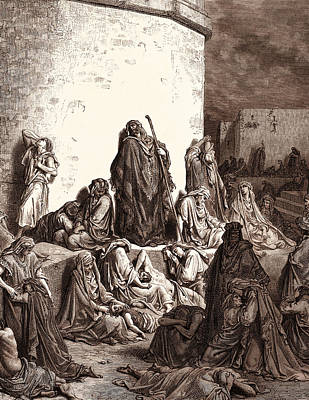
10 The elders of the daughter of Zion
    sit on the ground in silence;
they have thrown dust on their heads
    and put on sackcloth;
the young women of Jerusalem
    have bowed their heads to the ground.

11 My eyes are spent with weeping;
    my stomach churns;
my bile is poured out to the ground
    because of the destruction of the daughter of my people,
because infants and babies faint
    in the streets of the city.

12 They cry to their mothers,
    “Where is bread and wine?”
as they faint like a wounded man
    in the streets of the city,
as their life is poured out
    on their mothers’ bosom.

13 What can I say for you, to what compare you,
    O daughter of Jerusalem?
What can I liken to you, that I may comfort you,
    O virgin daughter of Zion?
For your ruin is vast as the sea;
    who can heal you?

14 Your prophets have seen for you
    false and deceptive visions;
they have not exposed your iniquity
    to restore your fortunes,
but have seen for you oracles
    that are false and misleading.

15 All who pass along the way
    clap their hands at you;
they hiss and wag their heads
    at the daughter of Jerusalem:
“Is this the city that was called
    the perfection of beauty,
    the joy of all the earth?”

16 All your enemies
    rail against you;
they hiss, they gnash their teeth,
    they cry: “We have swallowed her!
Ah, this is the day we longed for;
    now we have it; we see it!”

17 The Lord has done what he purposed;
    he has carried out his word,
which he commanded long ago;
    he has thrown down without pity;
he has made the enemy rejoice over you
    and exalted the might of your foes.

18 Their heart cried to the Lord.
    O wall of the daughter of Zion,
let tears stream down like a torrent
    day and night!
Give yourself no rest,
    your eyes no respite!

19 “Arise, cry out in the night,
    at the beginning of the night watches!
Pour out your heart like water
    before the presence of the Lord!
Lift your hands to him
    for the lives of your children,
who faint for hunger
    at the head of every street.” – Lamentations 2:10-19 ESV

The defeat and destruction of Jerusalem had left those who remained behind in a state of disbelief and despair. The few elders of the city who had not been taken captive were left to deal with the devastation, trying to restore some sense of order in the midst of the chaos.

But, according to Jeremiah, all they could do was “sit on the ground in silence” (Lamentations 2:10 ESV). They were stunned and staggered by the size of the task ahead of them. They had no king. And because their entire army had been demolished and disbanded by the Babylonians, they had no source of protection. The city was in shambles and the economy was in a hopeless state of ruin. So, these men did the only thing they could do: They mourned.

But these senior statesmen were not alone in their despair. Jeremiah describes the young women of the city as having “bowed their heads to the ground” (Lamentations 2:10 ESV). They express shame over their condition. It is likely that many of them had been widowed as a result of the way. Their husbands had been slaughtered by the Babylonians or taken captive. The unmarried women would have also felt the shame of knowing they might never find a husband. The number of eligible bachelors had dropped precipitously as a result of the war.

But there was another group of women whose shame was related to the treatment they had received at the hands of the Babylonian soldiers. Thousands of women had been raped and ravaged by the invading forces of Nebuchadnezzar. And those not taken captive were left to mourn the loss of their virginity and any hope of having a husband and a family.

And in the midst of this dark and depressing scene, the prophet Jeremiah speaks up, revealing the state of his own heart as he observes the pain and suffering all around him.

I have cried until the tears no longer come;
    my heart is broken.
My spirit is poured out in agony
    as I see the desperate plight of my people.
Little children and tiny babies
    are fainting and dying in the streets. – Lamentations 2:11 NLT

It would have been easy for Jeremiah to gloat over the plight of the people of Judah. After all, he had spent years of his life attempting to warn them that all of this was going to happen. But they had repeatedly refused to listen to him. In fact, they had treated Jeremiah like a social pariah, rejecting his message and ridiculing his calling as a prophet of God. And now that they were experiencing the judgment Jeremiah had warned about, he was probably tempted to tell them, “I told you so!” But instead, he wept until he had no more tears to shed.

Jeremiah took no delight in Judah’s destruction. He found no joy in watching children starve to death from a lack of food. The level of suffering among the people was incomparable and far beyond Jeremiah’s capacity to do anything about it. He despairingly asks, “how can I comfort you? For your wound is as deep as the sea. Who can heal you?” (Lamentations 2:13 NLT).

You can sense his anguish and desperation. Even as a prophet of God, he was having a difficult time seeing any silver lining on this dark cloud. And that’s because the message he had been given by God to deliver to the people of Judah had been limited in scope. It only dealt with the coming judgment of God, but did not reveal what would happen afterwards.

“Yes,” the Lord said, “for terror from the north will boil out on the people of this land. Listen! I am calling the armies of the kingdoms of the north to come to Jerusalem. I, the Lord, have spoken!

“They will set their thrones
    at the gates of the city.
They will attack its walls
    and all the other towns of Judah.
I will pronounce judgment
    on my people for all their evil—
for deserting me and burning incense to other gods.
    Yes, they worship idols made with their own hands!” – Jeremiah 1:14-16 NLT

And now that the words he had spoken had come to pass, Jeremiah was left to ponder what was to happen next. He recalled with a sense of sadness and frustration, the role the false prophets had played during the days leading up to the fall of Judah. These men had chosen to contradict his words, offering the people their own version of the truth.

Your prophets have said
    so many foolish things, false to the core.
They did not save you from exile
    by pointing out your sins.
Instead, they painted false pictures,
    filling you with false hope. – Lamentations 2:14 NLT

They had lied, telling the people what they wanted to hear rather than supporting Jeremiah’s message of repentance. And what made matters worse is that the people chose to listen to the wrong messengers.

A horrible and shocking thing
    has happened in this land—
the prophets give false prophecies,
    and the priests rule with an iron hand.
Worse yet, my people like it that way!
    But what will you do when the end comes? – Jeremiah 5:30-31 NLT

All the while Jeremiah had been warning of God’s pending judgment, the leaders of Judah had been painting a rosy picture, fueled by their own selfish interests and designed to maintain the status quo. These men didn’t want the people to repent or reform because it would have impacted their bottom line.

“From the least to the greatest,
    their lives are ruled by greed.
From prophets to priests,
    they are all frauds.
They offer superficial treatments
    for my people’s mortal wound.
They give assurances of peace
    when there is no peace.” – Jeremiah 6:13-14 NLT

And suddenly, Jeremiah turns his attention to the enemies of Judah, all those surrounding nations who were gloating over their demise. He portrays Judah’s enemies as a bunch of bragging bullies who are each claiming to have played a part in their fall.

“We have destroyed her at last!
    We have long waited for this day,
    and it is finally here!” – Lamentations 2:16 NLT

But Jeremiah makes it clear that no one can take credit for Judah’s destruction except God.

But it is the Lord who did just as he planned.
    He has fulfilled the promises of disaster
    he made long ago.
He has destroyed Jerusalem without mercy.
    He has caused her enemies to gloat over her
    and has given them power over her. – Lamentations 2:17 NLT

Not even Nebuchadnezzar, the king of Babylon, could boast over his role in Judah’s demise. He had been nothing more than an instrument in the hands of God. And Jeremiah had prophesied that this “great army” would one day show up and bring the judgment of God against Judah and the city of Jerusalem.

This is what the Lord says:
“Look! A great army coming from the north!
    A great nation is rising against you from far-off lands.
They are armed with bows and spears.
    They are cruel and show no mercy.
They sound like a roaring sea
    as they ride forward on horses.
They are coming in battle formation,
    planning to destroy you, beautiful Jerusalem.” – Jeremiah 6:22-23 NLT

And now that the damage had been done, Jeremiah calls the people of Judah to “Cry aloud before the Lord” and to “Let your tears flow like a river day and night” (Lamentations 2:18 NLT). He called on them to show true signs of repentance, lifting up their voices God and pleading with Him to show mercy.

Pour out your hearts like water to the Lord.
Lift up your hands to him in prayer,
    pleading for your children… – Lamentations 2:19 NLT

The days were dark. The circumstances were bleak. But the same God who had brought judgment could bring restoration. When Jeremiah had asked, “who can heal you?”, it had been a rhetorical question. And the answer was, “God.” He alone could heal them. He could fully restore them. But it was going to take a change of heart among the people of Judah. They were going to have to change their ways.

“Stop at the crossroads and look around.
    Ask for the old, godly way, and walk in it.
Travel its path, and you will find rest for your souls.
    But you reply, ‘No, that’s not the road we want!’” – Jeremiah 6:16 NLT

English Standard Version (ESV)
The Holy Bible, English Standard Version. ESV® Permanent Text Edition® (2016). Copyright © 2001 by Crossway Bibles, a publishing ministry of Good News Publishers.

New Living Translation (NLT)
Holy Bible, New Living Translation, copyright © 1996, 2004, 2015 by Tyndale House Foundation. Used by permission of Tyndale House Publishers Inc., Carol Stream, Illinois 60188. All rights reserved.

The Message (MSG)Copyright © 1993, 1994, 1995, 1996, 2000, 2001, 2002 by Eugene H. Peterson

The King Has Left the Building

6 He has laid waste his booth like a garden,
    laid in ruins his meeting place;
the Lord has made Zion forget
    festival and Sabbath,
and in his fierce indignation has spurned king and priest.

7 The Lord has scorned his altar,
    disowned his sanctuary;
he has delivered into the hand of the enemy
    the walls of her palaces;
they raised a clamor in the house of the Lord
    as on the day of festival.

8 The Lord determined to lay in ruins
    the wall of the daughter of Zion;
he stretched out the measuring line;
    he did not restrain his hand from destroying;
he caused rampart and wall to lament;
    they languished together.

9 Her gates have sunk into the ground;
    he has ruined and broken her bars;
her king and princes are among the nations;
    the law is no more,
and her prophets find
    no vision from the Lord. – Lamentations 2:6-9 ESV

The city of Jerusalem had been reduced to a heap of rubble. Its gates had been burned and torn from their hinges. Every home in the city had been looted and destroyed, including the king’s royal palace. The streets lay deserted because the majority of the city’s inhabitants were now living in exile in Babylon. Those who had been left behind, the poorest of the poor, had been relegated to serving as vinedressers and plowmen for their Babylonian overlords.

But for the people of Judah, the greatest loss, and the one they had the most difficult time processing, was the destruction of the temple. They never expected to see that happen. After all, it was God’s house, the place where His divine presence hovered over the mercy seat in the Holy of Holies. How could God allow His dwelling place to be destroyed by the Babylonians?  And yet, that is exactly what had happened. The book of 2 Kings provides a description of its destruction.

Nebuzaradan, the captain of the guard and an official of the Babylonian king, arrived in Jerusalem. He burned down the Temple of the Lord, the royal palace, and all the houses of Jerusalem. – 2 Kings 25:8-9 NLT

But before they destroyed the temple, they pillaged it and plundered every ounce of gold, all precious gems, every bolt of fine fabric, and every holy object that had been consecrated to the service of God.

The Babylonians broke up the bronze pillars in front of the Lord’s Temple, the bronze water carts, and the great bronze basin called the Sea, and they carried all the bronze away to Babylon. They also took all the ash buckets, shovels, lamp snuffers, ladles, and all the other bronze articles used for making sacrifices at the Temple. The captain of the guard also took the incense burners and basins, and all the other articles made of pure gold or silver. – 2 Kings 25:13-15 NLT

The value of their haul was incalculable, both financially and spiritually.

The weight of the bronze from the two pillars, the Sea, and the water carts was too great to be measured. These things had been made for the Lord’s Temple in the days of Solomon. – 2 Kings 25:16 NLT

But the Babylonians had not been content to ransack and loot the temple. They had summarily executed Seraiah the chief priest, Zephaniah the second priest, and the three keepers of the threshold.

Now, you can begin to understand the significance of the statement, “The Lord has blotted out all memory of the holy festivals and Sabbath days” (Lamentations 2:6 NLT). As horrific as the destruction of the temple may have been, the real loss suffered by the people of Judah was of far greater significance. It was about far more than the destruction of a building. It was about the elimination of the entire sacrificial system that God had ordained.

Consider closely the full import of the following verse.

They also took all the ash buckets, shovels, lamp snuffers, ladles, and all the other bronze articles used for making sacrifices at the Temple. – 2 Kings 25:14 NLT

Everything necessary for atonement had been destroyed or removed, leaving the people of Judah to face the stark and inconceivable reality that the guilt of their sins was permanent and unabsolvable. They no longer had any means of offering sacrifices to God and, therefore, no hope of receiving forgiveness for their sins. This would have been inconceivable to the people of Judah. They were the chosen people of God. He had promised to be with them forever. In fact, when Solomon had dedicated the temple, God had promised to make it His permanent dwelling place.

“I have heard your prayer and your petition. I have set this Temple apart to be holy—this place you have built where my name will be honored forever. I will always watch over it, for it is dear to my heart.” – 1 Kings 9:3 NLT

But God had also warned Solomon that this promise came with conditions.

“But if you or your descendants abandon me and disobey the commands and decrees I have given you, and if you serve and worship other gods, then I will uproot Israel from this land that I have given them. I will reject this Temple that I have made holy to honor my name. I will make Israel an object of mockery and ridicule among the nations.” – 1 Kings 9:6-7 NLT

And when people ask, “Why did the Lord do such terrible things to this land and to this Temple?” (1 Kings 9:8 NLT), the answer would be simple and clear.

“Because his people abandoned the Lord their God, who brought their ancestors out of Egypt, and they worshiped other gods instead and bowed down to them.” – 1 Kings 9:9 NLT

But the perspective of the people of Judah who found themselves suffering the aftermath of God’s judgment was quite different. Rather than admit their own guilt and culpability, they accused God of rejecting and despising His own temple.

The Lord has rejected his own altar;
    he despises his own sanctuary.
He has given Jerusalem’s palaces
    to her enemies.
They shout in the Lord’s Temple
    as though it were a day of celebration. – Lamentations 2:7 NLT

According to their misguided and misinformed logic, God’s anger had been directed against the temple and the city, not against them. In their minds, the temple had become the symbol of God‘s presence. They had turned it into a kind of talisman or good luck charm that guaranteed their security and safety, regardless of their behavior. They could sin and then make their way to the temple, offer their obligatory sacrifices, and walk away with their spiritual slate wiped clean.

But God had repeatedly reminded the Israelites that sacrifice alone was not enough. He was looking for repentant hearts. They had been guilty of simply going through the motions, offering sacrifices to stave off punishment, but without any intention of changing their ways.

“What makes you think I want all your sacrifices?”
    says the Lord.
“I am sick of your burnt offerings of rams
    and the fat of fattened cattle.
I get no pleasure from the blood
    of bulls and lambs and goats.
When you come to worship me,
    who asked you to parade through my courts with all your ceremony?
Stop bringing me your meaningless gifts;
    the incense of your offerings disgusts me!
As for your celebrations of the new moon and the Sabbath
    and your special days for fasting—
they are all sinful and false.” – Isaiah 1:11-13 NLT

It was King David who wrote the following words after his sin with Bathsheba had been exposed by God.

You do not desire a sacrifice, or I would offer one.
    You do not want a burnt offering.
The sacrifice you desire is a broken spirit.
    You will not reject a broken and repentant heart, O God. – Psalm 51:16-17 NLT

And yet, the people of Judah remained unbroken in spirit and unrepentant of heart. They mourned the loss of their city and grieved over the elimination of the sacrificial system, but they displayed no remorse over their conduct. In their minds, the temple had been their salvation. The building itself, along with its religious accouterments, and the ritualistic nature of the sacrificial system, had been their get-out-of-jail-free card. Now it was gone.

But long before the Babylonians invaded their city and destroyed the temple, Jeremiah had pleaded with them to refocus their attention on God.

“‘Even now, if you quit your evil ways, I will let you stay in your own land. But don’t be fooled by those who promise you safety simply because the LORD’s Temple is here. They chant, “The LORD’s Temple is here! The LORD’s Temple is here!” But I will be merciful only if you stop your evil thoughts and deeds and start treating each other with justice; only if you stop exploiting foreigners, orphans, and widows; only if you stop your murdering; and only if you stop harming yourselves by worshiping idols. Then I will let you stay in this land that I gave to your ancestors to keep forever.”’ – Jeremiah 7:3-7 NLT

Now, the temple was gone. But God was not. The building had been destroyed, but the One whose glory had once hovered over the mercy seat was still very much alive and well. The God of Abraham, Isaac, and Jacob had punished His people but had not abandoned them. The temple had never been intended to “contain” God. It had never been meant to be worshiped in place of God.

This is what the Lord says:

“Heaven is my throne,
    and the earth is my footstool.
Could you build me a temple as good as that?
    Could you build me such a resting place?” – Isaiah 66:1 NLT

English Standard Version (ESV)
The Holy Bible, English Standard Version. ESV® Permanent Text Edition® (2016). Copyright © 2001 by Crossway Bibles, a publishing ministry of Good News Publishers.

New Living Translation (NLT)
Holy Bible, New Living Translation, copyright © 1996, 2004, 2015 by Tyndale House Foundation. Used by permission of Tyndale House Publishers Inc., Carol Stream, Illinois 60188. All rights reserved.

The Message (MSG)Copyright © 1993, 1994, 1995, 1996, 2000, 2001, 2002 by Eugene H. Peterson