The Failure to Finish Well

9 In the twentieth year of Jeroboam king of Israel, Asa began to reign over Judah, 10 and he reigned forty-one years in Jerusalem. His mother’s name was Maacah the daughter of Abishalom. 11 And Asa did what was right in the eyes of the LORD, as David his father had done. 12 He put away the male cult prostitutes out of the land and removed all the idols that his fathers had made. 13 He also removed Maacah his mother from being queen mother because she had made an abominable image for Asherah. And Asa cut down her image and burned it at the brook Kidron. 14 But the high places were not taken away. Nevertheless, the heart of Asa was wholly true to the LORD all his days. 15 And he brought into the house of the LORD the sacred gifts of his father and his own sacred gifts, silver, and gold, and vessels.

16 And there was war between Asa and Baasha king of Israel all their days. 17 Baasha king of Israel went up against Judah and built Ramah, that he might permit no one to go out or come in to Asa king of Judah. 18 Then Asa took all the silver and the gold that were left in the treasures of the house of the LORD and the treasures of the king’s house and gave them into the hands of his servants. And King Asa sent them to Ben-hadad the son of Tabrimmon, the son of Hezion, king of Syria, who lived in Damascus, saying, 19 “Let there be a covenant between me and you, as there was between my father and your father. Behold, I am sending to you a present of silver and gold. Go, break your covenant with Baasha king of Israel, that he may withdraw from me.” 20 And Ben-hadad listened to King Asa and sent the commanders of his armies against the cities of Israel and conquered Ijon, Dan, Abel-beth-maacah, and all Chinneroth, with all the land of Naphtali. 21 And when Baasha heard of it, he stopped building Ramah, and he lived in Tirzah. 22 Then King Asa made a proclamation to all Judah, none was exempt, and they carried away the stones of Ramah and its timber, with which Baasha had been building, and with them King Asa built Geba of Benjamin and Mizpah. 23 Now the rest of all the acts of Asa, all his might, and all that he did, and the cities that he built, are they not written in the Book of the Chronicles of the Kings of Judah? But in his old age he was diseased in his feet. 24 And Asa slept with his fathers and was buried with his fathers in the city of David his father, and Jehoshaphat his son reigned in his place. – 1 Kings 15:9-24 ESV

The men who inherited the thrones of Judah and Israel were not doomed to repeat their predecessors’ mistakes. Their fate was not predetermined just because their fathers happened to model ungodly behavior. Though most of these men inherited kingdoms and legacies marked by sin and rebellion against God, they each had a choice to make. But as will become increasingly apparent, few of them seemed to make the right choice. The sins of a father can have a powerful influence over his son. The manner by which he conducts himself while performing his royal duties will make a strong impression on the one who follows in his footsteps – for better or worse.

In the case of Abijam, he was succeeded as king by his younger brother, Asa. These two brothers shared the same mother: Maacah, the daughter of Abishalom [Absalom], and they had both grown up in the household of Rehoboam. But each would approach their kingly responsibilities differently. While Abijam “walked in all the sins that his father did before him, and his heart was not wholly true to the LORD his God” (1 Kings 15:3 ESV), Asa “did what was right in the eyes of the LORD” (1 Kings 15:11 ESV).

The book of 2 Chronicles provides further details concerning Asa’s reign.

In his days the land had rest for ten years. And Asa did what was good and right in the eyes of the LORD his God. He took away the foreign altars and the high places and broke down the pillars and cut down the Asherim and commanded Judah to seek the LORD, the God of their fathers, and to keep the law and the commandment. He also took out of all the cities of Judah the high places and the incense altars. And the kingdom had rest under him. He built fortified cities in Judah, for the land had rest. He had no war in those years, for the LORD gave him peace. – 2 Chronicles 15:1-6 ESV

This young man had been born to the same pagan mother and lived through the wicked reigns of his father and older brother, and yet he had managed to maintain a semblance of his faith in Yahweh. In fact, the author of 1 Kings declares that he “did what was pleasing in the LORD’s sight, as his ancestor David had done” (1 Kings 15:11 NLT). Perhaps he had managed to develop a close relationship with his grandfather, David, before his death. Or it could be that he had grown up hearing the stories of David’s many exploits and of his close relationship with God. He was likely intrigued and influenced by God’s description of David as “a man after his own heart” (1 Samuel 13:14 ESV).

Something was triggered in Asa that led him to take a different path than that of his father and brother. After two decades of leadership that had promoted further idolatry and propagated a spirit of rebellion among the people of Judah, Asa appeared on the scene, determined to right the wrongs of his predecessors. And he got off to a great start.

He banished the male and female shrine prostitutes from the land and got rid of all the idols his ancestors had made. He even deposed his grandmother Maacah from her position as queen mother because she had made an obscene Asherah pole. He cut down her obscene pole and burned it in the Kidron Valley. – 1 Kings 15:12-13 NLT

These radical reforms must have been met with stiff opposition. After 20 years of worshiping false gods, the people of Judah had grown comfortable with the licentious and immoral nature of idolatry. They enjoyed the no-rules nature of these pagan religions. Their man-made gods allowed them to satisfy their basest desires and offered a tempting alternative to the more legalist and restrictive laws that accompanied the worship of Yahweh. So, it seems likely that Asa’s reforms were not welcome with open arms.

But, despite any opposition he may have encountered, Asa attempted to redress the sins of his father and brother by removing all the pagan shrines they had built and restoring the worship of Yahweh. He made an effort to renew the nation’s commitment to the Temple as the dwelling place of God and the only place where the worship of God was to be practiced.

…he brought into the house of the LORD the sacred gifts of his father and his own sacred gifts, silver, and gold, and vessels. – 1 Kings 15:15 ESV

This seems to indicate that Asa and his brother had both been guilty of offering expensive gifts to the many false gods of Judah. But now that he was king, Asa was righting that wrong, ordering the collection of all those valuable items and placing them in the treasury of the Temple. This very public act was both a demonstration of repentance and a visual reminder that there was only one true God who was worthy of man’s worship and deserving of such gifts of honor and praise.

Asa’s reign lasted 41 years, and while he “was wholly true to the LORD all his days” (1 Kings 15:14 ESV), he found it difficult to completely eradicate all the vestiges of idolatry in the land. The author of 2 Chronicles states that he “commanded Judah to seek the LORD, the God of their fathers, and to keep the law and the commandment” (2 Chronicles 14:4 ESV), and he “took out of all the cities of Judah the high places and the incense altars” (2 Chronicles 14:5 ESV). But 1 Kings reveals that his removal efforts were incomplete: “But the high places were not taken away” (1 Kings 15:14 ESV).

That little statement speaks volumes. It acts as a soft whisper of warning, providing a foreboding omen of what is to come. Asa’s efforts, while sincere and well-intentioned, would prove to be incomplete. His failure to eradicate all the high places was like a doctor failing to locate and remove all the cancer cells from the body of his patient. Those few sacred sites that were left standing would continue to lure the people of Judah away from God, and the apostasy they produced would continue to spread like cancer throughout the nation. His partial obedience, while praiseworthy, would in the long run prove insufficient. There were other signs that Asa’s love for God, while strong, had been influenced by the actions of his father and brother.

The author of 2 Chronicles states that Asa“ had no war in those years, for the LORD gave him peace” (2 Chronicles 14:6 ESV), and yet 1 Kings 15:16 paints a slightly different picture.

…there was war between Asa and Baasha king of Israel all their days. – 1 Kings 15:16 ESV

This is not a contradiction, but simply a recognition that the animosity between the northern and southern kingdoms had not abated. Thirty-six years into his 41-year reign, Asa found himself facing a threat from Baasha, the king of Israel. This man had murdered Nadab, the son of Jeroboam, and crowned himself king. Then, in an effort to secure his hold on the throne, he executed Jeroboam’s entire family (1 Kings 15:29). His actions seemed to have spawned a mass exodus of people who crossed the border into Judah to escape his reign of terror. So, as a preventative measure, Baasha built a fortified city along the border that provided a military presence to deter any further desertions.

What happened next provides a further glimpse into Asa’s heart and how he viewed his relationship with God. When faced with this increased military presence at his border, Asa decided to seek outside help. Notice that he did not seek assistance from Yahweh. Instead, he took the sacred treasures from the house of God and sent them to “Ben-hadad the son of Tabrimmon, the son of Hezion, king of Syria” (1 Kings 15:18 ESV). In essence, he sent a bribe to the king of Syria, in the hopes that this pagan king would come to the aid of Judah. And his ploy worked.

And Ben-hadad listened to King Asa and sent the commanders of his armies against the cities of Israel and conquered Ijon, Dan, Abel-beth-maacah, and all Chinneroth, with all the land of Naphtali. And when Baasha heard of it, he stopped building Ramah… – 1 Kings 1:20-21 ESV

Asa ordered the immediate dismantling of Baasha’s military outpost, and peace was restored. But there’s more to the story. The book of 2 Chronicles reveals that Asa’s decision to make a covenant with the king of Syria was outside the will of God. The prophet of God delivered a stinging rebuke to Asa.

“Because you relied on the king of Syria, and did not rely on the LORD your God, the army of the king of Syria has escaped you.…You have done foolishly in this, for from now on you will have wars.” – 2 Chronicles 16:7,9 ESV

This news angered Asa, and he had the prophet thrown in prison, but his anger did not abate. His frustration with God manifested itself in the cruel oppression of his own people. In time, he became a bitter man, driven by rage and suffering from poor health.

In the thirty-ninth year of his reign Asa was diseased in his feet, and his disease became severe. Yet even in his disease he did not seek the LORD, but sought help from physicians. – 2 Chronicles 16:12 ESV

The great reformer had become an angry and self-reliant ruler who refused to turn to God for healing or help. His reign lasted 41 long years but ended in pain, suffering, and alienation from God, and then he died. Yes, he proved to be a better king than his brother, but in the end, they both suffered the same fate. Their sins left them separated from God, and both men ended up leaving less-than-stellar legacies. Of Asa, the author simply states, “in his old age he was diseased in his feet” (1 Kings 15:23 ESV). What a fitting description for the end of Asa’s life. Forty-one years earlier, he had begun his reign walking in the footsteps of his grandfather David. He had been faithful and eager to be a man after God’s own heart. But by the end of his life, Asa’s walk with God had taken a devastating detour. He found himself unable to walk at all, a fitting symbol of his greatly diminished spiritual condition.

Had Asa listened to the words of Moses and Micah, his story might have ended much differently.

“And now, Israel, what does the LORD your God require of you, but to fear the LORD your God, to walk in all His ways and love Him, and to serve the LORD your God with all your heart and with all your soul, and to keep the LORD’s commandments and His statutes which I am commanding you today for your good…” – Deuteronomy 10:12-13 NASB

O people, the LORD has told you what is good, and this is what he requires of you: to do what is right, to love mercy, and to walk humbly with your God. – Micah 6:8 NLT

English Standard Version (ESV) The Holy Bible, English Standard Version. ESV® Permanent Text Edition® (2016). Copyright © 2001 by Crossway Bibles, a publishing ministry of Good News Publishers.

New Living Translation (NLT) Holy Bible, New Living Translation, copyright © 1996, 2004, 2015 by Tyndale House Foundation. Used by permission of Tyndale House Publishers Inc., Carol Stream, Illinois 60188. All rights reserved.
God Demands Faithfulness, Not Flawlessness

1 Now in the eighteenth year of King Jeroboam the son of Nebat, Abijam began to reign over Judah. 2 He reigned for three years in Jerusalem. His mother’s name was Maacah the daughter of Abishalom. 3 And he walked in all the sins that his father did before him, and his heart was not wholly true to the LORD his God, as the heart of David his father. 4 Nevertheless, for David’s sake the LORD his God gave him a lamp in Jerusalem, setting up his son after him, and establishing Jerusalem, 5 because David did what was right in the eyes of the LORD and did not turn aside from anything that he commanded him all the days of his life, except in the matter of Uriah the Hittite. 6 Now there was war between Rehoboam and Jeroboam all the days of his life. 7 The rest of the acts of Abijam and all that he did, are they not written in the Book of the Chronicles of the Kings of Judah? And there was war between Abijam and Jeroboam. 8 And Abijam slept with his fathers, and they buried him in the city of David. And Asa his son reigned in his place. – 1 Kings 15:1-8 ESV

All throughout his record of the kings of Judah and Israel, the author has dropped slight hints or clues that provide further insight into the actions of these men. In the case of Rehoboam, the king of Judah, he reveals that “When Rehoboam died, he was buried among his ancestors in the City of David. His mother was Naamah, an Ammonite woman. Then his son Abijam became the next king” (1 Kings 14:31 NLT). Hidden away in these three sentences is a small detail that could easily be overlooked. But this seemingly innocuous fact helps to explain how the spiritual state of God’s chosen people had so quickly deteriorated.

Rehoboam was the son of Solomon, and Solomon had more than 700 wives and 300 concubines. Many of those women were foreign princesses who had been given to Solomon as part of a peace agreement made between their home country and Israel. The author has already revealed that Solomon made many such treaties that required him to marry these women from pagan nations.

Now King Solomon loved many foreign women. Besides Pharaoh’s daughter, he married women from Moab, Ammon, Edom, Sidon, and from among the Hittites. The LORD had clearly instructed the people of Israel, “You must not marry them, because they will turn your hearts to their gods.” Yet Solomon insisted on loving them anyway. – 1 Kings 11:1-2 NLT

God had strictly forbidden the Israelites from taking wives for themselves from among the nations that lived in the land of Canaan. Long before the people of Israel had entered the land, Moses had clearly communicated God’s prohibition against any fraternization with the enemy.

“When the LORD your God brings you into the land you are about to enter and occupy, he will clear away many nations ahead of you: the Hittites, Girgashites, Amorites, Canaanites, Perizzites, Hivites, and Jebusites. These seven nations are greater and more numerous than you. When the LORD your God hands these nations over to you and you conquer them, you must completely destroy them. Make no treaties with them and show them no mercy. You must not intermarry with them. Do not let your daughters and sons marry their sons and daughters, for they will lead your children away from me to worship other gods. Then the anger of the LORD will burn against you, and he will quickly destroy you.” – Deuteronomy 7:1-4 NLT

But Solomon had chosen to disobey God’s command in a significant way. He had hundreds of foreign wives and, according to the closing verses of 1 Kings 14, he had married a woman from among the Ammonites. Once again, this small detail is intended to shed light on the moral and spiritual state of the nation. To fully grasp the significance of Solomon’s marriage to this woman,  we have to understand that the Ammonites were the descendants of Lot, the nephew of Abraham. But more importantly, their very existence is tied to a sad and sordid event that took place in Lot’s life. After Lot and his two daughters had been rescued from the sinful city of Sodom by an angel of the Lord, they found themselves living in a cave in the wilderness. One night, while Lot was drunk, his two daughters had sexual relations with him, resulting in both girls becoming pregnant. The book of Genesis states that “The younger daughter also gave birth to a son and named him Ben Ammi. He is the ancestor of the Ammonites of today” (Genesis 19:38 NLT).

Hundreds of years later, when the people of Israel were making their way from Egypt to the land of Canaan, their distant relatives, the Ammonites, refused to allow them to pass through their territory. In fact, they would actually attempt to have them cursed. So, God put a permanent ban on the descendants of the Ammonites and Moabites.

No Ammonite or Moabite or any of their descendants for ten generations may be admitted to the assembly of the LORD. These nations did not welcome you with food and water when you came out of Egypt. Instead, they hired Balaam son of Beor from Pethor in distant Aram-naharaim to curse you. But the LORD your God refused to listen to Balaam. He turned the intended curse into a blessing because the LORD your God loves you. As long as you live, you must never promote the welfare and prosperity of the Ammonites or Moabites. – Deuteronomy 23:3-6 NLT

Yet Solomon had chosen to disobey the will of God by marrying an Ammonite princess. From this unauthorized and illegal union had come the next king of Israel, Rehoboam, a man who proved to be anything but loyal to God. When Rehoboam died, his son Abijam took his place. But even in announcing Abijam as the next king of Judah, the author drops another not-so-subtle hint regarding this man’s lineage. He states that “His mother’s name was Maacah the daughter of Abishalom” (1 Kings 15:2 ESV). To understand the significance of this detail, we have to look at the book of 2 Chronicles.

Rehoboam took as wife Mahalath the daughter of Jerimoth the son of David, and of Abihail the daughter of Eliab the son of Jesse, and she bore him sons, Jeush, Shemariah, and Zaham. After her he took Maacah the daughter of Absalom, who bore him Abijah, Attai, Ziza, and Shelomith. Rehoboam loved Maacah the daughter of Absalom above all his wives and concubines (he took eighteen wives and sixty concubines, and fathered twenty-eight sons and sixty daughters). – 2 Chronicles 11:18-21 ESV

Abishalom is another variation of the name Absalom, and Abijah and Abijam are one and the same person. Rehoboam married a daughter of the very man who tried to steal the crown from his grandfather, David. Absalom proved successful in staging a coup against his father, but it was short-lived. Had he managed to complete his coup attempt, Solomon would never have been the next king of Israel. Yet, Rehoboam, the son of Solomon, married the daughter of the man who attempted to deny his father his God-given right to the throne of Israel.

There are so many plots and twists to this story that remain hidden from view, but they provide the context for all that happens. The individual actions of these men are to be seen as the byproducts of a much bigger problem. The nation of Israel had a long and sordid history of disobedience to God, and each successive generation followed in the footsteps of their ancestors, displaying the lingering and infectious nature of sin. It becomes painfully clear that each indiscretion and act of insubordination, no matter how small, has consequences. Our sins against God can take on a life of their own and, just as an infectious disease can spread from one person to another, so we can end up passing on our sinful propensities to the next generation. That is precisely what happened with the son of Rehoboam.

…he walked in all the sins that his father did before him, and his heart was not wholly true to the LORD his God, as the heart of David his father. – 1 Kings 15:3 ESV

Yet, God had his hand on Abijah, giving him victories over Jeroboam and the ten tribes of Israel. But it was not because of anything Abijah had done. God was honoring the faithfulness of David.

But for David’s sake, the LORD his God allowed his descendants to continue ruling, shining like a lamp, and he gave Abijam a son to rule after him in Jerusalem. For David had done what was pleasing in the LORD’s sight and had obeyed the LORD’s commands throughout his life, except in the affair concerning Uriah the Hittite. – 1 Kings 15:4-5 NLT

Not only do our sins have consequences, but our acts of faithfulness can also be passed on. God was preserving the kingdom of the rebellious Abijah because of the faithfulness of his grandfather. Amazingly, some of David’s faithfulness had been passed down to his grandson, manifesting itself in a powerful declaration of allegiance to God, spoken to the rival forces of the ten northern tribes.

“Do you really think you can stand against the kingdom of the LORD that is led by the descendants of David? You may have a vast army, and you have those gold calves that Jeroboam made as your gods. But you have chased away the priests of the LORD (the descendants of Aaron) and the Levites, and you have appointed your own priests, just like the pagan nations. You let anyone become a priest these days! Whoever comes to be dedicated with a young bull and seven rams can become a priest of these so-called gods of yours! But as for us, the LORD is our God, and we have not abandoned him.” – 2 Chronicles 13:8-10 NLT

When the battle ensued, the people of Judah cried out to God, and He delivered them.

So Judah defeated Israel on that occasion because they trusted in the LORD, the God of their ancestors. – 2 Chronicles 13:18 NLT

Despite their track record of unfaithfulness, God gave Abijah and the people of Judah a great victory over their enemies. This rebellious young king, who had inherited many of his father’s worst traits, managed to lead his people back to the LORD, if only for a short time. Faced with overwhelming odds and the threat of defeat at the hands of Jeroboam and the ten tribes of Judah, Abijah cried out to God. In that brief, shining moment, the nation of Judah placed their hope in the Almighty, and He delivered them. Abijah was far from perfect, but he chose to lead his people back to the LORD.

The author simply records: “And Abijam slept with his fathers, and they buried him in the city of David. And Asa his son reigned in his place” ( 1 Kings 15:8 ESV).  There is no definitive declaration of Abijam’s spiritual legacy, good or bad. However, the Book of 2 Chronicles reveals that Abijam’s actions had a positive effect on his son and heir to the throne.

When Abijah died, he was buried in the City of David. Then his son Asa became the next king. There was peace in the land for ten years. Asa did what was pleasing and good in the sight of the LORD his God. He removed the foreign altars and the pagan shrines. He smashed the sacred pillars and cut down the Asherah poles. He commanded the people of Judah to seek the LORD, the God of their ancestors, and to obey his law and his commands. Asa also removed the pagan shrines, as well as the incense altars from every one of Judah’s towns. So Asa’s kingdom enjoyed a period of peace. – 2 Chronicles 14:1-5 NLT

Yahweh doesn’t demand perfection from His people; He simply asks that they be faithful. The reference to Uriah the Hittite in verse 5 is meant to convey that David was far from flawless in his actions. His affair with Bathsheba and his role in her husband’s execution are dark spots on his spiritual legacy, but Yahweh viewed David as a man after His own heart.

David did what was right in the eyes of the LORD and did not turn aside from anything that he commanded him all the days of his life. – 1 Kings 15:5 ESV

God demands faithfulness, not lawlessness. He is looking for the person who will resist the temptation to compromise their convictions and remain true to their covenant commitments to Him. Abijam was not a perfect king or a sold-out follower of Yahweh, but when the time came, he did the right thing, and his son followed his example. But will the legacy continue? What will be the nature of this new generation of leadership? Will the next king be faithful or faithless? Will he display a heart for God or a hard-headed insistence to live in rebellion against Him? Only time will tell.

English Standard Version (ESV) The Holy Bible, English Standard Version. ESV® Permanent Text Edition® (2016). Copyright © 2001 by Crossway Bibles, a publishing ministry of Good News Publishers.

New Living Translation (NLT) Holy Bible, New Living Translation, copyright © 1996, 2004, 2015 by Tyndale House Foundation. Used by permission of Tyndale House Publishers Inc., Carol Stream, Illinois 60188. All rights reserved.
The Downward Spiritual Spiral

19 Now the rest of the acts of Jeroboam, how he warred and how he reigned, behold, they are written in the Book of the Chronicles of the Kings of Israel. 20 And the time that Jeroboam reigned was twenty-two years. And he slept with his fathers, and Nadab his son reigned in his place.

21 Now Rehoboam the son of Solomon reigned in Judah. Rehoboam was forty-one years old when he began to reign, and he reigned seventeen years in Jerusalem, the city that the Lord had chosen out of all the tribes of Israel, to put his name there. His mother’s name was Naamah the Ammonite. 22 And Judah did what was evil in the sight of the LORD, and they provoked him to jealousy with their sins that they committed, more than all that their fathers had done. 23 For they also built for themselves high places and pillars and Asherim on every high hill and under every green tree, 24 and there were also male cult prostitutes in the land. They did according to all the abominations of the nations that the LORD drove out before the people of Israel.

25 In the fifth year of King Rehoboam, Shishak king of Egypt came up against Jerusalem. 26 He took away the treasures of the house of the LORD and the treasures of the king’s house. He took away everything. He also took away all the shields of gold that Solomon had made, 27 and King Rehoboam made in their place shields of bronze, and committed them to the hands of the officers of the guard, who kept the door of the king’s house. 28 And as often as the king went into the house of the LORD, the guard carried them and brought them back to the guardroom.

29 Now the rest of the acts of Rehoboam and all that he did, are they not written in the Book of the Chronicles of the Kings of Judah? 30 And there was war between Rehoboam and Jeroboam continually. 31 And Rehoboam slept with his fathers and was buried with his fathers in the city of David. His mother’s name was Naamah the Ammonite. And Abijam his son reigned in his place. – 1 Kings 14:19-31 ESV

From this point forward, the author will provide a side-by-side chronology of the two kingdoms, alternating his focus from one kingly line to the other. The kingdom over which David and Solomon once reigned has been officially and permanently divided, creating two nations that will each mirror the excesses and exigencies of their rebellious leaders.

He begins with a short recap of Jeroboam’s reign over the ten northern tribes, which became known as the nation of Israel. Notice that the author refers to the wars that Jeroboam had to fight. Unlike Solomon, Jeroboam would not have the pleasure of ruling over a kingdom characterized by peace and prosperity. His entire 22-year reign would be marked by constant wars and territorial conflicts. The land that God had awarded to the ten tribes as their inheritance would become a place of turmoil and unrest. And the pagan nations that had once occupied the land would once again assert themselves and pose a persistent threat to Israel’s peace and security. But two decades into his reign, Jeroboam died, and his son Nadab assumed the throne of Israel.

Meanwhile, in the south, Rehoboam, the son of Solomon, ruled over the nation of Judah. He sat on the throne of his father in the city of Jerusalem, but the extent of his domain had been drastically reduced. He ruled over a single tribe, Judah, and he did so from “the city the LORD had chosen from among all the tribes of Israel as the place to honor his name” (1 Kings 14:21 NLT). This somewhat innocuous line is actually intended to stress the dramatically altered fortunes of Judah and its king. God had graciously allowed Solomon to construct a house for Him in the capital city of Jerusalem. The magnificent Temple that Solomon spent nearly eight years constructing was meant to be the dwelling place of God on earth, and God had agreed to honor this man-made structure by allowing it to be associated with His name.

“I have heard your prayer and your petition. I have set this Temple apart to be holy—this place you have built where my name will be honored forever. I will always watch over it, for it is dear to my heart.” – 1 Kings 9:3 NLT

But God had warned Solomon that this honor was conditional. If Solomon and the people of Israel failed to remain faithful to their covenant commitment, the glorious temple would fail to protect them from the judgment of God.

“As for you, if you will follow me with integrity and godliness, as David your father did, obeying all my commands, decrees, and regulations, then I will establish the throne of your dynasty over Israel forever. …But if you or your descendants abandon me and disobey the commands and decrees I have given you, and if you serve and worship other gods then I will uproot Israel from this land that I have given them. I will reject this Temple that I have made holy to honor my name. I will make Israel an object of mockery and ridicule among the nations. And though this Temple is impressive now, all who pass by will be appalled and will gasp in horror.” – 1 Kings 9:4-8 NLT

But Solomon had failed to live up to his end of the agreement. He allowed his love for his 1,000 forbidden foreign wives and concubines to turn his heart away from God. He became an idol worshiper and ordered the construction of countless shrines and holy sites dedicated to these false gods, which led to the apostasy of the people of Israel. Ultimately, that is what led to the split of his kingdom. But Solomon’s acts of spiritual adultery would pale in comparison to those of his son. Rehoboam’s 17 years of misguided leadership ended up causing the nation of Judah to abandon the one true God for a pantheon of false gods and immoral religious practices.

During Rehoboam’s reign, the people of Judah did what was evil in the LORD’s sight, provoking his anger with their sin, for it was even worse than that of their ancestors. For they also built for themselves pagan shrines and set up sacred pillars and Asherah poles on every high hill and under every green tree. There were even male and female shrine prostitutes throughout the land. The people imitated the detestable practices of the pagan nations the LORD had driven from the land ahead of the Israelites. – 1 Kings 14:22-24 NLT

While the house of God remained in Jerusalem, the people occupied themselves by offering sacrifices at the countless pagan shrines dotting the landscape of Judah. There were literally Asherah poles “on every high hill and under every green tree.” In other words, they were everywhere. Asherah was a female fertility god worshiped by the Syrians, Phoenicians, and many other nations that once called Canaan home. While Rehoboam was king, he encouraged the people to resurrect the gods and religious rituals of the land’s former inhabitants. In essence, he promoted spiritual regression. He led the people to adopt the false gods of the very same nations that had once occupied the land. Years earlier, Moses had clearly communicated God’s will concerning these pagan nations and their false gods.

You must completely destroy the Hittites, Amorites, Canaanites, Perizzites, Hivites, and Jebusites, just as the LORD your God has commanded you. This will prevent the people of the land from teaching you to imitate their detestable customs in the worship of their gods, which would cause you to sin deeply against the LORD your God. – Deuteronomy 20:17-18 NLT

But hundreds of years later, Rehoboam was reviving the “detestable customs” and causing the people to “sin deeply against the LORD.” Judah had become a hotbed of religious syncretism and moral relativism. They even instituted the use of sexual promiscuity as a feature of their worship, utilizing male and female cult prostitutes as priests and priestesses. Nothing was off-limits, and the commands of God became little more than divine suggestions, up to interpretation and easily ignored.

But God would not tolerate their unbridled and unapologetic disobedience. In the fifth year of Rehoboam’s 17-year reign, God sent the Egyptians to mete out His judgment against the rebellious and unrepentant people of Judah.

King Shishak of Egypt came up and attacked Jerusalem. He ransacked the treasuries of the Lord’s Temple and the royal palace; he stole everything, including all the gold shields Solomon had made. – 1 Kings 14;23-24 NLT

Having heard the rumors concerning the grandeur of Solomon’s Temple and the vast extent of his wealth, the Egyptian troops set their sights on these symbols of the nation’s prosperity. They ransacked the Temple and the royal palace, stealing everything, and further diminishing Rehoboam’s status as a king. Now, not only was his domain a fraction of its former size, but his financial net worth was greatly reduced. So much so that he didn’t have enough capital to replace the golden shields his father had commissioned. He was forced to manufacture cheaper replicas made of bronze. This scene portrays a stark contrast between the glory days of his father, Solomon.

So King Solomon became richer and wiser than any other king on earth. Kings from every nation came to consult him and to hear the wisdom God had given him. Year after year everyone who visited brought him gifts of silver and gold, clothing, weapons, spices, horses, and mules.

Solomon had 4,000 stalls for his horses and chariots, and he had 12,000 horses. He stationed some of them in the chariot cities, and some near him in Jerusalem. He ruled over all the kings from the Euphrates River in the north to the land of the Philistines and the border of Egypt in the south. The king made silver as plentiful in Jerusalem as stone. – 2 Chronicles 9:22-27 NLT

During Solomon’s reign, Israel enjoyed unprecedented peace because they were a force to be reckoned with in the region. Even the Egyptians sought alliances with Solomon because of the strength of his army.

Pharaoh, the king of Egypt, had attacked and captured Gezer, killing the Canaanite population and burning it down. He gave the city to his daughter as a wedding gift when she married Solomon. So Solomon rebuilt the city of Gezer. – 1 Kings 9:16-17 NLT

Yet, by the fifth year of Rehoboam’s reign, the Egyptians no longer feared Judah’s strength and took advantage of the nation’s weakened condition. It had only taken five years to transform the once-powerful kingdom of David into a regional laughing stock. And Rehoboam’s fortunes didn’t improve when the Egyptians returned home. He found himself in a constant civil war with King Jeroboam and the ten northern tribes. Twelve years later, at the age of 58, Rehoboam died, and his son took his place as the king of Judah. With this transition of power, a sad and recurring pattern begins to emerge. With each succeeding generation, the kings of Judah and Israel will bequeath to their heirs not only their throne but their propensity for sin, creating a seemingly unbroken chain of ever-increasing rebellion against God.

One of the themes that will be repeated incessantly throughout the rest of the books of 1st and 2nd Kings is the downward spiritual spiral of the men who will lead the two divided nations. Because of Rehoboam’s unfaithfulness and subsequent failed leadership, “Judah did what was evil in the sight of the LORD, and they provoked him to jealousy with their sins that they committed, more than all that their fathers had done” (1 Kings 14:22 ESV). And, sadly, that pattern would repeat itself time and time again as the kings of Israel and Judah continued to violate the covenant commitments made to Yahweh. The fates of both nations were directly tied to the spiritual apostasy of their kings. In time, the truth of the proverb would become a reality.

…when the wicked rule, the people groan. – Proverbs 29:2 ESV

English Standard Version (ESV) The Holy Bible, English Standard Version. ESV® Permanent Text Edition® (2016). Copyright © 2001 by Crossway Bibles, a publishing ministry of Good News Publishers.

New Living Translation (NLT) Holy Bible, New Living Translation, copyright © 1996, 2004, 2015 by Tyndale House Foundation. Used by permission of Tyndale House Publishers Inc., Carol Stream, Illinois 60188. All rights reserved.

The LORD Has Spoken

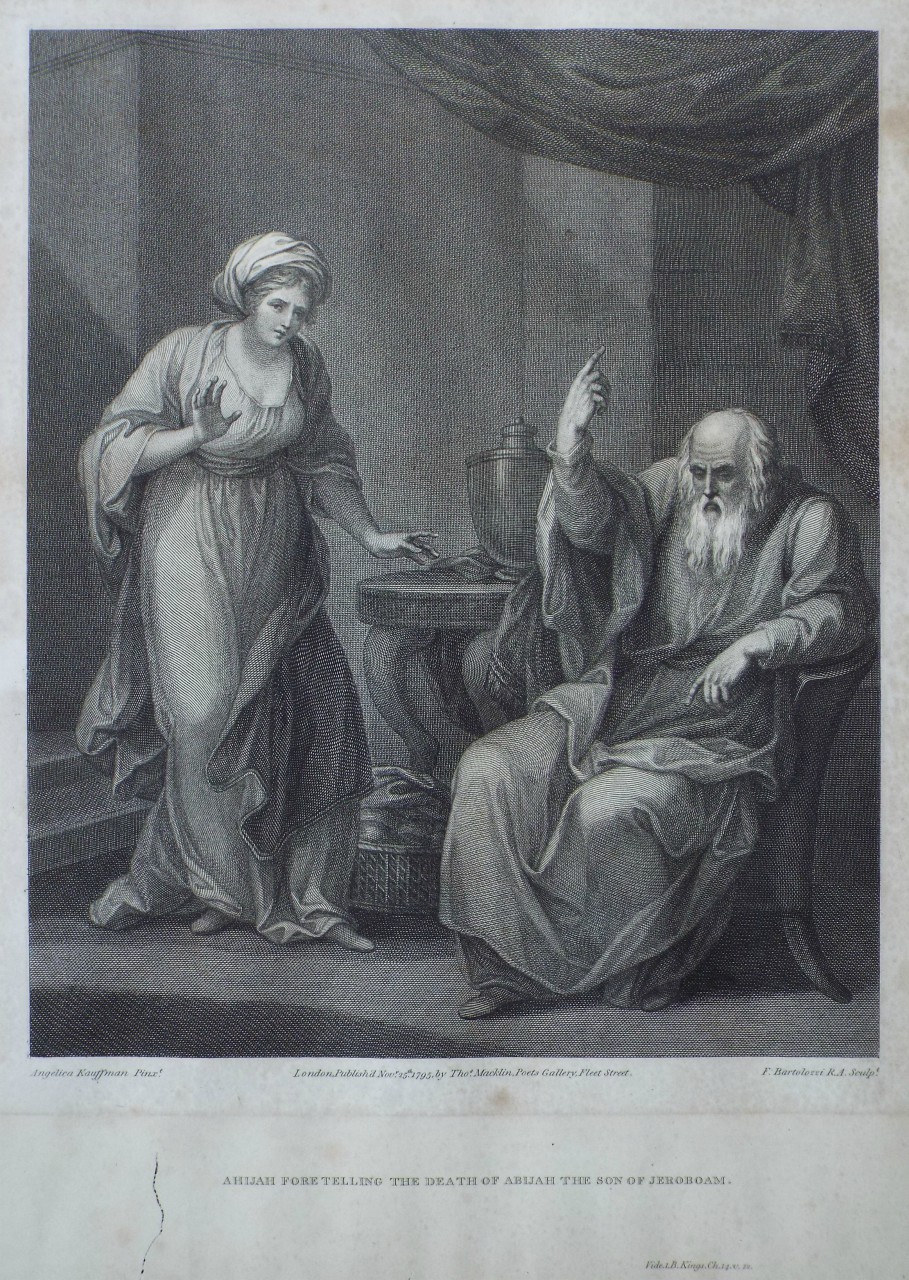
1 At that time Abijah the son of Jeroboam fell sick. 2 And Jeroboam said to his wife, “Arise, and disguise yourself, that it not be known that you are the wife of Jeroboam, and go to Shiloh. Behold, Ahijah the prophet is there, who said of me that I should be king over this people. 3 Take with you ten loaves, some cakes, and a jar of honey, and go to him. He will tell you what shall happen to the child.”

4 Jeroboam’s wife did so. She arose and went to Shiloh and came to the house of Ahijah. Now Ahijah could not see, for his eyes were dim because of his age. 5 And the LORD said to Ahijah, “Behold, the wife of Jeroboam is coming to inquire of you concerning her son, for he is sick. Thus and thus shall you say to her.”

When she came, she pretended to be another woman. 6 But when Ahijah heard the sound of her feet, as she came in at the door, he said, “Come in, wife of Jeroboam. Why do you pretend to be another? For I am charged with unbearable news for you. 7 Go, tell Jeroboam, ‘Thus says the LORD, the God of Israel: “Because I exalted you from among the people and made you leader over my people Israel 8 and tore the kingdom away from the house of David and gave it to you, and yet you have not been like my servant David, who kept my commandments and followed me with all his heart, doing only that which was right in my eyes, 9 but you have done evil above all who were before you and have gone and made for yourself other gods and metal images, provoking me to anger, and have cast me behind your back, 10 therefore behold, I will bring harm upon the house of Jeroboam and will cut off from Jeroboam every male, both bond and free in Israel, and will burn up the house of Jeroboam, as a man burns up dung until it is all gone. 11 Anyone belonging to Jeroboam who dies in the city the dogs shall eat, and anyone who dies in the open country the birds of the heavens shall eat, for the LORD has spoken it.”’ 12 Arise therefore, go to your house. When your feet enter the city, the child shall die. 13 And all Israel shall mourn for him and bury him, for he only of Jeroboam shall come to the grave, because in him there is found something pleasing to the LORD, the God of Israel, in the house of Jeroboam. 14 Moreover, the LORD will raise up for himself a king over Israel who shall cut off the house of Jeroboam today. And henceforth, 15 the LORD will strike Israel as a reed is shaken in the water, and root up Israel out of this good land that he gave to their fathers and scatter them beyond the Euphrates, because they have made their Asherim, provoking the LORD to anger. 16 And he will give Israel up because of the sins of Jeroboam, which he sinned and made Israel to sin.”

17 Then Jeroboam’s wife arose and departed and came to Tirzah. And as she came to the threshold of the house, the child died. 18 And all Israel buried him and mourned for him, according to the word of the LORD, which he spoke by his servant Ahijah the prophet. – 1 Kings 14:1-18 ESV

God had spoken His word of judgment against the false gods of Israel, and used a young, unnamed prophet to deliver it. This unidentified servant of God spoke his divine message directly to the altar itself. In the presence of King Jeroboam and the people of Israel, he addressed the sacred site itself, the place they had set up to worship and seek the favor of their man-made god. This shrine was located in the city of Bethel, in the southern region of the land belonging to the ten tribes. Jeroboam had constructed a second altar just like it in the northern city of Dan. In an attempt to prevent his people from returning to Judah to offer sacrifices to Yahweh at the temple in Jerusalem, he provided them with two new and more convenient worship sites. But these alternate sites and the altars they contained were adorned with golden calves, the man-made symbols of Jeroboam’s false gods. So, Yahweh had His prophet deliver a stinging indictment against one of these pseudo-sacred sites.

“O altar, altar! This is what the LORD says: A child named Josiah will be born into the dynasty of David. On you he will sacrifice the priests from the pagan shrines who come here to burn incense, and human bones will be burned on you.” – 1 Kings 13:2 NLT

Even these inanimate places of worship would be judged by God for the role they played in Israel’s apostasy. These carefully constructed sites made of handcrafted stones would end up desecrated and dishonored. The golden idols to which they were dedicated would be exposed for what they were: lifeless and powerless lumps of metal. The psalmist sardonically described the utter futility of these false gods.

Their idols are merely things of silver and gold,
    shaped by human hands.
They have mouths but cannot speak,
    and eyes but cannot see.
They have ears but cannot hear,
    and noses but cannot smell.
They have hands but cannot feel,
    and feet but cannot walk,
    and throats but cannot make a sound.
And those who make idols are just like them,
as are all who trust in them. – Psalm 115:4-8 NLT

Since Jeroboam had been responsible for the creation of these altars and the gods they contained, he too would experience the judgment of God. While he had been forced to stand and watch as the prophet destroyed one of his sacred shrines, he walked away unscathed. He was still the king, and his life went on just as it had before. After ordering the reconstruction of the altar, Jeroboam went about his business and soon forgot all that had happened at Bethel. But God had not forgotten the sins of Jeroboam.

Somewhere along the way, Jeroboam’s wife gave birth to a son, ensuring that he would have an heir to his throne to perpetuate his dynasty. But this joy was soon overshadowed by the news that Jeroboam’s son had become seriously ill. Concerned for his son’s health and his dynasty’s future, Jeroboam sent his wife to ask the prophet Ahijah for a divine prognosis. He wanted to know if his son would live or die.

Jeroboam likely chose to send his wife to Ahijah because the prophet had been the one to pronounce his kingship. Years earlier, Ahijah had been sent by Yahweh to inform Jeroboam that he had been selected to be the first king of the northern kingdom of Israel.

One day as Jeroboam was leaving Jerusalem, the prophet Ahijah from Shiloh met him along the way. Ahijah was wearing a new cloak. The two of them were alone in a field, and Ahijah took hold of the new cloak he was wearing and tore it into twelve pieces. Then he said to Jeroboam, “Take ten of these pieces, for this is what the LORD, the God of Israel, says: ‘I am about to tear the kingdom from the hand of Solomon, and I will give ten of the tribes to you!” – 1 Kings 11:29-31 NLT

The prophet made it clear that Jeroboam’s reign was the result of Solomon’s sin. The son of David had refused to remain faithful to Yahweh, having erected shrines and altars to the false gods of his many wives. As a result, God would divide his kingdom and establish ten of the 12 tribes as a separate nation-state. Jeroboam had done nothing to deserve his rise to power and prominence; it was the sovereign will of God.

The prophet also informed Jeroboam that Jerusalem would remain the place where Yahweh was to be worshiped. The two nations were to remain devoted to the worship of Yahweh and use the Temple in Jerusalem as their sole sacred site. As the newly installed king of Israel, Jeroboam would need to follow David’s example and encourage the ten northern tribes to remain faithful to Yahweh.

“I will place you on the throne of Israel, and you will rule over all that your heart desires. If you listen to what I tell you and follow my ways and do whatever I consider to be right, and if you obey my decrees and commands, as my servant David did, then I will always be with you. I will establish an enduring dynasty for you as I did for David, and I will give Israel to you.” – 1 Kings 11:37-38 NLT

But Jeroboam had failed to heed the prophet’s warning, and now he was suffering the consequences. Yet, when his son became ill, he chose to send his wife to the only man he believed could help him.

Even though Jeroboam’s wife had disguised herself to hide her identity as the queen, the old, blind prophet knew who she was as soon as she walked in the door. Ahijah had been given a divine “heads-up,” informing him of her visit and its purpose.

“Jeroboam’s wife will come here, pretending to be someone else. She will ask you about her son, for he is very sick. Give her the answer I give you.” – 1 Kings 14:5 NLT

As soon as this worried and grieving mother walked in the door, she was met with devastating news. Before she could speak a word, the prophet delivered a message of divine judgment against the house of Jeroboam. The woman who had delivered to Jeroboam an heir to his throne would now be charged with delivering a grim message of his dynasty’s destruction.

“Give your husband, Jeroboam, this message from the LORD, the God of Israel:…I will bring disaster on your dynasty and will destroy every one of your male descendants, slave and free alike, anywhere in Israel. I will burn up your royal dynasty as one burns up trash until it is all gone.” – 1 Kings 14:7, 10 NLT

The prophet made sure she understood that her husband’s reign had been a gift from God. Yahweh had “ripped the kingdom away from the family of David” and given it to Jeroboam (1 Kings 14:8 NLT), and Jeroboam had returned the favor by turning his back on God and causing the ten northern tribes to worship false gods. Just as God had predicted the future destruction of Jeroboam’s altars, He now decreed the destruction of Jeroboam’s heirs.

“The members of Jeroboam’s family who die in the city will be eaten by dogs, and those who die in the field will be eaten by vultures. I, the LORD, have spoken.” – 1 Kings 14:11 NLT

And much to his wife’s dismay, it would all begin with the death of his son.

“Go on home, and when you enter the city, the child will die.” – 1 Kings 14:12 NLT

It’s impossible to fathom the level of grief this woman felt upon hearing this devastating news. In just a matter of minutes, she had been informed that her entire world was about to collapse. Her husband’s kingdom was going to be destroyed, and her young son would die. The prophet made it painfully clear that it was all her husband’s fault. The message she had been given to deliver to Jeroboam left no doubts as to his culpability and sole responsibility for all that was about to happen.

“…you have not been like my servant David, who obeyed my commands and followed me with all his heart and always did whatever I wanted. You have done more evil than all who lived before you. You have made other gods for yourself and have made me furious with your gold calves.” – 1 Kings 14:8-9 NLT

But while this poor woman was still trying to process all that she had heard, Ahijah continued to deliver more bad news.

“In addition, the LORD will raise up a king over Israel who will destroy the family of Jeroboam. This will happen today, even now!” – 1 Kings 14:14 NLT

Jeroboam’s sin was going to have long-lasting consequences. His decision to lead the people of Israel into apostasy would be replicated by his successors, creating a lengthy lineage of spiritual adulterers among God’s chosen people. He had set the tone for their future rebellion, ensuring their eventual removal from the land of promise and their exile “beyond the Euphrates River” (1 Kings 14:15 NLT). Centuries later, God would use the nation of Assyria as His agents of judgment against the northern kingdom of Israel.

In 722 BC, this pagan nation conquered Israel and turned the chosen people of God into slaves. More than 200 years would pass before this devastating event took place. In the meantime, the kings of Israel would follow the pattern established by Jeroboam, leading the people of God into increasing rebellion and wickedness.

But at this point in the story, Jeroboam remains on the throne of Israel. For the moment, God allowed him to maintain his kingdom, but the die had been cast. The damage had been done, and the judgment of God had been decreed.

When Jeroboam’s poor wife returned home, the message of the prophet was confirmed.

“…as she came to the threshold of the house, the child died.” – 1 Kings 14:17 ESV

The judgment of God had begun.

English Standard Version (ESV) The Holy Bible, English Standard Version. ESV® Permanent Text Edition® (2016). Copyright © 2001 by Crossway Bibles, a publishing ministry of Good News Publishers.

New Living Translation (NLT) Holy Bible, New Living Translation, copyright © 1996, 2004, 2015 by Tyndale House Foundation. Used by permission of Tyndale House Publishers Inc., Carol Stream, Illinois 60188. All rights reserved.

The High Cost of Compromised Convictions

11 Now an old prophet lived in Bethel. And his sons came and told him all that the man of God had done that day in Bethel. They also told to their father the words that he had spoken to the king. 12 And their father said to them, “Which way did he go?” And his sons showed him the way that the man of God who came from Judah had gone. 13 And he said to his sons, “Saddle the donkey for me.” So they saddled the donkey for him and he mounted it. 14 And he went after the man of God and found him sitting under an oak. And he said to him, “Are you the man of God who came from Judah?” And he said, “I am.” 15 Then he said to him, “Come home with me and eat bread.” 16 And he said, “I may not return with you, or go in with you, neither will I eat bread nor drink water with you in this place, 17 for it was said to me by the word of the LORD, ‘You shall neither eat bread nor drink water there, nor return by the way that you came.’” 18 And he said to him, “I also am a prophet as you are, and an angel spoke to me by the word of the LORD, saying, ‘Bring him back with you into your house that he may eat bread and drink water.’” But he lied to him. 19 So he went back with him and ate bread in his house and drank water.

20 And as they sat at the table, the word of the LORD came to the prophet who had brought him back. 21 And he cried to the man of God who came from Judah, “Thus says the LORD, ‘Because you have disobeyed the word of the LORD and have not kept the command that the LORD your God commanded you, 22 but have come back and have eaten bread and drunk water in the place of which he said to you, “Eat no bread and drink no water,” your body shall not come to the tomb of your fathers.’” 23 And after he had eaten bread and drunk, he saddled the donkey for the prophet whom he had brought back. 24 And as he went away a lion met him on the road and killed him. And his body was thrown in the road, and the donkey stood beside it; the lion also stood beside the body. 25 And behold, men passed by and saw the body thrown in the road and the lion standing by the body. And they came and told it in the city where the old prophet lived.

26 And when the prophet who had brought him back from the way heard of it, he said, “It is the man of God who disobeyed the word of the LORD; therefore the LORD has given him to the lion, which has torn him and killed him, according to the word that the LORD spoke to him.” 27 And he said to his sons, “Saddle the donkey for me.” And they saddled it. 28 And he went and found his body thrown in the road, and the donkey and the lion standing beside the body. The lion had not eaten the body or torn the donkey. 29 And the prophet took up the body of the man of God and laid it on the donkey and brought it back to the city to mourn and to bury him. 30 And he laid the body in his own grave. And they mourned over him, saying, “Alas, my brother!” 31 And after he had buried him, he said to his sons, “When I die, bury me in the grave in which the man of God is buried; lay my bones beside his bones. 32 For the saying that he called out by the word of the LORD against the altar in Bethel and against all the houses of the high places that are in the cities of Samaria shall surely come to pass.”

33 After this thing Jeroboam did not turn from his evil way, but made priests for the high places again from among all the people. Any who would, he ordained to be priests of the high places. 34 And this thing became sin to the house of Jeroboam, so as to cut it off and to destroy it from the face of the earth. – 1 Kings 13:11-34 ESV

After delivering God’s message of judgment to Jeroboam and having destroyed the altar dedicated to one of Jeroboam’s false gods, the young prophet began his return journey to Judah. He had successfully fulfilled his God-ordained mission and was following Yahweh’s strict instructions to spend no additional time among the northern tribes. He was to accept no forms of hospitality or allow anything to delay his return home. He was even warned to take a different route back to Judah to prevent anyone from interfering with his mission. This young prophet had proved to be obedient to the will of God, even rejecting Jeroboam’s tempting offer of a meal and a reward. Instead, he declared his intentions to remain faithful to every detail of God’s instructions.

“Even if you gave me half of everything you own, I would not go with you. I would not eat or drink anything in this place. For the LORD gave me this command: ‘You must not eat or drink anything while you are there, and do not return to Judah by the same way you came.’” So he left Bethel and went home another way. – 1 Kings 13:8-10 NLT

But as the story continues to unfold and the young prophet makes his way home, he decides to take what appears to be an unsanctioned break under a large tree. Having not yet crossed the border into Judah, he decided to take a much-needed rest. While the text does not tell where the young man began his journey to Judah that day, he had likely spent many hours making the trip to Bethel. If he started his trip from Jerusalem, it would have been a 90-mile trek to Bethel. And now, after having destroyed Jeroboam’s altar to his false god, the prophet had to walk all the way back. So, it makes perfect sense that he was weary from all the activity and excitement of the day. He was tired, hungry, and alone. But he had not yet completed his mission. He had been instructed by God to return to Judah without delay and to avoid all distractions.

Yet, as the young man rested under the tree, he was approached by a stranger — an old prophet who happened to live in Bethel. The author provides few details about this man, except that he was a prophet and a father. His sons, who had witnessed the events at the altar that day, returned home and told him all that the young prophet had said and done. Intrigued by what he heard, the elder prophet commanded his sons to saddle a donkey so that he could seek out his younger peer. It seems likely that he simply wanted to verify the message the younger prophet had delivered. As a prophet himself, this older man would have been interested in whether the message delivered by the young man was actually from Yahweh. If it were, there were dark days ahead for the northern kingdom. What the young prophet declared at the altar earlier that day did not bode well for the ten northern tribes.

“A child named Josiah will be born into the dynasty of David. On you he will sacrifice the priests from the pagan shrines who come here to burn incense, and human bones will be burned on you.” – 1 Kings 13:2 NLT

Those were serious words that implied future judgment against the northern kingdom, and this senior prophet was anxious to verify their veracity. So, he mounted his donkey and began his search for the one who had delivered this foreboding message. Since the young prophet had decided to take his unscheduled rest stop under the tree, the older prophet caught up with him before he had crossed over into Judah. This is where the story gets interesting.

Based on what happens next, it is difficult to understand the motives of the older man. He clearly used deception to convince the younger prophet to return to his home for a meal. His offer was rejected by the young man because it violated the command of God.

“I am not allowed to eat or drink anything here in this place. For the Lord gave me this command: ‘You must not eat or drink anything while you are there, and do not return to Judah by the same way you came.’” – 1 Kings 13:16-17 NLT

They were still within the borders of Israel because the young prophet had not yet made it to the safety of Judah. But, anxious to hear more about the young man’s message from God, the older prophet lied to him. He falsely claimed to have been given a message from an angel commanding him to bring the young man to his home for a meal. Driven by hunger, the young prophet lowered his defenses and accepted the offer. But in doing so, he disobeyed the command of God. He allowed his physical appetites to cloud his thinking and compromise his convictions.

The text indicates that the young prophet violated the divine decree by sharing a meal in the older prophet’s home. As soon as he had eaten the food he had been commanded to avoid, the young man received a stinging rebuke from God delivered by the very man who had just deceived him.

“This is what the LORD says: You have defied the word of the LORD and have disobeyed the command the LORD your God gave you. You came back to this place and ate and drank where he told you not to eat or drink. Because of this, your body will not be buried in the grave of your ancestors.” – 1 Kings 13:21-22 NLT

This time, the older prophet had spoken the truth. His lie had caused the younger prophet to disobey God. Now, he had the unpleasant responsibility of delivering God’s message of judgment against the very man he had deceived and caused to disobey. The rest of the story reads like something out of Grimms’ Fairy Tales. The young man, with a full stomach and a heavy heart, began his journey home. But before he could make it into Judah, he was attacked by a lion. The beast killed the prophet but left the body and the donkey unmolested. Uncharacteristically, the lion stood sentry over the fallen body, protecting it from other predators. Passing travelers saw the strange scene and reported it back in Bethel. Upon hearing the news, the older prophet retrieved the body of the young man and placed it in his own tomb, located in the city of Bethel.

The old man was now fully convinced that what the young prophet had said had been the word of God.

“For the message the LORD told him to proclaim against the altar in Bethel and against the pagan shrines in the towns of Samaria will certainly come true.” – 1 Kings 13:32 NLT

Yahweh had used this young, unnamed prophet to declare His judgment against the ten northern tribes. Their continued apostasy would eventually lead to their destruction. When it came to His chosen people, God was deadly serious about their obedience to Him. Whether they were a fully united confederation of 12 tribes or divided into two rival kingdoms, they remained His prized possession and were obligated to live according to His commands. Obedience would bring the blessings of God, but disobedience would bring His curses.

The young prophet had learned the costly lesson that partial obedience was insufficient and unacceptable to God. He had almost completed his mission but had ultimately failed. He had been sent by God, but he ultimately ended up being punished by God for allowing worldly distractions to divert him from his ultimate goal. Had he crossed the border into Judah, he could have eaten his fill of food. But he compromised and allowed his physical appetites to cloud his thinking and distract him from his God-given assignment, and he paid dearly for his mistake. This young man’s life is a perfect illustration of what the apostle John warned about in his first epistle.

Do not love this world nor the things it offers you, for when you love the world, you do not have the love of the Father in you. For the world offers only a craving for physical pleasure, a craving for everything we see, and pride in our achievements and possessions. These are not from the Father, but are from this world. And this world is fading away, along with everything that people crave. But anyone who does what pleases God will live forever. – 1 John 2:15-17 NLT

The young prophet’s desire for physical pleasure ended up superseding his love for God, and it proved not only disappointing but deadly. The older and supposedly wiser prophet had long ago compromised his convictions by remaining in Israel long after Jeroboam had erected his false gods and created his own religion. He had done nothing to address the apostasy in Israel, and he seemed unbothered by the fact that Jeroboam restricted the people from returning to Jerusalem to celebrate the annual feasts. The fact that Yahweh chose to use a younger and much less experienced prophet to deliver His message of judgment to Jeroboam speaks volumes. Yet, in the end, the older prophet was convicted by his compromise and complacency and did the right thing.

So the prophet laid the body of the man of God on the donkey and took it back to the town to mourn over him and bury him. He laid the body in his own grave, crying out in grief, “Oh, my brother!” – 1 Kings 13:29-30 NLT

English Standard Version (ESV) The Holy Bible, English Standard Version. ESV® Permanent Text Edition® (2016). Copyright © 2001 by Crossway Bibles, a publishing ministry of Good News Publishers.

New Living Translation (NLT) Holy Bible, New Living Translation, copyright © 1996, 2004, 2015 by Tyndale House Foundation. Used by permission of Tyndale House Publishers Inc., Carol Stream, Illinois 60188. All rights reserved.

Sovereign Over All

1 And behold, a man of God came out of Judah by the word of the LORD to Bethel. Jeroboam was standing by the altar to make offerings. 2 And the man cried against the altar by the word of the LORD and said, “O altar, altar, thus says the LORD: ‘Behold, a son shall be born to the house of David, Josiah by name, and he shall sacrifice on you the priests of the high places who make offerings on you, and human bones shall be burned on you.’” 3 And he gave a sign the same day, saying, “This is the sign that the LORD spoken: ‘Behold, the altar shall be torn down, and the ashes that are on it shall be poured out.’” 4 And when the king heard the saying of the man of God, which he cried against the altar at Bethel, Jeroboam stretched out his hand from the altar, saying, “Seize him.” And his hand, which he stretched out against him, dried up, so that he could not draw it back to himself. 5 The altar also was torn down, and the ashes poured out from the altar, according to the sign that the man of God had given by the word of the LORD. 6 And the king said to the man of God, “Entreat now the favor of the LORD your God, and pray for me, that my hand may be restored to me.” And the man of God entreated the LORD, and the king’s hand was restored to him and became as it was before. 7 And the king said to the man of God, “Come home with me, and refresh yourself, and I will give you a reward.” 8 And the man of God said to the king, “If you give me half your house, I will not go in with you. And I will not eat bread or drink water in this place, 9 for so was it commanded me by the word of the LORD, saying, ‘You shall neither eat bread nor drink water nor return by the way that you came.’” 10 So he went another way and did not return by the way that he came to Bethel. – 1 Kings 13:1-10 ESV

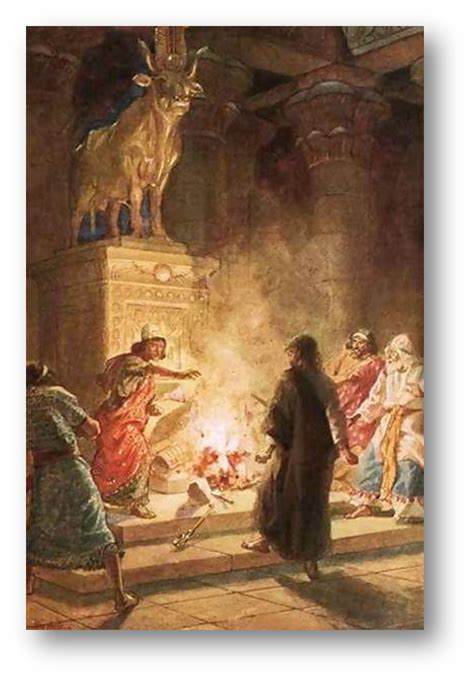
In an effort to preserve the kingdom given to him by God, Jeroboam made a boneheaded decision that ended up offending God. He knew that the members of the ten northern tribes were religious people and feared that they would continue to travel to Judah to offer sacrifices at the Temple Solomon had built in Jerusalem. This continued spiritual connection to the holy city might influence them to restore their relationship with Rehoboam and the people of Judah. So, to prevent this from happening, Jeroboam made the fateful decision to create an alternate religion for the ten tribes of Israel, complete with priests and golden idols made to look like calves, which he had placed in the cities of Dan and Bethel. Then he convinced the people to turn their backs on Yahweh by offering their sacrifices to the two golden calves.

“It is too much trouble for you to worship in Jerusalem. Look, Israel, these are the gods who brought you out of Egypt!”

He placed these calf idols in Bethel and in Dan—at either end of his kingdom. But this became a great sin, for the people worshiped the idols, traveling as far north as Dan to worship the one there. – 1 Kings 12:28-30 NLT

In following Jeroboam’s lead, the people no longer sought forgiveness, cleansing, and blessing from God Almighty, but placed their hopes in lifeless statues made by human hands. Years later, the prophet Isaiah would describe the futility of worshiping false gods.

How foolish are those who manufacture idols.
    These prized objects are really worthless.
The people who worship idols don’t know this,
    so they are all put to shame.
Who but a fool would make his own god—
    an idol that cannot help him one bit?
All who worship idols will be disgraced
    along with all these craftsmen—mere humans—
    who claim they can make a god.
They may all stand together,
    but they will stand in terror and shame. – Isaiah 44:9-11 NLT

But to Jeroboam, his decision made all the sense in the world. He was a pragmatist who was more interested in preserving his newfound status as king than in promoting the ongoing worship of the one who had made him king. And his decision, while initially successful, was about to prove seriously flawed.

Jeroboam had traveled to Bethel to offer sacrifices to one of his false gods. But while there, he received a visit from a prophet of the one true God. This unnamed man had come from Judah with a message from Yahweh. So, as Jeroboam was about to offer sacrifices to his visible, but lifeless god, he was given a word from the invisible, yet all-powerful God of Israel. And the prophet, seemingly ignoring Jeroboam, directed his message at the altar the king had constructed. In a sense, this was one deity speaking to another. Yahweh was challenging the false god of Jeroboam by delivering a prophecy concerning its coming destruction.

“O altar, altar! This is what the LORD says: A child named Josiah will be born into the dynasty of David. On you he will sacrifice the priests from the pagan shrines who come here to burn incense, and human bones will be burned on you.” – 1 Kings 13:2 NLT

Jeroboam’s god was going to meet an untimely end. When faced with the power of God Almighty, Jeroboam’s false god proved incapable of defending itself. It remained speechless because it was lifeless. And the warning delivered by the prophet of God carried long-term ramifications. It would be 290 years later before God fulfilled His word, and all during that time, the nation of Israel would continue to worship their false gods. But eventually, God would raise up a king over the southern kingdom of Judah named Josiah, and he would institute a series of religious reforms in both Judah and Israel. In doing so, he would fulfill God’s prophecy against the altar of Jeroboam’s false god.

The king also tore down the altar at Bethel—the pagan shrine that Jeroboam son of Nebat had made when he caused Israel to sin. He burned down the shrine and ground it to dust, and he burned the Asherah pole. Then Josiah turned around and noticed several tombs in the side of the hill. He ordered that the bones be brought out, and he burned them on the altar at Bethel to desecrate it. (This happened just as the LORD had promised through the man of God when Jeroboam stood beside the altar at the festival.) – 2 Kings 23:15-16 NLT

The very fact that this altar was still in existence and in use nearly 300 years later reveals the level of apostasy in Israel. Jeroboam’s decision to replace Yahweh with false gods was going to have long-lasting consequences. In an effort to preserve his kingdom, Jeroboam had been willing to sacrifice the spiritual well-being of his own people.

And to demonstrate that the words he had spoken were true, “the man of God gave a sign to prove his message” (1 Kings 13:3 NLT).

He said, “The LORD has promised to give this sign: This altar will split apart, and its ashes will be poured out on the ground.” – 1 Kings 13:3 NLT

God was going to validate His word with a powerful sign. There would be an immediate judgment on Jeroboam’s apostasy. His shrine and the golden calf it contained would be destroyed. But, once again, Jeroboam attempted to preserve his kingdom by rejecting the will of God. After the prophet had spoken his word of warning, Jeroboam commanded that he be arrested. He wrongly assumed that he could thwart the will of God by binding the messenger of God. In doing so, Jeroboam would establish a precedent that would carry over for generations. His successors to the throne of Israel would continue to reject the will of God by resisting and refusing the messengers of God. Rather than repent and return in humble submission to Yahweh, they would each cling stubbornly to their false gods, dooming their people to the judgment of God.

But Jeroboam’s attempt to stop God’s prophet proved ineffective and injurious. He still ended up with a shattered altar and a paralyzed hand. Suddenly convinced of the prophet’s position as God’s spokesman, Jeroboam begged him to intercede with Yahweh on his behalf.

“Entreat now the favor of the LORD your God, and pray for me, that my hand may be restored to me.” – 1 Kings 13:6 ESV

The prophet prayed and God responded, restoring full mobility to Jeroboam’s paralyzed hand. But Jeroboam’s response to this miracle is revealing. Having just witnessed the miraculous destruction of the altar to his false god and having had his hand paralyzed by God, you would think that Jeroboam would have begged for forgiveness. But instead, he tries to win over the favor of the prophet by inviting him to dinner and offering him a reward. Perhaps Jeroboam feared that the prophet might turn his attention to Dan and destroy the altar there. So, in another attempt to preserve his kingdom, he tried to bribe the prophet of God.

But God, knowing the true nature of Jeroboam’s heart, had warned the prophet not to accept any invitation from this conniving and calculating king.

“Even if you gave me half of everything you own, I would not go with you. I would not eat or drink anything in this place. For the Lord gave me this command: ‘You must not eat or drink anything while you are there, and do not return to Judah by the same way you came.’” – 1 Kings 13:8-9 NLT

Jeroboam was a man who, for the sake of his kingdom, had been willing to compromise his faith in God. And he assumed that this unnamed prophet would be just as willing to make concessions in exchange for monetary gain. But he was wrong. This unnamed prophet of Yahweh refused to compromise his convictions for personal gain. Even when faced with Jeroboam’s offer of a reward, this faithful servant remained uncompromising in his commitment to the will of God. He recognized Yahweh as the one true God and refused to be tempted by Jeroboam’s thinly veiled offer of monetary gain in exchange for spiritual infidelity. His actions reflect his firm and unwavering belief in his God, and echo the words Yahweh spoke through the prophet Isaiah.

This is what the LORD says—
    your Redeemer and Creator:
“I am the LORD, who made all things.
    I alone stretched out the heavens.
Who was with me
    when I made the earth?
I expose the false prophets as liars
    and make fools of fortune-tellers.
I cause the wise to give bad advice,
    thus proving them to be fools.
But I carry out the predictions of my prophets!” – Isaiah 44:24-26 NLT

Jeroboam’s reign over the ten northern tribes had been the work of God, not the result of his own ambition and ingenuity. Yahweh had ordained his rise to power as part of a judgment against Solomon for his spiritual infidelity that resulted in the proliferation of false gods in Israel. But rather than honor Yahweh for His providential role in his rise to power, Jeroboam had created his own religion, complete with its own gods, priestly caste, and sacrificial system. In a vain attempt to solidify his kingdom, Jeroboam led the ten northern tribes to abandon Yahweh and place their hope in the golden calves he had made.

Despite Jeroboam’s actions, the young prophet’s appearance serves as a sign that Yahweh was still in control. Jeroboam could create his own gods and erect shrines in their honor, but he could not escape the sovereign will of Yahweh. According to the word of the prophet, Jeroboam’s altar was destroyed and the ashes poured out. His god proved to be powerless before the one true God, and Jeroboam’s attempt to have the prophet arrested proved futile. As he pointed his finger at the prophet and ordered his arrest, Yahweh intervened, paralyzing Jeroboam’s arm and forcing him to watch as his precious altar was destroyed. Ironically, the rebellious Jeroboam was forced to beg the prophet to call on Yahweh for healing. Rather than appeal to his own self-manufactured god, Jeroboam knew that Yahweh was his only hope.

The prophet prayed, and the LORD answered. Despite his track record of unfaithfulness, Jeroboam received grace and mercy from Yahweh. The recalcitrant king’s hand was restored, and his kingdom was preserved because Yahweh had a much larger plan in place that Jeroboam or any other king could not oppose.

English Standard Version (ESV) The Holy Bible, English Standard Version. ESV® Permanent Text Edition® (2016). Copyright © 2001 by Crossway Bibles, a publishing ministry of Good News Publishers.

New Living Translation (NLT) Holy Bible, New Living Translation, copyright © 1996, 2004, 2015 by Tyndale House Foundation. Used by permission of Tyndale House Publishers Inc., Carol Stream, Illinois 60188. All rights reserved.

Divided Allegiance

25 Then Jeroboam built Shechem in the hill country of Ephraim and lived there. And he went out from there and built Penuel. 26 And Jeroboam said in his heart, “Now the kingdom will turn back to the house of David. 27 If this people go up to offer sacrifices in the temple of the LORD at Jerusalem, then the heart of this people will turn again to their lord, to Rehoboam king of Judah, and they will kill me and return to Rehoboam king of Judah.” 28 So the king took counsel and made two calves of gold. And he said to the people, “You have gone up to Jerusalem long enough. Behold your gods, O Israel, who brought you up out of the land of Egypt.” 29 And he set one in Bethel, and the other he put in Dan. 30 Then this thing became a sin, for the people went as far as Dan to be before one. 31 He also made temples on high places and appointed priests from among all the people, who were not of the Levites. 32 And Jeroboam appointed a feast on the fifteenth day of the eighth month like the feast that was in Judah, and he offered sacrifices on the altar. So he did in Bethel, sacrificing to the calves that he made. And he placed in Bethel the priests of the high places that he had made. 33 He went up to the altar that he had made in Bethel on the fifteenth day in the eighth month, in the month that he had devised from his own heart. And he instituted a feast for the people of Israel and went up to the altar to make offerings. – 1 Kings 12:25-33 ESV

Because of Solomon’s unfaithfulness, God divided his vast kingdom in half, placing ten of the 12 tribes under the rule of Jeroboam. This left Rehoboam, the son of Solomon, with only the tribe over which to reign, that of Judah. The sprawling domain he had inherited from his father had been greatly diminished, virtually overnight. This judgment against Solomon resulted in the division of one kingdom into two. In the north, the ten tribes would become the nation of Israel. In the south, the tribe of Judah, which was later joined by the tribe of Benjamin, would become known as the nation of Judah.

The 12 tribes of Israel were the descendants of the 12 sons of Jacob, whose name God later changed to Israel. These 12 tribes had been set apart by God and bestowed with a great privilege; they were to be His chosen people.

“For you are a people holy to the LORD your God. The LORD your God has chosen you to be a people for his treasured possession, out of all the peoples who are on the face of the earth.” – Deuteronomy 7:6 ESV

“And the LORD has declared today that you are a people for his treasured possession, as he has promised you, and that you are to keep all his commandments, and that he will set you in praise and in fame and in honor high above all nations that he has made, and that you shall be a people holy to the LORD your God, as he promised.” – Deuteronomy 26:18-19 ESV

God had miraculously rescued them out of their slavery in Egypt and had led them to the land of Canaan, which He had promised to give them as their inheritance. On their way to this promised land, God graciously provided them with His law, which provided them with detailed instructions regarding their behavior as His chosen people. They were His treasured possession and, as such, they were to reflect their unique status by conducting their lives according to His commands. This would ensure that they remained holy or set apart, living distinctively different lives from all the other nations of the world. And because God knew they would fail to keep all His laws, He provided them with the sacrificial system so they could receive cleansing from and forgiveness for their sins. But the one thing God required from them was faithfulness. The very first law He had given them to obey concerned their unwavering allegiance to Him.

“You shall have no other gods before me.” – Exodus 20:3 ESV

And because He knew the natural proclivity of man’s heart, God elaborated on His command by adding the following restrictions:

“You shall not make for yourself a carved image, or any likeness of anything that is in heaven above, or that is in the earth beneath, or that is in the water under the earth. You shall not bow down to them or serve them, for I the LORD your God am a jealous God, visiting the iniquity of the fathers on the children to the third and the fourth generation of those who hate me…” – Exodus 20:4-5 ESV

The book of Exodus goes on to record that the very day Moses came down from the top of Mount Sinai with the commandments of God in hand, he discovered the people of Israel had already violated the first command. While he had been on the mountaintop, the people had begun to have second thoughts about his leadership and the God he claimed to represent.

When the people saw that Moses delayed to come down from the mountain, the people gathered themselves together to Aaron and said to him, “Up, make us gods who shall go before us. As for this Moses, the man who brought us up out of the land of Egypt, we do not know what has become of him.” – Exodus 32:1 ESV

Aaron, the brother of Moses, obliged the people and ordered the construction of a golden calf, which the people promptly began to worship. When Moses later descended from Mount Sinai, he found the people dancing and singing before their newly crafted god.

And as soon as he came near the camp and saw the calf and the dancing, Moses’ anger burned hot, and he threw the tablets out of his hands and broke them at the foot of the mountain. He took the calf that they had made and burned it with fire… – Exodus 32:19-20 ESV

However, this wasn’t a new god; it was a reimagining of the one true God. When the golden calf was finished, the people said, “These are your gods, O Israel, who brought you up out of the land of Egypt!” (Exodus 32:4 ESV). But this declaration by the people concerned Aaron.

When Aaron saw this, he built an altar before it. And Aaron made a proclamation and said, “Tomorrow shall be a feast to the LORD.” – Exodus 32:5 ESV

Aaron clarified that this idol was to be seen as a representation of Yahweh, the LORD. He had helped the people create a more approachable and personable Yahweh. Rather than the God of smoke, fire, thunder, and lightning that had appeared on Mount Sinai, they now had a version of Yahweh that reminded them of the false gods they worshiped back in Egypt. 

This proclivity for unfaithfulness did not stop in the wilderness of Sinai. Even after God graciously led them to the land of Canaan and assisted them in conquering and occupying the land He had promised to give them, the people continued their pattern of disobedience, which led to further spiritual adultery. Idolatry became a habit for the people of God. And it was Solomon’s own penchant for false gods that led to the division of his kingdom.

…when Solomon was old his wives turned away his heart after other gods, and his heart was not wholly true to the LORD his God, as was the heart of David his father. For Solomon went after Ashtoreth the goddess of the Sidonians, and after Milcom the abomination of the Ammonites. So Solomon did what was evil in the sight of the LORD… – 1 Kings 11:4-6 ESV

But the infidelity of the people of Israel didn’t end with God’s judgment. As this chapter reveals, they seemed to have an endless capacity for unfaithfulness. As soon as Jeroboam was crowned king over the ten northern tribes, he made an executive decision that he hoped would guarantee his reign for years to come. Fearing that the people would feel obligated to worship Yahweh in Jerusalem, where Solomon’s temple was located, Jeroboam came up with a plan to erect his own holy cities with his own gods. This would eliminate the need for any Israelite to journey to Jerusalem to offer sacrifices. So, buoyed by the advice of his counselors, Jeroboam built these shrines in the cities of Dan and Bethel. Just like Aaron and Solomon, Jeroboam became personally responsible for leading the people into rebellion against God.

This caused Israel to sin; the people went to Bethel and Dan to worship the calves. – 1 Kings 12:20 ESV

And Jeroboam didn’t stop with the construction of these shrines to his man-made gods. He created his own religious system, complete with priests and a sacrificial system. He attempted to replicate all the details of the system established by Yahweh and, in doing so, provided the people with an alternative means of cleansing and forgiveness. But everything he did was in direct violation of Yahweh’s law.

It’s important to remember that God had given Jeroboam his kingdom and his kingship. He had done nothing to earn his new position or to establish his domain. It had all been handed to him by the sovereign will of God. And yet, fearing that he might lose what he had been given, Jeroboam chose to violate the will of God to protect and preserve his newfound power and prestige. Relying on faulty human reasoning, he determined that the best way to maintain the people’s allegiance was to provide them with their own gods to worship. And like docile sheep, the people willingly followed the lead of their new shepherd.

On the fifteenth day of the eighth month (a date he had arbitrarily chosen) Jeroboam offered sacrifices on the altar he had made in Bethel. He inaugurated a festival for the Israelites and went up to the altar to offer sacrifices. – 1 Kings 12: 33 NLT

The many shrines that Solomon had built to honor Ashtoreth, the goddess of the Sidonians; Milcom, the god of the Ammonites; and Chemosh, the god of Moab, were still in the land of Judah. The spirit of idolatry had not ended with the split of the kingdom. Now, Jeroboam had ensured that the ten northern tribes had their own false gods to worship in place of the one true God.

Centuries later, the apostle Paul described mankind’s tendency to try to replace the one true God with their own versions of Him.

But God shows his anger from heaven against all sinful, wicked people who suppress the truth by their wickedness.  They know the truth about God because he has made it obvious to them. For ever since the world was created, people have seen the earth and sky. Through everything God made, they can clearly see his invisible qualities—his eternal power and divine nature. So they have no excuse for not knowing God.

Yes, they knew God, but they wouldn’t worship him as God or even give him thanks. And they began to think up foolish ideas of what God was like. As a result, their minds became dark and confused. Claiming to be wise, they instead became utter fools. And instead of worshiping the glorious, ever-living God, they worshiped idols made to look like mere people and birds and animals and reptiles. – Romans 1:18-23 NLT

The Israelites, whom Yahweh had chosen to be His treasured possession, had every reason to know and understand the truth about God. He had redeemed them out of slavery in Egypt. He had led them across the wilderness to Mount Sinai, where He appeared to them in the form of a dark cloud complete with thunder and lightning. From Sinai’s peak, He had given them His law and the plans for the Tabernacle, which would serve as His heavenly dwelling place during their journey to Canaan.

Yahweh assisted them in their conquest of the land of Canaan and fulfilled His promise to give them the land as their inheritance. But the people of Israel have proved to be far from faithful and prone to spiritual infidelity. Solomon had set the tone, and his successors would follow his lead. The rest of the Book of Kings chronicles the sad story of how the divided nation of Israel failed to give Yahweh their undivided allegiance. Led by their kings, the people of Israel would consistently turn their backs on Yahweh. They would never entirely abandon Him, but they would consistently break their covenant commitment to Him.

English Standard Version (ESV) The Holy Bible, English Standard Version. ESV® Permanent Text Edition® (2016). Copyright © 2001 by Crossway Bibles, a publishing ministry of Good News Publishers.

New Living Translation (NLT) Holy Bible, New Living Translation, copyright © 1996, 2004, 2015 by Tyndale House Foundation. Used by permission of Tyndale House Publishers Inc., Carol Stream, Illinois 60188. All rights reserved.
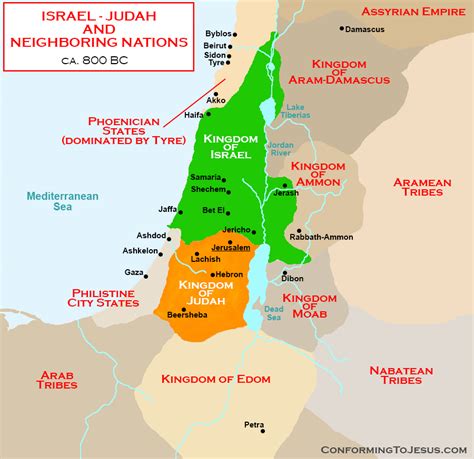
A Sad, But Sovereign State of Affairs

16 And when all Israel saw that the king did not listen to them, the people answered the king, “What portion do we have in David? We have no inheritance in the son of Jesse. To your tents, O Israel! Look now to your own house, David.” So Israel went to their tents. 17 But Rehoboam reigned over the people of Israel who lived in the cities of Judah. 18 Then King Rehoboam sent Adoram, who was taskmaster over the forced labor, and all Israel stoned him to death with stones. And King Rehoboam hurried to mount his chariot to flee to Jerusalem. 19 So Israel has been in rebellion against the house of David to this day. 20 And when all Israel heard that Jeroboam had returned, they sent and called him to the assembly and made him king over all Israel. There was none that followed the house of David but the tribe of Judah only.

21 When Rehoboam came to Jerusalem, he assembled all the house of Judah and the tribe of Benjamin, 180,000 chosen warriors, to fight against the house of Israel, to restore the kingdom to Rehoboam the son of Solomon. 22 But the word of God came to Shemaiah the man of God: 23 “Say to Rehoboam the son of Solomon, king of Judah, and to all the house of Judah and Benjamin, and to the rest of the people, 24 ‘Thus says the LORD, You shall not go up or fight against your relatives the people of Israel. Every man return to his home, for this thing is from me.’” So they listened to the word of the LORD and went home again, according to the word of the LORD. – 1 Kings 12:16-24 ESV

Reigning over the 12 tribes of Israel had never been an easy task. Even the great King David found it difficult to win over the allegiance of all the tribes when he first ascended to the throne. After the death of King Saul, David’s own tribe of Judah immediately crowned him as their king, but the rest of the tribes anointed Saul’s son, Ish-bosheth, as their king. This included Gilead, the Ashurites, Jezreel, Ephraim, Benjamin, and all Israel (2 Samuel 2:9). For seven and a half years, David reigned over the tribe of Judah, while the rest of the tribes gave their allegiance to Ish-bosheth. However, eventually, these two factions ended up fighting against one another.

There was a long war between the house of Saul and the house of David. And David grew stronger and stronger, while the house of Saul became weaker and weaker. – 2 Samuel 3:1 ESV

After a long and protracted struggle, Ish-bosheth was assassinated by two of his own soldiers, leaving the 11 tribes of Israel in a state of disarray. Eventually, they settled their dispute with Judah and agreed to accept David as their king.

So all the elders of Israel came to the king at Hebron, and King David made a covenant with them at Hebron before the LORD, and they anointed David king over Israel. David was thirty years old when he began to reign, and he reigned forty years. At Hebron he reigned over Judah seven years and six months, and at Jerusalem he reigned over all Israel and Judah thirty-three years. – 2 Samuel 5:3-5 ESV

Each of these tribes was characterized by a strong, independent streak and a natural desire for autonomy. While they had all demanded that Samuel the prophet appoint a king over them, they would have each preferred that he choose a man from their own particular tribe. This strong tribal allegiance made it difficult for any of Israel’s kings to rule without experiencing some form of unrest or dissatisfaction from the various clans. Ruling over this confederation of 12 tribes required diplomacy and humility. No king could expect to manage this diverse conglomeration of autonomous people groups through intimidation or brute force.

Yet, here was Rehoboam, the new king of Israel, attempting to do just that. Having heard the request of his people that he rescind some of his father’s more abusive policies, Rehoboam ignored their plea and threatened them with even worse conditions.

“My father laid heavy burdens on you, but I’m going to make them even heavier! My father beat you with whips, but I will beat you with scorpions!” – 1 Kings 12:14 NLT

Emboldened by the foolish counsel of his inexperienced peers, Rehoboam had decided that intimidation was better than negotiation. He stubbornly refused to make any concessions and, in doing so, he ended up alienating ten of the 12 tribes of Israel. In just a matter of minutes, Rehoboam managed to destroy the kingdom his father and grandfather had spent 80 years building.

When all Israel realized that the king had refused to listen to them, they responded,

“Down with the dynasty of David!
    We have no interest in the son of Jesse.
Back to your homes, O Israel!
    Look out for your own house, O David!”

So the people of Israel returned home. – 1 Kings 12:16 NLT

Centuries later, Jesus would make a statement that powerfully illustrates the folly of Rehoboam’s decision: “Every kingdom divided against itself is laid waste, and no city or house divided against itself will stand” (Matthew 12:25 ESV). In a single act, fueled by youthful pride and arrogance, Rehoboam managed to destroy one of the greatest nations on the face of the earth.

The people of Judah and Israel were as innumerable as the sand on the seashore; they had plenty to eat and drink and were happy. Solomon ruled all the kingdoms from the Euphrates River to the land of the Philistines, as far as the border of Egypt. These kingdoms paid tribute as Solomon’s subjects throughout his lifetime. – 1 Kings 4:20-21 NLT

Rehoboam had inherited his father’s wealth, crown, and vast domain, but it seems that his father’s wisdom had been non-transferable. He was operating in ignorance and determined to do things his own way, and he would learn the painful lesson from one of the many proverbs his father had collected.

There is a way that seems right to a man, but its end is the way to death. – Proverbs 14:12 ESV

This stubborn young man refused to believe that his kingdom was lost. In a futile effort to quell what he saw as an insurrection, “Rehoboam sent Adoniram, who was in charge of forced labor, to restore order, but the people of Israel stoned him to death” (1 Kings 12:18 NLT). Rehoboam quickly discovered that he was a king with a much-diminished kingdom. He had lost control over the entire northern region of the nation and was left with nothing but the land belonging to the tribe of Judah as his domain. The author of 1 Kings ensures that his audience understands the gravity of the situation.

And to this day the northern tribes of Israel have refused to be ruled by a descendant of David. – 1 Kings 12:19 NLT

This was not a temporary setback, but a permanent realignment of the nation of Israel’s political, civil, and religious fortunes. What happened that day would have long-term implications for all 12 tribes. And, as the author points out, this entire scenario played out according to the sovereign will of God; it had all been His doing. Yes, Rehoboam had played his part, alienating his fellow Israelites by refusing to listen to their calls for justice. But God had already warned that this was going to happen. It was His judgment against Solomon for his sin and rebellion.

The LORD was very angry with Solomon, for his heart had turned away from the LORD, the God of Israel, who had appeared to him twice. He had warned Solomon specifically about worshiping other gods, but Solomon did not listen to the LORD’s command. So now the LORD said to him, “Since you have not kept my covenant and have disobeyed my decrees, I will surely tear the kingdom away from you and give it to one of your servants.” – 1 Kings 11:9-11 NLT

This had all been God’s will. Yet, Rehoboam continued to stubbornly refuse to accept his fate. In a last-ditch effort to restore his kingdom, he assembled an army of 180,000 men from the tribes of Judah and Benjamin with the intent to fight a civil war against his own people. But God graciously intervened.

“Say to Rehoboam the son of Solomon, king of Judah, and to all the house of Judah and Benjamin, and to the rest of the people, ‘Thus says the LORD, You shall not go up or fight against your relatives the people of Israel. Every man return to his home, for this thing is from me.’” – 1 Kings 12:23-24 NLT

Rehoboam would not be able to thwart God’s will. The die had been cast, and the outcome was set in stone. The nation was divided, and no one could restore it to its former glory. The rest of the book of 1 Kings chronicles the somewhat sordid history of the divided nation of Israel. Virtually overnight, what had once been a rich and powerful kingdom was reduced to a shadow of its former glory. The ten tribes in the north became the nation of Israel, while Judah eventually joined forces with the tribe of Benjamin to form the nation of Judah.

These two nations would not only find themselves constantly at odds with one another, but also with God. The unfaithfulness displayed by Solomon would continue on both sides of the border that separated these two nations. For generations to come, the people whom God had chosen would choose to disobey and dishonor Him. Yet, throughout it all, He would continue to display His love and grace, sending His prophets to call His people to repent and return. Despite their unfaithfulness, He would remain faithful.

To his credit, Rehoboam listened to the words of Shemaiah, the man of God. This prophet delivered a message from Yahweh forbidding Rehoboam from using his 180,000 chosen warriors to attack the newly formed house of Israel. This prideful young king had demonstrated a propensity for acting impulsively and unwisely, but, in this case, he heeded the prophet’s warning and obeyed the command of Yahweh. Peace reigned because God intervened. But, as the text reveals, “to this day the northern tribes of Israel have refused to be ruled by a descendant of David” (1 Kings 12:19 NLT). 

English Standard Version (ESV) The Holy Bible, English Standard Version. ESV® Permanent Text Edition® (2016). Copyright © 2001 by Crossway Bibles, a publishing ministry of Good News Publishers.

New Living Translation (NLT) Holy Bible, New Living Translation, copyright © 1996, 2004, 2015 by Tyndale House Foundation. Used by permission of Tyndale House Publishers Inc., Carol Stream, Illinois 60188. All rights reserved.

The Pernicious Problem of Pride

41 Now the rest of the acts of Solomon, and all that he did, and his wisdom, are they not written in the Book of the Acts of Solomon? 42 And the time that Solomon reigned in Jerusalem over all Israel was forty years. 43 And Solomon slept with his fathers and was buried in the city of David his father. And Rehoboam his son reigned in his place.

1 Rehoboam went to Shechem, for all Israel had come to Shechem to make him king. 2 And as soon as Jeroboam the son of Nebat heard of it (for he was still in Egypt, where he had fled from King Solomon), then Jeroboam returned from Egypt. 3 And they sent and called him, and Jeroboam and all the assembly of Israel came and said to Rehoboam, 4 “Your father made our yoke heavy. Now therefore lighten the hard service of your father and his heavy yoke on us, and we will serve you.” 5 He said to them, “Go away for three days, then come again to me.” So the people went away.

6 Then King Rehoboam took counsel with the old men, who had stood before Solomon his father while he was yet alive, saying, “How do you advise me to answer this people?” 7 And they said to him, “If you will be a servant to this people today and serve them, and speak good words to them when you answer them, then they will be your servants forever.” 8 But he abandoned the counsel that the old men gave him and took counsel with the young men who had grown up with him and stood before him. 9 And he said to them, “What do you advise that we answer this people who have said to me, ‘Lighten the yoke that your father put on us’?” 10 And the young men who had grown up with him said to him, “Thus shall you speak to this people who said to you, ‘Your father made our yoke heavy, but you lighten it for us,’ thus shall you say to them, ‘My little finger is thicker than my father’s thighs. 11 And now, whereas my father laid on you a heavy yoke, I will add to your yoke. My father disciplined you with whips, but I will discipline you with scorpions.’”

12 So Jeroboam and all the people came to Rehoboam the third day, as the king said, “Come to me again the third day.” 13 And the king answered the people harshly, and forsaking the counsel that the old men had given him, 14 he spoke to them according to the counsel of the young men, saying, “My father made your yoke heavy, but I will add to your yoke. My father disciplined you with whips, but I will discipline you with scorpions.” 15 So the king did not listen to the people, for it was a turn of affairs brought about by the LORD that he might fulfill his word, which the LORD spoke by Ahijah the Shilonite to Jeroboam the son of Nebat. – 1 Kings 11:41-12:15 ESV

As God had promised, Solomon was allowed to complete his reign with his kingdom still intact. But upon Solomon’s death, his son Rehoboam, who succeeded him to the throne, found himself facing a God-ordained crisis that would leave his kingdom divided and greatly diminished. It would be easy to sympathize with poor Rehoboam because he was utterly unaware of what was about to happen to him. The day of his coronation should have been one of the most joyous occasions of his life. He was inheriting the vast kingdom his father had established, along with all the wealth and riches that Solomon had accumulated over the last four decades. He was a lucky young man. But his fate was about to take a decidedly negative turn for the worse. Speaking through the prophet Ahijah, God had promised to divide the kingdom of Israel, awarding ten of the tribes to Jeroboam and leaving Rehoboam with only one.

“For the sake of my servant David, the one whom I chose and who obeyed my commands and decrees, I will keep Solomon as leader for the rest of his life. But I will take the kingdom away from his son and give ten of the tribes to you. His son will have one tribe so that the descendants of David my servant will continue to reign, shining like a lamp in Jerusalem, the city I have chosen to be the place for my name.” – 1 Kings 11:34-36 NLT

But any sorrow one might feel for Rehoboam is quickly dispelled when his true nature is revealed as he attempts to handle his first official crisis as king. For some undisclosed reason, Rehoboam had decided to hold his coronation ceremony in the city of Shechem, located in the land that belonged to the tribe of Ephraim. His decision to hold this vital ceremony outside the city of Jerusalem may indicate that he was aware of the potential problem with Jeroboam. Solomon had likely warned Rehoboam about the possible threat from the Ephraimites.

Before his death, Solomon had become aware of the prediction that Ahijah the prophet had delivered concerning Jeroboam and attempted to have Jeroboam murdered. Jeroboam, who was an Ephraimite, had been assigned the task of supervising the conscripted labor force from among his own people. In performing his duties, he became aware of the heavy burden Solomon had placed upon the Ephraimites and other northern tribes. So, Rehoboam may have moved his coronation to Shechem in an attempt to placate and win over the disgruntled Ephraimites. But this ploy would prove unsuccessful.

From his place of exile in Egypt, Jeroboam heard the news that Solomon had died and returned to Israel, where he was promptly appointed the official spokesperson for the ten northern tribes. When Rehoboam arrived in Shechem for his coronation, he was met by a large contingent of the people who made an appeal through their appointed leader, Jeroboam.

“Your father was a hard master,” they said. “Lighten the harsh labor demands and heavy taxes that your father imposed on us. Then we will be your loyal subjects.” – 1 Kings 12:4 NLT

Notice that Jeroboam did not restate the words of the prophet. He did not boast about the promise God had made, declaring that he was going to be the next king over ten of the tribes of Israel. There were no threats of insurrection or insurgency. He simply expressed the people’s grievances and their desire to have the heavy burdens of labor and taxation alleviated.

This was a defining moment for Rehoboam. He could have seen this as an opportunity to unify the nation by demonstrating his intentions to be a fair and just king. Even though he was the son of Solomon, Rehoboam would have to win the favor and trust of the people. He was being given the opportunity to rectify some of his father’s less-than-stellar policies.

Having heard the people’s request, Rehoboam sent the people away, assuring them that he would take everything into consideration and return with a decision. As the son of Solomon, the man who compiled and edited an entire book of proverbial sayings, Rehoboam would have grown up hearing all the sage advice his father had gathered.

Where there is no guidance, a people falls, but in an abundance of counselors there is safety. – Proverbs 11:14 ESV

Without counsel plans fail, but with many advisers they succeed. – Proverbs 15:22 ESV

Plans are established by counsel; by wise guidance wage war. – Proverbs 20:18 ESV

Only with sound guidance should you wage war, and victory lies in a multitude of counselors. – Proverbs 24:6 BSB

So, it should come as no surprise that Rehoboam sought counsel. First, he “discussed the matter with the older men who had counseled his father” (1 Kings 12:6 NLT). These men advised Rehoboam that he could win over the people’s hearts by responding favorably to their request. He could forestall any potential unrest by demonstrating that he was, first and foremost, the servant of all the people. While Rehoboam was from the tribe of Judah, he was expected to serve as God’s shepherd over all the people. By making this concession, Rehoboam could avoid a rebellion and establish himself as a compassionate and caring king.

But Rehoboam didn’t like what he heard. The author flatly states, “Rehoboam rejected the advice of the older men and instead asked the opinion of the young men who had grown up with him and were now his advisers” (1 Kings 12:8 NLT). In doing so, Rehoboam lived out the truth revealed in the proverbs his father had so painstakingly collected.

The way of a fool is right in his own eyes, but a wise man listens to advice. – Proverbs 12:15 ESV

Listen to advice and accept instruction, that you may gain wisdom in the future. – Proverbs 19:20 ESV

Listen to instruction and be wise; do not ignore it. – Proverbs 8:33 BSB

Unlike his father, Rehoboam had not been given the gift of wisdom from God. He was young and inexperienced and in desperate need of wise counsel. But when he received it, he rejected it, choosing instead to seek out those who would tell him what he wanted to hear. Disliking the counsel of the older and wiser men, Rehoboam turned to his peers for advice, and they were more than eager to give it.

The young men replied, “This is what you should tell those complainers who want a lighter burden: ‘My little finger is thicker than my father’s waist! Yes, my father laid heavy burdens on you, but I’m going to make them even heavier! My father beat you with whips, but I will beat you with scorpions!’” – 1 Kings 12:10-11 NLT

These brash young men appealed to Rehoboam’s ego. They advised him to lay down the law and establish his reputation as a no-holds-barred disciplinarian who ruled with an iron fist. These young men knew Rehoboam well, and their advice was meant to appeal to his over-inflated ego and his desperate need to escape the shadow of his father’s reputation. In a demonstration of his inherent foolishness and pride, Rehoboam heeded the counsel of his peers and handed down his decision to the people. In doing so, he fulfilled the words of another of his father’s proverbs.

Those who trust their own insight are foolish, but anyone who walks in wisdom is safe. – Proverbs 28:26 NLT

Rather than humbly heeding the pleas of his people, Rehoboam listened to his own heart. However, the author reveals that this was all part of God’s sovereign will.

…it was a turn of affairs brought about by the LORD that he might fulfill his word. – 1 Kings 12:15 ESV

God didn’t force Rehoboam to do what he did. This stubborn and prideful young man simply acted according to his own sinful nature. However, in doing so, he fulfilled God’s will. Rehoboam’s decision would fuel the fire that would end up burning down his kingdom. In a foolish attempt to establish himself as a great king, Rehoboam unwittingly brought about the dismantling of the realm his father had built.

It seems likely that his more senior advisors would have responded to his fateful decision by quoting some of the proverbs his father had compiled. These sage counselors would have encouraged him to demonstrate humility rather than pride.

Pride leads to disgrace,
    but with humility comes wisdom. – Proverbs 11:2 NLT

Pride goes before destruction,
    and haughtiness before a fall. – Proverbs 16:18 ESV

Haughtiness goes before destruction;
    humility precedes honor. – Proverbs 18:12 NLT

Pride ends in humiliation,
    while humility brings honor. – Proverbs 29:23 NLT

Their own life experiences would have prompted them to beg Rehoboam to reconsider his unwise and potentially devastating decision. But Rehoboam’s mind was made up, and the fate of his kingdom was sealed. This sad state of affairs was a fulfillment of the warning God had given to Solomon. Because of Solomon’s unfaithfulness and refusal to repent of his spiritual infidelity, God did as He said He would do and split the kingdom, leaving Rehoboam with one tribe over which to rule. The days ahead would prove to be difficult as the heir to Solomon’s throne attempted to thwart God’s plan by winning back the ten disgruntled tribes through military force. His efforts would fail miserably, and the judgment of God would remain in effect for generations to come, all because one man failed to keep his covenant commitment to Yahweh.

English Standard Version (ESV) The Holy Bible, English Standard Version. ESV® Permanent Text Edition® (2016). Copyright © 2001 by Crossway Bibles, a publishing ministry of Good News Publishers.

New Living Translation (NLT) Holy Bible, New Living Translation, copyright © 1996, 2004, 2015 by Tyndale House Foundation. Used by permission of Tyndale House Publishers Inc., Carol Stream, Illinois 60188. All rights reserved.

God’s Will Would Be Done

26 Jeroboam the son of Nebat, an Ephraimite of Zeredah, a servant of Solomon, whose mother’s name was Zeruah, a widow, also lifted up his hand against the king. 27 And this was the reason why he lifted up his hand against the king. Solomon built the Millo, and closed up the breach of the city of David his father. 28 The man Jeroboam was very able, and when Solomon saw that the young man was industrious he gave him charge over all the forced labor of the house of Joseph. 29 And at that time, when Jeroboam went out of Jerusalem, the prophet Ahijah the Shilonite found him on the road. Now Ahijah had dressed himself in a new garment, and the two of them were alone in the open country. 30 Then Ahijah laid hold of the new garment that was on him, and tore it into twelve pieces. 31 And he said to Jeroboam, “Take for yourself ten pieces, for thus says the LORD, the God of Israel, ‘Behold, I am about to tear the kingdom from the hand of Solomon and will give you ten tribes 32 (but he shall have one tribe, for the sake of my servant David and for the sake of Jerusalem, the city that I have chosen out of all the tribes of Israel), 33 because they have forsaken me and worshiped Ashtoreth the goddess of the Sidonians, Chemosh the god of Moab, and Milcom the god of the Ammonites, and they have not walked in my ways, doing what is right in my sight and keeping my statutes and my rules, as David his father did. 34 Nevertheless, I will not take the whole kingdom out of his hand, but I will make him ruler all the days of his life, for the sake of David my servant whom I chose, who kept my commandments and my statutes. 35 But I will take the kingdom out of his son’s hand and will give it to you, ten tribes. 36 Yet to his son I will give one tribe, that David my servant may always have a lamp before me in Jerusalem, the city where I have chosen to put my name. 37 And I will take you, and you shall reign over all that your soul desires, and you shall be king over Israel. 38 And if you will listen to all that I command you, and will walk in my ways, and do what is right in my eyes by keeping my statutes and my commandments, as David my servant did, I will be with you and will build you a sure house, as I built for David, and I will give Israel to you. 39 And I will afflict the offspring of David because of this, but not forever.’” 40 Solomon sought therefore to kill Jeroboam. But Jeroboam arose and fled into Egypt, to Shishak king of Egypt, and was in Egypt until the death of Solomon. – 1 Kings 11:26-40 ESV

Despite all his wisdom, Solomon had made some serious errors in judgment, not the least of which was his decision to violate many of God’s commands. He had chosen to disobey God by amassing for himself stables full of thousands of horses and a harem filled with a thousand wives and concubines. On top of that, he had filled his treasury with vast quantities of gold and silver — all in direct violation of God’s commands (Deuteronomy 17:16-17).

Solomon had also managed to fulfill all the dire predictions the prophet Samuel had conveyed to the people of Israel when they demanded “a king to judge us like all the other nations have” (1 Samuel 8:5 NLT). Long before David or Solomon reigned over Israel, God had been their sovereign King. But the day came when the people grew tired of being governed by the judges and prophets whom God had placed over them. They preferred to have a leader who looked and acted like the kings of their enemies. In demanding a human king, they actually rejected the righteous rule of God over their lives. So, God gave them their wish but warned them of the consequences.

“These will be the ways of the king who will reign over you: he will take your sons and appoint them to his chariots and to be his horsemen and to run before his chariots. And he will appoint for himself commanders of thousands and commanders of fifties, and some to plow his ground and to reap his harvest, and to make his implements of war and the equipment of his chariots. He will take your daughters to be perfumers and cooks and bakers…He will take your male servants and female servants and the best of your young men and your donkeys, and put them to his work.” – 1 Samuel 8:11-13, 16 ESV

Solomon was guilty of all of the above. He had conscripted large numbers of his own people to serve as laborers on his many building projects. Solomon had used his power as king to force the people of Israel to do his bidding. There’s little doubt that the citizens of Solomon’s realm grew resentful of the involuntary nature of their role in building his kingdom and fame. Verse 26 introduces a man named Jeroboam, from the tribe of Ephraim, one of the largest of the northern tribes. It just so happened that Jeroboam was the son of one of Solomon’s former officials. At some point, Solomon took note of this young man, whose father had recently died. Recognizing a certain degree of leadership ability in Jeroboam, Solomon decided to put him on his payroll.

Jeroboam was a very capable young man, and when Solomon saw how industrious he was, he put him in charge of the labor force from the tribes of Ephraim and Manasseh, the descendants of Joseph. – 1 Kings 11:28 NLT

But notice that Solomon expected Jeroboam to supervise the laborers who had been conscripted from his own tribe. This unique responsibility exposed Jeroboam to the less-than-ideal conditions under which his fellow tribesmen were forced to serve King Solomon. It should come as no surprise that Jeroboam began to build up resentment over what he observed day after day. This scenario bears a striking resemblance to one involving the famous Hebrew patriarch, Moses. The great deliverer of Israel had been born in Egypt during a time when the people of Israel were suffering great persecution at the hands of Pharaoh, the king of Egypt.

…the Egyptians made the Israelites their slaves. They appointed brutal slave drivers over them, hoping to wear them down with crushing labor. They forced them to build the cities of Pithom and Rameses as supply centers for the king.…the Egyptians worked the people of Israel without mercy. They made their lives bitter, forcing them to mix mortar and make bricks and do all the work in the fields. They were ruthless in all their demands. – Exodus 1:11, 13-14 NLT

However, even under these harsh conditions, the people of Israel continued to increase in number, prompting Pharaoh to devise a plan to significantly reduce their numbers.

Then Pharaoh, the king of Egypt, gave this order to the Hebrew midwives, Shiphrah and Puah: “When you help the Hebrew women as they give birth, watch as they deliver. If the baby is a boy, kill him; if it is a girl, let her live.” – Exodus 1:15-16 NLT

He instituted a policy of ethnic cleansing meant to diminish any future possibility of the Israelites staging a revolt. But in the midst of this horrible circumstance, God raised up Israel’s future deliverer. Moses, who was an infant at the time and a target of Pharaoh’s edict, was miraculously spared and ended up being adopted into Pharaoh’s household. He would be raised as an Egyptian, living in the royal palace and enjoying all the benefits of his position as the adopted grandson of Pharaoh. But one day, as an adult, Moses would be given an up-close and personal exposure to the plight of his own people.

Many years later, when Moses had grown up, he went out to visit his own people, the Hebrews, and he saw how hard they were forced to work. During his visit, he saw an Egyptian beating one of his fellow Hebrews. After looking in all directions to make sure no one was watching, Moses killed the Egyptian and hid the body in the sand. – Exodus 2: 11-12 NLT

Despite his high standing in Pharaoh’s household, Moses’ rash action brought down the full wrath of his grandfather. He became a wanted man and was forced to flee for his life, eventually settling as an exile in the land of Midian. It was while living in the wilderness of Midian that Moses had a personal encounter with God and received his commission as Israel’s future deliverer.

Moses had seen the mistreatment of his people and taken matters into his own hands. But God was going to use Moses’ misapplied empathy and compassion in a far more effective way – all so that His divine will might be fulfilled.

In the case of Jeroboam, he was given a similar commission from God. But rather than a visit from God in the form of a burning bush, Jeroboam was confronted by a prophet of God.

One day as Jeroboam was leaving Jerusalem, the prophet Ahijah from Shiloh met him along the way. Ahijah was wearing a new cloak. The two of them were alone in a field, and Ahijah took hold of the new cloak he was wearing and tore it into twelve pieces. Then he said to Jeroboam, “Take ten of these pieces, for this is what the LORD, the God of Israel, says: ‘I am about to tear the kingdom from the hand of Solomon, and I will give ten of the tribes to you!’” – 1 Kings 11:29-31 NLT

Like Moses, Jeroboam received a direct commission from Yahweh. In a sense, he, too, would become a deliverer of his people. God was going to use Jeroboam to deliver the tribe of Ephraim, along with nine other northern tribes, from their subjugation under Solomon’s rule. As Moses was used by God to punish the wicked Egyptians, Jeroboam would become God’s chosen instrument for delivering judgment upon Solomon for his many acts of unfaithfulness and disobedience.

Much to his shock and surprise, Jeroboam was informed that God was going to divide Solomon’s vast kingdom in half and install him as the new king over ten of the tribes. God was painfully specific when delineating His reasons for this dramatic shift in the nation’s fortunes.

“For Solomon has abandoned me and worshiped Ashtoreth, the goddess of the Sidonians; Chemosh, the god of Moab; and Molech, the god of the Ammonites. He has not followed my ways and done what is pleasing in my sight. He has not obeyed my decrees and regulations as David his father did.” – 1 Kings 11:33 NLT

Yet, God also revealed His intentions to allow Solomon to complete his reign over an undivided kingdom. But at Solomon’s death, his son would inherit a kingdom that consisted of a single tribe, that of Judah.

“His son will have one tribe so that the descendants of David my servant will continue to reign, shining like a lamp in Jerusalem, the city I have chosen to be the place for my name.” – 1 Kings 11:36 NLT

Despite Solomon’s unfaithfulness, God remained faithful, vowing to keep the covenant He had made with David. He would preserve a remnant of Solomon’s kingdom so that one day He might fulfill the promise concerning the future king who would reign on David’s throne for perpetuity.

“And your house and your kingdom shall be made sure forever before me. Your throne shall be established forever.” – 2 Samuel 7:16 ESV

God had future plans in store for the rebellious nation of Israel. But for now, He was determined to punish Solomon for his repeated acts of unfaithfulness. He provided Jeroboam with the same arrangements He had made with Solomon. If Jeroboam remained committed to the word and the will of God, he would enjoy God’s blessings.

“I will place you on the throne of Israel, and you will rule over all that your heart desires. If you listen to what I tell you and follow my ways and do whatever I consider to be right, and if you obey my decrees and commands, as my servant David did, then I will always be with you. I will establish an enduring dynasty for you as I did for David, and I will give Israel to you.” – 1 Kings 11:37-38 NLT

Because 1 Kings is a book of history, it will just be a matter of time before we know whether Jeroboam lived up to God’s expectations. Yet, regardless of what Solomon had done or whatever Jeroboam would end up doing, God’s will would be done. All His promises would be kept and His plan would be fulfilled in its entirety.

But when Solomon heard about the message spoken by the prophet, he tried to thwart Yahweh’s will. He set out to eliminate any threat by having Jeroboam murdered. But Jeroboam escaped to Egypt, where he remained in exile until the death of Solomon. It’s interesting to note that Moses had fled from Egypt to escape the wrath of Pharaoh. Now, Jeroboam was fleeing to Egypt in an attempt to escape the wrath of Solomon. But, like Moses, Jeroboam would one day return and complete the assignment Yahweh had given him.

English Standard Version (ESV) The Holy Bible, English Standard Version. ESV® Permanent Text Edition® (2016). Copyright © 2001 by Crossway Bibles, a publishing ministry of Good News Publishers.

New Living Translation (NLT) Holy Bible, New Living Translation, copyright © 1996, 2004, 2015 by Tyndale House Foundation. Used by permission of Tyndale House Publishers Inc., Carol Stream, Illinois 60188. All rights reserved.