A Priceless But Poor Substitute for God

40 Hiram also made the pots, the shovels, and the basins. So Hiram finished all the work that he did for King Solomon on the house of the LORD: 41 the two pillars, the two bowls of the capitals that were on the tops of the pillars, and the two latticeworks to cover the two bowls of the capitals that were on the tops of the pillars; 42 and the four hundred pomegranates for the two latticeworks, two rows of pomegranates for each latticework, to cover the two bowls of the capitals that were on the pillars; 43 the ten stands, and the ten basins on the stands; 44 and the one sea, and the twelve oxen underneath the sea.

45 Now the pots, the shovels, and the basins, all these vessels in the house of the LORD, which Hiram made for King Solomon, were of burnished bronze. 46 In the plain of the Jordan the king cast them, in the clay ground between Succoth and Zarethan. 47 And Solomon left all the vessels unweighed, because there were so many of them; the weight of the bronze was not ascertained.

48 So Solomon made all the vessels that were in the house of the LORD: the golden altar, the golden table for the bread of the Presence, 49 the lampstands of pure gold, five on the south side and five on the north, before the inner sanctuary; the flowers, the lamps, and the tongs, of gold; 50 the cups, snuffers, basins, dishes for incense, and fire pans, of pure gold; and the sockets of gold, for the doors of the innermost part of the house, the Most Holy Place, and for the doors of the nave of the Temple.

51 Thus all the work that King Solomon did on the house of the LORD was finished. And Solomon brought in the things that David his father had dedicated, the silver, the gold, and the vessels, and stored them in the treasuries of the house of the LORD. – 1 Kings 7:40-51 ESV

Hiram was a busy man. The list of items he hand-crafted for use in Solomon’s Temple seems endless. From large basins cast from bronze to smaller shovels and pots, Hiram was responsible for the creation of every item that would be used in the worship of Yahweh. They were all adorned with fine detailing and intricate designs worthy of the God of the universe. Once placed in the Temple, they would be consecrated to God and dedicated to one purpose alone: To bring Him glory.

Each of these items would have been made according to the specifications provided by God to Moses when He ordered the creation of their original counterparts. These detailed instructions can be found in Exodus 25-30. It seems that the only article of furniture that Solomon did not have recreated was the Ark of the Covenant. According to 1 Kings 8, when the Temple was completed, Solomon had the Ark transported from the old city of David and moved to its new location. For years, the Ark had been kept in a special tent located in the lower section of Jerusalem, known as the City of David. The book of 2 Samuel describes how David supervised the relocation after he had prepared a new home for it.

So David went and brought up the ark of God from the house of Obed-edom to the city of David with rejoicing. And when those who bore the ark of the LORD had gone six steps, he sacrificed an ox and a fattened animal. And David danced before the LORD with all his might. And David was wearing a linen ephod. So David and all the house of Israel brought up the ark of the LORD with shouting and with the sound of the horn.… And they brought in the ark of the LORD and set it in its place, inside the tent that David had pitched for it. – 2 Samuel 6:12-15, 17 ESV

The Ark was considered the throne of God because it was topped by the mercy seat. In the original Tabernacle, the cloud of God’s glory would hover over the mercy seat, signifying His presence and power among the people of Israel. After having given Moses the specifications for constructing the Ark and the mercy seat, God had promised him, “There I will meet with you, and from above the mercy seat, from between the two cherubim that are on the ark of the testimony, I will speak with you about all that I will give you in commandment for the people of Israel” (Exodus 25:22 ESV).

But besides the Ark of the Covenant, everything else Hiram made was new and improved. The author reveals that so much bronze was used to cast all these items that it was impossible to measure the quantity of metal required to complete them. This fact was intended to emphasize the sheer scope of the project and the significant cost incurred by Solomon to ensure that the Temple to Yahweh was priceless.

Precious metals, expensive lumber made from cypress, olivewood, and cedar, and painstaking craftsmanship went into the making of these holy objects. The closer their proximity to the Holy of Holies, the more costly they were. The Holy of Holies was the innermost area within the Temple, where the Ark of the Covenant was kept. It was off-limits to everyone except the high priest, who was allowed to enter only once a year, on the Day of Atonement. It was in this place that God had promised to reveal His presence.

“Tell Aaron your brother not to come at any time into the Holy Place inside the veil, before the mercy seat that is on the ark, so that he may not die. For I will appear in the cloud over the mercy seat.” – Leviticus 16:2 ESV

So, any items that were located near the Holy of Holies were made of pure gold.

So Solomon made all the vessels that were in the house of the LORD: the golden altar, the golden table for the bread of the Presence, the lampstands of pure gold, five on the south side and five on the north, before the inner sanctuary; the flowers, the lamps, and the tongs, of gold; the cups, snuffers, basins, dishes for incense, and fire pans, of pure gold; and the sockets of gold, for the doors of the innermost part of the house, the Most Holy Place, and for the doors of the nave of the Temple. – 1 Kings 7:48-50 ESV

What’s important to consider is that most of these items would never be seen by the average Israelite. Due to their locations in the restricted areas of the Temple, they would have remained unseen by anyone except the priests. Yet, Solomon spared no expense in their making. He cut no corners. While they would remain out of sight and out of mind to most Jews, He knew they would be visible to Yahweh. He was not willing to do anything that might diminish the glory of the Temple or bring dishonor to his God. Solomon dedicated more than seven years of his life and a large portion of his royal treasury to the construction of the Temple.

For Solomon, the Temple was intended to represent the glory of God. Sitting atop Mount Zion, it would become a permanent symbol of His unsurpassed greatness. But as significant as this structure would become in the lives of the people of Israel, it would also become a distraction. Over time, the people would begin to place more trust in the Temple than in Yahweh. Rather than viewing this building as a symbol for God, they would make it a substitute for Him. The prophet Jeremiah would deliver a strong message from the LORD regarding their misplaced trust in a building.

The LORD gave another message to Jeremiah. He said, “Go to the entrance of the LORD’s Temple, and give this message to the people: ‘O Judah, listen to this message from the LORD! Listen to it, all of you who worship here! This is what the LORD of Heaven’s Armies, the God of Israel, says:

“‘Even now, if you quit your evil ways, I will let you stay in your own land. But don’t be fooled by those who promise you safety simply because the LORD’s Temple is here. They chant, “The LORD’s Temple is here! The LORD’s Temple is here!” But I will be merciful only if you stop your evil thoughts and deeds and start treating each other with justice; only if you stop exploiting foreigners, orphans, and widows; only if you stop your murdering; and only if you stop harming yourselves by worshiping idols. Then I will let you stay in this land that I gave to your ancestors to keep forever.

“‘Don’t be fooled into thinking that you will never suffer because the Temple is here. It’s a lie!’” – Jeremiah 7:1-8 NLT

The Temple was meant to be a priceless tribute to a holy and glorious God. But it was never intended to become His substitute. Yet how easy it is for human beings to place their hope and trust in what they can see. Because God is invisible, they look for something or someone on which to set their eyes and place their hope. Sadly, it would not be long before the nation of Israel made the Temple a poor substitute for the sovereign God of the universe. And Jeremiah would have to bring them the sobering message of God’s displeasure that would result in the temple’s destruction and their own banishment from the land of promise.

“So just as I destroyed Shiloh, I will now destroy this Temple that bears my name, this Temple that you trust in for help, this place that I gave to you and your ancestors. And I will send you out of my sight into exile, just as I did your relatives, the people of Israel.” – Jeremiah 7:14-15 NLT

In time, God would fulfill His word by sending the Babylonians to invade Judah, capture Jerusalem, and destroy the Temple that Solomon built.

On August 14 of that year, which was the nineteenth year of King Nebuchadnezzar’s reign, Nebuzaradan, the captain of the guard and an official of the Babylonian king, arrived in Jerusalem. He burned down the Temple of the LORD, the royal palace, and all the houses of Jerusalem. He destroyed all the important buildings in the city. Then he supervised the entire Babylonian army as they tore down the walls of Jerusalem on every side. – 2 Kings 25:8-10 NLT

The people of Israel had become convinced that the Temple was their guarantee of safety and security. As long as it stood in their midst, they believed Yahweh was with them and would continue to protect them from their enemies. But they had long ago ceased to worship and honor Him as the one true God. They had become idolatrous and unfaithful, treating Yahweh with disrespect and disdain as they turned to the false gods of their pagan neighbors. They continued to go through the motions, keeping the regulations and rules associated with the Mosaic Law, but their hearts had drifted far from Yahweh.

As Jerusalem lay under Babylonian siege, Yahweh delivered a stinging rebuke to His chosen people.

“These people say they are mine.
They honor me with their lips,
    but their hearts are far from me.
And their worship of me
    is nothing but man-made rules learned by rote.” – Isaiah 29:13 NLT

They were guilty of duplicity and spiritual infidelity. However, they had convinced themselves that they were safe as long as the Temple stood and they continued to offer sacrifices to Yahweh. But their hearts weren’t in it. Their affection for Yahweh had waned, and their trust in His power and sovereignty had diminished. They had more hope in a building than in the one whose name it was intended to glorify.

In the very next chapter, as Solomon dedicates his glorious new Temple, God will issue a somber word of warning.

“But if you or your descendants abandon me and disobey the commands and decrees I have given you, and if you serve and worship other gods, then I will uproot Israel from this land that I have given them. I will reject this Temple that I have made holy to honor my name. I will make Israel an object of mockery and ridicule among the nations. And though this Temple is impressive now, all who pass by will be appalled and will gasp in horror. They will ask, ‘Why did the LORD do such terrible things to this land and to this Temple?’” – 1 Kings 8:6-8 NLT

The Temple was intended to serve as a reminder of God’s glory and greatness, not as a replacement for Him. Pride in their glorious new Temple would soon distract the Israelites from recognizing Yahweh’s glory. They would allow the Temple’s opulence and majestic splendor to overshadow Yahweh’s holiness and righteousness, and they would pay dearly for their mistake.

English Standard Version (ESV) The Holy Bible, English Standard Version. ESV® Permanent Text Edition® (2016). Copyright © 2001 by Crossway Bibles, a publishing ministry of Good News Publishers.

New Living Translation (NLT) Holy Bible, New Living Translation, copyright © 1996, 2004, 2015 by Tyndale House Foundation. Used by permission of Tyndale House Publishers Inc., Carol Stream, Illinois 60188. All rights reserved.
No Detail Too Small

13 And King Solomon sent and brought Hiram from Tyre. 14 He was the son of a widow of the tribe of Naphtali, and his father was a man of Tyre, a worker in bronze. And he was full of wisdom, understanding, and skill for making any work in bronze. He came to King Solomon and did all his work.

15 He cast two pillars of bronze. Eighteen cubits was the height of one pillar, and a line of twelve cubits measured its circumference. It was hollow, and its thickness was four fingers. The second pillar was the same. 16 He also made two capitals of cast bronze to set on the tops of the pillars. The height of the one capital was five cubits, and the height of the other capital was five cubits. 17 There were lattices of checker work with wreaths of chain work for the capitals on the tops of the pillars, a lattice for the one capital and a lattice for the other capital. 18 Likewise he made pomegranates in two rows around the one latticework to cover the capital that was on the top of the pillar, and he did the same with the other capital. 19 Now the capitals that were on the tops of the pillars in the vestibule were of lily-work, four cubits. 20 The capitals were on the two pillars and also above the rounded projection which was beside the latticework. There were two hundred pomegranates in two rows all around, and so with the other capital. 21 He set up the pillars at the vestibule of the Temple. He set up the pillar on the south and called its name Jachin, and he set up the pillar on the north and called its name Boaz. 22 And on the tops of the pillars was lily-work. Thus the work of the pillars was finished.

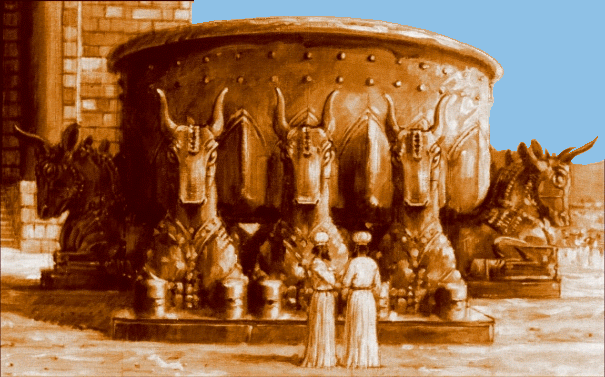
23 Then he made the sea of cast metal. It was round, ten cubits from brim to brim, and five cubits high, and a line of thirty cubits measured its circumference. 24 Under its brim were gourds, for ten cubits, compassing the sea all around. The gourds were in two rows, cast with it when it was cast. 25 It stood on twelve oxen, three facing north, three facing west, three facing south, and three facing east. The sea was set on them, and all their rear parts were inward. 26 Its thickness was a handbreadth, and its brim was made like the brim of a cup, like the flower of a lily. It held two thousand baths.

27 He also made the ten stands of bronze. Each stand was four cubits long, four cubits wide, and three cubits high. 28 This was the construction of the stands: they had panels, and the panels were set in the frames, 29 and on the panels that were set in the frames were lions, oxen, and cherubim. On the frames, both above and below the lions and oxen, there were wreaths of beveled work. 30 Moreover, each stand had four bronze wheels and axles of bronze, and at the four corners were supports for a basin. The supports were cast with wreaths at the side of each. 31 Its opening was within a crown that projected upward one cubit. Its opening was round, as a pedestal is made, a cubit and a half deep. At its opening there were carvings, and its panels were square, not round. 32 And the four wheels were underneath the panels. The axles of the wheels were of one piece with the stands, and the height of a wheel was a cubit and a half. 33 The wheels were made like a chariot wheel; their axles, their rims, their spokes, and their hubs were all cast. 34 There were four supports at the four corners of each stand. The supports were of one piece with the stands. 35 And on the top of the stand there was a round band half a cubit high; and on the top of the stand its stays and its panels were of one piece with it. 36 And on the surfaces of its stays and on its panels, he carved cherubim, lions, and palm trees, according to the space of each, with wreaths all around. 37 After this manner he made the ten stands. All of them were cast alike, of the same measure and the same form.

38 And he made ten basins of bronze. Each basin held forty baths, each basin measured four cubits, and there was a basin for each of the ten stands. 39 And he set the stands, five on the south side of the house, and five on the north side of the house. And he set the sea at the southeast corner of the house. – 1 Kings 7:13-39 ESV

The first question that comes to mind when reading this section of Chapter Seven is why the author took such great pains to describe each and every item in such precise detail. The amount of information is almost overwhelming, and even with all the helpful descriptions, it’s virtually impossible to determine what each item actually looked like.  So, why dedicate so much time and space to their description?

In a sense, the author is telling his readers that Solomon was a man who took a keen interest in every phase of the massive construction project he had commissioned. His father had left him with the overwhelming responsibility to create a house worthy of the God of Israel, and that was not something he took lightly. Solomon was a hands-on construction manager who cared deeply about every detail concerning this once-in-a-lifetime undertaking. While he delegated much of the work, there was never a moment when Solomon was not intimately and personally involved in it. He cared deeply about this project and wanted to ensure that the finished product was both beautiful and functional. When completed, the Temple would become the focal point of Israel’s worship of Yahweh. So, Solomon intended for every item associated with its construction and its ultimate operation to be of the finest craftsmanship.

From the quarrying of the massive stones used to build the temple to the carving of the intricate reliefs that adorned the bronze stands, Solomon oversaw everything. To ensure that the workmanship was of the highest quality, Solomon hired the finest craftsman money could buy.

Verse 13 states that Solomon sought out the services of a skilled craftsman from the city of Tyre, a gifted worker in bronze. But notice the additional details concerning Hiram’s qualifications:

And he was full of wisdom, understanding, and skill for making any work in bronze. – 1 Kings 7:1 ESV

This brings to mind a passage from the book of Exodus where God provided Moses with the identity of another man who would assist in the construction of the Tabernacle.

The LORD said to Moses, “See, I have called by name Bezalel the son of Uri, son of Hur, of the tribe of Judah, and I have filled him with the Spirit of God, with ability and intelligence, with knowledge and all craftsmanship, to devise artistic designs, to work in gold, silver, and bronze, in cutting stones for setting, and in carving wood, to work in every craft.” – Exodus 31:1-5 ESV

As was the case with Moses, it seems that Solomon was receiving divine assistance in procuring the services of the right people to help him complete this one-of-a-kind project. Hiram came highly recommended and divinely gifted for the job.

Once he arrived in Jerusalem, Hiram set to work casting the two bronze pillars that would grace the entrance to the Temple. At 27 feet in height, these two immense pillars were likely more decorative than functional. Since they were cast from a relatively soft metal like bronze and featured hollow interiors, they would have been incapable of providing support to the Temple’s roof.

These pillars were intended to frame the entrance to the Temple and provide symbolic significance to the One who dwelt within. Each pillar had a name. One was called Boaz, which means “In Him is strength.” The other was named Jachin, which means “He shall establish.” Both names were explicit references to the God of Israel. Every detail that adorned these pillars, from the water lilies to the pomegranates, was intended to illustrate the goodness and greatness of God. The Israelites served a God who provided them with everything they needed, including fertility and fruitfulness.

Next, Hiram crafted “the sea,” a large bronze basin that would sit outside the Temple’s entrance. This massive bowl was designed to replace the bronze laver that God had prescribed for the Tabernacle, while serving the same function as the original. According to Exodus 30, the first laver was used by the priests to purify themselves before offering sacrifices to God.

“You shall also make a basin of bronze, with its stand of bronze, for washing. You shall put it between the tent of meeting and the altar, and you shall put water in it, with which Aaron and his sons shall wash their hands and their feet. When they go into the tent of meeting, or when they come near the altar to minister, to burn a food offering to the Lord, they shall wash with water, so that they may not die. They shall wash their hands and their feet, so that they may not die. It shall be a statute forever to them, even to him and to his offspring throughout their generations.” – Exodus 30:18-21 ESV

The new basin was 15 feet in diameter, 47 feet in circumference, with a depth of 7.5 feet. It could hold up to 18,000 gallons of water, and its large size appears to have been designed to allow priests to completely immerse themselves, rather than just washing their hands and feet. It rested on the backs of 12 bronze oxen, arranged in groups of three, with each group facing a different direction on the compass. These bronze bulls may have been intended to represent the 12 tribes of Israel. But regardless, they were clearly symbols of strength.

Hiram then crafted ten mobile carts, each equipped with a large bronze basin. They featured wheels that allowed them to be moved about the Temple courtyard.

He also made ten basins in which to wash, and set five on the south side, and five on the north side. In these they were to rinse off what was used for the burnt offering, and the sea was for the priests to wash in. – 2 Chronicles 4:6 ESV

Each cart was six feet square and five and one-half feet high, and it held a bronze basin that could hold up to 240 gallons of water. As the Chronicles passage indicates, they were strategically located around the Temple courtyard and used by the priests to cleanse the blood from the sacrificial animals before they were offered to God.

You can almost sense that Solomon was attempting to improve on every item used in the original Tabernacle. He was making significant upgrades. Every item Hiram created was bigger and better than the original. Solomon was obsessed with making the house of God a grand and glorious structure, with every detail reflecting the majesty of its divine occupant. He could have saved himself a lot of time and money by reusing the original items, but Solomon would not settle for anything less than the best. So, he poured countless hours and resources into creating a Temple worthy of his great God, down to the last detail.

Solomon was following the instructions Yahweh gave to Moses from Mount Sinai when He ordered the creation of the original Tabernacle.

“Have the people of Israel build me a holy sanctuary so I can live among them. You must build this Tabernacle and its furnishings exactly according to the pattern I will show you.” – Exodus 25:8-9 NLT

Moses received detailed plans for the construction of the LORD’s house, with nothing left to the imagination. God was explicit in describing every facet of the Tabernacle’s design, and ordered Moses, “Be sure that you make everything according to the pattern I have shown you here on the mountain” (Exodus 25:40 NLT). Evidently, Moses received a vision of what the completed Tabernacle should look like, and he was to ensure that the finished product was an accurate facsimile. He was not to cut corners, leave out any detail, or make alterations to its design. No expense was to be spared, no shortcuts taken, and no cost-cutting measures considered because this was to be the house of Yahweh. The God of the universe deserved nothing but the best. If the people of Israel expected Him to dwell among them, they would need to build a house worthy of housing His presence. 

“I will meet the people of Israel there, in the place made holy by my glorious presence. Yes, I will consecrate the Tabernacle and the altar, and I will consecrate Aaron and his sons to serve me as priests. Then I will live among the people of Israel and be their God, and they will know that I am the LORD their God. I am the one who brought them out of the land of Egypt so that I could live among them. I am the LORD their God.” – Exodus 29:43-46 NLT

Solomon shared Moses’ commitment to build a house that Yahweh would deem worthy of bearing His name and containing His glory. So, he went out of his way to ensure that this house met Yahweh’s exacting standards, because he longed for the assurance of Yahweh’s presence and power.

English Standard Version (ESV) The Holy Bible, English Standard Version. ESV® Permanent Text Edition® (2016). Copyright © 2001 by Crossway Bibles, a publishing ministry of Good News Publishers.

New Living Translation (NLT) Holy Bible, New Living Translation, copyright © 1996, 2004, 2015 by Tyndale House Foundation. Used by permission of Tyndale House Publishers Inc., Carol Stream, Illinois 60188. All rights reserved.

Fame Versus Faithfulness

1 Solomon was building his own house thirteen years, and he finished his entire house.

2 He built the House of the Forest of Lebanon. Its length was a hundred cubits and its breadth fifty cubits and its height thirty cubits, and it was built on four rows of cedar pillars, with cedar beams on the pillars. 3 And it was covered with cedar above the chambers that were on the forty-five pillars, fifteen in each row. 4 There were window frames in three rows, and window opposite window in three tiers. 5 All the doorways and windows had square frames, and window was opposite window in three tiers.

6 And he made the Hall of Pillars; its length was fifty cubits, and its breadth thirty cubits. There was a porch in front with pillars, and a canopy in front of them.

7 And he made the Hall of the Throne where he was to pronounce judgment, even the Hall of Judgment. It was finished with cedar from floor to rafters.

8 His own house where he was to dwell, in the other court back of the hall, was of like workmanship. Solomon also made a house like this hall for Pharaoh’s daughter whom he had taken in marriage.

9 All these were made of costly stones, cut according to measure, sawed with saws, back and front, even from the foundation to the coping, and from the outside to the great court. 10 The foundation was of costly stones, huge stones, stones of eight and ten cubits. 11 And above were costly stones, cut according to measurement, and cedar. 12 The great court had three courses of cut stone all around, and a course of cedar beams; so had the inner court of the house of the LORD and the vestibule of the house. – 1 Kings 7:1-12 ESV

Once Solomon had completed the construction of the LORD’s House, he turned his attention to building his own royal palace and administrative complex. The author indicates that it took Solomon seven years to complete the Temple, and he spent an additional 13 years constructing the complex that would include separate residences for him and his wife, the daughter of Pharaoh. According to 1 Kings 9:10, Solomon spent two decades of his reign overseeing these various building projects.

It took Solomon twenty years to build the Lord’s Temple and his own royal palace. – 1 Kings 9:10 NLT

From the descriptions provided, it appears that Solomon’s palace complex consisted of a series of distinct structures, including the two royal residences, the House of the Forest of Lebanon, the Hall of Pillars, the Hall of Judgment, and the Hall of the Throne. These were evidently separate, but interconnected buildings arranged around a shared courtyard. Each of them was equally impressive in size and grandeur. The House of the Forest of Lebanon alone was larger in size than the Temple itself and featured the same degree of meticulous detailing and costly craftsmanship.

It would be easy to overlook that these impressive structures were only made possible by the forced conscription of Israelite citizens. In Chapter Five, it was revealed that Solomon instituted a nationwide “draft” to provide the large labor force necessary to accomplish his ambitious and ongoing building projects.

Then King Solomon conscripted a labor force of 30,000 men from all Israel. He sent them to Lebanon in shifts, 10,000 every month, so that each man would be one month in Lebanon and two months at home. Adoniram was in charge of this labor force. Solomon also had 70,000 common laborers, 80,000 quarry workers in the hill country, and 3,600 foremen to supervise the work. – 1 Kings 5:13-16 NLT

Tens of thousands of Israelites were forced into service and required to dedicate 20 years of their lives to these seemingly never-ending construction projects. When one building was done, another one would begin. Stones had to be quarried, transported, and carefully carved. Massive amounts of trees were cut down and moved to the various construction sites, where they were transformed into wood flooring and panels to adorn the walls and ceilings of Solomon’s royal residence and administrative offices. The sheer number of common laborers, skilled craftsmen, and project foremen to complete 20 years’ worth of construction projects is impossible to calculate. This doesn’t include the additional labor force required to manage Solomon’s household, care for his extensive flocks and herds, cultivate his fields and vineyards, tend his gardens, cook his food, and provide ongoing maintenance for his vast and growing kingdom. All of this was in fulfillment of the words spoken by Samuel the prophet, when he warned the people of Israel of the consequences that would come with their demand for a king.

“The king will draft your sons and assign them to his chariots and his charioteers, making them run before his chariots. Some will be generals and captains in his army, some will be forced to plow in his fields and harvest his crops, and some will make his weapons and chariot equipment. The king will take your daughters from you and force them to cook and bake and make perfumes for him. He will take away the best of your fields and vineyards and olive groves and give them to his own officials. He will take a tenth of your grain and your grape harvest and distribute it among his officers and attendants. He will take your male and female slaves and demand the finest of your cattle and donkeys for his own use. He will demand a tenth of your flocks, and you will be his slaves.” – 1 Samuel 8:11-17 NLT

Solomon was a good and wise king. He had been appointed by God Himself. But even his reign brought a certain degree of suffering and servitude upon the people of Israel. Their desire for a king had ultimately proven costly to them. Kings tend to build kingdoms. They go to war. They demand loyalty and allegiance. They wield power. They use their position to pursue their agendas. And sadly, they can end up treating their people as little more than tools in their royal toolbox.

Later in life, Solomon voiced his regrets at spending so much time, money, and energy building his grand and glorious kingdom. In the end, all his hard work and that of his conscripted laborers would be for naught because you can’t take it with you when you go.

I came to hate all my hard work here on earth, for I must leave to others everything I have earned. And who can tell whether my successors will be wise or foolish? Yet they will control everything I have gained by my skill and hard work under the sun. How meaningless! So I gave up in despair, questioning the value of all my hard work in this world.

Some people work wisely with knowledge and skill, then must leave the fruit of their efforts to someone who hasn’t worked for it. This, too, is meaningless, a great tragedy. So what do people get in this life for all their hard work and anxiety? Their days of labor are filled with pain and grief; even at night their minds cannot rest. It is all meaningless. – Ecclesiastes 2:18-23 NLT

There’s little doubt that Solomon was successful in all his building efforts. When the final brick was laid on the last building, the completed project was a sight to behold. Combined with the Temple complex, it must have made a powerful impression on all those who saw it. We know from Chapter 10 that when the Queen of Sheba made a royal visit to Jerusalem, she was awe-struck by the experience.

When the queen of Sheba realized how very wise Solomon was, and when she saw the palace he had built, she was overwhelmed. She was also amazed at the food on his tables, the organization of his officials and their splendid clothing, the cup-bearers, and the burnt offerings Solomon made at the Temple of the LORD. – 1 Kings 10:4-5 NLT

For 20 years, Solomon concentrated his efforts on building the physical representation of his kingdom. He built palaces, administrative buildings, throne rooms, judgment halls, and even a Temple to accommodate the God of Israel. He was transforming Jerusalem into a showplace where his power and prestige were constantly on display. Visitors couldn’t help but be impressed by the opulence of his royal residences, the sheer size and scope of his administrative complex, and the grandeur of the Temple.

But as will soon be made clear, there was something dark and foreboding lying beneath the shiny surface of Solomon’s kingdom. The trappings of success obscured a hidden danger that would prove to be Solomon’s undoing and the key to Israel’s ultimate fall from grace.

Hundreds of years later, Jesus, another descendant of King David, would warn against the danger of building kingdoms on earth and investing all our time and energy in accumulating earthly treasures.

“Don’t store up treasures here on earth, where moths eat them and rust destroys them, and where thieves break in and steal. Store your treasures in heaven, where moths and rust cannot destroy, and thieves do not break in and steal. Wherever your treasure is, there the desires of your heart will also be.” – Matthew 6:19-21 NLT

Solomon was under the misguided impression that materialism mattered. He was out to build a kingdom that would rival that of every other nation on earth. He wanted Israel to be the envy of the world, and his glowing reputation to spread throughout the land. In his later days, he would declare his rather pessimistic belief in the value of a good reputation, because that is all you really leave behind that is of lasting value.

A good reputation is more valuable than costly perfume.
    And the day you die is better than the day you are born.
Better to spend your time at funerals than at parties.
    After all, everyone dies—
    so the living should take this to heart. – Ecclesiastes 7:1-2 NLT

But two decades into his reign, Solomon was still working under the delusion that more was better. He would continue to amass more wealth, increase his land holdings, construct additional buildings, and furnish them all with the finest of furnishings. He was storing up treasures on earth in a desperate search for meaning and significance. Like a child in need of attention, Solomon was using his wealth and wisdom to make a name for himself. Perhaps it was all an attempt to break free from the shadow of his father’s looming legacy. It would have been difficult to follow in the footsteps of the man after God’s own heart. Solomon was neither a warrior nor a kingdom builder. He inherited his domain from his father and received his wisdom and wealth as gifts from Yahweh. However, Solomon used what he had to good effect and made a name for himself.

I also tried to find meaning by building huge homes for myself and by planting beautiful vineyards. I made gardens and parks, filling them with all kinds of fruit trees. I built reservoirs to collect the water to irrigate my many flourishing groves. I bought slaves, both men and women, and others were born into my household. I also owned large herds and flocks, more than any of the kings who had lived in Jerusalem before me. I collected great sums of silver and gold, the treasure of many kings and provinces. I hired wonderful singers, both men and women, and had many beautiful concubines. I had everything a man could desire!

So I became greater than all who had lived in Jerusalem before me, and my wisdom never failed me. Anything I wanted, I would take. I denied myself no pleasure. I even found great pleasure in hard work, a reward for all my labors. – Ecclesiastes 2:4-10 NLT

In time, Solomon’s love of self would replace his love for Yahweh. His obsession with self-promotion and establishing his reputation would supplant his desire to honor the name of God. Fame became more important than faithfulness.

In Solomon’s old age, they [his wives] turned his heart to worship other gods instead of being completely faithful to the Lord his God, as his father, David, had been. Solomon worshiped Ashtoreth, the goddess of the Sidonians, and Molech, the detestable god of the Ammonites. In this way, Solomon did what was evil in the LORD’s sight; he refused to follow the LORD completely, as his father, David, had done. – 1 Kings 11:4-6 NLT

English Standard Version (ESV) The Holy Bible, English Standard Version. ESV® Permanent Text Edition® (2016). Copyright © 2001 by Crossway Bibles, a publishing ministry of Good News Publishers.

New Living Translation (NLT) Holy Bible, New Living Translation, copyright © 1996, 2004, 2015 by Tyndale House Foundation. Used by permission of Tyndale House Publishers Inc., Carol Stream, Illinois 60188. All rights reserved.

Worthy of Glory and Honor

14 So Solomon built the house and finished it. 15 He lined the walls of the house on the inside with boards of cedar. From the floor of the house to the walls of the ceiling, he covered them on the inside with wood, and he covered the floor of the house with boards of cypress. 16 He built twenty cubits of the rear of the house with boards of cedar from the floor to the walls, and he built this within as an inner sanctuary, as the Most Holy Place. 17 The house, that is, the nave in front of the inner sanctuary, was forty cubits long. 18 The cedar within the house was carved in the form of gourds and open flowers. All was cedar; no stone was seen. 19 The inner sanctuary he prepared in the innermost part of the house, to set there the ark of the covenant of the LORD. 20 The inner sanctuary was twenty cubits long, twenty cubits wide, and twenty cubits high, and he overlaid it with pure gold. He also overlaid an altar of cedar. 21 And Solomon overlaid the inside of the house with pure gold, and he drew chains of gold across, in front of the inner sanctuary, and overlaid it with gold. 22 And he overlaid the whole house with gold, until all the house was finished. Also the whole altar that belonged to the inner sanctuary he overlaid with gold.

23 In the inner sanctuary he made two cherubim of olivewood, each ten cubits high. 24 Five cubits was the length of one wing of the cherub, and five cubits the length of the other wing of the cherub; it was ten cubits from the tip of one wing to the tip of the other. 25 The other cherub also measured ten cubits; both cherubim had the same measure and the same form. 26 The height of one cherub was ten cubits, and so was that of the other cherub. 27 He put the cherubim in the innermost part of the house. And the wings of the cherubim were spread out so that a wing of one touched the one wall, and a wing of the other cherub touched the other wall; their other wings touched each other in the middle of the house. 28 And he overlaid the cherubim with gold.

29 Around all the walls of the house he carved engraved figures of cherubim and palm trees and open flowers, in the inner and outer rooms. 30 The floor of the house he overlaid with gold in the inner and outer rooms.

31 For the entrance to the inner sanctuary he made doors of olivewood; the lintel and the doorposts were five-sided. 32 He covered the two doors of olivewood with carvings of cherubim, palm trees, and open flowers. He overlaid them with gold and spread gold on the cherubim and on the palm trees.

33 So also he made for the entrance to the nave doorposts of olivewood, in the form of a square, 34 and two doors of cypress wood. The two leaves of the one door were folding, and the two leaves of the other door were folding. 35 On them he carved cherubim and palm trees and open flowers, and he overlaid them with gold evenly applied on the carved work. 36 He built the inner court with three courses of cut stone and one course of cedar beams.

37 In the fourth year the foundation of the house of the LORD was laid, in the month of Ziv. 38 And in the eleventh year, in the month of Bul, which is the eighth month, the house was finished in all its parts, and according to all its specifications. He was seven years in building it. – 1 Kings 6:14-38 ESV

According to 1 Chronicles 28, David provided his son with detailed plans for constructing the Temple. He left nothing to chance, even leaving precise instructions for the duties of the priests and Levites, and outlining the various utensils to be used in the worship of Yahweh.

Then David gave Solomon the plans for the Temple and its surroundings, including the entry room, the storerooms, the upstairs rooms, the inner rooms, and the inner sanctuary—which was the place of atonement. David also gave Solomon all the plans he had in mind for the courtyards of the LORD’s Temple, the outside rooms, the treasuries, and the rooms for the gifts dedicated to the LORD. – 1 Chronicles 28:11-12 NLT

It is apparent from the descriptions given in these verses that David was modeling the Temple according to the plans of the Tabernacle that God had given to Moses. The Tabernacle, while a beautiful and ornate structure, was actually little more than a glorified tent designed for easy tear-down and set-up, so that it could be transported from one place to another. Yet David had intended the temple to be a permanent structure that would stand as a perpetual monument to God’s greatness.

Solomon spared no expense in creating this “house” for the God of Israel. He lined the walls and ceilings with imported cedar wood. He had the floors adorned with hand-crafted planks made from the finest cypress. He commissioned skilled craftsmen to carve doors made from olivewood. Following the pattern of the Tabernacle and the plans provided by his father, Solomon ensured that the temple featured a Holy Place and a Most Holy Place, also known as the Holy of Holies. Each of these rooms had special significance and purpose, and was designed to mirror the glory and greatness of God. Eight separate times, the author mentions the prominent use of solid gold in the construction. The entire building was filled with intricately carved reliefs featuring cherubim, palm trees, and open flowers.

This structure was meant to be a feast for the eyes. It was designed to create a virtual overload on the senses, drawing the attention of the onlooker upward and inward, into the inner recesses of the Most Holy Place where the Ark of the Covenant and the Mercy Seat of God were located. Everything about the building was meant to be symbolic or representative of a greater reality. This was intended to be the dwelling place of God on earth, and Solomon did everything in his power to ensure that this building, though built with human hands, declared the incomparable greatness of God.

For nearly seven and a half years, Solomon oversaw and underwrote this ambitious project. He poured countless hours into its planning. He spent endless days orchestrating all the details surrounding its construction and allocated vast sums of money to see that, when it was finally completed, it would be without equal. This was not a side project for Solomon. While he still had a kingdom to run, he never allowed the Temple to become a second-tier priority. Although he likely delegated many of the responsibilities related to its construction, he always maintained control over every aspect of its creation.

This was a labor of love that reveals Solomon’s determination to honor the God of his father. However, it also demonstrates Solomon’s own dedication to glorifying the God of Israel by constructing the finest Temple that money could afford and human ingenuity could create. Solomon wanted this to be a showplace, not to stroke his own ego, but to exalt Yahweh as the one true God. It was to be a house fit for a King – the King of the universe. Solomon’s unwavering determination to spare no expense in its construction reflects his grasp of Yahweh’s unparalleled supremacy. Ultimately, he knew that his efforts to construct a house worthy of God would prove woefully inadequate because, like the psalmist, he understood the incomparable nature of its occupant.

O LORD my God, how great you are!
    You are robed with honor and majesty.
    You are dressed in a robe of light.
You stretch out the starry curtain of the heavens;
    you lay out the rafters of your home in the rain clouds.
You make the clouds your chariot;
    you ride upon the wings of the wind.
The winds are your messengers;
    flames of fire are your servants. – Psalm 104-1-4 NLT

Solomon did everything he could to create an earthly dwelling place that was worthy of the incomparable and transcendent God of the universe. For seven years, he spared no expense and drove his workers relentlessly to ensure that the final product would be acceptable to God. Yet, despite all his efforts, Solomon knew that no structure built by flawed human hands would ever measure up to God’s glorious standards. In his prayer of dedication for the completed Temple, Solomon admitted that his grand “house,” while a sight to behold, was sorely inadequate to serve as Yahweh’s dwelling place.

“But will God really live on earth? Why, even the highest heavens cannot contain you. How much less this Temple I have built!” – 1 Kings 8:27 NLT

Solomon was a realist. He knew from the moment his father assigned him the task of building the Temple that he was faced with an impossible assignment. When he contracted with King Hiram of Tyre to supply all the lumber for the project, he admitted, “This must be a magnificent Temple because our God is greater than all other gods. But who can really build him a worthy home? Not even the highest heavens can contain him! So who am I to consider building a Temple for him, except as a place to burn sacrifices to him?” (2 Chronicles 2:5-6 NLT). 

Solomon seemed to understand that the Temple would serve as a focal point of Israel’s worship, providing a tangible and visible place where heaven and earth met. In his prayer of dedication, he expresses his understanding that the Temple was meant to serve as a lifeline to Yahweh.

“May you hear the humble and earnest requests from me and your people Israel when we pray toward this place. Yes, hear us from heaven where you live, and when you hear, forgive.” – 1 Kings 8:30 NLT

Solomon was under no delusion that Yahweh would actually take up residence in the Temple. As he repeatedly makes clear in his prayer of dedication, the Temple was built to honor God’s name. It was an earthly structure dedicated solely to Yahweh and set apart for worshiping Him alone. As long as it stood, it would draw the people of God into His presence and focus their attention on His glory, righteousness, holiness, and power. The Temple was to be a tangible reminder of Yahweh’s unrivalled majesty and perfection. It was intended to be a dim reflection of God’s glorious heavenly throne room.

In the Book of Revelation, the apostle John attempted to record his vision of the throne room of God in heaven. Hampered by the limits of human language, John did his best to describe the indescribable.

“Come up here, and I will show you what must happen after this.” And instantly I was in the Spirit, and I saw a throne in heaven and someone sitting on it. The one sitting on the throne was as brilliant as gemstones—like jasper and carnelian. And the glow of an emerald circled his throne like a rainbow. Twenty-four thrones surrounded him, and twenty-four elders sat on them. They were all clothed in white and had gold crowns on their heads. From the throne came flashes of lightning and the rumble of thunder. And in front of the throne were seven torches with burning flames. This is the sevenfold Spirit of God. In front of the throne was a shiny sea of glass, sparkling like crystal.” – Revelation 4:1-6 NLT

This was what Solomon attempted to replicate with his construction of the Temple, but he never had the benefit of seeing what John saw. Left to his imagination, he filled the Temple with expensive wood, precious metals, and elaborate stonework. He patterned it after the plans for the Tabernacle and included images of gourds, flowers, palm trees, and cherubim, angelic beings involved in the worship and praise of God. Everything was intended to accentuate and illustrate the glory of God. It was an earthly building meant to mirror a heavenly reality that was beyond human comprehension.

Yahweh was great and greatly to be praised. His name was worthy of honor and glory. His power was incomparable, and His majesty was unmatched by anything in the universe. The Temple was meant to reflect God’s greatness, and Solomon spent seven years and untold riches seeing that it would be a house worthy of bearing Yahweh’s name.

English Standard Version (ESV) The Holy Bible, English Standard Version. ESV® Permanent Text Edition® (2016). Copyright © 2001 by Crossway Bibles, a publishing ministry of Good News Publishers.

New Living Translation (NLT) Holy Bible, New Living Translation, copyright © 1996, 2004, 2015 by Tyndale House Foundation. Used by permission of Tyndale House Publishers Inc., Carol Stream, Illinois 60188. All rights reserved.

The Heart Is God’s Home

1 In the four hundred and eightieth year after the people of Israel came out of the land of Egypt, in the fourth year of Solomon’s reign over Israel, in the month of Ziv, which is the second month, he began to build the house of the LORD. 2 The house that King Solomon built for the LORD was sixty cubits long, twenty cubits wide, and thirty cubits high. 3 The vestibule in front of the nave of the house was twenty cubits long, equal to the width of the house, and ten cubits deep in front of the house. 4 And he made for the house windows with recessed frames. 5 He also built a structure against the wall of the house, running around the walls of the house, both the nave and the inner sanctuary. And he made side chambers all around. 6 The lowest story was five cubits broad, the middle one was six cubits broad, and the third was seven cubits broad. For around the outside of the house he made offsets on the wall in order that the supporting beams should not be inserted into the walls of the house.

7 When the house was built, it was with stone prepared at the quarry, so that neither hammer nor axe nor any tool of iron was heard in the house while it was being built.

8 The entrance for the lowest story was on the south side of the house, and one went up by stairs to the middle story, and from the middle story to the third. 9 So he built the house and finished it, and he made the ceiling of the house of beams and planks of cedar. 10 He built the structure against the whole house, five cubits high, and it was joined to the house with timbers of cedar.

11 Now the word of the LORD came to Solomon, 12 “Concerning this house that you are building, if you will walk in my statutes and obey my rules and keep all my commandments and walk in them, then I will establish my word with you, which I spoke to David your father. 13 And I will dwell among the children of Israel and will not forsake my people Israel.” – 1 Kings 6:1-13 ESV

David had begun the preparations for the construction of the Temple long before he died. It had been his idea to build a “house” for God, but he had been denied the honor of overseeing its actual construction. That task fell to his son and successor, Solomon. Even though David had given Solomon the plans and provided a vast amount of the building materials necessary to start the project, it would be four years into Solomon’s reign before construction began. The sheer size and scope of the project required careful planning and the time to amass and transport all the materials that David’s ambitious plans required.

Massive stones had to be quarried and moved to the building site. Lumber from Lebanon had to be cut and transported by ships from Tyre to the coastline of Israel, then carried inland to the city of Jerusalem. The site itself, located on the summit of Mount Zion, had to be leveled and prepared for the actual construction to begin. Four years after taking the throne, after all the preparations were complete, Solomon officially launched the construction phase of the project. The author points out that it was 480 years after the people of Israel had been released by God from their captivity in Egypt. This link back to Israel’s exodus from Egypt is significant because it provides a vivid contrast between the nation’s past and present circumstances. The Temple was being built to honor the God of Israel, the same God who, nearly half a millennium earlier, rescued their ancestors from their dire conditions in a foreign land. He had freed them from captivity and given them the land of Canaan as their inheritance – all in keeping with the promise He had made to Abraham.

“I will make you exceedingly fruitful, and I will make you into nations, and kings shall come from you. And I will establish my covenant between me and you and your offspring after you throughout their generations for an everlasting covenant, to be God to you and to your offspring after you. And I will give to you and to your offspring after you the land of your sojournings, all the land of Canaan, for an everlasting possession, and I will be their God.” – Genesis 17:6-8 ESV

God had kept His promise to Abraham, and provided the people of Israel with the land of Canaan as their inheritance. Now, Solomon, the son of David, was honoring his father’s wishes by building a Temple worthy of such a great and gracious God.

While the author provides detailed descriptions of the Temple’s layout and dimensions, there is insufficient information to determine precisely what the Temple looked like when it was completed. It was roughly twice the size of the Mosaic Tabernacle and built of massive hand-carved limestone blocks and lumber made from cedar from the forests of Lebanon. The completed structure was ornamented with gold. Solomon spared no expense in the construction of God’s house because it was to be a showplace, a one-of-a-kind structure meant to honor the God of Abraham, Isaac, and Jacob. Even with tens of thousands of conscripted laborers working around the clock, it would take nearly eight years to complete the project.

Sometime during construction, Solomon received a message from God. Amid his ongoing efforts to build a house for Yahweh, he was reminded that a beautiful building would not ensure the presence of God.

“Concerning this Temple you are building, if you keep all my decrees and regulations and obey all my commands, I will fulfill through you the promise I made to your father, David. I will live among the Israelites and will never abandon my people Israel.” – 1 Kings 6:12 NLT

God had made a commitment to David, promising to place one of his sons on the throne after him. This son would fulfill David’s dream of building a Temple for the LORD. But, more importantly, the LORD would place His protective hand over David’s son.

“…when you die and join your ancestors, I will raise up one of your descendants, one of your sons, and I will make his kingdom strong. He is the one who will build a house—a temple—for me. And I will secure his throne forever. I will be his father, and he will be my son. I will never take my favor from him as I took it from the one who ruled before you. I will confirm him as king over my house and my kingdom for all time, and his throne will be secure forever.’” – 1 Chronicles 17:11-14 NLT

But even David knew that this promise from God came with conditions. He believed God would fulfill His part of the covenant, but he also knew that his son would need to remain faithful to God. Just before his death, David warned Solomon that faithfulness would be essential if he wanted to experience God’s fruitfulness.

“I am going where everyone on earth must someday go. Take courage and be a man. Observe the requirements of the LORD your God, and follow all his ways. Keep the decrees, commands, regulations, and laws written in the Law of Moses so that you will be successful in all you do and wherever you go. If you do this, then the LORD will keep the promise he made to me. He told me, ‘If your descendants live as they should and follow me faithfully with all their heart and soul, one of them will always sit on the throne of Israel.’” – 1 Kings 2:2-4 NLT

Building God a house in which to dwell was not going to guarantee His presence, power, and provision. God didn’t require an earthly dwelling place, a point He made clear when David conceived the idea.

“This is what the LORD has declared: Are you the one to build a house for me to live in? I have never lived in a house, from the day I brought the Israelites out of Egypt until this very day. I have always moved from one place to another with a tent and a Tabernacle as my dwelling. Yet no matter where I have gone with the Israelites, I have never once complained to Israel’s tribal leaders, the shepherds of my people Israel. I have never asked them, ‘Why haven’t you built me a beautiful cedar house?’” – 2 Samuel 7:5-7 NLT

In the Book of Acts, Luke records a powerful sermon given by Stephen to a crowd of Jews who would eventually stone him to death. In that sermon, Stephen reminded them that the Temple was never meant to be a sign of God’s presence.

“David found favor with God and asked for the privilege of building a permanent Temple for the God of Jacob. But it was Solomon who actually built it. However, the Most High doesn’t live in temples made by human hands. As the prophet says,

‘Heaven is my throne,
    and the earth is my footstool.
Could you build me a temple as good as that?’
    asks the Lord.
‘Could you build me such a resting place?
  Didn’t my hands make both heaven and earth?’” – Acts 7:46-50 NLT

Luke also records the words of the apostle Paul, spoken to a crowd of Greeks in the middle of the city of Athens.

“He is the God who made the world and everything in it. Since he is Lord of heaven and earth, he doesn’t live in man-made temples, and human hands can’t serve his needs—for he has no needs. He himself gives life and breath to everything, and he satisfies every need.” – Acts 17:24-25 NLT

God wasn’t standing around in heaven, waiting for Solomon to complete the Temple so He could take up residence. God did not need Solomon’s Temple. God had made the stones and the trees used in its construction. He had created and breathed life into the men who labored to build it. He had placed Solomon on the throne and given him the privilege of carrying out his father’s wishes. The Temple was less a residence for Yahweh than it was a reminder of His holiness and greatness. Like the Tabernacle in the wilderness, the Temple was to serve as a symbol of Yahweh’s glorious presence among His chosen people. In a sense, the invisible God of the universe would become visible as the people gazed on the grandeur of His glorious house. The decorative gold, massive stones, and beams of aromatic cedar would create a jaw-dropping and awe-inspiring sight designed to convey the greatness of Yahweh.

But what God really wanted from Solomon was obedience. He desired a king who would live in faithful adherence to His laws and display a commitment to all His commands. Solomon’s own father understood that God was far more interested in the condition of a man’s heart than the accomplishments of his hands. After his illicit affair with Bathsheba, David penned the following penitential words.

You do not desire a sacrifice, or I would offer one.
    You do not want a burnt offering.
The sacrifice you desire is a broken spirit.
    You will not reject a broken and repentant heart, O God. – Psalm 51:16-17 NLT

As the Temple neared completion, Solomon was given a powerful reminder that the key to his success would not be found in a building, but in his commitment to the will and the ways of God. The Temple would be nothing more than a symbol of God’s presence. It would provide a daily reminder of His majesty and glory, but should never be seen as a guarantee of His pleasure with or approval of His people. As the grand edifice of the Temple neared completion, it rose from the heights of Mount Zion, becoming the pride of the people of Israel. But, if they weren’t careful, they would end up being more impressed with the work of their hands and worshiping their creation, than obeying and revering the Creator God.

Solomon could build a house for God, but God was more interested in inhabiting Solomon’s heart. Not long before Jesus made His way to Calvary to sacrifice His life on behalf of sinful humanity, He gave His disciples a message meant to encourage them. He was going to die, but He would rise again, and that miraculous event would usher in a new and life-altering relationship between Him and His followers.

“When I am raised to life again, you will know that I am in my Father, and you are in me, and I am in you. Those who accept my commandments and obey them are the ones who love me. And because they love me, my Father will love them. And I will love them and reveal myself to each of them.”

“All who love me will do what I say. My Father will love them, and we will come and make our home with each of them.” – John 14:20-21, 23 NLT

The apostle Paul would later expand on this idea, reminding the believers in Corinth that they were the dwelling place of God on earth.

Don’t you realize that all of you together are the temple of God and that the Spirit of God lives in you? …For God’s temple is holy, and you are that temple. – 1 Corinthians 3:16, 17 NLT

God lives in hearts, not houses. He takes up residence in His people, not a structure made from wood and stone.

For we are the temple of the living God. As God has said: “I will dwell with them and walk among them, and I will be their God, and they will be My people.” – 2 Corinthians 6:16 BSB

In Him the whole building is fitted together and grows into a holy temple in the Lord. And in Him you too are being built together into a dwelling place for God in His Spirit. – Ephesians 2:21-22 NLT

English Standard Version (ESV) The Holy Bible, English Standard Version. ESV® Permanent Text Edition® (2016). Copyright © 2001 by Crossway Bibles, a publishing ministry of Good News Publishers.

New Living Translation (NLT) Holy Bible, New Living Translation, copyright © 1996, 2004, 2015 by Tyndale House Foundation. Used by permission of Tyndale House Publishers Inc., Carol Stream, Illinois 60188. All rights reserved.

A Costly Endeavor

1 Now Hiram king of Tyre sent his servants to Solomon when he heard that they had anointed him king in place of his father, for Hiram always loved David. 2 And Solomon sent word to Hiram, 3 “You know that David my father could not build a house for the name of the LORD his God because of the warfare with which his enemies surrounded him, until the LORD put them under the soles of his feet. 4 But now the LORD my God has given me rest on every side. There is neither adversary nor misfortune. 5 And so I intend to build a house for the name of the LORD my God, as the LORD said to David my father, ‘Your son, whom I will set on your throne in your place, shall build the house for my name.’ 6 Now therefore command that cedars of Lebanon be cut for me. And my servants will join your servants, and I will pay you for your servants such wages as you set, for you know that there is no one among us who knows how to cut timber like the Sidonians.”

7 As soon as Hiram heard the words of Solomon, he rejoiced greatly and said, “Blessed be the LORD this day, who has given to David a wise son to be over this great people.” 8 And Hiram sent to Solomon, saying, “I have heard the message that you have sent to me. I am ready to do all you desire in the matter of cedar and cypress timber. 9 My servants shall bring it down to the sea from Lebanon, and I will make it into rafts to go by sea to the place you direct. And I will have them broken up there, and you shall receive it. And you shall meet my wishes by providing food for my household.” 10 So Hiram supplied Solomon with all the timber of cedar and cypress that he desired, 11 while Solomon gave Hiram 20,000 cors of wheat as food for his household, and 20,000 cors of beaten oil. Solomon gave this to Hiram year by year. 12 And the LORD gave Solomon wisdom, as he promised him. And there was peace between Hiram and Solomon, and the two of them made a treaty.

13 King Solomon drafted forced labor out of all Israel, and the draft numbered 30,000 men. 14 And he sent them to Lebanon, 10,000 a month in shifts. They would be a month in Lebanon and two months at home. Adoniram was in charge of the draft. 15 Solomon also had 70,000 burden-bearers and 80,000 stonecutters in the hill country, 16 besides Solomon’s 3,300 chief officers who were over the work, who had charge of the people who carried on the work. 17 At the king’s command they quarried out great, costly stones in order to lay the foundation of the house with dressed stones. 18 So Solomon’s builders and Hiram’s builders and the men of Gebal did the cutting and prepared the timber and the stone to build the house. – 1 Kings 5:1-18 ESV

Solomon possessed both great wisdom and wealth. But the one characteristic he possessed that truly set his life apart was his faithfulness. Solomon kept his word. He was always careful to follow through on his commitments. Solomon had made a pledge to David that, after his death, he would settle affairs with some of his former adversaries, and Solomon had quickly and effectively accomplished all of his father’s wishes.

But there remained one last piece of unfinished business. David had assigned his son the formidable task of building a house or temple for God. When David had conquered all his enemies and was enjoying a period of relative peace, he became convicted about his relatively opulent lifestyle. He lived in a sumptuous palace while the dwelling place of God remained little more than a glorified tent. This seeming contradiction prompted him to tell the prophet, Nathan, “See now, I dwell in a house of cedar, but the ark of God dwells in a tent” (2 Samuel 2 ESV). With Nathan’s blessing, David came up with a plan to build a “house of cedar” for God. But that night, God spoke to Nathan in a dream, giving him a message to deliver to David.

“Go and tell my servant David, ‘Thus says the LORD: Would you build me a house to dwell in? I have not lived in a house since the day I brought up the people of Israel from Egypt to this day, but I have been moving about in a tent for my dwelling. In all places where I have moved with all the people of Israel, did I speak a word with any of the judges of Israel, whom I commanded to shepherd my people Israel, saying, “Why have you not built me a house of cedar?”’’ – 2 Samuel 7:5-7 ESV

It seems that David’s well-intentioned plan to construct a house for God had not come from God. The sovereign God of the universe did not need a man-made house in which to dwell. No palace made with human hands could compare to the grandeur of God’s heavenly home.

“Heaven is my throne,
    and the earth is my footstool;
what is the house that you would build for me,
    and what is the place of my rest?
All these things my hand has made,
    and so all these things came to be,
declares the LORD.” – Isaiah 66:1-2 ESV

Nathan told David that if anyone was going to build a house, it would be God Almighty. The King of the universe promised to extend David’s dynasty and kingdom by “building a house” for David that would last far longer than the cedar palace in which David lived.

“Moreover, the LORD declares to you that the LORD will make you a house. When your days are fulfilled and you lie down with your fathers, I will raise up your offspring after you, who shall come from your body, and I will establish his kingdom. He shall build a house for my name, and I will establish the throne of his kingdom forever.” – 2 Samuel 7:11-13 ESV

God told David that the honor of building a house for Him would fall to someone else. One of David’s descendants would be allowed to fulfill his dream and complete the construction of the Temple. David graciously accepted God’s plan and later explained to his son, Solomon, why this important task had been passed on to him.

“My son, I wanted to build a Temple to honor the name of the LORD my God,” David told him. “But the LORD said to me, ‘You have killed many men in the battles you have fought. And since you have shed so much blood in my sight, you will not be the one to build a Temple to honor my name. But you will have a son who will be a man of peace. I will give him peace with his enemies in all the surrounding lands. His name will be Solomon, and I will give peace and quiet to Israel during his reign. He is the one who will build a Temple to honor my name.’” – 1 Chronicles 22:7-10 NLT

David had been the warrior-king, spending the vast majority of his reign doing battle with the enemies of God. While done on behalf of God, his many military exploits had resulted in much bloodshed and, therefore, disqualified him from building a house for God. But rather than allow his zeal for the project to diminish, David redirected his energies into developing the plans and gathering all the materials required to make this project a success. He personally selected the construction site and supervised the drafting of the plans and the initial procurement of building materials.

“My son Solomon is still young and inexperienced. And since the Temple to be built for the LORD must be a magnificent structure, famous and glorious throughout the world, I will begin making preparations for it now.” So David collected vast amounts of building materials before his death. – 1 Chronicles 22:5 NLT

David went out of his way to ensure that Solomon had everything he would need to build the finest temple imaginable.

So David gave orders to call together the foreigners living in Israel, and he assigned them the task of preparing finished stone for building the Temple of God. David provided large amounts of iron for the nails that would be needed for the doors in the gates and for the clamps, and he gave more bronze than could be weighed. He also provided innumerable cedar logs, for the men of Tyre and Sidon had brought vast amounts of cedar to David. – 1 Chronicles 22:2-4 NLT

But, despite David’s meticulous planning, Solomon still found himself in need of additional construction materials, including cedar logs from Lebanon’s famed forests. So, Solomon negotiated a contract with Hiram, the king of Tyre, that provided all the lumber needed to complete the project in exchange for wheat and olive oil.

Combined with David’s careful planning and procurement strategy, Solomon’s arrangement with Hiram guaranteed that he had all he needed to begin construction. But one thing was missing: Workers. This is where it gets interesting. The author reveals that Solomon instituted a non-military draft to supply the workers needed to complete the construction of the Temple.

Then King Solomon conscripted a labor force of 30,000 men from all Israel. He sent them to Lebanon in shifts, 10,000 every month, so that each man would be one month in Lebanon and two months at home. Adoniram was in charge of this labor force. Solomon also had 70,000 common laborers, 80,000 quarry workers in the hill country, and 3,600 foremen to supervise the work. – 1 Kings 5:13-16 NLT

This piece of information should bring to mind the words of Samuel, spoken to the people of Israel when they first demanded that God give them a king.

“These will be the ways of the king who will reign over you: he will take your sons and appoint them to his chariots and to be his horsemen and to run before his chariots. And he will appoint for himself commanders of thousands and commanders of fifties, and some to plow his ground and to reap his harvest, and to make his implements of war and the equipment of his chariots. He will take your daughters to be perfumers and cooks and bakers. He will take the best of your fields and vineyards and olive orchards and give them to his servants. He will take the tenth of your grain and of your vineyards and give it to his officers and to his servants. He will take your male servants and female servants and the best of your young men and your donkeys, and put them to his work. He will take the tenth of your flocks, and you shall be his slaves. And in that day you will cry out because of your king, whom you have chosen for yourselves, but the LORD will not answer you in that day.” – 1 Samuel 8:11-18 ESV

The text states that “Adoniram was in charge of this labor force” (1 Kings 5:14 NLT). He would eventually become Solomon’s official chief of conscription, and he would hold this position when Solomon’s son, Rehoboam, took the throne. Early in this reign, Rehoboam was warned that the people were disgruntled with the way Solomon had treated them. 

“Your father was a hard master,” they said. “Lighten the harsh labor demands and heavy taxes that your father imposed on us. Then we will be your loyal subjects.” – 2 Chronicles 10:4 NLT

But rather than listen to their demands, Rehoboam took the advice of his counselors.

“This is what you should tell those complainers who want a lighter burden: ‘My little finger is thicker than my father’s waist! Yes, my father laid heavy burdens on you, but I’m going to make them even heavier! My father beat you with whips, but I will beat you with scorpions!’” – 2 Chronicles 10:10-11 NLT

The people rebelled, and Rehoboam was forced to send Adoniram to quell the unrest.

King Rehoboam sent Adoniram, who was in charge of forced labor, to restore order, but the people of Israel stoned him to death. – 2 Chronicles 10:18 NLT

Solomon had set the precedent, and his son followed his lead. Solomon was God’s chosen successor to King David, and he had been blessed with godly wisdom and insight. Yet, even this divinely appointed king would still end up making unwise decisions. Solomon was the king, but he was just a man and proved to be a poor substitute for the King of the universe. In demanding that Samuel appoint a king over them, the people of Israel had rejected God as their sovereign ruler. Now, even under the wise and godly leadership of Solomon, they were going to discover that their demand for a human king came with a cost. The price for building the Temple was going to include blood, sweat, and tears. It would take nearly eight years to construct this architectural masterpiece, a period filled with pain, sacrifice, and suffering. The Temple David envisioned would become a living nightmare for many of the people of Israel. They would ultimately sacrifice their sons and daughters to the cause. Some likely died during the construction of the temple. Others probably suffered debilitating injuries, some of a permanent nature.

Solomon employed the wisdom given to him by God and benefited from the preparations made by his father, David. However, even his best efforts, undertaken with the best of intentions, still harmed God’s chosen people. The Temple would be built, but at a high price. The people had their king, but his reign did not come without consequences. It should not be overlooked that the construction of a house for God, the one true King of Israel, also came at a cost.

English Standard Version (ESV) The Holy Bible, English Standard Version. ESV® Permanent Text Edition® (2016). Copyright © 2001 by Crossway Bibles, a publishing ministry of Good News Publishers.

New Living Translation (NLT) Holy Bible, New Living Translation, copyright © 1996, 2004, 2015 by Tyndale House Foundation. Used by permission of Tyndale House Publishers Inc., Carol Stream, Illinois 60188. All rights reserved.

A Wealth of Reasons to Be Wary

20 Judah and Israel were as many as the sand by the sea. They ate and drank and were happy. 21 Solomon ruled over all the kingdoms from the Euphrates to the land of the Philistines and to the border of Egypt. They brought tribute and served Solomon all the days of his life.

22 Solomon’s provision for one day was thirty cors of fine flour and sixty cors of meal, 23 ten fat oxen, and twenty pasture-fed cattle, a hundred sheep, besides deer, gazelles, roebucks, and fattened fowl. 24 For he had dominion over all the region west of the Euphrates from Tiphsah to Gaza, over all the kings west of the Euphrates. And he had peace on all sides around him. 25 And Judah and Israel lived in safety, from Dan even to Beersheba, every man under his vine and under his fig tree, all the days of Solomon. 26 Solomon also had 40,000 stalls of horses for his chariots, and 12,000 horsemen. 27 And those officers supplied provisions for King Solomon, and for all who came to King Solomon’s table, each one in his month. They let nothing be lacking. 28 Barley also and straw for the horses and swift steeds they brought to the place where it was required, each according to his duty.

29 And God gave Solomon wisdom and understanding beyond measure, and breadth of mind like the sand on the seashore, 30 so that Solomon’s wisdom surpassed the wisdom of all the people of the east and all the wisdom of Egypt. 31 For he was wiser than all other men, wiser than Ethan the Ezrahite, and Heman, Calcol, and Darda, the sons of Mahol, and his fame was in all the surrounding nations. 32 He also spoke 3,000 proverbs, and his songs were 1,005. 33 He spoke of trees, from the cedar that is in Lebanon to the hyssop that grows out of the wall. He spoke also of beasts, and of birds, and of reptiles, and of fish. 34 And people of all nations came to hear the wisdom of Solomon, and from all the kings of the earth, who had heard of his wisdom. – 1 Kings 4:20-34 ESV

Solomon inherited a vast and sprawling kingdom from his father. But in time, Solomon would expand its borders until it reached from the Mediterranean Sea in the west to the Euphrates River in the far northeast. Its southern border reached all the way to the land occupied by the once-powerful Egyptians. As the author makes clear, many of the regions under Solomon’s rule were vassal states that were required to pay an annual tax to the royal treasury. Some of the land under Solomon’s rule was located outside the original geographic boundaries designated by God and allotted to the 12 tribes of Israel. Through alliances and treaties, Solomon expanded the influence and scope of his kingdom without waging a single war. His reign was marked by a period of unprecedented peace and prosperity, and it was in direct fulfillment of the promise God had made to Abraham hundreds of years earlier.

“I will certainly bless you. I will multiply your descendants beyond number, like the stars in the sky and the sand on the seashore. Your descendants will conquer the cities of their enemies.” – Genesis 22:17 NLT

David had been the conqueror, completing much of the work the 12 tribes had failed to do when they first took possession of the land of Canaan. David had successfully defeated and subjugated many of the remaining remnants of those nations that the Israelites had been charged to eliminate from the land. However, Solomon’s expansion of the kingdom occurred through peaceful negotiations and economic alliances.

Some believe that the author’s reference to Judah and Israel is proof that he wrote his book after God had divided the nation into the southern and northern kingdoms (1 Kings 11:43). But even when David had announced his decision to make Solomon the heir to his throne, he used these two designations when referring to his kingdom.

“…he shall be king in my place. And I have appointed him to be ruler over Israel and over Judah.” – 1 Kings 1:35 ESV

It seems likely that, over the years, the Israelites had already aligned themselves into two factions that were little more than loose confederations of tribes structured around geographic boundaries. Regardless, Solomon ruled over all of Israel and Judah, from the north to the south. And it was a period of unparalleled peace and abundance.

During the lifetime of Solomon, all of Judah and Israel lived in peace and safety. And from Dan in the north to Beersheba in the south, each family had its own home and garden. – 1 Kings 4:25 NLT

Everyone benefited from Solomon’s reign, including Solomon. In this passage, the author outlines the extent of Solomon’s great wealth, providing tangible proof that God had kept the promise He had made to Solomon.

“I will also give you what you did not ask for—riches and fame! No other king in all the world will be compared to you for the rest of your life!” – 1 Kings 3:13 NLT

The detailed lists provided by the author are intended to stagger the imagination and illustrate the vast nature of Solomon’s wealth.

The daily food requirements for Solomon’s palace were 150 bushels of choice flour and 300 bushels of meal; also 10 oxen from the fattening pens, 20 pasture-fed cattle, 100 sheep or goats, as well as deer, gazelles, roe deer, and choice poultry. – 1 Kings 4:22-23 NLT

The budget required to operate his royal residence was astronomical. Yet, Solomon had cleverly created a system that helped to underwrite this ongoing expense.

The district governors faithfully provided food for King Solomon and his court; each made sure nothing was lacking during the month assigned to him. They also brought the necessary barley and straw for the royal horses in the stables. – 1 Kings 4:27-28 NLT

A rotating schedule was implemented to equally distribute the responsibility for providing food for Solomon’s court, as well as for his expanding collection of horses. This note should catch the reader’s attention because it was in direct violation of God’s earlier command.

“The king must not build up a large stable of horses for himself.” – Deuteronomy 17:16 NLT

Yet, the author reveals that “Solomon had 4,000 stalls for his chariot horses, and he had 12,000 horses” (1 Kings 4:26 NLT). While the text reads “40,000,” it is thought to be a copyist’s error.  In 2 Chronicles 29:5, a companion passage, it reads: “Solomon had 4,000 stalls for horses and chariots, and 12,000 horsemen, whom he stationed in the chariot cities and with the king in Jerusalem.”

However, the most crucial point is that Solomon had assembled a stable of 12,000 horses, specifically bred to pull chariots. Later in his book, the author provides further details concerning Solomon’s extensive collection of horses and chariots.

Solomon built up a huge force of chariots and horses. He had 1,400 chariots and 12,000 horses. He stationed some of them in the chariot cities and some near him in Jerusalem. The king made silver as plentiful in Jerusalem as stone. And valuable cedar timber was as common as the sycamore-fig trees that grow in the foothills of Judah. Solomon’s horses were imported from Egypt and from Cilicia. – 1 Kings 10: 26-28 NLT

It is interesting to note that Solomon’s own father had described the vanity of putting one’s hope in horses and chariots.

Some nations boast of their chariots and horses, but we boast in the name of the LORD our God. – Psalm 20:7 NLT

Yet, Solomon seemed to have bought into the concept of a strong offense being the best defense. But in building up his formidable collection of chariots and horses, he had violated the command of God. Even though this passage paints a glowing picture of Solomon’s wealth, fame, and influence, a faint but dark cloud can be seen on the horizon.

Solomon was wise, wealthy, and highly successful. His kingdom was marked by tremendous prosperity and unprecedented peace. Yahweh had blessed him with a degree of wisdom that was unmatched by any other living human being.

God gave Solomon very great wisdom and understanding, and knowledge as vast as the sands of the seashore. In fact, his wisdom exceeded that of all the wise men of the East and the wise men of Egypt. He was wiser than anyone else… – 1 Kings 4:29-31 NLT

The wisdom that God bestowed upon Solomon was extensive, providing him with encyclopedic knowledge and a vast interest in a wide range of disciplines.

He composed some 3,000 proverbs and wrote 1,005 songs. He could speak with authority about all kinds of plants, from the great cedar of Lebanon to the tiny hyssop that grows from cracks in a wall. He could also speak about animals, birds, small creatures, and fish. – 1 Kings 4:32-33 NLT

Along with his vast wealth and wisdom, Solomon found fame. The author states that “kings from every nation sent their ambassadors to listen to the wisdom of Solomon” (1 Kings 4:34 NLT). He was a celebrity. He had a retinue of admirers who came from all over the world to witness his fabled wisdom and fabulous wealth. But you can almost sense the foreboding nature of this passage. Amidst all the splendor and opulence, a shadow looms. Much later in his reign, Solomon wrote of his vast wealth, wisdom, and penchant for surrounding himself with the finer things in life. 

I also tried to find meaning by building huge homes for myself and by planting beautiful vineyards. I made gardens and parks, filling them with all kinds of fruit trees. I built reservoirs to collect the water to irrigate my many flourishing groves. I bought slaves, both men and women, and others were born into my household. I also owned large herds and flocks, more than any of the kings who had lived in Jerusalem before me. I collected great sums of silver and gold, the treasure of many kings and provinces. I hired wonderful singers, both men and women, and had many beautiful concubines. I had everything a man could desire!

So I became greater than all who had lived in Jerusalem before me, and my wisdom never failed me. Anything I wanted, I would take. I denied myself no pleasure. – Ecclesiastes 2:4-10 NLT

In the early stages of his reign, Solomon found himself on a trajectory of success and unparalleled significance. He was sought out and looked up to. He was revered and envied. He had everything a man could ever want. But there was a cancer lurking, unseen and undetected, that threatened the health of his glorious kingdom. In time, it would reveal itself.

For now, Solomon was living the dream and using his God-given wisdom to build a kingdom that was unrivaled in power, size, and scope. But he needed to be watchful and wary of the hidden dangers that lurked behind the trappings of outward success. If he wasn’t careful, he could become intoxicated by his own fame and fortune. His success could go to his head and cause him to lose sight of the One who made it all possible. Yahweh was blessing Solomon, and soon, it would be time for Solomon to return the favor by building a house for Yahweh. 

English Standard Version (ESV) The Holy Bible, English Standard Version. ESV® Permanent Text Edition® (2016). Copyright © 2001 by Crossway Bibles, a publishing ministry of Good News Publishers.

New Living Translation (NLT) Holy Bible, New Living Translation, copyright © 1996, 2004, 2015 by Tyndale House Foundation. Used by permission of Tyndale House Publishers Inc., Carol Stream, Illinois 60188. All rights reserved.

Putting Godly Wisdom to Good Use

1 King Solomon was king over all Israel, 2 and these were his high officials: Azariah the son of Zadok was the priest; 3 Elihoreph and Ahijah the sons of Shisha were secretaries; Jehoshaphat the son of Ahilud was recorder; 4 Benaiah the son of Jehoiada was in command of the army; Zadok and Abiathar were priests; 5 Azariah the son of Nathan was over the officers; Zabud the son of Nathan was priest and king’s friend; 6 Ahishar was in charge of the palace; and Adoniram the son of Abda was in charge of the forced labor.

7 Solomon had twelve officers over all Israel, who provided food for the king and his household. Each man had to make provision for one month in the year. 8 These were their names: Ben-hur, in the hill country of Ephraim; 9 Ben-deker, in Makaz, Shaalbim, Beth-shemesh, and Elonbeth-hanan; 10 Ben-hesed, in Arubboth (to him belonged Socoh and all the land of Hepher); 11 Ben-abinadab, in all Naphath-dor (he had Taphath the daughter of Solomon as his wife); 12 Baana the son of Ahilud, in Taanach, Megiddo, and all Beth-shean that is beside Zarethan below Jezreel, and from Beth-shean to Abel-meholah, as far as the other side of Jokmeam; 13 Ben-geber, in Ramoth-gilead (he had the villages of Jair the son of Manasseh, which are in Gilead, and he had the region of Argob, which is in Bashan, sixty great cities with walls and bronze bars); 14 Ahinadab the son of Iddo, in Mahanaim; 15 Ahimaaz, in Naphtali (he had taken Basemath the daughter of Solomon as his wife); 16 Baana the son of Hushai, in Asher and Bealoth; 17 Jehoshaphat the son of Paruah, in Issachar; 18 Shimei the son of Ela, in Benjamin; 19 Geber the son of Uri, in the land of Gilead, the country of Sihon king of the Amorites and of Og king of Bashan. And there was one governor who was over the land. – 1 Kings 1:1-19 ESV

Through his record of Solomon’s deft handling of the dispute between the two prostitutes, the author has provided an example of Solomon’s Spirit-imbued wisdom. Solomon would put that wisdom to use in various ways, including the formation of his royal administration. His father’s death had left him as the sovereign authority over a large nation with a sizeable population spread over a vast area. To understand the nature of Solomon’s actions, as outlined in this passage, it is essential to recall the historical context that led to the establishment of the royal position in Israel.

Until the day Saul had been anointed the first king of Israel, the nation had functioned as a loose coalition of 12 tribes, with God as their King and sovereign. Israel was a theocracy. The tribes, while varying in size, each maintained independent control over the land they had been allotted by God. As the priestly tribe, the Levites were not given any land; instead, they were allocated cities within the territories of the other 11 tribes.

When the tribes first entered the land of Canaan, they had to defeat the existing inhabitants before they could occupy the land that had been awarded to them by God. To achieve this, the tribes formed alliances with one another, fighting side by side until they could settle in their respective territories. Once this task was accomplished, the tribes tended to operate independently of one another. There was no centralized governing body or system of government in place to provide guidance or regulate behavior. Over time, each of the tribes began to drift away from God and adopt the pagan practices of the land’s former inhabitants. They began worshiping false gods, a decision that forced Yahweh to judge them for their disobedience and unfaithfulness.

…the anger of the LORD was kindled against Israel, and he gave them over to plunderers, who plundered them. And he sold them into the hand of their surrounding enemies, so that they could no longer withstand their enemies. – Judges 2:14 ESV

This led to a period in which God governed the tribes through the administration of judges. These judges were comprised of a diverse and disparate group of individuals sent by God to deliver His disobedient people from their enemies and call them back into fellowship with Him.

Whenever the LORD raised up judges for them, the LORD was with the judge, and he saved them from the hand of their enemies all the days of the judge. For the LORD was moved to pity by their groaning because of those who afflicted and oppressed them. – Judges 2:18 ESV

This arrangement persisted for hundreds of years, until the day when the people demanded that God give them a king.

“Now appoint for us a king to judge us like all the nations.” – 1 Samuel 8:5 ESV

Samuel, who had been God’s official spokesman and the last of the judges, was offended by their demand; he took it as a personal slight. But God told him, “Obey the voice of the people in all that they say to you, for they have not rejected you, but they have rejected me from being king over them” (1 Samuel 8:7 ESV).

During their years as a confederation of independent tribes, Yahweh had been functioning as their sovereign authority. He had been their King. But as Samuel grew older and his two sons proved to be wicked, the people demanded a change in leadership. They wanted a human king, which meant they would be ruled over by a fallen, sin-prone man whose actions would have devastating implications. God had Samuel warn the Israelites of the consequences of their request.

“This is how a king will reign over you,” Samuel said. “The king will draft your sons and assign them to his chariots and his charioteers, making them run before his chariots. Some will be generals and captains in his army, some will be forced to plow in his fields and harvest his crops, and some will make his weapons and chariot equipment. The king will take your daughters from you and force them to cook and bake and make perfumes for him. He will take away the best of your fields and vineyards and olive groves and give them to his own officials. He will take a tenth of your grain and your grape harvest and distribute it among his officers and attendants. He will take your male and female slaves and demand the finest of your cattle and donkeys for his own use. He will demand a tenth of your flocks, and you will be his slaves. When that day comes, you will beg for relief from this king you are demanding, but then the LORD will not help you.” – 1 Samuel 8:11-18 NLT

They demanded a flesh-and-blood king, but God warned them that they would end up regretting their wish. But they refused to take God seriously and reiterated their demand for a king.

“Even so, we still want a king,” they said. “We want to be like the nations around us. Our king will judge us and lead us into battle.” – 1 Samuel 8:19-20 NLT

So, God gave them Saul, who was precisely what they had been looking for, a tall, good-looking man who had all the outward characteristics of a king.

Saul was the most handsome man in Israel—head and shoulders taller than anyone else in the land. – 1 Samuel 9:2 NLT

Saul looked like a king, and after receiving his anointing by Samuel, he gave all the indications that he would rule wisely and effectively. But, in time, his true nature revealed itself. He would prove to be headstrong and stubbornly disobedient, refusing to rule according to God’s will. So, God was forced to remove him as king over Israel.

“I am sorry that I ever made Saul king, for he has not been loyal to me and has refused to obey my command.” – 1 Samuel 15:11 NLT

When faced with the prospect of his removal, Saul attempted to assuage God by begging His forgiveness, but it was too little, too late. Samuel had to break the news to Saul that his refusal to obey God was unforgivable and his kingship was irredeemable.

“What is more pleasing to the LORD:
    your burnt offerings and sacrifices
    or your obedience to his voice?
Listen! Obedience is better than sacrifice,
    and submission is better than offering the fat of rams.
Rebellion is as sinful as witchcraft,
    and stubbornness as bad as worshiping idols.
So because you have rejected the command of the LORD,
    he has rejected you asking.” – 1 Samuel 15:22-23 NLT

To make matters worse, Samuel told Saul that God had already chosen his replacement.

“The LORD has torn the kingdom of Israel from you today and has given it to someone else—one who is better than you.” – 1 Samuel 15:28 NLT

God had shown the people what happens when they get what their hearts’ desire. He gave them a king who resembled the rulers of other nations. Now, they were going to see what a king looked like whose heart beat fast for God. God even warned Samuel that when looking for Saul’s replacement, he could not allow himself to be swayed by outward appearances. He had to look beneath the surface – at the heart.

“Do not look on his appearance or on the height of his stature, because I have rejected him. For the LORD sees not as man sees: man looks on the outward appearance, but the LORD looks on the heart.” – 1 Samuel 16:7 NLT

This wasn’t a beauty contest. It had nothing to do with good looks, pedigree, charisma, or natural abilities. Samuel was to look for a godly man, not just a good man. And God had already decided who that man would be.

…the LORD has sought out a man after his own heart. The LORD has already appointed him to be the leader of his people. – 1 Samuel 13:14 NLT

God chose David to be the next king. He wasn’t a perfect man, and he would prove to be anything but an ideal king. But he had a heart for God. He attempted to live his life in obedience to God, and God chose to make Solomon his successor. Early in his reign, Solomon also revealed himself to be a man after God’s own heart. He was faithful to Yahweh and attempted to operate his kingdom in submission to Yahweh’s will. He utilized his God-given wisdom to establish a royal administration that provided structure and stability, enabling the nation to thrive. This entire section of Chapter 4, with its list of difficult-to-pronounce names and obscure titles, is meant to reveal how Solomon utilized his divinely ordained wisdom to establish a system of government that would enable him to rule justly and righteously over the people of God.

Solomon did not take his responsibilities lightly or use his kingly powers selfishly. He ruled with wisdom and discernment, and the end result was that “Judah and Israel were as many as the sand by the sea. They ate and drank and were happy” (1 Kings 4:20 ESV). 

Solomon was demonstrating the truth of one of the proverbs he later recorded.

Without wise leadership, a nation falls; there is safety in having many advisers. – Proverbs 11:14 NLT

Solomon surrounded himself with wise and capable men who shared his vision of building a strong kingdom that operated under Yahweh’s divine authority. These verses detail Solomon’s plans to establish a centralized government, operating out of the capital city of Jerusalem. He was replacing the former system of independent tribal authority and creating a more streamlined and responsive means of governance and administration. Under David’s leadership, Israel had become a large nation with millions of inhabitants spread across a vast and extensive region. Solomon instituted a system of taxation and oversight to fund his royal administration.

“. . . this was a radical and decisive step, and that not only because it imposed upon the people an unprecedented burden. It meant that the old tribal system, already increasingly of vestigial significance, had been, as far as its political functioning was concerned, virtually abolished. In place of twelve tribes caring in turn for the central shrine were twelve districts taxed for the support of Solomon’s court!” – John Bright,
A History of Israel

But despite the burden these taxes placed on the people, they were content because their personal needs were met.

…they had plenty to eat and drink and were happy. – 1 Kings 4:20 NLT

English Standard Version (ESV) The Holy Bible, English Standard Version. ESV® Permanent Text Edition® (2016). Copyright © 2001 by Crossway Bibles, a publishing ministry of Good News Publishers.

New Living Translation (NLT) Holy Bible, New Living Translation, copyright © 1996, 2004, 2015 by Tyndale House Foundation. Used by permission of Tyndale House Publishers Inc., Carol Stream, Illinois 60188. All rights reserved.

Divine Discernment for Daily Life

16 Then two prostitutes came to the king and stood before him. 17 The one woman said, “Oh, my lord, this woman and I live in the same house, and I gave birth to a child while she was in the house. 18 Then on the third day after I gave birth, this woman also gave birth. And we were alone. There was no one else with us in the house; only we two were in the house. 19 And this woman’s son died in the night, because she lay on him. 20 And she arose at midnight and took my son from beside me, while your servant slept, and laid him at her breast, and laid her dead son at my breast. 21 When I rose in the morning to nurse my child, behold, he was dead. But when I looked at him closely in the morning, behold, he was not the child that I had borne.” 22 But the other woman said, “No, the living child is mine, and the dead child is yours.” The first said, “No, the dead child is yours, and the living child is mine.” Thus they spoke before the king.

23 Then the king said, “The one says, ‘This is my son that is alive, and your son is dead’; and the other says, ‘No; but your son is dead, and my son is the living one.’” 24 And the king said, “Bring me a sword.” So a sword was brought before the king. 25 And the king said, “Divide the living child in two, and give half to the one and half to the other.” 26 Then the woman whose son was alive said to the king, because her heart yearned for her son, “Oh, my lord, give her the living child, and by no means put him to death.” But the other said, “He shall be neither mine nor yours; divide him.” 27 Then the king answered and said, “Give the living child to the first woman, and by no means put him to death; she is his mother.” 28 And all Israel heard of the judgment that the king had rendered, and they stood in awe of the king, because they perceived that the wisdom of God was in him to do justice. – 1 Kings 3:16-28 ESV

In Solomon’s vision, he had requested that God give him “an understanding mind” so that he might be able to “discern between good and evil” (1 Kings 3:9 ESV). God granted Solomon’s request, bestowing upon him the ability “to discern what is right” (1 Kings 3:11 ESV). All of this occurred while Solomon slept, and when he awoke, there was probably little evidence that anything had changed. It is doubtful that he felt any different or could sense that he was wiser and more discerning. But, in time, he was given tangible proof that God had kept His word.

As the king, he was expected to act as the preeminent judge over his people. One of his duties was to ensure that the citizens of his kingdom were governed in an orderly and just manner. He was to see that there was a fair and equitable system for hearing and settling all civil disputes. This responsibility was not to be taken lightly. When David was king, it appears that he failed to prioritize this aspect of his kingly duties, and his son, Absalom, took advantage of this oversight.

He [Absalom] got up early every morning and went out to the gate of the city. When people brought a case to the king for judgment, Absalom would ask where in Israel they were from, and they would tell him their tribe. Then Absalom would say, “You’ve really got a strong case here! It’s too bad the king doesn’t have anyone to hear it. I wish I were the judge. Then everyone could bring their cases to me for judgment, and I would give them justice!” – 2 Samuel 15:2-4 NLT

Absalom knew that the people wanted a king who showed them care and concern. His daily appearances at the gate were intended to win them over and convince them that he was a more reliable advocate for them than David. And his actions paid off.

Absalom did this with everyone who came to the king for judgment, and so he stole the hearts of all the people of Israel. – 2 Samuel 15:6 NLT

But unlike his father, Solomon didn’t shirk his kingly responsibilities. He was willing to do the dirty work that came with his new role, which included presiding over disputes between the citizens of his kingdom. As this passage makes clear, Solomon didn’t practice a form of judicial snobbery. He could have limited his cases to those of the wealthy and influential and relegated disputes among ordinary people to a subordinate in his administration. But in this instance, Solomon presided over a case involving two prostitutes who would have been considered the scum of the earth. The Hebrew word used to describe them carries a strong pejorative meaning, most often being translated as “whores.” They were guilty of adultery and sexual immorality, and their reputations were well known within the community. Yet, Solomon graciously admitted them into his royal court and took the time to hear their dispute.

It’s interesting to note that Jesus Himself was accused of being “a friend of tax collectors and other sinners” (Matthew 11:19 NLT). He had a reputation for associating with the despised and disreputable of society. But, when faced with these accusations, Jesus didn’t deny them; he simply stated, “wisdom is shown to be right by its results” (Matthew 11:19 NLT). Jesus was emphasizing that, in time, His choice of friends would prove to be right and just. After all, Jesus had come into the world to save sinners (1 Timothy 1:15). When Jesus was condemned by the Jewish religious leaders for eating with tax collectors and sinners, He responded, “Healthy people don’t need a doctor—sick people do” (Matthew 9:12 NLT). Then He added, “For I have come to call not those who think they are righteous, but those who know they are sinners” ( Matthew 9:13 NLT).

Solomon understood that he was the God-appointed king over all the people. He didn’t have the right to pick and choose whom he governed. These two women, while clearly sinners, were still citizens of his kingdom and no less deserving of his time.

So, Solomon patiently listened to their story, and it proved to be a convoluted and complicated tale. These two women not only shared a common occupation, but they also lived in the same house. As a result of their chosen form of livelihood, both women eventually became pregnant. Within a few days of each other, both gave birth to healthy baby boys. But one of the infants died in his sleep, accidentally smothered by his own mother as he slept by her side in the bed. During the night, the woman woke to find her son dead, so driven by grief and jealousy, she took the body of her deceased baby and switched it with the living child. There is little doubt that this ploy would fail, but she was driven by despair rather than logic.

When the other woman awoke and discovered the lifeless baby by her side, she quickly discerned that it was not her child. The babies had been switched in the night. But the other mother vehemently denied any wrongdoing and vociferously declared that the living baby was her own. Unable to settle their dispute, the women brought the matter to the king. Now it was up to Solomon to deliver a wise and discerning resolution to their conflict.

After hearing these two emotionally charged mothers state their cases, Solomon simply said, “Bring me a sword” (1 Kings 3:24 ESV). His words must have come as a shock to the women. Why was he asking for a sword? What was he intending to do? Was he going to enact judgment and personally execute one of them on the spot? What they didn’t realize was that Solomon was utilizing the wisdom and discernment promised to him by God. Without even knowing it, Solomon was putting into practice his newfound ability to discern what was right. Having heard the details of the case and the conflicting claims of the women, Solomon somehow knew exactly what to do. 

Sword in hand, Solomon declared his shocking “solution” to the problem.

“Cut the living child in two, and give half to one woman and half to the other!” – 1 Kings 3:25 NLT

In essence, Solomon was declaring that since there was no way of knowing which woman was telling the truth, the only alternative was to kill the remaining child, so that neither had an advantage. This judgment sounds preposterous and totally unfair. One of the women was clearly lying, and this solution would have produced an inequitable and unrighteous outcome. But Solomon was operating under the divine influence of God Almighty. He had no intention of killing the baby. His “judgment” was a carefully crafted ploy, designed to expose which woman was the liar. The disparate responses of the two women quickly revealed the identity of the real mother as the one who begged for the life of the child to be spared. She was willing to lose custody of the child in exchange for his life. Yet, the other woman, motivated by grief and jealousy, was willing to see the living child killed so that the other mother might be deprived of joy.

This entire episode is included in the text to prove that God kept His promise to Solomon. The vision given to Solomon had been more than a dream; it was a prophetic word from God, and now Solomon knew that he had received the very gift he had requested: An understanding mind that could discern between good and evil.

Even Solomon must have been surprised by his own actions. But as Jesus said, “wisdom is shown to be right by its results.” The positive outcome of this dispute revealed that God’s wisdom had been at work. It had not been the result of human intelligence or Solomon’s inherent cleverness. He had been given the ability “to discern what is right” (1 Kings 3:11 ESV), and had put it to good use. The result was the joyful reunion of the mother and her child. There is no indication that Solomon condemned the other woman for her lies and subterfuge. She had already suffered the loss of her child, and that was punishment enough.

In time, news of Solomon’s novel approach to justice began to spread throughout the kingdom, and the people recognized it for what it was: The wisdom of God.

When all Israel heard the king’s decision, the people were in awe of the king, for they saw the wisdom God had given him for rendering justice. – 1 Kings 3:28 NLT

They found comfort in knowing they were governed by a king who possessed godly wisdom. They could expect to receive justice because their king was divinely equipped to discern right from wrong. The Proverbs speak of the benefits of a wise and just king.

When the godly are in authority, the people rejoice. – Proverbs 29:2 NLT

A just king gives stability to his nation… – Proverbs 29:4 NLT

If a king judges the poor fairly,
    his throne will last forever. – Proverbs 29:14 NLT

Solomon possessed godly wisdom, and this divinely dispensed attribute would serve him well for many years. But even Solomon knew that his newly acquired capability was a gift from the one true king: Yahweh

Many seek the ruler’s favor,
    but justice comes from the LORD. – Proverbs 29:26 NLT

English Standard Version (ESV) The Holy Bible, English Standard Version. ESV® Permanent Text Edition® (2016). Copyright © 2001 by Crossway Bibles, a publishing ministry of Good News Publishers.

New Living Translation (NLT) Holy Bible, New Living Translation, copyright © 1996, 2004, 2015 by Tyndale House Foundation. Used by permission of Tyndale House Publishers Inc., Carol Stream, Illinois 60188. All rights reserved.

Godly Wisdom Versus God-Like Wisdom

5 At Gibeon the LORD appeared to Solomon in a dream by night, and God said, “Ask what I shall give you.” 6 And Solomon said, “You have shown great and steadfast love to your servant David my father, because he walked before you in faithfulness, in righteousness, and in uprightness of heart toward you. And you have kept for him this great and steadfast love and have given him a son to sit on his throne this day. 7 And now, O LORD my God, you have made your servant king in place of David my father, although I am but a little child. I do not know how to go out or come in. 8 And your servant is in the midst of your people whom you have chosen, a great people, too many to be numbered or counted for multitude. 9 Give your servant therefore an understanding mind to govern your people, that I may discern between good and evil, for who is able to govern this your great people?”

10 It pleased the LORD that Solomon had asked this. 11 And God said to him, “Because you have asked this, and have not asked for yourself long life or riches or the life of your enemies, but have asked for yourself understanding to discern what is right, 12 behold, I now do according to your word. Behold, I give you a wise and discerning mind, so that none like you has been before you and none like you shall arise after you. 13 I give you also what you have not asked, both riches and honor, so that no other king shall compare with you, all your days. 14 And if you will walk in my ways, keeping my statutes and my commandments, as your father David walked, then I will lengthen your days.”

15 And Solomon awoke, and behold, it was a dream. Then he came to Jerusalem and stood before the ark of the covenant of the LORD, and offered up burnt offerings and peace offerings, and made a feast for all his servants. – 1 Kings 3:5-15 ESV

Early in his reign, Solomon was a man who loved and honored Yahweh. His devotion to God shows up in the regular trips he made to Gibeon, where the tent or Tabernacle was located. There, he would offer burnt offerings to God, sometimes as many as 1,000 at a time. The divine regulations concerning these sacrifices are found in the book of Leviticus, where they are described as “a burnt offering, a gift of a soothing aroma to the LORD” (Leviticus 1:17 NET).

On one such occasion, after a day of offering unblemished sacrificial animals on the altar to Yahweh, Solomon went to bed that evening and had a dream. In his dream, he was visited by Yahweh, who made Solomon a gracious and magnanimous offer: “Tell me what I should give you” (1 Kings 3:5 NET).

Solomon had spared no expense when giving to God the thousands of unblemished animals from his royal flocks and herds. He had willingly offered the best of what he had as a way of expressing his gratitude and devotion to God. And now, God was offering to give Solomon a gift in return. As a reward for his faithful obedience, Solomon was granted a once-in-a-lifetime opportunity to ask for whatever he desired from God. He was being given carte blanche, a literal blank check from Yahweh, to name his own blessing. The God of the universe was opening up the doors to His royal treasuries and telling Solomon that he could have whatever he wanted.

The gravity of this moment should not be overlooked. In a sense, Solomon was being tested by God to reveal the true nature of his heart. He could ask God for anything, and his request would expose his hidden desires and priorities.

What would you do if faced with the same opportunity? How would you respond? Would you ask for wealth, power, popularity, good health, and a long life? The problem is that many of us already think of God as some kind of cosmic Genie-in-a-bottle, an all-powerful, divine being who exists to fulfill our wishes. We would relish the thought of being in Solomon’s sandals, faced with the chance to tell God our one request for Him to meet. But this was Solomon’s dream, and he didn’t hesitate for a second to give God his answer.

First, Solomon expressed his gratitude to God for all that He had already done.

“You showed great and faithful love to your servant my father, David, because he was honest and true and faithful to you. And you have continued to show this great and faithful love to him today by giving him a son to sit on his throne.” – 1 Kings 3:6 NLT

Solomon was grateful for God’s faithfulness and unfailing love. He was well aware of the many ways in which God had blessed his father, David. Now, he was sitting on the throne of Israel because Yahweh had ordained it to be so. His newfound position of power and authority had been a gift from God. Solomon knew he had done nothing to deserve this honor. If anything, he felt ill-equipped and unprepared for such an important role.

“I am like a little child who doesn’t know his way around. And here I am in the midst of your own chosen people, a nation so great and numerous they cannot be counted!” – 1 Kings 3:7-8 NLT

When faced with a situation that could have easily exposed his greed and opportunism, Solomon displayed remarkable humility. His mind was not immediately filled with dreams of riches or glory. His first thoughts were not of a new royal wardrobe, a faster chariot, a bigger palace, or a larger kingdom. His mind focused on his inadequacy and inability to do the job he had been given by God. So, he asked Yahweh for the one thing he knew he lacked: Wisdom.

“Give me an understanding heart so that I can govern your people well and know the difference between right and wrong. For who by himself is able to govern this great people of yours?” – 1 Kings 3:9 NLT

Solomon already possessed unsurpassed power and tremendous wealth. He didn’t need more of either one. In the short time he had ruled over Israel, he realized that what he lacked was the wisdom to govern God’s people. It had been said of David that he shepherded the people of Israel with “integrity of heart” and “guided them with skillful hands” (Psalm 78:72 BSB). Solomon wanted to do the same thing, but knew he was deficient. He lacked the necessary qualities to govern wisely and well. So, he asked God to provide the missing ingredient, and God was pleased to do so. 

“Because you have asked for wisdom in governing my people with justice and have not asked for a long life or wealth or the death of your enemies—I will give you what you asked for! I will give you a wise and understanding heart such as no one else has had or ever will have!” – 1 Kings 3:11-12 NLT

In essence, God said, “Good answer!” He liked what He heard and was more than willing to give Solomon exactly what he had requested, and more.

“And I will also give you what you did not ask for—riches and fame! No other king in all the world will be compared to you for the rest of your life!” – 1 Kings 3:13 NLT

God blessed Solomon, first, by giving him what he needed most. God provided this newly crowned king with wisdom that would set him apart from every other ruler on the planet. Solomon would become world-renowned for his wisdom. Even today, he is often referred to as the wisest man who ever lived. However, God also gave Solomon more than he had requested, by promising to bless him with riches and fame. But those unrequested gifts would actually come as a result of Solomon’s wisdom. God didn’t suddenly fill Solomon’s royal treasuries with gold and silver. His net worth didn’t double overnight. His great wealth would be a byproduct of the wisdom given to him by God. One of the proverbs later collected and compiled by Solomon personifies the voice of wisdom, declaring its many residual benefits.

Riches and honor are with me,
    enduring wealth and righteousness. – Proverbs 8:18 ESV

Solomon would grow wealthy and become famous, but those were side benefits. The gift of wisdom, bestowed upon him by God, would enable Solomon to govern his kingdom according to divine principles. Every aspect of his decision-making was divinely influenced and inspired. As long as he relied on God, he would experience the blessings that accompany godly wisdom.

God gave Solomon very great wisdom and understanding, and knowledge as vast as the sands of the seashore. In fact, his wisdom exceeded that of all the wise men of the East and the wise men of Egypt. He was wiser than anyone else, including Ethan the Ezrahite and the sons of Mahol—Heman, Calcol, and Darda. His fame spread throughout all the surrounding nations. He composed some 3,000 proverbs and wrote 1,005 songs. He could speak with authority about all kinds of plants, from the great cedar of Lebanon to the tiny hyssop that grows from cracks in a wall. He could also speak about animals, birds, small creatures, and fish. And kings from every nation sent their ambassadors to listen to the wisdom of Solomon. – 1 Kings 4:29-34 NLT

Fame and fortune were not what Solomon asked for; wisdom was. Godly wisdom was the gift he received, and everything else flowed from it. As Proverbs 8 clearly states, the wisdom of God is of far greater value than any benefits it may yield.

Take my instruction instead of silver,
    and knowledge rather than choice gold,
for wisdom is better than jewels,
    and all that you may desire cannot compare with her. – Proverbs 8:10-11 ESV

It is interesting to note how Solomon worded his answer to Yahweh.

“Give your servant therefore an understanding mind to govern your people, that I may discern between good and evil…” – 1 Kings 3:9 ESV

This brings to mind the story of Adam and Eve in the garden. When God created the first couple, he placed them in the garden and gave them one prohibition.

“You may surely eat of every tree of the garden, but of the tree of the knowledge of good and evil you shall not eat, for in the day that you eat of it you shall surely die.” – Genesis 3:16-17 ESV

That one tree was off-limits, and consuming its fruit would result in death. Yet, it seems to have contained the very thing Solomon asked God for: The knowledge of good and evil. As the story goes, Eve later found herself in the garden, considering the tempting fruit of the forbidden tree. Suddenly, Satan, disguised as a serpent, appeared to her and encouraged her to eat what God had banned. When Eve articulated God’s warning of death if they ate the fruit, Satan countered, “You will not surely die. For God knows that when you eat of it your eyes will be opened, and you will be like God, knowing good and evil” (Genesis 3:4-5 ESV). 

Satan wasn’t offering the promise of godly wisdom; he was offering God-like wisdom. He was trying to get Eve to seek wisdom from the wrong source. Proverbs 2 states, “For the LORD gives wisdom; from his mouth come knowledge and understanding; he stores up sound wisdom for the upright” (Proverbs 2:6-7 ESV). Wisdom, at its core, is the knowledge of good and evil. It is the ability to understand the difference between right and wrong, as defined by God’s standards.  The knowledge of good and evil (wisdom) was never meant to come from any source other than God. But Satan wanted Adam and Eve to be the sole determiners of their moral standards. Rather than allow God to direct their moral trajectory, he wanted them to become moral free agents, choosing for themselves what was best. And when the first couple decided to “be as God,” they opened the door to sin, condemnation, and death. Thinking themselves to be wise, they became fools (Romans 1:22).

The Proverbs portray the outcome of Adam and Eve’s decision to choose God-like wisdom rather than godly wisdom. When they decided to become their own gods and determine their own standards for right and wrong, they discovered it produced a dangerous byproduct.

There is a way that seems right to a man, but its end is the way of death. – Proverbs 14:12 BSB

What sets Solomon’s request apart is his understanding that the knowledge of good and evil can only come from God. He knew that, on his own, he could not and would not make the right choices. Adam and Eve were lured by the fruit of self-determinism. They wanted to be the masters of their own fates, deciding for themselves how to live their lives. However, they failed to grasp the painful truth that the prophet Jeremiah later exposed.

The human heart is the most deceitful of all things, and desperately wicked. Who really knows how bad it is? – Jeremiah 17:9 NLT

Solomon was young and inexperienced, but he knew enough to know that he didn’t want to be “as God;” he wanted to have the wisdom of God. He was willing to let God determine what was right and wrong, and because he trusted God, he was blessed in ways he could have never imagined.

“I grant your request and give you a wise and discerning mind superior to that of anyone who has preceded or will succeed you.  Furthermore, I am giving you what you did not request—riches and honor so that you will be the greatest king of your generation.” – 1 Kings 3:12-13 NLT

English Standard Version (ESV) The Holy Bible, English Standard Version. ESV® Permanent Text Edition® (2016). Copyright © 2001 by Crossway Bibles, a publishing ministry of Good News Publishers.

New Living Translation (NLT) Holy Bible, New Living Translation, copyright © 1996, 2004, 2015 by Tyndale House Foundation. Used by permission of Tyndale House Publishers Inc., Carol Stream, Illinois 60188. All rights reserved.