The Handwriting on the Wall

1 King Belshazzar made a great feast for a thousand of his lords and drank wine in front of the thousand.

Belshazzar, when he tasted the wine, commanded that the vessels of gold and of silver that Nebuchadnezzar his father had taken out of the temple in Jerusalem be brought, that the king and his lords, his wives, and his concubines might drink from them. Then they brought in the golden vessels that had been taken out of the temple, the house of God in Jerusalem, and the king and his lords, his wives, and his concubines drank from them. They drank wine and praised the gods of gold and silver, bronze, iron, wood, and stone.

Immediately the fingers of a human hand appeared and wrote on the plaster of the wall of the king’s palace, opposite the lampstand. And the king saw the hand as it wrote. Then the king’s color changed, and his thoughts alarmed him; his limbs gave way, and his knees knocked together. The king called loudly to bring in the enchanters, the Chaldeans, and the astrologers. The king declared to the wise men of Babylon, “Whoever reads this writing, and shows me its interpretation, shall be clothed with purple and have a chain of gold around his neck and shall be the third ruler in the kingdom.” Then all the king’s wise men came in, but they could not read the writing or make known to the king the interpretation. Then King Belshazzar was greatly alarmed, and his color changed, and his lords were perplexed.

10 The queen, because of the words of the king and his lords, came into the banqueting hall, and the queen declared, “O king, live forever! Let not your thoughts alarm you or your color change. 11 There is a man in your kingdom in whom is the spirit of the holy gods. In the days of your father, light and understanding and wisdom like the wisdom of the gods were found in him, and King Nebuchadnezzar, your father—your father the king—made him chief of the magicians, enchanters, Chaldeans, and astrologers, 12 because an excellent spirit, knowledge, and understanding to interpret dreams, explain riddles, and solve problems were found in this Daniel, whom the king named Belteshazzar. Now let Daniel be called, and he will show the interpretation.” – Daniel 5:1-12 ESV

Once again, the narrative jumps ahead, shifting the focus from Nebuchadnezzar to Belshazzar, the last king to reign over the Babylonian empire. Nebuchadnezzar’s daughter, Nitocris, married Nabonidus, to whom she bore Belshazzar. When Nebuchadnezzar died in 562 B.C., he was succeeded by Amel-Marduk. Over a period of nine years, a succession of family members would rule the nation, including Neriglissar, Labashi-Marduk, and Nabonidus. When Nabonidus was exiled in 550 B.C., he appointed his eldest son, Belshazzar, as his co-regent. This places the events of chapter five nearly 66 years after Daniel and his friends arrived in Babylon and some 36 years after the events in chapter four.

Chronologically, the story recorded in chapter five takes place after the events found in chapters seven and eight. The author’s decision to rearrange the order was meant to connect Belshazzar’s vision with Nebuchadnezzar’s dream. Both stories deal with the topic of pride and feature Daniel’s God-given capacity to interpret dreams and visions (Daniel 1:17). Daniel was likely in his 80s when this story takes place and had been in exile and service to the Babylonian crown for decades.

As the story opens, Belshazzar is hosting a sumptuous feast for 1,000 of his lords. Little did he know that his reign and the dominance of the Babylonian kingdom were about to come to an end. His father, Nabonidus, had already been captured in battle with the Medo-Persians and sent into exile. His departure left Belshazzar in charge of the kingdom and tasked with protecting the capital city from the Medo-Persian army that camped outside its walls.

But instead of making battle plans, the king throws a lavish party for his cronies. As the wine flowed and the tongues loosened, Belshazzar commanded that his stewards retrieve the gold and silver cups that had been plundered from the Temple in Jerusalem when his grandfather had captured the city decades earlier. Facing possible defeat at the hands of the Medo-Persians, Belshazzar decided to relive the glory days of his grandfather and impress his guests with looted treasure from a bygone era. During his short reign, he had done little to expand the borders of his kingdom. He had few exploits to celebrate and no stories of global expansion with which to impress his guests. So, he brought out the symbols of his grandfather’s glory days and drank heartily before his friends and family members.

The author provides a not-so-subtle hint of things to come when he writes, “While they drank from them they praised their idols made of gold, silver, bronze, iron, wood, and stone” (Daniel 5:4 NLT). The Hebrew audience for which this book was intended would have recognized the warning sign in this statement. Belshazzar and his fellow partiers were using sacred vessels consecrated for use in the worship of Yahweh to celebrate the false gods of Babylon. This pride-filled decision would not turn out well and the text conveys the immediacy of the outcome.

Suddenly, they saw the fingers of a human hand writing on the plaster wall of the king’s palace, near the lampstand. The king himself saw the hand as it wrote, and his face turned pale with fright. His knees knocked together in fear and his legs gave way beneath him. – Daniel 5:5-6 NLT

Belshazzar’s actions were likely meant to instill a sense of national pride among his key leaders. The nation was on the brink of annihilation and in desperate need of encouragement. But his decision to boast in his own might at the expense of God was a poor one. The vision of a disembodied hand scrawling a message on the wall of his palace left Belshazzar and his guests shaken to the core. The entire entourage sobered up immediately.

In a scene reminiscent of chapters two and four, Belshazzar sent for his enchanters, Chaldeans, and astrologers. These “wise men” were gathered up and brought before the king, who demanded that they use their supernatural powers to ascertain the meaning of the vision.

“Whoever can read this writing and tell me what it means will be dressed in purple robes of royal honor and will have a gold chain placed around his neck. He will become the third highest ruler in the kingdom!” – Daniel 5:7 NLT

Belshazzar was willing to richly reward anyone who could provide an explanation for what he had just witnessed. While the floating hand had disappeared, the message it scrawled was still there for all to see. But the handwriting was in a language no one could decipher. The king’s occult experts were left scratching their heads and unable to interpret what the words said, let alone what they meant. This left the king in an increasing state of unrest and fear. The party was over and the drunken guests could only watch with increasing fear as the king became increasingly more agitated.

At this point, an unlikely and unexpected individual came to the rescue: The king’s own mother, Nitocris. She recalled a scene from the past and informed Belshazzar of a man named Daniel who had come to the aid of her father during a similar situation.

“There is a man in your kingdom who has within him the spirit of the holy gods. During Nebuchadnezzar’s reign, this man was found to have insight, understanding, and wisdom like that of the gods. Your predecessor, the king—your predecessor King Nebuchadnezzar—made him chief over all the magicians, enchanters, astrologers, and fortune-tellers of Babylon. – Daniel 5:11 NLT

Due to his advanced age, it seems likely that Daniel’s work schedule had greatly diminished. Despite his position as chief of all the wise men, Daniel had not been summoned to the palace. But the queen noted Daniel’s reputation for solving difficult mysteries.

“This man Daniel, whom the king named Belteshazzar, has exceptional ability and is filled with divine knowledge and understanding. He can interpret dreams, explain riddles, and solve difficult problems.” – Daniel 5:12 NLT

She purposefully shares Daniel’s Babylonian name, which is remarkably similar to that of her son. Belshazzar means “Baal protect the king” or “Prince of Bel.” Belteshazzar appears to be the feminine version of that same name and could be translated as “Lady protect the king.” But the similarities between their names would not have escaped Belshazzar. Desperate to have someone translate the words on the wall and provide their meaning, Belshazzar sent for Belteshazzar.

Once again, through a series of strange and unexpected events, God worked behind the scenes to communicate His will to a pagan, pride-filled king. Years had passed and a new king sat on the throne of Babylon, but he too would find himself little more than a pawn on the chessboard of God Almighty. This still-wet-behind-the-ears potentate had a lot to learn about sovereignty and power. He could drink from the Lord’s cups and gloat over his vast power and superiority, but his fate rested in the hands of Yahweh. Daniel, who was nearing the end of his life, was still a capable vessel in the hands of the Almighty. He was going to be used one more time to serve his God by proclaiming a divine message of judgment upon the arrogant ruler of a pagan kingdom.

God was not done with Daniel, and He was far from done with the nation of Babylon. Through the prophet Jeremiah, God had already predicted the demise of the once-mighty Babylonian empire.

“I will stir up a destroyer against Babylon
    and the people of Babylonia.
Foreigners will come and winnow her,
    blowing her away as chaff.
They will come from every side
    to rise against her in her day of trouble.
Don’t let the archers put on their armor
    or draw their bows.
Don’t spare even her best soldiers!
    Let her army be completely destroyed.
They will fall dead in the land of the Babylonians,
    slashed to death in her streets.
For the Lord of Heaven’s Armies
    has not abandoned Israel and Judah.
He is still their God,
    even though their land was filled with sin
    against the Holy One of Israel.” – Jeremiah 51:1-5 NLT

Belshazzar had been greatly disturbed by the handwriting on the wall, but he had no idea just how bad his day was about to get. Things were going to go from bad to worse. His little stunt of drinking wine from the vessels of God was going to cost him dearly. In an effort to glorify himself, Belshazzar had mocked God and now he would pay the price.

English Standard Version (ESV) The Holy Bible, English Standard Version. ESV® Permanent Text Edition® (2016). Copyright © 2001 by Crossway Bibles, a publishing ministry of Good News Publishers.

New Living Translation (NLT) Holy Bible, New Living Translation, copyright © 1996, 2004, 2015 by Tyndale House Foundation. Used by permission of Tyndale House Publishers Inc., Carol Stream, Illinois 60188. All rights reserved.

New English Translation (NET)NET Bible® copyright ©1996-2017 by Biblical Studies Press, L.L.C. http://netbible.com All rights reserved.
A Simple Lesson Hard Learned

34 At the end of the days I, Nebuchadnezzar, lifted my eyes to heaven, and my reason returned to me, and I blessed the Most High, and praised and honored him who lives forever,

for his dominion is an everlasting dominion,
    and his kingdom endures from generation to generation;
35 all the inhabitants of the earth are accounted as nothing,
    and he does according to his will among the host of heaven
    and among the inhabitants of the earth;
and none can stay his hand
    or say to him, “What have you done?”

36 At the same time my reason returned to me, and for the glory of my kingdom, my majesty and splendor returned to me. My counselors and my lords sought me, and I was established in my kingdom, and still more greatness was added to me. 37 Now I, Nebuchadnezzar, praise and extol and honor the King of heaven, for all his works are right and his ways are just; and those who walk in pride he is able to humble.” – Daniel 4:34-37 ESV

No details are provided regarding Nebuchadnezzar’s seven-year stint of psychological suffering. The text simply states that he “was driven from human society. He ate grass like a cow, and he was drenched with the dew of heaven” (Daniel 4:33 NLT). To put it bluntly, Nebuchadnezzar lost his mind, he went crazy. One minute, he stood on his palace rooftop surveying his vast domain and proclaiming his only glory, then, without warning, he was relegated to living like a wild animal. According to his own recollection, “He lived this way until his hair was as long as eagles’ feathers and his nails were like birds’ claws” (Daniel 4:33 NLT).

Seven years passed before Nebuchadnezzar “came to his senses” and recognized the error of his ways. For some unexplained reason, this beast of a man looked up to heaven and his reason returned. After seven years of living more like an animal than a man, he suddenly snapped out of it. But Nebuchadnezzar realized that his sudden mental restoration had not resulted from good fortune; it had been the work of God – the God of Daniel, Shadrach, Meshach, and Abednego. He confesses, “My sanity returned, and I praised and worshiped the Most High and honored the one who lives forever” (Daniel 4:34 NLT). His mind fully restored, the king articulated the insights about God he had gained from his experience.

“His rule is everlasting,
    and his kingdom is eternal.
All the people of the earth
    are nothing compared to him.
He does as he pleases
    among the angels of heaven
    and among the people of the earth.
No one can stop him or say to him,
    ‘What do you mean by doing these things?” – Daniel 4:34-35 NLT

But what would cause the pagan king of one of the most powerful nations on earth to sing the praises of the God of Israel – the nation he had defeated and whose people he had taken captive? Why would this man praise, glorify, and honor Yahweh as the King of Heaven? The answer is simple. God had humbled him. Nebuchadnezzar had learned the power and prominence of God the hard way. Seven years earlier, God had given Nebuchadnezzar a dream in which He had predicted the king’s not-too-distant and far-from-pleasant future.

It took Daniel to interpret the dream, but the meaning was clear. Because of Nebuchadnezzar’s pride, God would have to humble him. Nebuchadnezzar refused to acknowledge that God was responsible for putting him on his throne. He couldn’t bring himself to consider or acknowledge subordination to anyone else, including God. After having conquered virtually every nation in the region, he became drunk on his own success. He had a powerful army, lived in a beautiful palace, and enjoyed a life of ease and prosperity. He had power, possessions, and a massive pride problem.

Nebuchadnezzar had overlooked one important factor; it was God who had given him his throne and the ability to conquer all the surrounding nations. God had raised up Babylon for his own divine purposes and Nebuchadnezzar was simply a tool in the hands of the Almighty. So God took this pride-filled pagan king and humbled him. Daniel advised the king to take the dream seriously and to, “stop sinning and do what is right. Break from your wicked past and be merciful to the poor. Perhaps then you will continue to prosper” (Daniel 4:27 NLT). But Nebuchadnezzar refused to listen.

But seven years later, Nebuchadnezzar was a new man. He went from worshiping himself to worshiping God. He went from praising himself to praising God. Through his tragedy, he came to understand God’s rule “is everlasting, and his kingdom is eternal” (Daniel 4:34 NLT).

Pride is a powerful force in the hands of the enemy. He uses it to take our eyes off of God. Satan does not require men to worship him; he just wants to make sure that they worship ANYTHING other than God, and the worship of self is the ultimate form of idolatry. When we read our own press clippings and begin to believe our success is self-made, we are in danger. Self-exaltation is ultimately self-destructive. It can be bad for your health because God does not share His glory with anyone.

The Scriptures remind us, “God opposes the proud but gives grace to the humble” (James 4:6 NIV). The lesson Nebuchadnezzar had to learn was that God is sovereign over everyone and everything. He had to understand that God rules over ALL the kingdoms of Earth, including his own. He had to learn that God was the only true King and had no equals or competitors. He had to come to grips with the fact that God was the consummate conqueror, not him. Nebuchadnezzar had learned the lesson that James simply reiterated: “All his acts are just and true, and he is able to humble the proud” (Daniel 4:37 NLT).

The amazing part of the story is Nebuchadnezzar’s admission of God’s greatness was accompanied by his own restoration to power and prominence. During the seven years Nebuchadnezzar suffered from insanity and lived in lonely isolation from the rest of humanity, God preserved his kingdom. No coup took place. Nebuchadnezzar wasn’t de-throned or written off as a lost cause. His kingdom remained intact and as soon as word got out that he had been healed, his advisors and counselors restored him to power and showered him with greater honor than ever. And Nebuchadnezzar recognized that it was all the handiwork of God.

The lessons in this story are profound and echo across the ages. Pride is at the root of all sin and continues to plague humanity at every level. Even as modern-day believers we can begin to believe that any success we enjoy has been self-made. We convince ourselves to believe we are the masters of our souls and the sole arbiters of our fates. Our accomplishments and achievements are the work of our hands. But in this passage, God reminds us that the only thing that separates us from the wild beasts in the field is His divine, sovereign hand. He can lift us up and He can bring us down. He will not tolerate self-worship. He will not put up with self-exaltation. We are to keep our eyes focused on Him alone. May we learn from Nebuchadnezzar’s mistake and acknowledge God’s power and sovereignty so we don’t have to learn it the hard way.

Every man and woman must one day face the reality that God alone reigns. There are no other gods, either large or small. There are no self-made men and women. God rules over all that He has made and determines the fates of men and the futures of kingdoms.

The Lord has made everything for his own purposes,
even the wicked for a day of disaster. – Proverbs 16:4 NLT

He also has a strong disdain for those who proudly declare their independence and autonomy.

The Lord detests the proud;
    they will surely be punished. – Proverbs 16:4-5 NLT – Proverbs 16:5 NLT

God also reminds us that He not only despises pride, but He knows how to deal with it.

Pride goes before destruction,
    and haughtiness before a fall. – Proverbs 16:18 NLT

And He offers a better option for all those who will recognize their need for Him and acknowledge that submission to His will always results in soul-satisfaction rather than self-satisfaction.

Better to live humbly with the poor
    than to share plunder with the proud. Proverbs 16:19 NLT

English Standard Version (ESV) The Holy Bible, English Standard Version. ESV® Permanent Text Edition® (2016). Copyright © 2001 by Crossway Bibles, a publishing ministry of Good News Publishers.

New Living Translation (NLT) Holy Bible, New Living Translation, copyright © 1996, 2004, 2015 by Tyndale House Foundation. Used by permission of Tyndale House Publishers Inc., Carol Stream, Illinois 60188. All rights reserved.

New English Translation (NET)NET Bible® copyright ©1996-2017 by Biblical Studies Press, L.L.C. http://netbible.com All rights reserved.

A Mind of His Own

19 Then Daniel, whose name was Belteshazzar, was dismayed for a while, and his thoughts alarmed him. The king answered and said, “Belteshazzar, let not the dream or the interpretation alarm you.” Belteshazzar answered and said, “My lord, may the dream be for those who hate you and its interpretation for your enemies! 20 The tree you saw, which grew and became strong, so that its top reached to heaven, and it was visible to the end of the whole earth, 21 whose leaves were beautiful and its fruit abundant, and in which was food for all, under which beasts of the field found shade, and in whose branches the birds of the heavens lived— 22 it is you, O king, who have grown and become strong. Your greatness has grown and reaches to heaven, and your dominion to the ends of the earth. 23 And because the king saw a watcher, a holy one, coming down from heaven and saying, ‘Chop down the tree and destroy it, but leave the stump of its roots in the earth, bound with a band of iron and bronze, in the tender grass of the field, and let him be wet with the dew of heaven, and let his portion be with the beasts of the field, till seven periods of time pass over him,’ 24 this is the interpretation, O king: It is a decree of the Most High, which has come upon my lord the king, 25 that you shall be driven from among men, and your dwelling shall be with the beasts of the field. You shall be made to eat grass like an ox, and you shall be wet with the dew of heaven, and seven periods of time shall pass over you, till you know that the Most High rules the kingdom of men and gives it to whom he will. 26 And as it was commanded to leave the stump of the roots of the tree, your kingdom shall be confirmed for you from the time that you know that Heaven rules. 27 Therefore, O king, let my counsel be acceptable to you: break off your sins by practicing righteousness, and your iniquities by showing mercy to the oppressed, that there may perhaps be a lengthening of your prosperity.”

28 All this came upon King Nebuchadnezzar. 29 At the end of twelve months he was walking on the roof of the royal palace of Babylon, 30 and the king answered and said, “Is not this great Babylon, which I have built by my mighty power as a royal residence and for the glory of my majesty?” 31 While the words were still in the king’s mouth, there fell a voice from heaven, “O King Nebuchadnezzar, to you it is spoken: The kingdom has departed from you, 32 and you shall be driven from among men, and your dwelling shall be with the beasts of the field. And you shall be made to eat grass like an ox, and seven periods of time shall pass over you, until you know that the Most High rules the kingdom of men and gives it to whom he will.” 33 Immediately the word was fulfilled against Nebuchadnezzar. He was driven from among men and ate grass like an ox, and his body was wet with the dew of heaven till his hair grew as long as eagles’ feathers, and his nails were like birds’ claws. – Daniel 4:10-33 ESV

In the earlier episode, when forced to reveal and interpret the king’s dream, Daniel took the matter to God. He gathered his three friends together and they prayed, asking God to tell them the content of the dream and its meaning, and God obliged. This time, however, there is no indication that Daniel utilized prayer to discern the interpretation of the king’s second dream. It appears Daniel knew the meaning of the dream as soon as the king described it, but he hesitated and was  “dismayed for a while, and his thoughts alarmed him” (Daniel 4:19 ESV). No explanation is given for Daniel’s disturbed state of mind but when the king sensed his reluctance to speak and encouraged him to reveal what he knew, Daniel replied, “I wish the events foreshadowed in this dream would happen to your enemies, my lord, and not to you!” (Daniel 4:19 NLT).

Daniel may have been well into his 50s by the time this incident occurred. He would have spent decades in Nebuchadnezzar’s employment, serving as the chief of all the king’s wise men. It’s likely that, during that time, Daniel and the king would have developed a close relationship. Despite their ethnic and religious differences, the two men would have shared a mutual respect and affinity for one another. Daniel’s hesitancy to reveal the dream’s meaning was born out of his care and concern for Nebuchadnezzar, not a fear of repercussions.

Buoyed by the king’s kind words of encouragement, Daniel broke his silence and said, “That tree, Your Majesty, is you. For you have grown strong and great; your greatness reaches up to heaven, and your rule to the ends of the earth” (Daniel 4:22 NLT). That part of the dream would have been easy to deliver because it was what Nebuchadnezzar wanted to hear. But it was the second half of the interpretation that had disturbed Daniel and caused him to hesitate. The blissful, happy image of the king’s reign would not end well. The watcher in the dream was a bad omen that signaled an unpleasant and unavoidable end to the king’s fame and fortune.

Your Majesty, and what the Most High has declared will happen to my lord the king. You will be driven from human society, and you will live in the fields with the wild animals. You will eat grass like a cow, and you will be drenched with the dew of heaven. Seven periods of time will pass while you live this way, until you learn that the Most High rules over the kingdoms of the world and gives them to anyone he chooses.” – Daniel 4:24-25 NLT

Daniel had to be the bearer of bad news but he didn’t deliver his message with any sense of joy or vindictiveness. He found no comfort in informing Nebuchadnezzar of his fate. Daniel seems completely aware that Nebuchadnezzar was going to get what he deserved. After all his years in the king’s employment, Daniel knew from personal experience that Nebuchadnezzar had a pride problem. He would have regularly witnessed the king’s growing arrogance and overconfidence in his own self-worth. Nebuchadnezzar was the most powerful man in the world and he had built an empire that was second to none. But Daniel knew that God was about to send a powerful and irrefutable message to his pride-filled boss.

What’s interesting to note is the focus of God’s judgment. He chooses to mess with Nebuchadnezzar’s mind, not his might. God could have dealt a death blow to the kingdom of Babylon but, instead, he threatens the king with temporary insanity. Babylon posed no problem for God. He was not intimidated by Babylonian supremacy and their reputation as an invincible superpower. As Daniel reveals in his interpretation of the dream, “…the Most High rules over the kingdoms of the world and gives them to anyone he chooses” ( Daniel 4:25 NLT). God had chosen to use Babylon as His instrument of judgment against the nation of Judah. He had raised Nebuchadnezzar to power for the sole purpose of fulfilling His promise of divine discipline against His disobedient children.

“Therefore thus says the Lord of hosts: Because you have not obeyed my words, behold, I will send for all the tribes of the north, declares the Lord, and for Nebuchadnezzar the king of Babylon, my servant, and I will bring them against this land and its inhabitants, and against all these surrounding nations. I will devote them to destruction, and make them a horror, a hissing, and an everlasting desolation. – Jeremiah 25:8-9 ESV

But Nebuchadnezzar had grown overconfident and self-assured. In his eyes, he was a self-made man who took full credit for his own success and saw no end to his dream of world dominance. But God had other plans. Little did Nebuchadnezzar know that his 15 minutes of fame would one day come to an end. God had given Jeremiah a second part to the divine plan for Babylon’s future.

Moreover, I will banish from them the voice of mirth and the voice of gladness, the voice of the bridegroom and the voice of the bride, the grinding of the millstones and the light of the lamp. This whole land shall become a ruin and a waste, and these nations shall serve the king of Babylon seventy years. Then after seventy years are completed, I will punish the king of Babylon and that nation, the land of the Chaldeans, for their iniquity, declares the Lord, making the land an everlasting waste. I will bring upon that land all the words that I have uttered against it, everything written in this book, which Jeremiah prophesied against all the nations. For many nations and great kings shall make slaves even of them, and I will recompense them according to their deeds and the work of their hands.” – Jeremiah 25:10-14 NLT

But that prophecy was to be fulfilled at a later date. Nebuchadnezzar faced a much more imminent problem – the loss of his mind, not his kingdom. What God had in store for him was going to be personal and painful. His kingdom would remain intact but his sanity would be removed for “seven periods of time” ( Daniel 4:25 NLT). Most scholars believe this is a reference to years. If so, then the king was going to go through a protracted period of unprecedented insanity. He would live like an animal with no recollection of his former status as king and no interaction with other humans. The once great and greatly feared king of Babylon would become a madman, and there was nothing he could do to prevent it from happening.

There is no indication that Nebuchadnezzar could forestall the inevitable. He had no power to prevent God Most High from fulfilling His edict. Daniel will plead with the king to change his ways, but even he does not seem confident that it will do any good.

“King Nebuchadnezzar, please accept my advice. Stop sinning and do what is right. Break from your wicked past and be merciful to the poor. Perhaps then you will continue to prosper. – Daniel 4:27 NLT

God knew Nebuchadnezzar’s heart better than Daniel did. He knew the king would never bow the knee or renounce his pride and arrogance. Even the threat of losing his most precious possession, his mind, would not be enough to cause Nebuchadnezzar to repent.

But there was good news. While God would destroy Nebuchadnezzar’s mind, it would only be for a season. In time, God would relent and restore the king’s sanity. But it would only happen when the king had learned his lesson. God had Daniel inform Nebuchadnezzar of the meaning behind the stump in his dream.

“…the stump and roots of the tree were left in the ground. This means that you will receive your kingdom back again when you have learned that heaven rules.” – Daniel 4:26 NLT

Nebuchadnezzar’s mind would be bound by God until he was willing to admit the reality of God’s sovereignty. There was only one King and He alone rules and reigns over all the kingdoms of Earth. And despite Daniel’s desperate pleas for Nebuchadnezzar to repent, the king will continue in his stubborn, pride-filled ways.

English Standard Version (ESV) The Holy Bible, English Standard Version. ESV® Permanent Text Edition® (2016). Copyright © 2001 by Crossway Bibles, a publishing ministry of Good News Publishers.

New Living Translation (NLT) Holy Bible, New Living Translation, copyright © 1996, 2004, 2015 by Tyndale House Foundation. Used by permission of Tyndale House Publishers Inc., Carol Stream, Illinois 60188. All rights reserved.

New English Translation (NET)NET Bible® copyright ©1996-2017 by Biblical Studies Press, L.L.C. http://netbible.com All rights reserved.

If a Tree Falls In the Forest…

10 The visions of my head as I lay in bed were these: I saw, and behold, a tree in the midst of the earth, and its height was great. 11 The tree grew and became strong, and its top reached to heaven, and it was visible to the end of the whole earth. 12 Its leaves were beautiful and its fruit abundant, and in it was food for all. The beasts of the field found shade under it, and the birds of the heavens lived in its branches, and all flesh was fed from it.

13 “I saw in the visions of my head as I lay in bed, and behold, a watcher, a holy one, came down from heaven. 14 He proclaimed aloud and said thus: ‘Chop down the tree and lop off its branches, strip off its leaves and scatter its fruit. Let the beasts flee from under it and the birds from its branches. 15 But leave the stump of its roots in the earth, bound with a band of iron and bronze, amid the tender grass of the field. Let him be wet with the dew of heaven. Let his portion be with the beasts in the grass of the earth. 16 Let his mind be changed from a man’s, and let a beast’s mind be given to him; and let seven periods of time pass over him. 17 The sentence is by the decree of the watchers, the decision by the word of the holy ones, to the end that the living may know that the Most High rules the kingdom of men and gives it to whom he will and sets over it the lowliest of men.’ 18 This dream I, King Nebuchadnezzar, saw. And you, O Belteshazzar, tell me the interpretation, because all the wise men of my kingdom are not able to make known to me the interpretation, but you are able, for the spirit of the holy gods is in you.” – Daniel 4:10-18 ESV

On this occasion, Nebuchadnezzar shares the content of his dream with Daniel. When Nebuchadnezzar experienced his first disturbing dream, Daniel was forced to reveal its content and meaning (Daniel 2). This dream, like the first, left the king disturbed, frightened, and anxious to know what the imagery symbolized. But in recounting the details of the dream to Daniel, Nebuchadnezzar appears to have already reached his own conclusion about its meaning.

It didn’t take a soothsayer or fortune-teller to inform Nebuchadnezzar that the dream was about him. He seems to have already surmised that the tree featured in his vision was somehow meant to represent him and his kingdom. It would have been difficult to miss the symbolism and its less-than-encouraging message. The dream starts out well, as a large, healthy tree suddenly appears in the middle of the earth. This fully grown tree then began to grow ever larger, “reaching high into the heavens for all the world to see” (Daniel 4:11 NLT). So far, so good.

At this point in the dream, Nebuchadnezzar must have viewed the lush, healthy tree as an apt symbol of his own ever-expanding kingdom. After all, the tree was fruitful and beneficial to all those around it.

“It had fresh green leaves, and it was loaded with fruit for all to eat. Wild animals lived in its shade, and birds nested in its branches. All the world was fed from this tree.” – Daniel 4:14 NLT

Nebuchadnezzar would have enjoyed this part of the dream, viewing the imagery as justification and validation for his quest for global domination. He was doing the world a favor. The expansion of his kingdom had been a good thing, delivering peace and prosperity to the nations of the world. At least, that’s the way he would have seen it. But his dream doesn’t reflect the real outcome of his campaign to become the world’s reigning superpower: death, devastation, and destruction.

Nebuchadnezzar had long ago convinced himself that his conquests had been the right thing to do. After all, he had benefited greatly from his invasion of foreign lands and the subjugation of innocent people. His kingdom flourished and its melting pot of citizens lived in relative peace and harmony. The early portion of the dream seems to have confirmed the king’s sanitized view of his quest for global ascendency.

Then the dream takes a dark turn with the appearance of a “watcher.” This Aramaic term refers to one who stays awake to keep watch. Every kingdom had men who served as watchmen on the walls and played an important role as an early warning defense system, protecting the nation from threats. But in his dream, Nebuchadnezzar recognized this watcher as “a holy one, coming down from heaven” (Daniel 4:13 NLT). This was some kind of divine being who delivered a very disturbing message, transforming the king’s dream into a nightmare.

“Cut down the tree and lop off its branches!
    Shake off its leaves and scatter its fruit! – Daniel 4:14 NLT

This would have been when the king’s heart rate increased and his blood pressure spiked. The message was not what he wanted or expected to hear. This was some kind of divine decree, ordering the tree’s immediate destruction. Nothing about this message could be viewed as encouraging or uplifting. No amount of spin could make it sound beneficial or positive. Nebuchadnezzar knew full well that this message did not bode well for him or his kingdom. What made his dream so frightening was its rather obvious meaning. Nebuchadnezzar wasn’t looking for Daniel to provide an interpretation as much as clarification. He knew something was coming but he had no way of knowing what to expect. That is what frightened him most.

As Nebuchadnezzar continued to relay the specifics of the dream, he noted that the watcher gave further instructions to an invisible and unidentifiable audience. These unseen agents of destruction were ordered to chase away all the birds and animals and then cut down the tree, leaving only a stump. The entire scene was to be transformed from one of peace and tranquility to one of chaos and destruction. Then the limbless, fruitless stump was to be “bound with a band of iron and bronze and surrounded by tender grass” (Daniel 4:15 NLT).

That’s when the watcher’s message takes a sudden and disturbing twist. He shifts from talking about a defoliated tree and begins referring to an unidentified man.

“Now let him be drenched with the dew of heaven,
    and let him live with the wild animals among the plants of the field.
For seven periods of time,
    let him have the mind of a wild animal
    instead of the mind of a human.” – Daniel 4:15-16 NLT

This obviously caught the king’s attention. He no longer had to doubt whether the tree represented him or his kingdom; it was now perfectly and painfully clear. But what did it mean? What was the watcher describing and how would it turn out?

The dream ends without a clear resolution. The watcher simply states that the dream is of a heavenly origin and has a divine purpose: “that the living may know that the Most High rules the kingdom of men and gives it to whom he will and sets over it the lowliest of men” (Daniel 4:17 ESV). That part the king understood. But what did the rest of the dream mean? He must have assumed he was the man in the dream, but he had no idea what the watcher’s words meant. That’s where Daniel was to come in, so the king concluded his recounting of his dream with a desperate plea to his trusted counselor.

“‘Belteshazzar, that was the dream that I, King Nebuchadnezzar, had. Now tell me what it means, for none of the wise men of my kingdom can do so. But you can tell me because the spirit of the holy gods is in you.’ – Daniel 4:18 NLT

The stage was set and the expectations were high. Once again, Daniel found himself in the unenviable position of having to deliver not-so-good news to the most powerful man in the world. But Daniel would step up to the challenge and provide the message God had for the prideful and fear-filled king.

English Standard Version (ESV) The Holy Bible, English Standard Version. ESV® Permanent Text Edition® (2016). Copyright © 2001 by Crossway Bibles, a publishing ministry of Good News Publishers.

New Living Translation (NLT) Holy Bible, New Living Translation, copyright © 1996, 2004, 2015 by Tyndale House Foundation. Used by permission of Tyndale House Publishers Inc., Carol Stream, Illinois 60188. All rights reserved.

New English Translation (NET)NET Bible® copyright ©1996-2017 by Biblical Studies Press, L.L.C. http://netbible.com All rights reserved.

The Self-Delusions of a Self-Made Man

1 “King Nebuchadnezzar to all peoples, nations, and languages, that dwell in all the earth: Peace be multiplied to you! It has seemed good to me to show the signs and wonders that the Most High God has done for me.

How great are his signs,
    how mighty his wonders!
His kingdom is an everlasting kingdom,
    and his dominion endures from generation to generation.

4 I, Nebuchadnezzar, was at ease in my house and prospering in my palace. I saw a dream that made me afraid. As I lay in bed the fancies and the visions of my head alarmed me. So I made a decree that all the wise men of Babylon should be brought before me, that they might make known to me the interpretation of the dream. Then the magicians, the enchanters, the Chaldeans, and the astrologers came in, and I told them the dream, but they could not make known to me its interpretation. At last Daniel came in before me—he who was named Belteshazzar after the name of my god, and in whom is the spirit of the holy gods—and I told him the dream, saying, “O Belteshazzar, chief of the magicians, because I know that the spirit of the holy gods is in you and that no mystery is too difficult for you, tell me the visions of my dream that I saw and their interpretation.” – Daniel 4:1-9 ESV

The content of this chapter appears to cover events that happened much later in Nebuchadnezzar’s reign, perhaps near its end. Some scholars propose that a significant gap exists between the close of chapter three and the opening of chapter four. If correct, Daniel would be a much older man and Nebuchadnezzar’s kingdom would have had time to reach the height of its glory. Babylon would have become a formidable world power with its opulent capital city reflecting Nebuchadnezzar’s dreams of unbridled success and significance.

The chapter opens with what appears to be a written testimony from the king himself. He begins by praising the greatness of ‘ĕlâʿillay – the God most high. This is clearly a reference to the God of Daniel, Shadrach, Meshach, and Abednego. Nebuchadnezzar was not declaring his allegiance to the Hebrew God but was simply acknowledging Yahweh’s supremacy over all other gods. The king had ample evidence to reach this conclusion, having witnessed the miraculous salvation of Shadrach, Meshach, and Abednego from the fiery furnace. He also experienced Yahweh’s power when Daniel interpreted his dream, something none of his magicians, sorcerers, or astrologers could do. Nebuchadnezzar was impressed with the God of the Hebrews and had promoted Him to a premier position among all the gods of the Babylonians.

Nebuchadnezzar was an equal opportunity idolater, choosing to include the gods of the nations he had conquered. Since Yahweh had proved Himself powerful and useful, Nebuchadnezzar was willing to promote His worship. He had even issued an official decree that made it illegal to denigrate or disparage the God of the Hebrews.

“If any people, whatever their race or nation or language, speak a word against the God of Shadrach, Meshach, and Abednego, they will be torn limb from limb, and their houses will be turned into heaps of rubble. There is no other god who can rescue like this!” – Daniel 3:29 NLT

Even years later, as the king reflected on his power and prominence, he was willing to give Yahweh some of the credit. Verses 1-3 are intended to set up what Nebuchadnezzar is about to relate. In the verses that follow, the king recalls yet another incident involving a dream, Daniel, and Yahweh. Decades have passed and the prophecy contained in the first dream has not yet been fulfilled. His kingdom remains intact and his power has not diminished. He even begins his testimony with the pride-filled statement, “I, Nebuchadnezzar, was living in my palace in comfort and prosperity” (Daniel 4:4 NLT).

He was enjoying all the perks and benefits that accompanied the crown. He was rich, revered, and greatly feared. He ruled over a kingdom that had conquered much of the known world. But Nebuchadnezzar couldn’t control his unconscious thoughts. As he lay on his richly appointed bed, his mind was filled with nightmares that left him agitated and confused. Unable to sleep and anxious to know the meaning of the dream, Nebuchadnezzar sent for his wise men, a distinguished group of trusted advisors that included “magicians, enchanters, astrologers, and fortune-tellers” (Daniel 4:7 NLT). But as before, these self-proclaimed prophets men proved powerless to help the king.

I told them the dream, but they could not tell me what it meant. – Daniel 4:7 NLT

This time, Nebuchadnezzar took it easy on them. He didn’t require them to use their powers to determine what he dreamed, he simply asked them to explain its meaning. But they were clueless.

Then Daniel showed up. The text doesn’t explain Daniel’s late arrival but according to chapter two, he was the highest-ranking wise man in the kingdom.

…the king appointed Daniel to a high position and gave him many valuable gifts. He made Daniel ruler over the whole province of Babylon, as well as chief over all his wise men. – Daniel 2:48 NLT

Perhaps Daniel had been occupied with matters of state. But whatever the case, his timing could not have been better. He arrived just in time to hear the king’s dream and provide its interpretation. Nebuchadnezzar recounts Daniel’s entrance into the royal court by using his Hebrew and Babylonian names. It is unclear what Belteshazzar means but the king states that it has ties to one of his gods. He also adds the note that Daniel was filled with “the spirit of the holy gods” (Daniel 4:8 ESV). It seems unlikely that Nebuchadnezzar, a pagan polytheist, would have been referring to the Holy Spirit. He was simply acknowledging that Daniel possessed supernatural powers of a divine origin.

Desperate to know what his dream meant, Nebuchadnezzar begged Daniel to use his powers to solve the mystery.

“Belteshazzar, chief of the magicians, I know that the spirit of the holy gods is in you and that no mystery is too great for you to solve. Now tell me what my dream means.” – Daniel 4:9 NLT

While Nebuchadnezzar doesn’t mention Yahweh by name, he knows that Daniel is a devout follower of the God of the Hebrews. Throughout this chapter, Yahweh’s superiority will be proclaimed. Even in the opening verses, Nebuchadnezzar declares His greatness.

“How great are his signs,
    how powerful his wonders!
His kingdom will last forever,
    his rule through all generations. – Daniel 4:3 NLT

But as the chapter unfolds, Yahweh’s supremacy will be repeatedly stated.

“…the Most High rules the kingdom of men and gives it to whom he will and sets over it the lowliest of men.” – Daniel 4:17 ESV

“…this is the interpretation, O king: It is a decree of the Most High, which has come upon my lord the king.” – Daniel 4:24 ESV

“…the Most High rules the kingdom of men and gives it to whom he will. – Daniel 4:25 ESV

“…the Most High rules the kingdom of men and gives it to whom he will.” – Daniel 4:32 ESV

I blessed the Most High, and praised and honored him who lives forever,

for his dominion is an everlasting dominion,
    and his kingdom endures from generation to generation…” – Daniel 4:34 ESV

“…he does according to his will among the host of heaven
    and among the inhabitants of the earth…” – Daniel 4:35 ESV

I, Nebuchadnezzar, praise and extol and honor the King of heaven, for all his works are right and his ways are just; and those who walk in pride he is able to humble. – Daniel 4:37 ESV

This entire chapter is intended to provide a stark contrast between the powers of this world and the sovereign majesty and might of God Almighty. Nebuchadnezzar is meant to represent human authority in all its prideful arrogance. He is the consummate self-made man who dares to shake his fist in the face of God and declare his autonomy and independent authority. Surrounded by all the trappings of his own success, he dares to see himself as a deity in his own mind. But his dream mocks and rocks his confidence.

Nebuchadnezzar had conquered the world, but he couldn’t win the battle going on inside his head. Things were happening that he could not control or explain. There was a dimension to the world he could not see and over which he was powerless. Despite his posse of prophetic posers, he could not see the future. Regardless of his power, he had no way of controlling his fate. But the King of Heaven was not only aware of Nebuchadnezzar’s future, but He was in control of it.

Nebuchadnezzar was going to learn a powerful and painful lesson about God’s sovereignty and man’s inadequacy. His might was minimal when compared to that of God. His rule was impermanent when compared to that of God. His autonomy was non-existent when compared with the providential power of God Most High.

…all the nations of the world
    are but a drop in the bucket.
They are nothing more
    than dust on the scales.
He picks up the whole earth
    as though it were a grain of sand. – Isaiah 40:17 NLT

God sits above the circle of the earth.
    The people below seem like grasshoppers to him!
He spreads out the heavens like a curtain
    and makes his tent from them.
He judges the great people of the world
    and brings them all to nothing. – Isaiah 40:22-23 NLT

The king’s heart is like a stream of water directed by the Lord;
    he guides it wherever he pleases. – Proverbs 21:1 NLT

Nebuchadnezzar was surrounded by wealth, power, prestige, and a team of worldly wisemen who offered to provide him with insights into the future. But all the pomp and prophetic promises of this world are no match for God Most High.

English Standard Version (ESV) The Holy Bible, English Standard Version. ESV® Permanent Text Edition® (2016). Copyright © 2001 by Crossway Bibles, a publishing ministry of Good News Publishers.

New Living Translation (NLT) Holy Bible, New Living Translation, copyright © 1996, 2004, 2015 by Tyndale House Foundation. Used by permission of Tyndale House Publishers Inc., Carol Stream, Illinois 60188. All rights reserved.

New English Translation (NET)NET Bible® copyright ©1996-2017 by Biblical Studies Press, L.L.C. http://netbible.com All rights reserved.

God Doesn’t Need Man’s Help

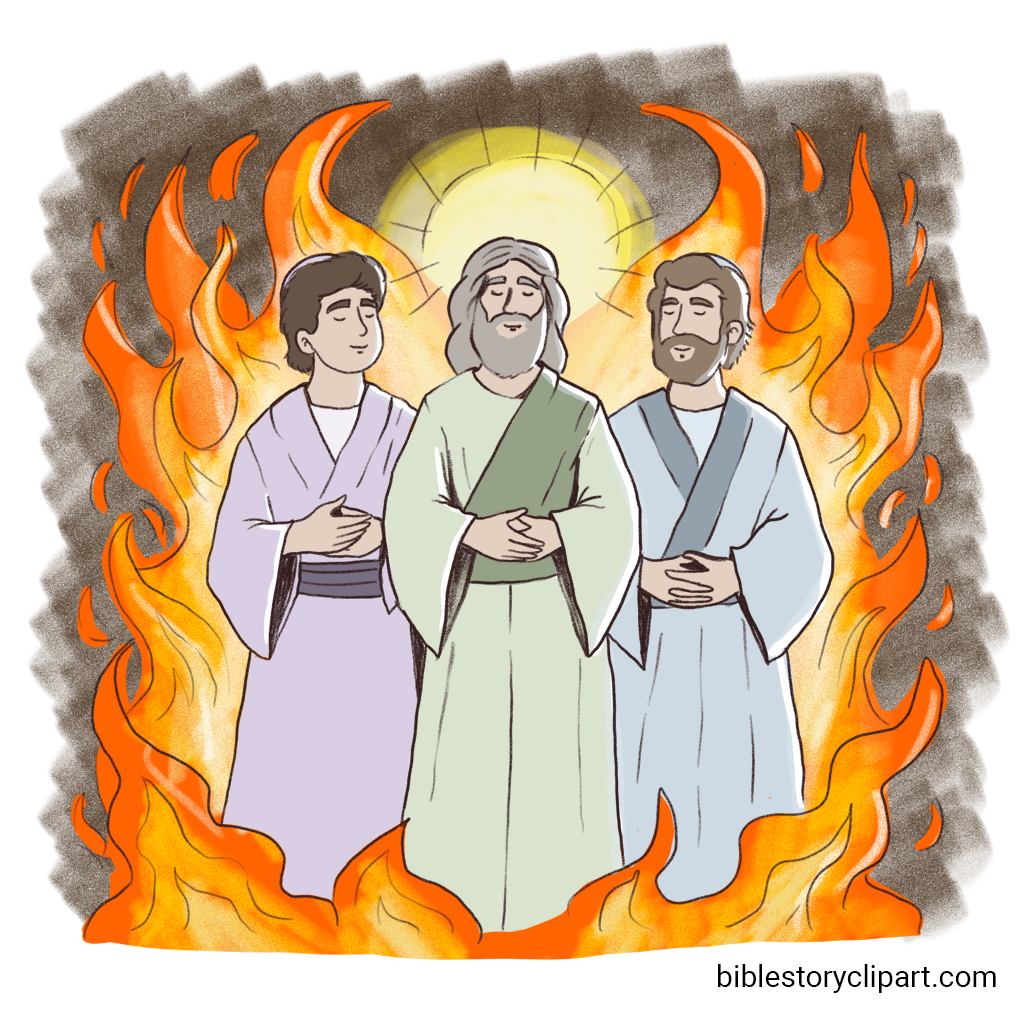
19 Then Nebuchadnezzar was filled with fury, and the expression of his face was changed against Shadrach, Meshach, and Abednego. He ordered the furnace heated seven times more than it was usually heated. 20 And he ordered some of the mighty men of his army to bind Shadrach, Meshach, and Abednego, and to cast them into the burning fiery furnace. 21 Then these men were bound in their cloaks, their tunics, their hats, and their other garments, and they were thrown into the burning fiery furnace. 22 Because the king’s order was urgent and the furnace overheated, the flame of the fire killed those men who took up Shadrach, Meshach, and Abednego. 23 And these three men, Shadrach, Meshach, and Abednego, fell bound into the burning fiery furnace.

24 Then King Nebuchadnezzar was astonished and rose up in haste. He declared to his counselors, “Did we not cast three men bound into the fire?” They answered and said to the king, “True, O king.” 25 He answered and said, “But I see four men unbound, walking in the midst of the fire, and they are not hurt; and the appearance of the fourth is like a son of the gods.”

26 Then Nebuchadnezzar came near to the door of the burning fiery furnace; he declared, “Shadrach, Meshach, and Abednego, servants of the Most High God, come out, and come here!” Then Shadrach, Meshach, and Abednego came out from the fire. 27 And the satraps, the prefects, the governors, and the king’s counselors gathered together and saw that the fire had not had any power over the bodies of those men. The hair of their heads was not singed, their cloaks were not harmed, and no smell of fire had come upon them. 28 Nebuchadnezzar answered and said, “Blessed be the God of Shadrach, Meshach, and Abednego, who has sent his angel and delivered his servants, who trusted in him, and set aside the king’s command, and yielded up their bodies rather than serve and worship any god except their own God. 29 Therefore I make a decree: Any people, nation, or language that speaks anything against the God of Shadrach, Meshach, and Abednego shall be torn limb from limb, and their houses laid in ruins, for there is no other god who is able to rescue in this way.” 30 Then the king promoted Shadrach, Meshach, and Abednego in the province of Babylon. – Daniel 3:19-30 ESV

Nebuchadnezzar became enraged when he realized his death threat had not dissuaded Shadrach, Meshach, and Abednego from refusing to bow down to his idol. He had warned them, “If you do not worship, you shall immediately be cast into a burning fiery furnace” (Daniel 3:15 ESV). Then he arrogantly challenged their God to do anything about it.

“And who is the god who will deliver you out of my hands?” – Daniel 3:15 ESV

But the three young men refused to compromise their convictions. They held their ground and refused to obey the king’s edict, choosing instead to place their faith in God’s power and providential care. They truly believed that Yahweh was fully capable of keeping them from the flames or rescuing them out of them.

“…our God whom we serve is able to deliver us from the burning fiery furnace, and he will deliver us out of your hand, O king. – Daniel 3:17 ESV

They had no way of knowing the outcome of the day’s events. God had given them no verbal guarantee that their lives would be spared. They even displayed a willingness to suffer whatever fate God may have in store for them.

“…even if he doesn’t [rescue us], we want to make it clear to you, Your Majesty, that we will never serve your gods or worship the gold statue you have set up.” – Daniel 3:18 NLT

Nebuchadnezzar couldn’t comprehend their willingness to face death rather than to compromise their convictions. He took their refusal as a personal affront to his power and authority. They weren’t just refusing to bow down to his image, they were rejecting his right to rule their lives. As king of the world’s most powerful nation, Nebuchadnezzar had grown drunk on his own success. He was obsessed with his image and used to getting his way. Nations fell before him. Lesser kings bowed down in front of him. His own citizens feared and revered him. But when these three young Hebrew men dared to question his sovereignty and withhold their allegiance, it was more than he could stand. So, he ordered their immediate executions.

The text makes it clear that Nebuchadnezzar was not simply carrying out his own decree by ordering the deaths of three recalcitrant Hebrews. He was launching a personal attack on the God of Shadrach, Meshach, and Abednego. This had become a personal battle between him and this dream-inducing, future-predicting God of Daniel and his three friends. Nebuchadnezzar was determined to come out the winner in this war of wills, so he ordered his “mighty men” to bind Shadrach, Meshach, and Abednego. He wasn’t leaving their arrest up to some low-level infantry soldiers who might allow them to escape. Next, he ordered the furnace to be super-heated and the three men to be clothed in layer after layer of flammable fabric. He was taking no chances. Nothing would prevent him from proving his power and asserting his authority over the meddling God of the Hebrews.

Nebuchadnezzar must have felt a perverse sense of joy as he watched his guards get consumed by the flames while throwing the three Hebrews into the furnace. There was no way of escape for Shadrach, Meshach, and Abednego, and there was no way their God could come to their aid. But Nebuchadnezzar was in for a shock. As he gazed into the furnace, he saw something that took his breath away.

“Look!” Nebuchadnezzar shouted. “I see four men, unbound, walking around in the fire unharmed! And the fourth looks like a god!” – Daniel 3:25 NLT

This was impossible. There was no way these men could have survived the flames of the furnace. Yet, they were walking about unharmed and accompanied by some kind of celestial being. To Nebuchadnezzar’s polytheistic mind, this fourth individual was “like a son of the gods.” The appearance of this being was not like that of the three men and the king concluded that it must be a divine manifestation.

Shocked and shaken by what he was witnessing, Nebuchadnezzar approached the mouth of the furnace and called out, “Shadrach, Meshach, and Abednego, servants of the Most High God, come out, and come here!” (Daniel 3:26 ESV). The king refers to their God as ‘ĕlâ ʿillay – God most high. As a polytheist, Nebuchadnezzar was simply confessing that the Hebrew God was the greatest of all gods. He was not declaring Yahweh to be the one true God; he was admitting that no other gods could compare or compete with the God of Shadrach, Meshach, and Abednego.

To the surprise of Nebuchadnezzar and his royal officials, the three men exited the furnace unharmed and untouched.

The hair of their heads was not singed, their cloaks were not harmed, and no smell of fire had come upon them. – Daniel 3:27 ESV

There was no logical way to explain their miraculous survival. The king’s magicians, sorcerers, and seers were dumbfounded by what they had witnessed. The Chaldeans who had maliciously accused Shadrach, Meshach, and Abednego must have been stunned by the unexpected outcome of their efforts. Having hoped to eliminate their competition, they had to stand back and watch the three Hebrews receive further praise and adulation from the king.

“Praise to the God of Shadrach, Meshach, and Abednego! He sent his angel to rescue his servants who trusted in him. They defied the king’s command and were willing to die rather than serve or worship any god except their own God. – Daniel 3:28 NLT

This was not the outcome the Chaldeans had expected. Rather than seeing their enemies burned alive, they watched as the three Hebrews were celebrated and elevated to even higher positions within the king’s administration.

But what happened next should not be overlooked or dismissed. It shouldn’t be misunderstood either. As a result of God’s miraculous deliverance of the Shadrach, Meshach, and Abednego, Nebuchadnezzar issued another rash and unnecessary edict.

“Therefore, I make this decree: If any people, whatever their race or nation or language, speak a word against the God of Shadrach, Meshach, and Abednego, they will be torn limb from limb, and their houses will be turned into heaps of rubble. There is no other god who can rescue like this!” – Daniel 3:28 NLT

At first glance, this appears to be a positive outcome. The king of a pagan, idol-worshiping nation is commanding that the God of the Hebrews be treated with honor and reverence. But look closely. This edict commands the worship of Yahweh under the penalty of death. It is devotion motivated by the threat of destruction. It was the same tactic Nebuchadnezzar used to coerce the worship of his statue. Bow down or die.

But God does not need men’s help. He also does not desire worship that is motivated by abject fear or simply as a means of escaping death. During the days that Israel wandered in the wilderness on their way to the promised land, Moses commanded them, “Hear, O Israel: The Lord our God, the Lord is one. You shall love the Lord your God with all your heart and with all your soul and with all your might” (Deuteronomy 6:4 ESV). “Worshiping” that is coerced or done out of a sense of obligation displeases God. It is meaningless, vain, and hypocritical. 

God despises heartless worship that is motivated by fear rather than true faith. The whole reason Daniel and his friends were in Babylon to begin with is because their forefathers had failed to worship God is spirit and in truth.

“I hate all your show and pretense—
    the hypocrisy of your religious festivals and solemn assemblies.
I will not accept your burnt offerings and grain offerings.
    I won’t even notice all your choice peace offerings.
Away with your noisy hymns of praise!
    I will not listen to the music of your harps.
Instead, I want to see a mighty flood of justice,
    an endless river of righteous living.” – Amos 5:21-24 NLT

Nebuchadnezzar was trying to manufacture worship, just as he had done with his statue. He thought he could force his people to have faith in Israel’s God. But that is not the kind of worship God requires or desires. God did not need Nebuchadnezzar’s help, and He did not desire the worship of those whose hearts were not in it. Worship done for the wrong reason and with an improper motivation is an affront to God.

Nebuchadnezzar’s edict was not going to produce true worshipers. It would only create the same kind of shallow, fear-induced worship that God accused the Israelites of displaying.

“…this people draw near with their mouth
    and honor me with their lips,
    while their hearts are far from me,
and their fear of me is a commandment taught by men…” – Isaiah 29:3 NLT

God didn’t want or need Nebuchadnezzar’s help. Manufactured worship is not worship at all. Faithfulness that is the fruit of fear and the byproduct of threats is a sham. It won’t last and it can’t withstand the heat of the furnace. The faith of Shadrach, Meshach, and Abednego wasn’t forced, it was from the heart.

English Standard Version (ESV) The Holy Bible, English Standard Version. ESV® Permanent Text Edition® (2016). Copyright © 2001 by Crossway Bibles, a publishing ministry of Good News Publishers.

New Living Translation (NLT) Holy Bible, New Living Translation, copyright © 1996, 2004, 2015 by Tyndale House Foundation. Used by permission of Tyndale House Publishers Inc., Carol Stream, Illinois 60188. All rights reserved.

New English Translation (NET)NET Bible® copyright ©1996-2017 by Biblical Studies Press, L.L.C. http://netbible.com All rights reserved.

Who Is the God Who Will Deliver You?

Therefore at that time certain Chaldeans came forward and maliciously accused the Jews. They declared to King Nebuchadnezzar, “O king, live forever! 10 You, O king, have made a decree, that every man who hears the sound of the horn, pipe, lyre, trigon, harp, bagpipe, and every kind of music, shall fall down and worship the golden image. 11 And whoever does not fall down and worship shall be cast into a burning fiery furnace. 12 There are certain Jews whom you have appointed over the affairs of the province of Babylon: Shadrach, Meshach, and Abednego. These men, O king, pay no attention to you; they do not serve your gods or worship the golden image that you have set up.”

13 Then Nebuchadnezzar in furious rage commanded that Shadrach, Meshach, and Abednego be brought. So they brought these men before the king. 14 Nebuchadnezzar answered and said to them, “Is it true, O Shadrach, Meshach, and Abednego, that you do not serve my gods or worship the golden image that I have set up? 15 Now if you are ready when you hear the sound of the horn, pipe, lyre, trigon, harp, bagpipe, and every kind of music, to fall down and worship the image that I have made, well and good. But if you do not worship, you shall immediately be cast into a burning fiery furnace. And who is the god who will deliver you out of my hands?”

16 Shadrach, Meshach, and Abednego answered and said to the king, “O Nebuchadnezzar, we have no need to answer you in this matter. 17 If this be so, our God whom we serve is able to deliver us from the burning fiery furnace, and he will deliver us out of your hand, O king. 18 But if not, be it known to you, O king, that we will not serve your gods or worship the golden image that you have set up.” – Daniel 3:8-18 ESV

This iconic story has been a staple of Sunday School classes for generations. Every child who grew up going to church heard about the exploits of Shadrach, Meshach, and Abednego in the fiery furnace. But in its telling, the story tends to take on the aura of a Grimm’s Fairy Tale. It becomes the fantastic recounting of three brave young men who proved their faith in God by standing up to the evil king and refusing to worship his false god. But their act of bravery didn’t come without cost. Their refusal to obey the king’s edict came with the penalty of death by fire in a blazing hot furnace. This macabre-sounding story is frightening even for adults, let alone children. But with the use of colorful cartoon-like pictures and a sanitized storyline, it has been used  to inspire young children to follow the example of its three brave characters.

Yet, is that the primary message behind the story of Shadrach, Meshach, and Abednego? So often, in an attempt to make the stories of the Bible more relevant and relatable, we focus on the lives of the characters they contain. We tell our children the story of Daniel in the lion’s den and challenge them to “dare to be a Daniel.” We recount the story of Joseph’s roller-coaster-like life in Egypt but focus on the reward he ultimately received for his faithfulness. We turn his life into a Horatio Alger, rags-to-riches story that portrays God as always ready to reward the patient and faithful. The not-so-subtle message becomes: If you do the right thing, there will always be a happy ending.

The stories of the Bible recount the lives of men and women just like you and me, but they were intended to be the primary focus of our attention. Yes, we can learn a lot about faith from the life of Abraham. We can discover what it means to be a man after God’s own heart by examining the life of David. The story of Shadrach, Meshach, and Abednego can inspire us to stand up for our convictions. But by making much of men, we tend to make little of God. By focusing on the exploits of the human characters in these stories we tend to lose sight of the One moving behind the scenes and orchestrating every aspect of the narrative.

From the first verses of its opening chapter, the Book of Daniel has been about God. The entire narrative began with a retelling of Nebuchadnezzar’s capture of the city of Jerusalem.

The Lord gave him victory over King Jehoiakim of Judah and permitted him to take some of the sacred objects from the Temple of God. So Nebuchadnezzar took them back to the land of Babylonia and placed them in the treasure-house of his god. – Daniel 1:2 NLT

The story begins with a reminder that God was in control and behind all that had happened. But He was not done. Just a few verses later, when Daniel refused to eat the king’s food, we read, “God had given the chief of staff both respect and affection for Daniel” (Daniel 1:9 NLT). As the story unfolds, we’re reminded that God continued to control the affairs of men, including those of the king and the four young Hebrew boys.

God gave these four young men an unusual aptitude for understanding every aspect of literature and wisdom. And God gave Daniel the special ability to interpret the meanings of visions and dreams. – Daniel 1:19 NLT

Chapter two records the story of Nebuchadnezzar’s disturbing dream and Daniel’s interpretation of it. But as the verse above makes clear, Daniel received this ability from the hand of God, and as the story reveals, God was the source behind Nebuchadnezzar’s dream.

“…there is a God in heaven who reveals secrets, and he has shown King Nebuchadnezzar what will happen in the future.” – Daniel 2:28 NLT

The dream, its interpretation, and its meaning were all the handiwork of God. Daniel was simply the instrument God used to accomplish His predetermined plan, and even Daniel recognized his subservient role in the whole affair.

“…it is not because I am wiser than anyone else that I know the secret of your dream, but because God wants you to understand what was in your heart.” – Daniel 2:30 NLT

After divulging the meaning of the dream, Daniel confessed, “The great God was showing the king what will happen in the future. The dream is true, and its meaning is certain” (Daniel 2:45 NLT). Even Nebuchadnezzar recognized the divine nature of the day’s events, declaring, “Truly, your God is the greatest of gods, the Lord over kings, a revealer of mysteries, for you have been able to reveal this secret” (Daniel 2:47 NLT).

When Daniel and his friends were rewarded with promotions, the story took a positive turn. Everything was looking up. God had revealed Himself in power and the pagan king had taken notice. Then chapter three opens up with Nebuchadnezzar’s decision to build a massive monument to his own glory and greatness. But it wasn’t enough that his statue loomed over the plains of Dura, he wanted all the citizens of his kingdom to bow before it. He demanded their unwavering allegiance in the form of abject worship, with death as the penalty for disobedience.

Don’t miss the message. The man who said, “Your God is the greatest of gods, the Lord over kings” was now demanding that he be worshiped like a god. He was declaring himself to be the greatest of gods. The king’s edict demanded all to “bow to the ground to worship King Nebuchadnezzar’s gold statue” (Daniel 3:5 NLT). This was nothing less than a declaration of war. Whether Nebuchadnezzar realized it or not, he was aligning himself against “the greatest of gods.” His statue was a bold and blatant statement of superiority and supremacy. But what God did next is surprising.

In the dream, God sent a massive bolder to destroy the statue. But in real life, God didn’t order a direct hit on the symbol of Nebuchadnezzar’s power. Instead, He delivered a distinctly different but no less powerful proof of His sovereignty, and Shadrach, Meshach, and Abednego would find themselves in the middle of the conflict between God and Nebuchadnezzar.

These men were not trying to make a statement. They had not made a pact to disobey the king’s edict and were not practicing a form of civil disobedience. They were simply doing what they always did, worshiping their God and living their lives in accordance with His will. But their actions were portrayed as evidence of insubordination. Driven by jealousy and hatred for these upstart Hebrews, some of the king’s Chaldean counselors leveled charges against them that were intended to result in death.

“…there are some Jews—Shadrach, Meshach, and Abednego—whom you have put in charge of the province of Babylon. They pay no attention to you, Your Majesty. They refuse to serve your gods and do not worship the gold statue you have set up.” – Daniel 3:12 NLT

Frustrated by this report, Nebuchadnezzar ordered that the men be brought before him. He repeated the conditions of his edict and warned them of the consequences of their disobedience.

“…if you refuse, you will be thrown immediately into the blazing furnace. And then what god will be able to rescue you from my power? – Daniel 3:15 NLT

That last line is critical to understanding the nature of the conflict taking place in this story. This is not about three men standing up for their convictions and facing off with an unjust and unrighteous king. It is about God proving His power and supremacy over the kingdoms of this world. God could have struck Nebuchadnezzar down. He could have ordered a plague to destroy the Chaldeans. But Nebuchadnezzar had issued a challenge. Not only had he erected a statue to declare his glory, but he had boldly asserted that his power was greater than that of God.

Caught in the middle of this conflict between a human king who believed himself to be a god and Yahweh, the greatest of gods, Shadrach, Meshach, and Abednego would have their faith tested. But the story is not about their faith; it is about the One on whom their faith relied. When confronted by the king and given a final ultimatum to bow down or die, they simply replied, “If we are thrown into the blazing furnace, the God whom we serve is able to save us. He will rescue us from your power, Your Majesty. But even if he doesn’t, we want to make it clear to you, Your Majesty, that we will never serve your gods or worship the gold statue you have set up” (Daniel 3:18 NLT).

Don’t miss the nature of their reply. They clearly see where the battle lines have been drawn. They know that this is a battle for sovereignty. The king had asserted his supremacy and declared his power over their lives. He believed that he held their future in his hands and could force their allegiance simply by threatening them with loss of life. But Shadrach, Meshach, and Abednego knew better because they knew their God was bigger. The king had power but he lacked true sovereignty. These young Hebrews believed that God was in control, despite the circumstances they faced. In their estimation, even the fiery furnace posed no real threat.

These young men were faith-filled because they believed their God to be faithful. In their youth, they had been exposed to the Psalms and the words of encouragement they bring.

In my distress I prayed to the Lord,
    and the Lord answered me and set me free.
The Lord is for me, so I will have no fear.
    What can mere people do to me?
Yes, the Lord is for me; he will help me.
    I will look in triumph at those who hate me.
It is better to take refuge in the Lord
    than to trust in people.
It is better to take refuge in the Lord
    than to trust in princes. – Psalm 118:5-9 NLT

And while they lived long before Jesus took on human flesh and dwelt among men, they displayed the very outlook that Jesus encouraged.

“Don’t be afraid of those who want to kill your body; they cannot touch your soul. Fear only God, who can destroy both soul and body in hell. – Matthew 10:28 NLT

The point of the story is not the size of their faith, but its source. These three young men were not super-saints or spiritual icons of virtue. They were ordinary men who believed in an extraordinary God who was all-knowing, all-powerful, and fully capable of delivering them. Their willingness to enter the furnace should not be viewed as a measurement of their faith but as a bold expression of their belief in the greatness of their God.

English Standard Version (ESV) The Holy Bible, English Standard Version. ESV® Permanent Text Edition® (2016). Copyright © 2001 by Crossway Bibles, a publishing ministry of Good News Publishers.

New Living Translation (NLT) Holy Bible, New Living Translation, copyright © 1996, 2004, 2015 by Tyndale House Foundation. Used by permission of Tyndale House Publishers Inc., Carol Stream, Illinois 60188. All rights reserved.

New English Translation (NET)NET Bible® copyright ©1996-2017 by Biblical Studies Press, L.L.C. http://netbible.com All rights reserved.

Pride Comes Before the Fall

1 King Nebuchadnezzar made an image of gold, whose height was sixty cubits and its breadth six cubits. He set it up on the plain of Dura, in the province of Babylon. Then King Nebuchadnezzar sent to gather the satraps, the prefects, and the governors, the counselors, the treasurers, the justices, the magistrates, and all the officials of the provinces to come to the dedication of the image that King Nebuchadnezzar had set up. Then the satraps, the prefects, and the governors, the counselors, the treasurers, the justices, the magistrates, and all the officials of the provinces gathered for the dedication of the image that King Nebuchadnezzar had set up. And they stood before the image that Nebuchadnezzar had set up. And the herald proclaimed aloud, “You are commanded, O peoples, nations, and languages, that when you hear the sound of the horn, pipe, lyre, trigon, harp, bagpipe, and every kind of music, you are to fall down and worship the golden image that King Nebuchadnezzar has set up. And whoever does not fall down and worship shall immediately be cast into a burning fiery furnace.” Therefore, as soon as all the peoples heard the sound of the horn, pipe, lyre, trigon, harp, bagpipe, and every kind of music, all the peoples, nations, and languages fell down and worshiped the golden image that King Nebuchadnezzar had set up. – Daniel 3:1-7 ESV

It is impossible to know when the events of this chapter took place. The author’s inclusion of them immediately after the events of chapter two leaves the impression that they happened in quick succession. However, some biblical scholars believe Nebuchadnezzar’s construction of the golden image occurred years later. There is speculation that the statue was erected in the later part of 595 B.C. to celebrate a failed coup attempt. Others have suggested that the statue was erected in 585 B.C. to commemorate the Babylonian conquest of Jerusalem. But whatever the timing or the occasion, the golden image was intended to symbolize Babylonian supremacy over all the other nations of the earth. This image was a PR stunt designed to rally public opinion in the king’s favor and elevate his status as the king of all kings.

Whether Nebuchadnezzar ordered the image to be built immediately after hearing the interpretation of his dream or did so later in his reign, his motive seems clear. The term “image” is translated from the Aramaic word tselem and refers to an idolatrous figure. It is found nowhere else in the Hebrew Bible except chapter 3 of Daniel. The Hebrew equivalent is ṣelem, which is used throughout the Old Testament to refer to idols. The text does not provide a description of the image but the reader is led to believe that it was a physical representation of the “great image” (Daniel 2:31) Nebuchadnezzar saw in his dream. Despite the disturbing nature of that dream and the less-than-optimistic meaning Daniel assigned to it, the king found ample inspiration to order the statue’s construction. His primary takeaway from the interpretation appears to have been Daniel’s opening words

You, O king, the king of kings, to whom the God of heaven has given the kingdom, the power, and the might, and the glory, and into whose hand he has given, wherever they dwell, the children of man, the beasts of the field, and the birds of the heavens, making you rule over them all—you are the head of gold.” – Daniel 2:37-38 ESV

He enjoyed hearing himself described as “the king of kings.” Discovering that Daniel’s God had given him power, might, and glory, Nebuchadnezzar’s overactive ego became more inflated than ever. But he was not satisfied with being “the head of gold.” He wanted more. While the dream portrayed an image comprised of different metals mixed with clay, Nebuchadnezzar commissioned a statue made of pure gold. When completed, it towered over the plain of Dura standing at a staggering height of nearly 100 feet. It only seems logical to assume that this statue bore the image of Nebuchadnezzar himself. This wasn’t an idol meant to represent Marduk, the primary god of the Babylonians; it was a tribute to one man’s obsession with his own self-importance.

There is little doubt that Nebuchadnezzar suffered from an overinflated ego and an overactive sense of self-worth. In the very next chapter, he will have yet another dream that symbolizes his struggle with pride and arrogance. Despite repeated warnings from God about his unjustified sense of self-importance, Nebuchadnezzar will stand on the balcony of his palace and proclaim, “Is not this great Babylon, which I have built by my mighty power as a royal residence and for the glory of my majesty?” (Daniel 4:30 ESV).

This man had every right to gloat over his own success because he ruled over the most powerful nation on earth. His might was unequalled and his kingdom was unmatched in size, wealth, and dominion. So, having erected this monument to his own success, he assembled all “the high officers, officials, governors, advisers, treasurers, judges, magistrates, and all the provincial officials” (Daniel 3:2 NLT) for its dedication. These men were there in an official capacity to demonstrate their allegiance to the king and to serve as representatives of the people.

As the leaders of the nation gathered in the shadow of this massive statue, a herald declared the king’s edict.

“People of all races and nations and languages, listen to the king’s command! When you hear the sound of the horn, flute, zither, lyre, harp, pipes, and other musical instruments, bow to the ground to worship King Nebuchadnezzar’s gold statue.” – Daniel 3:4-5 NLT

This image was not simply a monument to Nebuchadnezzar’s success and Babylonian supremacy, it was an idol to be worshiped. The king seems to have conveniently forgotten the statement he made when Daniel interpreted his dream.

“Truly, your God is God of gods and Lord of kings.” – Daniel 2:47 ESV

The golden statue towering over the plain of Dura was not a monument to Yahweh’s glory and might; it was a blatant tribute to Nebuchadnezzar’s accomplishments. Whether the image was made in his own likeness is irrelevant because its very presence robbed Yahweh of glory. The king’s command that all his citizens bow down and worship the image he made was an affront to the God of the universe. The same God who had graciously interpreted Nebuchadnezzar’s dream was being treated with contempt and displaced by an image made by human hands. Not only that, the worship Nebuchadnezzar demanded was coerced by the threat of death.

“Anyone who refuses to obey will immediately be thrown into a blazing furnace.” – Daniel 3:6 NLT

As will become clear, the king expected all people, regardless of nationality or religious affiliation, to worship his statue. Due to Nebuchadnezzar’s recent conquests and his penchant for taking captives, the population of Babylon would have been a diverse mixture of disparate people groups with their own deities and religious expressions. But they were each expected to show their unadulterated allegiance to the king and his kingdom by bowing down to his statue. This included Daniel and his companions. Despite Nebuchadnezzar’s glowing tribute to their God and their unexpected promotions, they would not escape the king’s edict and its penalty.

Nebuchadnezzar was not outlawing the worship of other gods; he was simply demanding the unwavering allegiance of his subjects – upon penalty of death. Everyone was free to worship their own gods, but they were also required to demonstrate the primacy of Nebuchadnezzar and the Babylonian state. Their allegiance was not optional. Their submission was not a matter of choice. It was a do-or-die proposition that left the people with little choice but to comply and, according to verse seven, “all the people…bowed to the ground and worshiped.”

Or did they? As the chapter unfolds, it will become clear that there were a few conscientious objectors. Not everyone was willing to obey the king’s edict and bow the knee to his statue. Shadrach, Meshach, and Abednego will refuse to comply and, as a result, suffer the consequences of their civil disobedience. These three Hebrew friends will stand their ground, refusing to compromise their convictions and welcoming the opportunity to trust in the faithfulness of their God.

English Standard Version (ESV) The Holy Bible, English Standard Version. ESV® Permanent Text Edition® (2016). Copyright © 2001 by Crossway Bibles, a publishing ministry of Good News Publishers.

New Living Translation (NLT) Holy Bible, New Living Translation, copyright © 1996, 2004, 2015 by Tyndale House Foundation. Used by permission of Tyndale House Publishers Inc., Carol Stream, Illinois 60188. All rights reserved.

New English Translation (NET)NET Bible® copyright ©1996-2017 by Biblical Studies Press, L.L.C. http://netbible.com All rights reserved.

Consider the Source

46 Then King Nebuchadnezzar fell upon his face and paid homage to Daniel, and commanded that an offering and incense be offered up to him. 47 The king answered and said to Daniel, “Truly, your God is God of gods and Lord of kings, and a revealer of mysteries, for you have been able to reveal this mystery.” 48 Then the king gave Daniel high honors and many great gifts, and made him ruler over the whole province of Babylon and chief prefect over all the wise men of Babylon. 49 Daniel made a request of the king, and he appointed Shadrach, Meshach, and Abednego over the affairs of the province of Babylon. But Daniel remained at the king’s court. – Daniel 2:46-49 ESV

After revealing the meaning of the king’s dream, Daniel confidently asserted, “A great God has made known to the king what shall be after this. The dream is certain, and its interpretation sure” (Daniel 2:45 ESV). The young man took the opportunity to promote the superiority of his God and the certainty of the vision and its message. Despite any aspersions the magicians, sorcerers, and Chaldeans might cast his way,  Daniel wanted Nebuchadnezzar to know that his words could be trusted because their source was divine. Unlike the gods of Babylon, Daniel’s God was all-knowing and all-powerful. He could “predict” the future because He was already aware of it. He knew it in advance. According to the Book of Isaiah, the God of Israel operates outside the limits of time and space. He is transcendent and eternal, having no beginning or end.

“Do not forget this! Keep it in mind!
    Remember this, you guilty ones.
Remember the things I have done in the past.
    For I alone am God!
    I am God, and there is none like me.
Only I can tell you the future
    before it even happens.
Everything I plan will come to pass,
    for I do whatever I wish. – Isaiah 46:8-10 NLT

As a well-educated Hebrew, Daniel would have been familiar with the Psalms of David. In them, David acknowledged his own awareness of God’s omniscience.

O Lord, you have examined my heart
    and know everything about me.
You know when I sit down or stand up.
    You know my thoughts even when I’m far away.
You see me when I travel
    and when I rest at home.
    You know everything I do.
You know what I am going to say
    even before I say it, Lord.
You go before me and follow me.
    You place your hand of blessing on my head.
Such knowledge is too wonderful for me,
    too great for me to understand!.
– Psalm 139:1-6 NLT

Nebuchadnezzar’s dream had not been the result of a poorly prepared meal or indigestion; it was the handiwork of God. It was He who created its content and orchestrated its timing. Because God was involved, it was more than a dream; it was prophetic. God used Nebuchadnezzar’s own political aspirations and dreams of world domination as the stage on which to reveal His own message of dominion. The vision was simply how God communicated His plans for Nebuchadnezzar’s kingdom and the future of the world. The God of the universe was letting this power-obsessed king know that his authority was limited and his kingdom was temporary.

In a real sense, the interpretation of the dream was less for Nebuchadnezzar’s benefit than it was for Daniel, his friends, and the people of Israel. God wanted His people to know that He was in charge. It was His plans that would be carried out, not those of Nebuchadnezzar. God held the fates of Daniel, Shadrach, Meshach, and Abednego in His hands. They were not the helpless pawns of the Babylonian king. Their deportation had been God’s doing. Their recent graduations from the king’s training program had been God’s will. Daniel’s capacity to interpret dreams and visions was a gift from God.

No one in the room, including Daniel, understood the import of the interpretation. God provided little in the way of details. Even to this day, scholars debate the nature of the kingdoms represented by the statue. There is even disagreement about the dream’s climactic ending as biblical scholars continue to debate the nature of the everlasting kingdom to come.

The whole point of the dream and its interpretation was to accentuate the will and sovereignty of God. Daniel and his friends needed to know that their God was in complete control of all that was going on in their lives, the world, and the future. Kingdoms come and go, but God is eternal. The plans of men are powerless before the will of God. The gods of this world are no match for the God of Abraham, Isaac, and Jacob.

Once again, the writings of King David must have brought comfort and encouragement to Daniel and his companions as they attempted to acclimate themselves to their new surroundings.

In times of trouble, may the Lord answer your cry.
    May the name of the God of Jacob keep you safe from all harm.
May he send you help from his sanctuary
    and strengthen you from Jerusalem.
May he remember all your gifts
    and look favorably on your burnt offerings. Interlude

May he grant your heart’s desires
    and make all your plans succeed.
May we shout for joy when we hear of your victory
    and raise a victory banner in the name of our God.
May the Lord answer all your prayers.

Now I know that the Lord rescues his anointed king.
    He will answer him from his holy heaven
    and rescue him by his great power.
Some nations boast of their chariots and horses,
    but we boast in the name of the Lord our God.
Those nations will fall down and collapse,
    but we will rise up and stand firm.

Give victory to our king, O Lord!
    Answer our cry for help.Psalm 20:1-9 NLT

Nebuchadnezzar was powerful but he was far from invincible. He could threaten his wise men with death but he couldn’t preserve his own kingdom from collapse. He could make plans to conquer the world but was incapable of controlling his own subconscious mind. He could not prevent his dreams of world domination from turning into nightmares of future devastation.

Daniel’s Spirit-induced interpretation reflects the non-negotiable reality of God’s sovereignty over the affairs of men and the future of mankind. Again, the words of the Psalms would have provided Daniel with comfort and security as he faced the threat of execution. He would have been reminded that, ultimately, all kings and kingdoms stand opposed to God. But God will have the last laugh.

Why are the nations so angry?
    Why do they waste their time with futile plans?
The kings of the earth prepare for battle;
    the rulers plot together
against the Lord
    and against his anointed one.
“Let us break their chains,” they cry,
    “and free ourselves from slavery to God.”

But the one who rules in heaven laughs.
    The Lord scoffs at them.
Then in anger he rebukes them,
    terrifying them with his fierce fury.
For the Lord declares, “I have placed my chosen king on the throne
    in Jerusalem, on my holy mountain.” – Psalm 2:1-6 NLT

Daniel and his friends had nothing to fear; their God was in complete control. But they weren’t the only ones who received an unforgettable lesson in Yahweh’s sovereignty.  The king was blown away by the entire experience and displayed his awe by bowing down before Daniel and worshiping him. The significance of that scene should not be overlooked. The most powerful man in the world was kneeling before a young man who was a member of a conquered and subjugated nation. It is unlikely that Nebuchadnezzar treated his magicians, sorcerers, and Chaldeans with the same respect. But the king revealed the motivation behind his genuflection.

“Truly, your God is the greatest of gods, the Lord over kings, a revealer of mysteries, for you have been able to reveal this secret.” – Daniel 2:47 NLT

He knew that Daniel was nothing more than the spokesman for “the greatest of gods.” But he also knew that Daniel had access to a deity who was preeminent and all-powerful. Daniel’s God was worthy of reverence and, as his messenger, Daniel was deserving of honor.

Then the king appointed Daniel to a high position and gave him many valuable gifts. He made Daniel ruler over the whole province of Babylon, as well as chief over all his wise men. – Daniel 2:48 NLT

It’s telling to note that Daniel’s first official act in his new capacity was to request a promotion for each of his friends. He recognized that God had blessed him with the king’s favor and he used it, not to his own advantage, but to secure the future of his companions. By seeing that his friends were elevated alongside him, Daniel ensured that he would have not only their companionship but also their spiritual support. He was living out the truth found in the Book of Ecclesiastes.

A person standing alone can be attacked and defeated, but two can stand back-to-back and conquer. Three are even better, for a triple-braided cord is not easily broken. – Ecclesiastes 4:12 NLT

English Standard Version (ESV) The Holy Bible, English Standard Version. ESV® Permanent Text Edition® (2016). Copyright © 2001 by Crossway Bibles, a publishing ministry of Good News Publishers.

New Living Translation (NLT) Holy Bible, New Living Translation, copyright © 1996, 2004, 2015 by Tyndale House Foundation. Used by permission of Tyndale House Publishers Inc., Carol Stream, Illinois 60188. All rights reserved.

New English Translation (NET)NET Bible® copyright ©1996-2017 by Biblical Studies Press, L.L.C. http://netbible.com All rights reserved.

A Dream Come True (Soon)

31 “You saw, O king, and behold, a great image. This image, mighty and of exceeding brightness, stood before you, and its appearance was frightening. 32 The head of this image was of fine gold, its chest and arms of silver, its middle and thighs of bronze, 33 its legs of iron, its feet partly of iron and partly of clay. 34 As you looked, a stone was cut out by no human hand, and it struck the image on its feet of iron and clay, and broke them in pieces. 35 Then the iron, the clay, the bronze, the silver, and the gold, all together were broken in pieces, and became like the chaff of the summer threshing floors; and the wind carried them away, so that not a trace of them could be found. But the stone that struck the image became a great mountain and filled the whole earth.

36 “This was the dream. Now we will tell the king its interpretation. 37 You, O king, the king of kings, to whom the God of heaven has given the kingdom, the power, and the might, and the glory, 38 and into whose hand he has given, wherever they dwell, the children of man, the beasts of the field, and the birds of the heavens, making you rule over them all—you are the head of gold. 39 Another kingdom inferior to you shall arise after you, and yet a third kingdom of bronze, which shall rule over all the earth. 40 And there shall be a fourth kingdom, strong as iron, because iron breaks to pieces and shatters all things. And like iron that crushes, it shall break and crush all these. 41 And as you saw the feet and toes, partly of potter’s clay and partly of iron, it shall be a divided kingdom, but some of the firmness of iron shall be in it, just as you saw iron mixed with the soft clay. 42 And as the toes of the feet were partly iron and partly clay, so the kingdom shall be partly strong and partly brittle. 43 As you saw the iron mixed with soft clay, so they will mix with one another in marriage, but they will not hold together, just as iron does not mix with clay. 44 And in the days of those kings the God of heaven will set up a kingdom that shall never be destroyed, nor shall the kingdom be left to another people. It shall break in pieces all these kingdoms and bring them to an end, and it shall stand forever, 45 just as you saw that a stone was cut from a mountain by no human hand, and that it broke in pieces the iron, the bronze, the clay, the silver, and the gold. A great God has made known to the king what shall be after this. The dream is certain, and its interpretation sure.” – Daniel 2:31-45 ESV

The tension in the room must have been palpable. Nebuchadnezzar sat in rapt silence as Daniel described the details of his dream. The magicians, conjurers, and Chaldeans listened in shocked silence as this young Hebrew pulled off a feat they had deemed impossible. Shadrach, Meshach, and Abednego watched as their friend stood before the king and his court, unveiling the message he had received from Yahweh.

And everyone in the room must have been surprised at the nature of the dream. It was probably not what they expected. Daniel described a massive statue of a man comprised of gold, silver, bronze, iron, and clay. He acknowledges that the statue’s visage had been frightening and confusing to the king but never fully discloses why. It seems unlikely that the statue’s composite makeup left the king trembling. Even the statue’s destruction by a massive bolder should not have caused the kind of fear and anxiety the king experienced. The only logical conclusion is that the king recognized his image on the face of the statue. The golden head bore his own likeness.

In his dream, Nebuchadnezzar had been given a vision of the future. As Daniel proceeds to interpret the meaning of the dream, he will disclose that the golden head of the massive statue represents the kingdom of Babylon.

“Your Majesty, you are the greatest of kings. The God of heaven has given you sovereignty, power, strength, and honor. He has made you the ruler over all the inhabited world and has put even the wild animals and birds under your control. You are the head of gold.” – Daniel 2:37-38 NLT

While Nebuchadnezzar’s initial glimpse of the statue might have produced feelings of pride, its destruction by the bolder was unexpected and frightening. There is no way he could have taken this disturbing scene as anything but a bad omen that presaged his death. But Daniel wanted the king to know that there was more to the vision than a prediction of his own demise. God was disclosing future events that would extend far beyond Nebuchadnezzar’s reign or Babylon’s 15 minutes of fame.

The composite nature of the statue is significant and, as Daniel discloses, it provides a visual representation of the future that moves from top to bottom. The head represents the reigning kingdom of the world: Babylon. Comprised of solid gold, it symbolizes the wealth and opulence of Nebuchadnezzar’s kingdom as well as its global dominance.  Much to Nebuchadnezzar’s surprise, Daniel announces that the Babylonian kingdom will be shortlived and ultimately be replaced by a larger but inferior kingdom. The statue’s chest and arms, crafted from silver, are larger than the head but of lesser value. They represent a nation that will rise and replace the Babylonians, only to find themselves supplanted by a still more inferior kingdom as reflected by the statue’s bronze belly and thighs. Moving down the statue’s length, Daniel describes its legs of iron, symbolizing yet one more kingdom to come. The fifth and final kingdom is represented by the feet of clay and iron.

In Nebuchadnezzar’s dream, this strange compilation of body parts was suddenly destroyed by “a rock…cut from a mountain, but not by human hands” – Daniel 2:34 NLT). This massive stone struck the feet of the statue, causing the entire structure to collapse and disintegrate into a cloud of fine dust from the impact.

Daniel’s description of this one-of-a-kind statue was exactly what Nebuchadnezzar had seen in his dream, but its meaning remained a mystery. Apart from Daniel, no one in the room had any idea what the imagery was meant to convey. But there was far more going on than Nebuchadnezzar could ever imagine. Little did he know that his vast and formidable kingdom would be temporary in nature. Babylon would be a relative blip on the radar screen of human history. It would come and go, only to be replaced by yet another kingdom whose moment in the spotlight of history would fade and be forgotten.

Despite Nebuchadnezzar’s recent and highly successful world-domination tour, his kingdom would not last. The kingdoms of men are temporary and those who rule over them are destined to death and obscurity. The statue was that of a man, symbolizing the earthly rule of human kings.

“The figure of a man was employed here because God wished to make known what would transpire during man’s day, the ages in which mortal man ruled the earth. Here, in one panoramic sweep, the whole history of human civilization is spread before us, from the days of Nebuchadnezzar to the end of time.” – Charles L. Feinberg, Daniel: The Kingdom of the Lord

Long before the Babylons invaded Judah and took Daniel and his companions captive, God had warned the kings of Edom, Moab, Ammon, Tyre, and Sidon that they too would suffer defeat at the hands of Nebuchadnezzar.

“Now I will give your countries to King Nebuchadnezzar of Babylon, who is my servant. I have put everything, even the wild animals, under his control. All the nations will serve him, his son, and his grandson until his time is up.” – Jeremiahs 27:6-7 ESV

Notice that God predicted the short-lived nature of Nebuchadnezzar’s dynasty. It would eventually come to an end, “Then many nations and great kings will conquer and rule over Babylon” (Jeremiah 27:7 ESV). That is exactly what the statue was meant to convey. 

“Nebuchadnezzar ruled about 45 years (605-560 B.C.), and his empire only lasted another 21 years. Nebuchadnezzar’s father, Nabopolassar, founded the Neo-Babylon Empire in 627 B.C., and it fell to the Persians in 539 B.C. So it existed for only 88 years.” – Thomas L. Constable, Notes of Daniel

But what Daniel had unveiled was far more than the end of Nebuchadnezzar’s kingdom; he was making known God’s plan for the end of the age. In a highly compressed timeline, God showed the rise and fall of the kingdoms of this world. There is much debate as to which kingdoms are symbolized by the multifaceted statue, but the general consensus is that the chest and arms represent the Medo-Persian Empire under Cyrus the Great, while the belly and thighs represent Greece under Alexander the Great. The legs of iron are believed to stand for Rome. But this once mighty kingdom, which ruled the world of Jesus’ day, eventually fell due to its weakened condition (feet of clay and iron). While the mighty Roman Empire lasted for half a century, it too was destined to end.

But the world did not end with the fall of Rome. Other kingdoms have come and gone. Nations have risen to power only to disappear from the scene and become relegated to the pages of history. But Daniel prophecies about a future kingdom that will develop behind the scenes while these world powers are still large and in charge. Each of these unnamed kingdoms is meant to represent the kingdoms of this world. They are temporary at best and no match for the kingdom to come.

During the reigns of those kings, the God of heaven will set up a kingdom that will never be destroyed or conquered. It will crush all these kingdoms into nothingness, and it will stand forever. – Daniel 2:44 NLT

While he is unaware of the full meaning of his interpretation, Daniel is communicating events that will happen with the return of Christ. The nations of this world will continue to vie for power and dominance, but none will be able to stand against the King of kings and Lord of lords when He returns to establish His eternal kingdom on earth.

The Book of Revelation reveals the final battle between Jesus and Satan, the prince of this world who will lead one final revolt in an attempt to overthrow the Kingdom of God.

Then I saw heaven opened, and a white horse was standing there. Its rider was named Faithful and True, for he judges fairly and wages a righteous war. His eyes were like flames of fire, and on his head were many crowns. A name was written on him that no one understood except himself. He wore a robe dipped in blood, and his title was the Word of God. The armies of heaven, dressed in the finest of pure white linen, followed him on white horses. From his mouth came a sharp sword to strike down the nations. He will rule them with an iron rod. He will release the fierce wrath of God, the Almighty, like juice flowing from a winepress. On his robe at his thigh was written this title: King of all kings and Lord of all lords.

Then I saw the beast and the kings of the world and their armies gathered together to fight against the one sitting on the horse and his army. And the beast was captured, and with him the false prophet who did mighty miracles on behalf of the beast—miracles that deceived all who had accepted the mark of the beast and who worshiped his statue. Both the beast and his false prophet were thrown alive into the fiery lake of burning sulfur. Their entire army was killed by the sharp sword that came from the mouth of the one riding the white horse. And the vultures all gorged themselves on the dead bodies. – Revelation 19:11-16, 19-21 ESV

Little did Daniel or Nebuchadnezzar understand that God had just revealed the entire timeline of human history through a dream. His plan for the people of Israel, Daniel and his friends, Nebuchadnezzar and his kingdom, and the future fate of the world was in place and working its way to completion, all according to God’s perfect timeline.

English Standard Version (ESV) The Holy Bible, English Standard Version. ESV® Permanent Text Edition® (2016). Copyright © 2001 by Crossway Bibles, a publishing ministry of Good News Publishers.

New Living Translation (NLT) Holy Bible, New Living Translation, copyright © 1996, 2004, 2015 by Tyndale House Foundation. Used by permission of Tyndale House Publishers Inc., Carol Stream, Illinois 60188. All rights reserved.

New English Translation (NET)NET Bible® copyright ©1996-2017 by Biblical Studies Press, L.L.C. http://netbible.com All rights reserved.