Our God Reigns.

After this I heard what seemed to be the loud voice of a great multitude in heaven, crying out,

“Hallelujah!
Salvation and glory and power belong to our God,
    for his judgments are true and just;
for he has judged the great prostitute
    who corrupted the earth with her immorality,
and has avenged on her the blood of his servants.”

Once more they cried out,

“Hallelujah!
The smoke from her goes up forever and ever.”

And the twenty-four elders and the four living creatures fell down and worshiped God who was seated on the throne, saying, “Amen. Hallelujah!” And from the throne came a voice saying,

“Praise our God,
    all you his servants,
you who fear him,
    small and great.”

Then I heard what seemed to be the voice of a great multitude, like the roar of many waters and like the sound of mighty peals of thunder, crying out,

“Hallelujah!
For the Lord our God
    the Almighty reigns.
Let us rejoice and exult
    and give him the glory,
for the marriage of the Lamb has come,
    and his Bride has made herself ready;
it was granted her to clothe herself
    with fine linen, bright and pure”—

for the fine linen is the righteous deeds of the saints.

And the angel said to me, “Write this: Blessed are those who are invited to the marriage supper of the Lamb.” And he said to me, “These are the true words of God.” 10 Then I fell down at his feet to worship him, but he said to me, “You must not do that! I am a fellow servant with you and your brothers who hold to the testimony of Jesus. Worship God.” For the testimony of Jesus is the spirit of prophecy. Revelation 19:1-10 ESV

At the close of chapter 18, the angel of God extended an invitation to all those in heaven to rejoice over the fall of Babylon.

“Rejoice over her, O heaven, and you saints and apostles and prophets, for God has given judgment for you against her!” – Revelation 18:20 ESV

But this was not a call to gloat over the demise of an earthly kingdom or over the destruction of those who lived in it. This was to be a celebration of God’s vindication of His people. Notice what the angel said: “God has given judgment for you against her.” They were to rejoice because their God had stepped in and stood against the forces of evil – all on their behalf. And as we begin chapter 19, we see that the angel’s invitation to celebrate and rejoice was eagerly taken up by those in heaven. John says that he immediately heard the sound of many voices, a great multitude, coming out of heaven, and they were singing the praises of God.

There are five songs contained in the first 10 verses of this chapter. The first four look back on the destruction of Babylon, recounting the city’s downfall, but celebrating God’s display of salvation, glory and power. The main emphasis of these songs is God’s vindication of all those who had suffered martyrdom as a result of Antichrist’s reign. And his rule and power are symbolized by his governmental headquarters in Babylon, which God brought to a devastating end. If you recall, all the way back in chapter six, John had seen, under the altar in heaven, the souls of all “those who had been slain for the word of God and for the witness they had borne” (Revelation 6:9 ESV), and they had been crying out:

“O Sovereign Lord, holy and true, how long before you will judge and avenge our blood on those who dwell on the earth?” – Revelation 6:10 ESV

Well, their prayers have been answered. God has avenged them, and all those in heaven rejoice at the faithfulness of God. They call on all those who fear Him to praise Him. Four separate times, we hear the phrase, “Hallelujah!” coming out of heaven. In the Greek it is hallēlouïa, and it literally means “Praise the Lord.” It is only found in this chapter and nowhere else in the New Testament. It is frequently used in the Old Testament, especially in the Psalms and is usually associated with God’s punishment of the ungodly.

Let sinners be consumed from the earth,
    and let the wicked be no more!
Bless the Lord, O my soul!
Praise the Lord! (Hallelujah) – Psalm 104:35 ESV

What a contrast we see between the songs of rejoicing emanating from heaven and the mourning of those who had placed all their hope in the false religion of the Antichrist and the immoral commercial and political system he established on earth. Back in chapter 18, John was told that the kings of the earth would weep and wail over Babylon’s fall. The merchants of the earth would weep and mourn over her demise. And even the sailors, who benefiteds from shipping the vast amounts of commercial goods that flowed from her gates, would mourn the loss of this great city, calling out, “What city was like the great city?” (Revelation 18:18 ESV). But in heaven, there would be nothing but singing and celebration over the fall of Babylon the Great.

The second song sung by the heavenly host celebrates the finality of Babylon’s fall. “The smoke from her goes up forever and ever” (Revelation 19:3 ESV). In other words, the city’s destruction at the hands of God is complete, eliminating any possibility that she should ever rise to power and prominence again. Babylon’s long and less-than-illustrious history of rebellion against God will be brought to an ignominious end.

While the people on earth had showered their praises on Antichrist and on his capital, the praises in heaven are reserved for God alone.

“Praise our God,
    all you his servants,
you who fear him,
    small and great.” – Revelation 19:5 ESV

And isn’t this the whole point of the book of Revelation? It paints the vivid and disturbing picture of God’s judgment against a world that has refused to praise and honor Him for millenniums. The apostle Paul outlines the problem in the opening chapter of his letter to the Romans, clearly indicting the world for its refusal to honor God as God and choosing instead to offer their praise to anything and everything but God.

18 For the wrath of God is revealed from heaven against all ungodliness and unrighteousness of men, who by their unrighteousness suppress the truth. 19 For what can be known about God is plain to them, because God has shown it to them. 20 For his invisible attributes, namely, his eternal power and divine nature, have been clearly perceived, ever since the creation of the world, in the things that have been made. So they are without excuse. 21 For although they knew God, they did not honor him as God or give thanks to him, but they became futile in their thinking, and their foolish hearts were darkened. 22 Claiming to be wise, they became fools, 23 and exchanged the glory of the immortal God for images resembling mortal man and birds and animals and creeping things. – Romans 1:18-23 ESV

The book of Revelation chronicles what happens when the world finally turns its back on God completely and finally. We have seen the visions of God’s judgments falling on rebellious humanity and, even under the fierce nature of His wrath, they stubbornly refuse to repent and acknowledge Him as God. The city of Babylon becomes the icon of man’s rebellion against God and, with its destruction, God signals the coming end to all sin and rebellion against Him. In short order His Son will return, to put the finishing touches on the divine plan to eliminate sin from the earth once and for all.

And the final song John hears echoing from the realm of heaven has to do with the coming marriage supper of the Lamb. With the fall of Babylon, one of the most long-awaited and eagerly anticipated events in human history can take place. On the night that Jesus was to be betrayed, as He celebrated His final Passover meal with the disciples, He told them, “I tell you I will not drink again of this fruit of the vine until that day when I drink it new with you in my Father’s kingdom” (Matthew 26:29 ESV). Jesus was letting His disciples know that there was going to be a delay, a period of time before He would celebrate over a meal with them again. He was referencing the Marriage Supper of the Lamb. After His resurrection, when He appeared to them on the shore of the Sea of Galilee, He ate fish with them. But there is yet another meal, still to come, and it will be shared in His Kingdom – His Kingdom on earth.

In a traditional Hebrew wedding, there are three major parts. First, the marriage is consummated by means of a contract. This is pictured in God calling unto Himself all those who He chooses as His own. Next, the day comes when the bridegroom, accompanied by friends, goes to the bride’s house and escorts her to his own home. This is reflected in the rapture, when Christ returns for His bride, the church, to take her to be with Him in heaven, His home (1 Thessalonians 4:16-18). Then, the final phase of the wedding celebration takes place: The wedding feast. And this is what the Marriage Supper of the Lamb is all about. Christ will return to earth and set up His Kingdom and, when He does, He will celebrate with His bride, the church.

It is important to notice the words of this final song.

“Let us rejoice and exult
    and give him the glory,
for the marriage of the Lamb has come,
    and his Bride has made herself ready.” – Revelation 19:7 ESV

The voices are referring to the bride of Christ. This is a clear reference to the church and not Israel. In the Old Testament, Israel was often referred to as the wife of Christ, but as a nation, they had proved unfaithful and adulterous. That is a big reason for much of what happens in the book of Revelation. God is bringing judgment on the sinful world, but also on rebellious Israel. But He will restore them. The Marriage Supper of the Lamb is a reference to the church and the final phase of the marriage ceremony. The bride is described as being ready, being dressed in “fine linen, bright and pure.” And John lets us know that these garments symbolize the righteous deeds of the saints. This is not a reference to their sinlessness while on earth, but to their glorification as a result of His return for them at the rapture. When Christ returns for His church, believers will experience immediate glorification, their final transformation into the likeness of Christ. In his first letter, John explains that the day is coming when we will be like Christ.

Beloved, we are God’s children now, and what we will be has not yet appeared; but we know that when he appears we shall be like him, because we shall see him as he is. – 1 John 3:2 ESV

And in his letter to the Ephesians, Paul reminds us that our transformation into His likeness is His doing. It is He who sanctifies us and it will be He who presents us to Himself as spotless and sinless, dressed in garments of righteousness.

25 Husbands, love your wives just as Christ loved the church and gave himself for her 26 to sanctify her by cleansing her with the washing of the water by the word, 27 so that he may present the church to himself as glorious—not having a stain or wrinkle, or any such blemish, but holy and blameless. – Ephesians 5:25-27 ESV

John is told by the angel, “Blessed are those who are invited to the marriage supper of the Lamb” (Revelation 19:9 ESV). There will be countless guests at this wedding feast. This will include the Old Testament saints as well as all those who will have been martyred for their faith during the days of the tribulation. These guests will be blessed because they will witness the faithfulness of God as His Son consummates His marriage covenant with His bride. Everything God has promised for the church and for the people of Israel will be fulfilled. And that is great cause for rejoicing.

English Standard Version (ESV) The Holy Bible, English Standard Version. ESV® Permanent Text Edition® (2016). Copyright © 2001

New Living Translation (NLT) Holy Bible, New Living Translation, copyright © 1996, 2004, 2015 by Tyndale House Foundation. Used by permission of Tyndale House Publishers Inc., Carol Stream, Illinois 60188. All rights reserved.

The Message (MSG)  Copyright © 1993, 1994, 1995, 1996, 2000, 2001, 2002 by Eugene H. Peterson
 

No More.

21 Then a mighty angel took up a stone like a great millstone and threw it into the sea, saying,

“So will Babylon the great city be thrown down with violence,
    and will be found no more;
22 and the sound of harpists and musicians, of flute players and trumpeters,
    will be heard in you no more,
and a craftsman of any craft
    will be found in you no more,
and the sound of the mill
    will be heard in you no more,
23 and the light of a lamp
    will shine in you no more,
and the voice of bridegroom and bride
    will be heard in you no more,
for your merchants were the great ones of the earth,
    and all nations were deceived by your sorcery.
24 And in her was found the blood of prophets and of saints,
    and of all who have been slain on earth.”  Revelation 18:21-24 ESV


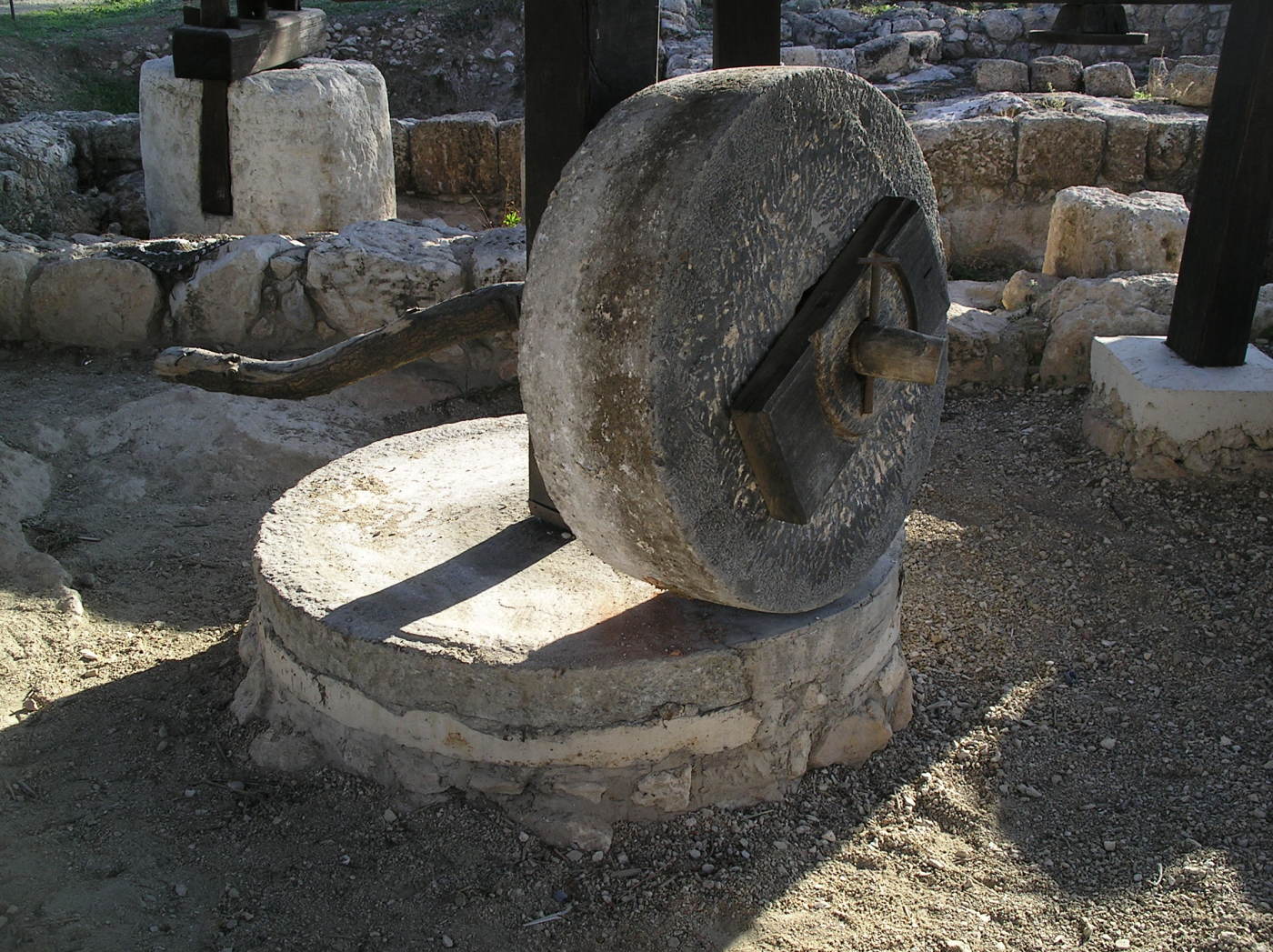
millstone2John is shown yet another mighty angel. Or perhaps it is the same angel he saw before. But this time, the angel took a large stone, similar to a millstone, and threw it into the sea.The imagery of this vision is very similar to a scene from the book of Jeremiah, in which the prophet sent a prince named Seraiah to Babylon with instructions to read the words from a scroll containing all the judgments against Babylon. Then, he was to “tie a stone to it and cast it into the midst of the Euphrates, and say, ‘Thus shall Babylon sink, to rise no more, because of the disaster that I am bringing upon her, and they shall become exhausted’” (Jeremiah 51:63-64 ESV). Jeremiah was pronouncing judgment against Babylon for her role in the fall of Jerusalem and the deportation of her people as captives. Even though Babylon had been used by God to bring about this punishment upon the people of Judah because of their rebellion against Him, the would suffer for the part they played in Judah’s fall. In a similar way, John sees the angel take the large stone and throw it into the sea, and he hears the angel call out, “So will Babylon the great city be thrown down with violence, and will be found no more” (Revelation 18:21 ESV). As the heavy stone disappears into the sea, never to be seen again, so will Babylon disappear off the face of the earth, never to rise again to power or prominence. John’s use of the term, “millstone” to describe the stone he saw the angel hurl into the sea, has important implications. A millstone was a large, round stone that was used to grind grain, nuts and other food elements. Also known as a grinding stone, it provides an apt description for Babylon, because as a nation, they had been grinding other nations under their power, eventually crushing and consuming them. And the Babylon represented in chapters 17 and 18 of Revelation will be the ultimate grinding stone of Satan, used to crush and defeat the people of God and the saints during the days of the tribulation. But God will bring a sudden and abrupt end to Babylon’s world domination and remove its ability to persecute the people of God once and for all time.

And the angel describes the impact of God’s judgment against the city of Babylon. Six different times, the angel is heard to repeat the words, “no more,” expressing the full and irreversible fall of this once-great city. There will be no more music played within its walls. There will be no more craftsmen selling their wares. The sound of wheat being ground at the mill will cease. There will be no one to light a lamp. And there will be no more marriage celebrations taking place. The usual affairs of life will be no more. And it is no coincidence that the words the angel speaks are very similar to those spoken by God to the people of Israel, just before He gave them over to the Babylonians thousands of years earlier.

“Therefore thus says the Lord of hosts: Because you have not obeyed my words, behold, I will send for all the tribes of the north, declares the Lord, and for Nebuchadnezzar the king of Babylon, my servant, and I will bring them against this land and its inhabitants, and against all these surrounding nations. I will devote them to destruction, and make them a horror, a hissing, and an everlasting desolation. 10 Moreover, I will banish from them the voice of mirth and the voice of gladness, the voice of the bridegroom and the voice of the bride, the grinding of the millstones and the light of the lamp. 11 This whole land shall become a ruin and a waste, and these nations shall serve the king of Babylon seventy years. – Jeremiah 25:8-11 ESV

God is now going to bring this same degree of destruction on the nation of Babylon, the dominion of the Antichrist and the symbol of mankind’s rebellion against Him. God punished the people of Israel, but eventually restored them to the land. After 70 years in captivity, He faithfully kept His promise to place a remnant of them back in Canaan, allowing them to rebuild the city of Jerusalem and the temple. But there will be no rebuilding or repopulating of Babylon. Its destruction will be final.

The angel provides three reasons for Babylon’s fall. First, it will be because her “merchants were the great ones of the earth” (Revelation 18:23 ESV). There is a sense in which Babylon and the businessmen who grow rich as a result of her power and prominence, will represent the pride of human achievement. The commercial success of this fallen, godless kingdom will be great and its influence will be felt around the globe. The pride and self-sufficiency that this kind of material success breeds, will become infectious, spreading like a cancer throughout the world. Secondly, Babylon will fall because it deceived the nations by means of sorcery. This metaphor is often used to describe the deceptions and seductions of idolatry. The worship of Antichrist will deceive many, leading them to succumb to his power and influence. They will see him as their savior, offering them everything they think they want and need, including joy, security, honor, and meaning in life. Babylon will become the source of all their wants and wishes. But they will be deceived. And finally, God will hold Babylon responsible for “the blood of prophets and of saints, and of all who have been slain on earth” (Revelation 18:24 ESV). This wicked world system, under the control of Antichrist, will be brought to an end because of its undeniable role in the death of God’s people. The Babylon of Revelation 18 clearly represents the city that will be in existence at that time, but it also represents the world system that has stood against God and His people for all time. Even during the days of Jeremiah, God had harsh words to say to the Babylon of his day, regarding their treatment of the people of Israel and His plan to repay them for their actions.

Babylon must fall for the slain of Israel,
    just as for Babylon have fallen the slain of all the earth. – Jeremiah 51:49 ESV

As the book of Revelation moves to its concluding chapters, John is seeing the days of the tribulation coming to a close. The time of the Gentiles is quickly coming to its final end. And this period of time, which has been in place for centuries, has been marked by false religions and a love affair with money and commercial success. Mankind has been deceived and distracted by countless false gods, offering themselves up as alternatives to the one true God. And the materialism and financial success marked by modernity has caused mankind to seek independence from God, thinking that money and the power it buys, can provide us with all we need to enjoy life. But false religions and a faulty dependence upon worldly possessions have never and will never satisfy. They are what the Bible describes as broken cisterns – man-made alternatives to God, which are designed to provide what only God can provide, but fail to do so. Once again, in the book of Jeremiah, we have the words of God spoken against the people of God. He accuses them of abandoning Him and of turning to false and faulty replacements for Him. And that is the primary problem with the age of the Gentiles, represented by the rise of Babylon during the days of the tribulation.

12 Be appalled, O heavens, at this;
    be shocked, be utterly desolate,
declares the Lord,
13 for my people have committed two evils:
they have forsaken me,
    the fountain of living waters,
and hewed out cisterns for themselves,
    broken cisterns that can hold no water. – Jeremiah 2:12-13 ESV

Self-sufficiency, pride and a refusal to place our hope in God. Those are the characteristics of our age and they will only become more pronounced during the dark days of the tribulation. They will come to a head and manifest themselves in the city occupied by Antichrist. But God will bring all of this to an end. He will destroy the false idols and all man-made institutions, set up as alternative sources of joy, happiness, contentment and fulfillment. They will be no more.

English Standard Version (ESV) The Holy Bible, English Standard Version. ESV® Permanent Text Edition® (2016). Copyright © 2001

New Living Translation (NLT) Holy Bible, New Living Translation, copyright © 1996, 2004, 2015 by Tyndale House Foundation. Used by permission of Tyndale House Publishers Inc., Carol Stream, Illinois 60188. All rights reserved.

The Message (MSG)  Copyright © 1993, 1994, 1995, 1996, 2000, 2001, 2002 by Eugene H. Peterson


God Has Given Judgment.

And the kings of the earth, who committed sexual immorality and lived in luxury with her, will weep and wail over her when they see the smoke of her burning. 10 They will stand far off, in fear of her torment, and say,

“Alas! Alas! You great city,
    you mighty city, Babylon!
For in a single hour your judgment has come.”

11 And the merchants of the earth weep and mourn for her, since no one buys their cargo anymore, 12 cargo of gold, silver, jewels, pearls, fine linen, purple cloth, silk, scarlet cloth, all kinds of scented wood, all kinds of articles of ivory, all kinds of articles of costly wood, bronze, iron and marble, 13 cinnamon, spice, incense, myrrh, frankincense, wine, oil, fine flour, wheat, cattle and sheep, horses and chariots, and slaves, that is, human souls.

14 “The fruit for which your soul longed
    has gone from you,
and all your delicacies and your splendors
    are lost to you,
    never to be found again!”

15 The merchants of these wares, who gained wealth from her, will stand far off, in fear of her torment, weeping and mourning aloud,

16 “Alas, alas, for the great city
    that was clothed in fine linen,
        in purple and scarlet,
    adorned with gold,
        with jewels, and with pearls!

17 For in a single hour all this wealth has been laid waste.”

And all shipmasters and seafaring men, sailors and all whose trade is on the sea, stood far off 18 and cried out as they saw the smoke of her burning,

“What city was like the great city?”

19 And they threw dust on their heads as they wept and mourned, crying out,

“Alas, alas, for the great city
    where all who had ships at sea
    grew rich by her wealth!
For in a single hour she has been laid waste.
20 Rejoice over her, O heaven,
    and you saints and apostles and prophets,
for God has given judgment for you against her!”  Revelation 18:9-20 ESV


detail-of-a-lion-found-along-the-processional-way-from-ishtar-gate-into-the-city-of-babylon-the-ishtar-gate-was-constructed-around-575-bc-by-king-nebuchadnezzar-iiKings, businessmen and commercial shippers will all mourn the loss of Babylon. The fall of this great city will have devastating implications on all who live on the earth. But the question remains as to whether John is seeing a vision of the fall of the literal city of Babylon or merely its commercial, political and religious representation. Some commentators turn to passages like Isaiah 13:19-22, which prophesies the destruction of Babylon, indicating that it will become uninhabitable.

19 And Babylon, the glory of kingdoms,
    the splendor and pomp of the Chaldeans,
will be like Sodom and Gomorrah
    when God overthrew them.
20 It will never be inhabited
    or lived in for all generations;
no Arab will pitch his tent there;
    no shepherds will make their flocks lie down there. – Isaiah 13:19-21 ESV

This passage, taken out of its context, makes it sound like Babylon was to soon be destroyed and never rebuilt or re-inhabited. But if we look a few verses earlier, we see that the prophecy indicates that its destruction is tied to “the day of the Lord.”

Wail, for the day of the Lord is near;
    as destruction from the Almighty it will come! – Isaiah 13:6 ESV

Just a few verses later, Isaiah expands on the nature of that day.

Behold, the day of the Lord comes,
    cruel, with wrath and fierce anger,
to make the land a desolation
    and to destroy its sinners from it.
10 For the stars of the heavens and their constellations
    will not give their light;
the sun will be dark at its rising,
    and the moon will not shed its light.
11 I will punish the world for its evil,
    and the wicked for their iniquity;
I will put an end to the pomp of the arrogant,
    and lay low the pompous pride of the ruthless. – Isaiah 13:9-11 ESV

The use of the phrase, “the day of the Lord”, is almost always tied to the end times or the final days where God intervenes directly into the affairs of mankind, bringing judgment on the earth for its sins. Jeremiah 51 is another Old Testament passage that prophesies the fall of Babylon and it infers that its fall will be sudden and unexpected.

Suddenly Babylon has fallen and been broken;
    wail for her! Jeremiah 51:8 ESV

And the prophet makes it clear that it will be God who brings about the fall and destruction of this once great city.

12 “Set up a standard against the walls of Babylon;
    make the watch strong;
set up watchmen;
    prepare the ambushes;
for the Lord has both planned and done
    what he spoke concerning the inhabitants of Babylon.
13 O you who dwell by many waters,
    rich in treasures,
your end has come;
    the thread of your life is cut.
14 The Lord of hosts has sworn by himself:
Surely I will fill you with men, as many as locusts,
    and they shall raise the shout of victory over you.” – Jeremiah 51:12-14 ESV

But this event has yet to take place. The city of Babylon has never experienced the kind of sudden fall and complete devastation outlined in these verses. Babylon was eventually overtaken by the Assyrians, but they did not destroy the city. They simply re-purposed it for their own use. The city of Babylon remained in existence for generations. It was the nation of Babylon that fell. The city itself simply became the property of those nations that ruled long after the fall of the nation of Babylon. This included the Achaemenid, Seleucid, Parthian, Roman, and Sassanid empires.

The sudden and final destruction of Babylon has yet to happen, and that is exactly what John is seeing foretold in this vision. John is seeing the aftermath of the great city’s eventual fall at the hands of God Almighty, and he is told that it will take place suddenly.

For in a single hour your judgment has come. – Revelation 18:10 ESV

It seems evident that the city of Babylon will be rebuilt and repopulated during the days of the tribulation. Located in what is today the nation of Iraq, the rebuilding of Babylon began during the long reign of Saddam Hussein. There is no reason to doubt that the Antichrist might not choose to locate his government in this significant geographic region. And with the vast financial resources at his disposal, he will have more than enough money to complete the rebuilding process.

There will be much mourning over the sudden loss of this prosperous and powerful city. The rulers of the earth will have benefited greatly from their association with the Antichrist’s government. The merchants of the earth will weep over the loss of revenue as a result of the city’s fall. Even those who ship goods, including the sailors on the ships, will mourn her loss, saying:

“Alas, alas, for the great city
    where all who had ships at sea
    grew rich by her wealth!
For in a single hour she has been laid waste. – Revelation 18:19 ESV

But it will be another matter in heaven, where there will be rejoicing over her demise.

“Rejoice over her, O heaven,
    and you saints and apostles and prophets,
for God has given judgment for you against her!” – Revelation 18:11 ESV

In fact, in the opening verses of the very next chapter, John hears the following words emanating from heaven.

1 “Hallelujah!
Salvation and glory and power belong to our God,
    for his judgments are true and just;
for he has judged the great prostitute
    who corrupted the earth with her immorality,
and has avenged on her the blood of his servants.” – Revelation 19:1-2 ESV

The prophet Jeremiah foretold of this great day and the rejoicing in heaven that it would bring.

47 “Therefore, behold, the days are coming
    when I will punish the images of Babylon;
her whole land shall be put to shame,
    and all her slain shall fall in the midst of her.
48 Then the heavens and the earth,
    and all that is in them,
shall sing for joy over Babylon,
    for the destroyers shall come against them out of the north,
declares the Lord. – Jeremiah 51:47-48 ESV

This passage makes clear that the destruction of Babylon will be sudden and complete. Three separate times, John is told that it will all take place in an hour.

For in a single hour your judgment has come. – Revelation 18:10 ESV

For in a single hour all this wealth has been laid waste. – Revelation 18:17 ESV

For in a single hour she has been laid waste. – Revelation 18:19 ESV

In just a matter of minutes, God will completely and utterly destroy this great city and remove from it all the trappings of wealth and prosperity for which it was known. He will eliminate its political and military power, transforming it into a smoking wasteland.

In his first letter, John warned his readers to not fall in love with the things this world offers. He described them as “the desires of the flesh and the desires of the eyes and pride of life” (1 John 2:16 ESV). Each of those are representative of the city of Babylon, which God destroys in the last days. It becomes the icon for worldliness and immorality. But John also warned his readers to remember that “the world is passing away along with its desires” (1 John 2:17 ESV), and that is exactly what we see happening in this 18th chapter of Revelation. The world system, represented by the physical city of Babylon, will be destroyed. All that mankind has placed its faith and hope in will be destroyed in less than 60 minutes of time. The luxury, wealth, power, prestige, and god-like successes of man will be laid waste by the God of the universe – “for mighty is the Lord God who has judged her” (Revelation 18:8 ESV).

English Standard Version (ESV) The Holy Bible, English Standard Version. ESV® Permanent Text Edition® (2016). Copyright © 2001

New Living Translation (NLT) Holy Bible, New Living Translation, copyright © 1996, 2004, 2015 by Tyndale House Foundation. Used by permission of Tyndale House Publishers Inc., Carol Stream, Illinois 60188. All rights reserved.

The Message (MSG)  Copyright © 1993, 1994, 1995, 1996, 2000, 2001, 2002 by Eugene H. Peterson


Mighty Is the Lord God.

1 After this I saw another angel coming down from heaven, having great authority, and the earth was made bright with his glory. And he called out with a mighty voice,

“Fallen, fallen is Babylon the great!
    She has become a dwelling place for demons,
a haunt for every unclean spirit,
    a haunt for every unclean bird,
    a haunt for every unclean and detestable beast.
For all nations have drunk
    the wine of the passion of her sexual immorality,
and the kings of the earth have committed immorality with her,
    and the merchants of the earth have grown rich from the power of her luxurious living.”

Then I heard another voice from heaven saying,

“Come out of her, my people,
    lest you take part in her sins,
lest you share in her plagues;
for her sins are heaped high as heaven,
    and God has remembered her iniquities.
Pay her back as she herself has paid back others,
    and repay her double for her deeds;
    mix a double portion for her in the cup she mixed.
As she glorified herself and lived in luxury,
    so give her a like measure of torment and mourning,
since in her heart she says,
    ‘I sit as a queen,
I am no widow,
    and mourning I shall never see.’
For this reason her plagues will come in a single day,
    death and mourning and famine,
and she will be burned up with fire;
    for mighty is the Lord God who has judged her. Revelation 18:1-8 ESV


detail-of-a-lion-found-along-the-processional-way-from-ishtar-gate-into-the-city-of-babylon-the-ishtar-gate-was-constructed-around-575-bc-by-king-nebuchadnezzar-iiIn this chapter, John records yet more specific information regarding the fall of Babylon. In the previous chapter, he provided us with a description of the false religious system associated with the city and its government. While some commentators choose to see all references to Babylon in these two chapters as symbolic only, it seems clear that the geographic location of the former city of Babylon is in view as well. The Scriptures appear to indicate that the city will yet again become a center of power from which the Antichrist operates during the days of the tribulation. It will become the political, religious and economic focal point of the world during that time, with the Antichrist operating his government from within its borders.

In chapter 17, John was shown the destruction of the false religious system, also referred to as Babylon or the great prostitute. Now, in chapter 18, he is given a vision of the destruction of Babylon’s financial system. If you recall, one of the things the false prophet did, along with establishing the apostate church built around the worship of Antichrist, was to institute the requirement of the mark of the beast. This visible symbol or mark was required to be affixed to the right hand or forehead of every individual on earth.

16 Also it [the false prophet] causes all, both small and great, both rich and poor, both free and slave, to be marked on the right hand or the forehead, 17 so that no one can buy or sell unless he has the mark, that is, the name of the beast or the number of its name. – Revelation 13:16-17 ESV

The mark was a non-negotiable requirement that became the means by which anyone could participate in the economy set up by the Antichrist and his world-wide government. The monopoly created by this kind of manipulative control would greatly influence the Antichrist’s power and fill the treasuries of his government. And John is given just a glimpse into the outcome of this kind of economic control.

…the merchants of the earth have grown rich from the power of her luxurious living. – Revelation 18:3 ESV

There appear to be two falls of Babylon described in these two chapters. The first involves the fall of the false religious system that was set up by the false prophet. Chapter 17 describes its fall, which takes place at the midway point of the 7 years of tribulation. But chapter 18 describes the fall of Babylon in its political and commercial form, which will take place at the end of the great tribulation, 3-1/2 years later. John was given a partial view of Babylon’s ultimate destruction back in chapter 16.

17 The seventh angel poured out his bowl into the air, and a loud voice came out of the temple, from the throne, saying, “It is done!” 18 And there were flashes of lightning, rumblings,[c] peals of thunder, and a great earthquake such as there had never been since man was on the earth, so great was that earthquake. 19 The great city was split into three parts, and the cities of the nations fell, and God remembered Babylon the great, to make her drain the cup of the wine of the fury of his wrath. – Revelation 16:17-19 ESV

It seems clear that this is referring to an actual city, the city of Babylon. And the result of this event will be that the city falls, literally and physically, resulting in its location becoming desolate and abandoned by mankind. The angel describes it as becoming, “a dwelling place for demons, a haunt for every unclean spirit, a haunt for every unclean bird, a haunt for every unclean and detestable beast” (Revelation 18:2 ESV). This formerly great city will become the abode of the demonic, an apt description of what it had really been all along. This geographic location on the planet has had a long history of immoral and unrighteous behavior associated with it, stretching all the way back to the tower of Babel, when mankind attempted to disobey the will of God.

“Come, let us build ourselves a city and a tower with its top in the heavens, and let us make a name for ourselves, lest we be dispersed over the face of the whole earth.” – Genesis 11:4 ESV

In this account, we see that, from day one, the territory known as Babylon, was associated with the sins of self-sufficiency, self-determinism, and self-glorification. Rather than obey God, men attempted to control their own fate and set themselves up as gods. And Babylon would become an ever-lasting symbol of man’s endless pursuit of autonomy and self-idolatry. But John is shown the final outcome God has in store for this great city. It will fall. And its fall will be great. All those nations that “have drunk the wine of the passion of her sexual immorality” will fall along with her. And notice what the second angel says about the city:

As she glorified herself and lived in luxury,
    so give her a like measure of torment and mourning. – Revelation 18:7 ESV

During the tribulation, Babylon will yet again become a prosperous and highly influential city. It will be restored to its former glory, replicating its glory days under King Nebuchadnezzar. But as great as Babylon will become, it will prove no match for Almighty God. As powerful, wealthy and influential as it will be during the waning days of the tribulation, it will experience a devastating fall – at the hands of God. The city’s pride, self-sufficiency, and love affair with immorality will come to an end. And so, a voice from heaven calls all believers living at that time to remove themselves from the city. They are to flee from her borders, distancing themselves from her immorality and rebellion against God. Like Lot running from Sodom and Gomorrah, the tribulation saints are to vacate the premises of Babylon, in anticipation of God’s judgment against her.

It is payback time. The voice from heaven that John hears describes the sins of Babylon being heaped up as high as heaven, an obvious comparison to the bricks heaped up by the people living in Babel. The sins of Babylon are obvious to God, and He will pay her back double for all that she has done. Like all those who stand opposed to God and who set themselves up as their own gods, Babylon and its inhabitants saw themselves as invulnerable and untouchable.

I sit as a queen,
I am no widow,
    and mourning I shall never see.” – Revelation 18:7 ESV

But as the proverb says, “Pride goes before destruction, and a haughty spirit before a fall” (Proverbs 16:18 ESV). And in a single day, judgment would come against Babylon. God will bring about the fall of this once-great city, “for mighty is the Lord God who has judged her” (Revelation 18:8 ESV)

The ultimate fall of Babylon will be real, but also symbolic. It represents the defeat of any and all who stand against God. Mankind has long opposed the will of God, refusing to accept Him as God and choosing to turn to man-made religions, making gods out of wealth, materialism, politics, government, and prosperity. Babylon will become a real-life representation of all these things, an actual city where godlessness reigns and rebellion against the God of the universe emanates. But Babylon will prove no match for God. The Antichrist will be exposed as a lousy stand-in for the real Savior of the world: Jesus Christ. And it is the one-and-only Christ who will return to the earth and set up the one true kingdom where righteousness will reign. The false kingdom of the Antichrist will be destroyed, to be replaced with the true kingdom of God on earth.

English Standard Version (ESV) The Holy Bible, English Standard Version. ESV® Permanent Text Edition® (2016). Copyright © 2001

New Living Translation (NLT) Holy Bible, New Living Translation, copyright © 1996, 2004, 2015 by Tyndale House Foundation. Used by permission of Tyndale House Publishers Inc., Carol Stream, Illinois 60188. All rights reserved.

The Message (MSG)  Copyright © 1993, 1994, 1995, 1996, 2000, 2001, 2002 by Eugene H. Peterson


Until the Words of God Are Fulfilled.

But the angel said to me, “Why do you marvel? I will tell you the mystery of the woman, and of the beast with seven heads and ten horns that carries her. The beast that you saw was, and is not, and is about to rise from the bottomless pit and go to destruction. And the dwellers on earth whose names have not been written in the book of life from the foundation of the world will marvel to see the beast, because it was and is not and is to come. This calls for a mind with wisdom: the seven heads are seven mountains on which the woman is seated; 10 they are also seven kings, five of whom have fallen, one is, the other has not yet come, and when he does come he must remain only a little while. 11 As for the beast that was and is not, it is an eighth but it belongs to the seven, and it goes to destruction. 12 And the ten horns that you saw are ten kings who have not yet received royal power, but they are to receive authority as kings for one hour, together with the beast. 13 These are of one mind, and they hand over their power and authority to the beast. 14 They will make war on the Lamb, and the Lamb will conquer them, for he is Lord of lords and King of kings, and those with him are called and chosen and faithful.”

15 And the angel said to me, “The waters that you saw, where the prostitute is seated, are peoples and multitudes and nations and languages. 16 And the ten horns that you saw, they and the beast will hate the prostitute. They will make her desolate and naked, and devour her flesh and burn her up with fire, 17 for God has put it into their hearts to carry out his purpose by being of one mind and handing over their royal power to the beast, until the words of God are fulfilled. 18 And the woman that you saw is the great city that has dominion over the kings of the earth.” Revelation 17:7-18 ESV

mapromeempireatheightIt’s fascinating that John is somewhat chided by the angel for having found all the talk about the great prostitute a bit difficult to understand. The angel promises to make the mystery clear and yet, this has become one of the most disputed passages in all of the book of Revelation. It seems apparent that the great prostitute introduced in the first six verses is a representation of the apostate church that comes to power in the world during the tribulation. Led by the false prophet, this false religion will promote the worship of the Antichrist. And it will lead the charge in the persecution of both orthodox Jews and tribulation saints. Countless believers in Christ, who come to faith during the seven-year period of the tribulation, will be put to death for refusing to accept the mark of the beast and for their unwillingness to worship the Antichrist.
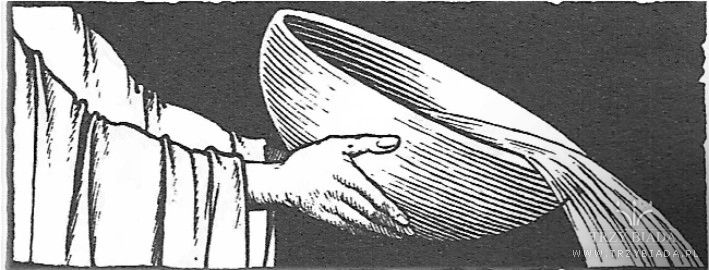
But the angel promises to give John further insight into the identity of the woman and the beast. Back in verse three, John describes seeing the woman “sitting on a scarlet beast that was full of blasphemous names, and it had seven heads and ten horns.” Now, in verse eight, the angel provides John with a bit more information regarding the identity of the beast:

The beast that you saw was, and is not, and is about to rise from the bottomless pit and go to destruction. – Revelation 17:8 ESV

The somewhat cryptic phrase, “it was and is not and is to come” shows up again later on in this same passage. But what does it mean? One of the things that makes it so difficult to determine just exactly who the angel is referring to in this passage is his use of the term, “beast.” Throughout the book of Revelation, that name is used to refer to Satan himself, the world ruler and the political government he sets up on earth. And because the three entities are so closely linked, it can become confusing as to which one is being talked about at any given time. In these verses, it seems that Satan, the Antichrist and his one-world government are all included in the angel’s description. The beast that was and is not and is about to rise from the bottomless pit seems to be a reference to the government or political system of the Antichrist. It will be a former world power that faded from the scene, but that will appear once again and become a the dominant political force on the planet – all because of the influence of Satan himself. The reference to the beast coming out of the abyss can only refer to Satan. The abyss or bottomless pit is his domain. It is from there that his power comes, and it is his power that makes possible this former world government to essentially resurrect and regain its former glory. And while Satan will be the invisible force behind this nation’s rise to former glory, the visible force will be Antichrist. And the people of the earth, those whose names are not written in the book of life, will marvel at his accomplishment. The unbelieving world will see the Antichrist as a political miracle worker and his kingdom as a sign of his divinity.

As always, when studying the book of Revelation, one must keep in mind other passages found in the book that can shed light on the seeming mysteries of John’s visions. Back in chapter 13, John was given another vision of the beast that coincides with what he is describing here.

1 And I saw a beast rising out of the sea, with ten horns and seven heads, with ten diadems on its horns and blasphemous names on its heads. And the beast that I saw was like a leopard; its feet were like a bear’s, and its mouth was like a lion’s mouth. And to it the dragon gave his power and his throne and great authority. One of its heads seemed to have a mortal wound, but its mortal wound was healed, and the whole earth marveled as they followed the beast. And they worshiped the dragon, for he had given his authority to the beast, and they worshiped the beast, saying, “Who is like the beast, and who can fight against it?” – Revelation 13:1-4 ESV

What is important to note is that the dragon, or Satan, is the one who gives his power to the the beast. And, just as in chapter 17, this beast is described as having seven heads and ten horns – a point that the angel tells John “calls for a mind with wisdom” (Revelation 17:9 ESV). This is going to be difficult to understand. It is going to require wisdom and discernment. And, as if the imagery is not already confusing enough, the angel informs John that the seven heads are actually seven mountains, on which the woman sits. And they represent seven kings. So, which is it? First of all, we need to notice the use of the number seven. As usual, it is a reference to completeness or wholeness. These seven kings or nations will represent seven empires that will form a comprehensive picture of mankind’s power and authority. The angel describes these seven kings or kingdoms as, “five of whom have fallen, one is, the other has not yet come” (Revelation 17:10 ESV). They would appear to be progressive or sequential in nature, with five of these kingdoms having existed at one time, but having faded from prominence. The one that “is” refers to the Roman empire that ruled the world when John penned the book of Revelation. And the one that “has not yet come” refers to the kingdom of the Antichrist, which will rise to power and prominence during the tribulation. It seems most likely that the five former kingdoms referred to by the angel include Egypt, Assyria, Babylon, Persia, and Greece. If you add Rome and then the kingdom that was yet to come and would remain a little while, you have the seven heads, mountains of kingdoms portrayed by the vision. And what do all of these kingdoms share in common? They have all persecuted or will persecute the people of God. Each has a less-then-ideal track record with the people of Israel and this will continue into the tribulation.

But what about the eighth nation mentioned in verse 11? To what could this be referring? Once again, the seven kings or mountains represent seven separate and successive kingdoms that will rule on earth. The first six include Egypt, Assyria, Babylon, Persia, Greece and the Roman empire of John’s day. But the Roman empire has since faded from view. The world is made up of a conglomeration of various nations and world powers, many of whom are remnants of the former Roman empire. A look at a map of the Roman empire at its zenith reveals that its domain was primarily located around the Mediterranean Sea and encompassed all of the land of Israel and extended all the way East into the former land of Babylon and Assyria. It seems that this empire will be revived in some form or fashion not long after the rapture of the church. That resurrected or restored Roman empire will form the seventh kingdom. And during the period of the tribulation, the Antichrist will come to power, setting up what is essentially an eighth kingdom. His rise to prominence will be accomplished by robbing power from a confederation of ten kings who will jointly rule the restored Roman empire. The angel makes it clear that the ten horns represent these ten kings, who will “receive authority as kings for one hour, together with the beast” (Revelation 17:12 ESV). Their joint rule will be brief in duration, ending with the Antichrist taking over as the supreme ruler over all the earth. As the angel states, these kings will “hand over their power and authority to the beast” (Revelation 17:14 ESV) or the Antichrist. He will have sole authority and power over all the nations of the earth, overseeing his one-world government from the restored city of Babylon. And one of Antichrist’s primary objectives will be to make war on the Lamb. He will stand opposed to Jesus Christ, but He will lose in his effort to overthrow Christ’s rightful position as King of kings and Lord of lords. The rest of the book of Revelation will present this epic struggle between the forces of Antichrist and Jesus Christ. It will culminate in a final battle and with the removal from power of Antichrist, Satan, and the false prophet. But more on that later.

This chapter ends with the angel providing John with an understanding of the symbolism behind the waters described in the first six verses. They are “peoples and multitudes and nations and languages” (Revelation 17:15 ESV). The great prostitute or false religion set up by the false prophet will have an overwhelming influence over the people of the earth. But Antichrist is not going to share his power and influence with anyone. So, under the divine instigation of God, Antichrist and his forces will turn on the apostate church, and destroy it. And the angel makes it clear that “God has put it into their hearts to carry out his purpose by being of one mind and handing over their royal power to the beast, until the words of God are fulfilled” (Revelation 17:17 ESV). God is going to cause Satan’s kingdom to divide and turn against itself. Even at the zenith of his power and influence over the world, Satan will not be able to resist the greater power of God. During the final days of the tribulation, there will be a religious and political form to the Antichrist’s rule. There will be an apostate church and an all-powerful government, but Antichrist will ultimately eliminate any and all competition to his rule, consolidating all power under him alone. Even the false church will fall, yielding all its power, influence and wealth to his cause. But John is given good news.

“…the Lamb will conquer them, for he is Lord of lords and King of kings, and those with him are called and chosen and faithful.” – Revelation 17:14 ESV

English Standard Version (ESV) The Holy Bible, English Standard Version. ESV® Permanent Text Edition® (2016). Copyright © 2001

New Living Translation (NLT) Holy Bible, New Living Translation, copyright © 1996, 2004, 2015 by Tyndale House Foundation. Used by permission of Tyndale House Publishers Inc., Carol Stream, Illinois 60188. All rights reserved.

The Message (MSG)  Copyright © 1993, 1994, 1995, 1996, 2000, 2001, 2002 by Eugene H. Peterson


The Great Prostitute.

Then one of the seven angels who had the seven bowls came and said to me, “Come, I will show you the judgment of the great prostitute who is seated on many waters, with whom the kings of the earth have committed sexual immorality, and with the wine of whose sexual immorality the dwellers on earth have become drunk.” And he carried me away in the Spirit into a wilderness, and I saw a woman sitting on a scarlet beast that was full of blasphemous names, and it had seven heads and ten horns. The woman was arrayed in purple and scarlet, and adorned with gold and jewels and pearls, holding in her hand a golden cup full of abominations and the impurities of her sexual immorality. And on her forehead was written a name of mystery: “Babylon the great, mother of prostitutes and of earth’s abominations.” And I saw the woman, drunk with the blood of the saints, the blood of the martyrs of Jesus. When I saw her, I marveled greatly. Revelation 17:1-6 ESV

In chapters 17 and 18, John is going to be given a detailed description of the destruction of Babylon, but as it represents the religious apostasy of the day (chapter 17) and the political power established by the Antichrist (chapter 18). Much of what John is being shown in these two chapters actually takes place before the events of chapter 16. The content of these two chapters provides us with a more precise understanding of just what will take place for the apostate church to rise to power and prominence during the first half of the tribulation. And chapter 18 will explain how Antichrist rose out of seeming obscurity to a position of global dominance.

An angel, who carried one of the seven bowls of judgment, appears to John and offers to introduce him to “the great prostitute.” As John will discover, this woman is actually the personification of the decadent and immoral religious system set up by the false prophet. We were first introduced to the false prophet in chapter 14, where he was introduced to John in a vision and appeared as the second beast.

12 It exercises all the authority of the first beast in its presence, and makes the earth and its inhabitants worship the first beast, whose mortal wound was healed. 13 It performs great signs, even making fire come down from heaven to earth in front of people, 14 and by the signs that it is allowed to work in the presence of the beast it deceives those who dwell on earth, telling them to make an image for the beast that was wounded by the sword and yet lived. 15 And it was allowed to give breath to the image of the beast, so that the image of the beast might even speak and might cause those who would not worship the image of the beast to be slain. 16 Also it causes all, both small and great, both rich and poor, both free and slave, to be marked on the right hand or the forehead, 17 so that no one can buy or sell unless he has the mark, that is, the name of the beast or the number of its name. – Revelation 14:12-17 ESV

This individual will operate under the direct jurisdiction of Antichrist, and set up a mandatory religious system that worships the image of the Antichrist. Much like emperor worship during the days of the Caesar in Rome, the people living during the tribulation will be forced to bow down to the Antichrist and treat him like a god. And the angel describes this false religious system as a prostitute. This is a common metaphor used in Scripture to describe spiritual adultery and the sin of idolatry.

At the end of seventy years, the Lord will visit Tyre, and she will return to her wages and will prostitute herself with all the kingdoms of the world on the face of the earth. – Isaiah 23:17 ESV

19 Your evil will chastise you,
    and your apostasy will reprove you.
Know and see that it is evil and bitter
    for you to forsake the Lord your God;
    the fear of me is not in you,
declares the Lord God of hosts.

20 “For long ago I broke your yoke
    and burst your bonds;
    but you said, ‘I will not serve.’
Yes, on every high hill
    and under every green tree
    you bowed down like a whore.” – Jeremiah 2:19-20 ESV

And all for the countless whorings of the prostitute,
    graceful and of deadly charms,
who betrays nations with her whorings,
    and peoples with her charms.

Behold, I am against you,
    declares the Lord of hosts,
    and will lift up your skirts over your face;
and I will make nations look at your nakedness
    and kingdoms at your shame. – Nahum 3:4-5 ESV

This religious system, set up by the false prophet, is guilty of having lured and enticed the kings of the earth. In other words, other world leaders will “get in bed” with this false religion, seeing it to be to their benefit to do so. And the people of the earth will become drunk with the wine of her immorality. They will drink in all the lies associated with this religion and worship an idol in place of the one true God. And John is shown a vision of this woman or false religion “sitting on a scarlet beast that was full of blasphemous names, and it had seven heads and ten horns” (Revelation 17:3 ESV). This is an almost word-for-word repeat of the description of the Antichrist, provided in chapter 13.

And I saw a beast rising out of the sea, with ten horns and seven heads, with ten diadems on its horns and blasphemous names on its heads. – Revelation 13:1 ESV

This false religious system will have direct ties to the rule and reign of Antichrist. They will have a symbiotic relationship, each benefiting the other. The false prophet will come to power only because the Antichrist has assumed supreme authority over the earth. And the false prophet will cause the people of the earth not only to submit to Antichrist’s leadership, but to worship him as a god. He will delude and deceive the people, performing signs and wonders, much like the Old Testament prophets of God did. But he will speak lies and blaspheme the name of God Almighty. Paul wrote about this coming day in his second letter to the Thessalonians.

The coming of the lawless one is by the activity of Satan with all power and false signs and wonders, 10 and with all wicked deception for those who are perishing, because they refused to love the truth and so be saved. 11 Therefore God sends them a strong delusion, so that they may believe what is false, 12 in order that all may be condemned who did not believe the truth but had pleasure in unrighteousness. – 2 Thessalonians 2:9-12 ESV

The imagery associated with John’s vision of this false religion conveys the idea of luxury and royalty. She is “arrayed in purple and scarlet, and adorned with gold and jewels and pearls” (Revelation 17:4 ESV). This religious system will be marked by wealth. It will have the trappings of financial success and be marked by pomp and circumstance. It is interesting to note that during the Reformation of the 16th-Century, many of the Reformers labeled the Pope as the Antichrist and the Catholic church as the false religion or apostate church. They did this, in part, because of its decadence, obsession with material wealth and for what they believed was false teaching regarding salvation.

Whereof it followeth Rome to be the seat of Antichrist, and the pope to be very antichrist himself. I could prove the same by many other scriptures, old writers, and strong reasons. (Thomas Cramner, Works by Cranmer, vol.1, pp.6-7).

Yea, to speak it in plain words; lest that we submit ourselves to Satan, thinking that we submit ourselves to Jesus Christ, for, as for your Roman kirk, as it is now corrupted, and the authority thereof, whereon stands the hope of your victory, I no more doubt but that it is the synagogue of Satan, and the head thereof, called the pope, to be that man of sin, of whom the apostle speaks. (John Knox, The History of the Reformation of Religion in Scotland, p.65).

…nothing else than the kingdom of Babylon and of very Antichrist. For who is the man of sin and the son of perdition, but he who by his teaching and his ordinances increases the sin and perdition of souls in the church; while he yet sits in the church as if he were God? All these conditions have now for many ages been fulfilled by the papal tyranny. (Martin Luther, First Principles, pp. 196-197).

You can see how they could have used the description provided by John in this chapter to reach their conclusions. But what John is seeing is something far greater and more significant than anything the Reformers could have ever imagined. This false church is described as having a name of mystery written on its forehead: “Babylon the great, mother of prostitutes and of earth’s abominations” (Revelation 17:5 ESV). The name, Babylon, has a long association with false religions and idolatry. Throughout the Scriptures, Babylon is used to refer to the influence of pagan religions upon the people of Israel, but also the New Testament church. It represents any and all counterfeit religions that offer up alternatives to the way of God. Even several of the seven churches to whom Jesus addressed His words in chapters two and three, were guilty of succumbing to the influence of the false teachings of Balaam and the Nicolaitans (Revelation 2:14-15). The church in Thyatira was guilty of allowing the influence of a woman “who calls herself a prophetess and is teaching and seducing my servants to practice sexual immorality and to eat food sacrificed to idols” (Revelation 2:20 ESV).

The deadly influence of Babylon, the false religious system that permeate our world, has been around since the beginning. Paul describes how it came to be.

22 Although they claimed to be wise, they became fools 23 and exchanged the glory of the immortal God for an image resembling mortal human beings or birds or four-footed animals or reptiles.

24 Therefore God gave them over in the desires of their hearts to impurity, to dishonor their bodies among themselves. 25 They exchanged the truth of God for a lie and worshiped and served the creation rather than the Creator, who is blessed forever! Amen. – Romans 1:22-25 ESV

And these individuals who chose to worship the creation rather than the Creator, have never been content to coexist with those who worship the one true God. From day one, they have stood opposed to all those who claim God as the one and only God. And the false prophet and his false religious system will not tolerate the people of God, the Jews, or the followers of Christ, including those who come to faith during the tribulation. John is told that this apostate religious system will be “drunk with the blood of the saints, the blood of the martyrs of Jesus” (Revelation 17:6 ESV). One of the greatest acts of rebellion on the part of this false religious system will be its role in the death of both Jews and Christians during the great tribulation. Satan, the power behind Antichrist’s rule, is ultimately opposed to anything and everyone associated with God and His Son. The whole purpose of the Antichrist’s rise to power is to marshal the forces of earth against the people of God. And the false prophet will create the ultimate one-world religion that unites the people of earth under one umbrella of religious expression, making illegal the worship of God or His Son, Jesus Christ. And while all of this is slated to happen during the days of the tribulation, we are already seeing the world’s slow, but steady shift in this direction. While we do not yet see the people of earth united under a single religious system, we do see the increasing hostility toward both Judaism and Christianity. The intolerance and hatred being expressed toward all those who worship the one true God is increasing exponentially. And the great tribulation will bring it all to a head.

English Standard Version (ESV) The Holy Bible, English Standard Version. ESV® Permanent Text Edition® (2016). Copyright © 2001

New Living Translation (NLT) Holy Bible, New Living Translation, copyright © 1996, 2004, 2015 by Tyndale House Foundation. Used by permission of Tyndale House Publishers Inc., Carol Stream, Illinois 60188. All rights reserved.

The Message (MSG)  Copyright © 1993, 1994, 1995, 1996, 2000, 2001, 2002 by Eugene H. Peterson


It Is Done.

17 The seventh angel poured out his bowl into the air, and a loud voice came out of the temple, from the throne, saying, “It is done!” 18 And there were flashes of lightning, rumblings, peals of thunder, and a great earthquake such as there had never been since man was on the earth, so great was that earthquake. 19 The great city was split into three parts, and the cities of the nations fell, and God remembered Babylon the great, to make her drain the cup of the wine of the fury of his wrath. 20 And every island fled away, and no mountains were to be found. 21 And great hailstones, about one hundred pounds each, fell from heaven on people; and they cursed God for the plague of the hail, because the plague was so severe. Revelation 16:17-21 ESV

199-001On the cross, after having endured the wrath of God against the sins of man, Jesus spoke His final words, “It is finished.” He had been persecuted, ridiculed, rejected, spat upon, and tortured to the point of death. And just before He breathed His last breath, He declared that His work was done. He had completed what He had come to do. With His sacrificial death on the cross, He would make possible the redemption of sinful mankind by providing a means by which they could, through faith in His substitutionary death, have their sins forgiven and their relationship with God the Father restored. The apostle Paul provides us with the unbelievable significance of Christ’s sacrificial act.
For if while we were enemies we were reconciled to God by the death of his Son, much more, now that we are reconciled, shall we be saved by his life. – Romans 5:10 ESV

Just a few verses earlier, Paul stated that “at the right time Christ died for the ungodly” (Romans 5:6 ESV). But not every ungodly person accepted the free gift of salvation made possible by God’s grace through Christ’s death. There were many, including the majority of the Jewish population on earth at the time, who refused to accept Jesus as their Lord and Savior. They preferred to remain in their sins. As John writes in his own gospel account: “the light has come into the world, and people loved the darkness rather than the light because their works were evil” (John 3:19 ESV). The work of Jesus, to make salvation available to all men, was finished on the cross. There was nothing left for Him to do. Except return to the earth one day. And all that John has been and will be shown in the visions recorded in the book of Revelation, are meant to be the preface for Christ’s second coming.

But it is interesting to note the words used to signify this last of the seven bowl judgments. John hears a loud voice coming from the temple in heaven and from the very throne of God. It shouts the three simple words, “It is done!” It is likely that these words came from the mouth of God Himself. He is declaring that the final judgment has come. The end of the tribulation period is getting ready to come to a close. There is more that will happen on earth after the seventh bowl is poured out, but this portion of God’s plan for earth and mankind is complete. Now the Messiah can return and set up His Kingdom on earth. But even more than that, His statement sets up an ever great moment that will take place at the end of the millennial reign of Christ on earth: The arrival of the New Jerusalem. John’s vision of that reality is recorded later in his book, and it envisions the days immediately after the completion of Jesus’ 1,000-year reign, the Great White Throne Judgment, and the creation of the new heavens and the new earth. John is allowed to see the arrival of the New Jerusalem, as it descends from heaven to earth, and on the throne sits God Almighty, who declares, “I am making all things new” (Revelation 21:5 ESV). And then John hears those three simple words yet again: It is done!

And he said to me, “It is done! I am the Alpha and the Omega, the beginning and the end. To the thirsty I will give from the spring of the water of life without payment. The one who conquers will have this heritage, and I will be his God and he will be my son. But as for the cowardly, the faithless, the detestable, as for murderers, the sexually immoral, sorcerers, idolaters, and all liars, their portion will be in the lake that burns with fire and sulfur, which is the second death.” – Revelation 21:6-8 ESV

The pouring out of the seventh plague from the seventh and final bowl was not the end, per se, but it represented the completion of one thing and the beginning of another. God was now ready to send His Son back to earth. And this news is accompanied by remarkable signs and wonders:

flashes of lightning, rumblings, peals of thunder, and a great earthquake such as there had never been since man was on the earth, so great was that earthquake. – Revelation 16:18 ESV

These are all signs of God’s divine judgment. But they also represent His holiness and almighty power. These same signs had all been evident when God descended upon Mount Sinai in the wilderness.

16 On the morning of the third day there were thunders and lightnings and a thick cloud on the mountain and a very loud trumpet blast, so that all the people in the camp trembled. 17 Then Moses brought the people out of the camp to meet God, and they took their stand at the foot of the mountain. 18 Now Mount Sinai was wrapped in smoke because the Lord had descended on it in fire. The smoke of it went up like the smoke of a kiln, and the whole mountain trembled greatly. – Exodus 19:16-18 ESV

God was in their midst and it was unmistakable. And now, with the pouring out of the final judgment, it was also clear that God was behind all that was about to happen. This was the work of the almighty, all-powerful God of the universe. And all these fantastic sights and sounds were more than just a divine pyrotechnic show. John immediately sees “the great city” split into three parts. This is most likely a reference to Babylon, which John mentions just a few verses later. Babylon is the poster boy for all cities on earth, representing the age of the Gentiles and man’s rebellion against God. Babylon’s sordid history goes all the way back to the time of the tower of Babel, when mankind refused to obey God’s command to spread across the earth. Instead, they determined to build a high tower and a great city, from which they would create a great nation – all in open rebellion against the will of God.

“Come, let us build ourselves a city and a tower with its top in the heavens, and let us make a name for ourselves, lest we be dispersed over the face of the whole earth.” – Genesis 11:4 ESV

Their arrogance and pride led to God creating multiple languages, making it impossible for them to communicate with one another. As a result they dispersed and gave up their building project. And yet Babylon would continue to exist as a city, becoming the icon for man’s pride and rebellion against God. And John sees this great city split into three parts, most likely as a result of the great earthquake. “God remembered Babylon the great, to make her drain the cup of the wine of the fury of his wrath” (Revelation 16:19 ESV). God has a long memory. He doesn’t forget and always remembers to repay those who have stood opposed to Him and His people. But Babylon is not alone. John indicates that “the cities of the nations fell” as well. The age of the Gentiles is coming to an end. The domination of the Gentile nations over Israel is being brought to a close. And Jesus spoke of this very day.

Jerusalem will be trampled underfoot by the Gentiles, until the times of the Gentiles are fulfilled. – Luke 21:24 ESV

It is interesting that the seventh bowl is mentioned as being poured out in the air, and yet the results of this judgment all take place on earth. Perhaps this has to do with Satan’s dominion over the air and the earth. Paul described Satan as “the prince of the power of the air, the spirit that is now at work in the sons of disobedience” (Ephesians 2:2 ESV). This bowl is poured out in Satan’s domain and impacts the world over which he has been allowed to have dominion. John says that “every island fled away, and no mountains were to be found” (Revelation 16:20 ESV). Evidently, there will be dramatic changes to the topography of the earth. There will be cataclysmic changes to the earth’s crust, causing never-before-seen alterations to the seas and the land. As always, there are those who try to minimize or simply eliminate the literal interpretation of this passage, choosing instead to view this as a symbolic destruction of the political systems of the earth. But there is no reason to doubt that God could not or would not do exactly what John is seeing take place. The very stability of the earth is at the mercy of God Almighty. Nothing will remain as it once was. Mountains and islands will be removed. All that mankind has come to know as reliable and unchangeable, will come to an end.

And then, the 100-pound stones fall from the sky. This devastating and obviously destructive event will leave people cursing God. The death and damage caused by this divine display of God’s power and wrath will be unprecedented. Buildings, animals and people will be destroyed. Everything man has built will succumb to these massive stones falling from the sky. It is interesting to note that stones were used to build the tower of Babel and here, God uses stones to destroy the cities of men. And back in the gospel of Matthew, we have recorded the words that Jesus spoke to the Pharisees.

“‘The stone that the builders rejected
has become the cornerstone;
this was the Lord’s doing,
and it is marvelous in our eyes’?” – Matthew 21:42 ESV

And Jesus goes on to tell them, “And the one who falls on this stone will be broken to pieces; and when it falls on anyone, it will crush him” (Matthew 21:44 ESV). God is bringing His judgment upon the world. He is raining divine destruction upon the earth and all those who live on it. And “the plague was severe.” God will literally stone all those who have blasphemed His holy name. This is the penalty prescribed by God Himself for all those who blaspheme His name.

“Take outside the camp him who has cursed; then let all who heard him lay their hands on his head, and let all the congregation stone him.” – Leviticus 24:14 ESV

As we will see in the very next chapter, God will begin to deal specifically with the religious and political systems of the earth. He will mete out His divine wrath on the Antichrist and his kingdom, as well as the false prophet and his apostate church. Amazingly, after all the devastation and destruction brought by the seven bowl judgments, mankind will still oppose God. The Antichrist will still maintain his control over the nations of the earth. And the people of earth will still bow down to his image, giving glory to him that was rightfully owed to God alone. But those things are quickly coming to an end. Because, as God has said, “It is done!”

English Standard Version (ESV) The Holy Bible, English Standard Version. ESV® Permanent Text Edition® (2016). Copyright © 2001

New Living Translation (NLT) Holy Bible, New Living Translation, copyright © 1996, 2004, 2015 by Tyndale House Foundation. Used by permission of Tyndale House Publishers Inc., Carol Stream, Illinois 60188. All rights reserved.

The Message (MSG)  Copyright © 1993, 1994, 1995, 1996, 2000, 2001, 2002 by Eugene H. Peterson


Unrelenting, Yet Unrepentant.

1 Then I heard a loud voice from the temple telling the seven angels, “Go and pour out on the earth the seven bowls of the wrath of God.”

So the first angel went and poured out his bowl on the earth, and harmful and painful sores came upon the people who bore the mark of the beast and worshiped its image.

The second angel poured out his bowl into the sea, and it became like the blood of a corpse, and every living thing died that was in the sea.

The third angel poured out his bowl into the rivers and the springs of water, and they became blood. And I heard the angel in charge of the waters say,

“Just are you, O Holy One, who is and who was,
    for you brought these judgments.
For they have shed the blood of saints and prophets,
    and you have given them blood to drink.
It is what they deserve!”

And I heard the altar saying,

“Yes, Lord God the Almighty,
    true and just are your judgments!”

The fourth angel poured out his bowl on the sun, and it was allowed to scorch people with fire. They were scorched by the fierce heat, and they cursed the name of God who had power over these plagues. They did not repent and give him glory.

10 The fifth angel poured out his bowl on the throne of the beast, and its kingdom was plunged into darkness. People gnawed their tongues in anguish 11 and cursed the God of heaven for their pain and sores. They did not repent of their deeds.

12 The sixth angel poured out his bowl on the great river Euphrates, and its water was dried up, to prepare the way for the kings from the east. 13 And I saw, coming out of the mouth of the dragon and out of the mouth of the beast and out of the mouth of the false prophet, three unclean spirits like frogs. 14 For they are demonic spirits, performing signs, who go abroad to the kings of the whole world, to assemble them for battle on the great day of God the Almighty. 15 (“Behold, I am coming like a thief! Blessed is the one who stays awake, keeping his garments on, that he may not go about naked and be seen exposed!”) 16 And they assembled them at the place that in Hebrew is called Armageddon. Revelation 16:1-15 ESV

199-001The seven bowls of God’s wrath are poured out in rapid succession. It seems that at this point on the tribulation timeline, things are moving at a rapid pace. We have already been told that these judgments “are the last, for with them the wrath of God is finished” (Revelation 15:1 ESV). But while the last, they are certainly not the least. These judgments are unrelenting in their intensity and quite specific in their application. There has been an escalating aspect to all of God’s judgment so far. First, there were the seven seals and out of the seventh seal came the seven trumpets. Out of the seventh and final trumpet came what we are seeing now: The seven bowl judgments. And these seven bowls contain seven different plagues, the visible manifestations or outpourings of God’s wrath against mankind. These plagues are widespread and all-encompassing, impacting the entire world, but in some cases, they are very specific and directed at certain regions and against particular people groups, such as the worshipers of Antichrist. Here is list of the seven bowls and the plagues they contain:

First Bowl – sores on the worshipers of the Antichrist

Second Bowl – seas turned to blood

Third Bowl – fresh water turned to blood

Fourth Bowl – scorching heat from the sun

Fifth Bowl – darkness and pain within the kingdom of the Antichrist

Sixth Bowl – drying up of the River Euphrates

Seventh Bowl – earthquakes and hail

With the first bowl, all those who bear the mark of the beast and who willingly worship the Antichrist, find themselves suffering from unbearable sores. The Greek word is helkos, and it refers to some sort of ulcer. But this is not your everyday, run-of-the-mill ulcer. They are described as kakos and ponēros, two Greek words that both can be translated as “evil,” but that speak of the severity of these particular sores. The first word makes it clear that these sores are “of a bad nature; not such as it ought to be.” They are out-of-the-ordinary. And their effect is described by the second word. They are extremely painful. And it’s interesting to note that God chooses to inflict all those who have taken the mark of the beast, a visible sign that was placed on their hands or foreheads, with a highly visible plague that covers their entire bodies. Their sign was most likely obscured by sores. And yet, all those who refused to take the mark of the beast or bow down to the image of the Antichrist are spared. They are protected by God because of their faithfulness to Him.

With the second bowl, God pours out a plague that is far more universal in nature. This time, the waters of the sea become “like the blood of a corpse” and the end result is that every living creature in the sea dies. We are not told whether this is a reference to the Mediterranean Sea or to all the seas and oceans of the earth. But it would seem that God is expanding His judgments and that this particular plague is worldwide in scope. Unlike the second trumpet judgment (Revelation 8:8-9), which only impacted a third of the earth’s oceans, this one is all-encompassing, and the devastating outcome of such a disaster defies the imagination. The stench alone would be unbearable. The effect on the world-wide food supply was be unimaginable. The potential for the spread of disease would be off the chart. While we find it difficult to imagine the oceans of the world being turned into literal blood, we have to keep in mind that these are supernatural events. They can’t be explained by normal or natural means. These are the works of the God who created the entire universe in six days. Nothing is too impossible for Him. And His decision to turn the waters of the oceans to blood makes much more sense when you consider the words He spoke to the people of Israel concerning His prohibition against consuming blood.

23 Only be sure that you do not eat the blood, for the blood is the life, and you shall not eat the life with the flesh. 24 You shall not eat it; you shall pour it out on the earth like water. 25 You shall not eat it, that all may go well with you and with your children after you, when you do what is right in the sight of the Lord. – Deuteronomy 12:23-25 ESV

The blood is the life. What are irony to consider that God is going to take the waters of the oceans, which contain the source of life for much of the world, and turn them to blood and fill them with death and decay. And it is important to remember that this particular plague is universal in nature, impacting all those who live on the earth, including all the unrepentant, unbelieving Jews who are alive at this time.

With the third bowl, God delivers an even more devastating blow to mankind, by turning all the sources of fresh water on the earth to blood. While there are some who choose to take these plagues as symbolic in nature, there is no apparent reason for us to do so. While they may seem too fantastic and far-fetched to believe, that does not mean they cannot and will not happen. We have to keep in mind that these are the final series of judgments and they represent the full wrath of God being poured out on a sin-stained earth and a stubbornly rebellious humanity. If we can accept the fact that there is a real place of eternal judgment reserved for all those who refuse to accept Jesus Christ as their Savior and Lord, we should have no trouble believing that God’s anger against sin show up in unbelievable, never-before-seen ways that defy explanation and imagination.

The angel who pours out this third judgment has a few words to say as he does so.

5 “Just are you, O Holy One, who is and who was,
    for you brought these judgments.
For they have shed the blood of saints and prophets,
    and you have given them blood to drink.
It is what they deserve!” – Revelation 16:5-6 ESV

He wants us to know that God is just and right for what He is doing. These judgments are well-deserved and the people of earth are receiving their just punishment. They are not innocent. They are not victims. They have played a major role in the deaths of countless tribulation saints who refused to take the mark of the beast and who chose to follow the Lamb (Revelation 14:4). And the angels words are echoed from the sanctuary in heaven.

“Yes, Lord God the Almighty,
    true and just are your judgments!” – Revelation 16:7 ESV

God is completely just in doing what He is doing. His motives and His actions are not to be questioned. He is the just and righteous judge of the universe, who is delivering a sentence upon the world that is right and without fault in any way.

The fourth bowl somehow causes the sun to become more intense, delivering scorching rays that make life on the earth unbearable. The unbelievers, those who have taken the mark of the beast, curse God, but more importantly, they refuse to repent and turn to God. Even the increased intensity of the sun’s rays and the pain that results from its effects will not cause them to confess their sins and turn to God. Imagine the suffering they will have to endure as a result of the lack of fresh water and the unbearable heat. But in spite of all this, they will stubbornly continue to reject God.

And then God will turn His attention to the kingdom of the Antichrist. Because the Antichrist will be the world ruler, this is a reference to all the earth. But the description makes it clear that this is a direct attack on the Antichrist’s rule and reign. His kingdom, the earth, will be plunged into darkness. Now, along with all the pain, suffering and agony the people of earth have had to deal with by virtue of the first four plagues, they will find themselves in perpetual darkness. The spiritual darkness of their lives will be accompanied by physical darkness. And John describes them as gnawing their tongues in anguish. The very tongues they used to worship and praise the Antichrist will be parched for lack of water and chewed raw because of their pain. And yet, they still refuse to repent. The words of the apostle Paul seem appropriate here.

…if you confess with your mouth that Jesus is Lord and believe in your heart that God raised him from the dead, you will be saved. – Romans 10:9 ESV

But rather than use their tongues to confess, they will gnaw them in agony.

The sixth bowl is the most specific of all. When poured out, it results in the drying up of the River Euphrates. While this judgment has no immediate ramifications for the people of earth, it will have long-term implications. Because it will ultimately set the stage for war. The River Euphrates is one of the most prominent and well-known rivers in the world, and it has a long and vital history in the Scriptures. We know from the book of Genesis, that the Euphrates was one of our rivers associated with the Garden of Eden.

10 A river flowed out of Eden to water the garden, and there it divided and became four rivers. 11 The name of the first is the Pishon. It is the one that flowed around the whole land of Havilah, where there is gold. 12 And the gold of that land is good; bdellium and onyx stone are there. 13 The name of the second river is the Gihon. It is the one that flowed around the whole land of Cush. 14 And the name of the third river is the Tigris, which flows east of Assyria. And the fourth river is the Euphrates. – Genesis 2:10-14 ESV

And it was also associated with the nation of Babylon. And it also formed the eastern boundary to the land that God promised to give to Abraham and his seed (Genesis 15:18). With the drying up of this great river, God is preparing the way for the kings from the east. He is removing a natural barrier and setting the state for a future war that will be waged during the final days of the great tribulation. And John is shown three frogs, which are defined as three demonic spirits, who will cause the kings of the earth to join in an alliance to do war against God. This event is called “the great day of God the Almighty” – which is also known as the battle of Armageddon. And John is presented with a parenthetical statement, delivered from the lips of Jesus Himself.

“Behold, I am coming like a thief! Blessed is the one who stays awake, keeping his garments on, that he may not go about naked and be seen exposed!” – Revelation 16:15 ESV

The apostle Paul warned about this coming day:

…the day of the Lord will come like a thief in the night. While people are saying, “There is peace and security,” then sudden destruction will come upon them as labor pains come upon a pregnant woman, and they will not escape. – 1 Thessalonians 5:2-3 ESV

Each of these six bowls and their associated plagues, are simply setting the stage and preparing the world for the return of Christ. And while the plagues themselves will be unrelenting in their intensity, they will have little impact on the unbelieving world. They will remain unrepentant and stubbornly opposed to God and His Son. So much so, that they will choose to wage war with God rather than bow their knee to His Son and honor Him as King of kings and Lord of lords.

English Standard Version (ESV) The Holy Bible, English Standard Version. ESV® Permanent Text Edition® (2016). Copyright © 2001

New Living Translation (NLT) Holy Bible, New Living Translation, copyright © 1996, 2004, 2015 by Tyndale House Foundation. Used by permission of Tyndale House Publishers Inc., Carol Stream, Illinois 60188. All rights reserved.

The Message (MSG)  Copyright © 1993, 1994, 1995, 1996, 2000, 2001, 2002 by Eugene H. Peterson


Great and Amazing.

1 Then I saw another sign in heaven, great and amazing, seven angels with seven plagues, which are the last, for with them the wrath of God is finished.

And I saw what appeared to be a sea of glass mingled with fire—and also those who had conquered the beast and its image and the number of its name, standing beside the sea of glass with harps of God in their hands. And they sing the song of Moses, the servant of God, and the song of the Lamb, saying,

“Great and amazing are your deeds,
    O Lord God the Almighty!
Just and true are your ways,
    O King of the nations!
Who will not fear, O Lord,
    and glorify your name?
For you alone are holy.
    All nations will come
    and worship you,
for your righteous acts have been revealed.”

After this I looked, and the sanctuary of the tent of witness in heaven was opened, and out of the sanctuary came the seven angels with the seven plagues, clothed in pure, bright linen, with golden sashes around their chests. And one of the four living creatures gave to the seven angels seven golden bowls full of the wrath of God who lives forever and ever, and the sanctuary was filled with smoke from the glory of God and from his power, and no one could enter the sanctuary until the seven plagues of the seven angels were finished. Revelation 15:1-8 ESV

199-001When reading the book of Revelation, one can begin to feel as if the onslaught of judgments coming on earth and its inhabitants will never come to an end. It seems as if each new chapter brings with it yet more devastating news of unbelievable and unbearable trials that will befall mankind. But in these chapters, Even in this chapter, John is given yet another sign in heaven, one he describes as “great and amazing,” that will involves seven plagues. These are the seven bowl judgments. But John is informed that these will be “the last, for with them the wrath of God is finished” (Revelation 15:1 ESV). There is a certain finality to this vision. He is being provided with a much-needed reminder that there is an end coming to all of God’s judgments upon the earth. There will be a climax to all that John has seen and that will be the second coming of Jesus Christ. The seven seals, the seven trumpets and the seven bowl judgments are nothing more than a preface, preparing the way for return of the Son of God. And He will bring with Him the final phase of God’s judgments, completing that portion of the divine plan for the redemption and restoration of the world. Christ will return immediately after the seventh bowl has been poured out.

John is being given a much-needed reminder that this seemingly endless wave of judgments has not only an end, but a purpose. None of what he has witnessed has been indiscriminate or arbitrary in nature. These are not the actions of a petty and impetuous deity who simply enjoys taking out His anger on the weak and defenseless. These are the acts of a holy, righteous and sovereign God who is obligated by His very nature to deal with the insurrection raised against His rightful rule and reign. We have seen over and over again the unrepentant nature of those who find themselves suffering under His righteous anger. He brings well-deserved judgments upon them, but they refuse to repent and acknowledge Him as God. They stubbornly cling to their false god, willingly worshiping the Antichrist, giving to him the glory only God deserves. John has been shown the gracious and merciful nature of God as He provides 144,000 Jewish converts to Christ who spend their entire lives during the tribulation, spreading the good news regarding Jesus Christ and God’s offer of salvation made possible through Him. But the vast majority of the people of earth will refuse this offer. They will turn up their noses at God’s gracious gift, choosing to remain in open rebellion against Him, rather than humbly turn to Him in humble repentance and submission. So, the seven bowls will be poured out and the final judgments of God will be meted out. But His judgments, like His patience, have an end. As we have seen repeatedly, the number seven is the number of perfection or completion. Just as there were seven seals and seven trumpets, there are seven bowls containing seven plagues. They represent God’s perfect and complete judgment against mankind. This is not a case of overkill on God’s part. Everything He has done and will do is perfectly righteous, without fault and in keeping with His blameless character.

John sees a sea of glass, like the one he saw in chapter four, but this one is mixed with fire. The sea of glass, that extends before the throne of God, is meant to reflect the glory. of God. But here, John sees God’s glory mixed with fire, a symbol of judgment. The seven plagues are “are the last, for with them the wrath of God is finished.” You cannot separate God’s glory from His wrath and judgment. A holy and righteous God cannot and will not tolerate insurrection and insubordination on the part of those He has created. He is obligated by His very nature to deal with the blatant rebellion of mankind to His sovereign will.

For you are not a God who delights in wickedness;
    evil may not dwell with you.
The boastful shall not stand before your eyes;
    you hate all evildoers.
You destroy those who speak lies;
    the Lord abhors the bloodthirsty and deceitful man. – Psalm 5:4-6 ESV

God does not view man’s sin as simply an alternative lifestyle or a decision to take a different path than the one He prescribes. He knows that sin is not only rebellion against His will, but an act of self-destruction, leading to death, not life. And sin, like a communicable disease, is contagious and deadly. It spreads like a cancer, infecting everyone with whom it comes in contact. It damages and destroys, and there is no end to its destructive influence. So, God must act. He must eliminate sin once and for all, and John is being reminded that this is exactly what God is going to do.

John sees, standing beside the sea of glass, a crowd of individuals who most likely represent all those who will come to faith in Christ during the days of the tribulation and suffer martyr’s deaths as a result. They are described as having “conquered the beast and its image and the number of its name” (Revelation 15:2 ESV). Having refused to take the mark of the beast and worship the Antichrist, they were executed. But now, John sees them, holding harps in their hands and singing the song of Moses and the song of the Lamb. These are most likely two different songs, but both containing praise for God’s salvation and redemption. In Deuteronomy 32, we have recorded one of the songs of Moses which speaks of God’s power and deliverance of His people.

For the Lord will vindicate his people
    and have compassion on his servants,
when he sees that their power is gone
    and there is none remaining, bond or free. – Deuteronomy 32:36 ESV

“‘See now that I, even I, am he,
    and there is no god beside me;
I kill and I make alive;
    I wound and I heal;
    and there is none that can deliver out of my hand.’” – Deuteronomy 32:39 ESV

One of the things recorded in the song of Moses found in Deuteronomy 32 is the reminder that God is righteous and just.

“The Rock, his work is perfect,
    for all his ways are justice.
A God of faithfulness and without iniquity,
    just and upright is he. – Deuteronomy 32:4 ESV

He always does what is right. He never acts unjustly or reacts to His people undeservedly. And that is exactly the message John hears in the song being sung by the martyred saints.

“Great and amazing are your deeds,
    O Lord God the Almighty!
Just and true are your ways,
    O King of the nations.” – Revelation 15:3 ESV

These saints vindicate the actions of God, proclaiming His righteousness and ascribing to Him holiness. They sing, “your righteous acts have been revealed” (Revelation 15:4 ESV), an unapologetic defense of all that God has done and will do. All the world will ultimately come to fear and worship Him for who He is, because He alone is holy.

And then John sees the seven angels carrying the seven plagues, coming out of the sanctuary of God. This is yet another, not-so-subtle-reminder, that these judgments are coming from the very throne room of God in heaven. They are divinely ordained and ordered. And one of the four creatures, who stand around the throne of God, give each of the seven angels a golden bowl containing the “full of the wrath of God who lives forever and ever” (Revelation 15:7 ESV). It is a bit confusing that the angels are described as carrying the seven plagues, but are then given the seven bowls. And the bowls are described as holding the wrath of anger of God. As we will see in the very next chapter, the seven bowls will be means by which the plagues are poured out on the earth. So perhaps, what John is being shown is that the angels walked out of the sanctuary of God, holding the form of God’s judgment – the plagues – but were then given the means by which those judgments would come – by His anger. The plagues would flow forth, mixed with the anger or divine wrath of God. Again, the song of Moses, recorded in Deuteronomy 32, speaks of this wrath of God coming upon all those who stand opposed to Him.

“Rejoice with him, O heavens;
    bow down to him, all gods,
for he avenges the blood of his children
    and takes vengeance on his adversaries.
He repays those who hate him
    and cleanses his people’s land.” – Deuteronomy 32:43 ESV

God’s righteous anger will be “poured out” in the form of seven very real and very devastating plagues. The wrath of God will take concrete and recognizable form. And like the people of Egypt, who suffered from the plagues that God poured out on them, the people of the earth will know that God alone is God. They will unmistakably recognize the power of God Almighty as He makes His anger both felt and known. And John ends this chapter with the statement that “the sanctuary was filled with smoke from the glory of God and from his power, and no one could enter the sanctuary until the seven plagues of the seven angels were finished” (Revelation 15:8 ESV). Access to God is completely cut off until the full extent of His judgment on earth is complete. This is a vivid and sobering reminder of God’s holiness. He is not to be trifled with. He is not to be treated flippantly or contemptuously. The sanctuary in heaven will be off limits to all until the full extent of God’s wrath is poured out and the final portion of His judgments are meted out.

And in the very next chapter, John will see each of those seven bowls poured out on the earth and its inhabitants. The focus will turn from heaven back to earth. The final days of God’s judgment have come and the return of His Son is closer than ever before.

English Standard Version (ESV) The Holy Bible, English Standard Version. ESV® Permanent Text Edition® (2016). Copyright © 2001

New Living Translation (NLT) Holy Bible, New Living Translation, copyright © 1996, 2004, 2015 by Tyndale House Foundation. Used by permission of Tyndale House Publishers Inc., Carol Stream, Illinois 60188. All rights reserved.

The Message (MSG)  Copyright © 1993, 1994, 1995, 1996, 2000, 2001, 2002 by Eugene H. Peterson


Behold, the Son of Man.

14 Then I looked, and behold, a white cloud, and seated on the cloud one like a son of man, with a golden crown on his head, and a sharp sickle in his hand. 15 And another angel came out of the temple, calling with a loud voice to him who sat on the cloud, “Put in your sickle, and reap, for the hour to reap has come, for the harvest of the earth is fully ripe.” 16 So he who sat on the cloud swung his sickle across the earth, and the earth was reaped.

17 Then another angel came out of the temple in heaven, and he too had a sharp sickle. 18 And another angel came out from the altar, the angel who has authority over the fire, and he called with a loud voice to the one who had the sharp sickle, “Put in your sickle and gather the clusters from the vine of the earth, for its grapes are ripe.” 19 So the angel swung his sickle across the earth and gathered the grape harvest of the earth and threw it into the great winepress of the wrath of God. 20 And the winepress was trodden outside the city, and blood flowed from the winepress, as high as a horse’s bridle, for 1,600 stadia. Revelation 14:14-20 ESV

Jesus with sickleOnce again, John uses the phrase, “Then I looked, and behold.” This signals another change in scene as well as another aspect of the coming judgment on the earth. John is given a vision of a white cloud on which sat “one like the son of man.” While John does not provide us with the identify of this individual, the title “son of man” is most typically used in Scripture as a title referring to Jesus’ humanity and also when speaking of his future rule over earth and its inhabitants. Daniel used the same title when referring to Jesus and His second coming.

13 “I saw in the night visions,

and behold, with the clouds of heaven
    there came one like a son of man,
and he came to the Ancient of Days
    and was presented before him.
14 And to him was given dominion
    and glory and a kingdom,
that all peoples, nations, and languages
    should serve him;
his dominion is an everlasting dominion,
    which shall not pass away,
and his kingdom one
    that shall not be destroyed. – Daniel 7:13-14 ESV

John had also described Jesus in this same way when he first saw Him in the vision of the heavenly throne room.

13 …and in the midst of the lampstands one like a son of man, clothed with a long robe and with a golden sash around his chest. 14 The hairs of his head were white, like white wool, like snow. His eyes were like a flame of fire, 15 his feet were like burnished bronze, refined in a furnace, and his voice was like the roar of many waters. 16 In his right hand he held seven stars, from his mouth came a sharp two-edged sword, and his face was like the sun shining in full strength. – Revelation 1:13-16 ESV

Jesus Himself used the same term when referring to His future return to the earth.

“When the Son of Man comes in his glory, and all the angels with him, then he will sit on his glorious throne. – Matthew 25:31 ESV

So, it is quite easy to deduce that the one John sees coming on the cloud is a representation of Jesus as He returns to the earth for the final time. He is described as wearing a golden crown (stephanos) which was typically awarded to victors. And He is carrying a sharp sickle, which is an instrument symbolic of judgment (Mark 4:29). Then John sees an angel coming out of the temple in heaven, calling out in a loud voice and telling Jesus that the time to reap or judge has come. The fact that the angel has come from the temple is an indication that this message is from God Himself. He is telling His Son that the harvest of the earth is “fully ripe.” It is more than ready. In a sense, the harvest is overly ripe and past due for harvest. The term “fully ripe” actually means “to wither away” and pictures fruit that has been on the vine too long. It is in a less-than-ideal state. So, God commands Jesus to begin His judgment of earth’s inhabitants. And John reveals describes seeing Jesus swing his sickle and the earth was reaped. The Greek word is therizō, and it infers that the harvest was “cut down.” It may be that this harvest, using the imagery of wheat or grain refers to the judgment of the unbelieving Gentiles. The second harvest, which John sees next, uses the imagery of grapes, a common symbol in the Old Testament of the people of Israel. So, it may represent that judging of unbelieving Jews. But both judgments or harvests take place at the end of the tribulation with the return of Christ.

John sees a second angel coming out of the temple in heaven and he too is carrying a sharp sickle. And yet a third angel, coming out from the alter in the temple, calls out to the second angel, commanding him to “Put in your sickle and gather the clusters from the vine of the earth, for its grapes are ripe” (Revelation 14:18 ESV). Once again, the fruit or harvest is described as ripe, but John uses a different Greek word, akmazō, which means “fully mature.” It describes grapes that are virtually bursting because of their fullness. It is another image describing the past due nature of mankind’s sin and rebellion. John is being given a preview of what is to come when Christ returns to the earth. As the Son of God, He will be given the authority to judge the unbelieving inhabitants of the earth. And, like overly ripe grapes, virtually bursting with the juice of their sin and rebellion, they will be gathered together and thrown into “the great winepress of the wrath of God” (Revelation 14:19 ESV). And the juice or blood of these unbelieving individuals will overflow the winepress to such an extent that it will be up to four-feet deep in some places. This imagery is shocking and difficult to comprehend. But it is meant to reveal that the judgment of God will be severe and sudden. And the prophet Joel used similar imagery to describe the final days of the tribulation.

12 Let the nations stir themselves up
    and come up to the Valley of Jehoshaphat;
for there I will sit to judge
    all the surrounding nations.

13 Put in the sickle,
    for the harvest is ripe.
Go in, tread,
    for the winepress is full.
The vats overflow,
    for their evil is great.

14 Multitudes, multitudes,
    in the valley of decision!
For the day of the Lord is near
    in the valley of decision. – Joel 3:12-14 ESV

The prophet Isaiah gave us a prophecy concerning this final judgment as well.

1 Who is this who comes from Edom,
    in crimsoned garments from Bozrah,
he who is splendid in his apparel,
    marching in the greatness of his strength?
“It is I, speaking in righteousness,
    mighty to save.”

Why is your apparel red,
    and your garments like his who treads in the winepress?

“I have trodden the winepress alone,
    and from the peoples no one was with me;
I trod them in my anger
    and trampled them in my wrath;
their lifeblood spattered on my garments,
    and stained all my apparel.
For the day of vengeance was in my heart,
    and my year of redemption had come.
I looked, but there was no one to help;
    I was appalled, but there was no one to uphold;
so my own arm brought me salvation,
    and my wrath upheld me.
I trampled down the peoples in my anger;
    I made them drunk in my wrath,
    and I poured out their lifeblood on the earth.” – Isaiah 63:1-6 ESV

The second coming of Christ will be marked by several major battles where countless millions will die. The enemies of God will resist His Son and refuse to acknowledge His rightful place as King. But He will defeat them. Later on in his book, John will describe yet another vision of Jesus, seated on a white horse and leading the host of heaven in a victory procession.

11 Then I saw heaven opened, and behold, a white horse! The one sitting on it is called Faithful and True, and in righteousness he judges and makes war. 12 His eyes are like a flame of fire, and on his head are many diadems, and he has a name written that no one knows but himself. 13 He is clothed in a robe dipped in blood, and the name by which he is called is The Word of God. 14 And the armies of heaven, arrayed in fine linen, white and pure, were following him on white horses. 15 From his mouth comes a sharp sword with which to strike down the nations, and he will rule them with a rod of iron. He will tread the winepress of the fury of the wrath of God the Almighty. 16 On his robe and on his thigh he has a name written, King of kings and Lord of lords. – Revelation 19:11-16 ESV

The son of man, Jesus Christ, the risen Lord and coming King, will one day reclaim His rightful place on David’s throne and rule the world in justice and righteousness. But first, He will judge the world, meting out the wrath of God on all those who have refused to honor Him as God. His Son will vindicate His name. The rebellion waged against God, attempted by all those who refused to worship Him as God, will be put down once and for all. John is being given a glimpse into the final days of God’s judgment, as His Son brings to a close the period of the tribulation, in preparation for the setting up of His millennial Kingdom on earth.


English Standard Version (ESV) The Holy Bible, English Standard Version. ESV® Permanent Text Edition® (2016). Copyright © 2001

New Living Translation (NLT) Holy Bible, New Living Translation, copyright © 1996, 2004, 2015 by Tyndale House Foundation. Used by permission of Tyndale House Publishers Inc., Carol Stream, Illinois 60188. All rights reserved.

The Message (MSG)  Copyright © 1993, 1994, 1995, 1996, 2000, 2001, 2002 by Eugene H. Peterson