Impressed by the Wrong Things

41 And he sat down opposite the treasury and watched the people putting money into the offering box. Many rich people put in large sums. 42 And a poor widow came and put in two small copper coins, which make a penny. 43 And he called his disciples to him and said to them, “Truly, I say to you, this poor widow has put in more than all those who are contributing to the offering box. 44 For they all contributed out of their abundance, but she out of her poverty has put in everything she had, all she had to live on.” 

1 And as he came out of the temple, one of his disciples said to him, “Look, Teacher, what wonderful stones and what wonderful buildings!” 2 And Jesus said to him, “Do you see these great buildings? There will not be left here one stone upon another that will not be thrown down.” – Mark 12:41-13:2 ESV

Jesus and His disciples remain in the temple courtyard, where He underwent a series of confrontations with the religious leaders who had been attempting to entrap Him. In a bold affront to their arrogant sense of superiority, Jesus had labeled their displays of self-righteousness as nothing more than hypocrisy.

“…they like to parade around in flowing robes and receive respectful greetings as they walk in the marketplaces. And how they love the seats of honor in the synagogues and the head table at banquets.” – Mark 12:38-39 NLT

These men were addicted to fine clothes and flattery. They craved recognition and demanded the respect of all those whom they considered their inferiors. And almost as if to provide a glaring contrast to their style of behavior, Jesus directs the attention of His disciples to a poor widow. He has positioned Himself opposite the temple treasury where He is silently observing the various people bringing their offerings and placing them in one of the 13 trumpet-shaped receptacles arranged around the perimeter of the Courtyard of the Women.

As Jesus looks on, a variety of people drop their freewill offerings into the boxes, many of whom are wealthy and can be seen donating large sums of money. Mark’s inference seems to be that their actions were intended to attract attention. The size of their contributions was intended to be noticed. Since all currency was in the form of coins, their gift would have made a great deal of noise as it clanged on the metal trumpet that topped the offering box. All heads would have turned to see who was giving such a generous amount.

But Jesus takes note of a poor widow, who “came and put in two small copper coins, which make a penny” (Mark 12:42 ESV). This woman’s small gift would have garnered little attention from the people who crowded the temple courtyard, but she caught the eye of Jesus. She was exactly the kind of person He had mentioned in His diatribe against the scribes.

“Yet they shamelessly cheat widows out of their property and then pretend to be pious by making long prayers in public.” – Mark 12:40 NLT

This widow was someone the scribes and other religious leaders would have taken advantage of in order to line their own pockets. Yet, to Jesus, she represented the truly righteous. Her two small coins would have made little noise as they descended into the offering box, but to Jesus, her actions spoke volumes. So, He pointed her out to His disciples and said, “Truly, I say to you, this poor widow has put in more than all those who are contributing to the offering box” (Mark 12:43 ESV).

It was not the size of her gift that mattered, but it was the state of her heart. She had not given to be noticed. Her gift had not been meant to impress. But Jesus knew that her gift had been a great sacrifice because she had “given everything she had to live on” (Mark 12:44 NLT). This entire scene is a visual demonstration of Jesus’ lesson from His sermon on the mount.

“Watch out! Don’t do your good deeds publicly, to be admired by others, for you will lose the reward from your Father in heaven. When you give to someone in need, don’t do as the hypocrites do—blowing trumpets in the synagogues and streets to call attention to their acts of charity! I tell you the truth, they have received all the reward they will ever get.” – Matthew 6:1-2 NLT

This woman, though poor, had sacrificed everything in order to give her freewill offering to God. But the others had given “out of their abundance” (Mark 12;44 ESV). It had cost them nothing. Their gifts, while impressive in size, had required no sacrifice on their part. They had actually profited from their efforts, having garnered the praise and admiration of others for their obviously generous contributions.

By pointing out this widow to His disciples, Jesus had been trying to continue His lesson on greatness in the Kingdom of God. But it seems that His disciples remained stubbornly oblivious to all that He was trying to teach them. In fact, as they made their way out of the temple courtyard, none of the disciples mention the widow and her sacrificial gift. But one of them takes note of the grandeur and opulence of the temple.

“Look, Teacher, what wonderful stones and what wonderful buildings!” – Mark 13:1 ESV
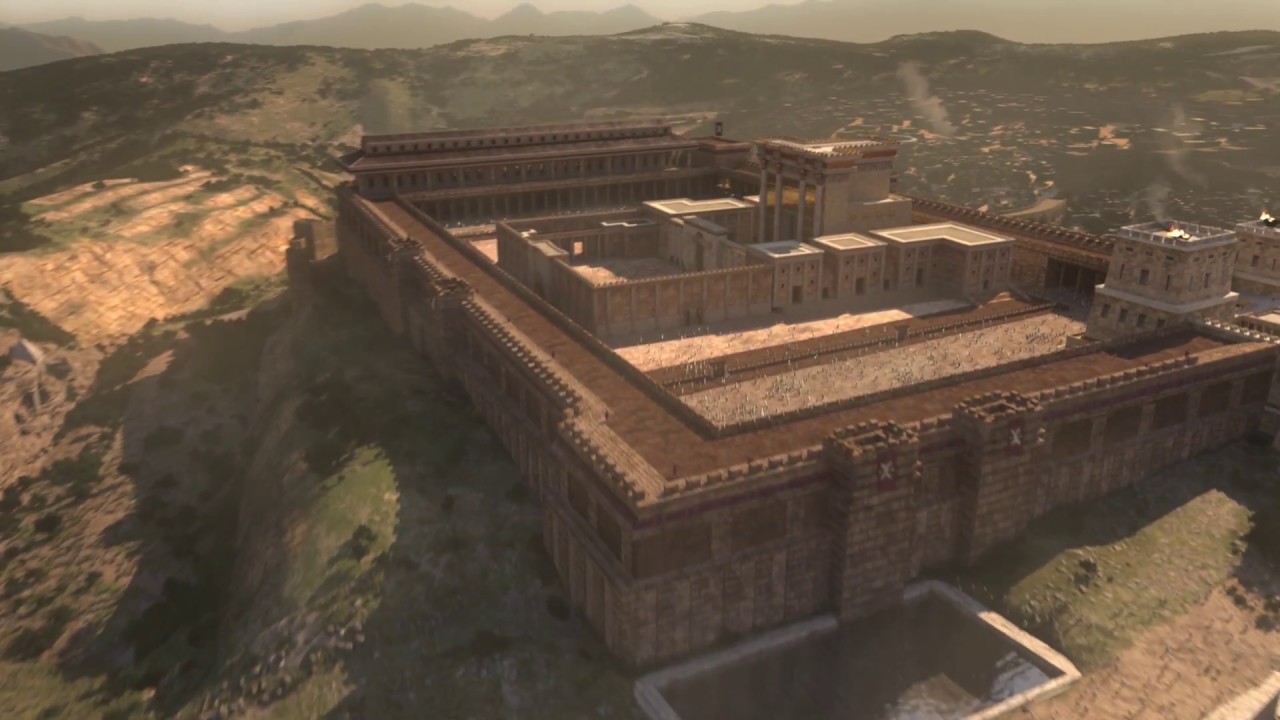
The temple was a magnificent complex that made an impressive sight from its prominent location atop Mount Zion. The Jews took great pride in this grand structure and the disciples were rightfully proud of and impressed by its sheer size and beauty. After all, it was the dwelling place of God.

The image of the poor widow had faded from their collective memories. Now, as they made their way out of the temple and back to the Mount of Olives, their attention was fixated on the structure that Herod the Great had helped expand and improve. The original temple, built by King Solomon, had been destroyed by the Babylonians in 587 B.C. Seventy years later, God had allowed a remnant of the people who had been exiled to Babylon to return and rebuild the temple. But, when completed, the new temple was just a shadow of its former glory. Herod the Great, in an attempt to win over the people, had decreed a massive rebuilding program that resulted in the grand structure that now dominated the landscape and captivated the attention of the disciples.

But Jesus, always ready to turn every moment into a teaching opportunity, told His disciples, “Do you see these great buildings? There will not be left here one stone upon another that will not be thrown down” (Mark 13:2 ESV). As we will see, this news shocked the disciples. They could not believe what they were hearing. How could God allow His beautiful house to be destroyed? But as hard as it was to fathom, everything Jesus said eventually came true. In A.D. 70, the Roman army, under the leadership of Titus, besieged Jerusalem in an effort to put an end to a long-standing Jewish revolt against Roman rule. After a three-month standoff, the Romans invaded the city, destroying and eventually burning the temple to the ground. They left no stone upon another.

The disciples had been unimpressed with the generous widow, but they couldn’t help but notice the grandeur of the temple. But Jesus ended up commending the woman and condemning the temple. She was elevated as an icon of righteousness and virtue, while the temple was declared to be the symbol of all that was wrong with Israel. As Jesus had declared earlier, the temple of God had become a “den of robbers” (Mark 11:17 ESV). The dwelling place of God had been desecrated by the very ones who were responsible for its care and protection.

Jesus was reminding His disciples of the words of God, spoken centuries earlier through Isaiah the prophet and directed at the rebellious people of Israel.

“‘Don’t be fooled into thinking that you will never suffer because the Temple is here. It’s a lie! Do you really think you can steal, murder, commit adultery, lie, and burn incense to Baal and all those other new gods of yours, and then come here and stand before me in my Temple and chant, “We are safe!”—only to go right back to all those evils again? Don’t you yourselves admit that this Temple, which bears my name, has become a den of thieves? Surely I see all the evil going on there. I, the LORD, have spoken!” – Jeremiah 7;8-11 NLT

Nothing had changed. Just as the original temple had been destroyed by God, so would this remarkable structure come under His judgment. Because the people of God failed to live in obedience to the will of God.

English Standard Version (ESV) The Holy Bible, English Standard Version. ESV® Permanent Text Edition® (2016). Copyright © 2001 by Crossway Bibles, a publishing ministry of Good News Publishers.

New Living Translation (NLT) Holy Bible, New Living Translation, copyright © 1996, 2004, 2015 by Tyndale House Foundation. Used by permission of Tyndale House Publishers Inc., Carol Stream, Illinois 60188. All rights reserved.

The Message (MSG)Copyright © 1993, 1994, 1995, 1996, 2000, 2001, 2002 by Eugene H. Peterson

Exposed and Condemned

35 And as Jesus taught in the temple, he said, “How can the scribes say that the Christ is the son of David? 36 David himself, in the Holy Spirit, declared,

“‘The Lord said to my Lord,
“Sit at my right hand,
    until I put your enemies under your feet.”’

37 David himself calls him Lord. So how is he his son?” And the great throng heard him gladly.

38 And in his teaching he said, “Beware of the scribes, who like to walk around in long robes and like greetings in the marketplaces 39 and have the best seats in the synagogues and the places of honor at feasts, 40 who devour widows’ houses and for a pretense make long prayers. They will receive the greater condemnation.” – Mark 12:35-40 ESV

Up until this point, it has been the Jewish religious leaders who have been asking all the questions, but now Jesus turns the tables on them. In verse 34, Mark indicated that, as a result of their three failed attempts to entrap Jesus, “no one dared to ask him any more questions.” They simply gave up. But they didn’t go away.

As Jesus continued to teach in the temple, He posed a question of His own. Matthew indicates that He directed it at a group of Pharisees standing nearby. This was probably the same group who had shown up with the scribe who asked Him which was the greatest commandment. These men are still standing close enough to hearJesus but are most likely plotting their next move against Him. They have completed discounted any notion that Jesus might be the Messiah. This fact is important because it sheds light on the question that Jesus poses.

“How can the scribes say that the Christ is the son of David?” – Mark 12:35 ESV

It’s interesting to note that the three gospel writers who cover this event each word Jesus’ question slightly differently. Matthew reports that Jesus directed His question at the Pharisees, asking them, “What do you think about the Christ? Whose son is he?” (Matthew 23:42 ESV). And Luke has Jesus asking, “How can they say that the Christ is David’s son?” (Luke 20″41 ESV). It seems likely that this was a series of questions that Jesus posed. First, He asked the Pharisees what they believed about the Messiah or Christ. After all, these men were the religious conservatives of their day and were supposed to be highly knowledgeable of the Hebrew Scriptures.

According to Matthew, these men quickly responded, declaring that the Christ would be “The son of David” (Matthew 22:42 ESV). Jesus then asked the Pharisees to explain how the scribes, the experts in the Mosaic law, would justify their belief that the Christ would be the son of David. All of these men were supposed to have a strong grasp of the Old Testament Scriptures and they shared a common belief that the Messiah would be a descendant of King David. But how would they justify it from God’s Word? One of the passages they would use was 2 Samuel 7:12-16, which records a promise that God had made to King David.

“I will raise up your offspring after you, who shall come from your body, and I will establish his kingdom. He shall build a house for my name, and I will establish the throne of his kingdom forever. I will be to him a father, and he shall be to me a son. When he commits iniquity, I will discipline him with the rod of men, with the stripes of the sons of men, but my steadfast love will not depart from him, as I took it from Saul, whom I put away from before you. And your house and your kingdom shall be made sure forever before me. Your throne shall be established forever.’”

While this promise was fulfilled in part with the birth of Solomon, the Jews believed it had longer-term implications that would ultimately come about through the arrival of the Messiah, the anointed one of God.

Keep in mind that Jesus has already publicly shamed these men, declaring them to be ignorant of God’s Word and strangers to the power of God.

“…you don’t know the Scriptures, and you don’t know the power of God.” – Mark 12:24 NLT

Their understanding that the Messiah would be a descendant of David was what drove their expectation that He would be a powerful king and ruler just like His predecessor. They were fully expecting the Messiah to arrive on the scene and wield a sword just as David had, conquering the enemies of Israel and restoring the people of God to their former position of prominence in the Middle East.

But Jesus turns to the Old Testament Scriptures in order to teach a vital truth regarding the Messiah. He quotes from the opening verse of Psalm 110, a psalm written by King David himself.

The Lord says to my Lord:
    “Sit at my right hand,
until I make your enemies your footstool.” – Psalm 110:1 ESV

Through His ongoing confrontations with the religious leaders, Jesus has been subtly revealing the justification for HIs authority. This whole situation had begun when the chief priests, scribes, and elders confronted Him over His unacceptable behavior in cleansing the temple. They demanded to know, “By what authority are you doing these things, or who gave you this authority to do them?” (Mark 11:28 NLT). And in every subsequent conversation Jesus had with these men, He had gave them glimpses of who He was by revealing His knowledge of God’s Word and declaring Himself to be “The stone that the builders rejected” (Mark 12:10 ESV). Through use of a parable, Jesus had described Himself as the son of the master of the vineyard. And the Pharisees had fully understood His meaning,

But here, Jesus uses the words of King David to make an important point about the Messiah that these learned men had somehow missed in all of their studies of the Scriptures.

Jesus notes that, in the psalm, David refers to his coming descendant as “my Lord.” In Hebrew the text reads, “Jehovah has said to my Lord (‘adown).” In other words, David records that God had spoken a promise to his future descendant. But Jesus wants to know why David would call this man his “Lord” or Adonai, one of the most common names in the Old Testament Scriptures used to refer to God Himself.  So, Jesus wants to know why David used this particular word to refer to a man. And why would God offer a mere man a position of prominence at His side?

“Sit at my right hand, until I put your enemies under your feet?” – Mark 12:36 ESV

There was more going on in this passage than the scribes and Pharisees understood. Jesus is revealing that the Messiah would not only be the son of David, He would be David’s Adonai (Lord and Master). The Messiah would be the Son of Man and the Son of God, the God-man who was fully divine and fully human. Even King David understood that his future descendant would have a unique relationship with God that was greater than anything he had ever experienced.

And Jesus summarized His point by asking these experts in the Hebrew Scriptures to explain how this could be.

“David himself calls him Lord. So how is he his son?” – Mark 12:37 ESV

But they refuse to answer. They had already discovered that their attempts to debate with Jesus had left them looking like fools. Yet Mark indicates that the crowd who overheard this conversation loved what Jesus had to say. To a certain degree, they probably enjoyed watching the public humiliation of these arrogant men, who prided themselves in their vast knowledge of the Bible and flaunted their superior righteousness. And, to their delight, Jesus dropped another bombshell.

“Beware of the scribes, who like to walk around in long robes and like greetings in the marketplaces and have the best seats in the synagogues and the places of honor at feasts, who devour widows’ houses and for a pretense make long prayers. They will receive the greater condemnation.” – Mark 12:38-40 ESV

Mark presents a very abbreviated recounting of Jesus’ teaching, leaving out the seven “woes” that Matthew records. After putting up with a constant barrage of condemnation from these religious leaders, Jesus turned the spotlight on them. And, according to Matthew’s account, Jesus essentially told the crowd to “do as they say, but not as they do.”

“The teachers of religious law and the Pharisees are the official interpreters of the law of Moses. So practice and obey whatever they tell you, but don’t follow their example. For they don’t practice what they teach. They crush people with unbearable religious demands and never lift a finger to ease the burden.” – Matthew 23:2-4 NLT

In other words, these man taught the law of God, but failed to live up to it. They could proclaim the truth of God’s Word but had no desire to let it influence the way they lived their lives. And in Matthew’s account, He records that Jesus called these men hypocrites and blind guides. They were frauds. And, not only that, they were like blind men futility attempting to provide guidance to others.

Jesus declares that these men were more interested in their reputations than they were in living according to God’s will. They loved being recognized for their fine robes and coveted their status as celebrities. They were addicted to honor and recognition. It was all about them. And Jesus declares that these men will receive greater condemnation. God would hold them accountable for their pride and arrogant mistreatment of His people.

These men had no right to question the authority of Jesus. He was the Son of God and was doing the will of God. But they were supposed to be the servants of God, caring for the flock He had placed under their care. Yet, they had failed miserably.

But Jesus, the Son of David and the Son of God, would faithfully fulfill the the will of His Father, sacrificing His life for the sake of His Father’s flock.

English Standard Version (ESV) The Holy Bible, English Standard Version. ESV® Permanent Text Edition® (2016). Copyright © 2001 by Crossway Bibles, a publishing ministry of Good News Publishers.

New Living Translation (NLT) Holy Bible, New Living Translation, copyright © 1996, 2004, 2015 by Tyndale House Foundation. Used by permission of Tyndale House Publishers Inc., Carol Stream, Illinois 60188. All rights reserved.

The Message (MSG)Copyright © 1993, 1994, 1995, 1996, 2000, 2001, 2002 by Eugene H. Peterson

Religious, but Not Righteous

28 And one of the scribes came up and heard them disputing with one another, and seeing that he answered them well, asked him, “Which commandment is the most important of all?” 29 Jesus answered, “The most important is, ‘Hear, O Israel: The Lord our God, the Lord is one. 30 And you shall love the Lord your God with all your heart and with all your soul and with all your mind and with all your strength.’ 31 The second is this: ‘You shall love your neighbor as yourself.’ There is no other commandment greater than these.” 32 And the scribe said to him, “You are right, Teacher. You have truly said that he is one, and there is no other besides him. 33 And to love him with all the heart and with all the understanding and with all the strength, and to love one’s neighbor as oneself, is much more than all whole burnt offerings and sacrifices.” 34 And when Jesus saw that he answered wisely, he said to him, “You are not far from the kingdom of God.” And after that no one dared to ask him any more questions. – Mark 12:28-34 ESV

The Sadducees faired no better than the Pharisees and Herodians. Jesus had handled their carefully crafted question with ease, revealing that their misunderstanding of the doctrine of the resurrection was based on their ignorance of the Scriptures. These men were supposed to be the brightest and the best that Israel had to offer. They were considered the spiritual rock stars of their day. The people revered them for their knowledge, power, and influence. Yet, Jesus had exposed them as pretenders who were ignorant of God’s Word and unfamiliar with His power.

“Is this not the reason you are wrong, because you know neither the Scriptures nor the power of God?” – Mark 12:24 ESV

The Jewish high council had two strikes against them, but they were far from ready to concede defeat. Matthew records that they quickly assembled a third team made up of Pharisees, one of whom was a scribe, an expert in the Mosaic law.

But when the Pharisees heard that he had silenced the Sadducees with his reply, they met together to question him again. One of them, an expert in religious law, tried to trap him with this question: “Teacher, which is the most important commandment in the law of Moses?” – Matthew 22:34-36 NLT

According to the Rabbis, the Mosaic Law contained 613 commands, 365 positive and 248 negative. It was a common practice among Israel’s religious scholars to categorize these laws according to their weight, classifying them as either heavy or light. Some laws were considered more important than others, and these men enjoyed debating which of the 613 laws was the most important.

By posing this question to Jesus, the scribe was attempting to put Him on the spot by forcing Him to reveal what He considered to be the greatest of all the laws of God. But without a moment’s hesitation, Jesus responded by quoting from Deuteronomy 6:4-5.

“Hear, O Israel: The Lord our God, the Lord is one. You shall love the Lord your God with all your heart and with all your soul and with all your might.”

This was a very well-known passage among the Jews because they were expected to recite it two times a day. It was known as the Shema, which is the Hebrew word for “Hear,” the first word in the verse.

This passage was to be a reminder of the covenant relationship between Yahweh and His chosen people. He was to be their only God and they were expected to give Him their full and unwavering allegiance. Every aspect of their lives was to reflect their faithful commitment to Him. It’s fair to assume that this scribe considered himself to be in full compliance with this command. And Jesus seems to know that the scribe and the rest of the Pharisees who sent him, all shared an overinflated sense of their own adherence to this particular law. So, He added a second part to His answer. This time, Jesus quoted from another part from the Pentateuch, the five books of Moses that they so greatly revered.

“You shall not take vengeance or bear a grudge against the sons of your own people, but you shall love your neighbor as yourself: I am the Lord.” – Leviticus 19:18 ESV

Not only were they to love God, but they were to show love to their neighbor as well. And this second part of Jesus’ answer was intended to expose a flaw in the thinking of these self-righteous religious leaders. They could easily proclaim their love for God, but it was far more difficult to prove their love for others. And Luke records an earlier encounter Jesus had with another scribe. This man had come to Jesus wanting to know what he needed to do to inherit eternal life. Jesus had responded to his question by asking him what the Mosaic law said. And the man had responded by quoting Deuteronomy 6 and Leviticus 19.

“You shall love the Lord your God with all your heart and with all your soul and with all your strength and with all your mind, and your neighbor as yourself.” – Luke 10:27 ESV

Jesus commended the man for his answer, telling him to “do this, and you will live” (Luke 10:28 ESV). But this led the man to seek clarification. He wanted to know what the law meant by “neighbor.” In essence, he was asking Jesus to narrow the definition so that it made compliance to the law feasible and doable. But Jesus had answered him with the parable of the Good Samaritan. In that parable Jesus described a man who had been attacked by thieves and left for dead. A priest and a Levite both encountered the man lying on the side of the road, but chose to ignore his plight. But when a Samaritan saw the man, he stopped and administered aid, even covering the cost of his convalescence at a nearby inn. And when Jesus asked the scribe which of these three men “proved to be a neighbor to the man who fell among the robbers?” (Luke 10:36 ESV), the scribe answered, “The one who showed him mercy” (Luke 10:37 ESV). And Jesus said to him, “You go, and do likewise” (Luke 10:37 ESV).

The Leviticus 19 passage required that the Jews love their neighbor in the same way they loved themselves. And God had provided no room for them to determine who their neighbor might be. This wasn’t about loving the lovely or showing affection to those who loved you in return. Jesus had earlier told His disciples, “Do to others as you would like them to do to you. If you love only those who love you, why should you get credit for that? Even sinners love those who love them! And if you do good only to those who do good to you, why should you get credit? Even sinners do that much!” (Luke 6:32-33 NLT).

And the apostle John would later expand on this idea, declaring that the failure to love others was evidence of a lack of love for God.

If anyone says, “I love God,” and hates his brother, he is a liar; for he who does not love his brother whom he has seen cannot love God whom he has not seen. – 1 John 4:20 ESV

So, when Jesus combined these two commandments together, He was indicating that it was impossible to love God without expressing selfless love for others. That is why He told the scribe, “There is no other commandment greater than these” (Mark 12:31 ESV). These two laws went hand-in-hand. They were inseparable. But the scribes and Pharisees were guilty of expressing their deep love and affection for God while treating their “neighbors” as second-class citizens. They  looked down on the lower classes, viewing them as ignorant and incapable of living up to God’s holy standards as revealed his His law. These very same men had regularly attacked Jesus for associating with tax collectors and prostitutes. They viewed His love for these people as sin. And yet, Jesus was telling them that a failure to love the unlovely was evidence of a hatred for God.

The answer Jesus gave left the scribe with no other choice than to agree with Him.

“Well said, Teacher. You have spoken the truth by saying that there is only one God and no other. And I know it is important to love him with all my heart and all my understanding and all my strength, and to love my neighbor as myself. This is more important than to offer all of the burnt offerings and sacrifices required in the law.” – Mark 12:32-33 NLT

But Jesus sensed that the man was beginning to see the light. He had heard what Jesus said and it had made sense to him. So, Jesus responded, “You are not far from the Kingdom of God” (Mark 12:34 NLT). Jesus was commending the scribe for his willingness to listen and learn. He had shown an openness to the truth, which was a critical first step in coming to an understanding of who Jesus was and what He had come to offer.

For the third time, the religious leaders had swung and missed. They had failed to trap Jesus with their cleverly worded questions. Instead, He had exposed them for their hypocrisy. By using the Scriptures against them, Jesus had revealed their ignorance of God’s Word which explained their inability to comprehend God’s power. The Son of God stood in their midst, but they failed to recognize Him. The Old Testament Scriptures they studied so diligently had predicted the Messiah’s coming, but because of their hardness of heart, their eyes were blind to His presence among them. The Kingdom of Heaven was near, but they couldn’t see it or enter into it.

With their latest setback, the religious leaders called off their attack. They no longer posed any more questions to Jesus. But their hatred for Him did not dissipate, so they were forced to come up with another strategy to plot His demise.

English Standard Version (ESV) The Holy Bible, English Standard Version. ESV® Permanent Text Edition® (2016). Copyright © 2001 by Crossway Bibles, a publishing ministry of Good News Publishers.

New Living Translation (NLT) Holy Bible, New Living Translation, copyright © 1996, 2004, 2015 by Tyndale House Foundation. Used by permission of Tyndale House Publishers Inc., Carol Stream, Illinois 60188. All rights reserved.

The Message (MSG)Copyright © 1993, 1994, 1995, 1996, 2000, 2001, 2002 by Eugene H. Peterson

A False Assumption and a Faulty Conclusion

18 And Sadducees came to him, who say that there is no resurrection. And they asked him a question, saying, 19 “Teacher, Moses wrote for us that if a man’s brother dies and leaves a wife, but leaves no child, the man must take the widow and raise up offspring for his brother. 20 There were seven brothers; the first took a wife, and when he died left no offspring. 21 And the second took her, and died, leaving no offspring. And the third likewise. 22 And the seven left no offspring. Last of all the woman also died. 23 In the resurrection, when they rise again, whose wife will she be? For the seven had her as wife.”

24 Jesus said to them, “Is this not the reason you are wrong, because you know neither the Scriptures nor the power of God? 25 For when they rise from the dead, they neither marry nor are given in marriage, but are like angels in heaven. 26 And as for the dead being raised, have you not read in the book of Moses, in the passage about the bush, how God spoke to him, saying, ‘I am the God of Abraham, and the God of Isaac, and the God of Jacob’? 27 He is not God of the dead, but of the living. You are quite wrong.” – Mark 12:18-27 ESV

Driven by their mutual hatred for Jesus, the Pharisees and Herodians had set aside their long-standing differences and joined forces in a vain attempt to bring His ministry to an end. But they had failed. They had tried to expose Jesus as a political insurrectionist who stood opposed to the Roman government and its excessive taxation of the people of Israel. But these men had misunderstood the nature of Jesus’ Kingdom. It was not of this world. He had not come to free Israel from slavery to Rome, but from slavery to sin and death. And His mission was spiritual in nature and not political. 

When the Pharisees and Herodians returned to the Sanhedrin and reported the results of their less-than-successful mission, they were replaced by a contingent of Sadducees. These men would form the second phase of their well-orchestrated attack on Jesus. The Sadducees were a powerful religious/political sect made up of the wealthy and influential upper class of Israel. They held the majority of the 70 seats in the Sanhedrin and controlled much of what happened in and around the temple. Their aristocratic mindset caused them to disdain the common man and to elevate themselves as members of the religious and political elite.

In order to preserve their superior status within the nation, the Sadducees had become reluctant partners with Rome, willingly accepting their presence as a necessary evil. Compromise with Rome allowed them to maintain their control over the nation of Israel. The Sadducees were essentially a political party that dabbled in religion. And while they expressed strong belief in the books of Moses (Genesis through Deuteronomy), they rejected many of the established doctrines of the Hebrew religion.

For instance, they denied any resurrection of the dead. And this led them to reject the concept of an afterlife. They had concluded that the soul perishes at death, so this eliminated any idea of rewards or penalties. Therefore, in their theology, there was no heaven or hell. And to top it all off, they discounted any belief in an invisible spiritual realm populated by demons and angels. In a sense, they were the religious progressives of their day, espousing liberal views on a wide range of important doctrines that put them at odds with the more traditional Pharisees.

But since the Pharisees and Herodians had failed in their mission to entrap Jesus, the more liberally minded Sadducees were given their chance. And they approached Jesus with a very carefully concocted and convoluted story that was meant to expose His more conservative and antiquated religious views. These men knew that the majority of the peasant class also clung to the more traditional views on the doctrines of the afterlife and resurrection. So, they made up a hypothetical story that was meant to reveal the absurdity of these beliefs.

But like the Pharisees and Herodians who preceded them, the Sadducees were going to meet their match in Jesus. While they viewed Him as nothing more than an uneducated peasant from the backwater village of Nazareth, He would prove to be far more knowledgeable of the Scriptures and more than able to defend the doctrines of the resurrection and the afterlife.

And it is important to remember that Jesus had made many comments about eternal life. In fact, Jesus had told Nicodemus, a member of the Pharisees, “For God so loved the world, that he gave his only Son, that whoever believes in him should not perish but have eternal life” (John 3:16 ESV). He had offered the Samaritan woman water that would permanently satisfy her thirst and provide her with eternal life.

“…whoever drinks of the water that I will give him will never be thirsty again. The water that I will give him will become in him a spring of water welling up to eternal life.” – John 4:14 ESV

And most recently, Jesus had told Martha, the sister of Lazarus, that her dead brother would rise again.

“I am the resurrection and the life. Whoever believes in me, though he die, yet shall he live, and everyone who lives and believes in me shall never die.” – John 11:25-26 ESV

These statements, and others like them, would have made their way back to the Sadducees. Jesus’ persistent claims regarding eternal life and the resurrection of the dead would have infuriated them. So, they decided to use their superior intelligence and vast knowledge of the Scriptures to expose Him as an uneducated fool.

They set up their trap by recounting a well-known law of Moses.

“Moses gave us a law that if a man dies, leaving a wife without children, his brother should marry the widow and have a child who will carry on the brother’s name.”  – Mark 12:19 NLT

They were referring to the levirate law, as outlined in Deuteronomy 25:5-10. This law required that the brother of a man who died without a male heir was obligated to marry his brother’s widow. The primary purpose of the law was to preserve the name of the deceased and to prevent the widow from becoming destitute.

But in an attempt to expose the ridiculous nature of belief in the resurrection, they created a convoluted and highly unlikely story. It involved a woman who ends up marrying seven different brothers, each of whom dies unexpectedly and prematurely, leaving her a widow without a male heir. Their strange tale ends with the death of the woman who had the unfortunate burden of being widowed seven different times. And they summarize their story with a question:

“So tell us, whose wife will she be in the resurrection? For all seven were married to her.” – Mark 12:23 NLT

You can almost see the smug expressions on their faces as they drop this bombshell on the unsuspecting Rabbi from Nazareth. They had Him. There was no way He would be able to answer this confusing conundrum and maintain His naive belief in the resurrection.

Little did they know that their whole story was built around a false premise. Jesus was about to expose their ignorance regarding the doctrine of the resurrection and it was because they did not understand God”s Word.

“Your mistake is that you don’t know the Scriptures, and you don’t know the power of God. For when the dead rise, they will neither marry nor be given in marriage. In this respect they will be like the angels in heaven.” – Mark 12:24-25 NLT

Jesus gave them a one-two combination that must have been a devastating blow to their overinflated egos. First, He accused them of not knowing the Scriptures. Then He added that they had no idea of the nature of God’s power. Because they could not fathom the idea of life after death, they had simply discounted it. And in spite of all their careful study of the books of Moses, they had been unable to appreciate the fact that nothing was impossible for God. They worshiped a God of limited power whose only interactions with mankind were relegated to this life.

They were trying to take an earthly-oriented law and apply it to eternal matters. But it was as Jesus had told Nicodemus: “If I have told you earthly things and you do not believe, how can you believe if I tell you heavenly things?” (John 3:12 ESV). These men were incapable of understanding eternal truths. They were trying to comprehend the ways of God by looking through the cloudy lenses of their earthly perspective. And, had he been around, the apostle Paul would have told them, “Oh, how great are God’s riches and wisdom and knowledge! How impossible it is for us to understand his decisions and his ways!” (Romans 11:33 NLT).

Their limited understanding had led to a limited view of God. They could not conceive of an afterlife because they viewed it as implausible and impossible. They were intimately familiar with death and probably feared it. And since they could not see what lie beyond the grave, they simply refused to acknowledge that anything was there. This life was all there was. But the whole story they had concocted had been based on misconceptions and misinterpretations of the Scriptures. Jesus informed them that there would be no marriage in the afterlife. So, it really didn’t matter how many husbands the fictitious widow had in this life. There will be no marriage because there will be no need to procreate. By virtue of His vast power, God will give resurrected and glorified bodies to all those who live in His eternal Kingdom. Men and women will no longer be expected to bring new life into the world. Their God-given order to fulfill the creation mandate to be fruitful and multiply will no longer apply.

And Jesus adds another not-so-subtle point of clarification that was meant to blow holes in one of the Sadducees’ other errant beliefs. He states that, in their eternal state, men and women will be much more like angels than human beings. They will be divine creatures who have the capacity to live in unbroken fellowship with God the Father for eternity. And like the angels, they will focus all their time and energy on His glory and offering Him their ceaseless praise.

Jesus ends His response with a lesson on the Old Testament Scriptures. He takes them back to the writings of Moses, recounting the story of the burning bush as recorded in the book of Exodus. It was there in the Midianite wilderness, that God appeared to Moses and called him to be the deliverer of His people. Out of the burning bush, God had declared to Moses, “I am the God of your father, the God of Abraham, the God of Isaac, and the God of Jacob” (Exodus 3:6 ESV). By the time Moses had come along, all three of these men had been long dead, and yet God refers to Himself as their God – present tense, not past tense. Jesus was trying to reveal to these so-called experts in the Pentateuch what they had missed. Abraham, Isaac, and Jacob were not gone, they had just been relocated. They were in the presence of their God.

Like the Pharisees and Herodian before them, the Sadducees failed. They proved no match for Jesus, the Son of God. They had put all their hope in this life, so when Jesus appeared offering the gift of eternal life, they could not bring themselves to believe what He had to say. But the doctrine of the resurrection was a central tenet of Jesus’ teaching. And it would be His own resurrection from the dead that would give His offer of eternal life validity. The apostle Paul summed it up well.

…if there is no resurrection of the dead, then Christ has not been raised either. And if Christ has not been raised, then all our preaching is useless, and your faith is useless. And we apostles would all be lying about God—for we have said that God raised Christ from the grave. But that can’t be true if there is no resurrection of the dead. And if there is no resurrection of the dead, then Christ has not been raised. And if Christ has not been raised, then your faith is useless and you are still guilty of your sins. In that case, all who have died believing in Christ are lost! And if our hope in Christ is only for this life, we are more to be pitied than anyone in the world.

But in fact, Christ has been raised from the dead. He is the first of a great harvest of all who have died. – 1 Corinthians 15:13-20 NLT

English Standard Version (ESV) The Holy Bible, English Standard Version. ESV® Permanent Text Edition® (2016). Copyright © 2001 by Crossway Bibles, a publishing ministry of Good News Publishers.

New Living Translation (NLT) Holy Bible, New Living Translation, copyright © 1996, 2004, 2015 by Tyndale House Foundation. Used by permission of Tyndale House Publishers Inc., Carol Stream, Illinois 60188. All rights reserved.

The Message (MSG)Copyright © 1993, 1994, 1995, 1996, 2000, 2001, 2002 by Eugene H. Peterson

Render Unto God

13 And they sent to him some of the Pharisees and some of the Herodians, to trap him in his talk. 14 And they came and said to him, “Teacher, we know that you are true and do not care about anyone’s opinion. For you are not swayed by appearances, but truly teach the way of God. Is it lawful to pay taxes to Caesar, or not? Should we pay them, or should we not?” 15 But, knowing their hypocrisy, he said to them, “Why put me to the test? Bring me a denarius and let me look at it.” 16 And they brought one. And he said to them, “Whose likeness and inscription is this?” They said to him, “Caesar’s.” 17 Jesus said to them, “Render to Caesar the things that are Caesar’s, and to God the things that are God’s.” And they marveled at him. – Mark 12:13-17 ESV

Jesus’ ransacking of the temple courtyard had caused quite a stir. And, as a result, His already strained relationship with the Jewish religious leaders took a dramatic turn for the worse. These men questioned His authority as well as His sanity, having earlier claimed that Jesus was possessed by a demon and in league with Satan. But when they met Him face to face, they found that He was anything but crazy. Jesus proved to be a formidable debater who, although an educated Rabbi from Nazareth, could stand toe-to-toe with the best and brightest members of the highly trained Sanhedrin. These professional religious scholars and experts in the Mosaic law found Jesus to be no pushover. And in today’s passage, we find the Sanhedrin taking a tag-team approach, sending wave after wave of their best thinkers to do mental battle with Jesus.

In chapter 11, Mark records the first onslaught. He described the chief priests, scribes, and elders confronting Jesus in the Courtyard of the Gentiles. But their attempt to trap Jesus didn’t turn out so well. Which led the Sanhedrin to send another team made up of Pharisees and Herodians. Now, this was a particularly strange alliance because these two groups were normally diametrically opposed. The Pharisees were a highly conservative religious sect, while the Herodians were essentially a political party that, as their name suggests, supported Herod Antipas, the Roman puppet king of Israel. To the Pharisees, the Herodians were sell-outs, whose support of Herod and willing tolerance of Roman rule greatly compromised Jewish independence.

Yet, these two opposing groups found unity in their shared hatred for Jesus. So, they made an unholy alliance, joining forces in an effort to trap Jesus. And Luke adds that these “spies” were driven by a desire to find condemning evidence that would result in Jesus’ arrest.

The scribes and the chief priests sought to lay hands on him at that very hour, for they perceived that he had told this parable against them, but they feared the people. So they watched him and sent spies, who pretended to be sincere, that they might catch him in something he said, so as to deliver him up to the authority and jurisdiction of the governor. – Luke 20:19-20 ESV

As soon as the Pharisees and Herodians begin their questioning of Jesus, it becomes clear why the Sanhedrin had decided to pair these two groups together. The entire scene is a set-up that begins with false flattery. They try to lower Jesus’ defenses by attempting to stroke His ego.

“Teacher,” they said, “we know how honest you are. You are impartial and don’t play favorites. You teach the way of God truthfully. Now tell us—is it right to pay taxes to Caesar or not? Should we pay them, or shouldn’t we?” – Mark 12:14-15 NLT

Their reputation as enemies was well known, and that was part of their scheme. They led Jesus to believe that they had come to Him for help in settling a dispute. The issue was the Roman poll tax. This was an annual tax imposed upon the Jews by the Romans that the Pharisees found in violation of their own laws concerning the sabbatical year. This was a head-tax that every Jew was required to pay every year, with no break during the seventh or sabbatical year. To the religiously-minded Pharisees, this tax was unacceptable. But to the Herodians, who supported the Roman government, it was a cost they were willing to pay because it helped maintain the peace.

But this entire “debate” was a ploy. The Pharisees must have assumed that Jesus was conservatively minded, just as they were, and would side with them. If He did, this would provide the Herodians with more than enough evidence to accuse Him of fomenting revolution against the Roman government. Their ultimate goal was to get Him in trouble with the civil authorities.

But “Jesus saw through their hypocrisy and said, ‘Why are you trying to trap me?’” (Mark 12:15 NLT). He was not fooled for a second. Their motives were painfully transparent, and Jesus refused to step into their poorly conceived trap. Instead, He was that they show Him a denarius, which was a Roman-minted coin. Jesus was about to turn their question regarding taxation into a lesson on veneration.

When they presented Him with the coin, Jesus asked a simple question: “Whose picture and title are stamped on it?” (Mark 12:16 NLT). And they quickly responded, “Caesar.” And what Jesus said next would leave them in a state of amazement.

“Well, then,” Jesus said, “give to Caesar what belongs to Caesar, and give to God what belongs to God.” – Mark 12:17 NLT

This had not been what they expected to hear. With His response, Jesus neither favored nor opposed the poll tax. Instead, He turned the whole debate into a lesson on loyalty and spiritual faithfulness. The Herodians placed a high priority on keeping the law of the Romans. The Pharisees countered that the laws of God had greater precedence than those of men. But Jesus was driving home the point that both groups were guilty of worshiping the wrong thing.

“The denarius of Tiberius portrayed the emperor as the semi-divine son of the god Augustus and the goddess Livia and bore the (abbreviated) inscription ‘Tiberius Caesar Augustus, Son of the Divine Augustus’ on the obverse and ‘Pontifex Maximus’ on the reverse. Both the representations and the inscriptions were rooted in the imperial cult and constituted a claim to divine honors.” – Lane, William L. The Gospel According to Mark. New International Commentary on the New Testament

For Jesus, this had nothing to do with taxation or Roman occupation. It had to do with the focus of the heart. Both of these groups were guilty of false worship. In a sense, the Herodians worshiped Caesar because they believed he provided them with protection and allowed them to enjoy their relative power and freedom. On the other hand, the Pharisees worshiped their oral and written laws, treating them with greater veneration than the One who had originally given them to Moses.

In a sense, Caesar required coins that bore his image as payment for services rendered. His troops kept the peace. His government provided social order and stability. And those who benefited from these amenities were expected to pay for them.

Jesus had no problem with rendering unto Caesar what belonged to him. The coins bore his image, so they were rightfully his. But mankind bears the image of God and, therefore, rightfully belongs to Him. That is why Jesus said, “give to God what belongs to God.”

God doesn’t need our money. He doesn’t even need our feeble attempts at religious rule-keeping and pharisaical posturing. Jesus knew that the Pharisees were guilty of going through the motions and only pretending to revere and worship God.

“You hypocrites! Isaiah was right when he prophesied about you, for he wrote, ‘These people honor me with their lips, but their hearts are far from me. Their worship is a farce, for they teach man-made ideas as commands from God.’” – Matthew 15:7-8 NLT

In a sense, Jesus is taking the conversation back to the issue of authority. Because of his position and power, Caesar had every right to demand a tax from the people over whom he ruled. But God also had the authority to demand worship from those whom He had made. Every man and woman on the planet bore the Imago Dei (the image of God) and were expected to give God what rightfully belonged to Him: Their lives and their worship.

Yet, as the apostle Paul discloses, even since the fall, mankind has repeatedly refused to render unto God what is rightfully His.

Yes, they knew God, but they wouldn’t worship him as God or even give him thanks. And they began to think up foolish ideas of what God was like. As a result, their minds became dark and confused. Claiming to be wise, they instead became utter fools. And instead of worshiping the glorious, ever-living God, they worshiped idols made to look like mere people and birds and animals and reptiles. – Romans 1:21-23 NLT

And for Jesus, the issue was the failure of the religious leaders to honor Him for who He was – the Son of God and the Savior of the world. To the Herodians, Caesar was like a god, worthy of their veneration and willing subjugation. And the Pharisees had made their religion their god,  placing all their hope in the rules and regulations that governed daily life, and provided any hope they had of salvation. But both had failed to recognize that God was in their midst. He had come to dwell with them. And all He asked was that they give Him what was due Him: Their lives and allegiance.

English Standard Version (ESV) The Holy Bible, English Standard Version. ESV® Permanent Text Edition® (2016). Copyright © 2001 by Crossway Bibles, a publishing ministry of Good News Publishers.

New Living Translation (NLT) Holy Bible, New Living Translation, copyright © 1996, 2004, 2015 by Tyndale House Foundation. Used by permission of Tyndale House Publishers Inc., Carol Stream, Illinois 60188. All rights reserved.

The Message (MSG)Copyright © 1993, 1994, 1995, 1996, 2000, 2001, 2002 by Eugene H. Peterson

It Is Marvelous In Our Eyes

1 And he began to speak to them in parables. “A man planted a vineyard and put a fence around it and dug a pit for the winepress and built a tower, and leased it to tenants and went into another country. 2 When the season came, he sent a servant to the tenants to get from them some of the fruit of the vineyard. 3 And they took him and beat him and sent him away empty-handed. 4 Again he sent to them another servant, and they struck him on the head and treated him shamefully. 5 And he sent another, and him they killed. And so with many others: some they beat, and some they killed. 6 He had still one other, a beloved son. Finally he sent him to them, saying, ‘They will respect my son.’ 7 But those tenants said to one another, ‘This is the heir. Come, let us kill him, and the inheritance will be ours.’ 8 And they took him and killed him and threw him out of the vineyard. 9 What will the owner of the vineyard do? He will come and destroy the tenants and give the vineyard to others. 10 Have you not read this Scripture:

“‘The stone that the builders rejected
    has become the cornerstone;
11 this was the Lord’s doing,
    and it is marvelous in our eyes’?”

12 And they were seeking to arrest him but feared the people, for they perceived that he had told the parable against them. So they left him and went away. – Mark 12:1-12 ESV

The chief priests, scribes, and elders of Israel had just confronted Jesus in the temple courtyard, demanding to know by what authority He had ransacked the place the day before. In an explosion of righteous indignation, Jesus had singlehandedly destroyed their little money-making venture of selling sacrificial animals and currency exchange. The greed and graft of these religious leaders and their total disregard for the holiness of His Father’s house had been more than Jesus could stand. And the fact that they had set up the entire operation in the Courtyard of the Gentiles had infuriated Jesus further.

The actions of Jesus had proved costly for these men – in more ways than one. The temporary shutdown of their sales operations had hit their bottom line. But it was their egos that had suffered the greater loss. Jesus had directly challenged their authority and, in doing so, He had diminished their standing among the people. That’s what prompted them to confront Jesus about His arrogant display the day before. But Jesus had refused to answer their question, choosing instead to remind them that they had refused to accept John the Baptist’s authority as well. These self-righteous and self-appointed leaders of Israel had a habit of rejecting anyone who spoke on behalf of God. In their minds, Jesus had no authority to do what He did. He was nothing more than a rural Rabbi from the backwater town of Nazareth. He had no education or credentials. He was not from a wealthy family and had no standing in their community.

But while Jesus refused to answer their question, He did take time to tell them a parable. In fact, according to Matthew’s gospel, Jesus told them a couple of different parables, each meant to address their question about authority. But more importantly, these two parables were designed to expose the religious leaders as rebels against God. Their refusal to accept Jesus was nothing less than a rejection of God Himself. It’s important to note that Jesus told this parable in the middle of the crowded temple courtyard, surrounded by foreign pilgrims who had come to Jerusalem for the Passover celebration. But His primary audience was the religious leaders who had arrogantly questioned His authority.

Jesus begins His parable by describing a man who planted a vineyard, complete with winepress, protective fence, and watchtower. Once the vineyard was complete, the man rented it out to tenant farmers who were expected to cultivate and care for it. Since the landowner had incurred the cost of constructing the vineyard, he expected to receive a share of the production and profits. But when he sent his servant to collect his portion of the first year’s harvest, the tenants beat the servant and sent him away empty-handed. So, the landowner sent a second servant, who was treated just a violently and shamefully. And the rebellious tenants, unwilling to turn over any of the fruit of their labor, murdered the third servant whom the landowner had sent. And Jesus indicates that this scene went on for some time.

“Others he sent were either beaten or killed, until there was only one left—his son whom he loved dearly.” – Mark 12:5 NLT

By this time, Jesus had the crowd hooked. They were totally enthralled with His story and anxious to know what the outcome would be. In their minds, they would have been debating what the landowner should do to the murderous tenants. And the thought of the man risking the life of his son would have been appalling to them. But, according to Jesus’ story, that’s exactly what the landowner did.

“The owner finally sent him, thinking, ‘Surely they will respect my son.’” – Mark 12:6 NLT

And it’s likely that the people in the crowd gasped at the father’s blatant display of naivete. After all these evil tenants had done to his servants, how could this man be so blind as to think they would show his son any respect? They knew exactly what was going to happen and probably wanted to scream at the landowner, “Don’t do it!” But as Jesus completes the story, their worst fears are realized.

“But the tenant farmers said to one another, ‘Here comes the heir to this estate. Let’s kill him and get the estate for ourselves!’ So they grabbed him and murdered him and threw his body out of the vineyard.” – Mark 12:7-8 NLT

And knowing that His audience has been blown away by the dark ending to His story, Jesus asks them, “What do you suppose the owner of the vineyard will do?” (Mark 12:9 NLT). Their minds had already gone there. They had already been to think about what they would do if they were the landowner. And their thoughts included nothing about forgiveness or clemency. They were focused on revenge and retribution, hoping that these wicked tenants were going to get exactly what they deserved. And much to their relief, Jesus finishes the story with the ending they were hoping for.

“I’ll tell you—he will come and kill those farmers and lease the vineyard to others.” – Mark 12:9 NLT

The bad guys lost, and justice prevailed. The story, while sad, had a happy ending. Everything turned out okay. But what the crowd failed to realize was that the story had a far deeper meaning. And Jesus revealed the more spiritual dimension of its message by quoting Psalm 118:22-23.

The stone that the builders rejected
    has become the cornerstone.
This is the Lord‘s doing;
    it is marvelous in our eyes.

This rather abrupt shift in topic was intentional. Jesus was quoting from the very same Psalm that the crowds had quoted from during His triumphal entry.

Blessed is he who comes in the name of the Lord! – Psalm 118:26 ESV

That Psalm declares that the Messiah will come in the name of the Lord, but it also states that He will be rejected. Yet, it is all “the Lord’s doing.” It is all part of God’s plan. This rejected stone will become the cornerstone of a great house that will bring glory and honor to God. And not long after Jesus would be rejected and crucified, Peter and John would stand before the high priests, scribes, and elders of Israel, declaring:

“This Jesus is the stone that was rejected by you, the builders, which has become the cornerstone.” – Acts 4:11 ESV

The very same men who stood in front of Jesus in the Courtyard of the Gentiles would later hear a message from two of His disciples, telling them, “And there is salvation in no one else, for there is no other name under heaven given among men by which we must be saved” (Acts 4:12 ESV). And Peter would pick up this theme of the cornerstone in one of his later letters.

For it stands in Scripture:

“Behold, I am laying in Zion a stone,
    a cornerstone chosen and precious,
and whoever believes in him will not be put to shame.”

So the honor is for you who believe, but for those who do not believe,

“The stone that the builders rejected
    has become the cornerstone,”

and

“A stone of stumbling,
    and a rock of offense.” – 1 Peter 2:6-8 ESV

Jesus would be rejected by the religious leaders of Israel. Just like the rebellious tenants in Jesus’ story, they would refuse to accept the Son sent by the Father. They would treat the Son with disrespect, rejecting His authority and claiming His inheritance as their own. In the parable, the vineyard was meant to represent Israel and the tenant farmers were the leaders to whom God had assigned the care of possession. Israel, as represented by the land, was always intended to be the inheritance of the Son. It did not belong to the leaders. They were merely its caretakers. But in their greed, they had treated Israel as their own, growing powerful and wealthy at the expense of God’s people. The servants in the story represent the prophets that God had sent throughout the centuries, calling His people to repentance. But the leaders of Israel had killed the prophets, refusing to relinquish their authority over the inheritance. And finally, God had sent His Son. But they would end up rejecting Him as well, putting Him to death in an effort to steal His rightful inheritance.

But their efforts would fail. They could kill the Son, but they would not end up taking what belonged to Him. The rejected stone would become the most valued cornerstone of a grand temple made up of those who placed their faith in Him. The apostle Paul reminds us that the rejection of Jesus has resulted in an incredible building made up of people from all walks of life and from every tribe, nation, and tongue.

Do you not know that you are God’s temple and that God’s Spirit dwells in you? If anyone destroys God’s temple, God will destroy him. For God’s temple is holy, and you are that temple. – 1 Corinthians 3:16-17 ESV

So then you are no longer strangers and aliens, but you are fellow citizens with the saints and members of the household of God, built on the foundation of the apostles and prophets, Christ Jesus himself being the cornerstone, in whom the whole structure, being joined together, grows into a holy temple in the Lord. In him you also are being built together into a dwelling place for God by the Spirit. – Ephesians 2:19-22 ESV

The high priests, scribes, and elders could reject the authority of Jesus, but they could not put a stop to the redemptive plan of God.  As the psalmist stated, “This is the Lord‘s doing; it is marvelous in our eyes.”

English Standard Version (ESV) The Holy Bible, English Standard Version. ESV® Permanent Text Edition® (2016). Copyright © 2001 by Crossway Bibles, a publishing ministry of Good News Publishers.

New Living Translation (NLT) Holy Bible, New Living Translation, copyright © 1996, 2004, 2015 by Tyndale House Foundation. Used by permission of Tyndale House Publishers Inc., Carol Stream, Illinois 60188. All rights reserved.

The Message (MSG)Copyright © 1993, 1994, 1995, 1996, 2000, 2001, 2002 by Eugene H. Peterson

To God Be the Glory

27 And they came again to Jerusalem. And as he was walking in the temple, the chief priests and the scribes and the elders came to him, 28 and they said to him, “By what authority are you doing these things, or who gave you this authority to do them?” 29 Jesus said to them, “I will ask you one question; answer me, and I will tell you by what authority I do these things. 30 Was the baptism of John from heaven or from man? Answer me.” 31 And they discussed it with one another, saying, “If we say, ‘From heaven,’ he will say, ‘Why then did you not believe him?’ 32 But shall we say, ‘From man’?”—they were afraid of the people, for they all held that John really was a prophet. 33 So they answered Jesus, “We do not know.” And Jesus said to them, “Neither will I tell you by what authority I do these things.” – Mark 11:27-33 ESV

For the disciples, it probably didn’t take long before the image of the withered fig tree was replaced with the thought of being able to wield power that could cast mountains into the sea. These men had a habit of hearing only what they wanted to hear when Jesus spoke. The true meanings behind most of His lessons tended to escape them. And this one had been no different. When they had heard Jesus say, “I tell you, you can pray for anything, and if you believe that you’ve received it, it will be yours” (Mark 11:24 NLT), they were probably thrilled. The very thought of having their every wish fulfilled, only by asking God, would have been a dream come true. And it’s fair to assume that the initial ideas that filled their heads were not what Jesus had in mind.

So, as they left the withered tree behind and continued their trip into the city of Jerusalem, the disciples were probably deep in thought about all the incredible implications behind what Jesus had just told them. But soon, they found themselves back in the temple courtyard, standing in the very place where Jesus had staged a one-man riot the day before. Less than 24-hours earlier, Jesus had ransacked the booths of the vendors selling overpriced sacrificial animals. He had overturned the tables of the moneychangers who were charging high fees to the thousands of foreign pilgrims who needed temple currency to purchase their sacrificial offerings. Driven by righteous indignation and motivated by zeal for the holiness of His Father’s house, Jesus had turned the carnival-like atmosphere of the temple courtyard into chaos and confusion.

Now, He had returned, and the first people to greet Him were “the chief priests and the scribes and the elders” (Mark 11:27 ESV). These were the representatives of the Sanhedrin, the high council of the Jews. This august body was comprised of some of the most wealthy and influential men in the city of Jerusalem. They also happened to be members of the primary religious sects within Judaism: The Sadducees, Pharisees, and Essenes. Some were experts in the Mosaic Law. And all were knowledgeable of the Hebrew Scriptures. They were powerful men who wielded great authority and saw Jesus as a threat to their way of life. And His little escapade the day before had been a public attack on the entire system of greed and graft for which they were responsible.

So, when they saw Jesus, they immediately confronted Him, demanding to know the reasons for His unacceptable and costly actions the day before.

“By what authority are you doing these things, or who gave you this authority to do them?” – Mark 11:28 ESV

By this time, the damage Jesus had done the previous afternoon had been repaired, and things had returned to normal. These men were probably there to protect their investments and to ensure that there would be no repeat performance of the previous day’s disruptive and costly episode.

Their question to Jesus revolved around authority. In essence, they were asking Jesus to explain why He thought He had the right to do what He did. And they seem to fear that He might try to do it again. The actions of Jesus had been a direct assault on their authority as the religious leaders of Israel. In their minds, Jesus had invaded their territory and begun a war on their way of life. And as the supreme rulers over the nation, they saw His actions as nothing less than insurrection. He was attacking their right to rule, and they wanted to know what possessed Him to do such a thing.

Jesus could have answered their question by declaring Himself to be the Son of God. He could have told them that He was the long-awaited Messiah of Israel. He was “the anointed one” (Hebrew – mashiyach). But He knew they would refuse to accept those answers. In their minds, they had already determined that Jesus had no authority. He was a loose cannon, operating on His own initiative and in direct opposition to their authority. And nothing Jesus could say would change their minds.

So, Jesus made them a proposition. He offered to answer their question, but only if they could answer one He had for them.

“Was the baptism of John from heaven or from man? Answer me.” – Mark 11:30 ESV

Jesus subtly changes the focus from Himself to John the Baptist. But notice that He kept the emphasis of His question on the topic of authority. By shifting their attention to John the Baptist, Jesus was forcing them to consider the true source of all authority.

John had burst onto the scene more than 33 years earlier. This strangely dressed man had suddenly shown up in the Judean wilderness, preaching a message that the Kingdom of Heaven was near and calling the people of Israel to repentance. And a large part of his ministry involved the baptism of all who were willing to repent and confess their sins.

People from Jerusalem and from all of Judea and all over the Jordan Valley went out to see and hear John. And when they confessed their sins, he baptized them in the Jordan River. – Matthew 3:5-6 NLT

John had attracted large crowds of people, who believed him to be a prophet of God. Even Herod Antipas, the Roman-appointed puppet-king of Israel, had understood John’s reputation among the people.

Herod wanted to kill John, but he was afraid of a riot, because all the people believed John was a prophet. – Matthew 14:5 NLT

Herod ultimately put John to death, but even this did nothing to diminish John’s standing among the people. So, when Jesus asked the religious leaders to state the source of John’s authority to baptize, He knew they would refuse to answer. No matter what they said, they would find themselves in a no-win situation. These men had no love affair with John. After all, while he had been alive, he had treated them with disrespect and disdain. At one point, he had publicly humiliated them, calling them a “brood of snakes” and exposing them as spiritual frauds.

“Who warned you to flee the coming wrath? Prove by the way you live that you have repented of your sins and turned to God. Don’t just say to each other, ‘We’re safe, for we are descendants of Abraham.’ That means nothing, for I tell you, God can create children of Abraham from these very stones. Even now the ax of God’s judgment is poised, ready to sever the roots of the trees. Yes, every tree that does not produce good fruit will be chopped down and thrown into the fire.” – Matthew 3:8-10 NLT

But if they gave the answer they wanted to give and said that John was operating on his own initiative, they faced the ire of the people. On the other hand, if they tried to placate the people by admitting that John’s authority was from heaven, it would reveal that their opposition to John had really been aimed at God.

After weighing all their options, the religious leaders decided that an admission of ignorance was the safest route to take. But when they failed to answer Jesus’ question, He refused to answer theirs. Their silence condemned them.

John had been a prophet sent by God. Everything he said and did was on behalf of God. His entire mission had been to herald the coming of the Messiah.

“I am the voice of one crying out in the wilderness, ‘Make straight the way of the Lord,’ as the prophet Isaiah said.” – John 1:23 ESV

And yet, the religious leaders of Israel had rejected his mission and message. When John had announced Jesus as “the Lamb of God, who takes away the sin of the world!” (John 1:29 ESV), the Pharisees, Sadducees, and scribes had refused to believe it. They attributed the miracles of Jesus to Satan. They condemned Him for His association with sinners. They accused Him of being a drunk. They spread rumors that He was illegitimate. They declared Him to be guilty of blasphemy for repeatedly claiming to be the Son of God. And this charge had led them to try and stone Him to death.

These men refused to accept Jesus because they could not bring themselves to believe that His power and authority were from God. While they were unable to explain how Jesus did all the things He did, they refused to even consider that He might actually be the Messiah. To do so would require that they relinquish their own authority, and their over-inflated egos wouldn’t allow them to do that.

Since they were unwilling to answer His question, Jesus responded, “Neither will I tell you by what authority I do these things” (Mark 11:33 ESV). He owed them no explanation. He had provided them with ample evidence that He was who He claimed to be. His miracles had spoken for themselves. And yet, time and time again, these stubbornly self-righteous men had refused to recognize and acknowledge the God-given authority of Jesus. And one of the greatest assessments of the sheer stupidity of their spiritual blindness came from the lips of a man who had been the undeserving recipient of Jesus’ divine authority.

“He healed my eyes, and yet you don’t know where he comes from? We know that God doesn’t listen to sinners, but he is ready to hear those who worship him and do his will. Ever since the world began, no one has been able to open the eyes of someone born blind. If this man were not from God, he couldn’t have done it.” – John 9:30-33 NLT

Now, back to the lesson of the withered fig tree. When the disciples had witnessed the remarkable power of Jesus to condemn the tree to death, they had been amazed. And when He had told them, “you can say to this mountain, ‘May you be lifted up and thrown into the sea,’ and it will happen” (Mark 11:23 NLT), they had been thrilled. He was offering them access to the same kind of authority He had. All they had to do was ask, and anything was possible. But there had been a caveat. Jesus had told them to “have faith in God” (Mark 11:22 ESV). This was not about their authority; it was about God’s. All that John had accomplished had been by God’s authority and for God’s glory. The same was true of Jesus. And the same was to be true of His disciples. The availability of God’s authority would be so they might accomplish God’s will and display His glory. The scribes and Pharisees were in it for their own glory. And Jesus was trying to help His disciples understand that faith in God was the key to bringing God glory, rather than self.

English Standard Version (ESV) The Holy Bible, English Standard Version. ESV® Permanent Text Edition® (2016). Copyright © 2001 by Crossway Bibles, a publishing ministry of Good News Publishers.

New Living Translation (NLT) Holy Bible, New Living Translation, copyright © 1996, 2004, 2015 by Tyndale House Foundation. Used by permission of Tyndale House Publishers Inc., Carol Stream, Illinois 60188. All rights reserved.

The Message (MSG)Copyright © 1993, 1994, 1995, 1996, 2000, 2001, 2002 by Eugene H. Peterson

Fruit and Faith

20 As they passed by in the morning, they saw the fig tree withered away to its roots. 21 And Peter remembered and said to him, “Rabbi, look! The fig tree that you cursed has withered.” 22 And Jesus answered them, “Have faith in God. 23 Truly, I say to you, whoever says to this mountain, ‘Be taken up and thrown into the sea,’ and does not doubt in his heart, but believes that what he says will come to pass, it will be done for him. 24 Therefore I tell you, whatever you ask in prayer, believe that you have received it, and it will be yours. 25 And whenever you stand praying, forgive, if you have anything against anyone, so that your Father also who is in heaven may forgive you your trespasses.” – Mark 11:20-25 ESV

When Jesus departed the temple, He and the disciples returned to Bethany for the evening. The next morning, which was probably Wednesday, they made their way back to the city of Jerusalem. After His symbolic exit from the temple the day before, it is likely that Jesus chose to enter the city through the Lion’s gate rather than the Golden Gate, which led directly into the temple complex. They would have taken the same path through the Kidron Valley and the Garden of Gethsemane, so eventually, they came to the spot where Jesus had cursed the fig tree the day before. And to the shock of the disciples, the fig tree was “withered away to its roots” (Mark 11:20 ESV).

Just the day before this same tree had been in perfect health, covered in green leaves and full of life. But despite its outward appearance of vitality, it had been missing one important thing: Fruit. This tree, unlike all the other fig trees in the garden, had bloomed early. Under normal conditions, the presence of leaves would have been an indication that there would be figs present. But when Jesus had approached the tree the day before, He had found it completely barren. So, He had cursed it.

Peter was the first to recognize the dramatic difference in the tree’s appearance. And he recalled the statement Jesus had made to the tree 24 hours earlier: “May no one ever eat fruit from you again” (Mark 11:14 ESV). Surprised by the tree’s sudden demise, Peter felt the need to let Jesus know that His curse had worked. He called out, “Rabbi, look! The fig tree that you cursed has withered” (Mark 11:21 ESV). Overnight, the once lush tree had dropped all of its leaves and lost every ounce of life-giving sap. It had withered away, from the roots up.

There is so much going on in this scene. The tree is the obvious focal point, and Jesus is going to use the opportunity to convey two different messages to His disciples. One will have to do with fruit and the other with faith. The reason the tree was dead was that it had failed to bear fruit. It had given all the appearances of fruitfulness but, upon closer examination, it was discovered to be barren. For Jesus, the tree was an apt symbol for the fruitlessness of the nation of Israel. Keep in mind that the city of Jerusalem was literally overflowing with pilgrims who had come to celebrate Passover. They were a people who practiced all the prescribed feasts and festivals. They regularly brought their tithes and offerings to the temple. They attempted to keep the Mosaic Law and, when they failed to do so, they counted on their sacrifices to assuage the anger of God.

Three years earlier, John the Baptist had confronted a group of Pharisees who had shown up in the wilderness of Judea where he had been preaching and baptizing. When John had seen them, he responded in prophetic anger, stating, “You brood of vipers! Who warned you to flee from the wrath to come? Bear fruit in keeping with repentance. And do not presume to say to yourselves, ‘We have Abraham as our father,’ for I tell you, God is able from these stones to raise up children for Abraham. Even now the axe is laid to the root of the trees. Every tree therefore that does not bear good fruit is cut down and thrown into the fire” (Matthew 3:7-10 ESV).

As the religious leaders of Israel, these men were thought to be icons of virtue and the symbols of moral rectitude. But John had recognized them for what they were: Withered and lifeless trees incapable of bearing good fruit. Their flowing robes and outward displays of righteousness were nothing more than “green leaves” that gave the impression of fruitfulness but without nothing to show for it.

Jesus would later pick up on this same theme, warning His disciples to be on the lookout for false prophets. And He told them exactly how to spot these dangerous charlatans.

“You can identify them by their fruit, that is, by the way they act. Can you pick grapes from thornbushes, or figs from thistles? A good tree produces good fruit, and a bad tree produces bad fruit. A good tree can’t produce bad fruit, and a bad tree can’t produce good fruit. So every tree that does not produce good fruit is chopped down and thrown into the fire. Yes, just as you can identify a tree by its fruit, so you can identify people by their actions.” – Matthew 7:16-20 NLT

And Jesus had also warned His disciples that only those who abide in Him can bear good fruit. And all those who refuse to abide in Him and fail to produce fruit will be dealt with severely by God.

“He cuts off every branch of mine that doesn’t produce fruit, and he prunes the branches that do bear fruit so they will produce even more.” – John 15:2 NLT

The Jewish people were to have been God’s choice vine, but they had failed to produce fruit in keeping with repentance. And when God had sent His Son, the people of Israel had rejected Him. So these fruitless “branches” would be cut off, completely eliminating any hope that they would ever produce good fruit.

The apostle Paul would later elaborate on this “cutting away” of the fruitless branches. In writing to the Gentile believers in Rome, he reminded them that they were branches that had been grafted into the olive tree of Israel. But at the same time, some of the natural branches had been removed.

Now if some of the branches were broken off, and you, a wild olive shoot, were grafted in among them and participated in the richness of the olive root, do not boast over the branches. But if you boast, remember that you do not support the root, but the root supports you. Then you will say, “The branches were broken off so that I could be grafted in.” Granted! They were broken off because of their unbelief, but you stand by faith. – Romans 11:17-20 NLT

With the cursing of the fig tree, Jesus was making a statement about the spiritual condition of the nation of Israel. And His foray into the temple complex the day before had revealed just how spiritually fruitless Israel had become. They were rotten to the core, down to the very roots. Their religious leaders were exactly what John the Baptist had declared them to be: A brood of vipers. And their venom had poisoned the people, leaving them just as withered and lifeless as that fig tree.

But none of this was on the minds of Peter and his companions as they stood looking at the dead tree. They were fixated on how quickly it had died after Jesus had cursed it. And Jesus knew that they were more interested in His display of power than they were in any lesson He might be trying to teach them. So, rather than expounding on the fruitlessness of Israel, Jesus took the opportunity to teach His disciples about faith.

“Have faith in God. I tell you the truth, you can say to this mountain, ‘May you be lifted up and thrown into the sea,’ and it will happen. But you must really believe it will happen and have no doubt in your heart.” – Mark 11:22-23 NLT

First, He pointed them to God. Jesus wanted His disciples to understand that God Almighty must be the focus of their faith. The reason the people of Israel had become fruitless was that they had failed to remain focused on God. Remember what Paul said: “They [Israel] were broken off because of their unbelief, but you [Gentiles] stand by faith” (Romans 11:20 NLT).

The real point behind Jesus’ lesson was the power of God. The reason we place our faith in God is that He is all-powerful. Nothing is impossible for Him. And Jesus uses an impossible scenario to describe the unfathomable power of God. If the unlikely situation arose where a mountain needed to be moved from one place to another, God could make it happen. The lesson Jesus is trying to teach has nothing to do with getting whatever we pray for. He is not suggesting to His disciples that they have a blank check from God to fulfill their heart’s desires. The focus of their faith was to be God, not the thing they wanted from Him. Having the power to curse a fig tree would end up being a curse in and of itself, if God was left out of the equation. God is not to be viewed as a source of power to accomplish our desires. He is to be the focus of our faith and the object of our affections. His power is not why we love Him, but it is always at the disposal of those who do love Him.

Fruitfulness is the byproduct of faith. As long as the disciples kept believing in God, they would experience His power flowing through their lives and resulting in the good fruit that only He can produce.

But Jesus also wanted His disciples to understand that while their access to God would place His power at their disposal, it came with conditions. The privilege of entering into God’s presence through prayer could prove dangerous. Attempting to avail oneself of God’s power for selfish reasons is always a risk. That is why James wrote, “you don’t have what you want because you don’t ask God for it. And even when you ask, you don’t get it because your motives are all wrong—you want only what will give you pleasure” (James 4:2-3 NLT).

But there is another, and even more dangerous tendency to avoid. God’s power is not to be used to seek revenge on your enemies. That’s why Jesus warned His disciples, “whenever you stand praying, forgive, if you have anything against anyone, so that your Father also who is in heaven may forgive you your trespasses” (Mark 11:25 ESV).

Jesus didn’t use the power of God to wither the fig tree because He was angry. He did it to teach His disciples a lesson. Jesus never used the power of God to seek revenge or call down divine wrath on His enemies. Yet, He knew that this would be a temptation for His disciples. In fact, just days earlier, as they were making their way to Bethany, Jesus had sent a few of His disciples into a Samaritan city to find accommodations for the night. When they returned, they announced to Jesus and the other disciples that the Samaritans wanted nothing to do with Jesus. This news infuriated James and John, the “Sons of Thunder,” and they asked Jesus for permission to use divine power to destroy the entire town.

“Lord, do you want us to tell fire to come down from heaven and consume them?” – Luke 9:54 ESV

But Jesus rebuked them for their spirit of revenge and their desire to use the power of God for self-centered purposes. This was not what He had taught them.

“But I say to you, Love your enemies and pray for those who persecute you, so that you may be sons of your Father who is in heaven.” – Matthew 5:44-45 ESV

Faith and fruitfulness. These two vital characteristics are inseparable. Without faith in God, it is impossible to produce fruit. And the absence of fruit is evidence of a life devoid of faith in God. But as Jesus had previously told His disciples, God was going to be glorified by their future fruitfulness. And the key would be their faith.

“If you abide in me, and my words abide in you, ask whatever you wish, and it will be done for you. By this my Father is glorified, that you bear much fruit and so prove to be my disciples.” – John 15:7-8 ESV

English Standard Version (ESV) The Holy Bible, English Standard Version. ESV® Permanent Text Edition® (2016). Copyright © 2001 by Crossway Bibles, a publishing ministry of Good News Publishers.

New Living Translation (NLT) Holy Bible, New Living Translation, copyright © 1996, 2004, 2015 by Tyndale House Foundation. Used by permission of Tyndale House Publishers Inc., Carol Stream, Illinois 60188. All rights reserved.

The Message (MSG)Copyright © 1993, 1994, 1995, 1996, 2000, 2001, 2002 by Eugene H. Peterson

No Figs. No Glory.

12 On the following day, when they came from Bethany, he was hungry. 13 And seeing in the distance a fig tree in leaf, he went to see if he could find anything on it. When he came to it, he found nothing but leaves, for it was not the season for figs. 14 And he said to it, “May no one ever eat fruit from you again.” And his disciples heard it.” 

15 And they came to Jerusalem. And he entered the temple and began to drive out those who sold and those who bought in the temple, and he overturned the tables of the money-changers and the seats of those who sold pigeons. 16 And he would not allow anyone to carry anything through the temple. 17 And he was teaching them and saying to them, “Is it not written, ‘My house shall be called a house of prayer for all the nations’? But you have made it a den of robbers.” 18 And the chief priests and the scribes heard it and were seeking a way to destroy him, for they feared him, because all the crowd was astonished at his teaching. 19 And when evening came they went out of the city. – Mark 11:12-19 ESV

After His triumphal entry into Jerusalem, Jesus had done a quick tour of the temple complex then returned to Bethany with His disciples. Evidently, they were staying at the home of Lazarus in Bethany. The next morning, Jesus and His disciples returned to the city, passing through the Kidron Valley and into the eastern gate. But Mark records a somewhat strange incident that took place as they made their way back to the city. He makes special note of Jesus’ hunger. This fact could have only have been known to Mark if it had been revealed to him by one of the disciples he interviewed for his gospel account. And the only way the disciples could have been aware of Jesus’ hunger is if He had said something about it that morning.

Having made known His hunger, Jesus spied a leaf-covered fig tree in the distance and made His way to it “to see if he could find anything on it” (Mark 11:13 ESV). The context indicates that He was looking for fruit to satisfy His hunger. But when He and the disciples arrived at the tree, they found it had leaves but no fruit. This point is significant because when the leaves of a fig tree began to appear, the fruit was not far behind. But this tree, while covered in leaves, was devoid of any figs. And Mark makes sure his readers know that “it was not the season for figs” (Mark 11:13 ESV).

The tree gave off the appearance of fruitfulness. Because it was covered in leaves it left the impression that it also bore the fruit that typically appeared at the same time. This tree had bloomed out of season. And while, from a distance, it appeared to be a fruit-bearing tree, it proved to be a disappointment. It failed to have what was necessary to satisfy Jesus’ hunger. So, Jesus cursed it.

“May no one ever eat fruit from you again.” – Mark 11:14 ESV

At first glance, it might appear that Jesus had either an eating disorder or an anger problem. After all, He cursed a tree for failing to bear fruit out of season, and all because He was hungry. But this entire scene was orchestrated by Jesus to drive home a point to His disciples. In doing what He did, Jesus was subtly recalling the words of the prophet Hosea.

They have deeply corrupted themselves
    as in the days of Gibeah:
he will remember their iniquity;
    he will punish their sins.

Like grapes in the wilderness,
    I found Israel.
Like the first fruit on the fig tree
    in its first season,
    I saw your fathers.
But they came to Baal-peor
    and consecrated themselves to the thing of shame,
    and became detestable like the thing they loved. – Hosea 9:9-10 ESV

Hosea was warning the people of Israel about God’s pending judgment because of their sin and rebellion against Him. While at one time they had been faithful and fruitful, they had ended up seeking other gods and committing spiritual adultery. They had been like a fig tree that bore fruit in season and then had suddenly lost its capacity to bear fruit at all.

This entire scene was designed by Jesus to be a powerful object lesson for His disciples. But it would come in two parts. The real point of the lesson would not be revealed until sometime later. In the meantime, Jesus and His disciples continued their walk to the city, most likely entering the eastern gate which opened directly onto the temple grounds. Once inside, Jesus encountered a familiar scene that caused His blood to boil. There, in the Courtyard of the Gentiles, were the same moneychangers and other vendors He had cast out a year earlier. During the Passover season, tens of thousands of pilgrims would make their way to Jerusalem to offer sacrifices at the temple. Because many of them were forced to travel great distances, they were not able to bring their sacrificial animals. So, the priests had set up a market within the Courtyard of the Gentiles where sacrificial animals could be purchased at exorbitant rates. And since only the local currency was accepted, pilgrims were required to exchange their foreign coinage with one of the temple-approved vendors. And, of course, these official moneychangers charged high fees for their services.

Jesus was infuriated by the carnival-like atmosphere and the blatant displays of greed and graft that filled the temple grounds. And, just as He had done before, Jesus cleaned house.

Jesus entered the temple area and began to drive out those who were selling and buying in the temple courts. He turned over the tables of the money changers and the chairs of those selling doves, and he would not permit anyone to carry merchandise through the temple courts… – Mark 11:16 NLT

We can only imagine the chaos that Jesus caused as He ransacked the stalls of the various vendors, upsetting their tables, and letting loose the sacrificial animals. He became a one-man wrecking machine, disrupting this Sanhedrin-sanctioned display of corruption and vice. And all the disciples could do was stand back and watch in slack-jawed amazement. But had the disciples understood the motivation behind Jesus’ actions, they would have joined Him in His efforts.

It is important that we consider where all of this took place. It was in the Courtyard of the Gentiles. This was the only area on the entire temple complex where non-Jews were allowed to enter. Any Gentiles who wished to worship the God of the Jews were free to do so, but they were restricted to this one area of the temple. In a sense, they were treated as second-class citizens. And the transformation of their courtyard from a place of prayer into a place of commerce was more than Jesus could stand. His righteous indignation was motivated by His understanding of His Father’s love for all people. And Jesus quotes from Isaiah 56 to reveal the nature of His wrath.

“And the foreigners who join themselves to the Lord,
    to minister to him, to love the name of the Lord,
    and to be his servants,
everyone who keeps the Sabbath and does not profane it,
    and holds fast my covenant—
these I will bring to my holy mountain,
    and make them joyful in my house of prayer;
their burnt offerings and their sacrifices
    will be accepted on my altar;
for my house shall be called a house of prayer
    for all peoples.” – Isaiah 56:6-7 ESV

The temple priests were more than willing to profit off the Gentiles who came to offer their burnt offerings and sacrifices to Yahweh. They would gladly sell them sacrificial animals way above market value and fill the temple treasury with the tidy profits they made. But in the midst of all the chaos and confusion, the prayers of the people were drowned out and the anger of the Son of God spilled over.

He accused the religious leaders of Israel of turning His Father’s house into a “den of robbers.” Once again, Jesus borrows from the writings of the prophets. This time He quotes from the book of Jeremiah.

“‘Don’t be fooled into thinking that you will never suffer because the Temple is here. It’s a lie! Do you really think you can steal, murder, commit adultery, lie, and burn incense to Baal and all those other new gods of yours, and then come here and stand before me in my Temple and chant, “We are safe!”—only to go right back to all those evils again? Don’t you yourselves admit that this Temple, which bears my name, has become a den of thieves? Surely I see all the evil going on there. I, the Lord, have spoken!’” – Jeremiah 7:8-11 NLT

God had condemned the people of Israel for their hypocrisy and condemned their tendency to treat the temple as some kind of talisman or good luck charm. They were guilty of living lives that violated every one of God’s commands and then returning to His temple as if they were innocent of any wrong-doing. In a sense, they were using the temple like a hideout, a place of sanctuary that they hoped would protect them from the punishment they deserved for their crimes against God.

And here, hundreds of years later, Jesus was echoing the words of His Heavenly Father and condemning the Jews of His day for continuing the apostasy of their ancestors. Nothing had changed. And the proof can be seen in the reaction of the religious leaders.

And the chief priests and the scribes heard it and were seeking a way to destroy him, for they feared him, because all the crowd was astonished at his teaching. – Mark 11:18 ESV

Rather than displaying remorse, these men seek revenge. They show no signs of regret or even a hint of conviction. In their minds, Jesus was the guilty party. He was the one who deserved to die. So, with this last public outburst by Jesus fresh on their minds, they began to plot His demise. But Jesus simply walked away, leaving a path of destruction in His wake. He walked out of the temple grounds, never to return again.

The departure of Jesus from the temple recalls another instance when the prophet Ezekiel was given a vision from God. In that vision, Ezekiel was given a glimpse of the glory of God filling the temple.

…the cloud of glory filled the inner courtyard. Then the glory of the Lord rose up from above the cherubim and went over to the entrance of the Temple. The Temple was filled with this cloud of glory, and the courtyard glowed brightly with the glory of the Lord. – Ezekiel 10:3-4 NLT

But as Ezekiel continued to watch, something truly significant happened. The glory of God slowly moved toward the east gate, which opened onto the Kidron Valley. And then, the glory of God departed. God Almighty vacated the premises.

Then the glory of the Lord moved out from the entrance of the Temple and hovered above the cherubim. And as I watched, the cherubim flew with their wheels to the east gate of the Lord’s Temple. And the glory of the God of Israel hovered above them. – Ezekiel 10:18-19 NLT

And Mark records that when evening came, Jesus and His disciples “went out of the city” (Mark 11:19 ESV). Jesus walked out the same gate He had walked in. And He would never enter the temple grounds again. The glory of God had left the temple, never to return. And that same temple, which the Jewish people revered and worshiped, would soon become a pile of rubble, destroyed by the Romans in A.D. 70. And to this day, the Jews have no temple. The glory of God, as revealed in the Son of God, has taken up residence in all those who have become the children of God. We are His temple, His dwelling place.

English Standard Version (ESV) The Holy Bible, English Standard Version. ESV® Permanent Text Edition® (2016). Copyright © 2001 by Crossway Bibles, a publishing ministry of Good News Publishers.

New Living Translation (NLT) Holy Bible, New Living Translation, copyright © 1996, 2004, 2015 by Tyndale House Foundation. Used by permission of Tyndale House Publishers Inc., Carol Stream, Illinois 60188. All rights reserved.

The Message (MSG)Copyright © 1993, 1994, 1995, 1996, 2000, 2001, 2002 by Eugene H. Peterson

An Insincere Welcome

1 Now when they drew near to Jerusalem, to Bethphage and Bethany, at the Mount of Olives, Jesus sent two of his disciples 2 and said to them, “Go into the village in front of you, and immediately as you enter it you will find a colt tied, on which no one has ever sat. Untie it and bring it. 3 If anyone says to you, ‘Why are you doing this?’ say, ‘The Lord has need of it and will send it back here immediately.’” 4 And they went away and found a colt tied at a door outside in the street, and they untied it. 5 And some of those standing there said to them, “What are you doing, untying the colt?” 6 And they told them what Jesus had said, and they let them go. 7 And they brought the colt to Jesus and threw their cloaks on it, and he sat on it. 8 And many spread their cloaks on the road, and others spread leafy branches that they had cut from the fields. 9 And those who went before and those who followed were shouting, “Hosanna! Blessed is he who comes in the name of the Lord! 10 Blessed is the coming kingdom of our father David! Hosanna in the highest!”

11 And he entered Jerusalem and went into the temple. And when he had looked around at everything, as it was already late, he went out to Bethany with the twelve. – Mark 11:1-11 ESV

According to John’s gospel account, when Jesus and His disciples arrived in Bethany, just east of Jerusalem, they attended a dinner given in His honor. It was held in the home of Lazarus, the man Jesus had recently raised from the dead. John indicates that there was a large crowd who had gathered outside the home where the dinner took place, hoping to get a glimpse of Jesus and Lazarus, who had become somewhat of a celebrity because of His unique death-to-life experience. And John adds that while Lazarus’ newfound fame came with adoring fans, it had also earned him some serious enemies.

…the chief priests made plans to put Lazarus to death as well, because on account of him many of the Jews were going away and believing in Jesus. – John 12:10 ESV

It was now just six days until the Feast of Passover and Jesus had His sights set on the task at hand. He knew He was nearing the final days of His earthly life and would soon be facing the prospect of a horrific death by crucifixion. The events that took place in Bethany and Bethpage were preparatory in nature, setting up all that was going to happen in the days ahead. Even at the dinner in Bethany, Mary had anointed the feet of Jesus with costly nard, a humble act of gratitude for what He had done for her brother, And when His disciples had expressed concern over what they believed was Mary’s wasteful use of the expensive ointment, Jesus had told them, “Leave her alone, so that she may keep it for the day of my burial” (John 12:7 ESV).

The next day, Jesus sent two of His disciples on a rather strange assignment to the nearby village of Bethphage. They were given specific instructions to locate a donkey’s colt on which no one had ever ridden. When they found it, they were to take it and bring it back to Jesus. If anyone questioned what they were doing, they were simply to respond, “The Lord has need of it and will send it back here immediately” (Mark 11:3 ESV). Matthew adds that the disciples were instructed to bring the colt and its mother, which indicates that the colt was not yet weaned. And Matthew also indicates that this entire episode was in fulfillment of Old Testament prophecy concerning the Messiah.

“Say to the daughter of Zion,
‘Behold, your king is coming to you,
    humble, and mounted on a donkey,
    on a colt, the foal of a beast of burden.’” – Matthew 21:5 ESV

Looking back on the events of that day, Matthew understood that everything Jesus had done had been purposeful and in keeping with the long-standing plans of God.

The disciples found everything just as Jesus had predicted, and soon as they returned, He mounted the young colt and began the last leg of His journey into Jerusalem. As He made His way, the crowds grew. Some had come with Him from Bethany, while others were some of the many pilgrims who lined the streets leading into the city.

There would have already been a festival-like atmosphere because of the close proximity of the Passover holiday. Throngs of people would have been making their way into Jerusalem, eager to participate in the Passover celebrations. But suddenly, all eyes seemed to fix on this strange scene of Jesus riding on a very undersized donkey. It is likely that one of the disciples led the female donkey and the colt simply followed its mother wherever she went. This entire scene must have been somewhat of an embarrassment to the disciples. Despite what the prophet Zechariah had written, this was not how a King should enter His own royal city. All along, the disciples had expected Jesus to enter Jerusalem as a military hero, riding a white horse and leading His army in victory over the Roman occupying forces. But here was Jesus, making His way into Jerusalem “mounted on a donkey, on a colt, the foal of a donkey” (Zechariah 9:9 ESV).

And yet, what happened next must have taken the disciples by surprise. As their little procession made its way from Bethphage to the gates of the city, people in the crowd began to take off their outer robes and cast them down in the road before Jesus. Others cut palm branches and used them to pave the path into the city. The disciples must have been shocked and pleased by what they were witnessing. These displays of homage to Jesus would have been totally unexpected and when the disciples heard what the people were shouting, their hearts must have soared.

“Hosanna! Blessed is he who comes in the name of the Lord! Blessed is the coming kingdom of our father David! Hosanna in the highest!” – Mark 11:9 ESV

This must have been music to the disciples’ ears. The crowds were shouting the praises of Jesus, clearly indicating their belief that He was the Messiah, the son of David and the rightful heir to the royal throne. This was exactly what the disciples had been hoping for all along. At this point, any thoughts about Jesus’ suffering and dying must have disappeared. The disciples must have been euphoric, joyously taking in the thrill of the moment as they walked alongside their triumphant King.

The people, who would have been singing the Psalms of Ascent as they made their way to Jerusalem, began shouting the words of another psalm, proclaiming Jesus to be its fulfillment.

Save us, we pray, O Lord!
    O Lord, we pray, give us success!

Blessed is he who comes in the name of the Lord! – Psalm 118:25-26 ESV

Hosanna is the Greek transliteration of the Hebrew phrase, hosi ah na, which means “Lord, save us!”

When we read the gospel accounts of this remarkable scene, we envision Jesus as the focal point of the procession, like a celebrity on a float in the Macy’s Thanksgiving Day Parade. But it could be that much of what the gospel writers describe is nothing more than the normal activities of the pilgrims making their way into the city. There would have been singing and celebration taking place because this was one of the mandatory feasts of Israel that took place every year. Their shouts of Hosanna would have been a normal part of the occasion because Passover was a celebration of God’s past deliverance of His people from slavery and subjugation. As the throng of travelers caught sight of the gates of Jerusalem, they would have shouted with joy, crying out to God for yet another deliverance from their enemies.

Had Jesus been the main attraction that day, the actions of the crowds would have garnered the attention of the Romans. But evidently, the Roman authorities noticed nothing uncommon taking place. It was all just part of the annual activities surrounding the Jewish celebration of Passover.

It almost appears that Jesus was taking advantage of the usual frenzy surrounding Passover in order to accentuate His entrance. While the people were shouting and proclaiming the salvation of God, the Son of God was riding in their midst. He was entering the city of David, mounted on a lowly colt of a donkey. Their salvation had arrived, in the form of the Savior of the world. But despite all the throwing of cloaks, the casting down of palm branches, and the shouts of “hosanna,” the people failed to recognize Jesus as who He truly was. And it appears that as soon as Jesus entered the city, the crowds quickly dispersed. Much to the disappointment of the disciples, Jesus was no longer the focal point of the moment. He was just another pilgrim walking the crowded streets of the city.

Some of the hype surrounding Jesus’ entrance into Jerusalem can be explained by the presence of those who had come with Him from Bethany. According to Matthew, these people who accompanied Jesus into Jerusalem were the ones who started the shouts of “hosanna!” And when the crowds began to ask for an explanation as to what was going on, they were told, “This is the prophet Jesus, from Nazareth of Galilee” (Matthew 21:11 ESV). And we know from Luke’s account that the Pharisees demanded that Jesus rebuke His disciples for stirring up the crowds. But Jesus had told them, “I tell you, if these were silent, the very stones would cry out” (Luke 19:40 ESV).

But Luke also adds that Jesus was aware that the people were unaware of the significance of what they were saying. Their shouts were meaningless and their cries for deliverance would go unheeded because they would not recognize Jesus as their Messiah. And Luke indicates that Jesus wept over the city, saying, “How I wish today that you of all people would understand the way to peace. But now it is too late, and peace is hidden from your eyes” (Luke 18:41 NLT).

They were oblivious to what was taking place around them. And despite all the hoopla surrounding His entrance, Jesus quickly became an afterthought, lost in the hustle and bustle of the season. He was just another Jew among the tens of thousands of pilgrims crowding the streets of the city. So, Jesus was able to make His way to the temple without any trouble and free from any further fanfare. And Mark indicates that after taking stock of the scene taking place at the temple complex, He returned to Bethany with His 12 disciples.

English Standard Version (ESV) The Holy Bible, English Standard Version. ESV® Permanent Text Edition® (2016). Copyright © 2001 by Crossway Bibles, a publishing ministry of Good News Publishers.

New Living Translation (NLT) Holy Bible, New Living Translation, copyright © 1996, 2004, 2015 by Tyndale House Foundation. Used by permission of Tyndale House Publishers Inc., Carol Stream, Illinois 60188. All rights reserved.

The Message (MSG)Copyright © 1993, 1994, 1995, 1996, 2000, 2001, 2002 by Eugene H. Peterson