The Power of Perseverance

11 I have been a fool! You forced me to it, for I ought to have been commended by you. For I was not at all inferior to these super-apostles, even though I am nothing. 12 The signs of a true apostle were performed among you with utmost patience, with signs and wonders and mighty works. 13 For in what were you less favored than the rest of the churches, except that I myself did not burden you? Forgive me this wrong!

14 Here for the third time I am ready to come to you. And I will not be a burden, for I seek not what is yours but you. For children are not obligated to save up for their parents, but parents for their children. 15 I will most gladly spend and be spent for your souls. If I love you more, am I to be loved less? 16 But granting that I myself did not burden you, I was crafty, you say, and got the better of you by deceit. 17 Did I take advantage of you through any of those whom I sent to you? 18 I urged Titus to go, and sent the brother with him. Did Titus take advantage of you? Did we not act in the same spirit? Did we not take the same steps? – 2 Corinthians 12:11-18 ESV

Paul confesses that he feels like a fool. All this self-promotion is out of character for him, but he tells the Corinthians that their silence forced him to do it. They are the ones who should have been commending him because they had been the recipients of his ministry and message. They had enjoyed the benefits of his self-sacrifice and loving commitment to share the gospel with them. As far as Paul was concerned, he had no reason to take a back seat to the “super-apostles” who were setting themselves up as his spiritual superiors. He had come to the Corinthians as an apostle of Jesus Christ, armed with the gospel and backed by the power of God as revealed in the signs and wonders he had performed while among them. This had been Paul’s modus operandi everywhere he went.

Yet I dare not boast about anything except what Christ has done through me, bringing the Gentiles to God by my message and by the way I worked among them. They were convinced by the power of miraculous signs and wonders and by the power of God’s Spirit. In this way, I have fully presented the Good News of Christ from Jerusalem all the way to Illyricum. – Romans 15:18-19 NLT

Paul had not short-changed the Corinthians; he had treated them the same way he had every other Gentile community he had visited. The only difference was that he had not burdened them with providing for his needs while he ministered among them. Others had funded his ministry, and before that, he had paid his way by working as a tent maker. Yet, there were those who accused him of deception and craftiness, claiming that he acted as if he were sacrificing on their behalf while hiding that he was receiving outside aid. There were others who said that Paul had simply gotten money from them by sending his surrogates to collect it, under the guise that it would be used for the saints in Jerusalem. In other words, they were accusing Paul of sending Titus and others to take up a collection, all the while using that money for himself. It seems that, in the eyes of the Corinthians, Paul could do nothing right. His actions were constantly under attack, and his motives were always suspect.

But Paul pledges to keep on loving and giving, whether or not they return the favor. It was his sincere desire to return to Corinth for a third time, and he intended to act in the same way he always had. He would love them like a father loves his children. While he greatly desired that love to be reciprocal, he wasn’t going to let their lack of love prevent him from doing the will of God. He tells them, “I will gladly spend myself and all I have for you, even though it seems that the more I love you, the less you love me” (2 Corinthians 12:15 NLT).

Everything Paul had done for them had been motivated by love. He had sacrificed greatly so they might receive the gospel. He had already written two other letters, intended to encourage them in their faith and to provide them with wise counsel regarding real-life scenarios taking place in their midst. He was like a loving father, gladly providing for his children’s needs and willingly making sacrifices for their benefit. And while he would have longed for them to return his love, he would not let their distrust and disloyalty sway his actions. All his efforts were motivated by his desire to please his heavenly Father. When all was said and done, Paul was out to please God, not men; he was looking for the praise of God, not the praise of men.

Paul’s only regret was that he was having to waste time defending himself before the Corinthians. There were other pressing needs he would have preferred to address. Instead of wasting time “boasting” about his qualifications and defending his actions, he would have preferred to help them grow in their faith. Paul was a teacher, yet he had to spend all his time playing defense attorney.

He could have given up and written off the Corinthians as too stubborn and hard-headed to waste any more of his valuable time on them. But Paul was committed to their spiritual well-being and was not content to see them languish in their faith and settle for the status quo. He would not allow their complacency to deter his commitment to the call of Christ on his life. He was out to make disciples, and nothing was going to stand in his way, including the damaging accusations of false apostles, the lack of love from those to whom he had shared the gospel, or the constant time spent defending his motives and reputation. His attitude remained, “I will gladly spend myself and all I have for you” (2 Corinthians 12:15 NLT).

Father, nobody likes to have their motives questioned, especially when their efforts are sincere and well-intentioned. So, it is understandable why Paul was so frustrated with the Corinthians. He had done nothing wrong, yet all his efforts on their behalf were under attack and unappreciated. His character was being attacked in an effort to undermine his authority. Yet, he never gave up or threw in the towel. It would have been so easy for him to dismiss the Corinthians as ungrateful and unworthy of his time and energy. But he saw himself as Your servant and was willing to take abuse for Your sake. As ministers of the gospel, we will not always be understood or appreciated. Our message will be rejected by some and our motives will be questioned by others. People will falsely accuse us and attempt to undermind our efforts. But, as difficult as that may be, we have to remember that we work for an audience of one: You. Never let me forget that. When I begin to lose heart because others seem to dismiss or even discredit my efforts, remind me of Paul’s unwavering commitment to his commission. He was not a quitter. When it came to his Christ-ordained mission, he refused to be distracted, deterred, or defeated, and that is the mindset I want to have. Amen

English Standard Version (ESV) The Holy Bible, English Standard Version. ESV® Permanent Text Edition® (2016). Copyright © 2001 by Crossway Bibles, a publishing ministry of Good News Publishers.

New Living Translation (NLT) Holy Bible, New Living Translation, copyright © 1996, 2004, 2015 by Tyndale House Foundation. Used by permission of Tyndale House Publishers Inc., Carol Stream, Illinois 60188. All rights reserved.

The Gift of Love

27 Now you are the body of Christ and individually members of it. 28 And God has appointed in the church first apostles, second prophets, third teachers, then miracles, then gifts of healing, helping, administrating, and various kinds of tongues. 29 Are all apostles? Are all prophets? Are all teachers? Do all work miracles? 30 Do all possess gifts of healing? Do all speak with tongues? Do all interpret? 31 But earnestly desire the higher gifts.

And I will show you a still more excellent way.

1 If I speak in the tongues of men and of angels, but have not love, I am a noisy gong or a clanging cymbal. And if I have prophetic powers, and understand all mysteries and all knowledge, and if I have all faith, so as to remove mountains, but have not love, I am nothing. If I give away all I have, and if I deliver up my body to be burned, but have not love, I gain nothing. 1 Corinthians 12:27-13:3 ESV

Paul says that we are individuals who, together, make up the body of Christ, the church. We are individuals, and our Spirit-endowed giftedness makes us indispensable. We have each been given a gift by the Holy Spirit for the corporate good of the rest of the faith community in which God has placed us. God has designed it so that none of us is an independent agent operating in isolation.

As Paul points out to the Corinthians, the body of Christ included some who were apostles. Others were assigned the gift of prophecy or teaching. Some worked miracles or performed healings, while others used their gift of administration or helping. And then there were those who had been given the gift of tongues. Each was necessary. Yes, some of the gifts might seem more significant, but all were essential to the church’s overall well-being. Their fallen nature led the Corinthians to elevate one gift above another. This categorization and prioritization of the gifts produced jealousy or pride, depending on the particular gift an individual received. So, Paul determined to show them a “more excellent way.”

Essentially, Paul addresses the one thing that holds the body of Christ together. Interestingly enough, it isn’t going to be our shared faith in Christ. That is what places us in the body of Christ, but it is not the glue that holds us together. Even our giftedness is not enough to keep us unified and compatible. So what is the glue that holds this unique collection of individuals together? What prevents our diversity, even in our areas of giftedness, from creating division, disorder, and dysfunctionality?

For Paul, the answer was love.

Within the Corinthian church, the gift of tongues had been elevated to rock-star status. In their estimation, tongues was a more flamboyant, outwardly obvious gift that garnered attention and created an aura of spirituality for the one who practiced it. But Paul is going to take a handful of the gifts, including tongues, and show that each is worthless if they are performed without love.

If I speak in the tongues of men and of angels, but have not love, I am a noisy gong or a clanging cymbal. – 1 Corinthians 13:1 ESV

The gift of tongues, practiced without love, was nothing more than a loud, irritating noise. It may be unavoidably noticeable, but it will also be undeniably unprofitable. The gift of tongues, like every other gift of the Spirit, was intended to build up and edify the body. To practice tongues without love would be to focus on self and to neglect the overall health of the church. The goal of the one speaking in tongues would be to garner attention for themself, rather than allowing the Spirit to use the gift for the good of others.

But Paul is not done.

And if I have prophetic powers, and understand all mysteries and all knowledge, and if I have all faith, so as to remove mountains, but have not love, I am nothing. – 1 Corinthians 13:2 ESV

You could have legitimate prophetic power to foretell the future and reveal God’s hidden truth, but if you did so without love, your efforts would be of no value. In essence, Paul is saying that, while your gift might make you a somebody in the eyes of others, in God’s eyes, you would be a nobody, unimportant and non-essential. Your lack of love would negate any value your gift might have had. It is worthless to understand the mysteries of God and to grasp the knowledge of God if that information is shared in a loveless and selfless manner. Paul drives his point home by stating that mountain-moving faith is useless without love. Even if you had enough faith to do the impossible but lacked love, your actions would not impress God, because your accomplishment would lack any redeeming value.

Next, Paul brings up a seemingly contradictory example.

If I give away all I have, and if I deliver up my body to be burned, but have not love, I gain nothing. – 1 Corinthians 13:3 ESV

Isn’t sacrifice always motivated by love? Wouldn’t love be the only thing that would cause someone to sacrifice their life? After all, Jesus Himself said, “Greater love has no one than this, that someone lay down his life for his friends” (John 15:13 ESV). But Paul’s point is that even the gift of giving, demonstrated by the ultimate act of martyrdom, can be done without love. You can die for a cause, but fail to do so out of love for others. You can give away all your possessions to gain the praise of men, but not out of love for them. It was Jesus who said, “When you give to the needy, sound no trumpet before you, as the hypocrites do in the synagogues and in the streets, that they may be praised by others. Truly, I say to you, they have received their reward” (Matthew 6:2 ESV). You may enjoy the accolades of men, but you will gain nothing from God.

Love is essential because God is love. To practice any of the gifts without love would be ungodly and out of character. It is possible for us to emulate or imitate the spiritual gifts, but we can’t produce them on our own. We can easily confuse talents with gifts. Just because we are capable leaders in the marketplace does not mean we have the spiritual gift of leadership or administration in the body of Christ. We may be gifted teachers or educators, but that does not mean we have the spiritual gift of teaching. When the Spirit of God gives a gift, it is always accompanied by love and intended to build up others in the body. Each gift is inherently selfless in its expression and is never accompanied by the question, “What’s in it for me?” A spiritual gift simply gives, expecting nothing in return, because that is the essence of love.

As Paul will make clear in the following verses, love is the only thing that will last. There is a day coming when all of the spiritual gifts will be unnecessary, having served their earthly purpose. In the eternal state, there will be no need for tongues, prophecy, healing, or miracles. We will no longer need faith or hope, because all things will have been fulfilled and made complete. God is love, and because He is eternal, so is love. Love is the glue that holds all things together; it is the bond of unity between God the Father, God the Son, and God the Holy Spirit.

For Paul, love is the more excellent way. It is the ultimate expression of God’s identity and far surpasses any of the gifts. In fact, it is love that gives each gift its true value.

Father, the bottom line for You is love because it is the greatest expression of Your divine character. Even Your holiness is best expressed through Your love. But Your love is not some kind of sentimental, sacrine, Valentine’s card kind of love. It is selfless, righteous, redemptive, and always focused on the betterment of others. Paul seemed to have You in mind when he wrote, “Love is patient and kind; love does not envy or boast; it is not arrogant or rude. It does not insist on its own way; it is not irritable or resentful; it does not rejoice at wrongdoing, but rejoices with the truth. Love bears all things, believes all things, hopes all things, endures all things” (1 Corinthians 13:4-7 ESV). You desire that we follow Your example, and You sent Your Son, as an expression of Your love for us, to make it possible. Then You gave us Your Spirit so that we have the power to model Your love here on earth. But we tend to make everything about us. We practice a form of self-love that is always motivated by greed rather than grace. We can even make the gifts of the Spirit all about us. But without love, even the gifts of the Spirit lose their value. Without love, our faith becomes meaningless. So, give us an ever-increasing understanding of  and appreciation for Your love for us so that we might pass it on to all those around us. Amen

English Standard Version (ESV) The Holy Bible, English Standard Version. ESV® Permanent Text Edition® (2016). Copyright © 2001 by Crossway Bibles, a publishing ministry of Good News Publishers.

New Living Translation (NLT) Holy Bible, New Living Translation, copyright © 1996, 2004, 2015 by Tyndale House Foundation. Used by permission of Tyndale House Publishers Inc., Carol Stream, Illinois 60188. All rights reserved.
The Failure to Give God Glory

12 At that time Merodach-baladan the son of Baladan, king of Babylon, sent envoys with letters and a present to Hezekiah, for he heard that Hezekiah had been sick. 13 And Hezekiah welcomed them, and he showed them all his treasure house, the silver, the gold, the spices, the precious oil, his armory, all that was found in his storehouses. There was nothing in his house or in all his realm that Hezekiah did not show them. 14 Then Isaiah the prophet came to King Hezekiah, and said to him, “What did these men say? And from where did they come to you?” And Hezekiah said, “They have come from a far country, from Babylon.” 15 He said, “What have they seen in your house?” And Hezekiah answered, “They have seen all that is in my house; there is nothing in my storehouses that I did not show them.”

16 Then Isaiah said to Hezekiah, “Hear the word of the LORD: 17 Behold, the days are coming, when all that is in your house, and that which your fathers have stored up till this day, shall be carried to Babylon. Nothing shall be left, says the LORD. 18 And some of your own sons, who will come from you, whom you will father, shall be taken away, and they shall be eunuchs in the palace of the king of Babylon.” 19 Then Hezekiah said to Isaiah, “The word of the LORD that you have spoken is good.” For he thought, “Why not, if there will be peace and security in my days?”

20 The rest of the deeds of Hezekiah and all his might and how he made the pool and the conduit and brought water into the city, are they not written in the Book of the Chronicles of the Kings of Judah? 21 And Hezekiah slept with his fathers, and Manasseh his son reigned in his place. 2 Kings 20:12-21 ESV

Hezekiah shows the Babylonian messengers his treasures (2 Kings 20, 13). Wood engraving, published in 1886.

For whatever reason, the author of 2 Kings provides no details concerning Hezekiah’s reaction to his miraculous healing or to God’s gracious gift of 15 more years of life. This man had been near death and had been informed by the prophet of God that his days were numbered. He was deathly sick and helpless to do anything about his situation, so he cried out to Yahweh, and Yahweh responded by restoring his health and promising to extend his life and reign an additional 15 years. Yet, the author simply skips to the next story without providing any insight into Hezekiah’s response to this wonderful gift from God. However, the Book of 2 Chronicles reveals that the newly healed king responded with pride rather than humble gratitude.

Hezekiah did not respond appropriately to the kindness shown him, and he became proud. So the LORD’s anger came against him and against Judah and Jerusalem. – 2 Chronicles 32:25 NLT

Perhaps Hezekiah’s new lease on life went to his head. He had narrowly escaped the clutches of death and was back to full health. On top of that, the Assyrian menace had all but disappeared, his kingdom was secure, and he was enjoying an unprecedented period of peace and prosperity. But he failed to remember the one who had made it all possible, even neglecting to offer any form of sacrifice to express his thanks to Yahweh. This arrogant display of ingratitude brought God’s anger against the king, his capital, and the nation of Judah.

Once again, we’re the author provides little in the way of details. But while he fails to tell us what form God’s judgment took, he reveals that it had its intended effect.

Hezekiah humbled himself and repented of his pride, as did the people of Jerusalem. So the LORD’s anger did not fall on them during Hezekiah’s lifetime. – 2 Chronicles 32:26 NLT

God’s wrath was abated, but it seems that Hezekiah’s pride was not. News of Hezekiah’s illness had reached the palace of Merodach-baladan, the king of Babylon, who sent emissaries to visit him. By the time these men made the long trek from Babylon to Jerusalem, Hezekiah had been restored to health. Not only that, he took advantage of his new lease on life by ordering an extensive expansion of his personal portfolio.

Hezekiah was very wealthy and highly honored. He built special treasury buildings for his silver, gold, precious stones, and spices, and for his shields and other valuable items. He also constructed many storehouses for his grain, new wine, and olive oil; and he made many stalls for his cattle and pens for his flocks of sheep and goats. He built many towns and acquired vast flocks and herds, for God had given him great wealth. – 2 Chronicles 32:27-29 NLT

By the time the Babylonian emissaries arrived, Hezekiah was in fine form and his pride was on full display. Eager to impress his visitors with the extent of his wealth, he gave them a grand tour of the royal capital.

Hezekiah received the Babylonian envoys and showed them everything in his treasure-houses—the silver, the gold, the spices, and the aromatic oils. He also took them to see his armory and showed them everything in his royal treasuries! There was nothing in his palace or kingdom that Hezekiah did not show them. – 2 Kings 20:13 NLT

But to better understand what is going on here, we need to turn back to 2 Chronicles 32 for context. It would appear that King Hezekiah was not only enjoying renewed health but a revitalized kingdom with a reinvigorated economy. Things were booming in Judah.

Hezekiah had it all: health, wealth, and prosperity, and he was more than happy to display the full extent of his power and possessions to his foreign guests. But the author of 2 Chronicles reveals an important detail that must not be overlooked. The visiting Babylonian emissaries wanted to know “about the sign that had been done in the land” (2 Chronicles 32:31 ESV). Evidently, upon their arrival, they had been told how the king had been healed by God. Someone had likely shared with them about the miracle of the shadow reversing itself on the steps of Ahaz, and they were intrigued and eager to hear more. In other words, Hezekiah was being given a chance to brag about the power of Yahweh.

But the passage reveals that Yahweh knew what was in Hezekiah’s heart and left the pride-filled king to learn another painful lesson.

However, when ambassadors arrived from Babylon to ask about the remarkable events that had taken place in the land, God withdrew from Hezekiah in order to test him and to see what was really in his heart.2 Chronicles 32:31 NLT

God stood back and watched to see how Hezekiah would respond to this opportunity. Since Yahweh is all-knowing, the test was not for His benefit; He knew exactly what Hezekiah was going to do. The test was for Hezekiah’s benefit, and he would fail miserably.

Rather than declare the glory and goodness of Yahweh to his pagan guests, Hezekiah bragged about himself. He said nothing about his miraculous healing or of God’s promise to extend his reign an additional 15 years. He even fails to mention the miraculous sign. His entire exchange with these men was centered upon himself. Look closely at how the author describes Hezekiah’s actions:

…he showed them all his treasure house, the silver, the gold, the spices, the precious oil, his armory, all that was found in his storehouses. There was nothing in his house or in all his realm that Hezekiah did not show them. – 2 Kings 20:13 ESV

It was all about him. And when Isaiah the prophet confronts Hezekiah, the self-obsessed king doesn’t try to hide his ego-driven display of self-adulation.

“They have seen all that is in my house; there is nothing in my storehouses that I did not show them.” – 2 Kings 20:15 ESV

Not once does Hezekiah mention Yahweh. He doesn’t even acknowledge God as the source behind all his possessions or his recently extended life. With this incredible demonstration of self-worship, Hezekiah fails the test and reveals exactly what is in his heart. So, Isaiah delivered what should have been a devastating bit of bad news:

“Behold, the days are coming, when all that is in your house, and that which your fathers have stored up till this day, shall be carried to Babylon. Nothing shall be left, says the LORD.” – 2 Kings 20:17 ESV

And, as if that was not bad enough, Isaiah adds another element to God’s divine judgment against Hezekiah and Judah.

“…some of your own sons, who will come from you, whom you will father, shall be taken away, and they shall be eunuchs in the palace of the king of Babylon.” – 2 Kings 20:18 ESV

Shockingly, Hezekiah responds favorably to the prophet’s words. He isn’t even fazed by the news that his sons will be taken as captives and forced to become eunuchs in the court of the Babylonian king. He receives the news of Yahweh’s judgment as good news. But why? Because all Hezekiah really cared about was himself. Look closely at his response to Isaiah.

“At least there will be peace and security during my lifetime.” – 2 Kings 20:19 NLT

According to 2 Chronicles 32:27, “Hezekiah was very wealthy and highly honored.” He enjoyed great prestige, power, and a time of unprecedented peace, and as long as he was able to keep what he had, he was willing to sacrifice the future, even if it meant that his sons would suffer so that he could prosper.

What makes this story even more disheartening is the fact that, at one time, Hezekiah had penned a poem to Yahweh, expressing his gratitude for his healing. Immediately after receiving the news that God would graciously deliver him from death, Hezekiah took the time to put his thoughts in writing. Look closely at what he said:

LORD, your discipline is good,
    for it leads to life and health.
You restore my health
    and allow me to live!
Yes, this anguish was good for me,
    for you have rescued me from death
    and forgiven all my sins.
For the dead cannot praise you;
    they cannot raise their voices in praise.
Those who go down to the grave
    can no longer hope in your faithfulness.
Only the living can praise you as I do today.
    Each generation tells of your faithfulness to the next.
Think of it—the LORD is ready to heal me!
    I will sing his praises with instruments
every day of my life
    in the Temple of the LORD. – Isaiah 38:16-20 NLT

They say time heals all wounds. But in Hezekiah’s case, time became his enemy. The further he got away from his near-death experience and his miraculous healing by Yahweh, the more forgetful and ungrateful he became. His focus shifted from the goodness and greatness of God to his own power and possessions. He became self-obsessed and myopic in his outlook and, as a result, he lost sight of Yahweh’s glory and grandeur. And it would be the prophet Isaiah who would write his own poem concerning Yahweh, which should have served as a wake-up call to the pride-filled and self-possessed king of Judah.

The LORD is the everlasting God,
    the Creator of all the earth.
He never grows weak or weary.
    No one can measure the depths of his understanding.
He gives power to the weak
    and strength to the powerless.
Even youths will become weak and tired,
    and young men will fall in exhaustion.
But those who trust in the LORD will find new strength.
    They will soar high on wings like eagles.
They will run and not grow weary.
    They will walk and not faint. – Isaiah 40:28-31 NLT

Hezekiah failed the test. The God who extended his life removed His glorious presence and allowed the pompous, prideful king to revel in his own glory and set the stage for the nation’s demise.

English Standard Version (ESV) The Holy Bible, English Standard Version. ESV® Permanent Text Edition® (2016). Copyright © 2001 by Crossway Bibles, a publishing ministry of Good News Publishers.

New Living Translation (NLT) Holy Bible, New Living Translation, copyright © 1996, 2004, 2015 by Tyndale House Foundation. Used by permission of Tyndale House Publishers Inc., Carol Stream, Illinois 60188. All rights reserved.

A Legacy of Lousy Leadership

1 In the second year of Joash the son of Joahaz, king of Israel, Amaziah the son of Joash, king of Judah, began to reign. He was twenty-five years old when he began to reign, and he reigned twenty-nine years in Jerusalem. His mother’s name was Jehoaddin of Jerusalem. And he did what was right in the eyes of the LORD, yet not like David his father. He did in all things as Joash his father had done. But the high places were not removed; the people still sacrificed and made offerings on the high places. And as soon as the royal power was firmly in his hand, he struck down his servants who had struck down the king his father. But he did not put to death the children of the murderers, according to what is written in the Book of the Law of Moses, where the LORD commanded, “Fathers shall not be put to death because of their children, nor shall children be put to death because of their fathers. But each one shall die for his own sin.”

He struck down ten thousand Edomites in the Valley of Salt and took Sela by storm, and called it Joktheel, which is its name to this day.

Then Amaziah sent messengers to Jehoash the son of Jehoahaz, son of Jehu, king of Israel, saying, “Come, let us look one another in the face.” And Jehoash king of Israel sent word to Amaziah king of Judah, “A thistle on Lebanon sent to a cedar on Lebanon, saying, ‘Give your daughter to my son for a wife,’ and a wild beast of Lebanon passed by and trampled down the thistle. 10 You have indeed struck down Edom, and your heart has lifted you up. Be content with your glory, and stay at home, for why should you provoke trouble so that you fall, you and Judah with you?”

11 But Amaziah would not listen. So Jehoash king of Israel went up, and he and Amaziah king of Judah faced one another in battle at Beth-shemesh, which belongs to Judah. 12 And Judah was defeated by Israel, and every man fled to his home. 13 And Jehoash king of Israel captured Amaziah king of Judah, the son of Jehoash, son of Ahaziah, at Beth-shemesh, and came to Jerusalem and broke down the wall of Jerusalem for four hundred cubits, from the Ephraim Gate to the Corner Gate. 14 And he seized all the gold and silver, and all the vessels that were found in the house of the LORD and in the treasuries of the king’s house, also hostages, and he returned to Samaria.

15 Now the rest of the acts of Jehoash that he did, and his might, and how he fought with Amaziah king of Judah, are they not written in the Book of the Chronicles of the Kings of Israel? 16 And Jehoash slept with his fathers and was buried in Samaria with the kings of Israel, and Jeroboam his son reigned in his place.

17 Amaziah the son of Joash, king of Judah, lived fifteen years after the death of Jehoash son of Jehoahaz, king of Israel. 18 Now the rest of the deeds of Amaziah, are they not written in the Book of the Chronicles of the Kings of Judah? 19 And they made a conspiracy against him in Jerusalem, and he fled to Lachish. But they sent after him to Lachish and put him to death there. 20 And they brought him on horses; and he was buried in Jerusalem with his fathers in the city of David. 21 And all the people of Judah took Azariah, who was sixteen years old, and made him king instead of his father Amaziah. 22 He built Elath and restored it to Judah, after the king slept with his fathers. 2 Kings 14:1-22 ESV

When King Jehoash of Judah was assassinated by two of his own servants, his son Amaziah ascended to the throne. He was only 25 years old when he assumed leadership over the nation of Judah, and one of his first official acts as king was to avenge his father’s death by executing the guilty parties. But Amaziah showed self-restraint and an appreciation for the Mosaic Law by refusing to seek revenge against the families of those who had perpetrated this crime. He could have used his power to wipe out every last descendant of his father’s assassins, but he would have been in clear violation of the law God had given to Moses and the people of Israel.

Parents must not be put to death for the sins of their children, nor children for the sins of their parents. Those deserving to die must be put to death for their own crimes. – Deuteronomy 24:16 NLT

His knowledge of the law and his willingness to uphold it were strong indicators of his desire to follow Yahweh’s will.

But it would soon become evident that his dedication to God was impartial and incomplete.

Amaziah did what was pleasing in the LORD’s sight, but not like his ancestor David. Instead, he followed the example of his father, Joash. – 2 Kings 14:3 NLT

Amaziah was his father’s son and tended to replicate Joash’s half-hearted commitment to Yahweh rather than the whole-hearted dedication of his ancestor David. It was said of his father, “All his life Joash did what was pleasing in the LORD’s sight because Jehoiada the priest instructed him. Yet, even so, he did not destroy the pagan shrines, and the people still offered sacrifices and burned incense there” (2 Kings 12:2-3 NLT). As long as Jehoiada the priest remained alive, providing Joash with wise and godly counsel, the king did well. But upon the priest’s death, Jehoash began to listen to the advice of his princes, who encouraged him to introduce idolatry to Judah. With his permission, they “decided to abandon the Temple of the LORD, the God of their ancestors, and they worshiped Asherah poles and idols instead! ” (2 Chronicles 24:18 NLT).

And when God ordered Zechariah, the son of Jehoiada the priest, to deliver a message to Jehoash condemning his actions, the king had him stoned to death. And it was this act that led to his death by assassination. So, Amaziah tended to mimic his father’s leadership style, displaying a desire to follow Yahweh but failing to make it a top priority of his administration.

Amaziah did what was pleasing in the LORD’s sight, but not wholeheartedly. – 2 Chronicles 25:2 NLT

At one point during his reign, Amaziah took a census to determine the strength of his fighting force. In those days, nations didn’t always maintain standing armies; they relied on conscription. In the event of war, they would issue a draft calling upon all able-bodied men to defend their country. Amaziah’s census revealed that his army consisted of “300,000 select troops, twenty years old and older, all trained in the use of spear and shield” (2 Chronicles 25:5 NLT). Deeming this number to be insufficient, Amaziah ordered the hiring of “100,000 experienced fighting men from Israel” (2 Chronicles 25:6 NLT). He used his royal treasury to hire mercenaries, but God sent a prophet who warned him against trusting the Israelites.

“Your Majesty, do not hire troops from Israel, for the LORD is not with Israel. He will not help those people of Ephraim! If you let them go with your troops into battle, you will be defeated by the enemy no matter how well you fight. God will overthrow you, for he has the power to help you or to trip you up.”  – 2 Chronicles 25:7-8 NLT

Unlike his father, Amaziah listened to the prophet’s advice and dismissed the Israelite troops. These men returned to Israel, offended and infuriated by the king’s action. They would later seek their revenge by raiding and plundering towns belonging to Judah that lay along the border between their two countries. These raids resulted in the deaths of 3,000 Judean citizens. 

Meanwhile, Amaziah launched a campaign against the Edomites, who had revolted against Judean control in the region. His troops were victorious, killing 10,000 Edomites in the initial battle, and then slaughtering an additional 10,000 captives by throwing them off a cliff.  This decisive victory led Amaziah to set his sights on Israel. He determined that with his army and Yahweh’s help, he could defeat the Israelites in battle. So, he sent word to King Jehoash of Israel, issuing him a challenge to meet on the field of battle.

But there was a problem. Amaziah had not sought Yahweh’s counsel in the matter. In fact, his victory over the Edomites had actually angered Yahweh because Amaziah had made the fateful mistake of bringing back Edomite idols as part of the spoils of war.

When King Amaziah returned from slaughtering the Edomites, he brought with him idols taken from the people of Seir. He set them up as his own gods, bowed down in front of them, and offered sacrifices to them! This made the LORD very angry – 2 Chronicles 25:14-15 NLT

This prompted God to send another prophet with another word of warning to the king.

“Why do you turn to gods who could not even save their own people from you?” – 2 Chronicles 25:15 NLT

But this time, rather than heed the prophet’s warning, Amaziah threatened him.

“Since when have I made you the king’s counselor? Be quiet now before I have you killed!” – 2 Chronicles 25:16 NLT

The prophet, undeterred by the king’s threat, warned him that Yahweh would bring destruction upon Judah if he proceeded with his plans to do battle with Israel. But Amaziah rejected the word of the LORD, sending his challenge to King Jehoash of Israel. Even Jehoash tried to convince Amaziah that he had become a bit overconfident with his victory over the Edomites. By picking a fight with Israel, Amaziah was biting off far more than he could chew, and it would end in disaster for Judah. But Amaziah rejected the words of King Jehoash and sent his troops into battle against the Israelites, and the results were predictable.

Judah was routed by the army of Israel, and its army scattered and fled for home. King Jehoash of Israel captured Judah’s king, Amaziah son of Joash and grandson of Ahaziah, at Beth-shemesh. Then he marched to Jerusalem, where he demolished 600 feet of Jerusalem’s wall, from the Ephraim Gate to the Corner Gate. He carried off all the gold and silver and all the articles from the Temple of the LORD. He also seized the treasures from the royal palace, along with hostages, and then returned to Samaria. – 2 Kings 14:12-14 NLT

This devastating and humiliating defeat was the handiwork of God. Amaziah’s decision to bring back idols from Edom and set them up in Jerusalem reveals not only his unfaithfulness but his stupidity. After his defeat and capture, Amaziah must have heard the words of the prophet ringing in his ears: “Why do you turn to gods who could not even save their own people from you?”

He had bowed down to the false gods of Edom and, as a result, was punished severely by the one true God. Yet, even after this decisive defeat, Amaziah would go on to reign over Judah for an additional 15 years. And just as Amaziah had emulated his father’s life, he would end up replicating his death.

There was a conspiracy against Amaziah’s life in Jerusalem, and he fled to Lachish. But his enemies sent assassins after him, and they killed him there. They brought his body back to Jerusalem on a horse, and he was buried with his ancestors in the City of David. – 2 Kings 14:19-20 NLT

His 29-year reign ended with his assassination, and 2 Chronicles seems to indicate that his death was a direct result of his unfaithfulness. There were those in Jerusalem who blamed the loss to the Israelites on Amaziah’s decision to forsake Yahweh, so they had decided to take matters into their own hands.

After Amaziah turned away from the Lord, there was a conspiracy against his life in Jerusalem. – 2 Chronicles 25:27 NLT

Amaziah was murdered, given a royal funeral, and then replaced by his 16-year-old son, Uzziah. And while this young man would display a desire to follow Yahweh, his efforts at reform would be incomplete, so the saga of Judah’s spiritual decline would continue seemingly unabated.

he did what was right in the eyes of the LORD, according to all that his father Amaziah had done. Nevertheless, the high places were not taken away. The people still sacrificed and made offerings on the high places. – 2 Kings 15:3-4 ESV

English Standard Version (ESV) The Holy Bible, English Standard Version. ESV® Permanent Text Edition® (2016). Copyright © 2001 by Crossway Bibles, a publishing ministry of Good News Publishers.

New Living Translation (NLT) Holy Bible, New Living Translation, copyright © 1996, 2004, 2015 by Tyndale House Foundation. Used by permission of Tyndale House Publishers Inc., Carol Stream, Illinois 60188. All rights reserved.

I Am the LORD

16 And they went out at noon, while Ben-hadad was drinking himself drunk in the booths, he and the thirty-two kings who helped him. 17 The servants of the governors of the districts went out first. And Ben-hadad sent out scouts, and they reported to him, “Men are coming out from Samaria.” 18 He said, “If they have come out for peace, take them alive. Or if they have come out for war, take them alive.”

19 So these went out of the city, the servants of the governors of the districts and the army that followed them. 20 And each struck down his man. The Syrians fled, and Israel pursued them, but Ben-hadad king of Syria escaped on a horse with horsemen. 21 And the king of Israel went out and struck the horses and chariots, and struck the Syrians with a great blow.

22 Then the prophet came near to the king of Israel and said to him, “Come, strengthen yourself, and consider well what you have to do, for in the spring the king of Syria will come up against you.”

23 And the servants of the king of Syria said to him, “Their gods are gods of the hills, and so they were stronger than we. But let us fight against them in the plain, and surely we shall be stronger than they. 24 And do this: remove the kings, each from his post, and put commanders in their places, 25 and muster an army like the army that you have lost, horse for horse, and chariot for chariot. Then we will fight against them in the plain, and surely we shall be stronger than they.” And he listened to their voice and did so. 

26 In the spring, Ben-hadad mustered the Syrians and went up to Aphek to fight against Israel. 27 And the people of Israel were mustered and were provisioned and went against them. The people of Israel encamped before them like two little flocks of goats, but the Syrians filled the country.

28 And a man of God came near and said to the king of Israel, “Thus says the LORD, ‘Because the Syrians have said, “The LORD is a god of the hills but he is not a god of the valleys,” therefore I will give all this great multitude into your hand, and you shall know that I am the LORD.’”1 Kings 20:16-28 ESV

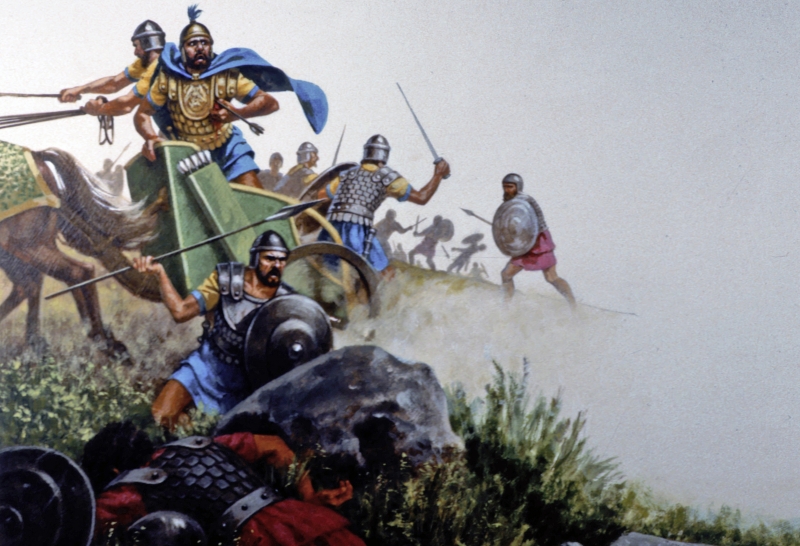
King Ahab found himself in a strange predicament. His capital city, Samaria, was under attack by a confederation of 32 kings, led by King Ben-hadad of Syria. But much to Ahab’s surprise, a prophet of Yahweh appeared with a plan for Israel’s deliverance.

“Thus says the LORD, Have you seen all this great multitude? Behold, I will give it into your hand this day, and you shall know that I am the LORD.” – 1 Kings 20:13 ESV

The very God whom Ahab and Jezebel had attempted to replace with their false gods announced that He was going to rescue His disobedient and unfaithful people. And Yahweh had told Ahab exactly how the victory would take place.

By the servants of the governors of the districts.” – 1 Kings 20:14 ESV

God was not going to utilize Ahab’s army to fight the Syrians. This is significant because Ahab, like all his predecessors, had assembled a large military force. Evidence of that fact has been found on an ancient Assyrian stone tablet that bears an inscription describing the battle of Qarqar between Ahab and his enemy, King Shalmaneser III of Assyria. The tablet records the size of the army that assembled to do battle that day as consisting of “2,000 chariots and 10,000 men of Ahab king of Israel.”

But on this occasion, Yahweh chose to place Ahab’s formidable resources in a secondary position, choosing instead to use “servants” – a group of ordinary people who, when assembled, amounted to only 7,000 in number.

Confident that he would defeat the Israelites, Ben-hadad and his vassal kings were drinking themselves drunk in a pre-victory celebration. So, when scouts arrived with a report that Israelite forces had been seen leaving the city, Beh-hadad assumed they were bringing news of Israel’s surrender or their decision to continue the battle. While he and his military commanders continued to toast their inevitable victory, the 7,000 servants made their way to the Syrian camp, followed by Ahab and his army.

This surprise attack caught the Syrian forces completely unawares and unable to respond. Led by the 7,000 servants, Ahab’s army quickly routed the Syrians, forcing them to abandon camp and run for their lives. Quickly sobered by this unexpected reversal of fortunes, Beh-hadad managed to escape, but the rest of his forces didn’t fare as well.

And the king of Israel went out and struck the horses and chariots, and struck the Syrians with a great blow. – 1 Kings 20:21 ESV

Notice that the author conveniently eliminates any mention of Ahab’s name. He simply refers to him as “the king of Israel.” He repeats this obvious slight in the very next verse, refusing to give Ahab any credit for the victory. He simply warns him that the battle may be done, but the war is far from over.

“Come, strengthen yourself, and consider well what you have to do, for in the spring the king of Syria will come up against you.” – 1 Kings 20:22 ESV

Ben-hadad would be back. He had suffered a devastating defeat, but once he had time to assess what had happened that day, the Syrian king would return, more determined than ever to avenge his loss by destroying the Israelites. Ben-hadad’s advisors encouraged his plans by suggesting that his loss had been divinely ordained. In their pagan way of thinking, the only thing that could explain a loss of this magnitude was the intervention of the gods. They rationalized away their defeat by concluding that they had chosen the wrong place to do battle.  They absolved Beh-hadad of any responsibility for the loss by assuring him, “Their gods are gods of the hills, and so they were stronger than we. But let us fight against them in the plain, and surely we shall be stronger than they” (1 Kings 20:23 ESV).

Little did they know how right they were. Their defeat had been the result of divine intervention, but geographic location had played no role in it. Yahweh was the God of the hills and the valleys; He was sovereign over all the earth. Unlike their false gods, Yahweh was unbound by time and space. The extent of His power was limitless. To the God of Israel, the battle location and the size of the opposing army made no difference. And so, when Ben-hadad’s advisors counseled him to rebuild his army and restructure his military command, it would prove to be futile advice. They had no idea what they were dealing with, and their ignorance led them to make some hazardous assumptions.

First, they assumed that the God of Israel was similar to their own gods – limited in power and vulnerable to defeat. Their “theology” relegated the gods to various regions or geographic jurisdictions. In their simplistic way of thinking, some gods ruled over the valleys while other gods had dominion over the hills. Their god had failed to deliver them a victory because they had chosen the wrong location for their battle. So, if they could lure the Israelites into the valley, they would expose Yahweh’s weak spot, and the battle would go their way.

Eager to avenge his loss, Ben-hadad took their advice and spent the winter rebuilding his army. He replaced the 32 kings with seasoned military commanders and ordered the construction of new chariots. He also made plans to take the fight to the valley, where the God of Israel would have no power and play no role in the outcome of the battle.

It is fascinating to consider that all of this was according to the sovereign will of God. He had orchestrated all the details concerning the original battle, including Ben-hadad’s escape. God had even told Ahab that the Syrians would return. Ben-hadad’s rebuilding and reconfiguring of his army had been part of God’s plan. The original battle had been intended to restore the Israelites’ belief in God. Prior to their victory, God had told them, “I will give it into your hand this day, and you shall know that I am the LORD” (1 Kings 20:13 ESV).

But Yahweh knew that little had changed in Israel. Even after their miraculous defeat of the Syrians, the people remained unconvinced of Yahweh’s status as the one true God. When spring rolled around, they found themselves facing their former foe again. This time, Beh-hadad showed up with a much larger and better-equipped army than before, and rather than laying siege to the city, his troops gathered in the Valley of Aphek. Ben-hadad had brought a bigger, better army and had chosen a battleground that was outside the reach of Yahweh’s power. Or so he thought.

The stage was set. The enemy of Israel had returned. And the author paints a rather bleak and foreboding picture of the situation.

Israel then mustered its army, set up supply lines, and marched out for battle. But the Israelite army looked like two little flocks of goats in comparison to the vast Aramean forces that filled the countryside! – 1 Kings 20:27 NLT

Here was Israel, outnumbered and underequipped yet again. They were no match for the Syrians. And this time, they would not have the walls of the city to protect them. They would be fighting on open terrain, facing an army equipped with chariots and horses and motivated by revenge.

But God sent another prophet with a promise of His presence and power.

“Thus says the LORD, ‘Because the Syrians have said, “The LORD is a god of the hills but he is not a god of the valleys,” therefore I will give all this great multitude into your hand, and you shall know that I am the LORD.’” – 1 Kings 20:28 ESV

Despite the overwhelming odds, God would provide another victory over their enemy. By the time this day was over, they would know that He was the one true God. But in verse 28, the author leaves out Ahab’s name again, simply referring to him as “the king of Israel.” God was going to deliver this victory despite Ahab, not because of him. Not only did Ahab deserve to lose this battle, but he also deserved to die for his idolatry and apostasy. But Yahweh was acting on behalf of His covenant people and protecting the integrity and honor of His name. He had made covenant promises to Abraham, Isaac, and Jacob, and given His word to Moses and David. And while Ahab had failed to use his position as the shepherd of Israel to lead them in faithful obedience, Yahweh would prove Himself true to His word and committed to His covenant promises.

English Standard Version (ESV) The Holy Bible, English Standard Version. ESV® Permanent Text Edition® (2016). Copyright © 2001 by Crossway Bibles, a publishing ministry of Good News Publishers.

New Living Translation (NLT) Holy Bible, New Living Translation, copyright © 1996, 2004, 2015 by Tyndale House Foundation. Used by permission of Tyndale House Publishers Inc., Carol Stream, Illinois 60188. All rights reserved.

Who Is Like You?

1 In you, O LORD, do I take refuge;
    let me never be put to shame!
In your righteousness deliver me and rescue me;
    incline your ear to me, and save me!
Be to me a rock of refuge,
    to which I may continually come;
you have given the command to save me,
    for you are my rock and my fortress.

Rescue me, O my God, from the hand of the wicked,
    from the grasp of the unjust and cruel man.
For you, O LORD, are my hope,
    my trust, O LORD, from my youth.
Upon you I have leaned from before my birth;
    you are he who took me from my mother’s womb.
My praise is continually of you.

I have been as a portent to many,
    but you are my strong refuge.
My mouth is filled with your praise,
    and with your glory all the day.
Do not cast me off in the time of old age;
    forsake me not when my strength is spent.
10 For my enemies speak concerning me;
    those who watch for my life consult together
11 and say, “God has forsaken him;
    pursue and seize him,
    for there is none to deliver him.”

12 O God, be not far from me;
    O my God, make haste to help me!
13 May my accusers be put to shame and consumed;
    with scorn and disgrace may they be covered
    who seek my hurt.
14 But I will hope continually
    and will praise you yet more and more.
15 My mouth will tell of your righteous acts,
    of your deeds of salvation all the day,
    for their number is past my knowledge.
16 With the mighty deeds of the Lord God I will come;
    I will remind them of your righteousness, yours alone.

17 O God, from my youth you have taught me,
    and I still proclaim your wondrous deeds.
18 So even to old age and gray hairs,
    O God, do not forsake me,
until I proclaim your might to another generation,
    your power to all those to come.
19 Your righteousness, O God,
    reaches the high heavens.
You who have done great things,
    O God, who is like you?
20 You who have made me see many troubles and calamities
    will revive me again;
from the depths of the earth
    you will bring me up again.
21 You will increase my greatness
    and comfort me again.

22 I will also praise you with the harp
    for your faithfulness, O my God;
I will sing praises to you with the lyre,
    O Holy One of Israel.
23 My lips will shout for joy,
    when I sing praises to you;
    my soul also, which you have redeemed.
24 And my tongue will talk of your righteous help all the day long,
for they have been put to shame and disappointed
    who sought to do me hurt. Psalm 71:1-24 ESV

The unknown author of this psalm has been trusting in Yahweh for a long time and has never been disappointed. His experience with relying on the Almighty has been positive, and he is more than willing to share it with others.

O Lord, you alone are my hope.
    I’ve trusted you, O Lord, from childhood.
Yes, you have been with me from birth;
    from my mother’s womb you have cared for me.
    No wonder I am always praising you! – Psalm 71:5-6 NLT

O God, you have taught me from my earliest childhood,
    and I constantly tell others about the wonderful things you do. – Psalm 71:17 NLT

But old age has caught up with him, and his diminished strength has left him ever more dependent upon God’s help and hope.

And now, in my old age, don’t set me aside.
    Don’t abandon me when my strength is failing. – Psalm 71:9 NLT

For years, this faithful servant has relied upon God to deliver him from difficulty and has used these divine interventions to sing God’s praises to anyone who would listen. He states, “My life is an example to many, because you have been my strength and protection” (Psalm 71:7 NLT). Year after year, his loved ones and neighbors have been able to learn vicariously as they witnessed his repeated deliverance by God. His life has been a testimony to God’s faithfulness and a tangible example of what trust in God looks like.

But now, in the twilight of his life, his enemies are spreading the rumor that he has been abandoned by God. His latter years are filled with more turmoil than he can physically endure or emotionally handle.

As has been his custom, he takes his need to the LORD, begging Him to intervene.

O Lord, I have come to you for protection;
    don’t let me be disgraced. – Psalm 71:1 NLT

Be my rock of safety
    where I can always hide.
Give the order to save me – Psalm 71:3 NLT

No details are given to explain the nature of his predicament, but the intensity of his suffering is unmistakable. He is surrounded by wicked and cruel oppressors who whisper against him and plot his demise. They accuse God of abandoning him and leaving him an easy target for their evil plans. But despite their verbal attacks and life-threatening overtures, the psalmist continues to place his hope in the LORD.

O God, don’t stay away.
    My God, please hurry to help me.
Bring disgrace and destruction on my accusers.
    Humiliate and shame those who want to harm me. – Psalm 71:12-13 NLT

In his frustration and confusion, the psalmist calls on God to avenge him and uses powerful language to communicate his preferred consequences for his enemies. He doesn’t turn the other cheek or ask God to forgive them because “they don’t know what they are doing” (Luke 23:34 NLT). No, he asks God to mete out justice and show no mercy. In his pain and suffering, he can only imagine an outcome that results in God’s wrath being poured out in full. No other resolution makes sense.

Living long before Jesus delivered His Sermon on the Mount, the psalmist operated under the premise of reciprocal justice, better known as lex talionis (law of retribution). The Mosaic Law contained a clause that supported this idea.

If there is further injury, the punishment must match the injury: a life for a life, an eye for an eye, a tooth for a tooth, a hand for a hand, a foot for a foot, a burn for a burn, a wound for a wound, a bruise for a bruise. – Exodus 21:23-25 NLT

But Jesus offered a different take on the law, declaring a higher standard for reciprocal justice.

You have heard the law that says, ‘Love your neighbor’ and hate your enemy. But I say, love your enemies! Pray for those who persecute you! In that way, you will be acting as true children of your Father in heaven. For he gives his sunlight to both the evil and the good, and he sends rain on the just and the unjust alike.” – Matthew 5:44-45 NLT

In his gospel account, Luke records a more nuanced version of Jesus’ radical message.

“But to you who are willing to listen, I say, love your enemies! Do good to those who hate you. Bless those who curse you. Pray for those who hurt you. If someone slaps you on one cheek, offer the other cheek also. If someone demands your coat, offer your shirt also. Give to anyone who asks; and when things are taken away from you, don’t try to get them back. Do to others as you would like them to do to you.” – Luke 6:27-31 NLT

Paul jumped on the bandwagon in his letter to the believers living in Rome, a hotbed of anti-Christian sentiment that was rife with persecution against Christ followers.

Bless those who persecute you. Don’t curse them; pray that God will bless them.Never pay back evil with more evil. – Romans 12:14, 17 NLT

Even the apostle Peter got in on the action, calling believers to live by a completely different code of conduct.

Don’t repay evil for evil. Don’t retaliate with insults when people insult you. Instead, pay them back with a blessing. That is what God has called you to do – 1 Peter 3:9 NLT

Yet, despite his adverse conditions and less-than-compassionate outlook, the psalmist knew he could count on God to hear and respond, providing him with another opportunity to sing God’s praises.

But I will keep on hoping for your help;
    I will praise you more and more.
I will tell everyone about your righteousness.
    All day long I will proclaim your saving power – Psalm 71:14-15 NLT

God had proven Himself trustworthy and reliable time and time again, and the psalmist remained confident that God would come through this time as well. In fact, he saw Yahweh as incomparably consistent in HIs actions. As far as he was concerned, God was one of a kind and had a proven track record of coming through at just the right time, and this occasion would be no different.

Who can compare with you, O God?
You have allowed me to suffer much hardship,
    but you will restore me to life again
    and lift me up from the depths of the earth.
– Psalm 71:19-20 NLT

The psalmist’s line of thought mirrors the words of Moses, written centuries earlier. When considering Israel’s unique relationship with God, Moses was prone to point out how His righteousness and accessibility went hand in hand. God was holy, yet wholly approachable.

For what great nation is there that has a god so near to it as the LORD our God is to us, whenever we call upon him? And what great nation is there, that has statutes and rules so righteous as all this law that I set before you today? – Deuteronomy 4:7-8 ESV

The law and sacrificial systems made it possible for unrighteous men to enter the presence of a holy God. That is why the psalmist was fully confident that God would restore him and thoroughly prepared to return the favor with joy, praise, and song.

Then I will praise you with music on the harp,
    because you are faithful to your promises, O my God.
I will sing praises to you with a lyre,
    O Holy One of Israel.
I will shout for joy and sing your praises,
    for you have ransomed me.
I will tell about your righteous deeds
    all day long – Psalm 71:22-24 NLT

Old age may have diminished some of his physical faculties, but it had done nothing to curb his enthusiasm or minimize his trust in God. He would keep believing and hoping to the end because his God was trustworthy and true.

Father, the older I get, the more I understand what the psalmist is trying to say. Experience has proven that You are trustworthy and worthy of my wholehearted confidence. You have never given a reason NOT to trust You, so why would I beginnow? Give me the strength to rely on You even when things look bleak and dark. Help me to rest in Your sovereignty and trust in Your power to show up even when things are looking down. There is no god like You, and no other place I can turn in my times. of need. Amen

English Standard Version (ESV) The Holy Bible, English Standard Version. ESV® Permanent Text Edition® (2016). Copyright © 2001 by Crossway Bibles, a publishing ministry of Good News Publishers.

New Living Translation (NLT) Holy Bible, New Living Translation, copyright © 1996, 2004, 2015 by Tyndale House Foundation. Used by permission of Tyndale House Publishers Inc., Carol Stream, Illinois 60188. All rights reserved.

Surrounded by Fools

To the choirmaster: according to Mahalath. A Maskil of David.

1 The fool says in his heart, “There is no God.”
    They are corrupt, doing abominable iniquity;
    there is none who does good.

God looks down from heaven
    on the children of man
to see if there are any who understand,
    who seek after God.

They have all fallen away;
    together they have become corrupt;
there is none who does good,
    not even one.

Have those who work evil no knowledge,
    who eat up my people as they eat bread,
    and do not call upon God?

There they are, in great terror,
    where there is no terror!
For God scatters the bones of him who encamps against you;
    you put them to shame, for God has rejected them.

Oh, that salvation for Israel would come out of Zion!
    When God restores the fortunes of his people,
    let Jacob rejoice, let Israel be glad. Psalm 53:1-6 ESV

This psalm is a slight variation on Psalm 14, with David using the title ĕlōhîm when referring to God, instead of Yahweh or Jehovah.

God [ĕlōhîm] looks down from heaven
    on the children of man
to see if there are any who understand,
    who seek after God. – Psalm 53:2 ESV

The LORD [Yᵊhōvâ] looks down from heaven on the children of man,
    to see if there are any who understand,
    who seek after God. – Psalm 14:2 ESV

This amended version of his original psalm was placed between Psalms 52 and 54 to help make a point about David’s interactions with Doeg the Edomite and the Ziphites. In the case of Doeg, this godless man murdered innocent priests and their families to advance his own career. He exhibited no fear of God and no regret for his actions. His dastardly deed is recorded in 1 Samuel 22.

In the very next chapter, David is hiding in Horesh in the land of Ziph. The inhabitants of Ziph learn of his presence among them and send news to King Saul.

Then the Ziphites went up to Saul at Gibeah, saying, “Is not David hiding among us in the strongholds at Horesh, on the hill of Hachilah, which is south of Jeshimon? Now come down, O king, according to all your heart’s desire to come down, and our part shall be to surrender him into the king’s hand.” – 1 Samuel 23:19-20 ESV

To escape Saul’s wrath, David is forced to flee yet again, this time to the strongholds of Engedi.

In both cases, David had to deal with those whom he determined to be fools. His criterion for qualifying for this less-than-flattering designation was simple: they acted as if God were non-existent.

Only fools say in their hearts,
    “There is no God.”
They are corrupt, and their actions are evil;
    not one of them does good! – Psalm 53:1 NLT

Notice that David accuses them of denying God’s existence in their hearts. This was not a verbal declaration but a silent conclusion that led to their godless actions. The Hebrew word David used for “fool” is nāḇāl, which is significant when one considers the story recorded in 1 Samuel 25. Not long after being sold out by the Ziphites, David and his men sought food from a wealthy landowner named Nabal. The text describes him as “crude and mean in all his dealings” (1 Samuel 25:3 NLT). For some unknown reason, his parents had named him nāḇāl, a Hebrew word that means “wicked, impious, or foolish.” The Brown-Driver-Briggs Lexicon describes this kind of individual as “the man who has no perception of ethical and religious claims, and with collateral idea of ignoble, disgraceful.” 

David sends his men to seek provisions from Nabal in return for having protected his shepherds and sheep. But this “fool” of a man lived up to his name and sent the following message to David:

“Who is this fellow David?” Nabal sneered to the young men. “Who does this son of Jesse think he is? There are lots of servants these days who run away from their masters. Should I take my bread and my water and my meat that I’ve slaughtered for my shearers and give it to a band of outlaws who come from who knows where?” – 1 Samuel 25:10-11 NLT

Enraged by Nabal’s disrespectful and ungrateful words, David was ready to end his life. But when Nabal’s wife Abigail learned of the situation, she intervened.

“I accept all blame in this matter, my lord. Please listen to what I have to say. I know Nabal is a wicked and ill-tempered man; please don’t pay any attention to him. He is a fool, just as his name suggests. But I never even saw the young men you sent. – 1 Samuel 25:24-25 NLT

Her actions prevented David from doing something even more foolish than Nabal. He relented from his plan to wipe out Nabal’s entire clan and spared the fool’s life.

David was surrounded by fools. It seemed that everywhere he turned, there were people who acted in foolish ways, treating him with contempt, hostility, and disrespect. They never seemed to consider whether their actions were in line with God’s will. So, in that respect, they acted as if God did not exist. And by this time in his life, David’s assessment of mankind had become fairly jaded.

God looks down from heaven
    on the entire human race;
he looks to see if anyone is truly wise,
    if anyone seeks God.
But no, all have turned away;
    all have become corrupt.
No one does good,
    not a single one! – Psalm 53:2-3 NLT

Everyone was corrupt and godless, from the king all the way down to Doeg, the herdsmen, the traitorous Ziphites, and Nabal the fool. David felt all alone and under constant attack from all sides. He had difficulty understanding how these people could behave in such a way. Did they really think they would get away with their actions? David was blown away by their arrogance and seeming disinterest in God’s judgment.

Will those who do evil never learn?
    They eat up my people like bread
    and wouldn’t think of praying to God. – Psalm 53:4 NLT

Everyone David took issue with was a card-carrying Hebrew who claimed to have a relationship with Yahweh. They were supposed to be God-fearing Jews who shared his belief in Yahweh’s sovereignty. But they acted as if God were nowhere to be found.

Even those who claim to know Him act as if He either doesn’t care about what they do or is too powerless to do anything about it. Some just refuse to believe in Him altogether. These people “are corrupt, and their actions are evil; not one of them does good!” (Psalm 53:1 NLT). This is not a very promising assessment on the character or condition of mankind. It leaves little doubt, at least from God’s perspective, that man is inherently wicked and in open rebellion against Him. Yet God is still reaching out to man, offering mercy and forgiveness. He will ultimately be forced to punish all those who refuse to accept His offer of new life through His Son, but until then, He keeps providing opportunities for them to repent and return to Him.

And while the world is a less-than-ideal place, full of people obsessed with their own agendas, consumed by their own importance, and controlled by their own sin natures, David gives us a glimpse of God’s goodness as he reminds us that God is always there for us even in the midst of all the evil that surrounds us. “But God is my helper. The Lord keeps me alive!” (Psalm 54:4 NLT).

David appeals to God’s power and places himself at God’s mercy to rescue him from his enemies.

Terror will grip them,
    terror like they have never known before.
God will scatter the bones of your enemies.
    You will put them to shame, for God has rejected them. – Psalm 53:5 NLT

Those who care nothing for God were making David’s life miserable. But David knew he could call out to God, and not only be heard but answered.

Who will come from Mount Zion to rescue Israel?
    When God restores his people,
    Jacob will shout with joy, and Israel will rejoice. – Psalm 53:6 NLT

David had seen the goodness of God time and time again in his life, delivering him from troubles and trials, rescuing him from every conceivable kind of predicament. And while he firmly believed that “no one does good, not a single one,” David knew that God can and does do good for those who love Him. His response was to offer God praise and gratitude. While no one else steps in and rescues God’s people, Yahweh can be counted on to be there when needed. That is why David says, “Jacob will shout with joy, and Israel will rejoice.”

All that God does is good, even when He has to deal with those who are bad. God is righteous and always does what is right. He never does wrong. He is just in all His actions towards men and never punishes unjustly or unfairly. He is good, and it doesn’t matter whether men reject Him, ignore Him, or attempt to deny He even exists. God remains good even when things appear bad.

Father, we live in a world that is sick and dying. It is filled with people who refuse to love and serve You. Many refuse to even believe in You. And yet, You remain good. You continue to make the sun shine on all men, showering them with Your common grace. You make the crops grow, the rain to fall, and the air breathable. You constantly offer the free gift of grace available through Your Son. And You care for Your own, providing them with a listening ear and a powerful hand to rescue and restore them. You are indeed a good God. Amen

English Standard Version (ESV) The Holy Bible, English Standard Version. ESV® Permanent Text Edition® (2016). Copyright © 2001 by Crossway Bibles, a publishing ministry of Good News Publishers.

New Living Translation (NLT) Holy Bible, New Living Translation, copyright © 1996, 2004, 2015 by Tyndale House Foundation. Used by permission of Tyndale House Publishers Inc., Carol Stream, Illinois 60188. All rights reserved.

When Circumstances Make Us Circumspect

To the choirmaster. A Maskil of the Sons of Korah.

1 O God, we have heard with our ears,
    our fathers have told us,
what deeds you performed in their days,
    in the days of old:
you with your own hand drove out the nations,
    but them you planted;
you afflicted the peoples,
    but them you set free;
for not by their own sword did they win the land,
    nor did their own arm save them,
but your right hand and your arm,
    and the light of your face,
    for you delighted in them.

You are my King, O God;
    ordain salvation for Jacob!
Through you we push down our foes;
    through your name we tread down those who rise up against us.
For not in my bow do I trust,
    nor can my sword save me.
But you have saved us from our foes
    and have put to shame those who hate us.
In God we have boasted continually,
    and we will give thanks to your name forever. Selah

But you have rejected us and disgraced us
    and have not gone out with our armies.
10 You have made us turn back from the foe,
    and those who hate us have gotten spoil.
11 You have made us like sheep for slaughter
    and have scattered us among the nations.
12 You have sold your people for a trifle,
    demanding no high price for them.
13 You have made us the taunt of our neighbors,
    the derision and scorn of those around us.
14 You have made us a byword among the nations,
    a laughingstock among the peoples.
15 All day long my disgrace is before me,
    and shame has covered my face
16 at the sound of the taunter and reviler,
    at the sight of the enemy and the avenger.

17 All this has come upon us,
    though we have not forgotten you,
    and we have not been false to your covenant.
18 Our heart has not turned back,
    nor have our steps departed from your way;
19 yet you have broken us in the place of jackals
    and covered us with the shadow of death.
20 If we had forgotten the name of our God
    or spread out our hands to a foreign god,
21 would not God discover this?
    For he knows the secrets of the heart.
22 Yet for your sake we are killed all the day long;
    we are regarded as sheep to be slaughtered.

23 Awake! Why are you sleeping, O Lord?
    Rouse yourself! Do not reject us forever!
24 Why do you hide your face?
    Why do you forget our affliction and oppression?
25 For our soul is bowed down to the dust;
    our belly clings to the ground.
26 Rise up; come to our help!
    Redeem us for the sake of your steadfast love! Psalm 44:1-26 ESV

Things don’t always go as expected. As God’s people, there is no guarantee that our lives will be trouble-free or exempt from difficulty. The truth is, bad things happen to good people. That is the primary theme of this psalm of lament.

Written by one of the sons of Korah, this psalm begins with a stirring tribute to God’s past faithfulness to His people. The opening lines record how God miraculously delivered the land of Canaan to the people of Israel under the leadership of Joshua.

You drove out the pagan nations by your power
    and gave all the land to our ancestors.
You crushed their enemies
    and set our ancestors free. – Psalm 44:2 NLT

Every Hebrew child grew up hearing about the exciting exploits of Joshua as he led the people of Israel in their conquest of Canaan. They could recite the details of the battle at Jericho, where the “walls came tumblin’ down.” These stories were part of the collective imagination of Israel, passed down from generation to generation to remind them of God’s power and promise-keeping nature. The psalmist freely admits, “We have heard it with our own ears—our ancestors have told us of all you did in their day, in days long ago” (Psalm 44:1 NLT).

These stories had been recorded for posterity in the books of Joshua and Judges, providing proof that God had fulfilled the promise he made to the people of Israel long before they set foot in the land of Canaan.

“I will send my terror ahead of you and create panic among all the people whose lands you invade. I will make all your enemies turn and run. I will send terror ahead of you to drive out the Hivites, Canaanites, and Hittites. But I will not drive them out in a single year, because the land would become desolate and the wild animals would multiply and threaten you. I will drive them out a little at a time until your population has increased enough to take possession of the land. And I will fix your boundaries from the Red Sea to the Mediterranean Sea, and from the eastern wilderness to the Euphrates River. I will hand over to you the people now living in the land, and you will drive them out ahead of you. – Exodus 23:27-31 NLT

God had kept His word, fulfilling His promise to provide His chosen people with a land of their own. The former slaves had become the masters of their own domain, thanks to God’s gracious intervention in their lives. Their conquest of the land had not been the result of their superior military might; it had been God’s doing, something the psalmist openly acknowledges.

They did not conquer the land with their swords;
    it was not their own strong arm that gave them victory.
It was your right hand and strong arm
    and the blinding light from your face that helped them,
    for you loved them. – Psalm 44:3 NLT

Seeming to speak on behalf of the king, the psalmist proclaims God’s sovereignty and the nation’s continued dependency upon His power for their survival. In the centuries since Joshua led the people across the Jordan River into Canaan, the Israelites remained reliant upon God’s strength for their protection and continued existence.

Only by your power can we push back our enemies;
    only in your name can we trample our foes. – Psalm 44:5 NLT

But something had happened that caused the psalmist to question God’s faithfulness. A national tragedy had left the people wondering whether God had turned His back on them. An unnamed enemy had humiliated the Israelites in battle, leaving them confused and conflicted and questioning the cause of their unexpected defeat. From all appearances, they had trusted in God, and He had let them down.

But now you have tossed us aside in dishonor.
    You no longer lead our armies to battle.
You make us retreat from our enemies
    and allow those who hate us to plunder our land. – Psalm 44:9-10 NLT

None of this made sense. The psalmist can think of no sin that would have warranted the devastating loss they had suffered. From his perspective, the nation remained faithful to God and undeserving of their humiliating defeat at the hands of their enemy.

All this has happened though we have not forgotten you.
    We have not violated your covenant.
Our hearts have not deserted you.
    We have not strayed from your path. – Psalm 44:17-18 NLT

There was no sin to confess or repent of. The psalmist can think of no instance of corporate immorality or iniquity that would have warranted such an obvious act of divine punishment. This loss had God’s hands all over it. It appeared to be a clear case of God’s judgment, but it seemed to lack justification. They had done nothing wrong. This led the psalmist to accuse God of punishing them unjustly.

You have covered us with darkness and death. – Psalm 44:19 NLT

He knew God to be all-wise and all-knowing. There was nothing that escaped His notice or went undetected. If they were guilty of unfaithfulness or idolatry, God would know it because He is omniscient. Yet, as far as the psalmist could tell, their corporate calamity had been God’s doing — whether deserved or not.

Yet because of you we are killed all day long; we are treated like sheep at the slaughtering block. – Psalm 44:22 NET

The psalmist boldly declares his belief that their tragedy was God’s doing. He could think of no other logical explanation and this led him to beg God to relent and restore His people.

Wake up, O Lord! Why do you sleep?
    Get up! Do not reject us forever.
Why do you look the other way?
    Why do you ignore our suffering and oppression? – Psalm 44:23-24 NLT

This psalm reflects the earth-bound, limited perspective of all believers. We are temporal creatures attempting to understand the ways of God in a fallen world where things don’t always make sense. The presence of evil and the experience of pain and suffering it can produce can leave us doubting God’s goodness and questioning His justice. We somehow expect that our faith in Him should exempt us from the trials and tribulations that others suffer.

Yet, the apostle Paul reminded the Christians in Corinth that trials and tribulations were to be expected in this life.

That is why we never give up. Though our bodies are dying, our spirits are being renewed every day. For our present troubles are small and won’t last very long. Yet they produce for us a glory that vastly outweighs them and will last forever! So we don’t look at the troubles we can see now; rather, we fix our gaze on things that cannot be seen. For the things we see now will soon be gone, but the things we cannot see will last forever. – 2 Corinthians 4:16-18 NLT

The Israelites were not exempt from difficulty, and neither were the Corinthians. Life can be hard. Suffering is an ever-present reality for believers and non-believers alike. Paul was well acquainted with that fact, having endured his own fair share of difficulties. He provided the believers in Corinth with a short list of some of his undeserved troubles while serving as an apostle of Jesus Christ.

I have worked harder, been put in prison more often, been whipped times without number, and faced death again and again.  Five different times the Jewish leaders gave me thirty-nine lashes. Three times I was beaten with rods. Once I was stoned. Three times I was shipwrecked. Once I spent a whole night and a day adrift at sea. I have traveled on many long journeys. I have faced danger from rivers and from robbers. I have faced danger from my own people, the Jews, as well as from the Gentiles. I have faced danger in the cities, in the deserts, and on the seas. And I have faced danger from men who claim to be believers but are not. I have worked hard and long, enduring many sleepless nights. I have been hungry and thirsty and have often gone without food. I have shivered in the cold, without enough clothing to keep me warm. – 2 Corinthians 11:23-27 NLT

Paul wasn’t complaining or bragging; he simply reminded his readers that no one is immune from suffering. Jesus Himself suffered and died as part of His faithful adherence to His Father’s will. He was falsely accused, viciously abused, and crucified on a Roman cross, though He was innocent of any crime and completely free from sin.

Paul wrote to Christians living in Rome, reminding them their circumstances were a lousy barometer of God’s love and faithfulness. These new believers were living in the capital city of the Roman Empire and under constant threats from a hostile government that had played a major role in the death of their Lord and Savior. Persecution and suffering were a daily reality but were never to be seen as a lack of God’s love for them.

Can anything ever separate us from Christ’s love? Does it mean he no longer loves us if we have trouble or calamity, or are persecuted, or hungry, or destitute, or in danger, or threatened with death? (As the Scriptures say, “For your sake we are killed every day; we are being slaughtered like sheep.”) No, despite all these things, overwhelming victory is ours through Christ, who loved us. – Romans 8:35-37 NLT

Notice that Paul quotes Psalm 44:22. He turns the psalmist’s lament into a statement of praise. Rather than blame God for any suffering we may have to endure, Paul suggests we see it as an opportunity to praise Him for His goodness and grace. He has a plan for us, and He can use every aspect of our lives on this earth to glorify Himself — even through tragedy, heartache, and suffering. That is why Paul told the Corinthians believers to view their present suffering as an opportunity to see God work.

We now have this light shining in our hearts, but we ourselves are like fragile clay jars containing this great treasure. This makes it clear that our great power is from God, not from ourselves.

We are pressed on every side by troubles, but we are not crushed. We are perplexed, but not driven to despair. We are hunted down, but never abandoned by God. We get knocked down, but we are not destroyed. Through suffering, our bodies continue to share in the death of Jesus so that the life of Jesus may also be seen in our bodies. – 2 Corinthians 4:7-10 NLT

Father, it’s so easy to let the circumstances of life become the barometer by which I measure Your faithfulness and love. When things are going well in my life, I tend to view You positively. But if one thing goes wrong, I rant and rail about Your apparent disinterest and seeming distance from my life. I judge Your love based on the physical conditions of my life. But You are always loving, faithful, and quick to reveal Yourself — even in the darkest moments of my life. Give me the ability to see You clearly even when life doesn’t make sense. Your plan is perfect and Your love for me is unwavering. I know I can trust You, but sometimes life causes me to doubt. Keep me focused on Your faithfulness so I won’t let the seeming failures of life distract and defeat me. Amen

English Standard Version (ESV) The Holy Bible, English Standard Version. ESV® Permanent Text Edition® (2016). Copyright © 2001 by Crossway Bibles, a publishing ministry of Good News Publishers.

New Living Translation (NLT) Holy Bible, New Living Translation, copyright © 1996, 2004, 2015 by Tyndale House Foundation. Used by permission of Tyndale House Publishers Inc., Carol Stream, Illinois 60188. All rights reserved.

Submission is Not a Dirty Word

18 Wives, submit to your husbands, as is fitting in the Lord. 19 Husbands, love your wives, and do not be harsh with them. 20 Children, obey your parents in everything, for this pleases the Lord. 21 Fathers, do not provoke your children, lest they become discouraged. 22 Bondservants, obey in everything those who are your earthly masters, not by way of eye-service, as people-pleasers, but with sincerity of heart, fearing the Lord. 23 Whatever you do, work heartily, as for the Lord and not for men, 24 knowing that from the Lord you will receive the inheritance as your reward. You are serving the Lord Christ. 25 For the wrongdoer will be paid back for the wrong he has done, and there is no partiality.

1 Masters, treat your bondservants justly and fairly, knowing that you also have a Master in heaven. Colossians 3:18-4:1 ESV

Paul now takes those other-oriented, selfless, and love-motivated character traits and applies them to everyday life. Since he was writing to believers living in Colossae, he customized his words for their particular context. He wanted them to know what seeking and setting their minds on things that are above would look like on a daily basis. He wasn’t promoting an ethereal and impractical brand of religious pietism and asceticism. No, he was recommending a highly practical brand of faith that revealed the transformative nature of the gospel in everyday life.

They were to “put on the new self, which is being renewed in knowledge after the image of its creator” (Colossians 3:10 ESV). As God’s chosen ones, they were to put on “compassionate hearts, kindness, humility, meekness, and patience” (Colossians 3:12 ESV). But none of these “add-ons” would be effective without love.

…put on love, which binds everything together in perfect harmony… – Colossians 3:14 ESV

Since God is love and He best expressed that love through the gift of His Son, Paul called the Colossians to “do everything in the name of the Lord Jesus” (Colossians 3:17 ESV). But what does that look like? How were they supposed to make these powerful admonitions practical? Well, Paul makes it plain and simple for them. He begins with the family unit, one of the most foundational and universal arenas of personal relationships in this life.

The family was God’s idea. He originated and ordained the union of one man and one woman, creating an indissoluble bond between them as husband and wife. The creation account found in the opening chapters of Genesis records God’s creation of the first marriage.

So the Lord God caused a deep sleep to fall upon the man, and while he slept took one of his ribs and closed up its place with flesh. And the rib that the Lord God had taken from the man he made into a woman and brought her to the man. Then the man said,

“This at last is bone of my bones
    and flesh of my flesh;
she shall be called Woman,
    because she was taken out of Man.”

Therefore a man shall leave his father and his mother and hold fast to his wife, and they shall become one flesh. – Genesis 2:21-24 ESV

Jesus Himself confirmed the validity of the Genesis account by stating, “Have you not read that he who created them from the beginning made them male and female, and said, ‘Therefore a man shall leave his father and his mother and hold fast to his wife, and the two shall become one flesh’? So they are no longer two but one flesh. What therefore God has joined together, let not man separate” (Matthew 19:4-6 ESV).

So, Paul begins at the beginning – with the family unit. He calls believing wives to submit to their believing husbands. But he adds an important, yet often overlooked, distinction: “as is fitting in the Lord” (Colossians 3:18 ESV). The New Living Translation puts it this way: “as is fitting for those who belong to the Lord.”

Paul’s use of the word “submission” was directly linked to his call that all believers conduct themselves with compassionate hearts, kindness, humility, meekness, and patience. If there was ever a relationship where those characteristics were necessary, it was the union between a husband and wife. So, he calls wives to lovingly, humbly, meekly, and patiently relate to their husbands in such a way that honors their role as the God-appointed head of the household. Paul provided additional insight into the headship role of the husband when writing to the church in Ephesus.

…submit to one another out of reverence for Christ. For wives, this means submit to your husbands as to the Lord. For a husband is the head of his wife as Christ is the head of the church. He is the Savior of his body, the church. As the church submits to Christ, so you wives should submit to your husbands in everything. – Ephesians 5:21-24 NLT

The biblical concept of submission has nothing to do with superiority or inferiority. Paul is not suggesting that women are somehow second-class citizens. He is simply articulating the divinely ordained concept of headship within the family unit. Just as Christ is the head of the church, the believing husband is responsible for the well-being of his family, and that role comes with a heavy dose of accountability.

Paul made it painfully clear that one of the primary leadership responsibilities of a godly husband was to selflessly love his wife. Once again, Paul provides further clarity in his letter to the church in Ephesus.

…this means love your wives, just as Christ loved the church. He gave up his life for her to make her holy and clean, washed by the cleansing of God’s word. – Ephesians 5:25-26 NLT

To lovingly and graciously submit to her husband, a wife must surrender her pride and natural desire for autonomy. In other words, she would have to “put off the old self with its practices” (Colossians 3:9 ESV). Submission doesn’t come naturally or easily for anyone. It requires a sacrifice of the human will. For anyone to submit in a way that “is fitting for those who belong to the Lord” (Colossians 3:18 NLT), they have to “put to death the sinful, earthly things lurking within” (Colossians 3:18 NLT). And according to Peter, submission isn’t required for wives alone. He calls all believers to model godly submission to all those in authority.

Be subject for the Lord’s sake to every human institution, whether it be to the emperor as supreme, or to governors as sent by him to punish those who do evil and to praise those who do good. For this is the will of God – 1 Peter 2:13-15 ESV

Regardless of their gender, each believer’s life is to be marked by an attitude of humble submission to others – for this is the will of God. According to Paul, one of the greatest displays of dying to self was to be a husband’s selfless expression of love for his wife. He was to put his wife’s life ahead of his own, even sacrificing his own life if necessary.

At the core of Paul’s teaching on submission is the contrast between humility and pride. There was no place for self-aggrandizement in the life of a believer.

Do nothing out of selfish ambition or empty pride, but in humility consider others more important than yourselves. Each of you should look not only to your own interests, but also to the interests of others. – Philippians 2:3-4 BSB

Even children had a part to play in God’s divine order for the home. They were to obey their parents in everything. Why? Because this was pleasing to the Lord. It was in keeping with His divine will. A child’s obedience was a form of submission to the God-ordained authority of their parents. Again, this is not normal or natural. As the proverb states, “Foolishness is bound up in the heart of a child…” (Proverbs 22:15 BSB).

It’s interesting to note that the disobedience of children was one of the characteristics Paul listed when describing the state of the world in the last days.

You should know this, Timothy, that in the last days there will be very difficult times. For people will love only themselves and their money. They will be boastful and proud, scoffing at God, disobedient to their parents, and ungrateful. They will consider nothing sacred. They will be unloving and unforgiving; they will slander others and have no self-control. They will be cruel and hate what is good. They will betray their friends, be reckless, be puffed up with pride, and love pleasure rather than God. – 2 Timothy 3:1-4 NLT

But, according to Paul, an obedient child is the byproduct of a loving and godly father.

Fathers, do not aggravate your children, or they will become discouraged. – Colossians 3:21 NLT

Proverbs 22 goes on to say, “A youngster’s heart is filled with foolishness, but physical discipline will drive it far away” (Proverbs 22:15 NLT). Yet, too much discipline, done in an unloving and heavy-handed manner, can do more harm than good. It can cause a child to become discouraged. Discipline that is unloving and lacking in compassion can disincentivize a child from trying to obey. It can actually result in rebellion rather than submission. So, Paul warns fathers to use their role as heads of their households with care.

Next, Paul moves from addressing the family unit to dealing with another relationship that was ubiquitous in the Colossian community: slavery. While we find this topic uncomfortable and somewhat off-putting, it was a normal part of everyday life for the citizens of Colossae.

“Scholars estimate about 10% (but possibly up to 20%) of the Roman empire’s population were enslaved. This would mean, for an estimated Roman empire population of 50 million (in the first century AD) between five and ten million were enslaved. This number would have been unequally distributed across the empire, with a higher concentration of enslaved people in urban areas and in Italy.” – http://www.britishmuseum.org

Slavery was an everyday part of daily life in Colossae. Yet Paul doesn’t attempt to address the moral implications of slavery. Instead, he shows the Colossian believers how their new identity in Christ should impact every area of life. The reality was that slaves were coming to faith in Christ and becoming a part of the local congregation of believers. It was highly likely that the church in Colossae had slaves attending worship services with their own masters. This presented a particularly difficult problem for Paul and the church’s leadership. How were these people supposed to relate to one another? How should their mutual relationship with Christ impact their interpersonal relationship with one another?

Paul addresses both parties. He tells slaves, “obey your earthly masters in everything you do. Try to please them all the time, not just when they are watching you. Serve them sincerely because of your reverent fear of the Lord” (Colossians 3:22 NLT). Then he turns his attention to the masters.

…be just and fair to your slaves. Remember that you also have a Master—in heaven. – Colossians 4:1 NLT

Notice his emphasis on God. Both parties were to recognize that their earthly relationship with one another had been dramatically altered by their new identity in Christ. While nothing had changed regarding their worldly status, Paul wanted them to know that God viewed them in a new light.

In this new life, it doesn’t matter if you are a Jew or a Gentile, circumcised or uncircumcised, barbaric, uncivilized, slave, or free. Christ is all that matters, and he lives in all of us. – Colossians 3:11 NLT

Paul’s words to slaves teach an invaluable and universal lesson. These were individuals who had no choice regarding their condition. Their position as slaves required that they submit, whether they wanted to or not. But Paul challenged them to take a different attitude.

Work willingly at whatever you do, as though you were working for the Lord rather than for people. Remember that the Lord will give you an inheritance as your reward, and that the Master you are serving is Christ. – Colossians 3:23-24 NLT

This call to a new outlook applied to every believer in the local church in Colossae. It’s what Paul meant when he wrote, “Set your minds on things that are above, not on things that are on earth” (Colossians 3:2 ESV). A slave was to live with an eternal perspective, knowing that his current circumstance was temporal. There was a reward awaiting him that made his present suffering pale in comparison. But that heavenly-minded, future-focused perspective was to motivate the life of every believer in Colossae, regardless of their gender, race, or social status.

English Standard Version (ESV) The Holy Bible, English Standard Version. ESV® Permanent Text Edition® (2016). Copyright © 2001 by Crossway Bibles, a publishing ministry of Good News Publishers.

New Living Translation (NLT) Holy Bible, New Living Translation, copyright © 1996, 2004, 2015 by Tyndale House Foundation. Used by permission of Tyndale House Publishers Inc., Carol Stream, Illinois 60188. All rights reserved.

Give!

38 “You have heard that it was said, ‘An eye for an eye and a tooth for a tooth.’ 39 But I say to you, Do not resist the one who is evil. But if anyone slaps you on the right cheek, turn to him the other also. 40 And if anyone would sue you and take your tunic, let him have your cloak as well. 41 And if anyone forces you to go one mile, go with him two miles. 42 Give to the one who begs from you, and do not refuse the one who would borrow from you.” – Matthew 5:38-42 ESV

In this passage from Jesus’ Sermon on the Mount, He shifts His focus to what was known as the “law of retaliation” or lex talionis in Latin. This was a very common legal concept in the ancient Near East that dictated retribution in kind – an eye for an eye or a hand for a hand. The Mosaic law even made provision for it. Exodus 21:23-25 reads: “But if there is harm, then you shall pay life for life, eye for eye, tooth for tooth, hand for hand, foot for foot, burn for burn, wound for wound, stripe for stripe.” The book of Leviticus provides further insight into how this law was to be applied:

“Whoever takes a human life shall surely be put to death. Whoever takes an animal’s life shall make it good, life for life. If anyone injures his neighbor, as he has done it shall be done to him, fracture for fracture, eye for eye, tooth for tooth; whatever injury he has given a person shall be given to him. Whoever kills an animal shall make it good, and whoever kills a person shall be put to death. You shall have the same rule for the sojourner and for the native, for I am the Lord your God.” – Leviticus 24:17-22 ESV

This was a civil law to be applied and overseen by the ruling authorities. It was not to be administered by individuals against an offending party. But the Jews had lifted this law out of its context and extended its intended meaning. They had turned it into an excuse for personal retribution, with no jurisdiction by any legal authority. The problem with that interpretation was that it had no end. It would lead to an escalating form of violence as each offended party attempted to outdo the other in terms of payback. Yet, this law had actually been intended to legislate and, therefore, limit vengeance. It was prescriptive and restrictive and was meant to defend against vigilante-style justice. The last thing any society needs is its citizens taking matters into their own hands when administering retribution for harm done.

However, the Jews had a distorted understanding of this law. They were actually using it as justification for enacting revenge on those who did them harm. In their minds, lex talionis made payback a viable option in any and all cases. In other words, they believed it taught that retribution was permitted by God and, therefore, was justifiable. But Jesus was out to confront their flawed perception with the truth of God’s will.  Much to their surprise, Jesus taught that God preferred them to pay back evil with good. They were to seek reconciliation, not retribution. Jesus provides them with a list of requirements that directly contradicted their understanding of lex talionis.

“Do not resist the one who is evil”
“Turn the other cheek”
“Give your cloak as well”
“Go the extra mile”
“Give to the one who begs”
“Don’t refuse the one who would borrow from you”

What is Jesus saying? He is refuting their distorted, self-focused view and teaching against a spirit of retaliation and retribution. He is NOT denying the right to self-defense. He is NOT promoting pacifism. He is teaching a change of heart that allows us to respond in love, not anger. It was the very life that Jesus lived and modeled while He was on this earth. The prophet Isaiah had predicted that when the Messiah came, He would suffer oppression and harsh treatment. But He would not retaliate.

He was oppressed and treated harshly, yet he never said a word. He was led like a lamb to the slaughter. And as a sheep is silent before the shearers, he did not open his mouth. Unjustly condemned, he was led away. – Isaiah 53:7-8 ESV

On the night that Jesus was betrayed and arrested, He assured His disciples that this was all part of the fulfillment of Isaiah’s prophecy concerning Him. He could have retaliated, but He chose not to.

Then the others grabbed Jesus and arrested him. But one of the men with Jesus pulled out his sword and struck the high priest’s slave, slashing off his ear.

“Put away your sword,” Jesus told him. “Those who use the sword will die by the sword. Don’t you realize that I could ask my Father for thousands of angels to protect us, and he would send them instantly? But if I did, how would the Scriptures be fulfilled that describe what must happen now?” – Matthew 26:50-54 NLT

When Jesus was brought before the high priest after His arrest, He didn’t lash out; instead, He fulfilled the words of Isaiah.

Then the high priest stood up before the others and asked Jesus, “Well, aren’t you going to answer these charges? What do you have to say for yourself?” But Jesus was silent and made no reply. – Mark 14:60-61 NLT

Jesus provides His listeners with five practical illustrations of what this life of self-sacrifice might look like.

Turn the other cheek – be willing to suffer shame for the sake of the Kingdom and the salvation of the lost

Let him have your cloak as well – be willing to suffer loss for the sake of the Kingdom and the salvation of the lost

Go with him two miles – be willing suffer inconvenience for the sake of the Kingdom and the salvation of the lost

Give to the one who begs from you – be willing to suffer being taken advantage of for the sake of the Kingdom and the salvation of the lost

Do not refuse the one who would borrow from you – be willing to suffer financial loss for the sake of the Kingdom and the salvation of the lost

In his letter to the Romans, the apostle Paul sums up what Jesus is saying:

Never pay back evil with more evil. Do things in such a way that everyone can see you are honorable. Do all that you can to live in peace with everyone.

Dear friends, never take revenge. Leave that to the righteous anger of God. For the Scriptures say,

“I will take revenge; I will pay them back,” says the Lord.

Instead, “If your enemies are hungry, feed them. If they are thirsty, give them something to drink. In doing this, you will heap burning coals of shame on their heads.”

Don’t let evil conquer you, but conquer evil by doing good. – Romans 12:17-21 NLT

Do you see how radical and revolutionary this would have been to Jesus’ listeners? Jesus was contrasting the law of retaliation with the law of love. He called people to a life of self-sacrifice and a ministry of reconciliation, not revenge. He told them that the blessed (those who are approved by God) are the ones who understand their calling to give their lives away, rather than getting even. Once again, Jesus was not teaching something new but was clarifying what the Scriptures had always taught. The Book of Proverbs contains numerous admonitions concerning the life of loving patience and reconciliation.

Sensible people control their temper; they earn respect by overlooking wrongs. – Proverbs 19:11 NLT

If your enemies are hungry, give them food to eat. If they are thirsty, give them water to drink. You will heap burning coals of shame on their heads, and the Lord will reward you. – Proverbs 25:21-22 NLT

Revenge simply perpetuates the problem. Retribution, rather than solving anything, only results in further retaliation and escalating tension. That’s why Paul would encourage the believers in Corinth by telling them “Bless those who persecute you. Don’t curse them; pray that God will bless them (Romans 12:14 NLT).

Paul lived out what he taught and held himself to the same exacting standard.

We bless those who curse us. We are patient with those who abuse us. We appeal gently when evil things are said about us. Yet we are treated like the world’s garbage, like everybody’s trash—right up to the present moment. – 1 Corinthians 4:12-13 NLT

The apostle Peter also encouraged his readers to follow Jesus’ teachings and the example He set with His own life.

Don’t repay evil for evil. Don’t retaliate with insults when people insult you. Instead, pay them back with a blessing. That is what God has called you to do, and he will bless you for it. For the Scriptures say, “If you want to enjoy life and see many happy days, keep your tongue from speaking evil and your lips from telling lies. Turn away from evil and do good. Search for peace, and work to maintain it. The eyes of the Lord watch over those who do right, and his ears are open to their prayers. But the Lord turns his face against those who do evil.” – 1 Peter 3:9-12 NLT

Peter quotes Psalm 34, a psalm of David, and he uses the words of David to remind his audience that God rewards or blesses those who live according to His laws and standards. But the ability to live in accordance with God’s laws is impossible apart from the presence of the Holy Spirit, and the Spirit is only available to those who place their faith in Jesus Christ as their Savior. Paul, Peter, and Jesus were teaching that this new life of self-sacrifice was impossible apart from the grace of God revealed in Christ alone and made available through faith alone. Jesus knew that what He was teaching was beyond the capacity of His audience to carry out. They were incapable of living, loving, sacrificing, and responding in the way Jesus was commanding. They might be able to pull off their distorted understanding of the law of retaliation, but when it came to the law of love, they would need help. They would require a righteousness they didn’t have and a power they did not possess.

When Jesus returned to His Father’s side in heaven, He gave His followers the gift of the indwelling Spirit of God, so they could give rather than get even. The Spirit equipped them with the power they needed to give their lives away selflessly and sacrificially. When Jesus sent out His disciples on their first missionary journey, He told them, “Give as freely as you have received!” (Matthew 10:8 NLT). On another occasion, He told His disciples, “Give, and you will receive. Your gift will return to you in full—pressed down, shaken together to make room for more, running over, and poured into your lap. The amount you give will determine the amount you get back” (Luke 6:38 NLT). What makes this statement so powerful is its context. Jesus was speaking about judgment, condemnation, and failure to forgive. He said, “Do not judge others, and you will not be judged. Do not condemn others, or it will all come back against you. Forgive others, and you will be forgiven” (Luke 6:37 NLT). Then He followed these commands with the word, “Give.” He wanted His disciples to give grace, love, mercy, forgiveness, and compassion – even to their enemies.

Jesus modeled this radical kind of giving as the Roman soldiers gambled over His clothing as He hung on the cross. In His agony and pain, Jesus prayed, “Father, forgive them, for they don’t know what they are doing” (Luke 23:34 NLT). Rather than retaliate, He gave the gift of forgiveness and love, and moments later, He gave His life. The apostle Paul writes, “There is one God, and there is one mediator between God and men, the man Christ Jesus, who gave Himself as a ransom for all—the testimony that was given at just the right time. ” (1 Timothy 2:5-6 BSB).

Jesus calls His disciples to a life marked by giving rather than getting even. He wants them to give rather than get and to seek reconciliation rather than revenge. For the believer, giving is not a means to an end. It’s not a way to earn accolades for our generosity. Our giving is not intended to gain God’s favor or merit His blessings. It is a lifestyle of generosity, selflessness, love, and sacrifice that reflects our identity as sons of God and joint heirs with Jesus Christ. And the motivation behind our giving is simple: “Give as freely as you have received!” (Matthew 10:8 NLT).

English Standard Version (ESV)
The Holy Bible, English Standard Version. ESV® Permanent Text Edition® (2016). Copyright © 2001 by Crossway Bibles, a publishing ministry of Good News Publishers.

New Living Translation (NLT)
Holy Bible, New Living Translation, copyright © 1996, 2004, 2015 by Tyndale House Foundation. Used by permission of Tyndale House Publishers Inc., Carol Stream, Illinois 60188. All rights reserved.