28 Now the rest of the acts of Josiah and all that he did, are they not written in the Book of the Chronicles of the Kings of Judah? 29 In his days Pharaoh Neco king of Egypt went up to the king of Assyria to the river Euphrates. King Josiah went to meet him, and Pharaoh Neco killed him at Megiddo, as soon as he saw him. 30 And his servants carried him dead in a chariot from Megiddo and brought him to Jerusalem and buried him in his own tomb. And the people of the land took Jehoahaz the son of Josiah, and anointed him, and made him king in his father’s place.
31 Jehoahaz was twenty-three years old when he began to reign, and he reigned three months in Jerusalem. His mother’s name was Hamutal the daughter of Jeremiah of Libnah. 32 And he did what was evil in the sight of the LORD, according to all that his fathers had done. 33 And Pharaoh Neco put him in bonds at Riblah in the land of Hamath, that he might not reign in Jerusalem, and laid on the land a tribute of a hundred talents of silver and a talent of gold. 34 And Pharaoh Neco made Eliakim the son of Josiah king in the place of Josiah his father, and changed his name to Jehoiakim. But he took Jehoahaz away, and he came to Egypt and died there. 35 And Jehoiakim gave the silver and the gold to Pharaoh, but he taxed the land to give the money according to the command of Pharaoh. He exacted the silver and the gold of the people of the land, from everyone according to his assessment, to give it to Pharaoh Neco.
36 Jehoiakim was twenty-five years old when he began to reign, and he reigned eleven years in Jerusalem. His mother’s name was Zebidah the daughter of Pedaiah of Rumah. 37 And he did what was evil in the sight of the LORD, according to all that his fathers had done.
1 In his days, Nebuchadnezzar king of Babylon came up, and Jehoiakim became his servant for three years. Then he turned and rebelled against him. 2 And the LORD sent against him bands of the Chaldeans and bands of the Syrians and bands of the Moabites and bands of the Ammonites, and sent them against Judah to destroy it, according to the word of the LORD that he spoke by his servants the prophets. 3 Surely this came upon Judah at the command of the LORD, to remove them out of his sight, for the sins of Manasseh, according to all that he had done, 4 and also for the innocent blood that he had shed. For he filled Jerusalem with innocent blood, and the LORD would not pardon. – 2 Kings 23:28-24:4 ESV
In his ongoing attempt to redeem the spiritual soul of the nation, King Josiah had bitten off more than he could chew. His many reforms and his ongoing battle against idolatry and apostasy were more than enough to keep him busy. But as the king of a powerful nation, he also had the responsibility to keep abreast of all the military and political machinations taking place in the region. At this point in history, the Assyrians were still the dominant force in the region, but the Babylonians were beginning to exert a formidable influence. They were an up-and-coming superpower that posed a real threat to Assyria’s global empire.
Josiah received word that the Egyptian army was on its way to Carchemish on the Euphrates River, where they were to join Assyrian forces in a battle against the upstart Babylonians. For some reason, Josiah made the fateful decision to oppose this military alliance between Egypt and Assyria.
After Josiah had finished restoring the Temple, King Neco of Egypt led his army up from Egypt to do battle at Carchemish on the Euphrates River, and Josiah and his army marched out to fight him. But King Neco sent messengers to Josiah with this message:
“What do you want with me, king of Judah? I have no quarrel with you today! I am on my way to fight another nation, and God has told me to hurry! Do not interfere with God, who is with me, or he will destroy you.” – 2 Chronicles 23:20-21 NLT
Perhaps Josiah was hoping that the Babylonians would bring an end to Assyria’s longstanding stranglehold on the region. Long after the Assyrians had called off their siege of Jerusalem, they remained a constant threat to Judah. So, Josiah rallied his troops and intercepted the Egyptian army as it made its way to Carchemish. But King Neco, the Pharaoh of Egypt, warned Josiah not to interfere, claiming to have a divine mandate from God.
But Josiah refused to listen to Neco, to whom God had indeed spoken, and he would not turn back. Instead, he disguised himself and led his army into battle on the plain of Megiddo. – 2 Chronicles 23:22 NLT
Josiah refused to believe that Yahweh was behind this unholy alliance between the Egyptians and the Assyrians. He couldn’t see any reason why Yahweh would direct the pagan king of the Egyptians to join forces with the already powerful and deadly kingdom of Assyria. It made no sense. But Josiah failed to understand that Yahweh was orchestrating His sovereign will and raising up the nation of Babylon as His agent of judgment against Assyria for its role in the destruction of the northern kingdom of Israel. Josiah was also unaware that God was preparing to use Babylon to destroy the nation of Judah.
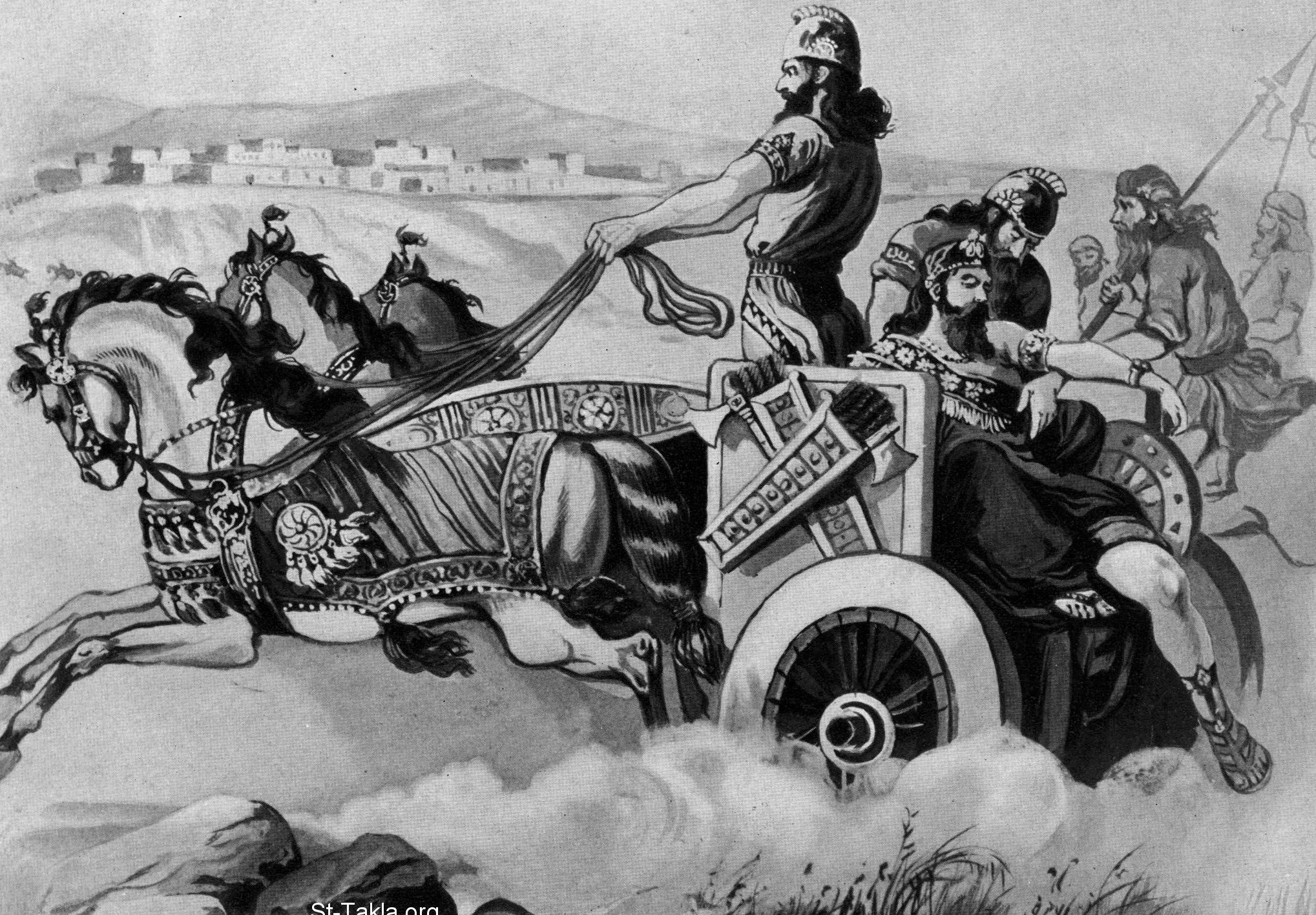 Ignorant of God’s plans, King Josiah decided to take matters into his own hands and led his troops into battle against the Egyptians. They intercepted the Egyptian army at a place called Megiddo, and in the ensuing battle, King Josiah was killed. The author of 2 Kings states that “Pharaoh Neco killed him at Megiddo, as soon as he saw him” (2 Kings 23:29 ESV). But in 2 Chronicles 35, we’re told that Josiah had disguised himself before going into battle. It seems that Josiah’s little ploy to hide his kingly identity failed. King Neco recognized Josiah instantly and ordered his death.
But the enemy archers hit King Josiah with their arrows and wounded him. He cried out to his men, “Take me from the battle, for I am badly wounded!” – 2 Chronicles 35:23 NLT
The wounded king was placed in another chariot and evacuated to the city of Jerusalem, where he died. After giving their fallen king a state funeral, the people chose Jehoahaz as his replacement. This choice seems a bit odd because Jehoahaz was Josiah’s middle son and, therefore, not the next in line to the throne. But it seems that the people were looking for a king who would bring back the old way of life to which they had grown accustomed. They missed the days of Manasseh and regretted all the reforms that Josiah had instituted in Judah. So, they chose the one son of Josiah who represented their best chance at bringing back the good old days. And it appears that they picked just the right man for the job becaise “he did what was evil in the LORD’s sight, just as his ancestors had done” (2 Kings 23:32 NLT).
B ut Jehoahaz’s reign would be short-lived. The people failed to take into account that King Neco might have something to say about who took Josiah’s place on the throne of Judah. Just three months into his reign, Jehoahaz was deposed by the Pharaoh and taken captive to Egypt, where he died. Neco filled the vacancy with Eliakim, the older brother of Jehoahaz, and changed his name to Jehoiakim. This young man became little more than a puppet king who was forced to make an annual tribute payment to the Egyptians. To do this, he imposed a debilitating tax on the people of Judah. The prophet provides a brief but sobering summary of the sad state of affairs in the southern kingdom of Judah after the death of Josiah.
Do not weep for the dead king or mourn his loss. Instead, weep for the captive king being led away! For he will never return to see his native land again.
For this is what the LORD says about Jehoahaz, who succeeded his father, King Josiah, and was taken away as a captive: “He will never return. He will die in a distant land and will never again see his own country.” – Jeremiah 22:10-12 NLT
With Josiah’s death, the period of reformation in Judah came to an abrupt end. He had been the heart and soul behind all the changes that had taken place, and, without him, the people quickly reverted to their old ways. Virtually overnight, the conditions in Judah took a dramatic turn for the worse. Judah was now a vassal state, ruled by a powerless king who answered to the Pharaoh of Egypt.
Josiah’s attempt to stop the Egyptians from joining forces with the Assyrians had failed. In 605 BC, just four years after Josiah’s death, these two armies were defeated by the Babylonians at the Battle of Carchemish. This unexpected victory by the Babylonians over the Egyptians and Assyrians proved to be a game-changing event in the history of the Middle East. It catapulted King Nebuchadnezzar of Babylon into the role of the most powerful ruler on earth. With his defeat of the Assyrians, Nebuchadnezzar took over all the lands they had conquered, dramatically increasing the size and influence of his empire.
Eventually, the Babylonians would wrest control of Judah from the hands of King Neco of Egypt, and Jehoiakim would find himself answering to yet another, more powerful, king. But Jehoiakim will try to resist his new overlord, refusing to submit to his authority. Like his father, Josiah, Jehoiakim will fail to see the sovereign hand of God behind all that is taking place. His outlook is short-sighted, and he will attempt to make the most of his less-than-ideal circumstances.
The prophet Jeremiah records God’s stinging condemnation of Jehoiakim’s arrogant and self-centered approach to leadership.
And the LORD says, “What sorrow awaits Jehoiakim,
who builds his palace with forced labor.
He builds injustice into its walls,
for he makes his neighbors work for nothing.
He does not pay them for their labor.
He says, ‘I will build a magnificent palace
with huge rooms and many windows.
I will panel it throughout with fragrant cedar
and paint it a lovely red.’
But a beautiful cedar palace does not make a great king!
Your father, Josiah, also had plenty to eat and drink.
But he was just and right in all his dealings.
That is why God blessed him.
He gave justice and help to the poor and needy,
and everything went well for him.
Isn’t that what it means to know me?”
says the LORD.
“But you! You have eyes only for greed and dishonesty!
You murder the innocent,
oppress the poor, and reign ruthlessly.” – Jeremiah 22:13-17 NLT
Unlike his reform-minded father, Jehoiakim had no heart for Yahweh. He was a self-obsessed man who used his power and position to improve his own lot in life while allowing the nation of Judah to continue its slide into apostasy. When Neco was forced to abandon his hold on Judah, Jehoiakim saw it as an opportunity to assert his independence, but he failed to understand the gravity of his situation. He had no clue that Yahweh had divinely ordained Nebuchadnezzar and the Babylonians to bring judgment against the nation of Judah. In attempting to resist the Babylonians, Jehoiakim was actually opposing the sovereign will of God, and he would pay dearly for his obstinacy.
For three years, Yahweh sent the Babylonians, Arameans, Moabites, and Ammonites against the rebellious nation of Judah. And the author leaves no doubt as to the purpose behind these raids.
These disasters happened to Judah because of the LORD’s command. He had decided to banish Judah from his presence because of the many sins of Manasseh. – 2 Kings 24:3 NLT
Little did Jehoiakim know that he was facing the beginning of the end. The coming judgment of Judah was imminent and unavoidable.
English Standard Version (ESV) The Holy Bible, English Standard Version. ESV® Permanent Text Edition® (2016). Copyright © 2001 by Crossway Bibles, a publishing ministry of Good News Publishers.
New Living Translation (NLT) Holy Bible, New Living Translation, copyright © 1996, 2004, 2015 by Tyndale House Foundation. Used by permission of Tyndale House Publishers Inc., Carol Stream, Illinois 60188. All rights reserved.
