As Unto the Lord

13 But we will not boast beyond limits, but will boast only with regard to the area of influence God assigned to us, to reach even to you. 14 For we are not overextending ourselves, as though we did not reach you. For we were the first to come all the way to you with the gospel of Christ. 15 We do not boast beyond limit in the labors of others. But our hope is that as your faith increases, our area of influence among you may be greatly enlarged, 16 so that we may preach the gospel in lands beyond you, without boasting of work already done in another’s area of influence. 17 “Let the one who boasts, boast in the Lord.” 18 For it is not the one who commends himself who is approved, but the one whom the Lord commends. – 2 Corinthians 10:13-18 ESV

While Paul was willing to become all things to all people so that he might save some (1 Corinthians 9:22), he was not willing to submit himself to the authority of men or to labor for their approval. Fourteen years after his conversion, Paul traveled to Jerusalem with Barnabas and Titus to meet with the original apostles. He had been doing ministry among the Gentiles for well over a decade and had never traveled to Jerusalem to get their approval for his ministry. In fact, Paul boldly proclaimed his independence from the leadership in Jerusalem.

…the leaders of the church had nothing to add to what I was preaching. (By the way, their reputation as great leaders made no difference to me, for God has no favorites.) Instead, they saw that God had given me the responsibility of preaching the gospel to the Gentiles, just as he had given Peter the responsibility of preaching to the Jews. – Galatians 2:6-7 NLT

Paul would later tell Timothy, “Work hard so you can present yourself to God and receive his approval. Be a good worker, one who does not need to be ashamed and who correctly explains the word of truth” (2 Timothy 2:15 NLT). He also told him, “Don’t let anyone think less of you because you are young. Be an example to all believers in what you say, in the way you live, in your love, your faith, and your purity” (1 Timothy 4:12 NLT).

For Paul, God’s approval of his work was paramount. He considered himself a servant of God, and so his only concern was to do what his Master had commanded him to do. And yet, because he was human, Paul was sensitive to the constant criticism he faced. His ministry was always under siege, and the most vicious attacks were personal in nature.

It seems that in Corinth, Paul was accused of having overstepped his bounds; he was operating outside his designated area of influence. Corinth was a long way from Jerusalem, and as a Jew, Paul had no business ministering to the primarily Gentile community there. His critics were saying he was out of bounds in Corinth; it was their territory, and he needed to mind his own business and leave them alone.

But Paul argued that he was under the same commission Jesus had given to the original 12 disciples

“Be my witnesses in Jerusalem and in all Judea and Samaria, and to the end of the earth.” – Acts 1:8 ESV

Paul considered Corinth well within his God-assigned jurisdiction, and he reminded them that he had brought the gospel there and helped plant the first church.

We were the first to reach as far as you with the gospel about Christ. – 2 Corinthians 10:14b NLT).

When ministry becomes a competition or a quest for fame and glory, everyone loses. Those who minister to gain recognition or the approval of men will always view other ministers as adversaries, not allies. Paul was not out to build his reputation, but to build up the body of Christ. He was not motivated by man’s approval, but by God’s. Paul wanted to one day hear the words, “Well done, good and faithful servant. You have been faithful over a little; I will set you over much. Enter into the joy of your master” (Matthew 25:21 ESV).

The whole idea of ministerial boundaries and serving God for personal glory or gain was foreign to Paul. He simply went where God told him to go, and was able to say, “I have fully presented the Good News of Christ from Jerusalem all the way to Illyricum. My ambition has always been to preach the Good News where the name of Christ has never been heard, rather than where a church has already been started by someone else” (Romans 15:19b-20 NLT).

Paul’s passion was for evangelism. He longed to take the gospel to those places where the name of Christ was unknown and the message of the good news had not yet been heard. But Paul also had a desire to see those who had come to faith in Christ grow up in their salvation (1 Corinthians 3:2; 1 Peter 2:2). So while he was anxious to continue his missionary efforts and take the gospel to places such as Rome and Spain (Acts 19:21; Romans 15:28), he was not willing to watch newly converted Christians languish in spiritual infancy or as the predatory practices false teachers. So he continued to reach out to the Corinthians, longing to see them grow. It was his desire that they increase in spiritual health and maturity. Once that goal was achieved, he reasoned, “Then we will be able to go and preach the Good News in other places far beyond you, where no one else is working. Then there will be no question of our boasting about work done in someone else’s territory.” (2 Corinthians 10:16 NLT). He wanted to move on, but was not willing to do so if it meant sacrificing the stability of the work in Corinth.

When all was said and done, Paul was only interested in one thing: God’s approval. He believed that he performed his duties before an audience of one: God. Yes, there would always be others watching. There would always be some who complimented his work and others who attacked it. But at the end of the day, he was endeavoring to please God, not men. He wanted to be able to lie his head on the pillow and find rest in the fact that he had done what God had called him to do. Which is what led him to write:

As the Scriptures say, “If you want to boast, boast only about the Lord.”

When people commend themselves, it doesn’t count for much. The important thing is for the Lord to commend them.2 Corinthians 10:17-18 ESV

When we faithfully do God’s will, we will find ourselves with admirers and detractors. We may receive compliments and equal amounts of criticism, and have our methods and motives questioned. Others will attempt to take credit for what we have done. But as long as we are doing what we do for the Lord, it will not matter.

Like Paul, we need to constantly remind ourselves that we perform our duties for an audience of one. His opinion is the only one that matters; the applause and approval of men carry no weight when compared to the commendation of God. So, “whatever you do, in word or deed, do everything in the name of the Lord Jesus, giving thanks to God the Father through him” (Colossians 3:17 ESV), and “do it all for the glory of God” (1 Corinthians 10:31 NLT).

Father, Men-pleasing is a non-contact sport among most Christians. We are competitive in nature, even when it comes to our spiritual lives. We compare and contrast, measuring our spiritual maturity based on what others think of us or how well our walk stacks up to theirs. We don’t like criticism and the thought of others questioning our godliness makes our blood boil. But Paul reminds me that Your opinion is the only one that matters. I perform for an audience of one: You. It is what You think of me that should motivate my actions and measure my effectiveness. But I am so prone to worrying about what others think about me. The approval of men is like a drug that clouds my thinking and causes me to lose sight my real purpose. I am Your servant and I answer to You alone. I exist to serve and please You. Thank You for using Paul to deliver that much-needed reminder. Now, help me to live it out in everyday life. Amen

English Standard Version (ESV) The Holy Bible, English Standard Version. ESV® Permanent Text Edition® (2016). Copyright © 2001 by Crossway Bibles, a publishing ministry of Good News Publishers.

New Living Translation (NLT) Holy Bible, New Living Translation, copyright © 1996, 2004, 2015 by Tyndale House Foundation. Used by permission of Tyndale House Publishers Inc., Carol Stream, Illinois 60188. All rights reserved.
A Time to Listen and Love

1 Then Eliphaz the Temanite answered and said:

“Should a wise man answer with windy knowledge,
    and fill his belly with the east wind?
Should he argue in unprofitable talk,
    or in words with which he can do no good?
But you are doing away with the fear of God
    and hindering meditation before God.
For your iniquity teaches your mouth,
    and you choose the tongue of the crafty.
Your own mouth condemns you, and not I;
    your own lips testify against you.

“Are you the first man who was born?
    Or were you brought forth before the hills?
Have you listened in the council of God?
    And do you limit wisdom to yourself?
What do you know that we do not know?
    What do you understand that is not clear to us?
10 Both the gray-haired and the aged are among us,
    older than your father.
11 Are the comforts of God too small for you,
    or the word that deals gently with you?
12 Why does your heart carry you away,
    and why do your eyes flash,
13 that you turn your spirit against God
    and bring such words out of your mouth?
14 What is man, that he can be pure?
    Or he who is born of a woman, that he can be righteous?
15 Behold, God puts no trust in his holy ones,
    and the heavens are not pure in his sight;
16 how much less one who is abominable and corrupt,
    a man who drinks injustice like water!” – Job 15:1-16 ESV

Eliphaz has heard enough. Having listened to Job’s lengthy diatribe, Eliphaz decides to speak up again and delivers a second speech aimed at exposing his friend’s pride and arrogance. He can’t believe the cockiness and overconfidence that Job displays. How can any man declare himself to be innocent in the eyes of God?

While Eliphaz tries to come across as defending the integrity of God, he seems more concerned about his own reputation. He has taken Job’s words personally and determined that his own integrity as a friend and a counselor has come under attack. How dare Job reject the advice of such learned men as Eliphaz, Bildad, and Zophar? He is so upset that he describes Job as a veritable blowhard who spews mindless rhetoric and rejects the wise counsel of his betters.

You are nothing but a windbag.
The wise don’t engage in empty chatter.
    What good are such words? – Job 15:2-3 NLT

Eliphaz is careful to keep God at the center of his argument, accusing Job of having no fear or reverence for the Lord. He wants to paint Job as an angry apostate whose very words condemn and convict him. The very fact that Job can so easily rail against the Almighty is ample proof that he is guilty as charged.

Your sins are telling your mouth what to say.
    Your words are based on clever deception.
Your own mouth condemns you, not I.
    Your own lips testify against you. – Job 15:5-6 NLT

But it becomes readily apparent that Eliphaz’s real point of contention is Job’s refusal to take his advice. This has become a personal matter.

“What do you know that we don’t?
    What do you understand that we do not?
On our side are aged, gray-haired men
    much older than your father!” – Job 15:9-10 NLT

Eliphaz pulls out the wisdom-is-the-purview-of-the-elderly card. Evidently, either he or one of his companions is older and, therefore, wiser. than Job. Or else he may be suggesting that he’s shared the facts surrounding Job’s case with other sages and received their endorsement of his conclusions. Either way, Eliphaz seems to believe that he has the upper hand in the debate over Job’s guilt or innocence.

He doesn’t believe that Job has some kind of special knowledge or direct access to God’s divine will. So, Job has no right to reject the counsel of his more learned and experienced peers. Eliphaz can’t understand the flippancy and callousness with which Job addresses God. How can this obvious sinner talk to God in the way that he does? As far as Eliphaz can tell, Job’s words provide all the proof necessary to reach a verdict of guilt.

“Is God’s comfort too little for you?
    Is his gentle word not enough?
What has taken away your reason?
    What has weakened your vision,
that you turn against God
    and say all these evil things? – Job 15:11-13 NLT

Eliphaz is totally convinced of Job’s guilt and refuses to consider any other option. He views his friend as “a corrupt and sinful person with a thirst for wickedness” (Job 15:16 NLT), and nothing is going to change his mind.

But where is the compassion? Why can’t Eliphaz manage to muster up any empathy or sympathy for his suffering friend? In Proverbs 15:4, the words of Solomon seem to have been written with Eliphaz and his friends in mind.

Gentle words are a tree of life;
    a deceitful tongue crushes the spirit.

The Message puts it this way: Kind words heal and help; cutting words wound and maim.

In one of his psalms, David described wicked people as those who “plot evil in their hearts and stir up trouble all day long. Their tongues sting like a snake; the venom of a viper drips from their lips” (Psalm 140:2-3 NLT). How is it that Job’s friends have become so caustic and condescending? Why have they chosen to dial up the rhetoric and intensify their attacks on Job’s integrity?

Eliphaz has transformed from a well-meaning friend to a full-fledged adversary. He is on the attack and seems frustrated at Job’s continued claims of innocence.

Eliphaz and his companions are now on a mission to convince Job of his guilt and they will stop at nothing to accomplish that objective. Any concern they may have had for Job’s feelings is long gone. This has gotten personal. They know they are right, which means Job is wrong. He just refuses to admit it. But they are not going to give up easily. They tell Job he is wicked, deceived, defiant, stubborn, and doomed if he doesn’t confess his guilt. They will even go so far as to blame the deaths of Job’s children on his sinfulness. They will attempt to soften their words by using farming metaphors (shriveled weeds, a vine whose grapes are harvested before they are ripe, an olive tree that sheds its blossoms so the fruit cannot form, etc.), but the pain hurts just as bad. Now Job not only has to mourn the loss of all his children, he must listen to accusations that he is the one responsible for their deaths.

What can we learn from this? What lessons are there in this passage for us? The simple one seems to be the destructive power of our tongues. We can use them to encourage and heal or to discourage and do lasting harm. Sometimes we may not mean to hurt others with our words, but when we fail to think before we speak, we can end up doing lasting damage. Job’s friends could have used the advice of James.

My dear brothers and sisters, be quick to listen, slow to speak, and slow to get angry. – James 1:19 NASB

They weren’t willing to listen to Job and they didn’t seem interested in what God might have to say about the situation. They had already reached their conclusion, and when Job refused to agree with their assessment, they became angry. And their anger led to even harsher words for their suffering friend.

These exchanges between Job and his friends remind me of the remarkable power contained in my own words. With them, I can bring about blessing or cursing. I can use them to build up or tear down. I can speak words of kindness and compassion, or I can speak words of criticism and accusation. Job needed true friends who cared more for his heart than for their need to be right. He needed compassion, not correction.

I am reminded of that famous passage from the pen of Solomon:

For everything there is a season,
    a time for every activity under heaven.
A time to be born and a time to die.
    A time to plant and a time to harvest.
A time to kill and a time to heal.
    A time to tear down and a time to build up.
A time to cry and a time to laugh.
    A time to grieve and a time to dance.
A time to scatter stones and a time to gather stones.
    A time to embrace and a time to turn away.
A time to search and a time to quit searching.
    A time to keep and a time to throw away.
A time to tear and a time to mend.
    A time to be quiet and a time to speak.
A time to love and a time to hate.
    A time for war and a time for peace. – Ecclesiastes 3:1-8 NLT

There’s a right time for everything, and the time was right for Job’s friends to shut up, listen up, and lift up. May each of us learn to know the difference.

English Standard Version (ESV) The Holy Bible, English Standard Version. ESV® Permanent Text Edition® (2016). Copyright © 2001

New Living Translation (NLT) Holy Bible, New Living Translation, copyright © 1996, 2004, 2015 by Tyndale House Foundation. Used by permission of Tyndale House Publishers Inc., Carol Stream, Illinois 60188. All rights reserved.

A Fight to the Finish

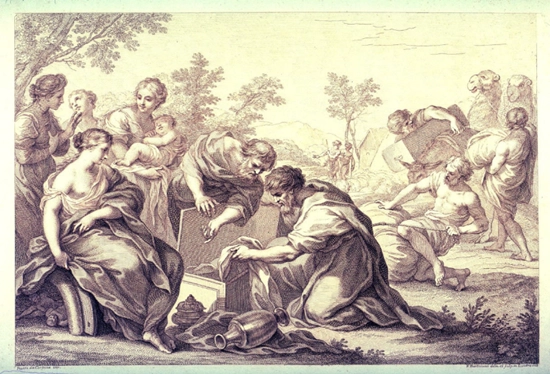
33 So Laban went into Jacob’s tent and into Leah’s tent and into the tent of the two female servants, but he did not find them. And he went out of Leah’s tent and entered Rachel’s. 34 Now Rachel had taken the household gods and put them in the camel’s saddle and sat on them. Laban felt all about the tent, but did not find them. 35 And she said to her father, “Let not my lord be angry that I cannot rise before you, for the way of women is upon me.” So he searched but did not find the household gods.

36 Then Jacob became angry and berated Laban. Jacob said to Laban, “What is my offense? What is my sin, that you have hotly pursued me? 37 For you have felt through all my goods; what have you found of all your household goods? Set it here before my kinsmen and your kinsmen, that they may decide between us two. 38 These twenty years I have been with you. Your ewes and your female goats have not miscarried, and I have not eaten the rams of your flocks. 39 What was torn by wild beasts I did not bring to you. I bore the loss of it myself. From my hand you required it, whether stolen by day or stolen by night. 40 There I was: by day the heat consumed me, and the cold by night, and my sleep fled from my eyes. 41 These twenty years I have been in your house. I served you fourteen years for your two daughters, and six years for your flock, and you have changed my wages ten times. 42 If the God of my father, the God of Abraham and the Fear of Isaac, had not been on my side, surely now you would have sent me away empty-handed. God saw my affliction and the labor of my hands and rebuked you last night.” Genesis 31:33-42 ESV

Reading this portion of the story is like watching a fight between two heavyweight boxers. Both Laban and Jacob are seasoned veterans of the ring, with an arsenal of well-honed skills at their disposal. And they each have proven themselves more than willing to resort to cheating if the circumstances call for it. They’re not afraid to fight dirty if that is what it will take to come out victorious.

So, as the angry and offended Laban confronts his nemesis, Jacob, tempers are at an all-time high. Upon discovering that Jacob had stolen away in the night, carrying his daughters, grandchildren, and personal household gods, Laban had set out in hot pursuit. Now, he was standing in front, full of fury and righteous indignation, accusing his son-in-law of everything from ingratitude and insensitivity to outright theft. But Jacob countered with a declaration of innocence and a vow to put to death anyone found in possession of Laban’s property.

Convinced of Jacob’s guilt, Laban ordered a thorough search of Jacob’s belongings. He began in the tents of Leah, Bilhah, and Zilpah. But his efforts proved fruitless. He could find no trace of the missing household gods. And there is a certain sense of irony in all of this because Laban was in the strange and helpless position of having to “search” for his own gods. All the while he looked, they remained hidden and silent, because they were powerless and incapable of speech. Laban’s gods couldn’t reveal, much less, save themselves. All during this story, they remain invisible and impotent, hidden away and unable to come to Laban’s aid. And it is not surprising that God’s Word has much to say about the idiocy of idols.

“What good is an idol carved by man,
    or a cast image that deceives you?
How foolish to trust in your own creation—
    a god that can’t even talk!
What sorrow awaits you who say to wooden idols,
    ‘Wake up and save us!’
To speechless stone images you say,
    ‘Rise up and teach us!’
    Can an idol tell you what to do?
They may be overlaid with gold and silver,
    but they are lifeless inside.” – Habakuk 2:18-19 NLT

“Don’t go back to worshiping worthless idols that cannot help or rescue you—they are totally useless!” – 1 Samuel 12:21 NLT

Their idols are merely things of silver and gold,
    shaped by human hands.
They have mouths but cannot speak,
    and eyes but cannot see.
They have ears but cannot hear,
    and noses but cannot smell.
They have hands but cannot feel,
    and feet but cannot walk,
    and throats but cannot make a sound.
And those who make idols are just like them,
    as are all who trust in them. – Psalm 115:4-8 NLT

One can only imagine Laban’s growing frustration as his search for his “lost” gods came up empty-handed. But his stubbornness would not allow him to give up and admit defeat. So, the search continued, this time to Rachel’s tent. And while Laban had been busy ransacking the tents of Leah, Bilhah, and Zilpah, Rachel had taken the household gods she had stolen and hid them in the saddle of her camel. Then, as Laban approached, she took a seat on the saddle. Verse 25 indicates that Jacob “had pitched his tent in the hill country,” so it seems likely that the saddle was lying on the ground near Rachel’s tent. And her pilfering of her father’s household gods seems to suggest that Rachel shared her father’s reverence for them. While the names of these gods are not revealed, it is readily apparent that they were of great value to Laban. He had traveled for three days in an attempt to recover them. And Rachel was willing to risk her life in order to keep them. The idols would have represented hope for future blessings and fruitfulness. Perhaps Rachel was hoping that one of these household gods could help her produce another son. Up to this point in the story, Rachel has only been able to conceive one time, and at the birth of that son, she had exclaimed, “May the Lord add yet another son to my family” (Genesis 30:24 NLT).

Perhaps Rachel believed that her first pregnancy had been the work of her father’s gods and she hoped that they would bring her further good fortune. It is clear that she was willing to risk a great deal in order to keep the gods in hiding and in her possession.

Firmly seated upon the saddle, with the idols hidden underneath her, Rachel begged her father’s forgiveness for not rising to greet him, using “the way of women” as her excuse. Laban remained unsuspecting of his daughter’s treachery and continued his search, “but he could not find the household idols” (Genesis 31:35 NLT).

And Jacob, completely oblivious to what his wife had done, must have been gloating on the inside as he watched his father-in-law’s frustration reach a fever pitch. But at some point, he lost his patience and demanded that the search end.

“What’s my crime?” he demanded. “What have I done wrong to make you chase after me as though I were a criminal? – Genesis 31:35 NLT

Jacob had endured enough of his father-in-law’s insulting behavior and demanded an apology for the last 20 years of abuse he had been forced to endure.

“For twenty years I have been with you, caring for your flocks. In all that time your sheep and goats never miscarried. In all those years I never used a single ram of yours for food. If any were attacked and killed by wild animals, I never showed you the carcass and asked you to reduce the count of your flock. No, I took the loss myself! You made me pay for every stolen animal, whether it was taken in broad daylight or in the dark of night.” – Genesis 31:38-39 NLT

Jacob had Laban on the ropes and he was pulling no punches. With each powerful blow, Jacob attempted to deliver the knock-out punch that would send his opponent to the mat. He recounted his tireless and selfless efforts to serve Laban. He reveled in his sense of self-righteousness, detailing the many ways he had treated Laban with nothing but respect. Jacob paints himself as the consummate victim, even describing himself as a helpless slave.

“Yes, for twenty years I slaved in your house! I worked for fourteen years earning your two daughters, and then six more years for your flock. And you changed my wages ten times!” – Genesis 31:41 NLT

He had Laban staggering under a steady barrage of accusations. Those watching this epic battle would have observed that Laban was about to go down for the count. And them, Jacob delivered the final blow that would bring this fight to an end.

“In fact, if the God of my father had not been on my side—the God of Abraham and the fearsome God of Isaac—you would have sent me away empty-handed. But God has seen your abuse and my hard work. That is why he appeared to you last night and rebuked you!” – Genesis 31:42 NLT

Jacob’s decisive one-two punch was Yahweh, the God of Abraham and the fearsome God of Isaac. Laban’s household gods had been no match for the Almighty. For 20 long years, as these two men had done battle, Jacob had enjoyed the blessings of Yahweh. Jacob concedes that all his success had been the work of Yahweh. And Jacob wanted Laban to know that Yahweh could and would undermine any attempts to keep him from returning to Canaan. There was no going back. Jacob would not be tricked again. And the scene seems to end with Jacob standing over his defeated foe as Yahweh raises his gloved hand in victory. That match is over but, for Jacob, the real fight is about to begin.

English Standard Version (ESV) The Holy Bible, English Standard Version. ESV® Permanent Text Edition® (2016). Copyright © 2001 by Crossway Bibles, a publishing ministry of Good News Publishers.

New Living Translation (NLT) Holy Bible, New Living Translation, copyright © 1996, 2004, 2015 by Tyndale House Foundation. Used by permission of Tyndale House Publishers Inc., Carol Stream, Illinois 60188. All rights reserved.

New English Translation (NET)NET Bible® copyright ©1996-2017 by Biblical Studies Press, L.L.C. http://netbible.com All rights reserved.

Day 129 – Matthew 26:57, 59-68; Mark 14:53, 55-65; Luke 22:54, 63-65; John 18:24

Guilty As Charged.

Matthew 26:57, 59-68; Mark 14:53, 55-65; Luke 22:54, 63-65; John 18:24

Jesus replied, “I Am. And you will see the Son of Man seated in the place of power at God’s right hand and coming on the clouds of heaven.” – Mark 14:62 NLT

When Jesus was finally brought before Caiaphas, the high priest, He found Himself in a room crowded with leading priests, elders and teachers of religious law. Even the high council or Sanhedrin was there. They had pulled out all the big guns for this final showdown with Jesus. There is little doubt that they intended this evening to result in the elimination of Jesus as a threat to their authority and way of life. He had been a thorn in their side for far too long, and now they were going to deal with Him. The only problem was that they needed solid accusations for which to bring this matter before the Roman authorities. They were wanting to have Jesus put to death and they did not have the authority to do so. They were going to have to convince the Roman authorities that Jesus had committed a crime worthy of death. So all these well-educated religious leaders were attempting to find any evidence that they could use against Jesus. But even when they couldn’t find any charges worthy of death, they didn’t let that stop them. They had arranged for a variety of individuals to come and give witness against Jesus, but they all ended up contradicting one another. These people were more than willing to accuse Jesus, probably for the hope of financial gain. Finally, some men stood up and claimed that they heard Jesus say that He was going to destroy the Temple. “We heard him say, ‘I will destroy this Temple made with human hands, and in three days I will build another, made without human hands’” (Mark 14:58 NLT). These men were actually twisting what Jesus had actually said. What Jesus had actually said was, “Destroy this temple, and in three days I will raise it up (John 2:19 NLT). Jesus had made this statement early in His ministry. It took place immediately after He had cleansed the Temple for the first time. The Jewish leaders had confronted Him, asking Him what He thought He was doing and who gave Him the authority to do it. Then they asked Him to give them a miraculous sign to prove His authority. That’s when Jesus made His statement regarding the destruction and raising of the “temple.” They obviously didn’t understand that He was talking about His own death and resurrection. They saw Jesus’ statement as ridiculous, exclaiming, “What! It has taken forty-six years to build this Temple, and you can rebuilt it in three days?” (John 2:20 NLT).

So in the minds of those accusing Jesus, His statement came across as the words of an insurrectionist. He had claimed He was going to destroy the Temple – Herod’s Temple. Now they were getting somewhere. This was just the kind of evidence they needed to bring before the Romans. The last thing the Roman authorities would want is someone threatening the peace and security of Jerusalem. But to the obvious disappointment of the religious leaders, even the men who accused Jesus couldn’t get their stories straight. So in frustration, the high priest asked Jesus, “Well, aren’t you going to answer these charges? What do you have to say for yourself?” (Mark 14:60 NLT). But Jesus said nothing. The charges were false and He remained silent. Then the high priest asked Him point blank, “Are you the Messiah, the Son of the Blessed One?” (Mark 14:61 NLT). This was the real issue. When all was said and done, this was the main point of contention between Jesus and the religious leaders. He had claimed to be the Messiah. That was the reason the people followed Him. It was for that reason the people welcomed Him with palm branches and shouts of “Hosanna!” when He had arrived in Jerusalem the previous Sunday. He had set Himself up as having been sent by God. Not only that, He had claimed to be the Son of God. Jesus responded to Caiaphas’ question by saying, “I Am. And you will see the Son of Man seated in the place of power at God’s right hand and coming on the clouds of heaven” (Mark 14:62 NLT). His statement brought an immediate reaction from the crowd because they knew exactly what He was saying. He was claiming to be God. His use of the phrase, “I Am” was intentional. It was the very same way God referred to Himself when He spoke to Moses at the burning bush. Moses had asked God what name He should give when the people ask who it was who sent him. God said to tell them, “I Am who I Am” had sent him. Jesus was clearly associating Himself with God. He was using the same language that God had used in order to refer to Himself. On top of that, Jesus claimed that He was going to be sitting at God’s right hand, a place of honor and power, and that He would be returning some day. That was all they needed. Caiaphas tore his clothes in shock. They no longer needed any witnesses. Jesus had committed the unpardonable sin: blasphemy. He had claimed to be God. In reality, it was Jesus’ words that were the problem. Blasphemy was based on injurious or disrespectful words or speech. In their minds, by saying what He said, Jesus had diminished the holiness of God. He had treated God with disrespect and dishonored His “otherness” or set-apartness. By claiming to be God, Jesus had become an offense to God – at least in their minds.

Their immediate response was violent. They began to spit on Him. They blindfolded him and beat Him with their fists. They mocked Him, telling Him to use His “divine” powers to tell them who it was who was hitting Him. The one piece of evidence they needed, Jesus gave them. And all He did was speak the truth. He acknowledged who He was. To do anything other than that would have truly been blasphemy. If Jesus had denied His deity, He would have been an offense to God. So He spoke the truth, and it set in motion everything that was about to happen. Jesus was guilty as charged. Not of blasphemy, but of being the Son of God and the Savior of the world. His crime was being God. And His punishment would be death. But it was for just that purpose He had come. God had come to die on behalf of sinful men. He had come to sacrifice His own life for the lives of all those who deserved death. It was because Jesus was spotless, sinless, and blameless that He was condemned to die. His worthiness was what led to His demise. He was guilty of being God, and nothing else. And it is for that reason that He made a perfect sacrifice. He was guilty as charged and we are innocent because of it.

Father, Your sinless Son was put to death because He was holy, righteous, and fully God. He was killed because He was who He said He was. He died because He was the only one who was undeserving of death. He was innocent, and we were guilty, but He is the one who died. All so that we might have life. What an amazing turn of events. What an incredible plan.  Amen.

Ken Miller
Grow Pastor & Minister to Men
kenm@christchapelbc.org