The LORD Has Spoken

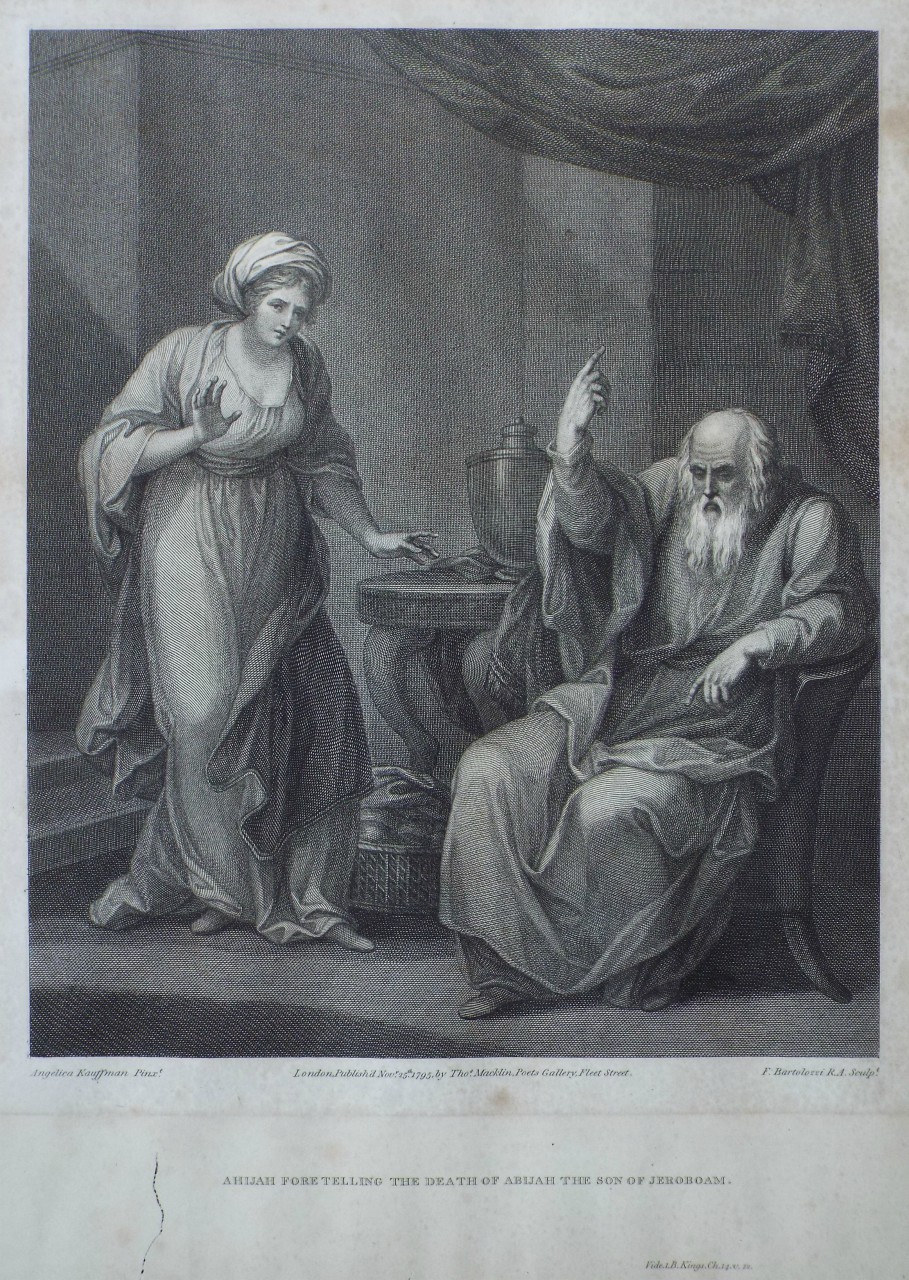
1 At that time Abijah the son of Jeroboam fell sick. And Jeroboam said to his wife, “Arise, and disguise yourself, that it not be known that you are the wife of Jeroboam, and go to Shiloh. Behold, Ahijah the prophet is there, who said of me that I should be king over this people. Take with you ten loaves, some cakes, and a jar of honey, and go to him. He will tell you what shall happen to the child.”

Jeroboam’s wife did so. She arose and went to Shiloh and came to the house of Ahijah. Now Ahijah could not see, for his eyes were dim because of his age. And the LORD said to Ahijah, “Behold, the wife of Jeroboam is coming to inquire of you concerning her son, for he is sick. Thus and thus shall you say to her.”

When she came, she pretended to be another woman. But when Ahijah heard the sound of her feet, as she came in at the door, he said, “Come in, wife of Jeroboam. Why do you pretend to be another? For I am charged with unbearable news for you. Go, tell Jeroboam, ‘Thus says the LORD, the God of Israel: “Because I exalted you from among the people and made you leader over my people Israel and tore the kingdom away from the house of David and gave it to you, and yet you have not been like my servant David, who kept my commandments and followed me with all his heart, doing only that which was right in my eyes, but you have done evil above all who were before you and have gone and made for yourself other gods and metal images, provoking me to anger, and have cast me behind your back, 10 therefore behold, I will bring harm upon the house of Jeroboam and will cut off from Jeroboam every male, both bond and free in Israel, and will burn up the house of Jeroboam, as a man burns up dung until it is all gone. 11 Anyone belonging to Jeroboam who dies in the city the dogs shall eat, and anyone who dies in the open country the birds of the heavens shall eat, for the LORD has spoken it.”’ 12 Arise therefore, go to your house. When your feet enter the city, the child shall die. 13 And all Israel shall mourn for him and bury him, for he only of Jeroboam shall come to the grave, because in him there is found something pleasing to the LORD, the God of Israel, in the house of Jeroboam. 14 Moreover, the LORD will raise up for himself a king over Israel who shall cut off the house of Jeroboam today. And henceforth, 15 the LORD will strike Israel as a reed is shaken in the water, and root up Israel out of this good land that he gave to their fathers and scatter them beyond the Euphrates, because they have made their Asherim, provoking the LORD to anger. 16 And he will give Israel up because of the sins of Jeroboam, which he sinned and made Israel to sin.”

17 Then Jeroboam’s wife arose and departed and came to Tirzah. And as she came to the threshold of the house, the child died. 18 And all Israel buried him and mourned for him, according to the word of the LORD, which he spoke by his servant Ahijah the prophet. 1 Kings 14:1-18 ESV

God had spoken His word of judgment against the false gods of Israel, and used a young, unnamed prophet to deliver it. This unidentified servant of God spoke his divine message directly to the altar itself. In the presence of King Jeroboam and the people of Israel, he addressed the sacred site itself, the place they had set up to worship and seek the favor of their man-made god. This shrine was located in the city of Bethel, in the southern region of the land belonging to the ten tribes. Jeroboam had constructed a second altar just like it in the northern city of Dan. In an attempt to prevent his people from returning to Judah to offer sacrifices to Yahweh at the temple in Jerusalem, he provided them with two new and more convenient worship sites. But these alternate sites and the altars they contained were adorned with golden calves, the man-made symbols of Jeroboam’s false gods. So, Yahweh had His prophet deliver a stinging indictment against one of these pseudo-sacred sites.

“O altar, altar! This is what the LORD says: A child named Josiah will be born into the dynasty of David. On you he will sacrifice the priests from the pagan shrines who come here to burn incense, and human bones will be burned on you.” – 1 Kings 13:2 NLT

Even these inanimate places of worship would be judged by God for the role they played in Israel’s apostasy. These carefully constructed sites made of handcrafted stones would end up desecrated and dishonored. The golden idols to which they were dedicated would be exposed for what they were: lifeless and powerless lumps of metal. The psalmist sardonically described the utter futility of these false gods.

Their idols are merely things of silver and gold,
    shaped by human hands.
They have mouths but cannot speak,
    and eyes but cannot see.
They have ears but cannot hear,
    and noses but cannot smell.
They have hands but cannot feel,
    and feet but cannot walk,
    and throats but cannot make a sound.
And those who make idols are just like them,
as are all who trust in them. – Psalm 115:4-8 NLT

Since Jeroboam had been responsible for the creation of these altars and the gods they contained, he too would experience the judgment of God. While he had been forced to stand and watch as the prophet destroyed one of his sacred shrines, he walked away unscathed. He was still the king, and his life went on just as it had before. After ordering the reconstruction of the altar, Jeroboam went about his business and soon forgot all that had happened at Bethel. But God had not forgotten the sins of Jeroboam.

Somewhere along the way, Jeroboam’s wife gave birth to a son, ensuring that he would have an heir to his throne to perpetuate his dynasty. But this joy was soon overshadowed by the news that Jeroboam’s son had become seriously ill. Concerned for his son’s health and his dynasty’s future, Jeroboam sent his wife to ask the prophet Ahijah for a divine prognosis. He wanted to know if his son would live or die.

Jeroboam likely chose to send his wife to Ahijah because the prophet had been the one to pronounce his kingship. Years earlier, Ahijah had been sent by Yahweh to inform Jeroboam that he had been selected to be the first king of the northern kingdom of Israel.

One day as Jeroboam was leaving Jerusalem, the prophet Ahijah from Shiloh met him along the way. Ahijah was wearing a new cloak. The two of them were alone in a field, and Ahijah took hold of the new cloak he was wearing and tore it into twelve pieces. Then he said to Jeroboam, “Take ten of these pieces, for this is what the LORD, the God of Israel, says: ‘I am about to tear the kingdom from the hand of Solomon, and I will give ten of the tribes to you! – 1 Kings 11:29-31 NLT

The prophet made it clear that Jeroboam’s reign was the result of Solomon’s sin. The son of David had refused to remain faithful to Yahweh, having erected shrines and altars to the false gods of his many wives. As a result, God would divide his kingdom and establish ten of the 12 tribes as a separate nation-state. Jeroboam had done nothing to deserve his rise to power and prominence; it was the sovereign will of God.

The prophet also informed Jeroboam that Jerusalem would remain the place where Yahweh was to be worshiped. The two nations were to remain devoted to the worship of Yahweh and use the Temple in Jerusalem as their sole sacred site. As the newly installed king of Israel, Jeroboam would need to follow David’s example and encourage the ten northern tribes to remain faithful to Yahweh.

I will place you on the throne of Israel, and you will rule over all that your heart desires. If you listen to what I tell you and follow my ways and do whatever I consider to be right, and if you obey my decrees and commands, as my servant David did, then I will always be with you. I will establish an enduring dynasty for you as I did for David, and I will give Israel to you.” – 1 Kings 11:37-38 NLT

But Jeroboam had failed to heed the prophet’s warning, and now he was suffering the consequences. Yet, when his son became ill, he chose to send his wife to the only man he believed could help him.

Even though Jeroboam’s wife had disguised herself to hide her identity as the queen, the old, blind prophet knew who she was as soon as she walked in the door. Ahijah had been given a divine “heads-up,” informing him of her visit and its purpose.

“Jeroboam’s wife will come here, pretending to be someone else. She will ask you about her son, for he is very sick. Give her the answer I give you.” – 1 Kings 14:5 NLT

As soon as this worried and grieving mother walked in the door, she was met with devastating news. Before she could speak a word, the prophet delivered a message of divine judgment against the house of Jeroboam. The woman who had delivered to Jeroboam an heir to his throne would now be charged with delivering a grim message of his dynasty’s destruction.

“Give your husband, Jeroboam, this message from the LORD, the God of Israel:…I will bring disaster on your dynasty and will destroy every one of your male descendants, slave and free alike, anywhere in Israel. I will burn up your royal dynasty as one burns up trash until it is all gone. – 1 Kings 14:7, 10 NLT

The prophet made sure she understood that her husband’s reign had been a gift from God. Yahweh had “ripped the kingdom away from the family of David” and given it to Jeroboam (1 Kings 14:8 NLT), and Jeroboam had returned the favor by turning his back on God and causing the ten northern tribes to worship false gods. Just as God had predicted the future destruction of Jeroboam’s altars, He now decreed the destruction of Jeroboam’s heirs.

“The members of Jeroboam’s family who die in the city will be eaten by dogs, and those who die in the field will be eaten by vultures. I, the LORD, have spoken.” – 1 Kings 14:11 NLT

And much to his wife’s dismay, it would all begin with the death of his son.

“Go on home, and when you enter the city, the child will die. – 1 Kings 14:12 NLT

It’s impossible to fathom the level of grief this woman felt upon hearing this devastating news. In just a matter of minutes, she had been informed that her entire world was about to collapse. Her husband’s kingdom was going to be destroyed, and her young son would die. The prophet made it painfully clear that it was all her husband’s fault. The message she had been given to deliver to Jeroboam left no doubts as to his culpability and sole responsibility for all that was about to happen.

“…you have not been like my servant David, who obeyed my commands and followed me with all his heart and always did whatever I wanted. You have done more evil than all who lived before you. You have made other gods for yourself and have made me furious with your gold calves.” – 1 Kings 14:8-9 NLT

But while this poor woman was still trying to process all that she had heard, Ahijah continued to deliver more bad news.

“In addition, the LORD will raise up a king over Israel who will destroy the family of Jeroboam. This will happen today, even now! – 1 Kings 14:14 NLT

Jeroboam’s sin was going to have long-lasting consequences. His decision to lead the people of Israel into apostasy would be replicated by his successors, creating a lengthy lineage of spiritual adulterers among God’s chosen people. He had set the tone for their future rebellion, ensuring their eventual removal from the land of promise and their exile “beyond the Euphrates River” (1 Kings 14:15 NLT). Centuries later, God would use the nation of Assyria as His agents of judgment against the northern kingdom of Israel.

In 722 BC, this pagan nation conquered Israel and turned the chosen people of God into slaves. More than 200 years would pass before this devastating event took place. In the meantime, the kings of Israel would follow the pattern established by Jeroboam, leading the people of God into increasing rebellion and wickedness.

But at this point in the story, Jeroboam remains on the throne of Israel. For the moment, God allowed him to maintain his kingdom, but the die had been cast. The damage had been done, and the judgment of God had been decreed.

When Jeroboam’s poor wife returned home, the message of the prophet was confirmed.

“…as she came to the threshold of the house, the child died.” – 1 Kings 14:17 ESV

The judgment of God had begun.

English Standard Version (ESV) The Holy Bible, English Standard Version. ESV® Permanent Text Edition® (2016). Copyright © 2001 by Crossway Bibles, a publishing ministry of Good News Publishers.

New Living Translation (NLT) Holy Bible, New Living Translation, copyright © 1996, 2004, 2015 by Tyndale House Foundation. Used by permission of Tyndale House Publishers Inc., Carol Stream, Illinois 60188. All rights reserved.

The Lord Saved Israel

16 And the watchmen of Saul in Gibeah of Benjamin looked, and behold, the multitude was dispersing here and there. 17 Then Saul said to the people who were with him, “Count and see who has gone from us.” And when they had counted, behold, Jonathan and his armor-bearer were not there. 18 So Saul said to Ahijah, “Bring the ark of God here.” For the ark of God went at that time with the people of Israel. 19 Now while Saul was talking to the priest, the tumult in the camp of the Philistines increased more and more. So Saul said to the priest, “Withdraw your hand.” 20 Then Saul and all the people who were with him rallied and went into the battle. And behold, every Philistine’s sword was against his fellow, and there was very great confusion. 21 Now the Hebrews who had been with the Philistines before that time and who had gone up with them into the camp, even they also turned to be with the Israelites who were with Saul and Jonathan. 22 Likewise, when all the men of Israel who had hidden themselves in the hill country of Ephraim heard that the Philistines were fleeing, they too followed hard after them in the battle. 23 So the Lord saved Israel that day. And the battle passed beyond Beth-aven.

24 And the men of Israel had been hard pressed that day, so Saul had laid an oath on the people, saying, “Cursed be the man who eats food until it is evening and I am avenged on my enemies.” So none of the people had tasted food. 25 Now when all the people came to the forest, behold, there was honey on the ground. 26 And when the people entered the forest, behold, the honey was dropping, but no one put his hand to his mouth, for the people feared the oath. 27 But Jonathan had not heard his father charge the people with the oath, so he put out the tip of the staff that was in his hand and dipped it in the honeycomb and put his hand to his mouth, and his eyes became bright. 28 Then one of the people said, “Your father strictly charged the people with an oath, saying, ‘Cursed be the man who eats food this day.’” And the people were faint. 29 Then Jonathan said, “My father has troubled the land. See how my eyes have become bright because I tasted a little of this honey. 30 How much better if the people had eaten freely today of the spoil of their enemies that they found. For now the defeat among the Philistines has not been great.” – 1 Samuel 14:16-30 ESV

From their safe and secure vantage point in Gibeah, Saul’s watchman could tell that something was happening at the Philistine base camp. They could see thousands of Philistine soldiers fleeing the scene but they had no idea what was causing this max exodus. In an attempt to discern what was going on, Saul demanded an immediate roll call of his army at Geba, located near the Philistine encampment. It seems that he wanted to determine if any of his troops had engaged in battle with the enemy without his authorization. When the report came back, Saul learned that only two individuals were missing: Jonathan and his armor-bearer. But Saul remained completely unaware of what was happening in the enemy camp. News of his son’s absence must have confused and concerned Saul. Was Jonathan AWOL or was he somehow involved in the situation taking place near Michmash?

Little did he know that Jonathan and his servant were involved in a miraculous rout of the Philistine forces, aided by the hand of God. Having snuck into the enemy camp, these two men killed 20 Philistine soldiers, a surprising and highly successful feat that caused panic to spread among the remaining Philistine forces.

…panic broke out in the Philistine army, both in the camp and in the field, including even the outposts and raiding parties. And just then an earthquake struck, and everyone was terrified. – 1 Samuel 14:15 NLT

Jonathan believed that God would come to their aid and that is just what happened. The son of the king had stepped out in faith, trusting that his God would give them victory over the enemy, despite the odds and his own father’s reticence to take the battle to the Philistines. It’s interesting to note that Jonathan never sought a word from God. He never uttered a prayer asking for direction. He simply did what good soldiers were supposed to do; he confronted the enemy of God and waited for God to direct his hand. His whole strategy had been based on receiving a simple sign from God.

“We will cross over and let them see us. If they say to us, ‘Stay where you are or we’ll kill you,’ then we will stop and not go up to them. But if they say, ‘Come on up and fight,’ then we will go up. That will be the Lord’s sign that he will help us defeat them.” – 1 Samuel 14:8-10 NLT

God never spoke, but the enemy did, tauntingly teasing Jonathan and his armor-bearer by calling out, “Come on up here, and we’ll teach you a lesson!” (1 Samuel 14:12 NLT). That was all Jonathan needed to hear. Firm in his belief that Jehovah “can win a battle whether he has many warriors or only a few” (1 Samuel 14:6 NLT), Jonathan accepted the Philistine’s invitation and proved that “nothing can hinder the Lord” (1 Samuel 14:6 NLT).

Meanwhile, back in Gibeah, Saul was still waiting on a word from God. He had summoned Ahijah the high priest and ordered him to seek divine guidance. The text states that Saul ordered the Ark of God to be retrieved from its location in Kiriath-jearim (1 Samuel 7:2). But many of the oldest manuscripts of the Old Testament texts state that Saul ordered Ahijah to use his ephod as a means of divination. The New English Translation reflects this alternate reading of the text.

So Saul said to Ahijah, “Bring near the ephod,” for he was at that time wearing the ephod in front of the Israelites. – 1 Samuel 14:18 NET

This makes more sense because it seems unlikely that Saul would have repeated the earlier mistake of the Israelites when they brought the Ark of God into the camp only to see it captured by the Philistines. In verse 3, the author reveals that Ahijah had entered Saul’s camp wearing an ephod or priestly robe. The details for the design of this garment are found in Exodus 28:6-14. But while this one-of-a-kind robe was truly spectacular in appearance, what set it apart was the “breastpiece of judgment” that came with it.

“Then, with great skill and care, make a chestpiece to be worn for seeking a decision from God. Make it to match the ephod, using finely woven linen embroidered with gold and with blue, purple, and scarlet thread.” – Exodus 28:15 NLT

What made this elaborate pouch so special was what was contained within it.

“Insert the Urim and Thummim into the sacred chestpiece so they will be carried over Aaron’s heart when he goes into the Lord’s presence. In this way, Aaron will always carry over his heart the objects used to determine the Lord’s will for his people whenever he goes in before the Lord.” – Exodus 28:30 NLT

Saul was hoping that Ahijah could use the sacred lots to discern the will of God. Rather than take action, he waited for some kind of sign to show him what to do. But, evidently, Ahijah’s attempt to seek divine guidance had produced no results. Finally, Saul ran out of patience.

But while Saul was talking to the priest, the confusion in the Philistine camp grew louder and louder. So Saul said to the priest, “Never mind; let’s get going!” – 1 Samuel 14:19 NLT

After a lengthy and unnecessary delay, Saul and his forces entered the battle. What happened next was an act of God. The greatly reduced Israelite army easily routed the far superior Philistine force. Even Hebrews who had joined the Philistine army as mercenaries decided to switch their allegiance mid-battle and fight with their kinsmen. Seeing what was happening at Michmach, AWOL Israelite soldiers came out of hiding and joined in the slaughter of the Philistines. The result was a great victory.

But Samuel, recording these events at a later date, makes it clear that the victory could not be attributed to Jonathan or Saul.

So the Lord saved Israel that day, and the battle continued to rage even beyond Beth-aven. – 1 Samuel 14:23 NLT

Jonathan was right when he said, “Nothing can hinder the Lord. He can win a battle whether he has many warriors or only a few!” (1 Samuel 14:6 NLT). He believed His God was all-powerful and fully capable of delivering His people with “the least of these.” It is almost as if Jonathan had the words of Joshua ringing in his ears as he and his armor-bearer took the battle to the enemy.

“For the Lord has driven out great and powerful nations for you, and no one has yet been able to defeat you. Each one of you will put to flight a thousand of the enemy, for the Lord your God fights for you, just as he has promised. So be very careful to love the Lord your God. – Joshua 23:9-11 NLT

God fought with Jonathan. One faithful man who believed in the faithfulness of his God was able to defeat a far superior enemy. Jonathan placed his hope in the Almighty and he wasn’t disappointed. He stepped out in faith and God showed up in a big way.

English Standard Version (ESV) The Holy Bible, English Standard Version. ESV® Permanent Text Edition® (2016). Copyright © 2001 by Crossway Bibles, a publishing ministry of Good News Publishers.

New Living Translation (NLT) Holy Bible, New Living Translation, copyright © 1996, 2004, 2015 by Tyndale House Foundation. Used by permission of Tyndale House Publishers Inc., Carol Stream, Illinois 60188. All rights reserved.

Israel’s Glory is Gone

16 And Saul and Jonathan his son and the people who were present with them stayed in Geba of Benjamin, but the Philistines encamped in Michmash. 17 And raiders came out of the camp of the Philistines in three companies. One company turned toward Ophrah, to the land of Shual; 18 another company turned toward Beth-horon; and another company turned toward the border that looks down on the Valley of Zeboim toward the wilderness.

19 Now there was no blacksmith to be found throughout all the land of Israel, for the Philistines said, “Lest the Hebrews make themselves swords or spears.” 20 But every one of the Israelites went down to the Philistines to sharpen his plowshare, his mattock, his axe, or his sickle, 21 and the charge was two-thirds of a shekel for the plowshares and for the mattocks, and a third of a shekel for sharpening the axes and for setting the goads. 22 So on the day of the battle there was neither sword nor spear found in the hand of any of the people with Saul and Jonathan, but Saul and Jonathan his son had them. 23 And the garrison of the Philistines went out to the pass of Michmash. 

1 One day Jonathan the son of Saul said to the young man who carried his armor, “Come, let us go over to the Philistine garrison on the other side.” But he did not tell his father. Saul was staying in the outskirts of Gibeah in the pomegranate cave at Migron. The people who were with him were about six hundred men, including Ahijah the son of Ahitub, Ichabod’s brother, son of Phinehas, son of Eli, the priest of the Lord in Shiloh, wearing an ephod. And the people did not know that Jonathan had gone. – 1 Samuel 13:16-14:3 ESV

Samuel had vacated the premises but the Philistines weren’t going anywhere. Their superior forces set up a base of operation in a place called Michmash, a Benjamite city located nine miles northeast of Jerusalem. From this central location, they sent out raiding parties to harass the poorly equipped Israelite army. While the Israelites had spent decades under Joshua’s leadership fighting the inhabitants of Canaan to gain possession of the land, they never really developed a standing, permanent army. Each tribe remained independent of the others and would send their troops only when the circumstances required it. During the period of the judges, the Israelite tribes became increasingly more isolated from one another and the Philistines controlled the iron trade within the region. This monopoly on iron prevented the Israelites from producing weapons that would allow them to compete with the Philistines. The more powerful Philistines even banned the blacksmith trade within the borders of Israel, forcing the Israelites to rely on Philistine tradesmen to sharpen their farm implements.

The whole point behind this historical aside in the narrative was to emphasize the desperate situation in which Saul and the Israelites found themselves. Things were going from bad to worse. Samuel was gone, a large portion of the Israelite army had deserted, and Saul was left to deal with the much larger and far superior forces of the Philistine army. The parenthetical statement regarding blacksmiths was meant to drive home the insurmountable odds facing Saul and the disobedient nation of Israel.

So on the day of the battle none of the people of Israel had a sword or spear, except for Saul and Jonathan. – 1 Samuel 13:20 NLT

To put it bluntly, the Israelites were outmanned and outgunned. They were facing the battle-tested Philistines with little more than picks, axes, and sickles to defend themselves, while the Philistines had iron weapons, body armor, and chariots at their disposal. Things did not look good for the people of Israel, and their new king was nowhere to be found because Saul had left camp and taken refuge in a cave somewhere near Gibeah (1 Samuel 14:2). 

But in Saul’s absence, his son Jonathan became frustrated by the lack of action on the part of the Israelites. Their presence near Michmash was doing little to stop the daily raids of the Philistines. The impotence and inaction of the Israelite army emboldened the enemy, causing them to increase their forays into Israelite territory where the helpless occupants of the targeted villages and towns became increasingly more frustrated and demoralized.

Desperate to do something about the situation, Jonathan convinced his armor-bearer to join him on a covert mission to infiltrate the enemy camp. The son of the new king refused to run this plan by his father because he knew it would never get approval. After all, it was little more than a suicide mission.

While Jonathan and his aide-de-camp prepared to sneak behind enemy lines, Saul was safely ensconced in Gibeah, surrounded by his 600-man personal garrison and accompanied by Ahijah the priest. The news that Saul included a priest of God in his contingent is tempered by the fact that this man was a descendant of Eli, the high priest whom God had rejected and whose line He had promised to eliminate. Because of the wickedness of Eli’s sons and his failure to deal with their abuse of their priestly positions, the line of Eli was cursed by God.

”I promised that your branch of the tribe of Levi would always be my priests. But I will honor those who honor me, and I will despise those who think lightly of me. The time is coming when I will put an end to your family, so it will no longer serve as my priests. All the members of your family will die before their time. None will reach old age. You will watch with envy as I pour out prosperity on the people of Israel. But no members of your family will ever live out their days. The few not cut off from serving at my altar will survive, but only so their eyes can go blind and their hearts break, and their children will die a violent death. And to prove that what I have said will come true, I will cause your two sons, Hophni and Phinehas, to die on the same day! – 1 Samuel 2:30-34 NLT

The text painstakingly chronicles Ahijah’s family tree, emphasizing his association with the cursed line of Eli.

Ahijah was the son of Ichabod’s brother Ahitub, son of Phinehas, son of Eli, the priest of the Lord who had served at Shiloh. – 1 Samuel 14:2 NLT

The disobedient Saul had chosen to seek the aid of the great-grandson of the disgraced high priest, Eli. Whether he realized it or not, Saul had picked the wrong player for his team. His choice of Ahijah was going to backfire because this man had been rejected by God and was no longer qualified to serve as a priest. He may have been wearing the ephod and the sacred garments of the high priest but he no longer bore God’s seal of approval. The text makes this clear by the mention of his uncle’s name: Ichabod.

The mention of Ichabod’s name is intentional and designed to drive home the desperate nature of Saul’s predicament. Chapter 4 contains the sad fate of Hophni and Phinehas, the two wicked sons of Eli. They were killed in the very same battle in which the Ark of the Covenant was captured by the Philistines. At the same time, Phinehas’ wife died while giving birth to his son.

She died in childbirth, but before she passed away the midwives tried to encourage her. “Don’t be afraid,” they said. “You have a baby boy!” But she did not answer or pay attention to them.

She named the child Ichabod (which means “Where is the glory?”), for she said, “Israel’s glory is gone.” – 1 Samuel 4:20-21 NLT

The mention of Ichabod in the opening lines of chapter 14 is meant to stress that the glory of God had departed Saul and his camp. The king may have enjoyed the company of a priest dressed in his priestly robes, but he was missing the presence of God. Ahijah was going to be of no use when it came to seeking God’s favor or atoning for sin. He could offer up prayers and present the appropriate sacrifices but his efforts would be futile and fruitless. Ahijah was an unworthy replacement for Samuel and his presence in Saul’s camp only served to emphasize the dire nature of the circumstances.

Meanwhile, as Saul and his discredited priest hid out in Gibeah, Jonathan and his servant made their way toward the enemy camp. As his father sat in a cave far from the enemy lines, Jonathan made the decision to risk capture and death rather than allow further inaction to lead to additional humiliation at the hands of the enemy. What happens next will serve to differentiate the son from his father and set the stage for God’s plan for Saul’s future replacement.

English Standard Version (ESV) The Holy Bible, English Standard Version. ESV® Permanent Text Edition® (2016). Copyright © 2001 by Crossway Bibles, a publishing ministry of Good News Publishers.

New Living Translation (NLT) Holy Bible, New Living Translation, copyright © 1996, 2004, 2015 by Tyndale House Foundation. Used by permission of Tyndale House Publishers Inc., Carol Stream, Illinois 60188. All rights reserved.

The Bearer of Bad News

1 At that time Abijah the son of Jeroboam fell sick. And Jeroboam said to his wife, “Arise, and disguise yourself, that it not be known that you are the wife of Jeroboam, and go to Shiloh. Behold, Ahijah the prophet is there, who said of me that I should be king over this people. Take with you ten loaves, some cakes, and a jar of honey, and go to him. He will tell you what shall happen to the child.”

Jeroboam’s wife did so. She arose and went to Shiloh and came to the house of Ahijah. Now Ahijah could not see, for his eyes were dim because of his age. And the Lord said to Ahijah, “Behold, the wife of Jeroboam is coming to inquire of you concerning her son, for he is sick. Thus and thus shall you say to her.”

When she came, she pretended to be another woman. But when Ahijah heard the sound of her feet, as she came in at the door, he said, “Come in, wife of Jeroboam. Why do you pretend to be another? For I am charged with unbearable news for you. Go, tell Jeroboam, ‘Thus says the Lord, the God of Israel: “Because I exalted you from among the people and made you leader over my people Israel and tore the kingdom away from the house of David and gave it to you, and yet you have not been like my servant David, who kept my commandments and followed me with all his heart, doing only that which was right in my eyes, but you have done evil above all who were before you and have gone and made for yourself other gods and metal images, provoking me to anger, and have cast me behind your back, 10 therefore behold, I will bring harm upon the house of Jeroboam and will cut off from Jeroboam every male, both bond and free in Israel, and will burn up the house of Jeroboam, as a man burns up dung until it is all gone. 11 Anyone belonging to Jeroboam who dies in the city the dogs shall eat, and anyone who dies in the open country the birds of the heavens shall eat, for the Lord has spoken it.”’ 12 Arise therefore, go to your house. When your feet enter the city, the child shall die. 13 And all Israel shall mourn for him and bury him, for he only of Jeroboam shall come to the grave, because in him there is found something pleasing to the Lord, the God of Israel, in the house of Jeroboam. 14 Moreover, the Lord will raise up for himself a king over Israel who shall cut off the house of Jeroboam today. And henceforth, 15 the Lord will strike Israel as a reed is shaken in the water, and root up Israel out of this good land that he gave to their fathers and scatter them beyond the Euphrates, because they have made their Asherim, provoking the Lord to anger. 16 And he will give Israel up because of the sins of Jeroboam, which he sinned and made Israel to sin.”

17 Then Jeroboam’s wife arose and departed and came to Tirzah. And as she came to the threshold of the house, the child died. 18 And all Israel buried him and mourned for him, according to the word of the Lord, which he spoke by his servant Ahijah the prophet. 1 Kings 14:1-18 ESV

God had spoken His word of judgment against the false gods of Israel, and He had used a young, unnamed prophet to deliver it. This unidentified servant of God had spoken his divine message directly to the altar itself. In the presence of King Jeroboam and the people of Israel, he had addressed the sacred site itself, the place they had set up to worship and seek the favor of their man-made god. This shrine was located in the city of Bethel, in the southern region of the land belonging to the ten tribes. And Jeroboam had constructed a second altar just like it in the northern city of Dan. In order to keep his people from returning to Judah to offer sacrifices to Yahweh at the temple in Jerusalem, he had provided them with two new and more convenient worship sites. But these alternate sites and the altars they contained were adorned with golden calves, the man-made symbols of Jeroboam’s made-up gods. So, God had His prophet deliver a stinging indictment against one of these pseudo-sacred sites.

“O altar, altar! This is what the Lord says: A child named Josiah will be born into the dynasty of David. On you he will sacrifice the priests from the pagan shrines who come here to burn incense, and human bones will be burned on you.” – 1 Kings 13:2 NLT

Even these inanimate places of worship would be judged by God for the role they played in Israel’s apostasy. These carefully constructed sites made of handcrafted stones would end up desecrated and dishonored. And the golden idols to which they were dedicated would be exposed for what they were: lifeless and powerless lumps of metal. The psalmist sardonically described the utter futility of these false gods.

Their idols are merely things of silver and gold,
    shaped by human hands.
They have mouths but cannot speak,
    and eyes but cannot see.
They have ears but cannot hear,
    and noses but cannot smell.
They have hands but cannot feel,
    and feet but cannot walk,
    and throats but cannot make a sound.
And those who make idols are just like them,
as are all who trust in them. – Psalm 115:4-8 NLT

And because Jeroboam had been the one responsible for the creation of these altars and the gods they contained, he too would experience the judgment of God. While he had been forced to stand and watch as the prophet destroyed one of his sacred shrines, he had walked away unscathed. He was still the king and his life went on just as it had before. After ordering the reconstruction of the altar, Jeroboam went about his business and soon forgot all that had happened at Bethel. But God had not forgotten the sins of Jeroboam.

Somewhere along the way, Jeroboam’s wife gave birth to a son, ensuring that he would have an heir to his throne who would perpetuate his dynasty. But this joy was soon overshadowed by the news that Jeroboam’s son had become seriously ill. Concerned for his son’s health and his dynasty’s future, Jeroboam sent his wife to ask the prophet Ahijah for a divine prognosis. He wanted to know if his son would live or die.

Even though she had disguised herself to avoid being recognized as the king’s wife, the old and blind prophet knew who she was as soon as she walked in the door. Ahijah had been given a divine “heads-up,” informing him of her visit and its purpose.

“Jeroboam’s wife will come here, pretending to be someone else. She will ask you about her son, for he is very sick. Give her the answer I give you.” – 1 Kings 14:5 NLT

And as soon as this worried and grieving mother walked in the door, she was met with devastating news. Before she could speak a word, the prophet delivered a message of divine judgment against the house of Jeroboam. The woman who had delivered to Jeroboam an heir to his throne would now be charged with delivering to him a message of his dynasty’s destruction.

“Give your husband, Jeroboam, this message from the Lord, the God of Israel:…I will bring disaster on your dynasty and will destroy every one of your male descendants, slave and free alike, anywhere in Israel. I will burn up your royal dynasty as one burns up trash until it is all gone. – 1 Kings 14:7, 10 NLT

And the prophet made sure she understood that her husband’s reign had been a gift from God. It had been God who had “ripped the kingdom away from the family of David” and given it to Jeroboam (1 Kings 14:8 NLT). And Jeroboam had returned the favor by turning his back on God and causing the ten northern tribes to worship false gods. Just as God had predicted the future destruction of Jeroboam’s altars, He now decreed the destruction of Jeroboam’s heirs.

“The members of Jeroboam’s family who die in the city will be eaten by dogs, and those who die in the field will be eaten by vultures. I, the Lord, have spoken.” – 1 Kings 14:11 NLT

And much to his wife’s dismay, it would all begin with the death of his son.

“Go on home, and when you enter the city, the child will die. – 1 Kings 14:12 NLT

It’s impossible to fathom the level of grief this woman felt upon hearing this devastating news. In just a matter of minutes, she had been informed that her entire world was about to collapse. Her husband’s kingdom was going to be destroyed and her young son was going to die. And the prophet had made it painfully clear that it was all her husband’s fault. The message she had been given to deliver to Jeroboam left no doubts as to his culpability and sole responsibility for all that was about to happen.

“…you have not been like my servant David, who obeyed my commands and followed me with all his heart and always did whatever I wanted. You have done more evil than all who lived before you. You have made other gods for yourself and have made me furious with your gold calves.” – 1 Kings 14:8-9 NLT

But while this poor woman was still trying to process all that she had heard, Ahijah continued to deliver more bad news.

“In addition, the Lord will raise up a king over Israel who will destroy the family of Jeroboam. This will happen today, even now! – 1 Kings 14:14 NLT

Jeroboam’s sin was going to have long-lasting consequences. His decision to lead the people of Israel into apostasy would be replicated by his successors, creating a lengthy lineage of spiritual adulterers among God’s chosen people. He had set the tone for their future rebellion, ensuring their eventual removal from the land of promise and their exile “beyond the Euphrates River” (1 Kings 14:15 NLT). Centuries later, God would use the nation of Assyria as His agents of judgment against the people of Israel. In 722 BC, this pagan nation conquered the northern kingdom and turned the chosen people of God into slaves. But it would be 210 years before this devastating event took place. In the meantime, the kings of Israel would follow the pattern established by Jeroboam, leading the people of God into increasing rebellion and wickedness.

But at this point in the story, Jeroboam remains on the throne of Israel. For the moment, God allows him to maintain his kingdom, but the die has been cast. The damage has been done and the judgment of God has been decreed.

And when Jeroboam’s poor wife returned home, the message of the prophet was confirmed.

“…as she came to the threshold of the house, the child died.” – 1 Kings 14:17 ESV

The judgment of God had begun.

English Standard Version (ESV) The Holy Bible, English Standard Version. ESV® Permanent Text Edition® (2016). Copyright © 2001 by Crossway Bibles, a publishing ministry of Good News Publishers.

New Living Translation (NLT) Holy Bible, New Living Translation, copyright © 1996, 2004, 2015 by Tyndale House Foundation. Used by permission of Tyndale House Publishers Inc., Carol Stream, Illinois 60188. All rights reserved.

The Message (MSG)Copyright © 1993, 1994, 1995, 1996, 2000, 2001, 2002 by Eugene H. Peterson