No Detail Too Small

13 And King Solomon sent and brought Hiram from Tyre. 14 He was the son of a widow of the tribe of Naphtali, and his father was a man of Tyre, a worker in bronze. And he was full of wisdom, understanding, and skill for making any work in bronze. He came to King Solomon and did all his work.

15 He cast two pillars of bronze. Eighteen cubits was the height of one pillar, and a line of twelve cubits measured its circumference. It was hollow, and its thickness was four fingers. The second pillar was the same. 16 He also made two capitals of cast bronze to set on the tops of the pillars. The height of the one capital was five cubits, and the height of the other capital was five cubits. 17 There were lattices of checker work with wreaths of chain work for the capitals on the tops of the pillars, a lattice for the one capital and a lattice for the other capital. 18 Likewise he made pomegranates in two rows around the one latticework to cover the capital that was on the top of the pillar, and he did the same with the other capital. 19 Now the capitals that were on the tops of the pillars in the vestibule were of lily-work, four cubits. 20 The capitals were on the two pillars and also above the rounded projection which was beside the latticework. There were two hundred pomegranates in two rows all around, and so with the other capital. 21 He set up the pillars at the vestibule of the Temple. He set up the pillar on the south and called its name Jachin, and he set up the pillar on the north and called its name Boaz. 22 And on the tops of the pillars was lily-work. Thus the work of the pillars was finished.
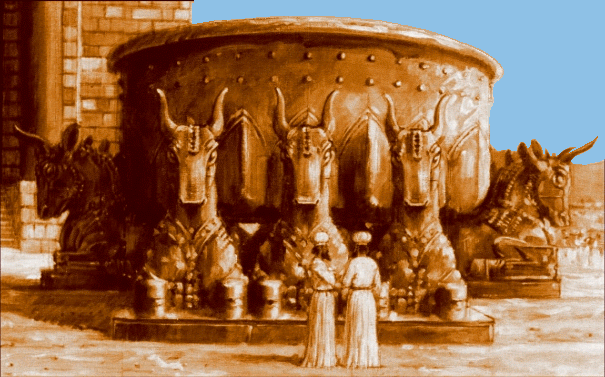
23 Then he made the sea of cast metal. It was round, ten cubits from brim to brim, and five cubits high, and a line of thirty cubits measured its circumference. 24 Under its brim were gourds, for ten cubits, compassing the sea all around. The gourds were in two rows, cast with it when it was cast. 25 It stood on twelve oxen, three facing north, three facing west, three facing south, and three facing east. The sea was set on them, and all their rear parts were inward. 26 Its thickness was a handbreadth, and its brim was made like the brim of a cup, like the flower of a lily. It held two thousand baths.

27 He also made the ten stands of bronze. Each stand was four cubits long, four cubits wide, and three cubits high. 28 This was the construction of the stands: they had panels, and the panels were set in the frames, 29 and on the panels that were set in the frames were lions, oxen, and cherubim. On the frames, both above and below the lions and oxen, there were wreaths of beveled work. 30 Moreover, each stand had four bronze wheels and axles of bronze, and at the four corners were supports for a basin. The supports were cast with wreaths at the side of each. 31 Its opening was within a crown that projected upward one cubit. Its opening was round, as a pedestal is made, a cubit and a half deep. At its opening there were carvings, and its panels were square, not round. 32 And the four wheels were underneath the panels. The axles of the wheels were of one piece with the stands, and the height of a wheel was a cubit and a half. 33 The wheels were made like a chariot wheel; their axles, their rims, their spokes, and their hubs were all cast. 34 There were four supports at the four corners of each stand. The supports were of one piece with the stands. 35 And on the top of the stand there was a round band half a cubit high; and on the top of the stand its stays and its panels were of one piece with it. 36 And on the surfaces of its stays and on its panels, he carved cherubim, lions, and palm trees, according to the space of each, with wreaths all around. 37 After this manner he made the ten stands. All of them were cast alike, of the same measure and the same form.

38 And he made ten basins of bronze. Each basin held forty baths, each basin measured four cubits, and there was a basin for each of the ten stands. 39 And he set the stands, five on the south side of the house, and five on the north side of the house. And he set the sea at the southeast corner of the house. 1 Kings 7:13-39 ESV

The first question that comes to mind when reading this section of Chapter Seven is why the author took such great pains to describe each and every item in such precise detail. The amount of information is almost overwhelming, and even with all the helpful descriptions, it’s virtually impossible to determine what each item actually looked like.  So, why dedicate so much time and space to their description?

In a sense, the author is telling his readers that Solomon was a man who took a keen interest in every phase of the massive construction project he had commissioned. His father had left him with the overwhelming responsibility to create a house worthy of the God of Israel, and that was not something he took lightly. Solomon was a hands-on construction manager who cared deeply about every detail concerning this once-in-a-lifetime undertaking. While he delegated much of the work, there was never a moment when Solomon was not intimately and personally involved in it. He cared deeply about this project and wanted to ensure that the finished product was both beautiful and functional. When completed, the Temple would become the focal point of Israel’s worship of Yahweh. So, Solomon intended for every item associated with its construction and its ultimate operation to be of the finest craftsmanship.

From the quarrying of the massive stones used to build the temple to the carving of the intricate reliefs that adorned the bronze stands, Solomon oversaw everything. To ensure that the workmanship was of the highest quality, Solomon hired the finest craftsman money could buy.

Verse 13 states that Solomon sought out the services of a skilled craftsman from the city of Tyre, a gifted worker in bronze. But notice the additional details concerning Hiram’s qualifications:

And he was full of wisdom, understanding, and skill for making any work in bronze. – 1 Kings 7:1 ESV

This brings to mind a passage from the book of Exodus where God provided Moses with the identity of another man who would assist in the construction of the Tabernacle.

The LORD said to Moses, “See, I have called by name Bezalel the son of Uri, son of Hur, of the tribe of Judah, and I have filled him with the Spirit of God, with ability and intelligence, with knowledge and all craftsmanship, to devise artistic designs, to work in gold, silver, and bronze, in cutting stones for setting, and in carving wood, to work in every craft.” – Exodus 31:1-5 ESV

As was the case with Moses, it seems that Solomon was receiving divine assistance in procuring the services of the right people to help him complete this one-of-a-kind project. Hiram came highly recommended and divinely gifted for the job.

Once he arrived in Jerusalem, Hiram set to work casting the two bronze pillars that would grace the entrance to the Temple. At 27 feet in height, these two immense pillars were likely more decorative than functional. Since they were cast from a relatively soft metal like bronze and featured hollow interiors, they would have been incapable of providing support to the Temple’s roof.

These pillars were intended to frame the entrance to the Temple and provide symbolic significance to the One who dwelt within. Each pillar had a name. One was called Boaz, which means “In Him is strength.” The other was named Jachin, which means “He shall establish.” Both names were explicit references to the God of Israel. Every detail that adorned these pillars, from the water lilies to the pomegranates, was intended to illustrate the goodness and greatness of God. The Israelites served a God who provided them with everything they needed, including fertility and fruitfulness.

Next, Hiram crafted “the sea,” a large bronze basin that would sit outside the Temple’s entrance. This massive bowl was designed to replace the bronze laver that God had prescribed for the Tabernacle, while serving the same function as the original. According to Exodus 30, the first laver was used by the priests to purify themselves before offering sacrifices to God.

“You shall also make a basin of bronze, with its stand of bronze, for washing. You shall put it between the tent of meeting and the altar, and you shall put water in it, with which Aaron and his sons shall wash their hands and their feet. When they go into the tent of meeting, or when they come near the altar to minister, to burn a food offering to the Lord, they shall wash with water, so that they may not die. They shall wash their hands and their feet, so that they may not die. It shall be a statute forever to them, even to him and to his offspring throughout their generations.” – Exodus 30:18-21 ESV

The new basin was 15 feet in diameter, 47 feet in circumference, with a depth of 7.5 feet. It could hold up to 18,000 gallons of water, and its large size appears to have been designed to allow priests to completely immerse themselves, rather than just washing their hands and feet. It rested on the backs of 12 bronze oxen, arranged in groups of three, with each group facing a different direction on the compass. These bronze bulls may have been intended to represent the 12 tribes of Israel. But regardless, they were clearly symbols of strength.

Hiram then crafted ten mobile carts, each equipped with a large bronze basin. They featured wheels that allowed them to be moved about the Temple courtyard.

He also made ten basins in which to wash, and set five on the south side, and five on the north side. In these they were to rinse off what was used for the burnt offering, and the sea was for the priests to wash in. – 2 Chronicles 4:6 ESV

Each cart was six feet square and five and one-half feet high, and it held a bronze basin that could hold up to 240 gallons of water. As the Chronicles passage indicates, they were strategically located around the Temple courtyard and used by the priests to cleanse the blood from the sacrificial animals before they were offered to God.

You can almost sense that Solomon was attempting to improve on every item used in the original Tabernacle. He was making significant upgrades. Every item Hiram created was bigger and better than the original. Solomon was obsessed with making the house of God a grand and glorious structure, with every detail reflecting the majesty of its divine occupant. He could have saved himself a lot of time and money by reusing the original items, but Solomon would not settle for anything less than the best. So, he poured countless hours and resources into creating a Temple worthy of his great God, down to the last detail.

Solomon was following the instructions Yahweh gave to Moses from Mount Sinai when He ordered the creation of the original Tabernacle.

“Have the people of Israel build me a holy sanctuary so I can live among them. You must build this Tabernacle and its furnishings exactly according to the pattern I will show you.” – Exodus 25:8-9 NLT

Moses received detailed plans for the construction of the LORD’s house, with nothing left to the imagination. God was explicit in describing every facet of the Tabernacle’s design, and ordered Moses, “Be sure that you make everything according to the pattern I have shown you here on the mountain” (Exodus 25:40 NLT). Evidently, Moses received a vision of what the completed Tabernacle should look like, and he was to ensure that the finished product was an accurate facsimile. He was not to cut corners, leave out any detail, or make alterations to its design. No expense was to be spared, no shortcuts taken, and no cost-cutting measures considered because this was to be the house of Yahweh. The God of the universe deserved nothing but the best. If the people of Israel expected Him to dwell among them, they would need to build a house worthy of housing His presence. 

“I will meet the people of Israel there, in the place made holy by my glorious presence. Yes, I will consecrate the Tabernacle and the altar, and I will consecrate Aaron and his sons to serve me as priests. Then I will live among the people of Israel and be their God, and they will know that I am the LORD their God. I am the one who brought them out of the land of Egypt so that I could live among them. I am the LORD their God. – Exodus 29:43-46 NLT

Solomon shared Moses’ commitment to build a house that Yahweh would deem worthy of bearing His name and containing His glory. So, he went out of his way to ensure that this house met Yahweh’s exacting standards, because he longed for the assurance of Yahweh’s presence and power.

English Standard Version (ESV) The Holy Bible, English Standard Version. ESV® Permanent Text Edition® (2016). Copyright © 2001 by Crossway Bibles, a publishing ministry of Good News Publishers.

New Living Translation (NLT) Holy Bible, New Living Translation, copyright © 1996, 2004, 2015 by Tyndale House Foundation. Used by permission of Tyndale House Publishers Inc., Carol Stream, Illinois 60188. All rights reserved.
The Covenant Confirmed

1 Then he said to Moses, “Come up to the Lord, you and Aaron, Nadab, and Abihu, and seventy of the elders of Israel, and worship from afar. Moses alone shall come near to the Lord, but the others shall not come near, and the people shall not come up with him.”

Moses came and told the people all the words of the Lord and all the rules. And all the people answered with one voice and said, “All the words that the Lord has spoken we will do.” And Moses wrote down all the words of the Lord. He rose early in the morning and built an altar at the foot of the mountain, and twelve pillars, according to the twelve tribes of Israel. And he sent young men of the people of Israel, who offered burnt offerings and sacrificed peace offerings of oxen to the Lord. And Moses took half of the blood and put it in basins, and half of the blood he threw against the altar. Then he took the Book of the Covenant and read it in the hearing of the people. And they said, “All that the Lord has spoken we will do, and we will be obedient.” And Moses took the blood and threw it on the people and said, “Behold the blood of the covenant that the Lord has made with you in accordance with all these words.” – Exodus 24:1-8 NLT

Prior to giving Moses the Decalogue and the Book of the Covenant, God warned the people of Israel that they would be expected to obey His commands.

“You yourselves have seen what I did to the Egyptians, and how I bore you on eagles’ wings and brought you to myself. Now therefore, if you will indeed obey my voice and keep my covenant, you shall be my treasured possession among all peoples, for all the earth is mine; and you shall be to me a kingdom of priests and a holy nation.” – Exodus 19:4-6 ESV

Their ongoing status as His chosen people depended upon their willingness to keep the covenant He was making with them. His laws were binding and the people’s adherence to them was non-optional. Now, the time had come for them to confirm their commitment to the covenant. In chapters 20-23, God laid out the terms of the covenant. He had clearly articulated the rules and regulations that would govern their behavior as His set-apart people. But those commandments would prove meaningless if the people refused to obey them.  And if they refused to keep the commands that God had given them, they would be rejecting His authority and sovereignty over their lives. So, this chapter in the book of Exodus records a seminal moment in the lives of the people of Israel.

God instructed Moses to return to the top of Mount Sinai and instructed him to bring along his brother Aaron, his two sons, Nadab and Abihu, as well as 70 of the elders of Israel. But before this small contingent of Israelite leaders made their ascent of Mount Sinai, Moses “told the people all the words of the Lord and all the rules” (Exodus 24:3 ESV).

He took the time to communicate all the instructions and regulations given to him by God. From the more general laws of the Decalogue to the detailed and highly specific content of the Book of the Covenant, Moses articulated clearly and carefully all the binding requirements of God.

In a sense, Moses was performing the role of a minister officiating a wedding ceremony between God and His bride, the nation of Israel. God had already expressed His vow to make the people of Israel His “own special treasure from among all the peoples on earth” (Exodus 19:5 NLT). He had chosen them as His own and pledged His intention to love and protect them. Now, it was their turn to state their vows, which they did with unwavering unity and enthusiasm.

And all the people answered with one voice and said, “All the words that the Lord has spoken we will do.” – Exodus 24:3 ESV

They had heard the terms of the marriage covenant and wholeheartedly agreed with them. With the covenant ratified, Moses took the time to document every one of God’s commandments, creating a permanent and unchanging contract between God and His people.

The next morning, Moses instructed the people to build an altar, and they would have done so by following the instructions given to them by God.

“Build for me an altar made of earth, and offer your sacrifices to me—your burnt offerings and peace offerings, your sheep and goats, and your cattle. Build my altar wherever I cause my name to be remembered, and I will come to you and bless you. If you use stones to build my altar, use only natural, uncut stones. Do not shape the stones with a tool, for that would make the altar unfit for holy use.” – Exodus 20:24-25 NLT

Along with the altar, the people were instructed to build 12 pillars, one for each of the 12 tribes of Israel. Then he commanded that burnt offerings and peace offerings be made to the Lord. The bulls used in these sacrifices were killed and their blood drained into basins. Moses took half of the blood and splashed it on the altar, an act of consecration and purification. Later, in the book of Leviticus, God explains the significance of the blood.

“…for the life of the body is in its blood. I have given you the blood on the altar to purify you, making you right with the Lord. It is the blood, given in exchange for a life, that makes purification possible.” – Leviticus 17:11 NLT

The author of the book of Hebrews picked up on this theme when he wrote:

Indeed, under the law almost everything is purified with blood, and without the shedding of blood there is no forgiveness of sins. – Hebrews 9:22 ESV

Moses was purifying the altar on which the offerings were made. This made the sacrifices acceptable to God. With the offerings completed, Moses read the Book of the Covenant out loud again, and the people reiterated their earlier commitment to obey.

“We will do everything the Lord has commanded. We will obey.” – Exodus 24:7 NLT

But then Moses did something unexpected and a bit unusual. He took the remaining blood in the basin and splattered it over the people. This rather gruesome scene offends our modern sensibilities, but it was meant to drive home a significant point. That blood had once pulsed through the veins of living creatures. But their lives had been sacrificed so that the people of Israel could be made pure and acceptable before God. Their sins had been atoned for through the death of another. And in sprinkling the blood on the people, Moses was covering over their unworthiness and sinfulness. He was presenting them as righteous before God, because of the atoning sacrifice of the sin substitute.

The author of Hebrews draws the vital connection between what Moses did that day and what Jesus later accomplished with His death on the cross.

With his own blood—not the blood of goats and calves—he entered the Most Holy Place once for all time and secured our redemption forever.

Under the old system, the blood of goats and bulls and the ashes of a heifer could cleanse people’s bodies from ceremonial impurity. Just think how much more the blood of Christ will purify our consciences from sinful deeds so that we can worship the living God. – Hebrews 9:12-14 NLT

The covenant-ratification ceremony that took place at the base of Mount Sinai was a worship service. God was purifying His people so that they could enter into His holy presence and worship Him. But, as Moses pointed out, the blood also sealed the covenant they had made.

“Look, this blood confirms the covenant the Lord has made with you in giving you these instructions.” – Exodus 24:8 NLT

Their words of affirmation had become binding. Their status as God’s chosen people had become permanent. Both parties were obligated to keep the covenant commitments they had made. And through their adherence to God’s laws, the people would be expressing their adoration of Him. Their obedience would symbolize their purity and illustrate their commitment to live as His chosen people.

English Standard Version (ESV) The Holy Bible, English Standard Version. ESV® Permanent Text Edition® (2016). Copyright © 2001

New Living Translation (NLT) Holy Bible, New Living Translation, copyright © 1996, 2004, 2015 by Tyndale House Foundation. Used by permission of Tyndale House Publishers Inc., Carol Stream, Illinois 60188. All rights reserved.

The Lamb for Sinners Slain

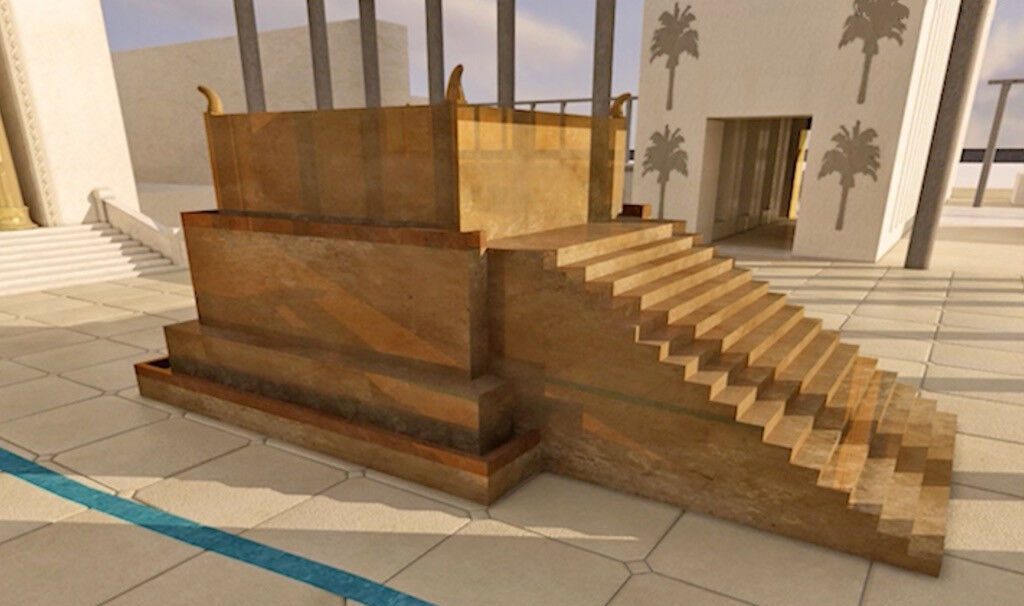
13 “These are the measurements of the altar by cubits (the cubit being a cubit and a handbreadth): its base shall be one cubit high and one cubit broad, with a rim of one span around its edge. And this shall be the height of the altar: 14 from the base on the ground to the lower ledge, two cubits, with a breadth of one cubit; and from the smaller ledge to the larger ledge, four cubits, with a breadth of one cubit; 15 and the altar hearth, four cubits; and from the altar hearth projecting upward, four horns. 16 The altar hearth shall be square, twelve cubits long by twelve broad. 17 The ledge also shall be square, fourteen cubits long by fourteen broad, with a rim around it half a cubit broad, and its base one cubit all around. The steps of the altar shall face east.”

18 And he said to me, “Son of man, thus says the Lord God: These are the ordinances for the altar: On the day when it is erected for offering burnt offerings upon it and for throwing blood against it, 19 you shall give to the Levitical priests of the family of Zadok, who draw near to me to minister to me, declares the Lord God, a bull from the herd for a sin offering. 20 And you shall take some of its blood and put it on the four horns of the altar and on the four corners of the ledge and upon the rim all around. Thus you shall purify the altar and make atonement for it. 21 You shall also take the bull of the sin offering, and it shall be burned in the appointed place belonging to the temple, outside the sacred area. 22 And on the second day you shall offer a male goat without blemish for a sin offering; and the altar shall be purified, as it was purified with the bull. 23 When you have finished purifying it, you shall offer a bull from the herd without blemish and a ram from the flock without blemish. 24 You shall present them before the Lord, and the priests shall sprinkle salt on them and offer them up as a burnt offering to the Lord. 25 For seven days you shall provide daily a male goat for a sin offering; also, a bull from the herd and a ram from the flock, without blemish, shall be provided. 26 Seven days shall they make atonement for the altar and cleanse it, and so consecrate it. 27 And when they have completed these days, then from the eighth day onward the priests shall offer on the altar your burnt offerings and your peace offerings, and I will accept you, declares the Lord God.” Ezekiel 43:13-27 ESV

It should be no surprise that the focus of everything in the Millennial Kingdom will be holiness. At that moment in human history, everything will be set apart unto God. His Son will rule over all the earth from His throne in Jerusalem, just as the angel had promised to his mother, Mary.

“You will conceive and give birth to a son, and you will name him Jesus. He will be very great and will be called the Son of the Most High. The Lord God will give him the throne of his ancestor David. And he will reign over Israel forever; his Kingdom will never end!” – Luke 1:31-33 NLT

This will be in fulfillment of the promise that God made to King David.

“And I will provide a homeland for my people Israel, planting them in a secure place where they will never be disturbed. Evil nations won’t oppress them as they’ve done in the past, starting from the time I appointed judges to rule my people Israel. And I will give you rest from all your enemies.…Your house and your kingdom will continue before me for all time, and your throne will be secure forever.” – 2 Samuel 7:10-11, 16 NLT

In this future kingdom, Jesus Christ, the Son of God, will be the King of kings and Lord of lords. He will rule supreme and His status as the Holy One of God will allow Him to mete out perfect righteousness as the sovereign head of state. With His sacrificial death and resurrection, Jesus earned the right to sit on David’s throne. Paul speaks of Jesus’ elevation to this highest honor because “he humbled himself in obedience to God and died a criminal’s death on a cross” (Philippians 2:8 NLT).

And because Jesus faithfully fulfilled the will of His Heavenly Father, He was rewarded with a return to His rightful place at His Father’s side.

God elevated him to the place of highest honor
    and gave him the name above all other names,
that at the name of Jesus every knee should bow,
    in heaven and on earth and under the earth,
and every tongue declare that Jesus Christ is Lord,
    to the glory of God the Father. – Philippians 2:9-11 NLT

But the latter part of this passage has yet to be fulfilled. We live in an age where the majority of people on earth refuse to honor the name of Christ or bow in submission to His will. They do not acknowledge Him as Lord. Yet, God’s redemptive plan includes a day when all that will change. The prophet, Micah, refers to this future restoration of the Kingdom of Israel and Christ’s reign as King.

In the last days, the mountain of the Lord’s house
    will be the highest of all—
    the most important place on earth.
It will be raised above the other hills,
    and people from all over the world will stream there to worship.
People from many nations will come and say,
“Come, let us go up to the mountain of the Lord,
    to the house of Jacob’s God.
There he will teach us his ways,
    and we will walk in his paths.”
For the Lord’s teaching will go out from Zion;
    his word will go out from Jerusalem.
The Lord will mediate between peoples
    and will settle disputes between strong nations far away. – Micah 4:1-3 NLT

Isaiah prophesied about the future earthly reign of Christ, declaring that “the government will rest on his shoulders” (Isaiah 9:6 NLT), and that government will be marked by peace.

His government and its peace
    will never end.
He will rule with fairness and justice from the throne of his ancestor David
    for all eternity. – Isaiah 9:7 NLT

Justice will rule in the wilderness
    and righteousness in the fertile field.
And this righteousness will bring peace.
    Yes, it will bring quietness and confidence forever.
My people will live in safety, quietly at home.
    They will be at rest. – Isaiah 32:16-18 NLT

So, why does God reveal to Ezekiel that this same Millennial Kingdom will be marked by a reinstitution of the sacrificial system? If Jesus’ paid the final debt for all sins and accomplished what the blood of bulls and goats could never do, why would God bring back the temple, the altar, and the practice of blood sacrifice?

“The existence of the millennial temple and the reinstatement of the sacrificial system [though not necessarily the reinstatement of the Mosaic Covenant] is not only understandable but predictable. Ezekiel’s vision of a restored sacrificial system was really not so amazing after all. The millennium will afford Israel the opportunity for the first time in its history to use the symbols of their covenant with Jesus as Messiah in view. It will be their first time to be a kingdom of priests and a holy nation showing forth to the world the redemptive work of Yahweh in the person of Jesus Christ the Messiah (Isa 53:7; 61:1-3; Zech 4:1 [sic 3:10]; John 1:29; Acts 8:32-35; 1 Pet 1:19; Rev 7:13-14; 5:9; 13:8; 15:3).” – L. E. Cooper Sr., Ezekiel

The author of Hebrews reminds us that the old sacrificial system functioned as a symbol or representation of something far greater to come.

The old system under the law of Moses was only a shadow, a dim preview of the good things to come, not the good things themselves. The sacrifices under that system were repeated again and again, year after year, but they were never able to provide perfect cleansing for those who came to worship. If they could have provided perfect cleansing, the sacrifices would have stopped, for the worshipers would have been purified once for all time, and their feelings of guilt would have disappeared.

But instead, those sacrifices actually reminded them of their sins year after year. For it is not possible for the blood of bulls and goats to take away sins. – Hebrews 10:1-4 NLT

According to this passage, the main purpose behind the Old Testament sacrificial system was to remind God’s people of their sins. It could never provide full and complete atonement. That’s why the sacrifices were perpetual and never-ending. The people lived in an endless cycle of sin-sacrifice-atonement-forgiveness. With their sins forgiven, they would simply repeat the cycle again, year after year. But Jesus came to be the “Lamb of God who takes away the sins of the world” (John 1:29). With His death on the cross, Jesus broke that endless cycle of sacrifice for sins.

So, why bring it back? It seems that the future sacrificial system described in Ezekiel has a distinctly different purpose. Rather than providing atonement for sins, it will point to the ultimate atoning sacrifice: Jesus Christ. The blood offered up on the Millennial Altar will commemorate “the precious blood of Christ, the sinless, spotless Lamb of God” (1 Peter 1:19 NLT).

When Christians partake of the elements of the Lord’s Table, they are not literally breaking the body of Christ or spilling His blood. They are practicing a symbolic rite designed to remind them of what Christ has done on their behalf. That’s why, on the night Jesus instituted the Lord’s Table, He told His disciples “do this in remembrance of me” (1 Corinthians 11:25).

God gives Ezekiel the dimensions for the altar of sacrifice. Then He provides very clear instructions regarding the ritual cleansing of the altar and the preparation of the sacrifices to be offered on it. This entire process is similar to that given by God to Moses when He first instituted the sacrificial system in the Judean wilderness. For the Israelites living in the Millennial Kingdom, this entire process of ceremonial cleansing and purification will be highly familiar, and it will serve as a powerful reminder of their past sins as a nation. But it will point them to the all-sufficient sacrifice of Jesus, whose blood has cleansed them from all their sins (1 John 1:7).

“The offerings presented thereon were meant to be memorials, much as the Lord’s Supper is no efficacious sacrifice but a memorial of a blessedly adequate and all-sufficient sacrifice for all time. Thus, whereas the sacrifices of the Old Testament economy were prospective, these are retrospective.” – Charles Lee Feinberg, The Prophecy of Ezekiel

The focus of this chapter is holiness – the holiness of God, His people, His Kingdom, and His Son. Everything in the Millennial Kingdom will be set apart for His glory. It will all be dedicated to His name and exist to point all people to Him alone. In a remarkable blending of old and new imagery, God provides Ezekiel a glimpse of a future age when the Old Testament sacrificial system will exist in perfect harmony with the resurrected and enthroned Lamb of God. During His thousand-year reign on earth, there will be believers and unbelievers living under His righteous rule. All those who survived the seven years of the Tribulation will have the pleasure of living as citizens of Christ’s earthly kingdom, but not all will worship Him as Lord. Perhaps this renewed sacrificial system will serve as a means of purification for all those who wish to enter the presence of the King of kings. Holiness will reign supreme in the Millennial Kingdom, and God has ordained a place and purpose for the sacrificial system in that time.

English Standard Version (ESV) The Holy Bible, English Standard Version. ESV® Permanent Text Edition® (2016). Copyright © 2001

New Living Translation (NLT) Holy Bible, New Living Translation, copyright © 1996, 2004, 2015 by Tyndale House Foundation. Used by permission of Tyndale House Publishers Inc., Carol Stream, Illinois 60188. All rights reserved.

That Didn’t Take Long.

10 And when they came to the region of the Jordan that is in the land of Canaan, the people of Reuben and the people of Gad and the half-tribe of Manasseh built there an altar by the Jordan, an altar of imposing size. 11 And the people of Israel heard it said, “Behold, the people of Reuben and the people of Gad and the half-tribe of Manasseh have built the altar at the frontier of the land of Canaan, in the region about the Jordan, on the side that belongs to the people of Israel.” 12 And when the people of Israel heard of it, the whole assembly of the people of Israel gathered at Shiloh to make war against them.

13 Then the people of Israel sent to the people of Reuben and the people of Gad and the half-tribe of Manasseh, in the land of Gilead, Phinehas the son of Eleazar the priest, 14 and with him ten chiefs, one from each of the tribal families of Israel, every one of them the head of a family among the clans of Israel. 15 And they came to the people of Reuben, the people of Gad, and the half-tribe of Manasseh, in the land of Gilead, and they said to them, 16 “Thus says the whole congregation of the Lord, ‘What is this breach of faith that you have committed against the God of Israel in turning away this day from following the Lord by building yourselves an altar this day in rebellion against the Lord? 17 Have we not had enough of the sin at Peor from which even yet we have not cleansed ourselves, and for which there came a plague upon the congregation of the Lord, 18 that you too must turn away this day from following the Lord? And if you too rebel against the Lord today then tomorrow he will be angry with the whole congregation of Israel. 19 But now, if the land of your possession is unclean, pass over into the Lord’s land where the Lord’s tabernacle stands, and take for yourselves a possession among us. Only do not rebel against the Lord or make us as rebels by building for yourselves an altar other than the altar of the Lord our God. 20 Did not Achan the son of Zerah break faith in the matter of the devoted things, and wrath fell upon all the congregation of Israel? And he did not perish alone for his iniquity.’”

21 Then the people of Reuben, the people of Gad, and the half-tribe of Manasseh said in answer to the heads of the families of Israel, 22 “The Mighty One, God, the Lord! The Mighty One, God, the Lord! He knows; and let Israel itself know! If it was in rebellion or in breach of faith against the Lord, do not spare us today 23 for building an altar to turn away from following the Lord. Or if we did so to offer burnt offerings or grain offerings or peace offerings on it, may the Lord himself take vengeance. 24 No, but we did it from fear that in time to come your children might say to our children, ‘What have you to do with the Lord, the God of Israel? 25 For the Lord has made the Jordan a boundary between us and you, you people of Reuben and people of Gad. You have no portion in the Lord.’ So your children might make our children cease to worship the Lord. 26 Therefore we said, ‘Let us now build an altar, not for burnt offering, nor for sacrifice, 27 but to be a witness between us and you, and between our generations after us, that we do perform the service of the Lord in his presence with our burnt offerings and sacrifices and peace offerings, so your children will not say to our children in time to come, “You have no portion in the Lord.”’ 28 And we thought, ‘If this should be said to us or to our descendants in time to come, we should say, “Behold, the copy of the altar of the Lord, which our fathers made, not for burnt offerings, nor for sacrifice, but to be a witness between us and you.”’ 29 Far be it from us that we should rebel against the Lord and turn away this day from following the Lord by building an altar for burnt offering, grain offering, or sacrifice, other than the altar of the Lord our God that stands before his tabernacle!”

30 When Phinehas the priest and the chiefs of the congregation, the heads of the families of Israel who were with him, heard the words that the people of Reuben and the people of Gad and the people of Manasseh spoke, it was good in their eyes. 31 And Phinehas the son of Eleazar the priest said to the people of Reuben and the people of Gad and the people of Manasseh, “Today we know that the Lord is in our midst, because you have not committed this breach of faith against the Lord. Now you have delivered the people of Israel from the hand of the Lord.”

32 Then Phinehas the son of Eleazar the priest, and the chiefs, returned from the people of Reuben and the people of Gad in the land of Gilead to the land of Canaan, to the people of Israel, and brought back word to them. 33 And the report was good in the eyes of the people of Israel. And the people of Israel blessed God and spoke no more of making war against them to destroy the land where the people of Reuben and the people of Gad were settled. 34 The people of Reuben and the people of Gad called the altar Witness, “For,” they said, “it is a witness between us that the Lord is God.”  Joshua 22:10-34 ESV

Now that the major portion of the fighting was over and the tribes of Israel had been awarded their respective land allotments, Joshua blessed and dismissed the three tribes that had been given land on the eastern side of the Jordan River. The tribes of Reuben and Gad, along with half the tribe of Manasseh, had requested to settle in the land of Gilead. But they had agreed to help the rest of the tribes conquer and possess the land of Canaan, and now that they had kept their commitment, Joshua was allowing them to return home. But not without a warning to remain faithful to Yahweh.


“Only be very careful to observe the commandment and the law that Moses the servant of the Lord commanded you, to love the Lord your God, and to walk in all his ways and to keep his commandments and to cling to him and to serve him with all your heart and with all your soul.” – Joshua 22:5 ESV

But almost immediately after returning to their side of the Jordan River, the natural boundary that separated them from the rest of the tribes of Israel, the trouble began. They made a fateful decision to build an altar to God, “an altar of imposing size” according to the text. But when the rest of the tribes heard about it, they jumped to a very wrong conclusion. They assumed that the tribes of Reuben, Gad and Manasseh had decided to abandon Yahweh for the gods of the Canaanites, in direct violation of God’s command given to Moses.

10 But when you go over the Jordan and live in the land that the Lord your God is giving you to inherit, and when he gives you rest from all your enemies around, so that you live in safety, 11 then to the place that the Lord your God will choose, to make his name dwell there, there you shall bring all that I command you: your burnt offerings and your sacrifices, your tithes and the contribution that you present, and all your finest vow offerings that you vow to the Lord. – Deuteronomy 12:10-11 ESV

God had made it clear that they were to offer sacrifices to Him in one place only – a place that He alone would designate. And that place was Shiloh. There, the tabernacle had been set up and the altar erected. And only there were the people of Israel to offer sacrifices to God. That point had been made perfectly clear by Moses.

13 Take care that you do not offer your burnt offerings at any place that you see, 14 but at the place that the Lord will choose in one of your tribes, there you shall offer your burnt offerings, and there you shall do all that I am commanding you. – Deuteronomy 12:13-14 ESV

So, the tribes west of the Jordan jumped to the conclusion that their three fellow tribes had broken faith with God and had erected an altar to a false god. Either that, or they had built an altar other than the one in Shiloh and were planning on making their own offerings and sacrifices, in direct violation of God’s prohibition against doing so. This was a communications disaster that was quickly turning into a potential civil war. Those tribes west of the Jordan assumed the worst and assembled to do battle with their brothers on the other side of the river. They were driven by the fear of what God would do if they allowed this sin to take place without taking steps to deal with it. They could still recall the sin of Achan and how his decision to disobey the command of God had brought defeat to the entire nation. They knew that God took disobedience to His law quite seriously and that individual sin had corporate consequences. And if three out of the 12 tribes chose to disobey God’s command, they would all end up suffering for it. So, they acted – probably a bit hastily and without getting their facts straight.

Again, they were operating in fear, based on what they knew to be God’s will regarding idolatry and His hatred for it. Moses had given them specific instructions about how to handle those who worshiped false gods.

12 “If you hear in one of your cities, which the Lord your God is giving you to dwell there, 13 that certain worthless fellows have gone out among you and have drawn away the inhabitants of their city, saying, ‘Let us go and serve other gods,’ which you have not known, 14 then you shall inquire and make search and ask diligently. And behold, if it be true and certain that such an abomination has been done among you, 15 you shall surely put the inhabitants of that city to the sword, devoting it to destruction, all who are in it and its cattle, with the edge of the sword. 16 You shall gather all its spoil into the midst of its open square and burn the city and all its spoil with fire, as a whole burnt offering to the Lord your God. It shall be a heap forever. It shall not be built again. – Deuteronomy 13:12-16 ESV

So, when they heard that the three tribes west of the Jordan had built an impressive altar, they wasted no time, gathering all the people together at Shiloh in preparation for an assault on their unfaithful brothers. But prior to marching into Gilead, they sent a delegation, made up of “Phinehas the son of Eleazar the priest, and with him ten chiefs, one from each of the tribal families of Israel” (Joshua 22:13-14 ESV). And, upon arrival in Gilead, these men wasted no time in stating their accusation against the tribes of Reuben, Gad and Manasseh.

What is this breach of faith that you have committed against the God of Israel in turning away this day from following the Lord by building yourselves an altar this day in rebellion against the Lord? – Joshua 22:16 ESV

They made it clear that they saw the actions of the three tribes as a breach of faith and an act of sin worthy of death. They assumed their brothers had been tempted by the unclean practices of the pagans living in the land of Gilead and begged them to consider moving over the Jordan and finding land among the rest of the tribes. They were asking them to repent and return to the Lord.

But the people of Reuben, Gad and Manasseh were shocked and appalled at what they heard. They were dumbstruck by the accusations of Phinehas and his fellow delegates. It was all a huge misunderstanding. They had not erected an altar to false gods. And the altar they had built was not for the purpose of offering sacrifices. It had been constructed as a memorial or reminder or, as they put it, as “a witness between us and you, and between our generations after us, that we do perform the service of the Lord in his presence with our burnt offerings and sacrifices and peace offerings” (Joshua 22:27 ESV). They feared that the natural boundary of the Jordan would end up becoming a relational barrier between themselves and the other tribes. In time, they speculated, their brothers west of the Jordan would see them as outsiders and bar them from worship at the tabernacle in Shiloh. So, they constructed the altar as a reminder to the generations to come, that they too were Yahweh worshipers. They had never intended to offer sacrifices on this altar. Their clearly articulated their purpose behind building the altar.

“Behold, the copy of the altar of the Lord, which our fathers made, not for burnt offerings, nor for sacrifice, but to be a witness between us and you.” – Joshua 22:28 ESV

A civil war was avoided and a disaster averted. The truth was revealed and all were able to rejoice in the fact that they worshiped the same God. The three tribes ended up calling the altar, “Witness” because “it is a witness between us that the Lord is God.” They shared a common love for and faith in God. The river may have separated them physically, but they were linked by their belief in Yahweh. And while idolatry would remain a constant threat for each of the tribes of Israel, on this occasion, it had been a huge misunderstanding. People jumped to conclusions. Fear got the best of Joshua and the people of Israel. They assumed the worst, but thankfully, they were prevented from acting on their false assumptions and sought the truth.

English Standard Version (ESV) The Holy Bible, English Standard Version. ESV® Permanent Text Edition® (2016). Copyright © 2001

New Living Translation (NLT) Holy Bible, New Living Translation, copyright © 1996, 2004, 2015 by Tyndale House Foundation. Used by permission of Tyndale House Publishers Inc., Carol Stream, Illinois 60188. All rights reserved.

The Message (MSG)  Copyright © 1993, 1994, 1995, 1996, 2000, 2001, 2002 by Eugene H. Peterson

The Law and Blessing.

30 At that time Joshua built an altar to the Lord, the God of Israel, on Mount Ebal, 31 just as Moses the servant of the Lord had commanded the people of Israel, as it is written in the Book of the Law of Moses, “an altar of uncut stones, upon which no man has wielded an iron tool.” And they offered on it burnt offerings to the Lord and sacrificed peace offerings. 32 And there, in the presence of the people of Israel, he wrote on the stones a copy of the law of Moses, which he had written. 33 And all Israel, sojourner as well as native born, with their elders and officers and their judges, stood on opposite sides of the ark before the Levitical priests who carried the ark of the covenant of the Lord, half of them in front of Mount Gerizim and half of them in front of Mount Ebal, just as Moses the servant of the Lord had commanded at the first, to bless the people of Israel. 34 And afterward he read all the words of the law, the blessing and the curse, according to all that is written in the Book of the Law. 35 There was not a word of all that Moses commanded that Joshua did not read before all the assembly of Israel, and the women, and the little ones, and the sojourners who lived among them. Joshua 8:30-35 ESV

ten_commandments-720x340Joshua and his forces have just defeated and captured the city of Ai. The men of the neighboring city of Bethel, who had joined forces and fought alongside Ai, were also defeated. So, in essence, the Israelites now had three cities they had conquered in their relatively short tenure in the land of promise. And now, Joshua leads the people to a place called Mount Ebal, where he builds an altar to the Lord. What is going on here? What prompted Joshua to do this? Was it simply because they had enjoyed two rousing victories over their enemies and he wanted to express thanks to God?  And why would he choose to travel all the way north to Mount Ebal in order to build his altar there? This would have entailed a 30-mile journey on the part of the people, so Joshua must have had a good reason for making this arduous trip immediately after a major military engagement against the city of Ai.

To understand what is going on in this passage, we must recall the instructions that Moses had given to the people of Israel concerning their entrance into the land of promise. He had been very specific, providing them with detailed instructions as to what they were to do as soon as they crossed over the Jordan. But it would appear that the people of Israel were behind schedule, having taken time to capture Jericho and Ai before they actually obeyed what Moses had told them to do.

1 Now Moses and the elders of Israel commanded the people, saying, “Keep the whole commandment that I command you today. And on the day you cross over the Jordan to the land that the Lord your God is giving you, you shall set up large stones and plaster them with plaster. And you shall write on them all the words of this law, when you cross over to enter the land that the Lord your God is giving you, a land flowing with milk and honey, as the Lord, the God of your fathers, has promised you. And when you have crossed over the Jordan, you shall set up these stones, concerning which I command you today, on Mount Ebal, and you shall plaster them with plaster. And there you shall build an altar to the Lord your God, an altar of stones. You shall wield no iron tool on them; you shall build an altar to the Lord your God of uncut stones. And you shall offer burnt offerings on it to the Lord your God, and you shall sacrifice peace offerings and shall eat there, and you shall rejoice before the Lord your God. And you shall write on the stones all the words of this law very plainly.” – Deuteronomy 27:1-7 ESV

Mount Ebal was located near a place called Shechem, a site with historical and religious significance for the people of Israel. It was at Shechem that Abraham had built an altar to the Lord after having arrived in the land of Canaan for the very first time.

Abram passed through the land to the place at Shechem, to the oak of Moreh. At that time the Canaanites were in the land. Then the Lord appeared to Abram and said, “To your offspring I will give this land.” So he built there an altar to the Lord, who had appeared to him. – Genesis 12:6-7 ESV

So, Joshua’s selection of Shechem and Mount Ebal were not arbitrary. He was following the commands of Moses and replicating the actions of Abraham, the great patriarch of the people of Israel. On this site, Joshua and the people of Israel renewed their covenant with God, recommitting themselves to keep His law and live as His people in the land He had provided for them. They built an altar to the Lord God, the God of Israel. This monument built of stones would be a tangible representation of Israel’s presence in the land and their dedication to worship their God as opposed to the many false gods of the inhabitants of Canaan.

The people erected an altar to God and offered sacrifices on it. But, in addition, Joshua “wrote on the stones a copy of the law of Moses, which he had written” (Joshua 8:32 ESV). This seems to indicate that Joshua wrote the law on the stones of the altar, not two tablets of stone as Moses had done. And while it is not clear what the text means by “the law of Moses,” it is possible that Joshua wrote the entire contents of the Book of Deuteronomy. The text states that, once Joshua had written the law on the stone, “he read all the words of the law, the blessing and the curse, according to all that is written in the Book of the Law” (Joshua 8:34 ESV). The blessing and the curse is a reference to the content found in chapter 28 of Deuteronomy. In that chapter is spelled out all that God will do for the people of Israel if they remain obedient to His law and all that He will do to them if they choose to disobey. They had already learned a painful, yet invaluable lesson about obedience in their initial defeat at the hands of the people of Ai. They had failed to keep God’s command regarding the plunder from Jericho and had suffered because of it. Now, with the building of the altar and the recitation of the law of Moses, the people were receiving a powerful reminder that their hope of receiving blessings from God while in the land was directly tied to their willingness to live in obedience to His law. And God had made it very clear what would happen to them if they chose to disobey.

15 “But if you will not obey the voice of the Lord your God or be careful to do all his commandments and his statutes that I command you today, then all these curses shall come upon you and overtake you. 16 Cursed shall you be in the city, and cursed shall you be in the field. 17 Cursed shall be your basket and your kneading bowl. 18 Cursed shall be the fruit of your womb and the fruit of your ground, the increase of your herds and the young of your flock. 19 Cursed shall you be when you come in, and cursed shall you be when you go out. – Deuteronomy 28:15-19 ESV

Their ability to conquer the land was dependent upon their willingness to obey God. He would bless them beyond measure, if only they would obey Him without question. This ceremony was more than just a religious ritual. It was a solemn and sobering reminder that their God was serious about obedience. He was a holy God who demanded that His chosen people live lives that would be set apart and distinctively different than those of the people living in the land. He had given them His law in order that they might live in keeping with His divine will. The law was to regulate all their behavior and all their relationships, including their relationship with God Himself. God had not left it up to their imagination. Right and wrong was not going to be a subjective issue for the people of Israel, because God had established an objective, black-and-white criteria for life and godliness.

With the reading of the law, the people of Israel received a much-needed reminder of their covenant commitment to God. Nothing had changed since God had given the law at Mount Sinai all those years before. The original tablets of stone, on which were written the commandments of God, were still in the ark of the covenant. His law had led them across the wilderness and over the Jordan. It had gone before them as they marched around the walls of Jericho. Now, they saw it written on the stones of the altar at Mount Ebal. And it would remain there, a permanent memorial, visible to Israelites and Canaanites alike, declaring the holiness of God and His unwavering demand that His chosen people live according to His will.

“Speak to all the congregation of the people of Israel and say to them, You shall be holy, for I the LORD your God am holy.” – Leviticus 19:2 ESV

English Standard Version (ESV) The Holy Bible, English Standard Version. ESV® Permanent Text Edition® (2016). Copyright © 2001

New Living Translation (NLT) Holy Bible, New Living Translation, copyright © 1996, 2004, 2015 by Tyndale House Foundation. Used by permission of Tyndale House Publishers Inc., Carol Stream, Illinois 60188. All rights reserved.

The Message (MSG)  Copyright © 1993, 1994, 1995, 1996, 2000, 2001, 2002 by Eugene H. Peterson


Day 114 – Matthew 26:17-19; Mark 14:12-16; Luke 22:7-13

My Time Has Come.

Matthew 26:17-19; Mark 14:12-16; Luke 22:7-13

“As you go into the city,” he told them, “you will see a certain man. Tell him, ‘The Teacher says: My time has come, and I will eat the Passover meal with my disciples at your house.’” – Matthew 26:18-20 NLT

The timing of Jesus’ triumphal entry, betrayal, trial and crucifixion was no fluke. The fact that this all happened during the celebration of Passover was no coincidence. This was the high holy week for all Jews and the city of Jerusalem would have been filled to capacity with pilgrims coming from all over the known world at that time. Luke tells us in Acts that there were “Parthians, Medes, Elamites, people from Mesopotamia, Judea, Cappadocia, Pontus, the province of Asia, Phrygia, Pamphylia, Egypt, and the areas of Libya around Cyrene, visitors from Rome (both Jews and converts to Judaism), Cretans and Arabs” (Acts 2:9-11 NLT). The city would have been a melting pot of different nationalities, consisting of all those who had converted to Judaism. Passover was a seven-day celebration that was followed 50 days later with the celebration of Pentecost, which commemorated the giving of the Law on Sinai. The energy level within the city would have been at an all-time high. People were everywhere. It was a festival and celebration, that would have had a holiday feel about it, much like Christmas does for us.

As the day for the celebration of the Passover meal approached, the disciples went to Jesus and asked Him where He wanted them to prepare the meal. This would not have been the first time they had celebrated Passover together. Ever since Jesus chose them as His followers, they would have made their way to Jerusalem each year, and eaten this meal together, much like a family, with Jesus as the head of the household. What the disciples didn’t know was that this particular Passover meal was going to be a radical departure from all those they had participated in before – all the way back to their childhoods. The entire last week of Jesus’ life, commonly referred to as Passion Week, was filled with significant allusions to the Old Testament celebration of Passover, most of which would have escaped the notice of the disciples. In Jesus’ instructions to His disciples, he said, “My time has come…” Jesus fully grasped the significance of what was about to happen and what it had to do with the Passover. He knew He was about to play the part of the innocent lamb, sacrificing His life in order that men might escape the grasp of death – just as in the days of the original Passover in Egypt.

His time had come. The climax of His earthly life was fast approaching. And as He sent the two disciples to make preparations for what would be His last Passover meal, His mind had to be swimming with thoughts regarding what was about to take place in the days ahead. Meanwhile the disciples who had been tasked with the preparations for the meal would have had their hands full. In reading the different accounts of this story in the Gospels, it appears as if all they had to do was procure a room. But there were extensive rituals to be performed. There was an unblemished lamb to purchase, sacrifice and prepare. In fact, these two disciples would have been the ones to actually take the life of the lamb they had chosen. There in the Temple grounds, along with thousands of other pilgrims, they would have watched as the life blood of their lamb was drained into a vessel, and then poured out at the foot of the altar. Then the lamb was “skinned, and cut open, the fat, the kidney’s, and liver, set apart for the altar; the rest wrapped in the skin, and carried home from the Temple.… As the new day approached, at sunset, the carcass was trussed for roasting, with two skewers of pomegranate wood, so that they formed a cross in the lamb. It was then put in an earthen oven of a special kind, resting, without bottom, on the ground, and was roasted in the earth” (J. Dwight Pentecost, The Words and Works of Jesus Christ).

Prior to this, they would have had to prepare the house in which they would be taking their meal together. They would have had to have removed all leaven, fermented grain or liquid, and anything that might defile the house. All the vessels to be used in preparation of the meal had to be painstakingly cleansed. This would have been an all-day affair. A blast from the silver trumpets in the Temple would have announced to all Jerusalem that the Passover had arrived. The time had come, just as it had over the years. But this time it was going to be different. This time there would be a new Lamb. This would be the final Passover. Once this week ended, there would never be a need for another lamb to ever be sacrificed again. No more blood would need to be shed. No more sacrifices would need to be made. A new covenant was going to be instituted. And while all of this escaped the notice of the disciples, Jesus was fully aware of what was going on and the eternal significance of the role He was about to play. It was for this moment He had come and the time had come for Him to do what only He could do.

Father, it is difficult to understand what these final days would have been like for Your Son. It is impossible to grasp what was going through His mind and heart as He drew closer to those final moments of His life. What He did, He did willingly. He was not forced or coerced. He was not made to die in our place. He did it gladly and out of love for us – in spite of our unlovableness. Thank You for sending Him to die in my place. Jesus, thank You for being willing to be obedient, even unto death – just for me. I know I didn’t deserve. I know I had done nothing to earn it. But You did it anyway. And I am eternally grateful. Amen.

Ken Miller
Grow Pastor & Minister to Men
kenm@christchapelbc.org