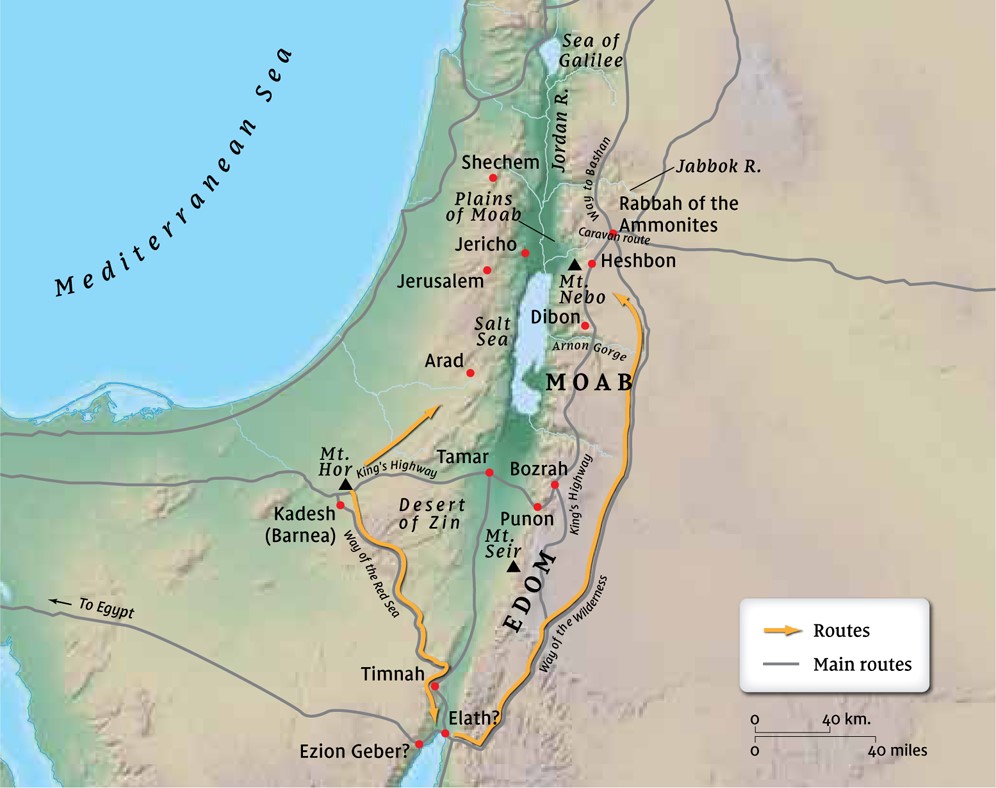
Divine On-the-Job Training

21 Then Israel sent messengers to Sihon king of the Amorites, saying, 22 “Let me pass through your land. We will not turn aside into field or vineyard. We will not drink the water of a well. We will go by the King’s Highway until we have passed through your territory.” 23 But Sihon would not allow Israel to pass through his territory. He gathered all his people together and went out against Israel to the wilderness and came to Jahaz and fought against Israel. 24 And Israel defeated him with the edge of the sword and took possession of his land from the Arnon to the Jabbok, as far as to the Ammonites, for the border of the Ammonites was strong. 25 And Israel took all these cities, and Israel settled in all the cities of the Amorites, in Heshbon, and in all its villages. 26 For Heshbon was the city of Sihon the king of the Amorites, who had fought against the former king of Moab and taken all his land out of his hand, as far as the Arnon. 27 Therefore the ballad singers say,

“Come to Heshbon, let it be built;
    let the city of Sihon be established.
28 For fire came out from Heshbon,
    flame from the city of Sihon.
It devoured Ar of Moab,
    and swallowed the heights of the Arnon.
29 Woe to you, O Moab!
    You are undone, O people of Chemosh!
He has made his sons fugitives,
    and his daughters captives,
    to an Amorite king, Sihon.
30 So we overthrew them;
    Heshbon, as far as Dibon, perished;
    and we laid waste as far as Nophah;
    fire spread as far as Medeba.”

31 Thus Israel lived in the land of the Amorites. 32 And Moses sent to spy out Jazer, and they captured its villages and dispossessed the Amorites who were there. 33 Then they turned and went up by the way to Bashan. And Og the king of Bashan came out against them, he and all his people, to battle at Edrei. 34 But the Lord said to Moses, “Do not fear him, for I have given him into your hand, and all his people, and his land. And you shall do to him as you did to Sihon king of the Amorites, who lived at Heshbon.” 35 So they defeated him and his sons and all his people, until he had no survivor left. And they possessed his land. Numbers 21:21-35 ESV

This is the Numbers’ version of the story of Israel’s unfortunate confrontation with the Sihon, the king of the Amorites. It’s also recorded in Deuteronomy 2, but in this rendition, Moses reveals that “Israel settled in all the cities of the Amorites, in Heshbon, and in all its villages” (Numbers 21:25 ESV). Not only did they conquer the Amorites, but they confiscated their cities and villages and moved into them. For the first time since leaving Egypt 39 years earlier, the Israelites found themselves living in real houses and enjoying all the amenities of a semi-settled existence.

On this occasion, they refused to walk away from a fight as they had in Edom because the territory of the Amorites provided the only access point to the land of promise. The Amorites were attempting to block the Israelites’ way to their inheritance, and while Moses tried to reason with Sihon, he soon discovered that brute force would be the only negotiating tool that would get the king’s attention.

God provided the Israelites with a decisive victory over the Amorites, and Moses made it clear that the land Israel conquered and confiscated had originally belonged to the Moabites. This is significant because, according to Deuteronomy 2, God had commanded the Israelites to avoid any conflict with the Moabites and had forbidden them from attempting to occupy any of their land. The territory of the Moabites was off-limits and under a divine ban.

“Do not bother the Moabites, the descendants of Lot, or start a war with them. I have given them Ar as their property, and I will not give you any of their land.” – Deuteronomy 2:9 NLT

But it appears that God provided Moses with a special dispensation regarding these cities and villages because Sihon had stolen them from the Moabites. These lands had transferred hands and, technically, no longer belonged to the Moabites.

Heshbon had been the capital of King Sihon of the Amorites. He had defeated a former Moabite king and seized all his land as far as the Arnon River. – Numbers 21:26 NLT

This transfer of ownership officially rendered the land open for conquest and occupation. But Moses points out that the Israelites went as far as the border of the Ammonites and no further. This is because the Israelites had been forbidden from taking any land belonging to the Ammonites or Moabites. These two people groups were the descendants of the two sons born to Lot through his incestuous relationship with his own daughters (Genesis 19:34-38).

But God had been explicit when issuing His prohibition about Moabite and Ammonite land.

“Do not bother the Moabites, the descendants of Lot, or start a war with them. I have given them Ar as their property, and I will not give you any of their land.” – Deuteronomy 2:9 NLT

“Today you will cross the border of Moab at Ar and enter the land of the Ammonites, the descendants of Lot. But do not bother them or start a war with them. I have given the land of Ammon to them as their property, and I will not give you any of their land.” – Deuteronomy 19:18-19 NLT

The land occupied by the Moabites and Ammonites was not part of the inheritance God had promised to Abraham, so there was really no need for Israel to get comfortable on this side of the river. Their land lay to the west and would be theirs soon enough.

But for the time being, God allowed them to live in the cities and villages they had taken from the Amorites. Moses relates the lyrics of a so-called “Song of Heshbon,” a ballad that had been composed by the Amorites commemorating Sihon’s defeat of the Moabites.

“Come to Heshbon and let it be rebuilt!
    Let the city of Sihon be restored.
A fire flamed forth from Heshbon,
    a blaze from the city of Sihon.
It burned the city of Ar in Moab;
    it destroyed the rulers of the Arnon heights.
What sorrow awaits you, O people of Moab!
    You are finished, O worshipers of Chemosh!
Chemosh has left his sons as refugees,
    his daughters as captives of Sihon, the Amorite king.
We have utterly destroyed them,
    from Heshbon to Dibon.
We have completely wiped them out
    as far away as Nophah and Medeba.” – Numbers 21:27-29 NLT

This little ditty provided justification for Israel’s occupation of the former Moabite cities because they had originally been stolen and occupied by the Amorites. So, technically, Israel had not violated God’s decree. Notice that Moses is very specific with his wording.

Thus Israel lived in the land of the Amorites.” – Numbers 21:31 ESV

God allowed Israel to continue their conquest of additional Amorite-occupied land, and He also provided them with decisive victories over the kingdom of Bashan.

“So the Lord our God handed King Og and all his people over to us, and we killed them all. Not a single person survived. We conquered all sixty of his towns—the entire Argob region in his kingdom of Bashan. Not a single town escaped our conquest. These towns were all fortified with high walls and barred gates. We also took many unwalled villages at the same time. We completely destroyed the kingdom of Bashan, just as we had destroyed King Sihon of Heshbon. We destroyed all the people in every town we conquered—men, women, and children alike. But we kept all the livestock for ourselves and took plunder from all the towns. – Deuteronomy 3:3-7 NLT

Israel’s wandering days were over, and with these battles, God was giving them on-the-job training, preparing them for the day when they crossed over the Jordan River and began their conquest of the land of Canaan. These victories on the east side of the Jordan were less about land acquisition than they were about providing the Israelites with much-needed military experience. They were learning how to conduct urban warfare as well as developing tactical strategies and honing their skills as warriors. Their access to well-fortified cities provided them with protection from their growing list of enemies. Until God gave them their marching orders to cross the Jordan, they would live on the east side and fine-tune their fighting skills.

English Standard Version (ESV) The Holy Bible, English Standard Version. ESV® Permanent Text Edition® (2016). Copyright © 2001

New Living Translation (NLT) Holy Bible, New Living Translation, copyright © 1996, 2004, 2015 by Tyndale House Foundation. Used by permission of Tyndale House Publishers Inc., Carol Stream, Illinois 60188. All rights reserved.

Conviction Versus Eviction

22 “You shall therefore keep all my statutes and all my rules and do them, that the land where I am bringing you to live may not vomit you out. 23 And you shall not walk in the customs of the nation that I am driving out before you, for they did all these things, and therefore I detested them. 24 But I have said to you, ‘You shall inherit their land, and I will give it to you to possess, a land flowing with milk and honey.’ I am the Lord your God, who has separated you from the peoples. 25 You shall therefore separate the clean beast from the unclean, and the unclean bird from the clean. You shall not make yourselves detestable by beast or by bird or by anything with which the ground crawls, which I have set apart for you to hold unclean. 26 You shall be holy to me, for I the Lord am holy and have separated you from the peoples, that you should be mine.

27 “A man or a woman who is a medium or a necromancer shall surely be put to death. They shall be stoned with stones; their blood shall be upon them.” Leviticus 20:22-27 ESV

Long before the Israelites entered the land of Canaan, God warned them that their stay there would be a short one if they failed to keep His commands. And God used very graphic terms to describe the consequences of their disobedience.

“You must keep all my decrees and regulations by putting them into practice; otherwise the land to which I am bringing you as your new home will vomit you out. – Leviticus 20:22 NLT

This rather grotesque-sounding eviction notice was intended to underscore the vile nature of the moral conditions in Canaan. Back in chapter 18, God used the same terminology to explain why He was planning to expel the land’s current occupants.

“Do not defile yourselves in any of these ways, for the people I am driving out before you have defiled themselves in all these ways. Because the entire land has become defiled, I am punishing the people who live there. I will cause the land to vomit them out. – Leviticus 18:24-25 NLT

According to God, the inhabitants of Canaan were guilty of all the sexual sins and morally repugnant behaviors He had just banned the Israelites from participating in. The lifestyle of the Canaanites was in direct opposition to the will of God and their presence in the land had left it defiled. The various people groups who had taken up residence in Canaan, including the Hivites, Girgashites, Jebusites, Amorites, Hittites, and Perizzites, were guilty of every one of the atrocities God had banned. Their immoral behavior had so “sickened” the land, that it was going to vomit them up in search of relief. The Hebrew word can literally be translated, “to vomit up, spue out, disgorge.”

Back in chapter 18, God described the land as being “defiled.” The Hebrew word is טָמֵא (ṭāmē’), and it means “to be foul, especially in a ceremonial or moral sense (contaminated)” (“H2930 – ṭāmē’ – Strong’s Hebrew Lexicon (kjv).” Blue Letter Bible. Web. 12 Jul, 2023. <https://www.blueletterbible.org/lexicon/h2930/kjv/wlc/0-1/&gt;). And God went on to explain that the land had become contaminated by the presence of the Canaanites. Their own defilement had left the land in a foul and morally corrupt state, leaving God with no other choice but to evict or disgorge the sickness from the land. And God warned the Israelites about mimicking the ways of the Canaanites.

You must not imitate their way of life. – Leviticus 18:2 NLT

Instead, the Israelites were to obey His decrees and regulations, so that they might “find life through them” (Leviticus 18:5 NLT). Rather than infecting the land with further moral sickness, the Israelites were to rejuvenate the land by living in obedience to the will of God. God reminds the Israelites that Canaan was the land of promise, an inheritance passed down from Abraham, Isaac, and Jacob.

“I have promised you, ‘You will possess their land because I will give it to you as your possession—a land flowing with milk and honey.’ I am the Lord your God, who has set you apart from all other people.’” – Leviticus 20:24 NLT

This rich, fertile land was intended to be a gift from God, but its fruitfulness had been diminished by the sinful exploits of the Canaanites. Their degraded behavior had left a stain on the land. But even in its morally compromised state, Canaan was to be the future home of God’s people, just as God had promised to Moses as his calling.

“I have promised to rescue you from your oppression in Egypt. I will lead you to a land flowing with milk and honey—the land where the Canaanites, Hittites, Amorites, Perizzites, Hivites, and Jebusites now live.” – Exodus 3:17 NLT

God had kept His word and rescued the Israelites from their captivity in Egypt. He had led them to Mount Sinai, where He gave them the law, His plans for the Tabernacle, and the instructions concerning the sacrificial system. But Sinai was a temporary stop in their journey east. Their real destination was Canaan and God was going to keep His promise to give them the land as their possession.

Centuries earlier, after God had called Abraham out of Ur and led him to the land of Canaan, He revealed the future fate of His servant’s descendants.

“Know for certain that your offspring will be sojourners in a land that is not theirs and will be servants there, and they will be afflicted for four hundred years.” – Genesis 15:13 ESV

God predicted the Israelite’s 400-year stay in Egypt. But God also promised their eventual return to the land of Canaan.

And they shall come back here in the fourth generation, for the iniquity of the Amorites is not yet complete.” – Genesis 15:16 ESV

God knew in advance that, during the Israelite’s absence from Canaan, the Amorites and all their pagan peers would turn the promised land into a moral wasteland. They would have four centuries to degrade and defile the land that God had set apart as the inheritance of Abraham’s offspring. And long before Moses and the people of Israel reached Sinai, God had assured His servant Abraham that the ownership of land would one day change hands.

“To your offspring I give this land, from the river of Egypt to the great river, the river Euphrates, the land of the Kenites, the Kenizzites, the Kadmonites, the Hittites, the Perizzites, the Rephaim, the Amorites, the Canaanites, the Girgashites and the Jebusites.” – Genesis 15:18-21 ESV

But there was one condition:

“You must keep all my decrees and regulations by putting them into practice; otherwise the land to which I am bringing you as your new home will vomit you out. – Leviticus 20:22 NLT

If the Israelites dared to emulate the ways of the Canaanites, they would face the same fate. Their set-apart status as God’s chosen people would not immunize them from God’s judgment. If they failed to obey His commands, they too would face eviction from the land. God wanted them to understand that their privileged position as His treasured possession came with expectations.

I am the Lord your God, who has set you apart from all other people. – Leviticus 20:24 NLT

God had “separated” them from all the other nations on earth. The Hebrew word is בָּדַל (bāḏal), and it means “to make a distinction or difference.” God had culled them from the rest of the nations, not because they were unique or deserving of His attention, but because He had determined to use them as an example of His grace, mercy, and love. He was going to do for them what they could never have accomplished on their own. He would set them apart, distinguishing them from the other nations by providing them with His laws to regulate their conduct, the Tabernacle to determine their worship, and the sacrificial system to maintain their right standing with Him. All of these things would set them apart as His chosen people. But none of it mattered if they failed to live up to their calling.

The Israelites were no different or better than the Hivites, Girgashites, Jebusites, Amorites, Hittites, and Perizzites. The only thing that distinguished them from the pagan occupants of Canaan was their relationship with Yahweh. They had been chosen by Him to serve as His “kingdom of priests and a holy nation” (Leviticus 19:6 ESV). But it was obedience to His commands that would truly set them apart. God had no use for disobedience priests of an unholy nation. The land of Canaan was already filled with those kinds of people. That’s why God reminds the Israelites, “You must be holy because I, the Lord, am holy. I have set you apart from all other people to be my very own” (Leviticus 20:26 NLT).

God didn’t want the Israelites to misunderstand. Yes, holiness can be viewed as a status conferred by God. The Hebrew word for “holy” is קָדוֹשׁ (qāḏôš), and can be translated as “set apart” or “consecrated.” God had separated the Israelites from the rest of the nations by deeming them to be His treasured possession. But their set-apart status required a distinctive set of behaviors. As His kingdom of priests and His holy nation, they were expected to live in a way that differentiated them from everyone else on the planet. Holiness isn’t just a status, it is a calling, and it requires purity, commitment, obedience, and faithfulness. Holiness is an all-encompassing lifestyle that demonstrates one’s allegiance to and love for God. The apostle Peter describes it this way:

So prepare your minds for action and exercise self-control. Put all your hope in the gracious salvation that will come to you when Jesus Christ is revealed to the world. So you must live as God’s obedient children. Don’t slip back into your old ways of living to satisfy your own desires. You didn’t know any better then. But now you must be holy in everything you do, just as God who chose you is holy. For the Scriptures say, “You must be holy because I am holy.” – 1 Peter 1:13-16 NLT

God had redeemed Israel out of captivity, given them His law, provided the Tabernacle as His earthly dwelling place, and instituted the sacrificial system as a means of atoning for their sins and maintaining their ongoing access to His power and presence. But they were going to have to live as who they were: His holy people. Otherwise, they would eventually suffer the same fate as the Canaanites.

There is an interesting parallel to this passage found in the story of Jonah. This prophet of God had been ordered to travel to Ninevah in order to deliver a message.

“…go to Nineveh, that great city, and call out against it, for their evil has come up before me.” – Jonah 1:2 ESV

But Jonah refused to obey God. Fearing that God’s message might result in the repentance of the wicked people of Ninevah, Jonah ran the other direction. He ended up on a ship, was caught in a storm, was cast into the sea by the sailors, and swallowed by a great fish. But what happens next is the truly interesting part. It seems that his time in the fish’s stomach brought Jonah to his senses and he prayed to God. But God’s means of deliverance was far from flattering or dignified. Notice what the text says:

And the LORD spoke to the fish, and it vomited Jonah out upon the dry land. – Jonah 2:10 ESV

That is the same Hebrew word used in Leviticus 20. God had the fish “vomit” or unceremoniously disgorge Jonah onto dry land. Jonah’s disobedience made the fish sick. And God warns the people of Israel that the same fate awaits them if they fail to keep His commands. But in their case, it will be the land itself that vomits them up. And God ends this section with a statement that appears somewhat out of place.

“Men and women among you who act as mediums or who consult the spirits of the dead must be put to death by stoning. They are guilty of a capital offense.” – Leviticus 20:27 NLT

But this summary statement appears to be a not-so-subtle reminder that holiness is tied directly to obedience. The ways of the wicked are to be avoided at all costs. God’s lengthy list of prohibitions is meant to be obeyed, down to the last detail. God would not tolerate any concessions or compromises. And neither will Jesus. In His words to the church in Laodicea, recorded in the book of Revelation, Jesus has some strong words concerning their failure to remain wholeheartedly committed to His will.

“I know all the things you do, that you are neither hot nor cold. I wish that you were one or the other! But since you are like lukewarm water, neither hot nor cold, I will spit you out of my mouth! – Revelation 3:15-16 NLT

The half-hearted obedience of His people is enough to make Jesus sick. Holiness demands a sold-out commitment to living set-apart lives that reveal the transformative power of God’s Word and will.

English Standard Version (ESV) The Holy Bible, English Standard Version. ESV® Permanent Text Edition® (2016). Copyright © 2001

New Living Translation (NLT) Holy Bible, New Living Translation, copyright © 1996, 2004, 2015 by Tyndale House Foundation. Used by permission of Tyndale House Publishers Inc., Carol Stream, Illinois 60188. All rights reserved.

Boot Camp for the Coming Battle

21 Then Israel sent messengers to Sihon king of the Amorites, saying, 22 “Let me pass through your land. We will not turn aside into field or vineyard. We will not drink the water of a well. We will go by the King’s Highway until we have passed through your territory.” 23 But Sihon would not allow Israel to pass through his territory. He gathered all his people together and went out against Israel to the wilderness and came to Jahaz and fought against Israel. 24 And Israel defeated him with the edge of the sword and took possession of his land from the Arnon to the Jabbok, as far as to the Ammonites, for the border of the Ammonites was strong. 25 And Israel took all these cities, and Israel settled in all the cities of the Amorites, in Heshbon, and in all its villages. 26 For Heshbon was the city of Sihon the king of the Amorites, who had fought against the former king of Moab and taken all his land out of his hand, as far as the Arnon. 27 Therefore the ballad singers say,

“Come to Heshbon, let it be built;
    let the city of Sihon be established.
28 For fire came out from Heshbon,
    flame from the city of Sihon.
It devoured Ar of Moab,
    and swallowed[f] the heights of the Arnon.
29 Woe to you, O Moab!
    You are undone, O people of Chemosh!
He has made his sons fugitives,
    and his daughters captives,
    to an Amorite king, Sihon.
30 So we overthrew them;
    Heshbon, as far as Dibon, perished;
    and we laid waste as far as Nophah;
    fire spread as far as Medeba.”

31 Thus Israel lived in the land of the Amorites. 32 And Moses sent to spy out Jazer, and they captured its villages and dispossessed the Amorites who were there. 33 Then they turned and went up by the way to Bashan. And Og the king of Bashan came out against them, he and all his people, to battle at Edrei. 34 But the Lord said to Moses, “Do not fear him, for I have given him into your hand, and all his people, and his land. And you shall do to him as you did to Sihon king of the Amorites, who lived at Heshbon.” 35 So they defeated him and his sons and all his people, until he had no survivor left. And they possessed his land. Numbers 21:21-35 ESV

This is the Numbers’ version of the story of Israel’s unfortunate confrontation with the Sihon, the king of the Amorites. It’s also recorded in Deuteronomy 2, but in this rendition, Moses reveals that “Israel settled in all the cities of the Amorites, in Heshbon, and in all its villages” (Numbers 21:25 ESV). Not only did they conquer the Amorites, but they confiscated their cities and villages and moved into them. For the first time since leaving Egypt 39 years earlier, the Israelites found themselves living in real houses and enjoying all the amenities of a semi-settled existence.

On this occasion, they refused to walk away from a fight as they had in Edom because the territory of the Amorites provided the only access point to the land of promise. The Amorites were attempting to block the Israelites’ way to their inheritance. And while Moses tried to reason with Sihon, he soon discovered that brute force would be the only negotiating tool that got the king’s attention.

God provided the Israelites with a decisive victory over the Amorites, and Moses makes it clear that the land Israel conquered and confiscated had originally belonged to the Moabites. This is significant because, according to Deuteronomy 2, God had commanded the Israelites to avoid any conflict with the Moabites and had forbidden them from attempting to occupy any of their land. The territory of the Moabites was off-limits and under a divine ban.

“Do not bother the Moabites, the descendants of Lot, or start a war with them. I have given them Ar as their property, and I will not give you any of their land.” – Deuteronomy 2:9 NLT

But it appears that God provided Moses with a special dispensation regarding these cities and villages because Sihon had stolen them from the Moabites. These lands had transferred hands and, technically, no longer belonged to the Moabites.

Heshbon had been the capital of King Sihon of the Amorites. He had defeated a former Moabite king and seized all his land as far as the Arnon River. – Numbers 21:26 NLT

This transfer of ownership officially rendered the land open for conquest and occupation. But Moses points out that the Israelites went as far as the border of the Ammonites and no further. This is because the Israelites had been forbidden from taking any land belonging to the Ammonites or Moabites. These two people groups were the descendants of the two sons born to Lot through his incestuous relationship with his own daughters (Genesis 19:34-38).

But God had been explicit when issuing His prohibition about Moabite and Ammonite land.

“Do not bother the Moabites, the descendants of Lot, or start a war with them. I have given them Ar as their property, and I will not give you any of their land.” – Deuteronomy 2:9 NLT

“Today you will cross the border of Moab at Ar and enter the land of the Ammonites, the descendants of Lot. But do not bother them or start a war with them. I have given the land of Ammon to them as their property, and I will not give you any of their land.” – Deuteronomy 19:18-19 NLT

The land occupied by the Moabites and Ammonites was not part of the inheritance God had promised to Abraham. So, there was really no need for Israel to get comfortable on this side of the river. Their land lay to the west and would be theirs soon enough.

But for the time being, God allowed them to live in the cities and villages they had taken from the Amorites. And Moses relates the lyrics of a so-called “Song of Heshbon,” a ballad that had been composed by the Amorites commemorating Sihon’s defeat of the Moabites.

“Come to Heshbon and let it be rebuilt!
    Let the city of Sihon be restored.
A fire flamed forth from Heshbon,
    a blaze from the city of Sihon.
It burned the city of Ar in Moab;
    it destroyed the rulers of the Arnon heights.
What sorrow awaits you, O people of Moab!
    You are finished, O worshipers of Chemosh!
Chemosh has left his sons as refugees,
    his daughters as captives of Sihon, the Amorite king.
We have utterly destroyed them,
    from Heshbon to Dibon.
We have completely wiped them out
    as far away as Nophah and Medeba.” – Numbers 21:27-29 NLT

This little ditty provided justification for Israel’s occupation of the former Moabite cities because they had originally been stolen and occupied by the Amorites. So, technically, Israel had not violated God’s decree.

Notice that Moses is very specific with his wording.

Thus Israel lived in the land of the Amorites.” – Numbers 21:31 ESV

And God allowed Israel to continue their conquest of additional Amorite-occupied land. He also provided them with decisive victories over the kingdom of Bashan.

“So the Lord our God handed King Og and all his people over to us, and we killed them all. Not a single person survived. We conquered all sixty of his towns—the entire Argob region in his kingdom of Bashan. Not a single town escaped our conquest. These towns were all fortified with high walls and barred gates. We also took many unwalled villages at the same time. We completely destroyed the kingdom of Bashan, just as we had destroyed King Sihon of Heshbon. We destroyed all the people in every town we conquered—men, women, and children alike. But we kept all the livestock for ourselves and took plunder from all the towns. – Deuteronomy 3:3-7 NLT

Israel’s wandering days were over. And with these battles, God was giving them on-the-job training, preparing them for the day when they crossed over the Jordan River and began their conquest of the land of Canaan. These victories on the east side of the Jordan were less about land acquisition than they were about providing the Israelites with much-needed military experience. They were learning how to conduct urban warfare. They were developing tactical strategies and honing their skills as warriors. And their access to well-fortified cities provided them with protection from their growing list of enemies. Until God gave them their marching orders to cross the Jordan, they would live on the east side and fine-tune their fighting skills.

English Standard Version (ESV) The Holy Bible, English Standard Version. ESV® Permanent Text Edition® (2016). Copyright © 2001

New Living Translation (NLT) Holy Bible, New Living Translation, copyright © 1996, 2004, 2015 by Tyndale House Foundation. Used by permission of Tyndale House Publishers Inc., Carol Stream, Illinois 60188. All rights reserved.

And the Lord Gave…

29 Then Joshua and all Israel with him passed on from Makkedah to Libnah and fought against Libnah. 30 And the Lord gave it also and its king into the hand of Israel. And he struck it with the edge of the sword, and every person in it; he left none remaining in it. And he did to its king as he had done to the king of Jericho.

31 Then Joshua and all Israel with him passed on from Libnah to Lachish and laid siege to it and fought against it. 32 And the Lord gave Lachish into the hand of Israel, and he captured it on the second day and struck it with the edge of the sword, and every person in it, as he had done to Libnah.

33 Then Horam king of Gezer came up to help Lachish. And Joshua struck him and his people, until he left none remaining.

34 Then Joshua and all Israel with him passed on from Lachish to Eglon. And they laid siege to it and fought against it. 35 And they captured it on that day, and struck it with the edge of the sword. And he devoted every person in it to destruction that day, as he had done to Lachish.

36 Then Joshua and all Israel with him went up from Eglon to Hebron. And they fought against it 37 and captured it and struck it with the edge of the sword, and its king and its towns, and every person in it. He left none remaining, as he had done to Eglon, and devoted it to destruction and every person in it.

38 Then Joshua and all Israel with him turned back to Debir and fought against it 39 and he captured it with its king and all its towns. And they struck them with the edge of the sword and devoted to destruction every person in it; he left none remaining. Just as he had done to Hebron and to Libnah and its king, so he did to Debir and to its king.

40 So Joshua struck the whole land, the hill country and the Negeb and the lowland and the slopes, and all their kings. He left none remaining, but devoted to destruction all that breathed, just as the Lord God of Israel commanded. 41 And Joshua struck them from Kadesh-barnea as far as Gaza, and all the country of Goshen, as far as Gibeon. 42 And Joshua captured all these kings and their land at one time, because the Lord God of Israel fought for Israel. 43 Then Joshua returned, and all Israel with him, to the camp at Gilgal. Joshua 10:29-43 ESV

003-joshua-sunThese verses chronicle the efforts of the Israelites as they wrapped up their defense of the people of Gibeon. After having defeated the combined forces of the five city-states and executed their kings, Joshua led his troops in a series of attacks on their cities. As you may recall, there had been four kings from southern Canaan who had alligned themselves with the king of Jerusalem, in order to attack the Gibeonites. This was all as a result of an alliance Joshua had made with the king of Gibeon.

Then the five kings of the Amorites, the king of Jerusalem, the king of Hebron, the king of Jarmuth, the king of Lachish, and the king of Eglon, gathered their forces and went up with all their armies and encamped against Gibeon and made war against it. – Joshua 10:5 ESV

But in spite of Joshua’s ill-advised and God-forbidden alliance, he was given victory over these kings because he had sworn an oath in God’s name to protect the people of Gibeon. So, God had given the people of Israel a great victory over them. But now, they had to do what God had commanded them to do and destroy all the nations of Canaan. While they could do nothing to harm the people of Gibeon because of their oath, they had no such alliances with the other cities of southern Canaan, collectively known as the land of the Amorites. So, beginning with Makkedah, the place where the five kings had sought refuge in a cave, Joshua and his forces began a methodical march through the land, conquering one city after another.

One of the most important factors behind these conquests is the obvious references made to God’s involvement. Repeatedly, the author tells us that God gave these cities into the hands of the Israelites. The victories were God-ordained and orchestrated. In fact, verse 42 tells us that “Joshua captured all these kings and their land at one time, because the Lord God of Israel fought for Israel.” By obeying the will of God, Joshua and the people of Israel experienced the blessing of God. He fought on their behalf and their victories were evidence of His presence and power. Beginning at Libnah and ending at Debir, the Israelites made their way through the land, doing exactly what God had commanded them to do.

So Joshua struck the whole land, the hill country and the Negeb and the lowland and the slopes, and all their kings. He left none remaining, but devoted to destruction all that breathed, just as the Lord God of Israel commanded. – Joshua 10:40 ESV

There were no compromises made or treaties signed. No cities were arbitrarily spared or kings allowed to live. Joshua seems to have learned a valuable lesson. He had discovered that things go so much better when you do things God’s way. With each victory, he was witnessing a miracle, because the nation of Israel was not a well-trained, well-equipped military force, but a rag-tag group of people who had spent the last 40 years wandering in the wilderness. Their blitzkrieg-like march through southern Canaan was the work of God. In just days, they defeated seven different kingdoms. Through simple obedience to God’s will, they were experiencing the benefits of God’s divine assistance. God gave them victory because they gave Him honor through their obedience.

As always, it’s important that we not view these events as some kind of land-grab as one nation attempts to illegally dispossess the rightful occupants. This is a spiritual endeavor, ordained by God and intended to set up the Israelites in the land so that, one day, He could send His Son to be not only the Jewish Messiah, but the Savior of the world. One of the cities that Joshua and his forces defeated was Jerusalem. This would become the capital of the Hebrew nation, where David reigned and where Jesus would die. And one day, Jesus will return to the city of Jerusalem, where He will set up His kingdom and reign for 1,000 years. God has a much larger, grander plan in mind than the defeats of a series of seven city-states. He is preparing the way for something far more important: The coming of His Son as the Savior of the world. In his gospel account, John describes Jesus as the light of the world.

In him was life, and the life was the light of men. The light shines in the darkness, and the darkness has not overcome it. – John 1:4-5 ESV

When Jesus came into the world, it was a place of darkness. It was filled with sin and its people were marked by a spirit of rebellion against God. The same thing was true in Joshua’s day. The land of Canaan was a place of spiritual darkness, filled with people who worshiped false gods and whose lifestyles were marked by open rebellion to the one true God. Paul describes their spiritual state in stark terms:

18 For the wrath of God is revealed from heaven against all ungodliness and unrighteousness of men, who by their unrighteousness suppress the truth. 19 For what can be known about God is plain to them, because God has shown it to them. 20 For his invisible attributes, namely, his eternal power and divine nature, have been clearly perceived, ever since the creation of the world, in the things that have been made. So they are without excuse. 21 For although they knew God, they did not honor him as God or give thanks to him, but they became futile in their thinking, and their foolish hearts were darkened. 22 Claiming to be wise, they became fools, 23 and exchanged the glory of the immortal God for images resembling mortal man and birds and animals and creeping things. – Romans 1:19-23 ESV

It is important to remember that the spiritual darkness of Canaan was palpable and real. These nations were under the curse of God because they lived in rebellion against God. And while we may find God’s methodology of destruction and devastation difficult to comprehend, He was establishing Himself as the one true God and the people of Israel as His chosen possession. As we have already seen, the victories of Israel over their enemies were leaving an indelible impression. Those Canaanites who were not living in the cities Israel destroyed, were undoubtedly impressed by the power of Israel’s God. They were convinced that Yahweh was far greater and more powerful than their own gods. They had no doubt pleaded with their deities to give them victory. They had made sacrifices at their altars and begged their gods for divine intervention. But their gods had failed them.

Like the plagues brought on the people of Egypt, God had a purpose in all of this. He was displaying His power among the nations through His chosen people, Israel. He was letting everyone in Canaan know that there was a new God in town. He was great and greatly to be feared. He was holy and demanded of His people that they live obediently and in keeping with His revealed law. As long as they obeyed Him, they would enjoy His power and presence. All the way back at the Jordan River, when God dried up the waters so the people could cross over into the land of promise, Joshua told the people, “He did this so all the nations of the earth might know that the LORD’s hand is powerful, and so you might fear the LORD your God forever” (Joshua 4:24 NLT). God was displaying His power through the lives of the people of Israel. They were His light in the darkness. They were revealing what happens when a nation lives in relationship with the one true God and in willing obedience to His will.


English Standard Version (ESV) The Holy Bible, English Standard Version. ESV® Permanent Text Edition® (2016). Copyright © 2001

New Living Translation (NLT) Holy Bible, New Living Translation, copyright © 1996, 2004, 2015 by Tyndale House Foundation. Used by permission of Tyndale House Publishers Inc., Carol Stream, Illinois 60188. All rights reserved.

The Message (MSG)  Copyright © 1993, 1994, 1995, 1996, 2000, 2001, 2002 by Eugene H. Peterson

For the Sake of His Name.

1 As soon as Adoni-zedek, king of Jerusalem, heard how Joshua had captured Ai and had devoted it to destruction, doing to Ai and its king as he had done to Jericho and its king, and how the inhabitants of Gibeon had made peace with Israel and were among them, he feared greatly, because Gibeon was a great city, like one of the royal cities, and because it was greater than Ai, and all its men were warriors. So Adoni-zedek king of Jerusalem sent to Hoham king of Hebron, to Piram king of Jarmuth, to Japhia king of Lachish, and to Debir king of Eglon, saying, “Come up to me and help me, and let us strike Gibeon. For it has made peace with Joshua and with the people of Israel.” Then the five kings of the Amorites, the king of Jerusalem, the king of Hebron, the king of Jarmuth, the king of Lachish, and the king of Eglon, gathered their forces and went up with all their armies and encamped against Gibeon and made war against it.

And the men of Gibeon sent to Joshua at the camp in Gilgal, saying, “Do not relax your hand from your servants. Come up to us quickly and save us and help us, for all the kings of the Amorites who dwell in the hill country are gathered against us.” So Joshua went up from Gilgal, he and all the people of war with him, and all the mighty men of valor. And the Lord said to Joshua, “Do not fear them, for I have given them into your hands. Not a man of them shall stand before you.” So Joshua came upon them suddenly, having marched up all night from Gilgal. 10 And the Lord threw them into a panic before Israel, who struck them with a great blow at Gibeon and chased them by the way of the ascent of Beth-horon and struck them as far as Azekah and Makkedah. 11 And as they fled before Israel, while they were going down the ascent of Beth-horon, the Lord threw down large stones from heaven on them as far as Azekah, and they died. There were more who died because of the hailstones than the sons of Israel killed with the sword.

12 At that time Joshua spoke to the Lord in the day when the Lord gave the Amorites over to the sons of Israel, and he said in the sight of Israel,

“Sun, stand still at Gibeon,
    and moon, in the Valley of Aijalon.”
13 And the sun stood still, and the moon stopped,
    until the nation took vengeance on their enemies.

Is this not written in the Book of Jashar? The sun stopped in the midst of heaven and did not hurry to set for about a whole day. 14 There has been no day like it before or since, when the Lord heeded the voice of a man, for the Lord fought for Israel.

15 So Joshua returned, and all Israel with him, to the camp at Gilgal. Joshua 10:1-15 ESV

The reputation of the Israelites was rapidly spreading throughout the land of Canaan. News of their destruction of the cities of Jericho and Ai had gotten out, as well as the treaty they had made with the people of Gibeon. And Joshua was about to find out that his decision to swear allegiance to the Gibeonites brought with it an added responsibility to protect them in the event they were attacked by hostile forces. It seems that the Jebusites assumed that the Gibeonites, a powerful nation, who had allied themselves with the Israelites, were now a potential threat to their national security. So, Adoni-zedek, the king of Jerusalem sent a message to the kings of Hebron, Jarmuth, Lachish, and Eglon, saying, “Come up to me and help me, and let us strike Gibeon. For it has made peace with Joshua and with the people of Israel” (Joshua 10:4 ESV). This five-nation alliance joined forces and surrounded Gibeon, intent on destroying them. But the people of Gibeon sent word to Joshua, demanding that he honor his treaty with them and come to their aid. Due to his ill-advised decision to accept the Gibeonites deceptive offer of an alliance, Joshua had unwittingly committed the nation of Israel to their protection. He was now obligated, by an oath to God, to come to their aid. He had sworn by the name of God and could not go back on his commitment without violating his word to God.

Back in chapter nine, we were left with the impression that Joshua’s treaty with the Gibeonites was simply a commitment to let them live.

18 But the people of Israel did not attack them, because the leaders of the congregation had sworn to them by the Lord, the God of Israel. Then all the congregation murmured against the leaders. 19 But all the leaders said to all the congregation, “We have sworn to them by the Lord, the God of Israel, and now we may not touch them. 20 This we will do to them: let them live, lest wrath be upon us, because of the oath that we swore to them.” – Joshua 9:18-20 ESV

But now, we discover that the Israelites had actually become the protectors of the people of Gibeon. Not only were they obligated to let them live, they were committed to keeping them alive. Their oath was going to be more costly than they had imagined.

And yet, God stood with Joshua and the people of Israel, promising to go before them and provide them with a victory over the five-nation alliance.

“Do not fear them, for I have given them into your hands. Not a man of them shall stand before you.” – Joshua 10:8 ESV

Joshua had sworn to the Gibeonites by the name of God and God was not about to let His name be denigrated or His honor be marred. His reputation was at stake. So, He acted and “threw them into a panic before Israel” (vs 10). Joshua and his troops chased their panic-stricken enemies as they fled for their lives. But this is when the story gets really interesting. Because Joshua had sworn an oath by God’s name, God was going to make sure that the Israelites, Gibeonites and the Amorites knew that this was His battle, not theirs. He got directly involved in the action, providing a miraculous display of His power to destroy the enemies of Israel.

…the Lord threw down large stones from heaven on them as far as Azekah, and they died. There were more who died because of the hailstones than the sons of Israel killed with the sword. – Joshua 10:11 ESV

What makes this event even more significant is that Baal, the false god of the Canaanites, was worshiped as the god who controlled the weather. He was in charge of the rain, hail and floods. And yet, Yahweh, the God of Israel rained down hail on the worshipers of Baal, destroying them while sparing the Israelites.  And as if that was not enough, God honored a request from Joshua to make the sun stand still, so that the Israelites could have more daylight to capture and destroy the remaining forces of the Amorites. The Canaanites, a term used to refer to all the people living in the land of Canaan, were also worshipers of the sun and moon, considering them to be deities. So, when God affected the sun, He was revealing His superior power over the false gods of the Canaanites.

But that begs the question: What exactly happened here? Did the earth really “stand still” as the text suggests? There has been much speculation and even more debate regarding this issue over the centuries. There are those who argue that God caused the earth to rotate on its axis or slowed the earth’s rotation in order to lengthen the day. This would have been a world-wide phenomena. There are others who believe it was a localized event, whereby God somehow altered atmospheric conditions in that region, creating a refraction of the sun’s light as it set in the sky. And then there are those who speculate that God simply provided a separate source of light that gave the appearance of sunlight. The bottom line is that we don’t know how God accomplished this miracle, we just know that he did. The text matter-of-factly states, “The sun stopped in the midst of heaven and did not hurry to set for about a whole day” (Joshua 10:13 ESV) and then, as if to clarify that this was a God-ordained miracle, reads, “There has been no day like it before or since, when the Lord heeded the voice of a man, for the Lord fought for Israel” (Joshua 10:14 ESV).

While we can easily find ourselves debating and doubting the how surrounding the events in this passage, we must not lose sight of the who behind it all. While it is easy to find this story difficult to believe, it is intended to stress the supernatural power of God. The God of the Israelites is not like Baal or Molech. He is a living, all-powerful God who fights on behalf of His people. He is not some kind of distant deity who sits up in heaven, watching helplessly as His people struggle to live their lives on this planet. He is intimately involved in their lives, interjecting Himself into their affairs in miraculous ways that defy explanation. The Amorites had good reason to fear the Israelites, but it had nothing to do with Joshua and his military forces. It was because the Israelites were the chosen people of God Almighty.

English Standard Version (ESV) The Holy Bible, English Standard Version. ESV® Permanent Text Edition® (2016). Copyright © 2001

New Living Translation (NLT) Holy Bible, New Living Translation, copyright © 1996, 2004, 2015 by Tyndale House Foundation. Used by permission of Tyndale House Publishers Inc., Carol Stream, Illinois 60188. All rights reserved.

The Message (MSG)  Copyright © 1993, 1994, 1995, 1996, 2000, 2001, 2002 by Eugene H. Peterson