The Inescapable, Unavoidable Will of God

28 Now the rest of the acts of Josiah and all that he did, are they not written in the Book of the Chronicles of the Kings of Judah? 29 In his days Pharaoh Neco king of Egypt went up to the king of Assyria to the river Euphrates. King Josiah went to meet him, and Pharaoh Neco killed him at Megiddo, as soon as he saw him. 30 And his servants carried him dead in a chariot from Megiddo and brought him to Jerusalem and buried him in his own tomb. And the people of the land took Jehoahaz the son of Josiah, and anointed him, and made him king in his father’s place.

31 Jehoahaz was twenty-three years old when he began to reign, and he reigned three months in Jerusalem. His mother’s name was Hamutal the daughter of Jeremiah of Libnah. 32 And he did what was evil in the sight of the Lord, according to all that his fathers had done. 33 And Pharaoh Neco put him in bonds at Riblah in the land of Hamath, that he might not reign in Jerusalem, and laid on the land a tribute of a hundred talents of silver and a talent of gold. 34 And Pharaoh Neco made Eliakim the son of Josiah king in the place of Josiah his father, and changed his name to Jehoiakim. But he took Jehoahaz away, and he came to Egypt and died there. 35 And Jehoiakim gave the silver and the gold to Pharaoh, but he taxed the land to give the money according to the command of Pharaoh. He exacted the silver and the gold of the people of the land, from everyone according to his assessment, to give it to Pharaoh Neco.

36 Jehoiakim was twenty-five years old when he began to reign, and he reigned eleven years in Jerusalem. His mother’s name was Zebidah the daughter of Pedaiah of Rumah. 37 And he did what was evil in the sight of the Lord, according to all that his fathers had done. 

1 In his days, Nebuchadnezzar king of Babylon came up, and Jehoiakim became his servant for three years. Then he turned and rebelled against him. 2 And the Lord sent against him bands of the Chaldeans and bands of the Syrians and bands of the Moabites and bands of the Ammonites, and sent them against Judah to destroy it, according to the word of the Lord that he spoke by his servants the prophets. 3 Surely this came upon Judah at the command of the Lord, to remove them out of his sight, for the sins of Manasseh, according to all that he had done, 4 and also for the innocent blood that he had shed. For he filled Jerusalem with innocent blood, and the Lord would not pardon. – 2 Kings 23:28-24:4 ESV

In his ongoing attempt to redeem the spiritual soul of the nation, King Josiah had bitten off more than he could chew. His many reforms and his ongoing battle against idolatry and apostasy were more than enough to keep him busy. But as the king of a powerful nation, he also had the responsibility to keep abreast of all the military and political machinations taking place in the region. At his point in history, the Assyrians were still the dominant force in the region, but the Babylonians were beginning to exert their formidable influence. They were an up-and-coming superpower that posed a real threat to Assyria’s global empire.

Josiah received word that the Egyptian army was on its way to Carchemish on the Euphrates River, where they were to join Assyrian forces in a battle against the upstart Babylonians. For some reason, Josiah made the fateful decision to oppose this military alliance between Egypt and Assyria.

After Josiah had finished restoring the Temple, King Neco of Egypt led his army up from Egypt to do battle at Carchemish on the Euphrates River, and Josiah and his army marched out to fight him. But King Neco sent messengers to Josiah with this message:

“What do you want with me, king of Judah? I have no quarrel with you today! I am on my way to fight another nation, and God has told me to hurry! Do not interfere with God, who is with me, or he will destroy you.” – 2 Chronicles 23:20-21 NLT

Perhaps Josiah was hoping that the Babylonians would bring an end to Assyria’s longstanding stranglehold on the region. Long after the Assyrians had called off their siege of Jerusalem, they remained a constant threat to Judah. So, Josiah rallied his troops and intercepted the Egyptian army as it made its way to Carchemish. But King Neco, the Pharaoh of Egypt, warned Josiah not to interfere, claiming to have a divine mandate from God.

But Josiah refused to listen to Neco, to whom God had indeed spoken, and he would not turn back. Instead, he disguised himself and led his army into battle on the plain of Megiddo. – 2 Chronicles 23:22 NLT

Josiah refused to believe that Yahweh was behind this unholy alliance between the Egyptians and the Assyrians. He couldn’t see any reason why God would direct the pagan king of the Egyptians to join forces with the already powerful and deadly kingdom of Assyrian. It made no sense. But Josiah failed to understand that God was orchestrating His sovereign will and raising up the nation of Babylon as His agent of judgment against Assyria for its role in the destruction of the northern kingdom of Israel. And Josiah was also unaware that God was preparing to use Babylon to destroy the nation of Judah.
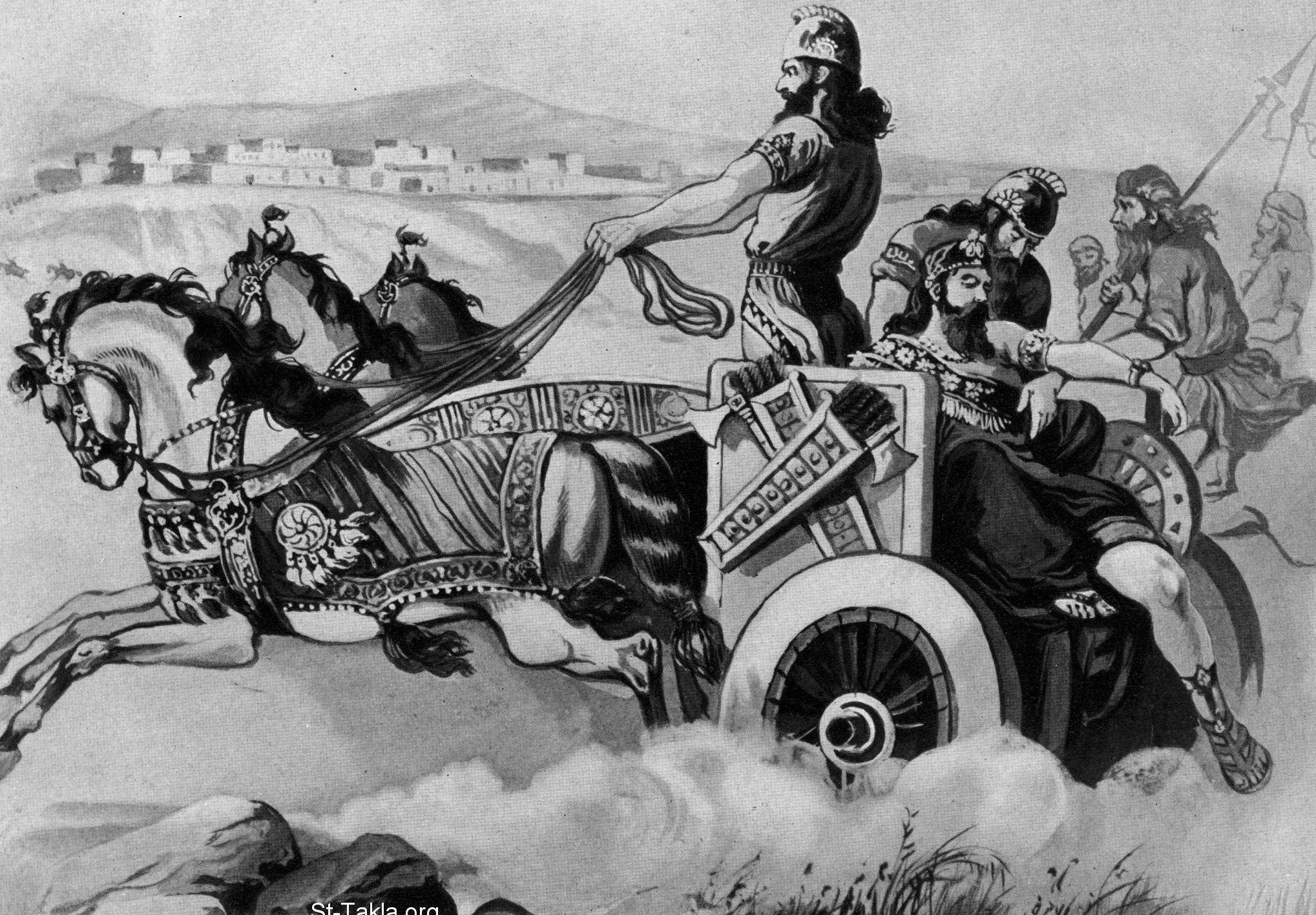
Ignorant of God’s plans, King Josiah decided to take matters into his own hands and led his troops into battle against the Egyptians. They intercepted the Egyptian army at a place called Megiddo and in the ensuing battle, King Josiah was killed. The author of 2 Kings states that “Pharaoh Neco killed him at Megiddo, as soon as he saw him” (2 Kings 23:29 ESV). But in 2 Chronicles 35, we’re told that Josiah had disguised himself. It seems that Josiah’s little ploy to hide his kingly identity failed. King Neco recognized Josiah instantly and ordered his death.

But the enemy archers hit King Josiah with their arrows and wounded him. He cried out to his men, “Take me from the battle, for I am badly wounded!” – 2 Chronicles 35:23 NLT

The wounded king was placed in another chariot and returned to the city of Jerusalem, where he died. After giving their fallen king a state funeral, the people chose Jehoahaz as his replacement. This choice seems a bit odd because Jehoahaz was Josiah’s middle son and, therefore, not the next in line to the throne. But it seems that the people were looking for a king who would bring back the old way of life to which they had grown accustomed. They missed the days of Manasseh and were regretting all the reforms that Josiah had instituted in Judah. So, they chose the son of Josiah who represented their best chance at bringing back the good old days. And it appears that picked just the right man for the job.

He did what was evil in the Lord’s sight, just as his ancestors had done. – 2 Kings 23:32 NLT

But Jehoahaz’s reign would be short-lived. The people failed to take into account that King Neco might have something to say about who took Josiah’s place on the throne of Judah. Just three months into his reign, Jehoahaz was deposed by the Pharaoh and taken captive to Egypt, where he died. Neco filled the vacancy with Eliakim, the older brother of Jehoahaz, and changed his name to Jehoiakim. This young man became little more than a vassal to the Pharaoh and was forced to make an annual tribute payment to the Egyptians. To do this, he imposed a debilitating tax on the people of Judah. The prophet provides a brief but sobering summary of the sad state of affairs in the southern kingdom of Judah after the death of Josiah.

Do not weep for the dead king or mourn his loss.
    Instead, weep for the captive king being led away!
    For he will never return to see his native land again.

For this is what the Lord says about Jehoahaz, who succeeded his father, King Josiah, and was taken away as a captive: “He will never return. He will die in a distant land and will never again see his own country.” – Jeremiah 22:10-12 NLT

With Josiah’s death, the period of reformation in Judah came to an abrupt end. He had been the heart and soul behind all the changes that had taken place. And without him, the people would revert to their old ways. Virtually overnight, the conditions in Judah took a dramatic turn for the worse. Judah was now a vassal state, ruled by a puppet king who answered to the Pharaoh of Egypt. Josiah’s attempt to stop the Egyptians from joining forces with the Assyrians had failed. In 605 BC, just four years after Josiah’s death, these two armies would be defeated by the Babylonians at the Battle of Carchemish. This unexpected victory by the Babylonians over the Egyptians and Assyrians would prove to be a game-changing event in the history of the middle east. It was catapult Nebuchadnezzar, the king of Babylon, into the role of the most powerful ruler on earth. With his defeat of the Assyrians, Nebuchadnezzar took over all the lands they had conquered, dramatically increasing the size and influence of his empire.

Eventually, the Babylonians would rest control of Judah from the hands of King Neco of Egypt. And Jehoiakim would find himself answering to yet another, more powerful, king. But as we will see, Jehoiakim will try to resist his new overlord, refusing to submit to his authority. Like his father, Josiah, Jehoiakim fails to see the sovereign hand of God behind all that is taking place. He is short-sighted in his outlook, and intent on making the most of his less-than-ideal circumstances. And the prophet Jeremiah records God’s stinging condemnation of Jehoiakim’s arrogant and self-centered approach to leadership.

And the Lord says, “What sorrow awaits Jehoiakim,
    who builds his palace with forced labor.
He builds injustice into its walls,
    for he makes his neighbors work for nothing.
    He does not pay them for their labor.
He says, ‘I will build a magnificent palace
    with huge rooms and many windows.
I will panel it throughout with fragrant cedar
    and paint it a lovely red.’
But a beautiful cedar palace does not make a great king!
    Your father, Josiah, also had plenty to eat and drink.
But he was just and right in all his dealings.
    That is why God blessed him.
He gave justice and help to the poor and needy,
    and everything went well for him.
Isn’t that what it means to know me?”
    says the Lord.
“But you! You have eyes only for greed and dishonesty!
    You murder the innocent,
    oppress the poor, and reign ruthlessly.” – Jeremiah 22:13-17 NLT

Unlike his reform-minded father, Jehoiakim had no heart for God. He was a self-obsessed man who used his power and position to improve his own lot in life while allowing the nation of Judah to continue its slide into apostasy. When Neco was forced to abandon his hold on Judah, Jehoiakim saw it as an opportunity to assert his independence. But he failed to understand the gravity of his situation. He had no clue that Nebuchadnezzar and the Babylonians had been chosen by God to bring judgment against the nation of Judah. In attempting to resist the Babylonians, Jehoiakim was actually opposing the will of God. And he would pay dearly for his obstinance. For three years, God would send the Babylonians, Arameans, Moabites, and Ammonites against the rebellious nation of Judah. And the author leaves no doubt as to the purpose behind these raids.

These disasters happened to Judah because of the Lord’s command. He had decided to banish Judah from his presence because of the many sins of Manasseh. – 2 Kings 24:3 NLT

Little did Jehoiakim know that he was facing the beginning of the end. The coming judgment of Judah was imminent and unavoidable.

English Standard Version (ESV) The Holy Bible, English Standard Version. ESV® Permanent Text Edition® (2016). Copyright © 2001 by Crossway Bibles, a publishing ministry of Good News Publishers.

New Living Translation (NLT) Holy Bible, New Living Translation, copyright © 1996, 2004, 2015 by Tyndale House Foundation. Used by permission of Tyndale House Publishers Inc., Carol Stream, Illinois 60188. All rights reserved.

The Message (MSG)Copyright © 1993, 1994, 1995, 1996, 2000, 2001, 2002 by Eugene H. Peterson
To God Be the Glory

27 And they came again to Jerusalem. And as he was walking in the temple, the chief priests and the scribes and the elders came to him, 28 and they said to him, “By what authority are you doing these things, or who gave you this authority to do them?” 29 Jesus said to them, “I will ask you one question; answer me, and I will tell you by what authority I do these things. 30 Was the baptism of John from heaven or from man? Answer me.” 31 And they discussed it with one another, saying, “If we say, ‘From heaven,’ he will say, ‘Why then did you not believe him?’ 32 But shall we say, ‘From man’?”—they were afraid of the people, for they all held that John really was a prophet. 33 So they answered Jesus, “We do not know.” And Jesus said to them, “Neither will I tell you by what authority I do these things.” – Mark 11:27-33 ESV

For the disciples, it probably didn’t take long before the image of the withered fig tree was replaced with the thought of being able to wield power that could cast mountains into the sea. These men had a habit of hearing only what they wanted to hear when Jesus spoke. The true meanings behind most of His lessons tended to escape them. And this one had been no different. When they had heard Jesus say, “I tell you, you can pray for anything, and if you believe that you’ve received it, it will be yours” (Mark 11:24 NLT), they were probably thrilled. The very thought of having their every wish fulfilled, only by asking God, would have been a dream come true. And it’s fair to assume that the initial ideas that filled their heads were not what Jesus had in mind.

So, as they left the withered tree behind and continued their trip into the city of Jerusalem, the disciples were probably deep in thought about all the incredible implications behind what Jesus had just told them. But soon, they found themselves back in the temple courtyard, standing in the very place where Jesus had staged a one-man riot the day before. Less than 24-hours earlier, Jesus had ransacked the booths of the vendors selling overpriced sacrificial animals. He had overturned the tables of the moneychangers who were charging high fees to the thousands of foreign pilgrims who needed temple currency to purchase their sacrificial offerings. Driven by righteous indignation and motivated by zeal for the holiness of His Father’s house, Jesus had turned the carnival-like atmosphere of the temple courtyard into chaos and confusion.

Now, He had returned, and the first people to greet Him were “the chief priests and the scribes and the elders” (Mark 11:27 ESV). These were the representatives of the Sanhedrin, the high council of the Jews. This august body was comprised of some of the most wealthy and influential men in the city of Jerusalem. They also happened to be members of the primary religious sects within Judaism: The Sadducees, Pharisees, and Essenes. Some were experts in the Mosaic Law. And all were knowledgeable of the Hebrew Scriptures. They were powerful men who wielded great authority and saw Jesus as a threat to their way of life. And His little escapade the day before had been a public attack on the entire system of greed and graft for which they were responsible.

So, when they saw Jesus, they immediately confronted Him, demanding to know the reasons for His unacceptable and costly actions the day before.

“By what authority are you doing these things, or who gave you this authority to do them?” – Mark 11:28 ESV

By this time, the damage Jesus had done the previous afternoon had been repaired, and things had returned to normal. These men were probably there to protect their investments and to ensure that there would be no repeat performance of the previous day’s disruptive and costly episode.

Their question to Jesus revolved around authority. In essence, they were asking Jesus to explain why He thought He had the right to do what He did. And they seem to fear that He might try to do it again. The actions of Jesus had been a direct assault on their authority as the religious leaders of Israel. In their minds, Jesus had invaded their territory and begun a war on their way of life. And as the supreme rulers over the nation, they saw His actions as nothing less than insurrection. He was attacking their right to rule, and they wanted to know what possessed Him to do such a thing.

Jesus could have answered their question by declaring Himself to be the Son of God. He could have told them that He was the long-awaited Messiah of Israel. He was “the anointed one” (Hebrew – mashiyach). But He knew they would refuse to accept those answers. In their minds, they had already determined that Jesus had no authority. He was a loose cannon, operating on His own initiative and in direct opposition to their authority. And nothing Jesus could say would change their minds.

So, Jesus made them a proposition. He offered to answer their question, but only if they could answer one He had for them.

“Was the baptism of John from heaven or from man? Answer me.” – Mark 11:30 ESV

Jesus subtly changes the focus from Himself to John the Baptist. But notice that He kept the emphasis of His question on the topic of authority. By shifting their attention to John the Baptist, Jesus was forcing them to consider the true source of all authority.

John had burst onto the scene more than 33 years earlier. This strangely dressed man had suddenly shown up in the Judean wilderness, preaching a message that the Kingdom of Heaven was near and calling the people of Israel to repentance. And a large part of his ministry involved the baptism of all who were willing to repent and confess their sins.

People from Jerusalem and from all of Judea and all over the Jordan Valley went out to see and hear John. And when they confessed their sins, he baptized them in the Jordan River. – Matthew 3:5-6 NLT

John had attracted large crowds of people, who believed him to be a prophet of God. Even Herod Antipas, the Roman-appointed puppet-king of Israel, had understood John’s reputation among the people.

Herod wanted to kill John, but he was afraid of a riot, because all the people believed John was a prophet. – Matthew 14:5 NLT

Herod ultimately put John to death, but even this did nothing to diminish John’s standing among the people. So, when Jesus asked the religious leaders to state the source of John’s authority to baptize, He knew they would refuse to answer. No matter what they said, they would find themselves in a no-win situation. These men had no love affair with John. After all, while he had been alive, he had treated them with disrespect and disdain. At one point, he had publicly humiliated them, calling them a “brood of snakes” and exposing them as spiritual frauds.

“Who warned you to flee the coming wrath? Prove by the way you live that you have repented of your sins and turned to God. Don’t just say to each other, ‘We’re safe, for we are descendants of Abraham.’ That means nothing, for I tell you, God can create children of Abraham from these very stones. Even now the ax of God’s judgment is poised, ready to sever the roots of the trees. Yes, every tree that does not produce good fruit will be chopped down and thrown into the fire.” – Matthew 3:8-10 NLT

But if they gave the answer they wanted to give and said that John was operating on his own initiative, they faced the ire of the people. On the other hand, if they tried to placate the people by admitting that John’s authority was from heaven, it would reveal that their opposition to John had really been aimed at God.

After weighing all their options, the religious leaders decided that an admission of ignorance was the safest route to take. But when they failed to answer Jesus’ question, He refused to answer theirs. Their silence condemned them.

John had been a prophet sent by God. Everything he said and did was on behalf of God. His entire mission had been to herald the coming of the Messiah.

“I am the voice of one crying out in the wilderness, ‘Make straight the way of the Lord,’ as the prophet Isaiah said.” – John 1:23 ESV

And yet, the religious leaders of Israel had rejected his mission and message. When John had announced Jesus as “the Lamb of God, who takes away the sin of the world!” (John 1:29 ESV), the Pharisees, Sadducees, and scribes had refused to believe it. They attributed the miracles of Jesus to Satan. They condemned Him for His association with sinners. They accused Him of being a drunk. They spread rumors that He was illegitimate. They declared Him to be guilty of blasphemy for repeatedly claiming to be the Son of God. And this charge had led them to try and stone Him to death.

These men refused to accept Jesus because they could not bring themselves to believe that His power and authority were from God. While they were unable to explain how Jesus did all the things He did, they refused to even consider that He might actually be the Messiah. To do so would require that they relinquish their own authority, and their over-inflated egos wouldn’t allow them to do that.

Since they were unwilling to answer His question, Jesus responded, “Neither will I tell you by what authority I do these things” (Mark 11:33 ESV). He owed them no explanation. He had provided them with ample evidence that He was who He claimed to be. His miracles had spoken for themselves. And yet, time and time again, these stubbornly self-righteous men had refused to recognize and acknowledge the God-given authority of Jesus. And one of the greatest assessments of the sheer stupidity of their spiritual blindness came from the lips of a man who had been the undeserving recipient of Jesus’ divine authority.

“He healed my eyes, and yet you don’t know where he comes from? We know that God doesn’t listen to sinners, but he is ready to hear those who worship him and do his will. Ever since the world began, no one has been able to open the eyes of someone born blind. If this man were not from God, he couldn’t have done it.” – John 9:30-33 NLT

Now, back to the lesson of the withered fig tree. When the disciples had witnessed the remarkable power of Jesus to condemn the tree to death, they had been amazed. And when He had told them, “you can say to this mountain, ‘May you be lifted up and thrown into the sea,’ and it will happen” (Mark 11:23 NLT), they had been thrilled. He was offering them access to the same kind of authority He had. All they had to do was ask, and anything was possible. But there had been a caveat. Jesus had told them to “have faith in God” (Mark 11:22 ESV). This was not about their authority; it was about God’s. All that John had accomplished had been by God’s authority and for God’s glory. The same was true of Jesus. And the same was to be true of His disciples. The availability of God’s authority would be so they might accomplish God’s will and display His glory. The scribes and Pharisees were in it for their own glory. And Jesus was trying to help His disciples understand that faith in God was the key to bringing God glory, rather than self.

English Standard Version (ESV) The Holy Bible, English Standard Version. ESV® Permanent Text Edition® (2016). Copyright © 2001 by Crossway Bibles, a publishing ministry of Good News Publishers.

New Living Translation (NLT) Holy Bible, New Living Translation, copyright © 1996, 2004, 2015 by Tyndale House Foundation. Used by permission of Tyndale House Publishers Inc., Carol Stream, Illinois 60188. All rights reserved.

The Message (MSG)Copyright © 1993, 1994, 1995, 1996, 2000, 2001, 2002 by Eugene H. Peterson

Lord of the Sabbath

1 After this there was a feast of the Jews, and Jesus went up to Jerusalem.

2 Now there is in Jerusalem by the Sheep Gate a pool, in Aramaic called Bethesda, which has five roofed colonnades. 3 In these lay a multitude of invalids—blind, lame, and paralyzed. 5 One man was there who had been an invalid for thirty-eight years. 6 When Jesus saw him lying there and knew that he had already been there a long time, he said to him, “Do you want to be healed?” 7 The sick man answered him, “Sir, I have no one to put me into the pool when the water is stirred up, and while I am going another steps down before me.” 8 Jesus said to him, “Get up, take up your bed, and walk.” 9 And at once the man was healed, and he took up his bed and walked.

Now that day was the Sabbath. 10 So the Jews said to the man who had been healed, “It is the Sabbath, and it is not lawful for you to take up your bed.” 11 But he answered them, “The man who healed me, that man said to me, ‘Take up your bed, and walk.’” 12 They asked him, “Who is the man who said to you, ‘Take up your bed and walk’?” – John 5:1-12 ESV

With the opening of chapter 5, John begins to explore the growing tension between Jesus and the religious authorities. While the meeting between Jesus and Nicodemus, a Pharisees himself, had been somewhat controversial, it had remained cordial. But with Jesus’ return to Jerusalem, the anger and resentment of the Pharisees and Sadduccees will become increasingly more evident and intense.

John will not abandon the theme of belief that has characterized the first four chapters, but he will now juxtapose it with the growing unbelief of the religious elite of Israel. In a sense, John will use the Pharisees and Sadduccees as a counterpoint to Jesus. These men were to have been the shepherds of Israel, leading the people to the truth of God’s Word and exemplifying a life of obedience. But as John will point out, their legalistic, rule-keeping mindset and arrogant self-righteousness stand in stark contrast to Jesus’ commitment to put the will of God above all else.  

“For I have come down from heaven, not to do my own will but the will of him who sent me. And this is the will of him who sent me, that I should lose nothing of all that he has given me, but raise it up on the last day. For this is the will of my Father, that everyone who looks on the Son and believes in him should have eternal life, and I will raise him up on the last day.” – John 6:38-40 ESV

Jesus was on a mission and He would not allow anything or anyone to hinder Him fulfilling the role assigned to Him by His Heavenly Father. He had divine authority to do the things He did. As the Son of God, Jesus did not need the permission of the legal or religious authorities because He was acting on behalf of God Almighty. The will of God superseded that of all other human authorities and allowed Jesus to perform signs and wonders that appeared to contradict the laws of nature and violate the rules of men.

After His brief excursion into the northern region of Galilee, Jesus made a second trip to Jerusalem in order to attend yet another Jewish festival. There were three annual feasts that all Jewish males were required to attend: Passover, Pentecost, and Tabernacles. In recounting this particular story, John leaves the name of the festival out, evidently deeming it as irrelevant to the point he was trying to make.

But John was quite specific when describing the location for this event. The context was critical to understanding what is going on in the story. Jesus arrived at the Pool of Bethesda, just outside the walls of the temple compound. This was a well-known and well-trafficked spot in Jerusalem because the waters of the spring-fed pool were believed to have healing qualities. The setting is key to understanding what is about to take place. As John stated in verse 3, the pool was a magnet for the “blind, lame, and paralyzed.” They all made their way to the pool each day in the hopes that the miraculous powers of the water might make them whole.

While John pointed out that “a multitude of invalids” surrounded the pool, he focused his attention on one particular man whose paralytic condition had persisted for 38 years. It is not clear whether this man had been coming to the pool for nearly four decades or if this was his first time to seek help from its healing waters. But John’s emphasis on the length of time is meant to accentuate the hopelessness of the man’s plight. And Jesus, upon seeing the man, was immediately aware of the decades-long nature of his condition, which makes the question He asks sound so unnecessary and out-of-place.

“Do you want to be healed?” – John 5:6 ESV

Of course, he did. What kind of question is that to ask at a time like this? This poor man had somehow made it all the way to the pool, in spite of his paralysis. He would not have been lying beside the waters if he had not wanted to experience healing.

John does not explain why Jesus chose to single out this one man. There were obviously others at the pool that day, and each and every one of them was there hoping for the same thing: Healing. But Jesus chose to speak to this man. And in response to Jesus’ question, the man explained his plight.

“Sir, I have no one to put me into the pool when the water is stirred up, and while I am going another steps down before me.” – John 4:7 ESV

His problem was not a lack of desire, but it was a lack of opportunity and capacity. His paralysis made it physically impossible for him to pursuit healing. His very condition proved to be a barrier to ever seeing his greatest desire fulfilled. Evidently, the pool’s healing powers were only available when the water was “stirred up.” It was only at that particular moment that a miracle could be expected, but it was reserved for the one who entered the water first. And this man, completely incapacitated by his illness and without anyone to assist him, was left to watch and wait, helplessly and hopelessly.

The description of the man’s plight is meant to stir the heart of the reader. But it is also meant to reveal the spiritual condition of each and every human being as they stand in need of healing but without the means by which to avail themselves of it. The healing waters were within this man’s reach, but he lacked the power to enter them. In a sense, he couldn’t heal himself. He needed help. And this is where Jesus stepped in.

Jesus said to him, “Get up, take up your bed, and walk.” And at once the man was healed, and he took up his bed and walked. – John 5:8-9 ESV

With a word, Jesus provided what the man lacked: The power to change. In a split second, this hopeless, helpless, bed-ridden paralytic was transformed into a completely healthy and whole specimen of a man. And no waters were necessary. Jesus spoke and the man walked.

But right when the story should be taking a decidedly upbeat turn, John reveals an underlying tension. He rather abruptly states, “Now that day was the Sabbath” (John 5:9 ESV). Rather than mentioning the celebration that would have followed such a miraculous moment, John simply points out that this had all taken place on the Sabbath. It was a holy day and, as such, it was to have been a day of rest. 

This significant detail is meant to point out the seeming problem with what Jesus said to the man and all that followed. Jesus specifically instructed the man to take up his bed and walk. He could have just told him to walk. Why was it necessary for him to gather up his bedroll? Because it was the Sabbath. Jesus knew exactly what day it was and His instructions to the man were given with that knowledge in mind. And His words produced the desired results. Yes, the man was healed, but not only that, the Pharisees were incensed. These religious rule-keepers witnessed the man carrying his bed and immediately confronted him for his blatant violation of the Sabbath law.

“It is the Sabbath, and it is not lawful for you to take up your bed.” – John 5:10 ESV

It is not clear whether these men had witnessed the healing, but even if they had, they were more concerned with what they saw as a flagrant disregard for the Mosaic Law.

The man, unaware of who Jesus was, told the religious leaders that he was simply obeying the words of the one who had healed him. But they still demanded to know the identity of this Sabbath law-breaker.

Jesus had specifically chosen the Sabbath day to perform this miracle. And His instructions to the lame man had been very precise. This entire scene was designed to set up a contrast between Jesus, the Son of God, and the religious leaders of Israel. He was their Messiah, sent from God to deliver the people from their bondage to sin and death. And as the Savior of the world, He had divine authority to accomplish the will of His Father. But for the religious leaders, their sacred rules and regulations were more important than the will of God. In their minds, adherence to the Sabbath blinded them to the presence of their Savior.

Yet, Jesus would later inform the Pharisees, “the Son of Man is Lord, even over the Sabbath!” (Matthew 12:8 NLT). This was all about authority and authenticity. Jesus was the Son of God and the long-awaited Messiah. And His audacious decision to heal on the Sabbath was proof of His deity and His divine authority.

English Standard Version (ESV) The Holy Bible, English Standard Version. ESV® Permanent Text Edition® (2016). Copyright © 2001 by Crossway Bibles, a publishing ministry of Good News Publishers.

New Living Translation (NLT)
Holy Bible, New Living Translation, copyright © 1996, 2004, 2015 by Tyndale House Foundation. Used by permission of Tyndale House Publishers Inc., Carol Stream, Illinois 60188. All rights reserved.

The Message (MSG)Copyright © 1993, 1994, 1995, 1996, 2000, 2001, 2002 by Eugene H. Peterson

The Man Believed the Word

46 So he came again to Cana in Galilee, where he had made the water wine. And at Capernaum there was an official whose son was ill. 47 When this man heard that Jesus had come from Judea to Galilee, he went to him and asked him to come down and heal his son, for he was at the point of death. 48 So Jesus said to him, “Unless you see signs and wonders you will not believe.” 49 The official said to him, “Sir, come down before my child dies.” 50 Jesus said to him, “Go; your son will live.” The man believed the word that Jesus spoke to him and went on his way. 51 As he was going down, his servants met him and told him that his son was recovering. 52 So he asked them the hour when he began to get better, and they said to him, “Yesterday at the seventh hour the fever left him.” 53 The father knew that was the hour when Jesus had said to him, “Your son will live.” And he himself believed, and all his household. 54 This was now the second sign that Jesus did when he had come from Judea to Galilee. – John 4:46-54 ESV

After their two-day, unplanned stopover in Samaria, Jesus and His disciples left for the northern region of Galilee. He did so, in spite of the popular proverb He had quoted to His disciples: “a prophet has no honor in his own hometown” (John 4:44 ESV). Jesus was returning to Galilee, but He made His way to Cana, rather than His own hometown of Nazareth. He returned to the scene of His first miracle, where He had turned the water into wine.

In verse 45, John indicates that Jesus received a warm welcome in Galilee because many of the people had been eyewitnesses to the signs He had performed in Jerusalem during the Feast of Passover. With this reference to Jesus’ signs, John provides a link back to the miracle performed at the wedding feast in Cana. While the guests at the feast had no idea that Jesus had transformed ordinary water into wine, His disciples were fully aware of what had transpired.

This, the first of his signs, Jesus did at Cana in Galilee, and manifested his glory. And his disciples believed in him. – John 2:11 ESV

And when Jesus had gone on to perform additional signs in Jerusalem during the Passover festival, John records, “many believed in his name when they saw the signs that he was doing” (John 2:23 ESV).

The basis for their belief was the nature of the miraculous signs Jesus performed. And John makes it clear that the warm reception Jesus received in Galilee was due to “all that he had done in Jerusalem” (John 4:45 ESV). They too were attracted to and enamored by the miracles of Jesus. And His reputation as a miracle worker was spreading rapidly throughout all Israel. Which sets up the next encounter Jesus will experience.

While in Cana, Jesus received a visit from an unnamed government official who came seeking healing for his deathly-ill son. While we know little about this man, it is likely that he was a Jew who was in the employment of Herod Antipas, the unofficial “king” of the Jews, appointed by the Romans. This distraught father had made the 13-mile journey from Capernaum to Cana in the hopes that he could convince Jesus to return with him and heal his son.

But this man’s impassioned plea for help was met with what a somewhat caustic response from Jesus.

“Unless you see signs and wonders you will not believe.” – John 4:48 ESV

While it is unclear in our English translation, Jesus used the plural pronoun “you,” indicating that His comment was aimed at the Jewish people. Their belief in Him was fickle and focused solely on His ability to entertain them with His supernatural miracles. They loved the idea of a miracle-working Messiah. But Jesus had made it clear to Nicodemus that the key to eternal life was to believe in Him, not just the miracles He performed.

“Whoever believes in him is not condemned, but whoever does not believe is condemned already, because he has not believed in the name of the only Son of God.” – John 3:18 ESV

They were believing in the miracle-performing reputation of Jesus, but not in the name of Jesus. It was not enough that He came declaring Himself to be the Son of God. They needed proof. They demanded signs. And the apostle Paul would later condemn his own people for their stubborn refusal to acknowledge the greatest sign ever given that proved the deity of Jesus.

Since God in his wisdom saw to it that the world would never know him through human wisdom, he has used our foolish preaching to save those who believe. It is foolish to the Jews, who ask for signs from heaven. And it is foolish to the Greeks, who seek human wisdom. So when we preach that Christ was crucified, the Jews are offended and the Gentiles say it’s all nonsense. – 1 Corinthians 1:21-23 NLT

Undeterred by the seeming slight from Jesus, the desperate father begged Jesus to come to Capernaum and heal his son before it was too late. He was running out of time. His son was at death’s door and they still had a 13-mile journey ahead of them. If only he could get Jesus to agree to accompany him back to Capernaum, there might still be a chance that his son could live.

And Jesus answered the man’s impassioned plea with the simple response, “Go; your son will live” (John 4:50 ESV). On that matter-of-fact statement from the lips of Jesus, the official “believed what Jesus said and started home” (John 4:50 NLT). He didn’t argue. He didn’t continue to plead with Jesus to come with him. He simply turned and began the 13-mile return trip home – believing the words of Jesus. No sign. No miracle. No proof.

The belief this man exhibited was of a different sort that those in Cana who believed because of the signs Jesus had performed in Jerusalem. It stood in stark contrast to the belief of Jesus’ disciples which had been based on His ability to turn water into wine. This man had believed the words of Jesus. And this distinction is significant. It brings to mind the testimony of God Himself, spoken at the baptism of Jesus.

“This is my Son, my Chosen One; listen to him!” – Luke 9:35 ESV

The Jews were enamored by the works of Jesus but they refused to listen to His words. As long as He kept performing miracles, they kept believing, but that belief was misplaced. They were so busy seeking a sign, that they missed the Savior.

Later on in his gospel, John records the words of Jesus declaring the divine origin of His message.

“For I have not spoken on my own authority, but the Father who sent me has himself given me a commandment—what to say and what to speak.” – John 12:49 ESV

And this was not the first time Jesus had claimed His words to be divinely inspired and spoken on behalf of His heavenly Father.

“My teaching is not mine, but his who sent me. If anyone’s will is to do God’s will, he will know whether the teaching is from God or whether I am speaking on my own authority.” – John 7:16-17 ESV

The people should have been listening to the words of Jesus, but they were too busy focusing their attention on the works of Jesus. And with their obsession over His miracles, they were missing the meat of His message.

“Do you not believe that I am in the Father and the Father is in me? The words that I say to you I do not speak on my own authority, but the Father who dwells in me does his works. Believe me that I am in the Father and the Father is in me, or else believe on account of the works themselves.” –  John 14:10-11 ESV

In a sense, Jesus was stating that there were two sources of belief: His miracles or His message. But the truest form of belief was to receive the words of Jesus as the words of God because He spoke as God. And Jesus went on to assure His disciples that they too would go on to perform miracles and signs.

“Truly, truly, I say to you, whoever believes in me will also do the works that I do; and greater works than these will he do, because I am going to the Father. Whatever you ask in my name, this I will do, that the Father may be glorified in the Son. If you ask me anything in my name, I will do it.” – John 14:12-13 ESV

Their ability to perform miracles would be based on their belief in Him and who He claimed to be. He was the Son of God and had the full authority of God to share His power with those who placed their faith in Him.

John’s entire gospel is focused on the divinity of Jesus. He is declaring the divine Sonship of Jesus and providing indisputable proof that this Rabbi from Nazareth was indeed who He claimed to be: The Son of God and the Savior of the world.

And as further evidence of Jesus’ deity, John describes the scene that took place when the father ran into his servants on his way home. They met him alone the way with the good news that “his son was alive and well” (John 4:51 NLT). And when the father asked at what time his son had begun to improve, he was told, “Yesterday afternoon at one o’clock his fever suddenly disappeared!” (John 4:52 NLT). And John closes his account with the following words:

Then the father realized that that was the very time Jesus had told him, “Your son will live.” And he and his entire household believed in Jesus. – John 4:53 NLT

When Jesus had said, “Your son will live,” the man had taken Him at His word and headed home. Now, he received confirmation that His faith had been rewarded. His son was well. Jesus had spoken, the man had believed, and his son had been healed. But notice how John ends this story with the words, “he and his entire household believed in Jesus.”

Their belief was not in the miracle but in the one who had spoken the miracle into existence. They believed in Jesus. Their faith was not focused on the healing of their family member. It was directed at the one who spoke with the authority of God.

English Standard Version (ESV) The Holy Bible, English Standard Version. ESV® Permanent Text Edition® (2016). Copyright © 2001 by Crossway Bibles, a publishing ministry of Good News Publishers.

New Living Translation (NLT)
Holy Bible, New Living Translation, copyright © 1996, 2004, 2015 by Tyndale House Foundation. Used by permission of Tyndale House Publishers Inc., Carol Stream, Illinois 60188. All rights reserved.

The Message (MSG)Copyright © 1993, 1994, 1995, 1996, 2000, 2001, 2002 by Eugene H. Peterson

Building Up the Body

12 We ask you, brothers, to respect those who labor among you and are over you in the Lord and admonish you, 13 and to esteem them very highly in love because of their work. Be at peace among yourselves. 14 And we urge you, brothers, admonish the idle, encourage the fainthearted, help the weak, be patient with them all. 15 See that no one repays anyone evil for evil, but always seek to do good to one another and to everyone. 16 Rejoice always, 17 pray without ceasing, 18 give thanks in all circumstances; for this is the will of God in Christ Jesus for you. 19 Do not quench the Spirit. 20 Do not despise prophecies, 21 but test everything; hold fast what is good. 22 Abstain from every form of evil. – 1 Thessalonians 5:12-22 ESV

After providing the Thessalonians with some much-needed clarification and new information regarding the end times, Paul brings the focus of his letter back to the present day. The news he shared regarding the Rapture of the church and the Second Coming of Christ was intended to quell their fears and cause them to encourage and build up one another. For Paul, the unity and mutual edification of fellow believers were essential to the health and vitality of the church. He told the church in Corinth:

I appeal to you, dear brothers and sisters, by the authority of our Lord Jesus Christ, to live in harmony with each other. Let there be no divisions in the church. Rather, be of one mind, united in thought and purpose. – 1 Corinthians 1:10 NLT

He encouraged the believers in Rome to “Live in harmony with each other” (Romans 12:16 NLT). And he wrote to the believers in Philippi, charging them to conduct themselves “in a manner worthy of the Good News about Christ and to stand together “with one spirit and one purpose, fighting together for the faith, which is the Good News” (Philippians 1:27 NLT).

And Paul knew that unity within the body of Christ began with the people showing respect and submitting themselves to those whom God had placed as leaders over the church. In his letter to the church in Ephesus, Paul referred to apostles, prophets, evangelists, pastors, and teachers as gifts from God, tasked with equipping “God’s people to do his work and build up the church, the body of Christ” (Ephesians 4:11-12 NLT).

The author of the book of Hebrews adds his own admonition regarding respect for and submission to the God-appointed leaders in the church.

Obey your spiritual leaders, and do what they say. Their work is to watch over your souls, and they are accountable to God. Give them reason to do this with joy and not with sorrow. – Hebrews 13:17 NLT

Paul told the members of the church in Corinth to treat those who ministered among them with respect and “to submit to them and others like them who serve with such devotion” (1 Corinthians 16:16 NLT). So, when Paul tells the Thessalonians to “to respect those who labor among you” and “to esteem them very highly in love because of their work,” he is simply restating his strongly held belief in God’s authority structure for the local church.

It is important to remember that at the point Paul wrote this letter, the church of Jesus Christ was still in its infancy. Through the evangelistic efforts of Paul, Silas, Barnabas, Timothy, Peter and the other apostles, the Gospel had spread like wildfire throughout the Roman empire. And its rapid expansion had created a pressing need for leaders. The book of Acts records that, on one of their many missionary journeys, Paul and Barnabas made many disciples and “they strengthened the believers. They encouraged them to continue in the faith” (Acts 14:22 NLT). And Luke goes on to explain how “Paul and Barnabas also appointed elders in every church. With prayer and fasting, they turned the elders over to the care of the Lord, in whom they had put their trust” (Acts 14:23 NLT).

One of the primary responsibilities Paul gave to his young protégés, Titus and Timothy, was to appoint elders and leaders for the growing number of congregations springing up all over Macedonia, Asia Minor, Galatia, and Achaia. He told Titus, “I left you on the island of Crete so you could complete our work there and appoint elders in each town as I instructed you” (Titus 1:5 NLT). And Paul gave Timothy very specific characteristics to look for when seeking out men to lead the church.

…a church leader must be a man whose life is above reproach. He must be faithful to his wife. He must exercise self-control, live wisely, and have a good reputation. He must enjoy having guests in his home, and he must be able to teach. He must not be a heavy drinkerc or be violent. He must be gentle, not quarrelsome, and not love money. He must manage his own family well, having children who respect and obey him. For if a man cannot manage his own household, how can he take care of God’s church? – 1 Timothy 3:2-5 NLT

These men were not to be new converts to the faith. Their lives were to be characterized by a level of integrity that garnered the respect of those inside and outside of the church. As Paul told Titus, these individuals were God-appointed leaders who were to be held to a high standard.

A church leader is a manager of God’s household, so he must live a blameless life. He must not be arrogant or quick-tempered; he must not be a heavy drinker, violent, or dishonest with money. – Titus 1:5 NLT

And when these men taught, led, fed, encouraged, or admonished the flock of God, they were to be treated with respect and love by those under their care.

But along with godly leadership, Paul knew there was a need for mutual accountability and compassionate care among the congregation. The church was the body of Christ. It was an organism, not an organization. And Paul wanted the Thessalonians to understand their mutual responsibility to care for and build up one another, which led him to write, “admonish the idle, encourage the fainthearted, help the weak, be patient with them all” (1 Thessalonians 5:14 NLT).

In his letters to the churches in Rome and Corinth, Paul compared the church to the human body.

Just as our bodies have many parts and each part has a special function, so it is with Christ’s body. We are many parts of one body, and we all belong to each other. – Romans 12:4-5 NLT

The human body has many parts, but the many parts make up one whole body. So it is with the body of Christ. – 1 Corinthians 12:12 NLT

And, as in the human body, the diversity of parts was part of God’s plan for maintaining unity and vitality. Each member of the body of Christ had a personal responsibility to use his or her gifts for the good of the whole. There was no place for selfishness or self-centeredness. God designed the body of Christ to operate in a spirit of solidarity, not solitariness.

So if God has given you the ability to prophesy, speak out with as much faith as God has given you. If your gift is serving others, serve them well. If you are a teacher, teach well. If your gift is to encourage others, be encouraging. If it is giving, give generously. If God has given you leadership ability, take the responsibility seriously. And if you have a gift for showing kindness to others, do it gladly.

Don’t just pretend to love others. Really love them. – 1 Corinthians 12:6-9 NLT

And Paul lets the Thessalonians know that the love God expected them to express toward one another was to consist of equal parts love, admonishment, comfort, help, and patience. They were to pursue what was best for one another, putting the needs of others ahead of their own. There was no place for disunity, dissension, lack of discipline, laziness, self-centeredness, or selfishness in the body of Christ.

In fact, as far as Paul was concerned, Christ’s church was to be characterized by continuous rejoicing, constant prayer, and contagious gratitude to God for all that He has done. And Paul makes it plain that these characteristics were in keeping with the will of God for the church. When the body of Christ operates outside those parameters, it runs the risk of extinguishing the work of the Spirit in their midst. Ungodly behavior among God’s people is unacceptable and has the same effect on the Spirit’s power as water being poured on an open flame. When members of the body of Christ fail to live in unity and refuse to minister to one another with a focus on community, the Spirit of God is grieved.

Let everything you say be good and helpful, so that your words will be an encouragement to those who hear them. And do not bring sorrow to God’s Holy Spirit by the way you live. – Ephesians 4:29-30 NLT

And, as if to illustrate all that he has just said, Paul warns the Thessalonians to “not treat prophecies with contempt” (1 Thessalonians 5:20 NET). This statement ties in Paul’s teaching on the end times and his admonition that the Thessalonians respect those who labor among them. Paul had provided them new teaching about the Rapture and the Second Coming of Christ. And, as difficult as these new revelations might be to understand, he expected them to receive them as coming from God. He invited them to “test everything” and to “hold fast what is good,” but they were not to treat the words of God contemptuously. The Greek word Paul uses means “to make of no account.” While they were free to examine and test these new teachings, they were not to throw them out just because they were difficult to understand or hard to accept.

So much of what they were hearing was new to them. The Bible as we know it did not yet exist. Like many of the other letters Paul wrote, this one would eventually become part of the Canon of Scripture. But at this point in the history of the church, the doctrines and theology with which we are intimately familiar were still in the process of being determined and disseminated. This meant that the members of the local churches were going to have to trust leaders like Paul, whom God had placed over them. And, as Paul concludes in this section, it also meant that they were going to have to avoid “every form of evil.”

Paul expands on this thought in his letter to the church in Rome.

Hate what is wrong. Hold tightly to what is good. Love each other with genuine affection, and take delight in honoring each other. Never be lazy, but work hard and serve the Lord enthusiastically. Rejoice in our confident hope. Be patient in trouble, and keep on praying. When God’s people are in need, be ready to help them. Always be eager to practice hospitality. – Romans 12:9-13 NLT

The body of Christ is to be a wonderful demonstration of unity, community, love, and mutual care, empowered by the Spirit of God and for the building up of the people of God.

English Standard Version (ESV)
The Holy Bible, English Standard Version. ESV® Permanent Text Edition® (2016). Copyright © 2001 by Crossway Bibles, a publishing ministry of Good News Publishers.

New Living Translation (NLT)
Holy Bible, New Living Translation, copyright © 1996, 2004, 2015 by Tyndale House Foundation. Used by permission of Tyndale House Publishers Inc., Carol Stream, Illinois 60188. All rights reserved.

The Message (MSG)Copyright © 1993, 1994, 1995, 1996, 2000, 2001, 2002 by Eugene H. Peterson

Not In It For What They Could Get Out Of It

1 For you yourselves know, brothers, that our coming to you was not in vain. 2 But though we had already suffered and been shamefully treated at Philippi, as you know, we had boldness in our God to declare to you the gospel of God in the midst of much conflict. 3 For our appeal does not spring from error or impurity or any attempt to deceive, 4 but just as we have been approved by God to be entrusted with the gospel, so we speak, not to please man, but to please God who tests our hearts. 5 For we never came with words of flattery, as you know, nor with a pretext for greed—God is witness. 6 Nor did we seek glory from people, whether from you or from others, though we could have made demands as apostles of Christ. 7 But we were gentle among you, like a nursing mother taking care of her own children. 8 So, being affectionately desirous of you, we were ready to share with you not only the gospel of God but also our own selves, because you had become very dear to us. – 1 Thessalonians 2:1-8 ESV

Paul was under constant pressure to defend his apostleship. While not one of the original 12 disciples of Jesus, Paul had received his commission to take the gospel to the Gentiles directly from Jesus Christ Himself. But his opponents, of which there were many, questioned the validity of his claim to be an emissary of Christ. And so, they would attempt to undermine his ministry by raising doubts concerning his authority to speak and the veracity of his message. He was just a man, they claimed. His message was not from God, but nothing more than the self-delusional rants of a self-appointed apostle.

So, Paul was forced to validate his ministry and message. In the opening line of his letter to the Galatian church, Paul wrote: “Paul, an apostle—not from men nor through man, but through Jesus Christ and God the Father” (Galatians 1:1 ESV). Just a few verses later, Paul told them:

For I would have you know, brothers, that the gospel that was preached by me is not man’s gospel. For I did not receive it from any man, nor was I taught it, but I received it through a revelation of Jesus Christ. – Galatians 1:11-12 ESV

And Paul went on to explain to them how that revelation came about.

For you have heard of my former life in Judaism, how I persecuted the church of God violently and tried to destroy it. And I was advancing in Judaism beyond many of my own age among my people, so extremely zealous was I for the traditions of my fathers. But when he who had set me apart before I was born, and who called me by his grace, was pleased to reveal his Son to me, in order that I might preach him among the Gentiles… – Galatians 1:13-16 ESV

Luke, the author of the Book of Acts, confirms Paul’s description of that event and provides us with further details.

Saul was uttering threats with every breath and was eager to kill the Lord’s followers. So he went to the high priest. He requested letters addressed to the synagogues in Damascus, asking for their cooperation in the arrest of any followers of the Way he found there. He wanted to bring them—both men and women—back to Jerusalem in chains. – Acts 9:1-2 ESV

But while on his way to Damascus, fully intending to continue his persecution of the followers of Jesus, Paul had a life-changing encounter.

As he was approaching Damascus on this mission, a light from heaven suddenly shone down around him. He fell to the ground and heard a voice saying to him, “Saul! Saul! Why are you persecuting me?”

“Who are you, lord?” Saul asked.

And the voice replied, “I am Jesus, the one you are persecuting! Now get up and go into the city, and you will be told what you must do.” – Acts 9:3-6 ESV

Saul (his Hebrew name), blinded by the light and bewildered by this unexpected change in his itinerary, made his way to Damascus. In the meantime, God appeared in a vision to Ananias, a Christ-follower living in the city, informing him to lay hands on Paul to restore his sight. Ananias expressed his reluctance because of Paul’s reputation for animosity against Christians, but God insisted that this was all part of His divine plan for Paul.

“Go, for Saul is my chosen instrument to take my message to the Gentiles and to kings, as well as to the people of Israel. And I will show him how much he must suffer for my name’s sake.” – Acts 9:15-16 ESV

And years later, Paul would stand before King Agrippa and recount the story of his conversion on the road to Damascus. And he would add the words of the message he received when Christ confronted him.

“But rise and stand upon your feet, for I have appeared to you for this purpose, to appoint you as a servant and witness to the things in which you have seen me and to those in which I will appear to you, delivering you from your people and from the Gentiles—to whom I am sending you to open their eyes, so that they may turn from darkness to light and from the power of Satan to God, that they may receive forgiveness of sins and a place among those who are sanctified by faith in me.” – Acts 26:16-18 ESV

But what does all this have to do with chapter 2 of the book of 1 Thessalonians? Everything. Because in this chapter, Paul is reminding the believers in Thessalonica of the day when he and Silas first appeared in their city more than a year earlier. In the interim, enemies of Paul had been spreading rumors and suggesting that he was not what he claimed to be. They had been casting dispersion on both his message and his motives.

Yet Paul reminds them that he and Silas had arrived in their city after having been beaten and imprisoned in Philippi. The city officials in Philippi had forced them to vacate the premises because their presence had resulted in a riot. And Paul reminds the Thessanlonians:

But though we had already suffered and been shamefully treated at Philippi, as you know, we had boldness in our God to declare to you the gospel of God in the midst of much conflict. – 1 Thessalonians 2:2 ESV

If Paul was claiming to be an apostle in order to get rich or famous, he was less than successful in his efforts. He wanted the believers in Thessalonica to know that his only motivation was to declare to them the gospel of God – even in the midst of conflict.

And Paul had the same message for the believers in Galatia. If he was simply out to gain the favor of men, he was failing miserably. In fact, if Paul had wanted to win a popularity contest, the last thing he would do is present himself as an apostle of Christ with a controversial message of sin, judgment, and salvation. That’s why Paul told the Galatians:

For am I now seeking the approval of man, or of God? Or am I trying to please man? If I were still trying to please man, I would not be a servant of Christ. – Galatians 1:10 ESV

And Paul assured the Thessalonians believers that, despite what others were saying, he and Silas had been anything but deceptive or dishonest in their motivation.

For our appeal does not spring from error or impurity or any attempt to deceive… – 1 Thessalonians 2:3 ESV

They had not been out to please men, seek glory, or get rich. But they had been approved by God and entrusted with the gospel message. That’s why, when they had suffered in Philippi, they hadn’t abandoned their mission, but continued their efforts to spread the gospel – even in the face of extreme opposition and personal pain. If Paul and Silas had been in it for what they could get out of it, they would have thrown in the towel a long time ago. But as Paul makes clear, their motivation had been and continued to be pure.

Our purpose is to please God, not people. He alone examines the motives of our hearts. Never once did we try to win you with flattery, as you well know. And God is our witness that we were not pretending to be your friends just to get your money! As for human praise, we have never sought it from you or anyone else. – 1 Thessalonians 2:4-6 NLT

Paul was anything but a people-pleaser. And his message was far from politically correct. He was an in-your-face, no-holds-barred kind of guy who delivered the message of the gospel unapologetically and with no attempt to water it down to make it more palatable and acceptable.

In taking the gospel to the Gentiles, Paul had faced opposition from the Jewish believers in Jerusalem, who still questioned the validity of uncircumcised Gentiles having access to salvation. If nothing else, they believed these Gentiles had to convert to Judaism first. But Paul had stood his ground, demanding that the gospel message put no such requirements on Gentile converts. Salvation was based on God’s grace alone through faith alone in Christ alone. Nothing more. Nothing less.

And Paul had also faced opposition from the Gentiles, who resisted his efforts to convert their people to this new religion or cult, called The Way. Paul’s message of the gospel was resulting in conversions among the Gentiles, leading these new believers to walk away from their false gods and their old ways of life in order to serve the one true God. Because the gospel brought about life change, these conversions were having an influence on the local communities and their economies. And, according to Luke, that’s exactly what happened in the city of Ephesus.

Many who became believers confessed their sinful practices. A number of them who had been practicing sorcery brought their incantation books and burned them at a public bonfire. The value of the books was several million dollars. – Acts 19:18-19 NLT

The gospel was powerfully transformative. It changed lives. And that was why Paul was committed to carrying out his God-ordained mission to share the gospel. He was motivated by love and compassion, not greed and fame. And he reminded the Thessalonians that he and Silas had come to them like innocent children, free from guile and with no ulterior motives. They had displayed the same kind of love as a mother who feeds and cares for her children. She does so sacrificially and willingly, and not for what she can get out of it.

And Paul assured them that “We loved you so much that we shared with you not only God’s Good News but our own lives, too” (1 Thessalonians 2:8 NLT). They had given their lives away. They had sacrificed. Rather than demand payment for their services, they had willingly shared all that they had. And they had risked all for the sake of the gospel and the salvation of the handful of Thessalonians who had heard and received it.

English Standard Version (ESV)
The Holy Bible, English Standard Version. ESV® Permanent Text Edition® (2016). Copyright © 2001 by Crossway Bibles, a publishing ministry of Good News Publishers.

New Living Translation (NLT)
Holy Bible, New Living Translation, copyright © 1996, 2004, 2015 by Tyndale House Foundation. Used by permission of Tyndale House Publishers Inc., Carol Stream, Illinois 60188. All rights reserved.

The Message (MSG)Copyright © 1993, 1994, 1995, 1996, 2000, 2001, 2002 by Eugene H. Peterson

Lord and King

41 Now while the Pharisees were gathered together, Jesus asked them a question, 42 saying, “What do you think about the Christ? Whose son is he?” They said to him, “The son of David.” 43 He said to them, “How is it then that David, in the Spirit, calls him Lord, saying,

44 “‘The Lord said to my Lord,
“Sit at my right hand,
    until I put your enemies under your feet”’?

45 If then David calls him Lord, how is he his son?” 46 And no one was able to answer him a word, nor from that day did anyone dare to ask him any more questions. –  Matthew 22:41-46 ESV

001-lost-sheep.jpg

We are quickly coming to the end of Matthew’s chronicle of the earthly ministry of Jesus. As we read through the events surrounding the last week of His life, we should begin to recognize that this is really about two kingdoms in conflict – the one the Pharisees and religious leaders had come to know, love and control; and the one that Jesus had come to establish. As John the Baptist began his ministry, paving the way for the coming of the Messiah, he had told the people of Israel, “Repent of your sins and turn to God, for the Kingdom of Heaven is near” (Matthew 3:2 NLT).

His call to repentance was not just an encouragement to change their behavior, it was a demand that they change their minds, their way of thinking. John was calling them to alter their preconceived notions about God, their concept of sin, the kingdom, the Messiah, and the means by which man can be restored to a right relationship with God. Repentance would require them to do an about-face concerning what they currently believed about all of those things. And that change of mind and heart would result in a change in behavior.

In the world into which Jesus came, the Jewish people had strong opinions about these matters, the byproduct of centuries of man-made decrees and religious doctrines and dogma. They thought they had God figured out and were convinced that they knew what they had to do to deal with sin. But they had grown callous to God and carefree about their own sin, justifying their actions and downplaying their own guilt. They put a lot of stock in their position as descendants of Abraham and in their unique status as God’s chosen people. But John the Baptist had come preaching a call to repentance. He had told them that the Kingdom of Heaven was close at hand. And Jesus came preaching that very same message, telling them, “Repent of your sins and turn to God, for the Kingdom of Heaven is near” (Matthew 4:17 NLT).

The Kingdom of Heaven was NEAR – in the form of the King of Heaven – Jesus Himself. This was a statement of authority and divine representation. Jesus was Emmanuel – God with us. He was the one true King. But the Jewish people failed to recognize Him as such.

Which brings us to today’s passage, where we see Jesus still sparring with the religious leaders of Israel. He had weathered a relentless gauntlet of questions from these men, as they attempted to expose and entrap Him. But this time Jesus turned the tables on them by requiring them to answer a question from Him. In doing so, He reveals some Messianic misconceptions on their part. He exposes their faulty views of who the Messiah would be and what He would do when He came.

Jesus asked them a very simple, yet revealing question: “What do you think about the Messiah? Whose son is he?” (Matthew 22:42a NLT). Jesus already knew what their response would be, and that answer would reveal a lot about their understanding of not only the Messiah but of His coming Kingdom.

“They replied, ‘He is the son of David.’” – Matthew 22:42b NLT

So, what does this answer tell us about their view of the Messiah? They believed the Messiah would be a descendant of David. But it also reveals that they viewed the Messiah’s kingdom would be of this earth and not heavenly in nature. In other words, they were anticipating a king just like David had been. They were expecting a ruler, a royal heir to David, who would wear his crown and sit on his throne, re-establishing Israel’s power in the region. They weren’t looking for a Savior from sin, but a deliverer from subjugation to Rome.

So, Jesus asked them a qualifying question: “How is it then that David, in the Spirit, calls him Lord, saying, ‘The Lord said to my Lord, “Sit at my right hand, until I put your enemies under your feet”’?” (Matthew 22:44 ESV).

At first glance, it sounds like Jesus is posing some kind of riddle or trick question. But He was quoting from a well-known Messianic passage found in Psalm 110:1. The Pharisees would have understood this passage as applying to the coming Messiah, or Davidic descendant. In fact, over the centuries, this psalm had been applied to each successive king in the Davidic dynasty and was used to refer to the ideal Davidic king. As a result, they would have been very familiar with the passage and its application to the coming Messiah. So, Jesus pointed out that in the psalm, David calls the Messiah his Lord.

If the coming Messiah was to be a “son” or descendant of David, the greatest king Israel had ever had, why would David call this man his “Lord?” To understand this question, you have to recognize that there are two different words used for “Lord” in Psalm 110. The first is Jehovah, a noun used to refer to God. It is the proper name of the God of Israel. The second word is adon, a noun that means “lord” or “master”. But when used in conjunction with Lord (Jehovah), it typically refers to God’s sovereignty or authority. So, you could read the line in Psalm 110 this way: The LORD (God) said to my (David’s) Lord (Messiah)…

The point Jesus was making was that David knew something about the Messiah that the Pharisees did not. That’s why Jesus asked them a further question: “Since David called the Messiah ‘my Lord,’ how can the Messiah be his son?” (Matthew 22:45 NLT). The Pharisees had a limited view of the Messiah. They believed He would be an earthly, physical, and fully human descendant of David, nothing more, nothing less. But Jesus’ point was that David seemed to know that the Messiah would be MORE than just a descendant. He would be divine and have God-given authority to rule and reign over God’s Kingdom. He would be David’s LORD and Master. He would be a divinely appointed ruler with power and authority far beyond anything David had known.

But the Pharisees couldn’t bring themselves to see or acknowledge this. Jesus was not what they were expecting and not what they wanted. He didn’t look like a king. He didn’t act like a king. And the Israelites wanted a king just like all the other nations. They wanted a king on their terms and according to their definition. It was the very same problem their ancestors had when they had demanded that the prophet Samuel appoint them a king like all the other nations.

They had rejected God as their King and, in response, God had given them Saul. Now, centuries later, they were demanding the same thing. But God was not going to give them another Saul. He was going to give them another David, an actual descendant of David, but a man greater than David had ever been. He would be the God-man, the Son of God, and the ultimate Savior of the world.

This whole exchange left the Pharisees stumped. For the first time, they had no response and no more questions. “And no one was able to answer him a word, nor from that day did anyone dare to ask him any more questions.” (Matthew 22:46 ESV).

This doesn’t mean they were giving up. They were simply changing their tactics. Their views had not changed. They remained unrepentant, refusing to change their minds about God, the Messiah, the Kingdom, and about their own sins. They refused to acknowledge Jesus as the Messiah. They stubbornly rejected any call to admit their own sin and their need for a Savior. They were not buying what Jesus was selling. And they would live to regret it.

English Standard Version (ESV)
The Holy Bible, English Standard Version. ESV® Permanent Text Edition® (2016). Copyright © 2001 by Crossway Bibles, a publishing ministry of Good News Publishers.

New Living Translation (NLT)
Holy Bible, New Living Translation, copyright © 1996, 2004, 2015 by Tyndale House Foundation. Used by permission of Tyndale House Publishers Inc., Carol Stream, Illinois 60188. All rights reserved.

The Message (MSG)Copyright © 1993, 1994, 1995, 1996, 2000, 2001, 2002 by Eugene H. Peterson

Rejected, But Still Ruling

28 “What do you think? A man had two sons. And he went to the first and said, ‘Son, go and work in the vineyard today.’ 29 And he answered, ‘I will not,’ but afterward he changed his mind and went. 30 And he went to the other son and said the same. And he answered, ‘I go, sir,’ but did not go. 31 Which of the two did the will of his father?” They said, “The first.” Jesus said to them, “Truly, I say to you, the tax collectors and the prostitutes go into the kingdom of God before you. 32 For John came to you in the way of righteousness, and you did not believe him, but the tax collectors and the prostitutes believed him. And even when you saw it, you did not afterward change your minds and believe him.

33 “Hear another parable. There was a master of a house who planted a vineyard and put a fence around it and dug a winepress in it and built a tower and leased it to tenants, and went into another country. 34 When the season for fruit drew near, he sent his servants to the tenants to get his fruit. 35 And the tenants took his servants and beat one, killed another, and stoned another. 36 Again he sent other servants, more than the first. And they did the same to them. 37 Finally he sent his son to them, saying, ‘They will respect my son.’ 38 But when the tenants saw the son, they said to themselves, ‘This is the heir. Come, let us kill him and have his inheritance.’ 39 And they took him and threw him out of the vineyard and killed him. 40 When therefore the owner of the vineyard comes, what will he do to those tenants?” 41 They said to him, “He will put those wretches to a miserable death and let out the vineyard to other tenants who will give him the fruits in their seasons.”

42 Jesus said to them, “Have you never read in the Scriptures:

“‘The stone that the builders rejected
    has become the cornerstone;
this was the Lord’s doing,
    and it is marvelous in our eyes’?

43 Therefore I tell you, the kingdom of God will be taken away from you and given to a people producing its fruits. 44 And the one who falls on this stone will be broken to pieces; and when it falls on anyone, it will crush him.”

45 When the chief priests and the Pharisees heard his parables, they perceived that he was speaking about them. 46 And although they were seeking to arrest him, they feared the crowds, because they held him to be a prophet. –  Matthew 21:28-46 ESV

Yesterday’s passage revealed the Pharisees confronting Jesus with a question that was designed to malign His actions. They had witnessed His triumphal entry, His cleansing of the temple, and all “the wonderful things that he did” (Matthew 21:15 ESV), and they were incensed at His audacity to bring His little carnival sideshow onto their turf. Jerusalem was their domain. And as far as they were concerned, Jesus had no right to do what He was doing. So, they had asked Him, “By what authority are you doing these things, and who gave you this authority?” (Matthew 21:23 ESV).

To understand the gist of their question, you have to consider the context. Jesus had walked on to the Temple grounds and angrily cleared out the moneychangers, overturning their tables. He drove away all those buying and selling animals for the sacrifices. And most importantly, Mark tells us, “he stopped everyone from using the Temple as a marketplace” (Mark 11:16 NLT). If you think about it, Jesus completely disrupted the entire sacrificial system for that day. He threw a wrench into the well-oiled machine of the corrupt religious system that had turned God’s house into a money-making enterprise that lined the pockets of their robes.

That sets up the passage we are dealing with today. Jesus had arrived back in Jerusalem from Bethany and was immediately confronted by the leading priests, the teachers of religious law, and the elders. They demanded to know who had given Him the authority to do what He had done. And it seems clear that they were talking about His disruption of the sacrificial system the day before.

By asking their question, they were inferring that Jesus had no right or authority to do what He did. His actions were not in keeping with accepted tradition. In their minds, Jesus was a renegade and a trouble maker. He was not one of them. He had not gone through the proper channels or received the necessary training. He had no authority because He had never been a disciple of one of the great rabbis. He was an imposter and needed to be dealt with as such.

Without knowing it, they were actually questioning Jesus’ kingship. Remember, just a few days before Jesus had ridden into town to the shouts of “Praise God! Blessings on the one who comes in the name of the Lord! Blessings on the coming Kingdom of our ancestor David! Praise God in highest heaven!” (Mark 11:9-10 NLT).

Jesus had been welcomed as a king. But now they were questioning His authority and attempting to paint Him as a radical and a revolutionary.

But rather than answer their question, Jesus countered with one of His own. “I’ll tell you by what authority I do these things if you answer one question,” Jesus replied. “Did John’s authority to baptize come from heaven, or was it merely human? Answer me!” (Mark 11:29-30 NLT).

Jesus put them squarely on the horns of a dilemma. If they said John’s authority was from heaven, they would be guilty of rejecting God. If they said it was of human origin, they risked alienating the people who saw John as a prophet. So they decided to plead ignorance. “We don’t know,” they responded. And as a result, Jesus refused to address their question regarding His authority. But in reality, Jesus did answer their question. He did so by telling three short parables. He turned to the crowd and began to teach in His usual method, using simple stories to teach a much deeper truth. But the context tells us what Jesus had in mind by telling these stories. The issue is one of authority and Jesus used these stories to address their original question.

Jesus shares three parables: The parable of the two sons, the parable of the landowner, and the parable of the wedding feast. In the first one, Jesus tells about a father with two sons, who orders the first son to go into the household vineyard and work. The son refused, but later repented and did what the father had asked. He orders the second son to go and he initially agrees, feigning obedience, but later refuses, never doing what the father asked. So, Jesus asked His audience, “Which one obeyed?” and they answered, “The first son.”

So what’s the point? The religious leaders believed they were sons of the kingdom due to their heritage as descendants of Abraham. Jesus made it clear that corrupt tax collectors and prostitutes would get into God’s Kingdom before they did. Why? Repentance and belief. The religious leaders refused to repent. They refused to believe. They would not acknowledge Jesus’ claim to be the Messiah and His authority as their rightful King.

In the second parable, Jesus tells of a landowner who planted a vineyard and then leased it out and moved to another country. When the grape harvest came, he sent his servants to collect his share of the crop. But the farmers to whom he had leased the land beat one servant, killed another, and stoned the last. So the landowner sent a larger group of servants and they were treated in the same way. Finally, he decided to send his own son, hoping that they would show him the respect he deserved. But when he arrived, they grabbed him, dragged him out of the vineyard and killed him. So, once again, Jesus asked the crowd what they thought the landowner would do to those rebellious tenant farmers when he returned. And the Pharisees were the first to respond.

The religious leaders replied, “He will put the wicked men to a horrible death and lease the vineyard to others who will give him his share of the crop after each harvest.” – Matthew 21:41 NLT

Their own answer condemned them.

Over the centuries, God had sent His prophets to His people, and they had been abused, rejected, and, in many cases, killed. So He had sent more, and they had been treated in the same way. Now, He had sent His Son, but He too would be killed in just a matter of days.

In telling this particular parable, Jesus was referring to a story from the book of Isaiah (Isaiah 5:1-7). Jesus makes sure they get the meaning of the story. “I tell you, the Kingdom of God will be taken away from you and given to a nation that will produce proper fruit. Anyone who stumbles over that stone will be broken to pieces, and it will crush anyone it falls on” (Matthew 21:43-44 NLT).

Jesus was the stone that the builders would reject, but in spite of their efforts, He would become the cornerstone. As King, Jesus had the authority to do as He wished – even if it meant taking away the Kingdom of God from those who rejected Him.

The Pharisees didn’t miss the point. Matthew later reveals: “When the leading priests and Pharisees heard this parable, they realized he was telling the story against them – they were the wicked farmers. They wanted to arrest him, but they were afraid of the crowds, who considered Jesus to be a prophet” (Matthew 21:45-46 NLT).

Jesus had authority because He was the Son of God, and all the prophecies contained in the Old Testament had predicted His coming. And, upon His arrival, He had called the people of Israel to repent for the kingdom was near because their long-awaited King had appeared. The nation of Israel had been extended an invitation to enter into His newly arrived kingdom, but they would end up refusing the offer. They would reject the messages of the prophets, of John the Baptist, and would refuse the offer of Jesus Christ.

It’s all a question of authority. And even today, each individual must decide whether Jesus Christ will have authority over his life. Will he hear what Jesus says and obey it? Will He accept His gracious invitation or reject it?

It seems that the arrogance and pride of the Pharisees are alive and well today. Many are too busy, too good, or too smart to buy into something so hard to believe. They question the validity of Jesus and, as a result, deny His authority over their lives. But sadly, so do many of us who claim to be Christ-followers.

Does the way you live your life reveal that you sometimes question His authority over your life? Do you refuse to put on the righteousness He has provided because you prefer your life just the way it is? Jesus not only wants to be the Savior, He wants to be your King. He wants to rule and reign in your life. He wants to lead you and direct you. He wants you to worship and obey Him. He wants you to live in submission to Him. Because He loves You and He alone knows what is best for you. He is a gracious, loving, merciful, righteous King who longs to provide for and protect His people.

English Standard Version (ESV)
The Holy Bible, English Standard Version. ESV® Permanent Text Edition® (2016). Copyright © 2001 by Crossway Bibles, a publishing ministry of Good News Publishers.

New Living Translation (NLT)
Holy Bible, New Living Translation, copyright © 1996, 2004, 2015 by Tyndale House Foundation. Used by permission of Tyndale House Publishers Inc., Carol Stream, Illinois 60188. All rights reserved.

The Message (MSG)Copyright © 1993, 1994, 1995, 1996, 2000, 2001, 2002 by Eugene H. Peterson

Authenticating Authority

1 And getting into a boat he crossed over and came to his own city. 2 And behold, some people brought to him a paralytic, lying on a bed. And when Jesus saw their faith, he said to the paralytic, “Take heart, my son; your sins are forgiven.” 3 And behold, some of the scribes said to themselves, “This man is blaspheming.” 4 But Jesus, knowing their thoughts, said, “Why do you think evil in your hearts? 5 For which is easier, to say, ‘Your sins are forgiven,’ or to say, ‘Rise and walk’? 6 But that you may know that the Son of Man has authority on earth to forgive sins”—he then said to the paralytic—“Rise, pick up your bed and go home.” 7 And he rose and went home. 8 When the crowds saw it, they were afraid, and they glorified God, who had given such authority to men. – Matthew 9:1-8 ESV

One thing that becomes readily apparent when reading Matthew’s gospel is that he seems to play fast and loose with the timeline surrounding the life and ministry of Jesus. A cursory comparison between his account and that of Luke and Mark reveals some obvious and, seemingly, glaring discrepancies as to the order in which some of these events took place. The content remains the same, but Matthew has chosen to reorder the narrative for thematic emphasis. He is linking together key events in the life of Jesus so that they complement and reinforce a particular aspect of Jesus’ identity. In this case, Matthew has been stringing together a series of miraculous events that clearly showcase the authority of Jesus as displayed in the supernatural encounters.

Matthew has recorded the following displays of Jesus’ authority and power:

His healing of the leper

His healing of the Centurion’s servant

His healing of Peter’s mother-in-law

His calming of the storm

His healing of the Gadarene demoniacs

His power over demons and their recognition of Him as the Son of God

Now, Matthew adds one more miracle to his evidentiary compilation of miracles supporting Jesus’ divine authority. This one took place in Capernaum, the town on the northeastern shore of the Sea of Galilee, where Jesus had set up His ministry headquarters. On this occasion, Jesus had returned to the house in which he resided, and with the news of His arrival, it was not long before a crowd of friends and followers had filled the small space. And as usual, Jesus’ appearance also attracted those in need of healing. Mark and Luke provide us with details concerning this event that Matthew chose to leave out.

And many were gathered together, so that there was no more room, not even at the door. And he was preaching the word to them. And they came, bringing to him a paralytic carried by four men. And when they could not get near him because of the crowd, they removed the roof above him, and when they had made an opening, they let down the bed on which the paralytic lay. – Mark 2:2-4 ESV

And behold, some men were bringing on a bed a man who was paralyzed, and they were seeking to bring him in and lay him before Jesus,  but finding no way to bring him in, because of the crowd, they went up on the roof and let him down with his bed through the tiles into the midst before Jesus. – Luke 5:18-19 ESV

Luke also lets us know that there were others in the crowd that day who would not have been considered close friends or associates of Jesus.

…as he was teaching, Pharisees and teachers of the law were sitting there, who had come from every village of Galilee and Judea and from Jerusalem… – Luke 5:17 ESV

And he adds: “And the power of the Lord was with him to heal.”

Imagine the scene. Jesus is in His home, surrounded by a crowd consisting of friends, family members, followers, and foes. Jesus is teaching. Perhaps He is expounding on the content of the message He had given on the hillside. There are those in the crowd eager to hear what He has to say, while others listen with a degree of incredulity and a growing spirit of animosity. When suddenly, they are all distracted by sounds on the roof and the sudden appearance of a hole in the ceiling above their heads. The falling debris causes those in the room to scatter, creating a space in the center of the room. Then, to their surprise, a small wooden cot is lowered by ropes into the room and comes to rest in the midst of them. On it lies a man whose condition is readily apparent. He is paralyzed and crippled. Perhaps many in the room know him and are familiar with his long-standing condition.

But everyone is shocked by the scene. The Pharisees and scribes are probably put off by the lack of decorum and a bit irritated by the over-the-top display of trust in Jesus. And Matthew makes it clear that trust is exactly the motivation behind the efforts of those holding the other ends of the ropes. He states, “Jesus saw their faith” (Matthew 9:2 ESV). In other words, their faith was tangible and visible. It showed up in their effort to get their friend in front of Jesus, no matter the cost. And notice that Jesus recognized their faith and not that of the paralytic. Yet, He addressed His words to their friend lying on the mat.

“Take heart, my son; your sins are forgiven.” – Matthew 9:2 ESV

Rather than address the man’s paralysis, Jesus mentions His sins. And it would seem that Jesus did so deliberately, knowing the reaction it would produce in the Pharisees and scribes. Matthew simply states that they accused Jesus of blasphemy. But Luke and Mark provide the thinking behind their conclusion.

And the scribes and the Pharisees began to question, saying, “Who is this who speaks blasphemies? Who can forgive sins but God alone?” – Luke 5:21 ESV

Now some of the scribes were sitting there, questioning in their hearts, “Why does this man speak like that? He is blaspheming! Who can forgive sins but God alone?” – Mark 2:6-7 ESV

Up to this point in his gospel, there are no other healings that Jesus performed where forgiveness of sin was mentioned. So why did Jesus use such language in this case? Was it because this man had been paralyzed as a result of some sin he had committed? That would have been the normal assumption of everyone in the room. It was a common belief among the Jews that illness was a direct result of sin. This errant understanding of sin and disease came up on another occasion when Jesus and His disciples encountered a blind man. They asked Him, “Rabbi…why was this man born blind? Was it because of his own sins or his parents’ sins?” (John 9:2 NLT). And Jesus’ response would have shocked them.

“It was not because of his sins or his parents’ sins,” Jesus answered. “This happened so the power of God could be seen in him.” – John 9:3 NLT

So, why did Jesus offer the paralytic forgiveness for his sins? Because Jesus knew that the religious leaders would have a problem with Him doing so. And their reaction proved Him right. They accused Him of blasphemy. And notice what they based their reaction on: Who can forgive sins but God alone.

In their minds, Jesus had no right to offer this man forgiveness of sins. That was the sole prerogative of God. Yet, that was exactly the point Jesus was trying to make. Remember that the demoniacs addressed Jesus as the Son of God. They knew who He was, and they knew He had the power to cast them out of the two men whom they had possessed. They also knew that Jesus had the power to torment them.

The Pharisees and scribes saw Jesus as little more than an itinerant rabbi from Nazareth who had been drawing crowds with His radical teaching and supernatural displays of power. But in no way did they every harbor any suspicions that He might be the Messiah.

And Jesus knew their thoughts and their hearts. Before they could even articulate their accusations against Him, Jesus addressed their suspicions by asking them a logical question: “For which is easier, to say, ‘Your sins are forgiven,’ or to say, ‘Rise and walk’?” (Matthew 9:5 ESV). Jesus had healed before. Everyone had seen it. And He had proven He could do so with just a word from His mouth. Yet, as marvelous as healing might be, forgiveness of sins was greater. And He wanted everyone in that room to understand that He had the power to offer both. 

And He let them know that His power to heal was proof of His authority over not only disease but over sin and death as well.

“But that you may know that the Son of Man has authority on earth to forgive sins”—he then said to the paralytic—“Rise, pick up your bed and go home.” – Matthew 9:6 ESV

By healing the man, Jesus offered proof that He was not a blasphemer and that, in fact, He had power that had been given to Him by God, including the power to forgive sins. He had God-given authority over sin because He was the Son of God.

Yet Jesus referred to Himself as the Son of Man. This designation was intended to reflect His unique status as the God-Man, God in human form. He was the visible manifestation of the invisible God. He was God incarnate. And He had full rights and access to the power and authority of God. Including the power to forgive sin. Healing as easy for Jesus. But so was the offer of forgiveness of sin. And the Pharisees had been right when they stated, “Who can forgive sins but God alone.”

Jesus was God. He was the Son of God. He was God in the flesh. And while men would marvel at His ability to heal the sick and even raise the dead, His greatest feat would be His sacrificial death that would make possible the forgiveness of sins for all those who placed their faith in Him.

When Jesus had finished, the paralyzed man had received the ability to walk. The Pharisees and scribes had been given ammunition to accuse Jesus of blasphemy. And the people had been given one more display of Jesus’ miraculous power. But notice the point that Matthew makes. He stresses the authority of Jesus, and he makes it clear that even the crowds had begun to understand that the ability of Jesus to perform His miracles was God-given.

When the crowds saw it, they were afraid, and they glorified God, who had given such authority to men. – Matthew 9:8 ESV

English Standard Version (ESV) The Holy Bible, English Standard Version. ESV® Permanent Text Edition® (2016). Copyright © 2001 by Crossway Bibles, a publishing ministry of Good News Publishers.

New Living Translation (NLT)
Holy Bible, New Living Translation, copyright © 1996, 2004, 2015 by Tyndale House Foundation. Used by permission of Tyndale House Publishers Inc., Carol Stream, Illinois 60188. All rights reserved.

The Message (MSG)Copyright © 1993, 1994, 1995, 1996, 2000, 2001, 2002 by Eugene H. Peterson

Keys to the Kingdom.

15 Thus says the Lord God of hosts, “Come, go to this steward, to Shebna, who is over the household, and say to him: 16 What have you to do here, and whom have you here, that you have cut out here a tomb for yourself, you who cut out a tomb on the height and carve a dwelling for yourself in the rock? 17 Behold, the Lord will hurl you away violently, O you strong man. He will seize firm hold on you 18 and whirl you around and around, and throw you like a ball into a wide land. There you shall die, and there shall be your glorious chariots, you shame of your master’s house. 19 I will thrust you from your office, and you will be pulled down from your station. 20 In that day I will call my servant Eliakim the son of Hilkiah, 21 and I will clothe him with your robe, and will bind your sash on him, and will commit your authority to his hand. And he shall be a father to the inhabitants of Jerusalem and to the house of Judah. 22 And I will place on his shoulder the key of the house of David. He shall open, and none shall shut; and he shall shut, and none shall open. 23 And I will fasten him like a peg in a secure place, and he will become a throne of honor to his father’s house. 24 And they will hang on him the whole honor of his father’s house, the offspring and issue, every small vessel, from the cups to all the flagons. 25 In that day, declares the Lord of hosts, the peg that was fastened in a secure place will give way, and it will be cut down and fall, and the load that was on it will be cut off, for the Lord has spoken.” – Isaiah 22:15-25 ESV

In this portion of the oracle against Jerusalem, attention is focused on two individuals, Shebna and Eliakim, whom God will use as human representations of Jerusalem’s problem. Shebna was the official secretary to the king. In a sense, he was the second most powerful man in the kingdom, acting in a role similar to that of secretary of state. Evidently, Shebna had used his influential position to amass for himself great wealth and prestige. He had even made plans to build an opulent tomb to memorialize himself after his death. While the people of Judah were worrying about how they were going to survive the threat of an Assyrian invasion, Shebna was focused on his legacy.

But God had other plans for Shebna. This egotistical and self-obsessed man was warned by God that his position was in jeopardy and that his tomb would never be occupied, at least not by him.

For the Lord is about to hurl you away, mighty man.
    He is going to grab you,
crumple you into a ball,
    and toss you away into a distant, barren land.
There you will die… – Isaiah 22:17-18 NLT

There is no doubt that Shebna was a powerful and influential man, but he was no match for God. He had used his access to the king to line his own pockets and build his own reputation. His love of self had long ago replaced his love for God and the people of Judah. Isaiah refers to Shebna as a shame to his master’s house. He had become a disgrace to his position as the royal administrator to the king of Judah, and God was going to replace him.

“Yes, I will drive you out of office,” says the Lord. “I will pull you down from your high position. And then I will call my servant Eliakim son of Hilkiah to replace you.” – Isaiah 22:19-20 NLT

We know from chapters 36 and 37 that both of these men served in the administration of King Hezekiah. In the fourteenth year of Hezekiah’s reign, Sennacherib, the king of Assyria, invaded Judah and sent an emissary to Jerusalem with a warning that the king surrender the city or face annihilation. The text tells us that Hezekiah sent two men to meet with Sennacherib’s spokesman.

And there came out to him Eliakim the son of Hilkiah, who was over the household, and Shebna the secretary… – Isaiah 36:1 ESV

These two men both served the king and enjoyed unprecedented influence over his affairs. But God warned Shebna that the day was coming when only Eliakim would remain, and he would step into the role from which Shebna would be forcibly removed by God.

The real point in all of this is not the fates of these two men, but the future well-being of Jerusalem and the people of Judah. Shebna had been obsessed with his own personal well-being, in the form of material wealth, power, and status. He had used his royal position to further his own agenda. But God was concerned about the future state of His people. Which is why He was going to remove Shebna and replace him with Eliakim.

“I will dress him in your royal robes and will give him your title and your authority. And he will be a father to the people of Jerusalem and Judah. I will give him the key to the house of David—the highest position in the royal court.” – Isaiah 22:21-22 NLT

God knew the hearts of both men and saw in Eliakim a radically different disposition. Unlike Shebna, Eliakim would be a father to the people of Jerusalem and Judah. He would be selfless, not self-obsessed. He would use his influence over the king to improve the nation’s welfare, not his own. And God mentions that He will give Eliakim the key to the house of David. As the personal secretary to the king, he would have unprecedented power and authority. He would hold the keys to the kingdom in his hand, acting as a representative of the king himself. And God knew that He could trust Eliakim to use his representative authority wisely and with the best interests of the king and the people in mind.

Jesus used this concept of the keys to the kingdom on several occasions. The first was when He blessed Peter for having acknowledged Him as “the Christ, the Son of the living God” (Matthew 16:16 ESV). Jesus told Peter:

“I will give you the keys of the kingdom of heaven, and whatever you bind on earth shall be bound in heaven, and whatever you loose on earth shall be loosed in heaven.” – Matthew 16:19 ESV

In due time, after His death and resurrection, Jesus would pass on His royal authority as King to His disciples. They would serve as His representatives on earth, acting as His emissaries with full access to His authority as King. Later on in his gospel, Matthew records another occasion when Jesus referenced the keys of the kingdom again. This time it followed a discussion He had with the disciples regarding sin within the body of Christ. Jesus warned that if a brother or sister in Christ commits a sin against a fellow believer and when confronted, refuses to repent, He is to be removed from the fellowship and treated as an unbeliever. And Jesus followed this teaching with the assurance:

“Truly, I say to you, whatever you bind on earth shall be bound in heaven, and whatever you loose on earth shall be loosed in heaven.” – Matthew 18:18 ESV

Again, in the scenario, Jesus described, He was letting the disciples know that they had authority to act on His behalf. He was entrusting His power as King to them.

And back in Isaiah, God was stating that any kingly authority Shebna enjoyed was going to be removed and given to Eliakim. Why? Because Shebna had abused his access to the keys to the kingdom. He had misused his authority.

And while Eliakim would prove to be a much more faithful steward of the responsibilities placed upon him, he too would eventually fail. Yes, for a time, Eliakim would exhibit the characteristics of a reliable and trustworthy steward, and God would use him.

“He will bring honor to his family name, for I will drive him firmly in place like a nail in the wall.” – Isaiah 22:23 NLT

But no man can live up to the standard required by God. In fact, no man was ever meant to replace God as the keeper of the keys to the kingdom. Even faithful Eliakim would prove unable to live up to the task handed to him by God.

“The time will come when I will pull out the nail that seemed so firm. It will come out and fall to the ground. Everything it supports will fall with it. I, the Lord, have spoken!” – Isaiah 22:25 NLT

God knew that the people of Judah were prone to put their faith in men. He was well aware that their natural tendency was to trust in anything and everyone but Him. So, God would one day remove Eliakim to further expose the peoples’ ill-placed hope in man.

But this brings to mind yet another reference concerning the key of David, the keys to the kingdom. It is found in the last book of the Bible. Once again, it comes from the lips of Jesus Himself, who introduces Himself to the church in Philadelphia with the following description:

“The words of the holy one, the true one, who has the key of David, who opens and no one will shut, who shuts and no one opens.” – Revelation 3:7 ESV

Jesus is the King. He is the one who holds the key of David. He is the fulfillment of the promise made by God to David.

“And your house and your kingdom shall be made sure forever before me. Your throne shall be established forever.” – 2 Samuel 7:16 ESV

Eliakim would enjoy the privilege and responsibility of wielding the key of David for a time. The disciples too were given the unique privilege of acting as Christ’s representatives on earth, stewarding His power and authority as they spread the good news of salvation. And every other follower of Christ who has ever lived has been given the keys to the Kingdom, the supernatural power of God, made ours through the sacrificial death and resurrection of the Son of God.

“All authority in heaven and on earth has been given to me. Go therefore and make disciples of all nations, baptizing them in the name of the Father and of the Son and of the Holy Spirit, teaching them to observe all that I have commanded you. And behold, I am with you always, to the end of the age.” – Matthew 28:18-20 ESV

It is faith in God that matters. It is the power of God as displayed in the Son of God that gives us hope. Our faith is to be in Him, not man. Our hope is to remain focused on what He has done, and He will do.

English Standard Version (ESV)
The Holy Bible, English Standard Version. ESV® Permanent Text Edition® (2016). Copyright © 2001 by Crossway Bibles, a publishing ministry of Good News Publishers.

New Living Translation (NLT)
Holy Bible, New Living Translation, copyright © 1996, 2004, 2015 by Tyndale House Foundation. Used by permission of Tyndale House Publishers Inc., Carol Stream, Illinois 60188. All rights reserved.

The Message (MSG)
Copyright © 1993, 1994, 1995, 1996, 2000, 2001, 2002 by Eugene H. Peterson