Out With the Old

1 Now the Philistines were fighting against Israel, and the men of Israel fled before the Philistines and fell slain on Mount Gilboa. And the Philistines overtook Saul and his sons, and the Philistines struck down Jonathan and Abinadab and Malchi-shua, the sons of Saul. The battle pressed hard against Saul, and the archers found him, and he was badly wounded by the archers. Then Saul said to his armor-bearer, “Draw your sword, and thrust me through with it, lest these uncircumcised come and thrust me through, and mistreat me.” But his armor-bearer would not, for he feared greatly. Therefore Saul took his own sword and fell upon it. And when his armor-bearer saw that Saul was dead, he also fell upon his sword and died with him. Thus Saul died, and his three sons, and his armor-bearer, and all his men, on the same day together. And when the men of Israel who were on the other side of the valley and those beyond the Jordan saw that the men of Israel had fled and that Saul and his sons were dead, they abandoned their cities and fled. And the Philistines came and lived in them. – 1 Samuel 31:1-7  ESV

While David and his men were pursuing and defeating the Amalikites, Saul and the Israelites were doing battle with the Philistines. David had sought the help of God and found success. Saul had sought the help of a witch and died in battle, along with his three sons. As a result of his God-ordained victory, David celebrated by distributing the spoils among his men and the elders of Judah. Yet, Israel’s defeat at the hands of the Philistines resulted in Saul’s death as well as the mass evacuation of Israelite cities near the scene of the battle. The Israelites’ loss would be the Philistines’ gain as they took occupation of those abandoned cities.

Two men and two completely different outcomes, yet both taking place at exactly the same time. What is interesting to note is the easy-to-miss reference to King Saul’s armor bearer. Verse six reads: “Thus Saul died, and his three sons, and his armor-bearer, and all his men, on the same day together.” This verse stands out because, at one time, David had been Saul’s armor bearer.

And David came to Saul and entered his service. And Saul loved him greatly, and he became his armor-bearer. – 1 Samuel 16:21 ESV

While just a passing reference in the text of 1 Samuel 31, it is significant to realize that David’s somewhat difficult-to-understand exile from the palace of Saul had been a literal godsend. God had ordained David’s disassociation from Saul to spare David the same fate as Saul. All those close to Saul, including his son, Jonathan, died as a result of his stubborn rebellion against the will of God. Had God not removed His Spirit from Saul and allowed an evil spirit to torment him, David could have remained in his service. David could have been a part of that battle with the Philistines, serving alongside the king as his armor bearer. But it had been God’s plan to separate David from Saul so that he might be spared and prepared to be Saul’s eventual replacement.

This entire scenario was the work of God; He had even warned Saul that it would happen. In fact, when Saul sought the aid of the witch of Endor and asked her to conjure up the departed spirit of Samuel the prophet, God intervened. Much to her surprise and shock, she successfully called up the dead prophet who delivered a chilling prediction to Saul.

“Because you did not obey the voice of the Lord and did not carry out his fierce wrath against Amalek, therefore the Lord has done this thing to you this day. Moreover, the Lord will give Israel also with you into the hand of the Philistines, and tomorrow you and your sons shall be with me. The Lord will give the army of Israel also into the hand of the Philistines.” – 1 Samuel 28:18-19 ESV

The end of Saul’s reign was at hand. As part of His divine plan, God determined the time had come for Saul’s reign to end so that David’s could begin. However, the transition of power did not take place immediately. Saul remained on the throne and David was forced to go into hiding – all part of God’s sovereign plan.

Despite David’s earlier defeat of Goliath and his successful battles against the Philistines, this powerful pagan nation still posed a threat to the kingdom of Israel. So, on this occasion, when Saul went up against them in yet another battle, he did so without the aid of David. This time, no young shepherd boy stepped up to save the day. There was no miraculous defeat of the Philistine champion or a rousing defeat of the enemy.

Forced to go into battle without his greatest warrior and without the assistance of the Lord, Saul witnessed the complete destruction of his army by the enemies of God. It should not escape our attention that Saul, while wounded in battle, was not killed as part of the battle. He lived to witness the executions of his sons and had to watch as his kinsmen were either slaughtered in front of him or deserted the battlefield in fright.

Saul was not allowed the dignity of falling in battle at the hands of his enemies. There would be no songs celebrating his valiant last-gasp stance against the enemy. He didn’t go down in a hail of arrows, his blood-soaked sword clutched in his hand and the lifeless bodies of his enemies lying at his feet; he impaled himself on his own sword. Fearing what the Philistines would do to him if they took him alive, Saul chose to end his own life and with that last act of desperation and defeat, Saul’s nearly 40-year reign over Israel (1 Samuel 13:1) came to an abrupt and ignominious end.

Even in the moments before his death, Saul feared man more than he feared God. He was more concerned with falling into the hands of the Philistines than with having to answer to his God. Had Saul been able to read the words of James, he might have had second thoughts about his life-ending decision.

For we know the one who said, “I will take revenge. I will pay them back.” He also said, “The LORD will judge his own people.” It is a terrible thing to fall into the hands of the living God. – Hebrews 10:30-31 NLT

Perhaps Saul had deluded himself into believing he had been a faithful king and obedient servant of God. Maybe he was convinced that he was a man of integrity. Whatever the case, Saul faced a judgment far worse than anything the Philistines could do to him. It was Jesus who warned, “Don’t be afraid of those who want to kill your body; they cannot touch your soul. Fear only God, who can destroy both soul and body in hell” (Matthew 10:28 NLT).

Saul died, just as the prophet had foretold. Israel was defeated and the Philistines were victorious. But God was still sovereign. He was not surprised by the outcome. He didn’t panic. No knee-jerk reaction or spur-of-the-moment decision was necessary to deal with this significant setback. It had all been part of His divine plan and sovereign will.

God had given the people what they demanded: A king. But not just any king. He gave them a king like all the other nations, just as they had requested. Little did they know that their demand would come back to haunt them. They would get what they wanted and much more. God could see into their hearts and knew that their request for a king was actually a rejection of Him as their sovereign. He even told Samuel the prophet, “Obey the voice of the people in all that they say to you, for they have not rejected you, but they have rejected me from being king over them” (1 Samuel 8:7 ESV).

The people’s 40-year experiment with the world’s brand of leadership had come to an abrupt end, and God was preparing to replace their king with a far better one – a man after his own heart. Not a perfect man. Not a sinless man. But a man whose heart had been trained to rely upon and rest in the will of God. A man who had learned the invaluable lessons of trusting God rather than relying upon himself. A man who had experienced the futility of self-preservation and learned the value of reliance upon the Lord.

Saul was done, but God was not. Israel was down, but not out. Their best days lie ahead of them. The king they had longed for was dead but God had his replacement in the wings. The days ahead looked dark and bleak, but a ray of hope shone on the horizon. God had a plan and He was working it to perfection. With Israel’s defeat and Saul’s death, the nation mourned but, little did they know that their best days were ahead of them.

English Standard Version (ESV) The Holy Bible, English Standard Version. ESV® Permanent Text Edition® (2016). Copyright © 2001 by Crossway Bibles, a publishing ministry of Good News Publishers.

New Living Translation (NLT) Holy Bible, New Living Translation, copyright © 1996, 2004, 2015 by Tyndale House Foundation. Used by permission of Tyndale House Publishers Inc., Carol Stream, Illinois 60188. All rights reserved.
Guilty As Charged

31 They struck down the Philistines that day from Michmash to Aijalon. And the people were very faint. 32 The people pounced on the spoil and took sheep and oxen and calves and slaughtered them on the ground. And the people ate them with the blood. 33 Then they told Saul, “Behold, the people are sinning against the Lord by eating with the blood.” And he said, “You have dealt treacherously; roll a great stone to me here.” 34 And Saul said, “Disperse yourselves among the people and say to them, ‘Let every man bring his ox or his sheep and slaughter them here and eat, and do not sin against the Lord by eating with the blood.’” So every one of the people brought his ox with him that night and they slaughtered them there. 35 And Saul built an altar to the Lord; it was the first altar that he built to the Lord.

36 Then Saul said, “Let us go down after the Philistines by night and plunder them until the morning light; let us not leave a man of them.” And they said, “Do whatever seems good to you.” But the priest said, “Let us draw near to God here.” 37 And Saul inquired of God, “Shall I go down after the Philistines? Will you give them into the hand of Israel?” But he did not answer him that day. 38 And Saul said, “Come here, all you leaders of the people, and know and see how this sin has arisen today. 39 For as the Lord lives who saves Israel, though it be in Jonathan my son, he shall surely die.” But there was not a man among all the people who answered him. 40 Then he said to all Israel, “You shall be on one side, and I and Jonathan my son will be on the other side.” And the people said to Saul, “Do what seems good to you.” 41 Therefore Saul said, “O Lord God of Israel, why have you not answered your servant this day? If this guilt is in me or in Jonathan my son, O Lord, God of Israel, give Urim. But if this guilt is in your people Israel, give Thummim.” And Jonathan and Saul were taken, but the people escaped. 42 Then Saul said, “Cast the lot between me and my son Jonathan.” And Jonathan was taken.

43 Then Saul said to Jonathan, “Tell me what you have done.” And Jonathan told him, “I tasted a little honey with the tip of the staff that was in my hand. Here I am; I will die.” 44 And Saul said, “God do so to me and more also; you shall surely die, Jonathan.” 45 Then the people said to Saul, “Shall Jonathan die, who has worked this great salvation in Israel? Far from it! As the Lord lives, there shall not one hair of his head fall to the ground, for he has worked with God this day.” So the people ransomed Jonathan, so that he did not die. 46 Then Saul went up from pursuing the Philistines, and the Philistines went to their own place. – 1 Samuel 14:31-46 ESV

Leave it to Saul to turn victory into defeat. When he finally discovered that his son had instigated an unauthorized attack at Michmash that caught the Philistines by surprise and caused them to panic, he decided to get in on the action by sending his troops into the battle. In his new role as king, he decided to flaunt his authority by requiring every soldier to swear an oath of abstinence. He forbade them from taking any sustenance until the enemy was completely defeated and while his son had believed that God would give the victory, Saul managed to make it all about him.

“Let a curse fall on anyone who eats before evening—before I have full revenge on my enemies.” – 1 Samuel 14:24 NLT

His rash decision to require his men to make a needless oath to protect his vain reputation would have serious consequences. He had decided to make this battle personal and his ridiculous executive order was going to come back to haunt him.

Surprisingly, as the battle waged on, the troops obeyed the command and refrained from eating any food. But Jonathan wasn’t in the camp when the order was given, so when he became famished, he took advantage of some raw honey discovered in the forest. His fellow soldiers warned him of the king’s edict, but Jonathan responded with a blunt and less-than-flattering assessment of his father’s unwise decision.

“My father has made trouble for us all!” Jonathan exclaimed. “A command like that only hurts us. See how refreshed I am now that I have eaten this little bit of honey. If the men had been allowed to eat freely from the food they found among our enemies, think how many more Philistines we could have killed!” – 1 Samuel 14:29-30 NLT

But the ramifications of Saul’s order would be far worse than Jonathan thought. As the day wore on and the Israelite soldiers wore down, they became so desperate for nourishment that they ended up violating Saul’s command. Worse yet, in doing so, they broke the law of God.

They chased and killed the Philistines all day from Micmash to Aijalon, growing more and more faint. That evening they rushed for the battle plunder and butchered the sheep, goats, cattle, and calves, but they ate them without draining the blood. – 1 Samuel 14:31-32 NLT

Saul caused his own men to sin against God. In prohibiting them from eating until the enemy was defeated and he was avenged, Saul had created a worst-case scenario that put his men in deadly danger. Every Israelite soldier knew the law of God that prohibited the consumption of blood. For generations, they had followed the command given by God to Moses.

“…never consume the blood, for the blood is the life, and you must not consume the lifeblood with the meat. Instead, pour out the blood on the ground like water. Do not consume the blood, so that all may go well with you and your children after you, because you will be doing what pleases the Lord.” – Deuteronomy 12:23-25 NLT

But on this occasion, Saul’s command superseded that of God. His men faithfully obeyed his edict until the battle was over and they returned to camp in the evening. Overcome by fatigue and hunger, the starving men slaughtered the livestock and greedily consumed the meat without properly draining away the blood. News of this out-of-control blood-soaked feast reached the ears of Saul.

“Look, the men are sinning against the Lord by eating meat that still has blood in it.” – 1 Samuel 14:33 NLT

Suddenly realizing the stupidity of his earlier decision, Saul attempted to make up for his mistake by ordering a large stone be set up for properly preparing the meat for human consumption.

“Find a large stone and roll it over here. Then go out among the troops and tell them, ‘Bring the cattle, sheep, and goats here to me. Kill them here, and drain the blood before you eat them. Do not sin against the Lord by eating meat with the blood still in it.’” – 1 Samuel 14:33-34 NLT

But rather than take responsibility for this disturbing scene, Saul blamed his men, saying, “You have dealt treacherously…” (1 Samuel 14: 33 ESV). In other words, it was all their fault. But their hunger-induced action was the direct result of Saul’s pride-induced decision to ban all food consumption. He had unwittingly caused his men to sin against God. Now, he tried to fix the problem by ordering the construction of an altar on which to offer sacrifices to Jehovah.

Throughout the night, the men slaughtered animals, offered sacrifices, and satiated their hunger. But no one rested. Instead, Saul ordered the men to pick up arms and return to the field of battle, demanding the complete annihilation of the Philistine army. Their bellies bloated with meat and their eyes weary from exhaustion, the men of Israel complied with Saul’s command. But Ahijah the priest suggested that they seek the will of God before venturing back to the battlefield.

So Saul asked God, “Should we go after the Philistines? Will you help us defeat them?” But God made no reply that day. – 1 Samuel 14:37 NLT

Ahijah likely attempted to use the Urim and Thummim, the sacred lots that were kept in a pouch on the high priestly ephod. But no matter how many times he cast the stone, God remained silent. Saul sought to know God’s will but his pleas fell on deaf ears. It’s not that God didn’t hear Saul’s questions, but that He had already rejected Saul as king.

“You have not kept the command the Lord your God gave you. Had you kept it, the Lord would have established your kingdom over Israel forever. But now your kingdom must end, for the Lord has sought out a man after his own heart. The Lord has already appointed him to be the leader of his people, because you have not kept the Lord’s command.” – 1 Samuel 13:13-14 NLT

God’s silence was Saul’s fault but, unwilling to admit his own culpability in the matter, Saul sought a scapegoat. He declared that God’s unwillingness to respond was someone else’s fault and vowed to find out who was responsible. This led him to make yet another unwise and uncalled-for command.

“I vow by the name of the Lord who rescued Israel that the sinner will surely die, even if it is my own son Jonathan!” – 1 Samuel 14:39 NLT

Saul’s men were appalled by this decision because they knew that Jonathan was the one who had unknowingly violated the original ban. The king was issuing a death warrant that called for his own son’s execution.

What happens next would almost be humorous if not for the seriousness of the consequences. Saul demanded that the people gather while Ahijah used the Urim and Thummim once again to seek an answer from the Lord. Saul was convinced that God’s failure to answer his original question was the result of sin in the camp and he was determined to discover the guilty party. So, as he and Jonathan observed the proceedings, Ahijah cast the lots and, this time, God answered.

Then they cast sacred lots, and Jonathan and Saul were chosen as the guilty ones, and the people were declared innocent. – 1 Samuel 14:41 NLT

This was not the outcome Saul was expecting. But it was reminiscent of the time when God had used the Urim and Thummim to expose Saul as His candidate to be king (1 Samuel 10:20-24). This time, the sacred lots revealed a radically different verdict: Saul and his son were both guilty before God. But sadly, Jonathan’s guilt was the direct result of his father’s rash and unnecessary prohibition against food consumption. That ill-fated decision had been Saul’s will, not God’s. Now his son would suffer the consequences.

Almost in a state of panic, Saul demanded that the lots be cast again to determine whether he or his son was to blame. Ahijah consulted the Urim and Thummin one more time and the answer they gave must have stunned Saul. “Jonathan was shown to be the guilty one” (1 Samuel 14:42 NLT). This unexpected verdict left Saul in a conundrum. What was he to do now? He had made a public vow to execute the guilty party – even if it was his own son. With his son’s guilt exposed for all to see, would Saul keep his vow? 

Still reeling from what had just happened, Saul demanded an explanation from Jonathan. What could his son have done to deserve death? What vile sin had he committed that led God to go silent? The answer Jonathan gave must have hit Saul like a hammer.

“I tasted a little honey,” Jonathan admitted. “It was only a little bit on the end of my stick. Does that deserve death?” – 1 Samuel 14:43 NLT

What Saul probably wanted to say was, “No, that is not a crime worthy of death.” But because God had revealed Jonathan as the guilty party, he knew he was obligated to keep his vow. He had promised to execute whoever God deemed as the sinner.

While the text provides no evidence of the inner turmoil that must have raged through Saul’s mind, it’s difficult to believe that he didn’t try to think of a way to get around his earlier vow. Because this entire exchange took place in a public setting, Saul was obligated to keep his word. Stunned and saddened, Saul announced, “Yes, Jonathan,” Saul said, “…you must die! May God strike me and even kill me if you do not die for this” (1 Samuel 14:44 NLT). Unbelievably, Saul makes yet another rash vow, challenging God to kill him if he fails to follow through with his son’s death.

But the people quickly intervened, persuading Saul to spare the life of Jonathan. And, just like that, Saul ignored his vow to God and allowed his son to live. Ultimately, Saul was the real guilty party. His sin had caused God’s silence. His rash vow had led to Jonathan’s unwitting sin. His decision to hide in a cave at Gibeah had allowed the Philistines to ravage Israel at will. Had it not been for the faith of Jonathan, the Philistines would have continued to wreak havoc throughout the land of Israel. But God had rewarded Jonathan’s faith with victory.

Yet, rather than finish the job that Jonathan had started, Saul called off his troops and allowed the Philistines to live and fight another day – another decision that would come back to haunt him.

English Standard Version (ESV) The Holy Bible, English Standard Version. ESV® Permanent Text Edition® (2016). Copyright © 2001 by Crossway Bibles, a publishing ministry of Good News Publishers.

New Living Translation (NLT) Holy Bible, New Living Translation, copyright © 1996, 2004, 2015 by Tyndale House Foundation. Used by permission of Tyndale House Publishers Inc., Carol Stream, Illinois 60188. All rights reserved.

Israel’s Glory is Gone

16 And Saul and Jonathan his son and the people who were present with them stayed in Geba of Benjamin, but the Philistines encamped in Michmash. 17 And raiders came out of the camp of the Philistines in three companies. One company turned toward Ophrah, to the land of Shual; 18 another company turned toward Beth-horon; and another company turned toward the border that looks down on the Valley of Zeboim toward the wilderness.

19 Now there was no blacksmith to be found throughout all the land of Israel, for the Philistines said, “Lest the Hebrews make themselves swords or spears.” 20 But every one of the Israelites went down to the Philistines to sharpen his plowshare, his mattock, his axe, or his sickle, 21 and the charge was two-thirds of a shekel for the plowshares and for the mattocks, and a third of a shekel for sharpening the axes and for setting the goads. 22 So on the day of the battle there was neither sword nor spear found in the hand of any of the people with Saul and Jonathan, but Saul and Jonathan his son had them. 23 And the garrison of the Philistines went out to the pass of Michmash. 

1 One day Jonathan the son of Saul said to the young man who carried his armor, “Come, let us go over to the Philistine garrison on the other side.” But he did not tell his father. Saul was staying in the outskirts of Gibeah in the pomegranate cave at Migron. The people who were with him were about six hundred men, including Ahijah the son of Ahitub, Ichabod’s brother, son of Phinehas, son of Eli, the priest of the Lord in Shiloh, wearing an ephod. And the people did not know that Jonathan had gone. – 1 Samuel 13:16-14:3 ESV

Samuel had vacated the premises but the Philistines weren’t going anywhere. Their superior forces set up a base of operation in a place called Michmash, a Benjamite city located nine miles northeast of Jerusalem. From this central location, they sent out raiding parties to harass the poorly equipped Israelite army. While the Israelites had spent decades under Joshua’s leadership fighting the inhabitants of Canaan to gain possession of the land, they never really developed a standing, permanent army. Each tribe remained independent of the others and would send their troops only when the circumstances required it. During the period of the judges, the Israelite tribes became increasingly more isolated from one another and the Philistines controlled the iron trade within the region. This monopoly on iron prevented the Israelites from producing weapons that would allow them to compete with the Philistines. The more powerful Philistines even banned the blacksmith trade within the borders of Israel, forcing the Israelites to rely on Philistine tradesmen to sharpen their farm implements.

The whole point behind this historical aside in the narrative was to emphasize the desperate situation in which Saul and the Israelites found themselves. Things were going from bad to worse. Samuel was gone, a large portion of the Israelite army had deserted, and Saul was left to deal with the much larger and far superior forces of the Philistine army. The parenthetical statement regarding blacksmiths was meant to drive home the insurmountable odds facing Saul and the disobedient nation of Israel.

So on the day of the battle none of the people of Israel had a sword or spear, except for Saul and Jonathan. – 1 Samuel 13:20 NLT

To put it bluntly, the Israelites were outmanned and outgunned. They were facing the battle-tested Philistines with little more than picks, axes, and sickles to defend themselves, while the Philistines had iron weapons, body armor, and chariots at their disposal. Things did not look good for the people of Israel, and their new king was nowhere to be found because Saul had left camp and taken refuge in a cave somewhere near Gibeah (1 Samuel 14:2). 

But in Saul’s absence, his son Jonathan became frustrated by the lack of action on the part of the Israelites. Their presence near Michmash was doing little to stop the daily raids of the Philistines. The impotence and inaction of the Israelite army emboldened the enemy, causing them to increase their forays into Israelite territory where the helpless occupants of the targeted villages and towns became increasingly more frustrated and demoralized.

Desperate to do something about the situation, Jonathan convinced his armor-bearer to join him on a covert mission to infiltrate the enemy camp. The son of the new king refused to run this plan by his father because he knew it would never get approval. After all, it was little more than a suicide mission.

While Jonathan and his aide-de-camp prepared to sneak behind enemy lines, Saul was safely ensconced in Gibeah, surrounded by his 600-man personal garrison and accompanied by Ahijah the priest. The news that Saul included a priest of God in his contingent is tempered by the fact that this man was a descendant of Eli, the high priest whom God had rejected and whose line He had promised to eliminate. Because of the wickedness of Eli’s sons and his failure to deal with their abuse of their priestly positions, the line of Eli was cursed by God.

”I promised that your branch of the tribe of Levi would always be my priests. But I will honor those who honor me, and I will despise those who think lightly of me. The time is coming when I will put an end to your family, so it will no longer serve as my priests. All the members of your family will die before their time. None will reach old age. You will watch with envy as I pour out prosperity on the people of Israel. But no members of your family will ever live out their days. The few not cut off from serving at my altar will survive, but only so their eyes can go blind and their hearts break, and their children will die a violent death. And to prove that what I have said will come true, I will cause your two sons, Hophni and Phinehas, to die on the same day! – 1 Samuel 2:30-34 NLT

The text painstakingly chronicles Ahijah’s family tree, emphasizing his association with the cursed line of Eli.

Ahijah was the son of Ichabod’s brother Ahitub, son of Phinehas, son of Eli, the priest of the Lord who had served at Shiloh. – 1 Samuel 14:2 NLT

The disobedient Saul had chosen to seek the aid of the great-grandson of the disgraced high priest, Eli. Whether he realized it or not, Saul had picked the wrong player for his team. His choice of Ahijah was going to backfire because this man had been rejected by God and was no longer qualified to serve as a priest. He may have been wearing the ephod and the sacred garments of the high priest but he no longer bore God’s seal of approval. The text makes this clear by the mention of his uncle’s name: Ichabod.

The mention of Ichabod’s name is intentional and designed to drive home the desperate nature of Saul’s predicament. Chapter 4 contains the sad fate of Hophni and Phinehas, the two wicked sons of Eli. They were killed in the very same battle in which the Ark of the Covenant was captured by the Philistines. At the same time, Phinehas’ wife died while giving birth to his son.

She died in childbirth, but before she passed away the midwives tried to encourage her. “Don’t be afraid,” they said. “You have a baby boy!” But she did not answer or pay attention to them.

She named the child Ichabod (which means “Where is the glory?”), for she said, “Israel’s glory is gone.” – 1 Samuel 4:20-21 NLT

The mention of Ichabod in the opening lines of chapter 14 is meant to stress that the glory of God had departed Saul and his camp. The king may have enjoyed the company of a priest dressed in his priestly robes, but he was missing the presence of God. Ahijah was going to be of no use when it came to seeking God’s favor or atoning for sin. He could offer up prayers and present the appropriate sacrifices but his efforts would be futile and fruitless. Ahijah was an unworthy replacement for Samuel and his presence in Saul’s camp only served to emphasize the dire nature of the circumstances.

Meanwhile, as Saul and his discredited priest hid out in Gibeah, Jonathan and his servant made their way toward the enemy camp. As his father sat in a cave far from the enemy lines, Jonathan made the decision to risk capture and death rather than allow further inaction to lead to additional humiliation at the hands of the enemy. What happens next will serve to differentiate the son from his father and set the stage for God’s plan for Saul’s future replacement.

English Standard Version (ESV) The Holy Bible, English Standard Version. ESV® Permanent Text Edition® (2016). Copyright © 2001 by Crossway Bibles, a publishing ministry of Good News Publishers.

New Living Translation (NLT) Holy Bible, New Living Translation, copyright © 1996, 2004, 2015 by Tyndale House Foundation. Used by permission of Tyndale House Publishers Inc., Carol Stream, Illinois 60188. All rights reserved.

Give Credit Where Credit Is Due

25 The Lord said to Moses, 26 “Take the count of the plunder that was taken, both of man and of beast, you and Eleazar the priest and the heads of the fathers’ houses of the congregation, 27 and divide the plunder into two parts between the warriors who went out to battle and all the congregation. 28 And levy for the Lord a tribute from the men of war who went out to battle, one out of five hundred, of the people and of the oxen and of the donkeys and of the flocks. 29 Take it from their half and give it to Eleazar the priest as a contribution to the Lord. 30 And from the people of Israel’s half you shall take one drawn out of every fifty, of the people, of the oxen, of the donkeys, and of the flocks, of all the cattle, and give them to the Levites who keep guard over the tabernacle of the Lord.” 31 And Moses and Eleazar the priest did as the Lord commanded Moses.

32 Now the plunder remaining of the spoil that the army took was 675,000 sheep, 33 72,000 cattle, 34 61,000 donkeys, 35 and 32,000 persons in all, women who had not known man by lying with him. 36 And the half, the portion of those who had gone out in the army, numbered 337,500 sheep, 37 and the Lord’s tribute of sheep was 675. 38 The cattle were 36,000, of which the Lord’s tribute was 72. 39 The donkeys were 30,500, of which the Lord’s tribute was 61. 40 The persons were 16,000, of which the Lord’s tribute was 32 persons. 41 And Moses gave the tribute, which was the contribution for the Lord, to Eleazar the priest, as the Lord commanded Moses.

42 From the people of Israel’s half, which Moses separated from that of the men who had served in the army— 43 now the congregation’s half was 337,500 sheep, 44 36,000 cattle, 45 and 30,500 donkeys, 46 and 16,000 persons— 47 from the people of Israel’s half Moses took one of every 50, both of persons and of beasts, and gave them to the Levites who kept guard over the tabernacle of the Lord, as the Lord commanded Moses.

48 Then the officers who were over the thousands of the army, the commanders of thousands and the commanders of hundreds, came near to Moses 49 and said to Moses, “Your servants have counted the men of war who are under our command, and there is not a man missing from us. 50 And we have brought the Lord’s offering, what each man found, articles of gold, armlets and bracelets, signet rings, earrings, and beads, to make atonement for ourselves before the Lord.” 51 And Moses and Eleazar the priest received from them the gold, all crafted articles. 52 And all the gold of the contribution that they presented to the Lord, from the commanders of thousands and the commanders of hundreds, was 16,750 shekels. 53 (The men in the army had each taken plunder for himself.) 54 And Moses and Eleazar the priest received the gold from the commanders of thousands and of hundreds, and brought it into the tent of meeting, as a memorial for the people of Israel before the Lord.  Numbers 31:25-54 ESV

There were 12,000 Israelite soldiers chosen to go into battle against the Midianites; 1,000 men from every tribe. That is a relatively small number when compared with the 601,730 men deemed battle-worthy according to the recent census taken by Moses. This small contingent of soldiers easily defeated their enemy and brought back an abundance of plunder from their raids of the towns and villages of the Midianites. And according to the military leaders, they had not lost a single man in the process.

“We, your servants, have accounted for all the men who went out to battle under our command; not one of us is missing! – Numbers 31:49 NLT

The mission had been a rousing success, and the bounty they had taken from the Midianites was substantial. But before anyone could enjoy the riches they had plundered, everyone and everything had to be ceremonially purified.

“Anything made of gold, silver, bronze, iron, tin, or lead—that is, all metals that do not burn—must be passed through fire in order to be made ceremonially pure. These metal objects must then be further purified with the water of purification. But everything that burns must be purified by the water alone. On the seventh day you must wash your clothes and be purified. Then you may return to the camp.” – Numbers 31:22-24 NLT

Moses warned the soldiers that they must also go through a purification ritual before they could enter the camp.

“…all of you who have killed anyone or touched a dead body must stay outside the camp for seven days. You must purify yourselves and your captives on the third and seventh days. Purify all your clothing, too, and everything made of leather, goat hair, or wood.” – Numbers 31:19-20 NLT

Contact with the enemy had rendered these men ceremonially impure, so they were required to go through a period of forced isolation and cleansing, along with all those taken captive during the mission. This was the process God had established and communicated to Moses back in chapter 19.

“All those who touch a dead human body will be ceremonially unclean for seven days. They must purify themselves on the third and seventh days with the water of purification; then they will be purified. But if they do not do this on the third and seventh days, they will continue to be unclean even after the seventh day. All those who touch a dead body and do not purify themselves in the proper way defile the Lord’s Tabernacle, and they will be cut off from the community of Israel. Since the water of purification was not sprinkled on them, their defilement continues. – Numbers 19:11-13 NLT

Once the men and their captives had completed the purification process, the booty was divided. The 12,000 combatants would receive their fair share of the reward, but those who remained behind would not be left out. This pattern of equity among those who went into battle and their brothers who remained behind would become a norm for the nation of Israel.

Centuries later, after a rousing victory over the Amalekites, King David encountered a problem among his soldiers. The ones who had assisted him in the battle were angry at having to share their plunder with those who had remained behind.

“They didn’t go with us, so they can’t have any of the plunder we recovered. Give them their wives and children, and tell them to be gone.” – 1 Samuel 30:22 NLT

These men wanted all the plunder for themselves. But David denied their selfish demands, saying: “No, my brothers! Don’t be selfish with what the Lord has given us. He has kept us safe and helped us defeat the band of raiders that attacked us. Who will listen when you talk like this? We share and share alike—those who go to battle and those who guard the equipment” (1 Samuel 23-24 NLT).

God had Moses establish a similar plan that required him to make a detailed list of all the plunder taken from the Midianites. Once that was done, Moses ordered that half the plunder be divided equally between the 12,000 men who had fought in the battle, while the other half was to be shared between the rest of the Israelites. But a portion of all the plunder was to be dedicated to God. From the soldier’s share 1/500th of all that was taken was to be given to the Lord.

“…one of every 500 of the prisoners and of the cattle, donkeys, sheep, and goats…” – Numbers 31:28 NLT

This share was to be placed under the care of Eleazar, the high priest, as an offering to the Lord, and the numbers are staggering. The Israelites dedicated 675 sheep and goats to God, along with 72 cattle, and 61 donkeys. The text also states that 32 virgin girls, taken as captives, were set aside for the Lord. It is likely that these young women became servants to the Levitical priests and assisted in the maintenance of the Tabernacle. Of the plunder given to the rest of the people, 1/50th of it was given to the Levites.

Moses took one of every fifty prisoners and animals and gave them to the Levites, who maintained the Lord’s Tabernacle. All this was done as the Lord had commanded Moses. – Numbers 31:47 NLT

There was one final offering presented to Yahweh. The military leaders who oversaw the battle came before Moses with an offering of atonement. Out of gratitude for God’s protection of their men, they brought a large number of gold armbands, bracelets, rings, earrings, and necklaces that the soldiers had taken as plunder. This would have been from the portion of the booty that belonged to the 12,000 soldiers. These men willingly gave up part of their reward as an offering to God.

“…we are presenting the items of gold we captured as an offering to the Lord from our share of the plunder—armbands, bracelets, rings, earrings, and necklaces. This will purify our lives before the Lord and make us right with him.” – Numbers 31:50 NLT

In essence, this was a ransom for the lives that God had graciously spared. Not one man had died in this expedition and the generals and captains were expressing their gratitude to God for His mercy and providential care.

This entire scenario paints a picture of how things were to unfold as the Israelites entered the land of Canaan. It served as a practice run in preparation for their future conquest of the promised land. There would be many more battles ahead, and every victory they enjoyed was to be recognized as the result of God’s grace and mercy. He would be going before them and fighting alongside them, and they were never to forget to render their thanksgiving to Him for His protection and provision.

Moses would repeatedly warn the people to take their relationship with God seriously. Without Him, they were nothing. He knew they would always face the temptation to take credit for their own success; a dangerous prospect that was to be avoided at all costs.

“Beware that in your plenty you do not forget the Lord your God and disobey his commands, regulations, and decrees that I am giving you today. For when you have become full and prosperous and have built fine homes to live in, and when your flocks and herds have become very large and your silver and gold have multiplied along with everything else, be careful!” – Deuteronomy 8:11-13 NLT

With every victory would come the temptation to glory in their success and celebrate their newfound wealth. But Moses wanted to remember that faithfulness was far more important than fame or financial success.

“Remember the Lord your God. He is the one who gives you power to be successful, in order to fulfill the covenant he confirmed to your ancestors with an oath.” – Deuteronomy 8:18 NLT

The Israelites had just experienced the providential hand of God. Their success over the Midianites had been His doing, not their own, and this amazing victory without the loss of a single Israelite soldier was the proof. They had learned the invaluable lesson that faith in God results in the presence and power of God. If they would only obey, they would experience even greater victories in the days ahead. But they were also learning that every successful battle was to be followed by a willing acknowledgment of God’s role as expressed by their faithful gifts of gratitude. God was going to go before them, and with each successive victory over their enemies, they would be expected to give credit where credit is due.

English Standard Version (ESV) The Holy Bible, English Standard Version. ESV® Permanent Text Edition® (2016). Copyright © 2001

New Living Translation (NLT) Holy Bible, New Living Translation, copyright © 1996, 2004, 2015 by Tyndale House Foundation. Used by permission of Tyndale House Publishers Inc., Carol Stream, Illinois 60188. All rights reserved.

The Fight of Faith Is Never Easy

The Lord spoke to Moses, saying, “Avenge the people of Israel on the Midianites. Afterward you shall be gathered to your people.” So Moses spoke to the people, saying, “Arm men from among you for the war, that they may go against Midian to execute the Lord’s vengeance on Midian. You shall send a thousand from each of the tribes of Israel to the war.” So there were provided, out of the thousands of Israel, a thousand from each tribe, twelve thousand armed for war. And Moses sent them to the war, a thousand from each tribe, together with Phinehas the son of Eleazar the priest, with the vessels of the sanctuary and the trumpets for the alarm in his hand. They warred against Midian, as the Lord commanded Moses, and killed every male. They killed the kings of Midian with the rest of their slain, Evi, Rekem, Zur, Hur, and Reba, the five kings of Midian. And they also killed Balaam the son of Beor with the sword. And the people of Israel took captive the women of Midian and their little ones, and they took as plunder all their cattle, their flocks, and all their goods. 10 All their cities in the places where they lived, and all their encampments, they burned with fire, 11 and took all the spoil and all the plunder, both of man and of beast. 12 Then they brought the captives and the plunder and the spoil to Moses, and to Eleazar the priest, and to the congregation of the people of Israel, at the camp on the plains of Moab by the Jordan at Jericho.

13 Moses and Eleazar the priest and all the chiefs of the congregation went to meet them outside the camp. 14 And Moses was angry with the officers of the army, the commanders of thousands and the commanders of hundreds, who had come from service in the war. 15 Moses said to them, “Have you let all the women live? 16 Behold, these, on Balaam’s advice, caused the people of Israel to act treacherously against the Lord in the incident of Peor, and so the plague came among the congregation of the Lord. 17 Now therefore, kill every male among the little ones, and kill every woman who has known man by lying with him. 18 But all the young girls who have not known man by lying with him keep alive for yourselves. 19 Encamp outside the camp seven days. Whoever of you has killed any person and whoever has touched any slain, purify yourselves and your captives on the third day and on the seventh day. 20 You shall purify every garment, every article of skin, all work of goats’ hair, and every article of wood.”

21 Then Eleazar the priest said to the men in the army who had gone to battle: “This is the statute of the law that the Lord has commanded Moses: 22 only the gold, the silver, the bronze, the iron, the tin, and the lead, 23 everything that can stand the fire, you shall pass through the fire, and it shall be clean. Nevertheless, it shall also be purified with the water for impurity. And whatever cannot stand the fire, you shall pass through the water. 24 You must wash your clothes on the seventh day, and you shall be clean. And afterward you may come into the camp.” Numbers 31:1-24 ESV

This is a difficult chapter. As I read it this morning I was struck by the seeming violence and barbaric nature of the scene it portrays. Something about it jars our modern-day sensibilities as we read about an entire civilization being wiped out as seemingly innocent women and children are slaughtered. It seems reminiscent of the tribal warfare and genocide taking place in remote places around our contemporary world and chronicled by the media.

Yet this is the story of the people of God doing the will of God. In reading this story we run the risk of being repulsed by the violence and becoming judgmental of a God who would justify such actions. If we’re not careful, we can become callous and insensitive to the very real battle the people of God found themselves in as they attempted to live as people of faith in the midst of a fallen world. Either extreme is wrong. Many have rejected the God of the Old Testament because He is portrayed as a blood-thirsty god who slaughtered indiscriminately and rather heartlessly. Others have reduced the details surrounding the lives of the Old Testament characters to nothing more than moralistic stories that have lost their vitality and any sense of reality. Yet these were real people living real lives and having to engage in very real battles of life and death. The fight of faith was anything but a metaphor.

To understand what was going on, we have to step outside of our modern context. We must immerse ourselves in the culture the Israelites would encounter as they prepared to take possession of the land of Canaan. This was not Disneyland; it was a hostile environment inhabited by pagan people groups who were vehemently opposed to Israel and their God. The NET Bible makes the following comment regarding the nature of the war that God commanded Moses to wage against the Midianites:

“The command in holy war to kill women and children seems in modern times a terrible thing to have been done (and it was), and something they ought not to have done. But this criticism fails to understand the situation in the ancient world. The entire life of the ancient world was tribal warfare, necessitating warfare. God’s judgment is poured out on whole groups of people who act with moral abandonment and in sinful pursuit.” – NET Bible Study Notes

The relationship between the Midianites and Israelites was a strained one. As the people of Israel made their way to the land promised to them by God, they had to pass through the land of Midian. However, the Midianites feared the Israelites and saw them as a threat to their safety and autonomy. So the Midianite king, a man named Balak, hired a seer named Balaam to place a curse on these unwanted intruders. Motivated by a sizeable reward, Balaam had repeatedly tried to fulfill the king’s wish but failed. God prohibited him from following through on his plan.

So, having failed at his assignment, the pagan soothsayer returned home without his reward. But the story didn’t end there. It seems that Balaam came up with a workaround. Since Yahweh wouldn’t allow him to curse the Israelites, he developed a simple, yet ingenious plan that would cause them to curse themselves. Moses described it in great detail in chapter 25.

Balaam convinced King Balak to use the Midianite women as weapons against the Israelites. But rather than wielding swords and spears, these women used their feminine wiles, successfully seducing the men of Israel and encouraging them to engage in sexual immorality. This ingenious plan eventually resulted in the Israelites worshiping the false gods of the Midianites. In doing so, these Midianite women caused the Israelites to turn their backs on God. They were a moral threat, rather than a military one but that is what made them so dangerous.

Balaam’s objective was to destroy the people of God from within, without ever having to raise a sword. So, God commanded Moses to deal harshly and mercilessly with the Midianites, ordering their complete destruction. While this directive may come across as a gross overreaction to our modern sensibilities, God knew that the continued presence of the Midianites would pose a constant threat to the spiritual well-being of His chosen people. The danger was real and the solution was sobering. The Midianites had effectively infiltrated the Israelite camp and caused God’s people to commit the unpardonable sin of idolatry, and God knew that the presence of the Midianites would threaten Israel’s moral health as a nation. So, He gave Moses one last assignment.

“On behalf of the people of Israel, take revenge on the Midianites for leading them into idolatry. After that, you will die and join your ancestors.” – Numbers 31:2 NLT

Moses obeyed God’s command and ordered the wholesale destruction of the Midianites and their cities. A force of 12,000 men carried out the mission, killing all the Midianite men and burning all their towns and villages. They even executed Balaam for his role in the whole affair. But the text reveals that the Israelite soldiers couldn’t bring themselves to kill the Midianite women.

Then the Israelite army captured the Midianite women and children and seized their cattle and flocks and all their wealth as plunder. – Numbers 31:9 NLT

Still driven by lust, the men saw the Midianite women as too valuable to kill and brought them back as plunder. In doing so, they poured gasoline on the fire of their own sinful desires. They actually made matters worse, and Moses reacted with disbelief and anger.

“Why have you let all the women live? These are the very ones who followed Balaam’s advice and caused the people of Israel to rebel against the LORD at Mount Peor. They are the ones who caused the plague to strike the LORD’s people.” – Numbers 31:15-16 NLT

The men of Israel were willing to allow the Midianite women to live even though they posed a threat to the nation’s safety. They were the very women who had caused them to rebel against God, to begin with.

But when God called the people to action, demanding that they deal with the threat to their spiritual safety, they obeyed. This was an act of faith. In fact, every battle the Israelites fought was an act of faith. They had spent most of their lives as slaves and shepherds and were unaccustomed to war. For the last 40 years, they had been wandering vagabonds. They had no real military training, and their battle experience was minimal. So, to form an army and fight against the Midianites was an act of faith. But God rewarded them for their obedience.

It’s interesting to note that the preceding chapter outlined the sheer number of sheep, goats, and bulls the people were required to offer in sacrifice to God each year. Then this chapter outlines the number of sheep, cattle, and donkeys the people took as plunder from the Midianites: 675,000 sheep, 72,000 cattle, and 61,000 donkeys.

It seems that the sacrifices were all about faith. They were to offer to God their best, even though it cost them dearly. The battle was all about faith, and trusting God to lead them in an endeavor for which they had no skills or experience. But the result was the reward of God. He repaid their faithfulness with abundance. God gave them back far more in the way of livestock than they would ever have to give to Him. He was testing their obedience. He wanted to see if they would step out in faith and obey what He told them to do.

Moses knew what needed to be done and ordered the soldiers to complete their mission.

“Now therefore, kill every male among the little ones, and kill every woman who has known man by lying with him. But all the young girls who have not known man by lying with him keep alive for yourselves.” – Numbers 31:17-18 ESV

To modern readers, this all seems so extreme and unnecessary. We tend to judge the actions of the Israelites through what we believe to be our more enlightened understanding of justice. But the land of Canaan was like the Wild West, filled with disparate people groups all vying for control and willing to do whatever was necessary to solidify their hold on the land. The Israelites were one nation among many but they had been chosen by God and awarded sole possession of the land of Canaan.

Yet, even more important than their possession of the land was the need to preserve their purity and demonstrate their faith in God. They were a set-apart people, wholly committed to Yahweh, and must be willing to follow His commands whatever the cost. No compromise. No concessions. No subtle softening of their convictions. The battle was real and the fight of faith would be anything but easy.

English Standard Version (ESV) The Holy Bible, English Standard Version. ESV® Permanent Text Edition® (2016). Copyright © 2001

New Living Translation (NLT) Holy Bible, New Living Translation, copyright © 1996, 2004, 2015 by Tyndale House Foundation. Used by permission of Tyndale House Publishers Inc., Carol Stream, Illinois 60188. All rights reserved.

Faith is the Victory

10 And the people of Israel set out and camped in Oboth. 11 And they set out from Oboth and camped at Iye-abarim, in the wilderness that is opposite Moab, toward the sunrise. 12 From there they set out and camped in the Valley of Zered. 13 From there they set out and camped on the other side of the Arnon, which is in the wilderness that extends from the border of the Amorites, for the Arnon is the border of Moab, between Moab and the Amorites. 14 Therefore it is said in the Book of the Wars of the Lord,

“Waheb in Suphah, and the valleys of the Arnon,
15 and the slope of the valleys
that extends to the seat of Ar,
and leans to the border of Moab.”

16 And from there they continued to Beer; that is the well of which the Lord said to Moses, “Gather the people together, so that I may give them water.” 17 Then Israel sang this song:

“Spring up, O well!—Sing to it!—
18 the well that the princes made,
that the nobles of the people dug,
with the scepter and with their staffs.”

And from the wilderness they went on to Mattanah, 19 and from Mattanah to Nahaliel, and from Nahaliel to Bamoth, 20 and from Bamoth to the valley lying in the region of Moab by the top of Pisgah that looks down on the desert. Numbers 21:10-20 ESV

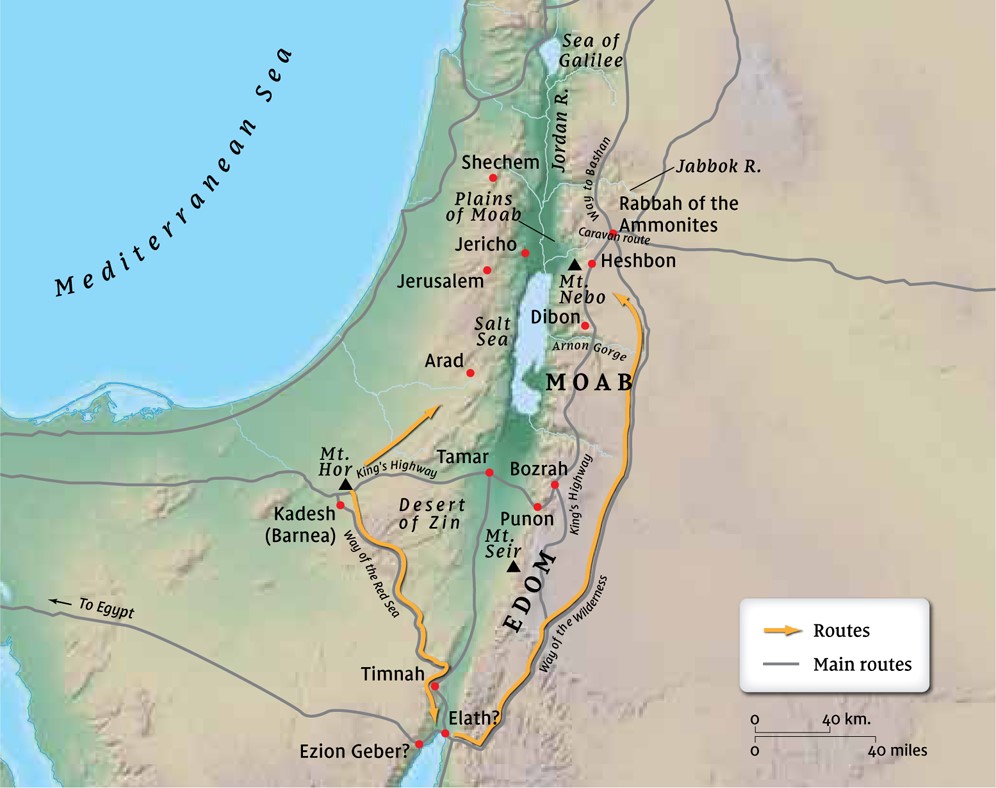
Having been denied safe passage through the land of Edom, the Israelites attempted to make their way through the Negev. However, their efforts were hampered by the Canaanites who occupied that territory. So, they reversed their steps and headed east around the borders of Edom to the western borders of Moab. This would have been a long and circuitous journey that left the Israelites frustrated by their slow progress. It was an unexpected and unwelcome detour that required the people of God to extend their time in the wilderness but there was a reason for this delay. God was waiting for the remainder of the first generation of Israelites who had refused to enter Canaan the first time to die off. In the book of Deuteronomy, Moses recalls the nearly 40-year death march the Israelites were forced to make because of their refusale to obey God’s command.

“Thirty-eight years passed from the time we first left Kadesh-barnea until we finally crossed the Zered Brook! By then, all the men old enough to fight in battle had died in the wilderness, as the Lord had vowed would happen. The Lord struck them down until they had all been eliminated from the community.” – Deuteronomy 2:14-15 NLT

And as that earlier generation slowly died off, the time grew closer to when the next crop of Israelites would face the decision to obey God and enter the land of Canaan. But as they drew closer to Canaan’s border, God warned the people to give the people of Moab a wide berth.

“Do not bother the Moabites, the descendants of Lot, or start a war with them. I have given them Ar as their property, and I will not give you any of their land.” – Deuteronomy 2:9 NLT

When the very last member of the earlier generation died, the Israelites were given permission to cross the border of Moab and enter the land of Ammon,

“Today you will cross the border of Moab at Ar and enter the land of the Ammonites, the descendants of Lot. But do not bother them or start a war with them. I have given the land of Ammon to them as their property, and I will not give you any of their land.’” – Deuteronomy 2:18-19 NLT

As before, the Israelites were to refrain from taking any land from the Ammonites. These people were close relatives of the Israelites and God declared their property to be off limits. God had awarded Lot’s descendants this land and the Israelites had no claim to it.

But the day came when God ordered the Israelites to begin their conquest of the land of Canaan. The older generation was gone and, after a nearly 40-year delay, it was time for God’s people to obey His command and enter the land of promise.

“Then the Lord said, ‘Now get moving! Cross the Arnon Gorge. Look, I will hand over to you Sihon the Amorite, king of Heshbon, and I will give you his land. Attack him and begin to occupy the land. Beginning today I will make people throughout the earth terrified because of you. When they hear reports about you, they will tremble with dread and fear.’” – Deuteronomy 2:24-25 NLT

Moses attempted to negotiate a treaty with Sihon, the king of the Amorites, but he was not interested in peace talks. That’s when God informed Moses to drop the peace overtures and have the people pick up their weapons.

“Look, I have begun to hand King Sihon and his land over to you. Begin now to conquer and occupy his land.” – Deuteronomy 2:31 NLT

The victory was overwhelming. Moses chronicled the event by giving God all the glory:

“…the Lord our God handed him over to us, and we crushed him, his sons, and all his people.  We conquered all his towns and completely destroyed everyone—men, women, and children. Not a single person was spared.” – Deuteronomy 2:33-34 NLT

In this chapter of Numbers, Moses refers to “the Book of the Wars of the Lord” (Numbers 21:14 ESV). This was a record of Israel’s victories recorded in the form of songs. The people were just beginning to witness the overwhelming power of God on their behalf and this victory over the Amorites was to be the first of many. The songs were intended to promote a sense of hope and confidence among the people of God.

After their defeat of the Amorites, the Israelites continued on to Beer, where God quenched the thirst of the people with refreshing water. And the people responded in grateful song.

“Spring up, O well!
    Yes, sing its praises!
Sing of this well,
    which princes dug,
which great leaders hollowed out
    with their scepters and staffs.” – Numbers 21:17-18 NLT

Israel was experiencing a sense of renewed confidence as they witnessed firsthand the power and providence of God. He was graciously preparing them for the days ahead and helping them to understand that anything was possible when they placed their faith in Him.

But while they were getting closer to the land of Canaan, they were not quite ready to take on the challenges that lie across the border. So, God continues to prepare them for the difficult days ahead.

Their enthusiasm, while admirable, would not be enough to bring victory against the nations living in Canaan. What the Israelites really needed was increased confidence in the power of God. Ultimately, the conquest of the land would be up to Him. They were going to need to learn to trust Him implicitly. Cockiness was not an acceptable substitute for confidence in God.

They were learning the timeless lesson recorded in the old hymn, “Faith is the Victory.”

Encamped along the hills of light,
Ye Christian soldiers, rise
And press the battle ere the night
Shall veil the glowing skies.
Against the foe in vales below
Let all our strength be hurled;
Faith is the victory, we know,
That overcomes the world.

Faith is the victory! (Faith is the victory!)
Oh, glorious victory
That overcomes the world.

English Standard Version (ESV) The Holy Bible, English Standard Version. ESV® Permanent Text Edition® (2016). Copyright © 2001

New Living Translation (NLT) Holy Bible, New Living Translation, copyright © 1996, 2004, 2015 by Tyndale House Foundation. Used by permission of Tyndale House Publishers Inc., Carol Stream, Illinois 60188. All rights reserved.

Zeal for the Lord

1 After the plague, the Lord said to Moses and to Eleazar the son of Aaron, the priest, “Take a census of all the congregation of the people of Israel, from twenty years old and upward, by their fathers’ houses, all in Israel who are able to go to war.” And Moses and Eleazar the priest spoke with them in the plains of Moab by the Jordan at Jericho, saying, “Take a census of the people, from twenty years old and upward,” as the Lord commanded Moses. The people of Israel who came out of the land of Egypt were:

Reuben, the firstborn of Israel; the sons of Reuben: of Hanoch, the clan of the Hanochites; of Pallu, the clan of the Palluites; of Hezron, the clan of the Hezronites; of Carmi, the clan of the Carmites. These are the clans of the Reubenites, and those listed were 43,730. And the sons of Pallu: Eliab. The sons of Eliab: Nemuel, Dathan, and Abiram. These are the Dathan and Abiram, chosen from the congregation, who contended against Moses and Aaron in the company of Korah, when they contended against the Lord 10 and the earth opened its mouth and swallowed them up together with Korah, when that company died, when the fire devoured 250 men, and they became a warning. 11 But the sons of Korah did not die.

12 The sons of Simeon according to their clans: of Nemuel, the clan of the Nemuelites; of Jamin, the clan of the Jaminites; of Jachin, the clan of the Jachinites; 13 of Zerah, the clan of the Zerahites; of Shaul, the clan of the Shaulites. 14 These are the clans of the Simeonites, 22,200.

15 The sons of Gad according to their clans: of Zephon, the clan of the Zephonites; of Haggi, the clan of the Haggites; of Shuni, the clan of the Shunites; 16 of Ozni, the clan of the Oznites; of Eri, the clan of the Erites; 17 of Arod, the clan of the Arodites; of Areli, the clan of the Arelites. 18 These are the clans of the sons of Gad as they were listed, 40,500.

19 The sons of Judah were Er and Onan; and Er and Onan died in the land of Canaan. 20 And the sons of Judah according to their clans were: of Shelah, the clan of the Shelanites; of Perez, the clan of the Perezites; of Zerah, the clan of the Zerahites. 21 And the sons of Perez were: of Hezron, the clan of the Hezronites; of Hamul, the clan of the Hamulites. 22 These are the clans of Judah as they were listed, 76,500.

23 The sons of Issachar according to their clans: of Tola, the clan of the Tolaites; of Puvah, the sclan of the Punites; 24 of Jashub, the clan of the Jashubites; of Shimron, the clan of the Shimronites. 25 These are the clans of Issachar as they were listed, 64,300.

26 The sons of Zebulun, according to their clans: of Sered, the clan of the Seredites; of Elon, the clan of the Elonites; of Jahleel, the clan of the Jahleelites. 27 These are the clans of the Zebulunites as they were listed, 60,500.

28 The sons of Joseph according to their clans: Manasseh and Ephraim. 29 The sons of Manasseh: of Machir, the clan of the Machirites; and Machir was the father of Gilead; of Gilead, the clan of the Gileadites. 30 These are the sons of Gilead: of Iezer, the clan of the Iezerites; of Helek, the clan of the Helekites; 31 and of Asriel, the clan of the Asrielites; and of Shechem, the clan of the Shechemites; 32 and of Shemida, the clan of the Shemidaites; and of Hepher, the clan of the Hepherites. 33 Now Zelophehad the son of Hepher had no sons, but daughters. And the names of the daughters of Zelophehad were Mahlah, Noah, Hoglah, Milcah, and Tirzah. 34 These are the clans of Manasseh, and those listed were 52,700.

35 These are the sons of Ephraim according to their clans: of Shuthelah, the clan of the Shuthelahites; of Becher, the clan of the Becherites; of Tahan, the clan of the Tahanites. 36 And these are the sons of Shuthelah: of Eran, the clan of the Eranites. 37 These are the clans of the sons of Ephraim as they were listed, 32,500. These are the sons of Joseph according to their clans.

38 The sons of Benjamin according to their clans: of Bela, the clan of the Belaites; of Ashbel, the clan of the Ashbelites; of Ahiram, the clan of the Ahiramites; 39 of Shephupham, the clan of the Shuphamites; of Hupham, the clan of the Huphamites. 40 And the sons of Bela were Ard and Naaman: of Ard, the clan of the Ardites; of Naaman, the clan of the Naamites. 41 These are the sons of Benjamin according to their clans, and those listed were 45,600.

42 These are the sons of Dan according to their clans: of Shuham, the clan of the Shuhamites. These are the clans of Dan according to their clans. 43 All the clans of the Shuhamites, as they were listed, were 64,400.

44 The sons of Asher according to their clans: of Imnah, the clan of the Imnites; of Ishvi, the clan of the Ishvites; of Beriah, the clan of the Beriites. 45 Of the sons of Beriah: of Heber, the clan of the Heberites; of Malchiel, the clan of the Malchielites. 46 And the name of the daughter of Asher was Serah. 47 These are the clans of the sons of Asher as they were listed, 53,400.

48 The sons of Naphtali according to their clans: of Jahzeel, the clan of the Jahzeelites; of Guni, the clan of the Gunites; 49 of Jezer, the clan of the Jezerites; of Shillem, the clan of the Shillemites. 50 These are the clans of Naphtali according to their clans, and those listed were 45,400.

51 This was the list of the people of Israel, 601,730. Numbers 26:1-51 ESV

Chapter 25 of the book of Numbers contains a watershed moment. It details a pivotal point in the lives of the Israelites and in their relationship with God. They stood on the brink of the Promised Land, after 40 years of wandering in the wilderness – their punishment for having doubted God and having listened to the negative report of the spies (Numbers 14:26-31). They were poised to enter the land of promise after years of wandering and waiting. God had just ordained a blessing on their behalf out of the mouth of Balaam, who had been hired to curse them Numbers 24). And while all this was happening, the people were busy aligning themselves with the daughters of Moab. The Expositors Bible Commentary has this to say about this important point in time:

The issue is that of apostasy from the Lord by participation in the debased, sexually centered Canaanite religious rites of Baal worship—that which would become the bane of Israel’s experience in the land. This chapter is an end and a beginning. It marks the end of the first generation; it also points to the beginning of a whole new series of wicked acts that will finally lead to Israel’s punishment…

The whole scene is reminiscent of what happened when the Law was given to Moses on Mount Sinai. While God was blessing them with the giving of the Law, the people were busy creating a golden calf that they could worship. In other words, they were turning away from God and choosing to replace Him with a god of their own making.

And Numbers 25 reveals the people of Israel doing the same thing all over again. Verse two makes it clear that this was not just about sex, it was about religion.

It started when the women invited the men to their sex-and-religion worship. They ate together and then worshiped their gods. – Numbers 25:2 NLT

Rather than remain set apart as God had commanded, the people were intimately joining themselves with the people of the land. They were violating the commands of God in order to enjoy the sensual and sexual pleasures all around them. And it’s likely that the people justified their actions.

We’re just trying to fit in!,” some probably said. “We’re just being ecumenical!,” others claimed. “We don’t want to be judgmental,” a few might have suggested. Rationalization reigned and the people brought dishonor to the name of God. So God brought a plague on them. He ordered the execution of all those who led this rebellion against His authority. But this thing was so out of hand that one of the Israelites had the audacity to bring one of the Midianite women into camp, right in front of Moses and the people as they wept in front of the tabernacle. He took her straight into his tent. No shame. No remorse. He was totally controlled by his sensual desires.

But one man took action. His name was Phinehas. With spear in hand, Phinehas followed the man into his tent and executed him and his Midianite accomplice. His actions halted the plague that God had sent on the people. And God acknowledges that it was the actions of this one man that spared the lives of the people of Israel. “Phinehas son of Eleazar and grandson of Aaron the priest has turned my anger away from the Israelites by displaying passionate zeal among them on my behalf. So I have stopped destroying all Israel as I had intended to do in my anger” (Numbers 25:11 NLT). Phinehas was motivated by a passionate zeal for God. He was not going to let the name of God get dragged through the mud. The literal translation is “he was zealous with my zeal.”

The emphasis on zeal is meant to stress his passion. The word “zeal” means a “passionate intensity to protect or preserve divine or social institutions.” Phinehas didn’t just stand by and watch. He acted. He couldn’t contain himself. And the Israelites are fortunate he couldn’t contain himself. Because it was his quick response that saved their lives. And that one man’s actions made a dramatic difference in the lives of the Israelites.

That sets up the events of chapter 26. After the plague eliminated 24,000 of the Israelites, God ordered Moses to take a census of the people.

“From the whole community of Israel, record the names of all the warriors by their families. List all the men twenty years old or older who are able to go to war.” – Numbers 26:2 NLT

God was preparing them to cross the border and begin their conquest of the land of Canaan. But he wanted them to know just how many warriors they had to work with. So, Moses and Eleazar canvassed each tribe in order to determine the size of Israel’s fighting force and the number came to 601,730 men. And it would appear that, because of the plague, that number was far less than it had been. It’s impossible to know if all 24,000 who died as a result of the plague had been males older than 20 years of age. But it seems likely that a good portion of the deceased would have been eligible for combat.

Yet, despite the disobedience of the people and the devastating results of the plague, God was providing Moses and Eleazar with the assurance they needed to move forward. If God could conquer the enemy of apostasy with the help of one man, He could certainly deliver the land of Canaan into the hands of the Israelites with more than 600,000 men.

But as will become clear, there was more to this census than determining the size of Israel’s army. These numbers would be used to determine the land allotment once the people entered Canaan. God had increased the number of Israelites dramatically since the day more than 400 years earlier when Jacob and his 70 family members had fled to Egypt to escape the famine in Canaan. God had kept His promise to Abraham and had created a great nation from his son, Isaac. Now, that nation stood poised and prepared to take possession of their inheritance. More than 600,000 strong, they were a formidable force and, with God’s help, they would conquer and dispossess all those godless nations that had taken up residence in the land of promise. But like Phinehas, they would need to display a zeal for the Lord and a willingness to obey His commands. If they did, nothing would be impossible for them.

English Standard Version (ESV) The Holy Bible, English Standard Version. ESV® Permanent Text Edition® (2016). Copyright © 2001

New Living Translation (NLT) Holy Bible, New Living Translation, copyright © 1996, 2004, 2015 by Tyndale House Foundation. Used by permission of Tyndale House Publishers Inc., Carol Stream, Illinois 60188. All rights reserved.

Battle-Ready

14 Stand therefore, having fastened on the belt of truth, and having put on the breastplate of righteousness, 15 and, as shoes for your feet, having put on the readiness given by the gospel of peace. 16 In all circumstances take up the shield of faith, with which you can extinguish all the flaming darts of the evil one; 17 and take the helmet of salvation, and the sword of the Spirit, which is the word of God, 18 praying at all times in the Spirit, with all prayer and supplication.  Ephesians 6:14-18a ESV

Two times Paul told his readers to put on “the whole armor of God.” He was not providing them with a menu of optional items from which to choose. It was not up to them to decide which piece of God’s divine equipment they were interested in wearing or utilizing. But the sad truth is, that’s exactly the way many of us as Christians approach this passage. Whether we intend to or not, we jeopardize our spiritual well-being by self-selecting the armor of God we want to put on. But Paul would have us understand that when it comes to divinely ordained weapons of our warfare, it’s all or nothing. He tells us to “put on every piece of God’s armor so you will be able to resist the enemy in the time of evil. Then after the battle you will still be standing firm” (Ephesians 6:13 NLT).

Paul uses two Greek words, ἀνθίστημι (anthistēmi) and ἵστημι (histēmi). The first means “to stand against” and the other means “to stand” (“G436 – anthistēmi, G2476 – histēmi – Strong’s Greek Lexicon (KJV).” Blue Letter Bible). To withstand in the evil day carries the idea of being able to stand your ground in the midst of battle. You find yourself under attack. The enemy has you surrounded, but you refuse to surrender your position. You resist. It is a defensive posture, not an offensive one. The enemy is bringing the battle to you.

Jesus told Peter, “I will build my church, and the gates of Hades will not overpower it” (Matthew 16:18 NET). Satan is out to destroy God’s people and so he launched a constant assault against the church of Jesus Christ. And the enemy is clever. He knows that the quickest way to destroy the church is by infiltrating its ranks. That way, he can  attack from without and within. But Paul calls us to stand our ground, to resist. James uses the same Greek word, ἀνθίστημι (anthistēmi), when he writes, “Submit yourselves therefore to God. Resist the devil, and he will flee from you” (James 4:7 ESV).

And Paul calls us to stand. It means to stand firm, immovable, and prepared for action. But how are we to pull that off? What is the secret to standing firm? Paul makes it quite clear. It is the whole armor of God. The belt of truth, the breastplate of righteousness, shoes for your feet comprised of the gospel of peace, the shield of faith, the helmet of salvation, and the sword of the Spirit. These six items are the indispensable equipment for every soldier of God. You can’t survive without them. It isn’t a question of whether the enemy will attack and you will see battle. It is inevitable and unavoidable. He brings the war to your doorstep each and every day. And God has given us all that we need to withstand and stand firm in the heat of the battle.

The belt of truth is the first and most essential piece of equipment. It most likely refers to the truth as revealed in God’s Word. Truth is key to standing up to the lies of the enemy. Remember, the goal is to “stand against the schemes of the devil” (Ephesians 6:11 ESV). That word “schemes” means “deceit or trickery.” Satan is a liar. He is cunning and clever, and he uses falsehood as his primary weapon of choice. So, truth is going to be one of our greatest assets as believers.

The breastplate of righteousness probably refers to the righteousness of Christ. Like the armor of a Roman soldier, this breastplate would provide protection from the neck to the thighs, covering all the vital organs. As believers, we are covered by the righteousness of Christ. It is His righteousness that has made us right with God. When the enemy attacks and hurls darts of accusations against our self-righteousness, we are protected or covered by the righteousness imputed to us by Christ at His death. Satan can accuse us, but he cannot harm us. Christ’s righteousness is readily available to us and provides us with protection from the relentless assaults of the enemy. He is out to put a dagger in our hearts, robbing us joy, peace, contentment, and any hope of living the abundant life that Jesus promised.

The thief comes only to steal and kill and destroy. I came that they may have life and have it abundantly. – John 10:10 ESV

No soldier would dare go into battle without shoes. How can you stand firm without proper footwear? And Paul describes these shoes as “the readiness given by the gospel of peace” (Ephesians 6:15 ESV). The gospel of peace (the Good News) is what provides us with the ability to stand firm, without slipping or sliding in uncertainty or losing our spiritual footing. Because of what Christ accomplished on the cross, we have peace with God. We are His and He is ours. That is why Paul so confidently claimed, “Neither death nor life, neither angels nor demons, neither our fears for today nor our worries about tomorrow—not even the powers of hell can separate us from God’s love. No power in the sky above or in the earth below—indeed, nothing in all creation will ever be able to separate us from the love of God that is revealed in Christ Jesus our Lord” (Romans 8:38-39 ESV).

The shield of faith is not something you wear, but something you hold. Like all of the other pieces of armor, it is given to you by God. It is His armor. Our faith is not self-manufactured, but it is a gift of the Spirit, provided for us by a gracious and loving God. As long as we stand behind our faith, we are safe. It is when we set aside our faith that we become vulnerable to the darts of the enemy. Faith is our trust in God and in His promises regarding us. He will not leave us or forsake us. He has prepared a permanent place for us. He will fight our battles for us. He has placed His all-powerful Spirit within us. And we must trust in these truths at all times. A weak shield is of little use in the heat of battle. Strong faith in a strong and faithful God will provide protection each and every time, no matter how difficult the circumstances.

The helmet of salvation protects our mind. It is the awareness and recognition of God’s ongoing saving work in our lives. It not only refers to our coming to faith in Christ, but to our ongoing sanctification and the daily saving work of God in our lives. Through His Son’s death, he saved us from sin and death, but He is also saving us from the flesh, the world, and the enemy. We must keep our minds focused on the saving work of God in our lives. We must constantly remind ourselves that He is faithful and strong, and that the battle is already won.

The sword of the Spirit is the Word of God. It is designed for hand-to-hand combat. The Scriptures are what we are to use when the enemy gets up close and personal. God’s Word provides us with the truth we need to deflect the lies thrown at us by Satan. It is both a defensive and offensive weapon, allowing us to protect ourselves, but also to bring harm to the enemy. Referring to the Holy Spirit, Jesus said, “when he comes he will convict the world of its sin, and of God’s righteousness, and of the coming judgment” (John 16:8 NLT). The Spirit of God and the Word of God are essential in our fight against the forces of this world.

Finally, Paul tells us to keep “praying at all times in the Spirit, with all prayer and supplication” (Ephesians 6:18a ESV). Prayer is nothing more than communication with God. Like a soldier out on the field of battle, timely communication from headquarters is the key to victory. We must listen to our heavenly commander, the Lord of Hosts. He is the captain of the armies of heaven and He has a battle plan in place. We are not to act as freelance mercenaries, operating based on our own agenda and implementing our own battle plan. It is through prayer and the reading of God’s Word that we receive instructions. It also provides us with a means of sharing our own needs and news from the battlefield. Staying in touch with God is essential to our survival.

The battle is real. The enemy is powerful. But our God is great and our armor is time-tested and proven reliable in the heat of battle. It has been made by God. It has been given to us by God. And our victory is assured because of God. “But you belong to God, my dear children. You have already won a victory over those people, because the Spirit who lives in you is greater than the spirit who lives in the world” (1 John 4:4 NLT).

English Standard Version (ESV) The Holy Bible, English Standard Version. ESV® Permanent Text Edition® (2016). Copyright © 2001 by Crossway Bibles, a publishing ministry of Good News Publishers.

New Living Translation (NLT) Holy Bible, New Living Translation, copyright © 1996, 2004, 2015 by Tyndale House Foundation. Used by permission of Tyndale House Publishers Inc., Carol Stream, Illinois 60188. All rights reserved.

New English Translation (NET)NET Bible® copyright ©1996-2017 by Biblical Studies Press, L.L.C. http://netbible.com All rights reserved.


It Is Enough

31 “Simon, Simon, behold, Satan demanded to have you, that he might sift you like wheat, 32 but I have prayed for you that your faith may not fail. And when you have turned again, strengthen your brothers.” 33 Peter said to him, “Lord, I am ready to go with you both to prison and to death.” 34 Jesus said, “I tell you, Peter, the rooster will not crow this day, until you deny three times that you know me.”

35 And he said to them, “When I sent you out with no moneybag or knapsack or sandals, did you lack anything?” They said, “Nothing.” 36 He said to them, “But now let the one who has a moneybag take it, and likewise a knapsack. And let the one who has no sword sell his cloak and buy one. 37 For I tell you that this Scripture must be fulfilled in me: ‘And he was numbered with the transgressors.’ For what is written about me has its fulfillment.” 38 And they said, “Look, Lord, here are two swords.” And he said to them, “It is enough.”  Luke 22:31-38 ESV

It’s clear from Mark’s account that, immediately after their celebration of the Passover meal,, Jesus and His disciples had left the upper room and made their way to the Mount of Olives, just across the Kidron Valley, east of Jerusalem.

And when they had sung a hymn, they went out to the Mount of Olives. – Mark 14:26 ESV

It was there that Jesus made yet another disturbing announcement.

And Jesus said to them, “You will all fall away, for it is written, ‘I will strike the shepherd, and the sheep will be scattered.’ But after I am raised up, I will go before you to Galilee.” – Mark 14:27-28 ESV

This foreboding prediction caught the disciples off-guard and caused the always quick-to-speak Peter to defend his own honor.

“Even though they all fall away, I will not.” – Mark 14:29 ESV

He was separating himself from the rest by declaring his undying commitment to remain by Jesus’ side no matter what happened. It was probably at this point in the conversation that Jesus spoke the words that Luke records.

“Simon, Simon, behold, Satan demanded to have you, that he might sift you like wheat, but I have prayed for you that your faith may not fail. And when you have turned again, strengthen your brothers.” – Luke 22:31-32 ESV

Jesus knew Simon well. He had spent more than three years attempting to disciple this impulsive and rather self-absorbed fisherman from Galilee. Peter was an over-confident over-achiever who regularly viewed himself as the unofficial and self-declared spokesman for the twelve. He had a strong competitive streak and a tendency to put his mouth in gear before his brain was fully engaged. This propensity often led him to say things he would later regret. And this would prove to be one such occasion.

Peter refused to accept Jesus’ assessment of his future faithfulness, but instead he argued that he was more than willing to lay his life on the line.

“Lord, I am ready to go with you both to prison and to death.” – Luke 22:33 ESV

These boastful words would come back to haunt Peter. He truly believed he was completely sold-out to the cause and willing to sacrifice anything to ensure that Jesus’ kingdom came to fruition. But what he didn’t know was the state of his own heart. Peter refused to accept the fact that he might be some kind of traitor or turncoat. Jesus must have had him confused with one of the other disciples. Yet Jesus made it clear that He had the right man by describing the exact nature of his wrong choice .

“I tell you, Peter, the rooster will not crow this day, until you deny three times that you know me.” – Luke 22:34 ESV

This must have hit Peter like a freight train. Jesus’ dire prediction left him stunned, embarrassed, and more than a bit defensive. Mark records that Peter immediately refuted Jesus’ accusation.

“If I must die with you, I will not deny you.” – Mark 14:31 ESV

In a desperate attempt to protect his own reputation, Peter essentially accused Jesus of being a liar. He denied Jesus’ assertion that he would be a denier. It’s important to remember that this entire conversation took place within earshot of the other disciples because when Peter made this bold claim, the other disciples echoed his words.

And they all said the same. – Luke 22:31 ESV

But at this point, Jesus redirected the topic of conversation by reminding them of their earlier mission when He had “sent them out to proclaim the kingdom of God and to heal” (Luke 9:2 ESV). Jesus asked them, “When I sent you out with no moneybag or knapsack or sandals, did you lack anything?” (Luke 22:35 ESV), and they responded, “Nothing!”

Then, Jesus made a shocking statement that must have left the disciples in a state of confusion.

“But now let the one who has a moneybag take it, and likewise a knapsack. And let the one who has no sword sell his cloak and buy one. – Luke 22:36 ESV

With this rather strange pronouncement, Jesus was letting them know that things were about to take a radical change. Earlier, when He had sent them out by twos, they had been instructed to provide nothing for their own care. Instead, they were to rely on the gracious support of others. But with Jesus’ approaching death and eventual resurrection, the spiritual battle around them was about to enter a new and much-darker phase. Little did they know that the days ahead would be marked by increasing hostility and resistance. This is what Jesus had tried to explain to them on a much earlier occasion.

“Don’t imagine that I came to bring peace to the earth! I came not to bring peace, but a sword.

‘I have come to set a man against his father,
    a daughter against her mother,
and a daughter-in-law against her mother-in-law.
    Your enemies will be right in your own household!’” – Matthew 10:34-36 NLT

Jesus had not been suggesting that His mission was that of a physical revolution fought with swords and spears. He was letting them know that the gospel of the Kingdom of God was going to end up having a polarizing affect on humanity. Those who embrace the gospel would find themselves facing the anger and animosity of their own loved ones. Jesus went on to tell them that their decision to follow Him would come with a high cost.

“If you love your father or mother more than you love me, you are not worthy of being mine; or if you love your son or daughter more than me, you are not worthy of being mine. If you refuse to take up your cross and follow me, you are not worthy of being mine.” – Matthew 10:37-38 NLT

Commitment to the cause of Christ would require a drastic change in priorities and alliances. Nothing was to stand in the way of their sold-out allegiance to Him. They would have to be willing to sacrifice everything for the cause. But Jesus assured them it would be well worth the effort.

“If you cling to your life, you will lose it; but if you give up your life for me, you will find it.” – Matthew 10:39 NLT

But was Jesus really suggesting that the disciples sell their possession order to purchase weapons? Was He condoning self-defense and physical violence? Some would suggest that is exactly what Jesus was doing. They point to Jesus’ response when one of the disciples indicated that they already had two swords in their possession. He said, “It is enough” (Luke 22:38 ESV). And if we fast-forward to later in the evening, when the soldiers came to arrest Jesus in the Garden of Gethsemane, Luke reports that one of the disciples responded to the intrusion by asking, “Lord, shall we strike with the sword?” (Luke 22:49 ESV). And before Jesus could say a word, one of them struck the servant of the high priest and cut off his right ear” (Luke 22:50 ESV). It seems apparent that the disciples had taken Jesus’ admonition to arm themselves quite literally. And yet, Matthew reveals that Jesus did not approve of their actions.

“Put away your sword,” Jesus told him. “Those who use the sword will die by the sword. Don’t you realize that I could ask my Father for thousands of angels to protect us, and he would send them instantly? But if I did, how would the Scriptures be fulfilled that describe what must happen now?” – Matthew 26:52-54 NLT

The whole reference to swords was meant to be a metaphor that let them know that they were about to go into battle. But as the apostle Paul would later explain, the battle was going to be spiritual, not physical in nature.

For we are not fighting against flesh-and-blood enemies, but against evil rulers and authorities of the unseen world, against mighty powers in this dark world, and against evil spirits in the heavenly places. – Ephesians 6:12 NLT

And Jesus inferred that this was spiritual conflict that could only be won by spiritual means. He clearly indicates that if physical protection was the objective, He could have made a personal request to His heavenly Father and thousands of angels with flaming swords would have descended in an instant. But Jesus never made that request and those angels never appeared. This wasn’t case of a lack of weaponry. It was matter of God’s will.

When Jesus had said, “It is enough,” He wasn’t suggesting that two swords would be sufficient to defend the kingdom. He was letting His disciples know that God can do much with little. Just as Jesus had fed the multitude with five loaves of bread and two fish, God could and would accomplish great things through 11 men who were ill-equipped and unprepared for the raging battle that loomed before them.

And the apostle Paul went on to describe the nature of the armor and the arsenal the disciples would eventually use to wage war in the spiritual realm.

Therefore, put on every piece of God’s armor so you will be able to resist the enemy in the time of evil. Then after the battle you will still be standing firm. Stand your ground, putting on the belt of truth and the body armor of God’s righteousness. For shoes, put on the peace that comes from the Good News so that you will be fully prepared. In addition to all of these, hold up the shield of faith to stop the fiery arrows of the devil. Put on salvation as your helmet, and take the sword of the Spirit, which is the word of God. – Ephesians 6:13-17 NLT

It is enough.

English Standard Version (ESV) The Holy Bible, English Standard Version. ESV® Permanent Text Edition® (2016). Copyright © 2001 by Crossway Bibles, a publishing ministry of Good News Publishers.

New Living Translation (NLT) Holy Bible, New Living Translation, copyright © 1996, 2004, 2015 by Tyndale House Foundation. Used by permission of Tyndale House Publishers Inc., Carol Stream, Illinois 60188. All rights reserved.

The Message (MSG)Copyright © 1993, 1994, 1995, 1996, 2000, 2001, 2002 by Eugene H. Peterson

Holy Hygiene

“When you are encamped against your enemies, then you shall keep yourself from every evil thing.

10 “If any man among you becomes unclean because of a nocturnal emission, then he shall go outside the camp. He shall not come inside the camp, 11 but when evening comes, he shall bathe himself in water, and as the sun sets, he may come inside the camp.

12 “You shall have a place outside the camp, and you shall go out to it. 13 And you shall have a trowel with your tools, and when you sit down outside, you shall dig a hole with it and turn back and cover up your excrement. 14 Because the Lord your God walks in the midst of your camp, to deliver you and to give up your enemies before you, therefore your camp must be holy, so that he may not see anything indecent among you and turn away from you. – Deuteronomy 23:9-14 ESV

As we have discussed before, the God of Israel was anything but a distant and disinterested diety who with no personal stake in the lives of His people. He cared deeply about every aspect of their lives. The laws God gave them to regulate their lives provide ample proof that His interest in them went well beyond matters concerning worship, tithing, and offering sacrifices to Him.

In these verses, Moses provides the people of Israel with instructions regarding war. As they prepared to enter the promised land, battle was going to be an inevitable part of their future. In order to occupy the land, they were going to have to conquer its inhabitants. So, God provided  Moses with instructions outlining their behavior while conducting military campaigns. Even during times of war, God expected the men of Israel to maintain a sense of decorum and to do all that was necessary to keep themselves holy or set apart before God. War would not be an excuse for wickedness. If anything, it would call for even greater care on the part of the people, to ensure that they did not defile themselves before God.

Because Israel did not maintain a standing army but operated on the basis of a mandatory militia, the men of fighting age all had to be ready at a moment’s notice to suit up for action. These excursions could last for indefinite periods of time and would require a great deal of sacrifice on the part of the nation. Men would be called away from their homes and families. Their farms, fields, and vineyards would go untended in their absence. Forced to leave their wives behind, these men would find themselves facing all kinds of temptations. And during these military campaigns, the encampments filled with men could easily become breeding grounds for lax moral behavior.

The first command concerned an avoidance of anything and everything that was considered evil. The old phrase, “boys will be boys” applies here. God knew that a crowd made up entirely of men would be like a magnet for wickedness. These men would find themselves tempted by everything from off-color humor to sexual promiscuity. In every century, gatherings of soldiers have always attracted prostitutes. And the heat of battle with its ever-present threat of death can cause any man to lose faith and compromise his moral convictions. So, Moses called the men of Israel to keep themselves pure, even during times of war.

The next two verses get very specific and graphic. They deal with ceremonial uncleanness as a result of a man having nocturnal emissions. Without their wives to satisfy their sexual needs, this was going to be a normal and natural occurrence. But it would also leave the individual in an impure state and in need of purification. God had provided very specific instructions concerning this matter.

“If a man has an emission of semen, he shall bathe his whole body in water and be unclean until the evening. And every garment and every skin on which the semen comes shall be washed with water and be unclean until the evening. – Leviticus 15:16-17 ESV

Ceremonial impurity was unacceptable. But so was physical impurity. That’s why Moses went on to provide the men with instructions regarding the disposal of human waste. These encampments could easily be filled with tens of thousands of men, creating a significant hygiene problem. With that many men gathered in one place for a prolonged period of time, waste disposal would have to be a major priority or disease and dysentery could easily diminish the full effectiveness of the army. So, Moses instructed each soldier to carry an implement for burying his waste. And they commanded to go outside the camp in order to relieve themselves. This would help prevent the spread of disease but also encourage privacy and modesty. But even more importantly, it would maintain purity in the camp, which was essential “Because the Lord your God walks in the midst of your camp, to deliver you and to give up your enemies before you” (Deuteronomy 23:14 ESV).

Even while on bivouac, the men of Israel were to consider the constant presence of God. He was always in their midst and, therefore, they were to maintain a sense of decorum and reverence, treating their temporary living conditions with the same care and concern as they would their own homes.

Jesus made the statement, “For where two or three are gathered in my name, there am I among them” (Matthew 18:20 ESV), and this thought would be true of the men of Israel as they gathered together to fight in the name of God. Holiness in the camp was essential. Impurity could easily result in God’s departure from their midst and that would prove to be a devastating outcome. Even in the heat of battle, holiness was required.

“…therefore your camp must be holy, so that he may not see anything indecent among you and turn away from you. – Deuteronomy 23:14 ESV

There was to be no time or place where holiness was not the Israelites’ highest priority. And while the life of the Christ-follower will also include moments of spiritual warfare, there is no excuse for compromise or moral laxness. Purity in the camp should always be our highest priority. The presence of God is real and He is with us in each and every circumstance. So, His call that we be holy as He is holy applies to every occasion in which we find ourselves, whether in the safety of our home or the heat of the battle.

English Standard Version (ESV) The Holy Bible, English Standard Version. ESV® Permanent Text Edition® (2016). Copyright © 2001 by Crossway Bibles, a publishing ministry of Good News Publishers.

New Living Translation (NLT) Holy Bible, New Living Translation, copyright © 1996, 2004, 2015 by Tyndale House Foundation. Used by permission of Tyndale House Publishers Inc., Carol Stream, Illinois 60188. All rights reserved.

The Message (MSG) Copyright © 1993, 1994, 1995, 1996, 2000, 2001, 2002 by Eugene H. Peterson