The Fateful Journey From Faith to Fear

41 And Elijah said to Ahab, “Go up, eat and drink, for there is a sound of the rushing of rain.” 42 So Ahab went up to eat and to drink. And Elijah went up to the top of Mount Carmel. And he bowed himself down on the earth and put his face between his knees. 43 And he said to his servant, “Go up now, look toward the sea.” And he went up and looked and said, “There is nothing.” And he said, “Go again,” seven times. 44 And at the seventh time he said, “Behold, a little cloud like a man’s hand is rising from the sea.” And he said, “Go up, say to Ahab, ‘Prepare your chariot and go down, lest the rain stop you.’” 45 And in a little while the heavens grew black with clouds and wind, and there was a great rain. And Ahab rode and went to Jezreel. 46 And the hand of the LORD was on Elijah, and he gathered up his garment and ran before Ahab to the entrance of Jezreel. 

1 Ahab told Jezebel all that Elijah had done, and how he had killed all the prophets with the sword. Then Jezebel sent a messenger to Elijah, saying, “So may the gods do to me and more also, if I do not make your life as the life of one of them by this time tomorrow.” Then he was afraid, and he arose and ran for his life and came to Beersheba, which belongs to Judah, and left his servant there. 1 Kings 18:41-19:3 ESV

Chapter 18 opened up with the words God spoke to Elijah: “Go, show yourself to Ahab, and I will send rain upon the earth” (1 Kings 18:1 ESV). This statement contains a command as well as a promise from God. After his three-and-a-half-year absence, Elijah was to return to Israel from Sidon and confront King Ahab one more time. But while this command would likely involve significant risk to the prophet, his obedience would result in a tremendous blessing on the people. God would end the prolonged drought and restore rain to the land.

It is impossible to know if Elijah was aware of all that would have to happen before the rain returned. There is no indication as to when God divulged the rest of His plan and Elijah’s role in it. But before the physical drought could end, the spiritual drought afflicting the people would have to come to a decisive conclusion that involved a dramatic confrontation between Elijah and the 450 prophets of Baal. However, the real battle would be between Yahweh, the God of Israel, and Baal, the god of Ahab and Jezebel.

Yahweh had won the day, displaying His power by sending fire from heaven that “consumed the burnt offering and the wood and the stones and the dust, and licked up the water that was in the trench” (1 Kings 18:38 ESV). This demonstrative exhibition of God’s omnipotence brought the people to their knees in fear and worship. What they had just witnessed left them thoroughly convinced that Yahweh was the one true God, and that newly revived awareness left them crying out, “The LORD, he is God; the LORD, he is God” (1 Kings 18:39 ESV). And as if to put an exclamation point on the whole scene, Elijah ordered the capture and execution of all 450 of Baal’s so-called prophets. Their god had remained silent when they cried to him for help. Now the prophet of Yahweh silenced them for good. They would no longer deceive and mislead the people of Israel with fallacious promises concerning their false god.

But there was still one thing missing: The rain that Yahweh had promised. Baal had been discredited, his prophets had been eliminated, and the peoples’ reverence for Yahweh had been rejuvenated. But the land remained under the God-ordained drought that had turned Israel into a dust bowl where water and food were scarce and daily survival was a challenge. The land that God had once described as “flowing with milk and honey” (Exodus 33:3 ESV) had become fruitless and lifeless, reflecting the spiritual state of the people who occupied it.

Hundreds of years earlier, long before the people of Israel took possession of the land of Canaan, Moses warned what would happen if they proved unfaithful.

“And if you will indeed obey my commandments that I command you today, to love the LORD your God, and to serve him with all your heart and with all your soul, he will give the rain for your land in its season, the early rain and the later rain, that you may gather in your grain and your wine and your oil. And he will give grass in your fields for your livestock, and you shall eat and be full. Take care lest your heart be deceived, and you turn aside and serve other gods and worship them; then the anger of the LORD will be kindled against you, and he will shut up the heavens, so that there will be no rain, and the land will yield no fruit, and you will perish quickly off the good land that the LORD is giving you.” – Deuteronomy 11:13-17 ESV

Years later, when God’s people continued to display their propensity for unfaithfulness, His prophet, Joel, would offer this promise of divine restoration even in the face of their disobedience.

Surely the LORD has done great things!
    Don’t be afraid, O land.
Be glad now and rejoice,
    for the LORD has done great things.
Don’t be afraid, you animals of the field,
    for the wilderness pastures will soon be green.
The trees will again be filled with fruit;
    fig trees and grapevines will be loaded down once more.
Rejoice, you people of Jerusalem!
    Rejoice in the LORD your God!
For the rain he sends demonstrates his faithfulness.
    Once more the autumn rains will come,
    as well as the rains of spring.
The threshing floors will again be piled high with grain,
    and the presses will overflow with new wine and olive oil.

The LORD says, “I will give you back what you lost…” – Joel 2:20-25 ESV

That day on Mount Carmel, the people had seen the fire of God fall from heaven, completely consuming the altar, sacrifice, and water. But they had not yet seen or felt His blessing. As Joel stated, “the rain he sends demonstrates his faithfulness.” Their land was in desperate need of restoration and rejuvenation, and so were they. After three-and-a-half years of spiritual drought, their hearts were parched and hardened. They had lost the capacity for fruitfulness and faithfulness and needed an outpouring of God’s grace and mercy.

Elijah knew what God had in store. So, he informed the shell-shocked king to “Go get something to eat and drink, for I hear a mighty rainstorm coming!” (1 Kings 18:41 NLT). There was a blessing on the horizon. Despite Ahab and Jezebel’s wickedness, God was about to pour out His goodness on the land.

The fact that Ahab had food to eat is symbolic of his self-centered approach to leadership. His sins had brought God’s curse upon the nation, but while the people suffered severely from the lack of rain, Ahab and Jezebel lived in royal comfort and ease. God would later issue an indictment against the leaders of Israel, warning them of their blatant disregard for the care of His people.

“What sorrow awaits you shepherds who feed yourselves instead of your flocks. Shouldn’t shepherds feed their sheep?” – Ezekiel 34:2 NLT

As Ahab was busy satisfying his own needs, Elijah interceded on behalf of the people of Israel. He “climbed to the top of Mount Carmel and bowed low to the ground and prayed with his face between his knees” (1 Kings 18:42 NLT). At one point during his prayer, he stopped and sent his servant to look toward the Mediterranean Sea in the east. But the servant saw nothing. This pattern repeated itself five more times with the same disappointing result. But the seventh time, the servant returned with a different report.

“I saw a little cloud about the size of a man’s hand rising from the sea.” – 1 Kings 18:44 NLT

Out on the distant horizon, the servant saw what appeared to be a glimmer of hope. It was a small and seemingly insignificant cloud, but Elijah knew what it meant. The blessing of God was about to fall and, when it did, it would come in torrents. So, he instructed his servant to warn Ahab to leave immediately, or he may not make it back to his winter palace in Jezreel. When Elijah’s servant looked to the east, he saw only a faint possibility. But through his eyes of faith,  Elijah saw something altogether different. He perceived the imminent arrival of the outpouring of God’s blessing, and before long, that small cloud developed into a massive storm that brought strong winds and torrential rains. As Ahab tried to outrun the storm in his chariot, “the LORD gave special strength to Elijah. He tucked his cloak into his belt and ran ahead of Ahab’s chariot all the way to the entrance of Jezreel” (1 Kings 18:46 NLT).
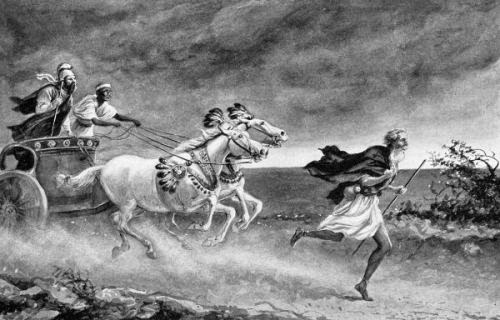
Because Jezreel was anywhere from 10 to 20 miles east of Mount Carmel, some commentators attempt to explain this last verse by saying that Ahab’s chariot got caught in the mud and delayed his arrival. Others speculate that Elijah simply took a shortcut over the ridge of Mount Carmel. But everything about this story has been focused on the matchless power of God, and it should not seem out of the question that God might endow his prophet with a supernatural capacity to outrun the chariot of his arch-nemesis. God had defeated Baal. Now, the prophet of God had defeated the benefactor of Baal.

But while Elijah had won the victory at Mount Carmel and the race to Jezreel, he would have little time to celebrate. Upon hearing the unexpected news of all that had transpired on Mount Carmel, Jezebel was outraged and directed all her anger at Elijah.

“May the gods strike me and even kill me if by this time tomorrow I have not killed you just as you killed them.” – 1 Kings 19:2 NLT

Despite all that Ahab told her about the day’s events, she remained unconvinced of Yahweh’s power. She even called on Baal and his queen mother, Asherah, to come to her aid so that she might avenge the deaths of the prophets by killing Elijah. She was still putting her hope and trust in her false gods. Even the sudden arrival of long-awaited rain did nothing to diminish her misplaced trust in her lifeless and powerless gods. Baal, Jezebel’s beloved fertility god, had done nothing to eliminate the drought that had plagued the land.

But even more surprising than Jezebel’s stubborn belief in Baal and her resistance to God was Elijah’s sudden display of fear and doubt. This man, who had called down fire from heaven and had singlehandedly executed 450 prophets of Baal, found himself intimidated by the idle threats of this self-absorbed, idol-worshiping queen. Her vow to avenge her false god should have made Elijah laugh with scorn. Her god had proven himself to be speechless, powerless, and utterly helpless in the face of Yahweh. Yet, the formerly faithful Elijah was suddenly fearful, and this time, rather than running to the problem in the strength of God, he took flight and tried to escape it. He fled for his life, covering the 25 miles from Jezreel to Beersheba, motivated by fear and in the strength of his own flesh. Faced with the threats of Jezebel, Elijah took his eyes off God and took his fate into his own hands. 

This faithful man of God allowed the words of an idol-obsessed queen to dishearten and defeat him. He had bravely faced off against the 450 prophets of Baal, but now, with Jezebel’s words ringing in his ear, Elijah ran all the way to Beersheba, located on the southern border of Judah. From there, he would enter the Judean wilderness, the very same place where the disobedient and doubtful Israelites had wandered for 40 years when they refused to enter the promised land. And, in no time at all, the once faith-filled Elijah would find himself racked by fear and desiring death rather than face the vengeful anger of Jezebel.

English Standard Version (ESV) The Holy Bible, English Standard Version. ESV® Permanent Text Edition® (2016). Copyright © 2001 by Crossway Bibles, a publishing ministry of Good News Publishers.

New Living Translation (NLT) Holy Bible, New Living Translation, copyright © 1996, 2004, 2015 by Tyndale House Foundation. Used by permission of Tyndale House Publishers Inc., Carol Stream, Illinois 60188. All rights reserved.

Little Is Much When God Is In It

1 So Israel took his journey with all that he had and came to Beersheba, and offered sacrifices to the God of his father Isaac. And God spoke to Israel in visions of the night and said, “Jacob, Jacob.” And he said, “Here I am.” Then he said, “I am God, the God of your father. Do not be afraid to go down to Egypt, for there I will make you into a great nation. I myself will go down with you to Egypt, and I will also bring you up again, and Joseph’s hand shall close your eyes.”

Then Jacob set out from Beersheba. The sons of Israel carried Jacob their father, their little ones, and their wives, in the wagons that Pharaoh had sent to carry him. They also took their livestock and their goods, which they had gained in the land of Canaan, and came into Egypt, Jacob and all his offspring with him, his sons, and his sons’ sons with him, his daughters, and his sons’ daughters. All his offspring he brought with him into Egypt.

Now these are the names of the descendants of Israel, who came into Egypt, Jacob and his sons. Reuben, Jacob’s firstborn, and the sons of Reuben: Hanoch, Pallu, Hezron, and Carmi. 10 The sons of Simeon: Jemuel, Jamin, Ohad, Jachin, Zohar, and Shaul, the son of a Canaanite woman. 11 The sons of Levi: Gershon, Kohath, and Merari. 12 The sons of Judah: Er, Onan, Shelah, Perez, and Zerah (but Er and Onan died in the land of Canaan); and the sons of Perez were Hezron and Hamul. 13 The sons of Issachar: Tola, Puvah, Yob, and Shimron. 14 The sons of Zebulun: Sered, Elon, and Jahleel. 15 These are the sons of Leah, whom she bore to Jacob in Paddan-aram, together with his daughter Dinah; altogether his sons and his daughters numbered thirty-three.

16 The sons of Gad: Ziphion, Haggi, Shuni, Ezbon, Eri, Arodi, and Areli. 17 The sons of Asher: Imnah, Ishvah, Ishvi, Beriah, with Serah their sister. And the sons of Beriah: Heber and Malchiel. 18 These are the sons of Zilpah, whom Laban gave to Leah his daughter; and these she bore to Jacob—sixteen persons.

19 The sons of Rachel, Jacob’s wife: Joseph and Benjamin. 20 And to Joseph in the land of Egypt were born Manasseh and Ephraim, whom Asenath, the daughter of Potiphera the priest of On, bore to him. 21 And the sons of Benjamin: Bela, Becher, Ashbel, Gera, Naaman, Ehi, Rosh, Muppim, Huppim, and Ard. 22 These are the sons of Rachel, who were born to Jacob—fourteen persons in all.

23 The son of Dan: Hushim. 24 The sons of Naphtali: Jahzeel, Guni, Jezer, and Shillem. 25 These are the sons of Bilhah, whom Laban gave to Rachel his daughter, and these she bore to Jacob—seven persons in all.

26 All the persons belonging to Jacob who came into Egypt, who were his own descendants, not including Jacob’s sons’ wives, were sixty-six persons in all. 27 And the sons of Joseph, who were born to him in Egypt, were two. All the persons of the house of Jacob who came into Egypt were seventy. – Genesis 46:1-27 ESV

As Jacob and his family began their journey from Canaan to Egypt, it must have been a bitter-sweet moment for this aging patriarch. While he must have been ecstatic at the thought of seeing his long-lost son, Joseph, it could not have been easy for him to leave behind the land that had been promised by God to his father and grandfather. The land of Canaan was supposed to be his inheritance and that of his children. But it had been devastated by a famine and was no longer capable of sustaining Jacob’s growing family. He really had no other choice but to leave Canaan behind and accept Pharaoh’s generous, yet unexpected, offer. So, motivated by the promise of good land and the prospect of being reunited with Joseph, Jacob and his family set out.

But Jacob made one last stop before crossing the southern border of Canaan and entering the wilderness of the Negev. He instructed his son to lead the caravan to Beersheba, a region that held special significance to Jacob and his family. It was there that Abraham, Jacob’s grandfather, had purchased a well from Abimelech, for the prices of seven yew lambs. The name Beersheba means “well of seven,” and it was there that “Abraham planted a tamarisk tree…and called there on the name of the Lord, the Everlasting God” (Genesis 21:33 ESV).

Years later, Isaac, Jacob’s father, would return to Beersheba and receive a vision from God, telling him, “I am the God of Abraham your father. Fear not, for I am with you and will bless you and multiply your offspring for my servant Abraham’s sake” (Genesis 26:24 ESV). And Isaac “built an altar there and called upon the name of the Lord” (Genesis 26:25 ESV).

Jacob returned to this familiar spot, likely in the hopes of receiving a word from God that might confirm his relocation to Egypt. Jacob was understandably reluctant to leave the land that God had promised to give him as an inheritance. What would happen in his absence? Would they ever return? Would the promise every be fulfilled? This was a watershed moment for Jacob and he sought assurances from God. And God did not disappoint.

After offering sacrifices to God on one of the altars that his grandfather or father had constructed, Jacob went to sleep. And during his sleep, God visited him in a dream and delivered a much-needed word of assurance.

“I am God, the God of your father. Do not be afraid to go down to Egypt, for there I will make you into a great nation. I myself will go down with you to Egypt, and I will also bring you up again, and Joseph’s hand shall close your eyes.” – Genesis 46:3-4 ESV

Jacob had the permission he had been seeking. God had sensed Jacob’s reticence and provided him with divine permission to relocated his family to Egypt. And not only did Jacob have permission to go, he was given the assurance of God’s presence as he did so. Then God upped the ante by reconfirming his promise to turn the clan of Jacob into a mighty nation. This was familiar refrain that had been heard for three generations but had yet to happen. God had told Abraham:

I will make of you a great nation, and I will bless you and make your name great, so that you will be a blessing.” – Genesis 12:2 ESV

And God had informed Abraham how this transformation would take place.

“Know for certain that your offspring will be sojourners in a land that is not theirs and will be servants there, and they will be afflicted for four hundred years. But I will bring judgment on the nation that they serve, and afterward they shall come out with great possessions. – Genesis 15:13-14 ESV

Even when Abraham was 99-years-old and still fatherless, God had reconfirmed his promise to make of him a great nation.

I will make you exceedingly fruitful, and I will make you into nations, and kings shall come from you.” – Genesis 17:6 ESV

And as Abraham anxiously waited for a son, God continued to reiterate His promise.

“Abraham shall surely become a great and mighty nation, and all the nations of the earth shall be blessed in him.” – Genesis 18:18 ESV

Now, years later, Jacob and his family were on their way to the very land where God had said the offspring of Abraham would “sojourn.” This trip had been God-ordained and had been part of the divine plan all along, just as Joseph’s betrayal by his brothers and the famine had been.

Having received confirmation from God, Jacob and his family continued their journey. And Moses uses verses 8-25 to give a detailed description of all the “sons” of Jacob. This list contains all the male descendants who had been born to Jacob while he lived in the land of Canaan. And while the list seems lengthy, it all adds up to a far-from-impressive number.

All the persons belonging to Jacob who came into Egypt, who were his own descendants, not including Jacob’s sons’ wives, were sixty-six persons in all. – Genesis 46:26 ESV

Riding in the wagons that Pharaoh had provided and eating the provisions he had sent, this little ragtag band of Israelites made their way to Egypt. They were small in number and facing an uncertain future in a foreign land where they would be in the minority and little more than aliens. But that had always been their lot. At no time in Canaan had Abraham, Isaac, or Jacob enjoyed the benefit of overwhelming numbers or superior strength. They had always been outsiders, living in a land that was occupied by others. They owned little land, occupied no cities, and garnered little respect. And now they were moving to a country where nothing was familiar and there hopes of inheriting the land of Canaan was a quickly fading memory.

Even if you add in Joseph, his wife, and two sons, the total number of Jacob’s family was a mere 70 individuals. But God was not phased by this seemingly insignificant and insufficient head count. As the creation account revealed, God is fully capable of creating something from nothing. And the entrance of 70 people into the land of Canaan was about to prove true the words of the old hymn, “Little Is Much When God Is In It.”

English Standard Version (ESV) The Holy Bible, English Standard Version. ESV® Permanent Text Edition® (2016). Copyright © 2001 by Crossway Bibles, a publishing ministry of Good News Publishers.

New Living Translation (NLT) Holy Bible, New Living Translation, copyright © 1996, 2004, 2015 by Tyndale House Foundation. Used by permission of Tyndale House Publishers Inc., Carol Stream, Illinois 60188. All rights reserved.

New English Translation (NET)NET Bible® copyright ©1996-2017 by Biblical Studies Press, L.L.C. http://netbible.com All rights reserved.

It Never Pays to Bargain With God

Now Esau saw that Isaac had blessed Jacob and sent him away to Paddan-aram to take a wife from there, and that as he blessed him he directed him, “You must not take a wife from the Canaanite women,” and that Jacob had obeyed his father and his mother and gone to Paddan-aram. So when Esau saw that the Canaanite women did not please Isaac his father, Esau went to Ishmael and took as his wife, besides the wives he had, Mahalath the daughter of Ishmael, Abraham’s son, the sister of Nebaioth.

10 Jacob left Beersheba and went toward Haran. 11 And he came to a certain place and stayed there that night, because the sun had set. Taking one of the stones of the place, he put it under his head and lay down in that place to sleep. 12 And he dreamed, and behold, there was a ladder set up on the earth, and the top of it reached to heaven. And behold, the angels of God were ascending and descending on it! 13 And behold, the Lord stood above it and said, “I am the Lord, the God of Abraham your father and the God of Isaac. The land on which you lie I will give to you and to your offspring. 14 Your offspring shall be like the dust of the earth, and you shall spread abroad to the west and to the east and to the north and to the south, and in you and your offspring shall all the families of the earth be blessed. 15 Behold, I am with you and will keep you wherever you go, and will bring you back to this land. For I will not leave you until I have done what I have promised you.” 16 Then Jacob awoke from his sleep and said, “Surely the Lord is in this place, and I did not know it.” 17 And he was afraid and said, “How awesome is this place! This is none other than the house of God, and this is the gate of heaven.”

18 So early in the morning Jacob took the stone that he had put under his head and set it up for a pillar and poured oil on the top of it. 19 He called the name of that place Bethel, but the name of the city was Luz at the first. 20 Then Jacob made a vow, saying, “If God will be with me and will keep me in this way that I go, and will give me bread to eat and clothing to wear, 21 so that I come again to my father’s house in peace, then the Lord shall be my God, 22 and this stone, which I have set up for a pillar, shall be God’s house. And of all that you give me I will give a full tenth to you.” Genesis 28:6-22 ESV

After Jacob had left to seek a wife from among his mother’s family in Mesopotamia, his brother Esau decided to try and win back his parent’s favor by marrying a woman from among his own clan. Esau already had two Hittite wives, but he knew that these marriages had been a huge disappointment to his mother and father. So, when he had heard Isaac warn Jacob not to take a wife from among the Canaanites, Esau determined to make amends with his parents by marrying one of his cousins. Her name was Mahalath and she was the daughter of Ishmael, the elder son of Abraham. While Esau had been angered by his parent’s complicity in Jacob’s stealing of his blessing, he also desired their favor. Having lost his birthright and his blessing, he was desperate to win them over. But he failed to consider the fact that God had divinely ordained the separation of Ishmael’s clan from that of Isaac’s. The Ishmaelites were not destined to share in the covenant promise made to Abraham. So, Esau’s marriage to Mahalath would do little to improve his relationship with his parents or to enhance his future prospects. Yet, during his brother’s 20-year absence, Esau would build a life for himself in Canaan, raising a family and attempting to maintain a civil relationship with his mother and father.

Meanwhile, Jacob continued his long and arduous journey to Haran. But some 58 miles into his trip, he was forced to stop for the night, and it would prove to be anything but a restful evening. As he drifted off to sleep, he had a vivid and somewhat disturbing dream. He envisioned a giant flight of steps reaching from heaven to earth, and on that massive stairway, there was a host of angels ascending and descending. But Jacob’s eye was drawn to the top of the stairway, where he caught a glimpse of Yahweh, the Lord. And, considering all that Jacob had just done to deceive his father and defraud his brother, this vision of the Almighty must have struck fear into his heart. Was God going to repay him for having stolen his brother’s blessing? Was this going to be some kind of well-deserved payback for his treachery and deceit? But before Jacob could formulate any words to speak to God, he was presented with an unexpected announcement.

“I am the Lord, the God of your grandfather Abraham, and the God of your father, Isaac. The ground you are lying on belongs to you. I am giving it to you and your descendants. Your descendants will be as numerous as the dust of the earth! They will spread out in all directions—to the west and the east, to the north and the south. And all the families of the earth will be blessed through you and your descendants. – Genesis 28:13-14 NLT

The symbolism contained in this dream is powerful and significant. As Jacob lay in the darkness, separated from his family and facing an uncertain future, a host of angelic beings were moving back and forth between heaven and earth. These messengers of God represent His divine oversight and influence over all that happens on earth. Their movement between the two realms was meant to symbolize His sovereign control over the affairs of this world. They were His celestial agents, carrying out His wishes and accomplishing His divine will among men.

While Jacob and his mother had been busily conspiring to deceive Isaac and defraud Esau, God’s will had been carried out. There was a constant movement taking place between heaven and earth, as God’s messengers carried out His orders and implemented His sovereign plans among men. But Jacob and Rebekah had been oblivious to this invisible activity taking place in the unseen realms. They had mistakenly thought that they were in control of their futures and fate. But now, Jacob was receiving a divine wake-up call, informing him that all his trickery and deceit had been unnecessary. There had been no need for Jacob to barter for the birthright or to steal the blessing of the firstborn. God had always intended for the covenant promise to be his. It had not been his cleverly conceived plan to fool Isaac that had earned him the right to his father’s inheritance. It had been the sovereign will of God.

From among all the men who lived on the earth, God had chosen Abraham. And He had given this undeserving Chaldean a promise to bless him beyond his wildest dream.

“I will make you into a great nation, and I will bless you,
and I will make your name great,
so that you will exemplify divine blessing.
I will bless those who bless you,
but the one who treats you lightly I must curse,
so that all the families of the earth may receive blessing through you.” – Genesis 12:2-3 NLT

And then, God had chosen Abraham’s son, Isaac, to be the conduit through whom this blessing would flow. God had sovereignly passed by Ishmael, the firstborn. And now, God was announcing that it had always been His plan to choose Jacob over Esau. The covenant promise would flow to him and through him. God was going to use this flawed vessel as the conduit through which He would accomplish His redemptive plan for mankind. And, not only that, God informed Jacob that he would enjoy divine protection all during his extended journey.

“What’s more, I am with you, and I will protect you wherever you go. One day I will bring you back to this land. I will not leave you until I have finished giving you everything I have promised you.” – Genesis 28:15 NLT

What Jacob didn’t know was that his trip was going to take much longer than he anticipated. Two decades would pass before he was able to return to Beersheba and, during that time, Jacob would experience both the blessings and the discipline of God. He would eventually find the wife for which he was searching. But, more importantly, he would discover the power and sovereignty of God. The next 20 years of his life would be filled with joy and sorrow, success and failure, hope and heartache. But his roller-coaster existence would also be marked by the constant assurance that God was with him, operating behind the scenes and orchestrating every aspect of his life. God had promised Jacob that he would remain with him to the end.

The impact this dream had on Jacob can be seen in his response when he awoke.

“Surely the Lord is in this place, and I wasn’t even aware of it!” – Genesis 28:16 NLT

Jacob could have spoken those words back in Beersheba as well because God had always been with him. He just hadn’t realized it. This divine encounter left Jacob shaken and sobered.

“What an awesome place this is! It is none other than the house of God, the very gateway to heaven!” – Genesis 28:17 NLT

Out of reverence for God, Jacob took the stone upon which his head had rested while he dreamed and he turned it into a sacred pillar. He named the place Bethel which means “house of God.” What’s fascinating is that this is the very same spot where, years earlier, Jacob’s grandfather Abraham had erected an altar to God.

Then he moved from there to the hill country east of Bethel and pitched his tent, with Bethel on the west and Ai on the east. There he built an altar to the Lord and worshiped the Lord. – Genesis 12:8 NLT

Like his grandfather before him, Jacob worshiped Yahweh. But, in keeping with his bargaining nature, Jacob attempted to strike a deal with God.

“If God will indeed be with me and protect me on this journey, and if he will provide me with food and clothing, and if I return safely to my father’s home, then the Lord will certainly be my God. And this memorial pillar I have set up will become a place for worshiping God, and I will present to God a tenth of everything he gives me.” – Genesis 28:20-22 NLT

Rather than rejoice in the fact that God had just promised to bless and not punish him, Jacob arrogantly attempted to bargain with the Almighty. He placed conditions on his continued worship of God. Despite the fact that God had promised to fulfill every aspect of the promise He had made, Jacob wanted guarantees. This undeserving grandson of Abraham tried to arm wrestle Yahweh by threatening to hold his worship if his conditions were not met. Suffice it to say, Jacob had a lot to learn about God.

English Standard Version (ESV) The Holy Bible, English Standard Version. ESV® Permanent Text Edition® (2016). Copyright © 2001 by Crossway Bibles, a publishing ministry of Good News Publishers.

New Living Translation (NLT) Holy Bible, New Living Translation, copyright © 1996, 2004, 2015 by Tyndale House Foundation. Used by permission of Tyndale House Publishers Inc., Carol Stream, Illinois 60188. All rights reserved.

New English Translation (NET)NET Bible® copyright ©1996-2017 by Biblical Studies Press, L.L.C. http://netbible.com All rights reserved.

Blessings and Obedience

15 And the angel of the Lord called to Abraham a second time from heaven 16 and said, “By myself I have sworn, declares the Lord, because you have done this and have not withheld your son, your only son, 17 I will surely bless you, and I will surely multiply your offspring as the stars of heaven and as the sand that is on the seashore. And your offspring shall possess the gate of his enemies, 18 and in your offspring shall all the nations of the earth be blessed, because you have obeyed my voice.” 19 So Abraham returned to his young men, and they arose and went together to Beersheba. And Abraham lived at Beersheba.

20 Now after these things it was told to Abraham, “Behold, Milcah also has borne children to your brother Nahor: 21 Uz his firstborn, Buz his brother, Kemuel the father of Aram, 22 Chesed, Hazo, Pildash, Jidlaph, and Bethuel.” 23 (Bethuel fathered Rebekah.) These eight Milcah bore to Nahor, Abraham’s brother. 24 Moreover, his concubine, whose name was Reumah, bore Tebah, Gaham, Tahash, and Maacah. Genesis 22:15-24 ESV

Abraham had fully intended to follow through with God’s command to sacrifice his son, Isaac. But God had graciously intervened and provided a ram to replace Isaac as the sacrifice. This imagery of a substitute is found throughout the Scriptures and foreshadows the coming of Jesus, the Lamb of God, who takes away the sin of the world (John 1:29). In the book of Exodus, the Israelites were spared the devastating consequences of the final plague if they followed Yahweh’s command to sacrifice a lamb and place its blood on the doorposts and lintels of their homes (Exodus 12:7). He gave them detailed instructions for preparing and consuming the lamb and promised to spare their firstborn sons if they did as He commanded them.

“For I will pass through the land of Egypt that night, and I will strike all the firstborn in the land of Egypt, both man and beast; and on all the gods of Egypt I will execute judgments: I am the Lord. The blood shall be a sign for you, on the houses where you are. And when I see the blood, I will pass over you, and no plague will befall you to destroy you, when I strike the land of Egypt. – Exodus 12:12-13 ESV

These Passover lambs served as substitutes for the people of Israel, providing a gracious and undeserved means of escaping the wrath of God. The Israelites had not earned God’s deliverance from judgment. While their suffering at the hands of the Egyptians was unwarranted, so was their salvation. God’s offer to spare them was in spite of them, not because of them. And God’s provision of a substitute for Isaac was not based on Abraham’s obedience or Isaac’s innocence. According to God’s Word, there is no one who stands before God as righteousness and deserving of His grace and mercy.

They are corrupt, and their actions are evil;
    not one of them does good!

God looks down from heaven
    on the entire human race;
he looks to see if anyone is truly wise,
    if anyone seeks God.
But no, all have turned away;
    all have become corrupt.
No one does good,
    not a single one! – Psalm 53:1-3 NLT

Don’t overlook the fact that God still required a sacrifice. He had demanded the death of Isaac but had willingly provided a ram to serve as the boy’s proxy. This ram, which appeared at just the right moment and had somehow been ensnared in a thicket, had been preapproved and preordained by God. Its sacrificial, substitutionary death provided Isaac with life. Once again, this scene foreshadows another Lamb whose life would provide victory over death and the grave.

“Worthy the Lamb for sinners slain,”
Cry the redeemed above,
“Blessing and honor to obtain,
And everlasting love.”

“Worthy the Lamb,” on earth we sing,
“Who died our souls to save;
Henceforth, O Death, where is thy sting?
Thy victory, O Grave?”

– James Montgomery, “Worthy the Lamb for Sinner’s Slain,” 1825, 1853

One can only imagine the extreme joy that Abraham experienced as he untied the ropes that held his son and embraced him in his arms. And on the altar he had constructed, Abraham and Isaac placed the body of the ram God had provided. This lifeless animal became a token of Abraham’s gratitude and an expression of his reverence for his gracious and merciful God.

And having completed the sacrifice, Abraham received a second message from the Lord.

“By myself I have sworn, declares the Lord, because you have done this and have not withheld your son, your only son, I will surely bless you, and I will surely multiply your offspring as the stars of heaven and as the sand that is on the seashore. And your offspring shall possess the gate of his enemies, and in your offspring shall all the nations of the earth be blessed, because you have obeyed my voice.” – Genesis 22:16-18 ESV

God reiterated the promise He had made when He called Abraham out of Haran.

Go from your country and your kindred and your father’s house to the land that I will show you. And I will make of you a great nation, and I will bless you and make your name great, so that you will be a blessing. I will bless those who bless you, and him who dishonors you I will curse, and in you all the families of the earth shall be blessed.” – Genesis 12:1-3 ESV

But this time, God seems to indicate that the blessings are conditional.

“Here again God promised Abraham that he would become the recipient of the covenant blessings. The covenant was not based on obedience, nor was the perpetuity of the covenant based on obedience—but rather the reception of covenant blessings was conditioned on obedience. Remember, an unconditional covenant may have conditional blessings.” – J. Dwight Pentecost, Thy Kingdom Come

God was recommitting Himself to His covenant obligations. He assured Abraham that He would do what He said He would do. He would make of Abraham a great nation, and Isaac would be the means through which that promise was fulfilled. But He was also reminding Abraham that the blessings associated with the covenant would be conditional. They would require obedience. In order for Abraham to experience the blessings of Canaan, he had been required to leave Haran and his kinsmen behind. God had forbidden Abraham from declaring Eliezer, his servant, to be his heir. And Abraham had been required to obey God’s command and disinherit Ishmael. The result of all of this was God’s commitment to bless Abraham through Isaac. Obedience always precedes blessing.

Centuries later, when the descendants of Abraham, Isaac, and Jacob were preparing to enter the land of Canaan after their 400-years of captivity in Egypt, Moses had delivered God’s clear call to obedience.

“And if you faithfully obey the voice of the Lord your God, being careful to do all his commandments that I command you today, the Lord your God will set you high above all the nations of the earth. And all these blessings shall come upon you and overtake you, if you obey the voice of the Lord your God. – Deuteronomy 28:1-2 ESV

God had kept the promise He had made to Abraham nearly half a century earlier.

“Know for certain that your offspring will be sojourners in a land that is not theirs and will be servants there, and they will be afflicted for four hundred years. But I will bring judgment on the nation that they serve, and afterward they shall come out with great possessions. As for you, you shall go to your fathers in peace; you shall be buried in a good old age. And they shall come back here in the fourth generation…” – Genesis 15:13-16 ESV

And God would ensure that Abraham’s offspring received the inheritance He had promised them. But to fully enjoy all the blessings the land had to offer, they would have to live in obedience to His commands. And Moses had been very specific.

“Blessed shall you be in the city, and blessed shall you be in the field. Blessed shall be the fruit of your womb and the fruit of your ground and the fruit of your cattle, the increase of your herds and the young of your flock. Blessed shall be your basket and your kneading bowl. Blessed shall you be when you come in, and blessed shall you be when you go out.” – Deuteronomy 28:3-6 ESV

The blessings were contingent upon obedience. And Moses made it painfully clear that disobedience would result in severe and costly consequences.

“But if you will not obey the voice of the Lord your God or be careful to do all his commandments and his statutes that I command you today, then all these curses shall come upon you and overtake you. Cursed shall you be in the city, and cursed shall you be in the field. Cursed shall be your basket and your kneading bowl. Cursed shall be the fruit of your womb and the fruit of your ground, the increase of your herds and the young of your flock. Cursed shall you be when you come in, and cursed shall you be when you go out.” – Deuteronomy 28:15-19 ESV

They would find themselves living in the land of promise, but unable to enjoy all the blessings the land afforded. And Moses warned them that their continued failure to live in obedience would result in their eventual removal from the land.

“Whereas you were as numerous as the stars of heaven, you shall be left few in number, because you did not obey the voice of the Lord your God. And as the Lord took delight in doing you good and multiplying you, so the Lord will take delight in bringing ruin upon you and destroying you. And you shall be plucked off the land that you are entering to take possession of it.” – Deuteronomy 28:62-63 ESV

Abraham had been willing to obey the command of God and offer up his son as a sacrifice. And, according to God, Abraham’s obedience was the reason the blessings associated with the covenant would be fulfilled

“…because you have done this and have not withheld your son, your only son, I will surely bless you, and I will surely multiply your offspring as the stars of heaven and as the sand that is on the seashore.” – Genesis 22:16-17 ESV

Abraham had not earned God’s blessings. God is simply stating that His blessings are always contingent upon obedience. Adam and Eve enjoyed the blessings of Eden as long as they obeyed God’s command to abstain from eating the fruit of the tree of the knowledge of good and evil. But as soon as they disobeyed God’s command and ate of the tree, they were cursed and eventually cast out of the garden. But their disobedience did not keep God from fulfilling His preordained plan to redeem the world through the seed of Adam and Eve. In fact, their disobedience set in motion the grand redemptive plan that God had put in place before the foundation of the world.

In choosing to obey God, Abraham received his son back. But even more importantly, Abraham secured the arrival of another “offspring” who would become a blessing to the nations. Abraham had no way of knowing what God had in store for him and his descendants. He could only take his son and return to his recently purchased property in Beersheba.

Moses closes out this chapter with a short genealogy of Abraham’s brother, Nahor. And his intent for including this list of obscure and difficult-to-pronounce names is simple. He is beginning to shift the focus from Abraham to Isaac. From this point forward, Moses will begin to chronicle the lives of Abraham’s descendants. And one name should stand out in the family tree of Nahor: Rebekah. Through a series of God-ordained events, she will become the wife of Isaac. And with their marriage, the stage will be set for Abraham to pass on his inheritance to his son, whose very life he owed to God.

English Standard Version (ESV) The Holy Bible, English Standard Version. ESV® Permanent Text Edition® (2016). Copyright © 2001 by Crossway Bibles, a publishing ministry of Good News Publishers.

New Living Translation (NLT) Holy Bible, New Living Translation, copyright © 1996, 2004, 2015 by Tyndale House Foundation. Used by permission of Tyndale House Publishers Inc., Carol Stream, Illinois 60188. All rights reserved.

New English Translation (NET)NET Bible® copyright ©1996-2017 by Biblical Studies Press, L.L.C. http://netbible.com All rights reserved.

The Everlasting, Ever Faithful God

22 At that time Abimelech and Phicol the commander of his army said to Abraham, “God is with you in all that you do. 23 Now therefore swear to me here by God that you will not deal falsely with me or with my descendants or with my posterity, but as I have dealt kindly with you, so you will deal with me and with the land where you have sojourned.” 24 And Abraham said, “I will swear.”

25 When Abraham reproved Abimelech about a well of water that Abimelech’s servants had seized, 26 Abimelech said, “I do not know who has done this thing; you did not tell me, and I have not heard of it until today.” 27 So Abraham took sheep and oxen and gave them to Abimelech, and the two men made a covenant. 28 Abraham set seven ewe lambs of the flock apart. 29 And Abimelech said to Abraham, “What is the meaning of these seven ewe lambs that you have set apart?” 30 He said, “These seven ewe lambs you will take from my hand, that this may be a witness for me that I dug this well.” 31 Therefore that place was called Beersheba, because there both of them swore an oath. 32 So they made a covenant at Beersheba. Then Abimelech and Phicol the commander of his army rose up and returned to the land of the Philistines. 33 Abraham planted a tamarisk tree in Beersheba and called there on the name of the Lord, the Everlasting God. 34 And Abraham sojourned many days in the land of the Philistines. Genesis 21:22-34 ESV

During the time in which Sarah gave birth to Isaac, Abraham was living in land provided to him by Abimelech, the king of Gerar. Abimelech had issued this generous land grant to Abraham as part of the restitution package he had paid for having mistakenly taken Sarah into his harem. Despite the fact that Abraham had deceived him, claiming Sarah to be his wife, Abimelech wanted to make things right in order to forestall any judgment from God for his actions.

Then Abimelech took sheep and oxen, and male servants and female servants, and gave them to Abraham, and returned Sarah his wife to him. And Abimelech said, “Behold, my land is before you; dwell where it pleases you.” – Genesis 20:14-15 ESV

Having accepted this generous offer, Abraham had settled somewhere within within the boundaries of Abimelech’s domain. In time, the king took notice of Abraham’s apparent success. This stranger from Ur of the Chaldees was actually prospering and experiencing significant growth. His family and flocks were expanding, and Abimelech began to have second thoughts about his decision to award Abraham with some of his most valuable real estate.

So, the king and his military commander made a surprise visit to Abraham, where this pagan monarch made a rather startling acknowledgement.

“God is obviously with you, helping you in everything you do…” – Genesis 21:22 NLT

Abimelech could sense that Abraham had the blessing of whatever God he worshiped. And the king feared that this unknown deity might continue to reward Abraham with further growth, creating a potential point of conflict over the land. This confession on the part of Abimelech further illustrates God’s commitment to keep His covenant promise to Abraham.

I will make of you a great nation, and I will bless you and make your name great, so that you will be a blessing. – Genesis 12:2 ESV

“And I will give to you and to your offspring after you the land of your sojournings, all the land of Canaan, for an everlasting possession, and I will be their God.” – Genesis 17:8 ESV

God was faithfully and methodically keeping His promise to Abraham, and Abimelech couldn’t help but notice. And his reaction is similar to that of Pharaoh when he later discovered the remarkable growth of the Israelites living in Egypt. The book of Exodus records that, when the descendants of Abraham first arrived in Egypt, they were only 70 in number. But “the people of Israel were fruitful and increased greatly; they multiplied and grew exceedingly strong, so that the land was filled with them” (Exodus 1:7 ESV). And Pharaoh, viewing their rapid expansion as a threat to his domain, took steps to mitigate the problem. 

“Look, the people of Israel now outnumber us and are stronger than we are. We must make a plan to keep them from growing even more. If we don’t, and if war breaks out, they will join our enemies and fight against us. Then they will escape from the country.” – Exodus 1:9-10 NLT

One can almost sense that Abimelech shared Pharaoh’s concern. While Abraham had only fathered two sons, he had many servants and at least 318 trained fighting men who had been born into his household (Genesis 14:14). All of these individuals would have done their part in expanding the size of Abraham’s “family.” But, unlike Pharaoh, Abimelech sought to make a non-aggression treaty with Abraham.

“Swear to me in God’s name that you will never deceive me, my children, or any of my descendants. I have been loyal to you, so now swear that you will be loyal to me and to this country where you are living as a foreigner.” – Genesis 21:23 NLT

Abimelech seemed to know that Abraham was under some form of divine favor and was reticent to oppose him. So, he proposed that they make a bilateral covenant between them. He had been gracious enough to allow Abraham to live in his land, and now he was asking that Abraham return the favor by promising to remain loyal to their relationship. And Abraham agreed to the proposal.

But, as part of the negotiations, Abraham lodged a complaint. In a land where water was the key to survival, a dispute arose between the servants of Abimelech and the servants of Abraham over water rights. The servants of Abimelech had unlawfully seized a well that had been dug by Abraham’s servants on land that belonged to their master. So, Abraham decided to bring this matter to Abimelech’s attention. But the king was slightly irritated that he was just now hearing about this problem.

“This is the first I’ve heard of it,” Abimelech answered. “I have no idea who is responsible. You have never complained about this before.” – Genesis 21:26 NLT

Abimelech claimed ignorance, and he wondered why Abraham had not mentioned this problem before. But it would appear that Abraham was taking advantage of the king’s desire to sign a peace treaty between them. Sensing that Abimelech was attempting to avoid conflict, Abraham offered to settle the matter by purchasing the land on which the well was located. Up to this point, Abraham had been living on land that actually belonged to Abimelech. But this situation provided a means by which Abraham could actually gain property rights that would ensure use of the well for generations to come.

Abraham and Abimelech “cut a covenant” with the sacrifice of sheep, goats, and cattle. The carcasses of these slain animals were divided in half and separated with a pathway passing between them. Then Abraham and Abimelech would have walked together from one end to the other, signifying their commitment to keep their end of the agreement or suffer a similar fate. This was often referred to as a blood covenant.

But once the treaty was sealed, Abimelech was surprised when Abraham “also took seven additional female lambs and set them off by themselves” (Genesis 21:28 NLT). When Abimelech questioned the nature of this gift, Abraham answered, “Please accept these seven lambs to show your agreement that I dug this well” (Genesis 21:30 NLT). In a sense, Abraham was adding a rider to their agreement, committing Abimelech to support his ownership of the well.

The treaty signed and the addendum approved, Abraham “named the place Beersheba (which means “well of the oath”), because that was where they had sworn the oath” (Genesis 21:31 NLT).

Moses states that, upon the ratification of the treaty, King Abimelech and his military commander returned to the land of the Philistines. Since the Philistines did not arrive in the land of Canaan until 800 years after this event, it seems likely that Moses was using this name to refer to a geographic region and not a particular people group. His readers would have been very familiar with the land the Philistines would eventually occupy, so they would have been able to understand the exact location to which Moses referred. King Abimelech returned to the east, leaving Abraham to occupy the region around Beersheba.

Moses wraps up his telling of this event by describing Abraham’s ceremonial planting of a tamarisk tree. According to Thomas L. Constable, “This tree was an appropriate symbol of the enduring grace of the faithful God whom Abraham recognized as “the Everlasting God” (El Olam). Abraham now owned a small part of the land God had promised him” (Thomas L. Constable, Notes on Genesis). An evergreen tree that was recognized for its longevity even in arid climates, the tamarisk would serve as a long-term reminder to Abraham and his descendants. It was a living altar at which Abraham called upon the name of the Eternal God. And it was there at Beersheba that Abraham “lived as a foreigner in Philistine country for a long time” (Genesis 21:34 NLT). He remained a sojourner and a stranger in the land, but God graciously provided him with a source of sustenance and a reminder of His faithfulness.

English Standard Version (ESV) The Holy Bible, English Standard Version. ESV® Permanent Text Edition® (2016). Copyright © 2001 by Crossway Bibles, a publishing ministry of Good News Publishers.

New Living Translation (NLT) Holy Bible, New Living Translation, copyright © 1996, 2004, 2015 by Tyndale House Foundation. Used by permission of Tyndale House Publishers Inc., Carol Stream, Illinois 60188. All rights reserved.

New English Translation (NET)NET Bible® copyright ©1996-2017 by Biblical Studies Press, L.L.C. http://netbible.com All rights reserved.

A Prophet Pity Party

But he himself went a day’s journey into the wilderness and came and sat down under a broom tree. And he asked that he might die, saying, “It is enough; now, O Lord, take away my life, for I am no better than my fathers.” And he lay down and slept under a broom tree. And behold, an angel touched him and said to him, “Arise and eat.” And he looked, and behold, there was at his head a cake baked on hot stones and a jar of water. And he ate and drank and lay down again. And the angel of the Lord came again a second time and touched him and said, “Arise and eat, for the journey is too great for you.” And he arose and ate and drank, and went in the strength of that food forty days and forty nights to Horeb, the mount of God.

There he came to a cave and lodged in it. And behold, the word of the Lord came to him, and he said to him, “What are you doing here, Elijah?” 10 He said, “I have been very jealous for the Lord, the God of hosts. For the people of Israel have forsaken your covenant, thrown down your altars, and killed your prophets with the sword, and I, even I only, am left, and they seek my life, to take it away.” 11 And he said, “Go out and stand on the mount before the Lord.” And behold, the Lord passed by, and a great and strong wind tore the mountains and broke in pieces the rocks before the Lord, but the Lord was not in the wind. And after the wind an earthquake, but the Lord was not in the earthquake. 12 And after the earthquake a fire, but the Lord was not in the fire. And after the fire the sound of a low whisper. 13 And when Elijah heard it, he wrapped his face in his cloak and went out and stood at the entrance of the cave. And behold, there came a voice to him and said, “What are you doing here, Elijah?” 14 He said, “I have been very jealous for the Lord, the God of hosts. For the people of Israel have forsaken your covenant, thrown down your altars, and killed your prophets with the sword, and I, even I only, am left, and they seek my life, to take it away.” 1 Kings 19:4-14 ESV

While everything had gone extremely well for Elijah on Mount Carmel, he soon found himself disappointed in how things turned out. His challenge of Baal and his false prophets had proven to be successful and, from the immediate reaction of the people, it had appeared that revival had come to the land. And this spiritual renewal of the people seemed to be symbolized by the torrential rain that had brought an end to the three-and-a-half-years of drought. It all appeared as if the nation was headed in the right direction. And as a prophet of God, Elijah longed to see the repentance and restoration of the people of God.

But upon his triumphant return to Jezreel, he was met with intense opposition from the very woman who had begun all this trouble in Israel. Queen Jezebel had become incensed when she heard what had Elijah had done to the 450 prophets of her god. So, she sent Elijah a life-threatening message.

“So may the gods do to me and more also, if I do not make your life as the life of one of them by this time tomorrow.” – 1 Kings 19:2 ESV

She swore an oath to her gods that she would avenge the deaths of the prophets of Baal by killing Elijah within 24 hours. If she failed to do so, her gods could take her life as payment. Despite the abject failure of her god to defeat Yahweh on Mount Carmel, she was still very much a believer. She exhibited no remorse or repentance but instead, warned Elijah that while he had won the battle on Mount Carmel, the war was far from over. She was willing to fight to the death – either his or her own.  And Elijah did not take this news well.

…he was afraid, and he arose and ran for his life and came to Beersheba, which belongs to Judah, and left his servant there. – 1 Kings 19:3 ESV

The man who had run from Mount Carmel to Jezreel after his victory over the prophets of Baal was now running for his life. But this time, he was powered by fear, not faith. And Elijah didn’t stop running until he had reached Beersheba, the last town of any size in the southernmost region of Judah. Then, leaving his servant behind in the city, Elijah traveled another day’s journey into the wilderness, where he finally stopped to rest.

In a state of deep depression and disillusionment, Elijah asked God to take his life. Since Ahab and Jezebel remained fully committed to their false gods, Elijah had concluded that his prophetic mission had been an abysmal failure. There would be no revival in Israel as long as those two wielded all the power and influence over the people. They were calling the shots and determining the nation’s religious affiliation.

Elijah had run out of faith and energy. He was physically, emotionally, and spiritually spent. And in his despondent state, he cried out to God, saying, “I have had enough, Lord.…Take my life, for I am no better than my ancestors who have already died” (1 Kings 19:4 NLT). Exhausted, he fell asleep. But he was soon awakened by an angel who commanded him to eat. There beside him was a loaf of bread and a jar of water. Rather than taking Elijah’s life, God had provided his faith-famished prophet with sustenance, miraculously delivered by the hand of an angel. Elijah may have decided that he was done, but God was not done with Elijah. The prophet ate and fell back asleep. 

But his rest was disturbed yet again by another visit from the angel, who had brought more food and a message.

“Get up and eat some more, or the journey ahead will be too much for you.” – 1 Kings 19:7 NLT

Elijah had not reached his final destination. He had run, but not far enough. And when he had abruptly fled Jezreel, he had done so because he thought his life was over. Either Jezebel was going to take his life or God would. But God had other plans. He sent Elijah on a 40-day journey further south, all the way to Mount Sinai. And the food God provided miraculously sustained Elijah for this long and arduous journey.

…the food gave him enough strength to travel forty days and forty nights to Mount Sinai, the mountain of God. – 1 Kings 19:8 ESV

This trip should have taken no more than 15-20 days by foot, but Elijah found himself wandering in the wilderness for 40 days and nights. This number is significant because it corresponds to the 40 years that the disobedient Israelites had spent wandering in the wilderness because they had failed to obey God and enter the land of Canaan (Numbers 13-14). Having heard the report of the spies that the land was full of giants and well-fortified cities, the people of Israel had refused to trust God and made plans to return to Egypt.

“If only we had died in Egypt, or even here in the wilderness!” they complained. “Why is the Lord taking us to this country only to have us die in battle? Our wives and our little ones will be carried off as plunder! Wouldn’t it be better for us to return to Egypt?” – Numbers 14:2-3 NLT

Now, centuries later, Elijah, the prophet of God, had chosen death in the wilderness rather than face the “giants” in his day. He had determined that Jezebel was too big for God. But God had brought Elijah to the very place where He had revealed Himself to the people of Israel. It had been at Mount Sinai that God had given His law to Moses. And it had been on Mount Sinai that God had displayed His glory and demonstrated His unparalleled power.

And when God had safely sequestered Elijah in the recesses of a cave, He asked His doubting prophet a question: “What are you doing here, Elijah?” (1 Kings 19:9 ESV). He was wanting Elijah to explain the motivation behind his most recent actions, and the prophet responded with a pitiful portrait of his Don-Quixote-like quest to defeat the enemies of God. He deemed himself the last-man-standing, the sole survivor of an ill-fated battle against the forces of evil.

“I have zealously served the Lord God Almighty. But the people of Israel have broken their covenant with you, torn down your altars, and killed every one of your prophets. I am the only one left, and now they are trying to kill me, too.” – 1 Kings 19:10 NLT

Elijah was throwing himself a pity party and he had invited God to attend. But God was not interested in celebrating Elijah’s accomplishments or validating his woe-is-me mentality. Instead, God instructed His despondent prophet to step out of the cave and into the shadow of Mount Sinai. And as Elijah stood there, God revealed Himself. At first, He came in the form of a fierce windstorm so powerful that it blew boulders off the face of the mountain. Then He appeared in the form of a massive earthquake that shook the ground under Elijah’s feet. Finally, God disclosed Himself to Elijah in the form of fire. And all of these manifestations of God’s glory and power were exactly what the people of Israel had seen when God had appeared to them centuries earlier at the very same spot.

On the morning of the third day, thunder roared and lightning flashed, and a dense cloud came down on the mountain. There was a long, loud blast from a ram’s horn, and all the people trembled.… All of Mount Sinai was covered with smoke because the Lord had descended on it in the form of fire. The smoke billowed into the sky like smoke from a brick kiln, and the whole mountain shook violently. – Exodus 19:16, 18 NLT

But in Elijah’s case, these dramatic revelations of God, while impressive, were not meant to represent the presence of God. The text clearly states that the Lord was not in the wind, the earthquake, or the fire. Yes, they were manifestations of His greatness, but they were not how God was going to speak to His prophet. After the ear-piercing blast of the wind, the earth-shaking rumble of the earthquake, and the roar of the fire, Elijah heard “the sound of a low whisper” ( 1 Kings 19:12 ESV). Evidently, the three previous displays of God’s power had driven Elijah back into the recesses of the cave. But upon hearing the gentle sound of the whisper, he timidly made his way back outside. And there, in the quiet of that moment, he heard God repeat His previous question: “What are you doing here, Elijah?” (1 Kings 19:13 NLT). 

And, once again, Elijah gave the same well-rehearsed reply. And don’t miss the focus of Elijah’s response. It was all about him. He alone had zealously served Yahweh. While everyone else in Israel had turned their backs on God, Elijah had remained faithful and fully committed. He was the last line of defense against the forces of evil, and now he was as good as dead.

Where was God? Even after the dramatic displays of divine power on Mount Sinai, Elijah had been unable to get his mind off of himself. For some reason, he believed that the future of Israel had been dependent upon him, and he had failed. He had let God down. Despite his victory over the prophets of Baal, Ahab and Jezebel were firmly entrenched and in charge of the affairs of the nation, or so Elijah thought. From his perspective, all was lost. But God had news for Elijah. And He had plans for Ahab and Jezebel. God was about to whisper His sovereign secret for Israel’s future in the ear of his self-consumed prophet. And Elijah was going to discover God’s answer to the question: “What are you doing here, Elijah?”

English Standard Version (ESV) The Holy Bible, English Standard Version. ESV® Permanent Text Edition® (2016). Copyright © 2001 by Crossway Bibles, a publishing ministry of Good News Publishers.

New Living Translation (NLT) Holy Bible, New Living Translation, copyright © 1996, 2004, 2015 by Tyndale House Foundation. Used by permission of Tyndale House Publishers Inc., Carol Stream, Illinois 60188. All rights reserved.

The Message (MSG)Copyright © 1993, 1994, 1995, 1996, 2000, 2001, 2002 by Eugene H. Peterson

When Faith Turns to Fear

41 And Elijah said to Ahab, “Go up, eat and drink, for there is a sound of the rushing of rain.” 42 So Ahab went up to eat and to drink. And Elijah went up to the top of Mount Carmel. And he bowed himself down on the earth and put his face between his knees. 43 And he said to his servant, “Go up now, look toward the sea.” And he went up and looked and said, “There is nothing.” And he said, “Go again,” seven times. 44 And at the seventh time he said, “Behold, a little cloud like a man’s hand is rising from the sea.” And he said, “Go up, say to Ahab, ‘Prepare your chariot and go down, lest the rain stop you.’” 45 And in a little while the heavens grew black with clouds and wind, and there was a great rain. And Ahab rode and went to Jezreel. 46 And the hand of the Lord was on Elijah, and he gathered up his garment and ran before Ahab to the entrance of Jezreel. 

1 Ahab told Jezebel all that Elijah had done, and how he had killed all the prophets with the sword. Then Jezebel sent a messenger to Elijah, saying, “So may the gods do to me and more also, if I do not make your life as the life of one of them by this time tomorrow.” Then he was afraid, and he arose and ran for his life and came to Beersheba, which belongs to Judah, and left his servant there. 1 Kings 18:41-19:3 ESV

Chapter 18 opened up with the words God spoke to Elijah: “Go, show yourself to Ahab, and I will send rain upon the earth” (1 Kings 18:1 ESV). This statement contains a command as well as a promise from God. After his three-and-a-half-year absence, Elijah was to return to Israel from Sidon and confront King Ahab one more time. But while this command would likely involve great risk to the prophet, his obedience would result in a tremendous blessing on the people. God would end the long drought and restore rain to the land.

It is impossible to know if Elijah was aware of all that would have to happen before the rain returned. There is no indication as to when God divulged the rest of His plan and Elijah’s role in it. But before the physical drought could end, the spiritual drought afflicting the people would have to come to a decisive conclusion that involved a dramatic confrontation between Elijah and the 450 prophets of Baal. But the real battle would be between Yahweh, the God of Israel, and Baal, the god of Ahab and Jezebel.

And God had won the day. He displayed His power by sending fire from heaven that “consumed the burnt offering and the wood and the stones and the dust, and licked up the water that was in the trench” (1 Kings 18:38 ESV). This demonstrative exhibition of God’s omnipotence brought the people to their knees in fear and worship of God. What they had just witnessed left them thoroughly convinced that Yahweh was the one true God, and that newly revived awareness left them crying out, “The Lord, he is God; the Lord, he is God” (1 Kings 18:39 ESV). And as if to put an exclamation point on the whole scene, Elijah had ordered the capture and execution of all 450 of Baal’s so-called prophets. When they had cried out to their god, he had remained silent. Now the prophet of Yahweh silenced them – for good. They would no longer deceive and mislead the people of Israel with fallacious promises concerning their false god.

But there was still one thing missing: The rain that God had promised. Baal had been discredited, his prophets had been eliminated, and the peoples’ reverence for Yahweh had been rejuvenated. But the land remained under the God-ordained drought that had turned Israel into a dust bowl where water and food were scarce and daily survival had become critical. The land that God had once described as “flowing with milk and honey” (Exodus 33:3 ESV) had become fruitless and lifeless, reflecting the spiritual state of the people who occupied it.

Hundreds of years earlier, long before the people of Israel took possession of the land of Canaan, Moses had warned them what would happen if they proved unfaithful.

“And if you will indeed obey my commandments that I command you today, to love the Lord your God, and to serve him with all your heart and with all your soul, he will give the rain for your land in its season, the early rain and the later rain, that you may gather in your grain and your wine and your oil. And he will give grass in your fields for your livestock, and you shall eat and be full. Take care lest your heart be deceived, and you turn aside and serve other gods and worship them; then the anger of the Lord will be kindled against you, and he will shut up the heavens, so that there will be no rain, and the land will yield no fruit, and you will perish quickly off the good land that the Lord is giving you.” – Deuteronomy 11:13-17 ESV

And years later, when God’s people continued to display their propensity for unfaithfulness, His prophet, Joel, would offer this promise of divine restoration even in the face of their disobedience.

Surely the Lord has done great things!
    Don’t be afraid, O land.
Be glad now and rejoice,
    for the Lord has done great things.
Don’t be afraid, you animals of the field,
    for the wilderness pastures will soon be green.
The trees will again be filled with fruit;
    fig trees and grapevines will be loaded down once more.
Rejoice, you people of Jerusalem!
    Rejoice in the Lord your God!
For the rain he sends demonstrates his faithfulness.
    Once more the autumn rains will come,
    as well as the rains of spring.
The threshing floors will again be piled high with grain,
    and the presses will overflow with new wine and olive oil.

The Lord says, “I will give you back what you lost…” – Joel 2:20-25 ESV

That day on Mount Carmel, the people had seen the fire of God fall from heaven, completely consuming the altar, sacrifice, and water. But they had not yet seen or felt His blessing. As Joel stated, “the rain he sends demonstrates his faithfulness.” Their land was in desperate need of restoration and rejuvenation, and so were they. After three-and-a-half-years of spiritual drought, their hearts were parched and hardened. They had lost the capacity for fruitfulness and faithfulness and they needed an outpouring of God’s grace and mercy.

Elijah knew what God had in store. So, he informed the shell-shocked king to “Go get something to eat and drink, for I hear a mighty rainstorm coming!” (1 Kings 18:41 NLT). There was a blessing on the horizon. In spite of Ahab and Jezebel’s wickedness, God was about to pour out His goodness on the land.

The fact that Ahab had food to eat is symbolic of his self-centered approach to leadership. His sins had brought God’s curse upon the nation. But while they suffered severely from the lack of rain, Ahab and Jezebel lived in royal comfort and ease. God would later issue an indictment against the leaders of Israel, warning them of their blatant disregard for the care of His people.

“What sorrow awaits you shepherds who feed yourselves instead of your flocks. Shouldn’t shepherds feed their sheep?” – Ezekiel 34:2 NLT

And as Ahab was busy satisfying his own needs, Elijah interceded on behalf of the people of Israel. He “climbed to the top of Mount Carmel and bowed low to the ground and prayed with his face between his knees” (1 Kings 18:42 NLT). At one point during his prayer, he stops and sends his servant to look toward the Mediterranean Sea in the east. But the servant sees nothing. This pattern repeats itself five more times with the same disappointing result. But the seventh time, the servant returns with a different report.

“I saw a little cloud about the size of a man’s hand rising from the sea.” – 1 Kings 18:44 NLT

Out on the distant horizon, the servant had seen what appeared to be a small glimmer of hope. It was a small and seemingly insignificant cloud. But Elijah knew what it meant. The blessing of God was about to fall and, when it did, it would come in torrents. So, he instructed his servant to warn Ahab to leave immediately or he may not make it back to his winter palace in Jezreel. When Elijah’s servant had looked to the east, he only saw a faint possibility. But through his eyes of faith,  Elijah saw something altogether different. He perceived the imminent arrival of the outpouring of God’s blessing. And before long that small cloud had developed into a massive storm that brought strong winds and torrential rains. And as Ahab tried to outrun the storm in his chariot, “the Lord gave special strength to Elijah. He tucked his cloak into his belt and ran ahead of Ahab’s chariot all the way to the entrance of Jezreel” (1 Kings 18:46 NLT).

Because Jezreel was anywhere from 10-20 miles east of Mount Carmel, some commentators attempt to explain this last verse by saying that Ahab’s chariot got caught in the mud and delayed his arrival. Others speculate that Elijah simply took a shortcut over the ridge of Mount Carmel. But everything about this story has been focused on the matchless power of God. And it should not seem out of the question that God might endow his prophet with a supernatural capacity to outrun the chariot of his arch-nemesis. God had defeated Baal. Now, the prophet of God had defeated the benefactor of Baal.

But while Elijah had won the victory at Mount Carmel and the race to Jezreel, he would have little time to celebrate. Upon hearing the unexpected news of all that had transpired on Mount Carmel, Jezebel was outraged and directed all her anger at Elijah.

“May the gods strike me and even kill me if by this time tomorrow I have not killed you just as you killed them.” – 1 Kings 19:2 NLT

Despite all that Ahab told her about the day’s events, she remained unconvinced of Yahweh’s power. She even called on Baal and his queen mother, Asherah, to come to her aid so that she might avenge the deaths of the prophets by killing Elijah. She was still putting her hope and trust in her false gods. Even the sudden arrival of long-awaited rain did nothing to diminish her misplaced trust in her lifeless and powerless gods.

But even more surprising than Jezebel’s stubborn resistance to God was Elijah’s sudden display of fear and doubt. This man who had called down fire from heaven and had singlehandedly executed 450 prophets of Baal found himself intimidated by the idle threats of this self-absorbed, idol-worshiping queen. Her vow to avenge her false god should have made Elijah laugh with scorn. Her god had proven himself to be speechless, powerless, and utterly helpless in the face of Yahweh. Yet, the formerly faithful Elijah was suddenly fearful, and this time, rather than running to the problem in the strength of God, he ran away from it. He fled for his life, covering the 25 miles from Jezreel to Beersheba motivated by fear and in the strength of his own flesh. Faced with the threats of Jezebel, Elijah took his eyes off of God and took his fate into his own hands.

English Standard Version (ESV) The Holy Bible, English Standard Version. ESV® Permanent Text Edition® (2016). Copyright © 2001 by Crossway Bibles, a publishing ministry of Good News Publishers.

New Living Translation (NLT) Holy Bible, New Living Translation, copyright © 1996, 2004, 2015 by Tyndale House Foundation. Used by permission of Tyndale House Publishers Inc., Carol Stream, Illinois 60188. All rights reserved.

The Message (MSG)Copyright © 1993, 1994, 1995, 1996, 2000, 2001, 2002 by Eugene H. Peterson

Divine Detours and Delays.

Then Jacob set out from Beersheba. The sons of Israel carried Jacob their father, their little ones, and their wives, in the wagons that Pharaoh had sent to carry him. They also took their livestock and their goods, which they had gained in the land of Canaan, and came into Egypt, Jacob and all his offspring with him, his sons, and his sons’ sons with him, his daughters, and his sons’ daughters. All his offspring he brought with him into Egypt.

Now these are the names of the descendants of Israel, who came into Egypt, Jacob and his sons. Reuben, Jacob’s firstborn, and the sons of Reuben: Hanoch, Pallu, Hezron, and Carmi. The sons of Simeon: Jemuel, Jamin, Ohad, Jachin, Zohar, and Shaul, the son of a Canaanite woman. The sons of Levi: Gershon, Kohath, and Merari. The sons of Judah: Er, Onan, Shelah, Perez, and Zerah (but Er and Onan died in the land of Canaan); and the sons of Perez were Hezron and Hamul. The sons of Issachar: Tola, Puvah, Yob, and Shimron. The sons of Zebulun: Sered, Elon, and Jahleel. These are the sons of Leah, whom she bore to Jacob in Paddan-aram, together with his daughter Dinah; altogether his sons and his daughters numbered thirty-three.

The sons of Gad: Ziphion, Haggi, Shuni, Ezbon, Eri, Arodi, and Areli. The sons of Asher: Imnah, Ishvah, Ishvi, Beriah, with Serah their sister. And the sons of Beriah: Heber and Malchiel. These are the sons of Zilpah, whom Laban gave to Leah his daughter; and these she bore to Jacob—sixteen persons.

The sons of Rachel, Jacob’s wife: Joseph and Benjamin. And to Joseph in the land of Egypt were born Manasseh and Ephraim, whom Asenath, the daughter of Potiphera the priest of On, bore to him. And the sons of Benjamin: Bela, Becher, Ashbel, Gera, Naaman, Ehi, Rosh, Muppim, Huppim, and Ard. These are the sons of Rachel, who were born to Jacob—fourteen persons in all.

The son of Dan: Hushim. The sons of Naphtali: Jahzeel, Guni, Jezer, and Shillem. These are the sons of Bilhah, whom Laban gave to Rachel his daughter, and these she bore to Jacob—seven persons in all.

All the persons belonging to Jacob who came into Egypt, who were his own descendants, not including Jacob’s sons’ wives, were sixty-six persons in all. And the sons of Joseph, who were born to him in Egypt, were two. All the persons of the house of Jacob who came into Egypt were seventy. Genesis 46:5-27

Beersheba was a place of significance for Jacob and his family. Years earlier, his grandfather, Abraham had planted a tree there and worshipped Yahweh.

Then Abraham planted a tamarisk tree at Beersheba, and there he worshiped the Lord, the Eternal God. – Genesis 21:23 NLT

Jacob’s father, Issac, would also meet with God at Beersheba. It was there he dug a well and built an altar to Yahweh.

From there Isaac moved to Beersheba, where the Lord appeared to him on the night of his arrival. “I am the God of your father, Abraham,” he said. “Do not be afraid, for I am with you and will bless you. I will multiply your descendants, and they will become a great nation. I will do this because of my promise to Abraham, my servant.” Then Isaac built an altar there and worshiped the Lord. He set up his camp at that place, and his servants dug another well. – Genesis 26:23-25 NLT

So when Jacob begins his journey to Egypt, he does so by going first to Beersheba, which was in the southern part of the land of Canaan. “So Israel took his journey with all that he had and came to Beersheba, and offered sacrifices to the God of his father Isaac” (Genesis 46:1 ESV). And while he was there, Jacob was visited by God.

God spoke to Israel in a vision during the night and said, “Jacob, Jacob!” He replied, “Here I am!” He said, “I am God, the God of your father. Do not be afraid to go down to Egypt, for I will make you into a great nation there. I will go down with you to Egypt and I myself will certainly bring you back from there. Joseph will close your eyes.” – Genesis 46:2-4 NLT

It is likely that part of Jacob’s reticence about going to Egypt stemmed from his awareness of a part of God’s promise to Abraham that we rarely talk about. Yes, God had promised to give Abraham the land of Canaan and to make of him a great nation, but there was a second part to the promise that rarely gets discussed. But Jacob would have been aware of it and couldn’t help but fear that his move to Egypt was the beginning of this part of the promise being fulfilled.

Then the Lord said to Abram, “You can be sure that your descendants will be strangers in a foreign land, where they will be oppressed as slaves for 400 years. But I will punish the nation that enslaves them, and in the end they will come away with great wealth. (As for you, you will die in peace and be buried at a ripe old age.) After four generations your descendants will return here to this land, for the sins of the Amorites do not yet warrant their destruction.” – Genesis 15:13-16 NLT

That is why God told Jacob, “Do not be afraid to go down to Egypt.” God was going to go with them. He was still going to make of them a great nation. And four generations later, He would bring them back to the land of Canaan. At just the right time. This was all part of God’s plan. It had always been a part of God’s plan. And it is why Abraham’s attempt to escape famine and flee to Egypt had been premature and not ordained by God. It is why God commanded Isaac not to go to Egypt when he faced yet another famine. God had a perfect timing to His plan. The land of Egypt was going to play a significant role in the salvation and establishment of the nation of Israel. It would be in this foreign land that God would bless Israel and multiply them. The book of Exodus opens with the following words:

These are the names of the sons of Israel (that is, Jacob) who moved to Egypt with their father, each with his family: Reuben, Simeon, Levi, Judah, Issachar, Zebulun, Benjamin, Dan, Naphtali, Gad, and Asher. In all, Jacob had seventy descendants in Egypt, including Joseph, who was already there. In time, Joseph and all of his brothers died, ending that entire generation. But their descendants, the Israelites, had many children and grandchildren. In fact, they multiplied so greatly that they became extremely powerful and filled the land. – Exodus 1:1-7 NLT

The estimates are, that by the end of their 400-year stay in Egypt, the Israelites numbered in the millions. They had multiplied significantly. God had blessed them dramatically. But it had all begun with one young man’s betrayal and sale into slavery. It had taken the highly unlikely rise of this young man to the second-most powerful position in the land of Egypt. It had involved a seven-year long famine and the relocation of an entire family from Canaan to Egypt. But God had accomplished it all, exactly as He had planned.

Too often, we mistakenly focus on the outcome of God’s promises, while neglecting to understand that God is free to fulfill His promises in any way He sees fit. Jacob was not excited about the prospect of moving his entire family to Egypt. He was not looking forward to the prospect of 400 years of slavery for his descendants. But to receive the blessings of God sometimes requires that we endure the trials and sufferings that come along the way. Joseph had to be sold into slavery. He had to suffer a false accusation of rape and endure unjustified imprisonment. He had to go through two years in prison while waiting for God’s timing to free him. But when all was said and done, Joseph found himself in the unique and privileged position of being the God-ordained means for saving the people of Israel.

The fulfillment of God’s promises sometimes require what appear to be unnecessary detours and delays. God has promised us eternal life and a permanent place in His Kingdom. But in the meantime, we find ourselves going through our own journeys into Egypt, long periods of seeming enslavement and difficulty, and the painful experience of trials that appear to have no point to them. But God is faithful. His promises are true. His methods are always right. And His presence is guaranteed, whether we are in Canaan or Egypt. “I will go down with you to Egypt and I myself will certainly bring you back from there” (Genesis 46:4 NLT).