A Belief Worth Dying For

29 Otherwise, what do people mean by being baptized on behalf of the dead? If the dead are not raised at all, why are people baptized on their behalf? 30 Why are we in danger every hour? 31 I protest, brothers, by my pride in you, which I have in Christ Jesus our Lord, I die every day! 32 What do I gain if, humanly speaking, I fought with beasts at Ephesus? If the dead are not raised, “Let us eat and drink, for tomorrow we die.” 33 Do not be deceived: “Bad company ruins good morals.” 34 Wake up from your drunken stupor, as is right, and do not go on sinning. For some have no knowledge of God. I say this to your shame. – 1 Corinthians 15:29-34 ESV

In verse 29, Paul takes a rather interesting but confusing diversion from his primary topic. He is simply trying to emphasize his point regarding the reality of the resurrection. To do so, he brings up another practice that was evidently common in Corinth. It involved proxy baptism or baptism for the dead. It’s likely that this practice was common in the pagan community, and some recent converts to Christianity retained their belief in it. Over the years, this verse has received as many as 40 different interpretations.

“They included that Christians in Corinth were being “baptized into the ranks of the dead” by martyrdom (thinking of “baptism” in the light of Mark 10:38; Luke 12:50), that this was ordinary Christian baptism that took place “over” the grave of the dead, or that new Christians were baptized to “replace” Christians who had died. Though interesting, these proposals lack credibility. The most plausible interpretation is that some in Corinth were getting baptized vicariously for the dead. Several factors, however, put this into perspective. Although Paul does not explicitly condemn the practice, neither does he endorse it.” – Christianity Today, August 10 1998, Vol. 42, No. 9

The most likely explanation is that Paul was referring to a practice common among the mystery religions in and around Corinth. These pagan religions encouraged their followers to be baptized on behalf of and in place of their deceased relatives in order to assure their “salvation.” It is the same belief held today by the Church of Jesus Christ of Latter-day Saints (Mormons). But Paul is not endorsing this practice. Notice that he says, “What do people mean by being baptized on behalf of the dead? If the dead are not raised at all, why are people baptized on their behalf (1 Corinthians 15:29 ESV)?

He is pointing out what others, outside the church, were doing. This was a practice familiar to the Corinthian believers, and Paul uses it to demonstrate that even pagan mystery religions held to the resurrection of the dead. Otherwise, their practice of proxy baptism would have been pointless. Paul was using this bizarre pagan practice to assert his belief in the resurrection of the dead. He is not condoning proxy baptism, but simply illustrating that even false religions embrace the concept of the resurrection. For Paul, the real danger was that a Christ follower would reject or refuse to believe in it, because that would be to reject the gospel.

Paul insists that his preaching of the resurrection of Christ had caused him great difficulty. On his missionary journeys, he had repeatedly put his life on the line to preach the death, burial, and resurrection of Jesus. In almost every city he entered, Paul would make a beeline for the synagogue, where he would deliver his message about Jesus as the Messiah.

As was Paul’s custom, he went to the synagogue service, and for three Sabbaths in a row he used the Scriptures to reason with the people. He explained the prophecies and proved that the Messiah must suffer and rise from the dead. He said, “This Jesus I’m telling you about is the Messiah.” – Acts 17:2-3 NLT

When he had first come to Corinth, he preached the same message.

I passed on to you what was most important and what had also been passed on to me. Christ died for our sins, just as the Scriptures said. He was buried, and he was raised from the dead on the third day, just as the Scriptures said. – 1 Corinthians 15:3-4

In Thessalonica, Paul and Silas had to run for their lives because the Jews had reacted to his “resurrection” message by stirring up a riot among the citizens. In Athens, “when they heard Paul speak about the resurrection of the dead, some laughed in contempt” (Acts 17:32 NLT). In Corinth, when he “testified to the Jews that Jesus was the Messiah…they opposed and insulted him” (Acts 18:5-6 NLT). 

When Paul met with the elders of the church in Ephesus, he reminded them, “I have done the Lord’s work humbly and with many tears. I have endured the trials that came to me from the plots of the Jews. I never shrank back from telling you what you needed to hear, either publicly or in your homes. I have had one message for Jews and Greeks alike—the necessity of repenting from sin and turning to God, and of having faith in our Lord Jesus” (Acts 20:19-21 NLT). That message was built upon the reality of the resurrection. Jesus had died and been raised back to life, as proof that He was the Christ, the long-awaited Messiah.

Paul had suffered greatly as a result of his belief in the resurrection. The resurrection of Jesus was a major cause of persecution of the disciples in the early church. When Paul asked, “Why are we in danger every hour?” (1 Corinthians 15:30 ESV), it was a rhetorical question. The answer was clear: the message of the resurrection was the cause of their suffering.

In Acts chapter 4, Luke records that Peter and John, after sharing the gospel in Solomon’s Portico in Jerusalem, were arrested.

And as they were speaking to the people, the priests and the captain of the temple and the Sadducees came upon them, greatly annoyed because they were teaching the people and proclaiming in Jesus the resurrection from the dead. And they arrested them and put them in custody until the next day, for it was already evening. But many of those who had heard the word believed, and the number of the men came to about five thousand. – Acts 4:1-4 ESV

They were arrested for proclaiming that Jesus had risen from the dead. It was this message that riled the Jewish religious leaders. The next day, as they stood before the high priest and his religious cohorts, Peter and John were asked to explain by what power or authority they had healed a crippled man the day before. And Peter responded, “Let it be known to all of you and to all the people of Israel that by the name of Jesus Christ of Nazareth, whom you crucified, whom God raised from the dead—by him this man is standing before you well” (Acts 4:10 ESV).

It is the resurrection of Jesus that gave the gospel its power and made possible the coming of the Holy Spirit. To reject the resurrection simply because you can’t explain it would be absurd. That is why Paul asks the Corinthians, “And what value was there in fighting wild beasts—those people of Ephesus—if there will be no resurrection from the dead? And if there is no resurrection, ‘Let’s feast and drink, for tomorrow we die!’” (1 Corinthians 15:32 NLT).

If there is no resurrection of the dead, then Jesus was not raised from the dead, and we have no hope of future resurrection. This life is all there is. If that’s the case, let us enjoy our lives while we can and stop worrying about eternity. But Paul rejects that logic. In fact, he tells the Corinthians, “Wake up from your drunken stupor, as is right, and do not go on sinning. For some have no knowledge of God. I say this to your shame” (1 Corinthians 15:34 ESV). It was as if their senses had been numbed by too much alcohol, affecting their ability to think clearly. So, Paul demanded that they “sober up” and start listening to God rather than their pagan friends and neighbors. The resurrection of Jesus was just as much a part of God’s plan as His death. When the women had come to the tomb to anoint the body of Jesus, they were met by two angels, who said to them:

“Why do you seek the living among the dead? He is not here, but has risen. Remember how he told you, while he was still in Galilee, that the Son of Man must be delivered into the hands of sinful men and be crucified and on the third day rise.” And they remembered his words, and returning from the tomb they told all these things to the eleven and to all the rest. – Luke 24:5-9 ESV

We need to wake up and recognize the reality of the resurrection. It is the resurrection of Jesus that gives us hope and assures us of our future resurrection. It is because Jesus rose again that we can believe He will one day come again. In the meantime, as we wait for that day, Paul would have us remember, “The Spirit of God, who raised Jesus from the dead, lives in you. And just as God raised Christ Jesus from the dead, he will give life to your mortal bodies by this same Spirit living within you” (Romans 8:11 NLT).

Father, the very fact that Paul had to spend so much time defending the reality of Christ’s resurrection proves that it was under attack. And the same thing is true today. The world can’t fathom the concept of a man dying for the sins of humanity and then rising back to life. It sounds far-fetched and more like a fairy tale. But for those of us who have placed our faith in Jesus, we see the resurrection as not only a reality, but a necessity. If Jesus did not rise from the dead, then our hope in eternal life is vain. Without the resurrection, there is no salvation, sanctification, or future glorification. But thank You, Father, that Your redemptive plan not included Your Son’s sacrificial death but also His supernatural resurrection. He is alive and seated by Your side in heaven and, one day, He is coming back. His mission is not yet complete, but He will finish what He began because You are a promise-keeping God. Amen

English Standard Version (ESV) The Holy Bible, English Standard Version. ESV® Permanent Text Edition® (2016). Copyright © 2001 by Crossway Bibles, a publishing ministry of Good News Publishers.

New Living Translation (NLT) Holy Bible, New Living Translation, copyright © 1996, 2004, 2015 by Tyndale House Foundation. Used by permission of Tyndale House Publishers Inc., Carol Stream, Illinois 60188. All rights reserved.

Well Worth the Hassle and the Wait

13 And we also thank God constantly for this, that when you received the word of God, which you heard from us, you accepted it not as the word of men but as what it really is, the word of God, which is at work in you believers. 14 For you, brothers, became imitators of the churches of God in Christ Jesus that are in Judea. For you suffered the same things from your own countrymen as they did from the Jews, 15 who killed both the Lord Jesus and the prophets, and drove us out, and displease God and oppose all mankind 16 by hindering us from speaking to the Gentiles that they might be saved—so as always to fill up the measure of their sins. But wrath has come upon them at last! 

17 But since we were torn away from you, brothers, for a short time, in person not in heart, we endeavored the more eagerly and with great desire to see you face to face, 18 because we wanted to come to you—I, Paul, again and again—but Satan hindered us. 19 For what is our hope or joy or crown of boasting before our Lord Jesus at his coming? Is it not you? 20 For you are our glory and joy. 1 Thessalonians 2:13-20 ESV

While there had been those who accused Paul and Silas of being in the ministry for what they could get out of it, Paul strongly denied their charges. He insisted that “we were not preaching with any deceit or impure motives or trickery” (1 Thessalonians 2:3 NLT). Their purpose had been “to please God, not people” (1 Thessalonians 2:4 NLT). With God as his witness, Paul asserted, “we were not pretending to be your friends just to get your money!” (1 Thessalonians 2:5 NLT).

Now, Paul uses the Thessalonians themselves as witnesses for his defense, recalling how they gladly heard and received the message of the gospel.

…when you received his message from us, you didn’t think of our words as mere human ideas. You accepted what we said as the very word of God—which, of course, it is. – 1 Thessalonians 2:13 NLT

They knew from their own experience that the message of salvation through faith in Christ alone was real and life-changing. Upon believing, they received the filling of the Holy Spirit, which was proof that the words of Paul and Silas were from God and not from men. Paul could not stop thanking God for the life-transforming power of the gospel. He even reminded the Thessalonians that this power to change lives “continues to work in you who believe (1 Thessalonians 2:13 NLT).

The word they had shared had worked, producing true and lasting life change in them. For Paul, that was the bottom line and all the proof he needed to substantiate his ministry and message. The Thessalonians had gotten far more out of Paul and Silas’ ministry than they had. These two men had not profited financially or increased their social standing in Thessalonica. So, before anyone considered listening to the false claims leveled against Paul and Silas, they needed to look at the fruit in their own lives. They were living proof that the message and ministry of Paul and Silas was true.

In his first letter to the church in Corinth, Paul provided a much-needed reminder of the transformation the gospel had made in their lives. He wanted them to see and appreciate the stark before-and-after contrast produced by their encounter with Christ. The gospel had been far more than just another message from the lips of men. It had been radically transformational and eternally significant.

Those who indulge in sexual sin, or who worship idols, or commit adultery, or are male prostitutes, or practice homosexuality, or are thieves, or greedy people, or drunkards, or are abusive, or cheat people—none of these will inherit the Kingdom of God. Some of you were once like that. But you were cleansed; you were made holy; you were made right with God by calling on the name of the Lord Jesus Christ and by the Spirit of our God. – 1 Corinthians 6:9-11 NLT

This was true for the Thessalonian believers as well. They had each experienced a remarkable alteration to their habits and behaviors. Their faith in Christ had resulted in the indwelling presence of the Spirit of God and produced undeniable fruit. If they were ever tempted to question Paul’s motives, all they had to do was look at the impact his message had on their lives. They had been cleansed, made holy, and restored to a right relationship with God.

And Paul adds another aspect of their experience that gave proof of the gospel’s veracity and power.

…you suffered persecution from your own countrymen. In this way, you imitated the believers in God’s churches in Judea who, because of their belief in Christ Jesus, suffered from their own people, the Jews. – 1 Thessalonians 2:14 NLT

Their own persecution at the hands of their countrymen was further proof of the gospel’s power. The difference it made in their lives had been witnessed by their friends and neighbors, who had not been happy with the results. After coming to faith in Christ, they had become lights in the darkness, exposing the sinful condition of their fellow citizens, and it resulted in persecution. And Paul assures them that this was normal and to be expected, and served as further proof of the gospel’s power. Their suffering on behalf of their faith was exactly what the believers in Judea had experienced; it came with the territory.

Jesus Himself had warned, “Everyone will hate you because you are my followers” (Mark 13:13 NLT). He told His disciples that they could expect to experience the same rejection by the world that He endured.

“The world would love you as one of its own if you belonged to it, but you are no longer part of the world. I chose you to come out of the world, so it hates you. Do you remember what I told you? ‘A slave is not greater than the master.’ Since they persecuted me, naturally they will persecute you.” – John 15:19-20 NLT

This hatred by the world was nothing new. The message of God’s redemptive plan for mankind has always met with resistance. Paul recounts how the prophets of God, who carried His message of repentance to His disobedient Israelites, were met with rejection and even faced death at the hands of those they were trying to save. The apostles of Jesus were having similar experiences as they took the message of God’s offer of salvation through faith alone in Christ alone to a lost and dying world.

To the world, the message of the gospel is nonsensical. The claim that the God of the universe sent His Son to take on human flesh and die on a cross to pay for the sins of mankind sounds ridiculous. The very fact that the salvation offered by God requires an admission of sin and the need for a Savior made the Jews uncomfortable. Paul pointed out the incomprehensible nature of the gospel in his first letter to the church in Corinth.

Since God in his wisdom saw to it that the world would never know him through human wisdom, he has used our foolish preaching to save those who believe. It is foolish to the Jews, who ask for signs from heaven. And it is foolish to the Greeks, who seek human wisdom. So when we preach that Christ was crucified, the Jews are offended and the Gentiles say it’s all nonsense. – 1 Corinthians 1:21-23 NLT

The gospel has and will always face opposition. But Paul insists that those who stand opposed to God’s gracious offer of salvation made possible through His Son’s sacrificial death will fail. He flatly states that, in their attempt to reject the Gospel message or its messengers, they “fail to please God and work against all humanity as they try to keep us from preaching the Good News of salvation to the Gentiles” (1 Thessalonians 2:15-16 NLT). Sadly, their efforts do little more than anger God and add to their debt of sin. And, as Paul told the believers in Rome, “the wages of sin is death, but the free gift of God is eternal life through Christ Jesus our Lord” (Romans 6:23 NLT).

For Paul, the physical separation from his spiritual children in Thessalonica was difficult. He longed to see them and to continue his ministry among them. It had been more than a year since he and Silas first visited their city, and much had taken place in their absence. He was proud of them, but his pastoral heart longed to be with them. But Paul insists that he had faced some serious opposition that kept his desire from becoming reality.

we wanted to come to you—I, Paul, again and again—but Satan hindered us. – 1 Thessalonians 2:18 ESV

Paul believed in spiritual warfare and was fully convinced that his ministry was opposed by the enemy of God because his ministry had been ordained by God. His commission placed him on the front lines of a battle that was taking place in the spiritual realms, but that had real-life implications.

For we are not fighting against flesh-and-blood enemies, but against evil rulers and authorities of the unseen world, against mighty powers in this dark world, and against evil spirits in the heavenly places. – Ephesians 6:12 NLT

Paul was well aware that he faced human opposition, but he also knew that the primary force behind it all was Satan himself. Yet, he remained “strong in the Lord and in his mighty power,” and “put on all of God’s armor” so he would “be able to stand firm against all strategies of the devil” (Ephesians 6:10-11 NLT).

Fully prepared for the battle in which he found himself engaged, Paul found the motivation to fight the good fight by focusing on the fruit of his efforts.

After all, what gives us hope and joy, and what will be our proud reward and crown as we stand before our Lord Jesus when he returns? It is you! Yes, you are our pride and joy. – 1 Thessalonians 2:19-20 NLT

Doing battle with the enemy was well worth it because it meant the difference between souls being saved or remaining lost. Resisting the opposition was essential if the message of man’s reconciliation to God was to spread. The joy of watching lives being transformed by the power of the Gospel is what kept Paul going. And while he faced opposition in this life, he knew the day was coming when all his efforts would be repaid with eternal life.

…what we suffer now is nothing compared to the glory he will reveal to us later. – Romans 8:18 NLT

Father, sometimes the gospel feels like little more than an add-on or accessory to our busy lives on this planet. Rather than viewing it as a a life-changing, eternity-sealing encounter with the living God, I treat it as some kind of bonus that gives me a leg up on this life with the added benefit of eternal life. I fail to recognize the magnitude of the gift I have received. When I suffer, I complain, When things don’t go the way I expect them to, I become frustrated. The thought of eternity seems distant and difficult to grasp, so I focus all my attention on the here and now, wondering why my relationship with Christ hasn’t produced heaven on earth. But Paul reminds me that my present suffering is nothing when compared to the future glory that awaits me. This life is not all there is. Your Son didn’t die so I could enjoy my best life now. He sacrificed Himself so that I could be restored to a right relationship with You and enjoy the assurance of Your presence and power in this life and the one to come. Yes, this life can be difficult. Suffering can be all too real. But it should not diminish my hope in Your promises, power, and presence. Help me keep my eye on the prize. Amen.

English Standard Version (ESV) The Holy Bible, English Standard Version. ESV® Permanent Text Edition® (2016). Copyright © 2001 by Crossway Bibles, a publishing ministry of Good News Publishers.

New Living Translation (NLT) Holy Bible, New Living Translation, copyright © 1996, 2004, 2015 by Tyndale House Foundation. Used by permission of Tyndale House Publishers Inc., Carol Stream, Illinois 60188. All rights reserved.
Nothing Is Too Difficult for God

1 Now the sons of the prophets said to Elisha, “See, the place where we dwell under your charge is too small for us. Let us go to the Jordan and each of us get there a log, and let us make a place for us to dwell there.” And he answered, “Go.” Then one of them said, “Be pleased to go with your servants.” And he answered, “I will go.” So he went with them. And when they came to the Jordan, they cut down trees. But as one was felling a log, his axe head fell into the water, and he cried out, “Alas, my master! It was borrowed.” Then the man of God said, “Where did it fall?” When he showed him the place, he cut off a stick and threw it in there and made the iron float. And he said, “Take it up.” So he reached out his hand and took it. 

Once when the king of Syria was warring against Israel, he took counsel with his servants, saying, “At such and such a place shall be my camp.” But the man of God sent word to the king of Israel, “Beware that you do not pass this place, for the Syrians are going down there.” 10 And the king of Israel sent to the place about which the man of God told him. Thus he used to warn him, so that he saved himself there more than once or twice.

11 And the mind of the king of Syria was greatly troubled because of this thing, and he called his servants and said to them, “Will you not show me who of us is for the king of Israel?” 12 And one of his servants said, “None, my lord, O king; but Elisha, the prophet who is in Israel, tells the king of Israel the words that you speak in your bedroom.” 13 And he said, “Go and see where he is, that I may send and seize him.” It was told him, “Behold, he is in Dothan.” 14 So he sent there horses and chariots and a great army, and they came by night and surrounded the city.

15 When the servant of the man of God rose early in the morning and went out, behold, an army with horses and chariots was all around the city. And the servant said, “Alas, my master! What shall we do?” 16 He said, “Do not be afraid, for those who are with us are more than those who are with them.” 17 Then Elisha prayed and said, “O LORD, please open his eyes that he may see.” So the LORD opened the eyes of the young man, and he saw, and behold, the mountain was full of horses and chariots of fire all around Elisha. 18 And when the Syrians came down against him, Elisha prayed to the LORD and said, “Please strike this people with blindness.” So he struck them with blindness in accordance with the prayer of Elisha. 19 And Elisha said to them, “This is not the way, and this is not the city. Follow me, and I will bring you to the man whom you seek.” And he led them to Samaria.

20 As soon as they entered Samaria, Elisha said, “O LORD, open the eyes of these men, that they may see.” So the LORD opened their eyes and they saw, and behold, they were in the midst of Samaria. 21 As soon as the king of Israel saw them, he said to Elisha, “My father, shall I strike them down? Shall I strike them down?” 22 He answered, “You shall not strike them down. Would you strike down those whom you have taken captive with your sword and with your bow? Set bread and water before them, that they may eat and drink and go to their master.” 23 So he prepared for them a great feast, and when they had eaten and drunk, he sent them away, and they went to their master. And the Syrians did not come again on raids into the land of Israel. 2 Kings 6:1-23 ESV

Let’s face it, even for a prophet of God, Elisha had some rather strange experiences. And the two that are recorded in the opening verses of this chapter are among the most bizarre. At first glance, the only thing they appear to have in common is Elisha himself. But upon further examination, one can see that both stories are meant to accentuate the power of God’s prophet. The first is short and to the point, but displays the supernatural, yet highly practical nature of Elisha’s divine enablement. This man was God’s representative and, as such, he displayed the caring concern that Yahweh had for His children.

Elisha’s fellow prophets approached him, seeking his approval to build a larger complex in which to house their growing number. They had chosen a spot near the Jordan River and intended to work as a team on the construction of their new home. Elisha gave them his blessing to begin the project, but they asked him to accompany them, which he did. But as they were going through the laborious process of cutting down the trees to make logs for their new headquarters, one of the men lost the head to his ax. It flew off the handle and landed in the river, disappearing from sight. To our minds, this doesn’t appear to be a life-and-death situation. Obviously, they had more than one ax, but the author reveals that this particular ax had been borrowed, and iron was a costly commodity in those days. So, the one who had borrowed the ax was deeply concerned over his bit of bad luck. He would have been required to replace the lost ax head and, on a prophet’s salary, that would have been difficult.

It’s difficult to read this story without thinking about the words that Solomon recorded in the book of Ecclesiastes.

One who digs a pit may fall into it,
and one who breaks through a wall may be bitten by a snake.
One who quarries stones may be injured by them;
one who splits logs may be endangered by them.
If an iron axhead is blunt and a workman does not sharpen its edge,
he must exert a great deal of effort;
so wisdom has the advantage of giving success. – Ecclesiastes 10:8-10 NET

Chopping wood with a loose ax head would have certainly fit into this category of unwise decisions. But rather than embarrass this poor man for his lack of forethought, Elisha simply asked him for a general idea of where the ax head entered the water. Then Elisha did something completely unexpected but practical. He “cut a stick and threw it into the water at that spot. Then the ax head floated to the surface” (2 Kings 6:6 NLT). Miraculously, the heavy iron ax head rose to the surface, where the man easily and eagerly retrieved it. His problem was solved, thanks to Elisha’s quick thinking and practical application of the divine resources at his disposal.

The second story is a bit more complex and far more in line with what we would expect of a prophet of God. Rather than the prophets of Yahweh constructing a new dwelling place, we have the Syrian king and his officers plotting an invasion of Israel. But before they could implement their strategy, Elisha received divine insight into their plans and warned the king of Israel. And much to King Ben-hadad’s frustration, this happened repeatedly.

This led the Syrian king to assume that a traitor was in his camp; someone was passing on their top-secret plans to the Israelites.  But his officers assured him that the problem was far worse than he thought. Yahweh, the God of Israel, had been listening in on all their secret strategy sessions and then passing the information on to Elisha, who warned the king of Israel.

Determined to put a stop to this leak in his communications network, Ben-hadad sent a large contingent of troops and chariots to capture Elisha. When Elisha’s servant woke up the next morning, he saw Syrian troops as far as the eye could see, and he cried out, “Oh, sir, what will we do now?” (2 Kings 6:15 NLT). But the prophet handled the news with the same degree of calmness he had exhibited when he heard about the lost ax head. He simply stated, “Don’t be afraid! For there are more on our side than on theirs!” (2 Kings 6:16 NLT). 

The petrified servant must have questioned his master’s sanity. How in the world could the prophet think that they had the Syrians outnumbered? But Elisha had every confidence that the same God who raised the ax head from the bottom of the Jordan could raise an army to defeat the Syrians. But Elisha knew his servant lacked the faith to believe in Yahweh’s intervention, so he confidently called on the power of Yahweh.

Then Elisha prayed, “O LORD, open his eyes and let him see!” The LORD opened the young man’s eyes, and when he looked up, he saw that the hillside around Elisha was filled with horses and chariots of fire. – 2 Kings 6:17 NLT

This “heavenly host” was intended to bolster the faith of Elisha’s servant. But, interestingly enough, the horses and chariots of fire did not engage the Syrians in battle. They served to provide a tangible visual representation of God’s power. It’s similar to what happened when Elisha witnessed God take Elijah to be with Him.

As they were walking along and talking, suddenly a fiery chariot pulled by fiery horses appeared. They went between Elijah and Elisha, and Elijah went up to heaven in a windstorm. – 2 Kings 2:11 NLT

God didn’t use the fiery chariots to transport Elisha, and the angelic host wasn’t there to save Elisha or the city of Dothan. Defeating the Syrians would not require a battle; it would simply require blindness. Elisha asked God to incapacitate the Syrian soldiers by removing their sight. Then the prophet led the confused, completely helpless Syrian army to the capital city of Samaria. When they arrived, “the LORD opened their eyes, and they discovered that they were in the middle of Samaria” (2 Kings 6:20 NLT).

Upon seeing the blind and helpless Syrian mercenaries in his capital city, King Jehoram determined to slaughter them on the spot. But Elisha instructed King Jehoram: “Give them food and drink and send them home again to their master” (2 Kings 6:22 NLT). So, Jehoram threw a great feast and then sent the Syrians home. News of this incredible Israelite victory reached the palace of Ben-hadad, informing him that the God of Israel was greater than the gods of the Syrians. Yahweh had protected His prophet and had provided the innocent people of Dothan with a gracious and merciful rescue from certain destruction.

The same God who cared enough to return a lost ax head was willing to display His supernatural power over the enemies of Israel. There was no water too deep, no enemy too powerful, and no problem too difficult for God.

“O Sovereign LORD! You made the heavens and earth by your strong hand and powerful arm. Nothing is too hard for you!” – Jeremiah 32:17 NLT

English Standard Version (ESV) The Holy Bible, English Standard Version. ESV® Permanent Text Edition® (2016). Copyright © 2001 by Crossway Bibles, a publishing ministry of Good News Publishers.

New Living Translation (NLT) Holy Bible, New Living Translation, copyright © 1996, 2004, 2015 by Tyndale House Foundation. Used by permission of Tyndale House Publishers Inc., Carol Stream, Illinois 60188. All rights reserved.

Yahweh’s Divine Tag Team

15 And the LORD said to him, “Go, return on your way to the wilderness of Damascus. And when you arrive, you shall anoint Hazael to be king over Syria. 16 And Jehu the son of Nimshi you shall anoint to be king over Israel, and Elisha the son of Shaphat of Abel-meholah you shall anoint to be prophet in your place. 17 And the one who escapes from the sword of Hazael shall Jehu put to death, and the one who escapes from the sword of Jehu shall Elisha put to death. 18 Yet I will leave seven thousand in Israel, all the knees that have not bowed to Baal, and every mouth that has not kissed him.”

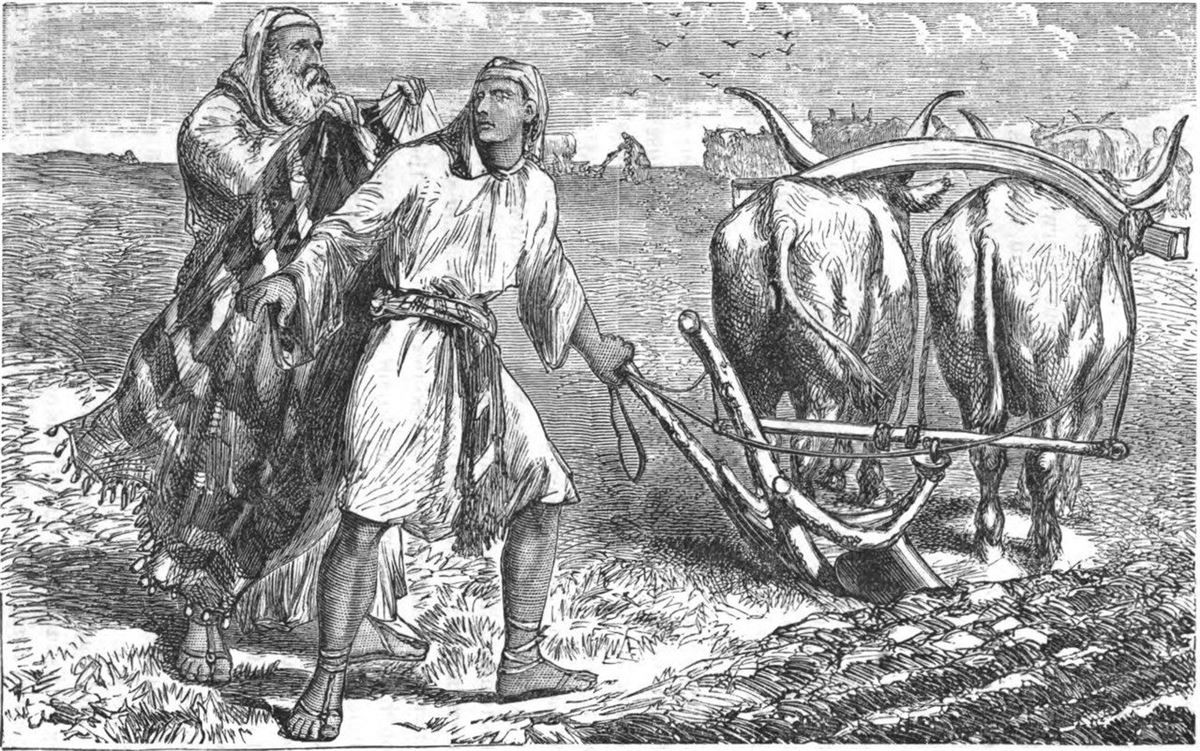
19 So he departed from there and found Elisha the son of Shaphat, who was plowing with twelve yoke of oxen in front of him, and he was with the twelfth. Elijah passed by him and cast his cloak upon him. 20 And he left the oxen and ran after Elijah and said, “Let me kiss my father and my mother, and then I will follow you.” And he said to him, “Go back again, for what have I done to you?” 21 And he returned from following him and took the yoke of oxen and sacrificed them and boiled their flesh with the yokes of the oxen and gave it to the people, and they ate. Then he arose and went after Elijah and assisted him. 1 Kings 19:15-21 ESV

The last three and a half years had taken their toll on Elijah. He had been living in a God-ordained exile in a remote village in the region of Sidon. While God had miraculously cared for him during that time, he had to live with the knowledge that there was a bounty on his head. King Ahab and his queen, Jezebel, had never forgiven him for the drought he had placed on the land of Israel. Elijah must have woken up every morning wondering if that would be the day God called him to confront Ahab and Jezebel one more time.

When that day finally came, Elijah obeyed God and made his way to Mount Carmel, where he challenged King Ahab to pit his 450 prophets of Baal against Yahweh, the one true God. That battle ended up being a lopsided affair, with Elijah’s God as the clear victor and the false god of Ahab and Jezebel exposed as a fraud and a failure. The dead bodies of his 450 prophets, strewn across the Jezreel Valley, were evidence of his decisive defeat.

But Elijah’s hope for revival in the land was soon replaced by fear for his own life. Jezebel had vowed to kill Elijah for his slaughter of the 450 prophets of Baal. And he responded to this news by running away. The prophet of God seemed to have lost all faith in God. Yet, even in his deep state of depression and despondency, Elijah was ministered to by God. Yahweh met Elijah right where he was, in the midst of his doubt and despair, and graciously provided him with a visual demonstration of His power. However, the wind, earthquake, and fire only frightened Elijah, causing him to take refuge in a cave. But it was the quiet whisper of God that drew him out, and the gentle voice of God asked Elijah to explain his presence there. What was the prophet doing so far from the scene of the recent victory over Baal? Why was he hiding? Elijah’s answer revealed his struggle with a lack of faith and a sense of failure.

I have been very jealous for the LORD, the God of hosts. For the people of Israel have forsaken your covenant, thrown down your altars, and killed your prophets with the sword, and I, even I only, am left, and they seek my life, to take it away.” – 1 Kings 19:14 ESV

Elijah described himself as alone and afraid. He had convinced himself that he was the last man standing, with no one to do battle at his side. In the heat of the moment, he had conveniently forgotten about the 100 prophets that God had used Obadiah to protect and preserve (1 Kings 18:13). Elijah felt alienated and alone, but his feelings were not based on reality. God even informed Elijah that He had preserved a remnant of “7,000 others in Israel who have never bowed down to Baal or kissed him!” (1 Kings 19:18 NLT). Elijah was far from alone, and God was far from finished with Elijah. But rather than rebuke His wavering prophet, God gave him his next assignment.

“Go back the same way you came, and travel to the wilderness of Damascus. When you arrive there, anoint Hazael to be king of Aram. Then anoint Jehu grandson of Nimshi to be king of Israel, and anoint Elisha son of Shaphat from the town of Abel-meholah to replace you as my prophet.” – 1 Kings 19:15 ESV

Despite his recent display of faithlessness and fear, Elijah would play a significant role in the next phase of God’s plans for Israel. God gave Elijah three assignments: First, he was to anoint a new king over the Syrians or Arameans. Then, he was to anoint a new king over Israel’s northern kingdom. Finally, he was to anoint his own successor. God provided Elijah little in the way of details. Other than the names of the men he was to anoint, Elijah had no way of knowing what any of this meant or how it would all turn out. But God was letting Elijah know that there were plans in the works of which he was unaware. Whether Elijah realized it or not, Ahab’s days were numbered, and the Syrians would end up playing a part in his eventual demise. There would be a new king in Israel one day. God had defeated the false god, Baal, and now He was going to mete out final judgment on the man responsible for Baal’s presence in Israel.

As if to further convince Elijah that he was not alone and that his mission was far from over, God revealed that the three men Elijah was to anoint would carry on the work that he had started at Mount Carmel. Elijah had killed the 450 prophets of Baal, but there were far more who needed to face the judgment of God for their apostasy and rebellion.

“Anyone who escapes from Hazael will be killed by Jehu, and those who escape Jehu will be killed by Elisha! – 1 Kings 19:17 NLT

Judgment was coming. Yahweh was preparing to purge Israel of all those who had bowed the knee to Baal, and He would start at the top with Ahab and Jezebel. But this divine plan to cleanse Israel would not happen overnight. In fact, it would last long after Elijah was gone. That’s why God informed Elijah that he was to anoint his successor.

“…anoint Elisha son of Shaphat from the town of Abel-meholah to replace you as my prophet. – 1 Kings 19:16 NLT

God already had Elijah’s replacement identified and a strategy in place to carry on His divine plan for Ahab’s punishment and Israel’s purification. A big reason for Elijah’s dejection was that the revival that started at Mount Carmel had stalled. When he had heard the people cry out, “The LORD, he is God; the LORD, he is God” (1 Kings 18:39 ESV), he genuinely believed that God had turned back the hearts of the people, and he expected to see an amazing renewal take place. He may have even thought that Ahab and Jezebel might repent and accept Yahweh as the one true God. But instead, the ever-defiant queen had threatened him with death.

But while Jezebel remained unwavering in her commitment to Baal, Elijah needed to understand that God was unfazed by her actions. As the sovereign, omniscient God of the universe, He had a plan in place to deal with Jezebel, Ahab, and all those who had bent the knee to Baal. And while Elijah might not live to see the final phase of that plan, he would play a decisive role in its implementation.

Revived and encouraged by Yahweh’s news, Elijah made his way to Abel-meholah, located in the Jordan Valley. While God clearly told Elijah to travel to the wilderness of Damascus and anoint Hazael to be king of Aram (1 Kings 19:15), it would appear that this was meant to be his final destination. On his way from Mount Sinai, he had to pass through the Jordan Valley, so it only made sense to stop there first and find the man who would be his replacement. He found Elisha plowing with 12 pairs of oxen in a field. This agrarian scene is significant for several reasons. First, it conveys an image of hope and expectation. After three-and-a-half years of drought, the rain had come, and now Elisha was preparing his formerly sun-baked fields for planting. He was anticipating a fruitful harvest sometime in the future. But Elisha’s presence in the field also reveals that he was a man of the land. He was not an influential figure with great wealth and prominence. He was a nondescript nobody whose only credentials were his calling by Yahweh.

What happens next appears strange to our modern sensibilities. Elijah walked up to this man, placed his cloak across his shoulders, and then simply walked away. What kind of bizarre ritual did this represent? How could Elisha have taken this unexpected action from this unknown stranger? Amazingly, it seems as if Elisha fully understood the significance of Elijah’s symbolic act. The text states that he “left the oxen standing there, ran after Elijah, and said to him, ‘First let me go and kiss my father and mother good-bye, and then I will go with you!’” (1 Kings 19:20 NLT). Perhaps God had already prepared Elisha for this moment, having revealed His plan through a dream or vision. He could have sent an angelic messenger to prepare Elisha for the prophet’s arrival. But whatever the case, Elisha seems to have been unfazed by what transpired and fully aware of what it meant. He immediately stopped his plowing and followed the man of God. His words and actions reveal that he knew who Elijah was and what he was asking him to do. His only request was that he be allowed to say goodbye to his family.

Elijah’s response to his request comes across as rather flippant.

Go back again, for what have I done to you?” – 1 Kings 19:20 ESV

In a sense, Elijah was simply emphasizing that this had all been God’s doing, not his. He was merely the messenger. Elisha was free to do as he pleased, and the young farmer-turned-prophet demonstrated his commitment to accept the call of God. He took the plow, the symbol of his former occupation, and used the wood to build an altar. Then, on that altar, he offered up the oxen with which he had been plowing. Elisha burned every bridge to his former life. He bid his parents and his past goodbye and “arose and went after Elijah and assisted him” (1 Kings 19:21 ESV).

As Elijah and Elisha made their way from the Jordan Valley, the first phase of the second half of God’s plan began. The revival Elijah had longed for and given up on was coming. Yahweh was not yet done. Elijah had been a key player in God’s renewal plans for Israel, but his part was coming to an end. The LORD had another man ready to take the baton and finish the race. God would use this divine tag team to accomplish His will concerning Israel and usher in a period of much-needed spiritual renewal among His covenant people. The apostle Paul would later explain his understanding of how God uses a team approach to accomplish His divine will.

What then is Apollos? What is Paul? Servants through whom you believed, as the Lord assigned to each. I planted, Apollos watered, but God gave the growth. So neither he who plants nor he who waters is anything, but only God who gives the growth. He who plants and he who waters are one, and each will receive his wages according to his labor. For we are God’s fellow workers. You are God’s field, God’s building. – 1 Corinthians 3:5-9 ESV

Elijah had planted; now it was Elisha’s turn to water. But the harvest would be the LORD’s.

English Standard Version (ESV) The Holy Bible, English Standard Version. ESV® Permanent Text Edition® (2016). Copyright © 2001 by Crossway Bibles, a publishing ministry of Good News Publishers.

New Living Translation (NLT) Holy Bible, New Living Translation, copyright © 1996, 2004, 2015 by Tyndale House Foundation. Used by permission of Tyndale House Publishers Inc., Carol Stream, Illinois 60188. All rights reserved.

A New Way of Living

Put to death therefore what is earthly in you: sexual immorality, impurity, passion, evil desire, and covetousness, which is idolatry. On account of these the wrath of God is coming. In these you too once walked, when you were living in them. But now you must put them all away: anger, wrath, malice, slander, and obscene talk from your mouth. Do not lie to one another, seeing that you have put off the old self with its practices 10 and have put on the new self, which is being renewed in knowledge after the image of its creator. 11 Here there is not Greek and Jew, circumcised and uncircumcised, barbarian, Scythian, slave, free; but Christ is all, and in all.  Colossians 3:5-11 ESV

How were the believers in Colossae supposed to set their minds on things that are above, not on things that are on earth? Was Paul suggesting they be so heavenly-minded that they were no earthly good? Paul has just challenged them to adopt a Christ-focused perspective that highlights the eternal aspect of their relationship with Him. Christ is seated at the right hand of His Father in heaven, and one day He will return. His presence at His Father’s side demonstrates that He successfully completed the initial phase of His earthly mission. The apostle Peter addressed the significance of Jesus’ resurrection and exaltation when he delivered his first sermon to the crowds at Pentecost.

“God raised Jesus from the dead, and we are all witnesses of this. Now he is exalted to the place of highest honor in heaven, at God’s right hand. And the Father, as he had promised, gave him the Holy Spirit to pour out upon us…” – Acts 2:32-33 NLT

Jesus’ death was efficacious. It accomplished the will of His heavenly Father and required no supplemental aids or add-ons to increase its effectiveness. Paul assured the believers in Rome that because Jesus died and rose again, they were assured of eternal life with Him.

We are sure of this because Christ was raised from the dead, and he will never die again. Death no longer has any power over him. When he died, he died once to break the power of sin. But now that he lives, he lives for the glory of God. So you also should consider yourselves to be dead to the power of sin and alive to God through Christ Jesus. – Romans 6:9-11 NLT

Paul picks up the same theme with the believers in Colossae. He wants them to live according to their new status as spiritually transformed and fully adopted children of God. Jesus didn’t die so that they might have their best life now but so that they might enjoy glorified life forever. However, Paul knew this future-focused mindset was challenging to maintain while living in the present. That’s why he provides them with practical guidance for navigating life in a fallen world. He is expanding the theme he began back in chapter two.

Therefore, as you received Christ Jesus the Lord, so walk in him, rooted and built up in him and established in the faith – Colossians 2:6-7 ESV

For Paul, it was always about faith. He firmly believed and persistently taught that faith was the key to our salvation and sanctification, and Jesus Christ is to be the sole focus of that faith. It is through Christ that we have access to the Father, and it is because of Christ that we have the assurance of eternal life. As Paul stated to the believers in Rome, the indwelling presence of the Holy Spirit was made possible because of Christ’s resurrection. Look closely at what Paul told the Roman believers: “Consider yourselves to be dead to the power of sin and alive to God through Christ Jesus” (Romans 6:11 NLT).

Their union with Christ gave them unprecedented power to live godly lives – even in the ungodly environment of Rome. The same thing was true for the Colossian Christians. Paul has already told them, “You have died with Christ, and he has set you free from the spiritual powers of this world. So why do you keep on following the rules of the world…” (Colossians 2:20 NLT).

Paul constantly admonished believers for their tendency to regress in their faith. They seemed to have no problem believing that Jesus could save them, but they had difficulty trusting that He could keep them saved and help them grow in godliness. So, they kept reverting to their old lifestyles based on human effort and self-righteousness.

So now that you know God (or should I say, now that God knows you), why do you want to go back again and become slaves once more to the weak and useless spiritual principles of this world? – Galatians 4:9 NLT

Paul was calling for complete separation from and dependence upon the things of this world. If Jesus was to be the believer’s sole source of salvation and sustenance, why were they continually turning to the world for satisfaction, fulfillment, significance, and hope? Their actions directly conflicted with their calling and expressed commitment to Jesus Christ. Their behavior did not accurately reflect their belief in a transformed life. That is why Paul demands they do an about-face, turning their backs on their former way of life and seeking things above.

So put to death the sinful, earthly things lurking within you. Have nothing to do with sexual immorality, impurity, lust, and evil desires. Don’t be greedy, for a greedy person is an idolater, worshiping the things of this world. – Colossians 3:5 NLT

Paul was well aware that his flock in Colossae was struggling with the ongoing presence of their sinful natures. Paul was not exempt from this internal battle between godliness and wickedness. In his letter to the Romans, he divulged his own struggle with indwelling sin.

I have discovered this principle of life—that when I want to do what is right, I inevitably do what is wrong. I love God’s law with all my heart. But there is another power within me that is at war with my mind. This power makes me a slave to the sin that is still within me. Oh, what a miserable person I am! Who will free me from this life that is dominated by sin and death? – Romans 7:21-24 NLT

But Paul answered his own pleading question, joyfully declaring, “Thank God! The answer is in Jesus Christ our Lord” (Romans 7:25 NLT). The solution to the problem of indwelling sin is Jesus. Because of Jesus, we have been given the gift of the Holy Spirit, who empowers us to say no to sin and yes to God. His divine presence provides us with all we need to put to death the sinful, earthly things lurking within us. Peter put it this way: “By his divine power, God has given us everything we need for living a godly life. We have received all of this by coming to know him, the one who called us to himself by means of his marvelous glory and excellence” (2 Peter 1:3 NLT).

Peter was addressing the power and presence of the indwelling Holy Spirit. Godly living wasn’t a matter of self-control, hard work, and a commitment to keeping a list of rules and religious rituals. Self-effort can only produce self-righteousness. But the kind of righteousness God demands can only be produced by the Spirit of God. That is why Paul told the Galatian church, “So I say, let the Holy Spirit guide your lives. Then you won’t be doing what your sinful nature craves” (Galatians 5:16 NLT). He went on to say, “Those who belong to Christ Jesus have nailed the passions and desires of their sinful nature to his cross and crucified them there” (Galatians 5:24 NLT).

Because of their relationship with Christ, their former sinful habits had been nailed to the cross with Him. But every believer knows how easy it is to breathe life into those old, dead habits and “resurrect” them again. So, Paul demands that they “put to death” those things. But how? Is he suggesting that this is an ongoing, daily action? Is it the fate of every Christian to live their entire earthly existence in a daily struggle to put sin to death? The answer is found in the grammar of Paul’s statement. When he states, “put to death,” he uses the Aorist Active Imperative (AAM) tense. The action described by the verb indicates that it is a past event. In other words, it has already taken place. Paul is stating that our old sinful habits have already been put to death – on the cross. So, we must constantly return them to their rightful place: the cross. Our present action is based on a past reality.

The action Paul commands is a natural byproduct of belief. If we truly believe that Jesus “canceled the record of the charges against us and took it away by nailing it to the cross” (Colossians 2:14 NLT), then we should confidently return those sinful habits right where they belong: to the cross. They are dead to us. They no longer possess power over us. Paul is reminding the Colossians that their new life in Christ is meant to reflect a new way of living.

You used to do these things when your life was still part of this world. But now is the time to get rid of anger, rage, malicious behavior, slander, and dirty language. – Colossians 3:7-8 NLT

They had been cleansed by the blood of Jesus Christ. They were now clothed in His righteousness. Yet, metaphorically,  they were constantly going back to the closet of sin and picking out old, soiled garments to wear. That’s why Paul reminds them that they had already “put off the old self with its practices” (Colossians 3:9 ESV) and “put on the new self, which is being renewed in knowledge after the image of its creator” (Colossians 3:10 ESV). It was a past action that required constant repeating in the present. But they were guilty of putting on the old self. In a sense, they were reaching into the closet of their past life and selecting one of their old, comfortably fitting sins to wear out in public. 

In this passage, Paul describes the ongoing nature of sanctification or spiritual growth. The Christian life is not meant to be static or stagnant. Once saved, always saved doesn’t mean that there is no ongoing transformation in the believer’s life. Peter indicates believers are to “grow into a full experience of salvation” (1 Peter 2:2 NLT). Paul told the Ephesians that they were to grow “in every way more and more like Christ” (Ephesians 4:15 NLT).

Growth in Christlikeness is non-optional for the believer, but it is not a matter of hard work and determination. One of the primary roles of the Holy Spirit is to assist Christians in their knowledge of Christ and their ongoing transformation into His likeness. This transformation is for all believers, regardless of their ethnic or cultural background. Each is to individually experience the Spirit’s transformative power so that, together, we might reflect that nature of Christ and bring glory to God the Father.

you are living stones that God is building into his spiritual temple. What’s more, you are his holy priests. Through the mediation of Jesus Christ, you offer spiritual sacrifices that please God. – 1 Peter 2:5 NLT

Jesus made our salvation possible and ensured our ongoing sanctification. Our transformation into His likeness is a supernatural work of God that requires our participation but not our power. We must willingly cooperate with the Spirit by submitting to His will and obeying His promptings. We put off the old in His power, not our own. We live to righteousness in His strength, not our own. Our ongoing renewal and reformation is His work, not ours.

English Standard Version (ESV) The Holy Bible, English Standard Version. ESV® Permanent Text Edition® (2016). Copyright © 2001 by Crossway Bibles, a publishing ministry of Good News Publishers.

New Living Translation (NLT) Holy Bible, New Living Translation, copyright © 1996, 2004, 2015 by Tyndale House Foundation. Used by permission of Tyndale House Publishers Inc., Carol Stream, Illinois 60188. All rights reserved.

Faith That Lasts

1 For I want you to know how great a struggle I have for you and for those at Laodicea and for all who have not seen me face to face, that their hearts may be encouraged, being knit together in love, to reach all the riches of full assurance of understanding and the knowledge of God’s mystery, which is Christ, in whom are hidden all the treasures of wisdom and knowledge. I say this in order that no one may delude you with plausible arguments. For though I am absent in body, yet I am with you in spirit, rejoicing to see your good order and the firmness of your faith in Christ.

Therefore, as you received Christ Jesus the Lord, so walk in him, rooted and built up in him and established in the faith, just as you were taught, abounding in thanksgiving. Colossians 2:1-7 ESV

In verse 29 of chapter one, Paul speaks of his ongoing “struggle” to proclaim the true gospel of Jesus Christ. The Greek word agōnizomai carries the idea of strenuous effort driven by intense zeal. Paul was obsessed with the idea of spiritual formation and expressed his own desire to whatever was necessary so that every believer achieved full spiritual maturity.

we tell others about Christ, warning everyone and teaching everyone with all the wisdom God has given us. We want to present them to God, perfect in their relationship to Christ. – Colossians 1:28 NLT

He poured out every ounce of his being to accomplish that goal. Here in chapter two, he uses the root word agōn to describe the ongoing “conflict” in which he finds himself engaged, and he confesses that his efforts are on behalf of all those congregations living in the Lycus Valley. The errant teachings concerning Christ had impacted not only the church in Colossae but the one in Laodicea as well. Likely, the nearby community of Hierapolis had also come under the influence of teachers making false claims that denied either the deity or humanity of Jesus.

The members of these three congregations had never met Paul face to face because, at the time he wrote this letter, he had not yet set foot in the Lycus Valley. His knowledge of their situation had come to him through Epaphras and others. But like a true shepherd, Paul expressed his loving concern for these distant flocks, declaring his intense desire “that their hearts may be encouraged, being knit together in love, to reach all the riches of full assurance of understanding and the knowledge of God’s mystery, which is Christ” (Colossians 2:2 ESV).

Paul was the consummate encourager. Yes, he often displayed a blunt, in-your-face style of confrontational leadership that could be withering in its intensity. Still, his ultimate goal was correction, which led to further spiritual growth. Even in these verses, Paul displays the loving concern of a pastor who longs to see his congregants experience the full measure of their salvation. For Paul, coming to faith in Christ was not a one-time event but an ongoing experience that included the believer’s initial reconciliation to God and their ongoing sanctification and ultimate glorification.

The apostle Peter described this full-orbed approach in his first letter, encouraging his readers to “crave pure spiritual milk so that you will grow into a full experience of salvation” (1 Peter 2:2 NLT). Paul warned Timothy that “in the last times some will turn away from the true faith; they will follow deceptive spirits and teachings that come from demons” (1 Timothy 4:1 NLT). In a second letter to Timothy, Paul reiterated his concern about the danger of a feeble and stagnant faith.

For a time is coming when people will no longer listen to sound and wholesome teaching. They will follow their own desires and will look for teachers who will tell them whatever their itching ears want to hear. They will reject the truth and chase after myths. – 2 Timothy 4:3-4 NLT

That’s why Paul told Timothy, “Preach the word of God. Be prepared, whether the time is favorable or not. Patiently correct, rebuke, and encourage your people with good teaching” (2 Timothy 4:2 NLT). And Paul practiced what he preached. He patiently corrected, rebuked, and encouraged the church in Colossae so that they might stand firm against the faith-deflating lies of the false teachers.

Throughout his ministry, Paul strived to keep Jesus Christ as the central focus of all his teachings. In his first letter to the church in Corinth, he referred to the doctrine of Jesus as the foundation upon which every other doctrine or teaching must rest.

I have laid the foundation like an expert builder. Now others are building on it. But whoever is building on this foundation must be very careful. For no one can lay any foundation other than the one we already have—Jesus Christ. – 1 Corinthians 3:10-11 NLT

The teachings of Jesus were not the foundation; it was Jesus Himself. The deity, humanity, sacrificial death, Spirit-empowered resurrection, and promised return of Jesus formed the firm foundation on which every believer’s faith must rest and remain. But Paul had been forced to confront the Corinthian believers about their propensity to embrace false doctrines about Jesus.

I am afraid, however, that just as Eve was deceived by the serpent’s cunning, your minds may be led astray from your simple and pure devotion to Christ. For if someone comes and proclaims a Jesus other than the One we proclaimed, or if you receive a different spirit than the One you received, or a different gospel than the one you accepted, you put up with it way too easily. – 2 Corinthians 11:3-4 BSB

Paul did not want the believers in Colossae to make the same mistake, so he reminded them that in Jesus, “lie hidden all the treasures of wisdom and knowledge” (Colossians 2:3 NLT). Anyone preaching a non-deified Jesus was proclaiming a lie and disseminating foolishness rather than wisdom. Anyone who refuted Jesus’ humanity and discounted His sacrificial death on the cross was to be viewed as a liar and not as a messenger from God. 

But Paul realized that many of these false teachers were highly persuasive, using well-crafted and lofty-sounding arguments that seemed to make sense. To make matters worse, these men were operating within the context of the local church in Colossae, while Paul was hundreds of miles away in Rome. He had been placed under house arrest by the emperor and denied the freedom to travel. So, while the false teachers mingled with the flock in Colossae, Paul was restricted to writing a letter. But he reminded them, “Though I am far away from you, my heart is with you” (Colossians 2:5 NLT). They were out of sight but not out of mind. And Paul expressed his joy when Epaphras informed him of their firm commitment to the faith – even in the face of false teaching.

So, Paul exhorts them to remain steadfast and unwavering in their faith. Despite everything happening around them, they had all the truth they needed to survive and thrive. A new version of the gospel was not necessary, and a different take on Jesus was not required. The key to their survival was not some new doctrine or novel take on Jesus’s identity but a continuing faith in the One who had made their salvation possible. Paul pleads with them to stay the course.

as you received Christ Jesus the Lord, so walk in him – Colossians 2:6 ESV

They had received Jesus by faith, and they needed to continue living their lives according to faith. Once again, Paul insists that faith is not a static, one-time act that results in salvation but an ongoing lifestyle of complete dependence upon the saving work of Jesus. True saving faith results in our ongoing transformation into His likeness, which will ultimately result in a future state of sinless perfection that will take place upon His return. Paul firmly believed that his faith in Christ was active and alive, determining every facet of his earthly existence, which is why he told the Galatian believers, “The life I live in the body, I live by faith in the Son of God, who loved me and gave Himself up for me” (Galatians 2:20 BSB).

The author of Hebrews describes faith as “the assurance of things hoped for, the conviction of things not seen” (Hebrews 11:1 ESV). Faith is not wishful thinking. It is not some baseless, unfounded desire for that which has no substance or chance of fulfillment. He uses two powerful words to describe the nature of faith. The first is hypostasis, which means “confidence or assurance.” It carries the idea of something being substantive, real, and has actual existence. The second word is elegchos, which means “proof.” Our faith is based on the belief that God’s promises are real, even when invisible to the human eye. Our faith is based on the trustworthiness of God, not our ability to see or touch what was promised. The Old Testament saints listed in chapter 11 of Hebrews displayed faith because they “died still believing what God had promised them. They did not receive what was promised, but they saw it all from a distance and welcomed it” (Hebrews 11:13 NLT). Christians don’t operate by the old adage “Seeing is believing.” Instead, they live by faith. As Paul said, “We walk by faith, not by sight” (2 Corinthians 5:7 ESV).

In his second letter to the church in Corinth, Paul reminded them that God had promised them new bodies – “a building from God, a house not made with hands, eternal in the heavens” (2 Corinthians 5:1 ESV). In their earthly lives, they struggled with pain, sorrow, and affliction. But God promised they would one day put on their “heavenly dwelling” and experience new life in His eternal kingdom. Then he assured them: “He who has prepared us for this very thing is God, who has given us the Spirit as a guarantee. So we are always of good courage. We know that while we are at home in the body we are away from the Lord, for we walk by faith, not by sight” (2 Corinthians 5:5-7 ESV).

That is why Paul called the Colossians to live their lives focused on Jesus, “rooted and built up in him and established in the faith” (Colossians 2:7 ESV). They were to keep their eyes fixed on “the founder and perfecter of our faith” (Hebrews 12:2 ESV). Paul did not want them to get distracted or dissuaded from the truth regarding Jesus. They were to remain “rooted” in their faith. Like a healthy, fruitful plant, they were to sink their roots deep into the promises found in the saving work of Jesus Christ. Rootedness results in fruitfulness or, as Paul puts it, being “built up.” Paul uses a word associated with architecture, portraying the steady, sound construction of a structure built on a solid foundation. Finally, Paul uses the term “established” to describe the final outcome of our faith. The Greek word means “to make good the promises by the event.” It conveys the idea of the promise being fulfilled. The assurance and conviction of our faith will become reality.

Faith has an object: Jesus Christ. But faith also has an objective: our future glorification. That is why Paul wanted them to remain firm in their faith. Saving faith is an enduring faith that focuses on the unwavering promises of God despite the vicissitudes and difficulties of this life. The apostle John provides us with a timeless word of encouragement that points us to the day when all the promises of God will be established.

Dear friends, we are already God’s children, but he has not yet shown us what we will be like when Christ appears. But we do know that we will be like him, for we will see him as he really is. And all who have this eager expectation will keep themselves pure, just as he is pure. – 1 John 3:2-3 NLT

English Standard Version (ESV) The Holy Bible, English Standard Version. ESV® Permanent Text Edition® (2016). Copyright © 2001 by Crossway Bibles, a publishing ministry of Good News Publishers.

New Living Translation (NLT) Holy Bible, New Living Translation, copyright © 1996, 2004, 2015 by Tyndale House Foundation. Used by permission of Tyndale House Publishers Inc., Carol Stream, Illinois 60188. All rights reserved.

No Other Gospel

21 And you, who once were alienated and hostile in mind, doing evil deeds, 22 he has now reconciled in his body of flesh by his death, in order to present you holy and blameless and above reproach before him, 23 if indeed you continue in the faith, stable and steadfast, not shifting from the hope of the gospel that you heard, which has been proclaimed in all creation under heaven, and of which I, Paul, became a minister. – Colossians 1:21-23 ESV

Paul knew it was essential that the Colossian believers fully understood who Jesus was and what He had done for them. Their concept of Jesus had become confused from allowing false ideas about His identity and accomplishments to filter into their beliefs about Him. After Jesus resurrected from the dead and ascended into heaven, growing speculation arose about His true identity and its implications for mankind. In His absence, His disciples continued to spread the news concerning the coming kingdom of God and the sole means of gaining entrance into it: By placing one’s faith in Jesus Christ.

But others had begun formulating their own ideas about Jesus and the implications of His life and death. The disciples had clearly spread the news that Jesus had risen from the dead and had returned to His Father’s side in heaven. Paul had boldly proclaimed the nature of Christ’s death, burial, and resurrection to the believers in Corinth.

I passed on to you what was most important and what had also been passed on to me. Christ died for our sins, just as the Scriptures said. He was buried, and he was raised from the dead on the third day, just as the Scriptures said. He was seen by Peter and then by the Twelve. After that, he was seen by more than 500 of his followers at one time, most of whom are still alive, though some have died. Then he was seen by James and later by all the apostles. Last of all, as though I had been born at the wrong time, I also saw him. – 1 Corinthians 15:3-8 NLT

However, some had begun to refute the disciples’ teaching concerning the resurrection, declaring it improbable and even unnecessary. That’s what led Paul to warn the Corinthians about this dangerous heresy.

…if there is no resurrection of the dead, then Christ has not been raised. And if Christ has not been raised, then your faith is useless and you are still guilty of your sins. In that case, all who have died believing in Christ are lost! And if our hope in Christ is only for this life, we are more to be pitied than anyone in the world. – 1 Corinthians 15:16-19 NLT

Others were spreading the idea that Jesus had not been an actual, flesh-and-blood human. They speculated that He only appeared to take on human form. This teaching was propagated by the Docetists who earned their name from the Greek word dokeĩn, which means “to seem.” They rejected John’s teaching that “the Word became flesh” (John 1:14). Because these people deemed the flesh to be inherently evil, they could not accept the idea of deity taking on humanity. So, they rationalized it away by claiming that Jesus had only appeared to have a human body. So, His “death” was just a fiction. But by voiding the humanity of Jesus, these false teachers were actually eliminating the heart of the gospel message. Without the humanity of Jesus, there would be no gospel. That is why the apostles boldly preached the reality of Jesus’ humanity.

He personally carried our sins in his body on the cross so that we can be dead to sin and live for what is right. By his wounds you are healed. – 1 Peter 2:24 NLT

The doctrine of the bodily death, burial, and resurrection of Jesus became the litmus test for determining the veracity of those claiming to be teachers.

Dear friends, do not believe everyone who claims to speak by the Spirit. You must test them to see if the spirit they have comes from God. For there are many false prophets in the world. This is how we know if they have the Spirit of God: If a person claiming to be a prophet acknowledges that Jesus Christ came in a real body, that person has the Spirit of God. But if someone claims to be a prophet and does not acknowledge the truth about Jesus, that person is not from God. Such a person has the spirit of the Antichrist, which you heard is coming into the world and indeed is already here. – 1 John 4:1-3 NLT

So, as Paul continues the introduction of his letter to the Colossian believers, he stresses the humanity of Jesus, reminding them that they had been “reconciled in his body of flesh by his death” (Colossians 1:22 ESV). For Paul, that point was essential because it explained how sinful human beings could be made right with a holy and righteous God. He even stressed the nature of their pre-conversion state, describing them as “alienated and hostile in mind, doing evil deeds” (Colossians 1:21 ESV). This concept of alienation and hostility was a common theme for Paul. He repeatedly stressed the formerly hopeless and helpless condition of those who now enjoyed a right standing with God. He wanted them to consider the almost incomprehensible scope of Christ’s sacrificial death and what it had accomplished on their behalf.

since we have been made right in God’s sight by the blood of Christ, he will certainly save us from God’s condemnation. For since our friendship with God was restored by the death of his Son while we were still his enemies, we will certainly be saved through the life of his Son. So now we can rejoice in our wonderful new relationship with God because our Lord Jesus Christ has made us friends of God. – Romans 5:9-11 NLT

The physical death of Jesus had made possible their spiritual transformation from enemies of God to friends of God. They had been reconciled to a righteous God by the undeserved death of His righteous and sinless Son. Paul reminded the believers in Rome of the remarkable nature of Jesus’ selfless sacrifice of His life.

The law of Moses was unable to save us because of the weakness of our sinful nature. So God did what the law could not do. He sent his own Son in a body like the bodies we sinners have. And in that body God declared an end to sin’s control over us by giving his Son as a sacrifice for our sins. – Romans 8:3 NLT

Paul told the believers in Colossae that because Jesus had died in their place, He had been able to present them to God the Father as “holy and blameless and above reproach” (Colossians 1:22 ESV). Jesus had taken upon Himself the penalty for their sins and, in exchange, had placed upon them His own unblemished righteousness. Paul fully understood the significance of this “great exchange” and boldly proclaimed His appreciation for it and his unwavering dependence upon it.

I no longer count on my own righteousness through obeying the law; rather, I become righteous through faith in Christ. For God’s way of making us right with himself depends on faith. – Philippians 3:9 NLT

For Paul, belief in Jesus’s death, burial, and resurrection was essential for living the Christian life. He called the Colossians to reject any false teaching that might undermine their faith in the gospel of Jesus Christ and urged them to remain committed to the good news just as they had heard it from Epaphras.

…you must continue to believe this truth and stand firmly in it. Don’t drift away from the assurance you received when you heard the Good News. – Colossians 1:23 NLT

Paul knew that false teachers would be a constant problem in the church. Each generation of believers would face a new wave of plausible but unreliable doctrines concerning the saving work of Jesus. He also knew that immature and poorly informed Christians would be easy targets for false teachers and end up “tossed and blown about by every wind of new teaching” and tricked by “lies so clever they sound like the truth” (Ephesians 4:14 NLT). For Paul, the best defense against false teaching was the truth. He declared his firm commitment to continue doing what he had always done: Preach the unadulterated gospel of Jesus Christ to any and all who would listen.

The Good News has been preached all over the world, and I, Paul, have been appointed as God’s servant to proclaim it. – Colossians 1:23 NLT

Paul wanted the Colossians to know that they had been reconciled to God through the physical death of Jesus Christ. He had been fully divine and fully human and died a very real, excruciating death on the cross—in their place. By placing their faith in Jesus’s substitutionary death, they had been restored to a right relationship with God. Formerly enemies of God, they now enjoyed a new status as His sons and heirs, and no false teacher or faulty doctrine could take that away from them.

Paul will continue to drive home his belief in the humanity of Jesus because it was essential to the gospel message. In the second chapter of his letter, he states, “In Christ all the fullness of the Deity lives in bodily form, and in Christ you have been brought to fullness” (Colossians 2:9-10 NLT). For Paul, Jesus’ humanity and deity were inseparable and non-debatable. If Jesus did not become an actual flesh-and-blood human, then His death on the cross was pointless. For Paul, the bodily death and resurrection of Jesus were the key to the gospel message. If Jesus only appeared to be human, then His death was nothing more than a charade. Without an actual body, it would be impossible for Jesus to die, and if Jesus did not die, the resurrection was unnecessary. But in his first letter to the believers in Corinth, Paul debunked this heretical notion.

For if there is no resurrection of the dead, then Christ has not been raised either. And if Christ has not been raised, then all our preaching is useless, and your faith is useless. And we apostles would all be lying about God—for we have said that God raised Christ from the grave. But that can’t be true if there is no resurrection of the dead. And if there is no resurrection of the dead, then Christ has not been raised. And if Christ has not been raised, then your faith is useless and you are still guilty of your sins. In that case, all who have died believing in Christ are lost! And if our hope in Christ is only for this life, we are more to be pitied than anyone in the world. – 1 Corinthians 15:13-19 NLT

Paul was willing to die to protect the integrity of the gospel. He would not tolerate any twisting of the truth or perversion of the message he had received from Jesus because there was too much at stake. The gospel was not up for interpretation or alteration. Yet, Paul constantly had to clean up the mess left behind by false and heretical teachers. He was forced to chastise the believers in Galatia for their lack of discernment and gullibility.

I am astonished that you are so quickly deserting him who called you in the grace of Christ and are turning to a different gospel—not that there is another one, but there are some who trouble you and want to distort the gospel of Christ. But even if we or an angel from heaven should preach to you a gospel contrary to the one we preached to you, let him be accursed. As we have said before, so now I say again: If anyone is preaching to you a gospel contrary to the one you received, let him be accursed. – Galatians 1:6-9 ESV

There was only one gospel, and it was based on Jesus’s life, death, and resurrection. To ensure that his audience understood, Paul unequivocally states, “He has reconciled you to himself through the death of Christ in his physical body. As a result, he has brought you into his own presence, and you are holy and blameless as you stand before him without a single fault” (Colossians 1:22 NLT). 

English Standard Version (ESV) The Holy Bible, English Standard Version. ESV® Permanent Text Edition® (2016). Copyright © 2001 by Crossway Bibles, a publishing ministry of Good News Publishers.

New Living Translation (NLT) Holy Bible, New Living Translation, copyright © 1996, 2004, 2015 by Tyndale House Foundation. Used by permission of Tyndale House Publishers Inc., Carol Stream, Illinois 60188. All rights reserved.

Be Ready!

32 “From the fig tree learn its lesson: as soon as its branch becomes tender and puts out its leaves, you know that summer is near. 33 So also, when you see all these things, you know that he is near, at the very gates. 34 Truly, I say to you, this generation will not pass away until all these things take place. 35 Heaven and earth will pass away, but my words will not pass away.

36 “But concerning that day and hour no one knows, not even the angels of heaven, nor the Son, but the Father only. 37 For as were the days of Noah, so will be the coming of the Son of Man. 38 For as in those days before the flood they were eating and drinking, marrying and giving in marriage, until the day when Noah entered the ark, 39 and they were unaware until the flood came and swept them all away, so will be the coming of the Son of Man. 40 Then two men will be in the field; one will be taken and one left. 41 Two women will be grinding at the mill; one will be taken and one left. 42 Therefore, stay awake, for you do not know on what day your Lord is coming. 43 But know this, that if the master of the house had known in what part of the night the thief was coming, he would have stayed awake and would not have let his house be broken into. 44 Therefore you also must be ready, for the Son of Man is coming at an hour you do not expect.

45 “Who then is the faithful and wise servant, whom his master has set over his household, to give them their food at the proper time? 46 Blessed is that servant whom his master will find so doing when he comes. 47 Truly, I say to you, he will set him over all his possessions. 48 But if that wicked servant says to himself, ‘My master is delayed,’ 49 and begins to beat his fellow servants and eats and drinks with drunkards, 50 the master of that servant will come on a day when he does not expect him and at an hour he does not know 51 and will cut him in pieces and put him with the hypocrites. In that place there will be weeping and gnashing of teeth. – Matthew 24:32-51 ESV

Jesus is attempting to open the eyes of His disciples and help them develop a long-term perspective regarding His Kingdom. They were focused on the here-and-now, and having trouble understanding that the talk of His coming death in Jerusalem was anything but bad news or something to be avoided at all costs. This entire chapter contains Jesus’ surprising and difficult-to-comprehend words that reveal the bigger picture regarding God’s plan of redemption. Jesus’ death on the cross would be just the beginning of a much larger and comprehensive plan of God that would include His resurrection and His return to His Father’s side. But, even more importantly, it would require His eventual return to earth as the conquering King.

While Jesus knew that there would be a long delay before His return, He wanted His disciples to live with a sense of eager anticipation. If they expected it to happen, kept their eyes open, and looked for the signs of its approach, they would be able to endure the struggles that were coming their way.

Jesus used the visual lesson of a fig tree to help the disciples understand that there would be visible, recognizable signs associated with His coming. The budding of a fig tree is a natural indication that summer is near. It is an unmistakable and irrefutable sign. Jesus wanted His disciples to know that the signs of His return would be just as clear and undeniable. He even assured them that “this generation will not pass away until all these things take place” (Matthew 24:34 ESV).

But what does that mean? Was He saying that the events associated with the end times would take place during the lifetimes of His disciples? The answer would seem to be no. But while they were alive, they would begin to see the early signs of His return. The budding of a fig tree provides a premonition or portent of something to come. The buds do not mean summer has arrived but that it is coming. In the same way, the disciples would live long enough to see signs that would point to Jesus’ coming. They would not be alive when He returned, but they would be given clear indications that it would happen.

Each generation of believers has been given signs that His coming is imminent and inevitable. These signs act as assurances of God’s faithfulness and are meant to encourage Christ-followers to continue to wait eagerly and hopefully.

The earth will continue to endure all kinds of struggles, including earthquakes, famines, floods, disasters, and even wars. Jesus even states that the world would eventually “pass away” (Matthew 24:35 ESV). The apostle Paul broke the same news to the believers in Corinth.

Those who use the things of the world should not become attached to them. For this world as we know it will soon pass away. – 1 Corinthians 7:31 NLT).

The apostle John wrote, “This world is fading away, along with everything that people crave” (1 John 2:17 NLT). Earlier, in this very same discourse, Jesus warned His disciples of future signs that would foretell the end of the age and the nearness of His return.

“…you will hear of wars and threats of wars, but don’t panic. Yes, these things must take place, but the end won’t follow immediately. Nation will go to war against nation, and kingdom against kingdom. There will be famines and earthquakes in many parts of the world. But all this is only the first of the birth pains, with more to come.” – Matthew 24:6-8 NLT

While there will be clear signs along the way, the actual day and date of the Lord’s return will remain a mystery. Christ’s followers will be given assurances of its coming but will not know the exact time of His return. Jesus indicated that even He did not know the day or the hour. God the Father alone has access to that information.

The second coming of Jesus will be a surprise, catching most of the earth’s inhabitants completely off-guard and unprepared. Jesus used the days of Noah as an apt point of comparison. In a way, Noah’s building of the ark was a clear sign that something was coming. Peter indicates that Noah warned his neighbors of God’s coming judgment and the availability of salvation made possible by the ark.

[God] did not spare the ancient world, but preserved Noah, a herald of righteousness… – 2 Peter 2:5 ESV

The New Living Translation reads: “Noah warned the world of God’s righteous judgment.” But the people in Noah’s day ignored the signs and refused the message of Noah. Instead, they busied themselves, “eating and drinking, marrying and giving in marriage, until the day when Noah entered the ark” (Matthew 24:38 ESV).

They continued with their lives, oblivious to the warning signs and ignorant of what was about to happen, until “the flood came and swept them all away” (Matthew 24:39 ESV). Jesus clarified to His disciples that the same thing would happen when He finally returned, catching the world unprepared and completely off-guard.

The next few verses have created much controversy over the ages. Some have attempted to use them as proof of the eventual rapture of the church. But it is important to keep these verses within their context. Jesus has been talking about His second coming, not the rapture, so the context is judgment, not salvation. When Christ returns the second time, He will come as a righteous judge to deal with sinful mankind once and for all. His coming will take place at the end of the Great Tribulation, a time in which many will come to faith in Christ and endure intense persecution at the hands of the Antichrist. But when Christ returns, He will defeat the Antichrist and his ungodly followers, casting Satan, the Antichrist, and the false prophet into the lake of fire or hell.

Then the devil, who had deceived them, was thrown into the fiery lake of burning sulfur, joining the beast and the false prophet. There they will be tormented day and night forever and ever. – Revelation 20:10 NLT

And all those who are living on the earth at that time will be judged as well, with their ultimate fate being consignment to hell.

Based on the context of the second coming, those whom Jesus describes as being “taken” are the unbelievers who remain. They will be judged and condemned, then sent to the destination God has prepared for them. Any who are “left” are meant to symbolize those who came to faith in Christ during the Great Tribulation.

Jesus appears to stress the need to remain prepared and fully expectant. This is why He said, “Stay awake, for you do not know on what day your Lord is coming” (Matthew 24:42 ESV). He added, “You also must be ready, for the Son of Man is coming at an hour you do not expect” (Matthew 24:44 ESV).

Disciples of Christ are to live with a sense of eager expectation and conduct themselves as if His return could occur at any moment. Waiting is difficult. The delay can easily cause us to lose hope and take our eyes off the prize. Jesus gave His disciples a warning in the form of yet another parable.

A faithful and wise servant stays vigilant and diligent while his master is away, conducting himself as if the master could walk in the door at any minute. But the wicked servant used the delay as an excuse to sow his wild oats. His sin-prone, self-centered nature manifested itself.  And Jesus warns that the servant’s master, like the Messiah, will return when the servants least expect it. When he does, he will bring just judgment on the wicked servant.

Again, Jesus was trying to get His disciples to understand that there was much more to the Kingdom than they ever imagined. His first coming was just the beginning, and His eventual departure would not be the end. He would come again. He had promised to do so, and they needed to live their lives as if it could and would happen – at any moment. They were to stay diligent and vigilant. They were to remain faithful and wise. Unlike the wicked, followers of Christ are to stay alert and awake, fully prepared for His return.

“Let the evildoer still do evil, and the filthy still be filthy, and the righteous still do right, and the holy still be holy.

“Behold, I am coming soon, bringing my recompense with me, to repay each one for what he has done. I am the Alpha and the Omega, the first and the last, the beginning and the end.” – Revelation 22:11-13 NLT

So, be ready.

English Standard Version (ESV)
The Holy Bible, English Standard Version. ESV® Permanent Text Edition® (2016). Copyright © 2001 by Crossway Bibles, a publishing ministry of Good News Publishers.

New Living Translation (NLT)
Holy Bible, New Living Translation, copyright © 1996, 2004, 2015 by Tyndale House Foundation. Used by permission of Tyndale House Publishers Inc., Carol Stream, Illinois 60188. All rights reserved.

Robbing God of Glory

1 Again I lifted my eyes and saw, and behold, a flying scroll! And he said to me, “What do you see?” I answered, “I see a flying scroll. Its length is twenty cubits, and its width ten cubits.” Then he said to me, “This is the curse that goes out over the face of the whole land. For everyone who steals shall be cleaned out according to what is on one side, and everyone who swears falsely shall be cleaned out according to what is on the other side. I will send it out, declares the Lord of hosts, and it shall enter the house of the thief, and the house of him who swears falsely by my name. And it shall remain in his house and consume it, both timber and stones. Zechariah 5:1-4 ESV

In God’s economy, the roles of king and priest were essential for maintaining the civil and moral order of the nation. Together, Zerubbabel and Joshua were responsible for rebuilding the Temple and reinstituting the sacrificial system of Israel. But Yahweh knew that the Temple could not guarantee an obedient people and the sacrifices could devolve into repetitious rituals that held no meaning and made no difference in the people’s behavior.

The reason the people of Judah had spent 70 years exiled in Babylon was because of their sinfulness and disobedience. Jeremiah the prophet had warned them that the Temple could not save them from God’s righteous wrath.

“Even now, if you quit your evil ways, I will let you stay in your own land. But don’t be fooled by those who promise you safety simply because the LORD’s Temple is here. They chant, ‘The LORD’s Temple is here! The LORD’s Temple is here!’ But I will be merciful only if you stop your evil thoughts and deeds and start treating each other with justice; only if you stop exploiting foreigners, orphans, and widows; only if you stop your murdering; and only if you stop harming yourselves by worshiping idols. Then I will let you stay in this land that I gave to your ancestors to keep forever.” – Jeremiah 7:4-7 NLT

The prophet Isaiah delivered a stinging indictment against God’s chosen people for their faux-faithfulness and hypocritical display of ritualistic and heartless worship.

the Lord says,
    “These people say they are mine.
They honor me with their lips,
    but their hearts are far from me.
And their worship of me
    is nothing but man-made rules learned by rote.” – Isaiah 29:13 NLT

God had warned them of the consequences of their disingenuous displays of adoration and rule-keeping.

“…I will bring disaster upon you,
    and there will be much weeping and sorrow.…

“I will be your enemy,
    surrounding Jerusalem and attacking its walls.
I will build siege towers
    and destroy it.” – Isaiah 29:2-3 NLT

God expected both heart transformation and behavior modification. His Law was intended to be a road map for righteous living. The sacrificial system was graciously provided as a means for maintaining a right standing with Him when the sins were inevitably committed.

In his role as governor, Zerubbabel was expected to deal with matters related to law and order. He was responsible for policing and enforcement of all civil laws designed to ensure the community’s safety and well-being.

When there is moral rot within a nation, its government topples easily.
    But wise and knowledgeable leaders bring stability. – Proverbs 28:2 NLT

As the high priest, Joshua was responsible for fostering the spiritual well-being of the nation. He and his fellow priests, along with the Levites, were to care for the Temple and orchestrate the sacrifices and feasts prescribed by God. But they were also to serve as judges, providing legal counsel and judicial decisions on difficult cases.

“Suppose a case arises in a local court that is too hard for you to decide—for instance, whether someone is guilty of murder or only of manslaughter, or a difficult lawsuit, or a case involving different kinds of assault. Take such legal cases to the place the Lord your God will choose, and present them to the Levitical priests or the judge on duty at that time. They will hear the case and declare the verdict. You must carry out the verdict they announce and the sentence they prescribe at the place the Lord chooses. You must do exactly what they say.” – Deuteronomy 17:8-10 NLT

Zerubbabel and Joshua represent the religious and civil leadership of the nation. As God’s appointed caretakers, they were expected to shepherd His flock. This would require equal amounts of love and discipline, something their predecessors failed to provide.

“What sorrow awaits the leaders of my people—the shepherds of my sheep—for they have destroyed and scattered the very ones they were expected to care for,” says the LORD. – Jeremiah 23:1 NLT

All of these factors provide important background to what takes place in chapter 5. In his sixth vision, Zechariah is shown a giant scroll, measuring 30 feet in length and 15 feet in height. On one side of this massive parchment is a list of all those who have committed theft. The other side contains the names of all who are guilty of swearing. This massive scroll contains only the names of thieves and those who pledge false oaths. But why did God focus on these two transgressions? Aren’t there far worse crimes that deserve God’s attention and judgment?

It seems that these two categories of sin both deal with taking what something that belongs to another. The seventh commandment clearly forbade stealing, and God but in the Book of Leviticus God expands His list of prohibitions.

“Do not steal. Do not deceive or cheat one another. Do not bring shame on the name of your God by using it to swear falsely. I am the Lord. Do not defraud or rob your neighbor. Do not make your hired workers wait until the next day to receive their pay. Do not insult the deaf or cause the blind to stumble. You must fear your God; I am the Lord. Do not twist justice in legal matters by favoring the poor or being partial to the rich and powerful. Always judge people fairly. Do not spread slanderous gossip among your people.” – Leviticus 19:11-16 NLT

Stealing and swearing seem to serve as broad categories that encompass all sins of speech and action. There are a lot of ways to steal from someone else. You can take their property and possessions but you can also rob them of their reputation. An employer can commit theft by failing to pay his workers a decent wage or by withholding payment for purely selfish reasons. However, as the Leviticus passage makes clear, our words can also rob others of their joy, honor, dignity, and self-worth.

Later in this same book, God will expand on this topic of theft and swearing.

“I am determined to bless Jerusalem and the people of Judah. So don’t be afraid. 16 But this is what you must do: Tell the truth to each other. Render verdicts in your courts that are just and that lead to peace. Don’t scheme against each other. Stop your love of telling lies that you swear are the truth. I hate all these things, says the Lord.” – Zechariah 8:15-17 NLT

But there appears to be more here than meets the eye. This scroll and the names of the guilty it contains are meant to get Zechariah’s attention. Its sheer size conveys the number of names that Zechariah saw, and he must have recognized many of them. Perhaps he saw his own name in the list. It seems likely that everyone living in Judah at the time would have found their name written on both sides of the scroll.

In the Book of Malachi, God issues a stern warning to the descendants of Jacob, calling them to change their behavior. He accuses them of stealing from Him and they seem shocked by His words.

“For I the LORD do not change; therefore you, O children of Jacob, are not consumed. From the days of your fathers you have turned aside from my statutes and have not kept them. Return to me, and I will return to you, says the LORD of hosts. But you say, ‘How shall we return?’ Will man rob God? Yet you are robbing me. But you say, ‘How have we robbed you?’ In your tithes and contributions. You are cursed with a curse, for you are robbing me, the whole nation of you. – Malachi 3:6-9 ESV

The people were guilty of short-changing God. They had repeatedly failed to give the required tithes and offerings, leaving the storehouses of the Temple empty. And God declares the entire nation to be guilty of this crime.

But that wasn’t the only transgression God’s people had committed. According to the Book of Numbers, God outlawed the making of false or fraudulent pledges to Him.

“This is what the Lord has commanded: A man who makes a vow to the Lord or makes a pledge under oath must never break it. He must do exactly what he said he would do. – Numbers 30:1-2 NLT

The Book of Numbers reiterates this command.

“When you make a vow to the Lord your God, be prompt in fulfilling whatever you promised him. For the Lord your God demands that you promptly fulfill all your vows, or you will be guilty of sin. – Deuteronomy 23:21-21 NLT

Swearing an oath to God and failing to honor it was a form of stealing. It was to rob God of what was rightfully His. Jesus picked up on this theme of vows and swearing in His Sermon on the Mount. As with all His other saying in this famous sermon, Jesus took the Old Testament teachings on vows, swearing, and oaths and made them even more practical.

“You have also heard that our ancestors were told, ‘You must not break your vows; you must carry out the vows you make to the LORD.’ But I say, do not make any vows! Do not say, ‘By heaven!’ because heaven is God’s throne. And do not say, ‘By the earth!’ because the earth is his footstool. And do not say, ‘By Jerusalem!’ for Jerusalem is the city of the great King. Do not even say, ‘By my head!’ for you can’t turn one hair white or black. Just say a simple, ‘Yes, I will,’ or ‘No, I won’t.’ Anything beyond this is from the evil one.” – Matthew 5:33-37 NLT

Stealing and swearing were common practices among the people of God in Zechariah’s day, and Zerubbabel and Joshua were far from guiltless. All stood before God condemned of robbing Him of glory, cheating Him of what was rightfully His, and offering false assurances of adoration and praise to cover up for their transgressions. But God wanted His people to know that He took their sins seriously and would deal with them harshly.

“…my curse will remain in that house and completely destroy it—even its timbers and stones.” – Zechariah 5:4 NLT

Yahweh wanted true heart change. He would not be satisfied with false piety, faux faithfulness, or fraudulent forms of worship. And God’s expectations remain just as high today. The apostle Paul reminded the believers in Thessalonica that God demanded words and actions that reflected true devotion and a commitment to holiness. Their behavior was to reflect their beliefs.

God’s will is for you to be holy, so stay away from all sexual sin. Then each of you will control his own body and live in holiness and honor—not in lustful passion like the pagans who do not know God and his ways. Never harm or cheat a fellow believer in this matter by violating his wife, for the Lord avenges all such sins, as we have solemnly warned you before. God has called us to live holy lives, not impure lives. Therefore, anyone who refuses to live by these rules is not disobeying human teaching but is rejecting God, who gives his Holy Spirit to you. – 1 Thessalonians 4:3-8 NLT

English Standard Version (ESV)
The Holy Bible, English Standard Version. ESV® Permanent Text Edition® (2016). Copyright © 2001 by Crossway Bibles, a publishing ministry of Good News Publishers.

New Living Translation (NLT)
Holy Bible, New Living Translation, copyright © 1996, 2004, 2015 by Tyndale House Foundation. Used by permission of Tyndale House Publishers Inc., Carol Stream, Illinois 60188. All rights reserved.

God of the Impossible

Then I came to the governors of the province Beyond the River and gave them the king’s letters. Now the king had sent with me officers of the army and horsemen. 10 But when Sanballat the Horonite and Tobiah the Ammonite servant heard this, it displeased them greatly that someone had come to seek the welfare of the people of Israel.

11 So I went to Jerusalem and was there three days. 12 Then I arose in the night, I and a few men with me. And I told no one what my God had put into my heart to do for Jerusalem. There was no animal with me but the one on which I rode. 13 I went out by night by the Valley Gate to the Dragon Spring and to the Dung Gate, and I inspected the walls of Jerusalem that were broken down and its gates that had been destroyed by fire. 14 Then I went on to the Fountain Gate and to the King’s Pool, but there was no room for the animal that was under me to pass. 15 Then I went up in the night by the valley and inspected the wall, and I turned back and entered by the Valley Gate, and so returned. 16 And the officials did not know where I had gone or what I was doing, and I had not yet told the Jews, the priests, the nobles, the officials, and the rest who were to do the work.

17 Then I said to them, “You see the trouble we are in, how Jerusalem lies in ruins with its gates burned. Come, let us build the wall of Jerusalem, that we may no longer suffer derision.” 18 And I told them of the hand of my God that had been upon me for good, and also of the words that the king had spoken to me. And they said, “Let us rise up and build.” So they strengthened their hands for the good work. 19 But when Sanballat the Horonite and Tobiah the Ammonite servant and Geshem the Arab heard of it, they jeered at us and despised us and said, “What is this thing that you are doing? Are you rebelling against the king?” 20 Then I replied to them, “The God of heaven will make us prosper, and we his servants will arise and build, but you have no portion or right or claim in Jerusalem.” Nehemiah 2:9-20 ESV

The time came for Nehemiah to leave behind his comfortable life in Persia and begin the 800-mile journey to Jerusalem. Nehemiah was accompanied by a contingent of royal guards who provided protection for the traveling party, which appears to have been small in number. Once they crossed the Euphrates River and entered “the province Beyond the River” (Nehemiah 2:7), Nehemiah presented the governors of the region with the letters of safe passage Artaxerxes provided.

Once Nehemiah arrived in Jerusalem, two local officials, Sanballat the Horonite and Tobiah the Ammonite, disclosed their displeasure.

they were very displeased that someone had come to help the people of Israel. – Nehemiah 2:10 NLT

When these two men became aware of Nehemiah’s intentions to rebuild the walls of Jerusalem, they couldn’t hide their anger. As Nehemiah’s building plans progressed, they would be joined by a third governor, Geshem the Arab, who assisted them in mocking the Jews.

But when Sanballat, Tobiah, and Geshem the Arab heard of our plan, they scoffed contemptuously. “What are you doing? Are you rebelling against the king?” they asked. – Nehemiah 2:19 NLT

These disgruntled governors were hoping to demoralize the Jews by accusing them of insurrection. They were hoping to turn the local Jewish population against Nehemiah by questioning the wisdom of his actions. If they could raise doubt concerning the viability of Nehemiah’s plans, he would lose his labor force. This intense pressure to intimidate and discourage the Jews was relentless. Chapter Four reveals that Sanballat and his fellow governors continued to ridicule Nehemiah and his grandiose plans.

Sanballat was very angry when he learned that we were rebuilding the wall. He flew into a rage and mocked the Jews, saying in front of his friends and the Samarian army officers, “What does this bunch of poor, feeble Jews think they’re doing? Do they think they can build the wall in a single day by just offering a few sacrifices? Do they actually think they can make something of stones from a rubbish heap—and charred ones at that?” – Nehemiah 4:1-2 NLT

Tobiah joined in the sarcasm-laced rhetoric, stating, “That stone wall would collapse if even a fox walked along the top of it!” (Nehemiah 4:3 NLT). When their words failed to dissuade the Jews, they would begin to consider violence as their only other option.

…when Sanballat and Tobiah and the Arabs, Ammonites, and Ashdodites heard that the work was going ahead and that the gaps in the wall of Jerusalem were being repaired, they were furious. They all made plans to come and fight against Jerusalem and throw us into confusion. – Nehemiah 4:7-8 NLT

But just three days after his arrival, Nehemiah and a few companions made a late-night inspection tour of the city’s walls. He had not yet disclosed his plans to anyone, including the local Jewish leaders, so this excursion was a fact-finding mission designed to determine the scope of the project. As he carefully navigated the rubble-strewn passage around the long-fallen walls, he could have become discouraged at the extent of the damage. At one point, the debris field was so dense that his donkey was unable to pass through. But despite the abysmal condition of the walls, Nehemiah did not lose heart. Upon completing his inspection, he gathered “the priests, the nobles, the officials, or anyone else in the administration” (Nehemiah 2:16 NLT) and presented them with an unexpected and unprecedented challenge.

“You know very well what trouble we are in. Jerusalem lies in ruins, and its gates have been destroyed by fire. Let us rebuild the wall of Jerusalem and end this disgrace!” – Nehemiah 2:17 NLT

For these men, Nehemiah’s words must have sounded like madness. What Nehemiah was suggesting was impossible. Had the darkness prevented him from seeing the full extent of the situation? Did he really believe he could do what no one else had done for nearly 150 years? The walls of Jerusalem had lain in ruins since 586 B.C. when Nebuchadnezzar’s forces leveled them as part of their long-standing siege and eventual takeover of the city.

on January 15, during the ninth year of Zedekiah’s reign, King Nebuchadnezzar of Babylon led his entire army against Jerusalem. They surrounded the city and built siege ramps against its walls. Jerusalem was kept under siege until the eleventh year of King Zedekiah’s reign. – 2 Kings 25:1-2 NLT

On August 14 of that year, which was the nineteenth year of King Nebuchadnezzar’s reign, Nebuzaradan, the captain of the guard and an official of the Babylonian king, arrived in Jerusalem. He burned down the Temple of the Lord, the royal palace, and all the houses of Jerusalem. He destroyed all the important buildings in the city. Then he supervised the entire Babylonian army as they tore down the walls of Jerusalem on every side. – 2 Kings 25:8-10 NLT

It had been 142 years since the walls fell and during that time, no attempt had been made to rebuild them. It was a project of such epic proportions that no one ever dared to take it on – until Nehemiah showed up on the scene.

This newcomer brought with him a renewed sense of hope and expectation. He told the people about his plans but made sure to disclose God’s role in it all. He wanted them to know that he was on a mission sanctioned by Yahweh Himself. The sovereign LORD had even moved the heart of King Artaxerxes to put the full weight of his royal authority behind the project. Nehemiah’s words had an immediate impact on his audience, causing them to declare, “Let us rise up and build” (Nehemiah 2:18 ESV). They were pumped and ready to begin. Nehemiah’s pep talk had left them so enthused that they conveniently overlooked the sheer size of the project and the relentless determination of their enemies.

But as verse 19 reveals, the enthusiastic Jews were soon reminded that their efforts would not come without opposition. Sanballat, Tobiah, and Geshem launched an immediate public relationship campaign designed to discourage and dissuade the Jews from accomplishing their God-ordained task. Yet, Nehemiah countered their attacks with a reminder of God’s presence and power.

“The God of heaven will help us succeed. We, his servants, will start rebuilding this wall. But you have no share, legal right, or historic claim in Jerusalem.” – Nehemiah 2:20 NLT

Nehemiah saw Sanballat, Tobiah, and Geshem as what they were – enemies of God who had no right to question God’s people and no claim on the land that He had given to the Israelites as their inheritance. These men weren’t just opposing the efforts of Nehemiah and his fellow Jews, they were directly violating the will of God Almighty.

Sanballat was probably a Moabite from Horonaim, a city of Moab. Tobiah was an Ammonite. Geshem was an Arab who governed over the region south of Judah. It is interesting to note that these three men represent three distinct people groups that had a love-hate relationship with Israel. The Moabites were descendants of Moab, the son born to Lot as a result of his incestuous relationship with his eldest daughter (Genesis 19:37). The Ammonites were descendants of Ben-ammi, the son born to Lot through his incestuous relationship with his younger daughter (Genesis 19:38). The “Arabs” mentioned in this passage is likely a reference to the Edomites who controlled an area east of the Arabah, from the Zered to the Gulf of Aqaba. They were the descendants of Esau, the twin brother of Jacob. So each of these nations was made up of people who were blood relatives of the Jews but they were not heirs of the promise God made to Abraham, Isaac, and Jacob.

As Nehemiah makes clear, they had “no portion or right or claim in Jerusalem” (Nehemiah 2:20 ESV). These nations had long ago compromised their spiritual standards and comingled with the pagan nations that lived in and around Canaan. They were idolatrous and polytheistic. During Israel’s 70-year exile in Babylon, each of these groups had taken advantage of the situation by claiming Israelite land as their own, and for the last 142 years, they had done everything in their power to oppose the Israelite’s repatriation of the land.

But Nehemiah had come to set things straight. The walls would be rebuilt and the security of Jerusalem would be restored. Despite the odds, Nehemiah knew they had Yahweh on their side.

“The God of heaven will make us prosper, and we his servants will arise and build…” – Nememiah 2:20 ESV

English Standard Version (ESV)
The Holy Bible, English Standard Version. ESV® Permanent Text Edition® (2016). Copyright © 2001 by Crossway Bibles, a publishing ministry of Good News Publishers.

New Living Translation (NLT)
Holy Bible, New Living Translation, copyright © 1996, 2004, 2015 by Tyndale House Foundation. Used by permission of Tyndale House Publishers Inc., Carol Stream, Illinois 60188. All rights reserved.

The Message (MSG)Copyright © 1993, 1994, 1995, 1996, 2000, 2001, 2002 by Eugene H. Peterson