13 “These are the measurements of the altar by cubits (the cubit being a cubit and a handbreadth): its base shall be one cubit high and one cubit broad, with a rim of one span around its edge. And this shall be the height of the altar: 14 from the base on the ground to the lower ledge, two cubits, with a breadth of one cubit; and from the smaller ledge to the larger ledge, four cubits, with a breadth of one cubit; 15 and the altar hearth, four cubits; and from the altar hearth projecting upward, four horns. 16 The altar hearth shall be square, twelve cubits long by twelve broad. 17 The ledge also shall be square, fourteen cubits long by fourteen broad, with a rim around it half a cubit broad, and its base one cubit all around. The steps of the altar shall face east.”
18 And he said to me, “Son of man, thus says the Lord God: These are the ordinances for the altar: On the day when it is erected for offering burnt offerings upon it and for throwing blood against it, 19 you shall give to the Levitical priests of the family of Zadok, who draw near to me to minister to me, declares the Lord God, a bull from the herd for a sin offering. 20 And you shall take some of its blood and put it on the four horns of the altar and on the four corners of the ledge and upon the rim all around. Thus you shall purify the altar and make atonement for it. 21 You shall also take the bull of the sin offering, and it shall be burned in the appointed place belonging to the temple, outside the sacred area. 22 And on the second day you shall offer a male goat without blemish for a sin offering; and the altar shall be purified, as it was purified with the bull. 23 When you have finished purifying it, you shall offer a bull from the herd without blemish and a ram from the flock without blemish. 24 You shall present them before the Lord, and the priests shall sprinkle salt on them and offer them up as a burnt offering to the Lord. 25 For seven days you shall provide daily a male goat for a sin offering; also, a bull from the herd and a ram from the flock, without blemish, shall be provided. 26 Seven days shall they make atonement for the altar and cleanse it, and so consecrate it. 27 And when they have completed these days, then from the eighth day onward the priests shall offer on the altar your burnt offerings and your peace offerings, and I will accept you, declares the Lord God.” – Ezekiel 43:13-27 ESV
It should be no surprise that the focus of everything in the Millennial Kingdom will be holiness. At that moment in human history, everything will be set apart unto God. His Son will rule over all the earth from His throne in Jerusalem, just as the angel had promised to his mother, Mary.
“You will conceive and give birth to a son, and you will name him Jesus. He will be very great and will be called the Son of the Most High. The Lord God will give him the throne of his ancestor David. And he will reign over Israel forever; his Kingdom will never end!” – Luke 1:31-33 NLT
This will be in fulfillment of the promise that God made to King David.
“And I will provide a homeland for my people Israel, planting them in a secure place where they will never be disturbed. Evil nations won’t oppress them as they’ve done in the past, starting from the time I appointed judges to rule my people Israel. And I will give you rest from all your enemies.…Your house and your kingdom will continue before me for all time, and your throne will be secure forever.” – 2 Samuel 7:10-11, 16 NLT
In this future kingdom, Jesus Christ, the Son of God, will be the King of kings and Lord of lords. He will rule supreme and His status as the Holy One of God will allow Him to mete out perfect righteousness as the sovereign head of state. With His sacrificial death and resurrection, Jesus earned the right to sit on David’s throne. Paul speaks of Jesus’ elevation to this highest honor because “he humbled himself in obedience to God and died a criminal’s death on a cross” (Philippians 2:8 NLT).
And because Jesus faithfully fulfilled the will of His Heavenly Father, He was rewarded with a return to His rightful place at His Father’s side.
God elevated him to the place of highest honor
and gave him the name above all other names,
that at the name of Jesus every knee should bow,
in heaven and on earth and under the earth,
and every tongue declare that Jesus Christ is Lord,
to the glory of God the Father. – Philippians 2:9-11 NLT
But the latter part of this passage has yet to be fulfilled. We live in an age where the majority of people on earth refuse to honor the name of Christ or bow in submission to His will. They do not acknowledge Him as Lord. Yet, God’s redemptive plan includes a day when all that will change. The prophet, Micah, refers to this future restoration of the Kingdom of Israel and Christ’s reign as King.
In the last days, the mountain of the Lord’s house
will be the highest of all—
the most important place on earth.
It will be raised above the other hills,
and people from all over the world will stream there to worship.
People from many nations will come and say,
“Come, let us go up to the mountain of the Lord,
to the house of Jacob’s God.
There he will teach us his ways,
and we will walk in his paths.”
For the Lord’s teaching will go out from Zion;
his word will go out from Jerusalem.
The Lord will mediate between peoples
and will settle disputes between strong nations far away. – Micah 4:1-3 NLT
Isaiah prophesied about the future earthly reign of Christ, declaring that “the government will rest on his shoulders” (Isaiah 9:6 NLT), and that government will be marked by peace.
His government and its peace
will never end.
He will rule with fairness and justice from the throne of his ancestor David
for all eternity. – Isaiah 9:7 NLT
Justice will rule in the wilderness
and righteousness in the fertile field.
And this righteousness will bring peace.
Yes, it will bring quietness and confidence forever.
My people will live in safety, quietly at home.
They will be at rest. – Isaiah 32:16-18 NLT
So, why does God reveal to Ezekiel that this same Millennial Kingdom will be marked by a reinstitution of the sacrificial system? If Jesus’ paid the final debt for all sins and accomplished what the blood of bulls and goats could never do, why would God bring back the temple, the altar, and the practice of blood sacrifice?
“The existence of the millennial temple and the reinstatement of the sacrificial system [though not necessarily the reinstatement of the Mosaic Covenant] is not only understandable but predictable. Ezekiel’s vision of a restored sacrificial system was really not so amazing after all. The millennium will afford Israel the opportunity for the first time in its history to use the symbols of their covenant with Jesus as Messiah in view. It will be their first time to be a kingdom of priests and a holy nation showing forth to the world the redemptive work of Yahweh in the person of Jesus Christ the Messiah (Isa 53:7; 61:1-3; Zech 4:1 [sic 3:10]; John 1:29; Acts 8:32-35; 1 Pet 1:19; Rev 7:13-14; 5:9; 13:8; 15:3).” – L. E. Cooper Sr., Ezekiel
The author of Hebrews reminds us that the old sacrificial system functioned as a symbol or representation of something far greater to come.
The old system under the law of Moses was only a shadow, a dim preview of the good things to come, not the good things themselves. The sacrifices under that system were repeated again and again, year after year, but they were never able to provide perfect cleansing for those who came to worship. If they could have provided perfect cleansing, the sacrifices would have stopped, for the worshipers would have been purified once for all time, and their feelings of guilt would have disappeared.
But instead, those sacrifices actually reminded them of their sins year after year. For it is not possible for the blood of bulls and goats to take away sins. – Hebrews 10:1-4 NLT
According to this passage, the main purpose behind the Old Testament sacrificial system was to remind God’s people of their sins. It could never provide full and complete atonement. That’s why the sacrifices were perpetual and never-ending. The people lived in an endless cycle of sin-sacrifice-atonement-forgiveness. With their sins forgiven, they would simply repeat the cycle again, year after year. But Jesus came to be the “Lamb of God who takes away the sins of the world” (John 1:29). With His death on the cross, Jesus broke that endless cycle of sacrifice for sins.
So, why bring it back? It seems that the future sacrificial system described in Ezekiel has a distinctly different purpose. Rather than providing atonement for sins, it will point to the ultimate atoning sacrifice: Jesus Christ. The blood offered up on the Millennial Altar will commemorate “the precious blood of Christ, the sinless, spotless Lamb of God” (1 Peter 1:19 NLT).
When Christians partake of the elements of the Lord’s Table, they are not literally breaking the body of Christ or spilling His blood. They are practicing a symbolic rite designed to remind them of what Christ has done on their behalf. That’s why, on the night Jesus instituted the Lord’s Table, He told His disciples “do this in remembrance of me” (1 Corinthians 11:25).
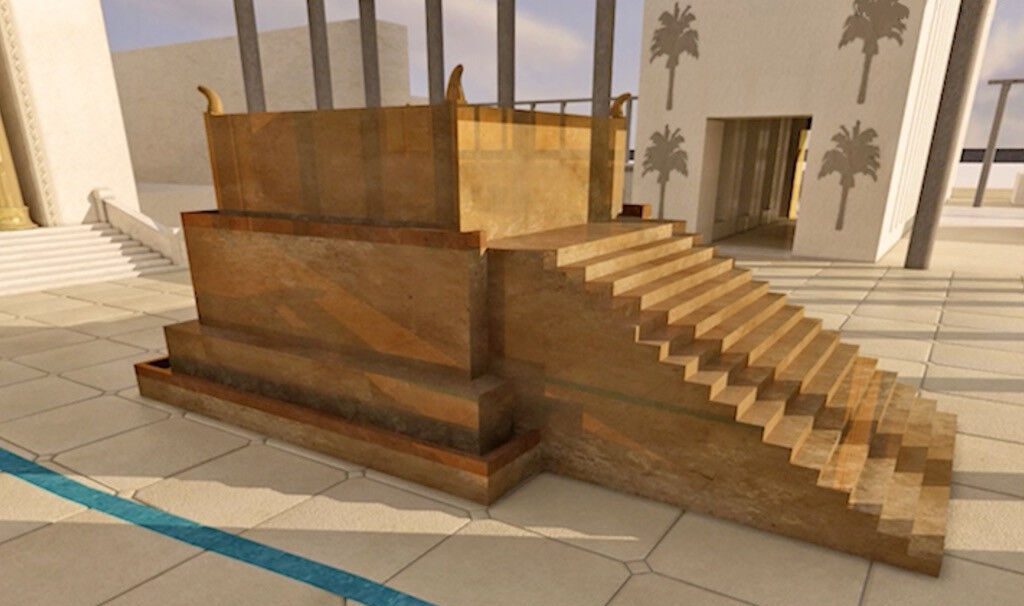 God gives Ezekiel the dimensions for the altar of sacrifice. Then He provides very clear instructions regarding the ritual cleansing of the altar and the preparation of the sacrifices to be offered on it. This entire process is similar to that given by God to Moses when He first instituted the sacrificial system in the Judean wilderness. For the Israelites living in the Millennial Kingdom, this entire process of ceremonial cleansing and purification will be highly familiar, and it will serve as a powerful reminder of their past sins as a nation. But it will point them to the all-sufficient sacrifice of Jesus, whose blood has cleansed them from all their sins (1 John 1:7).
“The offerings presented thereon were meant to be memorials, much as the Lord’s Supper is no efficacious sacrifice but a memorial of a blessedly adequate and all-sufficient sacrifice for all time. Thus, whereas the sacrifices of the Old Testament economy were prospective, these are retrospective.” – Charles Lee Feinberg, The Prophecy of Ezekiel
The focus of this chapter is holiness – the holiness of God, His people, His Kingdom, and His Son. Everything in the Millennial Kingdom will be set apart for His glory. It will all be dedicated to His name and exist to point all people to Him alone. In a remarkable blending of old and new imagery, God provides Ezekiel a glimpse of a future age when the Old Testament sacrificial system will exist in perfect harmony with the resurrected and enthroned Lamb of God. During His thousand-year reign on earth, there will be believers and unbelievers living under His righteous rule. All those who survived the seven years of the Tribulation will have the pleasure of living as citizens of Christ’s earthly kingdom, but not all will worship Him as Lord. Perhaps this renewed sacrificial system will serve as a means of purification for all those who wish to enter the presence of the King of kings. Holiness will reign supreme in the Millennial Kingdom, and God has ordained a place and purpose for the sacrificial system in that time.
English Standard Version (ESV) The Holy Bible, English Standard Version. ESV® Permanent Text Edition® (2016). Copyright © 2001
New Living Translation (NLT) Holy Bible, New Living Translation, copyright © 1996, 2004, 2015 by Tyndale House Foundation. Used by permission of Tyndale House Publishers Inc., Carol Stream, Illinois 60188. All rights reserved.