22 And as they were eating, he took bread, and after blessing it broke it and gave it to them, and said, “Take; this is my body.” 23 And he took a cup, and when he had given thanks he gave it to them, and they all drank of it. 24 And he said to them, “This is my blood of the covenant, which is poured out for many. 25 Truly, I say to you, I will not drink again of the fruit of the vine until that day when I drink it new in the kingdom of God.” – Mark 14:22-25 ESV
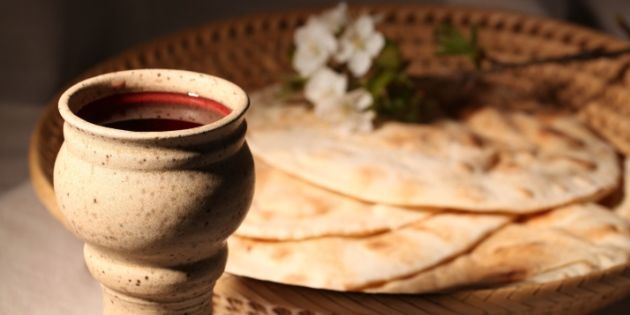 With His unidentified betrayer seated at the table with them, Jesus and His disciples began to eat the Passover meal together. As each course of this sacred meal was served, these men would have found it difficult to take their minds off of Jesus’ earlier announcement. One of them was going to do the unthinkable and betray the Lord. And the only hint that Jesus had given as to who the culprit might be was that it was “one of you twelve who is eating from this bowl with me” (Mark 14:20 NLT). That meant it could be any one of them.
But, acting as the head of the family in their shared Passover celebration, Jesus administered the various rites associated with this traditional meal to His 12 “sons.” And on this night, this annual and highly familiar event took on new meaning for these men. Little did they understand at the time that their Lord and Master was standing before them as the Pascal Lamb. He was as John the Baptist had said, “the Lamb of God, who takes away the sin of the world” (John 1:29 ESV). And He was “the bread of God…who comes down from heaven and gives life to the world” (John 6:33 ESV).
These declarations concerning Jesus’ true identity were being illustrated right before their eyes. Jesus used the various elements associated with the Passover meal to point to His God-ordained mission as their deliverer. This meal, which they had eaten every year throughout their lives, had always been a foreshadowing of something greater to come. Yes, it was a commemoration of God’s deliverance of the people of Israel from their captivity in Egypt. But it had also been given as a sign of the deliverance Jesus would bring when He came to earth as the sacrificial Lamb. Through the offering of His sinless body and the shedding of His innocent blood, Jesus would provide mankind with a way to be delivered from its captivity to sin and death.
So, during the meal, Jesus took some of the unleavened bread (a symbol of sinlessness) and “after blessing it broke it and gave it to them, and said, ‘Take; this is my body’” (Mark 14:22 ESV). And Luke records that Jesus added, “which is given for you. Do this in remembrance of me” (Luke 22:19 ESV). He offered them the bread and invited them to consume it, as a symbol of their faith in the sacrificial offering He was about to make on their behalf. It seems likely that the disciples recalled an earlier statement made by Jesus concerning the bread from heaven.
“I am the living bread that came down from heaven. If anyone eats of this bread, he will live forever. And the bread that I will give for the life of the world is my flesh.” – John 6:51 ESV
As they held the broken pieces of bread in their hands, the disciples had to wrestle with the significance of Jesus’ words and actions. But before they had tie to take in what Jesus was saying, He “took a cup, and when he had given thanks he gave it to them, and they all drank of it” (Mark 14:23 ESV). And according to Matthew’s account, Jesus told them, “this is my blood of the covenant, which is poured out for many for the forgiveness of sins” (Matthew 26:28 ESV).
Once again, the minds of the disciples must have been filled with memories of Jesus’ earlier teachings concerning the bread and the blood. At that time, His words had made little sense. But now, they were coming into clearer focus.
“Truly, truly, I say to you, unless you eat the flesh of the Son of Man and drink his blood, you have no life in you. Whoever feeds on my flesh and drinks my blood has eternal life, and I will raise him up on the last day. For my flesh is true food, and my blood is true drink. Whoever feeds on my flesh and drinks my blood abides in me, and I in him.” – John 6:53-56 ESV
Just as the disciples consumed the bread and the wine that night, they would have to ingest the body and blood of Jesus. In order to benefit from what Jesus was about to do for them, they would have to make His life a part of their own. In an act of faith, they would need to take in the gift of His body and blood, believing that these sacred elements would provide them with eternal life. The eating of bread and wine is an act of faith, It is an outward demonstration of trust that their consumption will provide nourishment to the physical body, In the same way, the body and blood of Christ are “consumed” as an act of faith, a willful display of faith in the efficacious nature of Jesus’ death on our behalf. He becomes part of us. He comes to live within us. That is exactly what Jesus meant when He said, “Whoever feeds on my flesh and drinks my blood abides in me, and I in him” (John 6:56 ESV).
In time, the disciples would understand the nature of Jesus’ words. With the coming of the Holy Spirit, they would be given the power to grasp and appreciate all that they had heard Jesus say to them. The apostle Paul would later describe the memorial aspect of what Jesus had done that fateful night. The church would go on to establish the eating of the bread and the drinking of the wine as a regularly occurring part of their corporate worship experience.
“For as often as you eat this bread and drink the cup, you proclaim the Lord’s death until he comes.” – 1 Corinthians 11:26 ESV
And the proclamation of His death is to continue until He returns again. It is His death that brings life. It was the sacrifice of His body and blood that made forgiveness of sin and freedom from death possible. But we must never forget that His death was followed by His resurrection. He was restored to life by the power of the Spirit of God. And He returned to His Father’s side in heaven. But, one day, He will return. And Jesus told His disciples, “I will not drink again of the fruit of the vine until that day when I drink it new in the kingdom of God” (Mark 14:25 ESV). Jesus was assuring His disciples that His death, burial, resurrection, and ascension would be followed by His return. When He comes back, He will establish His Kingdom on earth and once again share a cup of celebration with His faithful followers.
The apostle John provides us with a glimpse into this future day when Jesus will share another meal with His disciples. On this occasion, there will be no bread broken as a sign of death or wine consumed as a symbol of His shed blood. This will be a victory meal, a time of joyous celebration as the people of God rejoice in the finished work of the Son of God.
Then I heard what seemed to be the voice of a great multitude, like the roar of many waters and like the sound of mighty peals of thunder, crying out,
“Hallelujah!
For the Lord our God
the Almighty reigns.
Let us rejoice and exult
and give him the glory,
for the marriage of the Lamb has come,
and his Bride has made herself ready;
it was granted her to clothe herself
with fine linen, bright and pure”—
for the fine linen is the righteous deeds of the saints.
And the angel said to me, “Write this: Blessed are those who are invited to the marriage supper of the Lamb.” And he said to me, “These are the true words of God.” – Revelation 19:6-9 ESV
English Standard Version (ESV) The Holy Bible, English Standard Version. ESV® Permanent Text Edition® (2016). Copyright © 2001 by Crossway Bibles, a publishing ministry of Good News Publishers.
New Living Translation (NLT) Holy Bible, New Living Translation, copyright © 1996, 2004, 2015 by Tyndale House Foundation. Used by permission of Tyndale House Publishers Inc., Carol Stream, Illinois 60188. All rights reserved.
The Message (MSG)Copyright © 1993, 1994, 1995, 1996, 2000, 2001, 2002 by Eugene H. Peterson