Sin in the Camp

14 And the Lord relented from the disaster that he had spoken of bringing on his people.

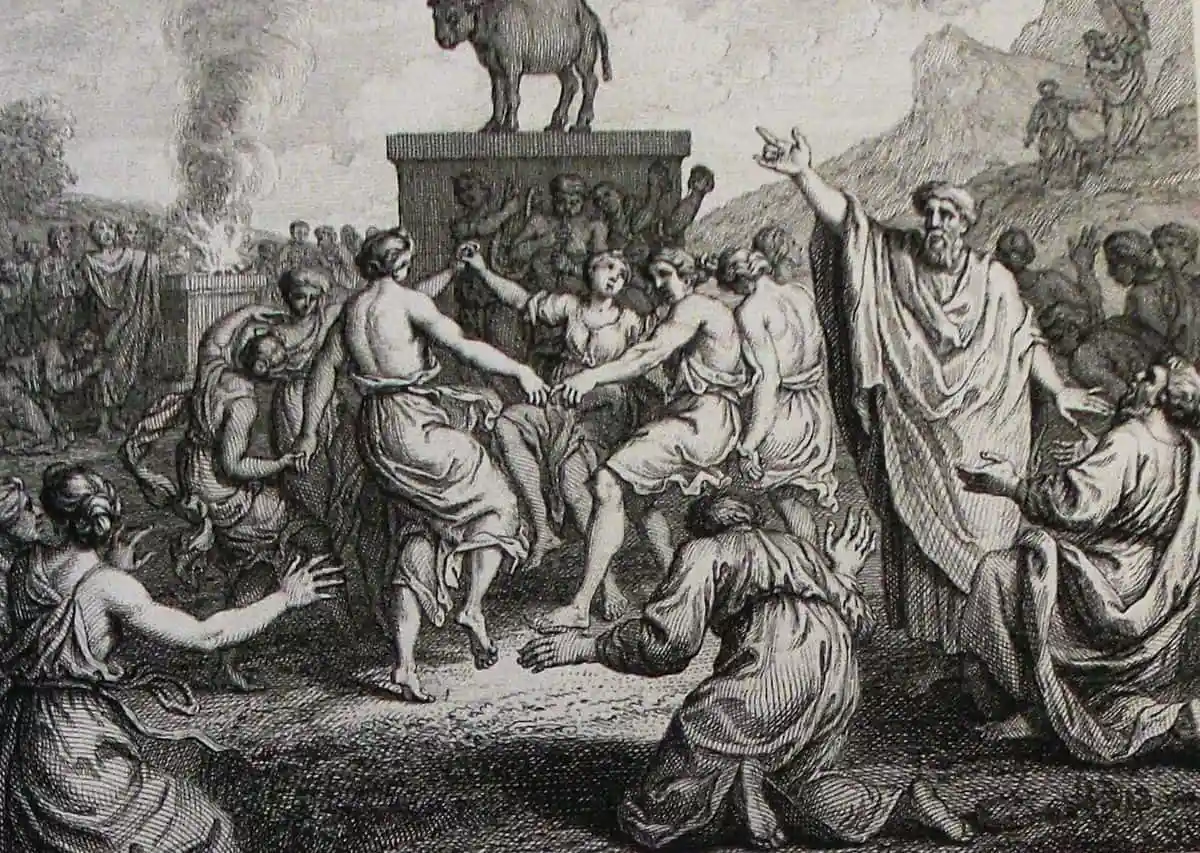
15 Then Moses turned and went down from the mountain with the two tablets of the testimony in his hand, tablets that were written on both sides; on the front and on the back they were written. 16 The tablets were the work of God, and the writing was the writing of God, engraved on the tablets. 17 When Joshua heard the noise of the people as they shouted, he said to Moses, “There is a noise of war in the camp.” 18 But he said, “It is not the sound of shouting for victory, or the sound of the cry of defeat, but the sound of singing that I hear.” 19 And as soon as he came near the camp and saw the calf and the dancing, Moses’ anger burned hot, and he threw the tablets out of his hands and broke them at the foot of the mountain. 20 He took the calf that they had made and burned it with fire and ground it to powder and scattered it on the water and made the people of Israel drink it.  – Exodus 32:14-20 ESV

Did Moses really change the mind of God? Was his intercession on behalf of the people the reason “the Lord relented from the disaster that he had spoken of bringing on his people” (Exodus 32:14)? It would appear from the text that Moses was successful in persuading God to spare the people of Israel from His wrath. But this conclusion would stand in direct contrast to other passages in the Bible that teach of God’s immutability or unchanging nature.

“For I the Lord do not change; therefore you, O children of Jacob, are not consumed.” – Malachi 3:6 ESV

In this passage from the book of Malachi, God was declaring His intentions to judge His people for their apostasy, but He would not completely destroy them because He had made a covenant promise and was going to fulfill it.

In the New Testament, James picks up on this theme when he writes:

Every good gift and every perfect gift is from above, coming down from the Father of lights, with whom there is no variation or shadow due to change. – James 1:17 ESV

God is consistent in character and action. He doesn’t say one thing and then do another; a fact that is recorded in the book of Numbers.

God is not man, that he should lie,
    or a son of man, that he should change his mind.
Has he said, and will he not do it?
    Or has he spoken, and will he not fulfill it? – Numbers 23:19 ESV

God had made a covenant commitment to Abraham, that He would produce from him a great nation and one day give them the land of Canaan as their inheritance.

“And I will establish my covenant between me and you and your offspring after you throughout their generations for an everlasting covenant, to be God to you and to your offspring after you. And I will give to you and to your offspring after you the land of your sojournings, all the land of Canaan, for an everlasting possession, and I will be their God.” – Genesis 17:7-8 ESV

And over the centuries, God reiterated and reconfirmed that covenant to Abraham’s descendants, all the way down to Moses and the people of Israel whom He had freed from captivity in Egypt. When God had commissioned Moses to be the deliverer of the people of Israel, He told him, “I promise that I will bring you up out of the affliction of Egypt to the land of the Canaanites, the Hittites, the Amorites, the Perizzites, the Hivites, and the Jebusites, a land flowing with milk and honey” (Exodus 3:17 ESV). God made a commitment and He was going to keep it.

So, what did God mean when He said to Moses, “let me alone, that my wrath may burn hot against them and I may consume them, in order that I may make a great nation of you” (Exodus 32:10 ESV)? Was He lying? Did He not mean what He said?

When reading a passage like this one, it is essential to consider the participants in the conversation. God was speaking to Moses, His chosen servant. This was an intimate conversation between the Lord and the man He had selected to lead His people out of captivity and all the way to the land of Canaan. Nothing about what happened in the valley had surprised God or caught Him off-guard. When He described the Israelites as “a stiff-necked people” (Exodus 32:9 ESV), He was not stating a fact He had just discerned from their most recent activity. He had known it all along, and Moses was also well aware of their stubborn disposition.

This entire exchange between God and Moses was meant to be a test – of Moses. God knew what had happened in the Israelite camp. Because of His omniscience and omnipresence, He had witnessed all that they had done to reject Him as their God. But Moses had been completely unaware of the sordid scene going on in the valley until God had informed him, and he had still not seen the extent of Israel’s wickedness with his own eyes.

Notice the wording of God’s statement to Moses. He places the burden on Moses when He says, “therefore let me alone, that my wrath may burn hot against them and I may consume them” (Exodus 32:10 ESV). In other words, God informs Moses that the fate of the Israelites is in his hands. God doesn’t say He is going to destroy them. He states that their destruction will come if Moses fails to intercede. And God knew the outcome before Moses did. Because of His omniscience, God knew exactly what Moses was going to do, even before Moses did.

And it is essential to note how Moses responded to God. He reminded the Lord of His power, faithfulness, reputation, and His covenant commitment. But God didn’t need a primer on His character or a pep talk about remaining faithful to His promises. This was a test to see if Moses fully understood the vast gap between the graciousness and goodness of God and the sinfulness of his own people. Because Moses was about to get a wake-up call concerning the moral and spiritual poverty of the people of Israel when he walked back into their camp. He would discover just how evil and worthy of God’s wrath they really were.

God was preparing Moses for the worst. He knew His servant was in for the shock when the full extent of Israel’s sinfulness became apparent. So, when Moses interceded and appealed to God’s faithfulness and reminded Him of His covenant commitment, it revealed that Moses understood that Israel’s future was fully dependent upon God’s mercy. They were incapable of living up to God’s holy requirements, and the only thing that kept God from destroying them was His mercy, grace, and commitment to keep His covenant promises.

The following insights from Philip Graham Ryken shed light on this difficult passage.

“It was never God’s purpose to destroy the Israelites, but only to save them. Even as he threatened wrath, there were hints that he would show mercy. First there was the simple fact that God commanded Moses to go down. If he really intended to destroy the Israelites, then why send Moses down at all? The answer is that he was planning to save them through the intercession of their mediator. the Israelites had not sinned themselves outside the grace of God. He was sending Moses to pray for their forgiveness.

Then there is the fact that God refers to the Israelites as the people of Moses: ‘Go down, because your people, whom you brought up out of Egypt…’ (Escod. 32:7). By talking this way, God was showing that the people were alienated from him by their sin. If they were going to make a cow and say, ‘These are your gods, O Israel!’ (v. 4b), then God was going to say to Moses, ‘these are your people.’ But he was not trying to shift the blame. Rather, he was helping Moses identify with the Israelites. There is a sense in which they were his people. Moses was their spiritual representative.” – Philip Graham Ryken, Exodus

From Moses’ perspective, it appeared as if God relented or changed His mind. Moses fully expected God to destroy the people of Israel because they deserved it. But rather than rain down judgment on His disobedient people, God sent Moses down the mountain carrying the two tablets containing His laws. In his arms, Moses’ held the Decalogue, but his mind was weighed down by all the details concerning the plans for God’s house and the installation of the priesthood. This poor man must have been confused and conflicted as he made his way down the mountain with Joshua, his companion. And when the camp of Israel came into sight, Moses was appalled by what he saw. It was worse than he could have imagined.

…as soon as he came near the camp and saw the calf and the dancing, Moses’ anger burned hot, and he threw the tablets out of his hands and broke them at the foot of the mountain. – Exodus 32:19 ESV

In a fit of rage, Moses destroyed the two tablets containing God’s law. This is the same man who dared to ask God, “does your wrath burn hot against your people?” (Exodus 32:11 ESV). He had the audacity to advise God, “Turn from your burning anger and relent from this disaster against your people” (Exodus 32:12 ESV). But now, having gotten a first-hand look at the magnitude of the problem, Moses was so angry that he broke the two tablets upon which God had engraved the Ten Commandments.

The people had been violating God’s laws, but in his anger, Moses actually destroyed the laws of God. In a sense, Moses acted out the entire problem with the law and Israel’s licentiousness. The law was never going to hold back their propensity for sin. In fact, Paul states that the purpose behind the law was never to irradicate sin, but to reveal it.

…its purpose is to keep people from having excuses, and to show that the entire world is guilty before God. For no one can ever be made right with God by doing what the law commands. The law simply shows us how sinful we are. – Romans 3:19-20 NLT

And since Moses had already relayed God’s laws to the people of Israel, they were without excuse. They knew that what they were doing was in violation of God’s laws, but they did it anyway. They willingly disregarded God’s commands. Not only that, they blatantly disregarded God Himself by making false gods meant to replace Him.

But in his white-hot anger, Moses destroyed the golden calf, burning it with fire and grinding what was left into a fine powder that he mixed with water and forced the people to drink. The people had been consumed by their own sin; now they were forced to consume their sin in the form of the foul-tasting concoction that Moses whipped up. There is no explanation given for this strange disciplinary action. But it must have left a powerful impression on the people as they gagged down the idol-laced water and considered the weight of their sin. But despite the distasteful nature of their judgment, it didn’t take long before the excuses began to flow and the blame game began. No one wanted to take responsibility for what had happened. But while God would not destroy the people of Israel, He would bring judgment against them. They would pay dearly for their sins and learn a painful lesson regarding the gravity of failing to obey god.

English Standard Version (ESV) The Holy Bible, English Standard Version. ESV® Permanent Text Edition® (2016). Copyright © 2001

New Living Translation (NLT) Holy Bible, New Living Translation, copyright © 1996, 2004, 2015 by Tyndale House Foundation. Used by permission of Tyndale House Publishers Inc., Carol Stream, Illinois 60188. All rights reserved.
Fair-Weather Faith

1 When the people saw that Moses delayed to come down from the mountain, the people gathered themselves together to Aaron and said to him, “Up, make us gods who shall go before us. As for this Moses, the man who brought us up out of the land of Egypt, we do not know what has become of him.” 2 So Aaron said to them, “Take off the rings of gold that are in the ears of your wives, your sons, and your daughters, and bring them to me.” 3 So all the people took off the rings of gold that were in their ears and brought them to Aaron. 4 And he received the gold from their hand and fashioned it with a graving tool and made a golden calf. And they said, “These are your gods, O Israel, who brought you up out of the land of Egypt!” 5 When Aaron saw this, he built an altar before it. And Aaron made a proclamation and said, “Tomorrow shall be a feast to the Lord.” 6 And they rose up early the next day and offered burnt offerings and brought peace offerings. And the people sat down to eat and drink and rose up to play. – Exodus 32:1-6 ESV

While Moses had been up on the mountaintop receiving the Decalogue and the Book of the Covenant from God, he had left his brother, Aaron, in charge of the people down in the valley. The last they had seen of Moses was him ascending Mount Sinai into the dark storm cloud. The thunder, lightning, and earth-shaking signs that accompanied God’s presence at Sinai had left them terrified and unwilling to go anywhere near the mountain or its summit. They wanted nothing to do with Yahweh and were content to let Moses act as their proxy.

Then Moses climbed up the mountain, and the cloud covered it. And the glory of the Lord settled down on Mount Sinai, and the cloud covered it for six days. On the seventh day the Lord called to Moses from inside the cloud. To the Israelites at the foot of the mountain, the glory of the Lord appeared at the summit like a consuming fire. Then Moses disappeared into the cloud as he climbed higher up the mountain. He remained on the mountain forty days and forty nights. – Exodus 24:15-18 NLT

During those 40 days and nights, the people of Israel began to wonder whether Moses was ever coming back. His long delay left them concerned about his safety and their own future. What would they do if Moses never came back? For all they knew, Moses had died on the mountaintop, a victim of Yahweh’s wrath.

It’s important to remember the sequence of events that precede chapter 32. God has already given Moses His laws and regulation, and Moses has shared them with the people. Not only that, the people expressed their eager willingness to obey all that God commanded.

Then Moses went down to the people and repeated all the instructions and regulations the Lord had given him. All the people answered with one voice, “We will do everything the Lord has commanded.” – Exodus 24:3 NLT

Following this corporate commitment to keep God’s laws, Moses wrote them all down for posterity (Exodus 24:4). Having completed his record of God’s commands, Moses “took the Book of the Covenant and read it aloud to the people” and, once again, “they all responded, ‘We will do everything the Lord has commanded. We will obey’” (Exodus 24:7 NLT). The people had heard every one of God’s commands and had agreed to keep them.

As part of the ceremony to inaugurate the institution of God’s laws, Moses offered blood sacrifices and sprinkled some of the blood on the people, telling them, “Look, this blood confirms the covenant the Lord has made with you in giving you these instructions” (Exodus 24:8 NLT). They had made a vow to obey all of God’s commands, and now that agreement had been sealed with blood, making it binding and carrying a penalty of death if they broke their commitment. This auspicious ceremony was then followed by a special invitation-only meal between some of the leadership of Israel and God Almighty.

Then Moses, Aaron, Nadab, Abihu, and the seventy elders of Israel climbed up the mountain. There they saw the God of Israel. Under his feet there seemed to be a surface of brilliant blue lapis lazuli, as clear as the sky itself. And though these nobles of Israel gazed upon God, he did not destroy them. In fact, they ate a covenant meal, eating and drinking in his presence! – Exodus 24:9-11 NLT

Then Moses was told to ascend back to the mountaintop where God promised to give a copy of the Ten Commandments written by His own hand.

“Come up to me on the mountain. Stay there, and I will give you the tablets of stone on which I have inscribed the instructions and commands so you can teach the people.” So Moses and his assistant Joshua set out, and Moses climbed up the mountain of God. – Exodus 24:12-13 NLT

Moses left Aaron and the elders of Israel in charge during his absence. These were the very same men who had been given the privilege of seeing the God of Israel and eating a covenant meal with Him. In sharing that meal with Yahweh, they had personally sealed their commitments to the covenant and pledged themselves to see that every law God had given was obeyed by the people of Israel.

What happens next is critical. According to chapter 24, Moses returned to the top of Mount Sinai, “And the glory of the Lord settled down on Mount Sinai, and the cloud covered it for six days. On the seventh day the Lord called to Moses from inside the cloud. To the Israelites at the foot of the mountain, the glory of the Lord appeared at the summit like a consuming fire. Then Moses disappeared into the cloud as he climbed higher up the mountain. He remained on the mountain forty days and forty nights” (Exodus 24:16-18 NLT).

This brings us to the events recorded in chapter 32. At the end of the 40 days, “When the Lord finished speaking with Moses on Mount Sinai, he gave him the two stone tablets inscribed with the terms of the covenant, written by the finger of God.” (Exodus 31:18 NLT).

Moses left the mountaintop with the God-inscribed copy of the Decalogue and all the instructions regarding the construction of the Tabernacle and the establishment of the priesthood. His arms and his mind were full of the divinely revealed will of God for the people of Israel. It is essential to understand that Moses was coming down from the mountain with not only the Ten Commandments but the plans for the Tabernacle, the house within which God’s presence was to dwell among the people. God had made a commitment to live among His chosen people in a house that they could construct with their own hands and pay for with their own resources.

But all that God had shared with Moses regarding the Tabernacle stands in direct opposition to what was taking place down in the valley. In Moses’ absence, the people began to have second thoughts about Yahweh. They were well aware of His commands and had heard every one of the regulations contained in the Book of the Covenant. They had even given their hearty approval and voiced their full commitment to living their lives according to God’s law.

But it took just over a month for the people of Israel to lose all their enthusiasm. The longer Moses delayed, the more they began to have second thoughts about everything. In their minds, Moses was Yahweh’s official representative and spokesperson. If Moses wasn’t coming back, their link to Yawheh would be broken. After all, it had been Moses who showed up in Egypt with news of their deliverance by the hand of Yahweh. And Moses had been the one to lead them out of Egypt and into the wilderness with the help of his God. But with Moses apparently gone, they began to question Yahweh and all the commitments they had made to Him.

When the people saw how long it was taking Moses to come back down the mountain, they gathered around Aaron. “Come on,” they said, “make us some gods who can lead us. We don’t know what happened to this fellow Moses, who brought us here from the land of Egypt.” – Exodus 32:1 NLT

With Moses out of the picture, the people turned to Aaron. At this point, Aaron had no concept of God’s plans regarding the Tabernacle and his future role as the high priest. That information resided with Moses and he had not yet returned to share it. So, when the people came to Aaron and expressed their desire to replace Yahweh with another god, he eagerly obliged them.

“Take the gold rings from the ears of your wives and sons and daughters, and bring them to me.” – Exodus 32:2 NLT

Little did Aaron know that he was taking what belonged to Yahweh and ordering it to be used for idolatry. He was unaware that God had given Moses a very different use for the resources of the people of Israel.

The Lord said to Moses, “Speak to the people of Israel, that they take for me a contribution. From every man whose heart moves him you shall receive the contribution for me. And this is the contribution that you shall receive from them: gold, silver, and bronze, blue and purple and scarlet yarns and fine twined linen, goats’ hair, tanned rams’ skins, goatskins, acacia wood, oil for the lamps, spices for the anointing oil and for the fragrant incense, onyx stones, and stones for setting, for the ephod and for the breastpiece. And let them make me a sanctuary, that I may dwell in their midst. Exactly as I show you concerning the pattern of the tabernacle, and of all its furniture, so you shall make it.” – Exodus 25:1-9 NLT

Aaron ordered the people to donate their gold earrings to construct an idol that was intended to replace Yahweh. This false god would take the place of the one true God. And in carrying out the will of the people, Aaron violated the very first commandment of the Decalogue.

“You must not have any other god but me. You must not make for yourself an idol of any kind or an image of anything in the heavens or on the earth or in the sea. You must not bow down to them or worship them, for I, the Lord your God, am a jealous God who will not tolerate your affection for any other gods.” – Exodus 20:3-5 NLT

And the man who oversaw the construction of this false god was the one whom God had chosen to serve as the high priest of Israel.

Then Aaron took the gold, melted it down, and molded it into the shape of a calf. – Exodus 32:4 NLT

God had great plans for Aaron and the people of Israel. They had no way of knowing that Moses was on his way down the mountain with God’s blueprints for the Tabernacle and His plans for the atoning work of the priesthood. The creator of heaven and earth was getting ready to take up residence among them, and yet they were busy replacing Him with a false god of their own design. And when Aaron had completed the construction of the golden calf and its accompanying altar, the people exclaimed, “O Israel, these are the gods who brought you out of the land of Egypt!” (Exodus 32:4 NLT).

Buoyed by the people’s enthusiasm, Aaron declared a feast for the following day so that the people might worship their newfound god. And sadly, the text records that “The people got up early the next morning to sacrifice burnt offerings and peace offerings. After this, they celebrated with feasting and drinking, and they indulged in pagan revelry” (Exodus 32:6 NLT).

Don’t miss the irony in all of this. Moses was coming down the mountain with all the details concerning the Tabernacle, the priesthood, and the sacrificial system. He had the plans for the Bronze Altar and directions for how the people might receive atonement and cleansing for their sins. But before his feet could reach the valley floor, the people of Israel had decided to come up with a plan of their own. It took just 40 days for the Israelites to forget Yahweh and every commitment they had made to Him. In their minds, He had always been Moses’ God and not their own. So, when Moses failed to return, they seized the opportunity to seek and serve another god.

English Standard Version (ESV) The Holy Bible, English Standard Version. ESV® Permanent Text Edition® (2016). Copyright © 2001

New Living Translation (NLT) Holy Bible, New Living Translation, copyright © 1996, 2004, 2015 by Tyndale House Foundation. Used by permission of Tyndale House Publishers Inc., Carol Stream, Illinois 60188. All rights reserved.

The Breastpiece of Judgment

15 “You shall make a breastpiece of judgment, in skilled work. In the style of the ephod you shall make it—of gold, blue and purple and scarlet yarns, and fine twined linen shall you make it. 16 It shall be square and doubled, a span its length and a span its breadth. 17 You shall set in it four rows of stones. A row of sardius, topaz, and carbuncle shall be the first row; 18 and the second row an emerald, a sapphire, and a diamond; 19 and the third row a jacinth, an agate, and an amethyst; 20 and the fourth row a beryl, an onyx, and a jasper. They shall be set in gold filigree. 21 There shall be twelve stones with their names according to the names of the sons of Israel. They shall be like signets, each engraved with its name, for the twelve tribes. 22 You shall make for the breastpiece twisted chains like cords, of pure gold. 23 And you shall make for the breastpiece two rings of gold, and put the two rings on the two edges of the breastpiece. 24 And you shall put the two cords of gold in the two rings at the edges of the breastpiece. 25 The two ends of the two cords you shall attach to the two settings of filigree, and so attach it in front to the shoulder pieces of the ephod. 26 You shall make two rings of gold, and put them at the two ends of the breastpiece, on its inside edge next to the ephod. 27 And you shall make two rings of gold, and attach them in front to the lower part of the two shoulder pieces of the ephod, at its seam above the skillfully woven band of the ephod. 28 And they shall bind the breastpiece by its rings to the rings of the ephod with a lace of blue, so that it may lie on the skillfully woven band of the ephod, so that the breastpiece shall not come loose from the ephod. 29 So Aaron shall bear the names of the sons of Israel in the breastpiece of judgment on his heart, when he goes into the Holy Place, to bring them to regular remembrance before the Lord. 30 And in the breastpiece of judgment you shall put the Urim and the Thummim, and they shall be on Aaron’s heart, when he goes in before the Lord. Thus Aaron shall bear the judgment of the people of Israel on his heart before the Lord regularly.” – Exodus 28:15-30 ESV

The high priest’s sacred garment was to include a second feature: the breastpiece of judgment. This smaller, color-coordinated accessory was also made of fine linen and woven with gold, blue, purple, and scarlet yarns. It hung from two gold chains which were attached to the shoulder straps of the linen ephod. This long piece of handcrafted fabric was folded into a square and stitched on three sides, forming a pocket. Attached to the front of the breastpiece were 12 precious gems, each engraved with the names of the 12 tribes of Israel. The gems were surrounded with gold filigree, accentuating the beauty and worth of each stone. Inside the pocket of the breastpiece were placed the Urim and Thummim, special stones used to discern the will of God.

“The purpose of the breastpiece was ‘for making decisions’ (v. 15). The Urim and Thummim, deposited in the pouch, were sacred lots used as the ‘means of making decisions’ (v. 30). The word ‘Urim’ begins with the first letter of the Hebrew alphabet and ‘Thummim’ begins with the last letter, so the lots were probably restricted to giving either positive or negative responses to questions asked of them. Strengthening that likelihood is the fact that the phrase ‘Urim and Thummim’ is best translated into English as ‘curses and perfections,’ meaning that if ‘Urim’ dominated when the lots were cast the answer would be no but if ‘Thummim’ dominated the answer would be yes.” – Ronald Youngblood, Exodus

Little is known about how the Urim and Thummim were used, but in the book of Numbers, Moses told his successor, Joshua, that these “sacred lots” were to be used to “determine everything” the Israelites were to do.

“When direction from the Lord is needed, Joshua will stand before Eleazar the priest, who will use the Urim—one of the sacred lots cast before the Lord—to determine his will. This is how Joshua and the rest of the community of Israel will determine everything they should do.” – Numbers 27:21 NLT

In the book of Joshua, it appears that the Urim and Thummim were used to determine who among the Israelites was guilty of violating the command of God.

“In the morning therefore you shall be brought near by your tribes. And the tribe that the Lord takes by lot shall come near by clans. And the clan that the Lord takes shall come near by households. And the household that the Lord takes shall come near man by man.” – Joshua 7:14 ESV

Prior to their defeat of the city of Jericho, God had given the Israelites clear instructions regarding what to do with the plunder of the city.

“Do not take any of the things set apart for destruction, or you yourselves will be completely destroyed, and you will bring trouble on the camp of Israel. Everything made from silver, gold, bronze, or iron is sacred to the Lord and must be brought into his treasury.” – Joshua 6:18-19 ESV

But a man named Achan had violated God’s command, and his son resulted in the Israelites’ failure to conquer the much smaller city of Ai. Apparently, the Urim and Thummim were used to determine the identity of the guilty party. For whatever reason, God chose to use this rather strange system to guide Joshua and the people of Israel. Rather than speaking to Joshua directly, as He had done with Moses, God provided the Urim and Thummim as the primary means for revealing His will. And because the Urim and Thummim were under the care of the high priest, Joshua was required to seek the aid of Eleazar in order to receive direction from God.

This breastpiece worn by the high priest was adorned with the 12 gemstones, signifying the 12 sons of Jacob and the 12 tribes of Israel. Inside the pouch formed by the breastpiece were the Urim and Thummim, which were essential tools for determining God’s will for the 12 tribes. And this vital accessory was worn next to the heart of the high priest, signifying both his role as mediator but also as shepherd of the people of God.

Two additional gold chains hung from the bottom of the breastpiece which attached to two gold rings affixed to the front of the linen ephod.

“This will hold the chestpiece securely to the ephod above the decorative sash. In this way, Aaron will carry the names of the tribes of Israel on the sacred chestpiece over his heart when he goes into the Holy Place.” – Exodus 28:28-29 NLT

Aaron was to hold the people of God close to his heart at all times, especially when serving in his role as the high priest. Every time he entered the Holy Place to offer atoning sacrifices on behalf of the people, he did so as their representative. He bore the 12 tribes on his shoulders and close to his heart. And between his heart and the 12 stones representing the people of God, were the tools for determining the will of God.

God had made it perfectly clear that in order for the Israelites to remain His treasured possession, they would have to obey His will.

“Now therefore, if you will indeed obey my voice and keep my covenant, you shall be my treasured possession among all peoples, for all the earth is mine; and you shall be to me a kingdom of priests and a holy nation.” – Exodus 19:5-6 ESV

Like priceless gems, the Israelites were of great value to God, and in his role as the high priest, Aaron was to share God’s care and concern for them. By carrying the Urim and Thummim, Aaron would play an important role in determining God’s will. But he would also serve as the agent of atonement, offering up the required blood sacrifices to cover the inevitable sins of the people.

In giving the Decalogue and the Book of the Covenant, God made His will known. He had disclosed the laws that were to regulate the behavior of the people of Israel. They knew what was expected of them. The apostle Paul summed up God’s expectations of His people when he wrote, “For this is the will of God, your sanctification…” (1 Thessalonians 4:3 ESV). When all is said and done, what God demands of His people is a life of holiness. He expects them to live in keeping with their status as His children. The Israelites didn’t need the Urim and Thummim to determine how to live. God had already revealed that to them. These little-understood stones were to be used in special instances when the Law of God could not be applied. They were not to be used for personal decision-making but only for determining the will of God for the entire community of God. In the rare instance that the Law was not applicable, the nation was to seek the will of God through this divinely ordained decision-making system.

Every child of God wrestles with the desire to know God’s will. But as the apostle Paul points out, the will of God is quite clear: He desires our holiness. Yet we tend to want God to be more specific. Who should I marry? What career path should I take? Is this the house you want me to buy? And it is not that God has no opinion about those matters, but it is that He is more concerned about your holiness. In most cases, our decision-making would be greatly simplified if we learned to ask the question: Will this decision help or hinder my pursuit of holiness? If I marry this individual will they become a partner in my desire to live a holy life? Will that job or career path pave the way to greater sanctification or lead me to a life of self-reliance and a love of the world?

As the high priest for the people of God, Aaron was given the tools to determine God’s will. But from the sparse references to the Urim and Thummim in the Scriptures, it appears that they were infrequently utilized. Aaron knew what God expected of His people. The Decalogue and the Book of the Covenant were quite specific and left little to the imagination. God demanded holiness. And the primary role of the high priest was to help the people of God maintain their holiness by atoning for their sinfulness. Their purity was to be his highest priority.

English Standard Version (ESV) The Holy Bible, English Standard Version. ESV® Permanent Text Edition® (2016). Copyright © 2001

New Living Translation (NLT) Holy Bible, New Living Translation, copyright © 1996, 2004, 2015 by Tyndale House Foundation. Used by permission of Tyndale House Publishers Inc., Carol Stream, Illinois 60188. All rights reserved.

The Covenant Confirmed

1 Then he said to Moses, “Come up to the Lord, you and Aaron, Nadab, and Abihu, and seventy of the elders of Israel, and worship from afar. 2 Moses alone shall come near to the Lord, but the others shall not come near, and the people shall not come up with him.”

3 Moses came and told the people all the words of the Lord and all the rules. And all the people answered with one voice and said, “All the words that the Lord has spoken we will do.” 4 And Moses wrote down all the words of the Lord. He rose early in the morning and built an altar at the foot of the mountain, and twelve pillars, according to the twelve tribes of Israel. 5 And he sent young men of the people of Israel, who offered burnt offerings and sacrificed peace offerings of oxen to the Lord. 6 And Moses took half of the blood and put it in basins, and half of the blood he threw against the altar. 7 Then he took the Book of the Covenant and read it in the hearing of the people. And they said, “All that the Lord has spoken we will do, and we will be obedient.” 8 And Moses took the blood and threw it on the people and said, “Behold the blood of the covenant that the Lord has made with you in accordance with all these words.” – Exodus 24:1-8 NLT

Prior to giving Moses the Decalogue and the Book of the Covenant, God warned the people of Israel that they would be expected to obey His commands.

“You yourselves have seen what I did to the Egyptians, and how I bore you on eagles’ wings and brought you to myself. Now therefore, if you will indeed obey my voice and keep my covenant, you shall be my treasured possession among all peoples, for all the earth is mine; and you shall be to me a kingdom of priests and a holy nation.” – Exodus 19:4-6 ESV

Their ongoing status as His chosen people depended upon their willingness to keep the covenant He was making with them. His laws were binding and the people’s adherence to them was non-optional. Now, the time had come for them to confirm their commitment to the covenant. In chapters 20-23, God laid out the terms of the covenant. He had clearly articulated the rules and regulations that would govern their behavior as His set-apart people. But those commandments would prove meaningless if the people refused to obey them.  And if they refused to keep the commands that God had given them, they would be rejecting His authority and sovereignty over their lives. So, this chapter in the book of Exodus records a seminal moment in the lives of the people of Israel.

God instructed Moses to return to the top of Mount Sinai and instructed him to bring along his brother Aaron, his two sons, Nadab and Abihu, as well as 70 of the elders of Israel. But before this small contingent of Israelite leaders made their ascent of Mount Sinai, Moses “told the people all the words of the Lord and all the rules” (Exodus 24:3 ESV).

He took the time to communicate all the instructions and regulations given to him by God. From the more general laws of the Decalogue to the detailed and highly specific content of the Book of the Covenant, Moses articulated clearly and carefully all the binding requirements of God.

In a sense, Moses was performing the role of a minister officiating a wedding ceremony between God and His bride, the nation of Israel. God had already expressed His vow to make the people of Israel His “own special treasure from among all the peoples on earth” (Exodus 19:5 NLT). He had chosen them as His own and pledged His intention to love and protect them. Now, it was their turn to state their vows, which they did with unwavering unity and enthusiasm.

And all the people answered with one voice and said, “All the words that the Lord has spoken we will do.” – Exodus 24:3 ESV

They had heard the terms of the marriage covenant and wholeheartedly agreed with them. With the covenant ratified, Moses took the time to document every one of God’s commandments, creating a permanent and unchanging contract between God and His people.

The next morning, Moses instructed the people to build an altar, and they would have done so by following the instructions given to them by God.

“Build for me an altar made of earth, and offer your sacrifices to me—your burnt offerings and peace offerings, your sheep and goats, and your cattle. Build my altar wherever I cause my name to be remembered, and I will come to you and bless you. If you use stones to build my altar, use only natural, uncut stones. Do not shape the stones with a tool, for that would make the altar unfit for holy use.” – Exodus 20:24-25 NLT

Along with the altar, the people were instructed to build 12 pillars, one for each of the 12 tribes of Israel. Then he commanded that burnt offerings and peace offerings be made to the Lord. The bulls used in these sacrifices were killed and their blood drained into basins. Moses took half of the blood and splashed it on the altar, an act of consecration and purification. Later, in the book of Leviticus, God explains the significance of the blood.

“…for the life of the body is in its blood. I have given you the blood on the altar to purify you, making you right with the Lord. It is the blood, given in exchange for a life, that makes purification possible.” – Leviticus 17:11 NLT

The author of the book of Hebrews picked up on this theme when he wrote:

Indeed, under the law almost everything is purified with blood, and without the shedding of blood there is no forgiveness of sins. – Hebrews 9:22 ESV

Moses was purifying the altar on which the offerings were made. This made the sacrifices acceptable to God. With the offerings completed, Moses read the Book of the Covenant out loud again, and the people reiterated their earlier commitment to obey.

“We will do everything the Lord has commanded. We will obey.” – Exodus 24:7 NLT

But then Moses did something unexpected and a bit unusual. He took the remaining blood in the basin and splattered it over the people. This rather gruesome scene offends our modern sensibilities, but it was meant to drive home a significant point. That blood had once pulsed through the veins of living creatures. But their lives had been sacrificed so that the people of Israel could be made pure and acceptable before God. Their sins had been atoned for through the death of another. And in sprinkling the blood on the people, Moses was covering over their unworthiness and sinfulness. He was presenting them as righteous before God, because of the atoning sacrifice of the sin substitute.

The author of Hebrews draws the vital connection between what Moses did that day and what Jesus later accomplished with His death on the cross.

With his own blood—not the blood of goats and calves—he entered the Most Holy Place once for all time and secured our redemption forever.

Under the old system, the blood of goats and bulls and the ashes of a heifer could cleanse people’s bodies from ceremonial impurity. Just think how much more the blood of Christ will purify our consciences from sinful deeds so that we can worship the living God. – Hebrews 9:12-14 NLT

The covenant-ratification ceremony that took place at the base of Mount Sinai was a worship service. God was purifying His people so that they could enter into His holy presence and worship Him. But, as Moses pointed out, the blood also sealed the covenant they had made.

“Look, this blood confirms the covenant the Lord has made with you in giving you these instructions.” – Exodus 24:8 NLT

Their words of affirmation had become binding. Their status as God’s chosen people had become permanent. Both parties were obligated to keep the covenant commitments they had made. And through their adherence to God’s laws, the people would be expressing their adoration of Him. Their obedience would symbolize their purity and illustrate their commitment to live as His chosen people.

English Standard Version (ESV) The Holy Bible, English Standard Version. ESV® Permanent Text Edition® (2016). Copyright © 2001

New Living Translation (NLT) Holy Bible, New Living Translation, copyright © 1996, 2004, 2015 by Tyndale House Foundation. Used by permission of Tyndale House Publishers Inc., Carol Stream, Illinois 60188. All rights reserved.

No Compromise

10 “For six years you shall sow your land and gather in its yield, 11 but the seventh year you shall let it rest and lie fallow, that the poor of your people may eat; and what they leave the beasts of the field may eat. You shall do likewise with your vineyard, and with your olive orchard.

12 “Six days you shall do your work, but on the seventh day you shall rest; that your ox and your donkey may have rest, and the son of your servant woman, and the alien, may be refreshed.

13 “Pay attention to all that I have said to you, and make no mention of the names of other gods, nor let it be heard on your lips.

14 “Three times in the year you shall keep a feast to me. 15 You shall keep the Feast of Unleavened Bread. As I commanded you, you shall eat unleavened bread for seven days at the appointed time in the month of Abib, for in it you came out of Egypt. None shall appear before me empty-handed. 16 You shall keep the Feast of Harvest, of the firstfruits of your labor, of what you sow in the field. You shall keep the Feast of Ingathering at the end of the year, when you gather in from the field the fruit of your labor. 17 Three times in the year shall all your males appear before the Lord God.

18 “You shall not offer the blood of my sacrifice with anything leavened, or let the fat of my feast remain until the morning.

19 “The best of the firstfruits of your ground you shall bring into the house of the Lord your God.

“You shall not boil a young goat in its mother’s milk. – Exodus 23:10-19 ESV

The next two laws continue God’s focus on truth and justice. While they appear to be dealing with the required Sabbath observances, there is more to these two commands than cessation from work or allowing the land to “rest” in the seventh year. The point behind these commands is love as expressed in concern for others.

God’s Sabbath laws were designed to provide physical rest, but they were also intended to minister to the needs of the less fortunate. In the case of the Sabbath year, God decreed that each seventh year, the people were to rest from their cultivation and care of the fields and orchards.

“Plant and harvest your crops for six years, but let the land be renewed and lie uncultivated during the seventh year.” – Exodus 23:10-11 NLT

These two laws anticipated the Israelite’s pending occupation of the land of Canaan. Seven years after they arrived in the land and took possession of it, they would be expected to enact this command. For six years they would labor and tend the land, but in the seventh year, they would take a God-ordained break so that the land could be renewed and restored.

But there was another point to this command. God wanted His people to care for the poor and needy among them.

“…let the poor among you harvest whatever grows on its own. Leave the rest for wild animals to eat. The same applies to your vineyards and olive groves.” – Exodus 23:11 NLT

For six years, God would meet the needs of His people and provide plenty of food to sustain them through the seventh year. This would echo His establishment of the Sabbath day.

“Look, I’m going to rain down food from heaven for you. Each day the people can go out and pick up as much food as they need for that day. I will test them in this to see whether or not they will follow my instructions. On the sixth day they will gather food, and when they prepare it, there will be twice as much as usual.” – Exodus 16:4-5 NLT

“Eat this food today, for today is a Sabbath day dedicated to the Lord. There will be no food on the ground today. You may gather the food for six days, but the seventh day is the Sabbath. There will be no food on the ground that day.” – Exodus 16:25-26 NLT

The Sabbath year was to mirror the Sabbath day. God wanted His people to believe in His divine providence. He was their provider and sustainer. He would care for all their needs. And when the people finally settled in the land of Canaan, they would have to be reminded that everything they possessed had been given to them by God.

“I gave you land you had not worked on, and I gave you towns you did not build—the towns where you are now living. I gave you vineyards and olive groves for food, though you did not plant them.” – Joshua 24:13 NLT

So, if God had graciously provided for all their needs, they were to reciprocate by sharing God’s bounty with the less fortunate among them, including the wild animals. God’s blessings were to be shared, not hoarded. By allowing their fields and vineyards to go uncultivated, they would experience no diminishment in crop yield. In fact, God would miraculously produce a bumper harvest that would meet the needs of all – without their help. God would step in and bless His creation for the benefit of all His creatures. And the Israelites were expected to participate in this gracious act of benevolence by simply resting and relying upon God’s goodness.

And God applied the same principle to the Sabbath day.

“You have six days each week for your ordinary work, but on the seventh day you must stop working. This gives your ox and your donkey a chance to rest. It also allows your slaves and the foreigners living among you to be refreshed.” – Exodus 23:12 NLT

Notice the emphasis on others. God wanted His people to share His concern for all creation. He knew that they would be tempted to view their status as His chosen people as a badge of honor and look down on others with an air of superiority. But their designation as His treasured possession did not give them to right to treat others with contempt. They had an obligation to use their status as God’s people as a means to reflect His character through their actions. Their unique relationship with Yahweh was meant to benefit all those around them, including their livestock.

God ends this section with a warning: “Pay close attention to all my instructions. You must not call on the name of any other gods. Do not even speak their names” (Exodus 23:13 NLT). This was a call to obedience and obeisance. God wanted their adherence to His commands as well as their unwavering devotion to His Lordship over their lives. He was looking for total commitment, not half-hearted compliance. This was about more than a list of rules to keep. It was about faithfulness and choosing to live in a way that reflected God’s character and demonstrated His glory.

The next commandments have to do with the annual feasts and festivals that God would establish for His people. Once again, these annual events were intended to take place once the Israelites took possession of the land of Canaan. But God had let Pharaoh know that these festivals were the whole reason He was demanding the release of His people.

“This is what the Lord, the God of Israel, says: Let my people go so they may hold a festival in my honor in the wilderness.” – Exodus 5:1 NLT

Moses replied, “We will all go—young and old, our sons and daughters, and our flocks and herds. We must all join together in celebrating a festival to the Lord.” – Exodus 10:9 NLT

With their exodus from Egypt, the Israelites began a pilgrimage to the promised land, and the three festivals outlined in this chapter were intended to be pilgrim feasts. The first came in the spring: The Feast of Unleavened Bread. This feast was directly tied to the Feast of Passover, and both pointed back to that eventful night in Egypt when God protected His people from the judgment of the death angel (Exodus 12).

God had established the Feast of Unleavened Bread as a perpetual ordinance designed to recall His divine deliverance of them from their captivity in Egypt.

“This is a day to remember forever—the day you left Egypt, the place of your slavery. Today the Lord has brought you out by the power of his mighty hand. (Remember, eat no food containing yeast.) On this day in early spring, in the month of Abib, you have been set free. You must celebrate this event in this month each year after the Lord brings you into the land of the Canaanites, Hittites, Amorites, Hivites, and Jebusites. (He swore to your ancestors that he would give you this land—a land flowing with milk and honey.) For seven days the bread you eat must be made without yeast. Then on the seventh day, celebrate a feast to the Lord. Eat bread without yeast during those seven days. In fact, there must be no yeast bread or any yeast at all found within the borders of your land during this time.” – Exodus 13:3-7 NLT

This feast was intended to be a liberation celebration. And two months later, it was to be followed by a second feast: The Feast of the Harvest. This particular festival was designed to show gratitude to God for all His provision. Also known as the Feast of Firstfruits, this annual event was a way for the Israelites to return thanks to God for His gracious providence over their lives.

Seven months after Passover, the Israelites were to celebrate a third feast: The Feast of Ingathering. This festival took place in the autumn after all the crops had been harvested and safely stored. During this week-long event, the Israelites were to live in temporary shelters as a reminder of their years wandering in the wilderness. That is why this festival is also referred to as the Feast of Booths or the Feast of Tabernacles.

“You must observe this festival to the Lord for seven days every year. This is a permanent law for you, and it must be observed in the appointed month from generation to generation. For seven days you must live outside in little shelters. All native-born Israelites must live in shelters. This will remind each new generation of Israelites that I made their ancestors live in shelters when I rescued them from the land of Egypt. I am the Lord your God.” – Leviticus 23:41-43 NLT

The commemoration of these annual feasts or festivals also required blood sacrifices. There was a cost to keeping these ordinances. Numbers 29 records that, during the Feast of Ingathering, the Israelites were required to make sacrifices for eight consecutive days, and the number of animals offered up was substantial. There were also grain offerings, liquid offerings, burnt offerings, and sin offerings. And according to Exodus 23, there were strict requirements as to how these offerings were to be made. God was very specific. And while these laws might sound strange to our modern ears, they were designed to illustrate the reality of sin and man’s need for redemption. Even the prohibition against boiling “a young goat in its mother’s milk” (Exodus 23:19) was meant as a protection for God’s people. It’s likely that this was a practice among the Canaanites and part of their idolatrous worship. But it also conveys a powerful contrast concerning life and death. To boil a goat in its mother’s milk would be to use the source of life to bring about death. It would be an inappropriate and unacceptable sacrifice.

God was meticulous in the giving of His commands. He would not allow His people to adopt or adapt pagan practices as part of their worship of Him. Whether it was the Sabbath observances or the annual feasts, the laws God ordained were binding and not up for debate or alteration. God’s will must be done in God’s way. No compromise. No cutting corners. 

English Standard Version (ESV) The Holy Bible, English Standard Version. ESV® Permanent Text Edition® (2016). Copyright © 2001

New Living Translation (NLT) Holy Bible, New Living Translation, copyright © 1996, 2004, 2015 by Tyndale House Foundation. Used by permission of Tyndale House Publishers Inc., Carol Stream, Illinois 60188. All rights reserved.

A Different Kind of Freedom

7 “When a man sells his daughter as a slave, she shall not go out as the male slaves do. 8 If she does not please her master, who has designated her for himself, then he shall let her be redeemed. He shall have no right to sell her to a foreign people, since he has broken faith with her. 9 If he designates her for his son, he shall deal with her as with a daughter. 10 If he takes another wife to himself, he shall not diminish her food, her clothing, or her marital rights. 11 And if he does not do these three things for her, she shall go out for nothing, without payment of money. – Exodus 21:7-11 ESV

As the Israelites stood at the base of Mount Sinai in the middle of the wilderness, they were in a kind of no man’s land between Egypt and Canaan. They were no longer living as the slaves of the descendants of Ham, but they were also far from their future homeland. Their exit from Egypt had been relatively easy but their first few months of travel to the land of promise had been marked by difficulties. They had encountered shortages of water and food, which God miraculously remedied. The days had been long and they had begun to grow weary of the monotonous and unpleasant nature of their journey. But God was preparing them for what lie ahead. He was teaching them to trust Him and to understand that He would provide for all their needs. The conquest of Canaan was not going to be a cakewalk.

The land God promised to Abraham as the homeland for his descendants was heavily occupied and the current residents would not give up their property willingly or easily. Their removal from the land was going to be a non-negotiable requirement for the Israelites because God knew that their pagan practices would have a negative influence on His chosen people. And Moses would later give the people an explanation for God’s extermination policy regarding the land of Canaan.

“When the Lord your God brings you into the land that you are entering to take possession of it, and clears away many nations before you, the Hittites, the Girgashites, the Amorites, the Canaanites, the Perizzites, the Hivites, and the Jebusites, seven nations more numerous and mightier than you, and when the Lord your God gives them over to you, and you defeat them, then you must devote them to complete destruction. You shall make no covenant with them and show no mercy to them. You shall not intermarry with them, giving your daughters to their sons or taking their daughters for your sons, for they would turn away your sons from following me, to serve other gods.” – Deuteronomy 7:1-4 ESV

And Moses went on to remind the Israelites of their unique status as God’s chosen people.

“For you are a people holy to the Lord your God. The Lord your God has chosen you to be a people for his treasured possession, out of all the peoples who are on the face of the earth.” – Deuteronomy 7:6 ESV

The giving of the Decalogue and the Book of the Covenant was intended to provide the Israelites with clear guidelines to govern their behavior. God had Canaan in mind when He gave them His legal code of conduct and many of these laws have direct application to the circumstances they will encounter when they enter the land. The greatest temptation they will face will be that of compromise and cultural assimilation. Rather than stand out as God’s treasured possession and live like a holy nation and a royal priesthood, they will be tempted to blend in with the pagan cultures around, adopting their ways and acclimating to their laws and lifestyles.

That is why many of the laws found in Exodus 21-23 sound so foreign to those of us living in the more “enlightened” 21st century. We struggle with God’s commands concerning slavery. We reel at the idea of God condoning a father selling his daughter or son for profit. In these opening verses of chapter 21, people seem to be treated like property rather than those made in the image of God.

The world in which the Israelites lived was far different from the one we occupy. In a way, they lived in a day and age that was similar to the American wild west. Canaan was a place filled with a diverse group of nations that practiced a variety of different religions and lived according to their own set of moral codes. There was no shared “law of the land” and no “sheriff” to help enforce it. Everyone did what was right in their own eyes. People were treated like property. Women had no rights or value, except for their child-bearing abilities.

When the Israelites finally entered the land of Canaan, they would find themselves surrounded by people who lived according to their own set of rules. So, long before the people of God arrived at their final destination, God gave them His criteria for navigating life in a fallen and broken world. And the fact that He started with the difficult topic of slavery was intentional. His people knew what it was like to be enslaved. Four generations of Israelites had experienced the devastating reality of this degrading and demoralizing institution. Of all people, they should have had a strong aversion to participating in such a reprehensible practice. But in their world, indentured servanthood was almost unavoidable. In an age when social welfare programs were non-existent, many who found themselves in debt had no other recourse but to use their bodies as collateral, entering into indentured servanthood to escape poverty or possible death.

The Israelites had lived through this sad reality during their days in Egypt. When the seven-year famine that ravaged the land reached its peak, the Egyptians became desperate for food. Having used all their money to purchase grain from the Egyptian government, they were forced to sell their property and possessions. When those things ran out, they were left with nothing else to offer but themselves.

…when that year was ended, they came to him the following year and said to him, “We will not hide from my lord that our money is all spent. The herds of livestock are my lord’s. There is nothing left in the sight of my lord but our bodies and our land. Why should we die before your eyes, both we and our land? Buy us and our land for food, and we with our land will be servants to Pharaoh. And give us seed that we may live and not die, and that the land may not be desolate.” – Genesis 47:18-19 ESV

As difficult as it is for us to believe or accept, this was the welfare system Joseph implemented that kept the people of Egypt alive. And rather than seeing Joseph’s actions as punitive or abusive, they expressed their gratefulness.

“You have saved our lives; may it please my lord, we will be servants to Pharaoh.” – Genesis 47:25 ESV

Yet, as we consider these first few laws, it’s difficult to understand how they could be the work of a holy, righteous, and just God. How could God condone a man selling his daughter as a slave? Why would God make provisions for one man to purchase another man and force him to act as his servant for six years? Our modern sensibilities make it almost impossible to grasp the significance of what was taking place in those days.

“In Israel servitude was voluntary (at least for Israelites). People hired themselves into the service of others. Usually this was because they were poor, and they recognized that the best way to meet their needs while at the same time paying off their debts was to become someone’s servant. Servant is the proper word for it. They were not slaves, as we usually think of the term, but something more like apprentices, hired hands, or indentured laborers. They lived in their master’s home, where they worked hard in exchange for room, board, and an honest wage.” – Philip Graham Ryken, Exodus: Saved For God’s Glory

When reading these chapters, it’s essential that we factor in the cultural conditions of the time period in which God’s laws were given. The Israelites were living in a day that was very dissimilar to the one in which we live. Cultural mores were distinctively different than those with which we are familiar. And God was giving His people laws that would make sense within their immediate context.

It is difficult for us to imagine any slave making the statement: “I love my master, my wife, and my children; I will not go out free” (Exodus 21:5 ESV). But the emphasis of the passage seems to be on the importance of the family unit. Even an Israelite in Moses’ day might have second-guessed the decision to exchange freedom for maintaining family unity. But God wants them to know that freedom is not the end-all. Within God’s economy, there are certain things that are of greater value than freedom itself. For God’s people, love for Him and love for others are to trump everything else. Even a slave can love his family well. But a man who sacrifices his family to achieve personal freedom has given up that which God has deemed of greater value.

God knew that the people of Israel were going to view their status as His treasured possession as some kind of exemption from pain and suffering. They were expecting to enjoy all the perks that come with being the chosen people of God Almighty. But centuries later, the apostle Paul would remind his readers that there are some things more important than status and significance.

Yes, each of you should remain as you were when God called you. Are you a slave? Don’t let that worry you—but if you get a chance to be free, take it. And remember, if you were a slave when the Lord called you, you are now free in the Lord. And if you were free when the Lord called you, you are now a slave of Christ. – 1 Corinthians 7:20-22 NLT

These laws were meant to regulate relationships, including those between men and those between men and God. That is why, when Jesus was asked to name the greatest commandment, He replied:

“You shall love the Lord your God with all your heart and with all your soul and with all your mind. This is the great and first commandment. And a second is like it: You shall love your neighbor as yourself. On these two commandments depend all the Law and the Prophets.” – Matthew 22:37-40 ESV

English Standard Version (ESV) The Holy Bible, English Standard Version. ESV® Permanent Text Edition® (2016). Copyright © 2001

New Living Translation (NLT) Holy Bible, New Living Translation, copyright © 1996, 2004, 2015 by Tyndale House Foundation. Used by permission of Tyndale House Publishers Inc., Carol Stream, Illinois 60188. All rights reserved.

Practical Laws For Real Life

1 “Now these are the rules that you shall set before them. 2 When you buy a Hebrew slave, he shall serve six years, and in the seventh he shall go out free, for nothing. 3 If he comes in single, he shall go out single; if he comes in married, then his wife shall go out with him. 4 If his master gives him a wife and she bears him sons or daughters, the wife and her children shall be her master’s, and he shall go out alone. 5 But if the slave plainly says, ‘I love my master, my wife, and my children; I will not go out free,’ 6 then his master shall bring him to God, and he shall bring him to the door or the doorpost. And his master shall bore his ear through with an awl, and he shall be his slave forever.” – Exodus 21:1-6 ESV

Beginning with chapter 21 and running through the 19th verse of chapter 23, Moses delivers the expanded version of God’s law to His people. He later refers to it as “the Book of the Covenant” (Exodus 24:7 ESV. This more comprehensive collection of commands was intended to be an extension of the Decalogue. It is “an application of the Decalogue to the specific social context of Israel as a nation” (John D. Currid, A Study Commentary on Exodus).

The Decalogue and the Book of the Covenant were not given in a complete moral or legal vacuum. By the time of the exodus, various ancient societies had developed legal codes to help regulate human behavior and interaction. Many of these codes contain prohibitions similar to those found in the Book of the Covenant. These include the Laws of Esnunna, created by the Akkadian civilization located in Mesopotamia. The Sumerian civilization had the Code of Lipit-Istar. And centuries later, the Babylonians would come up with the more familiar Code of Hammurabi.

It is important to note that the Israelites had not been living in a lawless state. Even in Egypt, their lives had been governed by a series of written and oral legal codes. God created humanity with a basic understanding of His righteous standards. The apostle Paul wrote about how God has placed within all men an instinctive understanding of His law.

Even Gentiles, who do not have God’s written law, show that they know his law when they instinctively obey it, even without having heard it. They demonstrate that God’s law is written in their hearts, for their own conscience and thoughts either accuse them or tell them they are doing right. – Romans 2:13-15 NLT

When Adam and Eve sinned in the garden, they violated a clear command of God.

“You may surely eat of every tree of the garden, but of the tree of the knowledge of good and evil you shall not eat, for in the day that you eat of it you shall surely die.” – Genesis 2:16-17 ESV

And their motivation for breaking that command was their desire to “be like God, knowing good and evil” (Genesis 3:5 ESV). As soon as they chose to disobey God’s prohibition, “the eyes of both were opened, and they knew that they were naked” (Genesis 3:7 ESV). They gained an immediate awareness of their sinful state. In that moment, their innocence was replaced with guilt, as they considered the ramifications of their actions.

From the very beginning, God’s moral law permeated His creation. And despite the sin of Adam and Eve, mankind maintained a rudimentary understanding of God’s will concerning human behavior. Cain knew murder was wrong, and he understood that there were painful consequences for those who took the life of the innocent.

Cain said to the Lord, “My punishment is greater than I can bear.” – Exodus 4:13 ESV

But all the legal codes in the world could not correct mankind’s moral spiral into disobedience and decadence. By the time we get to chapter six of Genesis, the moral state of human society had hit an all-time low.

The Lord observed the extent of human wickedness on the earth, and he saw that everything they thought or imagined was consistently and totally evil. – Genesis 6:5 NLT

Their problem was not a lack of laws, but a general unwillingness and inability to obey those laws. Things had deteriorated so badly, that the text indicates there was only one righteous man left on the earth.

Noah was a righteous man, the only blameless person living on earth at the time, and he walked in close fellowship with God. – Genesis 6:9 NLT

This led God to begin again, providing Noah and his extended family with a means of escaping His judgment against the rest of human society. And post-flood, God’s unwritten law continued to hold sway, dictating the behavior of all those who descended from Noah’s three sons. But the generations that followed proved to be no different than their pre-flood ancestors. They also willingly and regularly violated God’s righteous standards.

This led God to begin again with a man named Abram, an elderly pagan from the land of Ur in Mesopotamia. God chose this obscure individual to carry out His divine plan for restoring sinful mankind to a right relationship with Himself. And long before Abram and his barren wife, Sarai, had ever conceived their first child, God made a covenant with them. This legal agreement was intended to set apart Abram and his descendants as a special people, who would enjoy a one-of-a-kind relationship with God Almighty.

“As for you, you shall keep my covenant, you and your offspring after you throughout their generations. This is my covenant, which you shall keep, between me and you and your offspring after you: Every male among you shall be circumcised. You shall be circumcised in the flesh of your foreskins, and it shall be a sign of the covenant between me and you.” – Genesis 17:9-11 ESV

Circumcision was a sign of the covenant. It was a legal requirement mandated by God that was intended to signify their unwavering commitment to their newfound status as His chosen people. God had promised to produce from Abram and his barren wife a great and mighty nation. And that promise was passed down from Abram to his son, Isaac, and then from Isaac to Jacob. And the Israelites whom God redeemed out of captivity in Egypt were the direct descendants of Jacob. They were the great nation that God had promised and they were to be His treasured possession, a kingdom of priests, and a holy nation (Exodus 19:5-6).

But after 400 years of living in Egypt, separated from God and influenced by the idolatry and immorality of that land, the people of Israel needed a more concrete and comprehensive understanding of God’s expectations of them. So, He gave them His law. The Ten Commandments were the summary statement of His moral requirements. The Book of the Covenant provided the application of those “ten words” to everyday life situations. These practical and highly specific laws were given to the people of Israel. They were intended to govern their conduct and set them apart from every other people group on the earth. These laws were not to be universally applied or mandated for all cultures but were designed to differentiate the people of God from everyone else.

In a sense, the Ten Commandments are timeless and universal in their application. But the Book of the Covenant was meant to apply to a specific people group living at a particular time in human history.

“…the Book of the Covenant was never intended to address every possible situation. It was more a guide to cases than a statutory code. Whereas the Ten Commandments were expressed as universal absolutes, the laws in the Book of the Covenant dealt with specific situations. They provided a series of legal precedents that wise elders could use in settling disputes. While these case laws could not possibly cover every new situation that might arise, they illustrated basic legal principles for living in community with the people of God.” – Philip Graham Ryken, Exodus: Saved For God’s Glory

But why does God begin his Book of the Covenant with laws concerning slavery? The answer is found in the prologue that God gave before delivering the Decalogue to Moses.

And God spoke all these words, saying,

“I am the Lord your God, who brought you out of the land of Egypt, out of the house of slavery.” – Exodus 20:1-2 ESV

The Israelites had just been delivered from slavery in Egypt. They had spent several centuries under the heavy hand of the Pharaohs, toiling as indentured servants and enduring unrelenting persecution and suffering at the hands of their masters. But now, they were free. And God wanted them to use their newfound freedom as an incentive to treat others with greater dignity and respect.

It can’t be overlooked that, in His giving of the law, God does not abolish the practice of slavery. Instead, He provides moral guidelines for the treatment of those who find themselves enslaved. In a world where slavery was ubiquitous and universal, God provided a new way of regulating this institution that was of human origin. Slavery, like adultery, murder, incest, lying, and idolatry, was never God’s intention. They are all the result of sin’s entrance into the world. And slavery, as an institution and practice, became a symbol of mankind’s relationship with sin.

Jesus understood this undeniable link between mankind and sin. He described its vice-like grip on humanity in a statement He made to the Pharisees.

“Truly, truly, I say to you, everyone who practices sin is a slave to sin.” – John 8:34 ESV

The apostle Paul would later declare the remarkable significance of Jesus’ death on the cross, which provided the only means of being delivered from slavery to sin.

We know that our old self was crucified with him in order that the body of sin might be brought to nothing, so that we would no longer be enslaved to sin. For one who has died has been set free from sin. – Romans 6:6-7 ESV

God had delivered Israel from their slavery in Egypt. And when they exited that land, they brought with them a “mixed multitude” (Exodus 12:38) that most likely included their own personal slaves. In fact, when God instituted the Passover, He gave strict instructions concerning those slaves.

“…every slave that is bought for money may eat of it after you have circumcised him.” – Exodus 12:44 ESV

God knew that slavery was going to be a permanent part of human society, in one form or another. And it would provide a glaring and ongoing illustration of mankind’s hopeless relationship with sin. Just as there were those who were born into slavery, every human being is born into a state of sin. And just as there were those who sold themselves into slavery to satisfy a debt, there are those who willfully choose a life of sin in the hopes of finding relief from their guilt and shame.

From our current cultural vantage point, it is difficult for us to comprehend these verses. We struggle with the idea of God somehow condoning a practice our society knows to be abhorrent and has worked hard to abolish. But these passages are dealing with a subject that was woven into the social fabric of the times. Indentured servitude was a way of life. Every nation practiced it. And God wanted His people to exhibit a completely different approach to this painful and pervasive part of the human condition. So, He provided His chosen people with binding laws that were to govern their interactions with everyone in their community, including slaves.

English Standard Version (ESV) The Holy Bible, English Standard Version. ESV® Permanent Text Edition® (2016). Copyright © 2001

New Living Translation (NLT) Holy Bible, New Living Translation, copyright © 1996, 2004, 2015 by Tyndale House Foundation. Used by permission of Tyndale House Publishers Inc., Carol Stream, Illinois 60188. All rights reserved.