1 And as soon as it was morning, the chief priests held a consultation with the elders and scribes and the whole council. And they bound Jesus and led him away and delivered him over to Pilate. 2 And Pilate asked him, “Are you the King of the Jews?” And he answered him, “You have said so.” 3 And the chief priests accused him of many things. 4 And Pilate again asked him, “Have you no answer to make? See how many charges they bring against you.” 5 But Jesus made no further answer, so that Pilate was amazed.
6 Now at the feast he used to release for them one prisoner for whom they asked. 7 And among the rebels in prison, who had committed murder in the insurrection, there was a man called Barabbas. 8 And the crowd came up and began to ask Pilate to do as he usually did for them. 9 And he answered them, saying, “Do you want me to release for you the King of the Jews?” 10 For he perceived that it was out of envy that the chief priests had delivered him up. 11 But the chief priests stirred up the crowd to have him release for them Barabbas instead. 12 And Pilate again said to them, “Then what shall I do with the man you call the King of the Jews?” 13 And they cried out again, “Crucify him.” 14 And Pilate said to them, “Why? What evil has he done?” But they shouted all the more, “Crucify him.” 15 So Pilate, wishing to satisfy the crowd, released for them Barabbas, and having scourged Jesus, he delivered him to be crucified. – Mark 15:1-15 ESV
 It proved to be a long night for everyone involved. Jesus had been arrested late Thursday night and taken to the residence of Caiaphas, the high priest. His interrogation by Caiaphas and the other members of the Sanhedrin had lasted well into the early morning hours of the next day. During that time, Peter had denied Jesus and fled the scene in tears. And even Judas, the disciple who had chosen to betray Jesus, had stuck around to see what happened next. When he saw that Jesus had been condemned by the Sanhedrin, he had a change of heart. Matthew records that “when Judas, his betrayer, saw that Jesus was condemned, he changed his mind and brought back the thirty pieces of silver to the chief priests and the elders, saying, ‘I have sinned by betraying innocent blood’” (Matthew 27:3-4 ESV).
But his feelings of regret and remorse, while probably sincere, were of no benefit to Jesus. Judas’ decision to betray his Master had helped seal His fate. And while Judas returned the blood money he had been paid for his dastardly deed, it did nothing to assuage his guilt. In a final act of contrition, Judas took his own life (Matthew 27:5).
Meanwhile, having convicted Jesus of blasphemy, the high priest and the council convened an early morning meeting to determine their next steps. They knew that the Roman authorities would find the charge of blasphemy to be insufficient cause for authorizing the death of Jesus. So, they met one last time to deliberate on what additional charge they could bring against Jesus that would warrant His death and force the Roman governor to give his seal of approval. And it seems that they chose to accuse Jesus of high treason. If they could convince Pilate that Jesus was a dangerous revolutionary who was fomenting insurrection against the Roman government, they would achieve their goal of eliminating Jesus once and for all.
Having determined their strategy, the members of the high council had Jesus bound, and they moved en masse to the palace of the Roman governor. And Luke tells us that, once they had the ear of Pilate, these men wasted no time in pressing their charges against Jesus.
“We found this man misleading our nation and forbidding us to give tribute to Caesar, and saying that he himself is Christ, a king.” – Luke 23:2 ESV
If there was one thing the Roman government would not tolerate, it was any form of sedition. They knew from experience that the key to maintaining order in any of their vassal states was to deal with rebels quickly and harshly. And as the local representative of the Roman Empire, Pilate was responsible for maintaining law and order in his region. So, when the Sanhedrin accused Jesus of being a would-be king of Israel, it got the attention of the Roman governor.
But as Pilate looked at the unimpressive figure standing before him, it is likely that he found the charges to sound a bit far-fetched. Jesus did not have the look of an insurrectionist. There was nothing about Jesus’ appearance or demeanor that would give the impression He was a threat to the Roman government. In fact, the prophet Isaiah described the Messiah in less-than-flattering terms:
There was nothing beautiful or majestic about his appearance,
nothing to attract us to him.
He was despised and rejected—
a man of sorrows, acquainted with deepest grief.
We turned our backs on him and looked the other way. – Isaiah 53:2-3 NLT
So, Pilate turned to Jesus and asked Him, “Are you the King of the Jews?” (Mark 15:2 ESV). There was probably a tinge of sarcasm in Pilate’s words. In a sense, he was asking Jesus, “Are YOU the king of the Jews?” Was this disheveled looking man the reason Pilate had been forced to have this early morning meeting? Was He really the cause of all the turmoil taking place?
But all Jesus said in response was, “You have said so” (Mark 15:2 ESV). He didn’t deny the charges or attempt to defend Himself. He didn’t proclaim His innocence or expose the hypocrisy of His accusers. But while Jesus remained passive and quiet, HIs enemies barraged Pilate with a litany of additional charges against Jesus. And Pilate was amazed that this prisoner was able to maintain His composure and refrain from answering the growing list of charges against him. At one point, he even asked Jesus, “Do you not hear how many things they testify against you?” (Matthew 27:13 ESV). But Jesus refused to respond.
Amazingly, despite all the charges leveled against Jesus, Pilate reached the conclusion that He was innocent. He told the members of the Sanhedrin, “I find no guilt in this man” (Luke 23:4 ESV). But refusing to accept Pilate”s verdict, they intensified their efforts, shouting, “He stirs up the people, teaching throughout all Judea, from Galilee even to this place” (Luke 23:5 ESV). They wanted to paint Jesus as a dangerous radical who was inciting trouble all throughout the region, from Judea all the way to Galilee in the north.
But again, Pilate seemed to sense that their problem with Jesus was religious in nature and had nothing to do with Rome. This man was no threat to the empire. Pilate seems to have been intrigued by Jesus. In his gospel account, John reports that Pilate questioned Jesus further about His supposed kingship.
“Are you the King of the Jews?” – John 18:33 ESV
And Jesus responded by asking Pilate whether his question was motivated by personal interest or simply based on the accusations of the Sanhedrin. Pilate, taken aback by Jesus’ words, demanded to know what was really going on.
“Your own nation and the chief priests have delivered you over to me. What have you done?” – John 18:35 ESV
And Jesus responded with a clarification of the nature of His kingdom.
“My kingdom is not of this world. If my kingdom were of this world, my servants would have been fighting, that I might not be delivered over to the Jews. But my kingdom is not from the world.” – John 18:36 ESV
To Pilate, this sounded like an admission of guilt, so he asked Jesus, “So you are a king?” and Jesus answered, “You say that I am a king. For this purpose I was born and for this purpose I have come into the world—to bear witness to the truth. Everyone who is of the truth listens to my voice” (John 18:37 ESV). The issue was not so much whether Jesus was a king. It had more to do with the nature of His kingdom. The truth was that Jesus was a king, but not like Caesar. And He was not interested in overthrowing Rome and dethroning the emperor. His kingdom was not of this world. It was spiritual in nature. And this discussion led Pilate to conclude that this was nothing more than an internecine squabble among the Jews. So, he attempted to extricate himself from the situation by offering a compromise solution.
Over his years as prefect, Pilate had established a custom of releasing a single Jewish prisoner in honor of Passover. It made sense to Pilate that Jesus would be the obvious choice on this particular occasion. But he was surprised to hear the Jews demand the release of Barabbas, a convicted insurrectionist and murderer. They specifically requested that Pilate keep Jesus under lock and key, while setting free a dangerous criminal who was a real threat to the Roman empire.
Evidently, all the commotion that morning had attracted a crowd. So, Pilate, in an attempt to pacify the crowd, had offered to release Jesus “the King of the Jews” (Mark 15:9 ESV). But the Jewish religious leaders had whipped the crowd into a frenzy, inciting them to reject Pilate’s offer and demand the release of Barabbas. When Pilate asked what He should do with Jesus, the crowd shouted, “Crucify him” (Mark 15:13 ESV). Confused by the intensity of their anger, Pilate asked, “Why? What evil has he done?” (Mark 15:14 ESV), and the people simply shouted, “Let him be crucified!” (Matthew 27:23 ESV).
And sadly, Mark records that Pilate acquiesced to the demands of the people. While he felt certain that Jesus was innocent, having done nothing worthy of death, Pilate feared the growing anger of the mob.
So Pilate, wishing to satisfy the crowd, released for them Barabbas, and having scourged Jesus, he delivered him to be crucified. – Mark 15:15 ESV
And everything was happening just as the prophet Isaiah had predicted hundreds of years earlier.
Unjustly condemned, he was led away. – Isaiah 53:8 ESV
The King of the Jews “was led like a lamb to the slaughter” (Isaiah 53:7 ESV). And in just a few hours, the Son of God would become “the Lamb of God, who takes away the sin of the world!” (John 1:29 ESV).
English Standard Version (ESV) The Holy Bible, English Standard Version. ESV® Permanent Text Edition® (2016). Copyright © 2001 by Crossway Bibles, a publishing ministry of Good News Publishers.
New Living Translation (NLT) Holy Bible, New Living Translation, copyright © 1996, 2004, 2015 by Tyndale House Foundation. Used by permission of Tyndale House Publishers Inc., Carol Stream, Illinois 60188. All rights reserved.
The Message (MSG)Copyright © 1993, 1994, 1995, 1996, 2000, 2001, 2002 by Eugene H. Peterson

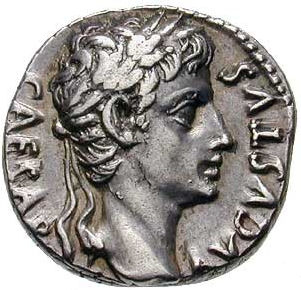 But Matthew makes it clear that Jesus saw through their ruse. He knew they were trying to trick Him and even accused them of hypocrisy. But in spite of His awareness of their less-than-sincere motives, He chose to answer their question. He asked for a Roman coin, which would have carried the image of Caesar, a fact that He got them to verify. Then He told them, “
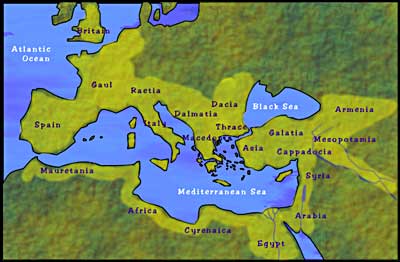 Peace and it lasted from roughly 27 B.C. to 180 A.D. Rome’s territory spread all the way from Spain to Israel, into Africa and Egypt and even as far as Britain. They brought peace and a certain amount of stability to the world. Their intricate network of roads made travel not only easier, but safer. It was during this time that Paul was able to travel all throughout the Roman world sharing the good news of Jesus Christ. Yes, the Roman government could be highly corrupt. Their presence in any land could be heavy handed and at times, oppressive. They ruled with an iron fist. They taxed their subjects mercilessly. They brought their polytheistic religion wherever they went. And yet, they tended to be surprisingly tolerant of the religious faiths of their subjects.