A Man Possessed

1I myself am satisfied about you, my brothers, that you yourselves are full of goodness, filled with all knowledge and able to instruct one another. 15 But on some points I have written to you very boldly by way of reminder, because of the grace given me by God 16 to be a minister of Christ Jesus to the Gentiles in the priestly service of the gospel of God, so that the offering of the Gentiles may be acceptable, sanctified by the Holy Spirit. 17 In Christ Jesus, then, I have reason to be proud of my work for God. 18 For I will not venture to speak of anything except what Christ has accomplished through me to bring the Gentiles to obedience—by word and deed, 19 by the power of signs and wonders, by the power of the Spirit of God—so that from Jerusalem and all the way around to Illyricum I have fulfilled the ministry of the gospel of Christ; 20 and thus I make it my ambition to preach the gospel, not where Christ has already been named, lest I build on someone else’s foundation, 21 but as it is written,

“Those who have never been told of him will see,
    and those who have never heard will understand.” – Romans 15:14-21 ESV

As Paul begins to wrap up his letter, he provides a glimpse into his heart. After spending nearly 15 chapters defining and defending the gospel and its non-negotiable dependence on faith alone, he takes a moment to remind his readers why he wrote the letter in the first place.

He was passionate. In a way, he was obsessed with the personal commission he received from Jesus Himself to take the gospel to the Gentiles, and he would stop at nothing to see that he fulfilled his responsibility. That is why he could put up with suffering, abuse, rejection, ridicule, and his apparent lack of success on many occasions. He was relentless in his mission and refused to be distracted or deterred from his life’s calling.  He described it as “the grace given me by God to be a minister of Christ Jesus to the Gentiles in the priestly service of the gospel of God” (Romans 15:15-16 ESV).

Paul considered his job as an apostle and missionary to be an expression of God’s lovingkindness and favor.  His responsibility to share the good news of Jesus Christ with the Gentiles was a privilege that was undeserved and unmerited, and he did not take it lightly. He had every reason to be proud of his work for God; not in a self-centered, boastful kind of way, but because he knew that anything he had accomplished was by God’s grace and through His power.

Paul had a healthy understanding of who he was and what he had accomplished.

For I am the least of all the apostles. In fact, I’m not even worthy to be called an apostle after the way I persecuted God’s church. But whatever I am now, it is all because God poured out his special favor on me—and not without results. For I have worked harder than any of the other apostles; yet it was not I but God who was working through me by his grace. – 1 Corinthians 15:9-10 NLT

His hard work and determination had paid off, and he could look back on all his missionary journeys and see the fruit of his labors. There were thriving, growing churches filled with new believers from all walks of life. Jews and Gentiles, having come to know Christ as their Savior, were worshiping together and living out Paul’s metaphor of the body of Christ. That is why he could say, “from Jerusalem and all the way around to Illyricum I have fulfilled the ministry of the gospel of Christ” (Romans 15:19 ESV). He had done his job and fulfilled his commission. But he was far from done.

I make it my ambition to preach the gospel, not where Christ has already been named, lest I build on someone else’s foundation. – Romans 15:20 ESV

He was neither content nor complacent and was unwilling to rest on his laurels. In fact, he had told the believers in Rome, “I long to visit you so I can bring you some spiritual gift that will help you grow strong in the Lord. When we get together, I want to encourage you in your faith, but I also want to be encouraged by yours” (Romans 1:11-12 NLT).

Paul was not distracted by the things of this world; money and materialism had no appeal to him. He told the believers in Philippi, “Yes, everything else is worthless when compared with the infinite value of knowing Christ Jesus my Lord. For his sake I have discarded everything else, counting it all as garbage, so that I could gain Christ and become one with him” (Philippians 3:8-9 NLT).

Paul made it his “ambition” to preach the gospel. The Greek word he uses is philotimeomai, and it means “to strive earnestly, make it one’s aim” (Thayer’s Greek Lexicon). You might say that Paul had a one-track mind. His single focus in life was to preach the gospel to the Gentiles; it was his sole passion. And what should amaze us is the incredible impact of one man committed to a singular cause. Paul changed the world and revolutionized the culture in which he lived. Everywhere he went, he left a wake filled with transformed lives. One man, one mission, and one hope for making men right with God: the gospel of Jesus Christ.

How easy it is for us to see ourselves as insignificant and incapable of making a difference in the world. We sometimes feel alone and outnumbered, and see our faith as too small and our influence as too weak when compared to the darkness that surrounds us. But like Paul, we must understand that any difference we make will not depend on us but on the power of God within us. Our job is to make ourselves available. We can make a difference with God’s help. As evidenced by the life of Paul, one individual can make a world of difference when he or she is committed to the cause of Christ and dependent upon the Spirit of God for strength.

And this is the secret: Christ lives in you. This gives you assurance of sharing his glory. So we tell others about Christ, warning everyone and teaching everyone with all the wisdom God has given us. We want to present them to God, perfect in their relationship to Christ. That’s why I work and struggle so hard, depending on Christ’s mighty power that works within me. – Colossians 1:27-29 NLT

Father, it is clearly evident that Paul was committed. He took his job seriously and viewed his mission as Your spokesperson as a privilege, not a duty. He was honored to serve and even suffer for the cause of Christ. He refused to give in, give up, or compromise his commission or convictions, even in the face of fierce opposition and the constant threat of death. He wasn’t oblivious to animosity of his enemies and he didn’t live with his head in the sand, ignoring the dangers that accompanied his mission. He simply knew that his work was divinely ordained and his life was providentially protected. He suffered constant rejection, relentless ridicule, and spent his fair share of time in prison for his efforts. But he remained committed to the cause. He even penned some of his most powerful and encouraging letters during his years in confinement. Rather than moan over his lot in life, he used those years of imprisonment to build up the body of Christ. His life is an inspiration. His dedication to ministry is a powerful reminder to every believer that we serve as Your ministers of reconciliation in this world. We too, are Your servants, tasked with the job of taking the gospel to the nations. But if we are to be successful, we must have the attitude that possessed Paul. 

I dare not boast about anything except what Christ has done through me, bringing the Gentiles to God by my message and by the way I worked among them.” – Romans 15:18 NLT

Amen

English Standard Version (ESV) The Holy Bible, English Standard Version. ESV® Permanent Text Edition® (2016). Copyright © 2001 by Crossway Bibles, a publishing ministry of Good News Publishers.

New Living Translation (NLT) Holy Bible, New Living Translation, copyright © 1996, 2004, 2015 by Tyndale House Foundation. Used by permission of Tyndale House Publishers Inc., Carol Stream, Illinois 60188. All rights reserved.22

Return to Me

1 In the eighth month, in the second year of Darius, the word of the Lord came to the prophet Zechariah, the son of Berechiah, son of Iddo, saying, “The Lord was very angry with your fathers. Therefore say to them, Thus declares the Lord of hosts: Return to me, says the Lord of hosts, and I will return to you, says the Lord of hosts. Do not be like your fathers, to whom the former prophets cried out, ‘Thus says the Lord of hosts, Return from your evil ways and from your evil deeds.’ But they did not hear or pay attention to me, declares the Lord. Your fathers, where are they? And the prophets, do they live forever? But my words and my statutes, which I commanded my servants the prophets, did they not overtake your fathers? So they repented and said, ‘As the Lord of hosts purposed to deal with us for our ways and deeds, so has he dealt with us.’” Zechariah 1:1-6 ESV

The year is 520 B.C. and 18 years have passed since the first wave of exiled Hebrews were allowed to leave Babylon and return to the land of Judah. When the Book of Zechariah opens, Darius reigns over the Medo-Persian empire and the book’s author serves as a priest and prophet for Yahweh. His grandfather, Ido, returned to Judah in 536 B.C. His name is listed among the prominent priests who served under Jeshua the high priest.

These are the priests and the Levites who came up with Zerubbabel the son of Shealtiel, and Jeshua: Seraiah, Jeremiah, Ezra, Amariah, Malluch, Hattush, Shecaniah, Rehum, Meremoth, Iddo, Ginnethoi, Abijah, Mijamin, Maadiah, Bilgah, Shemaiah, Joiarib, Jedaiah, Sallu, Amok, Hilkiah, Jedaiah. These were the chiefs of the priests and of their brothers in the days of Jeshua. – Nehemiah 12:1-7 ESV

Because Zechariah was a young man (Zechariah 2:4) when his prophetic ministry started, he likely was born in Babylon during the exile. It would make sense that he returned to Judah in 536 B.C. along with his father, grandfather, and the rest of his family. Over the next 18 years, he received his priestly training and was educated in the Mosaic Law.

At some point, God deemed Zechariah ready for ministry and sent him the following message:

“I, the LORD, was very angry with your ancestors. Therefore, say to the people, ‘This is what the Lord of Heaven’s Armies says: Return to me, and I will return to you, says the LORD of Heaven’s Armies.’ Don’t be like your ancestors who would not listen or pay attention when the earlier prophets said to them, ‘This is what the LORD of Heaven’s Armies says: Turn from your evil ways, and stop all your evil practices.’ – Zechariah 1:2-4 NLT

Zechariah’s introduction to the prophetic ministry was abrupt and far from encouraging. He was given an assignment that would have made even the most seasoned prophet question his calling. The LORD wastes no time with pleasantries and provides no explanation for His choice of Zechariah. He simply conveys His mood and the message He wants Zechariah to deliver to the people of Judah. God introduces Himself to Zechariah as Yahweh-Sabaoth, the LORD of Hosts. This name is meant to convey God’s sovereign power over the angelic host in heaven. He rules over a vast army of divine beings who operate in the unseen realm. But, as the LORD of Hosts, God’s authority extends to the earth where He rules over every power, kingdom, army, and realm.

Of all people, the Israelites would have understood that God has the power to control any king and kingdom on earth. He had used Nebuchadnezzar and the Babylonian army to punish their ancestors by invading the city of Jerusalem, destroying the Temple, and sending them into exile in Babylon. God later moved Cyrus king of Persia to issue a decree to send a remnant of the people back to Judah. God wanted Zechariah and the people of Judah to remember that He could use earthly kings and kingdoms to carry out His will – for good or bad.

God’s brief but pointed message to Zechariah conveys His anger with the people of Judah. He had allowed them to return to the land and orchestrated the rebuilding of the Temple. He had sent Ezra the scribe to teach them the Mosaic Law and reestablish the Levitical priesthood and sacrificial system. But despite all He had done to prepare a proper environment for worship and obedience, they had strayed from the path by violating His laws and compromising their convictions.

The final chapter of the Book of Nehemiah reports that by the year 432 B.C., the spiritual state of the people of Judah had reached an all-time low. Nehemiah returned from an extended stay in Babylon to find that the conditions in Judah had degraded beyond anything he could have imagined. When he arrived, Nehemiah was appalled by what he saw. Everywhere he looked, he saw signs that the people had violated the covenant they made with Yahweh. Everywhere he looked he found the “spiritual” walls of Jerusalem had fallen. The covenant had been broken and the people were ripe for spiritual attack.

Zechariah received his calling and message 88 years before Nehemiah returned to find Judah in an appalling state of spiritual decay. But God had seen the handwriting on the wall and chose to deputize young Zechariah as His official spokesman. This still wet-behind-the-ears priest would be tasked with conveying God’s message of repentance to the stubborn people of Judah, and that message was clear and direct.

“Turn from your evil ways, and stop all your evil practices.” – Zechariah 1:4 NLT

It also came with a warning of consequences if they chose to ignore it.

“Where are your ancestors now? They and the prophets are long dead. – Zechariah 1:5 NLT

The people living in Judah were one generation removed from the Babylonian captivity. Most of their parents and grandparents had died in captivity. God’s message carried the force of reality. They knew the LORD of Hosts was fully capable of carrying out His warnings of judgment because their ancestors were the proof.

God was angry with the people of Judah once again and demanded that they repent. He didn’t want this current crop of rebellious children to suffer the same fate as their forefathers. It took the destruction of Jerusalem and exile to bring their ancestors to their knees and to the place of repentance.

“…everything I said through my servants the prophets happened to your ancestors, just as I said. As a result, they repented and said, ‘We have received what we deserved from the Lord of Heaven’s Armies. He has done what he said he would do.’” – Zechariah 1:6 NLT

Was it going to take another disaster to wake up God’s people? Would they force God to deliver devastating judgment just like He did to their ancestors? Zechariah’s job was to deliver God’s good-news-bad-news message to the disobedient people of Judah, and it would not end well for him. Jesus spoke of Zechariah’s fate when addressing the hypocritical religious leaders of His day. He referred to these men as “whitewashed tombs.” According to Jesus’ estimation, they were “beautiful on the outside but filled on the inside with dead people’s bones and all sorts of impurity” (Matthew 23:27 NLT). In a sense, Jesus was delivering the same basic message as Zechariah.

“Outwardly you look like righteous people, but inwardly your hearts are filled with hypocrisy and lawlessness.” – Matthew 23:28 NLT

The people of Judah were going through the motions. They were still offering sacrifices, observing the Sabbath, attending the annual festivals, and presenting their tithes and offerings. They appeared to be righteous but, according to God, their hearts were far from Him (Isiah 29:13). Zechariah, like Jesus, would have to deliver a less-than-pleasant message to a people who were far from ready to hear it. And, according to Jesus, they eventually rejected the message by killing the messenger.

“Therefore, I am sending you prophets and wise men and teachers of religious law. But you will kill some by crucifixion, and you will flog others with whips in your synagogues, chasing them from city to city. As a result, you will be held responsible for the murder of all godly people of all time—from the murder of righteous Abel to the murder of Zechariah son of Berekiah, whom you killed in the Temple between the sanctuary and the altar. – Matthew 23:34-35 ESV

Jesus would suffer the same fate. He told the Jews of His day, “Yes, I realize that you are descendants of Abraham. And yet some of you are trying to kill me because there’s no room in your hearts for my message” (John 8:37 NLT). These self-righteous Jews rejected Jesus’ Messiahship because they didn’t like His message. According to Him, their Hebrew heritage was not enough to save them. They proudly claimed Abraham as their father but Jesus said they lacked Abraham’s faith.

“No,” Jesus replied, “for if you were really the children of Abraham, you would follow his example. Instead, you are trying to kill me because I told you the truth, which I heard from God. Abraham never did such a thing.” – John 8:39-40 NLT

This exchange so infuriated the Jews that they attempted to stone Jesus to death. But His time had not yet come. They would eventually collaborate with the Romans to orchestrate His crucifixion and end His life, but their efforts would fail to derail His ministry or thwart God’s plan of redemption.

Zechariah would faithfully carry out God’s orders and deliver the message he had been given. He would offer the people a choice. They could repent and enjoy God’s forgiveness or reject the message and suffer God’s judgment. It was up to them.

English Standard Version (ESV)
The Holy Bible, English Standard Version. ESV® Permanent Text Edition® (2016). Copyright © 2001 by Crossway Bibles, a publishing ministry of Good News Publishers.

New Living Translation (NLT)
Holy Bible, New Living Translation, copyright © 1996, 2004, 2015 by Tyndale House Foundation. Used by permission of Tyndale House Publishers Inc., Carol Stream, Illinois 60188. All rights reserved.
Jehovah-M’Kaddesh

7 “Consecrate yourselves, therefore, and be holy, for I am the Lord your God. Keep my statutes and do them; I am the Lord who sanctifies you.” – Leviticus 20:7-8 ESV

YHWHM’Kaddesh – The LORD Who Sanctifies, Makes Holy.” The key to understanding this name of God lies in its association with the Hebrew term, qāḏaš (קָדַש) which, according to the Outline of Biblical Usage carries the following meanings: “to consecrate, sanctify, prepare, dedicate, be hallowed, be holy, be sanctified, be separate.”

In verse 7, God commands the Israelites to “consecrate” (qāḏaš) themselves. The purpose for their consecration is their holiness; they are to “be holy” (qāḏôš), This is the adjective form of the root word qāḏaš and describes their set apart or sacred status as God’s chosen people. They are called to live ceremonially and morally different lives than those of every other people group on earth because they belong to God. They are His children and should reflect His holy character through adherence to His holy law.

But in this passage, God reminds His chosen people that their set-apart status is not the byproduct of law-keeping. In other words, they don’t earn their holiness through obedience or strict adherence to a set of religious rules or rituals. He states, “I am the Lord who sanctifies (qāḏaš) you.” God had already chosen them as His own and that distinction had nothing to do with their behavior. In the Book of Deuteronomy, Moses informed the people of Israel, whom God had recently released from captivity in Egypt, that they belonged to Him. 

“For you are a holy (qāḏôš) people, who belong to the LORD your God. Of all the people on earth, the LORD your God has chosen you to be his own special treasure.

“The LORD did not set his heart on you and choose you because you were more numerous than other nations, for you were the smallest of all nations! Rather, it was simply that the LORD loves you, and he was keeping the oath he had sworn to your ancestors.” – Deuteronomy 7:6-8 NLT

Moses states that they were already holy in God’s eyes and it had nothing to do with their adherence to the law. So, their set-apart status had nothing to do with their behavior. God’s rescue of them from captivity in Egypt had not been the result of their worthiness or some form of reward for their righteous character. It wasn’t even because they were a mighty and powerful nation that could prove beneficial to God’s plans. In fact, Moses states that their size and significance had nothing to do with their selection by God. Yahweh had chosen them as His special treasure, even though they “were the smallest of nations” (Deuteronomy 7:7 NLT).

But the Leviticus passage conveys God’s expectation that the Israelites live in keeping with their status as His special treasure. Their behavior was to match their identity as His chosen ones. They were already holy because God had hand-picked them; now they were to live like it. That’s why God tells them, “Keep my statutes and do them” (Leviticus 20:8 ESV). This was not an option but a command. Yahweh was communicating His non-negotiable expectation of His chosen people. They were to live as who they were as His treasured possession.

Moses went on to tell the Israelites that their obedience to God’s laws was binding and not up for debate.

“…you must obey all these commands, decrees, and regulations I am giving you today.” – Deuteronomy 7:11 NLT

Yet, their obedience to God’s law could not make them holy. Only God could do that. Their adherence to the law was proof of their set-apart status. It gave evidence of their standing as His treasure possession because the law had been given to them alone. It was God’s way of differentiating the Israelites from every other nation on earth. The law was intended to be God’s code of conduct for regulating their actions and attitudes as His people. It was the key to being holy. If the Israelites had been allowed to live just like all the other nations, there would have been no tangible difference between them. But God’s people were to live holy, set-apart lives that made them distinctively different from the rest of the nations on earth.

But the Israelites had a difficult time living up to their holy identity. According to God, they were holy, but they found it virtually impossible to maintain the standard God had given them.  Over the centuries, they repeatedly failed to obey God’s law, choosing instead to compromise their convictions and blend in with the nations around them. This did not make them any less holy or set apart in God’s eyes. In fact, it caused Him to punish them for bringing shame and dishonor to His name. They ended up in captivity again, this time in Assyria and Babylon. But the Book of Ezekiel prophecies about a future day when God will restore Israel because they remain His treasured possession. He is YHWHM’Kaddesh, The LORD who makes holy.

“…they shall all have one shepherd. They shall walk in my rules and be careful to obey my statutes. They shall dwell in the land that I gave to my servant Jacob, where your fathers lived. They and their children and their children’s children shall dwell there forever, and David my servant shall be their prince forever. I will make a covenant of peace with them. It shall be an everlasting covenant with them. And I will set them in their land and multiply them, and will set my sanctuary in their midst forevermore. My dwelling place shall be with them, and I will be their God, and they shall be my people.” – Ezekiel 7:24-27 ESV

God had called the people of Israel. He had set them apart and, in doing so, made them holy in His eyes. But He expected them to live in keeping with their identity as His children. He provided them with His law so they would know what holiness looked like in everyday life. Their relationship with Him came with rules. Their unmerited status as His chosen possession came with conditions and expectations. That’s why God commanded them to “be holy.” They were to display their identity through obedience to His commands.

But look closely at Ezekiel 7:24. Despite their failure to faithfully carry out God’s commands, the day is coming when God will see that they do. He confidently declares, “They shall walk in my rules and be careful to obey my statutes.” Their conduct will line up with their status as His holy people. Their character will reflect their consecrated state as His treasured possession. He will make it happen. Jehovah-M’Kaddesh will ensure that His people are positionally and practically holy in every way.

The apostle Paul picks up on this theme in his first letter to the church in Corinth.

Think about the circumstances of your call, brothers and sisters. Not many were wise by human standards, not many were powerful, not many were born to a privileged position. But God chose what the world thinks foolish to shame the wise, and God chose what the world thinks weak to shame the strong. God chose what is low and despised in the world, what is regarded as nothing, to set aside what is regarded as something, so that no one can boast in his presence. He is the reason you have a relationship with Christ Jesus, who became for us wisdom from God, and righteousness and sanctification and redemption, so that, as it is written,Let the one who boasts, boast in the Lord.” – 1 Coronthians 1:26-31 NLT

Notice that Paul reminds the Corinthians that they too were called by God. He chose them, not the other way around, and His choice of them had nothing to do with their wisdom, power, or status. They had done nothing to deserve their calling. In fact, Paul states that they were foolish, weak, low, and despised. In the world’s eyes, they were regarded as nothing. Even their relationship with Jesus had been God’s doing.

He [God] is the reason you have a relationship with Christ Jesus. – 1 Corinthians 1:30 NLT

God had called them and set them apart. He is the one who set them apart as His own.

God is faithful, by whom you were called into fellowship with his son, Jesus Christ our Lord. – 1 Corinthians 1:9 NLT

Paul echoes this wonderful reality in his letter to the Romans.

For God knew his people in advance, and he chose them to become like his Son, so that his Son would be the firstborn among many brothers and sisters. And having chosen them, he called them to come to him. And having called them, he gave them right standing with himself. And having given them right standing, he gave them his glory. – Romans 8:29-30 NLT

God is Jehovah-M’Kaddesh, the one who sanctifies and sets apart. It is He who makes our salvation and sanctification possible.

So now Jesus and the ones he makes holy have the same Father. That is why Jesus is not ashamed to call them his brothers and sisters. – Hebrews 2:11 NLT

Through His death on the cross, Jesus made our holiness possible. He paid the price for our sins, dying the death we deserved to die, so that we might be restored to a right relationship with our holy Father.

But when this priest had offered one sacrifice for sins for all time, he sat down at the right hand of God, where he is now waiting until his enemies are made a footstool for his feet. For by one offering he has perfected for all time those who are made holy. – Hebrews 11:12-14 NLT

We are holy but we are also becoming progressively more holy. It is an ongoing process that requires our willing reliance upon God’s Spirit and our faithful obedience to His will for our lives. The apostle Peter gives us the recipe for living holy lives as we wait for the return of Christ.

So prepare your minds for action and exercise self-control. Put all your hope in the gracious salvation that will come to you when Jesus Christ is revealed to the world. So you must live as God’s obedient children. Don’t slip back into your old ways of living to satisfy your own desires. You didn’t know any better then. But now you must be holy in everything you do, just as God who chose you is holy. For the Scriptures say, “You must be holy because I am holy.” – 1 Peter 1:13-16 NLT

God is Jehovah-M’Kaddesh, the one who sanctifies, but we also have a role to play and we wait for the completion of His sanctifying process in our lives: The glorification of our bodies. We cannot make ourselves holy; only God can do that and He has chosen to do it through the sacrificial death of His Son. But we can exhibit our holy standing by living as God’s obedient children through the indwelling power of the Spirit and the guidance of His Word.

English Standard Version (ESV)
The Holy Bible, English Standard Version. ESV® Permanent Text Edition® (2016). Copyright © 2001 by Crossway Bibles, a publishing ministry of Good News Publishers.

New Living Translation (NLT)
Holy Bible, New Living Translation, copyright © 1996, 2004, 2015 by Tyndale House Foundation. Used by permission of Tyndale House Publishers Inc., Carol Stream, Illinois 60188. All rights reserved.

Future-Focused Faith

By faith Abraham obeyed when he was called to go out to a place that he was to receive as an inheritance. And he went out, not knowing where he was going. By faith he went to live in the land of promise, as in a foreign land, living in tents with Isaac and Jacob, heirs with him of the same promise. 10 For he was looking forward to the city that has foundations, whose designer and builder is God. – Hebrews 11:8-10 ESV

The first four words of this section of Hebrews 11 are critical: “By faith Abraham obeyed.” It would be easy to put the emphasis on the latter half of the statement, making Abraham’s obedience the main point. But the author is simply attempting to provide further proof for the opening line of this chapter: “Now faith is the assurance of things hoped for, the conviction of things not seen” (Hebrews 11:1 ESV). Abraham’s obedience, while important, is meant to take a back seat to his faith. It is a byproduct of his faith. As the author said in verse six, “without faith it is impossible to please God.”

We have to go back to the Old Testament book of Genesis to see the complete story of Abraham’s call and his subsequent obedience to that call. He was living in Haran with his father and the rest of his family. They had moved there from Ur. And it was while he was living in Haran that God came to Abram (his original name), and said, “Leave your native country, your relatives, and your father’s family, and go to the land that I will show you. I will make you into a great nation. I will bless you and make you famous, and you will be a blessing to others. I will bless those who bless you and curse those who treat you with contempt. All the families on earth will be blessed through you” (Genesis 12:1-3 ESV).

What’s important to notice is that, according to the text, God had not given him the exact location of his final destination. Even the passage in Hebrews says that Abram “went out, not knowing where he was going.” This is an important part of the story. The extent of Abram’s knowledge was limited. He knew that God had called him and had promised to give him land and to produce from him a great nation. While these promises were substantial in scope, they were also a bit vague. Anyone would naturally want to know where and how. Where is this land you are giving me and how do you intend to produce a great nation from a man with a barren wife?

Abram would have had questions and concerns, yet he still obeyed God and did exactly as he was told. But the author’s emphasis is the faith that fueled Abram’s obedience. 

by faith Abraham obeyed. – Hebrews 11:8 ESV

He had no idea where he was going or how God was going to pull off what He had promised. Genesis tells us that Abram headed out, under the direction of God, and before long he found himself in the land of Canaan, a land occupied by none other than the Canaanites, the descendants of Ham, one of the sons of Noah.

Abram was a descendant of Shem, another son of Noah. So once he arrived at his final destination, Abram found the land already occupied by some distant family members. The author of Hebrews reminds us that “By faith he went to live in the land of promise, as in a foreign land” (Hebrews 11:9 ESV). Abram found himself living in a land that belonged to others, and its residents lived in well-furnished houses while his small family was relegated to the transient lifestyle of nomads, living in tents and constantly moving from one location to another.

They were little more than squatters and vagabonds who enjoyed no sense of stability or ownership, and this state of affairs would last for generations, spanning the lives of Isaac and Jacob. Abram had received a promise of land but he spent his entire life living like a stranger rather than an occupant. He never owned a home or lived within the secure walls of a city. In fact, the author of Hebrews states that during his entire tenure in Canaan, “he was looking forward to the city that has foundations, whose designer and builder is God” (Hebrews 11:10 ESV).

The Greek word the author uses is ekdechomai and it means “to look for, expect, wait for, await” (Greek Lexicon :: G1551 (KJV). Blue Letter Bible. Web. 4 Feb, 2016. <http://www.blueletterbible.org). Abram was waiting for, expecting, and anticipating something that had not yet come. He was eagerly and hopefully waiting for God to make his residence a permanent one. His understanding of the promise was that it would include a city made up of bricks and mortar, with walls, ceilings, and floors. Abram was eagerly anticipating the end of his nomadic existence spent living in tents.

But he had to wait, and along with having to deal with the existence of Canaanites, he had to endure the devastating impact of a debilitating drought. When he first arrived in the “promised land,” things were so bad that he was forced to take an unplanned detour to Egypt to seek food for his family. This was not what he had expected when he obeyed the call of God back in Ur. But through a series of unexpected but divinely ordained events, Abram arrived back in Canaan a wealthy man with an abundance of livestock. In fact, his flocks were so large that he and his nephew Lot had to part ways in order to keep from running into conflicts over pasturing rights. And when he gave Lot the first choice of land, his nephew chose the very best, leaving Abram with the less attractive portion. But Abram continued to trust God. He placed his hope and convictions in the promises of God. Even after Abram gave Lot the choice of the best land, God reconfirmed His promise to him.

Look as far as you can see in every direction—north and south, east and west. I am giving all this land, as far as you can see, to you and your descendants as a permanent possession. And I will give you so many descendants that, like the dust of the earth, they cannot be counted! Go and walk through the land in every direction, for I am giving it to you. – Genesis 13:14-17 ESV

According to God, the land was as good as his – all of it. Every square acre of it, including all of the land occupied by the Canaanites and by Lot belonged to Abram. He had yet to take possession of a single square inch of the land of Canaan but, according to God’s promise, it was all going to belong to his descendants. Abram placed his faith and hope in God and His word. The fact that he did not possess a permanent home or the deed to a piece of property did not diminish his belief that God was going to follow through on His promise. Abram lived with the assurance of things hoped for, the conviction of things not seen.

Yet, the author states that Abram and all the others listed in chapter 11 “died in faith, not having received the things promised, but having seen them and greeted them from afar, and having acknowledged that they were strangers and exiles on the earth” (Hebrews 11:13 ESV). Theirs was a future-focused faith. It was based on a promise, and that promise was assured because the promise-maker was trustworthy. Abram knew that the promise of God was far greater and encompassed far more than just his individual blessing. God’s promise involved future generations and had far-reaching implications. Abram would never live to see the complete fulfillment of God’s promise. He would be long gone by the time his descendants faced another famine in Canaan and returned to Egypt. He would never live to see them multiply and grow to such a degree that Pharaoh would become fearful of them and decree a pogrom designed to exterminate them. He would not experience the joy of watching God set his descendants free from their captivity in Egypt and lead them back to the promised land. He would not enjoy the thrill of seeing them conquer the land of Canaan and make it their own. He would never see the rise of King David or view the splendor of Solomon’s grand kingdom. And he would never live to see the coming of the Messiah, the one through whom all the nations of the earth would be blessed.

But Abram believed. He had faith. He obeyed. He worshiped. He waited. And he left the future in God’s hands. He had future faith because he believed in an eternal God who never fails to keep His word or fulfill His commitments. And the apostle Paul would have us live by faith as Abram did.

…we ourselves, who have the firstfruits of the Spirit, groan inwardly as we wait eagerly for adoption as sons, the redemption of our bodies. For in this hope we were saved. Now hope that is seen is not hope. For who hopes for what he sees? But if we hope for what we do not see, we wait for it with patience. – Romans 8:23-25 ESV

English Standard Version (ESV) The Holy Bible, English Standard Version. ESV® Permanent Text Edition® (2016). Copyright © 2001

New Living Translation (NLT) Holy Bible, New Living Translation, copyright © 1996, 2004, 2015 by Tyndale House Foundation. Used by permission of Tyndale House Publishers Inc., Carol Stream, Illinois 60188. All rights reserved.

A Bitter-Sweet Assignment

1 And he said to me, “Son of man, stand on your feet, and I will speak with you.” And as he spoke to me, the Spirit entered into me and set me on my feet, and I heard him speaking to me. And he said to me, “Son of man, I send you to the people of Israel, to nations of rebels, who have rebelled against me. They and their fathers have transgressed against me to this very day. The descendants also are impudent and stubborn: I send you to them, and you shall say to them, ‘Thus says the Lord God.’ And whether they hear or refuse to hear (for they are a rebellious house) they will know that a prophet has been among them. And you, son of man, be not afraid of them, nor be afraid of their words, though briers and thorns are with you and you sit on scorpions. Be not afraid of their words, nor be dismayed at their looks, for they are a rebellious house. And you shall speak my words to them, whether they hear or refuse to hear, for they are a rebellious house.

“But you, son of man, hear what I say to you. Be not rebellious like that rebellious house; open your mouth and eat what I give you.” And when I looked, behold, a hand was stretched out to me, and behold, a scroll of a book was in it. 10 And he spread it before me. And it had writing on the front and on the back, and there were written on it words of lamentation and mourning and woe.

1 And he said to me, “Son of man, eat whatever you find here. Eat this scroll, and go, speak to the house of Israel.” So I opened my mouth, and he gave me this scroll to eat. And he said to me, “Son of man, feed your belly with this scroll that I give you and fill your stomach with it.” Then I ate it, and it was in my mouth as sweet as honey. – Ezekiel 2:1-3:3 ESV

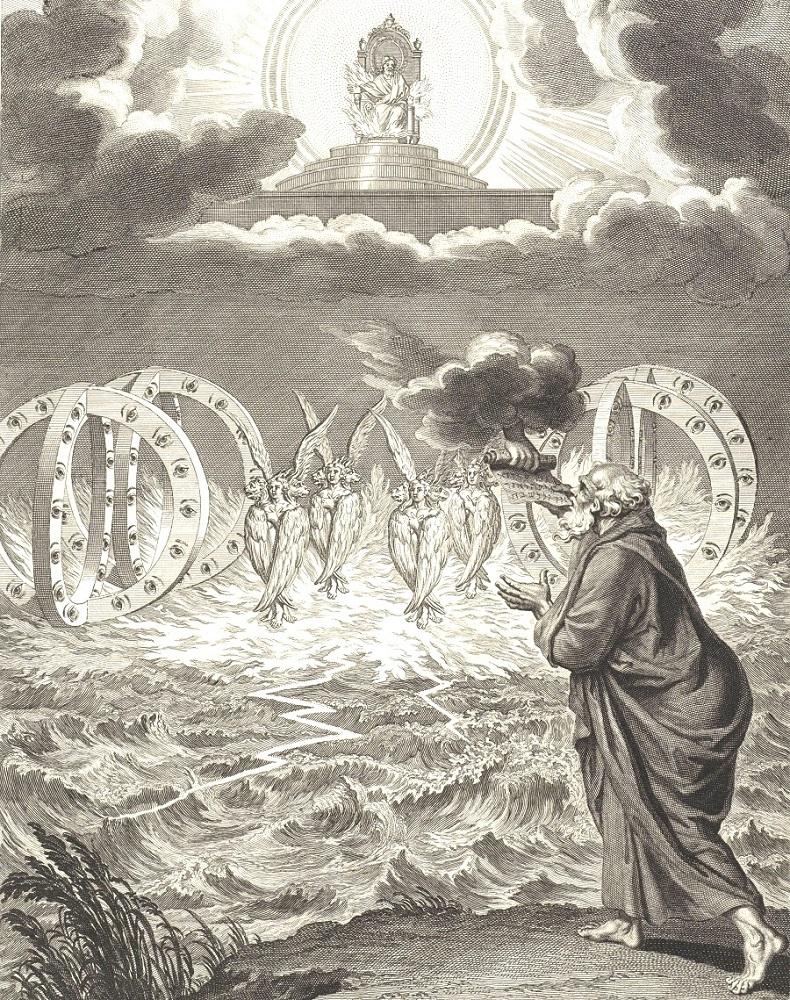
Ezekiel had been given a vision of God’s glory, and it left him face down on the ground in reverential fear and wonder. As this exiled young priest stood by the banks of the Kebar River in Babylon, the God of the universe made an unexpected and highly spectacular appearance.

Above this surface was something that looked like a throne made of blue lapis lazuli. And on this throne high above was a figure whose appearance resembled a man. From what appeared to be his waist up, he looked like gleaming amber, flickering like a fire. And from his waist down, he looked like a burning flame, shining with splendor. All around him was a glowing halo, like a rainbow shining in the clouds on a rainy day. This is what the glory of the Lord looked like to me. – Ezekiel 1:26-28 NLT

It is safe to assume that this was a once-in-a-lifetime experience for Ezekiel. He had never seen anything like this before, and to have the God of Abraham, Isaac, and Jacob appear to him in the remote recesses of the land of Babylon must have been a shock to his system. He was just a lowly priest who had been taken captive just like all the other residents of Jerusalem when the city had fallen to King Nebuchadnezzar’s forces.  Jehoiachin was the king of Judah at the time and, according to 2 Kings 12:9, “He did evil in the sight of the Lord as his ancestors had done.” Like most of his predecessors, Jehoiachin chose to use his royal power to promote idolatry that fostered unfaithfulness to God, and he suffered greatly for his refusal to honor the Almighty.

At that time the generals of King Nebuchadnezzar of Babylon marched to Jerusalem and besieged the city. King Nebuchadnezzar of Babylon came to the city while his generals were besieging it. King Jehoiachin of Judah, along with his mother, his servants, his officials, and his eunuchs surrendered to the king of Babylon. The king of Babylon, in the eighth year of his reign, took Jehoiachin prisoner. Nebuchadnezzar took from there all the riches in the treasuries of the Lord’s temple and of the royal palace. He removed all the gold items that King Solomon of Israel had made for the Lord’s temple, just as the Lord had warned. He deported all the residents of Jerusalem, including all the officials and all the soldiers (10,000 people in all). This included all the craftsmen and those who worked with metal. No one was left except for the poorest among the people of the land. – 2 Kings 12:10-14 NLT

Living amongst the exiled people of God, Ezekiel had firsthand experience with the apathy and complacency that had taken hold of them. A long way from home and no longer able to avail themselves of the temple and the sacrificial system, they had begun to lose interest in the things of God. Their circumstances had left them feeling abandoned by God and distraught over the far-from-ideal conditions of their captivity. With the passage of time, God had become out of sight, out of mind. They simply assumed He had turned His back on them and so, in time, they gave up hope and determined to make the most of their situation in Babylon.

But God had other plans that included appointing Ezekiel as the one who would deliver His message to the exiles. He had not forgotten about them. They had not been abandoned. Their exile had been intended to get their attention and to bring them to a point of repentance. Now, Ezekiel was going to be commissioned to serve as God’s spokesperson, delivering His call to repentance.

Having gotten Ezekiel’s full attention through the grand display of His glory, God delivered the details of his new assignment.

“I am sending you to the nation of Israel, a rebellious nation that has rebelled against me. They and their ancestors have been rebelling against me to this very day. They are a stubborn and hard-hearted people. But I am sending you to say to them, ‘This is what the Sovereign Lord says!’” – Ezekiel 2:3-4 NLT

God makes it painfully clear that Ezekiel’s new task would not be easy. He would have to deliver a message from God to a people who had a track record of stubbornness and insubordination. And God warns Ezekiel that his audience may not receive his message with open arms.

“And whether they listen or refuse to listen—for remember, they are rebels—at least they will know they have had a prophet among them.” – Ezekiel 2:5 NLT

There was no guarantee that Ezekiel would experience success. Despite the fact that he would be speaking the words of God, he had no way of knowing how the people would respond. In fact, God made it sound like his mission was doomed to certain failure.

What would you do if God called you to a task that He knew you were going to fail at? What if He even told you your efforts would be fruitless and non-productive? Most of us would bail. We would give up long before we got going. Because we’re wired with one thing in mind – success – and failure is not an acceptable alternative. But when Ezekiel got his marching orders from God, he was also given the not-so-great news that his ministry would be unsuccessful because his audience was going to be unresponsive.  God even told Ezekiel to expect threats and animosity. This was going to be one difficult job assignment.

In a sense, God was foreshadowing failure, but demanding obedience. Ezekiel’s success would not be measured by the number of callous, carnal Israelites he converted, but on his willingness to carry out God’s assignment faithfully, even in the face of rejection, ridicule, and poor results.

Even the message God gave Ezekiel to share was anything but good news. In his vision, Ezekiel was given a scroll that was covered with writing front and back, from edge to edge. It’s content?

“Funeral songs, words of sorrows, and pronouncements of doom.” – Ezekiel 2:9b NLT

It was a veritable compendium of bad news. So, not only would Ezekiel have a non-responsive audience, he was given an unappealing message. But God fully understood the foreboding nature of Ezekiel’s assignment, and he knew that Ezekiel was already wrestling with whether to follow through with His command. The young priest was afraid of how he and his message might be received by the people, but God encouraged him to have faith.

“Do not fear them or their words. Don’t be afraid even though their threats surround you like nettles and briars and stinging scorpions. Do not be dismayed by their dark scowls, even though they are rebels.” – Ezekiel 2:6 NLT

God was telling Ezekiel not to be frightened by the things they would threaten to do to him, the harsh words they might say about him, or the negative reaction they would inevitably have to him.

“Son of man, do not fear them or their words. Don’t be afraid even though their threats surround you like nettles and briers and stinging scorpions. Do not be dismayed by their dark scowls, even though they are rebels. You must give them my messages whether they listen or not. But they won’t listen, for they are completely rebellious!” – Ezekiel 2:6-7 NLT

Ezekiel was going to experience resistance. His message would not be well-received and the people would hold him responsible for its content. It was only a matter of time before they sought to kill the messenger. That’s why God warned Ezekiel to refrain from emulating the rebellious nature of his audience. He was not to reject God’s assignment just because it sounded difficult and more than a bit dangerous. God was open and above board as to the difficulty of the mission. He didn’t attempt to sugarcoat the assignment or paint a rosy picture of its outcome. Instead, God gave His newly appointed prophet all he would need to succeed.

“Son of man, listen to what I say to you. Do not join them in their rebellion. Open your mouth, and eat what I give you.” – Ezekiel 2:8 NLT

God held out a scroll, upon which were written lamentations, mourning, and woes. In other words, it was filled with bad news. The sheer volume of disheartening content was so great that it covered both sides of the scroll. God’s indictment against His people was great and He commanded Ezekiel to consume every last bit of it. He was to take it all in so that he might regurgitate it, word for word, to the disobedient people of God.

“Son of man, eat whatever you find here. Eat this scroll, and go, speak to the house of Israel.” – Ezekiel 3:1 ESV

But much to his surprise, Ezekiel found the less-than-appealing content of the scroll to be “sweet as honey.” (Ezekiel 3:3 ESV). There is a similar scene described in the book of Revelation. In it, the apostle John is given a vision of an angel who descends from heaven with a scroll in his hand. He presents the scroll to John and commands him to eat it.

“Yes, take it and eat it,” he said. “It will be sweet as honey in your mouth, but it will turn sour in your stomach!” So I took the small scroll from the hand of the angel, and I ate it! It was sweet in my mouth, but when I swallowed it, it turned sour in my stomach.

Then I was told, “You must prophesy again about many peoples, nations, languages, and kings.” – Revelation 10:9-11 NLT

Both John and Ezekiel would find the words of God to be both sweet and bitter. When the truth of God is consumed, it is pleasant and life-giving, but it can also result in conviction and condemnation.

For the word of God is alive and powerful. It is sharper than the sharpest two-edged sword, cutting between soul and spirit, between joint and marrow. It exposes our innermost thoughts and desires. – Hebrews 4:12 NLT

All Scripture is inspired by God and is useful to teach us what is true and to make us realize what is wrong in our lives. It corrects us when we are wrong and teaches us to do what is right. – 2 Timothy 3:16 NLT

For Ezekiel, consuming God’s word was sweet to the taste, but declaring it to the people would be a bitter experience. They would find it distasteful and difficult to swallow. But God was calling Ezekiel to be faithful and fearless in declaring its truth regardless of the outcome.

English Standard Version (ESV) The Holy Bible, English Standard Version. ESV® Permanent Text Edition® (2016). Copyright © 2001

New Living Translation (NLT) Holy Bible, New Living Translation, copyright © 1996, 2004, 2015 by Tyndale House Foundation. Used by permission of Tyndale House Publishers Inc., Carol Stream, Illinois 60188. All rights reserved.

A Call and a Commitment

1 Now the Lord said to Abram, “Go from your country and your kindred and your father’s house to the land that I will show you. And I will make of you a great nation, and I will bless you and make your name great, so that you will be a blessing. I will bless those who bless you, and him who dishonors you I will curse, and in you all the families of the earth shall be blessed.” Genesis 12:1-3 ESV

With the opening verses of chapter 12, Moses provides his Hebrew readers with an important history lesson that solidifies their unique role in God’s redemptive plan for all mankind. For generations, the Jews had rightfully viewed themselves as God’s chosen people. They considered themselves to be a people who had been set apart by God and declared to be His “treasured possession.” Those were the very words that Moses had communicated to them not long after God delivered them out of captivity in Egypt.

“Thus you shall say to the house of Jacob, and tell the people of Israel: ‘You yourselves have seen what I did to the Egyptians, and how I bore you on eagles’ wings and brought you to myself. Now therefore, if you will indeed obey my voice and keep my covenant, you shall be my treasured possession among all peoples, for all the earth is mine; and you shall be to me a kingdom of priests and a holy nation.’” – Exodus 19:3-6 ESV

Years later, when the people of Israel were standing on the border of Canaan, preparing to enter into the land that God had promised to give them, Moses reminded them of their privileged position as God’s set-apart people.

For you are a holy people, who belong to the LORD your God. Of all the people on earth, the LORD your God has chosen you to be his own special treasure.” – Deuteronomy 7:6 NLT

When reading the story of Abram’s call, it is essential to keep this unique relationship between God and the nation of Israel in mind. The original audience to whom Moses wrote would have relished this retelling of their storied history, but it’s likely that they missed some of the key messages that God had intended for them to hear. They would have brightened at the mention of Abram’s name. This would have been the part of the story where they sat up and took notice. God’s call of Abram had been the impetus for their very existence.

And while that was true, there is something far more significant in the story of Abram’s call than the formation of a single, set-apart nation. For generations, the descendants of Abram had missed the divine purpose behind their existence. They had not earned their favored status with God. The Almighty had not looked down from heaven, noticed their righteous behavior, and decided to reward them with a promotion. In fact, Moses had fully dispelled any thought of their favored status being a reward.

“The LORD did not set his heart on you and choose you because you were more numerous than other nations, for you were the smallest of all nations! Rather, it was simply that the LORD loves you, and he was keeping the oath he had sworn to your ancestors.” – Deuteronomy 7:7-8 NLT

That last line is the key to understanding Genesis 12. The Hebrews, as descendants of Abram, had been created by God. Despite their long and storied history, they had not always existed. There had been a time when not a single Jew walked the face of the earth. Even Abram was not of Jewish descent. He was a Chaldean. But from this one man came a people whom God would set apart. Like the rest of the universe in Genesis 1, the Hebrew people would be created by God, ex nihilo (out of nothing). And the 12th chapter of Genesis begins the story of this “new creation” by God.

The apostle Peter picked up on this theme when writing his first letter. He was addressing Christians who were living in Asia Minor and suffering persecution because of their faith. At one point in his letter, he describes them as “aliens and strangers” (1 Peter 2:11), living in the midst of the spiritual darkness that surrounded them. And he used language that compared them to the people of Israel.

But you are a chosen race, a royal priesthood, a holy nation, a people for his own possession, that you may proclaim the excellencies of him who called you out of darkness into his marvelous light. Once you were not a people, but now you are God’s people; once you had not received mercy, but now you have received mercy. – 1 Peter 2:9-10 ESV

That last line is critical. At one time, these people had not been “a people.” Oh, they existed, but they lacked a relationship with God. The apostle Paul addressed the Gentile believers in Ephesus with a similar thought.

…remember that at that time you were separate from Christ, alienated from the commonwealth of Israel, and strangers to the covenants of the promise, without hope and without God in the world. – Ephesians 2:12 BSB

And Paul went on to remind them of the dramatic transformation that God had brought about in their lives.

Therefore you are no longer strangers and foreigners, but fellow citizens with the saints and members of God’s household… – Ephesians 2:19 BSB

So, back to Genesis 12. With the opening line of the chapter, Moses describes God as sovereignly inserting Himself into the affairs of humanity once again. After all the genealogical lists describing the various lines of Shem, Ham, and Japheth, God focuses His attention on one man: Abram. And to this one individual, God issues a call and provides a promise.

“Go from your country and your kindred and your father’s house to the land that I will show you. And I will make of you a great nation, and I will bless you and make your name great, so that you will be a blessing. I will bless those who bless you, and him who dishonors you I will curse, and in you all the families of the earth shall be blessed.” – Genesis 12:1-3 ESV

According to chapter 11, Abram had been born in Ur of the Chaldeans, located in the land of Shinar. But at one point, his father had made the decision to move his entire family to Canaan. The text provides is no explanation for this costly and difficult relocation. But it is not difficult to see the sovereign hand of God orchestrating this entire affair.

It would have taken a great deal of time and effort to make the long journey from Ur to Canaan. Because the arid and impassable Arabian Desert was located immediately east of Ur, Terah was forced to take a time-consuming detour that eventually led them to Haran. And, once in Haran, Terah had a change of heart and decided to settle down. but God had other plans for Abram. In time, Haran became home to Abram. He too settled down and began to put down roots. But at some point, God commanded him to leave everything behind.

“Leave your native country, your relatives, and your father’s family, and go to the land that I will show you. – Genesis 12:1 NLT

This was a huge “ask” on God’s part. In those days, family ties were essential to survival. By this time in human history, the world had become a hostile place occupied by disparate people groups based on clans and tribal relationships. After God had scattered the nations across the face of the earth (Genesis 11:9), territorial boundaries and indigenous communities had become commonplace. Everyone had staked out their claims and was protecting their particular piece of the global pie. So, it would not have been easy for Abram to leave the safety and security of his clan behind.

But God’s command came with a promise. He was going to provide Abram with a new home in a new land. And it just happened to be the very same land that Terah had intended as his family’s destination. Perhaps Terah had given up on Canaan because he heard it was already occupied by other, more powerful clans. But this would prove to be no problem for God. For the first time since God had placed Adam in Eden, a man was going to be given a specific tract of land to occupy. And like Eden, Canaan was a beautiful and fruitful land, “a good and broad land, a land flowing with milk and honey” (Exodus 3:8 ESV).

According to God, this new land would become the sole possession of Abram’s descendants. In a sense, Canaan had Abram’s name on the deed. And it would be in this land that God would bless Abram and produce through him “a great nation.”

But there is a problem. It was mentioned in chapter 11 but only in passing. In the listing of Terah’s descendants, Abram is described as taking a wife for himself – a woman named Sarai. And then, almost as an aside, the test reveals, “Now Sarai was barren; she had no child” (Genesis 11:30 ESV). Abram would have been completely unaware of Sarai’s condition. But God knew. And yet, knowing that Sarai was incapable of bearing children, God declared that Abram would become the father of a great nation. God was going to bless Abram by giving him offspring. And those offspring would become a blessing to all the nations of the earth. An undeserving man and his barren wife would become the means by which God would pour out His blessings on all humanity.

And this is the point that the Hebrew people tended to miss. They considered themselves to be blessed by God because they were descendants of Abram. But they neglected to remember that their blessing came with a responsibility: They were to have been a blessing to the nations. God had set apart Abram and all his descendants so that they might serve as His representatives to the nations. God had promised to make them His “treasured possession among all peoples” (Exodus 19:5 ESV). But they had a job to do.

…you shall be to me a kingdom of priests and a holy nation… – Exodus 19:6 ESV

Priests were intended to be the mediators between God and man. The Hebrew people had been set apart by God so that they might minister on His behalf to all the nations of the earth. But they had proved to be unfaithful priests and far from a holy nation. But God’s promise would still be fulfilled. Because it would be through the line of Abram that He would bring the offspring through whom all the nations of the earth would be blessed. Jesus would accomplish what the nation of Israel had failed to do.

“I am the Lord; I have called you in righteousness;
    I will take you by the hand and keep you;
I will give you as a covenant for the people,
    a light for the nations… ” – Isaiah 42:6 ESV

“It is too light a thing that you should be my servant
    to raise up the tribes of Jacob
    and to bring back the preserved of Israel;
I will make you as a light for the nations,
    that my salvation may reach to the end of the earth.” – Isaiah 49:6 ESV

That is what sets this chapter apart. In it is contained the hope of all eternity. The coming of the Messiah is weaved into the fabric of Abram’s call and provides the underlying foundation for God’s promise of future blessing for all mankind.

English Standard Version (ESV) The Holy Bible, English Standard Version. ESV® Permanent Text Edition® (2016). Copyright © 2001 by Crossway Bibles, a publishing ministry of Good News Publishers.

New Living Translation (NLT) Holy Bible, New Living Translation, copyright © 1996, 2004, 2015 by Tyndale House Foundation. Used by permission of Tyndale House Publishers Inc., Carol Stream, Illinois 60188. All rights reserved.

New English Translation (NET)NET Bible® copyright ©1996-2017 by Biblical Studies Press, L.L.C. http://netbible.com All rights reserved.

Future-Focused Living

For if these qualities are yours and are increasing, they keep you from being ineffective or unfruitful in the knowledge of our Lord Jesus Christ. For whoever lacks these qualities is so nearsighted that he is blind, having forgotten that he was cleansed from his former sins. 10 Therefore, brothers, be all the more diligent to confirm your calling and election, for if you practice these qualities you will never fall. 11 For in this way there will be richly provided for you an entrance into the eternal kingdom of our Lord and Savior Jesus Christ. 2 Peter 1:8-11 ESV

Peter has encouraged his readers to supplement their faith in Christ with virtue, knowledge, self-control, steadfastness, godliness, brotherly affection, and love. That’s quite a list and one that every follower of Christ should desire to see manifested in their own life. These are non-optional attributes that reflect the character of Christ and are available to every Christian through the indwelling power of the Holy Spirit. So, the only excuse for their absence is a refusal to, as Paul put it, “walk by the Spirit.”

But I say, walk by the Spirit, and you will not gratify the desires of the flesh. For the desires of the flesh are against the Spirit, and the desires of the Spirit are against the flesh, for these are opposed to each other, to keep you from doing the things you want to do. – Galatians 5:16-17 ESV

And Paul went on to explain that those who live their lives in reliance upon the power of the Spirit will see the following fruit of the Spirit manifested in their lives: love, joy, peace, patience, kindness, goodness, faithfulness, gentleness, and self-control (Galatians 5:22-23 ESV).

Peter picks up on this idea of fruitfulness when he writes, “if these qualities are yours and are increasing, they keep you from being ineffective or unfruitful in the knowledge of our Lord Jesus Christ— (2 Peter 1:8 ESV). While his list is slightly different than that of Paul, the overlap is obvious. And when Peter states, “if these qualities are yours,” he is not suggesting that the believers to whom he is writing have somehow missed out on the Spirit’s distribution of fruit. Any absence of fruit in their lives is due to failure to live in obedience to the Spirit. As children of God, they had full access to these Spirit-imbued qualities through willing and humble submission to the Spirit.

It wasn’t a question of whether they had the Spirit or not. It was a matter of obedience.  The apostle Paul reminded the believers in Rome that their relationship with Christ had provided them with a formidable capacity to live differently.

…because you belong to him, the power of the life-giving Spirit has freed you from the power of sin that leads to death. – Romans 8:2 NLT

Because the Spirit lives within the children of God, “these qualities” are theirs by right. But these Spirit-enabled attributes are only theirs in reality if they choose to live in submission to the Spirit’s life-altering power. That is exactly what the apostle Paul told the believers in Ephesus.

Since you have heard about Jesus and have learned the truth that comes from him, throw off your old sinful nature and your former way of life, which is corrupted by lust and deception. Instead, let the Spirit renew your thoughts and attitudes. Put on your new nature, created to be like God—truly righteous and holy. – Ephesians 4:21-24 NLT

They were to submit to the Spirit’s leading and allow Him to begin His process of behavior modification from the inside out. It would start in the heart and mind. And when a child of God fails to allow the Spirit to renew their thoughts and attitudes, it will show up in the way they live their life. Their behavior will not reflect their beliefs and this grieves the Holy Spirit. That is why Paul went on to warn the Ephesian believers to seek proof of the Spirit’s presence in their outward behavior.

And do not bring sorrow to God’s Holy Spirit by the way you live. Remember, he has identified you as his own, guaranteeing that you will be saved on the day of redemption.

Get rid of all bitterness, rage, anger, harsh words, and slander, as well as all types of evil behavior. Instead, be kind to each other, tenderhearted, forgiving one another, just as God through Christ has forgiven you. – Ephesians 4:30-32 NLT

And Peter picks up on this same idea when he writes: “For whoever lacks these qualities is so nearsighted that he is blind, having forgotten that he was cleansed from his former sins” (2 Peter 1:9 ESV). Again, his point was not that they lacked the power to produce these qualities. They had the Holy Spirit living within them. Their problem was one of perspective. Peter describes it as a kind of spiritual myopia or nearsightedness. Unable to focus on the long-term implications of the Spirit’s presence, the believer can easily find themselves fixated on the present. They live for the here-and-now, allowing the circumstances of life to determine their actions. They compromise their convictions and fall back into the old habits that marked their former life.

Refusing to understand that sanctification is a long-term process, some believers run out of patience and take their eye off the prize. They develop a shortsighted mentality that demands quick results and immediate gratification. From the content of Peter’s first letter, it’s clear that the believers living in Asia Minor were suffering persecution for their faith, and they were looking for immediate relief. They wanted deliverance from the unexpected trials they were facing. And because their identification with Christ was the cause of their trouble, they were being tempted to alleviate their suffering by returning to their former way of life. Peter had addressed this natural tendency in the opening chapter of that letter.

So prepare your minds for action and exercise self-control. Put all your hope in the gracious salvation that will come to you when Jesus Christ is revealed to the world. So you must live as God’s obedient children. Don’t slip back into your old ways of living to satisfy your own desires. You didn’t know any better then. – 1 Peter 1:13-14 NLT

Notice Peter’s emphasis on “the gracious salvation that will come.” He was challenging them to raise their eyes and to focus on the incredible future that God had in store for them. This future-focused way of living was a regular part of the apostles’ teaching. The apostle Paul told the believers in Galatia:

Those who live only to satisfy their own sinful nature will harvest decay and death from that sinful nature. But those who live to please the Spirit will harvest everlasting life from the Spirit. So let’s not get tired of doing what is good. At just the right time we will reap a harvest of blessing if we don’t give up. – Galatians 6:8-9 NLT

This was the very message Peter had declared in his first letter.

All praise to God, the Father of our Lord Jesus Christ. It is by his great mercy that we have been born again, because God raised Jesus Christ from the dead. Now we live with great expectation, and we have a priceless inheritance—an inheritance that is kept in heaven for you, pure and undefiled, beyond the reach of change and decay. And through your faith, God is protecting you by his power until you receive this salvation, which is ready to be revealed on the last day for all to see. – 1 Peter 1:3-5 NLT

He wanted his readers to live with the end in mind. Yes, they were having to endure trials and testings that made their present life uncomfortable, but there was hope on the horizon that would make their “momentary light afflictions” (2 Corinthians 4:17) pale in comparison.

So be truly glad. There is wonderful joy ahead, even though you must endure many trials for a little while. These trials will show that your faith is genuine. It is being tested as fire tests and purifies gold—though your faith is far more precious than mere gold. So when your faith remains strong through many trials, it will bring you much praise and glory and honor on the day when Jesus Christ is revealed to the whole world. – 1 Peter 1:6-7 NLT

In his second letter, Peter reminds his readers to stay the course. Regardless of what they may have been facing, they could rest in the knowledge that God was protecting and preserving them. And it was these Spirit-enabled qualities that would see them through the difficult days ahead.

Therefore, brothers, be all the more diligent to confirm your calling and election, for if you practice these qualities you will never fall. – 2 Peter 1:10 ESV

Peter had opened up his letter with the timely reminder that God’s “divine power has granted to us all things that pertain to life and godliness” (2 Peter 1:3 ESV). They had all they needed to not only survive but thrive in this life. They were more than adequately equipped to handle whatever the world threw at them. But they were going to have to avail themselves of the power that God had provided. By living in the power of the Spirit they would confirm their identity as God’s children. Their Spirit-empowered lives would confirm their calling and help remind them of God’s future plans for them.

For in this way there will be richly provided for you an entrance into the eternal kingdom of our Lord and Savior Jesus Christ. – 2 Peter 1:11 ESV

English Standard Version (ESV) The Holy Bible, English Standard Version. ESV® Permanent Text Edition® (2016). Copyright © 2001 by Crossway Bibles, a publishing ministry of Good News Publishers.

New Living Translation (NLT) Holy Bible, New Living Translation, copyright © 1996, 2004, 2015 by Tyndale House Foundation. Used by permission of Tyndale House Publishers Inc., Carol Stream, Illinois 60188. All rights reserved.

New English Translation (NET)NET Bible® copyright ©1996-2017 by Biblical Studies Press, L.L.C. http://netbible.com All rights reserved.

Fan the Flame of Faith

1 Paul, an apostle of Christ Jesus by the will of God according to the promise of the life that is in Christ Jesus,

To Timothy, my beloved child:

Grace, mercy, and peace from God the Father and Christ Jesus our Lord.

I thank God whom I serve, as did my ancestors, with a clear conscience, as I remember you constantly in my prayers night and day. As I remember your tears, I long to see you, that I may be filled with joy. I am reminded of your sincere faith, a faith that dwelt first in your grandmother Lois and your mother Eunice and now, I am sure, dwells in you as well. For this reason I remind you to fan into flame the gift of God, which is in you through the laying on of my hands, for God gave us a spirit not of fear but of power and love and self-control. 2 Timothy 1:1-7 ESV

Over the course of his memorable and eventful life, the apostle Paul managed to write a number of letters, many of which would eventually form a large part of the New Testament canon of Scripture. His pastoral letters, like First and Second Corinthians, Galatians, Ephesians, Philippians, and Colossians, were addressed to the churches in those communities which he had helped to start. Paul was, first and foremost, an evangelist, with a Christ-ordained mandate to take the good news of the Gospel to the Gentiles. In his former life, Paul had been a dedicated Pharisee on a personal crusade to eradicate every last vestige of “the Way,” the name given to those who had chosen to become followers of the former rabbi, Jesus, who had been crucified in Jerusalem years earlier.

Paul, as a faithful Jew and a zealous member of the Pharisees, had deemed the teachings of Jesus as radical and a threat to the Hebrew faith. Yet God, in His infinite wisdom and as part of His divine redemptive plan, had chosen to redirect Paul’s ambitions and turn him from antagonist to evangelist.

The story of his conversion from persecutor to church planter can be found in the ninth chapter of the book of Acts. It explains how Paul had an unexpected and life-transforming encounter with Jesus Christ Himself. As a result of this once-in-a-lifetime experience, Paul would come to realize that the rumors concerning Jesus, the itinerant rabbi who had been executed by the Romans, were actually true. He was alive and well, having been resurrected from the dead. And all as proof that Jesus was who He had claimed to be all along: the Son of God and the long-awaited Messiah.

As a result of his roadside encounter with the risen Christ, the trajectory of Paul’s life was changed forever. He discovered a new purpose for his life and a much-improved focus for his ambitious nature and high-octane personality. Paul became one of the most outspoken proponents of the gospel, focusing his evangelistic efforts primarily on the Gentile world. Over the course of his life, he would lead countless individuals to Christ, helping them come to know the joy of salvation through faith in Christ.

Paul was an apostle, literally “a messenger” of Jesus Christ, who had been called and commissioned by Jesus to carry the gospel to the far reaches of the known world. And Paul would take his commission seriously, eventually embarking on three extensive missionary journeys to the far corners of the Roman Empire. And along the way, he shared the gospel with both Jews and Gentiles, revealing the truth “that Christ was crucified” (1 Corinthians 1:23 NLT) and “that Christ died for our sins in accordance with the Scriptures, that he was buried, that he was raised on the third day in accordance with the Scriptures” (1 Corinthians 15:3-4 ESV).

Paul faithfully preached this message in cities, synagogues, public squares, before governors and magistrates, and with a tireless passion to see the lost come to a saving relationship with Jesus Christ. And along the way, he witnessed countless individuals come to faith in Christ, including the young man to whom this letter is addressed. Timothy was a disciple of Paul’s, having been hand-selected by the apostle to join him on his missionary journeys and assist him in the spread of the gospel. The tone of this letter reflects Paul’s deep and personal affection for Timothy. Written from Rome where Paul was under house arrest and awaiting a hearing before the Roman Emperor, the letter is a highly personal and intimate message from the apostle to his young protégé and friend.

Paul’s love for Timothy is reflected in his salutation: “To Timothy, my beloved child” (2 Timothy 1:2 ESV). Paul viewed Timothy as a son and this letter contains words of fatherly love in the form of encouragement and admonition. Paul was obviously proud of Timothy, and even complimented him for his “sincere faith.” He was thankful that God had placed Timothy in his life and longed to see his young friend again. But, since Paul was under house arrest in Rome, and Timothy was ministering in Ephesus, Paul could only pray for and write to his son in the faith. And, in part, this letter was intended to encourage Timothy to remain faithful in the face of opposition. Paul was determined to help his young coworker become all that God intended him to be. Physically separated but spiritually bound by a common belief in Christ and a shared calling to preach the gospel, Paul felt a personal responsibility for Timothy’s life and ministry. And this letter is his attempt to pour into this young man’s life by calling him to an ever-increasing commitment to his faith and his Christ-mandated mission.

Paul reminds Timothy to “fan into flames the spiritual gift God gave you when I laid my hands on you” (2 Timothy 1:6 NLT). We’re not told what “spiritual gift” Paul had in mind, but we know that he viewed Timothy as having been specially gifted by God and he longed to see him use every resource at his disposal to faithfully accomplish his work. And he wanted Timothy to know that because he was gifted by God, he had no reason to embrace thoughts of inadequacy or fear.  

For God has not given us a spirit of fear and timidity, but of power, love, and self-discipline. – 2 Timothy 1:7 NLT

This was not the first time Paul had challenged Timothy to live in the power provided for him by God. In a previous letter, Paul had provided Timothy with strong words of encouragement aimed at countering any feelings of inadequacy or inability he may have felt.

Don’t let anyone think less of you because you are young. Be an example to all believers in what you say, in the way you live, in your love, your faith, and your purity. Until I get there, focus on reading the Scriptures to the church, encouraging the believers, and teaching them.

Do not neglect the spiritual gift you received through the prophecy spoken over you when the elders of the church laid their hands on you. Give your complete attention to these matters. Throw yourself into your tasks so that everyone will see your progress. Keep a close watch on how you live and on your teaching. Stay true to what is right for the sake of your own salvation and the salvation of those who hear you. – 1 Timothy 4:12-16 NLT

Paul knew from his own experience just how difficult living the Christian life could be. And the added pressure of preaching the gospel and shepherding the flock of Jesus Christ made Timothy’s job that much more difficult. He was young, relatively inexperienced, and in a high-pressure career where he faced opposition of a spiritual nature.

For we are not fighting against flesh-and-blood enemies, but against evil rulers and authorities of the unseen world, against mighty powers in this dark world, and against evil spirits in the heavenly places. – Ephesians 6:12 NLT

Timothy had been blessed to have a mother and grandmother who had modeled the life of faith for him. But he was now having to “fan the flame” of his own faith, learning to trust in the power provided for him by Christ. Paul wanted Timothy to know that he had power, love, and self-control at his disposal. He had everything he needed to accomplish that task before him. His age, inexperience, and any feelings of inadequacy he may have felt were irrelevant. He had a saving relationship with Christ, a clear calling to the gospel ministry, and the indwelling power of the Spirit of God. And Paul wanted him to know that he had a responsibility to remain faithful to his commission as a minister of the gospel because it is a “holy calling” (2 Timothy 1:9 ESV).

English Standard Version (ESV)
The Holy Bible, English Standard Version. ESV® Permanent Text Edition® (2016). Copyright © 2001 by Crossway Bibles, a publishing ministry of Good News Publishers.

New Living Translation (NLT)
Holy Bible, New Living Translation, copyright © 1996, 2004, 2015 by Tyndale House Foundation. Used by permission of Tyndale House Publishers Inc., Carol Stream, Illinois 60188. All rights reserved.

The Message (MSG)Copyright © 1993, 1994, 1995, 1996, 2000, 2001, 2002 by Eugene H. Peterson

A Costly Calling

21 From that time Jesus began to show his disciples that he must go to Jerusalem and suffer many things from the elders and chief priests and scribes, and be killed, and on the third day be raised. 22 And Peter took him aside and began to rebuke him, saying, “Far be it from you, Lord! This shall never happen to you.” 23 But he turned and said to Peter, “Get behind me, Satan! You are a hindrance to me. For you are not setting your mind on the things of God, but on the things of man.”

24 Then Jesus told his disciples, “If anyone would come after me, let him deny himself and take up his cross and follow me. 25 For whoever would save his life will lose it, but whoever loses his life for my sake will find it. 26 For what will it profit a man if he gains the whole world and forfeits his soul? Or what shall a man give in return for his soul? 27 For the Son of Man is going to come with his angels in the glory of his Father, and then he will repay each person according to what he has done. 28 Truly, I say to you, there are some standing here who will not taste death until they see the Son of Man coming in his kingdom.” –  Matthew 16:21-28 ESV

In response to Jesus’ question, “But who do you say that I am?,” Peter had been the first of the 12 to speak up.

“You are the Christ, the Son of the living God.” – Matthew 16:16 ESV

And Jesus had commended Peter for his answer, acknowledging that it had been revealed to him by God. Peter’s awareness of who Jesus was had come as a direct result of God’s revelation, not human intelligence or the teachings of men.

This common fisherman had been able to see something to which the learned scribes and Pharisees remained oblivious. They were experts in the Mosaic law and students of the Hebrew Scriptures but had failed to see what Peter had seen. They had accused Jesus of operating under the power and influence of Satan. To them, He was little more than a heretic and a man who willingly associated with prostitutes and sinners. They were spiritually blind and unable to see what Peter saw.

Peter was blessed for having been given the capacity to recognize Jesus as the Messiah, but he was about to find out that the privilege of divinely-inspired insight came at a cost. The disciples were able to see Jesus for who He was – their Messiah and Savior – but now they were going to find out exactly what that meant. Their preconceived notions of the Messiah’s role were about to be rocked. Any hopes they had of watching Jesus set up His kingdom on earth and placing them in positions of power and authority were going to be shattered.

Following Peter’s confession came Jesus’ revelation.

Jesus began to show his disciples that he must go to Jerusalem and suffer many things from the elders and chief priests and scribes, and be killed, and on the third day be raised. – Matthew 16:16 ESV

And we don’t have to wonder how this pronouncement impacted the disciples, because Matthew makes it quite clear.

Peter took him aside and began to rebuke him, saying, “Far be it from you, Lord! This shall never happen to you.” – Matthew 16:22 ESV

Once again, Peter was the first to speak up. But this time, his words would reward him with a rebuke from Jesus, not a blessing. In the Greek, Peter’s response was essentially, “God have mercy on you!”

He was expressing his deep-felt desire that God would not allow the words of Jesus to come to fruition. Peter was speaking from his heart. He was appalled by what he had heard. The thought of Jesus suffering and dying was not something he could get his head around. It made no sense. It didn’t fit into his expectations concerning the Messiah. And he couldn’t imagine that God would allow something like this to happen.

While Peter had been shocked at Jesus’ announcement, he was about to be rocked by Jesus’ response to him.

“Get behind me, Satan! You are a stumbling block to me, because you are not setting your mind on God’s interests, but on man’s.” – Matthew 16:23 NLT

Ouch! That had to have stung. Peter had just been pronounced as blessed because of his confession that Jesus was the Messiah. Now, Jesus was calling him “Satan.” What a dramatic turn of events. What an amazing fall from grace. Peter had gone from the teacher’s pet to a spiritual adversary.

But why did Jesus respond so harshly? Peter had meant well. He simply couldn’t imagine Jesus having to go through the things He had described. But Jesus saw Peter’s response for what it was: Satanically inspired.

Just as God had revealed to Peter that Jesus was the Messiah, Satan was attempting to influence Peter’s perception of what that meant. Satan wasn’t trying to dissuade Peter from believing Jesus was the Messiah. He simply wanted to confuse his understanding of the Messiah’s role. Like any good Jew, Peter’s view of the Messiah was somewhat self-centered and self-serving. He was interpreting his God-given awareness of Jesus as the Messiah through a man-made set of expectations. Notice what Jesus accused him of.

Peter was setting his mind on man’s interests, not God’s. He was thinking about what he wanted from the Messiah, not God’s purpose for the Messiah.

Peter was displaying a what’s-in-it-for-me mindset that viewed the Messiah as the answer to all of his personal problems. To Peter’s way of thinking, Jesus was no good to him dead. But what Peter failed to understand was that Jesus would not be the Messiah or Savior unless He died. Jesus had not come to fulfill the will of men, but the will of His Father in heaven. And Peter was going to have to learn that his personal expectations of the Messiah were going to have to take a backseat to God’s will concerning the Messiah.

This is why Jesus turned to all the disciples and said, “If anyone would come after me, let him deny himself and take up his cross and follow me” (Matthew 16:24 ESV). All of these men had experienced the call of Jesus, inviting them to follow Him. Now, Jesus was letting them know the cost of that calling. Their original motivation to follow Jesus had been self-serving. They had seen something in it for them. But now, Jesus was telling them that their calling came with a cost: Self-denial.

Jesus had just revealed that the role of Messiah came with a tremendous cost. He would suffer and die. In the same way, the role of disciple came with a cost. Just as Jesus would have to die to Himself, they would be required to die to their own self-interests. Jesus would go on to tell His disciples, “whoever would be first among you must be your slave, even as the Son of Man came not to be served but to serve, and to give his life as a ransom for many” (Matthew 20:27-28 NLT).

Peter had simply wanted to save the life of Jesus. But Jesus told him, “whoever wants to save his life will lose it, but whoever loses his life for my sake will find it” (Matthew 16:25 NLT). The model for true discipleship was that of self-sacrifice and selfless service, not self-centeredness. Jesus was attempting to focus the attention of His disciples on the eternal rather than the temporal. He wanted them to think about the kingdom to come, not their own kingdom on earth. Peter wanted it all here and now. But Jesus warned that getting all you desire in this life was worthless if you ended up losing your soul. Temporal treasures and earthly kingdoms will all pass away. But those who focus their eyes on the eternal will discover that their future reward far outweighs any pleasure they find in the present.

Jesus ends His address to His disciples with a somewhat confusing statement:

“Truly, I say to you, there are some standing here who will not taste death until they see the Son of Man coming in his kingdom.” – Matthew 16:28 ESV

These words must have left the disciples scratching their heads. They would have wondered what He meant. They would have wanted to know which of them He was referencing. And if we stop here, this verse will leave us just as confused as the disciples must have been. But we have the next chapter of Matthew’s gospel account to provide us with insight.

And after six days Jesus took with him Peter and James, and John his brother, and led them up a high mountain by themselves. And he was transfigured before them, and his face shone like the sun, and his clothes became white as light. – Matthew 17:1-12 ESV

The disciples would have to go six days without a clue as to what Jesus had meant. Fortunately, we’re given an immediate understanding of just what Jesus had been talking about. But more about that tomorrow.

English Standard Version (ESV)
The Holy Bible, English Standard Version. ESV® Permanent Text Edition® (2016). Copyright © 2001 by Crossway Bibles, a publishing ministry of Good News Publishers.

New Living Translation (NLT)
Holy Bible, New Living Translation, copyright © 1996, 2004, 2015 by Tyndale House Foundation. Used by permission of Tyndale House Publishers Inc., Carol Stream, Illinois 60188. All rights reserved.

The Message (MSG)Copyright © 1993, 1994, 1995, 1996, 2000, 2001, 2002 by Eugene H. Peterson

Branches, Pots, Pillars and Walls.

And the word of the Lord came to me, saying, “Jeremiah, what do you see?” And I said, “I see an almond branch.” Then the Lord said to me, “You have seen well, for I am watching over my word to perform it.”

The word of the Lord came to me a second time, saying, “What do you see?” And I said, “I see a boiling pot, facing away from the north.” Then the Lord said to me, “Out of the north disaster shall be let loose upon all the inhabitants of the land. For behold, I am calling all the tribes of the kingdoms of the north, declares the Lord, and they shall come, and every one shall set his throne at the entrance of the gates of Jerusalem, against all its walls all around and against all the cities of Judah. And I will declare my judgments against them, for all their evil in forsaking me. They have made offerings to other gods and worshiped the works of their own hands. But you, dress yourself for work; arise, and say to them everything that I command you. Do not be dismayed by them, lest I dismay you before them. And I, behold, I make you this day a fortified city, an iron pillar, and bronze walls, against the whole land, against the kings of Judah, its officials, its priests, and the people of the land. They will fight against you, but they shall not prevail against you, for I am with you, declares the Lord, to deliver you.” – Jeremiah 1:11-19 ESV

Jeremiah must have looked like he needed a bit of convincing. Of course, God knew Jeremiah’s heart and was fully aware that just because Jeremiah was called didn’t mean he was convinced of and committed to that calling. So, God gave His reluctant prophet a few signs to confirm that what He was saying was true. These two signs are similar to what God did when Moses expressed reluctance at God’s call to be the deliver of Israel.  Moses had his doubts. He was unconvinced that the people of Israel would listen to what God had given him to say.

But Moses protested again, “What if they won’t believe me or listen to me? What if they say, ‘The Lord never appeared to you’?” – Exodus 4:1 NLT

So, God gave Moses a sign. He asked Moses what he was holding in his hand and Moses, responded, “A shepherd’s staff” (Exodus 4:2 NLT).

“Throw it down on the ground,” the Lord told him. So Moses threw down the staff, and it turned into a snake! Moses jumped back. – Exodus 4:3 NLT

Moses couldn’t believe his eyes. He jumped back in fright and astonishment. He hadn’t seen this one coming. But God was not done yet.

Then the Lord told him, “Reach out and grab its tail.” So Moses reached out and grabbed it, and it turned back into a shepherd’s staff in his hand. – Exodus 4:4 NLT

In a similar way, God asked Jeremiah what he saw, and he responded, “I see an almond branch.” Whether this was a vision or an actual almond tree, we are not told. I tend to believe that God simply pointed out a nearby tree and almond trees were plentiful in that area of the world at that time. So Jeremiah saw the almond tree, which is one of the first trees to bloom in the spring. God was going to use this common sight and turn it into a constant reminder of His faithfulness to do what He has said He will do. The Hebrew word for almond is shaqed and it is very similar to a key word God uses in the very next line: shaqad. This Hebrew word mean “watch”. God told Jeremiah, “You have seen well, for I am watching over my word to perform it” (Jeremiah 1:12 ESV). Every time Jeremiah saw an almond (shaqed) tree, he would be reminded that God is watchful (shaqad) and will do what He has promised to do. Jeremiah could trust God.

But God was not done. Once again, He asked Jeremiah, ““What do you see?” And Jeremiah responded, “I see a boiling pot, facing away from the north” (Jeremiah 1:13 ESV). This time, Jeremiah was shown a pot of boiling water that was tipped precariously, as if its scalding contents were about to spill out. And when Jeremiah told God what he saw, God provide its meaning: “Out of the north disaster shall be let loose upon all the inhabitants of the land” (Jeremiah 1:14 ESV). What followed was God’s description of the fall of Jerusalem and the destruction of Judah. Remember, God had given Jeremiah a visual prompt in the form of the almond tree, that whatever He says will happen, will happen. And now, He was telling Jeremiah exactly what was going to happen. 

It is interesting to note that God simply tells Jeremiah, “ I am calling all the tribes of the kingdoms of the north … and they shall come, and every one shall set his throne at the entrance of the gates of Jerusalem” (Jeremiah 1:15 ESV). We know that it was the Babylonians who would eventually come against Judah. But when God gave Jeremiah this prophetic word, they were not a threat. It was the Assyrians who were the bully on the block at the time Jeremiah received his call and commission. But they would eventually be replaced by the Babylonians. The Neo-Babylonians would actually be a confederation of northern tribes that join forces in a massive army under the leadership of King Nebuchadnezzar. They would come against the cities of Judah and eventually establish a siege against the capital, Jerusalem.

God provided Jeremiah a glimpse into Judah’s not-so-pretty future. And He tells Jeremiah exactly why this was going to be their fate.

And I will declare my judgments against them, for all their evil in forsaking me. They have made offerings to other gods and worshiped the works of their own hands. – Jeremiah 1:16 ESV

Unfaithfulness. That would be the ultimate cause of Judah’s fall, just as it had been for Israel, the northern kingdom. And it is important to note that this word of warning came to Jeremiah when Josiah was king of Judah. He was the reformer-king. Unlike most of the other kings of Judah, he was described in positive terms: “He did what was pleasing in the Lord’s sight and followed the example of his ancestor David. He did not turn away from doing what was right” (2 Kings 22:2 NLT). He ordered repairs to the temple and in the process of doing the work, a copy of the book of the law was found. When Josiah heard what was written in the law, he was devastated. He realized that the people of Judah had been living in disobedience to God’s commands for years. So, he set out to change all that. He instituted a series of important reforms, calling the people back to the worship of Yahweh. He had the law read to the people and then he “renewed the covenant in the Lord’s presence. He pledged to obey the Lord by keeping all his commands, laws, and decrees with all his heart and soul. In this way, he confirmed all the terms of the covenant that were written in the scroll, and all the people pledged themselves to the covenant” (2 Kings 23:3 NLT).

So, when God gave Jeremiah the vision of the boiling pot, and warned him of the destruction to come, it was at a time in Judah when things were a spiritual upswing. Josiah was making some real progress in bringing about change. But God knew better. He knew the hearts of the people and was fully aware that much of what was happening was external in nature. The hearts of the people had not and would not change. Their unfaithfulness was inevitable and God’s judgment was unavoidable.

And God gives Jeremiah his marching orders: “Get up and prepare for action. Go out and tell them everything I tell you to say. Do not be afraid of them, or I will make you look foolish in front of them” (Jeremiah 1:17 NLT). Not exactly what you might call a pep talk. God let Jeremiah know that this was not going to be a walk in the park. He was going to face opposition. The people were not going to like what he had to say. Jeremiah was not going to win any popularity contests or be invited to a lot of dinner parties. But God let’s Jeremiah know that he will not be alone or left on his own.

“I make you this day a fortified city, an iron pillar, and bronze walls, against the whole land, against the kings of Judah, its officials, its priests, and the people of the land. They will fight against you, but they shall not prevail against you, for I am with you, declares the Lord, to deliver you.” – Jeremiah 1:18-19 ESV

God was going to equip Jeremiah to handle the task ahead of him. God uses three images to assure Jeremiah that he will have what it takes to do what he has been called to do. God tells this reluctant and, probably shell-shocked young man that He will make him like a fortified city, able to resist the onslaught of the enemy. He will be like an iron pillar, strong and able to remain upright under the greatest of pressures. He will also be like a bronze wall, impervious to the arrows of those who would seek to do him harm. Jeremiah’s job was not going to be easy, but God was going to be with him.

It is not easy to speak the truth of God. It never has been. What Jeremiah was going to have to tell the people of Judah was not going to be easy to say and it would be even harder to receive. The idea that God would destroy them would be repugnant to the people of Judah. Any calls to reform or repentance would be met with deaf ears. The prophet of God is rarely ever met with open arms by the people of God. And that is true today as it was back in Jeremiah’s day. In fact, Vance Havener sarcastically describes the modern church as a “non-prophet organization” (Vance Havner, cited by Dennis J. Hester, compiler, in The Vance Havner Quotebook, p. 179.). We don’t like to hear the truth. We don’t want to be told that what we’re doing is wrong or out of step with God’s will. We don’t like to be called on the carpet or have our sins exposed. In fact, Paul told Timothy that a day was coming “when people will no longer listen to sound and wholesome teaching. They will follow their own desires and will look for teachers who will tell them whatever their itching ears want to hear” (2 Timothy 4:3 NLT). And that day is here.

Jeremiah had his work cut out for him. But God was going to be with him. He just needed to be obedient and faithful to his calling, and God would do the rest. Jeremiah was not to seek the favor of men, but to pursue faithfulness to God.

English Standard Version (ESV)
The Holy Bible, English Standard Version. ESV® Permanent Text Edition® (2016). Copyright © 2001 by Crossway Bibles, a publishing ministry of Good News Publishers.

New Living Translation (NLT)
Holy Bible, New Living Translation, copyright © 1996, 2004, 2015 by Tyndale House Foundation. Used by permission of Tyndale House Publishers Inc., Carol Stream, Illinois 60188. All rights reserved.

The Message (MSG)Copyright © 1993, 1994, 1995, 1996, 2000, 2001, 2002 by Eugene H. Peterson