Jehovah-Jireh

13 And Abraham lifted up his eyes and looked, and behold, behind him was a ram, caught in a thicket by his horns. And Abraham went and took the ram and offered it up as a burnt offering instead of his son. 14 So Abraham called the name of that place, “The Lord will provide”; as it is said to this day, “On the mount of the Lord it shall be provided.”– Genesis  22:13-14 ESV

Genesis 22 contains the familiar and somewhat unsettling story of Abraham’s attempted sacrifice of his son Isaac. Moses records every excruciating detail surrounding this God-sanctioned event that required a loving father to offer up the life of his one-and-only son as a sacrifice. Abraham had received clear and non-negotiable instructions from ‘ĕlōhîm.

“Take your son, your only son Isaac, whom you love, and go to the land of Moriah, and offer him there as a burnt offering on one of the mountains of which I shall tell you.” – Genesis 22:2 ESV

Amazingly, the text contains no pushback from Abraham. There is no record of him arguing with or questioning God’s command. It simply states, “So Abraham rose early in the morning, saddled his donkey, and took two of his young men with him, and his son Isaac” (Genesis 22:3 ESV).

Three days into their journey to the region of Moriah, Abraham saw their final destination in the distance and decided to leave his servants behind. He and Isaac would travel alone to the place of sacrifice. Abraham, perhaps hoping to hide his true intentions from his unwitting son, told his servants, “The boy and I will travel a little farther. We will worship there, and then we will come right back” (Genesis 22:5 NLT). Some have determined this to be a statement of faith on Abraham’s part, suggesting that he was confident that God would spare his son. But it seems more likely that Abraham was waiting until the last minute to let Isaac in on the true nature of their journey. His son had no way of knowing the fate that lay in store for him.

Moses describes how Abraham took all the elements he would need for the sacrifice, including a knife, a blazing torch, and wood. Then he adds the heartwrenching notation: “And Abraham took the wood of the burnt offering and laid it on Isaac his son” (Genesis 22:6 ESV). Isaac was carrying the very wood upon which his young life would be consumed.

For those of us living on this side of the crucifixion, it should be easy to recognize the similarities between Isaac and Jesus. Both entered the world through miraculous, God-ordained births. Isaac was born to an elderly and barren woman. Jesus was born to a young virgin girl. Each of them was deeply adored by their respective fathers. And just as Abraham was facing the prospect of sacrificing his son, centuries later, God would offer up His one and only Son as the Lamb who takes away the sins of the world (John 1:29). There is even a striking similarity between Isaac bearing the wood for his own sacrifice and Jesus carrying the cross upon which He would be crucified.

But for the Jews for whom Moses recorded this story, none of these links to the future death of the Messiah would have been apparent. For them, this story would have had significance because it involved Isaac, who would later become the father of Jacob, the man whom God later renamed, Israel. And it was from this one man that they owed their very existence. To hear the story of how Jacob’s father was almost put to death by order of Yahweh must have left them appalled and confused. How could their God, the God of Abraham, Isaac, and Jacob, order such a thing? And, of course, they would have been viewing this entire scene through the lens of the Mosaic Law. They had been given clear instructions to avoid the religious rituals and customs of their pagan neighbors.

You must not worship the Lord your God the way the other nations worship their gods, for they perform for their gods every detestable act that the Lord hates. They even burn their sons and daughters as sacrifices to their gods. – Leviticus 12:31 NLT

And yet, Abraham had no written law to guide his actions. He was operating according to the spoken word of God Almighty, and His instructions had been clear.

“Take your son, your only son—yes, Isaac, whom you love so much—and go to the land of Moriah. Go and sacrifice him as a burnt offering on one of the mountains, which I will show you.” – Genesis 22:2 NLT

The disconcerting nature of this divine command must have left Abraham filled with questions. Why would God require the sacrifice of the very son whom He had miraculously provided? What possible good could come from something so seemingly wicked? But the key is found in three words found in the opening verse of this chapter: God tested Abraham.

The people of Israel were very familiar with the concept of divine testing. In fact, their ancestors had spent 40 years wandering in the wilderness, enduring ongoing tests from Yahweh that were designed to increase their dependence upon Him. The Book of Deuteronomy records Moses’ powerful words spoken to the people of Israel as they prepared to enter the land of Canaan for the first time.

“Remember how the LORD your God led you through the wilderness for these forty years, humbling you and testing you to prove your character, and to find out whether or not you would obey his commands. Yes, he humbled you by letting you go hungry and then feeding you with manna, a food previously unknown to you and your ancestors. He did it to teach you that people do not live by bread alone; rather, we live by every word that comes from the mouth of the LORD. For all these forty years your clothes didn’t wear out, and your feet didn’t blister or swell. Think about it: Just as a parent disciplines a child, the LORD your God disciplines you for your own good.” – Deuteronomy 8:2-5 NLT

So, it seems highly likely that the original readers of this book would have understood the nature of the test that Abraham was having to face. They knew that Yahweh expected obedience from His people because obedience was a sign of dependence and faith. They knew what disobedience looked like because they had grumbled and whined about their dislike for manna. During their years wandering in the wilderness, they spent more time complaining to Moses than they spent worshiping and expressing gratitude to God.

As Abraham and Isaac made their way to the site of the sacrifice, Isaac couldn’t help but notice that something was missing.

He said, “Behold, the fire and the wood, but where is the lamb for a burnt offering?” – Genesis 22:7 ESV

To the young Isaac, this was a glaring oversight. Why had his father failed to select an unblemished lamb before they left home? How were they going to find a suitable animal out in the wilderness? But Abraham calmly answered, “God will provide for himself the lamb for a burnt offering, my son” (Genesis 22:8 ESV). Once again, some believe this was an expression of Abraham’s faith. They suggest that Abraham somehow knew that God would provide a substitute. But, according to the author of Hebrews, Abraham was declaring his belief that Isaac was the lamb that God had provided. The sacrifice would take place. But Abraham still believed that God would fulfill His covenant promise, even if it meant raising Isaac from the dead.

It was by faith that Abraham offered Isaac as a sacrifice when God was testing him. Abraham, who had received God’s promises, was ready to sacrifice his only son, Isaac, even though God had told him, “Isaac is the son through whom your descendants will be counted.” Abraham reasoned that if Isaac died, God was able to bring him back to life again. And in a sense, Abraham did receive his son back from the dead. – Hebrews 11:17-19 NLT

Abraham fully intended to go through with God’s command. He did not delay, hoping for a last-minute reprieve. He did not scan the horizon, hoping for a lamb to miraculously appear. No, Moses records that “Abraham built an altar and arranged the wood on it. Then he tied his son, Isaac, and laid him on the altar on top of the wood. And Abraham picked up the knife to kill his son as a sacrifice” (Genesis 22:0-10 NLT).

One can only imagine the turmoil going on in Abraham’s mind and heart. Every fiber of his being must have been conflicted as his fatherly instincts waged war against his desire to walk before God and be blameless (Genesis 17:1). Interestingly enough, Moses provides no insight into Isaac’s reactions. The young boy appears to have remained eerily silent throughout this ordeal. He asked no further questions. He refused to put up a struggle. But just as Abraham prepared to shed the blood of his own innocent son, God intervened.

“Do not lay your hand on the boy or do anything to him, for now I know that you fear God, seeing you have not withheld your son, your only son, from me.” – Genesis 22:21 ESV

Abraham clearly loved Isaac. But he reverenced God. The Hebrew word for “fear” is יָרֵא (yārē’) and, in this context, it refers to reverent awe for God that is expressed through obedience. Abraham did not do what he did out of fear of God’s wrath, but out of reverence for God’s holiness and power. His obedience was an expression of his faith in an all-powerful and perfectly righteous God.

As the author of Hebrews suggests, “Abraham did receive his son back from the dead” (Hebrews 11:17 NLT). In Abraham’s mind, Isaac’s death was a foregone conclusion. But, at the very last second, his son’s life was spared. God provided a substitute.

Abraham lifted up his eyes and looked, and behold, behind him was a ram, caught in a thicket by his horns. And Abraham went and took the ram and offered it up as a burnt offering instead of his son. – Genesis 22:17 ESV

This verse foreshadows another sacrifice that would take place centuries later. It too would involve a loving Father and His precious Son. But this time, there would be no last-minute reprieve. There would be no substitute. In fact, the Son would serve as the substitute for sinful mankind. The apostle Paul reminds us of the tremendous cost that our Heavenly Father paid so that we might live to see another day.

He who did not spare his own Son but gave him up for us all, how will he not also with him graciously give us all things? – Romans 8:32 ESV

Abraham had his son returned to him, and out of gratitude and a growing reverence for this gracious and compassionate God, he named the place Jehovah-Jireh (YHWH-Yireh), which is most commonly translated as “the Lord will provide.” Isaac had been spared, not because he deserved it, but because God had plans to offer a far more significant and superior sacrifice. The apostle Paul declares the glory of this future gift the Lamb who would take away the sins of the world.

For everyone has sinned; we all fall short of God’s glorious standard. Yet God, in his grace, freely makes us right in his sight. He did this through Christ Jesus when he freed us from the penalty for our sins. For God presented Jesus as the sacrifice for sin. People are made right with God when they believe that Jesus sacrificed his life, shedding his blood. This sacrifice shows that God was being fair when he held back and did not punish those who sinned in times past, for he was looking ahead and including them in what he would do in this present time. God did this to demonstrate his righteousness, for he himself is fair and just, and he makes sinners right in his sight when they believe in Jesus. – Romans 3:23-26 NLT

There seems to be far more going on in this story than simply God’s provision of a substitute sacrifice. As important as that was, it paints an incomplete picture of ‘ĕlōhîm’s actions. Moses named the location YHWH yirʾe. The second half of that name is a transliteration of the Hebrew word rā’â which means “to see,” “look,” or “foresee.”

The Amplified Bible translates verse 14 as follows:

So Abraham named that place The LORD Will Provide. And it is said to this day, “On the mountain of the LORD it will be seen and provided.”

The Aramaic Bible in Plain English also weaves in the idea of seeing, adding the aspect of appearance.

And Abraham called the name of that place “LORD JEHOVAH will appear” of which it is said today, “In this mountain LORD JEHOVAH will appear.”

The Septuagint, the Greek translation of the Hebrew Bible, gives the meaning of the name as “The LORD hath seen.”

The 1917 Jewish Publication Society translation renders verse 14 this way:

And Abraham called the name of that place Adonai-jireh; as it is said to this day: “In the mount where the LORD is seen.

There seems to be far more going on here than the provision of a ram to take the place of Isaac. God saw Abraham’s faith and responded by providing a substitute. In that gracious act of mercy, Abraham saw the hand of God. And in the entire sequence of events, we can see God’s plan to send His Son as “the Lamb of God who takes away the sins of the world” (John 1:29). The same Hebrew word that is transliterated as jireh is used in verse 13 where it states, “Then Abraham looked up and saw a ram caught by its horns in a thicket. So he took the ram and sacrificed it as a burnt offering in place of his son.”

Throughout this entire scenario, sight plays a significant role. God was watching. Abraham was waiting to see what God would do. As Hebrews makes clear, he was counting on the fact that God could raise his son back to life. But then he saw the ram and experienced the grace of God. For modern-day Christians reading this account of Abraham and Isaac, we get to see that Mount Moriah was the eventual site of the Temple built by Solomon. It would also be the same area in which the sinless Son of God sacrificed His life on behalf of sinful humanity. Jehovah-Jireh sees and provides, not only a ram for the son of Abraham but His own Son for the sins of the world. He saw the need for His Son to be a Savior long before the world was made, Adam and Eve were created, or the fall took place. And we are the beneficiaries of God’s foresight and faithfulness, just as Isaac was.

English Standard Version (ESV)
The Holy Bible, English Standard Version. ESV® Permanent Text Edition® (2016). Copyright © 2001 by Crossway Bibles, a publishing ministry of Good News Publishers.

New Living Translation (NLT)
Holy Bible, New Living Translation, copyright © 1996, 2004, 2015 by Tyndale House Foundation. Used by permission of Tyndale House Publishers Inc., Carol Stream, Illinois 60188. All rights reserved.
There Is More To Come.

55 There were also many women there, looking on from a distance, who had followed Jesus from Galilee, ministering to him, 56 among whom were Mary Magdalene and Mary the mother of James and Joseph and the mother of the sons of Zebedee.

57 When it was evening, there came a rich man from Arimathea, named Joseph, who also was a disciple of Jesus. 58 He went to Pilate and asked for the body of Jesus. Then Pilate ordered it to be given to him. 59 And Joseph took the body and wrapped it in a clean linen shroud 60 and laid it in his own new tomb, which he had cut in the rock. And he rolled a great stone to the entrance of the tomb and went away. 61 Mary Magdalene and the other Mary were there, sitting opposite the tomb.

62 The next day, that is, after the day of Preparation, the chief priests and the Pharisees gathered before Pilate 63 and said, “Sir, we remember how that impostor said, while he was still alive, ‘After three days I will rise.’ 64 Therefore order the tomb to be made secure until the third day, lest his disciples go and steal him away and tell the people, ‘He has risen from the dead,’ and the last fraud will be worse than the first.” 65 Pilate said to them, “You have a guard of soldiers. Go, make it as secure as you can.” 66 So they went and made the tomb secure by sealing the stone and setting a guard. – Matthew 27:55-66 ESV

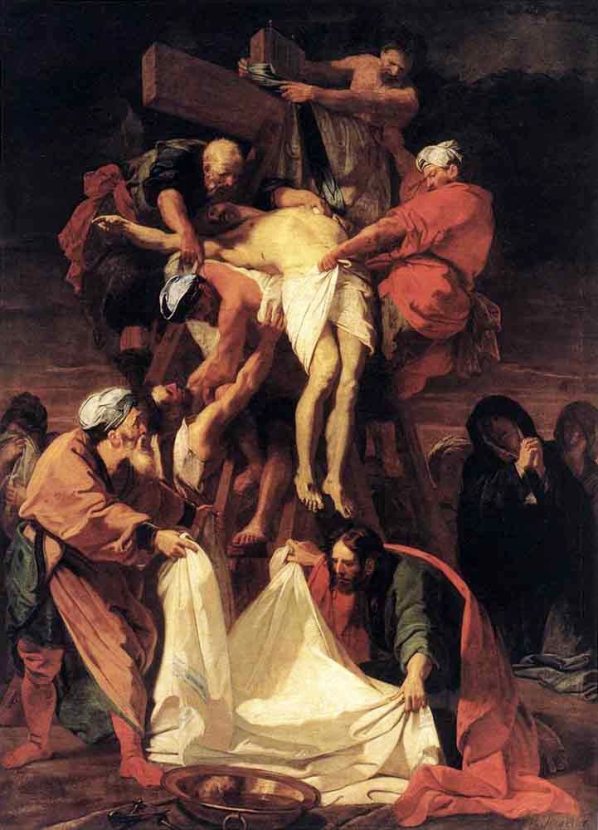
Jean_Jouvenet_Descent_From_The_Cross

Man’s sin debt had been paid, but the cost had been high. Jesus, the Son of God, had given His life so that others might experience eternal life. He died so that others might live. But, as the apostle Peter reminds us, “God paid a ransom to save you from the empty life you inherited from your ancestors. And the ransom he paid was not mere gold or silver. It was the precious blood of Christ, the sinless, spotless Lamb of God” (1 Peter 1:18-19 NLT). But as the Roman soldiers removed the lifeless body of Jesus from the cross, He was anything but spotless. He body had been beaten and bruised. His face had been slapped repeatedly leaving it bruised and practically unrecognizable. And hundreds of years earlier, the prophet Isaiah had described just how badly Jesus would be disfigured by this tragic event.

But many were amazed when they saw him. His face was so disfigured he seemed hardly human, and from his appearance, one would scarcely know he was a man. – Isaiah 52:14 NLT

He was covered in the blood that had flowed from the wounds left by the large nails pounded into his hands and feet. He had a gaping wound in His side from the point of the spear that had been meant to ensure His death. The crown of thorns that had been mockingly pressed onto His head had caused blood to flow down His face and into His eyes. The sinless, spotless Lamb of God had been slain.

In the Book of Revelation, John is given a glimpse of Jesus in His resurrected and glorifed state, standing in the throne room of God Almighty. And John’s description of Jesus is quite interesting.

…between the throne and the four living creatures and among the elders I saw a Lamb standing, as though it had been slain. – Revelation 5:6 ESV

He doesn’t see Jesus as a man, but as a Lamb. But he adds the telling descriptor: “as thought it had been slain.” The Greek word translated as “slain” is sphazō and it was used to refer to the slaughter of an animal for sacrifice. It can also be translated as “butchered.” Jesus had been the sacrificial Lamb, offered for the sins of many. And the ordeal had left its marks on Him.

It’s interesting to note that Matthew describes the followers of Christ who had remained to the bitter end, looking on from a distance. He only mentions women. None of the disciples are named. And among the women is “the mother of the sons of Zebedee” (Matthew 27:56 ESV). One has to wonder what had been going through her mind as she watched Jesus being crucified between the two thieves. She is the one who had come to Jesus and begged Him, “Say that these two sons of mine are to sit, one at your right hand and one at your left, in your kingdom” (Matthew 20:21 ESV). And Jesus had told her, “You do not know what you are asking” (Matthew 20:22 ESV). It’s likely that, as she watched Jesus die, she imagined her own two sons, James and John, hanging on the crosses to His right and left. Little had she shown that Jesus’ crowning as king was going to involve thorns, not gold. His entrance into His Kingdom was going to demand crucifixion, not a coronation. His exaltation would be proceeded by humiliation and death. And rather than taking up residence in a palace, Jesus would be placed in a borrowed tomb.

Joseph of Arimathea, a follower of Jesus, offered up his own tomb so that Jesus could have a proper burial. And once again, the prophet Isaiah spoke of this long before it ever happened.

But he was buried like a criminal; he was put in a rich man’s grave. – Isaiah 53:9 NLT

As Joseph had the stone rolled across the opening to his own tomb, the entire scene has a sense of finality to it. Jesus was dead. The crowds had dispersed. The supernatural darkness had passed and the light had returned. And everyone in Jerusalem had gone back to their lives as usual. Only a handful of women stood by, watching as Jesus was buried. This sad and sobering scene was also foretold by Isaiah.

He was despised and rejected—
    a man of sorrows, acquainted with deepest grief.
We turned our backs on him and looked the other way.
    He was despised, and we did not care. – Isaiah 53:3 NLT

But the religious leaders, still wary of the influence Jesus had over the people, took steps to ensure that nothing would happen that might resurrect the memory of Jesus. They knew that, while Jesus was alive, He had said that He would rise again. So, in order to prevent His disciples from stealing the body of Jesus and spreading rumors that He was alive, they stationed guards at the tomb with orders to remain there until the three days had passed. Evidently, they had attempted to get Pilate to provide Roman guards, but he refused. “So they went and made the tomb secure by sealing the stone and setting a guard” (Matthew 27:55 ESV).

And they waited.

This chapter ends in sadness. Its tragic conclusion provides the reader with little in the way of hope. Jesus is dead. The disciples have scattered to the four winds. The mother of Jesus and the women who loved and followed Him are in deep sorrow, having not been given the opportunity to anoint His body for burial. Which makes the anointing of Jesus in Bethany so important. Matthew records that “a woman came up to him with an alabaster flask of very expensive ointment, and she poured it on his head as he reclined at table” (Matthew 26:7 ESV), and Jesus had clearly pronounced, “In pouring this ointment on my body, she has done it to prepare me for burial” (Matthew 26:12 ESV).

As dark as this moment may appear, there is the invisible, yet sovereign hand of God evident in all that is going on. This is all taking place according to His divine plan – down to the last detail.

…he was pierced for our rebellion, crushed for our sins… – Isaiah 53:5 NLT

…He was beaten so we could be whole. – Isaiah 53:5 NLT

…He was whipped so we could be healed. – Isaiah 53:5 NLT

…He was oppressed and treated harshly. – Isaiah 53:7 NLT

…He was led like a lamb to the slaughter. – Isaiah 53:7 NLT

…Unjustly condemned, he was led away. – Isaiah 53:8 NLT

his life was cut short in midstream… – Isaiah 53:8 NLT

…he was struck down for the rebellion of my people. – Isaiah 53:8 NLT

he was buried like a criminal; he was put in a rich man’s grave. – Isaiah 53:9 NLT

All of this had been the pre-ordained will of God. And Jesus had willingly played His role in the whole affair – out of obedience to His heavenly Father and love for mankind. And while the closing verses of chapter 27 present a dismal scene, we know that the story is far from over. There is more to come. God’s plan is not yet complete. And Isaiah provides us with yet one more premonition of what lies ahead.

And because of his experience,
    my righteous servant will make it possible
for many to be counted righteous,
    for he will bear all their sins. – Isaiah 53:11 NLT

English Standard Version (ESV)
The Holy Bible, English Standard Version. ESV® Permanent Text Edition® (2016). Copyright © 2001 by Crossway Bibles, a publishing ministry of Good News Publishers.

New Living Translation (NLT)
Holy Bible, New Living Translation, copyright © 1996, 2004, 2015 by Tyndale House Foundation. Used by permission of Tyndale House Publishers Inc., Carol Stream, Illinois 60188. All rights reserved.

The Message (MSG)Copyright © 1993, 1994, 1995, 1996, 2000, 2001, 2002 by Eugene H. Peterson

Day 144 – Matthew 27:57-60; Mark 15:42-46; Luke 23:50-54; John 19:31-37

Down to the Last Detail.

Matthew 27:57-60; Mark 15:42-46; Luke 23:50-54; John 19:31-37

These things happened in fulfillment of the Scriptures that say, “Not one of this bones will be broken,” and “They will look on the one they have pierced.” – John 19:36-37 NLT

The death of Jesus was a well-orchestrated event, planned by God Himself and implemented with divine precision and detail. Nothing was overlooked or left to chance. At no point in the proceedings was God ever out of control or having to hastily respond to the plans of men. From the moment of His birth, Jesus’ entire life was predetermined by God. Even the timing of His death was part of God’s plan. And every single event that surrounded His death, while chaotic in appearance, was methodically thought out and controlled by God. And it had all been predicted by God through His prophets, hundreds of years earlier. Isaiah, referring to the Messiah, wrote “He had done no wrong and had never deceived anyone. But he was buried like a criminal; he was put in a rich man’s grave” (Isaiah 53:9 NLT). And we read in the Gospel accounts that Joseph of Arimethea, a rich man and member of the Jewish high council who had been secret follower of Jesus, went to Pilate and asked for permission to take the body of Jesus for burial. Matthew tells us that Joseph placed the body of Jesus in his own newly carved tomb. God the Father was not going to allow His Son’s body to be placed in a common burial plot for criminals. He would be buried in a rich man’s tomb. The prophet Zechariah had written hundreds of years earlier, “They will look on me on whom they have pierced and mourn for him as an only son. They will grieve bitterly for him as for a firstborn son who has died” (Zechariah 12:10 NLT). This was another Messianic prophecy, speaking of the one for whom the Israelites had long awaited. And we read in the book of John that the Roman guards, in an attempt to guarantee Jesus’ death, “pierced his side with a spear, and immediately blood and water flowed out” (John 19:34 NLT). And because the Jewish religious leaders wanted the bodies of Jesus and the two criminals who were crucified along with Him taken down before the Sabbath, the Roman guards broke their legs to hasten their deaths. But because Jesus was already dead, His legs were left intact. This was in direct fulfillment of the words of David found in Psalm 34: “He protects all his bones; not one of them is broken” (Psalm 34:20 NET).

John tells us that “these things happened in fulfillment of the Scriptures.” The death of Jesus had been predicted because it had been predetermined. It was all part of God’s divine plan for redeeming a lost and dying world. It was necessary in order for man’s guilt to be dealt with and God’s wrath to be satisfied. All of these things happened just as God had planned them to happen. And John tells us that what he wrote in his account was “from an eyewitness giving an accurate account. He speaks the truth so that you also can believe” (John 19:35 NLT). There was method to the madness. There was a purpose behind it all. As gruesome and hideous as the death of Jesus was, it was necessary. It was the only way for God to deal with sin and still be able to save the sinner. Isaiah reminds us that Jesus “was pierced for our rebellion, crushed for our sins. He was beaten so we could be whole. He was whipped so we could be healed. All of us, like sheep, have strayed away. We have left God’s paths to follow our own. Yet the Lord laid on him the sins of us all” (Isaiah 53:5-6 NLT). What Jesus suffered, God ordained. All so that we could be saved.

Father, what an incredible, amazing plan. I can’t even begin to understand it all. But the detail and the precision of it all is mind-blowing. This was not just some random act of violence or injustice. This was Your divine plan for man’s redemption being acted out in human history. Down to the last detail. Thank You! Amen.

Ken Miller
Grow Pastor & Minister to Men
kenm@christchapelbc.org

Day 141 – Matthew 27:35-44; Mark 15:24-32; Luke 23:33-43; John 19:18-27

It Was Love.

Matthew 27:35-44; Mark 15:24-32; Luke 23:33-43; John 19:18-27

A Sign was fastened above Jesus’ head announcing the charge against him. It read: “This is Jesus, the King of the Jews.” – Matthew 27:37 NLT

Jesus was guilty. Yes, He was guilty of being the King of the Jews., and it was for that reason He was crucified. Over and over again in the Gospel accounts, that term is used to describe Jesus. It was the main point of questioning by Pilate. It was the one point of accusation to which He would respond when questioned. It was how Pilate presented Him to the people. It was why He was mocked by the Roman guards and what caused them to place a purple robe on His shoulders and a crown of thorns on His head. Pilate even went as far as to have it written on the piece of wood that was nailed to the cross above Jesus’ head, signifying His “crime.” Interestingly enough, the Jewish religious leaders tried to get Pilate to change the wording, asking him to have it changed to “He said, I am the King of the Jews.” But Pilate refused. As Jesus was being crucified, the leading priests and teachers of religious law stood at the foot of the cross, mocking Him. “He saved others,” they scoffed, “but he can’t save himself!” (Mark 15:31 NLT). They shouted, “Let this Messiah, this King of Israel, come down from the cross so we can see it and believe him!” (Mark 15:32 NLT).  Even one of the criminals who was being crucified next to Him scoffed, saying, “So you’re the Messiah, are you? Prove it by saving yourself – and us, too, while you’re at it!” (Luke 23:39 NLT).

And here’s the amazing thing: Jesus could have saved Himself. He could have come down off the cross and put an end to His own suffering. He could have dealt with His enemies in righteous indignation, giving them exactly what they deserved – the full wrath of a holy God. But instead, Jesus responded, “Father, forgive them, for they don’t know what they are doing” (Luke 23:34 NLT). And He continued to allow Himself to be ridiculed and mocked. He continued to allow His life to ebb away, so that the very ones who were hurling abuse at Him might one day believe in Him and find forgiveness for their sins and a restored relationship with the Father. Yes, Jesus had the full capacity and power to come down off that cross, because He really was the King of the Jews and He really was the Son of God. He was divine, and yet He suffered and died. Why? What would possess Jesus to go through what He did? Why would He allow His own creation to mock and murder Him? I think the answer is found in the words of a song that I haven’t heard in quite some time. It expresses the reality of what held Jesus to that cross that day, and caused Him to give His life for you and for me. Read them slowly and think about them. Consider the significance of what they say. And then express your gratitude to Jesus for what He has done.

He could’ve called ten thousand angels
To deliver Him that day.
But He hung there in all His anguish
To prepare for me a way.

It wasn’t nails that held Him to the tree
Nor the angry crowd that cried crucify
For when Jesus died upon Calvary
It was love that held Him there.

Oh what love beyond all measure
That He gave His life for me
And I’m so glad that one day in glory
His Blessed Face I’ll see.

It wasn’t nails that held Him to the tree
Nor the angry crowd that cried crucify
For when Jesus died upon Calvary
It was love that held Him there.

Every day I’ll tell the story
Of His precious love for me
How He bled and died on Calvary
There to prove His love for me.

Jesus, You literally could have called ten thousand angels. You could have stopped the whole affair and decided that enough was enough. You could have turned Your full divine power against those who were crucifying You, and You would have been completely justified in Your actions. But instead, You remained faithful to Your Father’s plan, and You willingly sacrificed Your life for ours. It wasn’t nails that held you there. It wasn’t Roman guards who kept you on the cross. It wasn’t man-made laws or trumped-up charges that caused Your death. It was love. You died because You loved us. You died because Your Father loved us. It was love that held You there and I am forever grateful. Amen.

Ken Miller
Grow Pastor & Minister to Men
kenm@christchapelbc.org

Day 140 – Matthew 27:31-34; Mark 15:20-23; Luke 23:26-33; John 19:16-17

Don’t Weep For Me.

Matthew 27:31-34; Mark 15:20-23; Luke 23:26-33; John 19:16-17

A large crowd followed behind, including many grief-stricken women. But Jesus turned and said to them, “Daughters of Jerusalem, don’t weep for me, but weep for yourselves and for your children. For the days are coming…” – Luke 23:27-29 NLT

Luke is the only one of the gospel writers who includes this exchange between Jesus and the women who were following along as He bore His cross to the place of execution. As they walked along, they wept. They were shocked by the sequence of events that had unfolded over the last 24 hours. Here was their Messiah, beaten and bloody, the skin on His back flayed away down to the bones, being forced to carry a Roman cross on which He would be crucified. Their minds were filled with confusion. Their hearts were filled with sorrow. But Jesus, in the midst of all His pain and suffering, turns to them and tells them not to weep on His behalf. He warns them that their sorrow must be for all those who, in the future, end up rejecting Him. Because a day is coming when they will be judged for their refusal of the Messiah. Their rejection of their Savior will come back to haunt them. Jesus’ statement is very similar to His warning recorded by Matthew in his gospel account. At that time, Jesus had told His listeners that “the Good News about the Kingdom will be preached throughout the whole world, so that all nations will hear it; and then the end will come.” (Matthew 24:14 NLT). He went on to warn them, “The day is coming when you will see what Daniel the prophet spoke about—the sacrilegious object that causes desecration standing in the Holy Place.” (Reader, pay attention!) Then those in Judea must flee to the hills. A person out on the deck of a roof must not go down into the house to pack. A person out in the field must not return even to get a coat. How terrible it will be for pregnant women and for nursing mothers in those days. And pray that your flight will not be in winter or on the Sabbath. For there will be greater anguish than at any time since the world began. And it will never be so great again” (Matthew 24:15-21 NLT). Jesus had been talking about the great period of tribulation that is to come at the end of time. This literal seven-year period will take place immediately after the rapture of the Church. It is a time in which the Antichrist rises to power and in which he persecutes the Jewish people as they have never been persecuted before.

I believe Jesus is referring to this very period of time when He warns the women not to weep for Him, but to weep for themselves and their children. He tells them that days are coming when it will be best not to have children. In fact, it will be best to have never had a child. That’s how bad things are going to be. Jesus tells them, “For if these things are done when the tree is green, what will happen when it is dry?” (Luke 23:31 NLT). He seems to be referring to what will be Israel’s continuing spiritual withering and death. Jesus, the Son of God, was being put to death at a time when Israel was supposed to be worshiping God and keeping His commandments. They were still morally young and spiritually somewhat alive. But the day is coming when they will be withered and dry like the tree Jesus cursed along the side of the road because it lacked fruit. The fruitlessness and spiritual apathy of the people of Israel will one day reach a point where they will be punished by God. The great tribulation will be a difficult time for the people of Israel. But even in those days, God will not abandon them. Thousands will come to faith in Christ. God will miraculously defend them from their enemies and deliver them from the assaults of the Antichrist. And He will send His son once again, as a conquering King, who will set up His kingdom on earth in the city of Jerusalem.

As the women weeped for Jesus, they say this as the end. But Jesus wanted them to know that there was much more to come. In just a few short years, the city of Jerusalem and the Temple would both be destroyed by the Romans. Their whole sacrificial system would be done away with. But there would be even more to come. Jesus’ death was far from the end of the story. In a way, it was just the beginning. If tears were to be shed, they needed to be shed for all those who refuse to accept Jesus as their Savior. Judgment is inevitable. Rejection of the Messiah has serious consequences. What the Romans and the Jewish religious leaders were doing to Jesus was horrific and worthy of God’s judgment, but all those who reject the gift of His Son will also be worthy of His wrath and condemnation. It is for them that we should weep. It is to them we need to take the story of God’s great plan of redemption and reconciliation, made available through the sacrificial death of His Son.

Father, as horrible as the story of Your Son’s death is, how much more horrific is the reality that millions of people stand ready to fall under Your righteous judgment because they reject the reality of His death as payment for their sins. They snub Your gift and refuse to accept Your grace. Jesus died, but He rose again. He is alive and well, sitting at Your side and will one day return. But all those who have lived since He died and who have rejected Him will one day be judged by Him. And all those who refuse to accept His death as payment for their sins, will one day have to pay for their sins with their own lives. Give me an increasing burden and heart for those who have yet to hear and those who continue to refuse to listen. Show me how to weep for them as Your Son did for Jerusalem. Amen.

Ken Miller
Grow Pastor & Minister to Men
kenm@christchapelbc.org