Against All Odds

15 The Lord said to Moses, “Why do you cry to me? Tell the people of Israel to go forward. 16 Lift up your staff, and stretch out your hand over the sea and divide it, that the people of Israel may go through the sea on dry ground. 17 And I will harden the hearts of the Egyptians so that they shall go in after them, and I will get glory over Pharaoh and all his host, his chariots, and his horsemen. 18 And the Egyptians shall know that I am the Lord, when I have gotten glory over Pharaoh, his chariots, and his horsemen.”

19 Then the angel of God who was going before the host of Israel moved and went behind them, and the pillar of cloud moved from before them and stood behind them, 20 coming between the host of Egypt and the host of Israel. And there was the cloud and the darkness. And it lit up the night without one coming near the other all night.

21 Then Moses stretched out his hand over the sea, and the Lord drove the sea back by a strong east wind all night and made the sea dry land, and the waters were divided. 22 And the people of Israel went into the midst of the sea on dry ground, the waters being a wall to them on their right hand and on their left. 23 The Egyptians pursued and went in after them into the midst of the sea, all Pharaoh’s horses, his chariots, and his horsemen. 24 And in the morning watch the Lord in the pillar of fire and of cloud looked down on the Egyptian forces and threw the Egyptian forces into a panic, 25 clogging their chariot wheels so that they drove heavily. And the Egyptians said, “Let us flee from before Israel, for the Lord fights for them against the Egyptians.”

26 Then the Lord said to Moses, “Stretch out your hand over the sea, that the water may come back upon the Egyptians, upon their chariots, and upon their horsemen.” 27 So Moses stretched out his hand over the sea, and the sea returned to its normal course when the morning appeared. And as the Egyptians fled into it, the Lord threw the Egyptians into the midst of the sea. 28 The waters returned and covered the chariots and the horsemen; of all the host of Pharaoh that had followed them into the sea, not one of them remained. 29 But the people of Israel walked on dry ground through the sea, the waters being a wall to them on their right hand and on their left.

30 Thus the Lord saved Israel that day from the hand of the Egyptians, and Israel saw the Egyptians dead on the seashore. 31 Israel saw the great power that the Lord used against the Egyptians, so the people feared the Lord, and they believed in the Lord and in his servant Moses. – Exodus 14:15-31 ESV

The victory parade that Moses led out of Egypt had quickly turned into a nasty mob scene when the Israelites realized that Pharaoh and his army were bearing down on them. All hope of leaving Egypt had faded as soon as they caught sight of 600 chariots headed their way. Now all they could think about was certain death at the hands of their former captors.

“…it would have been better for us to serve the Egyptians than to die in the wilderness. – Exodus 14:12 ESV

The people were in full-blown panic, and Moses put up an impressive show of confidence in the face of a very difficult situation. He encouraged the people to “Fear not, stand firm, and see the salvation of the Lord” (Exodus 14:13 ESV). But he must have had reservations about exactly how God was going to get them out of this precarious situation. While the people screamed their questions at Moses, he must have issued a quick call for help to the Lord, because Yahweh responded to Moses with a question of His own.

“Why do you cry to me? – Exodus 14:15 ESV

This inquiry was directed at Moses and was accompanied by a set of instructions that the beleaguered spokesman was to carry out. Rather than stand around waiting for God to do something, Moses was to get busy and do his part in bringing about the very salvation he had assured the Israelites was coming.

Tell the people to get moving! Pick up your staff and raise your hand over the sea. Divide the water so the Israelites can walk through the middle of the sea on dry ground. – Exodus 14:15-16 ESV

These instructions must have hit Moses like a brick to the forehead. While he and Aaron had been a part of some spectacular signs in Egypt, this was taking things to another level. God was demanding that Moses use his staff to divide the Red Sea so that the people could pass through it on dry ground. And all the while, the people continued to voice their disapproval of his leadership.

But before Moses could play his part in God’s divine drama of deliverance, the Egyptians had to be stopped. So, God had His guiding angel move to the rear of the Israelite camp, closest to the Egyptian forces. Then the pillar of cloud, the symbol of God’s presence, repositioned itself between the Israelites and their enemy.

Then the angel of God, who had been leading the people of Israel, moved to the rear of the camp. The pillar of cloud also moved from the front and stood behind them. The cloud settled between the Egyptian and Israelite camps. As darkness fell, the cloud turned to fire, lighting up the night. But the Egyptians and Israelites did not approach each other all night.  Exodus 14:19-20 NLT

At the sight of this cosmic apparition, the Egyptians were stopped in their tracks. They could see the Israelite camp but were afraid to advance against them. Their most recent encounters with the power of the Israelites’ God had left them reluctant to take any chances. So, as dusk turned to dark, the pillar of cloud transformed into a pillar of fire that lit up the night sky.

And as God held off the Egyptians, Moses “raised his hand over the sea, and the Lord opened up a path through the water with a strong east wind” (Exodus 14:21 NLT). Yahweh, the God of creation, sent a powerful wind that caused the waters of the sea to stand up like transparent walls, exposing the sea bed underneath. And this wind blew throughout the night, simultaneously holding back the walls of water and drying out the sea bed so that it would provide firm footing for the Israelites. Then at just the right moment, God ordered Moses to lead the people across.

So the people of Israel walked through the middle of the sea on dry ground, with walls of water on each side! – Exodus 14:22 NLT

Stunned by what they witnessed, but motivated by a strong desire to distance themselves from the Egyptians, the Israelites formed into ranks and began their journey across the perfectly dry sea floor. And while they made their way through this divine detour, the angel of God and the pillar of fire kept the Egyptians at bay. Pharoah and his soldiers could only stand back and watch in stupefied wonder as the Israelites escaped across this massive causeway that had suddenly appeared in the middle of the sea.

But when the last Israelite’s sandal had cleared the path and was standing firm on the eastern bank of the sea, the barrier provided by the angel and the pillar of fire was removed. And within minutes, Pharaoh ordered his troops to pursue the fleeing Israelites. But God was not yet done.

…just before dawn the Lord looked down on the Egyptian army from the pillar of fire and cloud, and he threw their forces into total confusion. – Exodus 14:24 NLT

As Pharoah’s troops entered the pathway the Israelites had just vacated, the Lord of Hosts got in on the action. Somehow, these seasoned charioteers became confused and unable to make their way to the other shore. Perhaps their horses became frightened by the sound of the wind and the sight of the walls of water standing up on either side of them. It seems that the dry sea bed was suddenly transformed into a muddy morass in which the chariot wheels became stuck. Before long the entire Egyptian force found itself logjammed between the walls of water. Sensing the hand of Yahweh, they cried out, “Let us flee from before Israel, for the Lord fights for them against the Egyptians” (Exodus 14:25 ESV).

But they never made it out. As the sun began to rise in the eastern sky, “Moses raised his hand over the sea, and the water rushed back into its usual place” (Exodus 14:27 NLT). Within minutes, every single Egyptian who had entered the pathway had been drowned by the sudden deluge as the walls of water collapsed.

And the Israelites, standing high and dry on the eastern shore, watched the whole thing take place right before their eyes. Not a single chariot made it across and the only Egyptians the Israelites saw on the eastern shore were lifeless and powerless to do them any harm. And Moses chronicles the impact this spectacular event had on the people of God.

When the people of Israel saw the mighty power that the Lord had unleashed against the Egyptians, they were filled with awe before him. They put their faith in the Lord and in his servant Moses. – Exodus 14:31 NLT

When the odds were stacked against them and all seemed lost, the Israelites were delivered by their all-powerful, promise-keeping God. He had stepped into their reality and provided a one-of-a-kind miracle. And as the water of the Red Sea slowly settled back into its normal state, it was as if God had closed a door behind His people. There would be no turning back. That pathway was closed forever and the only way left for them to go was forward. With the enemy defeated, the angel of the Lord and the pillar of cloud took their places at the head of the column once again, and the people set out for their final destination: the land of promise.

English Standard Version (ESV) The Holy Bible, English Standard Version. ESV® Permanent Text Edition® (2016). Copyright © 2001

New Living Translation (NLT) Holy Bible, New Living Translation, copyright © 1996, 2004, 2015 by Tyndale House Foundation. Used by permission of Tyndale House Publishers Inc., Carol Stream, Illinois 60188. All rights reserved.

The Lord Will Fight For You

When the king of Egypt was told that the people had fled, the mind of Pharaoh and his servants was changed toward the people, and they said, “What is this we have done, that we have let Israel go from serving us?” So he made ready his chariot and took his army with him, and took six hundred chosen chariots and all the other chariots of Egypt with officers over all of them. And the Lord hardened the heart of Pharaoh king of Egypt, and he pursued the people of Israel while the people of Israel were going out defiantly. The Egyptians pursued them, all Pharaoh’s horses and chariots and his horsemen and his army, and overtook them encamped at the sea, by Pi-hahiroth, in front of Baal-zephon.

10 When Pharaoh drew near, the people of Israel lifted up their eyes, and behold, the Egyptians were marching after them, and they feared greatly. And the people of Israel cried out to the Lord. 11 They said to Moses, “Is it because there are no graves in Egypt that you have taken us away to die in the wilderness? What have you done to us in bringing us out of Egypt? 12 Is not this what we said to you in Egypt: ‘Leave us alone that we may serve the Egyptians’? For it would have been better for us to serve the Egyptians than to die in the wilderness.” 13 And Moses said to the people, “Fear not, stand firm, and see the salvation of the Lord, which he will work for you today. For the Egyptians whom you see today, you shall never see again. 14 The Lord will fight for you, and you have only to be silent.” – Exodus 14:5-14 ESV

At some point, it dawned on Pharaoh that the Israelites had no intentions of returning from their 3-day trek into the wilderness. Verse 5 states that “word reached the king of Egypt that the Israelites had fled.” The Hebrew word translated as “fled” is בָּרַח (bāraḥ), which carries the idea of running away. It seems likely that Pharoah had sent spies to keep an eye on the Israelites and to ensure that they kept their end of the bargain and returned after worshiping their God in the wilderness. Instead, Pharaoh was informed that the Israelites were attempting to make a break for it but had become lost and confused in the process.

Upon receiving the news of the somewhat circuitous route the Israelites had taken, Pharaoh concluded that they had become lost. He immediately regretted his previous decision to allow them to leave and was determined to do everything in his power to get them back.

So Pharaoh harnessed his chariot and called up his troops. He took with him 600 of Egypt’s best chariots, along with the rest of the chariots of Egypt, each with its commander. – Exodus 14:6-7 NLT

Twice, Moses emphasizes that God hardened Pharaoh’s heart. Once again, this is meant to emphasize God’s sovereignty over all that was taking place. But it does not absolve Pharaoh of guilt in the matter. He was not being forced to do what he did. This arrogant king was being motivated by the wickedness of his own heart but all according to the divine plan of God.

The very fact that God had ordered Moses to have the Israelites begin their journey out of Egypt headed in one direction and then had them reverse their course, is a clear indication that God had something else He had planned to do. He was not yet done humiliating Pharaoh and was about to enact one more irrefutable demonstration of His superior power and authority.

God had told Moses in advance exactly what He was going to do and why.

“…once again I will harden Pharaoh’s heart, and he will chase after you. I have planned this in order to display my glory through Pharaoh and his whole army. After this the Egyptians will know that I am the Lord!” – Exodus 14:4 NLT

The Lord of Hosts(Jehovah Sabaoth) was about to do battle with the elite troops of Egypt. One of the most powerful and feared armies in the world was going to find itself going up against God Almighty.

As the Israelites sat in their makeshift camp along the shore of the Red Sea, waiting for directions from Moses, they were unaware that Pharaoh and his troops were headed their way. And Pharaoh was motivated by what he believed to be was a blatant display of arrogance on the part of the Israelites.

he chased after the people of Israel, who had left with fists raised in defiance. – Exodus 14:8 NLT

He had been given time to reconsider his earlier decision and came to the conclusion that the Israelites needed a healthy serving of humble pie. So, mounted in his royal chariot, Pharaoh led his crack troops in hasty pursuit of a fleeing mob of confused and defenseless Israelites. But the Israelites weren’t running; they were sitting quietly by the shores of the Red Sea awaiting instructions from Moses. The pillar of cloud, a manifestation of God’s presence, still hovered nearby, and they had been instructed not to break camp until the cloud began to move. By all indications, they were right where God wanted them to be.

But, in time, the Israelites heard the sound of the approaching army and could see the large sandstorm stirred up by the horses’ hooves and the chariot wheels. And as the Israelites watched in horror, the 600 chariots of the Egyptian army came into view, barrelling toward them with unbridled abandon. And the hearts of the Israelites sank in despair.

Almost as if in unison, the people cried out to God for help. Others directed their fear and anger at Moses, shouting, “Why did you bring us out here to die in the wilderness? Weren’t there enough graves for us in Egypt? What have you done to us? Why did you make us leave Egypt?” (Exodus 14:11 NLT). These questions, among others, poured out in a torrent of rage and abject terror as the people considered their doomed fate. They began to hurl accusations against Moses and Aaron, questioning their leadership an demeaning the failed nature of their strategy. From their perspective, Moses and Aaron had blown it. Their promise of deliverance had turned into a guarantee of certain destruction. And the Israelites began to regret having ever left Egypt in the first place.

It’s better to be a slave in Egypt than a corpse in the wilderness! – Exodus 14:12 NLT

As far as they could tell, listening to Moses and Aaron had been a huge mistake. And as they vented their frustration, fears, and anger at these two elderly men, the Israelites failed to notice that the pillar of cloud had never stirred or left their sight. It remained right where it had been all along, signifying that God was still with them.

But Moses must have seen the cloud and gained renewed confidence. He withstood the verbal onslaught and responded with a powerful call to faith.

“Fear not, stand firm, and see the salvation of the Lord, which he will work for you today. For the Egyptians whom you see today, you shall never see again. The Lord will fight for you, and you have only to be silent.” – Exodus 14:13-14 ESV

While the eyes of the Israelites were fixated on the 600 chariots headed their way, Moses must have fixed his sight on the pillar of cloud, remembering the words of the Lord.

I have planned this in order to display my glory through Pharaoh and his whole army. – Exodus 14:4 NLT

Moses gave the people three simple instructions.

Fear not – he encouraged them to cease fearing because he knew that uncontrolled fear can turn to flight. If they ran, they were as good as dead. They could not outrun chariots.

Stand firm – rather then run, they were to stand their ground because God had them right where He wanted them. He had led them to this very spot, and it would be on this ground that they would see the deliverance of God.

See the salvation of the Lord – whether they realized it or not, they had ringside seats to what would be the greatest show on earth. Moses was inviting them to stand back and watch their God perform a miracle of epic proportions. When they thought all was lost and their lives were in the balance, God was ready to provide them with salvation.

The army bearing down on them looked formidable. The fate awaiting them appeared to be unavoidable. Though they greatly out numbered the Egyptians, they were no match for chariots, swords, and spears. Yet, God wanted them to trust Him. The army they feared would soon be gone. The deadly outcome they expected would not be forthcoming. All because Jehovah Sabaoth was on their side and He was about to display His omnipotence on their behalf.

English Standard Version (ESV) The Holy Bible, English Standard Version. ESV® Permanent Text Edition® (2016). Copyright © 2001

New Living Translation (NLT) Holy Bible, New Living Translation, copyright © 1996, 2004, 2015 by Tyndale House Foundation. Used by permission of Tyndale House Publishers Inc., Carol Stream, Illinois 60188. All rights reserved.
A Man of Divided Allegiance

10 At the end of twenty years, in which Solomon had built the two houses, the house of the Lord and the king’s house, 11 and Hiram king of Tyre had supplied Solomon with cedar and cypress timber and gold, as much as he desired, King Solomon gave to Hiram twenty cities in the land of Galilee. 12 But when Hiram came from Tyre to see the cities that Solomon had given him, they did not please him. 13 Therefore he said, “What kind of cities are these that you have given me, my brother?” So they are called the land of Cabul to this day. 14 Hiram had sent to the king 120 talents of gold.

15 And this is the account of the forced labor that King Solomon drafted to build the house of the Lord and his own house and the Millo and the wall of Jerusalem and Hazor and Megiddo and Gezer 16 (Pharaoh king of Egypt had gone up and captured Gezer and burned it with fire, and had killed the Canaanites who lived in the city, and had given it as dowry to his daughter, Solomon’s wife; 17 so Solomon rebuilt Gezer) and Lower Beth-horon 18 and Baalath and Tamar in the wilderness, in the land of Judah, 19 and all the store cities that Solomon had, and the cities for his chariots, and the cities for his horsemen, and whatever Solomon desired to build in Jerusalem, in Lebanon, and in all the land of his dominion. 20 All the people who were left of the Amorites, the Hittites, the Perizzites, the Hivites, and the Jebusites, who were not of the people of Israel— 21 their descendants who were left after them in the land, whom the people of Israel were unable to devote to destruction—these Solomon drafted to be slaves, and so they are to this day. 22 But of the people of Israel Solomon made no slaves. They were the soldiers, they were his officials, his commanders, his captains, his chariot commanders and his horsemen.

23 These were the chief officers who were over Solomon’s work: 550 who had charge of the people who carried on the work.

24 But Pharaoh’s daughter went up from the city of David to her own house that Solomon had built for her. Then he built the Millo.

25 Three times a year Solomon used to offer up burnt offerings and peace offerings on the altar that he built to the Lord, making offerings with it before the Lord. So he finished the house.

26 King Solomon built a fleet of ships at Ezion-geber, which is near Eloth on the shore of the Red Sea, in the land of Edom. 27 And Hiram sent with the fleet his servants, seamen who were familiar with the sea, together with the servants of Solomon. 28 And they went to Ophir and brought from there gold, 420 talents, and they brought it to King Solomon. 1 Kings 9:10-28 ESV

Solomon doesn’t realize it, but he is at the midway point of his 40-year reign. He has just completed the construction of the temple, his royal palaces, and all the buildings that will house his administrative offices.

With these projects behind him, Solomon turns his attention to other pressing matters. First, he makes an attempt to compensate King Hiram of Phoenicia for all the material and financial aid he had provided over the years. Early on in his reign, Solomon had made an agreement with Hiram that provided Solomon with all the lumber he needed for his many construction projects, while Hiram received much-needed grain and olive oil in return.

So Hiram supplied as much cedar and cypress timber as Solomon desired. In return, Solomon sent him an annual payment of 100,000 bushels of wheat for his household and 110,000 gallons of pure olive oil. – 1 Kings 5:10-11 NLT

This agreement had lasted for 20 years, and during that time, Solomon had compensated King Hiram for all the lumber and he had paid wages to all the Phoenician wood-workers who had helped with the various construction projects (1 Kings 5:6). But now that all the work was done, Solomon wanted to make a gesture of goodwill to his friend in Phoenicia. So, he gave Hiram 20 cities located in the land of Galilee along the border between Israel and Phoenicia. This appears to be a gracious act of generosity on Solomon’s part, but it quickly becomes apparent that his gift was a bit disingenuous. When Hiram personally inspected the cities Solomon had given him, his response reveals his deep disappointment.

“What kind of towns are these, my brother?” he asked. So Hiram called that area Cabul (which means “worthless”), as it is still known today. – 1 Kings 9:13 NLT

Evidently, these towns were located in a region of Galilee that was not conducive to agricultural production. Since Phoenicia occupied a narrow strip of land along the Mediterranean Sea, they were woefully deficient in arable farmland. That’s why Solomon’s compensation for the lumber had taken the form of grain and olive oil. At first glance, it would appear that Solomon had given them what they had always needed: Land on which to grow crops. But Hiram described Solomon’s gift as “Cabul,” a word that means “bound” or “sterile.” And while these 20 towns expanded the range of Hiram’s kingdom, they were essentially worthless. They provided no practical value. And what makes Solomon’s gift that much more egregious is that, over the years, Hiram had given Solomon 120 talents of gold. To put that in perspective, that’s nearly 5 tons of gold.

One could almost draw the conclusion that Solomon was somewhat of a Scrooge, a financial tightwad who was more than willing to spend money on himself, but was a bit stingy when it came to others. And it’s interesting to note that Solomon had given away land that had been part of the inheritance given by God to the people of Israel.

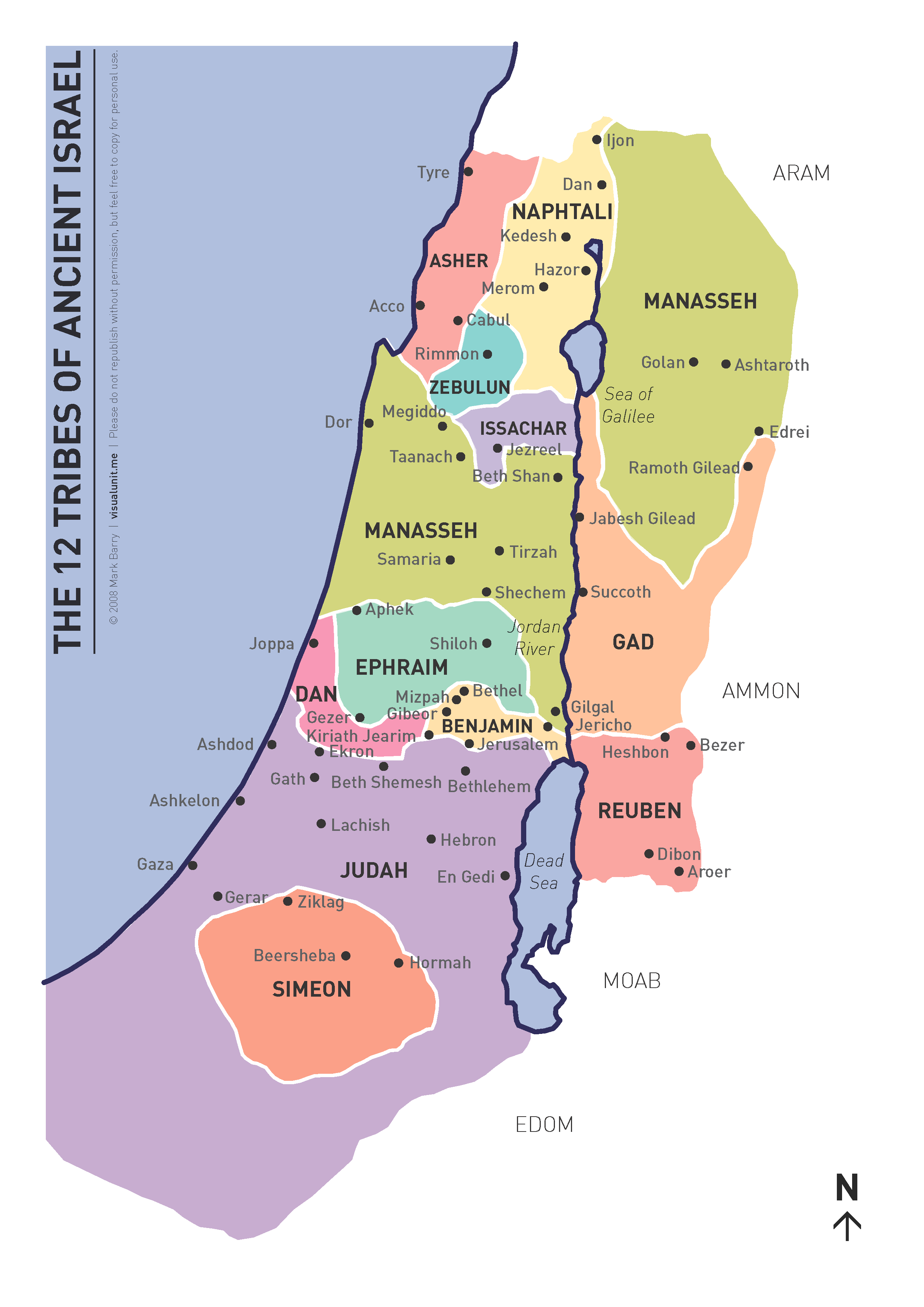
It’s most likely that the 20 towns were located in territory that had belonged to the tribes of Asher, Naphtali, and Zebulun. In awarding these cities to Hiram, Solomon was guilty of giving away land that belonged to the people of God. His willingness to give it away, coupled with Hiram’s poor assessment of it, reveals that it held no real value to Solomon.

One of the things that can be learned from studying the history of the Israelites is that every decision they made had long-term ramifications. The book of Judges reveals that, at one point, the tribes of Asher, Napthali, and Zebulun had been given the opportunity to conquer and occupy the land allotted to them by God, but they had failed.

The tribe of Zebulun failed to drive out the residents of Kitron and Nahalol, so the Canaanites continued to live among them. But the Canaanites were forced to work as slaves for the people of Zebulun.

The tribe of Asher failed to drive out the residents of Acco, Sidon, Ahlab, Aczib, Helbah, Aphik, and Rehob. Instead, the people of Asher moved in among the Canaanites, who controlled the land, for they failed to drive them out.

Likewise, the tribe of Naphtali failed to drive out the residents of Beth-shemesh and Beth-anath. Instead, they moved in among the Canaanites, who controlled the land. Nevertheless, the people of Beth-shemesh and Beth-anath were forced to work as slaves for the people of Naphtali. – Judges 1:30-33 NLT

One of the reasons the Phoenicians even existed was because of the failure of these three tribes to do what God had commanded them to do. As a result of their failure to drive out the inhabitants of the land, the Phoenicians occupied territory that was supposed to belong to the people of God. Now, Solomon had just awarded the Phoenicians with even more of Israel’s God-given inheritance.

Solomon’s main focus was the city of Jerusalem. Having willingly forfeited the cities located in the north, Solomon poured his time and energy into expanding his royal capital. To do so, Solomon enslaved thousands of non-Jews to work as laborers on his various rebuilding and enlargement projects. He conscripted Amorites, Hittites, Perizzites, Hivites, and Jebusites who were living in the land of Israel to provide slave labor for his ambitious expansion program. These people were used to extend the walls of Jerusalem, connecting the old City of David with the newer area surrounding the temple complex and the royal palaces and administrative headquarters. They “built towns as supply centers and constructed towns where his chariots and horses could be stationed” (1 Kings 9:19 NLT). Solomon was constructing a virtual theme park dedicated to his greatness; replete with palaces, terraces, stables for his many horses, and barracks for his growing army. 

And it’s important to remember that God had warned that His kings were not to refrain from certain actions.

The king must not build up a large stable of horses for himself… – Deuteronomy 17:16 NLT

The king must not take many wives for himself… – Deuteronomy 17:17 NLT

And he must not accumulate large amounts of wealth in silver and gold for himself… – Deuteronomy 17:17 NLT

Solomon was in violation of each of these commands. And while at this point, it appears that the daughter of Pharaoh was his only wife, it wouldn’t be long before he expanded his household greatly.

Now King Solomon loved many foreign women. Besides Pharaoh’s daughter, he married women from Moab, Ammon, Edom, Sidon, and from among the Hittites. The LORD had clearly instructed the people of Israel, “You must not marry them, because they will turn your hearts to their gods.” Yet Solomon insisted on loving them anyway. He had 700 wives of royal birth and 300 concubines. And in fact, they did turn his heart away from the LORD. – 1 Kings 11:1-3 NLT

Whether it was wives and concubines or horses and chariots, Solomon always seemed to be in building mode. Enough was never enough. He even built a fleet of boats and began an aggressive trading venture that netted him 16 tons of gold. For Solomon, bigger was always better. And yet, late in his life, Solomon would make a sad but telling admission.

I increased my possessions:
I built houses for myself;
I planted vineyards for myself.
I designed royal gardens and parks for myself,
and I planted all kinds of fruit trees in them.
I constructed pools of water for myself,
to irrigate my grove of flourishing trees.
I purchased male and female slaves,
and I owned slaves who were born in my house;
I also possessed more livestock—both herds and flocks—
than any of my predecessors in Jerusalem.
I also amassed silver and gold for myself,
as well as valuable treasures taken from kingdoms and provinces.
I acquired male singers and female singers for myself,
and what gives a man sensual delight—a harem of beautiful concubines.
So I was far wealthier than all my predecessors in Jerusalem,
yet I maintained my objectivity.
I did not restrain myself from getting whatever I wanted;
I did not deny myself anything that would bring me pleasure.
So all my accomplishments gave me joy;
this was my reward for all my effort.
Yet when I reflected on everything I had accomplished
and on all the effort that I had expended to accomplish it,
I concluded: “All these achievements and possessions are ultimately profitless—
like chasing the wind!
There is nothing gained from them on earth.” – Ecclesiastes 1:4-11 NLT

They say, “hindsight is 20-20,” and that would prove to be true in Solomon’s life. He would one day discover that his obsession with constant expansion, endless pleasure, and rampant materialism would never satisfy. But at the midway point of his reign, he didn’t know any better. So, he continued to try and balance his love for the things of this world with his love for God.  He kept accumulating material goods, while at the same time, offering sacrifices to God. Without even realizing it, he was worshiping two gods. Solomon was living out the very thing Jesus would later warn His disciples about.

“No one can serve two masters. For you will hate one and love the other; you will be devoted to one and despise the other. You cannot serve God and be enslaved to money.” – Matthew 6:24 NLT

English Standard Version (ESV) The Holy Bible, English Standard Version. ESV® Permanent Text Edition® (2016). Copyright © 2001 by Crossway Bibles, a publishing ministry of Good News Publishers.

New Living Translation (NLT) Holy Bible, New Living Translation, copyright © 1996, 2004, 2015 by Tyndale House Foundation. Used by permission of Tyndale House Publishers Inc., Carol Stream, Illinois 60188. All rights reserved.

The Message (MSG)Copyright © 1993, 1994, 1995, 1996, 2000, 2001, 2002 by Eugene H. Peterson

A Hidden Danger

20 Judah and Israel were as many as the sand by the sea. They ate and drank and were happy. 21 Solomon ruled over all the kingdoms from the Euphrates to the land of the Philistines and to the border of Egypt. They brought tribute and served Solomon all the days of his life.

22 Solomon’s provision for one day was thirty cors of fine flour and sixty cors of meal, 23 ten fat oxen, and twenty pasture-fed cattle, a hundred sheep, besides deer, gazelles, roebucks, and fattened fowl. 24 For he had dominion over all the region west of the Euphrates from Tiphsah to Gaza, over all the kings west of the Euphrates. And he had peace on all sides around him. 25 And Judah and Israel lived in safety, from Dan even to Beersheba, every man under his vine and under his fig tree, all the days of Solomon. 26 Solomon also had 40,000 stalls of horses for his chariots, and 12,000 horsemen. 27 And those officers supplied provisions for King Solomon, and for all who came to King Solomon’s table, each one in his month. They let nothing be lacking. 28 Barley also and straw for the horses and swift steeds they brought to the place where it was required, each according to his duty.

29 And God gave Solomon wisdom and understanding beyond measure, and breadth of mind like the sand on the seashore, 30 so that Solomon’s wisdom surpassed the wisdom of all the people of the east and all the wisdom of Egypt. 31 For he was wiser than all other men, wiser than Ethan the Ezrahite, and Heman, Calcol, and Darda, the sons of Mahol, and his fame was in all the surrounding nations. 32 He also spoke 3,000 proverbs, and his songs were 1,005. 33 He spoke of trees, from the cedar that is in Lebanon to the hyssop that grows out of the wall. He spoke also of beasts, and of birds, and of reptiles, and of fish. 34 And people of all nations came to hear the wisdom of Solomon, and from all the kings of the earth, who had heard of his wisdom. 1 Kings 4:20-34 ESV

Solomon inherited a vast and sprawling kingdom from his father, David. But in time, Solomon would expand it borders until it reached from the Mediterranean Sea in the west to the Euphrates River in the far northeast. And its southern border reached all the way to land occupied by the once-powerful Egyptians. As the author makes clear, many of the regions under Solomon’s rule were vassal states which were required to pay an annual tax to the royal treasury. Some of the land under Solomon’s rule was located outside the original geographic boundaries as designated by God and allotted to the 12 tribes of Israel. Through alliances and treaties, Solomon had managed to expand the influence and scope of his kingdom without waging a single war. His reign was marked by a period of unprecedented peace and prosperity. And it was in direct fulfillment of the promise God had made to Abraham hundreds of years earlier.

“I will certainly bless you. I will multiply your descendants beyond number, like the stars in the sky and the sand on the seashore. Your descendants will conquer the cities of their enemies.” – Genesis 22:17 NLT

David had been the conqueror, completing much of the work the 12 tribes had failed to do when they first took possession of the land. David had successfully defeated and subjugated many of the remaining remnants of those nations that the Israelites had been charged to eliminate from the land. But Solomon’s expansion of the kingdom would take place through peaceful negotiations and economic alliances.

There are some who believe that the author’s reference to Judah and Israel is proof that he wrote his book after God had divided the nation into the southern and northern kingdoms (1 Kings 11:43). But even when David had announced his decision to make Solomon the heir to his throne, he used these two designations when referring to his kingdom.

“he shall be king in my place. And I have appointed him to be ruler over Israel and over Judah.” – 1 Kings 1:35 ESV

It seems likely that, over the years, the Israelites had already aligned themselves into these two factions that were nothing more than loose confederations of the tribes structured around geographic boundaries. Regardless, Solomon ruled over all of Israel and Judah, from the north to the south. And it was a period of unparalleled peace and abundance.

During the lifetime of Solomon, all of Judah and Israel lived in peace and safety. And from Dan in the north to Beersheba in the south, each family had its own home and garden. – 1 Kings 4:25 NLT

Everyone benefited from Solomon’s reign, including Solomon. In this passage, the author outlines the extent of Solomon’s great wealth, providing tangible proof that God had kept the promise He had made to Solomon.

“I will also give you what you did not ask for—riches and fame! No other king in all the world will be compared to you for the rest of your life!” – 1 Kings 3:13 NLT

The detailed lists provided by the author are intended to stagger the imagination and illustrate the vast nature of Solomon’s wealth.

The daily food requirements for Solomon’s palace were 150 bushels of choice flour and 300 bushels of meal; also 10 oxen from the fattening pens, 20 pasture-fed cattle, 100 sheep or goats, as well as deer, gazelles, roe deer, and choice poultry. – 1 Kings 4:22-23 NLT

The budget required just to operate his royal residence was astronomical. And yet, Solomon had cleverly created a system that helped to underwrite this ongoing expense.

The district governors faithfully provided food for King Solomon and his court; each made sure nothing was lacking during the month assigned to him. They also brought the necessary barley and straw for the royal horses in the stables. – 1 Kings 4:27-28 NLT

A rotating schedule was put in place that equally distributed the responsibility for providing food for Solomon’s court, as well as for his growing collection of horses. And this note should catch the reader’s attention because God had clearly prohibited the kings of Israel from amassing for themselves large stables of horses.

“The king must not build up a large stable of horses for himself.” – Deuteronomy 17:16 NLT

Yet, the author reveals that “Solomon had 4,000 stalls for his chariot horses, and he had 12,000 horses” (1 Kings 4:26 NLT). While the text reads “40,000,” it is thought to be a copiest’s error.  In 2 Chronicles 29:5, a companion passage, it reads: “Solomon had 4,000 stalls for horses and chariots, and 12,000 horsemen, whom he stationed in the chariot cities and with the king in Jerusalem.

But the important point is that Solomon had managed to collect a stable of 12,000 horses that were specifically used to pull chariots. Later on, the author will provide further details concerning Solomon’s extensive collection of horses and chariots.

Solomon built up a huge force of chariots and horses. He had 1,400 chariots and 12,000 horses. He stationed some of them in the chariot cities and some near him in Jerusalem. The king made silver as plentiful in Jerusalem as stone. And valuable cedar timber was as common as the sycamore-fig trees that grow in the foothills of Judah. Solomon’s horses were imported from Egypt and from Cilicia. – 1 Kings 10: 26-28 NLT

It is interesting to note that Solomon’s own father had described the vanity of putting one’s hope in horses and chariots.

Some nations boast of their chariots and horses, but we boast in the name of the LORD our God. – Psalm 20:7 NLT

Yet, Solomon seemed to have bought into the concept that a strong offense was the best defense. But in building up his formidable collection of chariots and horses, he had violated the command of God. And even though this passage paints a glowing picture of Solomon’s wealth, fame, and influence, a feint, but dark cloud can be seen on the horizon.

Solomon was wise, wealthy, and highly successful. His kingdom was marked by tremendous prosperity and unprecedented peace. And God had blessed him with a degree of wisdom that was unmatched by any other living human being.

God gave Solomon very great wisdom and understanding, and knowledge as vast as the sands of the seashore. In fact, his wisdom exceeded that of all the wise men of the East and the wise men of Egypt. He was wiser than anyone else… – 1 Kings 4:29-31 NLT

And the wisdom that God bestowed on Solomon was extensive, providing him with an encyclopedic knowledge and vast interests in a wide range of disciplines.

He composed some 3,000 proverbs and wrote 1,005 songs. He could speak with authority about all kinds of plants, from the great cedar of Lebanon to the tiny hyssop that grows from cracks in a wall. He could also speak about animals, birds, small creatures, and fish. – 1 Kings 4:32-33 NLT

And along with his vast wealth and wisdom, Solomon found fame. The author states that “kings from every nation sent their ambassadors to listen to the wisdom of Solomon” (1 Kings 4:34 NLT). He was a celebrity. He had a retinue of admirers who came from all over the world to witness his fabled wisdom and fabulous wealth. But you can almost sense the foreboding nature of this passage. In the midst of all the splendor and opulence, there is a shadow looming. There is a cancer lurking, unseen and undetected, that threatens the health of Solomon’s glorious kingdom. And, in time, it will reveal itself. But for now, the state of Solomon’s kingdom appears to be healthy and whole.

English Standard Version (ESV) The Holy Bible, English Standard Version. ESV® Permanent Text Edition® (2016). Copyright © 2001 by Crossway Bibles, a publishing ministry of Good News Publishers.

New Living Translation (NLT) Holy Bible, New Living Translation, copyright © 1996, 2004, 2015 by Tyndale House Foundation. Used by permission of Tyndale House Publishers Inc., Carol Stream, Illinois 60188. All rights reserved.

The Message (MSG)Copyright © 1993, 1994, 1995, 1996, 2000, 2001, 2002 by Eugene H. Peterson