From Retribution to Restoration

27 “Therefore, son of man, speak to the house of Israel and say to them, Thus says the Lord God: In this also your fathers blasphemed me, by dealing treacherously with me. 28 For when I had brought them into the land that I swore to give them, then wherever they saw any high hill or any leafy tree, there they offered their sacrifices and there they presented the provocation of their offering; there they sent up their pleasing aromas, and there they poured out their drink offerings. 29 (I said to them, ‘What is the high place to which you go?’ So its name is called Bamah to this day.)

30 “Therefore say to the house of Israel, Thus says the Lord God: Will you defile yourselves after the manner of your fathers and go whoring after their detestable things? 31 When you present your gifts and offer up your children in fire, you defile yourselves with all your idols to this day. And shall I be inquired of by you, O house of Israel? As I live, declares the Lord God, I will not be inquired of by you.

32 “What is in your mind shall never happen—the thought, ‘Let us be like the nations, like the tribes of the countries, and worship wood and stone.’

33 “As I live, declares the Lord God, surely with a mighty hand and an outstretched arm and with wrath poured out I will be king over you. 34 I will bring you out from the peoples and gather you out of the countries where you are scattered, with a mighty hand and an outstretched arm, and with wrath poured out. 35 And I will bring you into the wilderness of the peoples, and there I will enter into judgment with you face to face. 36 As I entered into judgment with your fathers in the wilderness of the land of Egypt, so I will enter into judgment with you, declares the Lord God. 37 I will make you pass under the rod, and I will bring you into the bond of the covenant. 38 I will purge out the rebels from among you, and those who transgress against me. I will bring them out of the land where they sojourn, but they shall not enter the land of Israel. Then you will know that I am the Lord.

39 “As for you, O house of Israel, thus says the Lord God: Go serve every one of you his idols, now and hereafter, if you will not listen to me; but my holy name you shall no more profane with your gifts and your idols.

40 “For on my holy mountain, the mountain height of Israel, declares the Lord God, there all the house of Israel, all of them, shall serve me in the land. There I will accept them, and there I will require your contributions and the choicest of your gifts, with all your sacred offerings. 41 As a pleasing aroma I will accept you, when I bring you out from the peoples and gather you out of the countries where you have been scattered. And I will manifest my holiness among you in the sight of the nations. 42 And you shall know that I am the Lord, when I bring you into the land of Israel, the country that I swore to give to your fathers. 43 And there you shall remember your ways and all your deeds with which you have defiled yourselves, and you shall loathe yourselves for all the evils that you have committed. 44 And you shall know that I am the Lord, when I deal with you for my name’s sake, not according to your evil ways, nor according to your corrupt deeds, O house of Israel, declares the Lord God.” – Ezekiel 20:27-44 NLT

God goes on to reveal that, even after the second generation of Israelites successfully conquered the land of Canaan and established it as their homeland, their apostasy continued. He helped them to defeat their enemies and provided them with cities and homes to live in that they didn’t have to build. He blessed them with vineyards and fields they neither tilled nor planted. And yet, despite God’s gracious provision of their promised inheritance, they continued to blaspheme and betray Him.

“…for when I brought them into the land I had promised them, they offered sacrifices on every high hill and under every green tree they saw! They roused my fury as they offered up sacrifices to their gods. They brought their perfumes and incense and poured out their liquid offerings to them.” – Ezekiel 20:18 NLT

The delegation of Jewish dignitaries who had come to Ezekiel’s home had been hoping that the prophet would provide them with a positive message from Yahweh. They were of the mistaken opinion that God’s intentions to punish Judah was undeserved and, therefore, unjust. In their minds, God was punishing the wrong people. They truly believed that God was acting unfairly by visiting the sins of the fathers upon the children, and they were hoping Ezekiel would intercede on their behalf and get God to change His mind. But God was adamant in declaring their culpability and guilt.

“Do you intend to keep prostituting yourselves by worshiping vile images? For when you offer gifts to them and give your little children to be burned as sacrifices, you continue to pollute yourselves with idols to this day. Should I allow you to ask for a message from me, O people of Israel? As surely as I live, says the Sovereign Lord, I will tell you nothing.” – Ezekiel 20:30-31 NLT

They were far from innocent. In fact, their sins were actually worse than those of their forefathers. Their idolatrous behavior had degraded to the point that they were actually offering up their own children as blood sacrifices to their false gods. The prophet, Jeremiah, a contemporary of Ezekiel, had declared God’s disdain for this pagan and perverse practice.

“The people of Judah have sinned before my very eyes,” says the Lord. “They have set up their abominable idols right in the Temple that bears my name, defiling it. They have built pagan shrines at Topheth, the garbage dump in the valley of Ben-Hinnom, and there they burn their sons and daughters in the fire. I have never commanded such a horrible deed; it never even crossed my mind to command such a thing!” – Jeremiah 7:30-31 NLT

Just like the northern kingdom of Israel, the southern kingdom of Judah was guilty of embracing the false gods of the nations who surrounded them. And, according to God, this was a premeditated and calculated plan on their part. They willingly and wholeheartedly embrace the gods of their enemies in the hopes that they could provide them with an added measure of protection and provision.

“You say, ‘We want to be like the nations all around us, who serve idols of wood and stone.’ But what you have in mind will never happen. As surely as I live, says the Sovereign Lord, I will rule over you with an iron fist in great anger and with awesome power.” – Ezekiel 20:32-33 NLT

But God was not going to allow them to continue their pattern of spiritual adultery. He was no longer willing to tolerate their wandering eyes and unfaithful hearts. So, He had Ezekiel tell them the devastating news of a coming judgment that would include the exiles living in the land of Babylon.

“I will judge you there just as I did your ancestors in the wilderness after bringing them out of Egypt, says the Sovereign Lord. I will examine you carefully and hold you to the terms of the covenant. I will purge you of all those who rebel and revolt against me. I will bring them out of the countries where they are in exile, but they will never enter the land of Israel. Then you will know that I am the Lord.” – Ezekiel 20:36-38 NLT

Even those living in captivity in Babylon would have to face the music because they were no less guilty of apostasy. In an attempt to acclimate to their new surroundings, many of them had chosen to embrace the gods of Babylon. Believing that Yahweh had abandoned them, the exiles decided to try their luck with the gods of their captors, and there was no shortage of options. The Babylonians worshiped a veritable pantheon of deities that included Ishtar, Nabu, Apshu, Shamash, Ea, Tiamat, Nergal, Marduk, and Adad. To the exiled Jews, it appeared as if these pagan gods had provided Babylon with unprecedented success over their enemies, so it only made sense to test their effectiveness. But like their counterparts in Judah, they were going to discover the painful lesson that their false gods were powerless to deliver them from the coming judgment of Yahweh.

“Go right ahead and worship your idols, but sooner or later you will obey me and will stop bringing shame on my holy name by worshiping idols.” – Ezekiel 20:39 NLT

God reveals His plan for the future restoration of the nation of Israel. He predicts a day when their idolatry will come to an end, but it will only take place after their judgment and with the advent of a new covenant.

“The day is coming,” says the Lord, “when I will make a new covenant with the people of Israel and Judah. This covenant will not be like the one I made with their ancestors when I took them by the hand and brought them out of the land of Egypt. They broke that covenant, though I loved them as a husband loves his wife,” says the Lord. – Jeremiah 31:31-32 NLT

And later in the book of Ezekiel, God describes what He will do to make this new covenant possible.

“Then I will sprinkle clean water on you, and you will be clean. Your filth will be washed away, and you will no longer worship idols. And I will give you a new heart, and I will put a new spirit in you. I will take out your stony, stubborn heart and give you a tender, responsive heart. And I will put my Spirit in you so that you will follow my decrees and be careful to obey my regulations.” – Ezekiel 36:25-27 NLT

God makes it painfully clear that there will be retribution for their idolatry, but He also promised a time of restoration and renewal.

“For on my holy mountain, the great mountain of Israel, says the Sovereign Lord, the people of Israel will someday worship me, and I will accept them. There I will require that you bring me all your offerings and choice gifts and sacrifices.” – Ezekiel 20:40 NLT

The fulfillment of this prophecy has not yet been fully realized. While Israel has been restored as a nation, it does not enjoy unbroken fellowship with Yahweh. There is no temple in Jerusalem, so there is no means for offering sacrifices to God. There is no king sitting on the throne of David, ruling in righteousness over God’s redeemed and restored people. But the day is coming when all those things will come about. And when they do, God says, “You will look back on all the ways you defiled yourselves and will hate yourselves because of the evil you have done. You will know that I am the Lord, O people of Israel, when I have honored my name by treating you mercifully in spite of your wickedness. I, the Sovereign Lord, have spoken” (Ezekiel 20:43-44 NLT).

God will do for them what they were unwilling and incapable of doing for themselves. He will restore and reestablish them as His chosen people and revitalize their affection for Him. Centuries will pass and their apostasy will continue. But God will be faithful to keep His covenant promises and restore His people to their rightful place as His sons and daughters.

English Standard Version (ESV) The Holy Bible, English Standard Version. ESV® Permanent Text Edition® (2016). Copyright © 2001

New Living Translation (NLT) Holy Bible, New Living Translation, copyright © 1996, 2004, 2015 by Tyndale House Foundation. Used by permission of Tyndale House Publishers Inc., Carol Stream, Illinois 60188. All rights reserved.
Far From Done

14 And the word of the Lord came to me: 15 “Son of man, your brothers, even your brothers, your kinsmen, the whole house of Israel, all of them, are those of whom the inhabitants of Jerusalem have said, ‘Go far from the Lord; to us this land is given for a possession.’ 16 Therefore say, ‘Thus says the Lord God: Though I removed them far off among the nations, and though I scattered them among the countries, yet I have been a sanctuary to them for a while in the countries where they have gone.’ 17 Therefore say, ‘Thus says the Lord God: I will gather you from the peoples and assemble you out of the countries where you have been scattered, and I will give you the land of Israel.’ 18 And when they come there, they will remove from it all its detestable things and all its abominations. 19 And I will give them one heart, and a new spirit I will put within them. I will remove the heart of stone from their flesh and give them a heart of flesh, 20 that they may walk in my statutes and keep my rules and obey them. And they shall be my people, and I will be their God. 21 But as for those whose heart goes after their detestable things and their abominations, I will bring their deeds upon their own heads, declares the Lord God.”

22 Then the cherubim lifted up their wings, with the wheels beside them, and the glory of the God of Israel was over them. 23 And the glory of the Lord went up from the midst of the city and stood on the mountain that is on the east side of the city. 24 And the Spirit lifted me up and brought me in the vision by the Spirit of God into Chaldea, to the exiles. Then the vision that I had seen went up from me. 25 And I told the exiles all the things that the Lord had shown me. – Ezekiel 11:14-25 ESV

Ezekiel was an exile living in the distant land of Babylon, alongside thousands of his fellow Israelites who had been taken there against their wills as prisoners of war. The southern kingdom of Judah and its capital city of Jerusalem had been under the control of King Nebuchadnezzar of Babylon for a number of years. The kings of Judah were little more than vassals to the Nebuchadnezzar and were required to do his bidding. In 597 BC, Nebuchadnezzar’s forces had besieged the city of Jerusalem, forcing its 18-year-old king, Jehoiachin, to abandon his 3-month-long reign and surrender.

In the eighth year of Nebuchadnezzar’s reign, he took Jehoiachin prisoner. As the Lord had said beforehand, Nebuchadnezzar carried away all the treasures from the Lord’s Temple and the royal palace. He stripped away all the gold objects that King Solomon of Israel had placed in the Temple. King Nebuchadnezzar took all of Jerusalem captive, including all the commanders and the best of the soldiers, craftsmen, and artisans—10,000 in all. Only the poorest people were left in the land. – 2 Kings 24:12-14 NLT

It was at that time that Ezekiel found himself one of the thousands of former Judahites who made the long journey to the land of Babylon. Nebuchadnezzar installed Jehoiachin’s uncle, Mattaniah, as the new king of Judah and changed his name to Zedekiah. For more than a decade,  Zedekiah willingly subjugated himself and his country to the will of Nebuchadnezzar, but in the latter years of his reign, he made the fateful decision to rebel.

So on January 15, during the ninth year of Zedekiah’s reign, King Nebuchadnezzar of Babylon led his entire army against Jerusalem. They surrounded the city and built siege ramps against its walls. Jerusalem was kept under siege until the eleventh year of King Zedekiah’s reign. – 2 Kings 25:1-2 NLT

It was this still-pending event that Ezekiel was being warned about. As he and his co-exiles bided their time in Babylon, his contemporaries in Judah were living under the reign of the puppet king, Zedekiah. According to the book of 2 Kings, Zedekiah was an unrighteous ruler who followed in the footsteps of his predecessors, leading the people of Judah to continue their idolatrous ways.

Zedekiah did what was evil in the Lord’s sight, just as Jehoiakim had done. These things happened because of the Lord’s anger against the people of Jerusalem and Judah, until he finally banished them from his presence and sent them into exile. – 2 Kings 24:19-20 NLT

Yet, the people back in Judah were oblivious to what was about to happen. In fact, they were under the mistaken impression that they were the fortunate ones. After all, they remained in the land while many of their peers had been deported. Surely, God was on their side. In fact, God revealed to Ezekiel that his former compatriots were gloating over their fortunate state of affairs.

“Son of man, the people still left in Jerusalem are talking about you and your relatives and all the people of Israel who are in exile. They are saying, ‘Those people are far away from the Lord, so now he has given their land to us!’” – Ezekiel 11:15 NLT

When Nebuchadnezzar had ransacked the city of Jerusalem, he had taken the best and the brightest, along with the wealthiest and most influential members of the community. “Only the poorest people were left in the land” (2 Kings 24:14 NLT). And these people felt like they had won the lottery. They moved into the abandoned homes of their former neighbors, took over their businesses, confiscated their possessions, and enjoyed all the perks of their unexpected promotion. It was all too good to be true. In a sense, they viewed themselves as blessed by God.

But God saw things differently, and He provided Ezekiel with a message of comfort and encouragement for his fellow exiles.

“Therefore, tell the exiles, ‘This is what the Sovereign Lord says: Although I have scattered you in the countries of the world, I will be a sanctuary to you during your time in exile.’” – Ezekiel 11:16 NLT

God assured Ezekiel that He was in their midst, and He would be with them all throughout their captivity in Babylon. He would be their sanctuary. Yes, they were experiencing all the negative ramifications of an exiled existence in a foreign land. They were little more than refugees who enjoyed few rights or privileges and were viewed as second-class citizens by their Babylonian masters. They would never own land or operate their own businesses. Their former lifestyles of affluence and luxury were nothing more than a distant memory. But God had not abandoned them. And He had great plans for them.

They all longed to return home, but they had begun to lose hope that it would ever happen. But God gave Ezekiel some unexpected and much-needed news.

“I, the Sovereign Lord, will gather you back from the nations where you have been scattered, and I will give you the land of Israel once again.” – Ezekiel 11:17 NLT

And God assured Ezekiel that this returning remnant would play a vital role in restoring the spiritual health of the nation.

“When the people return to their homeland, they will remove every trace of their vile images and detestable idols.” – Ezekiel 11:18 NLT

These returning exiles will purge Judah of all the idols, altars, and high places erected by Zedekiah and his predecessors. It will be a time of cleansing and revival. In fact, God even promises to renew the hearts of His rebellious people.

“I will give them singleness of heart and put a new spirit within them. I will take away their stony, stubborn heart and give them a tender, responsive heart, so they will obey my decrees and regulations. Then they will truly be my people, and I will be their God.” – Ezekiel 11:19-20 NLT

God will miraculously restore the hearts of His people, providing them with a renewed capacity to serve and obey Him faithfully. And God will reiterate this promise later on in the book of Ezekiel.

“Then I will sprinkle clean water on you, and you will be clean. Your filth will be washed away, and you will no longer worship idols. And I will give you a new heart, and I will put a new spirit in you. I will take out your stony, stubborn heart and give you a tender, responsive heart. And I will put my Spirit in you so that you will follow my decrees and be careful to obey my regulations.” – Ezekiel 36:25-27 NLT

This promise must have brought a smile to Ezekiel’s face. It was almost too good to be true. The thought that God might restore His exiled people to their land was like music to Ezekiel’s ears. But did God keep His promise? Did He fulfill His commitment to return His exiled people to their land?

The answer is yes. In time, God did restore a remnant of His people to their rightful place in Judah. After 70 years of captivity in Babylon, a group of exiles would return under the leadership of Ezra and Nehemiah. They would make the long journey home and begin the rebuilding of the city of Jerusalem, reconstructing its walls, and restoring the destroyed temple of God.

But even after their return to the land, the people of God would never recapture their former days of glory and greatness. Israel would remain a second-rate nation without a king or a standing army. And while much of what God prophesied concerning their restoration would take place, the majority of the people would remain distant and disinterested in developing a vibrant relationship with Him. And this would last all the way until the coming of Jesus, their Messiah.

When Jesus appeared on the scene in Jerusalem, He found a people who were simply going through the religious motions. They talked a good game but their behavior revealed the true condition of their hearts. Jesus even quoted the prophet, Isaiah, when declaring their less-than-ideal spiritual state.

“You hypocrites! Isaiah was right when he prophesied about you, for he wrote,

‘These people honor me with their lips,
    but their hearts are far from me.
Their worship is a farce,
    for they teach man-made ideas as commands from God.’” – Matthew 15:7-9 NLT

So, there is a part of God’s promises that remains as yet unfulfilled. Jesus “came to his own, and his own people did not receive him” (John 1:11 ESV). They refused to recognize Him as their Messiah, Lord, and Savior. Instead, they demanded His crucifixion. And their actions revealed the true condition of their hearts. But the apostle Paul reminds us that the day will come when God fulfills the missing element of His covenant promise to Israel.

Some of the people of Israel have hard hearts, but this will last only until the full number of Gentiles comes to Christ. And so all Israel will be saved. As the Scriptures say,

“The one who rescues will come from Jerusalem,
    and he will turn Israel away from ungodliness.
And this is my covenant with them,
    that I will take away their sins.” – Romans 11:25-27 NLT

For Ezekiel and his peers, they could rest in the promise that they would one day return to the land of Judah. But centuries will have to pass before God brings about the final phase of His plan for the people of Israel. The day is coming when His Son will return to earth a second time and, when He does, God will keep His promise to restore His people to their former position of prominence and glory.

“This is what the Sovereign Lord says: When I cleanse you from your sins, I will repopulate your cities, and the ruins will be rebuilt. The fields that used to lie empty and desolate in plain view of everyone will again be farmed. And when I bring you back, people will say, ‘This former wasteland is now like the Garden of Eden! The abandoned and ruined cities now have strong walls and are filled with people!’ Then the surrounding nations that survive will know that I, the Lord, have rebuilt the ruins and replanted the wasteland. For I, the Lord, have spoken, and I will do what I say.” – Ezekiel 36:33-36 NLT

But Ezekiel’s vision ends with the glory of God departing the city of Jerusalem. God vacates the premises. But He is not done yet. And when Ezekiel found himself back in the land of Babylon, he shared all he had seen and heard with his fellow Jews. There was reason for hope because God had a plan and it included them.

English Standard Version (ESV) The Holy Bible, English Standard Version. ESV® Permanent Text Edition® (2016). Copyright © 2001

New Living Translation (NLT) Holy Bible, New Living Translation, copyright © 1996, 2004, 2015 by Tyndale House Foundation. Used by permission of Tyndale House Publishers Inc., Carol Stream, Illinois 60188. All rights reserved.

Potential Trouble in Paradise

1 These are the stages of the people of Israel, when they went out of the land of Egypt by their companies under the leadership of Moses and Aaron. 2 Moses wrote down their starting places, stage by stage, by command of the Lord, and these are their stages according to their starting places. 3 They set out from Rameses in the first month, on the fifteenth day of the first month. On the day after the Passover, the people of Israel went out triumphantly in the sight of all the Egyptians, 4 while the Egyptians were burying all their firstborn, whom the Lord had struck down among them. On their gods also the Lord executed judgments.

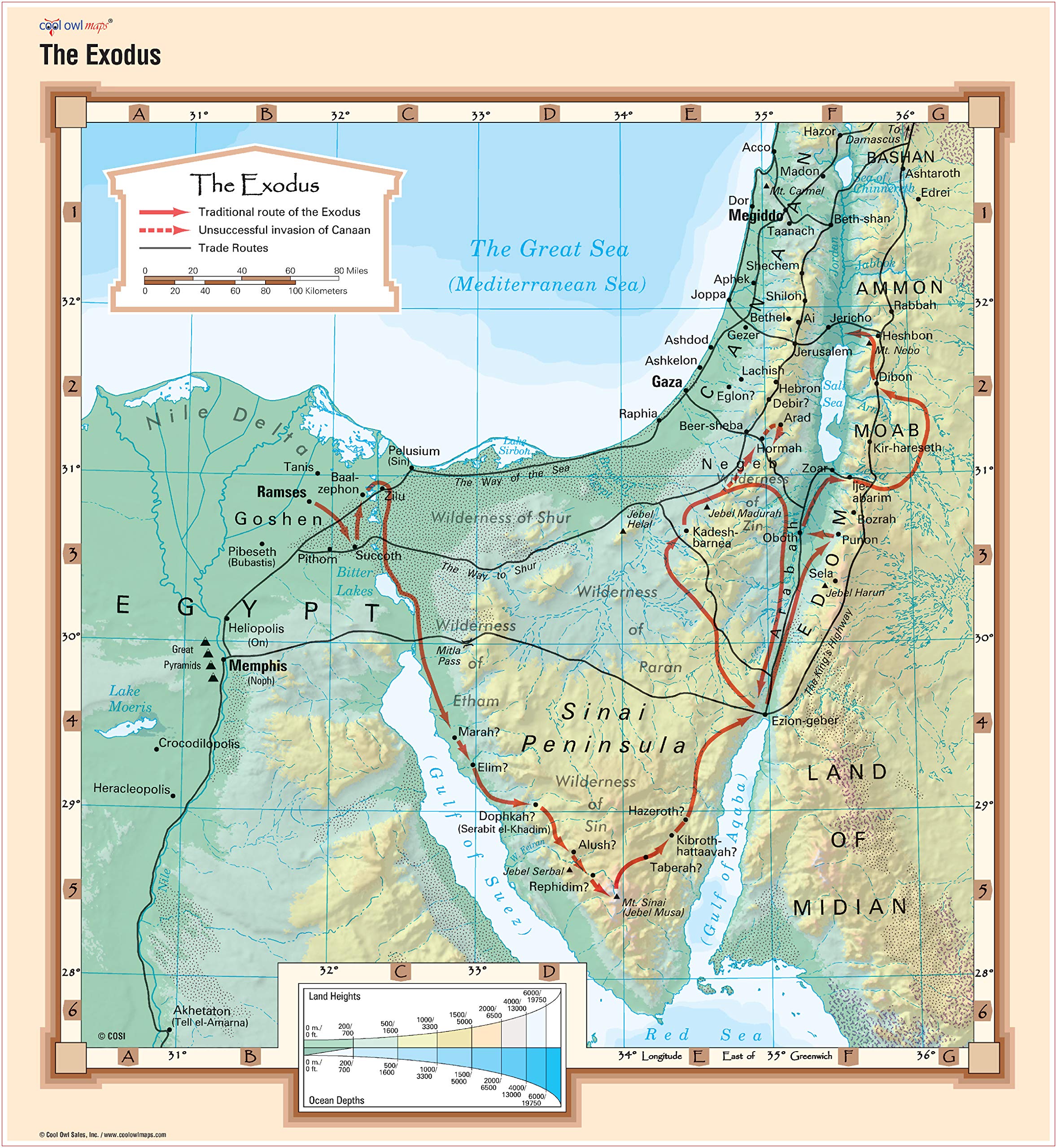
5 So the people of Israel set out from Rameses and camped at Succoth. 6 And they set out from Succoth and camped at Etham, which is on the edge of the wilderness. 7 And they set out from Etham and turned back to Pi-hahiroth, which is east of Baal-zephon, and they camped before Migdol. 8 And they set out from before Hahiroth and passed through the midst of the sea into the wilderness, and they went a three days’ journey in the wilderness of Etham and camped at Marah. 9 And they set out from Marah and came to Elim; at Elim there were twelve springs of water and seventy palm trees, and they camped there. 10 And they set out from Elim and camped by the Red Sea. 11 And they set out from the Red Sea and camped in the wilderness of Sin. 12 And they set out from the wilderness of Sin and camped at Dophkah. 13 And they set out from Dophkah and camped at Alush. 14 And they set out from Alush and camped at Rephidim, where there was no water for the people to drink. 15 And they set out from Rephidim and camped in the wilderness of Sinai. 16 And they set out from the wilderness of Sinai and camped at Kibroth-hattaavah. 17 And they set out from Kibroth-hattaavah and camped at Hazeroth. 18 And they set out from Hazeroth and camped at Rithmah. 19 And they set out from Rithmah and camped at Rimmon-perez. 20 And they set out from Rimmon-perez and camped at Libnah. 21 And they set out from Libnah and camped at Rissah. 22 And they set out from Rissah and camped at Kehelathah. 23 And they set out from Kehelathah and camped at Mount Shepher. 24 And they set out from Mount Shepher and camped at Haradah. 25 And they set out from Haradah and camped at Makheloth. 26 And they set out from Makheloth and camped at Tahath. 27 And they set out from Tahath and camped at Terah. 28 And they set out from Terah and camped at Mithkah. 29 And they set out from Mithkah and camped at Hashmonah. 30 And they set out from Hashmonah and camped at Moseroth. 31 And they set out from Moseroth and camped at Bene-jaakan. 32 And they set out from Bene-jaakan and camped at Hor-haggidgad. 33 And they set out from Hor-haggidgad and camped at Jotbathah. 34 And they set out from Jotbathah and camped at Abronah. 35 And they set out from Abronah and camped at Ezion-geber. 36 And they set out from Ezion-geber and camped in the wilderness of Zin (that is, Kadesh). 37 And they set out from Kadesh and camped at Mount Hor, on the edge of the land of Edom.

38 And Aaron the priest went up Mount Hor at the command of the Lord and died there, in the fortieth year after the people of Israel had come out of the land of Egypt, on the first day of the fifth month. 39 And Aaron was 123 years old when he died on Mount Hor.

40 And the Canaanite, the king of Arad, who lived in the Negeb in the land of Canaan, heard of the coming of the people of Israel.

41 And they set out from Mount Hor and camped at Zalmonah. 42 And they set out from Zalmonah and camped at Punon. 43 And they set out from Punon and camped at Oboth. 44 And they set out from Oboth and camped at Iye-abarim, in the territory of Moab. 45 And they set out from Iyim and camped at Dibon-gad. 46 And they set out from Dibon-gad and camped at Almon-diblathaim. 47 And they set out from Almon-diblathaim and camped in the mountains of Abarim, before Nebo. 48 And they set out from the mountains of Abarim and camped in the plains of Moab by the Jordan at Jericho; 49 they camped by the Jordan from Beth-jeshimoth as far as Abel-shittim in the plains of Moab.

50 And the Lord spoke to Moses in the plains of Moab by the Jordan at Jericho, saying, 51 “Speak to the people of Israel and say to them, When you pass over the Jordan into the land of Canaan, 52 then you shall drive out all the inhabitants of the land from before you and destroy all their figured stones and destroy all their metal images and demolish all their high places. 53 And you shall take possession of the land and settle in it, for I have given the land to you to possess it. 54 You shall inherit the land by lot according to your clans. To a large tribe you shall give a large inheritance, and to a small tribe you shall give a small inheritance. Wherever the lot falls for anyone, that shall be his. According to the tribes of your fathers you shall inherit. 55 But if you do not drive out the inhabitants of the land from before you, then those of them whom you let remain shall be as barbs in your eyes and thorns in your sides, and they shall trouble you in the land where you dwell. 56 And I will do to you as I thought to do to them.” – Numbers 33:1-56 ESV

The people of Israel are almost home. After more than 40 years in the wilderness, they stand on the eastern bank of Jordan River waiting for God’s command to cross over and begin their conquest and occupation of the land of promise. The day they had long been waiting for had finally arrived. There had been a lengthy delay, but now it was time to enjoy what God had promised so long ago.

But as with most things associated with God, the blessing was tied to a requirement. He had one last instruction to give them before they took possession of the land, and it was a fairly significant one. They must drive out all the people who were living there. On top of that, they had to destroy all the idols and pagan shrines erected to the gods of the land. They were to smash every vestige of idol worship they found. In other words, God expected them to clean house before they set up house.

Sounds simple enough doesn’t it? But if you’re the least bit familiar with the story of the Israelites, they didn’t exactly follow God’s instructions to the letter. They took a few liberties. It’s almost as if the enemy (Satan) was standing there just as he had been in the garden of Eden, asking the question, “Surely, God has not said…”

I can just hear Satan whispering in their ears, “You don’t have to get rid of ALL the idols, just most of them.” Or maybe he worded his temptation this way: “You might want to leave one of the pagan shrines intact, just in case Yahweh doesn’t come through for you.”

And as far as ridding the land of all its occupants, Satan probably did his best to convince the people of God just how politically incorrect and insensitive this might appear to the rest of the people in the region. They probably thought to themselves, “We don’t want to get off on the wrong foot with our new neighbors, do we?”

And God seemed to know that the people would have second thoughts about His command, so He warned them what would happen if they failed to obey.

“But if you fail to drive out the people who live in the land, those who remain will be like splinters in your eyes and thorns in your sides. They will harass you in the land where you live. And I will do to you what I had planned to do to them.” – Numbers 33:55-56 NLT

“Disobey me,” God says, “and you will live to regret it.” This was not a suggestion, but a command. God expected them to follow His requirements without delay or deviation. He had a good reason for what He was asking them to do, and He knew exactly what would happen if they chose to disobey Him. If the Israelites failed to remove the land’s occupants, their enemies would become a constant threat and a thorn in their side. They would never learn to live amicably together. So, cleansing was critical for spiritual survival.

In his commentary on the book of Numbers, Dr. Thomas Constable writes, “The repetition of ‘all’ (Numbers 33:52) stresses the importance of completely clearing the land of its inhabitants and their religious paraphernalia. God wanted to clean up the land spiritually and to make it a ‘holy land.’ The land was a gift from God to His first-born son, Israel (Numbers 33:53). God warned the Israelites what would happen to them if they were not completely obedient (Numbers 333:55-56). The Canaanites would be a constant source of irritation to them, and God would deal with His people as He planned to deal with the Canaanites.”

God wanted to purify the land spiritually and make it holy. That reminds me of what God wants to do with my life. He wants to clean it up spiritually and set it apart for His use. He is about removing anything in my life that might defile or defeat me. He wants to clean house.

But I tend to hang on to certain remnants of my past. I want to give the enemy some footholds in my life where he can live at peace. I want to keep some of the idols that were there before God came to occupy the land. I find the idols comforting. They bring me a little bit of peace and assurance. But God wants to purge my life of any vestiges of the past. He wants to make all things new. To receive all the blessings the Promised Land had to offer, the people had to obey God fully. The same thing is true for us today. To enjoy all the blessings our new life in Christ offers, we must obey God fully. God makes this clear in His Word.

…throw off your old evil nature and your former way of life, which is rotten through and through, full of lust and deception. – Ephesians 4:22 NLT

Don’t lie to one another. You’re done with that old life. It’s like a filthy set of ill-fitting clothes you’ve stripped off and put in the fire. – Colossians 3:9 MSG

The night is almost gone; the day of salvation will soon be here. So don’t live in darkness. Get rid of your evil deeds. Shed them like dirty clothes. Clothe yourselves with the armor of right living, as those who live in the light. We should be decent and true in everything we do, so that everyone can approve of our behavior. Don’t participate in wild parties and getting drunk, or in adultery and immoral living, or in fighting and jealousy. But let the Lord Jesus Christ take control of you, and don’t think of ways to indulge your evil desires. – Romans 13:12-14 NLT

God was looking for change in the lives of the Israelites. He wanted to purge and purify them, and that process began with a thorough cleansing of the land. His desire was to rid the landscape of their lives of any and all vestiges of the past.

Like the Israelites, we must take our set-apart status seriously.  We must remove all the idols and false gods that might draw us away from full reliance upon Him. If we do, we will be blessed. If we don’t, we will always find ourselves doing battle with past enemies and tempted to worship the false gods of our former life. Cleansing is always the key to blessing.

English Standard Version (ESV) The Holy Bible, English Standard Version. ESV® Permanent Text Edition® (2016). Copyright © 2001

New Living Translation (NLT) Holy Bible, New Living Translation, copyright © 1996, 2004, 2015 by Tyndale House Foundation. Used by permission of Tyndale House Publishers Inc., Carol Stream, Illinois 60188. All rights reserved.

Our Once-and-For-All Sacrifice

1 “On the first day of the seventh month you shall have a holy convocation. You shall not do any ordinary work. It is a day for you to blow the trumpets, 2 and you shall offer a burnt offering, for a pleasing aroma to the Lord: one bull from the herd, one ram, seven male lambs a year old without blemish; 3 also their grain offering of fine flour mixed with oil, three tenths of an ephah for the bull, two tenths for the ram, 4 and one tenth for each of the seven lambs; 5 with one male goat for a sin offering, to make atonement for you; 6 besides the burnt offering of the new moon, and its grain offering, and the regular burnt offering and its grain offering, and their drink offering, according to the rule for them, for a pleasing aroma, a food offering to the Lord.

7 “On the tenth day of this seventh month you shall have a holy convocation and afflict yourselves. You shall do no work, 8 but you shall offer a burnt offering to the Lord, a pleasing aroma: one bull from the herd, one ram, seven male lambs a year old: see that they are without blemish. 9 And their grain offering shall be of fine flour mixed with oil, three tenths of an ephah for the bull, two tenths for the one ram, 10 a tenth for each of the seven lambs: 11 also one male goat for a sin offering, besides the sin offering of atonement, and the regular burnt offering and its grain offering, and their drink offerings. – Numbers 29:1-11 ESV

Beginning in Numbers 28 and continuing through chapter 29, Moses provides a synopsis of the various public sacrifices that the people of Israel were required to make. There was a daily sacrifice of two lambs, as well as a sacrifice of two additional lambs each Sabbath day. On the first day of each month, they were to sacrifice two bulls, one ram, seven lambs, and one goat. Then, during each day of the seven-day-long Feast of Unleavened Bread, they were to sacrifice two bulls, one ram, seven lambs, and one goat. During Pentecost or the Feast of Weeks, they were to offer the same number of sacrifices. On the first day of the seventh month, they were to offer one bull, one ram, seven lambs, and one goat. On the Day of Atonement, they were to offer the same thing. Then for eight straight days during the Feast of Booths, they were to offer their largest number of sacrifices:

Day 1– 13 bulls, 2 rams, 14 lambs, 1 goat
Day 2 – 12 bulls, 2 rams, 14 lambs, 1 goat
Day 3 – 11 bulls, 2 rams, 14 lambs, 1 goat
Day 4 – 10 bulls, 2 rams, 14 lambs, 1 goat
Day 5 – 9 bulls, 2 rams, 14 lambs, 1 goat
Day 6 – 8 bulls, 2 rams, 14 lambs, 1 goat
Day 7 – 7 bulls, 2 rams, 14 lambs, 1 goat
Day 8 – 1 bull, 1 ram, 7 lambs, 1 goat

And each and every one of the sacrifices was to made “to the Lord.” They were to be a pleasing aroma to Him and were to be offered as an atonement for their sins and in order to maintain a right relationship with Him in the days to come. There were many sacrifices because of the sheer volume of sins among a nation of so many people. There was never an end to the need for the making of sacrifices and the atoning for sins. It was to be a perpetual requirement for the people – UNTIL God instituted a better plan.

There was a day coming when God would send His Son as the ultimate sacrifice for the sins of mankind. He would provide a permanent solution to man’s sin problem.

In John 6, we read the words of Jesus stating, “It was not Moses who gave you the bread from heaven, but my Father gives you the true bread from heaven. For the bread of God is he who comes down from heaven and gives life to the world” (John 6:32-33 ESV).

Under the system God established for the people of Israel, the sacrificial animals had to be provided by the people. They had to offer unblemished animals to God on their own behalf. But in the scenario that Jesus paints, He describes Himself as a sacrifice given by God for the people. Jesus used some very strange language that confused His disciples. He spoke of Himself as the bread of life and said, “This is the bread that comes down from heaven, so that one may eat of it and not die. I am the living bread that came down from heaven. If anyone eats of this bread, he will live forever. And the bread that I will give for the life of the world is my flesh” (John 6:50-51 ESV).

His choice of words shocked His hearers.

“How can this man give us his flesh to eat?” – John 6:52 ESV

But rather than clarify His message, Jesus responded with more of the same.

“Truly, truly, I say to you, unless you eat the flesh of the Son of Man and drink his blood, you have no life in you. Whoever feeds on my flesh and drinks my blood has eternal life, and I will raise him up on the last day.” – John 6:53-54 ESV

Of course, Jesus was not speaking of the literal consumption of His flesh and blood. He was referring to trust and belief in the coming sacrifice of His life on the cross for the sins of mankind. When we take in food, we trust that it will sustain us and supply us with life, In the same way, Jesus was saying that men will be required to “take in” His death on the cross, believing that it alone can provide them with forgiveness of their sins and eternal life.

But Jesus points out that this particular sacrifice was provided for us by God. He did what only He could do. In the book of Hebrews we read, “For since the law has but a shadow of the good things to come instead of the true form of these realities, it can never, by the same sacrifices that are continually offered every year, make perfect those who draw near. Otherwise, would they not have ceased to be offered, since the worshipers, having once been cleansed, would no longer have any consciousness of sins? But in these sacrifices there is a reminder of sins every year. For it is impossible for the blood of bulls and goats to take away sins” (Hebrews 10:1-4 ESV).

Until God sent His Son as a sacrifice for the sins of mankind, the people of God were caught in a cycle of sin and sacrifice. Their best efforts to remain in a right relationship with God were temporary and incomplete. They had to bring their best animals and sacrifice them to God in order to stave off their own execution for their sins. But in the New Testament, we read of God sacrificing His best in order to atone for the sins of mankind.

Paul tells us, “God shows his love for us in that while we were still sinners, Christ died for us” (Romans 5:8 ESV). God provided the singular and all-sufficient sacrifice of His Son – for us. In essence, the sacrifice of Jesus should be a “pleasing aroma” to us. This sacrifice was made for our benefit and for our consumption. And not only do we receive forgiveness from sin, but we also gain life – eternal life.

Jesus told His audience, “For this is the will of my Father, that everyone who looks on the Son and believes in him should have eternal life, and I will raise him up on the last day” (John 6:40 ESV). He was offering a permanent solution to the problem of sin, through His shed blood and crucified body. And yet, the people of His day were more concerned with literal bread and their own sad, temporary lives. They had come to Jesus seeking more food because He had miraculously fed them the evening before. He had filled their stomachs with bread and fish, and they craved more of the same.

When Jesus spoke of bread from heaven that gives life to the world, they responded, “Sire, give us this bread always” (John 6:34 ESV). But they wanted real bread, not the metaphorical or spiritual kind. They were stuck on a temporal, earthly plane, and failed to see that God was providing an offering for them that would do for them what they could never do for themselves.

It amazes me to think that God made a sacrifice on my behalf. He sent His Son to die for me. In the Old Testament sacrificial system, the people had to provide their own sacrifice, and it could only forestall or delay the inevitable reality of death. It could prolong life on this planet, but not provide life for eternity. Their sacrifices were temporal and eventually, ineffective at sustaining life. But God’s offering of His Son’s body and blood provides everlasting life. Jesus said, “Whoever feeds on this bread will live forever” (John 6:58 ESV).

All I have to do is receive God’s offering and believe that it is sufficient to pay for my sins and provide life more abundantly, both now and for eternity. Just as I eat bread and rely on it to sustain me, I must consume the sacrifice of God’s Son and allow Him to provide me with life everlasting. God has made a sacrifice on my behalf. He has sent His Son to die in my place. No more lambs, goats, bulls, or rams. Jesus offered Himself to God as a pleasing aroma, an acceptable sacrifice. And God offered His Son for me as a permanent solution to my ongoing sin problem. I live because He died. The sacrifice of Jesus by God was done for me, but not because of me. I didn’t deserve it. I had not earned that kind of gift. It was while I was in the depth of my own sin and hopelessness that God sent His Son as an offering on my behalf. The Son of God became the Bread of Life so that I might have eternal life. “We have been sanctified through the offering of the body of Jesus Christ once for all.” (Hebrews 10:10 ESV).

English Standard Version (ESV) The Holy Bible, English Standard Version. ESV® Permanent Text Edition® (2016). Copyright © 2001

New Living Translation (NLT) Holy Bible, New Living Translation, copyright © 1996, 2004, 2015 by Tyndale House Foundation. Used by permission of Tyndale House Publishers Inc., Carol Stream, Illinois 60188. All rights reserved.

Cleanliness Is Next to Godliness

11 “Whoever touches the dead body of any person shall be unclean seven days. 12 He shall cleanse himself with the water on the third day and on the seventh day, and so be clean. But if he does not cleanse himself on the third day and on the seventh day, he will not become clean. 13 Whoever touches a dead person, the body of anyone who has died, and does not cleanse himself, defiles the tabernacle of the Lord, and that person shall be cut off from Israel; because the water for impurity was not thrown on him, he shall be unclean. His uncleanness is still on him.

14 “This is the law when someone dies in a tent: everyone who comes into the tent and everyone who is in the tent shall be unclean seven days. 15 And every open vessel that has no cover fastened on it is unclean. 16 Whoever in the open field touches someone who was killed with a sword or who died naturally, or touches a human bone or a grave, shall be unclean seven days. 17 For the unclean they shall take some ashes of the burnt sin offering, and fresh water shall be added in a vessel. 18 Then a clean person shall take hyssop and dip it in the water and sprinkle it on the tent and on all the furnishings and on the persons who were there and on whoever touched the bone, or the slain or the dead or the grave. 19 And the clean person shall sprinkle it on the unclean on the third day and on the seventh day. Thus on the seventh day he shall cleanse him, and he shall wash his clothes and bathe himself in water, and at evening he shall be clean.

20 “If the man who is unclean does not cleanse himself, that person shall be cut off from the midst of the assembly, since he has defiled the sanctuary of the Lord. Because the water for impurity has not been thrown on him, he is unclean. 21 And it shall be a statute forever for them. The one who sprinkles the water for impurity shall wash his clothes, and the one who touches the water for impurity shall be unclean until evening. 22 And whatever the unclean person touches shall be unclean, and anyone who touches it shall be unclean until evening.” – Numbers 19:11-22 ESV

I am always amazed at the level of detail and intricacy found in the laws God gave to the Israelites. It can become confusing and a bit overwhelming at times as you read about the various sacrifices outlined by God in order for the people to maintain their purity before Him. It had to be intimidating for the people of Moses’ day.

Just trying to remember and keep all those rules and regulations would have been a daunting task. And there were different sacrifices for different situations. Chapter 19 outlines the sacrifice necessary to cleanse someone who has become defiled by having touched or been in the vicinity of a dead body. There was an elaborate and very specific rite or ritual to be followed in order for that person to be cleansed. Failure to follow God’s instructions would result in continued defilement and their removal from the camp. Not only would they be physically banned from fellowship, but they would also be cut off from access to the tabernacle and any ability to offer sacrifices for their sins. This was serious stuff.

So, God tells them to sacrifice a red heifer – one without defect and that had never worn a yoke. It was to be slaughtered outside the camp, then some of its blood was to be sprinkled on the tabernacle in order to cleanse it from defilement. The body of the heifer was to be burned completely, along with some cedar wood, hyssop, and scarlet yarn. The ashes were to be gathered and stored in a clean place outside the camp. Those ashes would play a critical role in the cleansing process of the defiled.

Any time someone came into contact with a dead body, they were to be immediately banned from the community to keep their defilement from spreading. The ashes from the red heifer were to be mixed with clean water, then sprinkled on the defiled person on the third and seventh days of his uncleanness. Then on the seventh day, he was to bathe and wash his clothes.

That same water was also to be sprinkled on the tabernacle and all its furnishings because when one of the Israelites became defiled, it defiled the tabernacle itself. And if you think about it, with people dying on a regular basis because of disease, old age, and other natural causes, it would have been easy to become defiled. So, this regulation was probably put into use quite frequently. Through no fault of your own, you could find yourself defiled and in danger of being cut off from the people of God. But fortunately, God provided a way to receive cleansing, and it involved the shedding of blood. The life of an unblemished animal had to be sacrificed so that the defiled person could receive cleansing.

There is a lot of obvious symbolism here. The unblemished red heifer represents Christ. He was the unblemished sacrifice for our sins. The hyssop, cedar wood, and scarlet yarn were all used in the cleansing of lepers. They may also represent the hyssop branch that was used to offer wine to Christ on the cross (John 19:29), the wood of the cross on which He was hung, and the scarlet robe that was placed on Him at His trial (Matthew 27:28). The blood speaks of Christ’s sacrificial death on the cross for the sins of mankind.

…the blood of Jesus his Son cleanses us from all sin… – 1 John 1:7 ESV

Just think how much more the blood of Christ will purify our consciences from sinful deeds so that we can worship the living God. For by the power of the eternal Spirit, Christ offered himself to God as a perfect sacrifice for our sins. – Hebrews 9:14 NLT

But all the symbolic imagery found in Numbers 19 was but a shadow of what was to come. While the mixture of water and ashes could cleanse a man on the outside, it did nothing to purify his heart. He would be outwardly clean, but inside, he could still be full of sin and corruption. Such was the inadequacy of this system. It was incomplete and incapable of totally wiping away sin and guilt. Additional sacrifices would be required. More blood would have to be shed. More ashes and water would need to be sprinkled. At no point could the people of God know that their sins were completely and permanently forgiven.

Just minutes after going through the rite of purification, you could inadvertently stumble upon a dead body and be defiled again. Or a loved one could die in your tent. And so you would have to start the process all over again. It was a never-ending process that required extreme diligence and perfect obedience. But these sacrifices were intended to represent a far better and more permanent sacrifice to come.

The book of Hebrews tells us that these regulations were a picture of the atoning work of Christ. They were an imperfect glimpse into the perfect cleansing that He would offer.

The blood of goats and bulls and the ashes of a heifer sprinkled on those who are ceremonially unclean sanctify them so that they are outwardly clean. How much more, then, will the blood of Christ, who through the eternal Spirit offered himself unblemished to God, cleanse our consciences from acts that lead to death, so that we may serve the living God! – Hebrews 9:13-14 NIV

The Message paraphrases those verses this way: “If that animal blood and the other rituals of purification were effective in cleaning up certain matters of our religion and behavior, think how much more the blood of Christ cleans up our whole lives, inside and out” (Hebrews 9:13-14 MSG).

Inside and out. That’s the difference. That’s the key. Christ came to provide cleansing that goes to the core of who we are. He came to purify our hearts, not just our actions. He came to cleanse us from the sin that permeates our very being. We aren’t just defiled by sin, we are sinners. Our very nature is sinful. We have sinful natures and that’s what separates us from God. But Jesus Christ came to give us a new nature. He didn’t just sprinkle us with His blood; He washed us with it. And we are daily being transformed into His likeness as the old vestiges of our sinful nature are slowly but surely removed. He is cleansing us inside and out.

Have you been to Jesus for the cleansing pow’r?
Are you washed in the blood of the Lamb?
Are you fully trusting in His grace this hour?
Are you washed in the blood of the Lamb?

Are you washed in the blood,
In the soul-cleansing blood of the Lamb?
Are your garments spotless? Are they white as snow?
Are you washed in the blood of the Lamb? – Elisha A. Hoffman, 1878

English Standard Version (ESV) The Holy Bible, English Standard Version. ESV® Permanent Text Edition® (2016). Copyright © 2001

New Living Translation (NLT) Holy Bible, New Living Translation, copyright © 1996, 2004, 2015 by Tyndale House Foundation. Used by permission of Tyndale House Publishers Inc., Carol Stream, Illinois 60188. All rights reserved.

Death, Defilement, and Cleansing

1 Now the Lord spoke to Moses and to Aaron, saying, 2 “This is the statute of the law that the Lord has commanded: Tell the people of Israel to bring you a red heifer without defect, in which there is no blemish, and on which a yoke has never come. 3 And you shall give it to Eleazar the priest, and it shall be taken outside the camp and slaughtered before him. 4 And Eleazar the priest shall take some of its blood with his finger, and sprinkle some of its blood toward the front of the tent of meeting seven times. 5 And the heifer shall be burned in his sight. Its skin, its flesh, and its blood, with its dung, shall be burned. 6 And the priest shall take cedarwood and hyssop and scarlet yarn, and throw them into the fire burning the heifer. 7 Then the priest shall wash his clothes and bathe his body in water, and afterward he may come into the camp. But the priest shall be unclean until evening. 8 The one who burns the heifer shall wash his clothes in water and bathe his body in water and shall be unclean until evening. 9 And a man who is clean shall gather up the ashes of the heifer and deposit them outside the camp in a clean place. And they shall be kept for the water for impurity for the congregation of the people of Israel; it is a sin offering. 10 And the one who gathers the ashes of the heifer shall wash his clothes and be unclean until evening. And this shall be a perpetual statute for the people of Israel, and for the stranger who sojourns among them. – Numbers 19:1-10 ESV

One of the things to keep in mind when reading these verses is the recent judgment that God had enacted upon the people of God. As a result of Korah’s rebellion, nearly 15,000 Israelites had died from a plague that God had sent among the people. This large-scale pandemic had left the survivors with a massive clean-up task. The bodies of the fallen had to be gathered and properly buried, rendering unclean all those who participated in the operation. Having come into contact with the bodies of the dead, they would have been considered defiled and in need of purification. And God had already provided clear instructions regarding the treatment of the unclean.

“Command the people of Israel that they put out of the camp everyone who is leprous or has a discharge and everyone who is unclean through contact with the dead. You shall put out both male and female, putting them outside the camp, that they may not defile their camp, in the midst of which I dwell.” And the people of Israel did so, and put them outside the camp; as the Lord said to Moses, so the people of Israel did. – Numbers 5:2-4 ESV

Due to the sheer number of volunteers necessary to dispose of nearly 15,000 corpses, the Israelites would have needed a tent city to house all those who had become defiled and ceremonially unclean. So, God instituted a new command that would bring a quick resolution to the problem.

“Tell the people of Israel to bring you a red heifer, a perfect animal that has no defects and has never been yoked to a plow. Give it to Eleazar the priest, and it will be taken outside the camp and slaughtered in his presence. Eleazar will take some of its blood on his finger and sprinkle it seven times toward the front of the Tabernacle.” – Numbers 19:2-4 NLT

This was to be a corporate endeavor, with the entire congregation participating, whether they were personally unclean or not. They were to choose a red heifer that was free from defect and had never been used to pull a plow. This means it would have been a highly valuable animal in the prime of health. They were not free to bring a maimed or diseased heifer. There was no option to offer an animal well past its prime or damaged by a lifetime of hard work. This sacrifice was going to cost them something.

The whole point of this ceremony was to protect the holiness of the tabernacle. The deaths of the rebels would have ended up defiling the entire congregation. And their defilement posed a very real and present danger to the holiness of the tabernacle itself. But the death of the heifer was not meant for atonement. In other words, it’s death was not intended to cleanse from sin but to purify from defilement.

Notice the detailed instructions God provided for Aaron. First, the animal was to be slaughtered and some of its blood used as a cleansing agent.

Eleazar will take some of its blood on his finger and sprinkle it seven times toward the front of the Tabernacle. – Numbers 19:4 NLT

Eleazar was one of the four sons of Aaron and served as a priest alongside his father and brothers. His job was to supervise the entire process, ensuring that the remains of the heifer were taken outside the camp and burned. As the body was cremated, Eleazar was to add a stick of cedar, a hyssop branch, and some scarlet yarn.

“Cedar wood was not as subject to decay as most other woods and so represented the continuance of life. It was also aromatic when burnt and was probably either the common brown-berried cedar or the Phoenician juniper.[164] Hyssop stood for purification from corruption, and the priests used it to apply blood, as in the Passover ritual. Scarlet wool symbolized the strong vital energy connected with blood (cf. Lev. 14:6). All of these elements combined to signify all that strengthened life. The person in charge added these elements to the heifer ashes as the heifer was burning.” – Thomas L. Constable, Notes on Numbers

The leftover ashes were to be collected and kept in a specific location outside the camp. All those involved in the sacrifice of the heifer were required to go through a special purification process before they could return to the camp. And the ashes were to be maintained for future purification of any who became defiled through contact with the dead. The ashes were to be mixed with water and used as a purifying agent. The death of the innocent and unblemished heifer was required for the cleansing properties of the water to be effective. The ashes mixed with water would provide purification from defilement and restore the guilty to a state of holiness. They could once again enter into the camp and enjoy access to the tabernacle and all the rites associated with it.

God, in His grace and mercy, provided a means by which the guilty could be forgiven and the unclean could be purified from the devastating effects of sin and death.

English Standard Version (ESV) The Holy Bible, English Standard Version. ESV® Permanent Text Edition® (2016). Copyright © 2001

New Living Translation (NLT) Holy Bible, New Living Translation, copyright © 1996, 2004, 2015 by Tyndale House Foundation. Used by permission of Tyndale House Publishers Inc., Carol Stream, Illinois 60188. All rights reserved.

A Shadow of Things to Come

1 So the Lord said to Aaron, “You and your sons and your father’s house with you shall bear iniquity connected with the sanctuary, and you and your sons with you shall bear iniquity connected with your priesthood. 2 And with you bring your brothers also, the tribe of Levi, the tribe of your father, that they may join you and minister to you while you and your sons with you are before the tent of the testimony. 3 They shall keep guard over you and over the whole tent, but shall not come near to the vessels of the sanctuary or to the altar lest they, and you, die. 4 They shall join you and keep guard over the tent of meeting for all the service of the tent, and no outsider shall come near you. 5 And you shall keep guard over the sanctuary and over the altar, that there may never again be wrath on the people of Israel. 6 And behold, I have taken your brothers the Levites from among the people of Israel. They are a gift to you, given to the Lord, to do the service of the tent of meeting. 7 And you and your sons with you shall guard your priesthood for all that concerns the altar and that is within the veil; and you shall serve. I give your priesthood as a gift, and any outsider who comes near shall be put to death.” – Numbers 18:1-7 ESV

As a result of the rebellion of Korah, God brought a plague among the people of Israel. It was only Aaron’s quick action, as he atoned for their sins, that prevented the complete destruction of the people of Israel at the hands of God. He intervened and interceded on their behalf, and God spared them. As a result, God reconfirmed His selection of Aaron and his sons to serve as His priests.

The budding of the rod of Aaron was a divine sign of God’s choosing of Aaron and the tribe of Levi as His servants. They would belong to Him. Only the Levites could serve as caretakers of the tabernacle and only Aaron and his sons could serve as intercessors with God on behalf of the people. With their jobs came great responsibilities and great blessings. They were to remain holy and set apart to God. They received no inheritance in the land, but God provided for them from the gifts that were given to Him as a part of the sacrifices of the people. The Levites received from God that which was holy. They ate well but they had to be very careful not to profane or desecrate the things of God through unholy conduct. God warned Aaron, “You, your sons, and your relatives from the tribe of Levi will be held responsible for any offenses related to the sanctuary. But you and your sons alone will be held responsible for violations connected with the priesthood” (Numbers 18:1 NLT).

These were ordinary men who had been given an extraordinary responsibility. They were the literal keepers of the spiritual flame of Israel. They were to maintain God’s house and everything in it. They protected it and transported it. Aaron and his sons, as the priests, were responsible for offering sacrifices on behalf of the people, atoning for their sins, and providing a means for them to remain in right standing with God. But their work could never fully remove guilt or provide full atonement for the sins of the people. But the priesthood and the sacrificial system as outlined in the Old Testament was a foreshadowing of something greater to come.

They serve in a system of worship that is only a copy, a shadow of the real one in heaven. For when Moses was getting ready to build the Tabernacle, God gave him this warning: “Be sure that you make everything according to the pattern I have shown you here on the mountain.” But now Jesus, our High Priest, has been given a ministry that is far superior to the old priesthood, for he is the one who mediates for us a far better covenant with God, based on better promises. – Hebrews 8:5-6 NLT

God’s plan for the tabernacle, the sacrificial system, and the priesthood was a temporary system that represented a far greater future reality. It was imperfect because it involved sinful men. Aaron and his sons were flawed and far from perfect, just like every other Israelite. For them to perform their duties as priests, they had to undergo rigorous purification rites for the atonement of their own sins. And, according to the book of Hebrews, their humanity made them susceptible to death just like everyone else and required that there be constant replacements available.

The former priests were many in number, because they were prevented by death from continuing in office. – Hebrews 7:23 ESV

But God’s plan was far greater than that of the tabernacle and the earthly priesthood. He had already determined a better means of atoning for the sins of man. And it would involve His own Son. This had been God’s plan all along. After His resurrection from the dead, Jesus gave His disciples two separate Bible lessons where He “opened their minds to understand the Scriptures” (Luke 24:45 ESV). For the two disciples on the road to Emmaus, “he interpreted to them in all the Scriptures the things concerning himself” (Luke 24:27 ESV). Jesus unpacked all the writings of Moses and the prophets, showing how He had been foreshadowed and predicted. Everything had been pointing to Him. The entire sacrificial system was but a shadow of things to come. The priesthood as practiced in Moses’ day, served as a glimpse of something greater to come.

He is the kind of high priest we need because he is holy and blameless, unstained by sin. He has been set apart from sinners and has been given the highest place of honor in heaven.  Unlike those other high priests, he does not need to offer sacrifices every day. They did this for their own sins first and then for the sins of the people. But Jesus did this once for all when he offered himself as the sacrifice for the people’s sins.  The law appointed high priests who were limited by human weakness. But after the law was given, God appointed his Son with an oath, and his Son has been made the perfect High Priest forever. – Hebrews 7:26-28 NLT

Man would need a greater High Priest. We would require a greater means of atonement. The sacrificial system, as practiced by the Jews in the days of Moses and even into the days of Jesus, could never fully eradicate the sins of men. Because man’s capacity for sin was endless, so was the need for constant sacrifice. There was never a point at which they were totally forgiven and completely free from the guilt of their sin. If nothing else, the law and the sacrificial system were a daily reminder of the ever-present reality of sin and guilt. No one could keep the law perfectly so, therefore, no one was truly sinless. And the constant capacity to sin required the constant need to sacrifice in order to atone for those sins.

But Jesus came to put an end to the madness. He was the High Priest who came to deal with sin once and for all.

He did not enter heaven to offer himself again and again, like the high priest here on earth who enters the Most Holy Place year after year with the blood of an animal. If that had been necessary, Christ would have had to die again and again, ever since the world began. But now, once for all time, he has appeared at the end of the age to remove sin by his own death as a sacrifice. And just as each person is destined to die once and after that comes judgment, so also Christ died once for all time as a sacrifice to take away the sins of many people. He will come again, not to deal with our sins, but to bring salvation to all who are eagerly waiting for him. – Hebrews 9:25-28 NLT

Because of Jesus’ sacrifice, our sins have been paid for. Our atonement has been accomplished once and for all. We can now stand before God as righteous in His eyes. All because of what Jesus accomplished on the cross on our behalf. We have been set free and are no longer slaves to sin. We have the capacity to live differently and distinctively, empowered by the indwelling Holy Spirit. And our righteousness is not of our own making but has been provided for us by Christ Himself. He bore our sins and transferred His righteousness to us. He died so that we might live.

When reading the Old Testament, we must look for Christ and understand that it all foreshadows His ultimate arrival on the scene. The Old Testament is as much about Christ as the four Gospels. Prior to His ascension, Jesus took time to teach His disciples and point out all that the Old Testament Scriptures revealed about Himself. The story of the Bible is the story of God’s ultimate redemption of mankind through the saving work of Jesus. Like any story, it has a beginning and an end. In the story recorded in Luke, we see Jesus departing from His disciples, ascending up into heaven. But we know that’s not the end of the story.

This Jesus, who was taken up from you into heaven, will come in the same way you saw him go into heaven. – Acts 1:11 ESV

He has gone, but He will someday return. His work as High Priest is complete but His job as King is not yet finished. And we look forward to the day when God closes the final chapter in His great book of redemption.

English Standard Version (ESV) The Holy Bible, English Standard Version. ESV® Permanent Text Edition® (2016). Copyright © 2001

New Living Translation (NLT) Holy Bible, New Living Translation, copyright © 1996, 2004, 2015 by Tyndale House Foundation. Used by permission of Tyndale House Publishers Inc., Carol Stream, Illinois 60188. All rights reserved.

The Fire of Cleansing

36 Then the Lord spoke to Moses, saying, 37 “Tell Eleazar the son of Aaron the priest to take up the censers out of the blaze. Then scatter the fire far and wide, for they have become holy. 38 As for the censers of these men who have sinned at the cost of their lives, let them be made into hammered plates as a covering for the altar, for they offered them before the Lord, and they became holy. Thus they shall be a sign to the people of Israel.” 39 So Eleazar the priest took the bronze censers, which those who were burned had offered, and they were hammered out as a covering for the altar, 40 to be a reminder to the people of Israel, so that no outsider, who is not of the descendants of Aaron, should draw near to burn incense before the Lord, lest he become like Korah and his company—as the Lord said to him through Moses.

41 But on the next day all the congregation of the people of Israel grumbled against Moses and against Aaron, saying, “You have killed the people of the Lord.” 42 And when the congregation had assembled against Moses and against Aaron, they turned toward the tent of meeting. And behold, the cloud covered it, and the glory of the Lord appeared. 43 And Moses and Aaron came to the front of the tent of meeting, 44 and the Lord spoke to Moses, saying, 45 “Get away from the midst of this congregation, that I may consume them in a moment.” And they fell on their faces. 46 And Moses said to Aaron, “Take your censer, and put fire on it from off the altar and lay incense on it and carry it quickly to the congregation and make atonement for them, for wrath has gone out from the Lord; the plague has begun.” 47 So Aaron took it as Moses said and ran into the midst of the assembly. And behold, the plague had already begun among the people. And he put on the incense and made atonement for the people. 48 And he stood between the dead and the living, and the plague was stopped. 49 Now those who died in the plague were 14,700, besides those who died in the affair of Korah. 50 And Aaron returned to Moses at the entrance of the tent of meeting, when the plague was stopped. – Numbers 16:36-50 ESV

God cleaned house. He purged the wickedness from the midst of the camp of Israel by swallowing the households of Korah, Dathan, and Abiram. Then He consumed the 250 co-conspirators with fire as they attempted to offer unacceptable sacrifices to Him. And when the smoke had lifted, all that was left were their bronze censers lying among the ashes with their charred bones.

This macabre scene was the result of a test that Moses had arranged to determine who among the Israelites was truly holy to the Lord.

“Korah, you and all your followers must prepare your incense burners. Light fires in them tomorrow, and burn incense before the Lord. Then we will see whom the Lord chooses as his holy one.” – Numbers 16:6-7 NLT

And God had declared the outcome of the test in no uncertain terms. The guilty and unholy had been punished. Yet, their destruction produced a rather strange result. The incense burners these rebels had been carrying at the time of their destruction had been purified in the process. The Lord ordered Moses to have them gathered and hammered into a covering for the altar.

“Tell Eleazar son of Aaron the priest to pull all the incense burners from the fire, for they are holy. Also tell him to scatter the burning coals. Take the incense burners of these men who have sinned at the cost of their lives, and hammer the metal into a thin sheet to overlay the altar. Since these burners were used in the Lord’s presence, they have become holy. Let them serve as a warning to the people of Israel.” – Numbers 16:37-38 NLT

Those men had presented their censers and burning incense to the Lord, but He had consumed them with flames because they were guilty of rebellion against Him. But because their incense burners had been presented to God, they had become holy or set apart for His use.

“As we think about the notion of the ‘holy,’ we recognize that things are made holy in Scripture, not because people are holy, but because the things are presented to the Lord, who is holy. Since these wicked men presented their censers to the Lord, the censers are holy, despite the men’s own wickedness.” – Ronald B. Allen, “Numbers.” In Genesis—Numbers. Vol. 2 of The Expositor’s Bible Commentary

This entire story provides a powerful reminder of the ever-present danger of doubt in the life of the follower of God. Doubt has a way of turning into disobedience, and disobedience against God is nothing more than rebellion against His Word and His will. In chapter eight of Numbers, this pattern was lived out in the lives of Korah, Dathan, Abiram, and On. These men were descendants of Levi and, as such, they were responsible for the care and upkeep of the tabernacle of God. God had set them apart as His servants and their jobs were essential to the spiritual well-being of the people of Israel. But they were dissatisfied with things as God had planned them. They wanted more responsibility. They wanted a greater role. They doubted God’s order of things and demanded a restructuring of responsibilities and duties. They pointed their fingers at Aaron and Moses, exclaiming, “You have gone too far! For all in the congregation are holy, every one of them, and the Lord is among them. Why then do you exalt yourselves above the assembly of the Lord?” (Numbers 16:3 ESV). Like Miriam in chapter 12, these men expressed their doubt in God’s preordained order of things and it led to their open disobedience and rebellion.

As a holy, righteous King, God was unwilling to tolerate the open rebellion of these men. While the rebellion of Korah, Dathan, and Abiram was more pronounced and obvious, the reality was that the entire congregation was guilty of turning against God. But Moses and Aaron had interceded and begged God to spare the congregation and punish the ring leaders. God would not tolerate rebellion among His people. He knew it to be like cancer that, if left unchecked, would spread among the people. So He eradicated it in a powerful way. But, according to Moses’ request, He spared the people.

And yet, amazingly, we read, “on the next day all the congregation of the people of Israel grumbled against Moses and against Aaron, saying, ‘You have killed the people of the Lord’” (Numbers 16:41 ESV). Once again, they expressed doubt that what had happened had been God’s will, and they openly rebelled against God’s representatives. So, as before, God warned Moses and Aaron to separate themselves from the people because He was about to destroy them. But Moses interceded yet again, telling Aaron to take his censer and “carry it quickly to the congregation and make atonement for them, for wrath has gone out from the Lord; the plague has begun” (Numbers 16:36 ESV).

God was bringing judgment on the people, and Moses’ quick thinking and Aarons’ immediate response spared the lives of many. In spite of their efforts, 14,700 people died that day – at the hand of God. Yet, there would have been even more, had they not interceded. The rebellion of the people had been a sin against God, and only the atoning work of Aaron, the high priest, had been able to satisfy the righteous judgment of God against them. Doubt is inevitable and, if left unchecked, it will always result in disobedience and rebellion against God. Mankind is prone to unfaithfulness, even those who call themselves followers of God. Disobedience is in our nature. The risk of rebellion is a constant reality for each of us.

In the gospel of Luke, there is another story of the people of God rebelling against the will of God. He had sent His Son as the Savior of the world. But Jesus didn’t come in the form they had anticipated. He failed to meet their expectations. Rather than a conquering king on a white horse leading a powerful army, He had shown up as a carpenter from the small hamlet of Nazareth and accompanied by a rag-tag group of disciples. Instead of revering Jesus as their long-awaited Messiah, the religious leaders responded with revulsion. They longed to rid themselves of His presence. They had Him arrested and dragged before Pilate, the governor, for trial and, ultimately, execution. Even Pilate found Jesus to be innocent of any wrongdoing. He tried repeatedly to release Him, but the people demanded His crucifixion, and they got their wish.

Their doubt led to disobedience, which resulted in rebellion and led to the death of the One whom God had sent. They doubted God’s Word and rejected His will. Writing more than 750 years before the events of the crucifixion, the prophet Isaiah predicted, “But he was pierced for our rebellion, crushed for our sins. He was beaten so we could be whole. He was whipped so we could be healed” (Isaiah 53:5 NLT).

God sent His Son to deal with our rebellion. But rather than snuff us out, He provided a means by which we could be healed and made whole. He paid the debt we owed, He suffered the death that was meant for us. He took on the penalty for our rebellion against God.

And it’s interesting to note that Aaron had been able to atone for the sins of the people by taking fire from the altar of God and using it to ignite incense in a censer. The same fire that had consumed the 250 leaders who had rejected God’s will was used to atone for and spare the rebellious Israelites. An incense burner in the hand of God’s anointed was the means by which God redeemed the unholy and undeserving. The all-consuming fire of God actually averted the deaths of tens of thousands of Israelites who had been deserving of God’s judgment. The plague was averted and the people were spared.

English Standard Version (ESV) The Holy Bible, English Standard Version. ESV® Permanent Text Edition® (2016). Copyright © 2001

New Living Translation (NLT) Holy Bible, New Living Translation, copyright © 1996, 2004, 2015 by Tyndale House Foundation. Used by permission of Tyndale House Publishers Inc., Carol Stream, Illinois 60188. All rights reserved.

Holiness Comes With a Price

11 And the Lord spoke to Moses, saying, 12 “Speak to the people of Israel, If any man’s wife goes astray and breaks faith with him, 13 if a man lies with her sexually, and it is hidden from the eyes of her husband, and she is undetected though she has defiled herself, and there is no witness against her, since she was not taken in the act, 14 and if the spirit of jealousy comes over him and he is jealous of his wife who has defiled herself, or if the spirit of jealousy comes over him and he is jealous of his wife, though she has not defiled herself, 15 then the man shall bring his wife to the priest and bring the offering required of her, a tenth of an ephah of barley flour. He shall pour no oil on it and put no frankincense on it, for it is a grain offering of jealousy, a grain offering of remembrance, bringing iniquity to remembrance.

16 “And the priest shall bring her near and set her before the Lord. 17 And the priest shall take holy water in an earthenware vessel and take some of the dust that is on the floor of the tabernacle and put it into the water. 18 And the priest shall set the woman before the Lord and unbind the hair of the woman’s head and place in her hands the grain offering of remembrance, which is the grain offering of jealousy. And in his hand the priest shall have the water of bitterness that brings the curse. 19 Then the priest shall make her take an oath, saying, ‘If no man has lain with you, and if you have not turned aside to uncleanness while you were under your husband’s authority, be free from this water of bitterness that brings the curse. 20 But if you have gone astray, though you are under your husband’s authority, and if you have defiled yourself, and some man other than your husband has lain with you, 21 then’ (let the priest make the woman take the oath of the curse, and say to the woman) ‘the Lord make you a curse and an oath among your people, when the Lord makes your thigh fall away and your body swell. 22 May this water that brings the curse pass into your bowels and make your womb swell and your thigh fall away.’ And the woman shall say, ‘Amen, Amen.’

23 “Then the priest shall write these curses in a book and wash them off into the water of bitterness. 24 And he shall make the woman drink the water of bitterness that brings the curse, and the water that brings the curse shall enter into her and cause bitter pain. 25 And the priest shall take the grain offering of jealousy out of the woman’s hand and shall wave the grain offering before the Lord and bring it to the altar. 26 And the priest shall take a handful of the grain offering, as its memorial portion, and burn it on the altar, and afterward shall make the woman drink the water. 27 And when he has made her drink the water, then, if she has defiled herself and has broken faith with her husband, the water that brings the curse shall enter into her and cause bitter pain, and her womb shall swell, and her thigh shall fall away, and the woman shall become a curse among her people. 28 But if the woman has not defiled herself and is clean, then she shall be free and shall conceive children.

29 “This is the law in cases of jealousy, when a wife, though under her husband’s authority, goes astray and defiles herself, 30 or when the spirit of jealousy comes over a man and he is jealous of his wife. Then he shall set the woman before the Lord, and the priest shall carry out for her all this law. 31 The man shall be free from iniquity, but the woman shall bear her iniquity.” – Numbers 5:11-31 ESV

It was literally impossible for the Israelites to maintain their holiness and purity before God. Sin and sickness, both inevitable outcomes of living in a fallen world, were going to be a constant part of their lives. And because God dwelt in their midst, the ramifications of their sinfulness and sickness were serious. Disease and disobedience both separated the people from God. The very existence of disease was a direct result of sin’s entrance into the world.

Ultimately, disease and disobedience both lead to death. God gave Moses strict instructions about what to do with those who found themselves suffering from potentially contagious diseases; they were to be removed from the camp. This was not an indication that their illness was due to a specific sin they had committed, but a recognition that sickness was the inevitable byproduct of sin’s presence in the world. God expected His people to remain pure, both spiritually and physically, if they wanted to enter into His presence. But as always, God provided a means by which they could be restored to a right relationship with Him, in spite of sickness or sin.

In today’s passage, we see that God even expected the marriages of His people to be pure and above reproach. To our modern sensibilities, these verses contain some rather bizarre and disturbing counsel for dealing with marital unfaithfulness. But while it may be easy to fixate on the almost cultic nature of God’s instructions, it’s important that we not miss the motivation behind them.

God provides Moses with detailed instructions for determining whether a man’s wife was guilty of adultery. It’s interesting to note that in the “test” God provided, the hidden sin of the woman, when revealed, would result in sickness. In this case, her sickness would be proof of her sin. And it’s no coincidence that the resulting sickness attacked the very organs that had been used to commit the sin in the first place. There is much about this passage that is difficult to understand, but it is clear that God was dealing with sin among His people in a powerful and pronounced way. This “test,” when witnessed by others, would prove to be an effective deterrent to further adultery in the camp.

In the closing part of chapter 6, God gives Moses a blessing to pronounce over the people.

The Lord bless you and keep you; the Lord make his face to shine upon you and be gracious to you; the Lord lift up his countenance upon you and give you peace. – Numbers 6:24-26 ESV

This simple, yet profound blessing reminds us that, ultimately, it was God’s desire to bless His people. And one of the greatest blessings God could bestow on the people of Israel was the guarantee of His abiding presence. But for God to remain within their midst, He had to deal justly and firmly with the sins committed by them. It was up to God to provide them with peace when their repeated sins and inevitable exposures to disease would leave them alienated from Him.

God alone is the instigator, arbiter, and maintainer of the relationship He has with mankind. It is He who seeks us and not the other way around. Left to our own devices, man will always seek a god of his own choosing. And man will tend to make the relationship with his god based on his own performance and acts of self-righteousness.

Humanity has always lived under the delusion that life can be lived apart from God. Even those who long for God, believe that He is little more than an objective to be pursued, a giver of gifts whose favor must be earned. They make God the means rather than the end. He becomes little more than a resource to get what they really want: peace, prosperity, contentment, happiness, fulfillment, and significance. This is why men make gods out of anything that even remotely seems to promise those things. But we can’t earn favor with God. And we can’t turn God into some kind of divine lottery ticket that we hope will grant us our heart’s wildest desires.

It was impossible for the people of Israel to live up to God’s exacting standards. They would and did continually fail. But God had provided a means of atoning for their inevitable sins and dealing with the inescapable reality of sickness. It is interesting to think about the fact that sickness was hard to hide. Skin disorders and diseases would inevitably reveal themselves to the rest of the faith community. And as soon as the sickness became apparent, it had to be dealt with. But sin can remain hidden for a long time, unobserved, and invisible to the faith community. Sin was like cancer that was undetected among the people of God, slowly spreading and infecting the body over time.

The passage in Numbers 6 contains some rather disturbing and difficult-to-understand directives for dealing with marital unfaithfulness. What God commands almost sounds like a form of witchcraft. It involves the mixing of strange potions and the incantation of curses. There are offerings made and mystical symptoms to be observed.

The whole thing comes across as something the pagan nations might practice. But this was the will of God for His people. It was a divinely ordained process for exposing sin in a marriage that could easily infect the entire faith community.

“Marital deceit is a matter of such seriousness that the truth must be discovered. It is harmful to the sanctity of the community at large, and destructive of one of the bases of community life.” – Philip J. Budd, Numbers

God takes sin seriously and He expected His children to do the same. There was no place for sinful activity among the people of God. But He knew it would inevitably take place. That is why He established strict guidelines for exposing sin so that the people might continue to enjoy His abiding presence and power in their midst.

“. . . this particular case law is included here because it gives another illustration of God’s personal involvement in the restitution for the sin of the nation. Within God’s covenant with Israel, there could be no hidden sin among God’s people nor any hidden suspicion of sin.

“The law of jealousy shows that through the role of the priest, God was actively at work in the nation and that no sin of any sort could be tolerated among God’s holy people.” – John H. Sailhamer, “The Mosaic Law and the Theology of the Pentateuch.” Westminster Theological Journal 53 (Fall 1991):241-61.

Sin carries a cost. It promises joy and fulfillment but rarely delivers. And hidden sin is one of the most egregious and dangerous. It may lie undetected but its influence continues to spread throughout the body of Christ. We may fool all those around us, but our all-knowing, all-seeing God cannot be deceived or duped. And because He cares for His people, He will see that sin is exposed and expunged. Out of His deep desire to bless His children, God lovingly purifies their lives from the damaging effects of sin.

English Standard Version (ESV) The Holy Bible, English Standard Version. ESV® Permanent Text Edition® (2016). Copyright © 2001

New Living Translation (NLT) Holy Bible, New Living Translation, copyright © 1996, 2004, 2015 by Tyndale House Foundation. Used by permission of Tyndale House Publishers Inc., Carol Stream, Illinois 60188. All rights reserved.

All According to Plan

7 Then came the day of Unleavened Bread, on which the Passover lamb had to be sacrificed. 8 So Jesus sent Peter and John, saying, “Go and prepare the Passover for us, that we may eat it.” 9 They said to him, “Where will you have us prepare it?” 10 He said to them, “Behold, when you have entered the city, a man carrying a jar of water will meet you. Follow him into the house that he enters 11 and tell the master of the house, ‘The Teacher says to you, Where is the guest room, where I may eat the Passover with my disciples?’ 12 And he will show you a large upper room furnished; prepare it there.” 13 And they went and found it just as he had told them, and they prepared the Passover. – Luke 22:7-13 ESV

The Jewish leaders were plotting Jesus’ death and had hired Judas, one of Jesus’ own disciples, to help them make it happen. This member of Jesus’ inner circle of followers would play a crucial role in making the arrest of Jesus a non-public affair, causing as little fanfare as possible. The religious leaders knew their plan to kill Jesus would be unpopular with the people, so stealth and secrecy would be essential. Their frustration and concern with Jesus were at a fever pitch. Just a few days earlier, the Sanhedrin had held a meeting to discuss what to do with Jesus.

“What are we going to do?” they asked each other. “This man certainly performs many miraculous signs. If we allow him to go on like this, soon everyone will believe in him. Then the Roman army will come and destroy both our Temple and our nation.” – John 11:47-48 NLT

Caiaphas, as high priest and head of the council, decided to take matters into his own hands and give his fellow council members a stern rebuke and a lesson in leadership.

“You don’t know what you’re talking about! You don’t realize that it’s better for you that one man should die for the people than for the whole nation to be destroyed.” – John 11:49-50 NLT

Little did Caiaphas know that his words were prophetic. His anger-filled words were actually a clear and concise statement of truth regarding the efficacy of Jesus’ death. In his gospel account, John added a parenthetical statement that revealed the divine inspiration behind Caiaphas’ words.

He did not say this on his own; as high priest at that time he was led to prophesy that Jesus would die for the entire nation. And not only for that nation, but to bring together and unite all the children of God scattered around the world.– John 11:51-52 NLT

God had a plan in place, and He was divinely orchestrating every aspect of it with unseen precision and according to a very strict timeline. And Jesus, in perfect alignment with His Father’s will, was keeping to the preordained schedule. Jesus completed His Olivet Discourse on Wednesday and then, on Thursday, He ordered Peter and John to go into Jerusalem and prepare the Passover meal. The timing is critical because, as Luke indicates, this was the day “on which the Passover lamb had to be sacrificed” (Luke 22:7 ESV). The symbolism of this particular day is profound. Jesus, as “the Lamb of God, who takes away the sin of the world” (John 1:29 ESV), was preparing to offer His life as a ransom for many (Matthew 20:28). In just a matter of hours, His blood would be spilled and His body broken so that sinful men and women might have the righteous wrath of God “pass over” their lives. He would become the ultimate pascal lamb, providing deliverance from death and the promise of eternal life.

In his description of this event, Luke provides details the other gospel authors leave out. He reveals that Jesus gave Peter and John very specific instructions regarding the location for their meal. Nothing was left to chance. The city of Jerusalem would have been overwhelmed by the number of pilgrims who had made their way there to celebrate Passover. Accommodations would have been in short supply. But somehow, Jesus had prearranged to have a room reserved for their use. In all the chaos and confusion of Jerusalem, Peter and John would find a man carrying a pitcher of water. This unidentified man, most likely a servant, would lead them to a house, where Peter and John would meet the homeowner. At that point, they were to deliver a message from Jesus.

“The Teacher says to you, Where is the guest room, where I may eat the Passover with my disciples?” – Luke 22:11 ESV

It is important to note that none of the disciples were aware of this location. That means that Jesus had not disclosed His plans to any of them. Which begs the question: How did Jesus manage to prearrange all the details surrounding the choice of this house and negotiate the arrangements with its owner? Had He made an unrecorded trip into Jerusalem and secured a room for their upcoming Passover meal? Or had He assigned the job to Mary of Martha, the sisters of Lazarus? None of the gospels provide answers to these questions. Which leads to a final possibility. Perhaps all the details surrounding the man with the pitcher and the home with the strangely available room was all a divinely orchestrated miracle. God had ordained it all.

Whatever the case, Peter and John did as Jesus said and they “found it just as he had told them, and they prepared the Passover” (Luke 22:13 ESV). Despite the crowded streets of Jerusalem, they were able to find the man with the pitcher of water. And seemingly, without words exchanged, they followed the man to the house. There they found a large upper room completely furnished and with everything they needed to celebrate the Passover meal with their Master.

Then Peter and John set about making preparations for the evening meal. Luke opened this section of his gospel with the words, “Then came the day of Unleavened Bread” (Luke 22:7 ESV). According to the book of Exodus, as part of the celebration of Passover, the Jews were to spend seven consecutive days eating unleavened bread. This bread, made without yeast, was to represent the removal of sin from their midst.

“This is a day to remember forever—the day you left Egypt, the place of your slavery. Today the Lord has brought you out by the power of his mighty hand. (Remember, eat no food containing yeast.).” – Exodus 13:3 NLT

On the day of the first Passover, Moses had told the people of Israel:

“For seven days the bread you eat must be made without yeast. Then on the seventh day, celebrate a feast to the Lord. Eat bread without yeast during those seven days. In fact, there must be no yeast bread or any yeast at all found within the borders of your land during this time.” – Exodus 13:6-7 NLT

As Peter and John made the preparations for the meal, they would have followed the detailed prescriptions provided in the book of Exodus, being careful to leave nothing out.

“Take special care of this chosen animal until the evening of the fourteenth day of this first month. Then the whole assembly of the community of Israel must slaughter their lamb or young goat at twilight. They are to take some of the blood and smear it on the sides and top of the doorframes of the houses where they eat the animal. That same night they must roast the meat over a fire and eat it along with bitter salad greens and bread made without yeast. Do not eat any of the meat raw or boiled in water. The whole animal—including the head, legs, and internal organs—must be roasted over a fire. Do not leave any of it until the next morning. Burn whatever is not eaten before morning.” – Exodus 12:6-10 NLT

It’s sobering to consider that they may very well have sprinkled the blood of the lamb on the door frame of the house in which they were preparing the meal. So, as Jesus arrived that evening with the rest of the disciples, He would have crossed over the threshold of the home, passing by the blood of the lamb on His way to eat His final Passover meal. And Peter and John would have diligently removed all leaven from the home, even enacting a symbolic ritual of cleansing as part of the Passover celebration. And yet, that evening, Judas would be present around the table as Jesus served the cup and the bread to His disciples. The one who had been filled by Satan and had conspired to sell out His Messiah and Master would recline at the same table. His heart leavened by sin, Judas would have his feet washed by Jesus and his stomach filled with the meat of the Passover lamb.

The actions of Judas would illustrate the words of John recorded in his gospel account.

He came to his own, and his own people did not receive him. – John 1:11 ESV

Judas had spent three years of his life in fellowship with the Son of God. He would celebrate the Passover meal with the Lamb of God. But he would end up betraying the Anointed One of God.

Peter and John did as they were told and prepared the meal. But, more importantly, Jesus was doing just as He had been commanded, fulfilling every part of His Father’s preordained plan – down to the last detail. And in doing so, He would be “the Lamb who was slaughtered before the world was made” (Revelation 13:8 NLT).

English Standard Version (ESV) The Holy Bible, English Standard Version. ESV® Permanent Text Edition® (2016). Copyright © 2001 by Crossway Bibles, a publishing ministry of Good News Publishers.

New Living Translation (NLT) Holy Bible, New Living Translation, copyright © 1996, 2004, 2015 by Tyndale House Foundation. Used by permission of Tyndale House Publishers Inc., Carol Stream, Illinois 60188. All rights reserved.

The Message (MSG)Copyright © 1993, 1994, 1995, 1996, 2000, 2001, 2002 by Eugene H. Peterson