A Sinner Condemned, Unclean

12 For all who have sinned without the law will also perish without the law, and all who have sinned under the law will be judged by the law. 13 For it is not the hearers of the law who are righteous before God, but the doers of the law who will be justified. 14 For when Gentiles, who do not have the law, by nature do what the law requires, they are a law to themselves, even though they do not have the law. 15 They show that the work of the law is written on their hearts, while their conscience also bears witness, and their conflicting thoughts accuse or even excuse them 16 on that day when, according to my gospel, God judges the secrets of men by Christ Jesus. – Romans 2:12-16 ESV

Paul viewed sin as nothing less than unrighteousness, man’s inability to live up to God’s righteous standard. Earlier, in chapter one, Paul wrote, “For the wrath of God is revealed from heaven against all ungodliness and unrighteousness of men, who by their unrighteousness suppress the truth” (Romans 1:18 ESV). The unrighteous behavior of men, their refusal to live according to God’s divine requirements, suppresses the truth about God’s identity and His expectations for mankind.

God created man to live in fellowship with Him, enjoying unbroken companionship and walking in step with His revealed will. But man chose autonomy over conformity to God’s will, making the fateful decision to determine right or wrong on his own.

Eve believed the lie of the enemy and did what God had commanded her not to do, and her husband willingly followed her lead. Ever since, men and women have continued to live unrighteously and ungodly, apart from God’s will. And, according to Paul, all men are without excuse, whether they had been given the Mosaic law or not. Paul makes it clear that both Jews and Gentiles stand before God as unrighteous. The Gentiles, or those “who have sinned without the law will also perish without the law” (Romans 2:12 ESV). They are without excuse, because they “show that they know his law when they instinctively obey it, even without having heard it” (Romans 2:14 NLT).

All men instinctively know right from wrong. All cultures have laws or accepted moral standards against murder, cheating, stealing, and a host of other “sins.” Paul says, “They demonstrate that God’s law is written in their hearts, for their own conscience and thoughts either accuse them or tell them they are doing right” (Romans 2:15 NLT). Having been created in the image of God, all humanity has had the Creator’s moral code imprinted on their hearts and minds. This includes the Gentiles who were never given the Mosaic Law to regulate their conduct and consciences.

But the Jews are just as culpable, if not more so. They were given the law of God engraved on tablets of stone. He clearly articulated His righteous standards and requirements for morally acceptable behavior. He showed them exactly what was necessary to live righteous and godly lives. Paul states, “the Jews, who do have God’s law, will be judged by that law when they fail to obey it” (Romans 2:12 NLT). They will be judged by what they know but, ultimately, by what they do.

For merely listening to the law doesn’t make us right with God. It is obeying the law that makes us right in his sight. – Romans 2:13 NLT

Knowledge of God’s law was not enough; He expected His commands to be obeyed. The Jews, who had been given the law, failed to keep it. They knew what was expected of them but were unable to live up to God’s righteous standards. So their lives were marked by unrighteousness, despite having received and heard God’s righteous commands.

The Gentiles were also condemned as unrighteous because they rejected the law of God written on their hearts. Yet Paul acknowledges that there are occasions when the Gentiles instinctively obey God’s law. 

they instinctively obey it, even without having heard it. They demonstrate that God’s law is written in their hearts, for their own conscience and thoughts either accuse them or tell them they are doing right.Romans 2:14-15 NLT

But their obedience is sporadic and devoid of any reverence for God. Their spotty adherence to the law is self-serving rather than submissive to God’s divine authority. As Paul stated in the opening chapter of his letter, the Gentiles long ago abandoned any intention of submitting to the will of God.

they knew God, but they wouldn’t worship him as God or even give him thanks. And they began to think up foolish ideas of what God was like. As a result, their minds became dark and confused. Claiming to be wise, they instead became utter fools. And instead of worshiping the glorious, ever-living God, they worshiped idols made to look like mere people and birds and animals and reptiles. – Romans 1:21-23 NLT

So what’s Paul’s point? What is he trying to tell us? Remember, in this letter he has addressed the gospel of God and attempted to explain the divine nature of God’s redemptive plan for mankind – “the power of God for salvation for everyone who believes, to the Jew first and also to the Greek” (Romans 1:16 ESV).

The kind of righteousness God demands is only available through faith, not through human effort. Both Jews and Gentiles have clearly proven that no one can live up to the righteous demands of a holy God. Quoting from the prophet Habakkuk, Paul writes, “The righteous shall live by faith” (Habakkuk 2:4 ESV). Those who would live righteous lives must do so based on faith in God. The Jews were required to trust in and rely upon the law of God to guide, direct, and protect them from sin and judgment. The Gentiles were dependent upon the law of God written on their hearts and were obligated, by faith, to trust His divine will.

Man inherently knows what is right; it is wired into his system. He knows instinctively what to do and how to live, but lacks the ability to pull it off. It isn’t that he is unaware of God’s expectations; it is that he is unable to live up to them. Later in this same letter, Paul writes, “The law of Moses was unable to save us because of the weakness of our sinful nature” (Romans 8:3a NLT).

Even when God gave the Jews His perfect, holy law, eliminating all doubt about what His expectations might be, He knew they would fail because of their sinful natures. But Paul provides the good news:

So God did what the law could not do. He sent his own Son in a body like the bodies we sinners have. And in that body God declared an end to sin’s control over us by giving his Son as a sacrifice for our sins. – Romans 8:3b NLT

That is Paul’s point and the thesis of his entire letter. God did for man what man could not do for himself. He provided a means by which man could be justified or made right with Him. And without faith in the saving work of the Son of God, no man, either Jew or Gentile, will be able to stand before God on the day of judgment. Their sins will condemn them, and even their most righteous acts will fail to measure up.

The prophet Isaiah assessed mankind’s state in rather bleak terms.

We are all infected and impure with sin.
    When we display our righteous deeds,
    they are nothing but filthy rags.
Like autumn leaves, we wither and fall,
    and our sins sweep us away like the wind.
Yet no one calls on your name
    or pleads with you for mercy.
Therefore, you have turned away from us
    and turned us over to our sins. – Isaiah 64:6-7 NLT

But again, Paul balances the bad news with the good news. “For our sake he made him to be sin who knew no sin, so that in him we might become the righteousness of God” (2 Corinthians 5:21 ESV). Jesus Christ, the Son of God, “was delivered up for our trespasses and raised for our justification” (Romans 4:25 ESV).

We are made right (justified) with God, not based on our own human effort, but because of the sacrificial death of Jesus Christ. And it is our faith in Him, not in our works, that leads to our salvation.

Father, Your gospel isn’t just good news, it is great news. It provided a way for sinful humanity to be restored to a right relationship with You. Without the death and resurrection of Jesus, none of us would stand a chance of entering Your presence and receiving forgiveness of sin and the hope of eternal life. Our best efforts, whether motivated by the law written on tablets or on our hearts, could not measure up to Your holy standards. All of “righteous” deeds are unacceptable to You because they are polluted by sin and rendered of no more value than “filthy rags.” Yet, because of Your gracious love and the sacrificial act of Your Son we can sing the words of the old hymn, “I stand amazed in the presence of Jesus the Nazarene, and wonder how he could love me, a sinner, condemned, unclean. How marvelous! How wonderful! And my song shall ever be:
How marvelous! How wonderful is my Savior’s love for me.”
Amen

English Standard Version (ESV) The Holy Bible, English Standard Version. ESV® Permanent Text Edition® (2016). Copyright © 2001 by Crossway Bibles, a publishing ministry of Good News Publishers.

New Living Translation (NLT) Holy Bible, New Living Translation, copyright © 1996, 2004, 2015 by Tyndale House Foundation. Used by permission of Tyndale House Publishers Inc., Carol Stream, Illinois 60188. All rights reserved.22
The Unhappy Lot of the Unrighteous

28 And since they did not see fit to acknowledge God, God gave them up to a debased mind to do what ought not to be done. 29 They were filled with all manner of unrighteousness, evil, covetousness, malice. They are full of envy, murder, strife, deceit, maliciousness. They are gossips, 30 slanderers, haters of God, insolent, haughty, boastful, inventors of evil, disobedient to parents, 31 foolish, faithless, heartless, ruthless. 32 Though they know God’s righteous decree that those who practice such things deserve to die, they not only do them but give approval to those who practice them. – Romans 1:28-32 ESV

This is the third time Paul uses the phrase, “God gave them up.” By this time, we should be able to see the seriousness of Paul’s point. If God releases men to live as they wish, separated from Him by rejecting His very existence or re-imagining their own version of Him, the outcome is less-than-ideal. Without God, the one true God, man is left to his own devices, and their foolish heart becomes increasingly darkened. Despite their self-proclaimed wisdom, they become fools, incapable of discerning right from wrong or righteousness from unrighteousness. The prophet Isaiah wrote about these kinds of people in his day.

What sorrow for those who drag their sins behind them with ropes made of lies, who drag wickedness behind them like a cart! – Isaiah 5:18 NLT

What sorrow for those who say that evil is good and good is evil, that dark is light and light is dark, that bitter is sweet and sweet is bitter. What sorrow for those who are wise in their own eyes and think themselves so clever. – Isaiah 5:20-21 NLT

When a man decides he has no need of God, he loses far more than his awareness of the Creator. The rejection or reinvention of God is a dangerous game to play. The NIV translates verse 28 this way: “they did not think it worthwhile to retain the knowledge of God, so God gave them over to a depraved mind.” They basically said, “We don’t need God anymore,” so God allowed them to experience life without Him, and “abandoned them to their foolish thinking and let them do things that should never be done” (NLT).

Without God in their lives, man loses the capacity to think wisely. As Isaiah said, they end up calling evil good and good evil. Their minds become twisted, and their logic becomes skewed. And Paul states that they become “filled” with all manner of unrighteousness, evil, covetousness, and malice. They literally become “filled to the brim.” Unrighteousness describes anything that is contrary to what God has deemed right or just. Evil has to do with man living out his godless purposes and desires in depraved ways. Covetousness is simply greed or the insatiable need for more; it is the opposite of contentment. Malice is a shameless desire to do others harm.

These characteristics mark those who reject God and manifest themselves in a variety of ways. Paul provides a fairly sobering list: “envy, murder, strife, deceit, maliciousness, gossiping, slander, hate for God, insolence, haughtiness or pride, boasting, invention of evil, disobedience to parents, foolishness, faithlessness, heartlessness, and ruthlessness” (Romans 1:29-30 ESV). 

Here’s the worst part: not only do they do these things, but they also give their full consent and approval to anyone else who does them. Even though they know “that those who practice such things deserve to die,” they do them anyway. They become driven by unrighteousness, evil, covetousness, and malice. It ends up filling them and overflowing from them.

It was Chrystostom who said, “the one who praises the sin of others is far worse than the one who sins himself” (Chrystostom, Homilies on Romans). Paul warned Timothy that a day would come when people would no longer want to hear the truth. They would look for teachers who would approve of their actions and tell them that their lifestyles were perfectly acceptable.

For a time is coming when people will no longer listen to sound and wholesome teaching. They will follow their own desires and will look for teachers who will tell them whatever their itching ears want to hear. They will reject the truth and chase after myths. – 2 Timothy 4:3-4 ESV

The Greek word Paul used for “myths” is mythos, which refers to something invented, a fiction or falsehood. Without God, men will not only invent their own god, but a different form of righteousness as well. They will determine their own ethical and moral standards, and then seek out those who will tell them that their unrighteous actions are acceptable. That is the world in which we live today. Sadly, there are pastors all across the country who are more than willing to tickle the ears of their congregations, telling them what they want to hear, approving of their lifestyle choices, and, as a result, denying the truth of God.

We live in a day when the cry for tolerance has drowned out God’s call for righteousness. We have become accepting and accommodating of all kinds of attitudes and actions that God has deemed unrighteous and unacceptable. It is unloving to allow someone to live according to a lie. It is unmerciful to hide the truth from those who are deceived. It was Jesus who said, “You are truly my disciples if you remain faithful to my teachings. And you will know the truth, and the truth will set you free” (John 8:21-32 NLT). The gospel of God is about the righteousness of God made available to men through the gift of His Son.

Left to his own devices, sinful man will never produce the righteousness that God demands. Even those who claim to believe in God will fail to live up to God’s righteous standards. That is why Paul says that all men are without excuse and stand guilty before God.

But the good news is that Jesus came to die for sinners. He came to pay the price for our guilt and to free us from condemnation. But for a man to be free, he must acknowledge the truth of his own sin and accept the gift of God’s Son. He must understand the reality of his guilt and the just outcome of his sin: death. Then he must accept the free gift of God’s grace and believe that Jesus Christ has paid his debt and replaced his unrighteousness with righteousness. That is the good news, the gospel of God.

Father, in a world where tolerance and a reduced standard of righteousness rule the day, there is an ever-increasing need for the truth of the gospel. Sin is real, whether anyone wants to admit it, and judgment is coming. Your holiness and righteousness do not diminish just because men question Your reality or try to reinvent Your nature. Your judgment against sin remains unchanged, but so does Your solution. Your Son is the only means by which sinful men can be restored to a right relationship with You. Death remains the penalty for unrighteousness, but Jesus gave His life so that sinners could become Your sons and daughters. But this world is full of people who have rejected You as God and who have determined to live according to their own standard. They are blind, ignorant, deceived, and in desperate need of the truth. Empower Your children to take seriously their role as reconcilers. May we become increasingly more bold in proclaiming the good news about Jesus and calling condemned sinners to “Come back to God!” (2 Corinthians 5:20 NLT). Amen

English Standard Version (ESV) The Holy Bible, English Standard Version. ESV® Permanent Text Edition® (2016). Copyright © 2001 by Crossway Bibles, a publishing ministry of Good News Publishers.

New Living Translation (NLT) Holy Bible, New Living Translation, copyright © 1996, 2004, 2015 by Tyndale House Foundation. Used by permission of Tyndale House Publishers Inc., Carol Stream, Illinois 60188. All rights reserved.22

Just Call Me Barabbas

18 But they all cried out together, “Away with this man, and release to us Barabbas”— 19 a man who had been thrown into prison for an insurrection started in the city and for murder. 20 Pilate addressed them once more, desiring to release Jesus, 21 but they kept shouting, “Crucify, crucify him!” 22 A third time he said to them, “Why? What evil has he done? I have found in him no guilt deserving death. I will therefore punish and release him.” 23 But they were urgent, demanding with loud cries that he should be crucified. And their voices prevailed. 24 So Pilate decided that their demand should be granted. 25 He released the man who had been thrown into prison for insurrection and murder, for whom they asked, but he delivered Jesus over to their will.  Luke 23:18-25 ESV

As far as Pilate was concerned, the Jewish religious leaders had done a poor job of prosecuting their case against Jesus. The litany of charges they had leveled against Him were dubious at best and outright lies at worst. And Pilate knew from the moment Caiaphas and his little entourage had shown up at His palace that their real issue with Jesus was religious in nature. He had seen through their little charade of faux civic duty and told them, “Take him yourselves and judge him by your own law” (John 18:31 ESV). He wanted no part in what was obviously a doctrinal dispute among the Jews.

Even after his personal interrogation of Jesus, Pilate remained convinced that He was innocent and had done nothing worthy of death. And he told the Jewish religious leaders as much.

“Nothing this man has done calls for the death penalty. So I will have him flogged, and then I will release him.” – Luke 18:15-16 NLT

But to men who would settle for nothing less than a death sentence, Pilate’s decision was totally unacceptable and infuriating. They were out for blood – literally – and began to demand that Pilate rethink his position and give in to their demands.

For whatever reason, Luke chose to leave out a significant part of the evening’s proceedings. Matthew and Mark disclose that Pilate had offered what he believed to be a way to spare Jesus’ life. It seems that he sincerely doubted whether the Jews were truly concerned about Jesus being an insurrectionist who posed a danger to the community. So, almost as a test, he offered them a choice between the lives of two men. One was Jesus, whom Pilate had deemed as unworthy of death. The other was a man named Barabbas, a convicted insurrectionist and murderer (Mark 15:7 ESV).

Apparently, Pilate had made it a custom to allow the people to request the release of one prisoner, in honor of the Feast of Passover. The Jewish religious leaders, who were very familiar with this rather strange policy, began to demand that Pilate honor his annual commitment. Naturally, Pilate assumed they were asking for the release of Jesus.

“Do you want me to release for you the King of the Jews?” – Mark 15:9 ESV

But much to his surprise, the Jews demanded that he set free a man who had already been condemned to death and deserved to be executed for his crimes. Yet Pilate really thought they would come to their senses and recognize that their hatred of Jesus was nothing more than a case of overinflated jealousy. Surely, they would listen to reason and not go through with this ill-fated inquisition. But he was wrong, and they vehemently vocalized their demands.

“Away with this man, and release to us Barabbas.”  – Mark 23:18 ESV

Taken aback by the degree of their hatred for Jesus, he asked,  “Then what shall I do with the man you call the King of the Jews?” (Mark 15:12 ESV). It seems apparent that Pilate was fully aware of the true intentions of the religious leaders. He was smart enough to know that they didn’t recognize Jesus as their Messiah, and by referring to Jesus as the “King of the Jews,” he was purposely poking the bear.

But Matthew reveals that there was another factor contributing to Pilate’s reticence to condemn Jesus to death. It seems that His wife had “suffered through a terrible nightmare” about Jesus (Matthew 27:19 NLT). She had even warned her husband, “Have nothing to do with that righteous man” (Matthew 27:19 ESV). She couldn’t put her finger on it, but there was something special about this man.

But when Pilate asked what was to be done with Jesus, the crowd shouted, “Crucify him” (Mark 15:13 ESV). Moved by the content of his wife’s nightmare and his belief that Jesus was an innocent man, Pilate continued to argue for his release. But the people shouted all the more loudly, “Crucify, crucify him!” (Luke 23:21 ESV).

This prompted Pilate to ask yet a third time: “Why? What evil has he done? I have found in him no guilt deserving death. I will therefore punish and release him” (Luke 23:22 ESV). And Luke records that the crowd, influenced by the high priest, members of the Sanhedrin, and their own elders, continued to demand that Jesus be crucified, “and their voices prevailed” (Luke 23:23 NLT).

Pilate finally gave up the fight. He acquiesced to the demands of the people and turned Him over to be put to death. Yet, Matthew noted that Pilate did so under duress.

Pilate saw that he wasn’t getting anywhere and that a riot was developing. So he sent for a bowl of water and washed his hands before the crowd, saying, “I am innocent of this man’s blood. The responsibility is yours!” – Matthew 27:24 NLT

He literally washed his hands of the matter and placed the responsibility clearly on the heads of the Jewish religious leaders. And their response is sad, yet insightful.

“We will take responsibility for his death—we and our children!” – Matthew 27:24 NLT

What an amazingly arrogant attitude these people displayed. They were basically calling down a curse from God on their own heads and those of their descendants. Driven by anger and a demonic-like hatred for Jesus, these men lost all sense of composure and reason. And their actions had just proven the veracity of the words that Jesus had spoken concerning them.

“For you are the children of your father the devil, and you love to do the evil things he does. He was a murderer from the beginning. He has always hated the truth, because there is no truth in him. When he lies, it is consistent with his character; for he is a liar and the father of lies.” – John 8:44 NLT

Mark records that Pilate “ordered Jesus flogged with a lead-tipped whip, then turned him over to the Roman soldiers to be crucified” (Mark 15:15 NLT). John adds that “the soldiers twisted together a crown of thorns and put it on his head and arrayed him in a purple robe. They came up to him, saying, ‘Hail, King of the Jews!’ and struck him with their hands” (John 19:2-3 NLT). And Luke provides the sobering statement: “he delivered Jesus over to their will” (Luke 23:25 ESV). This was exactly what the religious leaders had set out to do. It was their will. And yet, their will was subject to that of God. They did what they did of their own accord and driven by their own sinful hearts, but it was all according to the sovereign will of God Almighty.

But one of the most significant aspects of this story that often goes overlooked is the release of Barabbas. The details concerning this man are few and far between. The gospel authors simply reveal that he was a prisoner, charged with murder and insurrection, and likely facing execution for his crimes. And, of course, the primary form of capital punishment practiced by the Romans was crucifixion.  This man was a condemned criminal facing the most gruesome of deaths. He had already been convicted and condemned. His fate was sealed and there was nothing he could do about it.

Then, someone took his place. Jesus became the substitute for Barabbas, bearing his cross and suffering the death that had been intended for him. The sinner had been set free and the innocent man was crucified on his behalf. What an incredible picture of the entire redemptive story. Jesus, the innocent Lamb of God, was killed so that Barabbas could live. But it seems unlikely that Barabbas experienced a radical conversion experience, placing his faith in Jesus as his sin substitute. He probably went on to live his life just as he always had. He was a sinner, condemned, unclean and yet, Jesus had died in his place. Just as Jesus died in the place of all because all have sinned and fallen short of God’s glory (Romans 3:23).

The apostle Paul reminded the believers in Corinth that they too had been like Barabbas. They had been people imprisoned for their rebellion against God and facing a well-deserved death sentence. Yet, Jesus took their sins upon Himself by taking their place upon a cross that had their name on it. And, as a result, they were free to enjoy the benefits of forgiveness and a restored relationship with God.

Don’t you realize that those who do wrong will not inherit the Kingdom of God? Don’t fool yourselves. Those who indulge in sexual sin, or who worship idols, or commit adultery, or are male prostitutes, or practice homosexuality, or are thieves, or greedy people, or drunkards, or are abusive, or cheat people—none of these will inherit the Kingdom of God. Some of you were once like that. But you were cleansed; you were made holy; you were made right with God by calling on the name of the Lord Jesus Christ and by the Spirit of our God. – 1 Corinthians 6:9-11 NLT

English Standard Version (ESV) The Holy Bible, English Standard Version. ESV® Permanent Text Edition® (2016). Copyright © 2001 by Crossway Bibles, a publishing ministry of Good News Publishers.

New Living Translation (NLT) Holy Bible, New Living Translation, copyright © 1996, 2004, 2015 by Tyndale House Foundation. Used by permission of Tyndale House Publishers Inc., Carol Stream, Illinois 60188. All rights reserved.

The Message (MSG)Copyright © 1993, 1994, 1995, 1996, 2000, 2001, 2002 by Eugene H. Peterson

A Different Kind of Kingdom

33 So Pilate entered his headquarters again and called Jesus and said to him, “Are you the King of the Jews?” 34 Jesus answered, “Do you say this of your own accord, or did others say it to you about me?” 35 Pilate answered, “Am I a Jew? Your own nation and the chief priests have delivered you over to me. What have you done?” 36 Jesus answered, “My kingdom is not of this world. If my kingdom were of this world, my servants would have been fighting, that I might not be delivered over to the Jews. But my kingdom is not from the world.” 37 Then Pilate said to him, “So you are a king?” Jesus answered, “You say that I am a king. For this purpose I was born and for this purpose I have come into the world—to bear witness to the truth. Everyone who is of the truth listens to my voice.” 38 Pilate said to him, “What is truth?”

After he had said this, he went back outside to the Jews and told them, “I find no guilt in him. 39 But you have a custom that I should release one man for you at the Passover. So do you want me to release to you the King of the Jews?” 40 They cried out again, “Not this man, but Barabbas!” Now Barabbas was a robber. John 18:33-40 ESV

It doesn’t take long to recognize that Pilate, the Roman governor, has no clue as to the seriousness or scope of what is taking place outside his headquarters. His early morning routine has been interrupted by a contingent of angry Jewish religious leaders who are demanding the execution of one of their own people. Pilate, whose official residence was in Caesarea, the capital of the Roman province of Judea, has traveled to Jerusalem because of the Jewish Feast of Passover. This was one of the most well-attended of all the Jewish festivals, attracting pilgrims from all over the world. As a precaution, the Romans tended to increase their military presence in order to quell any trouble that might occur. So, Pilate was in town to ensure that the proceedings were peaceful and non-eventful. The last thing he would have wanted was a riot on his hands.

So, when the religious leaders showed up outside his door with a prisoner in tow, he was forced to give it his full attention. But it seems obvious that he saw the situation as nothing more than an internecine religious dispute that had nothing to do with Rome. He even demanded that they judge the man according to their own law. But the men who had dragged the beaten and disheveled Jesus to Pilate’s doorstep were not going to be satisfied by a sentence of ex-communication. They were seeking execution.

Leaving the Jewish leaders outside, Pilate entered his residence and had Jesus brought before him. In an attempt to get to the bottom of the matter, Pilate asked Jesus a series of short but direct questions.

“Are you the King of the Jews?” – vs. 33

“Am I a Jew?” – vs. 35

“What have you done?” – vs. 35

“So you are a king?” – vs. 36

“What is truth?” – vs. 38

Pilate’s line of questioning was directed at determining the identity of Jesus. He needed to know who this man was and what He had done to cause such an uproar among the religious leaders of Israel. Since the first question that Pilate posed had to do with kingship, it is apparent that the Jews had communicated Jesus’ claim to be the King of Jews.

Matthew records that during Jesus’ interrogation before the Sanhedrin, Caiaphas, the high priest had said to Him, “I demand in the name of the living God—tell us if you are the Messiah, the Son of God” (Matthew 26:63 NLT). And when Jesus had answered in the affirmative, His fate was sealed. They declared Him to be a blasphemer for having declared Himself to be equal with God. But knowing that the Roman governor would have no interest in Jesus’ claim to be the Messiah and the Son of God, the Jews put their charges in terms that would get Pilate’s full attention. This man was claiming to be the King of the Jews.

One of the greatest concerns of the Romans was any form of insurrection or uprising. So, a Jew claiming to be the rightful King of Israel was a potential problem that had to be addressed quickly and effectively. But Pilate, more curious than concerned, asked Jesus to confirm the charge against Him.

“Are you the King of the Jews?” – John 18:33 ESV

He was looking for a simple “Yes” or “No” answer. But instead, Jesus responds with a question of His own: “Do you say this of your own accord, or did others say it to you about me?” (John 18:34 ESV). Jesus doesn’t confirm or deny His kingship. He asks Pilate whether his question is based on personal curiosity or professional protocol. Was Pilate really interested in knowing if Jesus was the King of the Jews or was he simply reiterating the charges of the Sanhedrin?

But Jesus was not really looking for a response because He already knew the answer. Pilate, as a Roman, had no interest in whether Jesus was the legitimate king of the Jews or not. In his mind, Caesar was not only the king but his boss as well. And his job was to protect Caesar’s interests in Judea. And Pilate responds to Jesus with a tone of incredulity and disdain.

“Am I a Jew? Your own nation and the chief priests have delivered you over to me. What have you done?” – John 18:35 ESV

What Pilate failed to understand was that Jesus truly was the King of the Jews. But not only that, He was Pilate’s King as well. This royal prefect was staring into the face of the King of kings and Lord of lords. He was in the company of true royalty. Yes, Jesus’ face was bloodied and bruised, His clothes were disheveled, and His hands were bound, but He was no less a King.

And Jesus affirms and clarifies the nature of His kingship by declaring, “My kingdom is not of this world” (John 18:36 ESV). In a sense, Jesus assuaged any concerns Pilate might have had. Caesar had nothing to fear from Jesus or His kingdom because it was of a different kind. His kingdom was other-worldly. 

“If my kingdom were of this world, my servants would have been fighting, that I might not be delivered over to the Jews. But my kingdom is not from the world.” – John 18:36 ESV

In His high priestly prayer, recorded in chapter 17, Jesus made a declarative statement concerning His disciples:

they are not of the world, just as I am not of the world. I do not ask that you take them out of the world, but that you keep them from the evil one. They are not of the world, just as I am not of the world.” – John 17:14-16 ESV

And now, He tells Pilate that if His kingdom was of this world, His followers would be mounting an insurrection to set their King free. But He alone stood before Pilate. There were no riots in the streets. There were no enraged followers pounding down the doors of Pilate’s residence demanding the release of their rightful King. And yet, Jesus was still affirming His kingship and His right to rule and reign.

But before Jesus could sit on His throne, He would have to hang on a cross. He had come to be “lifted up” but not on a royal dais wearing flowing robes and a jewel-encrusted crown. No, He would have His garments stripped from Him and a crown of thorns mockingly placed on His head. And just hours later, Pilate himself would command that a sign be placed above the head of Jesus as He hung on the cross. It would read: “Jesus of Nazareth, the King of the Jews” (John 19:19 ESV).

Pilate, clueless as to what Jesus was talking about, simply responds: “So you are a king?” (John 18;37 ESV). He had no time or interest in discussing the nature of Jesus’ kingdom. All he wanted to know was if the charge against Jesus was accurate. Did Jesus consider Himself to be the King of Jews? And, once again, rather than answer Pilate directly, Jesus somewhat cryptically responds:

“You say that I am a king. For this purpose I was born and for this purpose I have come into the world—to bear witness to the truth. Everyone who is of the truth listens to my voice.” – John 18:37 ESV

Jesus seems to be saying that Pilate’s use of the term “king” was laden with all kinds of misconceptions and misunderstandings. He and Pilate were talking on two different levels and the governor was incapable of understanding what Jesus was saying to him.

Pilate was stuck on the earthly topic of kingship. All he wanted to know was if Jesus was a real threat to Rome’s authority in the region. Had this obscure Rabbi from Nazareth been trying to mount an insurrection and establish Himself as the King of Israel? If so, then Pilate would have to deal with this threat quickly and effectively.

But Jesus claims that He was born into the world for a different kind of purpose. He was of the lineage and line of King David and therefore, the rightful heir to the throne. But He had come into the world to “bear witness to the truth.”

In the opening chapter of his gospel, John declared, “For from his fullness we have all received, grace upon grace. For the law was given through Moses; grace and truth came through Jesus Christ” (John 1:16-17 ESV). Jesus came to earth in order to declare the truth regarding God’s plan of salvation. He was the embodiment of that truth. He had later declared of Himself, “I am the way, and the truth, and the life. No one comes to the Father except through me” (John 14:6 ESV).

And Jesus confirms to Pilate that, while He was a King, He had not come to earth to set up an earthly Kingdom. He had come to reveal the truth about how sinful humanity could be made right with God. And this offer of redemption and restoration was available to “everyone.”

He came to his own people, and even they rejected him. But to all who believed him and accepted him, he gave the right to become children of God. – John 1:11-12 NLT

“For this is how God loved the world: He gave his one and only Son, so that everyone who believes in him will not perish but have eternal life. – John 3:16 NLT

Pilate was standing face-to-face with the truth of God but didn’t realize it. So, he was left asking the question: “What is truth?” (John 18:38 ESV). The very “truth” that could set him free was standing right in front of him but all Pilate saw was a Jewish Rabbi bound with ropes and facing charges of insurrection.

So, he walked back out to Jesus’ accusers and announced, “I find no guilt in him. But you have a custom that I should release one man for you at the Passover. So do you want me to release to you the King of the Jews?” (John 18:38-39 ESV). Hoping to diffuse the situation, Pilate offered what he believed to be a viable option. Since he could find no legally viable reason to put Jesus to death, he offered to release him as a gesture of goodwill. But he made the mistake of referring to Jesus as “the King of the Jews.” And this unintended slight infuriated the Sanhedrin, leading them to demand the release of a common criminal named Barabbas. They preferred a convicted felon over the Savior of the world. The one who had been declared guiltless would take the place of the guilty.

English Standard Version (ESV) The Holy Bible, English Standard Version. ESV® Permanent Text Edition® (2016). Copyright © 2001 by Crossway Bibles, a publishing ministry of Good News Publishers.

New Living Translation (NLT) Holy Bible, New Living Translation, copyright © 1996, 2004, 2015 by Tyndale House Foundation. Used by permission of Tyndale House Publishers Inc., Carol Stream, Illinois 60188. All rights reserved.

The Message (MSG)Copyright © 1993, 1994, 1995, 1996, 2000, 2001, 2002 by Eugene H. Peterson

Our Amazingly Merciful God

22 The steadfast love of the Lord never ceases;
    his mercies never come to an end;
23 they are new every morning;
    great is your faithfulness.
– Lamentations 3:22-24 ESV

4 But God, being rich in mercy, because of the great love with which he loved us, even when we were dead in our trespasses, made us alive together with Chris Ephesians 2:-45 ESV

15 But you, O Lord,
    are a God of compassion and mercy,
slow to get angry
    and filled with unfailing love and faithfulness. – Psalm 86:15 NLT

19 The Lord replied, “I will make all my goodness pass before you, and I will call out my name, Yahweh, before you. For I will show mercy to anyone I choose, and I will show compassion to anyone I choose. – Exodus 33:19 NLT

The mercy of God. To adequately understand this remarkable attribute of God, one must also dive into the depths of His goodness. Notice the Exodus passage above. Moses had just made a rather bold request of God: “show me your glorious presence” (Exodus 33:18 NLT). And in response, God said, “I will make all my goodness pass before you” (Exodus 33:19 NLT). The Hebrew word translated as “goodness” is tuwb, and it can refer to “that which is good, or the best of anything” (Gesenius’ Hebrew-Chaldee Lexicon). God’s goodness and mercy go hand in hand. It was David who wrote of God, describing Him as the Great Shepherd. And David reveled in the inseparable and indispensable nature of God’s goodness and mercy.

Surely goodness and mercy shall follow me all the days of my life. – Psalm 23:6 ESV

According to Thomas Watson, “Mercy is the result and effect of God’s goodness.” Without the inherent goodness of God, mercy would be unavailable to us. But the psalmist displayed his understanding of and appreciation for the goodness of God when he wrote, “You are good and do only good” (Psalm 119:68 NLT). God’s goodness shows up in the form of mercy.

Think back on that somewhat arrogant request Moses made of God. He asked to see God’s glory. In other words, He wanted to see God face to face. He had heard the voice of God, but now he wanted to see Him. But notice what God said to Moses:

“…you may not look directly at my face, for no one may see me and live.” The Lord continued, “Look, stand near me on this rock. As my glorious presence passes by, I will hide you in the crevice of the rock and cover you with my hand until I have passed by. Then I will remove my hand and let you see me from behind. But my face will not be seen.” – Exodus 33:20-23 NLT

God was going to allow Moses the unique privilege of seeing His glory and goodness, but to do so, God would have to be merciful. The glory of God is so great that one glimpse of His face would have destroyed Moses. Sinful men cannot stand in the presence of a holy God and live to talk about it. .So, when God appeared before Moses that day, He allowed His servant to see His glory and goodness but only by displaying His mercy at the same time.

Moses was undeserving of the privilege of seeing God’s glory. Yes, he was the servant of God, but he was also a man stained by the presence of sin. And he was ignorant of the magnitude of his request. He had no idea what he was asking. But God did. And in His goodness, God showed Moses mercy. In fact, God clearly stated, “I will show mercy to anyone I choose, and I will show compassion to anyone I choose” (Exodus 33:19 NLT). And He explained to Moses just how He would do so. “I will hide you in the crevice of the rock and cover you with my hand until I have passed by” (Exodus 33:22 NLT). God promised to protect a sinful man from the unavoidable outcome of standing in the glorious presence of unblemished, fully righteous holiness.

There was another man who was provided the privilege of seeing God in all His glory. It was the prophet Isaiah who was given a glimpse into the throne room of God. And immediately after that experience, rather than boasting about his good fortune, Isaiah displayed an abject sense of fear.

“It’s all over! I am doomed, for I am a sinful man. I have filthy lips, and I live among a people with filthy lips. Yet I have seen the King, the Lord of Heaven’s Armies.” – Isaiah 6:5 NLT

The mercy of God is not to be taken lightly. That the all-glorious God would deem to show mercy and kindness to undeserving humanity should blow us away. It should leave us stunned. And yet, far too many of us treat God’s mercy with an attitude of flippancy and over-familiarity. We have somehow convinced ourselves that we deserve God’s mercy. But nothing could be farther from the truth.

It is not the wretchedness of the creature which causes Him to show mercy, for God is not influenced by things outside of Himself as we are. If God were influenced by the abject misery of leprous sinners, He would cleanse and save all of them. But He does not. Why? Simply because it is not His pleasure and purpose so to do. Still less is it the merits of the creatures which causes Him to bestow mercies upon them, for it is a contradiction in terms to speak of meriting “mercy.” – A. W. Tozer, The Attributes of God

Mercy is not something we earn. It is not dispensed by God based on the merit or worthiness of the recipient. It is solely the divine prerogative of God to show mercy upon whomever He chooses to do so. Moses did not deserve to see God’s glory. No, he deserved to come under God’s judgment. He was a sinner, condemned, and unclean, just like all the other Israelites.

It reminds me of the lyrics from the old hymn: I Stand Amazed.

I stand amazed in the presence
Of Jesus the Nazarene
And wonder how He could love me
A sinner, condemned, unclean

The mercy of God should leave us in a state of awe and amazement. Which brings to mind the lyrics of another, even more familiar hymn.

Amazing grace, how sweet the sound
That saved a wretch like me
I once was lost, but now am found
Was blind, but now I see

What makes God’s mercy so amazing is that He displays it in spite of man’s sinfulness. The apostle Paul reminds us that God displayed His love for us by sending His Son to die for us. We didn’t deserve it. We had done nothing to earn it.

But God showed his great love for us by sending Christ to die for us while we were still sinners. – Romans 5:8 NLT

God didn’t have to show mercy, but He did. And what makes this fact so difficult to comprehend and even harder to appreciate is that He did so in the face of mankind’s rebellion against Him. The apostle Paul describes just how bad things were when God made the decision to extend mercy.

“No one is righteous—
    not even one.
No one is truly wise;
    no one is seeking God.
All have turned away;
    all have become useless.
No one does good,
    not a single one.”
“Their talk is foul, like the stench from an open grave.
    Their tongues are filled with lies.”
“Snake venom drips from their lips.”
   “Their mouths are full of cursing and bitterness.”
“They rush to commit murder.
   Destruction and misery always follow them.
They don’t know where to find peace.”
   “They have no fear of God at all.”  – Romans 3:10-18 NLT

All men deserve to experience God’s righteous wrath, the outpouring of His just judgment for their rejection of Him. Paul goes on to say, “For everyone has sinned; we all fall short of God’s glorious standard” (Romans 3:23 NLT). But then he adds that unbelievable addendum. “Yet God, in his grace, freely makes us right in his sight. He did this through Christ Jesus when he freed us from the penalty for our sins” (Romans 3:24 NLT).

God showed mercy, and mercy is the withholding of a just condemnation. All have sinned. All have rejected and rebelled against God. And all deserve to experience the wrath of God. But “God, being rich in mercy, because of the great love with which he loved us, even when we were dead in our trespasses, made us alive together with Christ” (Ephesians 4:4-5 ESV). Paul expanded on this amazing news when he wrote to his young protége, Titus.

…he saved us, not because of the righteous things we had done, but because of his mercy. He washed away our sins, giving us a new birth and new life through the Holy Spirit. – Titus 3:5 NLT

Our God is amazingly merciful. And His mercies are new every morning. But how easy it is for us to take His mercy for granted or to view His mercy as somehow deserved. But the Puritan writer, Thomas Watson, would have us remember:

God’s mercy is free. To set up merit is to destroy mercy. Nothing can deserve mercy, because we are polluted in our blood; nor force it. We may force God to punish us, but not to love us. I will love them freely.’ Hos 14:4. Every link in the chain of salvation is wrought and interwoven with free grace. Election is free. He has chosen us in him, according to the good pleasure of his will.’ Eph 1:1. Justification is free. Being justified freely by his grace.’ Rom 3:34. Salvation is free. According to his mercy he saved us.’ Titus 3:3. Say not then, I am unworthy; for mercy is free. If God should show mercy to such only as are worthy, he would show none at all.

English Standard Version (ESV)
The Holy Bible, English Standard Version. ESV® Permanent Text Edition® (2016). Copyright © 2001 by Crossway Bibles, a publishing ministry of Good News Publishers.

New Living Translation (NLT)
Holy Bible, New Living Translation, copyright © 1996, 2004, 2015 by Tyndale House Foundation. Used by permission of Tyndale House Publishers Inc., Carol Stream, Illinois 60188. All rights reserved.

The Message (MSG)Copyright © 1993, 1994, 1995, 1996, 2000, 2001, 2002 by Eugene H. Peterson

Learning to Love the Law

1 And Moses summoned all Israel and said to them, “Hear, O Israel, the statutes and the rules that I speak in your hearing today, and you shall learn them and be careful to do them. The Lord our God made a covenant with us in Horeb. Not with our fathers did the Lord make this covenant, but with us, who are all of us here alive today. The Lord spoke with you face to face at the mountain, out of the midst of the fire, while I stood between the Lord and you at that time, to declare to you the word of the Lord. For you were afraid because of the fire, and you did not go up into the mountain. He said:

“‘I am the Lord your God, who brought you out of the land of Egypt, out of the house of slavery.

“‘You shall have no other gods before me.

“‘You shall not make for yourself a carved image, or any likeness of anything that is in heaven above, or that is on the earth beneath, or that is in the water under the earth. You shall not bow down to them or serve them; for I the Lord your God am a jealous God, visiting the iniquity of the fathers on the children to the third and fourth generation of those who hate me, 10 but showing steadfast love to thousands of those who love me and keep my commandments.

11 “‘You shall not take the name of the Lord your God in vain, for the Lord will not hold him guiltless who takes his name in vain.

12 “‘Observe the Sabbath day, to keep it holy, as the Lord your God commanded you. 13 Six days you shall labor and do all your work, 14 but the seventh day is a Sabbath to the Lord your God. On it you shall not do any work, you or your son or your daughter or your male servant or your female servant, or your ox or your donkey or any of your livestock, or the sojourner who is within your gates, that your male servant and your female servant may rest as well as you. 15 You shall remember that you were a slave in the land of Egypt, and the Lord your God brought you out from there with a mighty hand and an outstretched arm. Therefore the Lord your God commanded you to keep the Sabbath day.” – Deuteronomy 5:1-15 ESV

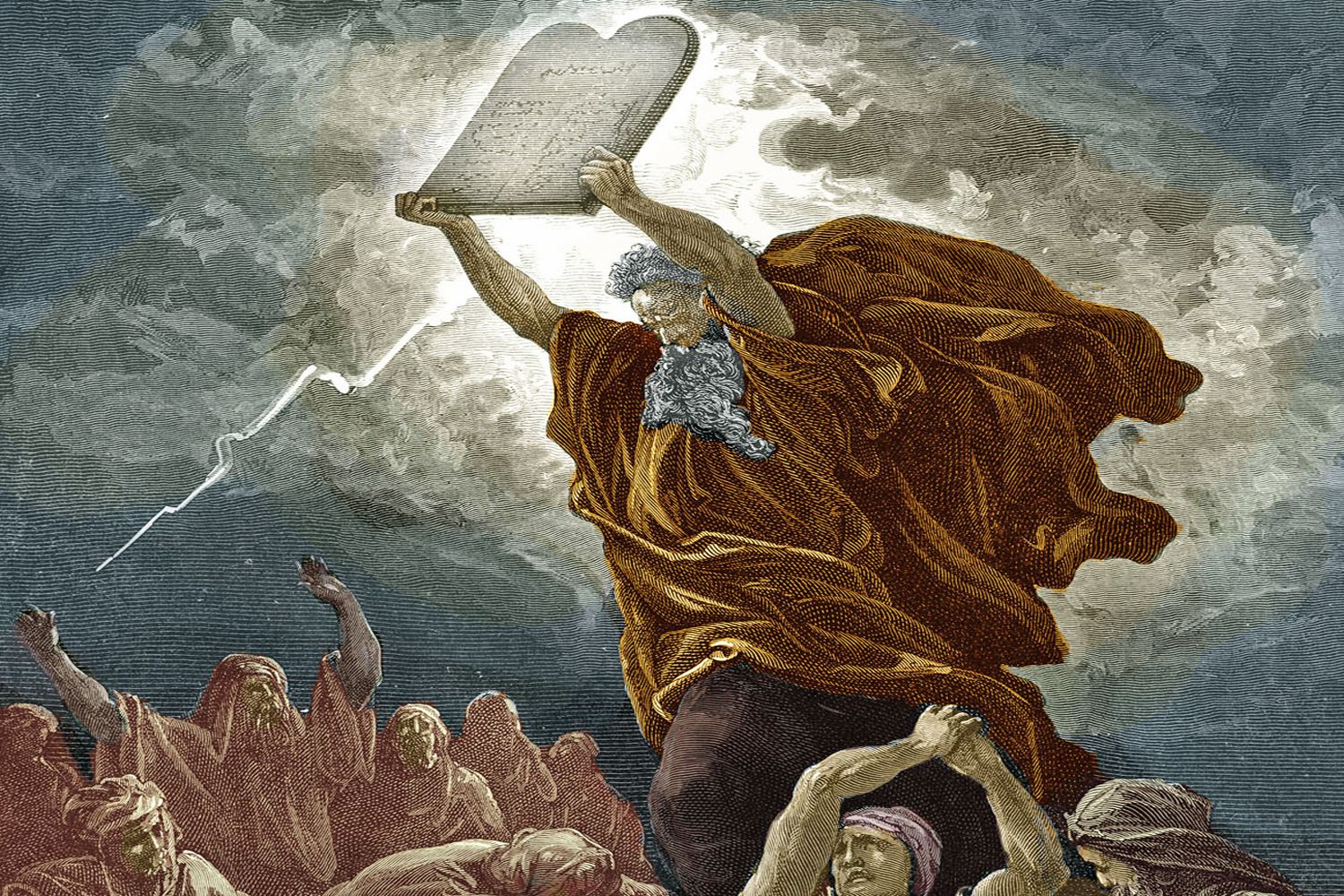
The Ten Commandments. We’re all vaguely familiar with them, even if we can’t recite them from memory. And we all have an image that comes to mind when we think of Moses holding the two tablets of stone containing the hand-carved code of conduct given by God to the people of Israel. But those commands seem distant and somewhat antiquated to most of us. And for many Christians, we operate as if the Ten Commandments no longer apply to us because we live under grace, not law. After all, the apostle Paul tells us, “Christ has rescued us from the curse pronounced by the law. When he was hung on the cross, he took upon himself the curse for our wrongdoing” (Galatians 3:13 NLT).

It’s easy to read a passage like that one and assume that the Ten Commandments are out-of-date and no longer apply. And Paul seems to support that conclusion with his words to the Christians in Rome.

For Christ is the end of the law for righteousness to everyone who believes. – Romans 10:4 ESV

But before we jump to conclusions, we have to recall the words of Jesus.

“Don’t misunderstand why I have come. I did not come to abolish the law of Moses or the writings of the prophets. No, I came to accomplish their purpose.” – Matthew 5:17 NLT

Jesus claimed to have come to earth in order to accomplish the purpose behind the law of Moses and the writings of the prophets. We would tend to say that Jesus came to earth to save the lost, and we would be right. Because that is exactly what the law foreshadowed and the prophecies of the Old Testament foretold. The apostle Paul tells us exactly why the law was given.

Why, then, was the law given? It was given alongside the promise to show people their sins. But the law was designed to last only until the coming of the child who was promised. – Galatians 3:19 NLT

God gave the law to the people of Israel in order that they might know just how holy He was and just how sinful they truly were. With God’s detailed list of all the dos and don’ts, shalls, and shall-nots provided for them, the people of Israel could not claim ignorance when it came to God’s expectations of them. But while His rules established clear guidelines for living, they also revealed man’s inability to live up to those guidelines. The Ten Commandments are holy, righteous, and just, providing man with a detailed list of God’s non-negotiable requirements for maintaining a right relationship with Him. But, once again, Paul reminds us that the law could never make anyone right with God because no one was capable of living up to God’s holy standard.

For no one can ever be made right with God by doing what the law commands. The law simply shows us how sinful we are. – Romans 3:20 NLT

The author of Hebrews adds that “the law never made anything perfect” (Hebrews 7:19 NLT). In other words, God’s giving of His holy law was intended to provide the Israelites with a clear standard or set of guidelines for living. But the presence of the law did not empower the people to obey. It told them what God expected of them, but did not provide them with the capacity to live up to those expectations. In a sense, the law could only condemn, not save.

Think of it this way: A speed limit sign is a government-sanctioned law declaring the legally established maximum rate of travel for a motor vehicle. It lets drivers know just how fast they are allowed to go on a particular section of highway. It cannot force them to travel at that speed. It does not limit their capacity to drive slower or faster. It simply sets the rules of conduct for that driving on that patch of road. But if the posted speed limit is 65 and you are traveling 75, every time you pass one of those signs declaring the speed limit, you will be condemned as guilty. All the sign can do is confirm if we are living up to the established standard or condemn us if we are not.

The apostle Paul describes the law as our guardian, tutor, or instructor.

Before the way of faith in Christ was available to us, we were placed under guard by the law. We were kept in protective custody, so to speak, until the way of faith was revealed.

Let me put it another way. The law was our guardian until Christ came; it protected us until we could be made right with God through faith. And now that the way of faith has come, we no longer need the law as our guardian. – Galatians 3:23-25 NLT

The law was given so that man might learn just how holy God is and just how sinful they could be. So, as Moses delivered the Ten Commandments to the next generation of Israelites, he was reminding them of the holiness of their God. They were to take God’s commands seriously and to treat them with the reverence they deserved. He warned them to “learn them and be careful to do them” (Deuteronomy 5:1 ESV). Because breaking God’s laws would break their fellowship with Him. Failing to keep His commands would place them under a curse.

The Jews would live under the guardianship or tutelage of the law for generations. From the time they entered the land of Canaan to the day that Jesus Christ took on human flesh, the Jews would be required by God to live according to His law. And, as Paul put it, the law would protect them as long as they obeyed it. It functioned as the speed limit sign on the highway of life. But when Jesus came, the law became unnecessary, because He provided a way for sinful men to be made right with a holy God. Rather than trying to keep God’s holy and righteous standards through human effort, they could place their faith in Christ. The Son of God became a man so that He might live a sinless life, keeping God’s law perfectly. He obeyed every single command given by God, accomplishing what no other man had ever been able to do before.

And it was because Jesus was perfectly obedient, that He was able to be the spotless sacrifice whose life was given as payment for mankind’s sin debt. He was the one who John described as “the Lamb of God, who takes away the sin of the world!” (John 1:29 ESV).  And He was the one who made forgiveness of sin possible. In other words, He provided a way for man to receive permanent forgiveness for every single violation of God’s holy law. The law revealed man’s sinfulness, but only Jesus could remove it. The law could condemn man as guilty, but only Jesus could pronounce man as innocent and righteous. And one day Paul explained this wonderful reality to a group of Jews who had gathered to hear him speak.

“Brothers, listen! We are here to proclaim that through this man Jesus there is forgiveness for your sins. Everyone who believes in him is made right in God’s sight—something the law of Moses could never do.” – Acts 13:38-39 NLT

So, as Moses unpacks God’s law to the people of Israel, it’s essential that we understand just how blessed we are. We live on this side of the cross, where the curse of the law has been replaced by the blessing of salvation through faith alone in Christ alone. We no longer live under the burden of trying to earn God’s favor through law-keeping. That does not mean the law is null-and-void and no longer applicable. It simply means we have been given a righteousness from Christ that makes it possible for us to live in obedience to God’s commands, not based on human effort but through the indwelling power of the Holy Spirit. And rather than viewing the law as our task-master, we can see it the way Paul did: “the law itself is holy, and its commands are holy and right and good” (Romans 7:12 NLT).

English Standard Version (ESV) The Holy Bible, English Standard Version. ESV® Permanent Text Edition® (2016). Copyright © 2001 by Crossway Bibles, a publishing ministry of Good News Publishers.

New Living Translation (NLT) Holy Bible, New Living Translation, copyright © 1996, 2004, 2015 by Tyndale House Foundation. Used by permission of Tyndale House Publishers Inc., Carol Stream, Illinois 60188. All rights reserved.

The Message (MSG) Copyright © 1993, 1994, 1995, 1996, 2000, 2001, 2002 by Eugene H. Peterson


Like One Unclean.

Behold, you were angry, and we sinned; in our sins we have been a long time, and shall we be saved? We have all become like one who is unclean, and all our righteous deeds are like a polluted garment. We all fade like a leaf, and our iniquities, like the wind, take us away. There is no one who calls upon your name, who rouses himself to take hold of you; for you have hidden your face from us, and have made us melt in the hand of our iniquities. – Isaiah 64:5b-7 ESV

Isaiah 64

Isaiah was brutally honest in his assessment of the condition of God’s people. It was not a pretty picture. He had just finished saying, “You meet him who joyfully works righteousness, those who remember you in your ways” (Isaiah 64:5a ESV), but then he had to sadly acknowledge that no one in Judah fit that description. God was going to meet them, but it would not be a joyful occasion, because of their sins. God was angry with them, and rightfully so. They just couldn’t seem to stop sinning, and Isaiah couldn’t think of a reason why God would ever want to save them. Their sins had left them unclean, like a leper banned from access to the temple of God. They were impure, unholy, and unable to come into the presence of God. But Isaiah uses even more graphic language to describe the nature of their sin. All their activities, even their so-called righteous ones, were like soiled menstrual rags – unclean, unacceptable, and repulsive to the sight of God. Like a leaf fallen from a tree, they were lifeless and easily carried away by the winds of sin. 

Isaiah paints a bleak, yet honest, picture. He knew all too well just how bad things had gotten in Judah. He had been trying to get their attention. He had been warning them of God’s pending judgment. But no one had listened. They had even stopped calling out to God. They couldn’t even seem to rouse themselves from their sinful stupor long enough to lift a hand in God’s direction. From the human perspective, it was as if God had hidden Himself from them. But it was their sin that had created a barrier between them and God. He was still there. He was ready to respond as soon as they were willing to repent. But their constant state of sin had left them in a sorry condition. They were separated from God and unable to do anything to remedy their problem. In fact, God had given them over to their sin. He had allowed them to reap the consequences of their choices. They were experiencing the consequences of their sin.

The apostle Paul describes a similar situation in his letter to the Romans. “Yes, they knew God, but they wouldn’t worship him as God or even give him thanks. And they began to think up foolish ideas of what God was like. As a result, their minds became dark and confused. Claiming to be wise, they instead became utter fools. And instead of worshiping the glorious, ever-living God, they worshiped idols made to look like mere people and birds and animals and reptiles” (Romans 1:21-23 NLT). Rather than worship God, they created their own gods. They came up with gods who would approve of their sin and validate their selfish desires. As a result, God let them have exactly what they wanted. “So God abandoned them to do whatever shameful things their hearts desired” (Romans 1:24 NLT). That verse should send shudders down the spine of every believer. The very thought of God abandoning us to do what our hearts desire should scare us. Our natural man, left to its own devices, will always choose the wrong path. Our old nature, motivated by pride, lust, greed, and selfishness, will always gravitate toward rebellion against God. Even as redeemed children of God, we must never lose sight of the fact that our capacity to sin remains within us. It is only our dependence upon God and our reliance upon His indwelling Spirit that gives us the ability to live righteously instead of sinfully. Paul reminds us, “So I say, let the Holy Spirit guide your lives. Then you won’t be doing what your sinful nature craves” (Galatians 5:16 NLT).

Sin is a constant threat to the child of God. We have our old sinful nature to deal with. We live in a hostile world that is opposed to us and intent on destroying us. We have an enemy who can’t stand us and who is out to steal, kill and destroy. While our sins can never separate us from the love of God or cause us to lose our salvation, they can destroy our joy, rob us of peace, damage our witness, harden our hearts, limit our effectiveness, and harm the reputation of God. There is nothing more sad than a child of God whose life doesn’t reflect his position. We have been redeemed by God through the blood of Jesus Christ and are intended to live lives that reflect our new-found status as sons and daughters of God. We have the Spirit of God living within us and the Word of God to guide us. We have been placed within the body of Christ and been given spiritual gifts designed to minister to one another so that we might grow in Christ-likeness. But sin can and will wreak havoc on our spiritual lives if we allow it to. If we give in to our sinful nature, we will reap the consequences. That’s why our constant dependence upon God is so important. Paul put it this way: “My old self has been crucified with Christ. It is no longer I who live, but Christ lives in me. So I live in this earthly body by trusting in the Son of God, who loved me and gave himself for me” (Galatians 2:2 NLT). I can choose to live as one unclean or as one who has been cleansed by the blood of Christ. I can give in to my old sinful nature or I can live in constant reliance upon the will of God with the help of the Spirit of God.