Our All-Knowing God Always Knows What Is Best

16 The Lord spoke to Moses, saying, 17 “These are the names of the men who shall divide the land to you for inheritance: Eleazar the priest and Joshua the son of Nun. 18 You shall take one chief from every tribe to divide the land for inheritance. 19 These are the names of the men: Of the tribe of Judah, Caleb the son of Jephunneh. 20 Of the tribe of the people of Simeon, Shemuel the son of Ammihud. 21 Of the tribe of Benjamin, Elidad the son of Chislon. 22 Of the tribe of the people of Dan a chief, Bukki the son of Jogli. 23 Of the people of Joseph: of the tribe of the people of Manasseh a chief, Hanniel the son of Ephod. 24 And of the tribe of the people of Ephraim a chief, Kemuel the son of Shiphtan. 25 Of the tribe of the people of Zebulun a chief, Elizaphan the son of Parnach. 26 Of the tribe of the people of Issachar a chief, Paltiel the son of Azzan. 27 And of the tribe of the people of Asher a chief, Ahihud the son of Shelomi. 28 Of the tribe of the people of Naphtali a chief, Pedahel the son of Ammihud.” 29 These are the men whom the Lord commanded to divide the inheritance for the people of Israel in the land of Canaan. 

1 The Lord spoke to Moses in the plains of Moab by the Jordan at Jericho, saying, 2 “Command the people of Israel to give to the Levites some of the inheritance of their possession as cities for them to dwell in. And you shall give to the Levites pasturelands around the cities. 3 The cities shall be theirs to dwell in, and their pasturelands shall be for their cattle and for their livestock and for all their beasts. 4 The pasturelands of the cities, which you shall give to the Levites, shall reach from the wall of the city outward a thousand cubits all around. 5 And you shall measure, outside the city, on the east side two thousand cubits, and on the south side two thousand cubits, and on the west side two thousand cubits, and on the north side two thousand cubits, the city being in the middle. This shall belong to them as pastureland for their cities.

6 “The cities that you give to the Levites shall be the six cities of refuge, where you shall permit the manslayer to flee, and in addition to them you shall give forty-two cities. 7 All the cities that you give to the Levites shall be forty-eight, with their pasturelands. 8 And as for the cities that you shall give from the possession of the people of Israel, from the larger tribes you shall take many, and from the smaller tribes you shall take few; each, in proportion to the inheritance that it inherits, shall give of its cities to the Levites.” – Numbers 34:16-35:8 ESV
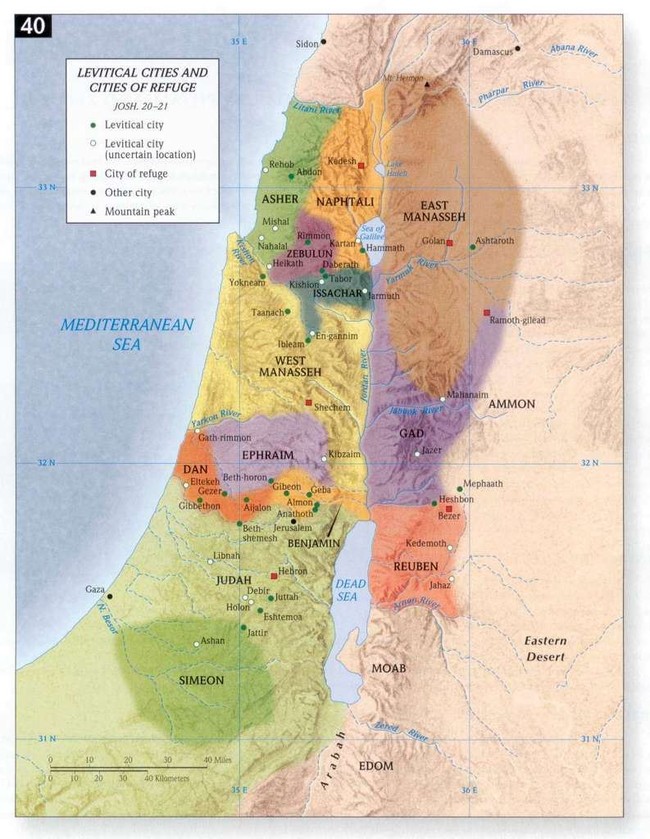
God provided Moses with the name of one man from each of the ten tribes of Israel. These men, hand-picked by God, would assist Eleazar, the high priest, and Joshua in the distribution of the land. The tribes of Gad and Reuben were not included because they had chosen to settle outside the boundaries of Canaan. These men were well-respected leaders among their respective tribes and would help to guarantee that the land was fairly apportioned and that each tribe, regardless of its size, was treated equitably and fairly. There was to be no favoritism or any form of nepotism. The larger tribes, whose numbers would be based on the recent census taken by Moses, would be allotted more extensive land allotments. But was not a guarantee that they would receive the best land. God was giving these ten men the weighty responsibility of dividing up the Israelites’ inheritance in a way that would satisfy all the parties involved, and that would not be an easy task.

The next thing on God’s agenda was to arrange for the needs of the tribe of Levi, his own tribe. He had already informed Moses that the Levites would inherit no land in Canaan. God had set apart the tribe of Levi as His special possession and had dedicated them to the care and maintenance of the Tabernacle. As a result, God promised to be their inheritance.

“Remember that the Levitical priests—that is, the whole of the tribe of Levi—will receive no allotment of land among the other tribes in Israel. Instead, the priests and Levites will eat from the special gifts given to the Lord, for that is their share. 2 They will have no land of their own among the Israelites. The Lord himself is their special possession, just as he promised them.” – Deuteronomy 18:1-2 NLT
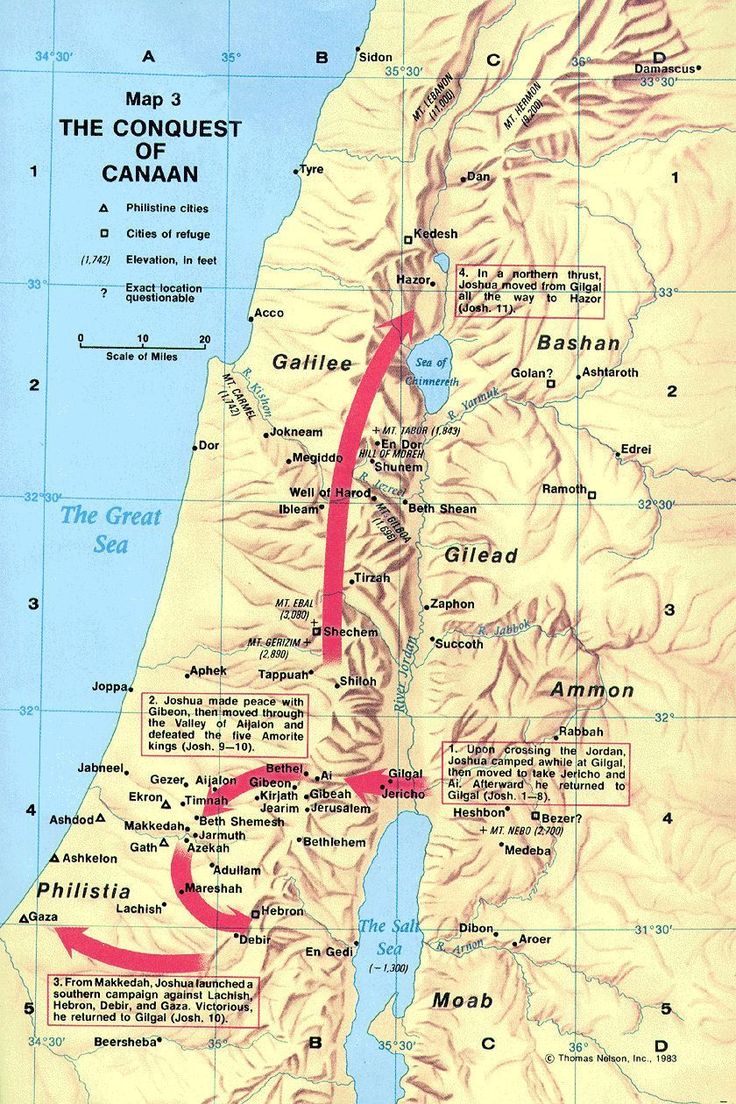
But while the Levites would be allotted no land in Canaan, they would be awarded the deeds to 48 cities located within the territories of each of the other 11 tribes (Joshua 21). Even the tribes of Gad, Reuben, and the half-tribe of Manasseh were required to provide the Levites with towns and pastureland for their flocks on the other side of the Jordan River. God had made ample accommodations for the Levites.

These Levitical cities were to be strategically located throughout the nation of Israel so that every Israelite was no more than ten miles from one of them. This helped to ensure that the people of God were never far away from a member of the Levitical priesthood, whose job was to provide instruction in the ways of God. The Levitical priests served as judges (Deuteronomy 17:8-13) and teachers of God’s law (Deuteronomy 33:10). So, it was essential that every Israelite had ready access to a Levitical town and a priest of God.

Of the 48 towns awarded to the Levites, six were to be designated as cities of refuge. These were specially sanctioned zones within the boundaries of Israel where anyone guilty of committing a non-premediated murder could seek asylum. God had already declared His ruling concerning murder (Exodus 20:13), but He had Moses present a special provision for cases involving accidental homicide.

“If someone kills another person unintentionally, without previous hostility, the slayer may flee to any of these cities to live in safety.” – Deuteronomy 19:4 NLT

He even had Moses provide a potential scenario in which a city of refuge would become necessary.

“For example, suppose someone goes into the forest with a neighbor to cut wood. And suppose one of them swings an ax to chop down a tree, and the ax head flies off the handle, killing the other person. In such cases, the slayer may flee to one of the cities of refuge to live in safety.” – Deuteronomy 19:5 NLT

God knew that life would happen and that deadly accidents would be a part of the Israelites’ existence in the land. Men would be killed and justice would need to be pursued. But what He didn’t want was some form of vigilante justice running rampant through the nation. Yet God knew that the relatives of a murder victim would tend to seek revenge against the guilty party and ask questions later. The cities of refuge were intended to protect the innocent while justice was being served.

Since Israel had no professional police force, these kinds of accidents could easily turn into bloodbaths where the relatives of the victim sought to avenge their loved one’s death. So, these cities, occupied by the Levites, would provide a place where the guilty party could find solace and seek a fair judgment concerning his guilt or innocence. In His plans for the land of promise, God was leaving nothing to chance. He was creating a well-designed system for dealing with the inevitable problem of sin among His chosen people. He was going to distribute the Levitical priesthood among them to provide spiritual enlightenment and He was going to create safe havens for those who unwittingly committed even the gravest of sins. God was providing for and protecting His people.

English Standard Version (ESV) The Holy Bible, English Standard Version. ESV® Permanent Text Edition® (2016). Copyright © 2001

New Living Translation (NLT) Holy Bible, New Living Translation, copyright © 1996, 2004, 2015 by Tyndale House Foundation. Used by permission of Tyndale House Publishers Inc., Carol Stream, Illinois 60188. All rights reserved.
Potential Trouble in Paradise

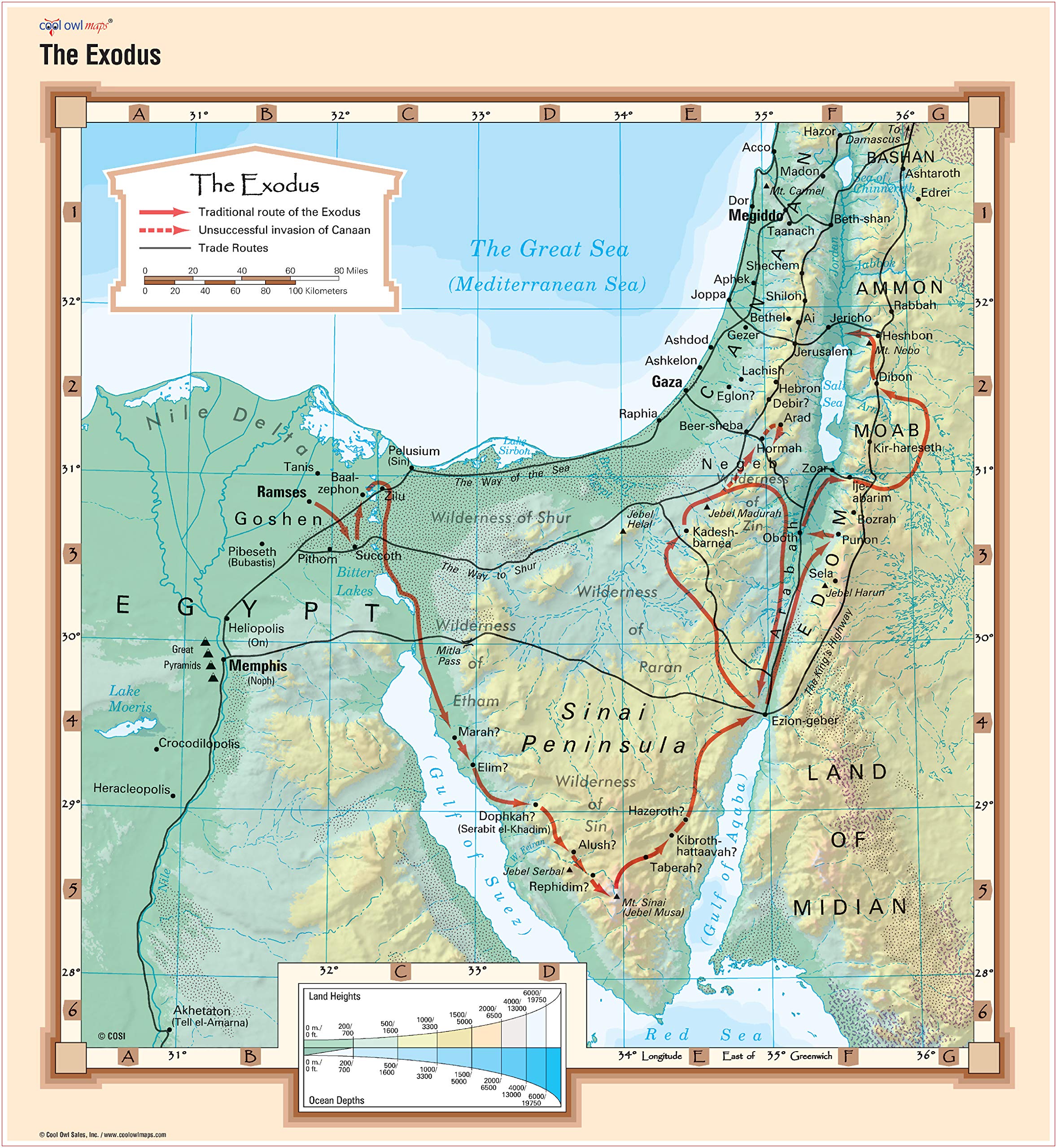
1 These are the stages of the people of Israel, when they went out of the land of Egypt by their companies under the leadership of Moses and Aaron. 2 Moses wrote down their starting places, stage by stage, by command of the Lord, and these are their stages according to their starting places. 3 They set out from Rameses in the first month, on the fifteenth day of the first month. On the day after the Passover, the people of Israel went out triumphantly in the sight of all the Egyptians, 4 while the Egyptians were burying all their firstborn, whom the Lord had struck down among them. On their gods also the Lord executed judgments.

5 So the people of Israel set out from Rameses and camped at Succoth. 6 And they set out from Succoth and camped at Etham, which is on the edge of the wilderness. 7 And they set out from Etham and turned back to Pi-hahiroth, which is east of Baal-zephon, and they camped before Migdol. 8 And they set out from before Hahiroth and passed through the midst of the sea into the wilderness, and they went a three days’ journey in the wilderness of Etham and camped at Marah. 9 And they set out from Marah and came to Elim; at Elim there were twelve springs of water and seventy palm trees, and they camped there. 10 And they set out from Elim and camped by the Red Sea. 11 And they set out from the Red Sea and camped in the wilderness of Sin. 12 And they set out from the wilderness of Sin and camped at Dophkah. 13 And they set out from Dophkah and camped at Alush. 14 And they set out from Alush and camped at Rephidim, where there was no water for the people to drink. 15 And they set out from Rephidim and camped in the wilderness of Sinai. 16 And they set out from the wilderness of Sinai and camped at Kibroth-hattaavah. 17 And they set out from Kibroth-hattaavah and camped at Hazeroth. 18 And they set out from Hazeroth and camped at Rithmah. 19 And they set out from Rithmah and camped at Rimmon-perez. 20 And they set out from Rimmon-perez and camped at Libnah. 21 And they set out from Libnah and camped at Rissah. 22 And they set out from Rissah and camped at Kehelathah. 23 And they set out from Kehelathah and camped at Mount Shepher. 24 And they set out from Mount Shepher and camped at Haradah. 25 And they set out from Haradah and camped at Makheloth. 26 And they set out from Makheloth and camped at Tahath. 27 And they set out from Tahath and camped at Terah. 28 And they set out from Terah and camped at Mithkah. 29 And they set out from Mithkah and camped at Hashmonah. 30 And they set out from Hashmonah and camped at Moseroth. 31 And they set out from Moseroth and camped at Bene-jaakan. 32 And they set out from Bene-jaakan and camped at Hor-haggidgad. 33 And they set out from Hor-haggidgad and camped at Jotbathah. 34 And they set out from Jotbathah and camped at Abronah. 35 And they set out from Abronah and camped at Ezion-geber. 36 And they set out from Ezion-geber and camped in the wilderness of Zin (that is, Kadesh). 37 And they set out from Kadesh and camped at Mount Hor, on the edge of the land of Edom.

38 And Aaron the priest went up Mount Hor at the command of the Lord and died there, in the fortieth year after the people of Israel had come out of the land of Egypt, on the first day of the fifth month. 39 And Aaron was 123 years old when he died on Mount Hor.

40 And the Canaanite, the king of Arad, who lived in the Negeb in the land of Canaan, heard of the coming of the people of Israel.

41 And they set out from Mount Hor and camped at Zalmonah. 42 And they set out from Zalmonah and camped at Punon. 43 And they set out from Punon and camped at Oboth. 44 And they set out from Oboth and camped at Iye-abarim, in the territory of Moab. 45 And they set out from Iyim and camped at Dibon-gad. 46 And they set out from Dibon-gad and camped at Almon-diblathaim. 47 And they set out from Almon-diblathaim and camped in the mountains of Abarim, before Nebo. 48 And they set out from the mountains of Abarim and camped in the plains of Moab by the Jordan at Jericho; 49 they camped by the Jordan from Beth-jeshimoth as far as Abel-shittim in the plains of Moab.

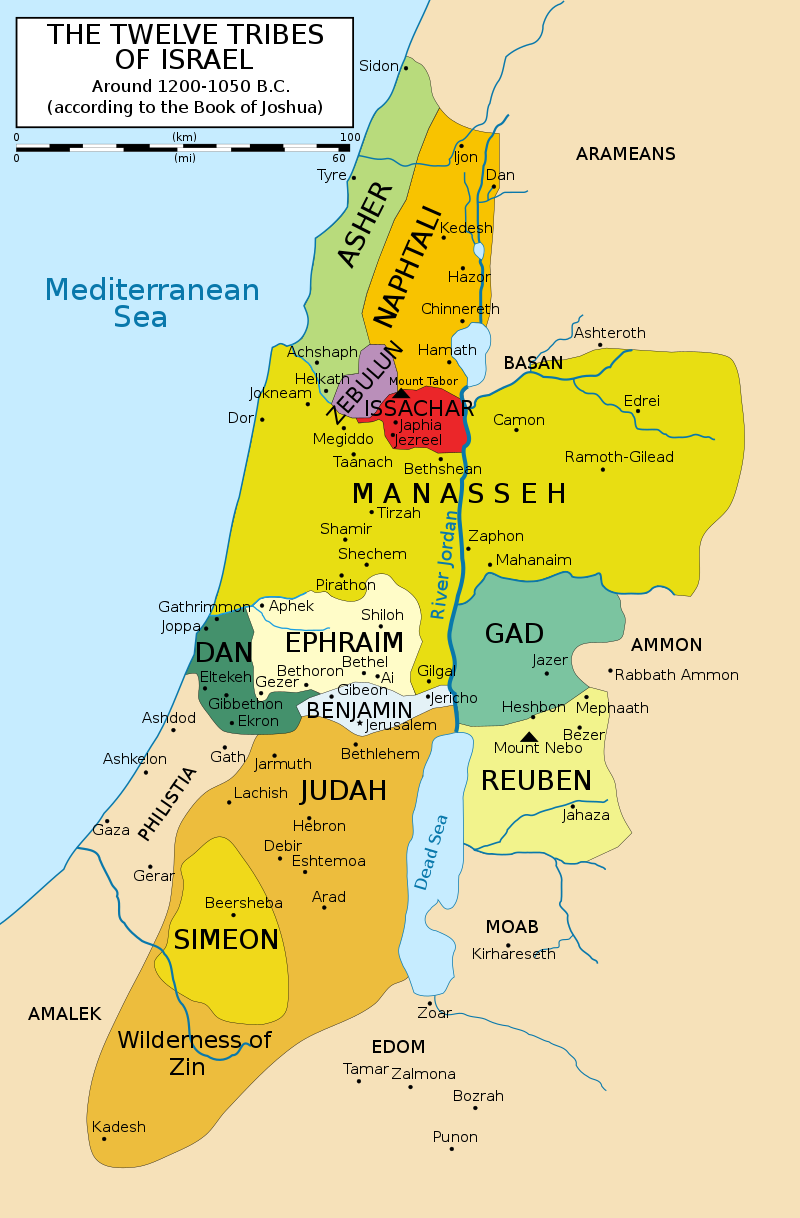
50 And the Lord spoke to Moses in the plains of Moab by the Jordan at Jericho, saying, 51 “Speak to the people of Israel and say to them, When you pass over the Jordan into the land of Canaan, 52 then you shall drive out all the inhabitants of the land from before you and destroy all their figured stones and destroy all their metal images and demolish all their high places. 53 And you shall take possession of the land and settle in it, for I have given the land to you to possess it. 54 You shall inherit the land by lot according to your clans. To a large tribe you shall give a large inheritance, and to a small tribe you shall give a small inheritance. Wherever the lot falls for anyone, that shall be his. According to the tribes of your fathers you shall inherit. 55 But if you do not drive out the inhabitants of the land from before you, then those of them whom you let remain shall be as barbs in your eyes and thorns in your sides, and they shall trouble you in the land where you dwell. 56 And I will do to you as I thought to do to them.” – Numbers 33:1-56 ESV

The people of Israel are almost home. After more than 40 years in the wilderness, they stand on the eastern bank of Jordan River waiting for God’s command to cross over and begin their conquest and occupation of the land of promise. The day they had long been waiting for had finally arrived. There had been a lengthy delay, but now it was time to enjoy what God had promised so long ago.

But as with most things associated with God, the blessing was tied to a requirement. He had one last instruction to give them before they took possession of the land, and it was a fairly significant one. They must drive out all the people who were living there. On top of that, they had to destroy all the idols and pagan shrines erected to the gods of the land. They were to smash every vestige of idol worship they found. In other words, God expected them to clean house before they set up house.

Sounds simple enough doesn’t it? But if you’re the least bit familiar with the story of the Israelites, they didn’t exactly follow God’s instructions to the letter. They took a few liberties. It’s almost as if the enemy (Satan) was standing there just as he had been in the garden of Eden, asking the question, “Surely, God has not said…”

I can just hear Satan whispering in their ears, “You don’t have to get rid of ALL the idols, just most of them.” Or maybe he worded his temptation this way: “You might want to leave one of the pagan shrines intact, just in case Yahweh doesn’t come through for you.”

And as far as ridding the land of all its occupants, Satan probably did his best to convince the people of God just how politically incorrect and insensitive this might appear to the rest of the people in the region. They probably thought to themselves, “We don’t want to get off on the wrong foot with our new neighbors, do we?”

And God seemed to know that the people would have second thoughts about His command, so He warned them what would happen if they failed to obey.

“But if you fail to drive out the people who live in the land, those who remain will be like splinters in your eyes and thorns in your sides. They will harass you in the land where you live. And I will do to you what I had planned to do to them.” – Numbers 33:55-56 NLT

“Disobey me,” God says, “and you will live to regret it.” This was not a suggestion, but a command. God expected them to follow His requirements without delay or deviation. He had a good reason for what He was asking them to do, and He knew exactly what would happen if they chose to disobey Him. If the Israelites failed to remove the land’s occupants, their enemies would become a constant threat and a thorn in their side. They would never learn to live amicably together. So, cleansing was critical for spiritual survival.

In his commentary on the book of Numbers, Dr. Thomas Constable writes, “The repetition of ‘all’ (Numbers 33:52) stresses the importance of completely clearing the land of its inhabitants and their religious paraphernalia. God wanted to clean up the land spiritually and to make it a ‘holy land.’ The land was a gift from God to His first-born son, Israel (Numbers 33:53). God warned the Israelites what would happen to them if they were not completely obedient (Numbers 333:55-56). The Canaanites would be a constant source of irritation to them, and God would deal with His people as He planned to deal with the Canaanites.”

God wanted to purify the land spiritually and make it holy. That reminds me of what God wants to do with my life. He wants to clean it up spiritually and set it apart for His use. He is about removing anything in my life that might defile or defeat me. He wants to clean house.

But I tend to hang on to certain remnants of my past. I want to give the enemy some footholds in my life where he can live at peace. I want to keep some of the idols that were there before God came to occupy the land. I find the idols comforting. They bring me a little bit of peace and assurance. But God wants to purge my life of any vestiges of the past. He wants to make all things new. To receive all the blessings the Promised Land had to offer, the people had to obey God fully. The same thing is true for us today. To enjoy all the blessings our new life in Christ offers, we must obey God fully. God makes this clear in His Word.

…throw off your old evil nature and your former way of life, which is rotten through and through, full of lust and deception. – Ephesians 4:22 NLT

Don’t lie to one another. You’re done with that old life. It’s like a filthy set of ill-fitting clothes you’ve stripped off and put in the fire. – Colossians 3:9 MSG

The night is almost gone; the day of salvation will soon be here. So don’t live in darkness. Get rid of your evil deeds. Shed them like dirty clothes. Clothe yourselves with the armor of right living, as those who live in the light. We should be decent and true in everything we do, so that everyone can approve of our behavior. Don’t participate in wild parties and getting drunk, or in adultery and immoral living, or in fighting and jealousy. But let the Lord Jesus Christ take control of you, and don’t think of ways to indulge your evil desires. – Romans 13:12-14 NLT

God was looking for change in the lives of the Israelites. He wanted to purge and purify them, and that process began with a thorough cleansing of the land. His desire was to rid the landscape of their lives of any and all vestiges of the past.

Like the Israelites, we must take our set-apart status seriously.  We must remove all the idols and false gods that might draw us away from full reliance upon Him. If we do, we will be blessed. If we don’t, we will always find ourselves doing battle with past enemies and tempted to worship the false gods of our former life. Cleansing is always the key to blessing.

English Standard Version (ESV) The Holy Bible, English Standard Version. ESV® Permanent Text Edition® (2016). Copyright © 2001

New Living Translation (NLT) Holy Bible, New Living Translation, copyright © 1996, 2004, 2015 by Tyndale House Foundation. Used by permission of Tyndale House Publishers Inc., Carol Stream, Illinois 60188. All rights reserved.

Part of the Plan

28 So Moses gave command concerning them to Eleazar the priest and to Joshua the son of Nun and to the heads of the fathers’ houses of the tribes of the people of Israel. 29 And Moses said to them, “If the people of Gad and the people of Reuben, every man who is armed to battle before the Lord, will pass with you over the Jordan and the land shall be subdued before you, then you shall give them the land of Gilead for a possession. 30 However, if they will not pass over with you armed, they shall have possessions among you in the land of Canaan.” 31 And the people of Gad and the people of Reuben answered, “What the Lord has said to your servants, we will do. 32 We will pass over armed before the Lord into the land of Canaan, and the possession of our inheritance shall remain with us beyond the Jordan.”

33 And Moses gave to them, to the people of Gad and to the people of Reuben and to the half-tribe of Manasseh the son of Joseph, the kingdom of Sihon king of the Amorites and the kingdom of Og king of Bashan, the land and its cities with their territories, the cities of the land throughout the country. 34 And the people of Gad built Dibon, Ataroth, Aroer, 35 Atroth-shophan, Jazer, Jogbehah, 36 Beth-nimrah and Beth-haran, fortified cities, and folds for sheep. 37 And the people of Reuben built Heshbon, Elealeh, Kiriathaim, 38 Nebo, and Baal-meon (their names were changed), and Sibmah. And they gave other names to the cities that they built. 39 And the sons of Machir the son of Manasseh went to Gilead and captured it, and dispossessed the Amorites who were in it. 40 And Moses gave Gilead to Machir the son of Manasseh, and he settled in it. 41 And Jair the son of Manasseh went and captured their villages, and called them Havvoth-jair. 42 And Nobah went and captured Kenath and its villages, and called it Nobah, after his own name. – Numbers 32:28-42 ESV

After listening to the proposal from the tribes of Gad and Reuben, Moses agreed to allow them to settle in land on the eastern side of the Jordan River, just outside the borders of Canaan. But he required them to swear an oath of fealty to the ten remaining tribes, agreeing to assist them in their conquest of the land of Canaan.

Moses then communicated the terms of the agreement to all the tribes of Israel, ensuring that everyone understood what was expected and what was to be done if those terms were not met. He wanted there to be no confusion or disagreement as to what this concession entailed for both parties.

“The men of Gad and Reuben who are armed for battle must cross the Jordan with you to fight for the Lord. If they do, give them the land of Gilead as their property when the land is conquered. But if they refuse to arm themselves and cross over with you, then they must accept land with the rest of you in the land of Canaan.” – Numbers 32:29-30 NLT

Notice that the terms of the agreement included the full participation of the Gadites and Reubenites until the land was fully conquered. This would not be a short-term commitment that entailed a single battle or a few short weeks of military service. The two tribes were obligated to fight alongside their brothers for the foreseeable future. And these two tribes were committing a sizeable number of their male population to fight for land that they would never occupy. In fact, the census Moses had taken revealed that between the tribes of Gad and Reuben, they fielded 84,230 soldiers. That comprised 14 percent of the entire Israelite force. So, their involvement in the conquest of Canaan would be vitally necessary to Israel’s success.

And the two tribes recommitted themselves to the terms of the agreement, assuring Moses and the rest of the leaders that they would follow through on their commitment.

“We are your servants, and we will do as the Lord has commanded! We will cross the Jordan into Canaan fully armed to fight for the Lord, but our property will be here on this side of the Jordan.” – Numbers 32:31-32 NLT

For however long it took, the Gadites and Reubenites would fight alongside their brothers and help ensure that every one of the ten tribes had successfully conquered and occupied their portion of the inheritance. That was a huge commitment on their part.

At this point in the narrative, it becomes clear that there was a third tribe that decided to get in on the action. This was the tribe of Manassah, one of the two sons of Joseph.

So Moses assigned land to the tribes of Gad, Reuben, and half the tribe of Manasseh son of Joseph. He gave them the territory of King Sihon of the Amorites and the land of King Og of Bashan—the whole land with its cities and surrounding lands. – Numbers 32:33 NLT

Half of this tribe also decided to take advantage of the prime real estate on the eastern side of the Jordan River. And Moses gave them his approval.

The rest of the chapter outlines how the three tribes began their conquest of the area known as the Transjordan. Long before the Israelites crossed over the Jordan and began to do battle with the Canaanites, the tribes of Gad, Reuben, and Manassah were gaining invaluable fighting experience against the enemies of Israel. The battles they undertook east of the Jordan would provide them with much-needed expertise in warfare strategy. It seems likely that their fellow Israelites assisted in many of these battles, assuring that the three tribes were able to capture and occupy enough land to meet the needs of their people.

God was sovereignly preparing the entire nation to enter the land of promise and carry out His divine plan. By the time came for them to cross the Jordan and conduct their first military campaign, they would have the confidence and experience they needed to succeed.

English Standard Version (ESV) The Holy Bible, English Standard Version. ESV® Permanent Text Edition® (2016). Copyright © 2001

New Living Translation (NLT) Holy Bible, New Living Translation, copyright © 1996, 2004, 2015 by Tyndale House Foundation. Used by permission of Tyndale House Publishers Inc., Carol Stream, Illinois 60188. All rights reserved.

High Walls, No Problem

1 “Then we turned and went up the way to Bashan. And Og the king of Bashan came out against us, he and all his people, to battle at Edrei. 2 But the Lord said to me, ‘Do not fear him, for I have given him and all his people and his land into your hand. And you shall do to him as you did to Sihon the king of the Amorites, who lived at Heshbon.’ 3 So the Lord our God gave into our hand Og also, the king of Bashan, and all his people, and we struck him down until he had no survivor left. 4 And we took all his cities at that time—there was not a city that we did not take from them—sixty cities, the whole region of Argob, the kingdom of Og in Bashan. 5 All these were cities fortified with high walls, gates, and bars, besides very many unwalled villages. 6 And we devoted them to destruction, as we did to Sihon the king of Heshbon, devoting to destruction every city, men, women, and children. 7 But all the livestock and the spoil of the cities we took as our plunder. 8 So we took the land at that time out of the hand of the two kings of the Amorites who were beyond the Jordan, from the Valley of the Arnon to Mount Hermon 9 (the Sidonians call Hermon Sirion, while the Amorites call it Senir), 10 all the cities of the tableland and all Gilead and all Bashan, as far as Salecah and Edrei, cities of the kingdom of Og in Bashan. 11 (For only Og the king of Bashan was left of the remnant of the Rephaim. Behold, his bed was a bed of iron. Is it not in Rabbah of the Ammonites? Nine cubits was its length, and four cubits its breadth, according to the common cubit).” – Deuteronomy 3:1-11 ESV

This chapter continues Moses’ description of the conquest of the Transjordan region – that are east of the Jordan River that was outside the land of Canaan. While the Israelites had their eyes set on the land west of the Jordan, God was leading them to remove any and all enemies on the other side of the river who might pose a future threat to their safety. This included the people living in Bashan. 

As we saw in yesterday’s post, God’s promise to Abraham had been much more extensive in terms of territorial boundaries.

“To your offspring I give this land, from the river of Egypt to the great river, the river Euphrates, the land of the Kenites, the Kenizzites, the Kadmonites, the Hittites, the Perizzites, the Rephaim, the Amorites, the Canaanites, the Girgashites and the Jebusites.” – Genesis 15:18-21 ESV

God had meant for Israel to fill the land from the Brook of Egypt, a small wadi on the easter border of Egypt, all the way to the Euphrates.  He had big plans for His chosen people. And, during the days of King David, Israel saw this promise partially fulfilled

David was able to extend the boundaries of Israel until it included virtually all of the land God had promised to Abraham. But it would not remain theirs for long. Disobedience on the part of Solomon, David’s son and successor, would cause God to split the kingdom in half, and it would never be restored to its former glory.

But there is a line in these opening verses of chapter 3 that speaks volumes regarding God’s power and man’s unwillingness or inability to trust in that power. After God commanded Moses to take the land belonging to Og, the king of Bashan, the people of Israel obeyed and were given a great victory over their enemies. They were able to destroy every city, town, and small village within the land. But notice how Moses describes their victory.

And we took all his cities at that time—there was not a city that we did not take from them—sixty cities, the whole region of Argob, the kingdom of Og in Bashan. All these were cities fortified with high walls, gates, and bars, besides very many unwalled villages. – Deuteronomy 3:4-5 ESV

If you recall, the reason the people of Israel had failed to enter the land 40 years earlier was because the 12 spies had brought back disturbing news. They had reported that the land was rich in produced but it was also defended by powerful armies who were housed in well-fortified cities. In fact, the people  had responded to the news by saying, “Our brothers have made our hearts melt, saying, ‘The people are greater and taller than we. The cities are great and fortified up to heaven’” (Deuteronomy 1:28 ESV).

And even when God assured them of certain victory, they had refused to believe. Moses had pleaded with them to trust God.

“Do not be in dread or afraid of them. The Lord your God who goes before you will himself fight for you, just as he did for you in Egypt before your eyes, and in the wilderness, where you have seen how the Lord your God carried you, as a man carries his son, all the way that you went until you came to this place.” – Deuteronomy 1:29-31 ESV

But the words of Moses had no impact on the people. He summarized their response to his pleas by saying, “Yet in spite of this word you did not believe the Lord your God” (Deuteronomy 1:32 ESV). Their enemies were bigger than their God. The circumstances they faced were greater than the God they claimed to follow. And it didn’t matter to them that He had freed them from slavery in Egypt and had faithfully guided them across the desert. When they had assessed their current situation, they had deemed their God incapable of fulfilling His promises to them.

Now, four decades later, God was proving Himself fully capable of defeating any and all enemies. The spies had been right. The cities were surrounded by high walls, but they proved to be no obstacle for God. He gave His chosen people victory over their enemies, allowing them to defeat what appeared to be more powerful armies and to destroy siege-proof cities. In fact, Moses states that “there was not a city that we did not take from them” (Deuteronomy 3:4 ESV). A total of 60 cities fell that day, and the people of Israel were able to take spoil from each and every one of them. And the resources they gathered would prove essential in supplying their future needs as they prepared their conquest of the land of Canaan.

The victories God gave His people were necessary. Not only did the plunder provide the Israelites with plenty of food for the future, the land would house the future settlements of the tribes of Dan and Reuben, as well as the half-tribe of Manassah. These battles were all part of God’s plan for His people. And while we may find the description of Israel’s complete annihilation of these people groups disturbing, there was a divine strategy taking place. As we saw yesterday, God had a reason for eliminating the nations that occupied the land and Moses made that reason known to the people of Israel.

“…because of the wickedness of these nations the Lord your God is driving them out from before you…” – Deuteronomy 9:5 ESV

God knew that these people, if allowed to remain in the land, would prove to be a constant threat to the people of Israel, not just militarily, but also morally. Their false religions and immoral behavior would tempt the Israelites to turn their backs on God. That is why God commanded His people to remove all the Canaanites from the land. But, as we will see, they would fail to do so. They would not fully comply with God’s commands and their failure to do so would play a huge part in their future demise as a nation.

English Standard Version (ESV) The Holy Bible, English Standard Version. ESV® Permanent Text Edition® (2016). Copyright © 2001 by Crossway Bibles, a publishing ministry of Good News Publishers.

New Living Translation (NLT) Holy Bible, New Living Translation, copyright © 1996, 2004, 2015 by Tyndale House Foundation. Used by permission of Tyndale House Publishers Inc., Carol Stream, Illinois 60188. All rights reserved.

The Message (MSG) Copyright © 1993, 1994, 1995, 1996, 2000, 2001, 2002 by Eugene H. Peterson