Divine Payback

1 The word of the Lord came to me: “Son of man, set your face toward the Ammonites and prophesy against them. Say to the Ammonites, Hear the word of the Lord God: Thus says the Lord God, Because you said, ‘Aha!’ over my sanctuary when it was profaned, and over the land of Israel when it was made desolate, and over the house of Judah when they went into exile, therefore behold, I am handing you over to the people of the East for a possession, and they shall set their encampments among you and make their dwellings in your midst. They shall eat your fruit, and they shall drink your milk. I will make Rabbah a pasture for camels and Ammon a fold for flocks. Then you will know that I am the Lord. For thus says the Lord God: Because you have clapped your hands and stamped your feet and rejoiced with all the malice within your soul against the land of Israel, therefore, behold, I have stretched out my hand against you, and will hand you over as plunder to the nations. And I will cut you off from the peoples and will make you perish out of the countries; I will destroy you. Then you will know that I am the Lord.

“Thus says the Lord God: Because Moab and Seir said, ‘Behold, the house of Judah is like all the other nations,’ therefore I will lay open the flank of Moab from the cities, from its cities on its frontier, the glory of the country, Beth-jeshimoth, Baal-meon, and Kiriathaim. 10 I will give it along with the Ammonites to the people of the East as a possession, that the Ammonites may be remembered no more among the nations, 11 and I will execute judgments upon Moab. Then they will know that I am the Lord.

12 “Thus says the Lord God: Because Edom acted revengefully against the house of Judah and has grievously offended in taking vengeance on them, 13 therefore thus says the Lord God, I will stretch out my hand against Edom and cut off from it man and beast. And I will make it desolate; from Teman even to Dedan they shall fall by the sword. 14 And I will lay my vengeance upon Edom by the hand of my people Israel, and they shall do in Edom according to my anger and according to my wrath, and they shall know my vengeance, declares the Lord God.

15 “Thus says the Lord God: Because the Philistines acted revengefully and took vengeance with malice of soul to destroy in never-ending enmity, 16 therefore thus says the Lord God, Behold, I will stretch out my hand against the Philistines, and I will cut off the Cherethites and destroy the rest of the seacoast. 17 I will execute great vengeance on them with wrathful rebukes. Then they will know that I am the Lord, when I lay my vengeance upon them.” – Ezekiel 25:1-17 ESV

From the moment the Israelites entered the land of Canaan, they found themselves surrounded by a host of hostile enemies. When they showed up on the scene after their 40-year trek through the wilderness, they were greeted with less-than-open arms by the land’s current occupants. The Israelites numbered in the millions by the time they entered the land, and they were viewed as a threat by the various people groups who lived in the region. But God had granted them a particular portion of the land as their inheritance. Centuries earlier, God had promised Abraham that the land of Canaan would be the possession of his offspring.

“I will always be your God and the God of your descendants after you. And I will give the entire land of Canaan, where you now live as a foreigner, to you and your descendants. It will be their possession forever, and I will be their God.” – Genesis 17:7-8 NLT

But during the more than 500-year delay between the time when that promise was given and when the people of Israel entered Canaan, the land had not set empty or unoccupied. Its fertile soil and central location made it an attractive piece of real estate. And while the Israelites had been languishing as slaves in Egypt, a host of nations had taken up residence in and around Canaan. This included the nations listed in the chapter: Ammon, Moab, Seir, Edom, and Philistia. These particular groups occupied territory on the edges of the land of Canaan, and God had given Moses instructions about how to deal with them. In order to enter Canaan, the people of Israel would need to pass through some of these outlying territories. Their goal was to do so as peacefully as possible but, if necessary, they were ordered to use force.

“As you approach a town to attack it, you must first offer its people terms for peace. If they accept your terms and open the gates to you, then all the people inside will serve you in forced labor. But if they refuse to make peace and prepare to fight, you must attack the town. When the Lord your God hands the town over to you, use your swords to kill every man in the town. But you may keep for yourselves all the women, children, livestock, and other plunder. You may enjoy the plunder from your enemies that the Lord your God has given you. – Deuteronomy 20:10-14 NLT

Some of the nations listed in this chapter had an interesting relationship with the people of Israel. They were actually blood relations. In the case of the Ammonites and Moabites, they were the descendants of Abraham’s nephew, Lot. The record of their rather sordid history is found in the book of Genesis. Lot had made the unwise decision to settle his family in Sodom, a city infamous for its immorality. But God graciously rescued Lot and his two daughters before destroying the entire city and all its occupants.

In the immediate aftermath of Lot’s rescue, his daughters took it upon themselves to continue their family line by getting their father drunk and having sexual relations with him. And their depraved plan worked.

…both of Lot’s daughters became pregnant by their own father.  When the older daughter gave birth to a son, she named him Moab. He became the ancestor of the nation now known as the Moabites. When the younger daughter gave birth to a son, she named him Ben-ammi. He became the ancestor of the nation now known as the Ammonites. – Genesis 19:36-38 NLT

So, the Ammonites and Moabites were actually distant relatives of the Israelites. They had settled in the eastern portion of the land of Palestine long before the nation of Israel had been released from its captivity in Egypt. And they both proved to be less-than-accommodating to the Israelites as they attempted to enter the land of Canaan.

But God’s warnings recorded in Ezekiel 25 have to do with their response to the much-later fall of the northern kingdom of Israel, and what will be their gloating response to the fall of Judah and Jerusalem. When the Babylonian finally defeated the southern kingdom of Judah, the Ammonites and Moabites would rejoice. But God warns that they will suffer a similar fate at the hands of “the people of the East” (Ezekiel 25:10 ESV).

And the same thing will happen to the Edomites. This nation enjoyed a close relationship with the Israelites as well. They were the descendants of Esau, the twin brother of Jacob. And while both brothers were in their mother’s womb, God had warned Rebekah, “The sons in your womb will become two nations. From the very beginning, the two nations will be rivals. One nation will be stronger than the other; and your older son will serve your younger son” (Genesis 25:23 NLT).

The Edomites and Israelites never got along. In fact, their history was marked by constant conflict. Despite their blood ties, there was no love lost between these two nations. And because the Edomites would also rejoice at Judah’s demise, God would bring judgment upon them as well.

“I will raise my fist of judgment against Edom. I will wipe out its people and animals with the sword. I will make a wasteland of everything from Teman to Dedan.” – Ezekiel 25:13 NLT

The final nation addressed in God’s message to Ezekiel is Philistia. The Philistines occupied the land along the shore of the Mediterranean Sea, just west of Canaan. They are first listed in the book of Genesis as the descendants of Mizraim, the grandson of Noah.

Mizraim was the ancestor of the Ludites, Anamites, Lehabites, Naphtuhites, Pathrusites, Casluhites, and the Caphtorites, from whom the Philistines came… – Genesis 10:13-14 NLT

So, they too were distant relatives of the Israelites. They were a warring people who posed a perennial problem for the Israelites throughout their history. When God released the Israelites from their captivity in Egypt, He had chosen to send them via a route that would avoid any conflict with the Philistines.

When Pharaoh finally let the people go, God did not lead them along the main road that runs through Philistine territory, even though that was the shortest route to the Promised Land. God said, “If the people are faced with a battle, they might change their minds and return to Egypt.” – Exodus 13:17 NLT

God knew that an encounter with the Philistines might dissuade His people from attempting to enter the land He had promised them, so He sent them on a lengthier and more circuitous way.

As they had done throughout their hostile history with Israel, the Philistines would take advantage of the northern kingdom’s fall to the Assyrians, confiscating their land and plundering their cities. And when Jerusalem came under siege by the Babylonians, the Philistines would use Judah’s suffering as an opportunity to extend their own borders and enrich their coffers. But they would pay dearly for their efforts.

“I will raise my fist of judgment against the land of the Philistines. I will wipe out the Kerethites and utterly destroy the people who live by the sea. I will execute terrible vengeance against them to punish them for what they have done.” – Ezekiel 25:16-17 NLT

Each of these nations had direct ties to the people of God. Yet they had chosen to rejoice at Israel’s suffering and profit from their loss. But when God was done punishing His disobedient people, He would turn His wrath upon their enemies. When the dust settled and the judgment of God had run its course, everyone would know that He alone was God. He warns the Ammonites, Moabites, Edomites, and Philistines, “when I have inflicted my revenge, they will know that I am the Lord” (Ezekiel 25:17 NLT).

And the prophet, Isaiah, predicts a future day when the once-divided nations of Israel and Judah will be reunited and they will wreak vengeance upon all their former enemies.

Then at last the jealousy between Israel and Judah will end.
    They will not be rivals anymore.
They will join forces to swoop down on Philistia to the west.
    Together they will attack and plunder the nations to the east.
They will occupy the lands of Edom and Moab,
    and Ammon will obey them. – Isaiah 11:13-14 NLT

God was going to judge His rebellious people, but He was not done with them. He would not renege on His commitment to them. And while the surrounding nations might see the fall of Israel and Judah as a godsend, they would one day experience the miracle of their complete revitalization and restoration as God’s chosen people. As God told Isaiah, the day was coming when all His promises to His people will be fulfilled and their fortunes will be restored.

In that day the Lord will reach out his hand a second time
    to bring back the remnant of his people—
those who remain in Assyria and northern Egypt;
    in southern Egypt, Ethiopia, and Elam;
    in Babylonia, Hamath, and all the distant coastlands.
He will raise a flag among the nations
    and assemble the exiles of Israel.
He will gather the scattered people of Judah
    from the ends of the earth. – Isaiah 11:11-12 NLT

English Standard Version (ESV) The Holy Bible, English Standard Version. ESV® Permanent Text Edition® (2016). Copyright © 2001

New Living Translation (NLT) Holy Bible, New Living Translation, copyright © 1996, 2004, 2015 by Tyndale House Foundation. Used by permission of Tyndale House Publishers Inc., Carol Stream, Illinois 60188. All rights reserved.

Good News and Bad News

18 The word of the Lord came to me again: 19 “As for you, son of man, mark two ways for the sword of the king of Babylon to come. Both of them shall come from the same land. And make a signpost; make it at the head of the way to a city. 20 Mark a way for the sword to come to Rabbah of the Ammonites and to Judah, into Jerusalem the fortified. 21 For the king of Babylon stands at the parting of the way, at the head of the two ways, to use divination. He shakes the arrows; he consults the teraphim; he looks at the liver. 22 Into his right hand comes the divination for Jerusalem, to set battering rams, to open the mouth with murder, to lift up the voice with shouting, to set battering rams against the gates, to cast up mounds, to build siege towers. 23 But to them it will seem like a false divination. They have sworn solemn oaths, but he brings their guilt to remembrance, that they may be taken.

24 “Therefore thus says the Lord God: Because you have made your guilt to be remembered, in that your transgressions are uncovered, so that in all your deeds your sins appear—because you have come to remembrance, you shall be taken in hand. 25 And you, O profane wicked one, prince of Israel, whose day has come, the time of your final punishment, 26 thus says the Lord God: Remove the turban and take off the crown. Things shall not remain as they are. Exalt that which is low, and bring low that which is exalted. 27 A ruin, ruin, ruin I will make it. This also shall not be, until he comes, the one to whom judgment belongs, and I will give it to him.

28 “And you, son of man, prophesy, and say, Thus says the Lord God concerning the Ammonites and concerning their reproach; say, A sword, a sword is drawn for the slaughter. It is polished to consume and to flash like lightning— 29 while they see for you false visions, while they divine lies for you—to place you on the necks of the profane wicked, whose day has come, the time of their final punishment. 30 Return it to its sheath. In the place where you were created, in the land of your origin, I will judge you. 31 And I will pour out my indignation upon you; I will blow upon you with the fire of my wrath, and I will deliver you into the hands of brutish men, skillful to destroy. 32 You shall be fuel for the fire. Your blood shall be in the midst of the land. You shall be no more remembered, for I the Lord have spoken.” – Ezekiel 21:18-32 ESV

Once again, God orders Ezekiel to illustrate His message through the use of performance art. To better illustrate the coming Babylonian invasion, Ezekiel must produce a two-dimensional map for the people to see. Perhaps he used the model of the city of Jerusalem that he created earlier and simply added a few pertinent details. But the goal was to show that the Babylonians would enter the land of Palestine somewhere in the north, near the city of Damascus. At that point, Nebuchadnezzar, the king of Babylon, will use divination in order to determine whether to attack Jerusalem, the capital city of Judah or send his troops to Rabbah, the capital city of Ammon.

The king of Babylon now stands at the fork, uncertain whether to attack Jerusalem or Rabbah. He calls his magicians to look for omens. They cast lots by shaking arrows from the quiver. They inspect the livers of animal sacrifices. – Ezekiel 21:21 NLT

This pagan king will utilize belomancy to determine his military strategy. This involved inscribing different names on the shafts of arrows and then placing the arrows in a quiver. Then an arrow was drawn out at random and whichever name was on that arrow indicated the god’s decision. In this case, the name on the arrow will be “Jerusalem.” But this will not be the work of a false god, but the sovereign will of Yahweh. He will determine the destination of the Babylonians.

The omen in his right hand says, ‘Jerusalem!’ With battering rams his soldiers will go against the gates, shouting for the kill. They will put up siege towers and build ramps against the walls. – Ezekiel 21:22 NLT

As the book of Proverbs states, “The lot is cast into the lap, but its every decision is from the LORD” (Proverbs 16:33 BSB). Despite the efforts of the Babylonian magicians, it will be God Almighty who determines Nebuchadnezzar’s actions.

But when the people living in Jerusalem hear that the Babylonians are headed their way, they will view this as a false omen. Nebuchadnezzar must have chosen the wrong arrow. Surely God would have preferred Ammon as the target of the Babylonian hordes. Not only had the Ammonites rebelled against Nebuchadnezzar’s rule just as the Judahites had, but they were godless and wicked. They deserved to be destroyed. The leaders of Jerusalem still believed that they were somehow immune from God’s wrath because they were His chosen people. But they were wrong, and God was about to give them a not-so-gentle wake-up call.

…the king of Babylon will remind the people of their rebellion. Then he will attack and capture them. – Ezekiel 21:23 NLT

And God gave King Zedekiah a foreboding message concerning his fate.

“Take off your jeweled crown,
    for the old order changes.
Now the lowly will be exalted,
    and the mighty will be brought down.
Destruction! Destruction!
    I will surely destroy the kingdom.
And it will not be restored until the one appears
    who has the right to judge it.
Then I will hand it over to him. – Ezekiel 21:26-27 NLT

And once Nebuchadnezzar has completed God’s plans for Judah and Jerusalem, he will be free to turn his attention to the Ammonites.

“And now, son of man, prophesy concerning the Ammonites and their mockery. Give them this message from the Sovereign Lord:

“A sword, a sword
    is drawn for your slaughter.” – Ezekiel 21:28 NLT

But even in the midst of all the doom and gloom, there is a message of hope for the future. God hints about the future restoration of Judah. Look closely at verse 27:

I will surely destroy the kingdom.
And it will not be restored until the one appears
    who has the right to judge it. – Ezekiel 21:27 NLT

Over and over again the prophet delivers messages from God regarding the sins of the people and the coming destruction. But occasionally God gives a glimpse of future hope. He lets them in on the secret that there is good news ahead. There is a brighter future on the horizon. He will not remain angry forever. And His destruction will not be complete or permanent. He will keep His covenant promise. In verse 27 we get a glimmer of light in the midst of all the darkness and gloom. Yes, destruction is coming. God is going to destroy the kingdom of Judah. And it will remain in a state of destruction and devastation for many years. But there is a day coming when He will restore the nation of Judah and the people of God. With the death of Zedekiah, the reign of the kings of Judah comes to an end. There would be no more kings sitting on the throne of David. Even now, there is no king in Israel. But God is not done. His plan is not yet complete. God tells Ezekiel that there is a day coming when He will turn over the kingdom to one “who has the right to judge it.”

We are told of this coming king in the book of Isaiah.

For a child is born to us,
    a son is given to us.
The government will rest on his shoulders.
    And he will be called:
Wonderful Counselor, Mighty God,
    Everlasting Father, Prince of Peace.
His government and its peace
    will never end.
He will rule with fairness and justice from the throne of his ancestor David
    for all eternity.
The passionate commitment of the Lord of Heaven’s Armies
    will make this happen! – Isaiah 9:6-7 NLT

The prophet Jeremiah was told about this coming king as well.

“For the time is coming,”
    says the Lord,
“when I will raise up a righteous descendant
    from King David’s line.
He will be a King who rules with wisdom.
    He will do what is just and right throughout the land.
And this will be his name:
    ‘The Lord Is Our Righteousness.’
In that day Judah will be saved,
    and Israel will live in safety.”Jeremiah 23:5-6 NLT

The bad news came with some very good news. God had a plan for His people. He was not done with Israel. Even now, God’s future plan remains unfulfilled but fully in place. They are a nation, but they do not have a king. They have no temple. There is no sacrificial system to atone for their sins. They have no priesthood. But there is a day coming when God will provide them with a ruler who will serve as their priest and king. He will rule and reign in righteousness. He will reestablish the throne of David and rule in Jerusalem with total power and complete righteousness. He is the King of kings and the Lord of lords, the Messiah, Jesus the Son of God.

But long before the true King of Israel appears, the nation would have to face the righteous judgment of God. Their guilt would have to be condemned and their sins atoned for – until the Son of Righteousness appears.

“Therefore, this is what the Sovereign Lord says: Again and again you remind me of your sin and your guilt. You don’t even try to hide it! In everything you do, your sins are obvious for all to see. So now the time of your punishment has come!” – Ezekiel 21:24 NLT

But the good news is that their time of restoration is still yet to come. God is not done. His promises concerning Israel are yet to be fulfilled. But they will be.

English Standard Version (ESV) The Holy Bible, English Standard Version. ESV® Permanent Text Edition® (2016). Copyright © 2001

New Living Translation (NLT) Holy Bible, New Living Translation, copyright © 1996, 2004, 2015 by Tyndale House Foundation. Used by permission of Tyndale House Publishers Inc., Carol Stream, Illinois 60188. All rights reserved.

Our Faithful God

27 And Balak said to Balaam, “Come now, I will take you to another place. Perhaps it will please God that you may curse them for me from there.” 28 So Balak took Balaam to the top of Peor, which overlooks the desert. 29 And Balaam said to Balak, “Build for me here seven altars and prepare for me here seven bulls and seven rams.” 30 And Balak did as Balaam had said, and offered a bull and a ram on each altar.

1 When Balaam saw that it pleased the Lord to bless Israel, he did not go, as at other times, to look for omens, but set his face toward the wilderness. And Balaam lifted up his eyes and saw Israel camping tribe by tribe. And the Spirit of God came upon him, and he took up his discourse and said,

“The oracle of Balaam the son of Beor,
    the oracle of the man whose eye is opened,
the oracle of him who hears the words of God,
    who sees the vision of the Almighty,
    falling down with his eyes uncovered:
How lovely are your tents, O Jacob,
    your encampments, O Israel!
Like palm groves that stretch afar,
    like gardens beside a river,
like aloes that the Lord has planted,
    like cedar trees beside the waters.
Water shall flow from his buckets,
    and his seed shall be in many waters;
his king shall be higher than Agag,
    and his kingdom shall be exalted.
God brings him out of Egypt
    and is for him like the horns of the wild ox;
he shall eat up the nations, his adversaries,
    and shall break their bones in pieces
    and pierce them through with his arrows.
He crouched, he lay down like a lion
    and like a lioness; who will rouse him up?
Blessed are those who bless you,
    and cursed are those who curse you.”

10 And Balak’s anger was kindled against Balaam, and he struck his hands together. And Balak said to Balaam, “I called you to curse my enemies, and behold, you have blessed them these three times. 11 Therefore now flee to your own place. I said, ‘I will certainly honor you,’ but the Lord has held you back from honor.” 12 And Balaam said to Balak, “Did I not tell your messengers whom you sent to me, 13 ‘If Balak should give me his house full of silver and gold, I would not be able to go beyond the word of the Lord, to do either good or bad of my own will. What the Lord speaks, that will I speak’? 14 And now, behold, I am going to my people. Come, I will let you know what this people will do to your people in the latter days.” Numbers 23:27-24:14 ESV

The third time is the charm, or so Balak hoped. In his relentless effort to have Balaam curse the Israelites, Balak suggested that they try their luck at a third location. He still harbored hopes that they might be able to convince Jehovah to change His mind and curse His own people. In a sense, he was attempting to treat God as he had Balaam; by trying to buy Him off. Balak seemed to believe that deities were no different than humans and were susceptible to bribes and influence peddling. He had already authorized the construction of 14 altars and the sacrifice of 56 bulls and seven rams in an attempt to sway the mind of God. And his obsession with defeating the Israelites drove him to up the ante one more time.

But on this occasion, Balaam refused to seek the will of Jehovah because he already knew what the answer would be. The seer had already determined that nothing would convince the God of Israel to do anything but bless His people. Balak’s sacrifices were an exercise in futility and a waste of time.

Rather than follow Balak to Mount Peor, Balaam headed to the wilderness, where it appears he was given a vision by God. As he lay prostrate on the ground, the Holy Spirit opened his eyes to see the Israelites “camping tribe by tribe” (Numbers 24:2 ESV). In the previous accounts, Balaam had stood on higher ground and seen a portion of the Israelite camp with his own eyes. But this time, he was given a vision that allowed him to see each and every one of the 12 tribes of Israel, and this Spirit-induced dream was accompanied by yet another message from God.

“This is the message of Balaam son of Beor,
    the message of the man whose eyes see clearly,
the message of one who hears the words of God,
    who sees a vision from the Almighty,
    who bows down with eyes wide open…” – Numbers 24:3-4 NLT

Balaam was left without any doubts regarding the countless number of Israelites camped in the plains of Moab. He was given a panoramic vision of the entire nation of Israel and was overwhelmed by what he saw.

“How beautiful are your tents, O Jacob;
    how lovely are your homes, O Israel!
They spread before me like palm groves,
    like gardens by the riverside.
They are like tall trees planted by the Lord,
    like cedars beside the waters…” – Numbers 24:5-6 NLT

In his trance-like state, Balaam envisioned Israel as tall trees planted by the hand of God. They grew tall and strong beside the waters, and they were cared for by their divine gardener.

“He will pour the water out of his buckets,
and their descendants will be like abundant water;
their king will be greater than Agag,
and their kingdom will be exalted.” – Numbers 24:7 NET

As God had promised to Abraham centuries earlier, He was going to bless His people and transform them into a mighty nation.

“I will make of you a great nation, and I will bless you and make your name great, so that you will be a blessing. I will bless those who bless you, and him who dishonors you I will curse…” – Genesis 12:2-3 ESV

God had delivered them from their captivity in Egypt and had been leading them through the wilderness for the last four decades. But soon, they would no longer be wanderers in the wilderness but citizens of a mighty kingdom ruled over by a powerful king. The promised blessings of Jehovah would be fully realized and there was nothing anyone could do to prevent this predetermined outcome.

“God brought them out of Egypt.
They have, as it were, the strength of a young bull;
they will devour hostile people,
and will break their bones,
and will pierce them through with arrows. – Numbers 24:8 NET

Once again, Balak was receiving far-from-pleasant news from his hired gun. Rather than pronouncing a curse on Israel, Balaam was singing the praises of their God and warning against any attempts to do them harm. None of this was what Balak wanted to hear. And to make matters worse, Balaam describes God as a hungry apex predator, waiting to attack and destroy any who would dare stand against His will. And, quoting from Jehovah’s covenant promise to Abraham, Balaam provides Balak with one final warning against trying to curse the Israelites.

“Blessed are those who bless you,
    and cursed are those who curse you.” – Numbers 24:9 ESV

Israel was favored by God and there was nothing Balaam or anyone else could do to alter that fact. Their future was in the hands of Jehovah. He had great plans for them and He would see to it that the covenant promises He made to Abraham were fully fulfilled.

But Balak refused to accept Balaam’s assessment and angrily fired his disappointing diviner. He reneged on his promise of reward and sent Balaam home empty-handed.

“I called you to curse my enemies! Instead, you have blessed them three times. Now get out of here! Go back home! I promised to reward you richly, but the Lord has kept you from your reward.” – Numbers 24:10-11 NLT

But before he departed, Balaam had one more thing to say to his former employer. He reminded Balak that from the very beginning he had been open and above board about his inability to curse the Israelites. He had warned Balak that regardless of how much reward he was offered, he “would be powerless to do anything against the will of the Lord” (Numbers 24:13 NLT). While Balaam confessed that he could be easily bought off, Jehovah was not susceptible to bribes. The God of Israel had made promises to His people and He would faithfully fulfill them, despite anyone’s attempts to deter or dissuade Him.

As Balaam prepared to return home, he gave Balak one final series of messages that would leave the over-confident king in a state of despair and disillusionment. Not only would God never curse His own people, but He would use them to pour out curses on the nations of Canaan. This wandering band of former slaves would become a force to be reckoned with, as Jehovah carried out His promise to transform them into a mighty nation and gift them the land of Canaan as their home. God would keep every covenant commitment He had made to Abraham, including the promise of many descendants and the gift of a homeland.

“Look as far as you can see in every direction—north and south, east and west. I am giving all this land, as far as you can see, to you and your descendants as a permanent possession. And I will give you so many descendants that, like the dust of the earth, they cannot be counted! Go and walk through the land in every direction, for I am giving it to you.” – Genesis 13:14-17 NLT

English Standard Version (ESV) The Holy Bible, English Standard Version. ESV® Permanent Text Edition® (2016). Copyright © 2001

New Living Translation (NLT) Holy Bible, New Living Translation, copyright © 1996, 2004, 2015 by Tyndale House Foundation. Used by permission of Tyndale House Publishers Inc., Carol Stream, Illinois 60188. All rights reserved.
God Will Provide

Then the Lord spoke to Aaron, “Behold, I have given you charge of the contributions made to me, all the consecrated things of the people of Israel. I have given them to you as a portion and to your sons as a perpetual due. This shall be yours of the most holy things, reserved from the fire: every offering of theirs, every grain offering of theirs and every sin offering of theirs and every guilt offering of theirs, which they render to me, shall be most holy to you and to your sons. 10 In a most holy place shall you eat it. Every male may eat it; it is holy to you. 11 This also is yours: the contribution of their gift, all the wave offerings of the people of Israel. I have given them to you, and to your sons and daughters with you, as a perpetual due. Everyone who is clean in your house may eat it. 12 All the best of the oil and all the best of the wine and of the grain, the firstfruits of what they give to the Lord, I give to you. 13 The first ripe fruits of all that is in their land, which they bring to the Lord, shall be yours. Everyone who is clean in your house may eat it. 14 Every devoted thing in Israel shall be yours. 15 Everything that opens the womb of all flesh, whether man or beast, which they offer to the Lord, shall be yours. Nevertheless, the firstborn of man you shall redeem, and the firstborn of unclean animals you shall redeem. 16 And their redemption price (at a month old you shall redeem them) you shall fix at five shekels in silver, according to the shekel of the sanctuary, which is twenty gerahs. 17 But the firstborn of a cow, or the firstborn of a sheep, or the firstborn of a goat, you shall not redeem; they are holy. You shall sprinkle their blood on the altar and shall burn their fat as a food offering, with a pleasing aroma to the Lord. 18 But their flesh shall be yours, as the breast that is waved and as the right thigh are yours. 19 All the holy contributions that the people of Israel present to the Lord I give to you, and to your sons and daughters with you, as a perpetual due. It is a covenant of salt forever before the Lord for you and for your offspring with you.”  Numbers 18:8-19 ESV

After having dealt decisively with the rebellious leaders of Israel, God reiterates the priestly duties of Aaron and his sons. Despite the demands of Korah and his dissatisfied co-conspirators, God had not budged one inch. He had not compromised His sovereign will that the priesthood belonged to Aaron and his offspring. And this chapter opened with God reiterating His instructions to Aaron.

Then the Lord said to Aaron: “You, your sons, and your relatives from the tribe of Levi will be held responsible for any offenses related to the sanctuary. But you and your sons alone will be held responsible for violations connected with the priesthood. – Numbers 18:1 NLT

With the privilege of service in God’s house came the burden of responsibility. God was going to hold Aaron and his sons accountable for any sins the people might commit in conjunction with the tabernacle or the sacrificial system. Maintaining the holiness of the tabernacle and every object it contained was up to these men. And they were required to follow God’s strict and stringent rules concerning their own moral purity in order to act as His servants and the peoples’ mediators.

God wanted Aaron to consider the priesthood as a gift that should be carefully maintained and painstakingly protected. Purity was essential. And adherence to God’s commands concerning the tabernacle were to be non-negotiable.

“I am giving you the priesthood as your special privilege of service.” – Numbers 18:7 NLT

And this incredible gift would come with unparalleled blessings. The amazing thing about serving God is how He graciously blesses His servants. Aaron and his sons would enjoy the fruit of their labors in the form of a “portion of all the most holy offerings—including the grain offerings, sin offerings, and guilt offerings” (Numbers 18:9 NLT). All their dietary needs would be met as they feasted on the gifts given by the people as sacrifices to God.

As part of the requirements for offerings and sacrifices, the people could only bring the best of the best. They had to bring the first-fruits – “the best of the olive oil, new wine, and grain” (Numbers 18:12 NLT). No damaged goods or expired fruit allowed.

“All the sacred offerings and special offerings presented to me when the Israelites lift them up before the altar also belong to you. I have given them to you and to your sons and daughters as your permanent share. Any member of your family who is ceremonially clean may eat of these offerings. – Numbers 18:11 NLT

Any gifts given by the people to God would automatically become the property of the priests. Once an offering was made and accepted, a portion of the sacrifice would be reserved for the priests. This included the meal, sin, and trespass offerings. In this way, the priests and their families would always have plenty of food to eat. As part of God’s plan, the Levites would own no property within the land of Canaan. As a result, they could grow no crops of their own or raise flocks and herds from which they could expect to receive milk and meat to eat or skin and fleece with which to clothe themselves. They were completely dependent upon the gracious provision of God. He would willingly share a portion of the gifts given to Him by the people.

“All the first crops of their land that the people present to the Lord belong to you. Any member of your family who is ceremonially clean may eat this food.” – Numbers 18:13 NLT

They would enjoy luxury of good food thanks to the goodness of their generous God. And God reminded Aaron of the significance of this arrangement.

“Everything in Israel that is specially set apart for the Lord also belongs to you.” – Numbers 18:14 NLT

God even made provision for the dedication of the firstborn, both human and animal. Technically, every firstborn male child belonged to God. And when that child’s parents dedicated him to God, they could offer a special redemption price to buy his freedom.

“When the firstborn of all living things were offered to God, they became, in part, the property of the priests, God’s representatives. When people or animals were redeemed, the priests received the payment (the redemption price). When a firstborn animal was sacrificed, the priest received a portion. The contributions from all these offerings helped compensate the priests for not being allowed to own land (15-20).” –  Bridgeway Bible Commentary

That redemption price became yet another means by which God provided for the priests of Israel. He would have a multitude of ways in which He could meet their needs. But there were certain animals that were off-limits and intended for God’s use only. They could not be redeemed or paid for.

“However, you may not redeem the firstborn of cattle, sheep, or goats. They are holy and have been set apart for the Lord. Sprinkle their blood on the altar, and burn their fat as a special gift, a pleasing aroma to the Lord. – Numbers 18:17 NLT

But God still allowed His priests to enjoy a portion of the meat from these sacrificial animals.

The meat of these animals will be yours, just like the breast and right thigh that are presented by lifting them up as a special offering before the altar. Yes, I am giving you all these holy offerings that the people of Israel bring to the Lord. They are for you and your sons and daughters, to be eaten as your permanent share.” – Numbers 18:18-19 NLT

God refers to this arrangement as a covenant of salt. This helps to convey its longevity and perseverance. Salt was a preservative used to prolong the viability of meats. And by declaring His arrangement with the priest in these terms, God was declaring His intentions to meet their needs for generations to come. He was faithful and could be relied upon to feed and care for His priests. They had nothing to worry about.

“It is a covenant of salt forever before the Lord for you and for your offspring with you.” – Numbers 18:19 NLT

English Standard Version (ESV) The Holy Bible, English Standard Version. ESV® Permanent Text Edition® (2016). Copyright © 2001

New Living Translation (NLT) Holy Bible, New Living Translation, copyright © 1996, 2004, 2015 by Tyndale House Foundation. Used by permission of Tyndale House Publishers Inc., Carol Stream, Illinois 60188. All rights reserved.

Learning to Recognize God’s Love

“I have loved you,” says the Lord. But you say, “How have you loved us?” “Is not Esau Jacob’s brother?” declares the Lord. “Yet I have loved Jacob but Esau I have hated. I have laid waste his hill country and left his heritage to jackals of the desert.” If Edom says, “We are shattered but we will rebuild the ruins,” the Lord of hosts says, “They may build, but I will tear down, and they will be called ‘the wicked country,’ and ‘the people with whom the Lord is angry forever.’” Your own eyes shall see this, and you shall say, “Great is the Lord beyond the border of Israel!” – Malachi 1:2-5 ESV

Whether we can accurately determine Malachi’s identity or not is irrelevant. What is important is that the author more than lives up to his God-given title of “my messenger.” Every word he has recorded is a message from Yahweh to His covenant people, the nation of Israel. For generations, these descendants of Abraham had enjoyed a unique, one-of-a-kind relationship with God that had made them the beneficiaries of His love and blessings. God had set them apart and declared them to be His prized possession, among all the nations of the earth. When He had successfully freed them from their 400-year captivity in Egypt, God had led them to Mount Sinai, where He spoke to Moses and delivered give the following message:

“Now therefore, if you will indeed obey my voice and keep my covenant, you shall be my treasured possession among all peoples, for all the earth is mine; and you shall be to me a kingdom of priests and a holy nation.’ These are the words that you shall speak to the people of Israel.” – Exodus 19:5-6 ESV

And the people had eagerly responded, “All that the Lord has spoken we will do” (Exodus 19:8 ESV). Even before God had communicated the terms of the covenant, they had agreed to keep it. They liked the idea of being God’s treasured possession, so they wholeheartedly declared their intentions to keep whatever conditions He set forth. But it was three days later that God called Moses up to the top of Mount Sinai and delivered the content of the covenant agreement to which they had already pledged their allegiance.

When Moses returned from the mountaintop, he shared with the people all that God had told him.

Moses came and told the people all the words of the Lord and all the rules. And all the people answered with one voice and said, “All the words that the Lord has spoken we will do.” And Moses wrote down all the words of the Lord. He rose early in the morning and built an altar at the foot of the mountain, and twelve pillars, according to the twelve tribes of Israel. And he sent young men of the people of Israel, who offered burnt offerings and sacrificed peace offerings of oxen to the Lord. And Moses took half of the blood and put it in basins, and half of the blood he threw against the altar. Then he took the Book of the Covenant and read it in the hearing of the people. And they said, “All that the Lord has spoken we will do, and we will be obedient.” And Moses took the blood and threw it on the people and said, “Behold the blood of the covenant that the Lord has made with you in accordance with all these words.” – Exodus 24:3-8 ESV

Moses revealed to the nation of Israel the Ten Commandments and all the associated laws that were intended to regulate their behavior as God’s chosen people. This God-ordained code of conduct was a non-negotiable regulatory document that would distinguish the nation of Israel from all the other nations of the earth. As long as they remained obedient to the covenant, they would be blessed. But should they choose to disobey, they would find themselves suffering severe and inescapable consequences.

But the history of the people of Israel reveals their epic failure at keeping their word. Once God had successfully planted them in Canaan, the land He had promised as their inheritance, they began to reveal their propensity for disobedience and unfaithfulness. They repeatedly violated the terms of the covenant and, despite constant warnings from God, they refused to repent and return to Him. Generation after generation carried on a dangerous love affair with the world and its many false gods, choosing the snub their noses in the face of the one true God. And eventually, God was forced to fulfill His warnings of retribution and destruction. That is why they had spent 70 years living as captives in the land of Babylon. God had warned them time and time again that He would remove them from the land of promise if they continued to violate His covenant and, in 587 B.C., the Babylonians had overrun the city of Jerusalem, destroyed the temple, and taken thousands of its citizens back to Babylon as slaves.

At the time Malachi wrote his message from God, a remnant of the exiles had been living back in Judah for years. The walls of Jerusalem had been rebuilt, the temple had been restored, and the sacrificial system had been renewed, but the people remained just as rebellious and disobedient as ever. So, through His “messenger,” God delivered a powerful reminder of His unrequited love and patience with his stubborn people.

Through Malachi, God declared the reality of His steadfast, unwavering love. Despite all they had suffered over the last 70 years, He had never fallen out of love with them. “I have always loved you,” He reminded them. And even their time in exile had been an expression of His affection because “the LORD reproves him whom he loves, as a father the son in whom he delights” (Proverbs 3:12 ESV).

But the people had a difficult time viewing the destruction of their city and their seven-decade-long internment in Babylon as evidence of God’s love, so they asked, “Really? How have you loved us?” (Malachi 1:2 NLT). From their perspective, it appeared as if God was angry with them and, even now, they suffered constant threats from their enemies and lived in a city that was little more than a shadow of its former glory. They had no king, no standing army, and little hope of ever seeing their fate reversed. As a result, they were distrustful of God, questioning His goodness and doubting His word concerning their wellbeing.

So, God reminded them of how they came to be His chosen people in the first place. He took them back to the births of Esau and Jacob, the twin boys born to Isaac and Rebekah. Malachi’s audience knew the story well. Before the boys were born, God had told Rebekah that the infants inside her womb represented two separate nations.

“Two nations are in your womb,
    and two peoples from within you shall be divided;
the one shall be stronger than the other,
    the older shall serve the younger.” – Genesis 25:23 ESV

God informed Rebekah that the younger of the two boys would become the greater nation. According to tradition, the elder son should have been the recipient of the father’s inheritance and the one to bear the blessing of the firstborn. But, through a series of somewhat underhanded, but clearly God-ordained events, Jacob, the younger of the two siblings, would become the next in line to receive the inheritance that had been passed down through Abraham to Isaac. Jacob had been “loved” by God.

“When He said here that He hated Esau, He meant that He did not choose to bestow His favor on Esau to the extent that He did on Jacob (cf. Psalm 139:21). He made this choice even before they were born…” – Thomas L. Constable, Notes of Malachi

God had chosen to break precedence and set apart Jacob rather than Esau, and it had nothing to do with either boy’s value or worthiness. In fact, the apostle Paul points out the undeserving nature of either child and explains the sovereign nature of God’s will concerning His decision.

…before they were born, before they had done anything good or bad, she received a message from God. (This message shows that God chooses people according to his own purposes; he calls people, but not according to their good or bad works.) She was told, “Your older son will serve your younger son.” In the words of the Scriptures, “I loved Jacob, but I rejected Esau.” – Romans 9:11-13 NLT

From a human perspective, it appears as if God showed greater favor to one son while disfavoring the other. But God did not completely abandon Esau. He simply chose to make His covenant commitment to the descendants of Jacob. God eventually gave Esau the land of the hill country, located around Moun Seir in Edom. In a sense, God blessed Esau by providing him with land as an inheritance, but Esau would prove to be unfaithful and idolatrous. His descendants, the Edomites, would be a constant thorn in the side of the Israelites. And when the Babylonians invaded the region, the Edomite cities and towns were also destroyed.

And when the Edomites declared their intent to reclaim and rebuild their devastated homeland, God warned them that he would prevent them from doing so.

“They may try to rebuild, but I will demolish them again. Their country will be known as ‘The Land of Wickedness,’ and their people will be called ‘The People with Whom the Lord Is Forever Angry.’ – Malachi 1:4 NLT

The Edomites would become an illustration of the futility and hopelessness that faces all those who are not in a covenant relationship with God. The only reason the Israelites had been able to return to the land and rebuild their former capital was that God had ordained it. The decree set forth by King Cyrus of Persia that had allowed a remnant to return to Jerusalem had been God’s doing. He had orchestrated it all. And, in doing so, He had proved His love for His chosen people yet again.

As the Israelites looked around them, they would soon realize that none of the neighboring nations that had fallen to the Babylonians would experience the same degree of revitalization as they had. Not even the Edomites, the descendants of Isaac, would ever rebuild their cities or reestablish their hold on the land. And this should have caused the Israelites to declare, “Truly, the Lord’s greatness reaches far beyond Israel’s borders!” (Malachi 1:5 NLT).

Both the Israelites and the Edomites were descendants of Abraham and Isaac, and both had suffered the judgment of God, having been destroyed by the Babylonians in the sixth century. Yet only Israel had enjoyed restoration after judgment. Despite what appeared to be their less-than-ideal circumstances, the Israelites were experiencing the love of God in the form of His covenant commitment. He had restored them just as He said He would do and He was not yet done blessing them. But, as the following verses will reveal, God did expect to see significant changes among His people.

English Standard Version (ESV) The Holy Bible, English Standard Version. ESV® Permanent Text Edition® (2016). Copyright © 2001 by Crossway Bibles, a publishing ministry of Good News Publishers.

New Living Translation (NLT) Holy Bible, New Living Translation, copyright © 1996, 2004, 2015 by Tyndale House Foundation. Used by permission of Tyndale House Publishers Inc., Carol Stream, Illinois 60188. All rights reserved.

New English Translation (NET)NET Bible® copyright ©1996-2017 by Biblical Studies Press, L.L.C. http://netbible.com All rights reserved.

Blessed to Be a Blessing

28 He had sent Judah ahead of him to Joseph to show the way before him in Goshen, and they came into the land of Goshen. 29 Then Joseph prepared his chariot and went up to meet Israel his father in Goshen. He presented himself to him and fell on his neck and wept on his neck a good while. 30 Israel said to Joseph, “Now let me die, since I have seen your face and know that you are still alive.” 31 Joseph said to his brothers and to his father’s household, “I will go up and tell Pharaoh and will say to him, ‘My brothers and my father’s household, who were in the land of Canaan, have come to me. 32 And the men are shepherds, for they have been keepers of livestock, and they have brought their flocks and their herds and all that they have.’ 33 When Pharaoh calls you and says, ‘What is your occupation?’ 34 you shall say, ‘Your servants have been keepers of livestock from our youth even until now, both we and our fathers,’ in order that you may dwell in the land of Goshen, for every shepherd is an abomination to the Egyptians.” 

1 So Joseph went in and told Pharaoh, “My father and my brothers, with their flocks and herds and all that they possess, have come from the land of Canaan. They are now in the land of Goshen.” And from among his brothers he took five men and presented them to Pharaoh. Pharaoh said to his brothers, “What is your occupation?” And they said to Pharaoh, “Your servants are shepherds, as our fathers were.” They said to Pharaoh, “We have come to sojourn in the land, for there is no pasture for your servants’ flocks, for the famine is severe in the land of Canaan. And now, please let your servants dwell in the land of Goshen.” Then Pharaoh said to Joseph, “Your father and your brothers have come to you. The land of Egypt is before you. Settle your father and your brothers in the best of the land. Let them settle in the land of Goshen, and if you know any able men among them, put them in charge of my livestock.” – Genesis 46:28-47:6 ESV

As Jacob approached the land of Egypt, he pulled a page out of his long and storied playbook. Almost as if he was reliving his long-delayed reunion with his brother, Esau (Genesis 32:3), Jacob sent Judah ahead of the caravan, with instructions to find Joseph and request his assistance in finding the land granted to them by Pharaoh. Perhaps Jacob harbored suspicions and was attempting to ensure that the entire family was not walking into a trap set for them by the Egyptians. But Judah did as his father suggested and soon returned with Joseph, riding in his royal chariot. This scene must have the aged Jacob staggering from unbelief and overwhelmed by joy. There, standing right in front of him was the son that he had long thought to be dead. It was like witnessing a miracle, a veritable resurrection.

Joseph had grown up and was not wearing the familiar multicolored robe that Jacob had given him, but even in his old age and with failing eyesight, Jacob had no problem recognizing his boy. And their reunion was an emotional affair. Both men wept as they clung to one another in joy and disbelief. Neither had ever expected to see the other again. But God had graciously made it happen.

Having been given the unexpected blessing of seeing his son again, Jacob expressed his gratitude to God by stating that his long and adventure-filled life was now complete. He had lived to witness the impossible and was now ready to be with God.

“Now I am ready to die, since I have seen your face again and know you are still alive.” – Genesis 46:30 NLT

He could now die in peace, knowing that Joseph was alive, but also that his family had been preserved from certain death had they stayed in Canaan. All of his sons were together again and his family was under the watchful eye of Joseph and the gracious protection of Pharaoh.

Jacob and his sons were primarily sheepherders. It had been while he was living in Haran with his inlaws, that Jacob had been blessed by God with great wealth in the form of herds and flocks.

Thus the man increased greatly and had large flocks, female servants and male servants, and camels and donkeys. – Genesis 30:43 ESV

But eventually, Jacob made the fateful decision to return home to Canaan, the land that had been promised to his father and grandfather by God.

So Jacob arose and set his sons and his wives on camels. He drove away all his livestock, all his property that he had gained, the livestock in his possession that he had acquired in Paddan-aram, to go to the land of Canaan to his father Isaac. – Genesis 31:17-18 ESV

And, once Jacob returned to Canaan, his assets had continued to increase. It had been while pasturing their father’s flocks in Dothan, that the brothers of Joseph had made the decision to turn against Joseph, eventually selling him into slavery. But now, years later, these very same shepherds and their vast flocks would find employment in the most unlikely of places. Joseph informed his father and brothers that he was going to request permission from Pharaoh that they be allowed to settle in the land of Goshen with their flocks. This was an ingenious plan on the part of Joseph because he knew that the  Egyptians held shepherds in great disdain. If he could convince Pharaoh to let his family settle in the fertile land of Goshen, he knew the Egyptians would give them wide berth, avoiding them at all costs “for everyone who takes care of sheep is disgusting to the Egyptians” (Genesis 46:28 NET).

Unsurprisingly, Pharaoh agreed with Joseph’s plan, decreeing that Jacob and his sons should settle in the land of Goshen. And in addition, he hired Joseph’s brothers to tend his herds and flocks as well. In other words, he guaranteed the Israelites a steady income for as long as they lived in the land.

“Now that your father and brothers have joined you here, choose any place in the entire land of Egypt for them to live. Give them the best land of Egypt. Let them live in the region of Goshen. And if any of them have special skills, put them in charge of my livestock, too.” – Genesis 47:5-6 NLT

In a sense, Jacob’s family was set for life. They had gone from facing a famine in Canaan to a land of fruitfulness where their flocks could thrive and their clan could survive. It was all almost too good to be true. But it was all in keeping with the promise that God had made to Abraham.

“I will bless you and make your name great, so that you will be a blessing. I will bless those who bless you…” – Genesis 12:2-3 ESV

And this was the very same promise that God had reiterated to Jacob when he had returned to Canaan from his time in Haran.

“Your name is Jacob; no longer shall your name be called Jacob, but Israel shall be your name.” So he called his name Israel. And God said to him, “I am God Almighty: be fruitful and multiply. A nation and a company of nations shall come from you, and kings shall come from your own body. The land that I gave to Abraham and Isaac I will give to you, and I will give the land to your offspring after you.” – Genesis 35:10-12 ESV

Little did Jacob know at the time that this promise would require a not-so-brief detour to the land of Egypt. But it would be in Egypt that God would greatly increase the number of Jacob’s descendants. As they made themselves at home in the land of Canaan, they found themselves unharassed by enemies and able to enjoy relative peace and prosperity in their new home.

In the book of Exodus, Moses reveals what transpired while the Israelites lived in the land of Egypt. They had entered Egypt, few in number, but they did not stay that way.

All the descendants of Jacob were seventy persons; Joseph was already in Egypt. Then Joseph died, and all his brothers and all that generation. But the people of Israel were fruitful and increased greatly; they multiplied and grew exceedingly strong, so that the land was filled with them. – Exodus 1:5-7 ESV

God was behind this entire transition from Canaan to Egypt. It had all been for a much greater purpose than anyone realized at the time. Pharaoh had been generous and Joseph showed his gratitude by conveying a blessing on him. In keeping with the promise of God, the descendants of Abraham were proving to be a blessing to the nations. Because of Joseph, Pharaoh and his countrymen had been spared the effects of a seven-year famine. He was now more rich and powerful than he had ever been, thanks to Joseph’s ingenuity and foresight.  And God would use the once-despised, falsely accused, and unjustly imprisoned Joseph to bless the family of Israel.

So Joseph assigned the best land of Egypt—the region of Rameses—to his father and his brothers, and he settled them there, just as Pharaoh had commanded. And Joseph provided food for his father and his brothers in amounts appropriate to the number of their dependents, including the smallest children. – Genesis 47:11-12 ESV

English Standard Version (ESV) The Holy Bible, English Standard Version. ESV® Permanent Text Edition® (2016). Copyright © 2001 by Crossway Bibles, a publishing ministry of Good News Publishers.

New Living Translation (NLT) Holy Bible, New Living Translation, copyright © 1996, 2004, 2015 by Tyndale House Foundation. Used by permission of Tyndale House Publishers Inc., Carol Stream, Illinois 60188. All rights reserved.

New English Translation (NET)NET Bible® copyright ©1996-2017 by Biblical Studies Press, L.L.C. http://netbible.com All rights reserved.

The Weight of Waiting

20 These are the sons of Seir the Horite, the inhabitants of the land: Lotan, Shobal, Zibeon, Anah, 21 Dishon, Ezer, and Dishan; these are the chiefs of the Horites, the sons of Seir in the land of Edom. 22 The sons of Lotan were Hori and Hemam; and Lotan’s sister was Timna. 23 These are the sons of Shobal: Alvan, Manahath, Ebal, Shepho, and Onam. 24 These are the sons of Zibeon: Aiah and Anah; he is the Anah who found the hot springs in the wilderness, as he pastured the donkeys of Zibeon his father. 25 These are the children of Anah: Dishon and Oholibamah the daughter of Anah. 26 These are the sons of Dishon: Hemdan, Eshban, Ithran, and Cheran. 27 These are the sons of Ezer: Bilhan, Zaavan, and Akan. 28 These are the sons of Dishan: Uz and Aran. 29 These are the chiefs of the Horites: the chiefs Lotan, Shobal, Zibeon, Anah, 30 Dishon, Ezer, and Dishan; these are the chiefs of the Horites, chief by chief in the land of Seir.

31 These are the kings who reigned in the land of Edom, before any king reigned over the Israelites. 32 Bela the son of Beor reigned in Edom, the name of his city being Dinhabah. 33 Bela died, and Jobab the son of Zerah of Bozrah reigned in his place. 34 Jobab died, and Husham of the land of the Temanites reigned in his place. 35 Husham died, and Hadad the son of Bedad, who defeated Midian in the country of Moab, reigned in his place, the name of his city being Avith. 36 Hadad died, and Samlah of Masrekah reigned in his place. 37 Samlah died, and Shaul of Rehoboth on the Euphrates reigned in his place. 38 Shaul died, and Baal-hanan the son of Achbor reigned in his place. 39 Baal-hanan the son of Achbor died, and Hadar reigned in his place, the name of his city being Pau; his wife’s name was Mehetabel, the daughter of Matred, daughter of Mezahab.

40 These are the names of the chiefs of Esau, according to their clans and their dwelling places, by their names: the chiefs Timna, Alvah, Jetheth, 41 Oholibamah, Elah, Pinon, 42 Kenaz, Teman, Mibzar, 43 Magdiel, and Iram; these are the chiefs of Edom (that is, Esau, the father of Edom), according to their dwelling places in the land of their possession. Genesis 36:20-43 ESV

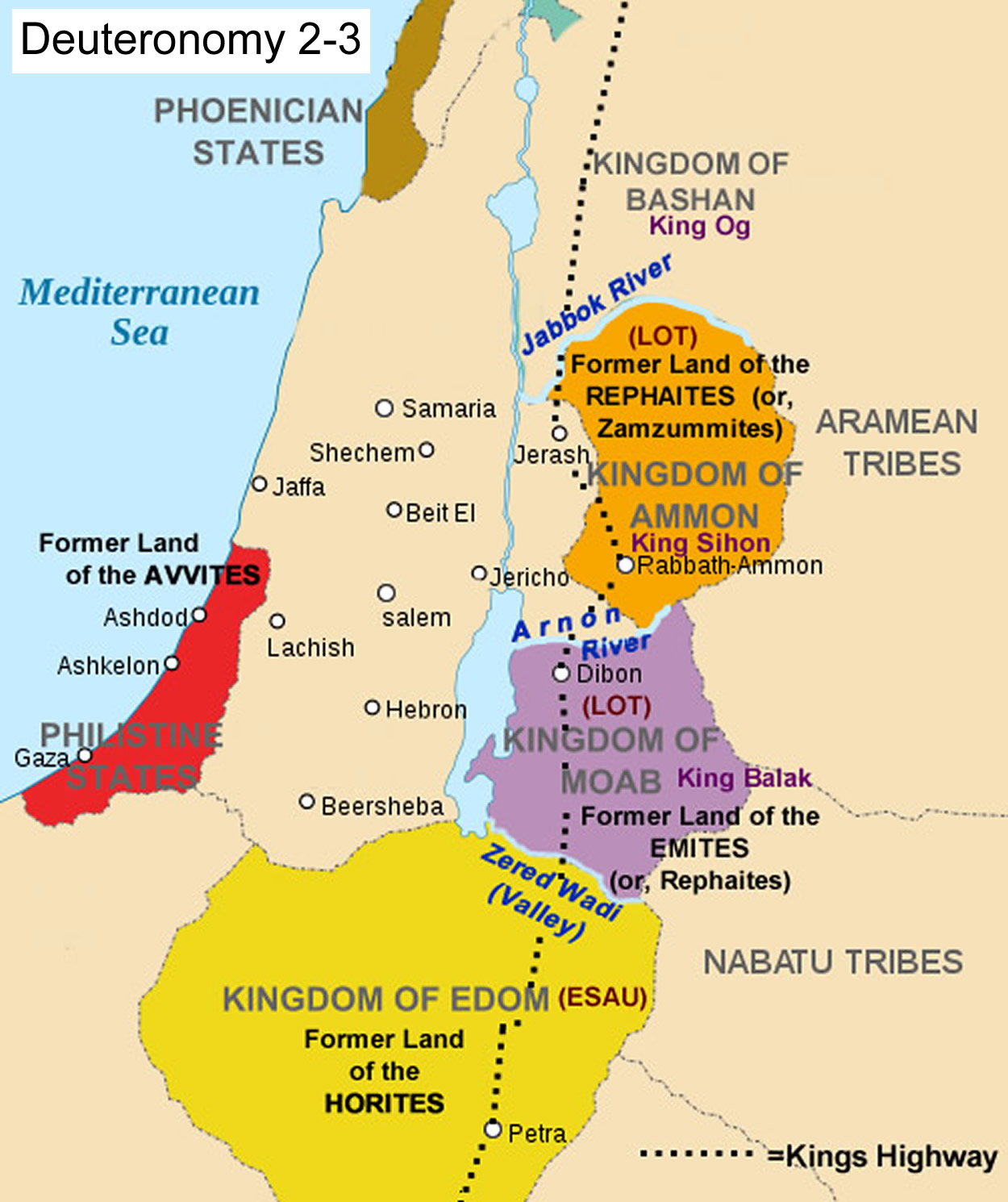
Moses makes it clear that the land in which Esau and his descendants eventually settled was far from empty. It had been occupied by another group of people known as the Horites. The first mention we have of them is found in Genesis 14, where they are listed among a group of nations that were defeated by an alliance of four kings. This confederation of kings attacked and defeated the people living in the area around Mount Seir,  in the far south of Canaan. They ended up conquering the cities of Sodom and Gomorrah, taking captive all the citizens, including the nephew of Abraham.

When Esau separated from his brother, Jacob, he ended up settling in the very same region as the Horites and, eventually, his sons and their children would supplant the Horites as the official inhabitants of the land. Hundreds of years later, when Moses prepared to lead the people of Israel into the promised land, he would receive instruction from God regarding this southern region and its inhabitants.

“You are about to pass through the territory of your brothers, the people of Esau, who live in Seir; and they will be afraid of you. So be very careful. Do not contend with them, for I will not give you any of their land, no, not so much as for the sole of the foot to tread on, because I have given Mount Seir to Esau as a possession.” – Deuteronomy 2:4-5 ESV

Moses records that Esau and his clan didn’t simply overwhelm the Horites with their superior numbers and strength, but that God orchestrated the transference of the land from one group to the other.

“…he [God] destroyed the Horites before them and they dispossessed them and settled in their place even to this day.” – Deuteronomy 2:22 ESV

The leader of the Horites was a man named Seir, and a large mountain in the region aptly bore his name. The Horites proved to be quite prolific, as the genealogy found in verses 20-43 reflects. But the chiefs of Seir and the chiefs of Esau would end up engaged in an ongoing conflict over control of the land around Mount Seir.

These are the sons of Dishan: Uz and Aran. These are the chiefs of the Horites: the chiefs Lotan, Shobal, Zibeon, Anah, Dishon, Ezer, and Dishan; these are the chiefs of the Horites, chief by chief in the land of Seir. – Genesis 36:28-30 ESV

These are the names of the chiefs of Esau, according to their clans and their dwelling places, by their names: the chiefs Timna, Alvah, Jetheth, Oholibamah, Elah, Pinon, Kenaz, Teman, Mibzar, Magdiel, and Iram; these are the chiefs of Edom (that is, Esau, the father of Edom), according to their dwelling places in the land of their possession. – Genesis 436:40-43 ESV

These two groups of “chiefs” or leaders of their clans would have gone head-to-head in battle with one another over control of the land. But what is interesting is that Moses provides a list of the kings who ruled over the land of Edom, and not one chief among the Horites or Edomites can be found on that list. It contains the name of eight Edomite kings, but none appear to be sons of Esau or Seir. In fact, one is referred to as a Temanite, another hales from Rehoboth, and still another comes from a place called Masrekah.  This sequential order of kings seems to reveal that there was a constant shift of power among the people groups that occupied this region. And Moses points out that the land of Edom had many kings long before the nation of Israel had their first monarch. Part of the reason for this disparity is that the people of Israel would eventually make their way to Egypt where they would remain for 400 years. During that time, the land of Edom would go through a long list of kings, chiefs, and leaders, while the Israelites were biding their time in Egypt. But the land of promise, like Edom, would not go unoccupied during the Israelites’ long absence. Canaan would be filled with nations, and overrun by the sins of idolatry and immorality.

And by the time Moses led the people of Israel back into the land, the  descendants of Esau (the Edomites) would be well established around Mount Seir. In keeping with God’s directive, the Israelites would view Edom as off-limits, restricting themselves to the purchase of food and supplies, but avoiding the confiscation of any Edomite territory because it had been given to them by God. And Moses states, “So we went on, away from our brothers, the people of Esau, who live in Seir, away from the Arabah road from Elath and Ezion-geber (Deuteronomy 2:8 ESV).

All of this sets up the next section of Moses’ historical record of the people of Israel. While Esau and his descendants were busy making themselves at home in Edom, Israel and his descendants would be continuing the nomadic lifestyle established by Abraham and Isaac. Moses opens up chapter seven with the statement: “Jacob lived in the land of his father’s sojournings, in the land of Canaan” (Genesis 37:1 ESV).

The Hebrew word that Moses used is מָגוּר (māḡûr), which can also be translated “to be a stranger.” That is why the New Living Translation translates verse 1 this way: “So Jacob settled again in the land of Canaan, where his father had lived as a foreigner.

Isaac, like his father before him, lived in the land of Canaan, more like an alien and a stranger than as a legal citizen. Neither Abraham or Isaac lived in a city or built a permanent dwelling place. They were sojourners, moving from one place to another, and never staying long enough to consider anywhere in the land of Canaan as their true home. And it is the author of the book of Hebrews who explains the reason behind this vagabond existence that was passed down from father to sin to grandson.

It was by faith that Abraham obeyed when God called him to leave home and go to another land that God would give him as his inheritance. He went without knowing where he was going. And even when he reached the land God promised him, he lived there by faith—for he was like a foreigner, living in tents. And so did Isaac and Jacob, who inherited the same promise. Abraham was confidently looking forward to a city with eternal foundations, a city designed and built by God. – Hebrews 11:8-10 NLT

And the author of Hebrews indicates that Abraham, Isaac, and Jacob never got to see that city – in their lifetimes.

All these people died still believing what God had promised them. They did not receive what was promised, but they saw it all from a distance and welcomed it. They agreed that they were foreigners and nomads here on earth. – Hebrews 11:13 NLT

The Edomites had kings and kingdoms. Even the Horites had a long list of chiefs and enjoyed that benefit of living in cities built by human hands. But the people of God would have to wait a long time before they experienced the fulfillment of God’s promise. God had promised to give them the land of Canaan as their inheritance, but neither Abraham, Isaac, or Jacob would make ever find their permanent home in the land of promise because God had something better in store.

Obviously people who say such things are looking forward to a country they can call their own. If they had longed for the country they came from, they could have gone back. But they were looking for a better place, a heavenly homeland. That is why God is not ashamed to be called their God, for he has prepared a city for them. – Hebrews 11:14-15 NLT

The wait would be difficult but well worth it.

English Standard Version (ESV) The Holy Bible, English Standard Version. ESV® Permanent Text Edition® (2016). Copyright © 2001 by Crossway Bibles, a publishing ministry of Good News Publishers.

New Living Translation (NLT) Holy Bible, New Living Translation, copyright © 1996, 2004, 2015 by Tyndale House Foundation. Used by permission of Tyndale House Publishers Inc., Carol Stream, Illinois 60188. All rights reserved.

New English Translation (NET)NET Bible® copyright ©1996-2017 by Biblical Studies Press, L.L.C. http://netbible.com All rights reserved.

With Friends Like This…

43 Then Laban answered and said to Jacob, “The daughters are my daughters, the children are my children, the flocks are my flocks, and all that you see is mine. But what can I do this day for these my daughters or for their children whom they have borne? 44 Come now, let us make a covenant, you and I. And let it be a witness between you and me.” 45 So Jacob took a stone and set it up as a pillar. 46 And Jacob said to his kinsmen, “Gather stones.” And they took stones and made a heap, and they ate there by the heap. 47 Laban called it Jegar-sahadutha, but Jacob called it Galeed. 48 Laban said, “This heap is a witness between you and me today.” Therefore he named it Galeed, 49 and Mizpah, for he said, “The Lord watch between you and me, when we are out of one another’s sight. 50 If you oppress my daughters, or if you take wives besides my daughters, although no one is with us, see, God is witness between you and me.”

51 Then Laban said to Jacob, “See this heap and the pillar, which I have set between you and me. 52 This heap is a witness, and the pillar is a witness, that I will not pass over this heap to you, and you will not pass over this heap and this pillar to me, to do harm. 53 The God of Abraham and the God of Nahor, the God of their father, judge between us.” So Jacob swore by the Fear of his father Isaac, 54 and Jacob offered a sacrifice in the hill country and called his kinsmen to eat bread. They ate bread and spent the night in the hill country.

55  Early in the morning Laban arose and kissed his grandchildren and his daughters and blessed them. Then Laban departed and returned home. Genesis 31:43-55 ESV

Laban’s desperate search for his missing idols proved to be a bust. So, he had no other recourse but to let Jacob continue his journey to Canaan. This meant saying goodbye to his two daughters and his 11 grandsons. And he was not happy about it. In fact, he let Jacob know that the whole affair was nothing less than a form of highway robbery.

“These women are my daughters, these children are my grandchildren, and these flocks are my flocks—in fact, everything you see is mine. But what can I do now about my daughters and their children? So come, let’s make a covenant, you and I, and it will be a witness to our commitment.” – Genesis 41:43-44 NLT

He offered no confession or admission of wrongdoing. Instead, he accused Jacob of having taken what rightfully belonged to him, including his daughters, grandsons, and flocks. But sensing that he was powerless to stop Jacob’s departure, Laban decided to bury the hatchet and offered to sign a non-aggression pact with his son-in-law. Jacob was leaving Haran a very wealthy man and Laban was reluctant to completely sever ties with him, because he stood to lose a lot more than access to his daughters and grandsons. He really did believe that Jacob was absconding with his possessions and still held out hope that he might one day get them back.

But Jacob, anxious to put as much territory between he and Laban as physically possible, agreed to the treaty.

So Jacob took a stone and set it up as a monument. Then he told his family members, “Gather some stones.” So they gathered stones and piled them in a heap. Then Jacob and Laban sat down beside the pile of stones to eat a covenant meal. – Genesis 31:45-46 NLT

They erected a monument to commemorate their agreement, then sealed the deal with a meal. But despite their mutual pledge, the two men couldn’t agree on a name for the location. Laban called it יְגַר שָׂהֲדוּתָא (yᵊḡar śāhăḏûṯā’), which means “witness heap.” B ut Jacob named it גַּלְעֵד (galʿēḏ), which means “heap of testimony.”

The terms of the covenant were simple. They basically agreed to let the stones to serve as a boundary marker, which they pledged never to pass in order to harm on another.

“I will never pass this pile of stones to harm you, and you must never pass these stones or this monument to harm me. I call on the God of our ancestors—the God of your grandfather Abraham and the God of my grandfather Nahor—to serve as a judge between us.” – Genesis 31:52-53 NLT

It was less a treaty than it was an agreement to refrain from doing harm to one another. There were no wounds healed or friendships made as a result of this act. Laban and Jacob remained distrustful of one another and were much more like enemies than co-signers of a peace agreement. Because of their mutual interest in Leah, Rachel, and the children, the two men agreed to set their animosities aside and do what was necessary to protect those whom they loved.

And it’s interesting to note that the idol-worshiping Laban was the one who chose to call upon the name of Jacob’s God as witness.

“May the Lord keep watch between us to make sure that we keep this covenant when we are out of each other’s sight. If you mistreat my daughters or if you marry other wives, God will see it even if no one else does. He is a witness to this covenant between us. – Genesis 31:49-50 NLT

While hundreds of miles would separate the two men, Laban called upon Yahweh to act as witness to their agreement and as the divine monitor of Jacob’s behavior. If Jacob got out of line and mistreated Leah or Rachel, Laban asked God to intervene and pass judgment on him. As a father, Laban grieved over the thought that he would no longer be able to protect his daughters. And it seems unlikely that he would live long enough to see his grandsons grow up and mature. He seemed to know that this would be the last time he ever saw his daughters and grandchildren.

So Jacob took an oath before the fearsome God of his father, Isaac, to respect the boundary line. Then Jacob offered a sacrifice to God there on the mountain and invited everyone to a covenant feast. After they had eaten, they spent the night on the mountain. – Genesis 31:53-54 NLT

Jacob would never return to Haran. And his relationship with his father-in-law would not end on the best of terms. They completed their covenant agreement, then parted ways. Laban returned to Mesopotamia and Jacob continued his journey back to Canaan. And Jacob must have felt a great sense of relief as he watched his father-in-law ride off into the distance. The last 20 years of his life had been a living nightmare, but now it was all over. But Jacob’s relief would be short-lived. He had gotten rid of one enemy but had another waiting for him at home – his brother Esau.

In the two decades he had been in Haran, Jacob had never received word from Rebekah that it was safe to come home (Genesis 27:45). So, he had no idea what to expect. Was Esau still harboring bitterness for him or had his anger subsided? Would he be greeted with a confrontation or a warm welcome? Every mile he traveled must have been excruciating as the distance between he and Esau diminished. His time of reckoning was drawing near. But, as always, God had plans of which Jacob was oblivious. This trip was going to end far better than Jacob could have ever imagined and it would all be in keeping with the promise had made 20 years earlier.

“Behold, I am with you and will keep you wherever you go, and will bring you back to this land. For I will not leave you until I have done what I have promised you.” – Genesis 28:15 NLT

English Standard Version (ESV) The Holy Bible, English Standard Version. ESV® Permanent Text Edition® (2016). Copyright © 2001 by Crossway Bibles, a publishing ministry of Good News Publishers.

New Living Translation (NLT) Holy Bible, New Living Translation, copyright © 1996, 2004, 2015 by Tyndale House Foundation. Used by permission of Tyndale House Publishers Inc., Carol Stream, Illinois 60188. All rights reserved.

New English Translation (NET)NET Bible® copyright ©1996-2017 by Biblical Studies Press, L.L.C. http://netbible.com All rights reserved.

It Never Pays to Bargain With God

Now Esau saw that Isaac had blessed Jacob and sent him away to Paddan-aram to take a wife from there, and that as he blessed him he directed him, “You must not take a wife from the Canaanite women,” and that Jacob had obeyed his father and his mother and gone to Paddan-aram. So when Esau saw that the Canaanite women did not please Isaac his father, Esau went to Ishmael and took as his wife, besides the wives he had, Mahalath the daughter of Ishmael, Abraham’s son, the sister of Nebaioth.

10 Jacob left Beersheba and went toward Haran. 11 And he came to a certain place and stayed there that night, because the sun had set. Taking one of the stones of the place, he put it under his head and lay down in that place to sleep. 12 And he dreamed, and behold, there was a ladder set up on the earth, and the top of it reached to heaven. And behold, the angels of God were ascending and descending on it! 13 And behold, the Lord stood above it and said, “I am the Lord, the God of Abraham your father and the God of Isaac. The land on which you lie I will give to you and to your offspring. 14 Your offspring shall be like the dust of the earth, and you shall spread abroad to the west and to the east and to the north and to the south, and in you and your offspring shall all the families of the earth be blessed. 15 Behold, I am with you and will keep you wherever you go, and will bring you back to this land. For I will not leave you until I have done what I have promised you.” 16 Then Jacob awoke from his sleep and said, “Surely the Lord is in this place, and I did not know it.” 17 And he was afraid and said, “How awesome is this place! This is none other than the house of God, and this is the gate of heaven.”

18 So early in the morning Jacob took the stone that he had put under his head and set it up for a pillar and poured oil on the top of it. 19 He called the name of that place Bethel, but the name of the city was Luz at the first. 20 Then Jacob made a vow, saying, “If God will be with me and will keep me in this way that I go, and will give me bread to eat and clothing to wear, 21 so that I come again to my father’s house in peace, then the Lord shall be my God, 22 and this stone, which I have set up for a pillar, shall be God’s house. And of all that you give me I will give a full tenth to you.” Genesis 28:6-22 ESV

After Jacob had left to seek a wife from among his mother’s family in Mesopotamia, his brother Esau decided to try and win back his parent’s favor by marrying a woman from among his own clan. Esau already had two Hittite wives, but he knew that these marriages had been a huge disappointment to his mother and father. So, when he had heard Isaac warn Jacob not to take a wife from among the Canaanites, Esau determined to make amends with his parents by marrying one of his cousins. Her name was Mahalath and she was the daughter of Ishmael, the elder son of Abraham. While Esau had been angered by his parent’s complicity in Jacob’s stealing of his blessing, he also desired their favor. Having lost his birthright and his blessing, he was desperate to win them over. But he failed to consider the fact that God had divinely ordained the separation of Ishmael’s clan from that of Isaac’s. The Ishmaelites were not destined to share in the covenant promise made to Abraham. So, Esau’s marriage to Mahalath would do little to improve his relationship with his parents or to enhance his future prospects. Yet, during his brother’s 20-year absence, Esau would build a life for himself in Canaan, raising a family and attempting to maintain a civil relationship with his mother and father.

Meanwhile, Jacob continued his long and arduous journey to Haran. But some 58 miles into his trip, he was forced to stop for the night, and it would prove to be anything but a restful evening. As he drifted off to sleep, he had a vivid and somewhat disturbing dream. He envisioned a giant flight of steps reaching from heaven to earth, and on that massive stairway, there was a host of angels ascending and descending. But Jacob’s eye was drawn to the top of the stairway, where he caught a glimpse of Yahweh, the Lord. And, considering all that Jacob had just done to deceive his father and defraud his brother, this vision of the Almighty must have struck fear into his heart. Was God going to repay him for having stolen his brother’s blessing? Was this going to be some kind of well-deserved payback for his treachery and deceit? But before Jacob could formulate any words to speak to God, he was presented with an unexpected announcement.

“I am the Lord, the God of your grandfather Abraham, and the God of your father, Isaac. The ground you are lying on belongs to you. I am giving it to you and your descendants. Your descendants will be as numerous as the dust of the earth! They will spread out in all directions—to the west and the east, to the north and the south. And all the families of the earth will be blessed through you and your descendants. – Genesis 28:13-14 NLT

The symbolism contained in this dream is powerful and significant. As Jacob lay in the darkness, separated from his family and facing an uncertain future, a host of angelic beings were moving back and forth between heaven and earth. These messengers of God represent His divine oversight and influence over all that happens on earth. Their movement between the two realms was meant to symbolize His sovereign control over the affairs of this world. They were His celestial agents, carrying out His wishes and accomplishing His divine will among men.

While Jacob and his mother had been busily conspiring to deceive Isaac and defraud Esau, God’s will had been carried out. There was a constant movement taking place between heaven and earth, as God’s messengers carried out His orders and implemented His sovereign plans among men. But Jacob and Rebekah had been oblivious to this invisible activity taking place in the unseen realms. They had mistakenly thought that they were in control of their futures and fate. But now, Jacob was receiving a divine wake-up call, informing him that all his trickery and deceit had been unnecessary. There had been no need for Jacob to barter for the birthright or to steal the blessing of the firstborn. God had always intended for the covenant promise to be his. It had not been his cleverly conceived plan to fool Isaac that had earned him the right to his father’s inheritance. It had been the sovereign will of God.

From among all the men who lived on the earth, God had chosen Abraham. And He had given this undeserving Chaldean a promise to bless him beyond his wildest dream.

“I will make you into a great nation, and I will bless you,
and I will make your name great,
so that you will exemplify divine blessing.
I will bless those who bless you,
but the one who treats you lightly I must curse,
so that all the families of the earth may receive blessing through you.” – Genesis 12:2-3 NLT

And then, God had chosen Abraham’s son, Isaac, to be the conduit through whom this blessing would flow. God had sovereignly passed by Ishmael, the firstborn. And now, God was announcing that it had always been His plan to choose Jacob over Esau. The covenant promise would flow to him and through him. God was going to use this flawed vessel as the conduit through which He would accomplish His redemptive plan for mankind. And, not only that, God informed Jacob that he would enjoy divine protection all during his extended journey.

“What’s more, I am with you, and I will protect you wherever you go. One day I will bring you back to this land. I will not leave you until I have finished giving you everything I have promised you.” – Genesis 28:15 NLT

What Jacob didn’t know was that his trip was going to take much longer than he anticipated. Two decades would pass before he was able to return to Beersheba and, during that time, Jacob would experience both the blessings and the discipline of God. He would eventually find the wife for which he was searching. But, more importantly, he would discover the power and sovereignty of God. The next 20 years of his life would be filled with joy and sorrow, success and failure, hope and heartache. But his roller-coaster existence would also be marked by the constant assurance that God was with him, operating behind the scenes and orchestrating every aspect of his life. God had promised Jacob that he would remain with him to the end.

The impact this dream had on Jacob can be seen in his response when he awoke.

“Surely the Lord is in this place, and I wasn’t even aware of it!” – Genesis 28:16 NLT

Jacob could have spoken those words back in Beersheba as well because God had always been with him. He just hadn’t realized it. This divine encounter left Jacob shaken and sobered.

“What an awesome place this is! It is none other than the house of God, the very gateway to heaven!” – Genesis 28:17 NLT

Out of reverence for God, Jacob took the stone upon which his head had rested while he dreamed and he turned it into a sacred pillar. He named the place Bethel which means “house of God.” What’s fascinating is that this is the very same spot where, years earlier, Jacob’s grandfather Abraham had erected an altar to God.

Then he moved from there to the hill country east of Bethel and pitched his tent, with Bethel on the west and Ai on the east. There he built an altar to the Lord and worshiped the Lord. – Genesis 12:8 NLT

Like his grandfather before him, Jacob worshiped Yahweh. But, in keeping with his bargaining nature, Jacob attempted to strike a deal with God.

“If God will indeed be with me and protect me on this journey, and if he will provide me with food and clothing, and if I return safely to my father’s home, then the Lord will certainly be my God. And this memorial pillar I have set up will become a place for worshiping God, and I will present to God a tenth of everything he gives me.” – Genesis 28:20-22 NLT

Rather than rejoice in the fact that God had just promised to bless and not punish him, Jacob arrogantly attempted to bargain with the Almighty. He placed conditions on his continued worship of God. Despite the fact that God had promised to fulfill every aspect of the promise He had made, Jacob wanted guarantees. This undeserving grandson of Abraham tried to arm wrestle Yahweh by threatening to hold his worship if his conditions were not met. Suffice it to say, Jacob had a lot to learn about God.

English Standard Version (ESV) The Holy Bible, English Standard Version. ESV® Permanent Text Edition® (2016). Copyright © 2001 by Crossway Bibles, a publishing ministry of Good News Publishers.

New Living Translation (NLT) Holy Bible, New Living Translation, copyright © 1996, 2004, 2015 by Tyndale House Foundation. Used by permission of Tyndale House Publishers Inc., Carol Stream, Illinois 60188. All rights reserved.

New English Translation (NET)NET Bible® copyright ©1996-2017 by Biblical Studies Press, L.L.C. http://netbible.com All rights reserved.

A Growing Conflict

17 So Isaac departed from there and encamped in the Valley of Gerar and settled there. 18 And Isaac dug again the wells of water that had been dug in the days of Abraham his father, which the Philistines had stopped after the death of Abraham. And he gave them the names that his father had given them. 19 But when Isaac’s servants dug in the valley and found there a well of spring water, 20 the herdsmen of Gerar quarreled with Isaac’s herdsmen, saying, “The water is ours.” So he called the name of the well Esek, because they contended with him. 21 Then they dug another well, and they quarreled over that also, so he called its name Sitnah. 22 And he moved from there and dug another well, and they did not quarrel over it. So he called its name Rehoboth, saying, “For now the Lord has made room for us, and we shall be fruitful in the land.”

23 From there he went up to Beersheba. 24 And the Lord appeared to him the same night and said, “I am the God of Abraham your father. Fear not, for I am with you and will bless you and multiply your offspring for my servant Abraham’s sake.” 25 So he built an altar there and called upon the name of the Lord and pitched his tent there. And there Isaac’s servants dug a well. 

26 When Abimelech went to him from Gerar with Ahuzzath his adviser and Phicol the commander of his army, 27 Isaac said to them, “Why have you come to me, seeing that you hate me and have sent me away from you?” 28 They said, “We see plainly that the Lord has been with you. So we said, let there be a sworn pact between us, between you and us, and let us make a covenant with you, 29 that you will do us no harm, just as we have not touched you and have done to you nothing but good and have sent you away in peace. You are now the blessed of the Lord.” 30 So he made them a feast, and they ate and drank. 31 In the morning they rose early and exchanged oaths. And Isaac sent them on their way, and they departed from him in peace. 32 That same day Isaac’s servants came and told him about the well that they had dug and said to him, “We have found water.” 33 He called it Shibah; therefore the name of the city is Beersheba to this day.

34 When Esau was forty years old, he took Judith the daughter of Beeri the Hittite to be his wife, and Basemath the daughter of Elon the Hittite, 35 and they made life bitter for Isaac and Rebekah. Genesis 26:17-35 ESV

The blessings of God were clearly evident in Isaac’s life. He had become a wealthy man while living among the people of Philistia. But they soon grew jealous and suspicious of this stranger’s expanding presence in their land, so they demanded that he leave. But Isaac didn’t go far. He ended up settling in the Valley of Gerar, where he began the process of digging wells for his growing flocks and herds. Unfortunately for Isaac, the wells his father had dug many years earlier had been decommissioned by the Philistines. In an effort to rid themselves of Abraham and his future descendants, they had filled in all the wells he had dug. This forced Isaac to dig new wells, a laborious and time-consuming task.

But each time Isaac’s servants dug a productive well, they found themselves in a contentious standoff with the local citizens, who claimed it as their own. It seems that everywhere Isaac turned, he was faced with opposition. The Philistines were going out of their way to make his stay in their land as uncomfortable as possible. And because the entire land of Canaan was experiencing a famine, Isaac was having a difficult time caring for all the flocks, herds, and servants with which God had blessed him. He even ended up giving two of the wells the highly descriptive names of “Contention” and “Enmity.” Things were not going well.

They say the third time is the charm, and that proved true for Isaac. A third well dug by his servants proved to be uncontested, prompting Isaac to give it the name, Rehoboth,  which means, “to make room.” It seems that Isaac was expressing his gratitude to God for having made room for them among the Philistines. Despite all the opposition they had faced, God had provided them with a much-needed source of fresh water. And Isaac vocalized his gratefulness for God’s blessing.

For now the Lord has made room for us, and we shall be fruitful in the land.” – Genesis 26:22 ESV

The water provided by the well was another sign of God’s blessings upon Isaac. Not only would he be able to sustain the life of his flocks, but he would have water necessary to plant and harvest crops – in the middle of a famine.

But after an undisclosed length of time, Isaac moved his growing clan to Beersheba. This small town was located at the southernmost tip of Canaan, on the very edge of Negev Desert. It was in Beersheba that Abraham had made an covenant with King Abimelech. It was there, decades earlier, that the servants of Abimelech had unlawfully seized a well dug by Abraham. In exchange for seven ewe lambs, Abimelech acknowledged the well as belonging to Abraham and his descendants. The name Beersheba means “well of seven” or “well of the oath.” It was while living in Beersheba that Isaac received a vision and message from the Lord.

“I am the God of Abraham your father. Fear not, for I am with you and will bless you and multiply your offspring for my servant Abraham’s sake.” – Genesis 26:24 ESV

God reiterated His covenant commitment to Isaac, ensuring him that the promises made to Abraham would be fulfilled through him. Abraham was dead but God’s promises were very much alive and well. He would do what He had promised to do. Like his father before him, Isaac built an altar to Yahweh and “called there on the name of the Lord, the Everlasting God” (Genesis 21:33 ESV).

Having demonstrated his devotion and gratitude to God, Isaac commissioned the digging of yet another well, probably an indication of his vast wealth and the growing size of his flocks and herds. One well would not suffice. And when Abimelech received word that Isaac had settled in Beersheba just as Abraham had done, he determined to pay the young man a visit. This entire scene is reminiscent of a similar trip made years earlier by Abimelech and Phicol, his army commander.

At that time Abimelech and Phicol the commander of his army said to Abraham, “God is with you in all that you do. Now therefore swear to me here by God that you will not deal falsely with me or with my descendants or with my posterity, but as I have dealt kindly with you, so you will deal with me and with the land where you have sojourned.” And Abraham said, “I will swear.”Genesis 21:22-24 ESV

History has a way of repeating itself and chapter 26 of Genesis is proof. Here we have the king of Gerar and his army commander making another unscheduled visit to Beersheba in order to strike another agreement with the son of Abraham.

“We see plainly that the Lord has been with you. So we said, let there be a sworn pact between us, between you and us, and let us make a covenant with you, that you will do us no harm, just as we have not touched you and have done to you nothing but good and have sent you away in peace. You are now the blessed of the Lord.” – Genesis 26:28-29 ESV

Abimelech renewed his covenant with Abraham, but this time, with his son. He saw the handwriting on the wall and seemed to understand that Abraham’s God was going to continue to pour out His blessing upon Abraham’s offspring. The names may have changed, but the outcome seemed as certain as ever. Even this pagan potentate understood that Abraham’s offspring were the heirs of God’s gracious provision and protection. So, he made a peace treaty with Isaac and celebrated their agreement with a feast.

Then Isaac was informed that yet another well had been dug in Beersheba, which he promptly named, Shibah, which means “oath.” There is more to this name than a recognition of an oath sworn between two men. This entire pericope is meant to stress the covenant-keeping nature of God Almighty. He had made an oath to Abraham and He was going to stand by it, even though Abraham was long gone. Isaac would be the next in line to receive the blessings of God. And soon, his son, Jacob would follow in his footsteps.

But Moses ends this section with a brief update on Esau’s marital status. Esau was technically the firstborn son, but he had sold his birthright to Jacob for the price of a bowl of stew. And in these closing verses of chapter 26, Moses reveals that Esau ended up taking two foreign wives from among the Hittites. These were the descendants of Heth, who had been one of the sons of Canaan., who was the grandson of Noah. Ham, the son of Noah had dishonored him so, as a result, Noah had placed a curse upon Ham’s descendants (Genesis 9:25).

Esau, who had treated his birthright with contempt, ended up marrying two different women from among the descendants of Heth. And Moses flatly states, “and they made life bitter for Isaac and Rebekah” (Genesis 26:35 ESV). Noah had declared that the offspring of Canaan would end up being the servants of their own relatives. And it seems that this curse came to fruition in the life of Esau. By marrying women from among the sons of Heth, Esau sealed their fate and assured an ongoing conflict between the sons of Jacob and Esau.

But Esau’s wives made life miserable for Isaac and Rebekah. – Genesis 26:35 NLT

How? They ended up bearing Esau children who would become the enemies of Jacob’s descendants. And the stage is set for a growing conflict between Jacob and Esau. But God is at work, behind the scenes, orchestrating everything according to His sovereign plan.

English Standard Version (ESV) The Holy Bible, English Standard Version. ESV® Permanent Text Edition® (2016). Copyright © 2001 by Crossway Bibles, a publishing ministry of Good News Publishers.

New Living Translation (NLT) Holy Bible, New Living Translation, copyright © 1996, 2004, 2015 by Tyndale House Foundation. Used by permission of Tyndale House Publishers Inc., Carol Stream, Illinois 60188. All rights reserved.

New English Translation (NET)NET Bible® copyright ©1996-2017 by Biblical Studies Press, L.L.C. http://netbible.com All rights reserved.