Playing the Long Game

23 In the fifteenth year of Amaziah the son of Joash, king of Judah, Jeroboam the son of Joash, king of Israel, began to reign in Samaria, and he reigned forty-one years. 24 And he did what was evil in the sight of the LORD. He did not depart from all the sins of Jeroboam the son of Nebat, which he made Israel to sin. 25 He restored the border of Israel from Lebo-hamath as far as the Sea of the Arabah, according to the word of the LORD, the God of Israel, which he spoke by his servant Jonah the son of Amittai, the prophet, who was from Gath-hepher. 26 For the LORD saw that the affliction of Israel was very bitter, for there was none left, bond or free, and there was none to help Israel. 27 But the LORD had not said that he would blot out the name of Israel from under heaven, so he saved them by the hand of Jeroboam the son of Joash.

28 Now the rest of the acts of Jeroboam and all that he did, and his might, how he fought, and how he restored Damascus and Hamath to Judah in Israel, are they not written in the Book of the Chronicles of the Kings of Israel? 29 And Jeroboam slept with his fathers, the kings of Israel, and Zechariah his son reigned in his place. 2 Kings 14:23-29 ESV

Sometime during the reign of King Jehoash of Judah, the other King Jehoash of Israel made his son, Jeroboam II, his co-regent. He was named after the first king of the northern kingdom, who ruled after God divided the nation of Israel in half. This division of Solomon’s kingdom was done as a punishment for his idolatry and apostasy. In the latter years of his reign, Solomon had begun to worship the false gods of his many foreign wives.

So Solomon did what was evil in the sight of the LORD and did not wholly follow the LORD, as David his father had done. Then Solomon built a high place for Chemosh the abomination of Moab, and for Molech the abomination of the Ammonites, on the mountain east of Jerusalem. And so he did for all his foreign wives, who made offerings and sacrificed to their gods. 1 Kings 11:6-8 ESV

As punishment for Solomon’s unfaithfulness, God raised up Jeroboam and placed him over the ten northern tribes of Israel. But Jeroboam proved to be just as unfaithful as Solomon. One of his first official acts as king was to establish his own religion, complete with golden calf idols erected in the cities of Dan and Bethel. He even created his own priesthood and sacrificial system so that the ten northern tribes would have no reason to go to Jerusalem to worship at the Temple of Yahweh.

King Jehoash’s decision to name his son after this man reveals much about his character. But the author seems to assure his readers that the name was fitting because Jeroboam II lived up to the reputation of his infamous predecessor.

He did what was evil in the LORD’s sight. He refused to turn from the sins that Jeroboam son of Nebat had led Israel to commit. – 2 Kings 14:24 NLT

At his father’s death, Jeroboam II transitioned from his position as co-regent to king of all the northern tribes, a title he would hold for 41 years. He would become the longest-reigning king in the history of Israel, outlasting the monarchy of King Jehoash of Judah and that of his son, Amaziah. But other than the note describing the sinful disposition of Jeroboam’s reign, the author provides few other details about his accomplishments. There is a brief mention of his expansion of Israel’s territorial boundaries, but it would appear that this was the work of God, not Jeroboam.
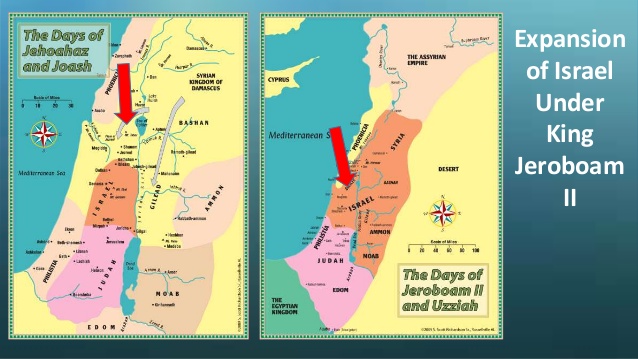
Verse 25 mentions the name of Jonah. He was one of three prophets, including Hosea and Amos, who ministered to the ten northern tribes of Israel. This is the same Jonah who would later receive a divine commission from God to call the pagan people of Ninevah to repentance (Jonah 1:1-2). But long before Jonah was sent to the Assyrians, his responsibility was to act as God’s spokesman to the kings and citizens of Israel. It would appear from the text that Jonah gave King Jeroboam a word from Yahweh, commanding him to expand Israel’s borders, and the king obeyed.

Jeroboam II recovered the territories of Israel between Lebo-hamath and the Dead Sea, just as the LORD, the God of Israel, had promised through Jonah son of Amittai, the prophet from Gath-hepher. – 2 Kings 14:25 NLT

By faithfully fulfilling this divine mandate, Jeroboam II restored Israel’s borders to near their former extent under King Solomon. While Jeroboam was anything but a godly king, he proved an accomplished leader who helped reestablish Israel’s power and prominence. In fact, both the northern and southern kingdoms would experience unprecedented prosperity during this period. This fact seems difficult to reconcile when considering that both kingdoms were being ruled over by godless kings who promoted idolatry and apostasy. Yet, the author reveals that God was at work, behind the scenes, protecting and preserving His people.

And because the LORD had not said he would blot out the name of Israel completely, he used Jeroboam II, the son of Jehoash, to save them. – 2 Kings 14:27 NLT

God had made a covenant commitment to preserve His people. Despite their repeated demonstrations of disobedience and unfaithfulness, He had never allowed them to suffer the full and well-deserved consequences of their sin. He stepped in and rescued them time and time again. Long before they ever entered the land of Canaan or established themselves as a nation, God had clearly communicated His expectations to them.

If you fully obey the LORD your God and carefully keep all his commands that I am giving you today, the LORD your God will set you high above all the nations of the world. You will experience all these blessings if you obey the LORD your God… – Deuteronomy 28:1-2 NLT

Then God outlined all the blessings they could expect if they lived in obedience to His will. But He also warned them that disobedience would bring curses.

But if you refuse to listen to the LORD your God and do not obey all the commands and decrees I am giving you today, all these curses will come and overwhelm you… – Deuteronomy 28:15 NLT

The list of potential curses that followed was intense and terrifying, and ended with the warning: “The LORD will exile you and your king to a nation unknown to you and your ancestors. There in exile you will worship gods of wood and stone! You will become an object of horror, ridicule, and mockery among all the nations to which the LORD sends you[ (Deuteronomy 28:36-37 NLT).

Should they choose to disobey, there would be dire and devastating consequences. But as the author of 2 Kings reveals, “the LORD had not said he would blot out the name of Israel completely” (2 Kings 14:27 NLT). While Yahweh had warned of destruction and even eventual deportation, He had never spoken of Israel’s obliteration. He was committed to keeping the promise He had made to Abraham, Isaac, and Jacob, and it was Jacob whom God renamed Israel.

“Your name is Jacob, but you will not be called Jacob any longer. From now on your name will be Israel.” So God renamed him Israel.

Then God said, “I am El-Shaddai—‘God Almighty.’ Be fruitful and multiply. You will become a great nation, even many nations. Kings will be among your descendants! And I will give you the land I once gave to Abraham and Isaac. Yes, I will give it to you and your descendants after you.” – Genesis 35:10-12 NLT

This scene took place in Bethel, and it just so happened that Bethel was one of the towns where the original Jeroboam set up a golden calf idol. The very place where God promised to make of Jacob (Israel) a great nation, Jeroboam I had erected an idol that would lead the people away from Yahweh. He had promoted disobedience and, in doing so, had brought upon the people of Israel the curses of God.  Yet the author of 2 Kings reveals that God chose to show compassion to His rebellious people.

…the LORD saw the bitter suffering of everyone in Israel, and that there was no one in Israel, slave or free, to help them. – 2 Kings 14:26 NLT

Yes, they were rebellious. The people of Israel had forsaken Him repeatedly, but Yahweh viewed His chosen people as helpless and hopeless; they had no one to save them. Their kings had proven themselves unwilling and incapable of providing godly leadership, and Jeroboam II was no different than his namesake. Yet, God chose to use this godless king to protect His chosen people.

…because the LORD had not said he would blot out the name of Israel completely, he used Jeroboam II, the son of Jehoash, to save them. – 2 Kings 14:27 NLT

God was preserving His people, not because they deserved it, but because He had a plan that required their continued existence. Centuries earlier, God made a promise to the patriarch, Abraham:

“I will certainly bless you. I will multiply your descendants beyond number, like the stars in the sky and the sand on the seashore. Your descendants will conquer the cities of their enemies. And through your descendants all the nations of the earth will be blessed—all because you have obeyed me.” – Genesis 22:17-18 NLT

God had made a commitment to bless the nations of the earth through Abraham’s descendants. Yet, as we have seen, the seed of Abraham had proven to be anything but a blessing. They brought shame to the name of Yahweh through their repeated demonstrations of unfaithfulness. But God chose to preserve them because He had a plan to bring about the blessing of the nations. He would accomplish this plan through the “seed” of Abraham, and the apostle Paul tells us exactly how God fulfilled that promise.

Now the promises were made to Abraham and to his offspring. It does not say, “And to offsprings,” referring to many, but referring to one, “And to your offspring,” who is Christ. – Galatians 3:16 NLT

God preserved the Israelites so that Jesus, who was born a descendant of Abraham, might become the ultimate fulfillment of God’s promise to bless the nations. Paul goes on to describe how God’s commitment to protect and preserve the nation of Israel has impacted all the nations of the earth.

There is neither Jew nor Greek, there is neither slave nor free, there is no male and female, for you are all one in Christ Jesus. And if you are Christ’s, then you are Abraham’s offspring, heirs according to promise. – Galatians 3:28-29 NLT

All along the way, God had been watching out for His chosen people because He had set them apart for a reason. They were to be the conduit through which He would bring the blessing of salvation to a lost and dying world. That is why, even after He eventually sent them into exile in Babylon, God restored them to the land of promise.

“I myself will tend my sheep and give them a place to lie down in peace, says the Sovereign LORD. I will search for my lost ones who strayed away, and I will bring them safely home again. I will bandage the injured and strengthen the weak. But I will destroy those who are fat and powerful. I will feed them, yes—feed them justice!” – Ezekiel 34:15-16 NLT

Yahweh was faithful to keep His promise and preserve His people so that, one day, He might send His Son as the Messiah of Israel and the Savior of the world. His plans for Israel were timeless and not temporary, and were never about the kingdoms of David or Solomon. The split of the kingdom, the fall of Israel, and Babylon’s defeat of Judah were all part of His sovereign strategy to prepare the way for the eventual King of kings and Lord of lords — Jesus Christ the Savior.

English Standard Version (ESV) The Holy Bible, English Standard Version. ESV® Permanent Text Edition® (2016). Copyright © 2001 by Crossway Bibles, a publishing ministry of Good News Publishers.

New Living Translation (NLT) Holy Bible, New Living Translation, copyright © 1996, 2004, 2015 by Tyndale House Foundation. Used by permission of Tyndale House Publishers Inc., Carol Stream, Illinois 60188. All rights reserved.

The High Cost of Compromised Convictions

11 Now an old prophet lived in Bethel. And his sons came and told him all that the man of God had done that day in Bethel. They also told to their father the words that he had spoken to the king. 12 And their father said to them, “Which way did he go?” And his sons showed him the way that the man of God who came from Judah had gone. 13 And he said to his sons, “Saddle the donkey for me.” So they saddled the donkey for him and he mounted it. 14 And he went after the man of God and found him sitting under an oak. And he said to him, “Are you the man of God who came from Judah?” And he said, “I am.” 15 Then he said to him, “Come home with me and eat bread.” 16 And he said, “I may not return with you, or go in with you, neither will I eat bread nor drink water with you in this place, 17 for it was said to me by the word of the LORD, ‘You shall neither eat bread nor drink water there, nor return by the way that you came.’” 18 And he said to him, “I also am a prophet as you are, and an angel spoke to me by the word of the LORD, saying, ‘Bring him back with you into your house that he may eat bread and drink water.’” But he lied to him. 19 So he went back with him and ate bread in his house and drank water.

20 And as they sat at the table, the word of the LORD came to the prophet who had brought him back. 21 And he cried to the man of God who came from Judah, “Thus says the LORD, ‘Because you have disobeyed the word of the LORD and have not kept the command that the LORD your God commanded you, 22 but have come back and have eaten bread and drunk water in the place of which he said to you, “Eat no bread and drink no water,” your body shall not come to the tomb of your fathers.’” 23 And after he had eaten bread and drunk, he saddled the donkey for the prophet whom he had brought back. 24 And as he went away a lion met him on the road and killed him. And his body was thrown in the road, and the donkey stood beside it; the lion also stood beside the body. 25 And behold, men passed by and saw the body thrown in the road and the lion standing by the body. And they came and told it in the city where the old prophet lived.

26 And when the prophet who had brought him back from the way heard of it, he said, “It is the man of God who disobeyed the word of the LORD; therefore the LORD has given him to the lion, which has torn him and killed him, according to the word that the LORD spoke to him.” 27 And he said to his sons, “Saddle the donkey for me.” And they saddled it. 28 And he went and found his body thrown in the road, and the donkey and the lion standing beside the body. The lion had not eaten the body or torn the donkey. 29 And the prophet took up the body of the man of God and laid it on the donkey and brought it back to the city to mourn and to bury him. 30 And he laid the body in his own grave. And they mourned over him, saying, “Alas, my brother!” 31 And after he had buried him, he said to his sons, “When I die, bury me in the grave in which the man of God is buried; lay my bones beside his bones. 32 For the saying that he called out by the word of the LORD against the altar in Bethel and against all the houses of the high places that are in the cities of Samaria shall surely come to pass.”

33 After this thing Jeroboam did not turn from his evil way, but made priests for the high places again from among all the people. Any who would, he ordained to be priests of the high places. 34 And this thing became sin to the house of Jeroboam, so as to cut it off and to destroy it from the face of the earth. 1 Kings 13:11-34 ESV

After delivering God’s message of judgment to Jeroboam and having destroyed the altar dedicated to one of Jeroboam’s false gods, the young prophet began his return journey to Judah. He had successfully fulfilled his God-ordained mission and was following Yahweh’s strict instructions to spend no additional time among the northern tribes. He was to accept no forms of hospitality or allow anything to delay his return home. He was even warned to take a different route back to Judah to prevent anyone from interfering with his mission. This young prophet had proved to be obedient to the will of God, even rejecting Jeroboam’s tempting offer of a meal and a reward. Instead, he declared his intentions to remain faithful to every detail of God’s instructions.

“Even if you gave me half of everything you own, I would not go with you. I would not eat or drink anything in this place. For the LORD gave me this command: ‘You must not eat or drink anything while you are there, and do not return to Judah by the same way you came.’” So he left Bethel and went home another way. – 1 Kings 13:8-10 NLT

But as the story continues to unfold and the young prophet makes his way home, he decides to take what appears to be an unsanctioned break under a large tree. Having not yet crossed the border into Judah, he decided to take a much-needed rest. While the text does not tell where the young man began his journey to Judah that day, he had likely spent many hours making the trip to Bethel. If he started his trip from Jerusalem, it would have been a 90-mile trek to Bethel. And now, after having destroyed Jeroboam’s altar to his false god, the prophet had to walk all the way back. So, it makes perfect sense that he was weary from all the activity and excitement of the day. He was tired, hungry, and alone. But he had not yet completed his mission. He had been instructed by God to return to Judah without delay and to avoid all distractions.

Yet, as the young man rested under the tree, he was approached by a stranger — an old prophet who happened to live in Bethel. The author provides few details about this man, except that he was a prophet and a father. His sons, who had witnessed the events at the altar that day, returned home and told him all that the young prophet had said and done. Intrigued by what he heard, the elder prophet commanded his sons to saddle a donkey so that he could seek out his younger peer. It seems likely that he simply wanted to verify the message the younger prophet had delivered. As a prophet himself, this older man would have been interested in whether the message delivered by the young man was actually from Yahweh. If it were, there were dark days ahead for the northern kingdom. What the young prophet declared at the altar earlier that day did not bode well for the ten northern tribes.

“A child named Josiah will be born into the dynasty of David. On you he will sacrifice the priests from the pagan shrines who come here to burn incense, and human bones will be burned on you.” – 1 Kings 13:2 NLT

Those were serious words that implied future judgment against the northern kingdom, and this senior prophet was anxious to verify their veracity. So, he mounted his donkey and began his search for the one who had delivered this foreboding message. Since the young prophet had decided to take his unscheduled rest stop under the tree, the older prophet caught up with him before he had crossed over into Judah. This is where the story gets interesting.

Based on what happens next, it is difficult to understand the motives of the older man. He clearly used deception to convince the younger prophet to return to his home for a meal. His offer was rejected by the young man because it violated the command of God.

“I am not allowed to eat or drink anything here in this place. For the Lord gave me this command: ‘You must not eat or drink anything while you are there, and do not return to Judah by the same way you came.’” – 1 Kings 13:16-17 NLT

They were still within the borders of Israel because the young prophet had not yet made it to the safety of Judah. But, anxious to hear more about the young man’s message from God, the older prophet lied to him. He falsely claimed to have been given a message from an angel commanding him to bring the young man to his home for a meal. Driven by hunger, the young prophet lowered his defenses and accepted the offer. But in doing so, he disobeyed the command of God. He allowed his physical appetites to cloud his thinking and compromise his convictions.

The text indicates that the young prophet violated the divine decree by sharing a meal in the older prophet’s home. As soon as he had eaten the food he had been commanded to avoid, the young man received a stinging rebuke from God delivered by the very man who had just deceived him.

“This is what the LORD says: You have defied the word of the LORD and have disobeyed the command the LORD your God gave you. You came back to this place and ate and drank where he told you not to eat or drink. Because of this, your body will not be buried in the grave of your ancestors.” – 1 Kings 13:21-22 NLT

This time, the older prophet had spoken the truth. His lie had caused the younger prophet to disobey God. Now, he had the unpleasant responsibility of delivering God’s message of judgment against the very man he had deceived and caused to disobey. The rest of the story reads like something out of Grimms’ Fairy Tales. The young man, with a full stomach and a heavy heart, began his journey home. But before he could make it into Judah, he was attacked by a lion. The beast killed the prophet but left the body and the donkey unmolested. Uncharacteristically, the lion stood sentry over the fallen body, protecting it from other predators. Passing travelers saw the strange scene and reported it back in Bethel. Upon hearing the news, the older prophet retrieved the body of the young man and placed it in his own tomb, located in the city of Bethel.

The old man was now fully convinced that what the young prophet had said had been the word of God.

“For the message the LORD told him to proclaim against the altar in Bethel and against the pagan shrines in the towns of Samaria will certainly come true.” – 1 Kings 13:32 NLT

Yahweh had used this young, unnamed prophet to declare His judgment against the ten northern tribes. Their continued apostasy would eventually lead to their destruction. When it came to His chosen people, God was deadly serious about their obedience to Him. Whether they were a fully united confederation of 12 tribes or divided into two rival kingdoms, they remained His prized possession and were obligated to live according to His commands. Obedience would bring the blessings of God, but disobedience would bring His curses.

The young prophet had learned the costly lesson that partial obedience was insufficient and unacceptable to God. He had almost completed his mission but had ultimately failed. He had been sent by God, but he ultimately ended up being punished by God for allowing worldly distractions to divert him from his ultimate goal. Had he crossed the border into Judah, he could have eaten his fill of food. But he compromised and allowed his physical appetites to cloud his thinking and distract him from his God-given assignment, and he paid dearly for his mistake. This young man’s life is a perfect illustration of what the apostle John warned about in his first epistle.

Do not love this world nor the things it offers you, for when you love the world, you do not have the love of the Father in you. For the world offers only a craving for physical pleasure, a craving for everything we see, and pride in our achievements and possessions. These are not from the Father, but are from this world. And this world is fading away, along with everything that people crave. But anyone who does what pleases God will live forever. – 1 John 2:15-17 NLT

The young prophet’s desire for physical pleasure ended up superseding his love for God, and it proved not only disappointing but deadly. The older and supposedly wiser prophet had long ago compromised his convictions by remaining in Israel long after Jeroboam had erected his false gods and created his own religion. He had done nothing to address the apostasy in Israel, and he seemed unbothered by the fact that Jeroboam restricted the people from returning to Jerusalem to celebrate the annual feasts. The fact that Yahweh chose to use a younger and much less experienced prophet to deliver His message of judgment to Jeroboam speaks volumes. Yet, in the end, the older prophet was convicted by his compromise and complacency and did the right thing.

So the prophet laid the body of the man of God on the donkey and took it back to the town to mourn over him and bury him. He laid the body in his own grave, crying out in grief, “Oh, my brother!” – 1 Kings 13:29-30 NLT

English Standard Version (ESV) The Holy Bible, English Standard Version. ESV® Permanent Text Edition® (2016). Copyright © 2001 by Crossway Bibles, a publishing ministry of Good News Publishers.

New Living Translation (NLT) Holy Bible, New Living Translation, copyright © 1996, 2004, 2015 by Tyndale House Foundation. Used by permission of Tyndale House Publishers Inc., Carol Stream, Illinois 60188. All rights reserved.

The Implications of Imprecation

To the choirmaster. A Psalm of David.

Deliver me, O LORD, from evil men;
    preserve me from violent men,
who plan evil things in their heart
    and stir up wars continually.
They make their tongue sharp as a serpent’s,
    and under their lips is the venom of asps. Selah

Guard me, O LORD, from the hands of the wicked;
    preserve me from violent men,
    who have planned to trip up my feet.
The arrogant have hidden a trap for me,
    and with cords they have spread a net;
    beside the way they have set snares for me. Selah

I say to the LORD, You are my God;
    give ear to the voice of my pleas for mercy, O LORD!
O LORD, my Lord, the strength of my salvation,
    you have covered my head in the day of battle.
Grant not, O LORD, the desires of the wicked;
    do not further their evil plot, or they will be exalted! Selah

As for the head of those who surround me,
    let the mischief of their lips overwhelm them!
10 Let burning coals fall upon them!
    Let them be cast into fire,
    into miry pits, no more to rise!
11 Let not the slanderer be established in the land;
    let evil hunt down the violent man speedily!

12 I know that the LORD will maintain the cause of the afflicted,
    and will execute justice for the needy.
13 Surely the righteous shall give thanks to your name;
    the upright shall dwell in your presence. – Psalm 140:1-13 ESV

This psalm reflects David’s reliance upon Yahweh as he pleads for deliverance from his enemies. There is no indication when this psalm was written, so it is impossible to know which adversaries or circumstances David had in mind when he penned these words. But David was a warrior and well accustomed to facing all manner of foes, including lions, bears, and even giants. David was an accomplished soldier with a track record of success, yet he called on Yahweh to deliver and guard him from those he describes as evil, violent, and wicked men.

The first word he uses is raʿ, which in Hebrew means “evil” or “malignant.” Whoever these individuals were, David viewed them as thoroughly evil. They were predisposed to causing pain and suffering, using everything at their disposal to “stir up trouble all day long” (Psalm 140:2 NLT), including their words. 

Their tongues sting like a snake;
    the venom of a viper drips from their lips.  – Psalm 140:3 NLT

According to David, their evil hearts were the source of their venom. They were inherently evil at their core, causing them to conspire and plot the downfall of others for their own perverse pleasure or self-promotion. But their words were more than hurtful; they were inherently violent. David describes them as ḥāmās, another Hebrew word that conveys the idea of cruelty and injustice. They weren’t simply out to ruin David’s reputation; they were plotting his destruction and would use everything at their disposal to accomplish that goal.

In verses 4-5, David repeats his less-than-flattering assessment of his enemies by calling them wicked (rāšāʿ) and arrogant (gē’ê). The Hebrew word rāšāʿ describes someone who is morally wrong or guilty of a crime. In essence, they are sinners who have violated God’s law and are worthy of His condemnation. To David, these men were anything but God-fearers. They weren’t just an annoyance for David; they were inherently ungodly and deserved to be punished for their crimes.

Like a prosecuting attorney in a trial, David gives further evidence of their guilt by describing them as arrogant. The Hebrew word gē’ê paints the picture of someone being “high and lifted up.” To put it plainly, these men were full of themselves, holding undeserved thoughts of their own grandeur and greatness. The Proverbs provide an apt description of these kinds of individuals.

My child, if sinners entice you,
    turn your back on them!
They may say, “Come and join us.
    Let’s hide and kill someone!
    Just for fun, let’s ambush the innocent!
Let’s swallow them alive, like the grave;
    let’s swallow them whole, like those who go down to the pit of death.
Think of the great things we’ll get!
    We’ll fill our houses with all the stuff we take.
Come, throw in your lot with us;
    we’ll all share the loot.” – Proverbs 1:10-14 NLT

These are the kinds of men David was dealing with, and he longed for Yahweh to mete out well-deserved justice and judgment on them. But first, he asked to be delivered from them.

O LORD, rescue me from evil people.
    Protect me from those who are violent… – Psalm 140:1 NLT

O LORD, keep me out of the hands of the wicked.
    Protect me from those who are violent – Psalm 140:4 NLT

If this psalm was written while David was king, he would have had the full weight of the crown at his disposal. He could have mustered his troops and ordered the arrest of his adversaries. He could have declared war and eliminated the threat through violent means. But instead, David called on Yahweh and asked for His divine rescue and protection.

David was predisposed to trust Yahweh and reluctant to take matters into his own hands. During his days of fleeing from King Saul, he was presented with several opportunities to take Saul’s life, but he refused. Encouraged by his own men to kill his nemesis, David said, “The LORD forbid that I should do this to my lord the king. I shouldn’t attack the LORD’s anointed one, for the LORD himself has chosen him” (1 Samuel 24:6 NLT). 

Years later, when David became king and was forced to flee the city of Jerusalem because his son Absalom had staged a successful coup, David was confronted by a relative of Saul, who cursed him for usurping the Benjamites’ rightful claim to the throne of Israel. When one of David’s men heard this man’s violent threats, he offered to take his life, but David responded with patience and understanding.

“No!” the king said. “Who asked your opinion, you sons of Zeruiah! If the LORD has told him to curse me, who are you to stop him?”

Then David said to Abishai and to all his servants, “My own son is trying to kill me. Doesn’t this relative of Saul have even more reason to do so? Leave him alone and let him curse, for the LORD has told him to do it. And perhaps the LORD will see that I am being wronged and will bless me because of these curses today.” – 2 Samuel 16:12-13 NLT

David believed that Yahweh was sovereign over all things, including his life and the fate of his throne. That is what led him to turn to Yahweh for help.

“You are my God!”
    Listen, O LORD, to my cries for mercy!
O Sovereign LORD, the strong one who rescued me,
    you protected me on the day of battle.
LORD, do not let evil people have their way.
    Do not let their evil schemes succeed,
    or they will become proud. – Psalm 140:6-8 NLT

David knew he needed God’s mercy, protection, and rescue. His hope was not based on his own strength or self-reliance, but upon Yahweh. David had experienced Yahweh’s rescue in the past, and he knew it was the best solution to his present problem.

But this psalm is more than a prayer for intervention; it is also a request for imprecation (cursing). David wanted his enemies to be dealt with severely, and he felt free to provide Yahweh with his opinions about the fate of his adversaries.

Let my enemies be destroyed
    by the very evil they have planned for me.
Let burning coals fall down on their heads.
    Let them be thrown into the fire
    or into watery pits from which they can’t escape.
Don’t let liars prosper here in our land.
    Cause great disasters to fall on the violent. – Psalm 140:9-11 NLT

David’s words are difficult to read because they seem to lack any sense of mercy, forgiveness, and grace. They certainly don’t reflect the teachings of the Proverbs.

Don’t rejoice when your enemies fall;
    don’t be happy when they stumble.
For the LORD will be displeased with you
    and will turn his anger away from them. – Proverbs 24:17-19 NLT

If your enemies are hungry, give them food to eat.
    If they are thirsty, give them water to drink.
You will heap burning coals of shame on their heads,
    and the LORD will reward you. – Proverbs 25:21-22 NLT

David’s request seems to contradict the message that Jesus would later deliver in His Sermon on the Mount.

“But I say, love your enemies! Pray for those who persecute you! In that way, you will be acting as true children of your Father in heaven. For he gives his sunlight to both the evil and the good, and he sends rain on the just and the unjust alike.” – Matthew 5:44-45 NLT

David’s prayer of imprecation or cursing is understandable but not necessarily acceptable. Just because it appears in Scripture and comes from the pen of the man after God’s own heart (Acts 13:22), it does not mean that David’s request was either acceptable to or answered by God. In his mind, David was reciting the moral code of lex talionis, which was found in the Mosaic Law.

But if there is further injury, the punishment must match the injury: a life for a life, an eye for an eye, a tooth for a tooth, a hand for a hand, a foot for a foot, a burn for a burn, a wound for a wound, a bruise for a bruise. – Exodus 21:23-25 NLT

David was under the impression that the wicked deserved exactly what they had planned for him. It seemed only just and fair that the tables be turned and Yahweh pour out on them the troubles they had planned for David. This all made sense to David, and he felt free to share his honest assessment with Yahweh. But in his summation of the psalm, David provides a hint as to what he was really interested in: Justice.

But I know the LORD will help those they persecute;
    he will give justice to the poor.
Surely righteous people are praising your name;
    the godly will live in your presence. – Psalm 140:12-13 NLT

David knew that whatever the outcome might be, Yahweh would be the one to dispense justice as He saw fit. As human beings, it is only normal and natural for us to consider retaliation and vengeance as non-negotiable outcomes of Yahweh’s justice. We want to see the wicked suffer. We demand that evil people get what they deserve. But, in the end, we must trust the LORD to do what He deems best. In another psalm, Ethan the Ezrahite points out that Yahweh alone has the right to determine what justice looks like and how it should be delivered.

Powerful is your arm!
    Strong is your hand!
    Your right hand is lifted high in glorious strength.
Righteousness and justice are the foundation of your throne.
    Unfailing love and truth walk before you as attendants. – Psalm 89:13-14 NLT

David was free to share his thoughts with God. He could wish for the worst on his enemies, but when all was said and done, he would have to leave justice in the hands of his sovereign LORD.

Father, I don’t always understand Your ways, and there are times when I grow weary of the wicked, violent, and evil people that populate this world. I find myself wishing nothing but ill-will on them. I want to see Your justice delivered — on my terms. But Your Son called me to pray for them. He told me not to worry about they can do to me, but focus my thoughts on Your righteousness and Your expectations that I live up to the holy standard to which You have called me. I want to trust You with my life and leave the fates of my enemies up to You. Hep me to live by the trust found in Psalm 118:6-7. “The Lord is for me, so I will have no fear. What can mere people do to me? Yes, the Lord is for me; he will help me. I will look in triumph at those who hate me.” Amen

English Standard Version (ESV) The Holy Bible, English Standard Version. ESV® Permanent Text Edition® (2016). Copyright © 2001 by Crossway Bibles, a publishing ministry of Good News Publishers.

New Living Translation (NLT) Holy Bible, New Living Translation, copyright © 1996, 2004, 2015 by Tyndale House Foundation. Used by permission of Tyndale House Publishers Inc., Carol Stream, Illinois 60188. All rights reserved.

Divine Payback

10 Because of the violence done to your brother Jacob,
    shame shall cover you,
    and you shall be cut off forever.
11 On the day that you stood aloof,
    on the day that strangers carried off his wealth
and foreigners entered his gates
    and cast lots for Jerusalem,
    you were like one of them.
12 But do not gloat over the day of your brother
    in the day of his misfortune;
do not rejoice over the people of Judah
    in the day of their ruin;
do not boast
    in the day of distress.
13 Do not enter the gate of my people
    in the day of their calamity;
do not gloat over his disaster
    in the day of his calamity;
do not loot his wealth
    in the day of his calamity.
14 Do not stand at the crossroads
    to cut off his fugitives;
do not hand over his survivors
    in the day of distress. Obadiah 1:10-14 ESV

The feud between the Israelites and Edomites had deep roots, going back to the births of their two patriarchs, Jacob and Esau. Their father Isaac had asked God to allow his wife Rebekah to conceive and these twin sons resulted from God’s miraculous intervention. But even in the womb, Jacob and Esau exhibited their propensity for conflict.

The children struggled together within her, and she said, “If it is thus, why is this happening to me?” So she went to inquire of the Lord. And the Lord said to her,

“Two nations are in your womb,
    and two peoples from within you shall be divided;
the one shall be stronger than the other,
    the older shall serve the younger.” – Genesis 25:22-23 ESV

Even at birth, their competitive nature was on full display.

The first came out red, all his body like a hairy cloak, so they called his name Esau. Afterward his brother came out with his hand holding Esau’s heel, so his name was called Jacob. – Genesis 25:25-26 ESV

A later incident confirmed God’s earlier prediction, “the older shall serve the younger” (Genesis 25:23). After a long day of hunting, Esau encountered his “younger” brother making stew. Overcome by hunger, he begged Jacob to give him a bowl of the delicious-smelling stew. Taking advantage of the situation, Jacob offered to sell the stew for the price of his brother’s birthright. Without hesitation, Esau agreed, and in doing so, he treated his rights as the firstborn son with disdain.

Jacob said, “Sell me your birthright now.” Esau said, “I am about to die; of what use is a birthright to me?” Jacob said, “Swear to me now.” So he swore to him and sold his birthright to Jacob. Then Jacob gave Esau bread and lentil stew, and he ate and drank and rose and went his way. Thus Esau despised his birthright. – Genesis 25:31-34 ESV

Esau’s rash decision was far more costly than he could have imagined. He had forfeited his right to inherit the leadership of his family in the event of Isaac’s death. He had allowed his temporary hunger to dramatically alter his future role and financial standing. As the firstborn son, Esau stood to inherit twice as much as his brother Jacob (Deuteronomy 21:17). But he had squandered it all for a single meal.

Years later, as their father lay on his deathbed, Jacob and Esau proved their mutual disdain yet again. Aided by his conniving mother, Jacob tricked Isaac into giving him the blessing reserved for the firstborn son. In an elaborate ruse, Jacob disguised himself as his brother and convinced his poor-sighted father to bestow on him the blessing of the firstborn. Fooled by Jacob’s impersonation, Isaac unknowingly blessed the wrong son.

“See, the smell of my son
    is as the smell of a field that the Lord has blessed!
May God give you of the dew of heaven
    and of the fatness of the earth
    and plenty of grain and wine.
Let peoples serve you,
    and nations bow down to you.
Be lord over your brothers,
    and may your mother’s sons bow down to you.
Cursed be everyone who curses you,
    and blessed be everyone who blesses you!” – Genesis 27:27-29 ESV

News of this injustice left Esau so enraged that he contemplated killing his own brother.

From that time on, Esau hated Jacob because their father had given Jacob the blessing. And Esau began to scheme: “I will soon be mourning my father’s death. Then I will kill my brother, Jacob.” – Genesis 27:41 NLT

Worried about Jacob’s safety, Rebekah sent him away to prevent Esau from taking his life. She would never see her son again. And while Jacob and Esau would later heal their relationship, the tension between them would transfer to their descendants. Centuries later, when Moses attempted to lead the Israelites through the land of the Edomites, they were rebuffed and threatened with death by the offspring of Esau.

But Edom said to him, “You shall not pass through, lest I come out with the sword against you.” And the people of Israel said to him, “We will go up by the highway, and if we drink of your water, I and my livestock, then I will pay for it. Let me only pass through on foot, nothing more.” But he said, “You shall not pass through.” And Edom came out against them with a large army and with a strong force. Thus Edom refused to give Israel passage through his territory, so Israel turned away from him. – Numbers 20:18-21 ESV

The animosity between Israel and Edom continued for generations. Even during the reigns of Saul and David, the Edomites proved to be a problem.  They used their mountain stronghold as a base of operations to raid and pillage Israelite towns and settlements. Over the years, they joined forces with Israel’s enemies to wage war against their blood relatives. Now, God was warning that He would hold them accountable for their actions.

“Because of the violence you did
    to your close relatives in Israel,
you will be filled with shame
    and destroyed forever. – Obadiah 1:10 NLT

Verse 10 is the summary statement for all that follows in verses 11-14. When Israel was invaded by outside forces, the Edomites not only refused to come to their aid, but they took advantage of their predicament and “acted like one of Israel’s enemies” (Obadiah 1:11 NLT). They were opportunists.

To make matters worse, when the citizens of Judah were taken captive and exiled to foreign lands, the Edomites gloated and rejoiced. They found a perverse sense of joy in watching their blood relatives suffer. As if to drive home the abysmal nature of Judah’s plight, Obadiah refers to their suffering as “the day of his misfortune,” “the day of distress,” “the day of their calamity,” and “the day of their ruin.”

Yet, as Judah suffered, the Edomites rejoiced, gloated, boasted, and looted. They enriched themselves at Judah’s expense and, for this, they would pay dearly.

When God called Abram, one of the things He promised to do was to use this man and his barren wife to produce a great nation. But there was a second aspect to the promise.

I will make of you a great nation, and I will bless you and make your name great, so that you will be a blessing. I will bless those who bless you, and him who dishonors you I will curse…” – Genesis 12:2-3 ESV

The Edomites had made the fatal error of dishonoring the descendants of Abraham, and they had done so despite God’s gracious treatment of them. When Moses prepared to lead the Israelites into the promised land, God made a disclosure about the Edomites that revealed His sovereign care for them.

“You have been wandering around in this hill country long enough; turn to the north. Give these orders to the people: “You will pass through the country belonging to your relatives the Edomites, the descendants of Esau, who live in Seir. The Edomites will feel threatened, so be careful. Do not bother them, for I have given them all the hill country around Mount Seir as their property, and I will not give you even one square foot of their land. If you need food to eat or water to drink, pay them for it.” – Deuteronomy 2:3-6 NLT

God had graciously given the Edomiites the land around Mount Seir. It was their God-given inheritance and He would not allow the Israelites to occupy any of it. Yet, the Edomites refused to aid Moses and the people of God. They rejected Moses’ request to pass through their land and to sell them provisions for their journey. Instead, they threatened the Israelites with physical violence if they came anywhere near their land. In essence, they cursed or dishonored the descendants of Abraham. Now, they would experience the “curse” of God.

God would later tell the Israelites, ““Do not detest the Edomites…because the Edomites are your relatives” (Deuteronomy 23:7 NLT). But this did not prevent God from meting out justice against the Edomites. He had blessed them. He had provided land for them. Despite Esau’s disdain for his birthright, God had ensured that Esau’s progeny were well provided for. They had everything they needed and had they blessed the Israelites by providing food and safe passage, God would have blessed them even more. But they had chosen to treat God’s people harshly and hatefully, and their disrespect would result in God’s discipline.

As you have done, it shall be done to you;
    your deeds shall return on your own head. – Obadiah 1:15 ESV

All those who choose to be enemies rather than allies to God’s people will pay dearly for their decisions. Indifference is no excuse. Refusing to aid God’s chosen people is no less egregious than attacking them. But to take advantage of their misery and suffering is inexcusable and worthy of God’s wrath.

English Standard Version (ESV)
The Holy Bible, English Standard Version. ESV® Permanent Text Edition® (2016). Copyright © 2001 by Crossway Bibles, a publishing ministry of Good News Publishers.

New Living Translation (NLT)
Holy Bible, New Living Translation, copyright © 1996, 2004, 2015 by Tyndale House Foundation. Used by permission of Tyndale House Publishers Inc., Carol Stream, Illinois 60188. All rights reserved.

The Message (MSG)Copyright © 1993, 1994, 1995, 1996, 2000, 2001, 2002 by Eugene H. Peterson

Cleansing Is Always the Key to Blessing

1 These are the stages of the people of Israel, when they went out of the land of Egypt by their companies under the leadership of Moses and Aaron. Moses wrote down their starting places, stage by stage, by command of the Lord, and these are their stages according to their starting places. They set out from Rameses in the first month, on the fifteenth day of the first month. On the day after the Passover, the people of Israel went out triumphantly in the sight of all the Egyptians, while the Egyptians were burying all their firstborn, whom the Lord had struck down among them. On their gods also the Lord executed judgments.

So the people of Israel set out from Rameses and camped at Succoth. And they set out from Succoth and camped at Etham, which is on the edge of the wilderness. And they set out from Etham and turned back to Pi-hahiroth, which is east of Baal-zephon, and they camped before Migdol. And they set out from before Hahiroth and passed through the midst of the sea into the wilderness, and they went a three days’ journey in the wilderness of Etham and camped at Marah. And they set out from Marah and came to Elim; at Elim there were twelve springs of water and seventy palm trees, and they camped there. 10 And they set out from Elim and camped by the Red Sea. 11 And they set out from the Red Sea and camped in the wilderness of Sin. 12 And they set out from the wilderness of Sin and camped at Dophkah. 13 And they set out from Dophkah and camped at Alush. 14 And they set out from Alush and camped at Rephidim, where there was no water for the people to drink. 15 And they set out from Rephidim and camped in the wilderness of Sinai. 16 And they set out from the wilderness of Sinai and camped at Kibroth-hattaavah. 17 And they set out from Kibroth-hattaavah and camped at Hazeroth. 18 And they set out from Hazeroth and camped at Rithmah. 19 And they set out from Rithmah and camped at Rimmon-perez. 20 And they set out from Rimmon-perez and camped at Libnah. 21 And they set out from Libnah and camped at Rissah. 22 And they set out from Rissah and camped at Kehelathah. 23 And they set out from Kehelathah and camped at Mount Shepher. 24 And they set out from Mount Shepher and camped at Haradah. 25 And they set out from Haradah and camped at Makheloth. 26 And they set out from Makheloth and camped at Tahath. 27 And they set out from Tahath and camped at Terah. 28 And they set out from Terah and camped at Mithkah. 29 And they set out from Mithkah and camped at Hashmonah. 30 And they set out from Hashmonah and camped at Moseroth. 31 And they set out from Moseroth and camped at Bene-jaakan. 32 And they set out from Bene-jaakan and camped at Hor-haggidgad. 33 And they set out from Hor-haggidgad and camped at Jotbathah. 34 And they set out from Jotbathah and camped at Abronah. 35 And they set out from Abronah and camped at Ezion-geber. 36 And they set out from Ezion-geber and camped in the wilderness of Zin (that is, Kadesh). 37 And they set out from Kadesh and camped at Mount Hor, on the edge of the land of Edom.

38 And Aaron the priest went up Mount Hor at the command of the Lord and died there, in the fortieth year after the people of Israel had come out of the land of Egypt, on the first day of the fifth month. 39 And Aaron was 123 years old when he died on Mount Hor.

40 And the Canaanite, the king of Arad, who lived in the Negeb in the land of Canaan, heard of the coming of the people of Israel.

41 And they set out from Mount Hor and camped at Zalmonah. 42 And they set out from Zalmonah and camped at Punon. 43 And they set out from Punon and camped at Oboth. 44 And they set out from Oboth and camped at Iye-abarim, in the territory of Moab. 45 And they set out from Iyim and camped at Dibon-gad. 46 And they set out from Dibon-gad and camped at Almon-diblathaim. 47 And they set out from Almon-diblathaim and camped in the mountains of Abarim, before Nebo. 48 And they set out from the mountains of Abarim and camped in the plains of Moab by the Jordan at Jericho; 49 they camped by the Jordan from Beth-jeshimoth as far as Abel-shittim in the plains of Moab.

50 And the Lord spoke to Moses in the plains of Moab by the Jordan at Jericho, saying, 51 “Speak to the people of Israel and say to them, When you pass over the Jordan into the land of Canaan, 52 then you shall drive out all the inhabitants of the land from before you and destroy all their figured stones and destroy all their metal images and demolish all their high places. 53 And you shall take possession of the land and settle in it, for I have given the land to you to possess it. 54 You shall inherit the land by lot according to your clans. To a large tribe you shall give a large inheritance, and to a small tribe you shall give a small inheritance. Wherever the lot falls for anyone, that shall be his. According to the tribes of your fathers you shall inherit. 55 But if you do not drive out the inhabitants of the land from before you, then those of them whom you let remain shall be as barbs in your eyes and thorns in your sides, and they shall trouble you in the land where you dwell. 56 And I will do to you as I thought to do to them.” Numbers 33:1-56 ESV

After doing to rapid-fire recounting of Israel’s trek from Egypt to the banks of the Jordan River, Moses prepares the people of God for their next big task. They are almost at the end of their four-decade-long journey, but they are far from done.  After more than 40 years in the wilderness, they stand on the eastern bank of the Jordan River waiting for God’s command to cross over and begin their conquest and occupation of the land of promise. The day they had long been waiting for had finally arrived. There had been a lengthy delay, but now it was time to enjoy what God had promised so long ago.

But as with most things associated with God, the blessing was tied to a requirement. He had one last instruction to give them before they took possession of the land, and it was a fairly significant one. They must drive out all the people who were living there. On top of that, they had to destroy all the idols and pagan shrines erected to the gods of the land. They were to smash every vestige of idol worship they found. In other words, God expected them to clean up before they settled down.

Sounds simple enough doesn’t it? But if you’re the least bit familiar with the story of the Israelites, they didn’t exactly follow God’s instructions to the letter; they took a few liberties. It’s almost as if the enemy (Satan) was standing there just as he had been in the garden of Eden, asking the question, “Surely, God has not said…”

I can just hear Satan whispering in their ears, “You don’t have to get rid of ALL the idols, just most of them.” Or maybe he worded his temptation this way: “You might want to leave one of the pagan shrines intact, just in case Yahweh doesn’t come through for you.”

As far as God’s command to rid the land of all its occupants, Satan probably did his best to convince the Israelites just how politically incorrect and insensitive this might appear to the rest of the people in the region. They probably thought to themselves, “We don’t want to get off on the wrong foot with our new neighbors, do we?”

And God seemed to know that the people would have second thoughts about His command, so He warned them what would happen if they failed to obey.

“But if you fail to drive out the people who live in the land, those who remain will be like splinters in your eyes and thorns in your sides. They will harass you in the land where you live. And I will do to you what I had planned to do to them.” – Numbers 33:55-56 NLT

“Disobey me,” God says, “and you will live to regret it.” This was not a suggestion, but a command. God expected them to follow His requirements without delay or deviation. He had a good reason for what He was asking them to do, and He knew exactly what would happen if they chose to disobey Him. If the Israelites failed to remove the land’s occupants, their enemies would become a constant threat and a thorn in their side. They would never learn to live amicably together. So, cleansing was critical for spiritual survival.

In his commentary on the Book of Numbers, Dr. Thomas Constable writes, “The repetition of ‘all’ (Numbers 33:52) stresses the importance of completely clearing the land of its inhabitants and their religious paraphernalia. God wanted to clean up the land spiritually and to make it a ‘holy land.’ The land was a gift from God to His first-born son, Israel (Numbers 33:53). God warned the Israelites what would happen to them if they were not completely obedient (Numbers 333:55-56). The Canaanites would be a constant source of irritation to them, and God would deal with His people as He planned to deal with the Canaanites.”

God wanted to purify the land spiritually and make it holy. That reminds me of what God wants to do with my life. He wants to clean it up spiritually and set it apart for His use. He is about removing anything in my life that might defile or defeat me. In essence, He wants to clean house.

But I tend to hang on to certain remnants of my past. I want to give the enemy some footholds in my life where he can live in peace. I want to maintain some of the idols that were there before God came to occupy the land because I find them comforting. They bring me a little bit of peace and assurance. But God wants to purge my life of any vestiges of the past. He wants to make all things new.

To receive all the blessings the promised land had to offer, the people were going to have to obey God fully. The same thing is true for us today. To enjoy all the blessings our new life in Christ offers, we must obey God fully. God makes this clear in His Word.

…throw off your old evil nature and your former way of life, which is rotten through and through, full of lust and deception. – Ephesians 4:22 NLT

Don’t lie to one another. You’re done with that old life. It’s like a filthy set of ill-fitting clothes you’ve stripped off and put in the fire. – Colossians 3:9 MSG

The night is almost gone; the day of salvation will soon be here. So don’t live in darkness. Get rid of your evil deeds. Shed them like dirty clothes. Clothe yourselves with the armor of right living, as those who live in the light. We should be decent and true in everything we do, so that everyone can approve of our behavior. Don’t participate in wild parties and getting drunk, or in adultery and immoral living, or in fighting and jealousy. But let the Lord Jesus Christ take control of you, and don’t think of ways to indulge your evil desires. – Romans 13:12-14 NLT

God was looking for a change in the lives of the Israelites. He wanted to purge and purify them, and that process began with a thorough cleansing of the land. His desire was to rid the landscape of their lives of any and all vestiges of the past.

Like the Israelites, we must take our set-apart status seriously.  We must remove all the idols and false gods that might draw us away from full reliance upon Him. If we do, we will be blessed. If we don’t, we will always find ourselves doing battle with past enemies and tempted to worship the false gods of our former life. Cleansing is always the key to blessing.

English Standard Version (ESV) The Holy Bible, English Standard Version. ESV® Permanent Text Edition® (2016). Copyright © 2001

New Living Translation (NLT) Holy Bible, New Living Translation, copyright © 1996, 2004, 2015 by Tyndale House Foundation. Used by permission of Tyndale House Publishers Inc., Carol Stream, Illinois 60188. All rights reserved.

The Lord of Heaven’s Armies

27 And Balak said to Balaam, “Come now, I will take you to another place. Perhaps it will please God that you may curse them for me from there.” 28 So Balak took Balaam to the top of Peor, which overlooks the desert. 29 And Balaam said to Balak, “Build for me here seven altars and prepare for me here seven bulls and seven rams.” 30 And Balak did as Balaam had said, and offered a bull and a ram on each altar.

1 When Balaam saw that it pleased the Lord to bless Israel, he did not go, as at other times, to look for omens, but set his face toward the wilderness. And Balaam lifted up his eyes and saw Israel camping tribe by tribe. And the Spirit of God came upon him, and he took up his discourse and said,

“The oracle of Balaam the son of Beor,
    the oracle of the man whose eye is opened,
the oracle of him who hears the words of God,
    who sees the vision of the Almighty,
    falling down with his eyes uncovered:
How lovely are your tents, O Jacob,
    your encampments, O Israel!
Like palm groves that stretch afar,
    like gardens beside a river,
like aloes that the Lord has planted,
    like cedar trees beside the waters.
Water shall flow from his buckets,
    and his seed shall be in many waters;
his king shall be higher than Agag,
    and his kingdom shall be exalted.
God brings him out of Egypt
    and is for him like the horns of the wild ox;
he shall eat up the nations, his adversaries,
    and shall break their bones in pieces
    and pierce them through with his arrows.
He crouched, he lay down like a lion
    and like a lioness; who will rouse him up?
Blessed are those who bless you,
    and cursed are those who curse you.”

10 And Balak’s anger was kindled against Balaam, and he struck his hands together. And Balak said to Balaam, “I called you to curse my enemies, and behold, you have blessed them these three times. 11 Therefore now flee to your own place. I said, ‘I will certainly honor you,’ but the Lord has held you back from honor.” 12 And Balaam said to Balak, “Did I not tell your messengers whom you sent to me, 13 ‘If Balak should give me his house full of silver and gold, I would not be able to go beyond the word of the Lord, to do either good or bad of my own will. What the Lord speaks, that will I speak’? 14 And now, behold, I am going to my people. Come, I will let you know what this people will do to your people in the latter days.” Numbers 23:27-24:14 ESV

The third time would be the charm, or so Balak hoped. In his relentless effort to have Balaam curse the Israelites, Balak suggested that they try their luck at a third location. He still harbored hopes that Balaam might be able to convince Jehovah to change His mind and curse His own people. In a sense, Balak was attempting to treat God as he had Balaam, by trying to buy Him off. Balak seemed to believe that deities were no different than humans and were susceptible to bribes and influence peddling. He had already authorized the construction of 14 altars and the sacrifice of 56 bulls and seven rams in an attempt to sway the mind of Israel’s God, and his obsession with defeating the Israelites drove him to up the ante one more time.

But on this occasion, Balaam refused to seek the will of Jehovah because he already knew what the answer would be. The seer had already determined that nothing would convince the God of Israel to do anything but bless His people. Balak’s sacrifices were an exercise in futility and a waste of time.

Rather than follow Balak to Mount Peor, Balaam headed to the wilderness, where it appears he was given a vision by God. As he lay prostrate on the ground, the Holy Spirit opened his eyes to see the Israelites “camping tribe by tribe” (Numbers 24:2 ESV). In the previous accounts, Balaam had stood on higher ground and seen a portion of the Israelite camp with his own eyes. But this time, he was given a vision that allowed him to see each of the 12 tribes of Israel, and this Spirit-induced dream was accompanied by yet another message from God.

“This is the message of Balaam son of Beor,
    the message of the man whose eyes see clearly,
the message of one who hears the words of God,
    who sees a vision from the Almighty,
    who bows down with eyes wide open…” – Numbers 24:3-4 NLT

Balaam was left without any doubts regarding the countless number of Israelites camped in the plains of Moab. He was given a panoramic vision of the entire nation of Israel and was overwhelmed by what he saw.

“How beautiful are your tents, O Jacob;
    how lovely are your homes, O Israel!
They spread before me like palm groves,
    like gardens by the riverside.
They are like tall trees planted by the Lord,
    like cedars beside the waters…” – Numbers 24:5-6 NLT

In his trance-like state, Balaam envisioned Israel as tall trees planted by the hand of God. They grew tall and strong beside the waters and were cared for by their divine gardener.

“He will pour the water out of his buckets,
and their descendants will be like abundant water;
their king will be greater than Agag,
and their kingdom will be exalted.” – Numbers 24:7 NET

As God had promised to Abraham centuries earlier, He was going to bless His people and transform them into a mighty nation.

“I will make of you a great nation, and I will bless you and make your name great, so that you will be a blessing. I will bless those who bless you, and him who dishonors you I will curse…” – Genesis 12:2-3 ESV

God had delivered them from their captivity in Egypt and led them through the wilderness for the last four decades. But soon, they would no longer be wanderers in the wilderness but citizens of a mighty kingdom ruled over by a powerful king. The promised blessings of Jehovah would be fully realized and there was nothing anyone could do to prevent this predetermined outcome.

“God brought them out of Egypt.
They have, as it were, the strength of a young bull;
they will devour hostile people,
and will break their bones,
and will pierce them through with arrows. – Numbers 24:8 NET

Once again, Balak was receiving far-from-pleasant news from his hired gun. Rather than pronouncing a curse on Israel, Balaam was singing the praises of their God and warning against any attempts to do them harm. None of this was what Balak wanted to hear. To make matters worse, Balaam describes God as a hungry apex predator, waiting to attack and destroy any who would dare stand against His will. Part of the message God gave to Balaam was a direct quote from His covenant promise to Abraham.

“Blessed are those who bless you,
    and cursed are those who curse you.” – Numbers 24:9 ESV

This reiteration of God’s commitment to curse all those who cursed His people was intended to provide Balak with one final warning to rethink his strategy. Israel was favored by God and there was nothing Balaam or anyone else could do to alter that fact. Their future was in the hands of Jehovah. He had great plans for them and would see to it that the covenant promises He made to Abraham were fully fulfilled.

But Balak refused to accept Balaam’s assessment and angrily fired his disappointing diviner. He reneged on his promise of reward and sent Balaam home empty-handed.

“I called you to curse my enemies! Instead, you have blessed them three times. Now get out of here! Go back home! I promised to reward you richly, but the Lord has kept you from your reward.” – Numbers 24:10-11 NLT

But before he departed, Balaam had one more thing to say to his former employer. He reminded Balak that from the very beginning, he had been open and above board about his inability to curse the Israelites. He had warned Balak that regardless of how much reward he was offered, he “would be powerless to do anything against the will of the Lord” (Numbers 24:13 NLT). While Balaam confessed that he could be easily bought off, Jehovah was not susceptible to bribes. The God of Israel had made promises to His people and He would faithfully fulfill them, despite anyone’s attempts to deter or dissuade Him.

As Balaam prepared to return home, he gave Balak one final series of messages that would leave the over-confident king in a state of despair and disillusionment. Not only would God never curse His own people, but He would use them to pour out curses on the nations of Canaan. This wandering band of former slaves would become a force to be reckoned with, as Jehovah carried out His promise to transform them into a mighty nation and give them the land of Canaan as their home. God would keep every covenant commitment He had made to Abraham, including the promise of many descendants and the gift of a homeland.

“Look as far as you can see in every direction—north and south, east and west. I am giving all this land, as far as you can see, to you and your descendants as a permanent possession. And I will give you so many descendants that, like the dust of the earth, they cannot be counted! Go and walk through the land in every direction, for I am giving it to you.” – Genesis 13:14-17 NLT

More than half a millennium later, God was preparing to fulfill the promise He had made to Abraham, and nothing would stand in his way. King Balak of Moab and his forces would prove to be little more than a speed bump for God Almighty. Like Pharaoh and the army of Egypt, this foreign power would discover the nation of Israel to be a formidable foe backed by an omnipotent God.

On his way out the door, Balaam will deliver one final message to his former client, detailing the fate of the nations of Canaan. Once again, this pagan seer from Aram will become God’s chosen instrument to declare a divine pronouncement on Israel’s future and Moab’s fate. But God will expand the scope of His plans for Israel’s future conquests by including the Kenites and Amalekites. This final message from Jehovah, delivered through this unlikely envoy, will outline an expansive plan for Israel’s destiny that spans thousands of years and will culminate with the second coming of the Messiah and the establishment of His Kingdom on earth.

Balak would soon learn the painful lesson that it doesn’t pay to curse God’s chosen people. The most powerful nations of this earth are no match for Jehovah Sabaoth – the Lord of Heaven’s Armies.

The kings of the earth prepare for battle;
    the rulers plot together
against the Lord
    and against his anointed one.
“Let us break their chains,” they cry,
    “and free ourselves from slavery to God.”

But the one who rules in heaven laughs.
    The Lord scoffs at them.
Then in anger he rebukes them,
    terrifying them with his fierce fury.
For the Lord declares, “I have placed my chosen king on the throne
    in Jerusalem, on my holy mountain.” – Psalm 2:2-6 NLT

English Standard Version (ESV) The Holy Bible, English Standard Version. ESV® Permanent Text Edition® (2016). Copyright © 2001

New Living Translation (NLT) Holy Bible, New Living Translation, copyright © 1996, 2004, 2015 by Tyndale House Foundation. Used by permission of Tyndale House Publishers Inc., Carol Stream, Illinois 60188. All rights reserved.

Far From Fair Weather Friends

11 Now when Job’s three friends heard of all this evil that had come upon him, they came each from his own place, Eliphaz the Temanite, Bildad the Shuhite, and Zophar the Naamathite. They made an appointment together to come to show him sympathy and comfort him. 12 And when they saw him from a distance, they did not recognize him. And they raised their voices and wept, and they tore their robes and sprinkled dust on their heads toward heaven. 13 And they sat with him on the ground seven days and seven nights, and no one spoke a word to him, for they saw that his suffering was very great. – Job 2:11-13 ESV

Amid all his sorrow and suffering, Job gets a visit from three of his closest friends. Each of them had received news of Job’s losses and made plans to leave their respective towns and rendevous in Uz to provide moral support to their mutual friend. We know from chapter 32, that another friend named Elihu joined them at some point. At this point, we know nothing about these men, other than their names but in time their individual personalities will become increasingly more evident.

But for now, all we know is that they graciously agreed to gather in Uz to check on the physical, mental, and emotional well-being of their friend. It is important to note that what motivated their travel plans was “this evil that had come upon” Job (Job 2:11 ESV). The Hebrew word for “evil” is הָרָעָה (raʿ) and it refers to that which is bad, wicked, malignant, or simply disagreeable. But it would appear that these men had all come to the same conclusion. Whatever had happened to their friend was the result of evil, and it will soon become clear that they assumed that Job had done something to deserve the distress and devastation he was experiencing. They believed there was a cause-and-effect rationale behind all that had happened to Job and they would soon deem it their responsibility to help Job confess whatever sin he had committed to merit God’s judgment.

Yet, upon their arrival in Uz, the well-meaning and highly motivated friends of Job find their friend’s condition far more distressing than they could have ever imagined. The skin disease from which Job suffered had left him virtually unrecognizable. Their shock and distress at Job’s alarming physical state left them stunned. But soon, their silence soon gave way to mournful cries of pity as “they tore their robes and threw dust into the air over their heads to show their grief” (Job 2:12 NLT). This rather theatrical display of emotions was probably not what Job had expected and, most certainly, not what he needed at the moment. This dramatic demonstration was intended to convince Job that they felt his pain and could somehow relate to all that he had suffered. This is not to suggest that these friends were insincere or simply putting on a show of false sympathy. They were doing what was culturally customary in that day and age. The sincerity of their actions is evidenced by their willingness to sit in silence beside their grieving friend for a full seven days as he continued to mourn Job his staggering losses.

No one said a word to Job, for they saw that his suffering was too great for words. – Job 2:13 NLT

No doubt, this show of mutual support meant a great deal to Job. He had just lost all ten of his adult children and the only words of comfort and counsel he got from his wife was to curse God and die (Job 2:9). He had been left alone to wrestle with the import of his situation, so the arrival of his friends would have been a source of great encouragement. Their decision to join him in Uz was a sign of their love and affection for him, and their willingness to sit in silence while Job mourned demonstrates that they were there for the long haul. Their visit was not a spur-of-the-moment kind of thing, and they were in no rush to return home. They quietly waited, biding their time until Job was ready to hear what they had to say. And, as we will see, they were not at a loss for words; they were simply waiting for the right time to share their insights into Job’s circumstances.

These men demonstrated the truth of the proverb: “A friend is always loyal, and a brother is born to help in time of need” (Proverbs 17:17 NLT). In Job’s time of need,  his friends were there for him. Their presence was palpable and tangible. Even as they sat alongside him in silence, their close proximity served as a balm for the pain Job was having to endure. His trials were no less difficult, but he no longer faced them alone.

Yet, the arrival of Job’s friends would not be without its own set of difficulties. These compassionate companions would soon break their silence and begin to share their personal insights into Job’s predicament. Once the seven days of mourning had passed, they would begin to offer up their well-reasoned assessment of Job’s situation and outline a strategy for remedying the problem.

But Job will beat them to the punch. His patient endurance will run its course and he’ll take the opportunity to take exception with God’s providential plan for his life. Surprisingly, the blameless Job will end up cursing his ill-fated life and express his preference for an early death. His carefully constructed facade of faithfulness will begin to crumble under the weight of his burdens. It’s not that Job no longer believes in God; it is that he no longer has the strength to endure the weight of his own sorrow and suffering. But God will show no surprise at Job’s outburst. He will hear His servant out and then allow Job’s friends to share their collective wisdom. But ultimately, God will step in and set the record straight. The entire ordeal surrounding Job’s life will be given an explanation and the sovereign plan of Almighty God will be exposed for all to see.

English Standard Version (ESV) The Holy Bible, English Standard Version. ESV® Permanent Text Edition® (2016). Copyright © 2001

New Living Translation (NLT) Holy Bible, New Living Translation, copyright © 1996, 2004, 2015 by Tyndale House Foundation. Used by permission of Tyndale House Publishers Inc., Carol Stream, Illinois 60188. All rights reserved.


The Pitiful Plans of Men

Now there arose a new king over Egypt, who did not know Joseph. And he said to his people, “Behold, the people of Israel are too many and too mighty for us. 10 Come, let us deal shrewdly with them, lest they multiply, and, if war breaks out, they join our enemies and fight against us and escape from the land.” 11 Therefore they set taskmasters over them to afflict them with heavy burdens. They built for Pharaoh store cities, Pithom and Raamses. 12 But the more they were oppressed, the more they multiplied and the more they spread abroad. And the Egyptians were in dread of the people of Israel. 13 So they ruthlessly made the people of Israel work as slaves 14 and made their lives bitter with hard service, in mortar and brick, and in all kinds of work in the field. In all their work they ruthlessly made them work as slaves.

15 Then the king of Egypt said to the Hebrew midwives, one of whom was named Shiphrah and the other Puah, 16 “When you serve as midwife to the Hebrew women and see them on the birthstool, if it is a son, you shall kill him, but if it is a daughter, she shall live.” 17 But the midwives feared God and did not do as the king of Egypt commanded them, but let the male children live. 18 So the king of Egypt called the midwives and said to them, “Why have you done this, and let the male children live?” 19 The midwives said to Pharaoh, “Because the Hebrew women are not like the Egyptian women, for they are vigorous and give birth before the midwife comes to them.” 20 So God dealt well with the midwives. And the people multiplied and grew very strong. 21 And because the midwives feared God, he gave them families. 22 Then Pharaoh commanded all his people, “Every son that is born to the Hebrews you shall cast into the Nile, but you shall let every daughter live.” – Exodus 1:8-22 ESV

As the story of Exodus begins, approximately 360 years have passed since Jacob’s descendants first arrived in the land of Egypt. During the nearly four centuries they had lived in Goshen, a rich and fertile land located in the Nile delta, their numbers had exploded. Moses explains that “the people of Israel were fruitful and increased greatly; they multiplied and grew exceedingly strong, so that the land was filled with them” (Exodus 1:7 ESV). This statement is intended to prepare the reader for what comes next. It is essential to recognize that the Israelites’ 360-year stay in Egypt had been marked by relative peace and prosperity. They were living in the well-water plains of Lower Egypt and had plenty of pasture lands for their growing flocks and herds. While Jacob’s son, Joseph, was still alive and functioning as Pharaoh’s right-hand man, they enjoyed his patronage and protection. With Pharaoh’s permission, Joseph settled his family in Goshen and provided them food from the storehouses of Egypt.

Joseph settled his father and his brothers and gave them a possession in the land of Egypt, in the best of the land, in the land of Rameses, as Pharaoh had commanded. And Joseph provided his father, his brothers, and all his father’s household with food, according to the number of their dependents. – Genesis 47:11-12 ESV

And for 360 years they enjoyed a full and satisfying life in Egypt. This is important to understand because, too often, we operate under the impression that the Israelites lived as slaves in Egypt for 400 years. But the reality is that the vast majority of their time in Egypt had been marked by God’s blessings. He had greatly increased their numbers and had graciously multiplied their flocks and herds. They actually lived better lives than many of the Egyptians from the lower classes who must have resented the prosperity of these Hebrew refugees.

And Moses points out that the burgeoning numbers of the Israelites had gotten the attention of none other than Pharaoh himself.

Now there arose a new king over Egypt, who did not know Joseph. And he said to his people, “Behold, the people of Israel are too many and too mighty for us. Come, let us deal shrewdly with them, lest they multiply, and, if war breaks out, they join our enemies and fight against us and escape from the land.” – Exodus 1:8-10 ESV

Moses does not provide the name of this Pharaoh because it is not relevant to the storyline. There has been much debate and scholarly speculation as to the identity of this “king over Egypt.” Some have identified him as Ahmose, while others have determined him to be Amenhotep I or Thutmose I. It is virtually impossible to know with any certainty which of these men was the Pharaoh mentioned in Exodus 1:8. But, whoever he was, he saw the Hebrews as a threat to his kingdom. From his throne in Zoan, the capital of Egypt at the time, he likely received regular reports that kept him informed about the expansive Hebrew population in Goshen. He describes them as being “too many and too mighty.” For nearly four decades they had lived alongside the Egyptian people and had posed no threat to the nation. But for some reason, this particular Pharaoh became paranoid about their presence and decided to take steps to bring them under control and mitigate their potential for joining forces with one of Egypt’s adversaries.

“…if a war breaks out, they will ally themselves with our enemies and fight against us and leave the country.”

So they put foremen over the Israelites to oppress them with hard labor. As a result they built Pithom and Rameses as store cities for Pharaoh. – Exodus 1:10-11 NLT

This represents the turning point in the Israelites’ existence in Egypt. For the next 40 years, things would grow increasingly difficult for the descendants of Jacob. Almost overnight, their prospects in the land of Egypt would take a decidedly negative turn.

Notice that Pharaoh had no desire for the Israelites to leave the land of Egypt. He was not looking to expel them but was only interested in bringing them under his control. It is likely that the Egyptians benefited from the presence of the Israelites. During the days of Joseph, his brothers had served as shepherds over the royal herds.

Pharaoh said to Joseph, “Your father and your brothers have come to you. The land of Egypt is before you; settle your father and your brothers in the best region of the land. They may live in the land of Goshen. If you know of any highly capable men among them, put them in charge of my livestock.” – Genesis 47:5-6 NLT

It is likely that this arrangement still existed and the new Pharaoh had benefited from shepherding skills of the Hebrews. And the sheer number of Israelites would have made them a powerful trading and economic force in Egypt. So, Pharaoh decided to institute a series of measures that would bring the Israelites under his mastery.

It began with what can only be described as forced enslavement. Pharaoh ordered the conscription of all able-bodied Hebrews and used them as an unpaid labor force to build the cities of Pithom and Rameses. These construction projects would have taken decades and would have subjected the Israelites to grueling conditions designed to crush their morale and beat them into submission. Yet, Moses indicates that “the more the Egyptians oppressed them, the more they multiplied and spread” (Exodus 1:12 NLT).

The resilience of the Hebrews frustrated and enraged the Egyptians, causing them to increase the intensity of their oppression.

They made their lives bitter by hard service with mortar and bricks and by all kinds of service in the fields. Every kind of service the Israelites were required to give was rigorous. – Exodus 1:14 NLT

But despite the brutal conditions placed upon them, the Israelites seemed to prosper. This led Pharaoh to turn up the heat. This time, he ordered a pogrom that utilized infanticide as a means of controlling the ever-increasing numbers of Israelites. If he couldn’t beat them into submission, he would simply eradicate them.

The king of Egypt said to the Hebrew midwives, one of whom was named Shiphrah and the other Puah, “When you assist the Hebrew women in childbirth, observe at the delivery: If it is a son, kill him, but if it is a daughter, she may live.” But the midwives feared God and did not do what the king of Egypt had told them; they let the boys live. – Exodus 1:15-17 NLT

Pharaoh attempted to lower the birthrates of the Hebrews by ordering the immediate execution of every male infant, and he chose to implement this sadistic strategy by enlisting the services of the Hebrew midwives. These women were ordered to carry out this gruesome plan by using their intimate role as midwives to murder innocent newly-born male babies. But they refused to carry out those orders. Fearing God more than Pharaoh, they risked their own lives by sparing the lives of every baby boy they helped deliver. And when Pharaoh caught wind of what they were doing, he confronted them.

Then the king of Egypt summoned the midwives and said to them, “Why have you done this and let the boys live?” – Exodus 1:18 NLT

These women responded with what appears to be a lie.

“Because the Hebrew women are not like the Egyptian women—for the Hebrew women are vigorous; they give birth before the midwife gets to them!” – Exodus 1:19 NLT

It seems that these two women oversaw a network of midwives who served the large Hebrew population. In an attempt to explain the higher-than-expected number of successful male births, they chalked it up to the “vigor” of the Hebrew women. The labor time of the Hebrews was so fast, that the midwives weren’t able to get there in time to help with the birth. It’s likely that there was an element of truth to Shiphrah and Puah’s statement, but they were also disguising the fact that they had ordered non-compliance to Pharaoh’s edict among their fellow midwives. They were not going to play his sadistic game. And Moses makes it clear that God was pleased with their actions.

God dealt well with the midwives. And the people multiplied and grew very strong. And because the midwives feared God, he gave them families. – Exodus 1:20-21 ESV

God blessed them because their sacrificial efforts resulted in the saving of many lives. As a result, the people of Israel continued to increase in number and God blessed these women with families of their own.

In a final, last-gasp attempt to control the Hebrew population, Pharaoh ordered every Egyptian to play a part in his nationwide infanticide program.

Then Pharaoh commanded all his people, “Every son that is born to the Hebrews you shall cast into the Nile, but you shall let every daughter live.” – Exodus 1:22 ESV

He was not giving up. His fear of and hatred for the Hebrews only intensified with time and with each setback to his plan. But this conflict was going to set the stage for the rest of the story. because God also had a plan. And His plan was bigger and greater than that of Pharaoh. The persecutions and pogrom of Pharaoh were not going to get in the way of what God had in store for His chosen people. As a matter of fact, it was going to be the very thing God would use to set His people free. Slavery and persecution would become the backdrop for His plan of redemption for them. But to set them free, they would have to be enslaved. Had they never been persecuted by the Egyptians, the Israelites would never have wanted to leave. They had nothing to go back to. They had no land, no home, no gardens, and no farms.

They were content living in Egypt. But things were about to change. The situation was about to heat up because God was about to do something unexpected and unprecedented. He had a promise He was going to fulfill.

English Standard Version (ESV) The Holy Bible, English Standard Version. ESV® Permanent Text Edition® (2016). Copyright © 2001

New Living Translation (NLT) Holy Bible, New Living Translation, copyright © 1996, 2004, 2015 by Tyndale House Foundation. Used by permission of Tyndale House Publishers Inc., Carol Stream, Illinois 60188. All rights reserved.

The Performance of a Lifetime

1 “And you, son of man, take a brick and lay it before you, and engrave on it a city, even Jerusalem. And put siegeworks against it, and build a siege wall against it, and cast up a mound against it. Set camps also against it, and plant battering rams against it all around. And you, take an iron griddle, and place it as an iron wall between you and the city; and set your face toward it, and let it be in a state of siege, and press the siege against it. This is a sign for the house of Israel.

“Then lie on your left side, and place the punishment of the house of Israel upon it. For the number of the days that you lie on it, you shall bear their punishment. For I assign to you a number of days, 390 days, equal to the number of the years of their punishment. So long shall you bear the punishment of the house of Israel. And when you have completed these, you shall lie down a second time, but on your right side, and bear the punishment of the house of Judah. Forty days I assign you, a day for each year. And you shall set your face toward the siege of Jerusalem, with your arm bared, and you shall prophesy against the city. And behold, I will place cords upon you, so that you cannot turn from one side to the other, till you have completed the days of your siege. – Ezekiel 4:1-8 ESV

Ezekiel was a priest who had been commissioned by God to be His prophet, but then God made him a prisoner in his own home. And with the opening verses of chapter four, Ezekiel receives yet one more role – that of a performance artist. Not only would he be required to speak on God’s behalf, delivering His messages of judgment to the people, but he was going to have to act out those messages in a series of strange one-man plays.

Evidently, Ezekiel was given a reprieve from his God-ordained house arrest, long enough to carry out the first of God’s bizarre parables in 3-D. These performances were intended to visually demonstrate God’s pending judgment upon the nation of Judah. Without speaking a word, Ezekiel was to stage a one-act, outdoor theater production complete with props and a plot line.

“…son of man, take a brick and lay it before you, and engrave on it a city, even Jerusalem. And put siegeworks against it, and build a siege wall against it, and cast up a mound against it. Set camps also against it, and plant battering rams against it all around. And you, take an iron griddle, and place it as an iron wall between you and the city; and set your face toward it, and let it be in a state of siege, and press the siege against it. This is a sign for the house of Israel. – Ezekiel 4:1-3 NLT

One can only imagine the look on Ezekiel’s face when he received this command from the Almighty. There is no way of knowing whether Ezekiel was an introvert or an extrovert, but it is safe to say that neither temperament would have made this command easy to obey. After all, God was asking His prophet to make a fool of himself – in public. Ezekiel was going to have to put on a performance as “a sign for the house of Israel.” He couldn’t do it in the privacy of his own home but would be forced to take his show on the road, acting it out in the streets for all to see.

The thought must have run through Ezekiel’s head that this little parable in a play was going to get less-than-stellar reviews. He must have considered the stinging ridicule he would have to endure as he carried out God’s command. But the text contains no record of Ezekiel’s thoughts. We are provided with no insights into his state of mind as he received the divine script for his first performance. Like a mime, Ezekiel was to act out this drama without any words. God provided him with a detailed list of the props he was to use along with the state directions he was to follow.

God commanded him to take a common clay brick and draw on it the image of the city of Jerusalem. He was to place the brick outside his house, in full view of the people, then build siege walls, ramps, and an enemy camp around it. Like a little boy playing with toy soldiers, Ezekiel was to construct a model of the siege of Jerusalem. But that’s not all. It gets worse. God commanded Ezekiel to erect an iron plate, then to lie down on his left side for a period of 390 days with the iron plate between himself and the “city” of Jerusalem. When the 390 days were up, he was to turn over and lie on his right side for another 40 days.

There has been much debate over the years as to what all this was intended to mean. It seems obvious that God was commanding Ezekiel to act out the siege and eventual fall of Jerusalem to the Babylonians. But why would God have Ezekiel act out an event that had already occurred? After all, the people of Judah to whom Ezekiel was prophesying were in Babylon because of the fall of Jerusalem. They have lived through these events. But there is some speculation that Ezekiel was acting out two different sieges of Jerusalem. The first took place in 597 BC and is recorded in 2 Kings 24:10-17. At that time, Nebuchadnezzar’s troops entered Jerusalem and “carried off all the treasures of the house of the Lord and the treasures of the king’s house, and cut in pieces all the vessels of gold in the temple of the Lord, which Solomon king of Israel had made, as the Lord had foretold” (2 Kings 24:13 ESV). The Babylonians took 10,000 people captive and it is likely that Ezekiel was among them.

But 11 years later, the Babylonians would return and lay siege to the city again. This time, they bring about its complete destruction.

Nebuzaradan, the captain of the bodyguard, a servant of the king of Babylon, came to Jerusalem. And he burned the house of the Lord and the king’s house and all the houses of Jerusalem; every great house he burned down. And all the army of the Chaldeans, who were with the captain of the guard, broke down the walls around Jerusalem. – 2 Kings 25:8-10 ESV

It seems likely that Ezekiel was acting out the second siege of Jerusalem which had not yet taken place. While his audience would have experienced the terrors associated with the first siege of 597 BC, God was letting them know that there was more judgment to come.

There were those among the exiles who were declaring that their stay in Babylon was coming to an end and God was going to return them to Judah. The rumors had been circulating that their predicament was temporary in nature. God was going to spare them and allow them to return home. But they were not living in obedience to God’s law and had never repented of the sins that had led to their captivity in the first place.

Hundreds of years earlier, God had warned the people of Israel what would happen if they failed to remain faithful to Him. Through His prophet, Moses, God had conveyed the curses that would come upon them if they refused to keep His commands.

“They will attack your cities until all the fortified walls in your land—the walls you trusted to protect you—are knocked down. They will attack all the towns in the land the Lord your God has given you.

“The siege and terrible distress of the enemy’s attack will be so severe that you will eat the flesh of your own sons and daughters, whom the Lord your God has given you.” – Deuteronomy 28:52-53 NLT

Now, centuries later, God was having Ezekiel act out the ramifications of their continued rebellion. Even though they had personally endured the first siege and ended up as captives in the land of Babylon, they had never repented of their sins. Some commentators believe the iron plate was represent the barrier between God and His chosen people. Because of their ongoing stubbornness and continuing unfaithfulness, the remaining inhabitants of Jerusalem would find their prayers unanswered and God’s help unavailable. He would not rescue them from their coming trial.

And the exiles watching Ezekiel’s performance would discover that any hopes they had of returning to Jerusalem were nothing but wishful thinking. God gave Ezekiel firm instructions that were to communicate a clear message.

“…set your face toward the siege of Jerusalem, with your arm bared, and you shall prophesy against the city.” – Ezekiel 4:7 ESV

Ezekiel was to play that part of God in this divine drama. His bare arm was a symbol of God’s all-powerful and inescapable judgment. The Almighty would be behind the second siege of Jerusalem and would bring about its utter destruction.

There has been much debate regarding the meaning behind the length of days that Ezekiel was required to lie on his side. God makes it clear that the days represent years.

“I assign to you a number of days, 390 days, equal to the number of the years of their punishment. So long shall you bear the punishment of the house of Israel.” – Ezekiel 4:5 ESV

And if you add the 40 days to the 390, you get 430 total days or years. But what do they represent? It is interesting to note that this was the same number of years the Israelites were captives in the land of Egypt before God delivered them through Moses. Perhaps there was a not-so-subtle message concerning God’s future deliverance of His rebellious people when He eventually allowed a remnant of them to return to the land of Judah under Nehemiah.

But while we cannot ascertain the exact meaning behind the 430 years, God wanted Ezekiel to spend more than a year of his life acting out this drama. And to help him do so, God divinely restrained him with ropes.

“I will place cords upon you, so that you cannot turn from one side to the other, till you have completed the days of your siege.” – Ezekiel 4:8 ESV

God knew this was going to be a difficult assignment and, along the way, Ezekiel would face plenty of temptations to quit. God had already told him his audience would prove disinterested and unwilling to hear what he had to say. So, day after day, month after month, Ezekiel would act out his drama to an unresponsive and unappreciative audience. But he was to complete the task assigned to him, and God made sure that he did so.

Yet, as distasteful as this assignment was, God was going to make it even more difficult, all in order to dramatize the devastation awaiting His rebellious and unrepentant people.

English Standard Version (ESV) The Holy Bible, English Standard Version. ESV® Permanent Text Edition® (2016). Copyright © 2001

New Living Translation (NLT) Holy Bible, New Living Translation, copyright © 1996, 2004, 2015 by Tyndale House Foundation. Used by permission of Tyndale House Publishers Inc., Carol Stream, Illinois 60188. All rights reserved.

Our Faithful God

27 And Balak said to Balaam, “Come now, I will take you to another place. Perhaps it will please God that you may curse them for me from there.” 28 So Balak took Balaam to the top of Peor, which overlooks the desert. 29 And Balaam said to Balak, “Build for me here seven altars and prepare for me here seven bulls and seven rams.” 30 And Balak did as Balaam had said, and offered a bull and a ram on each altar.

1 When Balaam saw that it pleased the Lord to bless Israel, he did not go, as at other times, to look for omens, but set his face toward the wilderness. And Balaam lifted up his eyes and saw Israel camping tribe by tribe. And the Spirit of God came upon him, and he took up his discourse and said,

“The oracle of Balaam the son of Beor,
    the oracle of the man whose eye is opened,
the oracle of him who hears the words of God,
    who sees the vision of the Almighty,
    falling down with his eyes uncovered:
How lovely are your tents, O Jacob,
    your encampments, O Israel!
Like palm groves that stretch afar,
    like gardens beside a river,
like aloes that the Lord has planted,
    like cedar trees beside the waters.
Water shall flow from his buckets,
    and his seed shall be in many waters;
his king shall be higher than Agag,
    and his kingdom shall be exalted.
God brings him out of Egypt
    and is for him like the horns of the wild ox;
he shall eat up the nations, his adversaries,
    and shall break their bones in pieces
    and pierce them through with his arrows.
He crouched, he lay down like a lion
    and like a lioness; who will rouse him up?
Blessed are those who bless you,
    and cursed are those who curse you.”

10 And Balak’s anger was kindled against Balaam, and he struck his hands together. And Balak said to Balaam, “I called you to curse my enemies, and behold, you have blessed them these three times. 11 Therefore now flee to your own place. I said, ‘I will certainly honor you,’ but the Lord has held you back from honor.” 12 And Balaam said to Balak, “Did I not tell your messengers whom you sent to me, 13 ‘If Balak should give me his house full of silver and gold, I would not be able to go beyond the word of the Lord, to do either good or bad of my own will. What the Lord speaks, that will I speak’? 14 And now, behold, I am going to my people. Come, I will let you know what this people will do to your people in the latter days.” Numbers 23:27-24:14 ESV

The third time is the charm, or so Balak hoped. In his relentless effort to have Balaam curse the Israelites, Balak suggested that they try their luck at a third location. He still harbored hopes that they might be able to convince Jehovah to change His mind and curse His own people. In a sense, he was attempting to treat God as he had Balaam; by trying to buy Him off. Balak seemed to believe that deities were no different than humans and were susceptible to bribes and influence peddling. He had already authorized the construction of 14 altars and the sacrifice of 56 bulls and seven rams in an attempt to sway the mind of God. And his obsession with defeating the Israelites drove him to up the ante one more time.

But on this occasion, Balaam refused to seek the will of Jehovah because he already knew what the answer would be. The seer had already determined that nothing would convince the God of Israel to do anything but bless His people. Balak’s sacrifices were an exercise in futility and a waste of time.

Rather than follow Balak to Mount Peor, Balaam headed to the wilderness, where it appears he was given a vision by God. As he lay prostrate on the ground, the Holy Spirit opened his eyes to see the Israelites “camping tribe by tribe” (Numbers 24:2 ESV). In the previous accounts, Balaam had stood on higher ground and seen a portion of the Israelite camp with his own eyes. But this time, he was given a vision that allowed him to see each and every one of the 12 tribes of Israel, and this Spirit-induced dream was accompanied by yet another message from God.

“This is the message of Balaam son of Beor,
    the message of the man whose eyes see clearly,
the message of one who hears the words of God,
    who sees a vision from the Almighty,
    who bows down with eyes wide open…” – Numbers 24:3-4 NLT

Balaam was left without any doubts regarding the countless number of Israelites camped in the plains of Moab. He was given a panoramic vision of the entire nation of Israel and was overwhelmed by what he saw.

“How beautiful are your tents, O Jacob;
    how lovely are your homes, O Israel!
They spread before me like palm groves,
    like gardens by the riverside.
They are like tall trees planted by the Lord,
    like cedars beside the waters…” – Numbers 24:5-6 NLT

In his trance-like state, Balaam envisioned Israel as tall trees planted by the hand of God. They grew tall and strong beside the waters, and they were cared for by their divine gardener.

“He will pour the water out of his buckets,
and their descendants will be like abundant water;
their king will be greater than Agag,
and their kingdom will be exalted.” – Numbers 24:7 NET

As God had promised to Abraham centuries earlier, He was going to bless His people and transform them into a mighty nation.

“I will make of you a great nation, and I will bless you and make your name great, so that you will be a blessing. I will bless those who bless you, and him who dishonors you I will curse…” – Genesis 12:2-3 ESV

God had delivered them from their captivity in Egypt and had been leading them through the wilderness for the last four decades. But soon, they would no longer be wanderers in the wilderness but citizens of a mighty kingdom ruled over by a powerful king. The promised blessings of Jehovah would be fully realized and there was nothing anyone could do to prevent this predetermined outcome.

“God brought them out of Egypt.
They have, as it were, the strength of a young bull;
they will devour hostile people,
and will break their bones,
and will pierce them through with arrows. – Numbers 24:8 NET

Once again, Balak was receiving far-from-pleasant news from his hired gun. Rather than pronouncing a curse on Israel, Balaam was singing the praises of their God and warning against any attempts to do them harm. None of this was what Balak wanted to hear. And to make matters worse, Balaam describes God as a hungry apex predator, waiting to attack and destroy any who would dare stand against His will. And, quoting from Jehovah’s covenant promise to Abraham, Balaam provides Balak with one final warning against trying to curse the Israelites.

“Blessed are those who bless you,
    and cursed are those who curse you.” – Numbers 24:9 ESV

Israel was favored by God and there was nothing Balaam or anyone else could do to alter that fact. Their future was in the hands of Jehovah. He had great plans for them and He would see to it that the covenant promises He made to Abraham were fully fulfilled.

But Balak refused to accept Balaam’s assessment and angrily fired his disappointing diviner. He reneged on his promise of reward and sent Balaam home empty-handed.

“I called you to curse my enemies! Instead, you have blessed them three times. Now get out of here! Go back home! I promised to reward you richly, but the Lord has kept you from your reward.” – Numbers 24:10-11 NLT

But before he departed, Balaam had one more thing to say to his former employer. He reminded Balak that from the very beginning he had been open and above board about his inability to curse the Israelites. He had warned Balak that regardless of how much reward he was offered, he “would be powerless to do anything against the will of the Lord” (Numbers 24:13 NLT). While Balaam confessed that he could be easily bought off, Jehovah was not susceptible to bribes. The God of Israel had made promises to His people and He would faithfully fulfill them, despite anyone’s attempts to deter or dissuade Him.

As Balaam prepared to return home, he gave Balak one final series of messages that would leave the over-confident king in a state of despair and disillusionment. Not only would God never curse His own people, but He would use them to pour out curses on the nations of Canaan. This wandering band of former slaves would become a force to be reckoned with, as Jehovah carried out His promise to transform them into a mighty nation and gift them the land of Canaan as their home. God would keep every covenant commitment He had made to Abraham, including the promise of many descendants and the gift of a homeland.

“Look as far as you can see in every direction—north and south, east and west. I am giving all this land, as far as you can see, to you and your descendants as a permanent possession. And I will give you so many descendants that, like the dust of the earth, they cannot be counted! Go and walk through the land in every direction, for I am giving it to you.” – Genesis 13:14-17 NLT

English Standard Version (ESV) The Holy Bible, English Standard Version. ESV® Permanent Text Edition® (2016). Copyright © 2001

New Living Translation (NLT) Holy Bible, New Living Translation, copyright © 1996, 2004, 2015 by Tyndale House Foundation. Used by permission of Tyndale House Publishers Inc., Carol Stream, Illinois 60188. All rights reserved.