New Occupants, Same Old Story

19 Judah also did not keep the commandments of the LORD their God, but walked in the customs that Israel had introduced. 20 And the LORD rejected all the descendants of Israel and afflicted them and gave them into the hand of plunderers, until he had cast them out of his sight.

21 When he had torn Israel from the house of David, they made Jeroboam the son of Nebat king. And Jeroboam drove Israel from following the LORD and made them commit great sin. 22 The people of Israel walked in all the sins that Jeroboam did. They did not depart from them, 23 until the LORD removed Israel out of his sight, as he had spoken by all his servants the prophets. So Israel was exiled from their own land to Assyria until this day.

24 And the king of Assyria brought people from Babylon, Cuthah, Avva, Hamath, and Sepharvaim, and placed them in the cities of Samaria instead of the people of Israel. And they took possession of Samaria and lived in its cities. 25 And at the beginning of their dwelling there, they did not fear the LORD. Therefore the LORD sent lions among them, which killed some of them. 26 So the king of Assyria was told, “The nations that you have carried away and placed in the cities of Samaria do not know the law of the god of the land. Therefore he has sent lions among them, and behold, they are killing them, because they do not know the law of the god of the land.” 27 Then the king of Assyria commanded, “Send there one of the priests whom you carried away from there, and let him go and dwell there and teach them the law of the god of the land.” 28 So one of the priests whom they had carried away from Samaria came and lived in Bethel and taught them how they should fear the LORD. 2 Kings 17:19-28 ESV

The northern kingdom of Israel was conquered by the Assyrians in 722 BC, and as verse 18 indicates, the defeat of the ten northern tribes left only the southern kingdom, consisting of the tribes of Judah and Benjamin. Yet none of this should have come as a surprise. God repeatedly sent His prophets to warn of Israel’s impending fall. Even the prophets like Micah, who ministered to the southern kingdom of Judah, were ordered to declare God’s words of judgment against Israel’s capital city of Samaria.

“So I, the LORD, will make the city of Samaria
    a heap of ruins.
Her streets will be plowed up
    for planting vineyards.
I will roll the stones of her walls into the valley below,
    exposing her foundations.
All her carved images will be smashed.
    All her sacred treasures will be burned.
These things were bought with the money
    earned by her prostitution,
and they will now be carried away
    to pay prostitutes elsewhere.” – Micah 1:6-7 NLT

And Isaiah, another prophet to the southern kingdom, had also predicted the fall of Samaria.

What sorrow awaits the proud city of Samaria—
    the glorious crown of the drunks of Israel.
It sits at the head of a fertile valley,
    but its glorious beauty will fade like a flower.
It is the pride of a people
    brought down by wine.
For the LORD will send a mighty army against it.
    Like a mighty hailstorm and a torrential rain,
they will burst upon it like a surging flood
    and smash it to the ground.
The proud city of Samaria—
    the glorious crown of the drunks of Israel—
    will be trampled beneath its enemies’ feet. – Isaiah 28:1-3 NLT

But God had also raised up prophets who spoke directly to the people of Israel. Despite the ongoing apostasy and unfaithfulness of the northern kingdom, Yahweh continued to raise up men like Amos to deliver His message of impending judgment for their sins.

Announce this to the leaders of Philistia
    and to the great ones of Egypt:
“Take your seats now on the hills around Samaria,
    and witness the chaos and oppression in Israel.”

“My people have forgotten how to do right,”
    says the LORD.
“Their fortresses are filled with wealth
    taken by theft and violence.
Therefore,” says the Sovereign LORD,
    “an enemy is coming!
He will surround them and shatter their defenses.
    Then he will plunder all their fortresses.” – Amos 3:9-11 NLT

Hosea was another prophet to the northern kingdom who also clearly communicated God’s displeasure and His intention to punish them for their rebellion.

…they have deserted the LORD
    to worship other gods.

“Wine has robbed my people
    of their understanding.
They ask a piece of wood for advice!
    They think a stick can tell them the future!
Longing after idols
    has made them foolish.
They have played the prostitute,
    serving other gods and deserting their God.” – Hosea 10-12 NLT

Decade after decade, the kings of Israel led the nation down a path of destruction. They had been warned but refused to listen. And the author of 2 Kings reminds his readers that the Israelites had no one to blame but themselves.

Jeroboam drew Israel away from following the LORD and made them commit a great sin. And the people of Israel persisted in all the evil ways of Jeroboam. They did not turn from these sins until the LORD finally swept them away from his presence, just as all his prophets had warned. – 2 Kings 17:212-23 NLT

The fall of Israel should have been a wake-up call to the people living in Judah. As they witnessed the fall of their northern neighbor, they should have recognized it as the hand of God Almighty. “But even the people of Judah refused to obey the commands of the LORD their God, for they followed the evil practices that Israel had introduced” (2 Kings 17:19 NLT). It was God’s desire that Judah take notice of Israel’s fall and refuse to follow their example of idolatry and apostasy. The prophet Hosea shared God’s heart when he wrote, “Though you, Israel, are a prostitute, may Judah not be guilty of such things” (Hosea 4:15 NLT).

But the handwriting was on the wall. The fate of Judah was sealed. God knew exactly what was going to happen. The people of Judah would fail to learn from Israel’s mistake.

“The arrogance of Israel testifies against her;
    Israel and Ephraim will stumble under their load of guilt.
    Judah, too, will fall with them.
When they come with their flocks and herds
    to offer sacrifices to the LORD,
they will not find him,
    because he has withdrawn from them.
They have betrayed the honor of the LORD,
    bearing children that are not his.
Now their false religion will devour them
    along with their wealth.” – Hosea 5:5-7 NLT

It would be just a matter of time before Judah experienced a similar fate. While they had enjoyed a limited degree of spiritual success under the efforts of a few of their kings, they were still guilty of emulating Israel’s sins. A love affair with false gods would continue to plague the nation, leading them to turn their backs on Yahweh. Though they continued to offer their sacrifices at the Temple, the day was coming when God would no longer tolerate their hypocritical displays of faithfulness. That is why Hosea wrote, “When they come with their flocks and herds to offer sacrifices to the Lord, they will not find him” (Hosea 5:6 NLT).

It was the prophet Isaiah who declared God’s displeasure and disgust with Judah because their worship of Him was a meaningless mockery. They were just going through the motions.

“These people say they are mine. They honor me with their lips, but their hearts are far from me. And their worship of me is nothing but man-made rules learned by rote.” – Isaiah 29:13 NLT

The people of Judah had ring-side seats to the divine destruction of Israel. After witnessing the fall of their northern neighbor, they must have realized that the king of Assyria would not limit his conquest to the capture of Samaria. He would continue south, and they would likely be his next victim.

After having conquered Israel, the Assyrians took many of its citizens as captives. Then they began a repopulation campaign, importing people from other conquered territories, such as Babylon, Cuthah, Avva, Hamath, and Sepharvaim. These non-Jews were forcibly relocated into the towns of Samaria, filling the vacancies left by the exiled Israelites. The Assyrians expected these migrant workers to tend the land to maintain its production capacity. But God had other plans.

Because these foreigners knew nothing about Yahweh, they continued to worship their own gods. But they were now living on land that belonged to the God of Israel. Just because the people of Israel were gone did not mean that God had vacated the premises. It had been His land all along, and the Israelites had been nothing more than His stewards. In their absence, God would protect the integrity of His name and the sacredness of the land He had promised to Abraham, Isaac, and Jacob. The land was holy because He had consecrated it and set it apart, and He was not about to let it revert to its former state. When God gave the land to Joshua and the people of Israel, He had tasked them with removing all the pagan nations that currently occupied its borders. Now, centuries later, He was not about to let the land revert to its former state of pagan idolatry. So, when the new arrivals began to worship their false gods, Yahweh sent lions to attack them. The news of this divinely ordained act of judgment reached the king of Assyria.

“The people you have sent to live in the towns of Samaria do not know the religious customs of the God of the land. He has sent lions among them to destroy them because they have not worshiped him correctly.” – 2 Kings 17:26 NLT

Amazingly, the pagan Assyrians recognized the hand of God in all of this. They were more attentive to the actions of Yahweh than the people of Israel had ever been, and the king of Assyria took immediate action.

“Send one of the exiled priests back to Samaria. Let him live there and teach the new residents the religious customs of the God of the land.” – 2 Kings 17:27 NLT

It’s interesting to note that this lone priest was sent to Bethel, one of the two cities where King Jeroboam had placed his golden idols (1 Kings 12:25-30). Perhaps the king of Assyria knew that this town had become a key focal point of pagan worship. It would have made sense for these idol worshipers to seek out those places within Israel where they could offer sacrifices to their gods. And because Jeroboam had erected shrines in Bethel and Dan, these would have been attractive destinations for the newly arrived occupants seeking something that would remind them of home. So, the priest was sent to Bethel, which, in Hebrew, means “house of God.”

This unidentified priest was tasked with instructing the land’s new residents in the proper worship of Yahweh, the God of Israel. Don’t miss the irony in all of this. The people of Israel, who had been chosen by God, had chosen to worship other gods. So, Yahweh removed them from the land. The king of Assyria sent foreigners to replace the exiled Israelites and then ordered that they be instructed in the proper worship of Yahweh. This pagan king did what none of the kings of Israel had ever done, and it was all part of the sovereign will of the God of Israel.

But as will become clear, these new “converts” to Judaism would prove no different from the Israelites. Unwilling to give up their idols, they would simply add Yahweh as another option in their arsenal of deities, and the pattern of syncretism and unfaithfulness would continue. The land had new occupants, but it was the same old story. Their worship of Yahweh would be nothing but man-made rules learned by rote. Like the Israelites before them, they would just be going through the motions, forcing Yahweh to protect the honor of His name and the holiness of the land He had given to His chosen people.

English Standard Version (ESV) The Holy Bible, English Standard Version. ESV® Permanent Text Edition® (2016). Copyright © 2001 by Crossway Bibles, a publishing ministry of Good News Publishers.

New Living Translation (NLT) Holy Bible, New Living Translation, copyright © 1996, 2004, 2015 by Tyndale House Foundation. Used by permission of Tyndale House Publishers Inc., Carol Stream, Illinois 60188. All rights reserved.

Anointed to Annihilate

1 Then Elisha the prophet called one of the sons of the prophets and said to him, “Tie up your garments, and take this flask of oil in your hand, and go to Ramoth-gilead. And when you arrive, look there for Jehu the son of Jehoshaphat, son of Nimshi. And go in and have him rise from among his fellows, and lead him to an inner chamber. Then take the flask of oil and pour it on his head and say, ‘Thus says the LORD, I anoint you king over Israel.’ Then open the door and flee; do not linger.”

So the young man, the servant of the prophet, went to Ramoth-gilead. And when he came, behold, the commanders of the army were in council. And he said, “I have a word for you, O commander.” And Jehu said, “To which of us all?” And he said, “To you, O commander.” So he arose and went into the house. And the young man poured the oil on his head, saying to him, “Thus says the LORD, the God of Israel, I anoint you king over the people of the LORD, over Israel. And you shall strike down the house of Ahab your master, so that I may avenge on Jezebel the blood of my servants the prophets, and the blood of all the servants of the LORD. For the whole house of Ahab shall perish, and I will cut off from Ahab every male, bond or free, in Israel. And I will make the house of Ahab like the house of Jeroboam the son of Nebat, and like the house of Baasha the son of Ahijah. 10 And the dogs shall eat Jezebel in the territory of Jezreel, and none shall bury her.” Then he opened the door and fled.

11 When Jehu came out to the servants of his master, they said to him, “Is all well? Why did this mad fellow come to you?” And he said to them, “You know the fellow and his talk.” 12 And they said, “That is not true; tell us now.” And he said, “Thus and so he spoke to me, saying, ‘Thus says the LORD, I anoint you king over Israel.’” 13 Then in haste every man of them took his garment and put it under him on the bare steps, and they blew the trumpet and proclaimed, “Jehu is king.” 2 Kings 9:1-13 ESV

In 1 Kings 19:15-16, we have the record of God’s final commission to Elijah, in which He gave the prophet three tasks. One of them was to anoint Hazael to be the next king of Syria. A second was to anoint Jehu as king of Israel. The third was to anoint Elisha as his own successor.

Elijah followed God’s instructions regarding Elisha, and, at this point in the story, the new prophet has thoroughly established himself as Elijah’s God-ordained replacement. It would also appear that Elijah kept God’s command concerning the anointing of Hazael. In 2 Kings 8, the author revealed the morbid details concerning Hazael’s ascension to the throne of Syria. While King Ben-hadad was weak and recovering from a recent illness, Hazael murdered him by suffocating him to death with a wet sheet. And the prophet Elisha had wept when he realized the deadly consequences for Israel that would accompany this man’s rise to power.

“Because I know the evil that you will do to the people of Israel. You will set on fire their fortresses, and you will kill their young men with the sword and dash in pieces their little ones and rip open their pregnant women.” – 2 Kings 8:12 ESV

But as 2 Kings 9 opens, it becomes apparent that there was one aspect of Elijah’s assignment he had neglected to complete. Either that, or he had chosen to pass on the responsibility to his successor. Jehu had not yet been anointed King of Israel. Jehoram, the son of Ahab and Jezebel, still occupied the throne and was continuing his parents’ legacy of apostasy and unfaithfulness. But the time had come for God’s prophecy concerning Ahab and his descendants to be fulfilled. He had warned Ahab that his stubborn determination to lead the people of Israel into idolatry would not go unpunished.

“So now the LORD says, ‘I will bring disaster on you and consume you. I will destroy every one of your male descendants, slave and free alike, anywhere in Israel! I am going to destroy your family as I did the family of Jeroboam son of Nebat and the family of Baasha son of Ahijah, for you have made me very angry and have led Israel into sin.’” – 1 Kings 21:21-22 NLT

God had used the prophet Elijah to deliver this message of impending destruction. He was not going to allow Ahab and Jezebel to go unpunished for their blatant disregard for His law or their arrogant dismissal of His sovereignty over Israel. God would do to them what He had done to Jeroboam and Baasha by completely wiping out their hopes for establishing a dynasty by destroying all their male descendants.  When considering the curse God leveled against Ahab, it is essential to compare it with the promise God made to King David.

“When your days are fulfilled and you lie down with your fathers, I will raise up your offspring after you, who shall come from your body, and I will establish his kingdom. He shall build a house for my name, and I will establish the throne of his kingdom forever. I will be to him a father, and he shall be to me a son. When he commits iniquity, I will discipline him with the rod of men, with the stripes of the sons of men, but my steadfast love will not depart from him, as I took it from Saul, whom I put away from before you. And your house and your kingdom shall be made sure forever before me. Your throne shall be established forever.’” – 2 Samuel 7:12-16 ESV

While Ahab, Jeroboam, and Baasha would see their dreams of establishing long-lasting dynasties come to an end, God promised David that his house and throne would endure forever. And God would fulfill this promise through the southern kingdom of Judah. Even though most of the kings who eventually ruled over Judah proved to be just as godless and wicked as the northern kings, God would keep His promise to secure the Davidic dynasty. And, as the New Testament reveals, He would do so through Jesus Christ, a descendant of David and the Messiah of Israel.

But God had something far less glorious in store for King Jehoram of Israel. As he sat in his summer palace in Jezreel, he had no idea that God was about to remove him from power and bring his father’s wicked legacy to an abrupt and permanent end.

Once again, it appears that Elijah never completed his assignment to anoint Jehu as the next king of Israel. So, Elisha was left with the responsibility of finalizing God’s three-part anointing plan. But even Elisha seems to have delegated this final job to an underling. He selected one of the prophets and gave him precise instructions: “Take this flask of olive oil with you. Go to Ramoth-gilead, and find Jehu son of Jehoshaphat, son of Nimshi. Call him into a private room away from his friends, and pour the oil over his head. Say to him, ‘This is what the LORD says: I anoint you to be the king over Israel.’ Then open the door and run for your life!” (2 Kings 9:1-3 NLT). That last sentence could not have left the young prophet feeling confident and encouraged as he made his way to Ramoth-gilead.

But even though Elijah passed the buck to Elisha, who in turn reassigned the responsibility to someone else, God’s will would be done. This young prophet, flask in hand, would be used to anoint Jehu as the divine instrument of God’s wrath against Ahab and his descendants.

When the prophet arrived in Ramoth-gilead, he found Jehu in a meeting with his fellow generals. He summoned Jehu into a private room, where he poured the oil on his head and informed the surprised general of his new position and commission.

“This is what the LORD, the God of Israel, says: I anoint you king over the LORD’s people, Israel. You are to destroy the family of Ahab, your master. In this way, I will avenge the murder of my prophets and all the LORD’s servants who were killed by Jezebel. The entire family of Ahab must be wiped out. I will destroy every one of his male descendants, slave and free alike, anywhere in Israel.” – 2 Kings 9:6-8 NLT

All of this was unexpected news to Jehu. There is no indication that he had been plotting Jehoram’s death and his own ascension to the throne. But the shocking news of his kingship had to have been overshadowed by the clear conditions associated with it. He was to completely wipe out every last male descendant of Ahab. Not only that, he was to see to it that Jezebel met her end as well.

Dogs will eat Ahab’s wife Jezebel at the plot of land in Jezreel, and no one will bury her.” – 2 Kings 9:10 NLT

God was commanding Jehu to launch an insurrection against the king and his family. As Jehu sat with oil running down his head and the prophet’s words racing through his brain, the king’s generals waited with curiosity on the other side of the door. Having completed his assignment, the prophet fled for his life, leaving Jehu to rejoin his fellow generals and face their questions about what had just happened. Despite the oil dripping from his head, he attempted to downplay his encounter with the prophet. But they sensed he was hiding something and pressed him for details.

Wisely choosing not to divulge all the specifics of his conversation with the prophet, Jehu simply stated, “He said to me, ‘This is what the LORD says: I have anointed you to be king over Israel’” (2 Kings 9:12 NLT). And, much to his relief and surprise, the reaction he received from his peers was positive and encouraging. 

Then they quickly spread out their cloaks on the bare steps and blew the ram’s horn, shouting, “Jehu is king!” – 2 Kings 9:13 NLT

His fellow generals declared their overwhelming support of his anointing as the next king of Israel. Of course, they weren’t aware of the second half of the prophet’s message concerning the complete annihilation of Ahab’s family. But at this point, they were entirely on board with Jehoram’s removal and Jehu’s rise to power. Some of their enthusiasm could have been the result of the king’s recent defeat against the Syrians at Ramoth-gilead. Jehoram had been wounded in the battle and was recuperating at Jezreel. These generals may have lost confidence in Jehoram’s leadership and welcomed the idea of a king with a military background. The Syrians remained a threat to the nation, and Jehoram had proven himself to be a less-than-reliable commander-in-chief.

But, as always, this was the sovereign hand of God orchestrating every single detail of the storyline so that His divine will might be accomplished. He had pledged to destroy Ahab’s dynasty, and now He was about to implement His plan to bring it about. And that plan would include Jehu, who found himself in the unexpected but vital role of the LORD’s anointed. Jehu had not earned the right to be the next king of Israel; God had sovereignly chosen him to be an instrument of judgment against the descendants of Ahab.

It is interesting to note that Jehu’s name means “Yahweh is He.” This obscure general had no track record of faithfulness to Yahweh, but as the prophet Samuel learned when he was looking for God’s replacement for King Saul, “The LORD doesn’t see things the way you see them. People judge by outward appearance, but the LORD looks at the heart” (1 Samuel 16:7 NLT). Yahweh was intimately aware of Jehu’s heart and knew he was the perfect man to carry out His plan of judgment against Ahab, Jezebel, and their descendants. As the next chapter will reveal, Jehu proved to be the right choice for the job because he carried out Yahweh’s will and set in motion a series of aggressive efforts to eradicate Baal worship from the land of Israel. 

Jehu destroyed every trace of Baal worship from Israel.2 Kings 10:28 NLT

Yahweh would use Jehu to remove the wicked influence of Jezebel and her false god, but his reformation efforts would be insufficient. As the next chapter reveals, “He did not, however, destroy the gold calves at Bethel and Dan, with which Jeroboam son of Nebat had caused Israel to sin” (2 Kings 10:29 NLT). Despite his radical reforms, the nation of Israel would remain apostate and idolatrous. But Yahweh would use this flawed and far-from-faithful man to accomplish His sovereign vow to repay Ahab for his wickedness.

English Standard Version (ESV) The Holy Bible, English Standard Version. ESV® Permanent Text Edition® (2016). Copyright © 2001 by Crossway Bibles, a publishing ministry of Good News Publishers.

New Living Translation (NLT) Holy Bible, New Living Translation, copyright © 1996, 2004, 2015 by Tyndale House Foundation. Used by permission of Tyndale House Publishers Inc., Carol Stream, Illinois 60188. All rights reserved.
Just When You Thought It Couldn’t Get Any Worse

29 In the thirty-eighth year of Asa king of Judah, Ahab the son of Omri began to reign over Israel, and Ahab the son of Omri reigned over Israel in Samaria twenty-two years. 30 And Ahab the son of Omri did evil in the sight of the LORD, more than all who were before him. 31 And as if it had been a light thing for him to walk in the sins of Jeroboam the son of Nebat, he took for his wife Jezebel the daughter of Ethbaal king of the Sidonians, and went and served Baal and worshiped him. 32 He erected an altar for Baal in the house of Baal, which he built in Samaria. 33 And Ahab made an Asherah. Ahab did more to provoke the LORD, the God of Israel, to anger than all the kings of Israel who were before him. 34 In his days Hiel of Bethel built Jericho. He laid its foundation at the cost of Abiram his firstborn, and set up its gates at the cost of his youngest son Segub, according to the word of the LORD, which he spoke by Joshua the son of Nun. 1 Kings 16:29-34 ESV

Things have not been going well in the northern kingdom of Judah. The downward spiritual spiral that began with the reign of Jeroboam has continued unabated. His decision to re-image the God of Israel as a golden calf had been in direct violation of the command given to Moses by God hundreds of years earlier.

“I am the LORD your God, who rescued you from the land of Egypt, the place of your slavery. You must not have any other god but me. You must not make for yourself an idol of any kind or an image of anything in the heavens or on the earth or in the sea. You must not bow down to them or worship them, for I, the LORD your God, am a jealous God who will not tolerate your affection for any other gods. I lay the sins of the parents upon their children; the entire family is affected—even children in the third and fourth generations of those who reject me.” – Exodus 20:1-5 NLT

And yet, despite God’s clear instructions, Jeroboam made his own gods and then attempted to claim that they, not Yahweh, had delivered the nation from their captivity in Egypt.

So on the advice of his counselors, the king made two gold calves. He said to the people, “It is too much trouble for you to worship in Jerusalem. Look, Israel, these are the gods who brought you out of Egypt!”

He placed these calf idols in Bethel and in Dan—at either end of his kingdom. But this became a great sin, for the people worshiped the idols, traveling as far north as Dan to worship the one there. – 1 Kings 12:28-30 NLT

Jeroboam’s decision brought a curse from God upon his dynasty. As a result, his son, Abijah, died in infancy. Another son, Nadab, inherited the throne upon Jeroboam’s death, but in the second year of his reign, he was assassinated by a man named Baasha, who declared himself king. Baasha fulfilled the curse God had placed over the house of Jeroboam by putting to death every one of his descendants. But because Baasha proved to be a wicked king who led the people into further idolatry, God placed a curse on his house as well. Baasha was assassinated by Zimri, the commander of his chariots, who then proceeded to wipe out the entire royal household. But Zimri’s reign would last only seven days. When faced with a coup led by Omri, his former superior officer, Zimri chose to commit suicide. Omri then declared himself to be the legitimate king of Israel. But his reign would prove to be no better than that of his predecessor. In fact, the author flatly states, “Omri did what was evil in the sight of the LORD, and did more evil than all who were before him. For he walked in all the way of Jeroboam the son of Nebat, and in the sins that he made Israel to sin, provoking the LORD, the God of Israel, to anger by their idols” (1 Kings 16:25-26 ESV).

There has been no break in Israel’s downward trajectory. Like water in a sink when the plug is pulled, the spiritual state of the nation continued to spiral down the drain. And just when it appears that Israel has reached an all-time low, another character is introduced who manages to establish himself as the official record holder for apostasy and wickedness.

Omri was succeeded by his son, Ahab, and in more ways than one. Not only did this young man ascend to his father’s throne, but he managed to eclipse his father’s record of sin and rebellion. The author introduces Ahab’s reign with the stinging indictment: “Ahab the son of Omri did evil in the sight of the LORD, more than all who were before him” (1 Kings 16:30 ESV). Then he follows up that far-from-flattering assessment with tangible proof.

He compares the wickedness of Ahab with that of Jeroboam, the first king of the northern tribes of Israel. Jeroboam had been guilty of making his own false gods and attributing to them the credit for something Yahweh had done. In a sense, Jeroboam had tried to create his own version of the one true God. But Ahab decided to abandon Yahweh altogether, replacing Him with Baal, the god of the Canaanites, and his choice of this particular god was influenced by his wife, Jezebel. His marriage to Jezebel had been orchestrated by his father as part of a treaty he had made with Ethbaal, the king of Tyre and Sidon. To form an alliance with this pagan nation, Omri arranged a marriage between his son and Ethbaal’s daughter. This unholy alliance was in direct violation of God’s command.

When the LORD your God hands these nations over to you and you conquer them, you must completely destroy them. Make no treaties with them and show them no mercy. You must not intermarry with them. Do not let your daughters and sons marry their sons and daughters, for they will lead your children away from me to worship other gods. – Deuteronomy 7:2-3 NLT

While the marriage had been Omri’s idea, the author refuses to absolve Ahab of any guilt for his role in the affair. He had been fully compliant and complicit.

…he took for his wife Jezebel the daughter of Ethbaal king of the Sidonians, and went and served Baal and worshiped him. – 1 Kings 16:31 ESV

Just as God had warned, Ahab’s pagan wife ended up having a powerful and detrimental influence over him. This marriage, arranged purely for political purposes, was destined to have dire spiritual implications. What Omri had done to secure the state of his kingdom would end up sealing its fate. Jezebel would do more to degrade the spiritual health of the nation than any king, including her own husband.

This pagan princess introduced her new husband to the gods of her people. The Phoenicians and Canaanites considered Baal to be the most powerful of all the gods. According to their mythology, he was the offspring of El, the chief god, and Asherah, the moon goddess. Baal was sometimes referred to as the sun god or the god of thunder. He was considered a fertility god who rewarded those who worshiped him with fruitfulness, in the form of children and abundant crops.

Ahab willingly and eagerly adopted the false gods of Jezebel, ordering the construction of a temple dedicated to Baal and the erection of an Asherah pole for the worship of Baal’s mother, the moon goddess. These actions stand in stark contrast to those of Solomon, who constructed a Temple for Yahweh in the capital city of Jerusalem. Now, here was Ahab, the king of the northern tribes of Judah, building a temple in the capital city of Samaria dedicated to the worship of the false god of the Canaanites. The people of Israel had sunk to an all-time low, and it was going to get even worse.

The author provided a foreshadowing of things to come when he stated that Ahab “did more to provoke the anger of the LORD, the God of Israel, than any of the other kings of Israel before him” (1 Kings 16:33 NLT). This foreboding statement is followed by another tangible expression of Ahab’s ill-fated actions. It seems that Ahab had given orders to rebuild the destroyed city of Jericho. This task was assigned to a man named Hiel, but the endeavor proved costly. While overseeing the construction of the city, Hiel ended up losing two of his own sons. 

This somewhat strange and seemingly out-of-place narrative is meant to illustrate Ahab’s blatant disregard for the will of God. His determination to rebuild the city of Jericho was in direct violation of God’s command. Hundreds of years earlier, when the Israelites had first entered the land of Canaan, Jericho had been the first city they had defeated and destroyed. God had given them a supernatural victory over the city and its inhabitants, and then He commanded its destruction, placing a curse on anyone who tried to rebuild the ruins.

“Cursed before the Lord be the man who rises up and rebuilds this city, Jericho.

“At the cost of his firstborn shall he
    lay its foundation,
and at the cost of his youngest son
    shall he set up its gates.” – Joshua 6:26 ESV

Hiel, under direct orders from Ahab, ended up violating the command of God, and, as a result, he inadvertently found himself suffering the curse of God. The author sadly states that this poor man “laid its foundation at the cost of Abiram his firstborn, and set up its gates at the cost of his youngest son Segub, according to the word of the LORD” (1 Kings 16:34 ESV).

The marriage of Ahab and Jezebel would prove to be one of the worst things that ever happened to the people of God. This unholy alliance ended up bringing great sorrow upon the nation, leading the people into further rebellion against God. Eventually, Jezebel became the poster girl for wickedness and evil. Her very name would become a byword for all that stands opposed to God. In fact, her name appears in the very last book of the Bible, as a less-than-flattering description of a woman who would end up leading the church at Thyatira into immorality and the worship of false gods.

“But I have this complaint against you. You are permitting that woman—that Jezebel who calls herself a prophet—to lead my servants astray. She teaches them to commit sexual sin and to eat food offered to idols. I gave her time to repent, but she does not want to turn away from her immorality.” – Revelation 2:20-21 NLT

But the devastating exploits of this power couple were just beginning. As will become painfully evident, their evil actions would not go unnoticed or unpunished by God. He is omniscient and omnipotent, possessing the divine capacity to see and know all things, and the power to deal with the wickedness of man justly and sovereignly. Ahab and Jezebel would wield tremendous authority and display an unbridled arrogance toward Yahweh. Their failure to honor and revere Him as God would come back to haunt them. The actions of this royal couple would bring down God’s wrath, not just because they refused to honor Him, but because they influenced others to follow their lead. The apostle Paul describes the fate of all those who follow the path of Ahab and Jezebel.

Since they thought it foolish to acknowledge God, he abandoned them to their foolish thinking and let them do things that should never be done. Their lives became full of every kind of wickedness, sin, greed, hate, envy, murder, quarreling, deception, malicious behavior, and gossip. They are backstabbers, haters of God, insolent, proud, and boastful. They invent new ways of sinning, and they disobey their parents. They refuse to understand, break their promises, are heartless, and have no mercy. They know God’s justice requires that those who do these things deserve to die, yet they do them anyway. Worse yet, they encourage others to do them, too. – Romans 1:28-32 NLT

English Standard Version (ESV) The Holy Bible, English Standard Version. ESV® Permanent Text Edition® (2016). Copyright © 2001 by Crossway Bibles, a publishing ministry of Good News Publishers.

New Living Translation (NLT) Holy Bible, New Living Translation, copyright © 1996, 2004, 2015 by Tyndale House Foundation. Used by permission of Tyndale House Publishers Inc., Carol Stream, Illinois 60188. All rights reserved.
The LORD Has Spoken

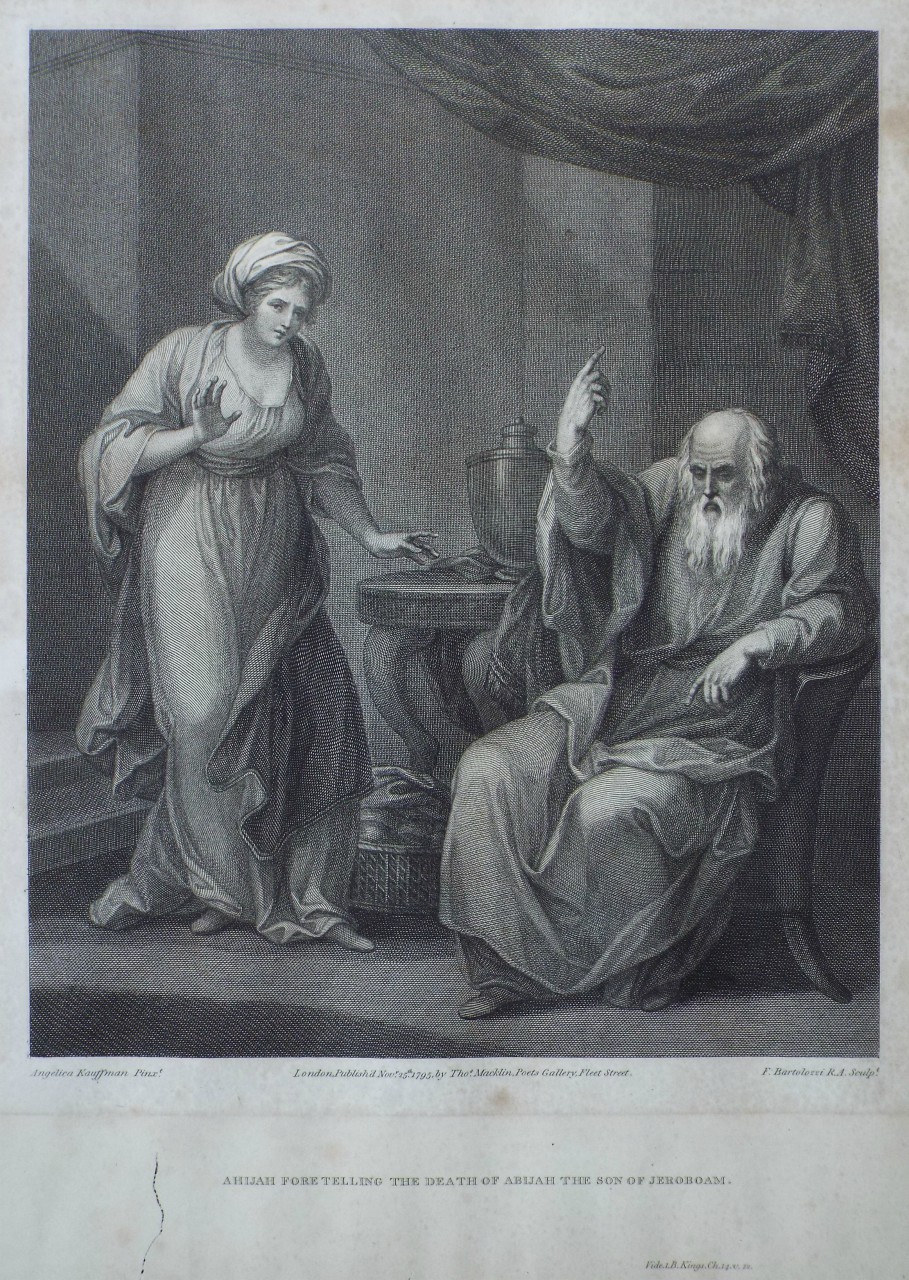
1 At that time Abijah the son of Jeroboam fell sick. And Jeroboam said to his wife, “Arise, and disguise yourself, that it not be known that you are the wife of Jeroboam, and go to Shiloh. Behold, Ahijah the prophet is there, who said of me that I should be king over this people. Take with you ten loaves, some cakes, and a jar of honey, and go to him. He will tell you what shall happen to the child.”

Jeroboam’s wife did so. She arose and went to Shiloh and came to the house of Ahijah. Now Ahijah could not see, for his eyes were dim because of his age. And the LORD said to Ahijah, “Behold, the wife of Jeroboam is coming to inquire of you concerning her son, for he is sick. Thus and thus shall you say to her.”

When she came, she pretended to be another woman. But when Ahijah heard the sound of her feet, as she came in at the door, he said, “Come in, wife of Jeroboam. Why do you pretend to be another? For I am charged with unbearable news for you. Go, tell Jeroboam, ‘Thus says the LORD, the God of Israel: “Because I exalted you from among the people and made you leader over my people Israel and tore the kingdom away from the house of David and gave it to you, and yet you have not been like my servant David, who kept my commandments and followed me with all his heart, doing only that which was right in my eyes, but you have done evil above all who were before you and have gone and made for yourself other gods and metal images, provoking me to anger, and have cast me behind your back, 10 therefore behold, I will bring harm upon the house of Jeroboam and will cut off from Jeroboam every male, both bond and free in Israel, and will burn up the house of Jeroboam, as a man burns up dung until it is all gone. 11 Anyone belonging to Jeroboam who dies in the city the dogs shall eat, and anyone who dies in the open country the birds of the heavens shall eat, for the LORD has spoken it.”’ 12 Arise therefore, go to your house. When your feet enter the city, the child shall die. 13 And all Israel shall mourn for him and bury him, for he only of Jeroboam shall come to the grave, because in him there is found something pleasing to the LORD, the God of Israel, in the house of Jeroboam. 14 Moreover, the LORD will raise up for himself a king over Israel who shall cut off the house of Jeroboam today. And henceforth, 15 the LORD will strike Israel as a reed is shaken in the water, and root up Israel out of this good land that he gave to their fathers and scatter them beyond the Euphrates, because they have made their Asherim, provoking the LORD to anger. 16 And he will give Israel up because of the sins of Jeroboam, which he sinned and made Israel to sin.”

17 Then Jeroboam’s wife arose and departed and came to Tirzah. And as she came to the threshold of the house, the child died. 18 And all Israel buried him and mourned for him, according to the word of the LORD, which he spoke by his servant Ahijah the prophet. 1 Kings 14:1-18 ESV

God had spoken His word of judgment against the false gods of Israel, and used a young, unnamed prophet to deliver it. This unidentified servant of God spoke his divine message directly to the altar itself. In the presence of King Jeroboam and the people of Israel, he addressed the sacred site itself, the place they had set up to worship and seek the favor of their man-made god. This shrine was located in the city of Bethel, in the southern region of the land belonging to the ten tribes. Jeroboam had constructed a second altar just like it in the northern city of Dan. In an attempt to prevent his people from returning to Judah to offer sacrifices to Yahweh at the temple in Jerusalem, he provided them with two new and more convenient worship sites. But these alternate sites and the altars they contained were adorned with golden calves, the man-made symbols of Jeroboam’s false gods. So, Yahweh had His prophet deliver a stinging indictment against one of these pseudo-sacred sites.

“O altar, altar! This is what the LORD says: A child named Josiah will be born into the dynasty of David. On you he will sacrifice the priests from the pagan shrines who come here to burn incense, and human bones will be burned on you.” – 1 Kings 13:2 NLT

Even these inanimate places of worship would be judged by God for the role they played in Israel’s apostasy. These carefully constructed sites made of handcrafted stones would end up desecrated and dishonored. The golden idols to which they were dedicated would be exposed for what they were: lifeless and powerless lumps of metal. The psalmist sardonically described the utter futility of these false gods.

Their idols are merely things of silver and gold,
    shaped by human hands.
They have mouths but cannot speak,
    and eyes but cannot see.
They have ears but cannot hear,
    and noses but cannot smell.
They have hands but cannot feel,
    and feet but cannot walk,
    and throats but cannot make a sound.
And those who make idols are just like them,
as are all who trust in them. – Psalm 115:4-8 NLT

Since Jeroboam had been responsible for the creation of these altars and the gods they contained, he too would experience the judgment of God. While he had been forced to stand and watch as the prophet destroyed one of his sacred shrines, he walked away unscathed. He was still the king, and his life went on just as it had before. After ordering the reconstruction of the altar, Jeroboam went about his business and soon forgot all that had happened at Bethel. But God had not forgotten the sins of Jeroboam.

Somewhere along the way, Jeroboam’s wife gave birth to a son, ensuring that he would have an heir to his throne to perpetuate his dynasty. But this joy was soon overshadowed by the news that Jeroboam’s son had become seriously ill. Concerned for his son’s health and his dynasty’s future, Jeroboam sent his wife to ask the prophet Ahijah for a divine prognosis. He wanted to know if his son would live or die.

Jeroboam likely chose to send his wife to Ahijah because the prophet had been the one to pronounce his kingship. Years earlier, Ahijah had been sent by Yahweh to inform Jeroboam that he had been selected to be the first king of the northern kingdom of Israel.

One day as Jeroboam was leaving Jerusalem, the prophet Ahijah from Shiloh met him along the way. Ahijah was wearing a new cloak. The two of them were alone in a field, and Ahijah took hold of the new cloak he was wearing and tore it into twelve pieces. Then he said to Jeroboam, “Take ten of these pieces, for this is what the LORD, the God of Israel, says: ‘I am about to tear the kingdom from the hand of Solomon, and I will give ten of the tribes to you! – 1 Kings 11:29-31 NLT

The prophet made it clear that Jeroboam’s reign was the result of Solomon’s sin. The son of David had refused to remain faithful to Yahweh, having erected shrines and altars to the false gods of his many wives. As a result, God would divide his kingdom and establish ten of the 12 tribes as a separate nation-state. Jeroboam had done nothing to deserve his rise to power and prominence; it was the sovereign will of God.

The prophet also informed Jeroboam that Jerusalem would remain the place where Yahweh was to be worshiped. The two nations were to remain devoted to the worship of Yahweh and use the Temple in Jerusalem as their sole sacred site. As the newly installed king of Israel, Jeroboam would need to follow David’s example and encourage the ten northern tribes to remain faithful to Yahweh.

I will place you on the throne of Israel, and you will rule over all that your heart desires. If you listen to what I tell you and follow my ways and do whatever I consider to be right, and if you obey my decrees and commands, as my servant David did, then I will always be with you. I will establish an enduring dynasty for you as I did for David, and I will give Israel to you.” – 1 Kings 11:37-38 NLT

But Jeroboam had failed to heed the prophet’s warning, and now he was suffering the consequences. Yet, when his son became ill, he chose to send his wife to the only man he believed could help him.

Even though Jeroboam’s wife had disguised herself to hide her identity as the queen, the old, blind prophet knew who she was as soon as she walked in the door. Ahijah had been given a divine “heads-up,” informing him of her visit and its purpose.

“Jeroboam’s wife will come here, pretending to be someone else. She will ask you about her son, for he is very sick. Give her the answer I give you.” – 1 Kings 14:5 NLT

As soon as this worried and grieving mother walked in the door, she was met with devastating news. Before she could speak a word, the prophet delivered a message of divine judgment against the house of Jeroboam. The woman who had delivered to Jeroboam an heir to his throne would now be charged with delivering a grim message of his dynasty’s destruction.

“Give your husband, Jeroboam, this message from the LORD, the God of Israel:…I will bring disaster on your dynasty and will destroy every one of your male descendants, slave and free alike, anywhere in Israel. I will burn up your royal dynasty as one burns up trash until it is all gone. – 1 Kings 14:7, 10 NLT

The prophet made sure she understood that her husband’s reign had been a gift from God. Yahweh had “ripped the kingdom away from the family of David” and given it to Jeroboam (1 Kings 14:8 NLT), and Jeroboam had returned the favor by turning his back on God and causing the ten northern tribes to worship false gods. Just as God had predicted the future destruction of Jeroboam’s altars, He now decreed the destruction of Jeroboam’s heirs.

“The members of Jeroboam’s family who die in the city will be eaten by dogs, and those who die in the field will be eaten by vultures. I, the LORD, have spoken.” – 1 Kings 14:11 NLT

And much to his wife’s dismay, it would all begin with the death of his son.

“Go on home, and when you enter the city, the child will die. – 1 Kings 14:12 NLT

It’s impossible to fathom the level of grief this woman felt upon hearing this devastating news. In just a matter of minutes, she had been informed that her entire world was about to collapse. Her husband’s kingdom was going to be destroyed, and her young son would die. The prophet made it painfully clear that it was all her husband’s fault. The message she had been given to deliver to Jeroboam left no doubts as to his culpability and sole responsibility for all that was about to happen.

“…you have not been like my servant David, who obeyed my commands and followed me with all his heart and always did whatever I wanted. You have done more evil than all who lived before you. You have made other gods for yourself and have made me furious with your gold calves.” – 1 Kings 14:8-9 NLT

But while this poor woman was still trying to process all that she had heard, Ahijah continued to deliver more bad news.

“In addition, the LORD will raise up a king over Israel who will destroy the family of Jeroboam. This will happen today, even now! – 1 Kings 14:14 NLT

Jeroboam’s sin was going to have long-lasting consequences. His decision to lead the people of Israel into apostasy would be replicated by his successors, creating a lengthy lineage of spiritual adulterers among God’s chosen people. He had set the tone for their future rebellion, ensuring their eventual removal from the land of promise and their exile “beyond the Euphrates River” (1 Kings 14:15 NLT). Centuries later, God would use the nation of Assyria as His agents of judgment against the northern kingdom of Israel.

In 722 BC, this pagan nation conquered Israel and turned the chosen people of God into slaves. More than 200 years would pass before this devastating event took place. In the meantime, the kings of Israel would follow the pattern established by Jeroboam, leading the people of God into increasing rebellion and wickedness.

But at this point in the story, Jeroboam remains on the throne of Israel. For the moment, God allowed him to maintain his kingdom, but the die had been cast. The damage had been done, and the judgment of God had been decreed.

When Jeroboam’s poor wife returned home, the message of the prophet was confirmed.

“…as she came to the threshold of the house, the child died.” – 1 Kings 14:17 ESV

The judgment of God had begun.

English Standard Version (ESV) The Holy Bible, English Standard Version. ESV® Permanent Text Edition® (2016). Copyright © 2001 by Crossway Bibles, a publishing ministry of Good News Publishers.

New Living Translation (NLT) Holy Bible, New Living Translation, copyright © 1996, 2004, 2015 by Tyndale House Foundation. Used by permission of Tyndale House Publishers Inc., Carol Stream, Illinois 60188. All rights reserved.

Sovereign Over All

1 And behold, a man of God came out of Judah by the word of the LORD to Bethel. Jeroboam was standing by the altar to make offerings. And the man cried against the altar by the word of the LORD and said, “O altar, altar, thus says the LORD: ‘Behold, a son shall be born to the house of David, Josiah by name, and he shall sacrifice on you the priests of the high places who make offerings on you, and human bones shall be burned on you.’” And he gave a sign the same day, saying, “This is the sign that the LORD spoken: ‘Behold, the altar shall be torn down, and the ashes that are on it shall be poured out.’” And when the king heard the saying of the man of God, which he cried against the altar at Bethel, Jeroboam stretched out his hand from the altar, saying, “Seize him.” And his hand, which he stretched out against him, dried up, so that he could not draw it back to himself. The altar also was torn down, and the ashes poured out from the altar, according to the sign that the man of God had given by the word of the LORD. And the king said to the man of God, “Entreat now the favor of the LORD your God, and pray for me, that my hand may be restored to me.” And the man of God entreated the LORD, and the king’s hand was restored to him and became as it was before. And the king said to the man of God, “Come home with me, and refresh yourself, and I will give you a reward.” And the man of God said to the king, “If you give me half your house, I will not go in with you. And I will not eat bread or drink water in this place, for so was it commanded me by the word of the LORD, saying, ‘You shall neither eat bread nor drink water nor return by the way that you came.’” 10 So he went another way and did not return by the way that he came to Bethel. 1 Kings 13:1-10 ESV

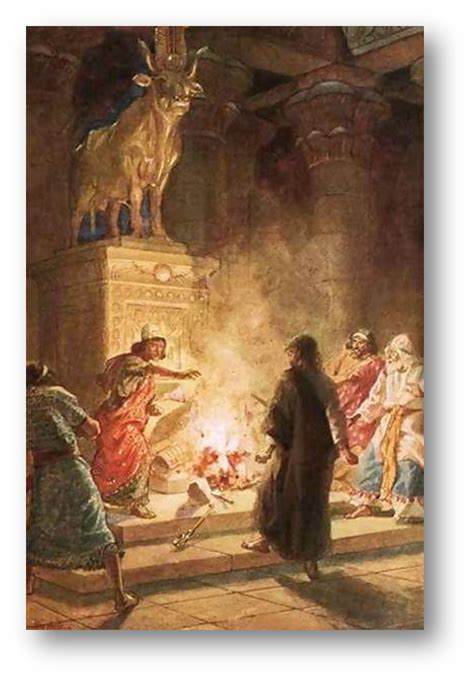
In an effort to preserve the kingdom given to him by God, Jeroboam made a boneheaded decision that ended up offending God. He knew that the members of the ten northern tribes were religious people and feared that they would continue to travel to Judah to offer sacrifices at the Temple Solomon had built in Jerusalem. This continued spiritual connection to the holy city might influence them to restore their relationship with Rehoboam and the people of Judah. So, to prevent this from happening, Jeroboam made the fateful decision to create an alternate religion for the ten tribes of Israel, complete with priests and golden idols made to look like calves, which he had placed in the cities of Dan and Bethel. Then he convinced the people to turn their backs on Yahweh by offering their sacrifices to the two golden calves.

“It is too much trouble for you to worship in Jerusalem. Look, Israel, these are the gods who brought you out of Egypt!”

He placed these calf idols in Bethel and in Dan—at either end of his kingdom. But this became a great sin, for the people worshiped the idols, traveling as far north as Dan to worship the one there. – 1 Kings 12:28-30 NLT

In following Jeroboam’s lead, the people no longer sought forgiveness, cleansing, and blessing from God Almighty, but placed their hopes in lifeless statues made by human hands. Years later, the prophet Isaiah would describe the futility of worshiping false gods.

How foolish are those who manufacture idols.
    These prized objects are really worthless.
The people who worship idols don’t know this,
    so they are all put to shame.
Who but a fool would make his own god—
    an idol that cannot help him one bit?
All who worship idols will be disgraced
    along with all these craftsmen—mere humans—
    who claim they can make a god.
They may all stand together,
    but they will stand in terror and shame. – Isaiah 44:9-11 NLT

But to Jeroboam, his decision made all the sense in the world. He was a pragmatist who was more interested in preserving his newfound status as king than in promoting the ongoing worship of the one who had made him king. And his decision, while initially successful, was about to prove seriously flawed.

Jeroboam had traveled to Bethel to offer sacrifices to one of his false gods. But while there, he received a visit from a prophet of the one true God. This unnamed man had come from Judah with a message from Yahweh. So, as Jeroboam was about to offer sacrifices to his visible, but lifeless god, he was given a word from the invisible, yet all-powerful God of Israel. And the prophet, seemingly ignoring Jeroboam, directed his message at the altar the king had constructed. In a sense, this was one deity speaking to another. Yahweh was challenging the false god of Jeroboam by delivering a prophecy concerning its coming destruction.

O altar, altar! This is what the LORD says: A child named Josiah will be born into the dynasty of David. On you he will sacrifice the priests from the pagan shrines who come here to burn incense, and human bones will be burned on you.” – 1 Kings 13:2 NLT

Jeroboam’s god was going to meet an untimely end. When faced with the power of God Almighty, Jeroboam’s false god proved incapable of defending itself. It remained speechless because it was lifeless. And the warning delivered by the prophet of God carried long-term ramifications. It would be 290 years later before God fulfilled His word, and all during that time, the nation of Israel would continue to worship their false gods. But eventually, God would raise up a king over the southern kingdom of Judah named Josiah, and he would institute a series of religious reforms in both Judah and Israel. In doing so, he would fulfill God’s prophecy against the altar of Jeroboam’s false god.

The king also tore down the altar at Bethel—the pagan shrine that Jeroboam son of Nebat had made when he caused Israel to sin. He burned down the shrine and ground it to dust, and he burned the Asherah pole. Then Josiah turned around and noticed several tombs in the side of the hill. He ordered that the bones be brought out, and he burned them on the altar at Bethel to desecrate it. (This happened just as the LORD had promised through the man of God when Jeroboam stood beside the altar at the festival.) – 2 Kings 23:15-16 NLT

The very fact that this altar was still in existence and in use nearly 300 years later reveals the level of apostasy in Israel. Jeroboam’s decision to replace Yahweh with false gods was going to have long-lasting consequences. In an effort to preserve his kingdom, Jeroboam had been willing to sacrifice the spiritual well-being of his own people.

And to demonstrate that the words he had spoken were true, “the man of God gave a sign to prove his message” (1 Kings 13:3 NLT).

He said, “The LORD has promised to give this sign: This altar will split apart, and its ashes will be poured out on the ground.” – 1 Kings 13:3 NLT

God was going to validate His word with a powerful sign. There would be an immediate judgment on Jeroboam’s apostasy. His shrine and the golden calf it contained would be destroyed. But, once again, Jeroboam attempted to preserve his kingdom by rejecting the will of God. After the prophet had spoken his word of warning, Jeroboam commanded that he be arrested. He wrongly assumed that he could thwart the will of God by binding the messenger of God. In doing so, Jeroboam would establish a precedent that would carry over for generations. His successors to the throne of Israel would continue to reject the will of God by resisting and refusing the messengers of God. Rather than repent and return in humble submission to Yahweh, they would each cling stubbornly to their false gods, dooming their people to the judgment of God.

But Jeroboam’s attempt to stop God’s prophet proved ineffective and injurious. He still ended up with a shattered altar and a paralyzed hand. Suddenly convinced of the prophet’s position as God’s spokesman, Jeroboam begged him to intercede with Yahweh on his behalf.

“Entreat now the favor of the LORD your God, and pray for me, that my hand may be restored to me.” – 1 Kings 13:6 ESV

The prophet prayed and God responded, restoring full mobility to Jeroboam’s paralyzed hand. But Jeroboam’s response to this miracle is revealing. Having just witnessed the miraculous destruction of the altar to his false god and having had his hand paralyzed by God, you would think that Jeroboam would have begged for forgiveness. But instead, he tries to win over the favor of the prophet by inviting him to dinner and offering him a reward. Perhaps Jeroboam feared that the prophet might turn his attention to Dan and destroy the altar there. So, in another attempt to preserve his kingdom, he tried to bribe the prophet of God.

But God, knowing the true nature of Jeroboam’s heart, had warned the prophet not to accept any invitation from this conniving and calculating king.

“Even if you gave me half of everything you own, I would not go with you. I would not eat or drink anything in this place. For the Lord gave me this command: ‘You must not eat or drink anything while you are there, and do not return to Judah by the same way you came.’” – 1 Kings 13:8-9 NLT

Jeroboam was a man who, for the sake of his kingdom, had been willing to compromise his faith in God. And he assumed that this unnamed prophet would be just as willing to make concessions in exchange for monetary gain. But he was wrong. This unnamed prophet of Yahweh refused to compromise his convictions for personal gain. Even when faced with Jeroboam’s offer of a reward, this faithful servant remained uncompromising in his commitment to the will of God. He recognized Yahweh as the one true God and refused to be tempted by Jeroboam’s thinly veiled offer of monetary gain in exchange for spiritual infidelity. His actions reflect his firm and unwavering belief in his God, and echo the words Yahweh spoke through the prophet Isaiah.

This is what the LORD says—
    your Redeemer and Creator:
“I am the LORD, who made all things.
    I alone stretched out the heavens.
Who was with me
    when I made the earth?
I expose the false prophets as liars
    and make fools of fortune-tellers.
I cause the wise to give bad advice,
    thus proving them to be fools.
But I carry out the predictions of my prophets!” – Isaiah 44:24-26 NLT

Jeroboam’s reign over the ten northern tribes had been the work of God, not the result of his own ambition and ingenuity. Yahweh had ordained his rise to power as part of a judgment against Solomon for his spiritual infidelity that resulted in the proliferation of false gods in Israel. But rather than honor Yahweh for His providential role in his rise to power, Jeroboam had created his own religion, complete with its own gods, priestly caste, and sacrificial system. In a vain attempt to solidify his kingdom, Jeroboam led the ten northern tribes to abandon Yahweh and place their hope in the golden calves he had made.

Despite Jeroboam’s actions, the young prophet’s appearance serves as a sign that Yahweh was still in control. Jeroboam could create his own gods and erect shrines in their honor, but he could not escape the sovereign will of Yahweh. According to the word of the prophet, Jeroboam’s altar was destroyed and the ashes poured out. His god proved to be powerless before the one true God, and Jeroboam’s attempt to have the prophet arrested proved futile. As he pointed his finger at the prophet and ordered his arrest, Yahweh intervened, paralyzing Jeroboam’s arm and forcing him to watch as his precious altar was destroyed. Ironically, the rebellious Jeroboam was forced to beg the prophet to call on Yahweh for healing. Rather than appeal to his own self-manufactured god, Jeroboam knew that Yahweh was his only hope.

The prophet prayed, and the LORD answered. Despite his track record of unfaithfulness, Jeroboam received grace and mercy from Yahweh. The recalcitrant king’s hand was restored, and his kingdom was preserved because Yahweh had a much larger plan in place that Jeroboam or any other king could not oppose.

English Standard Version (ESV) The Holy Bible, English Standard Version. ESV® Permanent Text Edition® (2016). Copyright © 2001 by Crossway Bibles, a publishing ministry of Good News Publishers.

New Living Translation (NLT) Holy Bible, New Living Translation, copyright © 1996, 2004, 2015 by Tyndale House Foundation. Used by permission of Tyndale House Publishers Inc., Carol Stream, Illinois 60188. All rights reserved.

Sons and Daughters of God

1 The sons of Issachar: Tola, Puah, Jashub, and Shimron, four. The sons of Tola: Uzzi, Rephaiah, Jeriel, Jahmai, Ibsam, and Shemuel, heads of their fathers’ houses, namely of Tola, mighty warriors of their generations, their number in the days of David being 22,600. The son of Uzzi: Izrahiah. And the sons of Izrahiah: Michael, Obadiah, Joel, and Isshiah, all five of them were chief men. And along with them, by their generations, according to their fathers’ houses, were units of the army for war, 36,000, for they had many wives and sons. Their kinsmen belonging to all the clans of Issachar were in all 87,000 mighty warriors, enrolled by genealogy.

The sons of Benjamin: Bela, Becher, and Jediael, three. The sons of Bela: Ezbon, Uzzi, Uzziel, Jerimoth, and Iri, five, heads of fathers’ houses, mighty warriors. And their enrollment by genealogies was 22,034. The sons of Becher: Zemirah, Joash, Eliezer, Elioenai, Omri, Jeremoth, Abijah, Anathoth, and Alemeth. All these were the sons of Becher. And their enrollment by genealogies, according to their generations, as heads of their fathers’ houses, mighty warriors, was 20,200. 10 The son of Jediael: Bilhan. And the sons of Bilhan: Jeush, Benjamin, Ehud, Chenaanah, Zethan, Tarshish, and Ahishahar. 11 All these were the sons of Jediael according to the heads of their fathers’ houses, mighty warriors, 17,200, able to go to war. 12 And Shuppim and Huppim were the sons of Ir, Hushim the son of Aher.

13 The sons of Naphtali: Jahziel, Guni, Jezer and Shallum, the descendants of Bilhah.

14 The sons of Manasseh: Asriel, whom his Aramean concubine bore; she bore Machir the father of Gilead. 15 And Machir took a wife for Huppim and for Shuppim. The name of his sister was Maacah. And the name of the second was Zelophehad, and Zelophehad had daughters. 16 And Maacah the wife of Machir bore a son, and she called his name Peresh; and the name of his brother was Sheresh; and his sons were Ulam and Rakem. 17 The son of Ulam: Bedan. These were the sons of Gilead the son of Machir, son of Manasseh. 18 And his sister Hammolecheth bore Ishhod, Abiezer, and Mahlah. 19 The sons of Shemida were Ahian, Shechem, Likhi, and Aniam.

20 The sons of Ephraim: Shuthelah, and Bered his son, Tahath his son, Eleadah his son, Tahath his son, 21 Zabad his son, Shuthelah his son, and Ezer and Elead, whom the men of Gath who were born in the land killed, because they came down to raid their livestock. 22 And Ephraim their father mourned many days, and his brothers came to comfort him. 23 And Ephraim went in to his wife, and she conceived and bore a son. And he called his name Beriah, because disaster had befallen his house. 24 His daughter was Sheerah, who built both Lower and Upper Beth-horon, and Uzzen-sheerah. 25 Rephah was his son, Resheph his son, Telah his son, Tahan his son, 26 Ladan his son, Ammihud his son, Elishama his son, 27 Nun his son, Joshua his son. 28 Their possessions and settlements were Bethel and its towns, and to the east Naaran, and to the west Gezer and its towns, Shechem and its towns, and Ayyah and its towns; 29 also in possession of the Manassites, Beth-shean and its towns, Taanach and its towns, Megiddo and its towns, Dor and its towns. In these lived the sons of Joseph the son of Israel.

30 The sons of Asher: Imnah, Ishvah, Ishvi, Beriah, and their sister Serah. 31 The sons of Beriah: Heber, and Malchiel, who fathered Birzaith. 32 Heber fathered Japhlet, Shomer, Hotham, and their sister Shua. 33 The sons of Japhlet: Pasach, Bimhal, and Ashvath. These are the sons of Japhlet. 34 The sons of Shemer his brother: Rohgah, Jehubbah, and Aram. 35 The sons of Helem his brother: Zophah, Imna, Shelesh, and Amal. 36 The sons of Zophah: Suah, Harnepher, Shual, Beri, Imrah. 37 Bezer, Hod, Shamma, Shilshah, Ithran, and Beera. 38 The sons of Jether: Jephunneh, Pispa, and Ara. 39 The sons of Ulla: Arah, Hanniel, and Rizia. 40 All of these were men of Asher, heads of fathers’ houses, approved, mighty warriors, chiefs of the princes. Their number enrolled by genealogies, for service in war, was 26,000 men. – 1 Chronicles 7:1-40 ESV

As the chronicler nears the end of his lengthy genealogical record, he provides details concerning some of the remaining tribes of Israel. For his original audience, the various lists of names served an important purpose; it was their link to the past to remind them of their heritage as sons and daughters of God. They were the chosen ones, descended from Abraham, Isaac, and Jacob, and each of them could trace their roots back to one of the sons of Jacob. Surrounded by the uncertainty of their new life in Judah, these recently transplanted exiles would desperately cling to this lifeline to the past to give them hope. In a way, they must have felt like strangers in a strange land but, in reading these genealogical records, they were reminded that they belonged. This was their home. They were God’s people. And the inheritance promised to Abraham was rightfully theirs.

In this chapter, the author covers the lines of Issachar, Benjamin, Naphtali, Manasseh, Ephraim, and Asher, but he leaves out the tribes of Dan and Zebulun. No reason is given for their absence, but because the author has already included the tribe of Levi and dealt with the two halves of the tribe of Manasseh separately, it appears that he wanted to keep the number of tribes at 12. Including Dan and Zebulun would have given the impression that there were 14 tribes. It seems that it was more important to the writer to maintain a total of 12 tribes than to worry about which ones were left out or included.

But the chronicler gave special emphasis to the tribes of Judah and Benjamin. The tribe of Benjamin is covered in verses 6-12 of chapter 7 and all of chapter 8. Judah is also given more extensive coverage. His focus on these two tribes is most likely linked to their role in providing Israel with its first two kings. Saul, who served as the first king of Israel, was Benjamite, while David hailed from the tribe of Judah.

There was a time when the people of Israel had been ruled by judges whom God appointed over them. The last of these was a man named Samuel, who was also a prophet of God. When he grew old, the people of Israel feared that he would appoint one of his wicked sons to serve in his place. So, they declared their demands for a king.

“Behold, you are old and your sons do not walk in your ways. Now appoint for us a king to judge us like all the nations.” – 1 Samuel 8:5 ESV

While this request angered Samuel, God decided to give them exactly what they wanted. He even warned them how things would turn out if they got a king like all the other nations (1 Samuel 5:10-18). But the people ignored God’s warning and Saul became their first king. In time, the people discovered that God had been right. Saul proved to be a bad king and was eventually replaced by David, whom God declared to be a man after His own heart. So, for their role in giving Israel its first two kings, the tribes of Benjamin and Judah were given more significant coverage.

But it seems that the chronicler is going out of his way to emphasize that God is the God of all the tribes of Israel. They had all been returned by God from exile in Babylon to the land of promise. Every person who read this account could trace back his lineage to one of these tribes. They could relate to the history of Saul and David. They all shared the same covenant-keeping God. God had a plan for all of Israel, not just Judah, but He was going to use Judah to establish His kingdom – in the future. From the tribe of Judah would come the Messiah.

By providing the lengthy genealogies, the writer is reminding the people of Israel of their significance in the world. They have a rich heritage and are each descendants of Abraham, and, as such, are the chosen people of God. This fact could have easily been forgotten after spending 70 years in exile. So God reminds them of who they are and from whence they have come. He has returned them to the land, and while things might not look so good at the moment, He is far from done.

As Christ-followers we too can easily forget our rich heritage. We are sons of God and joint heirs with Jesus Christ. But, like the Israelites, we find ourselves living like strangers in a strange land. When we lose our identity as God’s people, we can end up compromising our convictions and growing complacent and far too comfortable with the world. Rather than maintaining our God-given distinctiveness, we adopt and adapt the ways of this world. But the apostle John warns us to avoid this love affair with the world.

Do not love this world nor the things it offers you, for when you love the world, you do not have the love of the Father in you. For the world offers only a craving for physical pleasure, a craving for everything we see, and pride in our achievements and possessions. These are not from the Father, but are from this world. And this world is fading away, along with everything that people crave. But anyone who does what pleases God will live forever. – 1 John 2:15-17 NLT

Paul provides us with a similar admonition.

Don’t copy the behavior and customs of this world, but let God transform you into a new person by changing the way you think. Then you will learn to know God’s will for you, which is good and pleasing and perfect. – Romans 12:2 NLT

Not to be outdone, James adds his own warning against growing comfortable with the world.

Don’t you realize that friendship with the world makes you an enemy of God? I say it again: If you want to be a friend of the world, you make yourself an enemy of God. – James 4:4 NLT

The 12 tribes of Israel were expected to recall their ancestry and remember their calling as God’s chosen people. Seventy years of exile had done nothing to diminish their unique status as children of God. Their bloodline determined their heritage and their inheritance. Many of those who returned from exile had been born in Babylon, but God wanted them to know that they were still sons and daughters of Abraham, and as such, they were heirs of the promise.

We too are heirs of a rich heritage and bear the distinction of being God’s chosen people. But we must constantly remind ourselves what Jesus said: “You are no longer part of the world. I chose you to come out of the world” (John 15:19 NLT). We are God’s sons and daughters and are citizens of a different Kingdom.

…our citizenship is in heaven, and from it we await a Savior, the Lord Jesus Christ. – Philippians 3:20 ESV

We may find these lengthy genealogical lists difficult to read and even harder to apply, but they should remind us of our unique status as God’s people and His desire that we live out our new identity with confidence and hope in His eternal promises. Peter provides us with a powerful reminder of our one-of-a-kind status as Kingdom citizens.

…you are a chosen people. You are royal priests, a holy nation, God’s very own possession. As a result, you can show others the goodness of God, for he called you out of the darkness into his wonderful light.

“Once you had no identity as a people;
    now you are God’s people.
Once you received no mercy;
    now you have received God’s mercy.”

Dear friends, I warn you as “temporary residents and foreigners” to keep away from worldly desires that wage war against your very souls. Be careful to live properly among your unbelieving neighbors. Then even if they accuse you of doing wrong, they will see your honorable behavior, and they will give honor to God when he judges the world. – 1 Peter 2:9-12 NLT

English Standard Version (ESV)
The Holy Bible, English Standard Version. ESV® Permanent Text Edition® (2016). Copyright © 2001 by Crossway Bibles, a publishing ministry of Good News Publishers.

New Living Translation (NLT)
Holy Bible, New Living Translation, copyright © 1996, 2004, 2015 by Tyndale House Foundation. Used by permission of Tyndale House Publishers Inc., Carol Stream, Illinois 60188. All rights reserved.

The Sport of Competitive Conception

Then she said, “Here is my servant Bilhah; go in to her, so that she may give birth on my behalf, that even I may have children through her.” So she gave him her servant Bilhah as a wife, and Jacob went in to her. And Bilhah conceived and bore Jacob a son. Then Rachel said, “God has judged me, and has also heard my voice and given me a son.” Therefore she called his name Dan. Rachel’s servant Bilhah conceived again and bore Jacob a second son. Then Rachel said, “With mighty wrestlings I have wrestled with my sister and have prevailed.” So she called his name Naphtali.

When Leah saw that she had ceased bearing children, she took her servant Zilpah and gave her to Jacob as a wife. 10 Then Leah’s servant Zilpah bore Jacob a son. 11 And Leah said, “Good fortune has come!” so she called his name Gad. 12 Leah’s servant Zilpah bore Jacob a second son. 13 And Leah said, “Happy am I! For women have called me happy.” So she called his name Asher.

14 In the days of wheat harvest Reuben went and found mandrakes in the field and brought them to his mother Leah. Then Rachel said to Leah, “Please give me some of your son’s mandrakes.” 15 But she said to her, “Is it a small matter that you have taken away my husband? Would you take away my son’s mandrakes also?” Rachel said, “Then he may lie with you tonight in exchange for your son’s mandrakes.” 16 When Jacob came from the field in the evening, Leah went out to meet him and said, “You must come in to me, for I have hired you with my son’s mandrakes.” So he lay with her that night. 17 And God listened to Leah, and she conceived and bore Jacob a fifth son. 18 Leah said, “God has given me my wages because I gave my servant to my husband.” So she called his name Issachar.

19 And Leah conceived again, and she bore Jacob a sixth son. 20 Then Leah said, “God has endowed me with a good endowment; now my husband will honor me, because I have borne him six sons.” So she called his name Zebulun. 21 Afterward she bore a daughter and called her name Dinah.

22 Then God remembered Rachel, and God listened to her and opened her womb. 23 She conceived and bore a son and said, “God has taken away my reproach.” 24 And she called his name Joseph, saying, “May the Lord add to me another son!” Genesis 30:3-24 ESV

This story reads like a 1970s television soap opera. The interpersonal intrigues are difficult to keep up with and the sheer number of births is mind-boggling. Moses provides no timeline for this narrative, but suffice it to say, Jacob was a busy man. In the span of 19 verses, Moses describes Jacob as fathering seven sons by four different women. And it’s impossible to read this story and not see the similarities found in the lives of Jacob’s parents and grandparents. But it is if Jacob, Rachel, and Leah have taken the art of conception to a whole new level. It has become a competitive sport, with the women in Jacob’s life batting him like a helpless shuttlecock in a game of badminton.

In fact, it got so bad that Jacob functioned more like a prostitute than as the patriarch of his own family. When his wives ordered him to sleep with their maidservants, he seemed to passively comply. At one point, his wife Leah actually sold some mandrakes to Rachel and used sexual access to Jacob as her bartering chip. Having paid for his services, she simply informed Jacob of the arrangement.

“You must come and sleep with me tonight!” she said. “I have paid for you with some mandrakes that my son found.” So that night he slept with Leah. – Genesis 30:16 NLT

It’s difficult to keep up, but at this point in the story, Jacob has fathered 11 sons. Leah has given him Reuben, Simeon, Levi, Judah, Issachar, and Zebulun. Her handmaid Zilpah has added Gad and Asher. Rachel’s handmaid provided Dan and Naphtali. And, after God opened her womb, Rachel delivered Joseph.

Due to her barrenness, Rachel had been unable to bear Jacob any children – until God had intervened. As her husband’s favorite wife, she found herself shamed by her infertility and her frustrating inability to give Jacob the one thing he desired most: A son. So, in an effort to compete with her sister’s prolific child-bearing capabilities, she had come up with the idea to have children through a surrogate.

“Take my maid, Bilhah, and sleep with her. She will bear children for me, and through her I can have a family, too.” – Genesis 30:3 NLT

In a fit of jealousy and driven by purely selfish motives, Rachel ordered Jacob to father a son through her servant. And just as Abraham had followed the same advice from his wife, Sarah, Jacob complied. Not once, but twice. And this little act of competitive conception encouraged Leah to take up the sport. She too offered her servant to Jacob and, once again, he willingly took her up on the offer. The result? Two more sons.

It would be easy to read this story and be left with the impression that things have gotten completely out of control. There is no referee in this game of one-upmanship. Each of these women seems to make up the rules as the game unfolds. And Jacob comes across like a triple-A prospect who suddenly gets called up to the big leagues. This little country boy from Beersheba was going up against the pros.

But, Moses wants his readers to know that this is not some no-rules, make-it-up-as-you-go-along free-for-all. God is fully in control and operating behind the scenes in order to accomplish His divine will. Yes, it’s messy and incorporates all the subterfuge and self-promotion that Rachel and Leah bring to the table, but it is far from out of control. As Moses lists the various names of the boys born to Jacob, his Jewish readers would have recognized the names of their individual tribes. These boys would grow to become men and father 11 of the 12 tribes of Israel. And on two separate occasions, Moses deliberately pauses the narrative at the mention of the names of Judah and Joseph. When Leah had given birth to her fourth son, she had named him Judah, then Moses wrote, “Then she ceased bearing” (Genesis 29:35 ESV). It seems that God had turned off the tap. He sovereignly sealed her womb, not permanently, but for a period of time.

As stated in yesterday’s blog, Judah was to become the tribe through whom the Messiah of Israel would be born. Judah was going to play a major role in the national affairs of Israel and the future fate of the world. And the same thing is true of Joseph.

Rachel, the favored wife of Jacob, could not bear children. That is until God sovereignly ordained it. And when He miraculously opened her womb, Rachel gave birth to a boy named Joseph. Little did Rachel know that this long-awaited son would play a vital role in the future salvation and preservation of the people of Israel. Moses readers would have been highly familiar with the story of Joseph. He would grow to become the favorite son of Jacob, a designation that would make him the envy of his 10 older brothers. Jacob would lavish the favored son of his favorite wife with affection and gifts, a move that would make Joseph the target of his brothers’ ire.

Jacob loved Joseph more than any of his other children because Joseph had been born to him in his old age. So one day Jacob had a special gift made for Joseph—a beautiful robe. But his brothers hated Joseph because their father loved him more than the rest of them. They couldn’t say a kind word to him. – Genesis 37:3-4 NLT

Yet, like Judah, Joseph was destined to play a special role in his family’s future. While Rachel and Leah were busy conniving and competing, God had more serious and world-changing plans in mind. He was using the selfish and shortsighted machinations of these two women to fulfill the covenant promise He had made to Abraham, Isaac, and now, Jacob. As usual, the characters in the story remain oblivious to the unseen actions of God. They believed themselves to be in control and driving the narrative. Oh, they give God lip service.

“God has vindicated me! He has heard my request and given me a son.” – Genesis 30:6 NLT

“God has rewarded me for giving my servant to my husband as a wife.” – Genesis 30:18 NLT

“God has given me a good reward.” – Genesis 30:20 NLT

“God has removed my disgrace…” – Genesis 30:23 NLT

But they were operating according to their own agendas and in keeping with their own selfish desires. Yet, God was righteously redeeming their flawed actions in order to bring about the plan He had developed long before any of them ever existed.

With the birth of Joseph, a new chapter in the story will begin. For nearly two decades, Jacob had been living in Haran with his father-in-law Laban. He had been waiting on word from his mother, Rachel, informing him that Esau had forgiven him and it was safe to return home. But that message had never come. In all likelihood, Rachel had died while Jacob had been away. He now had two wives, two concubines, and 11 sons. God had blessed him and he realized it was time to return to Canaan. According to God, it was there that his inheritance would be found. When Jacob had stopped in Bethel on his way to Haran, God had appeared to him in a dream and said:

“I am the Lord, the God of your grandfather Abraham, and the God of your father, Isaac. The ground you are lying on belongs to you. I am giving it to you and your descendants. Your descendants will be as numerous as the dust of the earth! They will spread out in all directions—to the west and the east, to the north and the south. And all the families of the earth will be blessed through you and your descendants. What’s more, I am with you, and I will protect you wherever you go. One day I will bring you back to this land. I will not leave you until I have finished giving you everything I have promised you.” – Genesis 28:13-15 NLT

Now, it was time to go back to the land because Jacob knew that Canaan was where the promises of God would be fully fulfilled.

English Standard Version (ESV) The Holy Bible, English Standard Version. ESV® Permanent Text Edition® (2016). Copyright © 2001 by Crossway Bibles, a publishing ministry of Good News Publishers.

New Living Translation (NLT) Holy Bible, New Living Translation, copyright © 1996, 2004, 2015 by Tyndale House Foundation. Used by permission of Tyndale House Publishers Inc., Carol Stream, Illinois 60188. All rights reserved.

New English Translation (NET)NET Bible® copyright ©1996-2017 by Biblical Studies Press, L.L.C. http://netbible.com All rights reserved.

For Evil and Not for Good

1 I saw the Lord standing beside the altar, and he said:

“Strike the capitals until the thresholds shake,
    and shatter them on the heads of all the people;
and those who are left of them I will kill with the sword;
    not one of them shall flee away;
    not one of them shall escape.

“If they dig into Sheol,
    from there shall my hand take them;
if they climb up to heaven,
    from there I will bring them down.
If they hide themselves on the top of Carmel,
    from there I will search them out and take them;
and if they hide from my sight at the bottom of the sea,
    there I will command the serpent, and it shall bite them.
And if they go into captivity before their enemies,
    there I will command the sword, and it shall kill them;
and I will fix my eyes upon them
    for evil and not for good.”

The Lord God of hosts,
he who touches the earth and it melts,
    and all who dwell in it mourn,
and all of it rises like the Nile,
    and sinks again, like the Nile of Egypt;
who builds his upper chambers in the heavens
    and founds his vault upon the earth;
who calls for the waters of the sea
    and pours them out upon the surface of the earth—
the Lord is his name.

“Are you not like the Cushites to me,
    O people of Israel?” declares the Lord.
“Did I not bring up Israel from the land of Egypt,
    and the Philistines from Caphtor and the Syrians from Kir?
Behold, the eyes of the Lord God are upon the sinful kingdom,
    and I will destroy it from the surface of the ground,
    except that I will not utterly destroy the house of Jacob,”
declares the Lord.

“For behold, I will command,
    and shake the house of Israel among all the nations
as one shakes with a sieve,
    but no pebble shall fall to the earth.
10 All the sinners of my people shall die by the sword,
    who say, ‘Disaster shall not overtake or meet us.’Amos 9:1-10 ESV

In this final vision, Amos sees God standing next to an altar. But this scene does not take place at the temple in Jerusalem. Ever since the kingdom of Solomon had been divided in two by God, the ten northern tribes had abstained from worshiping Yahweh at the temple that Solomon had constructed in Jerusalem. Instead, they worshiped the false gods that Jeroboam I had set up in Dan and Bethel.

Jeroboam thought to himself, “Unless I am careful, the kingdom will return to the dynasty of David. When these people go to Jerusalem to offer sacrifices at the Temple of the Lord, they will again give their allegiance to King Rehoboam of Judah. They will kill me and make him their king instead.”

So on the advice of his counselors, the king made two gold calves. He said to the people, “It is too much trouble for you to worship in Jerusalem. Look, Israel, these are the gods who brought you out of Egypt!”

He placed these calf idols in Bethel and in Dan—at either end of his kingdom. But this became a great sin, for the people worshiped the idols, traveling as far north as Dan to worship the one there.

Jeroboam also erected buildings at the pagan shrines and ordained priests from the common people—those who were not from the priestly tribe of Levi. – 1 Kings 12:26-31 NLT

And long after Jeroboam’s death, the kingdom of Israel continued to worship the golden calves he had set up in Dan and Bethel. So, the altar in Amos’ vision is most likely in one of those locations. He sees God standing next to the sacred shrine dedicated to the golden calf of Jeroboam – the false god that had been meant to replace Him.

Amos sees Yahweh, the one true God, standing in judgment over the altar of the false god that the people of Israel had chosen to worship instead of Him. In essence, God is standing next to one of the golden calf statues that Jeroboam I had created. And in the very presence of this false god, Yahweh calls for the destruction of his house.

Strike the tops of the Temple columns,
    so that the foundation will shake.
Bring down the roof
    on the heads of the people below.
I will kill with the sword those who survive.
    No one will escape!” – Amos 9:1 NLT

Amos is being given a glimpse of the coming judgment of God upon the house of Jacob (Israel). With the destruction of the temple dedicated to Israel’s false god, Yahweh is displaying His unparalleled power and declaring His well-deserved judgment upon them for their rejection of Him. While a literal destruction of this pagan temple would only result in a few deaths, God assures Amos that “no one will escape” His wrath. They can run but they won’t be able to escape the judgment of God Almighty. And God uses language that is reminiscent of the words of King David, recorded in Psalm 139.

I can never escape from your Spirit!
    I can never get away from your presence!
If I go up to heaven, you are there;
    if I go down to the grave, you are there.
If I ride the wings of the morning,
    if I dwell by the farthest oceans,
even there your hand will guide me,
    and your strength will support me. – Psalm 139:7-10 NLT

It doesn’t matter where they go, God will find them and mete out His judgment upon them. Rather than guidance and strength, they will find only the righteous indignation and full fury of the God they have chosen to abandon. And one of the fascinating things about this passage is its rather veiled but obvious reference to Jonah. God states, “Even if they hide at the very top of Mount Carmel, I will search them out and capture them. Even if they hide at the bottom of the ocean, I will send the sea serpent after them to bite them” (Amos 9:3 NLT).

Amos was a contemporary of Jonah, another prophet that God had appointed to the northern tribe of Israel. But at one point, God had given Jonah a commission to take His message of pending judgment to the Assyrians living in the capital city of Nineveh. Fearing that the pagan people of Nineveh would hear God’s message and repent, Jonah refused to obey God’s command. Instead, he booked passage on a ship to Tarshish, hoping to escape the presence of the Lord. But through a series of divinely ordained events, God pursued His rebellious and disobedient prophet. God sent a storm that placed Jonah and his fellow passengers in great danger.

Then the sailors picked Jonah up and threw him into the raging sea, and the storm stopped at once! The sailors were awestruck by the Lord’s great power, and they offered him a sacrifice and vowed to serve him.

Now the Lord had arranged for a great fish to swallow Jonah. And Jonah was inside the fish for three days and three nights. – Jonah 1:15-17 NLT

When Jonah was cast into the sea, he sank beneath the waves. He began to drown. And he later described for God what that experience had been like.

You threw me into the ocean depths,
    and I sank down to the heart of the sea.
The mighty waters engulfed me;
    I was buried beneath your wild and stormy waves. – Jonah 2:3 NLT

But God sent the sea serpent to bite him (Amos 9:3). But in Jonah’s case, the “serpent” was actually a symbol of God’s salvation. Even Jonah recognized that the “great fish” had been an agent of God’s mercy.

I sank down to the very roots of the mountains.
    I was imprisoned in the earth,
    whose gates lock shut forever.
But you, O Lord my God,
    snatched me from the jaws of death! – Jonah 2:6 NLT

After three days and nights inside the great fish, Jonah was unceremoniously vomited out on dry land. He was rescued and redeemed from death by the sovereign hand of God. After his miraculous and God-ordained deliverance, Jonah went to Nineveh and delivered God’s message of judgment, and the people repented. God’s will was done.

Jonah had rebelled against God and had suffered the consequences. He had thought He could escape the wrath of God and was proven wrong. And the people of Israel were going to learn the same painful lesson. Just as God had appointed the wind to create the storm that resulted in Jonah’s drowning, He would appoint enemies to destroy the people of Israel. The same God who “draws up water from the oceans and pours it down as rain on the land” (Amos 9:6 NLT), was going to use His sovereign power to rain down judgment upon the disobedient people of Israel.

But, like Jonah, they would find that their God was merciful and longsuffering. Jonah did not drown, and the people of Israel would not be completely destroyed.

“I, the Sovereign Lord,
    am watching this sinful nation of Israel.
I will destroy it
    from the face of the earth.
But I will never completely destroy the family of Israel…” – Amos 9:8 NLT

Jonah lived to tell the story of his own rebellion. And a remnant of the people of Israel would live to tell about God’s undeserved mercy and grace toward them. In the midst of His declaration of judgment, God promises to redeem a remnant of His people.

“For I will give the command
    and will shake Israel along with the other nations
as grain is shaken in a sieve,
    yet not one true kernel will be lost.” – Amos 9:9 NLT

There were still those in Israel who remained true to Yahweh, and He would preserve and protect them. Why? Because He was not yet done. The rebellion of His people would be punished, but His sovereign plan for the world would still be accomplished. God had set apart the people of Israel so that they might be a light to the nations, but they had failed to accomplish God’s will. Yet, He had a plan in place that would bring about the fulfillment of His original mandate that Israel be a light to the nations. And it would come about through His Son, the true Israel.

God, the Lord, created the heavens and stretched them out.
    He created the earth and everything in it.
He gives breath to everyone,
    life to everyone who walks the earth.
And it is he who says,
“I, the Lord, have called you to demonstrate my righteousness.
    I will take you by the hand and guard you,
and I will give you to my people, Israel,
    as a symbol of my covenant with them.
And you will be a light to guide the nations.
    You will open the eyes of the blind.
You will free the captives from prison,
    releasing those who sit in dark dungeons.” – Isaiah 42:5-7 NLT

Jesus would accomplish what Israel had failed to do. He would be a descendant of Abraham and the son of King David who would fully accomplish God’s will. But for that to happen, God would spare a remnant of His people so that His Son could one day enter the world, born of the virgin, Mary, and the rightful heir to the throne of David. And, as Amos was about to see, while God was prepared to judge Israel, He was far from done with them, because He had a plan in place.

English Standard Version (ESV) The Holy Bible, English Standard Version. ESV® Permanent Text Edition® (2016). Copyright © 2001 by Crossway Bibles, a publishing ministry of Good News Publishers.

New Living Translation (NLT) Holy Bible, New Living Translation, copyright © 1996, 2004, 2015 by Tyndale House Foundation. Used by permission of Tyndale House Publishers Inc., Carol Stream, Illinois 60188. All rights reserved.

The Message (MSG)Copyright © 1993, 1994, 1995, 1996, 2000, 2001, 2002 by Eugene H. Peterson

Uncompromising Conviction

1 And behold, a man of God came out of Judah by the word of the Lord to Bethel. Jeroboam was standing by the altar to make offerings. And the man cried against the altar by the word of the Lord and said, “O altar, altar, thus says the Lord: ‘Behold, a son shall be born to the house of David, Josiah by name, and he shall sacrifice on you the priests of the high places who make offerings on you, and human bones shall be burned on you.’” And he gave a sign the same day, saying, “This is the sign that the Lord has spoken: ‘Behold, the altar shall be torn down, and the ashes that are on it shall be poured out.’” And when the king heard the saying of the man of God, which he cried against the altar at Bethel, Jeroboam stretched out his hand from the altar, saying, “Seize him.” And his hand, which he stretched out against him, dried up, so that he could not draw it back to himself. The altar also was torn down, and the ashes poured out from the altar, according to the sign that the man of God had given by the word of the Lord. And the king said to the man of God, “Entreat now the favor of the Lord your God, and pray for me, that my hand may be restored to me.” And the man of God entreated the Lord, and the king’s hand was restored to him and became as it was before. And the king said to the man of God, “Come home with me, and refresh yourself, and I will give you a reward.” And the man of God said to the king, “If you give me half your house, I will not go in with you. And I will not eat bread or drink water in this place, for so was it commanded me by the word of the Lord, saying, ‘You shall neither eat bread nor drink water nor return by the way that you came.’” 10 So he went another way and did not return by the way that he came to Bethel. 1 Kings 13:1-10 ESV

In an effort to preserve the kingdom given to him by God, Jeroboam had made a boneheaded decision that ended up offending God. He knew that the Israelites were a religious people and feared that they would continue to travel to Judah to offer sacrifices at the temple Solomon had built in Jerusalem. This continued spiritual connection to the holy city might influence them to restore their relationship with Rehoboam and the people of Judah. So, to prevent this from happening, Jeroboam had made the fateful decision to create an alternate religion for the ten tribes of Israel, complete with priests and golden idols made to look like calves, which he had placed in the cities of Dan and Bethel. Then he convinced the people to turn their backs on Yahweh by offering their sacrifices to the two golden calves.

“It is too much trouble for you to worship in Jerusalem. Look, Israel, these are the gods who brought you out of Egypt!”

He placed these calf idols in Bethel and in Dan—at either end of his kingdom. But this became a great sin, for the people worshiped the idols, traveling as far north as Dan to worship the one there. – 1 Kings 12:28-30 NLT

In following Jeroboam’s lead, the people no longer sought forgiveness, cleansing, and blessing from God Almighty, but placed their hopes in lifeless statues made by human hands. Years later, the prophet Isaiah would describe the futility of worshiping false gods.

How foolish are those who manufacture idols.
    These prized objects are really worthless.
The people who worship idols don’t know this,
    so they are all put to shame.
Who but a fool would make his own god—
    an idol that cannot help him one bit?
All who worship idols will be disgraced
    along with all these craftsmen—mere humans—
    who claim they can make a god.
They may all stand together,
    but they will stand in terror and shame. – Isaiah 44:9-11 NLT

But to Jeroboam, his decision made all the sense in the world. He was a pragmatist who was more interested in preserving his newfound status as king than in promoting the ongoing worship of the one who had made him king. And his decision, while initially successful, was about to prove seriously flawed.

Jeroboam had traveled to Bethel in order to offer sacrifices to one of his false gods. But while there, he received a visit from a prophet of the one true God. This unnamed man had come from Judah with a message from the Almighty. So, as Jeroboam was about to offer sacrifices to his visible, but lifeless god, he was given a word from the invisible, yet all-powerful God of Israel. And the prophet, seemingly ignoring Jeroboam, directed his message at the altar the king had constructed. In a sense, this was one god speaking to another. Yahweh was challenging the false god of Jeroboam by delivering a prophecy concerning its coming destruction.

O altar, altar! This is what the Lord says: A child named Josiah will be born into the dynasty of David. On you he will sacrifice the priests from the pagan shrines who come here to burn incense, and human bones will be burned on you.” – 1 Kings 13:2 NLT

Jeroboam’s god was going to meet an untimely end. When faced with the power of God Almighty, Jeroboam’s false god proved incapable of defending itself. It remained speechless because it was lifeless. And the warning delivered by the prophet of God carried long-term ramifications. It would be 290 years later before God fulfilled His word, and all during that time, the nation of Israel would continue to worship their false gods. But eventually, God would raise up a king over Judah whose name was Josiah, and he would institute a series of religious reforms in both Judah and Israel. And, in doing so, he would fulfill God’s prophecy against the altar of Jeroboam’s false god.

The king also tore down the altar at Bethel—the pagan shrine that Jeroboam son of Nebat had made when he caused Israel to sin. He burned down the shrine and ground it to dust, and he burned the Asherah pole. Then Josiah turned around and noticed several tombs in the side of the hill. He ordered that the bones be brought out, and he burned them on the altar at Bethel to desecrate it. (This happened just as the Lord had promised through the man of God when Jeroboam stood beside the altar at the festival.) – 2 Kings 23:15-16 NLT

The very fact that this altar was still in existence and in use nearly 300 years later reveals the level of apostasy in Israel. Jeroboam’s decision to replace Yahweh with false gods was going to have long-lasting consequences. In an effort to preserve his kingdom Jeroboam was willing to sacrifice the spiritual well-being of his own people.

And to demonstrate that the words he had spoken were true, “the man of God gave a sign to prove his message” (1 Kings 13:3 NLT).

He said, “The Lord has promised to give this sign: This altar will split apart, and its ashes will be poured out on the ground.” – 1 Kings 13:3 NLT

God was going to validate His word with a powerful sign. There would be an immediate judgment on Jeroboam’s apostasy. His shrine and the golden calf it contained would be destroyed. But, once again, Jeroboam attempted to preserve his kingdom by rejecting the will of God. After the prophet had spoken his word of warning, Jeroboam commanded that he be arrested. He wrongly assumed that he could thwart the will of God by binding the messenger of God. And, in doing so, Jeroboam would establish a precedent that would carry over for generations. His successors to the throne of Israel would continue to reject the will of God by resisting and refusing the messengers of God. Rather than repent and return in humble submission to Yahweh, they would each cling stubbornly to their false gods, dooming their people to the judgment of God.

But Jeroboam’s attempt to stop God’s prophet proved ineffective and injurious. He still ended up with a shattered altar and a paralyzed hand. Suddenly convinced of the prophet’s position as God’s spokesman, Jeroboam begged him to intercede with Yahweh on his behalf.

“Entreat now the favor of the Lord your God, and pray for me, that my hand may be restored to me.” – 1 Kings 13:6 ESV

The prophet prayed and God responded, restoring full mobility to Jeroboam’s paralyzed hand. But Jeroboam’s response to this miracle is revealing. Having just witnessed the miraculous destruction of the altar to his false god and having had his hand paralyzed by God, you would think that Jeroboam would have begged for forgiveness. But instead, he tries to win over the favor of the prophet by inviting him to dinner and offering him a reward. Perhaps Jeroboam feared that the prophet might turn his attention to Dan and destroy the altar there. So, in another attempt to preserve his kingdom, he tried to bribe the prophet of God.

But God, knowing the true nature of Jeroboam’s heart, had warned the prophet not to accept any invitation from this conniving and calculating king.

“Even if you gave me half of everything you own, I would not go with you. I would not eat or drink anything in this place. For the Lord gave me this command: ‘You must not eat or drink anything while you are there, and do not return to Judah by the same way you came.’” – 1 Kings 13:8-9 NLT

Jeroboam was a man who, for the sake of his kingdom, had been willing to compromise his faith in God. And he assumed that this unnamed prophet would be just as willing to make concessions in exchange for monetary gain. But he was wrong. This young prophet was unwilling to sell out his God for personal reward. Even when faced with Jeroboam’s offer of a reward, this faithful servant of God remained uncompromising in his commitment to the will of God. He recognized Yahweh as the one true God and would not allow Jeroboam or anyone else to cause him to compromise his convictions. And his actions reflect his firm and unwavering belief in his God.

This is what the Lord says—
    your Redeemer and Creator:
“I am the Lord, who made all things.
    I alone stretched out the heavens.
Who was with me
    when I made the earth?
I expose the false prophets as liars
    and make fools of fortune-tellers.
I cause the wise to give bad advice,
    thus proving them to be fools.
But I carry out the predictions of my prophets!” – Isaiah 44:24-26 NLT

English Standard Version (ESV) The Holy Bible, English Standard Version. ESV® Permanent Text Edition® (2016). Copyright © 2001 by Crossway Bibles, a publishing ministry of Good News Publishers.

New Living Translation (NLT) Holy Bible, New Living Translation, copyright © 1996, 2004, 2015 by Tyndale House Foundation. Used by permission of Tyndale House Publishers Inc., Carol Stream, Illinois 60188. All rights reserved.

The Message (MSG)Copyright © 1993, 1994, 1995, 1996, 2000, 2001, 2002 by Eugene H. Peterson

Faithful to the End

18 And of Zebulun he said,

“Rejoice, Zebulun, in your going out,
    and Issachar, in your tents.
19 They shall call peoples to their mountain;
    there they offer right sacrifices;
for they draw from the abundance of the seas
    and the hidden treasures of the sand.”

20 And of Gad he said,

“Blessed be he who enlarges Gad!
    Gad crouches like a lion;
    he tears off arm and scalp.
21 He chose the best of the land for himself,
    for there a commander’s portion was reserved;
and he came with the heads of the people,
    with Israel he executed the justice of the Lord,
    and his judgments for Israel.”

22 And of Dan he said,

“Dan is a lion’s cub
    that leaps from Bashan.” Deuteronomy 33:18-22 ESV

Zebulun and Issachar were sons of Jacob by Leah, and their allotments of land in Canaan shared a common border. So, Moses addresses these two tribes with a combined blessing.

Moses refers to Zebulun “going out” and Issachar “in your tents.” It seems that one tribe would become traders, going out in ships and returning with foreign goods and profits from their journeys. Yet the tribe of Issachar would remain in their tents, living a more agrarian and settled life.

But with their location between the Mediterranean Sea and the Sea of Galilee, they would “draw from the abundance of the seas.” And Zebulun, in particular, would benefit greatly from its access to Sidon. They would eventually establish commercial links to the Phoenicians, and become profitable traders all along the Mediterranean coastline.

In his blessing of Zebulun, Jacob had prophesied of the tribe’s close association with the sea.

“Zebulun shall dwell at the shore of the sea;
    he shall become a haven for ships,
    and his border shall be at Sidon.” – Genesis 49:13 ESV

It is important to note that the land the tribe of Zebulun occupied would become part of region known as Galilee. And the book of Isaiah predicts that the day would come when Zebulun and its neighboring tribe, Naphtali, would experience days of darkness and despair. They, along with the other tribes of the northern kingdom, would be conquered by the Assyrians and taken into captivity. But God had good news for them.

Nevertheless, that time of darkness and despair will not go on forever. The land of Zebulun and Naphtali will be humbled, but there will be a time in the future when Galilee of the Gentiles, which lies along the road that runs between the Jordan and the sea, will be filled with glory.

The people who walk in darkness
    will see a great light.
For those who live in a land of deep darkness,
    a light will shine. – Isaiah 9:1-2 NLT

Out of the land of Galilee would come the long-awaited Messiah. God would send His Son as the light of the world, piercing the darkness of sin and offering a means by which fallen mankind could be restored to a right relationship with Himself.

Concerning Issachar, Jacob had seen his son’s occupation as a laborer, working the land and, as Moses later put it, benefiting from “the hidden treasures of the sand.” But Jacob also predicted the future Issachar and his brothers would experience as slaves of the Assyrians.

“Issachar is a strong donkey,
    crouching between the sheepfolds.
He saw that a resting place was good,
    and that the land was pleasant,
so he bowed his shoulder to bear,
    and became a servant at forced labor.” – Genesis 49:14-15 ESV

When it came to his son, Gad, Jacob had little to say.

“Raiders shall raid Gad,
    but he shall raid at their heels.” – Genesis 49:19 ESV

It seems that Gad, a relatively small tribe, would find itself under constant attack by marauding bands of brigands and opportunists. We know from Judges 1, that none of the tribes were successful in removing the Canaanites from the land. So, there were always remnants of these enemies wandering throughout the land, wreaking havoc on unsuspecting villages and towns belonging to the Israelites. And because Gad as relatively small, they were an easy target. But Jacob predicted that the descendants of Gad would give as well as they took.

Moses adds another element to his blessing of the tribe of Gad, by recognizing God’s blessing of them. They were awarded “the best of the land” – a reference to the land of Gilead on the eastern side of the Jordan. Long before the people of Israel crossed the border into Canaan, the tribes of Gad, Manassah, and Reuben had requested to settle the rich pasture land lying outside the land of promise. And Moses gave them permission to do so as long as they agreed to help the remaining tribes conquer and settle the land of Canaan. They did so and were awarded the land of Gilead as their inheritance. Moses honors them for the commitment to keep their word.

“…he came with the heads of the people,
    with Israel he executed the justice of the Lord,
    and his judgments for Israel.” – Deuteronomy 33:21 ESV

When Jacob blessed his son, Dan, he paints a rather disconcerting image of his future. He describes him as a judge of his people, but also as a serpent or poisonous snake.

“Dan shall judge his people
    as one of the tribes of Israel.
Dan shall be a serpent in the way,
    a viper by the path,
that bites the horse’s heels
    so that his rider falls backward.
I wait for your salvation, O Lord.” – Genesis 49:16-18 ESV

The book of Judges clarifies this rather conflicting image by telling us, “Now in those days Israel had no king. And the tribe of Dan was trying to find a place where they could settle, for they had not yet moved into the land assigned to them when the land was divided among the tribes of Israel” (Judges 18:1 NLT).

They had been alloted land in Canaan and, while it was small in size, it was very fertile. But, like all the other tribes, Dan had failed to drive out the Canaanites and so they never fully occupied the land given to them by God.

The Amorites pressed the people of Dan back into the hill country, for they did not allow them to come down to the plain. – Judges 1:34 ESV

So, rather than obeying the command of God, they decided to search for other lands in which to settle. They set out five spies who came back with a report of a possible spot for resettlement.

So the five men went on to the town of Laish, where they noticed the people living carefree lives, like the Sidonians; they were peaceful and secure. The people were also wealthy because their land was very fertile. And they lived a great distance from Sidon and had no allies nearby. – Judges 18:7 NLT

This news prompted the Danites to send 600 men to attack Laish and take the land as their own. But on the way, they decided to steal a Levite who was serving in the household of an Israelite named Micah. We know from the text, that Micah had employed this Levite to serve as his personal priest and that Micah and his neighbors were idolatrous. When the Danites stole the young Levite, they also took the false gods Micah worshiped, which cause he and his neighbors to chase down the Danites and beg for their return.

Then, with Micah’s idols and his priest, the men of Dan came to the town of Laish, whose people were peaceful and secure. They attacked with swords and burned the town to the ground. There was no one to rescue the people, for they lived a great distance from Sidon and had no allies nearby. This happened in the valley near Beth-rehob.

Then the people of the tribe of Dan rebuilt the town and lived there. They renamed the town Dan after their ancestor, Israel’s son, but it had originally been called Laish. – Judges 18:27-29 NLT

Years later, God would divide the kingdom of Israel in two, creating Judah in the south and Israel in the north. The Danites would play a huge part in the eventual fall of the northern kingdom of Israel. In 1 Kings 12:25-33, we have the account of King Jeroboam who, fearing that the citizens of the northern kingdom would travel to Jerusalem in the south in order to worship God, decided to erect two altars in the north of Dan. Not only that, he erected a golden calf at each location, creating his own false gods and an entire religious system of his own design.

Interestingly enough, all Moses had to say about Dan was “Dan is a lion’s whelp,
That leaps forth from Bashan” (Deuteronomy 33:22 NLT). Bashan was located near Laish, the town that the Danites conquered and occupied. The description of Dan as a lion’s whelp or cub is intended to portray that tribe as impetuous and undisciplined. It lacks wisdom and the skills acquired by age and experience. The Danites would steal land not given to them by God. They would steal a Levite and make him their personal priest, something God never commanded. And, on top of all that, they would steal idols and set them up as their gods. Eventually, under the poor leadership of Jeroboam, they would create their own religion and erect their own altars to false gods, leading to their eventual judgment by God.

Each of these tribes, Zebulun, Issachar, Gad, and Dan, had been set apart by God as His own. But they had all failed to live up to God’s standards. They had proven to be unfaithful, disbelieving, and disobedient. But even their wickedness would not keep God from displaying His faithfulness. Out of the darkness of Zebulun a great light would shine. The book of John records the arrival of this great light in the form of Jesus Christ, the Son of God and the Savior of the world.

The true light, which gives light to everyone, was coming into the world. He was in the world, and the world was made through him, yet the world did not know him. He came to his own, and his own people did not receive him. But to all who did receive him, who believed in his name, he gave the right to become children of God, who were born, not of blood nor of the will of the flesh nor of the will of man, but of God. – John 1:9-13 ESV

Even though darkness reigned, the light penetrated the darkness. Even though the tribes of Israel proved unfaithful, God proved Himself to be faithful to keep His word.

English Standard Version (ESV) The Holy Bible, English Standard Version. ESV® Permanent Text Edition® (2016). Copyright © 2001 by Crossway Bibles, a publishing ministry of Good News Publishers.

New Living Translation (NLT) Holy Bible, New Living Translation, copyright © 1996, 2004, 2015 by Tyndale House Foundation. Used by permission of Tyndale House Publishers Inc., Carol Stream, Illinois 60188. All rights reserved.

The Message (MSG) Copyright © 1993, 1994, 1995, 1996, 2000, 2001, 2002 by Eugene H. Peterson