The LORD Reigns Over All

20 Then Isaiah the son of Amoz sent to Hezekiah, saying, “Thus says the LORD, the God of Israel: Your prayer to me about Sennacherib king of Assyria I have heard. 21 This is the word that the LORD has spoken concerning him:

“She despises you, she scorns you—
    the virgin daughter of Zion;
she wags her head behind you—
    the daughter of Jerusalem.

22 “Whom have you mocked and reviled?
    Against whom have you raised your voice
and lifted your eyes to the heights?
    Against the Holy One of Israel!
23 By your messengers you have mocked the LORD,
    and you have said, ‘With my many chariots
I have gone up the heights of the mountains,
    to the far recesses of Lebanon;
I felled its tallest cedars,
    its choicest cypresses;
I entered its farthest lodging place,
    its most fruitful forest.
24 I dug wells
    and drank foreign waters,
and I dried up with the sole of my foot
    all the streams of Egypt.’

25 “Have you not heard
    that I determined it long ago?
I planned from days of old
    what now I bring to pass,
that you should turn fortified cities
    into heaps of ruins,
26 while their inhabitants, shorn of strength,
    are dismayed and confounded,
and have become like plants of the field
    and like tender grass,
like grass on the housetops,
    blighted before it is grown.

27 “But I know your sitting down
    and your going out and coming in,
    and your raging against me.
28 Because you have raged against me
    and your complacency has come into my ears,
I will put my hook in your nose
    and my bit in your mouth,
and I will turn you back on the way
    by which you came.

29 “And this shall be the sign for you: this year eat what grows of itself, and in the second year what springs of the same. Then in the third year sow and reap and plant vineyards, and eat their fruit. 30 And the surviving remnant of the house of Judah shall again take root downward and bear fruit upward. 31 For out of Jerusalem shall go a remnant, and out of Mount Zion a band of survivors. The zeal of the LORD will do this.

32 “Therefore thus says the LORD concerning the king of Assyria: He shall not come into this city or shoot an arrow there, or come before it with a shield or cast up a siege mound against it. 33 By the way that he came, by the same he shall return, and he shall not come into this city, declares the LORD. 34 For I will defend this city to save it, for my own sake and for the sake of my servant David.”

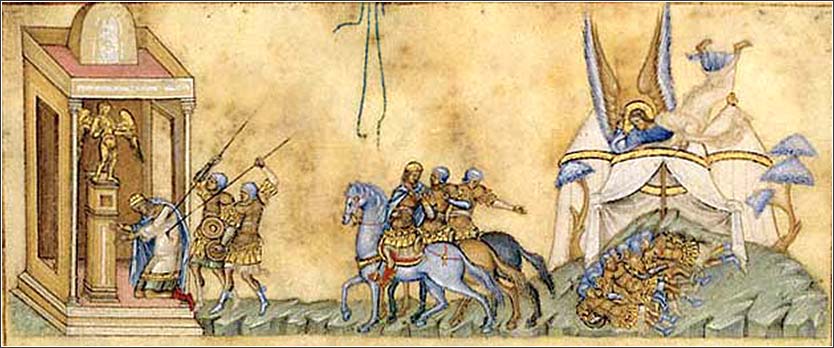
35 And that night the angel of the LORD went out and struck down 185,000 in the camp of the Assyrians. And when people arose early in the morning, behold, these were all dead bodies. 36 Then Sennacherib king of Assyria departed and went home and lived at Nineveh. 37 And as he was worshiping in the house of Nisroch his god, Adrammelech and Sharezer, his sons, struck him down with the sword and escaped into the land of Ararat. And Esarhaddon his son reigned in his place. 2 Kings 19:20-37 ESV

This is essentially the story of three kings. First, there is King Sennacherib, the sovereign ruler over the rapidly expanding Assyrian empire. He is the commander-in-chief of one of the most powerful armies on earth, and his ambitious plans for global conquest have met with little to no resistance. Kingdom after kingdom has fallen before his army, and now he has his sights set on the nation of Judah, where Hezekiah, the second king in our story, rules from his throne in Jerusalem. But King Hezekiah finds himself in the unenviable position of ruling over a city under siege. His capital city is surrounded by the Assyrian army, and he has been given an ultimatum to surrender or face annihilation.

Two kings. One is dressed in his royal robes and reveling in the indisputable reality of his own success. The other has discarded his regal attire for sackcloth and ashes, the garments of mourning. Sennacherib is a confident and self-assured king who sees no end to his plans for global conquest and domination. He is unstoppable, and it would appear that Hezekiah agrees with that assessment because he has turned to Yahweh for help. With his city completely surrounded and his allies nowhere to be seen, Hezekiah has called on the God of Judah to come to their aid.

“O LORD, God of Israel, you are enthroned between the mighty cherubim! You alone are God of all the kingdoms of the earth. You alone created the heavens and the earth. Bend down, O LORD, and listen! Open your eyes, O LORD, and see! Listen to Sennacherib’s words of defiance against the living God.” – 2 Kings 19:15-16 NLT

This penitent petition engages the attention of the third king in our story.  From His royal throne room in heaven, Yahweh heard the humble and contrite prayer of the king of Judah and immediately responded with an answer. The sovereign King of kings, who rules over all the kingdoms of the earth, sent a message to Hezekiah through His prophet Isaiah.

But this message, while delivered to King Hezekiah, was really directed at Sennacherib. Yahweh, the indisputable King of the universe, had a few choice words for the pompous and prideful potentate of Assyria. He warns the over-confident, land-grabbing king that his plans for Judah’s conquest will fail.

“The virgin daughter of Zion
    despises you and laughs at you.
The daughter of Jerusalem
    shakes her head in derision as you flee. – 2 Kings 19:21 NLT

Despite Sennacherib’s boastful claims, Jerusalem will remain pure and undefiled, her walls unbreached, and her population spared the indignities of conquest or capture. Yahweh wanted Sennacherib to know that the day was coming when the citizens of Jerusalem would rejoice and celebrate as the Assyrians abandoned their siege and disappeared over the horizon.

Sennacherib had made the fateful mistake of mocking the wrong deity, and Yahweh let him know that his derisive and disrespectful words were going to cost him. He had offended the Holy One of Israel and would soon suffer the consequences for his error. But first, God points out Sennacherib’s primary problem: His pride.

“By your messengers you have defied the LORD.
    You have said, ‘With my many chariots
I have conquered the highest mountains—
    yes, the remotest peaks of Lebanon.
I have cut down its tallest cedars
    and its finest cypress trees.
I have reached its farthest corners
    and explored its deepest forests.
I have dug wells in many foreign lands
    and refreshed myself with their water.
With the sole of my foot
    I stopped up all the rivers of Egypt!’” – 2 Kings 19:23-24 NLT

Sennacherib suffered from a terminal “I” condition. His unbridled success had gone to his head, and he had begun to believe that he was invincible and, in a sense, divine. By his own boastful admission, Sennacherib claimed that the kings of Assyria had defeated the gods of all their enemies.

“Have the gods of other nations rescued them—such nations as Gozan, Haran, Rezeph, and the people of Eden who were in Tel-assar? My predecessors destroyed them all! What happened to the king of Hamath and the king of Arpad? What happened to the kings of Sepharvaim, Hena, and Ivvah?” – 2 Kings 19:12-13 NLT

And he was convinced that Yahweh, the God of Judah, would fare no better than any of the other gods. But Sennacherib failed to understand that Yahweh was the sovereign ruler over all the nations of the world. The Assyrians’ rise to global dominance had been a part of God’s preordained plan. They were nothing more than instruments in His hands and actors in His divine drama that will one day culminate with the redemption and restoration of all creation.

Yahweh let Sennacherib know that he had no right to boast or brag; he could take no credit for any of his success. It had all been according to the sovereign will of the King of the universe. Although Sennacherib was a pagan and not a citizen of the chosen nation of Israel, God was sovereignly directing this unbeliever’s life to accomplish His divine will.

“I decided this long ago.
Long ago I planned it,
    and now I am making it happen.
I planned for you to crush fortified cities
    into heaps of rubble.
That is why their people have so little power
    and are so frightened and confused.
They are as weak as grass,
    as easily trampled as tender green shoots.
They are like grass sprouting on a housetop,
    scorched before it can grow lush and tall.” – 2 Kings 19:25-26 NLT

This message, while directed at Sennacherib, was meant to encourage Hezekiah. It was intended as a well-timed reminder to the king of Judah that his God was sovereign over all things. Regardless of the circumstances of life, the people of God could and should rest in the fact that their God reigns. Centuries later, when the nation of Judah fell to the Babylonians and a remnant of the people found themselves living in exile, the prophet Daniel expressed his firm belief in Yahweh’s sovereignty over all the affairs of human life.

“…the Most High rules over the kingdoms of the world. He gives them to anyone he chooses— even to the lowliest of people.” – Daniel 4:17 NLT

The psalmists shared Daniel’s optimistic and faith-filled perspective.

The LORD has established his throne in the heavens, and his kingdom rules over all.
 – Psalm 103:19 ESV

For the LORD Most High is awesome. He is the great King of all the earth. – Psalm 47:2 NLT

God reigns above the nations, sitting on his holy throne. – Psalm 47:8 NLT

For all the kings of the earth belong to God. – Psalm 47:9 NLT

The LORD reigns, let the earth rejoice; let the many coastlands be glad! – Psalm 97:1 ESV

The LORD reigns; let the peoples tremble! He sits enthroned upon the cherubim; let the earth quake! – Psalm 99:1 ESV

Yahweh wanted Hezekiah and Sennacherib to understand that they had nothing to do with their positions or power. Their very existence was God-ordained and orchestrated down to the last detail. Their kingdoms and crowns were fully attributable to God, and He had the divine right to remove them from power should He so choose, which is exactly what He warned Sennacherib was going to happen.

“I will put my hook in your nose
    and my bit in your mouth.
I will make you return
    by the same road on which you came.” – 2 Kings 19:28 NLT

Man’s plans must always give way to God’s sovereign will.

Many are the plans in the mind of a man, but it is the purpose of the LORD that will stand. – Proverbs 19:21 ESV

Sennacherib had ambitious plans for global dominance, but he would soon find that God’s plan superseded his own. And the King of the universe assured Hezekiah that He would protect Jerusalem and continue to provide for all their needs. Sennacherib and his forces would remain a threat for three more years, but God made it clear that “his armies will not enter Jerusalem. They will not even shoot an arrow at it” (2 Kings 19:32 NLT).

As a sign that He was in full control of the situation, God sent an angel who slaughtered 185,000 Assyrian soldiers in a single night. The next morning, the citizens of Jerusalem woke up to find the land outside the walls covered in corpses, but the rest of the Assyrian army was nowhere to be seen. The King of kings had displayed His sovereign power by sending a single angel to wreak havoc among the Assyrians.

When Sennacherib returned home, his days of glory and conquest came to an abrupt and ignominious end; he was assassinated by two of his own sons. As a further sign of Yahweh’s sovereignty and singularity as the King of kings, Sennacherib’s less-than-glorious death took place in the temple of his god.

The circumstances surrounding Sennacherib’s demise should not go unnoticed. As the vainglorious king of Assyria was safely ensconced in his capital and worshiping in the temple of his false god, the one true King chose to demonstrate His sovereign power over all the kingdoms of the earth. The Holy One of Israel proved yet again that He is “the great King of all the earth” (Psalm 47:2 NLT).

English Standard Version (ESV) The Holy Bible, English Standard Version. ESV® Permanent Text Edition® (2016). Copyright © 2001 by Crossway Bibles, a publishing ministry of Good News Publishers.

New Living Translation (NLT) Holy Bible, New Living Translation, copyright © 1996, 2004, 2015 by Tyndale House Foundation. Used by permission of Tyndale House Publishers Inc., Carol Stream, Illinois 60188. All rights reserved.
Conviction Over Compromise

1 For three years Syria and Israel continued without war. But in the third year Jehoshaphat the king of Judah came down to the king of Israel. And the king of Israel said to his servants, “Do you know that Ramoth-gilead belongs to us, and we keep quiet and do not take it out of the hand of the king of Syria?” And he said to Jehoshaphat, “Will you go with me to battle at Ramoth-gilead?” And Jehoshaphat said to the king of Israel, “I am as you are, my people as your people, my horses as your horses.”

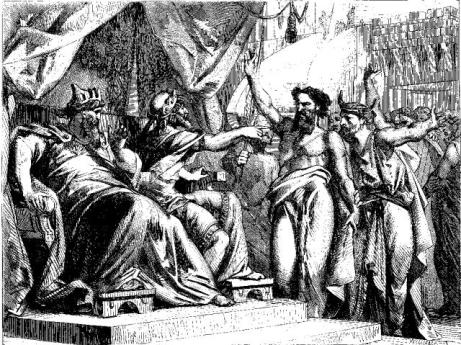
And Jehoshaphat said to the king of Israel, “Inquire first for the word of the LORD.” Then the king of Israel gathered the prophets together, about four hundred men, and said to them, “Shall I go to battle against Ramoth-gilead, or shall I refrain?” And they said, “Go up, for the Lord will give it into the hand of the king.” But Jehoshaphat said, “Is there not here another prophet of the LORD of whom we may inquire?” And the king of Israel said to Jehoshaphat, “There is yet one man by whom we may inquire of the LORD, Micaiah the son of Imlah, but I hate him, for he never prophesies good concerning me, but evil.” And Jehoshaphat said, “Let not the king say so.” Then the king of Israel summoned an officer and said, “Bring quickly Micaiah the son of Imlah.” 10 Now the king of Israel and Jehoshaphat the king of Judah were sitting on their thrones, arrayed in their robes, at the threshing floor at the entrance of the gate of Samaria, and all the prophets were prophesying before them. 11 And Zedekiah the son of Chenaanah made for himself horns of iron and said, “Thus says the LORD, ‘With these you shall push the Syrians until they are destroyed.’” 12 And all the prophets prophesied so and said, “Go up to Ramoth-gilead and triumph; the LORD will give it into the hand of the king.”

13 And the messenger who went to summon Micaiah said to him, “Behold, the words of the prophets with one accord are favorable to the king. Let your word be like the word of one of them, and speak favorably.” 14 But Micaiah said, “As the LORD lives, what the LORD says to me, that I will speak.” 1 Kings 22:1-14 ESV

King Ahab had been placed under a curse from God for having spared the life of Ben-hadad, the king of Syria. Rather than obey God’s command to put his enemy to death, Ahab had chosen to sign a peace treaty with him that would allow Israel to profit from Syria’s lucrative trading business. Yet, despite the judgment leveled against him by God, Ahab’s decision seems to have produced positive results.

The treaty that Ahab brokered produced three years of peace and prosperity between the two nations. Israel and Syria became allies and trading partners. According to an inscription on an Assyrian tablet discovered in 1861, Ahab and Ben-hadad were part of a 12-nation confederation that faced Emperor Shalmaneser and the Assyrians in the Battle of Qarqar in 853 BC. So, while God had decreed that Ahab’s dynasty would come to an end with his death, the king of Israel continued to enjoy a small measure of success. His insatiable desire for glory and self-aggrandizement would eventually drive him to jeopardize his peaceful and prosperous relationship with Syria.

During the time Ahab was on the throne of Israel, Jehoshaphat became the king of Judah. He succeeded his father, Asa, and, according to the book of 2 Chronicles, Jehoshaphat proved to be a good king.

The LORD was with Jehoshaphat, because he walked in the earlier ways of his father David. He did not seek the Baals, but sought the God of his father and walked in his commandments, and not according to the practices of Israel. Therefore the LORD established the kingdom in his hand. And all Judah brought tribute to Jehoshaphat, and he had great riches and honor. His heart was courageous in the ways of the LORD. And furthermore, he took the high places and the Asherim out of Judah. – 2 Chronicles 17:3-6 ESV

Because Jehoshaphat chose to remove all the false gods and restore the worship of the one true God, his reign was blessed, and the southern kingdom of Judah became a powerful force in the region. But Jehoshaphat, like his father before him, made the mistake of placing his trust in the Syrians. When King Baasha of Israel began to build a fortified city on the border between Israel and Judah, King Asa sought the help of Ben-hadad and the Syrians. Asa “took silver and gold from the treasures of the house of the LORD and the king’s house and sent them to Ben-hadad king of Syria” (2 Chronicles 16:2 ESV). He used these funds to convince Ben-hadad to break his covenant with Israel and join forces with him. His ploy worked, and Baasha stopped construction on his military outpost. But God condemned Asa for his alliance with Ben-hadad, warning that Judah would face non-stop war during the rest of his reign. Rather than trust God, Asa had placed his hope in a foreign king who worshiped false gods.

And while his son Jehoshaphat would prove to be faithful to God, he would also make an alliance with an ungodly, idol-worshiping king.

Now Jehoshaphat had great riches and honor, and he made a marriage alliance with Ahab. After some years he went down to Ahab in Samaria. And Ahab killed an abundance of sheep and oxen for him and for the people who were with him, and induced him to go up against Ramoth-gilead. – 2 Chronicles 18:1-2 ESV

This marital alliance ultimately put Jehoshaphat in a difficult position. While visiting Israel’s capital city of Samaria, Jehoshaphat was presented with an official request from Ahab for military assistance in recapturing the town of Ramoth-gilead from the Syrians. It galled Ahab that the Syrians had stolen a city that had once belonged to Israel, and nothing had been done about it.

“Do you know that Ramoth-gilead belongs to us, and we keep quiet and do not take it out of the hand of the king of Syria?” – 1 Kings 22:3 ESV

So, he called on Jehoshaphat to help him right this apparent wrong, and Jehoshaphat quickly and readily agreed.

“I am as you are, my people as your people, my horses as your horses.” – 1 Kings 22:4 ESV

But Jehoshaphat, anxious to remain obedient to God, asked Ahab to seek Yahweh’s counsel. It’s important to understand that Jehoshaphat wanted to know what the “LORD” (Yahweh) would have them do. But when Ahab commissioned his 400 prophets to seek the will of the gods, they came back with the answer:

“Go up, for the Lord (ăḏōnāy) will give it into the hand of the king.” – 1 Kings 22:6 ESV

These men did not mention the name of Yahweh, and Jehoshaphat seems to have immediately recognized that these were false prophets who had been seeking the will of their false god. So, he asked Ahab if there were no prophets of the one true God left in Israel. Ahab reluctantly confessed that one prophet of Yahweh remained, a man named Micaiah, whom he hated with a passion.

“He never prophesies anything but trouble for me!” – 1 Kings 22:8 NLT

Micaiah never told Ahab what he wanted to hear, so the king avoided him like the plague. But Jehoshaphat insisted that Micaiah be consulted before any action was taken against the Syrians.  So, Ahab sent someone to fetch his least-favorite prophet. In the meantime, his 400 false prophets bombarded Jehoshaphat with their cheery predictions of success.

“Go up to Ramoth-gilead and triumph; the LORD (Yahweh) will give it into the hand of the king.” – 1 Kings 22:12 ESV

This time, the prophets of Baal changed their tune and mentioned the name of Yahweh. Perhaps they hoped this reference to the God of Israel would convince Jehoshaphat to acquiesce and give his approval for the joint venture against the Syrians.

The text doesn’t reveal how long it took for Micaiah to be located and brought to Samaria. However, during the delay, Jehoshaphat found himself pressured to listen to the false prophets and join forces with Ahab. The temptation to compromise his convictions was great. He could have easily given in and listened to the popular opinions of the crowd, but instead, Jehoshaphat waited to hear a word from Yahweh.

Even Micaiah found himself pressured to follow the party line. The messenger who located him delivered a not-so-subtle warning that there was only one answer King Ahab wanted to hear.

“Look, all the prophets are promising victory for the king. Be sure that you agree with them and promise success.” – 1 Kings 22:13 NLT

But Micaiah would not be bullied into submission. He knew how much Ahab hated him, and he would be risking his life to disobey a direct order from the king. Yet his allegiance to Yahweh was greater than his fear of Ahab. So, he told the messenger, “As surely as the LORD lives, I will say only what the LORD tells me to say” (1 Kings 22:14 NLT).

It must have been a long and awkward trip back to Samaria for the messenger. He probably feared for his own life because he knew the prophet was determined to deliver bad news to the king. Everyone who worked for Ahab and all the people who lived in Israel knew that their king had no love affair with Yahweh. He had spent his entire reign promoting the worship of false gods like Baal and Asherah, and he had done everything he could do to ignore and even eliminate the prophets of God. Ahab knew exactly what Micaiah was going to say when he showed up, and it would not be what he wanted to hear.

Ahab needed Jehoshaphat’s help against the Syrians, and he knew that Jehoshaphat’s God would stand opposed to his ambitious plans to recapture Ramoth-gilead. Ahab didn’t want to hear from God because he was unwilling to do God’s will. Like a petulant child, Ahab was determined to get his way, even if it meant disobeying Yahweh’s will. But the prophet of the LORD was unwilling to succumb to the pressure to compromise his convictions and tell the king what he wanted to hear. He would speak the truth, even if it cost him his life. This obscure and little-known prophet was going to choose character over conformity and stand up to the threats of the wicked and powerful king of Israel.

Micaiah’s commitment to Yahweh was unassailable and non-negotiable. Nothing would convince him to compromise or sell out. He was determined to remain faithful to his God, whatever the cost. His bold determination to stand his ground in the face of intense opposition and even the threat of death is reminiscent of the actions of Shadrach, Meshach, and Abednego, the Hebrew friends of Daniel who found themselves facing a death sentence for refusing to bow to the statue King Nebuchadnezzar had erected.

“I will give you one more chance to bow down and worship the statue I have made when you hear the sound of the musical instruments. But if you refuse, you will be thrown immediately into the blazing furnace. And then what god will be able to rescue you from my power?”

Shadrach, Meshach, and Abednego replied, “O Nebuchadnezzar, we do not need to defend ourselves before you. If we are thrown into the blazing furnace, the God whom we serve is able to save us. He will rescue us from your power, Your Majesty. But even if he doesn’t, we want to make it clear to you, Your Majesty, that we will never serve your gods or worship the gold statue you have set up.” – Daniel 3:15-18 NLT

These three young men were willing to die for their beliefs and gladly faced the fires of the furnace with their commitment to Yahweh uncompromised. And their unwavering faith was rewarded.

So Shadrach, Meshach, and Abednego stepped out of the fire. Then the high officers, officials, governors, and advisers crowded around them and saw that the fire had not touched them. Not a hair on their heads was singed, and their clothing was not scorched. They didn’t even smell of smoke! – Daniel 3:26-27 NLT

The Book of Acts records another story of uncompromising faith in the face of unrelenting pressure. Peter and John had been jailed by the powerful Jewish Sanhedrin for preaching “that through Jesus there is a resurrection of the dead” (Acts 4:2 NLT). The following morning, when the two men were dragged before the council, they were ordered to cease and desist. The high priest commanded them, “never again to speak or teach in the name of Jesus” (Acts 4:18 NLT). 

But Peter and John replied, “Do you think God wants us to obey you rather than him? We cannot stop telling about everything we have seen and heard.” – Acts 4:18-20 NLT

Facing the threat of additional jail time or worse, Peter and John stood their ground and declared their intention to continue preaching the truth concerning Jesus. They could be threatened, but they would not be silenced. And, in doing so, they joined the ranks of other faithful men like Micaiah, Daniel, Shadrach, Meshach, and Abednego.

English Standard Version (ESV) The Holy Bible, English Standard Version. ESV® Permanent Text Edition® (2016). Copyright © 2001 by Crossway Bibles, a publishing ministry of Good News Publishers.

New Living Translation (NLT) Holy Bible, New Living Translation, copyright © 1996, 2004, 2015 by Tyndale House Foundation. Used by permission of Tyndale House Publishers Inc., Carol Stream, Illinois 60188. All rights reserved.

How Great Is His Goodness

14 Then the LORD will appear over them,
    and his arrow will go forth like lightning;
the LORD God will sound the trumpet
    and will march forth in the whirlwinds of the south.
15 The LORD of hosts will protect them,
    and they shall devour, and tread down the sling stones,
and they shall drink and roar as if drunk with wine,
    and be full like a bowl,
    drenched like the corners of the altar.

16 On that day the LORD their God will save them,
    as the flock of his people;
for like the jewels of a crown
    they shall shine on his land.
17 For how great is his goodness, and how great his beauty!
    Grain shall make the young men flourish,
    and new wine the young women. – Zechariah 9:14-17 ESV

In verses 12-13, Yahweh invites all His people who remain dispersed around the world to return to the land of promise. The remnant who had left Babylon and made the long journey to Judah with Zerubbabel were just a fraction of the Israelites still scattered in distant lands. This divine invitation was extended to any and all Jews to come to their ancestral homeland.

“Return to your stronghold, O prisoners of hope;
    today I declare that I will restore to you double.
For I have bent Judah as my bow;
    I have made Ephraim its arrow.
I will stir up your sons, O Zion,
    against your sons, O Greece,
    and wield you like a warrior’s sword. – Zechariah 9:12-132 ESV

When the Assyrians invaded the northern kingdom of Israel in 732 B.C., many Israelites fled to neighboring countries seeking safety. When Israel feel in 720 B.C., many of these refugees chose to remain in their adopted homelands rather than return to Israel. When the capital city of Samaria fell, many Israelites were taken as captives to Assyria, never to return to Israel. The same thing happened to the southern kingdom of Judah nearly 120 years later when the Babylonians invaded their land and destroyed the capital city of Jerusalem. When the first wave of Babylonian soldiers arrived in Judah, many of its citizens fled for their lives. Those who remained were forced to witness the fall of Jerusalem in 586 B.C. Tens of thousands of them were forced to make the long march to Babylon as captives. Almost 70 years after their arrival in the land, a small portion of them returned to Judah to rebuild the Temple and the city and its walls.

While Yahweh’s message is addressed to Zechariah and intended for his fellow Judahites, this section of verses speaks of a future generation of Israelites who will return to the land long after Zechariah and his contemporaries are gone. He describes a future day when Judah and Israel (Ephraim) will be reunited under Yahweh’s sovereign leadership. The LORD will lead them in battle against their enemies.

“The LORD will appear above his people;
    his arrows will fly like lightning!
The Sovereign Lord will sound the ram’s horn
    and attack like a whirlwind from the southern desert. – Zechariah 9:14 NLT

The LORD’s sudden appearance will usher in an epic battle between the reunified Israelite kingdom and their enemies. Verse 13 describes Israel’s future enemy as Greece, but this is more likely a reference to the Gentile nations as a whole. This prophecy was partially fulfilled in the second century B.C.  when the Jews rose up against their Greek/Syrian oppressors. The Greeks had conquered much of the known world under the leadership of Alexander the Great but with his death in 323 B.C., his vast empire was divided between four of his top commanders. Eventually, Judah came under the heavy-handed rule of the Seleucids, founded by Seleucus, one of Alexander’s generals. In 175 B.C., Antiochus IV assumed leadership of the Seleucid Empire and began to persecute the Jews, outlawing many of their religious practices and demanding the worship of the Greek god, Zeus. In an attempt to humiliate the Jews and their God, Antiochus ordered the sacrifice of a pig in the Temple. This desecration of the house of God led to the Maccabean Revolt.

In one of his many visions, the prophet Daniel was given a glimpse into the future where he saw these horrible events unfolding.

“After this period of sixty-two sets of seven, the Anointed One will be killed, appearing to have accomplished nothing, and a ruler will arise whose armies will destroy the city and the Temple. The end will come with a flood, and war and its miseries are decreed from that time to the very end. The ruler will make a treaty with the people for a period of one set of seven, but after half this time, he will put an end to the sacrifices and offerings. And as a climax to all his terrible deeds, he will set up a sacrilegious object that causes desecration, until the fate decreed for this defiler is finally poured out on him.” – Daniel 9:26-27 NLT

But what Daniel saw was only partially fulfilled with the Macabbean Revolt. Jesus alluded to this fact when He delivered His Olivette Discourse near the end of His life.

“The day is coming when you will see what Daniel the prophet spoke about—the sacrilegious object that causes desecration standing in the Holy Place.” (Reader, pay attention!) “Then those in Judea must flee to the hills. A person out on the deck of a roof must not go down into the house to pack. A person out in the field must not return even to get a coat. How terrible it will be for pregnant women and for nursing mothers in those days. And pray that your flight will not be in winter or on the Sabbath. For there will be greater anguish than at any time since the world began. And it will never be so great again. In fact, unless that time of calamity is shortened, not a single person will survive. But it will be shortened for the sake of God’s chosen ones.” – Matthew 24:15-22 NLT

Jesus spoke these words long after the Macabbean Revolt, indicating that Daniel’s message was not yet fulfilled. There would be another desecration of the Temple sometime in the distant future. In Revelation 13, the apostle John describes the vision he received of the end times events associated with Jesus’ second coming. In his vision he saw the false prophet set up an idol of the Antichrist and demand that all people bow down and worship it.

He ordered the people to make a great statue of the first beast, who was fatally wounded and then came back to life. He was then permitted to give life to this statue so that it could speak. Then the statue of the beast commanded that anyone refusing to worship it must die. – Revelation 13:14-15 NLT

These strange-sounding, supernatural events will occur near the end of the Great Tribulation. The Antichrist will rule over all the earth, empowered by Satan himself. The false prophet will serve as Antichrist’s right-hand man, performing great signs and miracles, and ordering the worship of Antichrist instead of the one true God. But at the end of this period, the LORD will appear. John was also provided with a vision of that epic moment.

Then I saw heaven opened, and a white horse was standing there. Its rider was named Faithful and True, for he judges fairly and wages a righteous war. His eyes were like flames of fire, and on his head were many crowns. A name was written on him that no one understood except himself. He wore a robe dipped in blood, and his title was the Word of God. The armies of heaven, dressed in the finest of pure white linen, followed him on white horses. From his mouth came a sharp sword to strike down the nations. He will rule them with an iron rod. He will release the fierce wrath of God, the Almighty, like juice flowing from a winepress. On his robe at his thigh was written this title: King of all kings and Lord of all lords. – Revelation 19:11-16 NLT

John was allowed to see the second coming of Jesus Christ as He returned to earth to deliver judgment upon the Antichrist and all his followers. In his vision, John saw “the beast and the kings of the world and their armies gathered together to fight against the one sitting on the horse and his army” (Revelation 19:19 NLT). In an earlier vision, John saw Satan, the Antichrist, and his false prophet use demonic forces to instigate a glogal insurrection against God.

And I saw three evil spirits that looked like frogs leap from the mouths of the dragon, the beast, and the false prophet. They are demonic spirits who work miracles and go out to all the rulers of the world to gather them for battle against the LORD on that great judgment day of God the Almighty. – Revelation 16:13-14 NLT

Revelation 19 describes how these coalition forces fared against the LORD.

Then I saw the beast and the kings of the world and their armies gathered together to fight against the one sitting on the horse and his army. And the beast was captured, and with him the false prophet who did mighty miracles on behalf of the beast—miracles that deceived all who had accepted the mark of the beast and who worshiped his statue. Both the beast and his false prophet were thrown alive into the fiery lake of burning sulfur. Their entire army was killed by the sharp sword that came from the mouth of the one riding the white horse. And the vultures all gorged themselves on the dead bodies. – Revelation 19:19-21 NLT

This would appear to be the same event Yahweh describes in His message to Zechariah.

“On that day the LORD their God will rescue his people,
    just as a shepherd rescues his sheep.
They will sparkle in his land
    like jewels in a crown.
How wonderful and beautiful they will be!
    The young men will thrive on abundant grain,
    and the young women will flourish on new wine. – Zechariah 9:16-17 NLT

The great battle described in Revelation 19 will be followed by the millennial reign of Christ – a thousand years during which He will rule over all the earth from the throne of David in Jerusalem. His Kingdom will be worldwide and marked by righteousness, peace, and truth. John was given a vision of this marvelous scene as well.

Then I saw thrones, and seated on them were those to whom the authority to judge was committed. Also I saw the souls of those who had been beheaded for the testimony of Jesus and for the word of God, and those who had not worshiped the beast or its image and had not received its mark on their foreheads or their hands. They came to life and reigned with Christ for a thousand years. – Revelation 20:4 NLT

All those martyred during the Great Tribulation will be resurrected and allowed to rule alongside Christ in His earthly Kingdom. Believing Jews and Gentiles will live side-by-side in the city of Jerusalem benefiting from the righteous rule of the King of kings and Lord of lords.

But the ultimate fulfillment of God’s message to Zechariah takes place when God makes all things new. Christ’s reign earthly Kingdom will last a thousand years and then be followed by God’s recreation of the heavens and earth.

Then I saw a new heaven and a new earth, for the old heaven and the old earth had disappeared. And the sea was also gone. And I saw the holy city, the new Jerusalem, coming down from God out of heaven like a bride beautifully dressed for her husband. – Revelation 21:1-2 NLT

God will come to dwell on earth in the New Jerusalem, reigning alongside His Son.

I heard a loud shout from the throne, saying, “Look, God’s home is now among his people! He will live with them, and they will be his people. God himself will be with them. He will wipe every tear from their eyes, and there will be no more death or sorrow or crying or pain. All these things are gone forever.” – Revelation 21:3-4 NLT

In this earthly paradise, the new Eden, God will come to live among His people, including both Jews and Gentiles. It will be a time of great rejoicing because all the walls of separation will have been removed. Evil and sin will have been eradicated and the ungodly will have been removed.

I saw no temple in the city, for the Lord God Almighty and the Lamb are its temple. And the city has no need of sun or moon, for the glory of God illuminates the city, and the Lamb is its light. The nations will walk in its light, and the kings of the world will enter the city in all their glory. Its gates will never be closed at the end of day because there is no night there. And all the nations will bring their glory and honor into the city. Nothing evil will be allowed to enter, nor anyone who practices shameful idolatry and dishonesty—but only those whose names are written in the Lamb’s Book of Life. – Revelation 21:22-27 NLT

It’s no wonder that Yahweh ends His message with the rather bold self-assessment, “how great is his goodness, and how great his beauty!” (Zechariah 9:17 ESV).

English Standard Version (ESV)
The Holy Bible, English Standard Version. ESV® Permanent Text Edition® (2016). Copyright © 2001 by Crossway Bibles, a publishing ministry of Good News Publishers.

New Living Translation (NLT)
Holy Bible, New Living Translation, copyright © 1996, 2004, 2015 by Tyndale House Foundation. Used by permission of Tyndale House Publishers Inc., Carol Stream, Illinois 60188. All rights reserved.

Out of Sight But Never Out of Control

1 Then Darius the king made a decree, and search was made in Babylonia, in the house of the archives where the documents were stored. And in Ecbatana, the citadel that is in the province of Media, a scroll was found on which this was written: “A record. In the first year of Cyrus the king, Cyrus the king issued a decree: Concerning the house of God at Jerusalem, let the house be rebuilt, the place where sacrifices were offered, and let its foundations be retained. Its height shall be sixty cubits and its breadth sixty cubits, with three layers of great stones and one layer of timber. Let the cost be paid from the royal treasury. And also let the gold and silver vessels of the house of God, which Nebuchadnezzar took out of the temple that is in Jerusalem and brought to Babylon, be restored and brought back to the temple that is in Jerusalem, each to its place. You shall put them in the house of God.”

“Now therefore, Tattenai, governor of the province Beyond the River, Shethar-bozenai, and your associates the governors who are in the province Beyond the River, keep away. Let the work on this house of God alone. Let the governor of the Jews and the elders of the Jews rebuild this house of God on its site. Moreover, I make a decree regarding what you shall do for these elders of the Jews for the rebuilding of this house of God. The cost is to be paid to these men in full and without delay from the royal revenue, the tribute of the province from Beyond the River. And whatever is needed—bulls, rams, or sheep for burnt offerings to the God of heaven, wheat, salt, wine, or oil, as the priests at Jerusalem require—let that be given to them day by day without fail, 10 that they may offer pleasing sacrifices to the God of heaven and pray for the life of the king and his sons. 11 Also I make a decree that if anyone alters this edict, a beam shall be pulled out of his house, and he shall be impaled on it, and his house shall be made a dunghill. 12 May the God who has caused his name to dwell there overthrow any king or people who shall put out a hand to alter this, or to destroy this house of God that is in Jerusalem. I Darius make a decree; let it be done with all diligence.” Ezra 6:1-12 ESV

The letter was sent and received, prompting King Darius to order a search of the royal archives for any record of a decree issued by his predecessor, King Cyrus. Much to the surprise of Tattenai and Shethar-bozenai, a scroll was found in Ecbatana, the citadel that is in the province of Media. This long-forgotten document contained the following statement from King Cyrus:

“In the first year of King Cyrus’s reign, a decree was sent out concerning the Temple of God at Jerusalem.

“Let the Temple be rebuilt on the site where Jews used to offer their sacrifices, using the original foundations. Its height will be ninety feet, and its width will be ninety feet. Every three layers of specially prepared stones will be topped by a layer of timber. All expenses will be paid by the royal treasury. Furthermore, the gold and silver cups, which were taken to Babylon by Nebuchadnezzar from the Temple of God in Jerusalem, must be returned to Jerusalem and put back where they belong. Let them be taken back to the Temple of God.” – Ezra 6:3-5 NLT

Tattenai and Shethar-bozenai had assumed that the Jews’ claim of having an official edict from King Cyrus was a figment of their imagination. They believed that the Jews had fabricated this official decree to justify their return to the land and their rebuilding efforts. But there it was in black and white, written on an official document and stored in the royal archives. The Jews had not been lying.

The discovery of Cyrus’ decree left King Darius with no choice but to ensure its enforcement. He was obligated by what was known as “the law of the Medes and Persians” (Daniel 6:8 ESV). This ancient law code stated that edicts authorized by the king were irrevocable and unchangeable. Not even a future king had the authority to countermand a previous edict. In their estimation, the king was the law, and the law could not contradict itself. Darius himself had fallen prey to the binding nature of this legal code when he passed a law that prohibited the worship of anyone or anything but himself for a period of 30 days. His high officials and straps had given him the idea and convinced him to carry it out.

“Long live King Darius! We are all in agreement—we administrators, officials, high officers, advisers, and governors—that the king should make a law that will be strictly enforced. Give orders that for the next thirty days any person who prays to anyone, divine or human—except to you, Your Majesty—will be thrown into the den of lions. And now, Your Majesty, issue and sign this law so it cannot be changed, an official law of the Medes and Persians that cannot be revoked.” – Daniel 6:6-8 NLT

In signing his name to the document, Darius made the law official and irrevocable, which proved to be a problem when he discovered the intentions of his royal counselors. Their motives had been self-serving and designed to entrap another of the king’s royal counselors. Daniel was a young Jewish boy who had been taken captive when the Babylonians invaded Judah and destroyed Jerusalem. Through a series of divinely-orchestrated events, Daniel had risen to prominence in the administration of King Nebuchadnezzar. Now, he served as a high official in the court of King Darius. But his fellow administrative companions were jealous of his success and less than enthusiastic about his worship of the Hebrew God. So, they devised a trap which the king inadvertently signed into law. When Daniel violated the king’s edict, he was forced to face the consequences. He was thrown to the lions and there was nothing Darius could do to save him. But God intervened and Daniel was miraculously spared.

When this very same Darius discovered the edict of Cyrus, he knew he was obligated to enforce it, which he did. He even added a word of warning to Tattenai, Shethar-bozenai, and all the local administrative officials in Judah.

stay away from there! Do not disturb the construction of the Temple of God. Let it be rebuilt on its original site, and do not hinder the governor of Judah and the elders of the Jews in their work.” – Ezra 6:6-7 NLT

The very same men who had sent the letter to King Darius were given an order to cease and desist. They were to avoid any and all contact with the Jews, allowing them to carry out the decree of Cyrus with no interference or harassment. He also ordered them to use the royal treasury to fund the construction work and the king’s herds to supply animals for their sacrifices. The governor and his companions must have been stunned by this unexpected turn of events. This was not what they had expected. But they were not alone. Even the Jews must have stood by in wide-eyed wonder as they heard the content of the king’s letter.

Ever since their return to Judah, they had faced ongoing opposition, leaving them to wonder if God was really with them. There are times when it appears as if God is not around. Because of our circumstances, we assume that He must be busy somewhere else or is simply unaware of what is happening in our lives. But that is not the God of the Bible. He is never distracted, disinterested, or distant. He is always there, always watching, and always completely aware of what is going on – every moment of every day.

The people of God who returned to build the Temple and restore Jerusalem would learn that truth from personal experience. Things had not gone well for them upon their return. They faced opposition and constant threats. At one point they were forced to halt construction because of a royal edict. When they started back up again, their enemies relaunched their attacks and did everything in their power to demotivate and distract God’s people from their task.

It would have been easy for them to assume that God was unaware of their plight or disinterested. But nothing could have been further from the truth. We can’t judge the faithfulness or nearness of God based on our circumstances. We read in verse five that “their God was watching over them.” He had not taken His eyes off of them. He had not removed His hand of protection from them. From their limited perspective, it looked as if God had abandoned them. But He was there and He cared. He was still in control. And despite the attempts of their enemies to stir up trouble, God had other plans.

When Tattenai and Shethar-bozenai wrote their letter to King Darius, they had expected a royal decree commanding the Jews to cease and desist in their rebuilding efforts. But to their shock and surprise, the message from Darius contained an official edict to “let the Temple be rebuilt” (Ezra 6:3). Not only that, the very men who had attempted to thwart the efforts of the Jews to rebuild the Temple and reconstruct the walls of Jerusalem, were commanded to provide assistance.

What a God we serve. He was not only aware of what was going on, but He used the plans of the enemies of Israel to accomplish His will. He turned what they meant for evil into good. The Jews received unexpected funding and assistance from an unlikely source, the very people who had been trying to put a stop to their efforts.

It would have been natural for them to take a look at their circumstances and assume that God had abandoned them, or that He was somehow punishing them. But they would have been wrong. God was working behind the scenes in ways they could never have imagined. Assuming God’s absence or indifference is a dangerous thing to do. When we do, we doubt the faithfulness of God and reject the promises found in His Word. God is constantly faithful and ever-present. His love endures forever. We must judge God based on His Word and His character, not our circumstances. What is visible is not always an accurate indicator of what is going on. God’s efforts are not always visible to our eyes or apparent to our senses, but that doesn’t mean He is attentive or active. Our God is always watching out for us and working on behalf of us, whether we see it or believe it. No matter what difficulty we face, He is always there and He is always working on our behalf.

English Standard Version (ESV)
The Holy Bible, English Standard Version. ESV® Permanent Text Edition® (2016). Copyright © 2001 by Crossway Bibles, a publishing ministry of Good News Publishers.

New Living Translation (NLT)
Holy Bible, New Living Translation, copyright © 1996, 2004, 2015 by Tyndale House Foundation. Used by permission of Tyndale House Publishers Inc., Carol Stream, Illinois 60188. All rights reserved.

The Message (MSG)Copyright © 1993, 1994, 1995, 1996, 2000, 2001, 2002 by Eugene H. Peterson

I Heard, but I Did Not Understand

1 “At that time shall arise Michael, the great prince who has charge of your people. And there shall be a time of trouble, such as never has been since there was a nation till that time. But at that time your people shall be delivered, everyone whose name shall be found written in the book. And many of those who sleep in the dust of the earth shall awake, some to everlasting life, and some to shame and everlasting contempt. And those who are wise shall shine like the brightness of the sky above; and those who turn many to righteousness, like the stars forever and ever. But you, Daniel, shut up the words and seal the book, until the time of the end. Many shall run to and fro, and knowledge shall increase.”

Then I, Daniel, looked, and behold, two others stood, one on this bank of the stream and one on that bank of the stream. And someone said to the man clothed in linen, who was above the waters of the stream, “How long shall it be till the end of these wonders?” And I heard the man clothed in linen, who was above the waters of the stream; he raised his right hand and his left hand toward heaven and swore by him who lives forever that it would be for a time, times, and half a time, and that when the shattering of the power of the holy people comes to an end all these things would be finished. I heard, but I did not understand. Then I said, “O my lord, what shall be the outcome of these things?” He said, “Go your way, Daniel, for the words are shut up and sealed until the time of the end. 10 Many shall purify themselves and make themselves white and be refined, but the wicked shall act wickedly. And none of the wicked shall understand, but those who are wise shall understand. 11 And from the time that the regular burnt offering is taken away and the abomination that makes desolate is set up, there shall be 1,290 days. 12 Blessed is he who waits and arrives at the 1,335 days. 13 But go your way till the end. And you shall rest and shall stand in your allotted place at the end of the days.” – Daniel 12:1-13 ESV

The prophecy ends leaving Daniel in a state of confusion. He has been given a glimpse of Israel’s future but has no idea what it means, when it will happen, or how it will all turn out. He responds in fearful confusion, “I heard, but I did not understand. Then I said, ‘O my lord, what shall be the outcome of these things?’” (Daniel 12:8 ESV).

Daniel’s consternation is understandable because of the frightening nature of the prophecy. Gabriel, the divine messenger, has described a series of disconcerting events including wars on Earth and in the heavenly realms. He spoke of a period of 490 years that would be “perilous times” (Daniel 925). Gabriel warned of a coming prince who would destroy Jerusalem and the recently reconstructed Temple. It would be a time accompanied by floods, desolation, and seemingly endless wars.

In chapter 10, Daniel was exposed to even more details about the future that left him dismayed and filled with dread.

“…no strength was left in me…” – Daniel 10:8 ESV

I retained no strength. – Daniel 10:8 ESV

I fell on my face. – Daniel 10:9 ESV

“I stood up trembling. – Daniel 10:11 ESV

I turned my face toward the ground and was mute. – Daniel 10:15 ESV

Daniel was terrified by all that he had seen and heard. None of it had come across as good news to the elderly servant of Yahweh. This whole series of disturbing visions had come as a result of Daniel’s prayer to his “great and awesome God” (Daniel 9:4 NLT). But it was not what Daniel had expected to hear. Daniel had appealed to Yahweh’s covenant-keeping nature, begging Him to fulfill His promises of unfailing love to those who love Him and obey His commands (Daniel 9:4). Daniel had confessed the sins of his people and freely admitted they did not deserve God’s goodness, grace, and mercy. But Daniel had appealed to God’s mercy, begging Him to intercede on behalf of the downtrodden and disenfranchised people of Israel.

“We make this plea, not because we deserve help, but because of your mercy. O Lord, hear. O Lord, forgive. O Lord, listen and act! For your own sake, do not delay, O my God, for your people and your city bear your name.” – Daniel 9:18-19 NLT

Yet, the message that Gabriel brought was anything but encouraging. None of it made sense because it painted a bleak and foreboding picture of the future that filled Daniel with dread, doubt, and discomfort.

To restore Daniel’s confidence, the heavenly messenger delivered a word of comfort and encouragement.

“O man greatly loved, fear not, peace be with you; be strong and of good courage.” – Daniel 10:19 ESV

Daniel was strengthened by these gracious words and expressed his desire to hear more about God’s plans for the future. But what came next was more bad news. Gabriel launched into a lengthy description of wars between the Persians, Greeks, Egyptians, and Syrians (Seleucids). These kingdoms of the north and south would battle over the land of Palestine, with Israel sitting at the center of the conflicts. Once again, this news would have left Daniel perplexed and questioning the purpose behind it all.

When Gabriel described the future desecration of the Temple, Daniel must have been beside himself with anger and resentment.

“His army will take over the Temple fortress, pollute the sanctuary, put a stop to the daily sacrifices, and set up the sacrilegious object that causes desecration. He will flatter and win over those who have violated the covenant. But the people who know their God will be strong and will resist him.” – Daniel 11:31-32 NLT

How could these things be part of God’s will for the people of Israel? Had God not heard his prayer? Was God oblivious to their plight and unwilling to keep His covenant promises? This entire sequence of events was beyond Daniel’s comprehension, and what he heard next made matters even worse.

“Wise leaders will give instruction to many, but these teachers will die by fire and sword, or they will be jailed and robbed. During these persecutions, little help will arrive, and many who join them will not be sincere. And some of the wise will fall victim to persecution. In this way, they will be refined and cleansed and made pure until the time of the end, for the appointed time is still to come. – Daniel 11:33-35 NLT

But what Daniel failed to understand was that God had a long-term plan for the people of Israel that included both suffering and salvation. He would eventually answer Daniel’s prayer but not on Daniel’s timeline. In fact, Daniel would not live long enough to see most of these prophecies fulfilled. Yet God was gracious enough to let him know that there would be a happy ending to this dark and disconcerting story.

This is where the final chapter comes in. It closes with a glimpse into the far-distant future. God gives Daniel a final view of His plan for Israel. While much of what He revealed to Daniel in chapter 11 had to do with Antiochus Epiphanes and events that have already taken place, chapter 12 contains details about events that have yet to happen – even in our day. They refer to the seven-year period known as the Great Tribulation – part of God’s 70 sevens (chapter 9).

In this closing chapter, God reveals to Daniel the final phase of world history before Christ returns to the earth. He refers to it as a period of unparalleled persecution of the Jewish people, the chosen people of God.

“…there shall be a time of trouble, such as never has been since there was a nation till that time. – Daniel 12:1 ESV

This “time of trouble” will be unprecedented and exceed anything the Israelites have experienced since becoming a nation. Nothing will compare with this dark chapter in Israel’s future, including their captivity in Egypt or their fall to the Babylonians. Yet Daniel is told, “at that time your people shall be delivered, everyone whose name shall be found written in the book” ( Daniel 12:1 ESV).

There is hope. The future is dark but a glimmer of light can be seen on the horizon. Gabriel begins to paint a hopeful vision of the future that reveals God’s sovereign plan to fulfill every promise He made to the people of Israel.

“Those who are wise will shine as bright as the sky, and those who lead many to righteousness will shine like the stars forever.” – Daniel 12:3 NLT

He has not forgotten them and will not fail to keep His covenant commitments to them. But Daniel is warned that their suffering will continue for as long as God deems it necessary.

It will go on for a time, times, and half a time. When the shattering of the holy people has finally come to an end, all these things will have happened. – Daniel 12:7 NLT

The cryptic phrase “a time, times, and a half time” is a distinctively Hebrew way of describing time. It refers to a year, two years, and half a year, which adds up to three years. This alludes to the second half of the seven-year Tribulation that will come upon the Earth during the end times. This is the final “seven” of the seventy-sevens described in Daniel 9.

Daniel confesses his confusion, saying, “I heard, but I did not understand” (Daniel 12:8 ESV). He had no way of understanding what this vision meant. He had no concept of the end times or any capacity to decipher the complicated numerology used in the vision. All he can do is ask what the outcome will be. But rather than an answer, Daniel receives an order to go about his business.

“Go your way, Daniel, for the words are shut up and sealed until the time of the end. Many shall purify themselves and make themselves white and be refined, but the wicked shall act wickedly. And none of the wicked shall understand, but those who are wise shall understand. – Daniel 12:9-10 ESV

This is the same basic answer that Jesus gave to His disciples just before He ascended back into heaven. After witnessing His death and miraculous resurrection, the disciples were anxious to know what He would do next. So, they asked, “Lord, has the time come for you to free Israel and restore our kingdom?” (Acts 1:6 NLT).

They were still hoping that Jesus would establish His earthly Kingdom. Their dreams of serving in His royal administration had been reignited by Jesus’ victory over death. If He could rise from the dead, He could certainly conquer the Romans.

But Jesus told them “The Father alone has the authority to set those dates and times, and they are not for you to know” (Acts 1:7 NLT). They needed to go about their business and the next verses reveals their job description.

“…you will be my witnesses, telling people about me everywhere—in Jerusalem, throughout Judea, in Samaria, and to the ends of the earth. – Acts 1:8 NLT

They had work to do and so did Daniel. He didn’t need to understand all the details regarding the end times. In fact, he wouldn’t be around to see any of it happen. Neither would the disciples of Jesus. They are all long gone but the prophecy contained in Daniel 12 remains unfulfilled.

The Great Tribulation has yet to take place. Because of the unprecedented scope of human wickedness and evil that marks our day, some believe we are living in the Tribulation. But Jesus described this future period as something far worse than anything humanity has ever experienced.

“For there will be greater anguish than at any time since the world began. And it will never be so great again. In fact, unless that time of calamity is shortened, not a single person will survive. But it will be shortened for the sake of God’s chosen ones. – Matthew 24:21-22 NLT

We may live in dark days, but they are nothing compared with what is to come. The Great Tribulation will be marked by intense persecution of the Jews because of the rise of the Antichrist – a powerful political figure who will make the exploits of Antiochus Epiphanes pale in comparison.

All of this would have shocked poor Danie. He had watched his people suffer through exile for almost 70 years and now he was being told that their persecution would last until the end of time. It would not get any better. During his lifetime, Daniel had been privileged to witness a remnant of the people of God return to the land of promise. But now he was being told of future days when they would be scattered yet again. There would be wars, persecutions, and countless attempts to exterminate the Jews over the centuries. Even today, we are witnessing verbal and physical assaults on God’s chosen people as millions revile their very existence and the nations plot their extermination.

While they occupy part of the original promised land, they remain under constant attack. But God is not done. He is not finished with His people. Their suffering will continue, but a day is coming when He will restore them. There is one last Great Tribulation to be endured but then His Son will return. There is hope. There is a happy ending to this story because God has written it and He will fulfill it.

So Gabriel tells Daniel to “go your way until the end.” He provides Daniel assurance that all will work out, including Daniel’s own resurrection to new life in Christ’s future kingdom. Daniel will die, but he will rise again, so that he can spend eternity with the God in whom he had placed his hope and trust all those years living in captivity in Babylon. Daniel could rest knowing that God was going to faithfully complete what He had promised to do. And we can rest in that same promise.

We may not understand all that these prophecies contain, but we don’t have to. Like Daniel and the disciples of Jesus, we need to go about our business and live with hope in the promises of God. He will do what He has said He will do, and He will do it according to His divine timeline.

English Standard Version (ESV) The Holy Bible, English Standard Version. ESV® Permanent Text Edition® (2016). Copyright © 2001 by Crossway Bibles, a publishing ministry of Good News Publishers.

New Living Translation (NLT) Holy Bible, New Living Translation, copyright © 1996, 2004, 2015 by Tyndale House Foundation. Used by permission of Tyndale House Publishers Inc., Carol Stream, Illinois 60188. All rights reserved.

New English Translation (NET)NET Bible® copyright ©1996-2017 by Biblical Studies Press, L.L.C. http://netbible.com All rights reserved.

He Shall Come to His End

36 “And the king shall do as he wills. He shall exalt himself and magnify himself above every god, and shall speak astonishing things against the God of gods. He shall prosper till the indignation is accomplished; for what is decreed shall be done. 37 He shall pay no attention to the gods of his fathers, or to the one beloved by women. He shall not pay attention to any other god, for he shall magnify himself above all. 38 He shall honor the god of fortresses instead of these. A god whom his fathers did not know he shall honor with gold and silver, with precious stones and costly gifts. 39 He shall deal with the strongest fortresses with the help of a foreign god. Those who acknowledge him he shall load with honor. He shall make them rulers over many and shall divide the land for a price.

40 “At the time of the end, the king of the south shall attack him, but the king of the north shall rush upon him like a whirlwind, with chariots and horsemen, and with many ships. And he shall come into countries and shall overflow and pass through. 41 He shall come into the glorious land. And tens of thousands shall fall, but these shall be delivered out of his hand: Edom and Moab and the main part of the Ammonites. 42 He shall stretch out his hand against the countries, and the land of Egypt shall not escape. 43 He shall become ruler of the treasures of gold and of silver, and all the precious things of Egypt, and the Libyans and the Cushites shall follow in his train. 44 But news from the east and the north shall alarm him, and he shall go out with great fury to destroy and devote many to destruction. 45 And he shall pitch his palatial tents between the sea and the glorious holy mountain. Yet he shall come to his end, with none to help him. – Daniel 11:36-45 ESV

Verse 31 records a prophecy concerning Antiochus Epiphanies, a Greek king who ruled over the Seleucid Empire from 175-164 B.C. His official title was Antiochus IV, but he preferred to go by his self-proclaimed title “Epiphanes,” which means “illustrious one” or “god manifest.” Because of his brutal treatment of the Jewish people, they nicknamed him “Epimanes” which translates as “mad one.” Having successfully conquered most of Egypt, he turned his sights on the kingdom of Judah and its capital city of Jerusalem. In an attempt to demoralize the Jews and denigrate their God, he ordered the desecration of their holiest site, the Temple of Yahweh.

Forces from him shall appear and profane the temple and fortress, and shall take away the regular burnt offering. And they shall set up the abomination that makes desolate. – Daniel 11:31 ESV

Some scholars believe Antiochus was attempting to quell a long-standing conflict between Hellenistic and Traditionalist Jews. The former adopted the pagan practices and culture of the Greeks, while the latter adhered to the Mosaic Law and the worship of Yahweh. In a blatant display of bias, Antiochus set up an altar to the Greek god Zeus and sacrificed a pig on the altar. When the traditionalists expressed outrage, Antiochus had some of them slaughtered and others sold as slaves. He then issued a series of decrees that outlawed the practice of circumcision, ordered sacrifices to pagan gods, and demanded that Jews add swine to their daily diet.

His actions resulted in the Macabbean revolt, an uprising led by Judas Maccabeus that scored a series of surprising and decisive victories over the more powerful Seleucid forces. Eventually, Antiochus and the Seleucids vacated Judah and the Temple was restored in 165 B.C.

But verse 36 contains an abrupt change that may not be recognizable to the casual reader. Even Jews living when this book was first written would not have recognized the nature of the transition in the narrative. Everything Daniel penned was to take place in the not-so-distant future. They would have had no way of understanding the meaning behind Gabriel’s message or the timing and the nations involved.

But by the time Jesus arrived on the scene, most of the prophecies would have been fulfilled. The battles between the Egyptians and the Seleucids would have been part of the historical record. The Persian Empire would have fallen to Alexander the Great and his Greek forces. The geopolitical landscape of the region would have undergone tremendous change and by the time Jesus began His earthly ministry, the Romans were the dominant world power.

Yet, Jesus spoke of Antiochus Epiphanes’ abomination of desolation as if it lie in the future, not the past.

“So when you see the abomination of desolation spoken of by the prophet Daniel, standing in the holy place (let the reader understand), then let those who are in Judea flee to the mountains. Let the one who is on the housetop not go down to take what is in his house, and let the one who is in the field not turn back to take his cloak. And alas for women who are pregnant and for those who are nursing infants in those days! Pray that your flight may not be in winter or on a Sabbath. For then there will be great tribulation, such as has not been from the beginning of the world until now, no, and never will be. – Matthew 24:15-21 ESV

Jesus was not reflecting on the devastating events in Israel’s distant past; He was pointing toward an as-yet-to-be-fulfilled aspect of the prophecy contained in the Book of Daniel. Jesus was describing the final seven years of the 490 years outlined in the prophecy. Verse 36 mentions a king who “shall do as he wills. He shall exalt himself and magnify himself above every god, and shall speak astonishing things against the God of gods” (Daniel 11:36 ESV). This is not a reference to Antiochus Epiphanes; it is a prophecy concerning a future king who will replicate the exploits of the former Seleucid king. This world leader will be Antiochus Epiphanes on steroids.

In the prophecy, Gabriel reveals that this future king will bring about a persecution of the people of Israel that will be unsurpassed in its ferocity and scope.

“…there shall be a time of trouble, such as never has been since there was a nation till that time.” – Daniel 12:1 ESV

This is exactly what Jesus picked up on when He stated, “there will be great tribulation, such as has not been from the beginning of the world until now, no, and never will be” (Matthew 24:21 ESV). Jesus was exposing the true meaning of the prophecy. There was a hidden and yet unfulfilled aspect of the vision that needed to be revealed and understood.

Jesus delivered this message during His Olivette Discourse, just days before His triumphal entry into Jerusalem and His arrest, trials, and crucifixion. He was letting His followers know there was far more to God’s plan than they realized. The 12 disciples had long believed that Jesus was the Messiah and expected Him to establish His earthly kingdom at any moment. They were convinced that He had come to overthrow their oppressive Roman overlords, reestablish the Davidic dynasty, and restore the Israelite nation to prominence and power. But Jesus wanted them to know that God had other plans.

As He spoke to His disciples, Jesus warned them, “you will hear of wars and rumors of wars. See that you are not alarmed, for this must take place, but the end is not yet. For nation will rise against nation, and kingdom against kingdom, and there will be famines and earthquakes in various places. All these are but the beginning of the birth pains” (Matthew 24:6-8 ESV).  This news would have shocked them and left their heads reeling. It was not what they expected.

But Jesus wasn’t done. As His befuddled followers listened, He painted an even bleaker picture of the future.

“…they will deliver you up to tribulation and put you to death, and you will be hated by all nations for my name’s sake. And then many will fall away and betray one another and hate one another. And many false prophets will arise and lead many astray. And because lawlessness will be increased, the love of many will grow cold.” – Daniel 24:0-12 ESV

This news must have stung them to the core. Jesus was not only suggesting that His disciples would face persecution and even death, but some of them would eventually betray Him. They had no way of knowing that Jesus’ words were speaking of the immediate future as well as a time in the far-distant future.

With Jesus’ death, resurrection, and ascension, the timeline associated with Daniel’s 490-year prophecy was put on hold. It is as if the pause button was pushed and the prophetic narrative was brought to a close, only to be restarted at some future date. When Jesus ascended back up into heaven, the time of the Gentiles began. The Jewish people had rejected their Messiah and the message of the gospel was to be taken to the Gentiles. Paul, the apostle to the Gentiles, wrote about this era of emphasis on the Gentile nations. But he also revealed that this period would come to an end.

…a partial hardening has come upon Israel, until the fullness of the Gentiles has come in. – Romans 11:25 ESV

And Jesus spoke of this very same thing but in a different light.

“For there will be great distress upon the earth and wrath against this people. They will fall by the edge of the sword and be led captive among all nations, and Jerusalem will be trampled underfoot by the Gentiles, until the times of the Gentiles are fulfilled.” – Luke 21:24 ESV

This is what Daniel 11:36-12:4 is all about. The pause button has been pushed. The period of the Gentiles is running its course. But the day will come when the pause button will be pushed again and the prophetic timeline will begin once again.

The closing verses of Daniel 11 describe the period known as the Great Tribulation. This will be the last seven years of the 490-year prophetic timeline. A king, reminiscent of Antiochus Epiphanes will come to power. The Book of Revelation reveals this king to be the Antichrist. He will be powerful, resourceful, and unrelenting in his persecution of God’s people. The last seven years of God’s prophetic timeline will focus on the people of Israel because the Church will have been raptured and removed from the Earth. This will bring an end to the “times of the Gentiles.”

God will then focus all His attention on His chosen people, the Jews. But it will be a difficult time filled with pain, suffering, persecution, and death. The enemy will make one last attempt to destroy God’s people just as Antiochus and so many others have tried to do over the centuries. The Antichrist will do his best to destroy God’s people but “he shall come to his end, with none to help him” (Daniel 11:45 ESV). And Jesus provides the reason for his demise.

“Immediately after the tribulation of those days the sun will be darkened, and the moon will not give its light, and the stars will fall from heaven, and the powers of the heavens will be shaken. Then will appear in heaven the sign of the Son of Man, and then all the tribes of the earth will mourn, and they will see the Son of Man coming on the clouds of heaven with power and great glory. And he will send out his angels with a loud trumpet call, and they will gather his elect from the four winds, from one end of heaven to the other. – Matthew 24:29-31 ESV

Jesus will make His second appearance, bringing an end to the 490-year prophetic vision. He will come and He will conquer. He will return and, this time, He will rule and reign over His earthly Kingdom – just as God planned it to be.

English Standard Version (ESV) The Holy Bible, English Standard Version. ESV® Permanent Text Edition® (2016). Copyright © 2001 by Crossway Bibles, a publishing ministry of Good News Publishers.

New Living Translation (NLT) Holy Bible, New Living Translation, copyright © 1996, 2004, 2015 by Tyndale House Foundation. Used by permission of Tyndale House Publishers Inc., Carol Stream, Illinois 60188. All rights reserved.

New English Translation (NET)NET Bible® copyright ©1996-2017 by Biblical Studies Press, L.L.C. http://netbible.com All rights reserved.

The People Who Know Their God

1 “And as for me, in the first year of Darius the Mede, I stood up to confirm and strengthen him.

“And now I will show you the truth. Behold, three more kings shall arise in Persia, and a fourth shall be far richer than all of them. And when he has become strong through his riches, he shall stir up all against the kingdom of Greece. Then a mighty king shall arise, who shall rule with great dominion and do as he wills. And as soon as he has arisen, his kingdom shall be broken and divided toward the four winds of heaven, but not to his posterity, nor according to the authority with which he ruled, for his kingdom shall be plucked up and go to others besides these.

“Then the king of the south shall be strong, but one of his princes shall be stronger than he and shall rule, and his authority shall be a great authority. After some years they shall make an alliance, and the daughter of the king of the south shall come to the king of the north to make an agreement. But she shall not retain the strength of her arm, and he and his arm shall not endure, but she shall be given up, and her attendants, he who fathered her, and he who supported her in those times.

“And from a branch from her roots one shall arise in his place. He shall come against the army and enter the fortress of the king of the north, and he shall deal with them and shall prevail. He shall also carry off to Egypt their gods with their metal images and their precious vessels of silver and gold, and for some years he shall refrain from attacking the king of the north. Then the latter shall come into the realm of the king of the south but shall return to his own land.

10 “His sons shall wage war and assemble a multitude of great forces, which shall keep coming and overflow and pass through, and again shall carry the war as far as his fortress. 11 Then the king of the south, moved with rage, shall come out and fight against the king of the north. And he shall raise a great multitude, but it shall be given into his hand. 12 And when the multitude is taken away, his heart shall be exalted, and he shall cast down tens of thousands, but he shall not prevail. 13 For the king of the north shall again raise a multitude, greater than the first. And after some years he shall come on with a great army and abundant supplies.

14 “In those times many shall rise against the king of the south, and the violent among your own people shall lift themselves up in order to fulfill the vision, but they shall fail. 15 Then the king of the north shall come and throw up siegeworks and take a well-fortified city. And the forces of the south shall not stand, or even his best troops, for there shall be no strength to stand. 16 But he who comes against him shall do as he wills, and none shall stand before him. And he shall stand in the glorious land, with destruction in his hand. 17 He shall set his face to come with the strength of his whole kingdom, and he shall bring terms of an agreement and perform them. He shall give him the daughter of women to destroy the kingdom, but it shall not stand or be to his advantage. 18 Afterward he shall turn his face to the coastlands and shall capture many of them, but a commander shall put an end to his insolence. Indeed, he shall turn his insolence back upon him. 19 Then he shall turn his face back toward the fortresses of his own land, but he shall stumble and fall, and shall not be found.

20 “Then shall arise in his place one who shall send an exactor of tribute for the glory of the kingdom. But within a few days he shall be broken, neither in anger nor in battle. 21 In his place shall arise a contemptible person to whom royal majesty has not been given. He shall come in without warning and obtain the kingdom by flatteries. 22 Armies shall be utterly swept away before him and broken, even the prince of the covenant. 23 And from the time that an alliance is made with him he shall act deceitfully, and he shall become strong with a small people. 24 Without warning he shall come into the richest parts of the province, and he shall do what neither his fathers nor his fathers’ fathers have done, scattering among them plunder, spoil, and goods. He shall devise plans against strongholds, but only for a time. 25 And he shall stir up his power and his heart against the king of the south with a great army. And the king of the south shall wage war with an exceedingly great and mighty army, but he shall not stand, for plots shall be devised against him. 26 Even those who eat his food shall break him. His army shall be swept away, and many shall fall down slain. 27 And as for the two kings, their hearts shall be bent on doing evil. They shall speak lies at the same table, but to no avail, for the end is yet to be at the time appointed. 28 And he shall return to his land with great wealth, but his heart shall be set against the holy covenant. And he shall work his will and return to his own land.

29 “At the time appointed he shall return and come into the south, but it shall not be this time as it was before. 30 For ships of Kittim shall come against him, and he shall be afraid and withdraw, and shall turn back and be enraged and take action against the holy covenant. He shall turn back and pay attention to those who forsake the holy covenant. 31 Forces from him shall appear and profane the temple and fortress, and shall take away the regular burnt offering. And they shall set up the abomination that makes desolate. 32 He shall seduce with flattery those who violate the covenant, but the people who know their God shall stand firm and take action. 33 And the wise among the people shall make many understand, though for some days they shall stumble by sword and flame, by captivity and plunder. 34 When they stumble, they shall receive a little help. And many shall join themselves to them with flattery, 35 and some of the wise shall stumble, so that they may be refined, purified, and made white, until the time of the end, for it still awaits the appointed time.” – Daniel 11:1-35 ESV

Chapter 10 ends with a statement from Gabriel, the angel who delivered the vision to Daniel. In his closing remarks, Gabriel announced, “But I will tell you what is inscribed in the book of truth: there is none who contends by my side against these except Michael, your prince” (Daniel 10:27 ESV). Many Old Testament translators believe verse 1 of chapter 11 should be included in the parenthetical statement made by Gabriel that began in verse 21 of chapter 10. The New Living Translation renders the opening line of chapter 11 in this way:

“I have been standing beside Michael to support and strengthen him since the first year of the reign of Darius the Mede.)” – Daniel 11:1 NLT

They have made the remarks part of Gabriel’s closing message to Daniel, ensuring that the content of chapter 11 remains closely linked to the vision recorded in chapter 10. This is not a new incident and does not describe yet another vision. Gabriel is simply revealing additional information from “the book of truth” (Daniel 10:12 ESV).

Gabriel begins, “now I will show you the truth. Behold, three more kings shall arise in Persia, and a fourth shall be far richer than all of them” (Daniel 11:2 ESV). The heavenly messenger is still providing Daniel with an answer to the prayer he prayed in chapter 9. Having read in the writings of Jeremiah that Judah’s 70-year exile was about to end,  Daniel was concerned about the fate of his people. What would happen to them when they returned to the land of promise? How would they fare?

Gabriel was sent to give Daniel a glimpse into the expansive plans that God had for His chosen people. In these chapters, Daniel is getting a panoramic view of prophetic history, beginning with the not-so-distant future and ending with events related to the end of the age. Verses 2-35 cover the flow of history from the days of King Cyrus to the rise of Antiochus Epiphanes, a vile world leader who will abuse the people of God mercilessly and relentlessly. Then the narrative will fast-forward to a future time when another world ruler will arise who mirrors the actions of Antiochus Epiphanes. This future king “shall do as he wills. He shall exalt himself and magnify himself above every god, and shall speak astonishing things against the God of gods” (Daniel 11:36 ESV).

Daniel has no way of knowing that the first part of Gabriel’s message concerns events preceding the first advent of Israel’s long-awaited Messiah (verses 2-35). The second half of the message concerns events that will precede Messiah’s second coming. But for those of us living after the first coming of Jesus the Christ (Messiah), this chapter provides us with hope because everything found in verses 2-35 has been fulfilled with painstaking clarity and detail.

In the first half of this chapter, Gabriel provides Daniel with news about the future – disturbing news that outlines the various wars and conflicts that will take place in the years ahead. He tells of the coming of Alexander the Great, the various kings of Egypt, and ultimately, the rise of Antiochus Epiphanes, the Syrian king who was so wicked that he foreshadows the coming of the Antichrist. The amazing thing about this message is its unbelievable accuracy. Some biblical scholars find the accuracy of these predictions too good to be true and write the entire chapter off as nothing more than a ruse. They conjecture that the author wrote this material long after the events it records, disguising his efforts as prophecy. But if they are right and chapter 11 is history disguised as prophecy, then the rest of chapter 11 should have already been fulfilled as well.

But as will become clear, there is no historical evidence that the events recorded in the second half of the chapter have already taken place. The prophecies found in verses 2-35 are not cleverly disguised historical events; they are divine predictions from the lips of the sovereign God of the universe. He knew, down to the smallest detail, what was going to take place long before it happened. He knew all about the coming wars between the Syrians and Egyptians. He knew who would win and who would lose. And while these great leaders would operate as if they were in control of their own destinies, in the end, their futures were in the hands of God.

Throughout this chapter, we read such phrases as “the end will come at the appointed time,”  “then at the appointed time,” and “the appointed time is still to come.” The rise and fall of nations is under the sovereign hand of Almighty God. He is in complete control. Daniel is reminded, “For what has been determined will surely take place” (Daniel 11:36 NLT).

Verses 2-35 set up and establish the rise to power of Antiochus Epiphanes, a conniving, flattering, and powerful king who seemed to have a special hatred for the people of Israel. His actions against them foreshadow the events of the end times when the Antichrist will target the people of God and persecute them as they have never been persecuted before. At one point, Antiochus Epiphanes, frustrated over a battle lost to the Egyptians, orders his general, Apollonius, and a contingent of 22,000 soldiers to attack Jerusalem on a Sabbath. They take many Jewish women and children captive, plundering the temple, and burning the city. His goal was to completely exterminate Judaism and to Hellenize Palestine. He would forbid the Jews to follow the Mosaic Law or practice the Jewish sacrifices, festivals, and circumcision. He would even install an image of the Greek god Zeus in the Temple and offer an unsanctioned and unclean sacrifice to his false god on the altar dedicated to Yahweh. This cruel and wicked man sacrificed a swine to Zeus and sprinkled its blood within the Holy of Holies, desecrating the Temple and defaming God’s name.

Yet, despite all these dire predictions, Daniel is told, “But the people who know their God will be strong and resist him” (Daniel 11:32 NLT). Even during the dire days of Antiochus Epiphanes, the people of God will remain. There will always be a remnant of God-fearing, God-believing, God-empowered saints to stand against the greatest of enemies. God was calling Daniel and the people of God to remain strong during the coming persecution because He would be with them. The immediate future was filled with turmoil, upheaval, political unrest, and persecution for the people of God, but they were to remember that He was in complete control.

We must remain strong as well. We should not be shocked at what we see taking place around us. There is a spiritual battle taking place that manifests itself in the material world. Wars and violence should not shock or scare us. They are to be expected and simply part of living in a fallen world at war with God. But we can rest in the knowledge that our God is great and is in full control of the situation. Like Daniel, we must learn to trust God even when we don’t understand the ways of God. We must continually seek to grow in our knowledge and understanding of His character.

Paul even prayed for the believers in his day that God would give them, “complete knowledge of his will” and “spiritual wisdom and understanding” (Colossians 1:9 NLT). He knew the importance of these things and how necessary they were to a believer’s survival in a wicked world. Those equipped with a knowledge of God’s will, spiritual wisdom, and understanding would not only survive but thrive.

Then the way you live will always honor and please the Lord, and your lives will produce every kind of good fruit. All the while, you will grow as you learn to know God better and better. – Colossians 1:10 NLT

May you and I grow in our knowledge and understanding of God so that we might be strong and resist the enemy in our day. As we grow in our knowledge of God, we will come to love and trust Him more – no matter what comes our way.

English Standard Version (ESV) The Holy Bible, English Standard Version. ESV® Permanent Text Edition® (2016). Copyright © 2001 by Crossway Bibles, a publishing ministry of Good News Publishers.

New Living Translation (NLT) Holy Bible, New Living Translation, copyright © 1996, 2004, 2015 by Tyndale House Foundation. Used by permission of Tyndale House Publishers Inc., Carol Stream, Illinois 60188. All rights reserved.

New English Translation (NET)NET Bible® copyright ©1996-2017 by Biblical Studies Press, L.L.C. http://netbible.com All rights reserved.

Days Yet to Come

1 In the third year of Cyrus king of Persia a word was revealed to Daniel, who was named Belteshazzar. And the word was true, and it was a great conflict. And he understood the word and had understanding of the vision.

In those days I, Daniel, was mourning for three weeks. I ate no delicacies, no meat or wine entered my mouth, nor did I anoint myself at all, for the full three weeks. On the twenty-fourth day of the first month, as I was standing on the bank of the great river (that is, the Tigris) I lifted up my eyes and looked, and behold, a man clothed in linen, with a belt of fine gold from Uphaz around his waist. His body was like beryl, his face like the appearance of lightning, his eyes like flaming torches, his arms and legs like the gleam of burnished bronze, and the sound of his words like the sound of a multitude. And I, Daniel, alone saw the vision, for the men who were with me did not see the vision, but a great trembling fell upon them, and they fled to hide themselves. So I was left alone and saw this great vision, and no strength was left in me. My radiant appearance was fearfully changed, and I retained no strength. Then I heard the sound of his words, and as I heard the sound of his words, I fell on my face in deep sleep with my face to the ground.

10 And behold, a hand touched me and set me trembling on my hands and knees. 11 And he said to me, “O Daniel, man greatly loved, understand the words that I speak to you, and stand upright, for now I have been sent to you.” And when he had spoken this word to me, I stood up trembling. 12 Then he said to me, “Fear not, Daniel, for from the first day that you set your heart to understand and humbled yourself before your God, your words have been heard, and I have come because of your words. 13 The prince of the kingdom of Persia withstood me twenty-one days, but Michael, one of the chief princes, came to help me, for I was left there with the kings of Persia, 14 and came to make you understand what is to happen to your people in the latter days. For the vision is for days yet to come.”

15 When he had spoken to me according to these words, I turned my face toward the ground and was mute. 16 And behold, one in the likeness of the children of man touched my lips. Then I opened my mouth and spoke. I said to him who stood before me, “O my lord, by reason of the vision pains have come upon me, and I retain no strength. 17 How can my lord’s servant talk with my lord? For now no strength remains in me, and no breath is left in me.”

18 Again one having the appearance of a man touched me and strengthened me. 19 And he said, “O man greatly loved, fear not, peace be with you; be strong and of good courage.” And as he spoke to me, I was strengthened and said, “Let my lord speak, for you have strengthened me.” 20 Then he said, “Do you know why I have come to you? But now I will return to fight against the prince of Persia; and when I go out, behold, the prince of Greece will come. 21 But I will tell you what is inscribed in the book of truth: there is none who contends by my side against these except Michael, your prince. – Daniel 10:1-21 ESV

These closing chapters of the Book of Daniel contain some of the most important prophecies in the Scriptures. It all began with Daniel reading the words of Jeremiah the prophet concerning Israel’s 70-year exile in Babylon. Through the prophet, God promised that there would be an expiration date for the banishment of the people from the land. God had sent them into exile at the hands of the Babylonians but He would also return them to land. From what Daniel could ascertain, the time was drawing near for that promise to be fulfilled. Encouraged by what he read, Daniel was also concerned that this promise might not be fulfilled because of the disobedience of the people of Israel. He immediately set out to rectify the problem. Entering into a period of fasting and prayer, Daniel confessed the sins of his people and begged God to forgive them so that they might return to the land and restore it to its former glory.

O Lord, hear; O Lord, forgive. O Lord, pay attention and act. Delay not, for your own sake, O my God, because your city and your people are called by your name.” – Daniel 9:19 ESV

This is when Daniel was visited by Gabriel, a messenger from God sent to give him “insight and understanding” (Daniel 9:23 ESV) into the future events concerning the nation of Israel. Daniel had primarily been concerned about the exiles’ upcoming return to the land. After all, the 70 years were just about to expire. But God wanted Daniel to know that He had far greater plans in store for His chosen people.

Gabriel began to unveil God’s plans concerning a period of seventy weeks or seventy sevens. To understand the meaning of this strange phrase, it is important to remember that Daniel had just read about the 70 years of captivity coming to an end. He was thinking in terms of years. So, when Gabriel mentioned the seventy sevens, Daniel would have recognized it as a reference to 490 years.

Gabriel was letting Daniel in on the details of God’s longer-term plans for Israel. This 490-year timeline would bring about six significant outcomes concerning Jerusalem and the people of Israel.

First, the 490 years will finally end Israel’s rebellion against God, eliminate all sin, provide atonement for their guilt, usher in a time of everlasting righteousness, confirm all the biblical prophecies, and result in the anointing of the Most Holy Place. These six byproducts would have caught Daniel’s attention. After his impassioned prayer and painfully honest confession of Israel’s sin, the thought of a day when their transgression and guilt would come to an end would have been music to his ears. But there were other, less appealing aspects to the prophecy that had to happen before the good news could be fulfilled.

Gabriel spoke of Jerusalem being rebuilt and then destroyed, along with the Temple. He warns of floods, wars, and miseries. He reveals that a powerful ruler will appear on the scene who will make a treaty with Israel and then break it. This same leader will desecrate the Temple and outlaw the observance of the sacrificial system.

As chapter 10 opens, three years have passed and the prophecy Daniel read in the Book of Jeremiah has already begun to be fulfilled. The year is 536 B.C. and Daniel is an old man – well into his 80s. He has spent most of his adult life living in exile in the land of Babylon. Two years earlier in 538 B.C., Cyrus the Medo-Persian king issued a decree that permitted the Jews to return to their land so they could rebuild the Temple under the leadership of a man named Zerubbabel. The Book of Ezra reveals that by 537 B.C. they had reinstituted the sacrificial system and by 536 B.C., they had begun work on the Temple.

Yet Daniel remained in Babylon, perhaps too old to make the long trip back to the Judah. He was in retirement by now, having served in the administrations of a succession of different kings. But even in his old age and despite the fact that the real action was taking place back in Judah, Daniel was still hearing from his God. Daniel’s advancing years and decreased activity had not prevented him from receiving additional insights from God concerning the future of Israel.

God sent Daniel a special messenger – “a man dressed in linen clothing, with a belt of pure gold around his waist. His body looked like a precious gem. His face flashed like lightning, and his eyes flamed like torches. His arms and feet shone like polished bronze, and his voice roared like a vast multitude of people” (Daniel 10:5-6 NLT).

Daniel had been in mourning for three weeks when this vision came to him. It’s likely he had received the news of the difficulties facing the remnant of Jews who had returned to the land. They faced extensive opposition from those who had taken over the land in their absence. While progress had been made, it had not been without great difficulty. They were under spiritual and physical attack from their enemies, and Daniel was likely interceding on their behalf. It was during this extended time of prayer that Daniel received a “visit” from God’s messenger.

When Daniel encountered this divine messenger, he reacted with fear. At the sound his voice, Daniel fainted. Yet two times, the messenger assured Daniel he was “greatly loved” (Daniel 10:11 ESV). This was not just a reference to Daniel’s status as one of God’s chosen people; it was meant to let Daniel know he was precious to God. Daniel had faithfully served God all the years he had lived in Babylon and remained obedient to God’s will and reliant upon God’s power.

Through Gabriel, God encouraged Daniel to take courage and be strong because what he was about to hear was going to be difficult to accept. God revealed to Daniel that a great spiritual war was going on, unseen by men, and impacting the world in which Daniel lived. He also told Daniel that things were going to get worse before they got better. The conflicts the people of Israel faced back in Judah were nothing compared with what was to come. Much to Daniel’s surprise and disappointment, there would continue to be conflicts on earth and in the heavens until God decided it was time to bring it all to an end.

This elderly servant of God was getting a glimpse into the future of Israel and the world. For Daniel, these events would have been disturbing and not encouraging. But despite the negative nature of the news, God wanted Daniel to be encouraged and remain strong. God was not trying to scare Daniel; He was revealing His sovereign, unstoppable will concerning His chosen people and the world He had made. God wanted Daniel to know that He was in complete control of all that was happening back in Jerusalem and well into the future.

Gabriel reveals that his appointment with Daniel had been delayed because of spiritual warfare. He had been dispatched by God the moment Daniel had begun to pray but on his way he had encountered “the prince of the kingdom of Persia” (Daniel 10:13 ESV). This is likely a reference to a demon, not a human king. Jesus referred to Satan as “the prince of this world” (John 14:30). Paul called him the “prince of the power of the air” (Ephesians 2:2). So, it only makes sense that this “prince” that Gabriel encountered was one of the fallen angels who had joined Satan in his rebellion against God (Jude 1:6).

This demonic creature tried to keep Gabriel from accomplishing his God-ordained task. This cosmic battle in the unseen realms reminds us that spiritual warfare is taking place all around us at all time. God has a plan and his enemies are doing everything in their power to prevent that plan from taking place. But God is in control. His will cannot be circumvented, sidelined, or supplanted. The apostle John provides a stirring reminder of God’s supremacy and ultimate victory over the enemy.

Little children, you are from God and have overcome them, for he who is in you is greater than he who is in the world. – 1 John 4:4 ESV

Before departing and returning to his battle with “the prince of Persia,” Gabriel promises to tell Daniel all that is “written in the Book of Truth” (Daniel 10:21 NLT). This statement is meant to assure Daniel of the message’s veracity and reliability. Gabriel was assuring Daniel that these things must happen because God had ordained it to be so. They were all part of His divine plan and recorded in the Book of Truth. Nothing has happened or ever will happen that is outside the sovereign will of God Almighty.

Daniel could be encouraged and remain strong even in the face of coming struggles. He could hear bad news concerning the remnant in Judah but could rest easy knowing God was in control. When he heard that Gabriel was returning to do war with the prince of Persia, he had no reason to worry or panic. The realization that spiritual warfare was taking place in the unseen realms was meant to remind Daniel that his God was working behind the scenes to ensure that His will was done.

Daniel’s God was all-powerful and in full control. Because Daniel prayed and received an answer from God, we have been given a glimpse into the future. One of first things we should realize is that most of the six outcomes that Gabriel outlined in his message to Daniel have yet to take place. Israel’s rebellion against God has not come to an end. Despite Jesus’ incarnation, the Jewish people rejected Him as their long-awaited Messiah. Rather than worship Him as King, they had Him crucified.

It is also painfully clear that sin has not ended or been eradicated. Jesus came to be the Lamb of God who takes away the sin of the world (John 1:29), yet sin remains because there are those who refuse to accept Him as their sin substitute and Savior. And because of their rejection of the Savior, their guilt and condemnation remain. Sin’s penalty of death still hands over their heads like the sword of Damocles.

It is obvious that we are not living in a time of everlasting righteousness. Wickedness and evil abound and unrighteousness rules the day. It is also self-evident that many of the prophecies contained in the Scriptures remain unfulfilled. Jesus promised to return but has not yet done so. Finally, the anointing of the Most Holy Place has yet to happen because there is no Temple.

Yet, Daniel was given a glimpse into the future and a fleeting and rather fuzzy view of things to come. Because we have been given the completed canon of Scripture, we know how the story ends. By combining the writings of Daniel with John’s fantastic insights recorded in the Book of Revelation, we can begin to piece together God’s incredible plans for Israel’s future and the fate of the world.

We know that things will get worse before they get better. We know the enemy will fight until the end. But we also know that our side wins. God’s will will be accomplished. His plan will be fulfilled. So there is no need to be afraid. Like Daniel, we are precious to God. He has chosen us and He will protect us. We can take courage. We can be strong.

English Standard Version (ESV) The Holy Bible, English Standard Version. ESV® Permanent Text Edition® (2016). Copyright © 2001 by Crossway Bibles, a publishing ministry of Good News Publishers.

New Living Translation (NLT) Holy Bible, New Living Translation, copyright © 1996, 2004, 2015 by Tyndale House Foundation. Used by permission of Tyndale House Publishers Inc., Carol Stream, Illinois 60188. All rights reserved.

New English Translation (NET)NET Bible® copyright ©1996-2017 by Biblical Studies Press, L.L.C. http://netbible.com All rights reserved.

More Than Daniel Prayed For

20 While I was speaking and praying, confessing my sin and the sin of my people Israel, and presenting my plea before the Lord my God for the holy hill of my God, 21 while I was speaking in prayer, the man Gabriel, whom I had seen in the vision at the first, came to me in swift flight at the time of the evening sacrifice. 22 He made me understand, speaking with me and saying, “O Daniel, I have now come out to give you insight and understanding. 23 At the beginning of your pleas for mercy a word went out, and I have come to tell it to you, for you are greatly loved. Therefore consider the word and understand the vision.

24 “Seventy weeks are decreed about your people and your holy city, to finish the transgression, to put an end to sin, and to atone for iniquity, to bring in everlasting righteousness, to seal both vision and prophet, and to anoint a most holy place. 25 Know therefore and understand that from the going out of the word to restore and build Jerusalem to the coming of an anointed one, a prince, there shall be seven weeks. Then for sixty-two weeks it shall be built again with squares and moat, but in a troubled time. 26 And after the sixty-two weeks, an anointed one shall be cut off and shall have nothing. And the people of the prince who is to come shall destroy the city and the sanctuary. Its end shall come with a flood, and to the end there shall be war. Desolations are decreed. 27 And he shall make a strong covenant with many for one week, and for half of the week he shall put an end to sacrifice and offering. And on the wing of abominations shall come one who makes desolate, until the decreed end is poured out on the desolator.” – Daniel 9:20-27 ESV

As a result of Daniel’s prayer, God responded. He sent the angel Gabriel to provide Daniel with “insight and understanding.” Gabriel told Daniel, “The moment you began praying, a command was given. And now I am here to tell you what it was, for you are very precious to God. Listen carefully so that you can understand the meaning of your vision” (Daniel 9:23 NLT). This was Daniel’s second encounter with God’s heavenly messenger and, this time, Gabriel proceeded to give Daniel insight into events surrounding the end times.

As Daniel listened intently, Gabriel outlined a chronological framework regarding the future of Jerusalem. Daniel did not know that his vision had long-term implications, dealing with events that would take place far into the future and involve the coming of the Messiah. As Daniel had read the writings of Jeremiah, he was reminded that God was about to restore Israel to the land after their 70 years of exile in Babylon. But He had far more in store for the nation of Israel.

He was going to restore peace and righteousness to the world with the return of His Son at the end of the age. The same God of mercy, grace, and forgiveness to whom Daniel prayed was the one who would fulfill all His promises regarding the end of the age and the coming of His Son’s Eternal Kingdom.

Verse 24 contains the full outline of the prophecy.

“A period of seventy sets of seven has been decreed for your people and your holy city to finish their rebellion, to put an end to their sin, to atone for their guilt, to bring in everlasting righteousness, to confirm the prophetic vision, and to anoint the Most Holy Place.” – Daniel 9:24 NLT

The term “weeks” is better translated “sevens,” thus Gabriel outlines a period of seventy sets of seven. Verse 25 describes a period of sixty-nine sevens and verse 26 describes what happens between the sixty-ninth and the seventieth seventh. Then verse 27 outlines the events surrounding the final seventieth-seventh. All of this cryptic-sounding talk of weeks and numbers must have left Daniel’s head spinning. He had no way of comprehending its meaning but Gabriel made it clear that it all had to do the prophetic vision of Israel’s future.

Daniel had just finished confessing the sins of his people and, now, Gabriel was letting him know that the day was coming when the rebellious Israelites would finish their rebellion. But this dramatic change in their behavior would not come as a result of their own effort but by the gracious hand of God. He would put an end to their sin, atone for their guilt, and bring in everlasting righteousness. The day was coming when God would do for the people of Israel what they could never have done for themselves.

The prophet Ezekiel recorded God’s promise of this epic and future transformation in the lives of His chosen people.

“For I will gather you up from all the nations and bring you home again to your land. Then I will sprinkle clean water on you, and you will be clean. Your filth will be washed away, and you will no longer worship idols. And I will give you a new heart, and I will put a new spirit in you. I will take out your stony, stubborn heart and give you a tender, responsive heart. And I will put my Spirit in you so that you will follow my decrees and be careful to obey my regulations. And you will live in Israel, the land I gave your ancestors long ago. You will be my people, and I will be your God.” – Ezekiel 36:24-28 NLT

God had great plans for the nation of Israel and for the world in general. In less than three years, He would orchestrate the return of a remnant of His people to the land of Israel, but that would be just the beginning of His master plan. Daniel was anxious to know that his people would be returning to Judah but God wanted His faithful servant to understand that He had something far greater in store for them.

To make sense of this prophecy, it is essential to understand the seventy-sevens as referring to years and not weeks. When you consider that Daniel understood the prophecy of Jeremiah as dealing with a literal 70-year span in which the Israelites would be captives in Babylon, it only makes sense to see the seventy-sevens (490) as a period of years. With the fall the Jerusalem at the hands of the Babylonians, the city suffered under the hand of Gentiles for 70 years. In the same way, Jerusalem would have to endure another 490 years under Gentile rule.

In a way, Daniel was receiving a good news-bad news message. He had just been reminded that the 70 years of Babylonian captivity were about to come to an end. That was the good news. But now he was being told that another period of Gentile oppression was in Israel’s future. Yet this prophesy is anything but clear. Daniel had no way of understanding the ramifications of what Gabriel was saying. When Gabriel said, “Now listen and understand,” Daniel must have been expecting a detailed and precise explanation of his vision. But, instead, he heard, “Seven sets of seven plus sixty-two sets of seven will pass from the time the command is given to rebuild Jerusalem until a ruler—the Anointed One—comes. Jerusalem will be rebuilt with streets and strong defenses, despite the perilous times.” (Daniel 9:25 NLT).

What did it all mean? When would it all happen? Daniel likely understood that Gabriel was speaking in terms of years and not weeks but nothing else would have made sense to him. Then, Gabriel added another confusing aspect to the vision.

“After this period of sixty-two sets of seven, the Anointed One will be killed, appearing to have accomplished nothing, and a ruler will arise whose armies will destroy the city and the Temple. The end will come with a flood, and war and its miseries are decreed from that time to the very end. – Daniel 9:26 NLT

None of this would have sounded like good news to Daniel. Despite his experience with interpreting dreams, this explanation was far from encouraging. Destruction, floods, war, misery – none of this came across as favorable or faith-inducing. Then Gabriel described the cessation of the sacrificial system and the desecration of God’s house. This would have been worse than anything Daniel had experienced six decades earlier. He had lived through the fall of Jerusalem and now he was being told that something far more devastating lay in Israel’s future.

Daniel is told that after a period of 434 years, an “anointed one” will appear on the scene. This “prince” or ruler will rebuild Jerusalem and make a treaty with the people of Israel.

The ruler will make a treaty with the people for a period of one set of seven… – Daniel 9:27 NLT

Midway through this seven-year treaty, this ruler will break his agreement and outlaw the sacrificial system. On top of that, he will desecrate the Temple of God by setting up a false God within the Holy of Holies. Jesus spoke of this very event.

“The day is coming when you will see what Daniel the prophet spoke about—the sacrilegious object that causes desecration standing in the Holy Place.” (Reader, pay attention!)” – Matthew 24:15 NLT

The apostle Paul also addressed this end times event when writing to the church in Thessalonica.

Don’t let anyone deceive you in any way, for that day will not come until the rebellion occurs and the man of lawlessness is revealed, the man doomed to destruction. He will oppose and will exalt himself over everything that is called God or is worshiped, so that he sets himself up in God’s temple, proclaiming himself to be God. – 2 Thessalonians 2:3-4 NLT

The apostle John was also given a vision of this as-yet-to-happen event which he recorded in the Book of Revelation.

People worshiped the dragon because he had given authority to the beast, and they also worshiped the beast and asked, “Who is like the beast? Who can wage war against it?”

The beast was given a mouth to utter proud words and blasphemies and to exercise its authority for forty-two months. It opened its mouth to blaspheme God, and to slander his name and his dwelling place and those who live in heaven. It was given power to wage war against God’s holy people and to conquer them. And it was given authority over every tribe, people, language and nation. All inhabitants of the earth will worship the beast—all whose names have not been written in the Lamb’s book of life, the Lamb who was slain from the creation of the world. – Revelation 13:5-8 NLT

At the point at which Daniel heard the words of Gabriel, he had no way of knowing the full extent of the vision’s meaning. He didn’t realize the significance of what he had seen and the long-term ramifications of its meaning and message. There were future events on the horizon that would dramatically alter the political, social, and religious landscape of the world – for eternity. God was going to return the exiles to the land of promise, but He had far greater things in store for His people and the nations of the world.

Daniel was not given a play-by-play explanation of the vision. He was not provided with a detailed timeline or the identities of any of the major players in the divine drama that would unfold in the future. God simply wanted Daniel to know that there was a plan in place and it would happen on time and in just the way God had ordained.

English Standard Version (ESV) The Holy Bible, English Standard Version. ESV® Permanent Text Edition® (2016). Copyright © 2001 by Crossway Bibles, a publishing ministry of Good News Publishers.

New Living Translation (NLT) Holy Bible, New Living Translation, copyright © 1996, 2004, 2015 by Tyndale House Foundation. Used by permission of Tyndale House Publishers Inc., Carol Stream, Illinois 60188. All rights reserved.

New English Translation (NET)NET Bible® copyright ©1996-2017 by Biblical Studies Press, L.L.C. http://netbible.com All rights reserved.

For Your Own Sake, O Lord

1 In the first year of Darius the son of Ahasuerus, by descent a Mede, who was made king over the realm of the Chaldeans— in the first year of his reign, I, Daniel, perceived in the books the number of years that, according to the word of the Lord to Jeremiah the prophet, must pass before the end of the desolations of Jerusalem, namely, seventy years.

Then I turned my face to the Lord God, seeking him by prayer and pleas for mercy with fasting and sackcloth and ashes. I prayed to the Lord my God and made confession, saying, “O Lord, the great and awesome God, who keeps covenant and steadfast love with those who love him and keep his commandments, we have sinned and done wrong and acted wickedly and rebelled, turning aside from your commandments and rules. We have not listened to your servants the prophets, who spoke in your name to our kings, our princes, and our fathers, and to all the people of the land. To you, O Lord, belongs righteousness, but to us open shame, as at this day, to the men of Judah, to the inhabitants of Jerusalem, and to all Israel, those who are near and those who are far away, in all the lands to which you have driven them, because of the treachery that they have committed against you. To us, O Lord, belongs open shame, to our kings, to our princes, and to our fathers, because we have sinned against you. To the Lord our God belong mercy and forgiveness, for we have rebelled against him 10 and have not obeyed the voice of the Lord our God by walking in his laws, which he set before us by his servants the prophets. 11 All Israel has transgressed your law and turned aside, refusing to obey your voice. And the curse and oath that are written in the Law of Moses the servant of God have been poured out upon us, because we have sinned against him. 12 He has confirmed his words, which he spoke against us and against our rulers who ruled us, by bringing upon us a great calamity. For under the whole heaven there has not been done anything like what has been done against Jerusalem. 13 As it is written in the Law of Moses, all this calamity has come upon us; yet we have not entreated the favor of the Lord our God, turning from our iniquities and gaining insight by your truth. 14 Therefore the Lord has kept ready the calamity and has brought it upon us, for the Lord our God is righteous in all the works that he has done, and we have not obeyed his voice. 15 And now, O Lord our God, who brought your people out of the land of Egypt with a mighty hand, and have made a name for yourself, as at this day, we have sinned, we have done wickedly.

16 “O Lord, according to all your righteous acts, let your anger and your wrath turn away from your city Jerusalem, your holy hill, because for our sins, and for the iniquities of our fathers, Jerusalem and your people have become a byword among all who are around us. 17 Now therefore, O our God, listen to the prayer of your servant and to his pleas for mercy, and for your own sake, O Lord, make your face to shine upon your sanctuary, which is desolate. 18 O my God, incline your ear and hear. Open your eyes and see our desolations, and the city that is called by your name. For we do not present our pleas before you because of our righteousness, but because of your great mercy. 19 O Lord, hear; O Lord, forgive. O Lord, pay attention and act. Delay not, for your own sake, O my God, because your city and your people are called by your name.” – Daniel 9:1-19 ESV

This chapter opens with a second mention of Darius the Mede ruling over the kingdom of the Chaldeans. His name first appeared in chapter six in reference to an earlier event in Daniel’s life. He is the one who made a decree that for 30 days all the citizens of his kingdom must pray to him alone. His fateful decision had been at the prompting of his counselors who were jealous of Daniel and hoping to get rid of him. They were the ones who suggested that the penalty for disobeying the king’s order would be death by being fed to the lion.

There has been much debate as to the identity of Darius because no extra-biblical records contain any mention of a Babylonian or Medo-Persian king by that name. As was stated in our discussion of the events in chapter six, the simplest solution to this problem may lie in the meaning of the name “Darius.” It is of Aramaic origin and translates as “lord.” It was likely a title rather than a proper name. It seems that the author purposefully chose to leave out the name of the king involved in the story. He also provides scant details to help determine the date of the events recorded in this chapter. It is as if Darius was intended to represent all the “lords” who ruled over the kingdom of Babylon and its successor, the Medo-Persian empire.

But regardless of who Darius was, the events recorded in this chapter most likely happened toward the end of Daniel’s life when he was in his early 80s. Even in his latter years, Daniel remains faithful to Yahweh. Somehow he had received a copy of the letters that Jeremiah the prophet had written to the exiles living in Babylon. Jeremiah remained in Jerusalem but was commissioned by God to deliver a message to all those who had been taken captive by the Babylonians at the fall of Jerusalem. The letter was intended for “the elders, priests, prophets, and all the people who had been exiled to Babylon by King Nebuchadnezzar” (Jeremiah 29:1 NLT), and here is what it said:

This is what the Lord of Heaven’s Armies, the God of Israel, says to all the captives he has exiled to Babylon from Jerusalem: “Build homes, and plan to stay. Plant gardens, and eat the food they produce. Marry and have children. Then find spouses for them so that you may have many grandchildren. Multiply! Do not dwindle away! And work for the peace and prosperity of the city where I sent you into exile. Pray to the Lord for it, for its welfare will determine your welfare.” – Jeremiah 29:4-7 NLT

Daniel had managed to get his hands on some of the correspondence between Jeremiah and the Hebrew people living in Babylon. It also seems apparent that he had access to some of Jeremiah’s other writings. This faithful and aging servant of Yahweh remained uncompromised in his convictions despite his long tenure in the Babylonian administration. One of the reasons for his undiminished faith was that he stayed in touch with his God. He was obviously a man of prayer. But he was also a man of the Word. This chapter reveals that Daniel was reading from the writings of Jeremiah the prophet.

Under God’s direction, Jeremiah had faithfully sent letters reminding the Israelites to make the most of their time in Babylon but to never forget that there would be an end to their exile. God had told Jeremiah that their period of suffering would last 70 years and then they would be restored to the land.

When Daniel pens the words of this chapter, the people of Israel have been in captivity for about 67 years. He has spent most of his adult life in Babylon and upon reading the words of Jeremiah, he discovers that the fulfillment of God’s promise is drawing near. But rather than sit back, Daniel prays. What prompted this reaction was what he found written in Jeremiah’s prophesy:

This is what the Lord says: “You will be in Babylon for seventy years. But then I will come and do for you all the good things I have promised, and I will bring you home again. For I know the plans I have for you,” says the Lord. “They are plans for good and not for disaster, to give you a future and a hope. In those days when you pray, I will listen. If you look for me wholeheartedly, you will find me. I will be found by you,” says the Lord. “I will end your captivity and restore your fortunes. I will gather you out of the nations where I sent you and will bring you home again to your own land.” – Jeremiah 29:10-14 NLT

It seems likely that he also read Jeremiah’s reaction when God commanded him to buy a field just before the Babylonians invaded Judah.

“O Sovereign Lord, you have told me to buy the field – paying good money for it before these witnesses – even though the city will soon be handed over to the Babylonians.” – Jeremiah 32:25 NLT

God’s command made no sense to Jeremiah. It was a bad time to be investing in land but Jeremiah did as the Lord commanded because he understood God’s unfailing love and believed that God would fulfill His promise to restore Israel to the land one day. Jeremiah’s investment was based on the integrity of God.

Daniel read the words of Jeremiah and his response was one of prayer and fasting. His prayer was full of repentance on behalf of the people, and he included himself in their guilt. He appealed to God’s mercy. He praised God for His unfailing love and unwavering commitment to keep His promises. He acknowledged that their restoration would have nothing to do with their own merit; it would be for God’s sake and the honor of His name. Despite their years of rebellion and sin, God would forgive and restore them.

This entire chapter is reminiscent of the words God spoke at the dedication of the Temple that Solomon built for God’s glory. Yahweh told them that if they failed to be faithful, He would bring punishment. But if they repented, He would restore them.

“Then if my people who are called by my name will humble themselves and pray and seek my face and turn from their wicked ways, I will hear from heaven and will forgive their sins and restore their land.” – 2 Chronicles 7:14 NLT

Now, centuries later, Daniel is reminded of God’s promise of restoration and challenged by the need for humility, repentance, and prayer. So, he takes it upon himself to step up and do what God commanded. Even after all the decades of living in Babylon, Daniel longed to go home to Judah. Yet, he knew that God expected a change of heart among His people. Repentance must precede restoration.

Daniel was not bitter with God. He did not shake his fist in the face of God and demand an explanation or compensation for damages done. Instead, he openly confessed the sins of his people and justified God’s actions.

“You have kept your word and done to us and our rulers exactly as you warned. Never has there been such a disaster as happened in Jerusalem. Every curse written against us in the Law of Moses has come true. Yet we have refused to seek mercy from the Lord our God by turning from our sins and recognizing his truth.” – Daniel 9:12-13 NLT

Despite their exile, the people of Israel remained defiant and unrepentant. But not Daniel. He was ready to see God work and so he was ready to confess and call out for God’s mercy. He reminds God of His previous rescue of the people from their captivity in Egypt. He believes that God can do it again but knows that God is looking for repentant hearts among His people. This leads Daniel to cry out, “O my God, lean down and listen to me. Open your eyes and see our despair. See how your city—the city that bears your name—lies in ruins. We make this plea, not because we deserve help, but because of your mercy” (Daniel 9:18 NLT).

He knew they didn’t deserve God’s favor so he called on God to preserve the integrity of His own name. Daniel realized he was asking a lot but believed Yahweh to be a covenant-keeping God who always kept His word.

English Standard Version (ESV) The Holy Bible, English Standard Version. ESV® Permanent Text Edition® (2016). Copyright © 2001 by Crossway Bibles, a publishing ministry of Good News Publishers.

New Living Translation (NLT) Holy Bible, New Living Translation, copyright © 1996, 2004, 2015 by Tyndale House Foundation. Used by permission of Tyndale House Publishers Inc., Carol Stream, Illinois 60188. All rights reserved.

New English Translation (NET)NET Bible® copyright ©1996-2017 by Biblical Studies Press, L.L.C. http://netbible.com All rights reserved.