Servants and Substitutes

1 These are the generations of Aaron and Moses at the time when the Lord spoke with Moses on Mount Sinai. 2 These are the names of the sons of Aaron: Nadab the firstborn, and Abihu, Eleazar, and Ithamar. 3 These are the names of the sons of Aaron, the anointed priests, whom he ordained to serve as priests. 4 But Nadab and Abihu died before the Lord when they offered unauthorized fire before the Lord in the wilderness of Sinai, and they had no children. So Eleazar and Ithamar served as priests in the lifetime of Aaron their father.

5 And the Lord spoke to Moses, saying, 6 “Bring the tribe of Levi near, and set them before Aaron the priest, that they may minister to him. 7 They shall keep guard over him and over the whole congregation before the tent of meeting, as they minister at the tabernacle. 8 They shall guard all the furnishings of the tent of meeting, and keep guard over the people of Israel as they minister at the tabernacle. 9 And you shall give the Levites to Aaron and his sons; they are wholly given to him from among the people of Israel. 10 And you shall appoint Aaron and his sons, and they shall guard their priesthood. But if any outsider comes near, he shall be put to death.”

11 And the Lord spoke to Moses, saying, 12 “Behold, I have taken the Levites from among the people of Israel instead of every firstborn who opens the womb among the people of Israel. The Levites shall be mine, 13 for all the firstborn are mine. On the day that I struck down all the firstborn in the land of Egypt, I consecrated for my own all the firstborn in Israel, both of man and of beast. They shall be mine: I am the Lord.” – Numbers 3:1-13 ESV

Having provided Moses with the logistical arrangements of the various tribes around the Tabernacle, God now deals with the one tribe that He seems to have overlooked. The tribe of Levi was not mentioned in chapter two but they would play a significant role in the life of the Israelites and would be distributed equally among the other tribes within the encampment. This one tribe had been chosen by God to serve as caretakers of the Tabernacle but also as instructors of the law, teaching the people to obey the commands of God. They had received this special designation because of the role they played during the golden calf incident at Mount Sinai.

Not long after they arrived at the mountain, Moses left them in the valley while he ascended the mountain to confer with God. He left his brother Aaron in charge, but when Moses failed to return, the people began to pressure Aaron to take over the leadership responsibilities. The first thing they demanded their new leader to do was to make a new version of the God of Mount Sinai. They were unhappy with the thunder-and-lightning-fear-inducing God who occupied the summit of Mount Sinai.

To the Israelites at the foot of the mountain, the glory of the Lord appeared at the summit like a consuming fire. – Exodus 24:17 NLT

The powerful manifestation of God’s presence on Mount Sinai left the people petrified and fearful to draw near. So, when Moses failed to return after 40 days, they demanded that Aaron make them gods that were more like the gods they had worshiped in Egypt.

“Up, make us gods who shall go before us. As for this Moses, the man who brought us up out of the land of Egypt, we do not know what has become of him.” – Exodus 32:1 ESV

Aaron gave in to their demands by gathering their gold jewelry and fashioning it into the image of a calf. Then he announced, “Tomorrow shall be a feast to the Lord” (Exodus 32:5 ESV). The Hebrew word for “Lord” is Yahweh. Aaron was proclaiming that this calf he had made with his own hands was actually the God who had rescued them from Egypt. He had made a new and improved version of the God of Abraham, Isaac, and Jacob. But Aaron’s actions did not go unnoticed by God.

“Go down, for your people, whom you brought up out of the land of Egypt, have corrupted themselves. They have turned aside quickly out of the way that I commanded them. They have made for themselves a golden calf and have worshiped it and sacrificed to it and said, ‘These are your gods, O Israel, who brought you up out of the land of Egypt!’” – Exodus 32:7-8 ESV

When Moses descended the mountain with the Ten Commandments in his hands, he witnessed with his own eyes the extent of the people’s wickedness.

Moses saw that Aaron had let the people get completely out of control, much to the amusement of their enemies. So he stood at the entrance to the camp and shouted, “All of you who are on the Lord’s side, come here and join me.” And all the Levites gathered around him. – Exodus 32:25-26 NLT

Moses knew he had to deal with the rebellion in the camp so he called for volunteers to assist him in meting out judgment. His own tribe, the Levites, were the only ones who stepped up to the challenge. Surrounded by his fellow tribesmen, Moses gave them their grim marching orders.

“Thus says the Lord God of Israel, ‘Put your sword on your side each of you, and go to and fro from gate to gate throughout the camp, and each of you kill his brother and his companion and his neighbor.’” – Exodus 32:27 ESV

When the Levites had finished their work, more than 3,000 Israelites lay lifeless on the valley floor. Then Moses made the following announcement to his fellow Levites.

“Today you have been ordained for the service of the Lord, each one at the cost of his son and of his brother, so that he might bestow a blessing upon you this day.” – Exodus 32:29 ESV

It’s interesting to note that God had already planned to have the Levites serve as priests. He had given Moses the following instructions during his 40-day absence.

“Then bring near to you Aaron your brother, and his sons with him, from among the people of Israel, to serve me as priests—Aaron and Aaron’s sons, Nadab and Abihu, Eleazar and Ithamar.” – Exodus 28:1 ESV

Little did the Levites know that their actions during the Golden Calf incident simply confirmed the role to which God had already assigned them. As God’s chosen priesthood, the Levites would also serve as the designated substitutes for the firstborn.

Before the Israelites left Egypt, God ordained the final plague that would ensure their release. He warned the Israelites that on one fateful night, all the firstborn of both animals and men would die unless His instructions were closely followed. He ordered each Israelite to sacrifice a lamb and sprinkle its blood on the doorpost and lintel of their home. This act of faith would ensure that the firstborn living within the walls of that home would be spared. And, as a result of God’s gracious acts of salvation, He claimed all the firstborn males of the Israelites as His own.

“Dedicate to me all the firstborn sons of Israel and every firstborn male animal. They are mine.” – Exodus 13:2 NLT

God had spared the firstborn of the Israelites and, in return, the people were to set apart those individuals to His service. They belonged to God. But things were about to change. God had another plan. He appointed the tribe of Levi to serve as ministers and as priests within the Tabernacle. They were the smallest of the tribes and seemed to hold special favor with God because of their role in the aftermath of the Golden Calf debacle.

The Levites became God’s servants and they served as the peoples’ substitute. God still claimed the firstborn as His own. They belonged to Him because He had spared their lives the night the death angel had passed over their homes in the land of Egypt. When Moses numbered all the firstborn males of the tribes of Israel they totaled 22,273. These were probably the number of firstborn males who had been born since they had left Egypt. The total number of Levite males from one month and older were 22,000. God was going to allow the Levites to become substitutes for the firstborn of all the Israelites.

“The Levites will be reserved for me as substitutes for the firstborn sons of Israel; I am the LORD. And the Levites’ livestock are mine as substitutes for the firstborn livestock of the whole nation of Israel.” – Number 3:41 NLT

God could have required all the firstborn males of Israel to maintain and move His Tabernacle. He could have demanded that they serve as His ministers and priests, but instead, He set aside the tribe of Levi for this important duty. And in doing so, He allowed the Levites to serve as surrogates and stand-ins for all the firstborn of Israel.

The Levites were not to be included in the census of fighting men but were to care for the Tabernacle. They were responsible for taking it down when they broke camp and for erecting it when they set up camp again. In doing so, they would be protecting the sons of Israel from death. No one but member of the tribe of Levi was allowed to come near the Tabernacle or touch any of its furnishings (Numbers 1:47-54).

The Levites had been given a heavy responsibility. They were to care for all the things related to the Tabernacle, maintaining them and moving them whenever the Israelites broke camp and relocated. It was a huge task and, because the Tabernacle was God’s holy dwelling place, it was to be taken seriously. God seemed to know that if this responsibility had been left up to the people, they would have dropped the ball. The Tabernacle would have fallen into disrepair as they became distracted with their own cares and concerns. So He appointed this task to the Levites. They served as substitutes. They satisfied God’s requirement that the firstborn were to belong to Him. They served in the place of those who were rightfully obligated to serve God. The firstborn had been graciously replaced by someone else.

This is a picture of Christ’s substitutionary death for each of us. He became our sin substitute. He paid the debt we owed. He took our place. He served in our stead. He satisfied the demands of a holy God and did what none of us were able to do. He made the ultimate sacrifice, which is exactly what the Levites did. They became a sacrifice for the people of Israel. They served and satisfied the demands of God by maintaining and caring for His Tabernacle. They kept the people of Israel from experiencing death by keeping the Tabernacle holy and set apart for God. Their role was vital to the spiritual life of the people of God. They gave so that others might live. Just as Jesus has done for us.

English Standard Version (ESV) The Holy Bible, English Standard Version. ESV® Permanent Text Edition® (2016). Copyright © 2001

New Living Translation (NLT) Holy Bible, New Living Translation, copyright © 1996, 2004, 2015 by Tyndale House Foundation. Used by permission of Tyndale House Publishers Inc., Carol Stream, Illinois 60188. All rights reserved.

Plague Number Ten

29 At midnight the Lord struck down all the firstborn in the land of Egypt, from the firstborn of Pharaoh who sat on his throne to the firstborn of the captive who was in the dungeon, and all the firstborn of the livestock. 30 And Pharaoh rose up in the night, he and all his servants and all the Egyptians. And there was a great cry in Egypt, for there was not a house where someone was not dead. 31 Then he summoned Moses and Aaron by night and said, “Up, go out from among my people, both you and the people of Israel; and go, serve the Lord, as you have said. 32 Take your flocks and your herds, as you have said, and be gone, and bless me also!” – Exodus 12:29-32 ESV

God had warned His chosen people about the tenth and final plague that would befall the land of Egypt and, this time, Goshen would not be spared the devastating consequences of His judgment. When the death angel passed through the land, he would enact God’s divine order to take the lives of all the firstborn within the land, including those of the livestock.

“I will pass through the land of Egypt that night, and I will strike all the firstborn in the land of Egypt, both man and beast; and on all the gods of Egypt I will execute judgments: I am the Lord.” – Exodus 12:12 ESV

This plague would indiscriminate in its effect. There would be no protective barrier placed over the land of Goshen, where the Israelites lived. Their flocks and herds would not be set apart and spared from the death angel’s dark designs. Death was coming to all the firstborns in the land of Egypt, including those of the Israelites – unless they believed God’s warning, obeyed His command, and fulfilled every part of His plan for their salvation.

“Go, pick out a lamb or young goat for each of your families, and slaughter the Passover animal. Drain the blood into a basin. Then take a bundle of hyssop branches and dip it into the blood. Brush the hyssop across the top and sides of the doorframes of your houses. And no one may go out through the door until morning. For the Lord will pass through the land to strike down the Egyptians. But when he sees the blood on the top and sides of the doorframe, the Lord will pass over your home. He will not permit his death angel to enter your house and strike you down.” – Exodus 12:21-24 NLT

These instructions make it quite clear that obedience must accompany belief. To accept the reality of the coming judgment but to do nothing to prepare for it would result in certain death. Any Israelite who refused to follow God’s detailed plan of salvation would expose all the firstborns in his home to the judgment of God. Their Hebrew heritage would not save them. Being a Jew would not immunize them from God’s wrath. The death angel would visit any and all homes where the sign of the blood was missing. Living in Goshen would not be enough. Being a descendant of Abraham would not provide built-in protection. And refusing to sacrifice their unblemished lamb and sprinkle its blood on the doorpost and lintel of their home would leave any Israelite exposed to the wrath of their own righteous and just God.

And that very evening, at the stroke of midnight, the death angel passed through the land and meted out the justice of God.

…that night at midnight, the Lord struck down all the firstborn sons in the land of Egypt, from the firstborn son of Pharaoh, who sat on his throne, to the firstborn son of the prisoner in the dungeon. Even the firstborn of their livestock were killed. – Exodus 12:29 NLT

Moses reveals that “There was not a single house where someone had not died” (Exodus 12:30 NLT). This plague was widespread and left no home unaffected by its gruesome consequences. It all happened just as God had predicted to Moses.

“All the firstborn sons will die in every family in Egypt, from the oldest son of Pharaoh, who sits on his throne, to the oldest son of his lowliest servant girl who grinds the flour. Even the firstborn of all the livestock will die.” – Exodus 11:5 NLT

As the Egyptians slept soundly in their beds, their firstborn sons took their last breaths and died. Sometime during the early hours of the morning, the grim reality of what had just happened became apparent. An audible sound of mourning emanated from all over the land of Egypt, including from the halls of the royal palace, where Pharaoh had awoken to find the lifeless body of his own firstborn son, the rightful heir to his kingly dynasty.

This latest plague accomplished its objective. Pharoah, distraught with grief, ordered Moses and Aaron to the royal palace, where he issued the following long-delayed order:

“Get out!” he ordered. “Leave my people—and take the rest of the Israelites with you! Go and worship the Lord as you have requested. Take your flocks and herds, as you said, and be gone. Go, but bless me as you leave.” – Exodus 12:31-32 NLT

Long before Moses left Midian for Egypt, God had told him exactly what was going to happen. The Lord had given him a preview of coming attractions, including the death of Pharaoh’s own son.

“When you arrive back in Egypt, go to Pharaoh and perform all the miracles I have empowered you to do. But I will harden his heart so he will refuse to let the people go. Then you will tell him, ‘This is what the Lord says: Israel is my firstborn son. I commanded you, “Let my son go, so he can worship me.” But since you have refused, I will now kill your firstborn son!’” – Exodus 4:21-23 NLT

Now, God had Pharaoh’s full and undivided attention. The lifeless body of the heir to his throne was lying in his royal bed chamber. The most powerful man in all of Egypt had suffered a devastating and irreversible blow, and he had been powerless to do anything to prevent it.

The stage was set. The time for Israel’s departure had finally come. The ten successive plagues had primed the pump and prepared the hearts of the Egyptians to abide by God’s demand. Even the recalcitrant and headstrong Pharaoh had been broken by this latest outpouring of God’s divine judgment. This time, he demanded that Israelites leave, and as soon as possible. But before they left, he asked Moses and Aaron to pray a blessing over him.

It seems that Pharaoh wanted some kind of reward from the Israelite God for having graciously allowed His people to leave. Pharaoh wanted credit for doing what God had forced him to do. And, as the story unfolds, it will become clear that Pharaoh still expected the Israelites to return from their brief religious pilgrimage into the adjoining wilderness. After all, Moses and Aaron had always stated that their desire was to travel three days journey into the wilderness so that they might worship their God. And, as far as Pharaoh understood, that was still the case. So he boldly requested that they put in a good word for him when they worshiped their God.

But little did Pharaoh know that Moses and Aaron had no intentions of coming back. s

English Standard Version (ESV) The Holy Bible, English Standard Version. ESV® Permanent Text Edition® (2016). Copyright © 2001

New Living Translation (NLT) Holy Bible, New Living Translation, copyright © 1996, 2004, 2015 by Tyndale House Foundation. Used by permission of Tyndale House Publishers Inc., Carol Stream, Illinois 60188. All rights reserved.
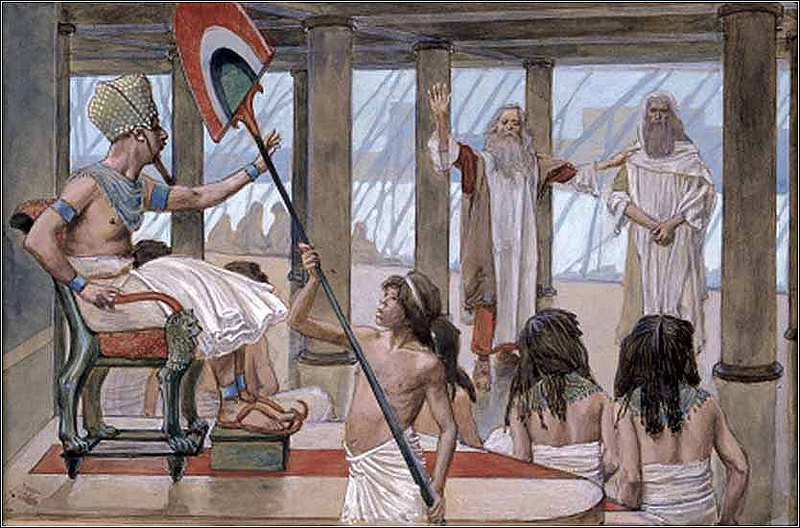
The Precursor to the Final Plague

1 The Lord said to Moses, “Yet one plague more I will bring upon Pharaoh and upon Egypt. Afterward he will let you go from here. When he lets you go, he will drive you away completely. 2 Speak now in the hearing of the people, that they ask, every man of his neighbor and every woman of her neighbor, for silver and gold jewelry.” 3 And the Lord gave the people favor in the sight of the Egyptians. Moreover, the man Moses was very great in the land of Egypt, in the sight of Pharaoh’s servants and in the sight of the people.

4 So Moses said, “Thus says the Lord: ‘About midnight I will go out in the midst of Egypt, 5 and every firstborn in the land of Egypt shall die, from the firstborn of Pharaoh who sits on his throne, even to the firstborn of the slave girl who is behind the handmill, and all the firstborn of the cattle. 6 There shall be a great cry throughout all the land of Egypt, such as there has never been, nor ever will be again. 7 But not a dog shall growl against any of the people of Israel, either man or beast, that you may know that the Lord makes a distinction between Egypt and Israel.’ 8 And all these your servants shall come down to me and bow down to me, saying, ‘Get out, you and all the people who follow you.’ And after that I will go out.” And he went out from Pharaoh in hot anger. 9 Then the Lord said to Moses, “Pharaoh will not listen to you, that my wonders may be multiplied in the land of Egypt.”

10 Moses and Aaron did all these wonders before Pharaoh, and the Lord hardened Pharaoh’s heart, and he did not let the people of Israel go out of his land. – Exodus 11:1-10 ESV

The last plague ended on a foreboding note.

Then Pharaoh said to him, “Get away from me; take care never to see my face again, for on the day you see my face you shall die.” Moses said, “As you say! I will not see your face again.”  Exodus 10:28-29 ESV

Moses and Pharaoh parted ways on less-than-stellar terms, and the words of Moses carry an ominous tone to them. It is as if he knows that this epic war of the wills is about to come to an abrupt end. There is no reason to believe that Moses knew the exact number of plagues God had planned to send, but he could sense that God’s patience had run out.

All along the way, God had been displaying His power and authority over nature. He had transformed a staff into a snake and turned water into blood. He had somehow managed to produce an overabundance of frogs from the very same blood-infused water that had killed all the fish. Then He had produced an infestation of stinging gnats from the dust of the ground. This was followed by swarms of biting flies that appeared as if out of nowhere. But while those pesky flies made the lives of the Egyptians miserable, they were somehow prevented from entering the land of Goshen, where the Israelites lived. And that same region was protected when God sent death to the livestock of the Egyptians. Not a single sheep, cow, donkey, or camel belonging to the Israelites suffered death. Next God turned ash into a dustlike substance that spread throughout the land of Egypt, inflicting the Egyptians with anthrax-like sores all over their bodies. God followed this devastating disease with a double disaster that left the Egyptian agricultural economy in ruins. A hailstorm of epic proportions was followed by a nationwide locust infestation that stripped the land bare of all vegetation. And finally, there was darkness. In the middle of the day, Ra, the sun god literally disappeared from the sky.

Yahweh had repeatedly demonstrated His sovereignty over creation and His vast superiority over the false gods of Egypt. He had amply proven His status as the one true God. At any point along the way, God could have taken Pharaoh’s life and brought this whole lopsided battle to an end. But He had a very good reason for not doing so.

“By now I could have lifted my hand and struck you and your people with a plague to wipe you off the face of the earth. But I have spared you for a purpose—to show you my power and to spread my fame throughout the earth.” – Exodus 9:15-16 NLT

But with the ninth plague completed, God revealed to Moses what was about to happen. The darkness was about to be broken by the light of God’s sovereign glory.

“I will strike Pharaoh and the land of Egypt with one more blow. After that, Pharaoh will let you leave this country. In fact, he will be so eager to get rid of you that he will force you all to leave.” – Exodus 11:1 NLT

What happened next is an illustration of the apostle John’s words, written centuries later.

The light shines in the darkness, and the darkness can never extinguish it. – John 1:15 NLT

In his gospel, John makes the following statement regarding Jesus, the light of the world.

God’s light came into the world, but people loved the darkness more than the light, for their actions were evil. – John 3:19 NLT

The darkness that had permeated the land of Egypt was an apt symbol of their moral state as a people. They were living in the darkness of sin and had a darkened understanding of God’s glory. While they believed in all kinds of gods, they could not comprehend the idea of one God who possessed such devastating and unparalleled power. But now they were going to see God’s glory and greatness on full display.

God had already commanded Moses to inform Pharaoh of the unpleasant nature of the final and pending judgment.

“This is what the Lord says: At midnight tonight I will pass through the heart of Egypt. All the firstborn sons will die in every family in Egypt, from the oldest son of Pharaoh, who sits on his throne, to the oldest son of his lowliest servant girl who grinds the flour. Even the firstborn of all the livestock will die. Then a loud wail will rise throughout the land of Egypt, a wail like no one has heard before or will ever hear again.” – Exodus 11:4-6 NLT

This plague was going to make all the others seem like a walk in the park. And this time, even the house of Pharaoh would go unspared. He too was going to lose a loved one. His eldest son was going to die and there was nothing he could do to prevent it. But in the land of Goshen, it would be another matter.

“…it will be so peaceful that not even a dog will bark. Then you will know that the Lord makes a distinction between the Egyptians and the Israelites.” – Exodus 11:7 NLT

The Israelites and their flocks and herds would be divinely protected. If they followed the Lord’s instructions, not a single firstborn among them would die. Their obedience to God’s instructions would preserve life. But along with protection from death, God would provide the Israelites with great wealth. Amazingly, despite all the trouble the Egyptians had suffered because of the presence of the Israelites, “the Lord had caused the Egyptians to look favorably on the people of Israel” (Exodus 11:3 NLT). Not only that, but “Moses was considered a very great man in the land of Egypt, respected by Pharaoh’s officials and the Egyptian people alike” (Exodus 11:3 NLT). Moses wasn’t exactly loved by Pharaoh, but the king’s officials and the citizens of his land held Moses in high esteem.

While Pharaoh’s heart had been hardened by all the plagues, the hearts of the people had actually been softened. So much so, that God instructed the Israelites to ask their Egyptian neighbors for gifts of gold and silver. This must have sounded like ill-fated advice to the shell-shocked Israelites. These people had suffered greatly at the hands of the Egyptians and the thought of their overlords providing them with parting gifts must have come across as more than a bit insane.

But God assured them that this final plague was going to be the deal-breaker. When the Egyptians see how God “makes a distinction between the Egyptians and the Israelites” (Exodus 11:7 NLT), they will beg the Israelites to leave and pay them to do so.

Moses delivered this bizarre pronouncement to Pharaoh, then vacated his presence for the last time. He was done asking for Pharaoh’s permission and cooperation. Moses knew that something was about to happen that would break this man’s seemingly unshakeable resolve to oppose the will of God. So, Moses walked out of Pharaoh’s presence and left the king to consider the weight of his words.

“At midnight tonight, I will pass through the heart of Egypt. All the firstborn sons will die in every family in Egypt, from the oldest son of Pharaoh, who sits on his throne…” – Exodus 11:4-5 NLT

The darkness of the ninth plague had dissipated, but a new and even deeper darkness was about to envelop the land as God sent the death angel to exact a costly judgment on the recalcitrant king of Egypt.

English Standard Version (ESV) The Holy Bible, English Standard Version. ESV® Permanent Text Edition® (2016). Copyright © 2001

New Living Translation (NLT) Holy Bible, New Living Translation, copyright © 1996, 2004, 2015 by Tyndale House Foundation. Used by permission of Tyndale House Publishers Inc., Carol Stream, Illinois 60188. All rights reserved.

Faith: Belief In Action.

By faith he kept the Passover and sprinkled the blood, so that the Destroyer of the firstborn might not touch them. – Hebrews 11:28 ESV

The author of Hebrews skips over a large section of the biography of Moses, going straight from his departure from Egypt after killing another Egyptian to the days just prior to his second departure, this time leading the entire nation of Israel into the wilderness. The account in Hebrews leaves out large, seemingly significant sections of Moses’ life, including his call at the burning bush, his somewhat reluctant return to Egypt, his encounters with Pharaoh, and the first nine plagues. From the moment God called Moses in Midian and told him he would be the deliverer of God’s people, Moses had to have faith in the word of God. When God had appeared to him at the burning bush in Midian, He had told Moses:

Then the Lord said, “I have surely seen the affliction of my people who are in Egypt and have heard their cry because of their taskmasters. I know their sufferings, and I have come down to deliver them out of the hand of the Egyptians and to bring them up out of that land to a good and broad land, a land flowing with milk and honey, to the place of the Canaanites, the Hittites, the Amorites, the Perizzites, the Hivites, and the Jebusites. And now, behold, the cry of the people of Israel has come to me, and I have also seen the oppression with which the Egyptians oppress them.” – Exodus 3:7-9 ESV

This would have been good news to Moses. But then he heard the rest of God’s plan. “Come, I will send you to Pharaoh that you may bring my people, the children of Israel, out of Egypt” (Exodus 3:10 ESV). Moses was reluctant, even resistant, to God’s plan. But God told him, “I will be with you, and this shall be the sign for you, that I have sent you: when you have brought the people out of Egypt, you shall serve God on this mountain” (Exodus 3:12 ESV). God had given Moses a promise, an assurance that he was the one to do the job. God would be with him and God would bring he and the people of Israel back to this very same spot – Mount Horeb, also known as Mount Sinai. God went on to tell Moses the rest of His plan.

“But I know that the king of Egypt will not let you go unless compelled by a mighty hand.  So I will stretch out my hand and strike Egypt with all the wonders that I will do in it; after that he will let you go. And I will give this people favor in the sight of the Egyptians; and when you go, you shall not go empty, but each woman shall ask of her neighbor, and any woman who lives in her house, for silver and gold jewelry, and for clothing. You shall put them on your sons and on your daughters. So you shall plunder the Egyptians.” – Exodus 23:19-22 ESV

So Moses went. And everything went just as God had said. All the way up to the point to which the author of Hebrews refers in verse 28 of chapter 11. There was going to be one last plague that God would bring on the land of Egypt. And while the first nine had been troubling and even devastating at times, the last plague would be deadly. God warned Pharaoh through His servant Moses, “Thus says the Lord: ‘About midnight I will go out in the midst of Egypt, and every firstborn in the land of Egypt shall die, from the firstborn of Pharaoh who sits on his throne, even to the firstborn of the slave girl who is behind the handmill, and all the firstborn of the cattle’” (Exodus 11:4-5 ESV). While God had protected the people of Israel from most of the other plagues, this one was going to be nation-wide and non-discriminate. All the first-born males throughout the land would die, of both man and animal, including the firstborn of the Jews. Unless they followed God’s directions. On the tenth day of the month, every household was to select a lamb – a one-year old, unblemished male lamb. They were to “keep it until the fourteenth day of this month, when the whole assembly of the congregation of Israel shall kill their lambs at twilight” (Exodus 12:6 ESV).

“Then they shall take some of the blood and put it on the two doorposts and the lintel of the houses in which they eat it. They shall eat the flesh that night, roasted on the fire; with unleavened bread and bitter herbs they shall eat it. Do not eat any of it raw or boiled in water, but roasted, its head with its legs and its inner parts. And you shall let none of it remain until the morning; anything that remains until the morning you shall burn. In this manner you shall eat it: with your belt fastened, your sandals on your feet, and your staff in your hand. And you shall eat it in haste. It is the Lord‘s Passover. For I will pass through the land of Egypt that night, and I will strike all the firstborn in the land of Egypt, both man and beast; and on all the gods of Egypt I will execute judgments: I am the Lord. The blood shall be a sign for you, on the houses where you are. And when I see the blood, I will pass over you, and no plague will befall you to destroy you, when I strike the land of Egypt.” – Exodus 12:7-13 ESV

The people of Israel were instructed to take the blood of their lambs and sprinkle it on the doorposts and lentils of their homes. This final step was essential for their salvation. God had told them, “For the Lord will pass through to strike the Egyptians, and when he sees the blood on the lintel and on the two doorposts, the Lord will pass over the door and will not allow the destroyer to enter your houses to strike you” (Exodus 12:23 ESV). The blood of the innocent lamb would protect them. But it required faith and obedience. Of all the plagues, this one hit the closest to him – literally. If the people of Israel failed to follow God’s commands, they would suffer the same fate as the Egyptians. Their protection and preservation required faith and action. And Moses led the way. He placed his faith in God and did what God had told him to do. The whole scenario had to have sounded bizarre to Moses. There was no precedent for killing a lamb and sprinkling its blood as a form of protection from death. The sacrificial system had not yet been given. This would have been a costly command, because as shepherds, the people of Israel put a high value on their livestock, especially one that was one-year old and without blemish. A male lamb would have been prime breeding stock. God’s plan probably sounded far-fetched and fairly sketchy to most of the Jews. They most likely had doubts as to whether it would work. You can imagine their fear and dismay as the “destroyer” passed over the city that night and they heard the cries coming from the homes of all those who had lost a firstborn. They would have wondered if the blood would work. But as the dawn came, the thing that saved them was not the quantity or quality of their faith, but the presence of the blood. The Lord looked for the blood. It was the blood that saved them, not their faith. It was God who protected them, not their faith. Their faith was simply an instrument through which they expressed their trust in God. Moses and the people had to put their faith in God’s plan of salvation. And when they did, it worked. 

It was Moses’ faith in the word of God that ultimately convinced the people of God to sprinkle the blood on their doorposts and lentils. He believed God. His faith was influential and infectious. By faith he obeyed the command of God. By faith he instructed the people of God. His faith in God was instrumental in saving tens of thousands of firstborn Israelites. By faith he kept the Passover and sprinkled the blood. His faith showed up in action. He took God at His word and took steps to obey God’s word.