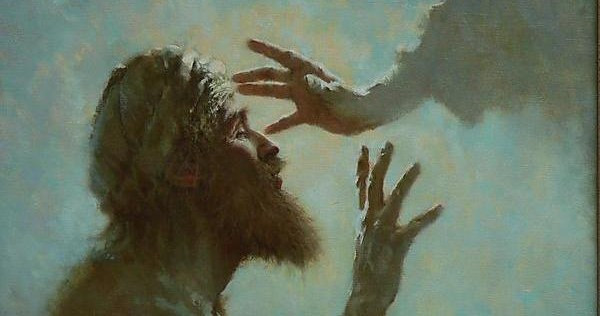
27 And as Jesus passed on from there, two blind men followed him, crying aloud, “Have mercy on us, Son of David.” 28 When he entered the house, the blind men came to him, and Jesus said to them, “Do you believe that I am able to do this?” They said to him, “Yes, Lord.” 29 Then he touched their eyes, saying, “According to your faith be it done to you.” 30 And their eyes were opened. And Jesus sternly warned them, “See that no one knows about it.” 31 But they went away and spread his fame through all that district.
32 As they were going away, behold, a demon-oppressed man who was mute was brought to him. 33 And when the demon had been cast out, the mute man spoke. And the crowds marveled, saying, “Never was anything like this seen in Israel.” 34 But the Pharisees said, “He casts out demons by the prince of demons.” – Matthew 9:27-34 ESV
 Matthew has been going out of his way to prove the authority of Jesus by weaving together a series of somewhat unrelated events, purposefully taking them out of their chronological order, and rearranging them to bolster his claim that Jesus was the Messiah, the Son of God.
Here we have another example of Jesus demonstrating His power and authority through His miraculous healing of two blind men. The prophet Isaiah wrote of a future period of time when the blind would receive their sight.
Then the eyes of the blind shall be opened,
and the ears of the deaf unstopped;
then shall the lame man leap like a deer,
and the tongue of the mute sing for joy. – Isaiah 35:5-6 ESV
And Matthew is faithfully providing evidence meant to prove that the long-awaited day had arrived. Even Jesus would later acknowledge that He was the anointed one, the Messiah, for whom the Jews had been eagerly awaiting. When John the Baptist ended up in prison, having been put there by King Herod, he sent his disciples to ask Jesus, “Are you the Messiah we’ve been expecting, or should we keep looking for someone else?” (Matthew 11:3 NLT). He was looking for confirmation because things were not working out quite like he had expected. He was receiving reports about all that Jesus was doing, but it must have contradicted his preconceived notions of how the Messiah would go about His business. So, he asked Jesus to clarify whether He really was, “The Lamb of God who takes away the sin of the world!” (John 1:29 NLT).
And Jesus patiently and graciously responded, “Go back to John and tell him what you have heard and seen—the blind see, the lame walk, those with leprosy are cured, the deaf hear, the dead are raised to life, and the Good News is being preached to the poor” (Matthew 11:4-5 NLT). Look at that list. Within the last two chapters, Matthew has covered almost every one of them. We’ve read how Jesus healed the paralyzed man so he could pick up his mat and walk. Jesus reached out and touched the man with leprosy, allowing him to walk away cleansed and whole. And, thanks to Jesus, the daughter of Jairus was literally raised from death back to life.
Later on, while visiting the synagogue in His hometown of Nazareth, Jesus would read the following verses from the 61st chapter of the book of Isaiah:
“The Spirit of the Lord is upon me,
because he has anointed me to proclaim good news to the poor.
He has sent me to proclaim release to the captives
and the regaining of sight to the blind,
to set free those who are oppressed,
to proclaim the year of the Lord’s favor.” – Luke 4:18-19 NLT
Then He would declare to those who had just heard Him read those words: ““Today this scripture has been fulfilled even as you heard it being read” (Luke 4:21 ESV). Those verses from Isaiah were well-known to the Jews and considered a prophetic passage concerning the coming Messiah. Jesus was claiming to be the fulfillment of those verses. He was the anointed one of God who came to proclaim good news to the poor, provide release to the captives, restore sight to the blind, and set the free the oppressed.
And Matthew gives us two more proofs that support the claims of Jesus. The first involves two blind men who follow Jesus, begging Him to show them mercy, and appealing to His status as the Son of David. They seemed to recognize Jesus as a descendant of King David, perhaps indicating their belief that He truly was the Messiah. They viewed Jesus as a man with authority and power. And it is likely that they had heard all the rumors concerning the other miracles Jesus had performed. So, they begged Jesus to show them mercy. They even followed Him into a nearby house, demonstrating their persistent and unrelenting desire for His help with their problem.
And, Jesus asked them a probing question: “Do you believe that I am able to do this?” (Matthew 9:28 ESV). While all they had asked for was mercy, Jesus knew what it was they really desired. They desperately wanted to be healed from their blindness. They longed to be released from the darkness that had become their uninvited and unwelcome companion.
It is likely that Jesus knew the answer before He asked. He had the unique capacity to understand the hearts of men and to ascertain the unspoken thoughts of their minds. So, it seems that He was providing these two men with the opportunity to express their internal faith in an outward way. Which they did by responding, “Yes, Lord” (Matthew 9:28). And Jesus acknowledged the veracity of their faith by declaring that their healing was a direct result of it. They had believed. Therefore, they were healed. Matthew simply states, “And their eyes were opened{ (Matthew 9:30 ESV).
No sooner had these two men walked out the door with their sight restored, another man entered the house, but he was far from alone. He was possessed by a demon whose presence had left the man unable to speak. Obviously, Jesus was well aware of the man’s problem and immediately addressed it by casting out the demon. And with the demon’s departure, the man’s capacity to speak returned. This miracle left the crowds exclaiming, “Never was anything like this seen in Israel” (Matthew 9:33 ESV).
They were blown away it all. They had just witnessed Isaiah 61 being lived out right before their eyes. The blind had just regained their sight, and the oppressed had just been set free. And Jesus had done it all. He had clearly demonstrated His Messiahship in tangible, life-altering ways. But while the people marveled, the religious leaders scoffed, writing off the miracles of Jesus as proof of His alliance with the Devil, not of His divinity. They accused Jesus of being in league with Satan himself, declaring, “He casts out demons by the prince of demons{ (Matthew 9:34 ESV). And this would not be the last time they issued that ridiculous assessment of Jesus’ power.
The two blind men couldn’t help but sing the praises of Jesus, in spite of His warning to keep the news of their healing to themselves. They wanted everyone to know what had happened. They had once been blind, but now they could see. But the Pharisees were singing a different tune, declaring that Jesus was a charlatan, a wolf in sheep’s clothing. In their minds, Jesus was in cahoots with the devil, trying to deceive the minds of men by performing seemingly miraculous healings that drew the crowds away from the real purveyors of truth: Themselves.
Yet, Jesus would later refer to the Pharisees as “blind guides leading the blind” (Matthew 15:14 NLT). And rather humorously, Jesus described the foolishness and futility of a blind man taking guidance from another blind man: “…if one blind person guides another, they will both fall into a ditch” (Matthew 15:14 NLT). While Jesus was busy restoring sight to those who couldn’t see, the Pharisees were foolishly trying to provide them with directions when they were blind themselves.
The Savior had come. The restorer of sight had arrived. The deliverer of captives was in their midst. And with every miracle Jesus performed, He provided further, unequivocal proof of who He was and what He had come to do.
English Standard Version (ESV) The Holy Bible, English Standard Version. ESV® Permanent Text Edition® (2016). Copyright © 2001 by Crossway Bibles, a publishing ministry of Good News Publishers.
New Living Translation (NLT)
Holy Bible, New Living Translation, copyright © 1996, 2004, 2015 by Tyndale House Foundation. Used by permission of Tyndale House Publishers Inc., Carol Stream, Illinois 60188. All rights reserved.