The Stronger Man

14 Now he was casting out a demon that was mute. When the demon had gone out, the mute man spoke, and the people marveled. 15 But some of them said, “He casts out demons by Beelzebul, the prince of demons,” 16 while others, to test him, kept seeking from him a sign from heaven. 17 But he, knowing their thoughts, said to them, “Every kingdom divided against itself is laid waste, and a divided household falls. 18 And if Satan also is divided against himself, how will his kingdom stand? For you say that I cast out demons by Beelzebul. 19 And if I cast out demons by Beelzebul, by whom do your sons cast them out? Therefore they will be your judges. 20 But if it is by the finger of God that I cast out demons, then the kingdom of God has come upon you. 21 When a strong man, fully armed, guards his own palace, his goods are safe; 22 but when one stronger than he attacks him and overcomes him, he takes away his armor in which he trusted and divides his spoil. 23 Whoever is not with me is against me, and whoever does not gather with me scatters.” – Luke 11:14-23 ESV

After recording Jesus’ instructions to His disciples on the subject of prayer, Luke seems to make a rather abrupt shift in the topic. There were a lot of rumors concerning Jesus. Some believed Him to be the Messiah, while others speculated that He might be Elijah or one of the other prophets, resurrected from the dead. His miracles and messages had made a powerful impression on many people, but there were those who took exception to this enigmatic Rabbi from Nazareth. And their speculation regarding His identity had been heavily influenced by the rumors the religious leaders had begun to spread.

We know from the gospel accounts of Matthew and Mark that the Sanhedrin had begun to circulate the rumor that Jesus was demon-possessed. Even while He had been ministering in Galilee, a contingent of Pharisees had been sent from Jerusalem to the region around the northern shore of the Sea of Galilee. It was on this occasion that these men pronounced their verdict regarding the source of Jesus’ miraculous powers.

“He’s possessed by Satan, the prince of demons. That’s where he gets the power to cast out demons.” – Mark 3:22 NLT

Matthew seems to record a similar, yet different situation in which Jesus cast a demon out of a man and was immediately accused by the Pharisees of having done so by the power of Satan.

“No wonder he can cast out demons. He gets his power from Satan, the prince of demons.” – Matthew 12:24 NLT

These men had been trying to counteract the enthusiasm of the crowd. Some of those who had witnessed this miraculous healing had begun to wonder out loud if Jesus really was their long-awaited Messiah.

“Could it be that Jesus is the Son of David, the Messiah?” – Matthew 12:23 NLT

The Pharisees could not tolerate this kind of speculation, so they began to accuse Jesus of being in league with Satan. Unable to deny His power, they decided to question its source. And in all three cases, Jesus strongly refuted their accusations, exposing the illogical nature of their claim.

In Luke’s account, it appears that the Pharisees had been successful in circulating their rumor concerning the satanic source of Jesus’ power. They had planted the seed of doubt and it had begun to take root. On this occasion, it was not a Pharisee who leveled the accusation against Jesus, but one of the onlookers.

“He casts out demons by Beelzebul, the prince of demons…” – Luke 11:15 ESV

The Jewish people commonly used the name, Beelzebul, when referring to Satan. It is derived from two words, Baal, which was the name for the chief Canaanite deity, and Zebul, which means “exalted dwelling.” In the Greek New Testament, it is sometimes spelled Beelzeboul, which can be translated as “lord of dung.” It was a commonly used euphemism for Satan himself, the prince of demons.

So, on this occasion, you have some in the crowd accusing Jesus of being a tool of Satan, while others are demanding that He show them some kind of heavenly sign to prove He is the Messiah. It was a volatile and intensely polarized scene. But, just as He had done before, Jesus calmly and patiently addressed the unsubstantiated and blasphemous rumors being leveled against Him.

None of it made any sense. Why in the world, Jesus asked, would Satan cast out one of his own? That would not only be illogical but highly unproductive. And to drive home His point, Jesus forces His accusers to consider the absurd nature of their argument.

“Any kingdom divided by civil war is doomed. A family splintered by feuding will fall apart. You say I am empowered by Satan. But if Satan is divided and fighting against himself, how can his kingdom survive?” – Luke 11:17-18 NLT

It would be totally irrational for Satan to provide Jesus with the power to cast out demons. To do so would be self-defeating and self-destructive. And those who had witnessed Jesus cast out demons would have recognized that the demons never left willingly or without a fight. On many occasions, they opposed Jesus, verbally acknowledging Him as the Son of God. Luke records an earlier situation in which Jesus was confronted by a disgruntled demon and his companions who fully recognized and confessed His divine power and authority.

“Why are you interfering with us, Jesus of Nazareth? Have you come to destroy us? I know who you are—the Holy One of God!” – Luke 4:34 NLT

Jesus’ ability to cast out demons was a clear indication of His sovereign power and validation of His identity as the Messiah. He was the King and, in exorcising demons, He was exercising His divinely ordained power and authority over the enemy. The demons clearly recognized this fact, but the Pharisees could not or simply would not.

And Jesus points out the hypocrisy of it all. The exorcism of demons was not uncommon among the Jewish people. And Jesus raises the logical question that since there were others who claimed to possess the power to cast out demons, were they also in cooperation with Satan? They couldn’t have it both ways. Either exorcism was divinely empowered or it was not. It was a work of God or it was a work of Satan. But Jesus points out the most logical and significant conclusion.

“But if I am casting out demons by the power of God, then the Kingdom of God has arrived among you.” – Luke 11:20 NLT

Whether they realized it or not, those in the crowd who had demanded a sign had already received one. Jesus was operating by the power of God and, in doing so, was giving evidence that He was the King of Israel. And His arrival was proof that the long-awaited promise of the kingdom was being fulfilled. He was the Messiah, the stronger man who was defeating the strong man (Satan) by the power of God. He was the chosen one who had been sent to bring release to all those held captive by the enemy. Ever since the fall, Satan had operated as the prince of this world, enslaving and controlling mankind, and waging a relentless war against God. Even at the incarnation, Satan had attempted to destroy the Son of God through the demon-possessed efforts of Herod (Matthew 2:1-18). Immediately after Jesus’ baptism, He was led by the Holy Spirit into the Judean wilderness, where Satan launched an all-out assault designed to derail Jesus from His God-ordained mission. But he failed.

And now Jesus was waging war on Satan. With every exorcism He performed, Jesus was giving evidence that Satan’s power was waning and his days were numbered. In Jesus, Satan, the strong man, had more than met his match. And Jesus informs His accusers that their disbelief was tantamount to insurrection. By accusing Jesus of operating by the power of Satan, they were actually illustrating their own cooperation with the enemy.

“Anyone who isn’t with me opposes me, and anyone who isn’t working with me is actually working against me.” – Luke 11:23 NLT

This is essentially the same message Peter had received when he had rebuked Jesus for speaking of His coming suffering and death in Jerusalem. Jesus had strongly admonished His well-meaning but misinformed friend, “Get away from me, Satan! You are a dangerous trap to me. You are seeing things merely from a human point of view, not from God’s” (Matthew 16:23 NLT). In opposing Jesus’ declaration of God’s will, Peter had unknowingly aligned himself with the aims of the enemy. He had essentially become the tool of Satan, trying to thwart the redemptive plan that God had ordained for His Son. What Peter failed to realize was that Jesus’ death was going to be the key to breaking Satan’s power over mankind. With Jesus’ crucifixion, Satan would assume he had won the victory. But he would be wrong – dead wrong. The sacrificial death of Jesus would bring about the emancipation of all those who were held captive by the enemy. The author of Hebrews reminds us:

Because God’s children are human beings—made of flesh and blood—the Son also became flesh and blood. For only as a human being could he die, and only by dying could he break the power of the devil, who had the power of death. Only in this way could he set free all who have lived their lives as slaves to the fear of dying. – Hebrews 2:14-15 NLT

And the apostle John adds, “the Son of God came to destroy the works of the devil” (1 John 3:8 NLT). While Jesus walked this earth, He demonstrated His power over the enemy. But it was on the cross, as He breathed His last breath, that Jesus delivered the death blow to Satan. With the willful sacrifice of His life, Jesus fulfilled the curse that God had placed upon Satan as a result of his temptation of Adam and Eve.

“And I will cause hostility between you and the woman, and between your offspring and her offspring. He will strike your head, and you will strike his heel.” – Genesis 3:15 NLT

Jesus, the stronger man, has defeated Satan. Yes, he still wields his power and displays an open disdain for God and His people, but he is a defeated foe. His days are numbered and his future is sealed. He fights a futile war with a preordained outcome. All because Jesus, the Son of God, fulfilled the will of God and gave His life as a ransom for many.

English Standard Version (ESV) The Holy Bible, English Standard Version. ESV® Permanent Text Edition® (2016). Copyright © 2001 by Crossway Bibles, a publishing ministry of Good News Publishers.

New Living Translation (NLT) Holy Bible, New Living Translation, copyright © 1996, 2004, 2015 by Tyndale House Foundation. Used by permission of Tyndale House Publishers Inc., Carol Stream, Illinois 60188. All rights reserved.

The Message (MSG)Copyright © 1993, 1994, 1995, 1996, 2000, 2001, 2002 by Eugene H. Peterson
Authority & Power

21 And they went into Capernaum, and immediately on the Sabbath he entered the synagogue and was teaching. 22 And they were astonished at his teaching, for he taught them as one who had authority, and not as the scribes. 23 And immediately there was in their synagogue a man with an unclean spirit. And he cried out, 24 “What have you to do with us, Jesus of Nazareth? Have you come to destroy us? I know who you are—the Holy One of God.” 25 But Jesus rebuked him, saying, “Be silent, and come out of him!” 26 And the unclean spirit, convulsing him and crying out with a loud voice, came out of him. 27 And they were all amazed, so that they questioned among themselves, saying, “What is this? A new teaching with authority! He commands even the unclean spirits, and they obey him.” 28 And at once his fame spread everywhere throughout all the surrounding region of Galilee.

29 And immediately he left the synagogue and entered the house of Simon and Andrew, with James and John. 30 Now Simon’s mother-in-law lay ill with a fever, and immediately they told him about her. 31 And he came and took her by the hand and lifted her up, and the fever left her, and she began to serve them.

32 That evening at sundown they brought to him all who were sick or oppressed by demons. 33 And the whole city was gathered together at the door. 34 And he healed many who were sick with various diseases, and cast out many demons. And he would not permit the demons to speak, because they knew him. – Mark 1:21-34 ESV

In his gospel account, Luke reports that “Jesus returned to Galilee, filled with the Holy Spirit’s power. Reports about him spread quickly through the whole region. He taught regularly in their synagogues and was praised by everyone” (Luke 4:14-15 ESV). And Mark provides a glimpse into one such occasion.

After calling Andrew, Simon, James, and John to be His disciples, Jesus and His new recruits made their way to the town of Capernaum on the northern shore of the Sea of Galilee. On the Sabbath, Jesus and His disciples made their way to the local synagogue. The synagogue was the building in each community where the Jews gathered for worship, prayer, and instruction. The Hebrew word is beit k’nesset (literally, House of Assembly). The Jews typically referred to this building as a synagogue, which is the Greek translation of  beit k’nesset.

The synagogue came into existence during Israel’s Babylonian captivity. After the Babylonians defeated Judah in 597 B.C., they took tens of thousands of Israelites captive and transported them to Babylon. With no access to the temple, the Jews were forced to come up with an alternative place of worship. Even after the Jews returned to Judah and rebuilt the temple which had been destroyed by the Babylonians, they continued to build synagogues in their local communities.

The synagogue was a place of prayer and instruction. And when the Jews gathered on the Sabbath, they would read from the Torah, the five books of Moses (Genesis, Exodus, Leviticus, Numbers, and Deuteronomy). After the reading of the sacred Scriptures, there would be a time of teaching or instruction.

Mark indicates that Jesus was teaching in the synagogue in Capernaum. Because Jesus was recognized as a Rabbi, it would have been quite normal for the leadership of the synagogue to extend Him this honor. But while Mark makes much of the peoples’ reaction to what Jesus’ taught, he provides no details concerning its content. He simply states, “they were astonished at his teaching, for he taught them as one who had authority, and not as the scribes” (Mark 1:22 ESV). The Greek word Mark used conveys the idea that they were “blown away” by the force of Jesus’ words. It seems that they were astonished or amazed, not so much by what Jesus said than by how He said it. He taught with authority (exousia). The people in the synagogue that day had never heard anything like it. In a sense, they felt like Jesus spoke as if He knew what He was talking about.

Mark purposefully contrasts the instruction of Jesus with that of the scribes. These men were considered the experts in the Law of Moses. Their job was to study the Law, transcribe it, and provide written commentaries about it. But Mark infers that these well-educated men lacked the authority and power that Jesus possessed. This will be the first of many contrasts that Mark establishes between Jesus and the religious leaders of Israel.

And, as if to illustrate that Jesus didn’t just have a way with words, Mark describes an encounter between Jesus and a man with an “unclean spirit.” Mark indicates that as soon as Jesus had finished speaking, this demon-possessed man interrupted the service, crying out, “What have you to do with us, Jesus of Nazareth? Have you come to destroy us? I know who you are—the Holy One of God” (Mark 1:24 ESV).

Evidently, this man had been in the room the entire time. But it was Jesus’ authoritative teaching that caused the demon(s) within the man to react in fear and anger. They had literally been struck by the power of Jesus’ words. The demon’s use of the plural pronoun, “us” may indicate that the man had more than one demon or that there were other demons present in the synagogue that day. Whatever the case, the demon had immediately recognized the identity of Jesus, referring to Him as “the Holy One of God.” This demonic being clearly knew who Jesus was and why He had come. He even asked Jesus if He planned to destroy him and his fellow demons right then and there.

With his description of this encounter, Mark establishes yet another point of conflict that will characterize Jesus’ earthly ministry. Not only will Jesus find Himself at odds with the Jewish religious leaders, but He will also be engaged in a battle with what Paul describes as “spiritual forces of evil in the heavenly places” (Ephesians 6:12).

But these spiritual forces were not relegated to the invisible world. They had infiltrated the realm of men and were wreaking havoc among God’s chosen people. This will not be the last of Jesus’ encounters with demons. But these other-worldly invaders were going to prove no match for the Holy One of God.

Jesus refused to answer or even acknowledge the demon’s question, choosing instead to shut the demon up by casting him out. The Greek word translated as “rebuke” can actually mean “to censure or silence.” Rather than verbally castigate the demon, Jesus simply removed his ability to speak by forcing him to vacate the man’s body.

“Be silent, and come out of him!” – Mark 1:25 ESV

With no host to occupy, the demon found itself with no means of communication.

And the unclean spirit, convulsing him and crying out with a loud voice, came out of him. – Mark 1;26 ESV

This strange and disturbing scene left those who had witnessed it even more amazed and astonished than ever. But notice that they connected what they had seen to the teaching of Jesus.

“What sort of new teaching is this?” they asked excitedly. “It has such authority! Even evil spirits obey his orders!” – Mark 1:27 NLT

Jesus’ words carried real power. It could not be said of Jesus that He was “all talk, no action.” Unlike the scribes, who could probably describe what the Scriptures had to say about demons, Jesus could control them. He had power over them. His words had authority. And this distinction did not go unnoticed. Mark indicates that “at once his fame spread everywhere throughout all the surrounding region of Galilee” (Mark 1:28 ESV). And that means that it wasn’t long before news of what Jesus had done made its way to the religious leaders in Jerusalem. As Jesus’ fame spread, so did His infamy. And before long, Jesus would find Himself doing battle on multiple fronts.

But Jesus was not done demonstrating His power. After His exorcism of the demon in the synagogue, Jesus made His way to the home of Andrew and Simon. Mark indicates that Simon’s mother-in-law was ill. It is likely that Simon (Peter) told this story to Mark and that is why it is included in his gospel account. When Jesus was informed of her illness, He simply took her by the hand and she was immediately healed. Without a word being said, she went from suffering to serving. This point should not be overlooked. In the scene that took place in the synagogue, the emphasis was on Jesus’ words. He spoke as one having authority. But on this occasion, Jesus said nothing. He took the woman by the hand and she was immediately healed. It was another case of Jesus demonstrating His power and authority, but this time without words.

This latest episode only increased Jesus’ notoriety and further inflamed the curiosity of the people. Mark reveals that by the end of the day, the crowds had gathered outside the home of Simon and Andrew. News had spread and it wasn’t long before “all who were sick or oppressed by demons” made their way to Jesus. And Mark indicates that “the whole city was gathered together at the door” (Mark 1:33 ESV).

And what did Jesus do? He “healed many people who were sick with various diseases, and he cast out many demons” (Mark 1:34 ESV). He demonstrated His power and authority – over disease and demons. In a sense, Jesus gave proof of what the demon had said. He really was the Holy One of God and the source of His authority and power was divine, not human. He was able to do what He did because of who He was. But the people, while impressed by what they saw, were not yet convinced of His divinity.

English Standard Version (ESV) The Holy Bible, English Standard Version. ESV® Permanent Text Edition® (2016). Copyright © 2001 by Crossway Bibles, a publishing ministry of Good News Publishers.

New Living Translation (NLT) Holy Bible, New Living Translation, copyright © 1996, 2004, 2015 by Tyndale House Foundation. Used by permission of Tyndale House Publishers Inc., Carol Stream, Illinois 60188. All rights reserved.

The Message (MSG)Copyright © 1993, 1994, 1995, 1996, 2000, 2001, 2002 by Eugene H. Peterson

What Sort of Man is This?

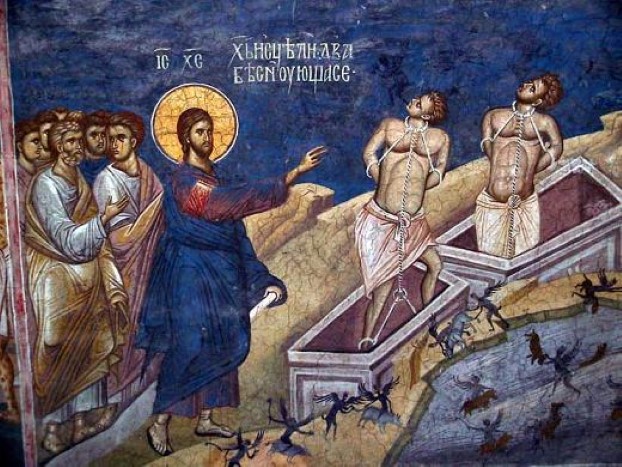
28 And when he came to the other side, to the country of the Gadarenes, two demon-possessed men met him, coming out of the tombs, so fierce that no one could pass that way. 29 And behold, they cried out, “What have you to do with us, O Son of God? Have you come here to torment us before the time?” 30 Now a herd of many pigs was feeding at some distance from them. 31 And the demons begged him, saying, “If you cast us out, send us away into the herd of pigs.” 32 And he said to them, “Go.” So they came out and went into the pigs, and behold, the whole herd rushed down the steep bank into the sea and drowned in the waters. 33 The herdsmen fled, and going into the city they told everything, especially what had happened to the demon-possessed men. 34 And behold, all the city came out to meet Jesus, and when they saw him, they begged him to leave their region. – Matthew 8:28-34 ESV

The first question we must address is why Matthew included two demon-possessed men in his account of this event, while Mark and Luke mention only one. The simple and honest answer is that we don’t know. It could be that Mark and Luke were describing the more radical and intimidating one of the two men. They both provide detailed descriptions of the man’s demon-possessed state.

…no one could bind him anymore, not even with a chain, for he had often been bound with shackles and chains, but he wrenched the chains apart, and he broke the shackles in pieces. No one had the strength to subdue him. – Mark 5:3-4 ESV

For a long time he had worn no clothes, and he had not lived in a house but among the tombs.…He was kept under guard and bound with chains and shackles, but he would break the bonds and be driven by the demon into the desert. – Luke 8:27, 29 ESV

The fact that Luke and Mark mention only one demoniac does not invalidate or contradict Matthew’s account that there were actually two. Each of these men compiled their gospel accounts with a particular audience in mind, with a singular focus intended, and from their own personal perspectives. So, while there appears to be some discrepancy between their accounts, each of the gospel writers provides a unique take on a shared experience.

It is important to recall the immediate context that accompanies this story. The disciples have just experienced a life-threatening storm at sea and had been eye-witnesses to Jesus’ miraculous calming of the wind and the waves with nothing more than a command. This had left the disciples in a state of joyful relief, but also confused disbelief, as they asked, “What sort of man is this, that even winds and sea obey him?” (Matthew 8:27 ESV). With each passing day and every miraculous display of His power, the disciples were receiving more insight into Jesus’ identity, but much of it left them increasingly more confused as to who He was and what He had come to do.

Upon reaching the eastern side of the Sea of Galilee, the disciples must have been relieved to be back on dry land. After their harrowing experience in the storm, the beaches and hills of Gadara were a welcome sight. But their relief was to be short-lived because as soon as they disembarked from their boats, they discovered that they had landed in the vicinity of Gentile burial ground. And to make matters worse, from among the tombs appeared two naked, wild-eyed, demon-possessed men.

Gadara, the regional capital of the Decapolis, was located on the southeastern side of the Sea of Galilee. It was a predominantly Gentile region and would not have been a common destination for the Jewish disciples of Jesus. The presence of the graveyard and the arrival of demoniacs made their landing in this particular location that much more uncomfortable and unattractive. This was the last place any of these men wanted to be.

But this encounter, like all the others the disciples of Jesus would experience, was God-ordained. Everything that had taken place over the preceding hours had resulted in this every scene taking place. The storm had driven them southeast, far from their original destination. The disciples would never have intended to land at a place like Gadara. But that was exactly what God had sovereignly ordained. This encounter with the demoniacs was not a case of chance or bad luck but was all part of a divine plan to display the true identity of Jesus. Remember the question the disciples asked immediately after the calming of the storm: “What sort of man is this, that even winds and sea obey him?” Mark recorded their question this way: “Who then is this…?” (Mark 4:41 ESV). And God was about to give them an answer to their question from a very unexpected and unlikely source.

…two demon-possessed men met him, coming out of the tombs, so fierce that no one could pass that way. And behold, they cried out, “What have you to do with us, O Son of God?” – Matthew 8:28-29 ESV

The demons which possessed these men addressed Jesus as the Son of God. They spoke to Him, fully cognizant of His identity and authority. They even ask Him, “Have you come here to torment us before the time?” (Matthew 8:29 ESV). These demons were fallen angels, agents of Satan whose sole responsibility was to torment men and women. At one time, they had been part of the heavenly host who worshiped God Almighty, but they had joined in Satan’s attempted coup against God and been cast out of God’s presence. They were now relegated to seeking out refuge in the bodies of helpless humans, tormenting and slowly destroying them.

It’s important to stop and consider how all of this was impacting the disciples of Jesus. Remember, they are Jews, and they have suddenly found themselves on Gentile soil, in close proximity to a graveyard, and accosted by two demon-possessed men. Everything about this scene shouts, “unclean!” They were not to associate with Gentiles. To do so would render them unclean. They were forbidden to come into contact with anything dead. If they did, they would be considered unclean. And to have anything to do with demons was unthinkable. Yet, here they were.

And they were hearing these demons address their rabbi and teacher as the Son of God. If you recall, this is exactly how God addressed Jesus at His baptism.

“This is my beloved Son, with whom I am well pleased.” – Matthew 3:17 ESV

God had confirmed the identity of Jesus. But now, He was providing further evidence by allowing the disciples to witness the proof of Jesus’ divine power and authority through the wind and waves, and even the words of demons.

And as if the location and the unexpected company were not bad enough, Matthew is about to reveal that the disciples were in eye-shot of a herd of pigs. This would have been one more proof to these men that they were not where they were meant to be. Pigs were considered unclean to Jews, and they were to have nothing to do with them. Yet, here they were, in a Gentile land, in the company of two demon-possessed Gentiles, in close proximity to a Gentile cemetery, and with a herd of pigs nearby. Could it get any worse?

But all of this was pre-ordained by God. There is nothing about this story that should be viewed as happenstance or coincidence. This was all meant to be. And the overwhelming sense of uncleanness and impurity is intended. Jesus, the Son of God and the Savior of the world, is right where He is supposed to be, surrounded by darkness and confronted by the impurity that pervades and permeates the world. John records in His gospel:

In him was life, and the life was the light of men. The light shines in the darkness, and the darkness has not overcome it. – John 1:4-5 ESV

The disciples would have sensed the darkness of their surroundings. They would have longed to enter their boats and sail away, risking another storm at sea rather than spending another moment in that God-forsaken, sin-infested region. But Jesus was right where He was supposed to be. He was the light of God shining amid the darkness. He was the Son of God, confronting sin and casting out the demons of darkness and destruction. And even the demons recognized that they were no match for Jesus. They also knew that their reign of terror on this earth was going to be short-lived because God had a plan in place for their ultimate defeat. That is why they asked Jesus, “Have you come here to torment us before the time?”

The Book of Revelation reveals that there is a future judgment for Satan and all of his demonic followers. John describes it in graphic terms.

Then the devil, who had deceived them, was thrown into the fiery lake of burning sulfur, joining the beast and the false prophet. There they will be tormented day and night forever and ever. – Revelation 20:10 ESV

These demons inherently know that they have met their match in Jesus. And all they can do is beg to be cast into a herd of swine. Later on in his gospel, Matthew records the words of Jesus concerning the need for demons to have a host to possess. Their entire existence is based on possession and manipulation.

“When the unclean spirit has gone out of a person, it passes through waterless places seeking rest, but finds none. Then it says, ‘I will return to my house from which I came.’ And when it comes, it finds the house empty, swept, and put in order. Then it goes and brings with it seven other spirits more evil than itself, and they enter and dwell there, and the last state of that person is worse than the first.” – Matthew 12:43-45 ESV

These demons knew what Jesus was about to do, so they request that He allow them to possess the herd of pigs. And this request speaks volumes when it comes to Satan’s outlook on humanity. We are little better than swine to Satan and his demons.

And when Jesus cast the demons into the swine, the entire herd “rushed down the steep bank into the sea and drowned in the waters” (Matthew 8:32 ESV). These soul-less animals proved to be poor hosts for the demons, ending their lives and leaving the demons to pass through waterless places seeking rest, but finding none.

But the reaction of the helpless pigs stands in stark contrast to that of the herdsman. Matthew tells us that they “fled, and going into the city they told everything, especially what had happened to the demon-possessed men” (Matthew 8:33 ESV). And Mark provides us with additional insight, describing them returning to find the formerly possessed men in a dramatically altered state.

…the one who had had the legion, sitting there, clothed and in his right mind, and they were afraid… – Mark 5:14-15 ESV

The herdsman returned with their neighbors and friends, but rather than reacting with amazement and wonder at the amazing transformation of these two men who used to terrorize their community, they respond in fear. And Matthew records that “they begged him [Jesus] to leave their region” (Matthew 8:34 ESV). They wanted nothing to do with Jesus.

Consider all the responses recorded in this story. The demons begged to be spared. The pigs plunged to their deaths. The herdsman ran in terror. The townspeople returned in curiosity. But they all begged Jesus to leave. There was no revival in Gadara that day. But the lives of two men were dramatically changed. And Jesus sent them back into their community with a charge to tell what He had done for them.

“Go home to your friends and tell them how much the Lord has done for you, and how he has had mercy on you.” And he went away and began to proclaim in the Decapolis how much Jesus had done for him, and everyone marveled. – Mark 5:19-20 ESV

The only reaction that Matthew fails to record is that of the disciples. We’re left to wonder what they thought about all of this. But just imagine the sheer volume of questions that must have been running through their minds as they considered all that they had just witnessed. This entire scenario must have left them dumbfounded and confused. But God was slowly and methodically answering their question: What sort of man is this?

English Standard Version (ESV) The Holy Bible, English Standard Version. ESV® Permanent Text Edition® (2016). Copyright © 2001 by Crossway Bibles, a publishing ministry of Good News Publishers.

New Living Translation (NLT)
Holy Bible, New Living Translation, copyright © 1996, 2004, 2015 by Tyndale House Foundation. Used by permission of Tyndale House Publishers Inc., Carol Stream, Illinois 60188. All rights reserved.

The Message (MSG)Copyright © 1993, 1994, 1995, 1996, 2000, 2001, 2002 by Eugene H. Peterson