Unbelievably Unrepentant

“I gave you cleanness of teeth in all your cities,
and lack of bread in all your places,
yet you did not return to me,”
declares the Lord.

“I also withheld the rain from you
when there were yet three months to the harvest;
I would send rain on one city,
and send no rain on another city;
one field would have rain,
and the field on which it did not rain would wither;
so two or three cities would wander to another city
to drink water, and would not be satisfied;
yet you did not return to me,”
declares the Lord.

“I struck you with blight and mildew;
your many gardens and your vineyards,
your fig trees and your olive trees the locust devoured;
yet you did not return to me,”
declares the Lord.

10 “I sent among you a pestilence after the manner of Egypt;
I killed your young men with the sword,
and carried away your horses,
and I made the stench of your camp go up into your nostrils;
yet you did not return to me,”
declares the Lord.

11 “I overthrew some of you,
as when God overthrew Sodom and Gomorrah,
and you were as a brand plucked out of the burning;
yet you did not return to me,”
declares the Lord.

12 “Therefore thus I will do to you, O Israel;
because I will do this to you,
prepare to meet your God, O Israel!”

13 For behold, he who forms the mountains and creates the wind,
and declares to man what is his thought,
who makes the morning darkness,
and treads on the heights of the earth—
the Lord, the God of hosts, is his name!Amos 4:6-13 ESV

In this section of Amos’ message, it would appear that he has 1 Kings 8 in mind. In that passage, King Solomon is offering his prayer of dedication for the newly constructed temple in Jerusalem. Solomon fully realized that it was impossible for the God of the universe to actually take up residence in a building made with human hands. The omnipotent, omnipresent God who created the heavens and the earth could not be contained in a man-made structure. But Solomon God to “watch over this Temple night and day” (1 Kings 8:29 NLT). The temple was being dedicated to God’s glory and would bear His name.  So, with that in mind, Solomon asked God to “hear the prayers I make toward this place” (1 Kings 8:29 NLT). Then he added:

May you hear the humble and earnest requests from me and your people Israel when we pray toward this place. Yes, hear us from heaven where you live, and when you hear, forgive.” – 1 Kings 8:30 NLT

Then Solomon outlined for God a series of likely scenarios in which the people would find themselves needing divine assistance. Solomon knew his people well, and he was fully aware that they would commit sins against God that would result in the judgment of God. So, he asked that the temple might be a place of intercession where the people could come in repentance and offer up their prayers to the Almighty. And Solomon asked God to confirm that, if they prayed, He would hear and forgive.

Now, fast-forward to the reign of Jeroboam II. He is ruling over the kingdom of Israel, consisting of the ten northern tribes that broke away from Judah and Benjamin shortly after Solomon’s death. The northern kingdom is wicked and unrepentant. They are idolatrous, immoral, unjust, and guilty of having turned their backs on God. And in verses 6-11 of chapter four, Amos records God’s words concerning their stubborn, unrepentant hearts.

God reminds them that He has brought judgment after judgment against them, in the form of famine, drought, disease, pestilence, and war, but they have repeatedly refused to repent. And with each description of the judgment He sent upon them, God adds the sad refrain, “yet you did not return to me” (Amos 4:6 ESV).

God had sent a famine among the cities of Israel. And because they had no food, they had “cleanness of teeth” (Amos 4:6 ESV). Their sin had resulted in God’s judgment and a devastating lack of life’s necessities. But Solomon had prayed with just such an incident in mind. He asked God, “If there is a famine in the land and if your people Israel pray about their troubles, raising their hands toward this Temple, then hear from heaven where you live, and forgive. Give your people what their actions deserve, for you alone know each human heart” (1 Kings 8:37, 38-39 NLT).

But notice what Solomon said: If there is a famine and if your people pray….

And there was a famine, but the people did not pray. They never turned to God in repentance. And because they were living in the northern kingdom of Israel, far from the city of Jerusalem, the temple of God was out of sight, out of mind. They had their own temples dedicated to their own false gods.

Next, God reminds them that He had withheld the rain, causing them to suffer the consequences of drought. This should have been no surprise to the people of God, because, generations earlier, Moses had warned them what would happen if they chose to disobey God’s laws:

The skies above will be as unyielding as bronze, and the earth beneath will be as hard as iron. The Lord will change the rain that falls on your land into powder, and dust will pour down from the sky until you are destroyed. – Deuteronomy 28:23-24 NLT

And Solomon, knowing the sinful propensity of the people of Israel, had foreseen this day and had used it as another example of the need for God’s forgiveness.

“If the skies are shut up and there is no rain because your people have sinned against you, and if they pray toward this Temple and acknowledge your name and turn from their sins because you have punished them, then hear from heaven and forgive the sins of your servants, your people Israel. Teach them to follow the right path, and send rain on your land that you have given to your people as their special possession.” – 1 Kings 8:35-36 NLT

But the lack of rain had not produced repentant hearts. Instead, the hearts of the people remained as hard as the sun-baked, rain-deprived soil. They remained unwilling to repent and, therefore, they remained unforgiven by God.

But God had not stopped with famine and drought. He had also destroyed their crops with blight and mildew. He sent locusts to devour their fig and olive trees. These natural disasters were actually divine judgments, designed to get the attention of the apostate people of Israel. But, once again, they failed to repent and return. And, once again, Solomon had foreseen this situation and had included it in his prayer to God.

“If there is … a plague or crop disease or attacks of locusts or caterpillars…whatever disaster or disease there is—and if your people Israel pray about their troubles, raising their hands toward this Temple, then hear from heaven where you live, and forgive.” – 1 Kings 8:37-39

All the people needed to do was admit their fault and turn to God in repentance. But they would stubbornly refuse to do so.

And their stubbornness proved costly. After sending diseases on the fields, vineyards, and orchards of Israel, God sent pestilence among the people. He brought upon the Israelites the same kind of plagues that had destroyed the people of Egypt. Solomon had seen this coming as well. He had specifically feared the possibility of this very thing happening when he prayed, “If there is … a plague…” (1 Kings 8:37 ESV).

But not only did God send a devastating and deadly plague, He sent enemy troops who killed the soldiers of Israel, leaving a mass of decaying corpses in their wake.

I killed your young men in war
    and led all your horses away.
    The stench of death filled the air!” – 1 Kings 8:10 NLT

And, according to the prayer of Solomon, the people of Israel had failed to pray to God before entering into battle with their enemies and, as a result, they were defeated.

“If your people go out where you send them to fight their enemies, and if they pray to the Lord by turning toward this city you have chosen and toward this Temple I have built to honor your name, then hear their prayers from heaven and uphold their cause.” – 1 Kings 8:44-45 NLT

The people of Israel didn’t turn to God because they didn’t believe they needed Him. And they refused to return to God because they no longer believed in Him. They had long ago rejected Him as their God. And they had paid the price.

God had even decreed the destruction of some of their cities. Enemy forces had besieged and destroyed many Israelite cities and towns, burning them to the ground and leaving them desolated wastelands, much like the sinful cities Sodom and Gomorrah had become.

“I destroyed some of your cities,
    as I destroyed Sodom and Gomorrah.
Those of you who survived
    were like charred sticks pulled from a fire. – Amos 4:11 NLT

But even these devastating consequences failed to produce repentance among the people of Israel.

“But still you would not return to me,”
    says the Lord. – Amos 4:11 LT

At no point do the people of Israel turn their faces to the temple in Jerusalem and turn their hearts to the God whose name it bears. Despite all God’s judgments against them, they refuse to confess their sins and call out for His mercy and forgiveness. So, God provides them with one final and fateful warning: “prepare to meet your God, O Israel!” (Amos 4:12 ESV).

While they consistently refused to return to Him in repentance, they were still going to have to deal with Him. Closing their eyes and their hearts did not make God go away. Just because they failed to acknowledge Him as God, did not mean He no longer existed. And Amos adds his two cents worth by reminding them that Yahweh was the Creator-God, the maker of all things. He was the sovereign God of the universe who holds all things in His mighty hands and is fully capable of dealing justly and rightly with His creation. And He would.

For behold, he who forms the mountains and creates the wind,
    and declares to man what is his thought,
who makes the morning darkness,
    and treads on the heights of the earth—
    the Lord, the God of hosts, is his name! – Amos 4:13 ESV

English Standard Version (ESV) The Holy Bible, English Standard Version. ESV® Permanent Text Edition® (2016). Copyright © 2001 by Crossway Bibles, a publishing ministry of Good News Publishers.

New Living Translation (NLT) Holy Bible, New Living Translation, copyright © 1996, 2004, 2015 by Tyndale House Foundation. Used by permission of Tyndale House Publishers Inc., Carol Stream, Illinois 60188. All rights reserved.

The Message (MSG)Copyright © 1993, 1994, 1995, 1996, 2000, 2001, 2002 by Eugene H. Peterson
Sickness, Shadows, and Signs

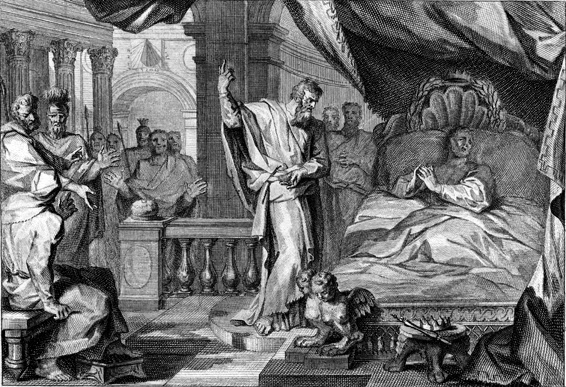
1 In those days Hezekiah became sick and was at the point of death. And Isaiah the prophet the son of Amoz came to him and said to him, “Thus says the Lord, ‘Set your house in order, for you shall die; you shall not recover.’” Then Hezekiah turned his face to the wall and prayed to the Lord, saying, “Now, O Lord, please remember how I have walked before you in faithfulness and with a whole heart, and have done what is good in your sight.” And Hezekiah wept bitterly. And before Isaiah had gone out of the middle court, the word of the Lord came to him: “Turn back, and say to Hezekiah the leader of my people, Thus says the Lord, the God of David your father: I have heard your prayer; I have seen your tears. Behold, I will heal you. On the third day you shall go up to the house of the Lord, and I will add fifteen years to your life. I will deliver you and this city out of the hand of the king of Assyria, and I will defend this city for my own sake and for my servant David’s sake.” And Isaiah said, “Bring a cake of figs. And let them take and lay it on the boil, that he may recover.”

And Hezekiah said to Isaiah, “What shall be the sign that the Lord will heal me, and that I shall go up to the house of the Lord on the third day?” And Isaiah said, “This shall be the sign to you from the Lord, that the Lord will do the thing that he has promised: shall the shadow go forward ten steps, or go back ten steps?” 10 And Hezekiah answered, “It is an easy thing for the shadow to lengthen ten steps. Rather let the shadow go back ten steps.” 11 And Isaiah the prophet called to the Lord, and he brought the shadow back ten steps, by which it had gone down on the steps of Ahaz. 2 Kings 20:1-11 ESV

Hezekiah was a good man who remained faithful to Yahweh throughout his tenure as king of Judah. This made him a rather rare commodity among the other kings Judah and Israel. Most of these men displayed a passion for idols and a propensity for godless behavior that brought upon them God’s judgment. So many of Hezekiah’s peers and predecessors had been nothing more than apostate idol worshipers. Yet, the author of 2 Kings saved his most glowing assessment for King Hezekiah.

He trusted in the Lord, the God of Israel, so that there was none like him among all the kings of Judah after him, nor among those who were before him. – 2 Kings 18:5 ESV

Hezekiah had instituted a series of religious reforms in Judah that were meant to restore the peoples’ devotion to and confidence in Yahweh. He cleansed the temple of God that had been allowed to fall into a state of disrepair. He reinstituted temple worship by recommissioning the priests and Levites. He also called for the reinstatement of the feast of unleavened bread and the celebration of Passover,  which both had long been neglected. These annual celebrations had been commissioned by God and were intended to be reminders of God’s deliverance of the people of Israel from their captivity in Egypt. But when Hezekiah issued a royal decree that the nation of Judah gather in Jerusalem to re-commemorate these two God-ordained festivals, some of the people responded with derision and refused to attend. Many of those who did come to Jerusalem had failed to follow God’s requirements concerning purification.

Most of those who came from Ephraim, Manasseh, Issachar, and Zebulun had not purified themselves. But King Hezekiah prayed for them, and they were allowed to eat the Passover meal anyway, even though this was contrary to the requirements of the Law. For Hezekiah said, “May the Lord, who is good, pardon those who decide to follow the Lord, the God of their ancestors, even though they are not properly cleansed for the ceremony.” And the Lord listened to Hezekiah’s prayer and healed the people. – 2 Chronicles 30:18-20 NLT

Yet all of Hezekiah’s reforms and his determination to restore the nation’s dedication to Yahweh did not prevent him from encountering difficulties during his reign. His faithfulness to God did not innoculate his reign from potential trials or keep his kingdom trouble-free. In fact, even this godly and faithful king found himself having to deal with the threat of destruction at the hands of the Assyrians. But when the enemy showed up outside the gates of Jerusalem, Hezekiah didn’t rail against God, accusing the Almighty of having abandoned His people. The king didn’t waste time listing all of his reforms or recounting all his efforts to restore the worship of Yahweh to Judah. No, he simply prayed that God would intervene on their behalf – and He did. God had not prevented the enemy from showing up, but He did miraculously cause them to go away. In the midst of their greatest trial, when all looked hopeless and they found themselves helpless, Hezekiah and the people of Judah had their faith reinvigorated by the power and presence of God.

And while God miraculously delivered His people from the threat of annihilation by the Assyrians, that was not the only difficulty that Hezekiah faced. The author states that “in those days” or around the same time that the Assyrian threat was taking place, the king of Judah became deathly ill. Just when the kingdom was facing its most difficult trial, Hezekiah was given a devasting bit of bad news from the prophet of God: “Set your affairs in order, for you are going to die. You will not recover from this illness” (2 Kings 20:1 NLT).

But once again, Hezekiah didn’t respond in anger or resentment. He didn’t lash out at God in disappointment or hurl accusations of divine dereliction of duty. He simply prayed. He turned his face to the wall and called out to his God: “Remember, O Lord, how I have always been faithful to you and have served you single-mindedly, always doing what pleases you” (2 Kings 20:3 NLT). Then he simply wept. 

Hezekiah wasn’t bragging or boasting. He wasn’t insinuating that God was somehow obligated to heal him. He was simply asking that God not forget his efforts to remain faithful. Hezekiah did not ask to be restored. He begged to be remembered. And he probably had his eternal state in mind at the time. He was hoping that he had done enough to earn God’s favor and to secure entrance into His Kingdom. And God heard Hezekiah’s prayer and provided him with an immediate response.

“I have heard your prayer and seen your tears. I will heal you, and three days from now you will get out of bed and go to the Temple of the Lord. I will add fifteen years to your life, and I will rescue you and this city from the king of Assyria. I will defend this city for my own honor and for the sake of my servant David.” – 2 Kings 20:5-6 NLT

God gave Hezekiah an additional 15 years to lead the people of Judah. And, on top of that, God assured Hezekiah that He would protect the city of Jerusalem from the Assyrian threat. God was going to eliminate the enemy outside the gates of the city and the illness inside the body of Hezekiah. And when the king asked Isaiah if he could provide any proof that these things would actually take place, God graciously obliged by providing a miracle.

he brought the shadow back ten steps, by which it had gone down on the steps of Ahaz. – 2 Kings 20:11 ESV

Evidently, right before the eyes of the king and all those in his royal bedroom, the sun appeared to reverse itself. The shadow that had advanced ten steps suddenly went in the opposite direction, in direct violation of natural order. God’s particular choice of a sign was intended to prove to Hezekiah that He could do the impossible. If He could cause the shadow to reverse its course, He could also reverse the effects of Hezekiah’s illness and the outcome of the Assyrian siege.

Nothing was too difficult for God. The one who gave the sun its light could control its shadow. The one who gave Hezekiah his life could prolong it. And the one who gave men the ability to conceive and implement plans could easily redirect or reverse those plans to suit His sovereign will. The shadow reversed. The king was healed. The Assyrians gave up their siege of Jerusalem. God graciously displayed His power over sickness, nature, and the nations of the world. And Hezekiah was given 15 more years to prove his faithfulness to Yahweh. But as we will see, his new lease on life will not produce the most glowing results. The glory of his former faithfulness will see its shadow reversed as the king struggles with pride and the seductive influence of success.

English Standard Version (ESV) The Holy Bible, English Standard Version. ESV® Permanent Text Edition® (2016). Copyright © 2001 by Crossway Bibles, a publishing ministry of Good News Publishers.

New Living Translation (NLT) Holy Bible, New Living Translation, copyright © 1996, 2004, 2015 by Tyndale House Foundation. Used by permission of Tyndale House Publishers Inc., Carol Stream, Illinois 60188. All rights reserved.

The Message (MSG)Copyright © 1993, 1994, 1995, 1996, 2000, 2001, 2002 by Eugene H. Peterson

The Touch of Faith

21 And when Jesus had crossed again in the boat to the other side, a great crowd gathered about him, and he was beside the sea. 22 Then came one of the rulers of the synagogue, Jairus by name, and seeing him, he fell at his feet 23 and implored him earnestly, saying, “My little daughter is at the point of death. Come and lay your hands on her, so that she may be made well and live.” 24 And he went with him.

And a great crowd followed him and thronged about him. 25 And there was a woman who had had a discharge of blood for twelve years, 26 and who had suffered much under many physicians, and had spent all that she had, and was no better but rather grew worse. 27 She had heard the reports about Jesus and came up behind him in the crowd and touched his garment. 28 For she said, “If I touch even his garments, I will be made well.” 29 And immediately the flow of blood dried up, and she felt in her body that she was healed of her disease. 30 And Jesus, perceiving in himself that power had gone out from him, immediately turned about in the crowd and said, “Who touched my garments?” 31 And his disciples said to him, “You see the crowd pressing around you, and yet you say, ‘Who touched me?’ 32 And he looked around to see who had done it. 33 But the woman, knowing what had happened to her, came in fear and trembling and fell down before him and told him the whole truth. 34 And he said to her, “Daughter, your faith has made you well; go in peace, and be healed of your disease.” Mark 5:21-34 ESV

The disciples sailed back to the opposite shore with their minds filled with the images of the herd of demon-possessed swine plummeting over the cliff into the sea and the former demoniac sitting calmly at the feet of Jesus. It had been a whirlwind 24 hours. They had witnessed Jesus calm a violent storm and restore a demon-possessed man to sanity. In addition, they had heard those demons refer to their master as the “Jesus, Son of the Most High God” (Mark 5:7 ESV). In a sense, with the testimony of the demons still ringing in their ears, they had unknowingly received the answer they had posed earlier. When they had witnessed the miracle of Jesus calming the storm, they had asked, “Who then is this, that even the wind and the sea obey him?” (Mark 4:41 ESV).

They should have had their answer. But Jesus was not done revealing the true nature of His identity. There would be more God-ordained encounters in the days ahead that would provide further proof that Jesus was who He claimed to be and who the demons confessed Him to be.

Having returned from their brief but eventful trip to the region of Decapolis, Jesus and His disciples found themselves immediately surrounded by a large crowd. Mark gives the impression that, before Jesus could even disembark from the boat, the masses of people had been lined the shoreline. And Luke supports that idea by adding,, “they were all waiting for him” (Luke 8:40 ESV).

Still standing by the sea and surrounded by a mass of people, Jesus was approached by a man named Jairus, who was a ruler in the local synagogue. This man was not a professional priest, but a layman who was responsible for conducting Sabbath services and for the ongoing care of the synagogue. His role would have made him a recognized and well-respected member of the local community. And his high-visibility position most likely resulted in some familiarity with the Pharisees and other religious rulers of Israel. So, when he kneeled at the feet of Jesus, in front of a large gathering of his own neighbors and friends, he was taking a great risk – not only personally but professionally.

We know from John’s gospel that the religious leaders of Israel were intensifying their efforts to discredit Jesus and to pressure the people from following Him. John records an occasion when Jesus healed a man who had been blind from birth. When the Pharisees interrogated the man’s parents, attempting to discern whether he had truly been born blind, they were racked with fear. And John tells us why.

His parents said these things because they feared the Jews, for the Jews had already agreed that if anyone should confess Jesus to be Christ, he was to be put out of the synagogue. – John 9:22 ESV

Yet, here was Jairus, a ruler in the local synagogue, kneeling before Jesus and begging Him to heal His daughter.

“My little daughter is at the point of death. Come and lay your hands on her, so that she may be made well and live.” – Mark 5:23 ESV

Mark tries to convey the intensity of the man’s desperation when he writes, “he fell at his feet and implored him earnestly” (Mark 5:22-23 ESV). Mark uses the same Greek word, parakaleō, that he used to describe how the demons begged Jesus not to torment them, but to cast them into the swine. And it was the same word he used to describe the fearful townspeople begging Jesus to leave their community.

This man was emotionally distraught and willing to do anything to save the life of his dying daughter. She meant far more to him than his career or reputation. And if expressing faith in Jesus could preserve her life, the loss of his job was a price he was willing to pay. And much to his relief, Jesus agreed to go with him. But they didn’t go alone. Mark reports that “a great crowd followed him and thronged about him” (Mark 5:24 ESV). The crowd moved en masse, pressing in on Jesus and the anxious father as they made their way to the man’s home. But before they could reach their destination, something else took place.

There was another individual in the crowd that day. But, unlike the ruler of the synagogue, this person held no high position in the community. It was an obscure, unnamed woman who had made her way to the seashore that day with the desperate hope of receiving healing from this man named Jesus. But she was just one among many, struggling to fight her way through the crowd in an effort to get close enough to touch the hem of His garment.

This woman had what appears to be an incurable medical condition that Mark describes as “a discharge of blood” (Mark 5:25 ESV). And she had suffered with it for 12 long years. Not only that, she had exhausted all her resources seeking a cure through traditional medical treatments. But nothing had worked. In fact, her condition had grown worse, leaving her in a state of desperation. But unlike Jairus, the crowds were not going to part and allow her access to Jesus. She was going to have to fight and claw her way through the bustling crowd just to get close enough to see Jesus.

But what stands out is the woman’s faith. She fully believed that if she could only touch Jesus’ robe, she would be healed.

If I touch even his garments, I will be made well.” – Mark 5:28 ESV

Jairus was convinced that if Jesus would only touch his daughter, she would be made well. This woman believed that if she could just touch Jesus, she would be healed. Both believed that Jesus was the solution to their particular problem.

Somehow, this frail and physically weakened woman forced her way through the crowd and touched the edge of Jesus’ robe. And Mark describes that “immediately the flow of blood dried up, and she felt in her body that she was healed of her disease” (Mark 5:29 ESV). Her healing was immediate, and she knew it. But no one else in the crowd was even aware of her presence., and they had no idea that a miracle had even taken place. Yet, Jesus did.

Jesus realized at once that healing power had gone out from him, so he turned around in the crowd and asked, “Who touched my robe?” – Mark 5:30 NLT

Luke reports that Jesus informed His disciples, “Someone touched me, for I perceive that power has gone out from me” (Luke 8:46 ESV). It seems likely that Jesus was fully aware of the woman’s identity. He could have said nothing and simply allowed the woman to walk away unnoticed and rejoicing in her renewed health. But Jesus wanted His disciples to know what had happened. And He was willing to postpone his trip to Jairus’ house in order to reveal the miracle that had just taken place.

Suddenly exposed and unable to extricate herself from the crowd, the woman timidly and guiltily stepped forward. She “came in fear and trembling and fell down before him and told him the whole truth” (Mark 5:33 ESV). Once again, her confession was not for Jesus’ benefit. He already knew what had happened. But this woman’s remarkable testimony was meant to encourage the disciples and provide them with further proof of who Jesus was. It was also meant to illustrate the kind of faith they were supposed to have. Notice what Jesus said to the woman.

“Daughter, your faith has made you well; go in peace, and be healed of your disease.” – Mark 5:34 ESV

Jesus had not spoken her healing into existence. He had not even touched her.  And yet, she stood before Him completely whole. It was her faith in Jesus that had brought about her remarkable transformation. He wants to correct a dangerous misconception in the woman’s thinking. She had reasoned that there must be some kind of power emanating from Jesus, and this power must be transferable. But Jesus insists that her healing was a result of faith, not superstition or some kind of supernatural force field.

As incredible as it may sound, at the moment the woman touched the edge of His robe, Jesus was aware of the woman’s presence, the purpose of her action, and He willingly released His power to heal her. This was not some kind of automatic outflow of energy that was outside of Jesus’ control or volition. There were countless people who touched Him that day, many of whom longed to receive healing. But it was only this woman who received that for which she had hoped. And Jesus describes her action as an example of faith.

The author of Hebrews describes faith as “the assurance of things hoped for, the conviction of things not seen” (Hebrews 11:1 ESV). This woman hoped to be healed, and was fully assured it would happen if she could only manage to get close enough to touch the edge of Jesus’ robe. She didn’t need to talk to Him. She believed His power was so great that a simple touch of His garment could do what countless physicians had been unable to do. And her faith was rewarded.

And when Jesus said, “be healed of your disease,” He was confirming the veracity of her testimony and the source of her healing. It had been Him.

But before the crowds could take in all that had just happened or the disciples could ask any questions, the mood of the moment was about to take a dramatically dark turn. The focus was going to shift from healing to death, from joy to sorrow, and from hope to despair. But Jesus was far from done.

English Standard Version (ESV) The Holy Bible, English Standard Version. ESV® Permanent Text Edition® (2016). Copyright © 2001 by Crossway Bibles, a publishing ministry of Good News Publishers.

New Living Translation (NLT) Holy Bible, New Living Translation, copyright © 1996, 2004, 2015 by Tyndale House Foundation. Used by permission of Tyndale House Publishers Inc., Carol Stream, Illinois 60188. All rights reserved.

The Message (MSG)Copyright © 1993, 1994, 1995, 1996, 2000, 2001, 2002 by Eugene H. Peterson

A Sinner Condemned and Unclean

35 And rising very early in the morning, while it was still dark, he departed and went out to a desolate place, and there he prayed. 36 And Simon and those who were with him searched for him, 37 and they found him and said to him, “Everyone is looking for you.” 38 And he said to them, “Let us go on to the next towns, that I may preach there also, for that is why I came out.” 39 And he went throughout all Galilee, preaching in their synagogues and casting out demons.

40 And a leper came to him, imploring him, and kneeling said to him, “If you will, you can make me clean.” 41 Moved with pity, he stretched out his hand and touched him and said to him, “I will; be clean.” 42 And immediately the leprosy left him, and he was made clean. 43 And Jesus sternly charged him and sent him away at once, 44 and said to him, “See that you say nothing to anyone, but go, show yourself to the priest and offer for your cleansing what Moses commanded, for a proof to them.” 45 But he went out and began to talk freely about it, and to spread the news, so that Jesus could no longer openly enter a town, but was out in desolate places, and people were coming to him from every quarter.  Mark 1:35-45 ESV

Mark has clearly established that Jesus exuded a certain power and authority that revealed itself in His words and actions. When spoke in the synagogue in Capernaum, the people took notice, but when He cast out the demon, they were blown away. Jesus simply spoke a word of command and the demon was forced to leave the man he had been tormenting. The same thing happened when Jesus healed Simon’s mother-in-law. With nothing more than a spoken word, Jesus exorcised her debilitating fever and restored her to health.

But in today’s verses, Mark provides a glimpse into the source behind Jesus’ power and authority. After a very full day of activities, Jesus rose very early the next morning, well before dawn. It is likely that His disciples were still fast asleep when Jesus rose and “went out to an isolated place to pray” (Mark 1:35 NLT).

Mark provides no details concerning Jesus’ destination or the content of His prayer.  But this early-morning excursion by Jesus reveals His intimate relationship with His Heavenly Father and His desire for fellowship and instruction. We know from the four gospels that Jesus made a habit of getting alone with His Father. He regularly sought the companionship of the Father and, in doing so, revealed His humble dependence upon His Father’s will. Jesus repeatedly expressed His complete reliance upon God.

“I tell you the truth, the Son can do nothing by himself. He does only what he sees the Father doing. Whatever the Father does, the Son also does.” – John 5:19 NLT

“I can do nothing on my own. I judge as God tells me. Therefore, my judgment is just, because I carry out the will of the one who sent me, not my own will.”  – John 5:30 NLT

“I don’t speak on my own authority. The Father who sent me has commanded me what to say and how to say it. And I know his commands lead to eternal life; so I say whatever the Father tells me to say.” – John 12:49-50 NLT

Jesus, the Son of God, regularly sought time alone with God, but not just for fellowship. He also sought to know the Father’s will. Isaiah provided a Spirit-inspired, prophetic glimpse into this unique relationship between the Father and His Son.

The Sovereign Lord has given me his words of wisdom,
    so that I know how to comfort the weary.
Morning by morning he wakens me
    and opens my understanding to his will.
The Sovereign Lord has spoken to me,
    and I have listened. – Isaiah 50:4-5 NLT

Mark gives no indication as to how long Jesus was gone but by the time His disciples woke up, they began to wonder where He was. They immediately began a search for Him, and when they found Him they inquired as to where He had been. This scene is reminiscent of one recorded in the gospel of Luke. It took place in Jerusalem when Jesus was only 12-years-old. He had made a trip to the capital city with the rest of His family for the annual Feast of Passover. But when the feast was over and His family had begun their return trip home, they discovered Jesus was missing. So, they returned to Jerusalem, and three days later they finally found Jesus at the temple, “sitting among the religious teachers, listening to them and asking questions” (Luke 2:46 NLT).

When Mary and Joseph expressed their frustration and concern to Jesus, He responded, “But why did you need to search?…Didn’t you know that I must be in my Father’s house?” (Luke 2:49 NLT). This was actually a Hebrew idiom that could best be translated, “Didn’t you know that I must be in the [things] of my Father?” Even at 12-years-of-age, Jesus was seeking those things that concerned His Father. And more than 17 years later, Jesus was still seeking to be “in the things of” His Father.

Upon finding Jesus, the disciples informed Him, ““Everyone is looking for you” (Mark 1:37 ESV). Jesus was in great demand. But while the disciples and the crowds were desperately seeking Jesus, He had been spending some much-needed time alone with God.

This time, Jesus didn’t explain His actions, but simply replied, “We must go on to other towns as well, and I will preach to them, too. That is why I came” (Mark 1:38 NLT). Notice that Jesus puts the emphasis on preaching. This ties directly back to what Mark wrote in verses 14-15.

Later on, after John was arrested, Jesus went into Galilee, where he preached God’s Good News. “The time promised by God has come at last!” he announced. “The Kingdom of God is near! Repent of your sins and believe the Good News!” – Mark 1:14-15 NLT

It was for this reason that Jesus had been sent to earth by His Father. He would spend just over three years declaring the Good News of God’s Kingdom and then offer His own life as the atoning sacrifice that would make it possible for sinful men and women to enter into that Kingdom.

It’s interesting to note how Mark describes what happened next: “So he traveled throughout the region of Galilee, preaching in the synagogues and casting out demons” (Mark 1:39 NLT). He describes Jesus as preaching the Good News but also casting out demons. Jesus was declaring the coming of God’s Kingdom while, at the same time, singlehandedly and systematically dismantling the kingdom of Satan. In a sense, Jesus was telegraphing the future impact and import of His coming death. With His sacrificial death on the cross, Jesus would destroy Satan’s monopoly over the lives of men. The apostle Paul put it this way:

We know that our old sinful selves were crucified with Christ so that sin might lose its power in our lives. We are no longer slaves to sin. For when we died with Christ we were set free from the power of sin. – Romans 6:6-7 NLT

While Mark indicates that Jesus traveled throughout Galilee preaching in synagogues and casting our demons, the first miracle he describes Jesus performing involves a leper, not a demon. This man, who was obviously a Jew, suffered from a horrible disease that left him in pain and agony but also ostracized him from his faith community. Lepers were considered ceremonially unclean and the very visible symptoms of the disease would have made him an object of scorn and derision.

But this man made his way to Jesus, expressing his desperate need for help and his firm belief that Jesus could heal him.

“If you are willing, you can heal me and make me clean.” – Mark 1:40 NLT

Mark provides no explanation for this man’s remarkable expression of faith. It is most likely that news of Jesus’ healing power had spread to his community and this man saw in Jesus a once-in-a-lifetime opportunity to be freed from his disfiguring and, ultimately, deadly disease.

And with great specificity, Mark describes what happened next:

Moved with compassion, Jesus reached out and touched him. “I am willing,” he said. “Be healed!” – Mark 1:41 NLT

Jesus probably saw in this man a tangible illustration of every Israelite’s predicament. In a real sense, they were all unclean and condemned to a life of permanent separation. But, unlike this man, their separation was spiritual and left them alienated from God. They carried about them the scars and mars of their sins, which made them unacceptable and unclean to a holy and righteous God. And like the leper, there was nothing they could do to help themselves. But Jesus had compassion. He cared.

And this time, rather than just speak, Jesus reached out and touched. In spite of the man’s condition, Jesus willingly and deliberately touched the man. According to the law, this action would have rendered Jesus ceremonially unclean. But He was willing to take that risk. In a sense, Jesus took on the man’s leprosy and left the man with wholeness. Once again, this foreshadows what Jesus would accomplish with His death on the cross.

He personally carried our sins in his body on the cross so that we can be dead to sin and live for what is right. By his wounds you are healed. – 1 Peter 2:24 NLT

He took on our infirmities and carried our sorrows… – Isaiah 53:4 BSB

And Mark reveals that the man’s condition was changed instantaneously.

Instantly the leprosy disappeared, and the man was healed. – Mark 1:42 NLT

And Jesus commanded the man to tell no one but to go straight to the temple where he was to seek confirmation of his healing from the priest. Then he was to present a thanks offering. According to the Mosaic law, it was required that a leper be examined and declared free of the disease before he or she could be restored to fellowship within the community. Jesus also warned the man to refrain from telling anyone about what had happened. This may come across as a rather strange and unnecessary command but when the man violated it, it is easy to see why Jesus gave it in the first place. Of course, no one can blame the man for his enthusiasm and excitement. He wanted everyone to know that he had been healed and was absolutely clean for the first time in a long time.

But as the news of his healing spread, the crowds grew, forcing Jesus to take His ministry outside the crowded confines of the cities. But His relocation did little to stop the steady flow of people seeking healing, help, and hope.

English Standard Version (ESV) The Holy Bible, English Standard Version. ESV® Permanent Text Edition® (2016). Copyright © 2001 by Crossway Bibles, a publishing ministry of Good News Publishers.

New Living Translation (NLT) Holy Bible, New Living Translation, copyright © 1996, 2004, 2015 by Tyndale House Foundation. Used by permission of Tyndale House Publishers Inc., Carol Stream, Illinois 60188. All rights reserved.

The Message (MSG)Copyright © 1993, 1994, 1995, 1996, 2000, 2001, 2002 by Eugene H. Peterson

The Outcast, the Alien, and the Sick

1 When he came down from the mountain, great crowds followed him. And behold, a leper came to him and knelt before him, saying, “Lord, if you will, you can make me clean.” And Jesus stretched out his hand and touched him, saying, “I will; be clean.” And immediately his leprosy was cleansed. And Jesus said to him, “See that you say nothing to anyone, but go, show yourself to the priest and offer the gift that Moses commanded, for a proof to them.”

When he had entered Capernaum, a centurion came forward to him, appealing to him, “Lord, my servant is lying paralyzed at home, suffering terribly.” And he said to him, “I will come and heal him.” But the centurion replied, “Lord, I am not worthy to have you come under my roof, but only say the word, and my servant will be healed. For I too am a man under authority, with soldiers under me. And I say to one, ‘Go,’ and he goes, and to another, ‘Come,’ and he comes, and to my servant, ‘Do this,’ and he does it.” 10 When Jesus heard this, he marveled and said to those who followed him, “Truly, I tell you, with no one in Israel have I found such faith. 11 I tell you, many will come from east and west and recline at table with Abraham, Isaac, and Jacob in the kingdom of heaven, 12 while the sons of the kingdom will be thrown into the outer darkness. In that place there will be weeping and gnashing of teeth.” 13 And to the centurion Jesus said, “Go; let it be done for you as you have believed.” And the servant was healed at that very moment.

14 And when Jesus entered Peter’s house, he saw his mother-in-law lying sick with a fever. 15 He touched her hand, and the fever left her, and she rose and began to serve him. 16 That evening they brought to him many who were oppressed by demons, and he cast out the spirits with a word and healed all who were sick. 17 This was to fulfill what was spoken by the prophet Isaiah: “He took our illnesses and bore our diseases.” – Matthew 8:1-17 ESV

Jesus followed up His words with action. Once He had delivered His message, He didn’t seek a quiet place to rest and enjoy some alone-time. He immediately began to do what God had sent Him to do.

“The Spirit of the Lord is upon me, for he has anointed me to bring Good News to the poor. He has sent me to proclaim that captives will be released, that the blind will see, that the oppressed will be set free, and that the time of the Lord’s favor has come.” – Luke 4:18-19 NLT

Jesus was a man on a mission. He knew His time on earth was limited, and all His time and energy were focused on fulfilling His Father’s will. And it did not take long before Jesus’ empathy for the down-and-out, and the down-trodden began to reveal itself. Matthew records three distinctively different encounters between Jesus and a person in need. The first was a leper. The second was a Roman Centurion. And the third was the mother-in-law of one of His own disciples.

The leper, who was most likely a Jew, was a social outcast and a pariah. Because of his disease, he was required by law to announce himself by the words, “Unclean, unclean!” He was to be avoided and shunned at all costs. He was even refused access to the Temple grounds, making it impossible for him to receive atonement for his sins. And in the Jewish mindset, his disease was viewed as a curse from God, the outcome of some heinous sin in his life.

The second man Jesus encounters was a Roman Centurion, and most likely a Gentile. He was an officer in the Roman army with responsibility for 100 battle-hardened soldiers. To the Jews, he would have been a painful and daily reminder of the oppressive regime that had occupied Israel and forced its people into subjugation. He would have been despised and seen as an oppressor whose presence in their land was unwanted and unappreciated.

The final individual was the mother-in-law of Peter, one of the Lord’s recently recruited disciples. Because it is safe to assume that Peter’s wife was a Jew, we can conclude that his mother-in-law would be as well. And all we know from the text is that she had come down with a fever that had left her bedridden. She was helpless and in need of healing.

Three very different individuals whose circumstances could not have been more disparate: A Jewish man with a disfiguring and life-threatening disease, a Roman Centurion with an ailing servant, and a Jewish woman with a fever. And yet, each of them has an encounter with Jesus Christ, the Son of God, and the Messiah of the Jewish people.

It’s important to remember that Matthew wrote his gospel with the goal of proving Jesus’ claim to be the King of the Jews and their long-awaited Messiah. In His just-completed sermon on the mount, Jesus had discussed the nature of life in His Kingdom. Now, Matthew reveals three encounters that provide proof of Jesus’ power and His rightful claim to be the heir to the throne of David.

Back in chapter four, Matthew provided a summary of Jesus’ earthly ministry.

And he went throughout all Galilee, teaching in their synagogues and proclaiming the gospel of the kingdom and healing every disease and every affliction among the people. – Matthew 4:23 ESV

Now, in chapter eight, we see the healing aspect of that ministry displayed in three separate scenes. Matthew does not allow himself to be restricted by the chronology behind these events. Instead, he arranges them in such a way that they create a comprehensive picture of who Jesus was and what He came to do. Matthew seems to be much more interested in developing a theme than in trying to provide a reliable timeline of events. These three encounters are grouped together for a reason and provide us with a somewhat 3-dimensional image of the Savior.

The leper was the disease-riddled outcast who had no place within the faith community of Israel because of what was believed to be his obvious sin. He was unwanted. He was considered untouchable and unredeemable by every other Jew. Yet, he called out to Jesus, “Lord, if you will, you can make me clean” (Matthew 8:2 ESV). At this point, it is interesting to consider the words of Jesus when He was confronted by the self-righteous Pharisees because of His association with tax-collectors and sinners. He simply stated: “Those who are well have no need of a physician, but those who are sick” (Matthew 9:12 ESV).

This leper had no problem acknowledging his need. He was sick and in need of cleansing – both physically and spiritually. His disease had left him ceremonially impure and incapable of receiving atonement for his sins. He desperately longed to be clean and whole again. And he saw in Jesus a source of hope and help. So, he called out in faith, and “Jesus stretched out his hand and touched him” (Matthew 8:3 ESV). Don’t miss the significance of that statement. Jesus touched him. In doing so, Jesus defiled himself. He became impure and took on the disqualifying nature of that man’s condition. An audible gasp must have leaped from the throats of all those who witnessed this scene. And yet, Matthew states that the man’s leprosy was immediately cleansed. He was made whole – in an instance. Jesus could have spoken a word and the man would have received the healing he desired. But Jesus went out of His way to touch him. He associated with an outcast. He showed love and mercy to undesirable and undeserving.

In the case of the Centurion, Jesus met a man who was just as despised by the Jews, but for different reasons. He was an outsider or alien. He had no place in Israel. He was the enemy and a pagan oppressor of the Jewish people whose very presence made their lives a living hell. Yet, this man approached Jesus with dignity and respect, pleading that He come to the aid of his ailing servant.

The leper had said, “if you will, you can make me clean,” and Jesus had responded, “I will.” The Centurion made no request, but simply stated the need, and Jesus responded, “I will come and heal him” (Matthew 8:7 ESV). Jesus was just as willing to heal the servant of a Roman soldier than He was to cleanse the disease of a Jewish leper.

And when the Centurion heard the words of Jesus, he was blown away, declaring that he saw no need for Jesus to go out of His way or trouble Himself. Embarrassed to think of Jesus visiting his humble home, he declared, “only say the word, and my servant will be healed” (Matthew 8:8 ESV). This Gentile soldier expressed faith that Jesus could simply speak a word and his servant would be healed. And Jesus, blown away by this foreigner’s faith, stated, “Truly, I tell you, with no one in Israel have I found such faith” (Matthew 8:10 ESV). And Matthew matter-of-factly reports, “the servant was healed at that very moment” (Matthew 8:13 ESV).

Then, Matthew records the healing of Peter’s mother-in-law. It is a simple recounting of what appears to be a much-less perilous problem. She had a fever. But there was no indication that her life was in danger. And in this case, Matthew tells us that Jesus saw, He touched, and she was healed. No request for healing was made. No faith was exhibited. Jesus simply saw a need, and graciously provided a solution.

An outcast, an alien, and a sick woman. Three different individuals with three different needs and three distinctively different backgrounds. But all sharing a common trait. They were helpless to do anything about their condition. They each had a need they could not meet: A devastating skin disease, a desperately ill servant, and a demobilizing fever. And Jesus, the King, provided healing and help.

And it didn’t stop there. These three were just the beginning of many more who would find their way to the feet of Jesus in the hopes of finding a solution to their problems. And Matthew records that Jesus “cast out the spirits with a word and healed all who were sick. This was to fulfill what was spoken by the prophet Isaiah: “He took our illnesses and bore our diseases” (Matthew 8:16-17 ESV).

Matthew is telegraphing a message regarding Jesus’ real intentions. The physical healings He performed were a visible sign of the spiritual renovation He had come to bring to a fallen world. The leper, the servant, and the mother-in-law each received healing from their diseases, but the day would come when each of them would experience another disease or illness, and eventually, each would succumb to the inevitability of death. When Jesus later said, “I came that they may have life and have it abundantly” (John 10:10 ESV), He was speaking of far more than a life free from disease, sickness, or pain. He was talking about eternal life that begins with a saving relationship with Him, a lifelong process of Spirit-empowered sanctification, and that ends with the believer’s ultimate glorification.

The primary ailment plaguing mankind that Jesus came to deal with is the penalty of sin. With His death on the cross, Jesus conquered both sin and the grave. He paid the penalty for the sins of mankind, offering His sinless life as the sacrificial substitute for sinful men and women. As the prophet Isaiah so beautifully stated:

But he was pierced for our transgressions; he was crushed for our iniquities; upon him was the chastisement that brought us peace, and with his wounds we are healed. – Isaiah 53:5 ESV

English Standard Version (ESV)
The Holy Bible, English Standard Version. ESV® Permanent Text Edition® (2016). Copyright © 2001 by Crossway Bibles, a publishing ministry of Good News Publishers.

New Living Translation (NLT)
Holy Bible, New Living Translation, copyright © 1996, 2004, 2015 by Tyndale House Foundation. Used by permission of Tyndale House Publishers Inc., Carol Stream, Illinois 60188. All rights reserved.

The Message (MSG)Copyright © 1993, 1994, 1995, 1996, 2000, 2001, 2002 by Eugene H. Peterson

From Bad to Worse

25 “The Lord will cause you to be defeated before your enemies. You shall go out one way against them and flee seven ways before them. And you shall be a horror to all the kingdoms of the earth. 26 And your dead body shall be food for all birds of the air and for the beasts of the earth, and there shall be no one to frighten them away. 27 The Lord will strike you with the boils of Egypt, and with tumors and scabs and itch, of which you cannot be healed. 28 The Lord will strike you with madness and blindness and confusion of mind, 29 and you shall grope at noonday, as the blind grope in darkness, and you shall not prosper in your ways. And you shall be only oppressed and robbed continually, and there shall be no one to help you. 30 You shall betroth a wife, but another man shall ravish her. You shall build a house, but you shall not dwell in it. You shall plant a vineyard, but you shall not enjoy its fruit. 31 Your ox shall be slaughtered before your eyes, but you shall not eat any of it. Your donkey shall be seized before your face, but shall not be restored to you. Your sheep shall be given to your enemies, but there shall be no one to help you. 32 Your sons and your daughters shall be given to another people, while your eyes look on and fail with longing for them all day long, but you shall be helpless. 33 A nation that you have not known shall eat up the fruit of your ground and of all your labors, and you shall be only oppressed and crushed continually, 34 so that you are driven mad by the sights that your eyes see. 35 The Lord will strike you on the knees and on the legs with grievous boils of which you cannot be healed, from the sole of your foot to the crown of your head.” Deuteronomy 28:25-35 ESV

Let’s face it, bad things happen. Calamity comes to everyone because it is no respecter of persons. And while God had promised that obedience to His law would bring blessings, He had never said that their lives would be trouble-free, disease-resistant, peace-filled, or painless. There would still be plenty of difficulties because they lived in a fallen world. They would still be required to offer sacrifices because they would continue to sin and need atonement.

So, when Moses discusses the curses that will come upon the people of Israel for what appears to be their stubborn and ongoing disobedience to God’s law, he makes sure they understand that this will be difficulties and trials on steroids. These will not be your everyday, run-of-the-mill troubles that are a normal part of everyday life on this planet. No, they will be extreme, and like nothing they have ever experienced before. There will be no relief or escape. They will feature the worst kind of suffering one can image and then take that suffering one step further.

Look closely at how each curse is described. God was going to personally see to it that Israel lost battles against their enemies. That was nothing new for Israel because they had already been defeated at Ai. But Moses describes a demoralizing rout that has the Israelites scattering in seven different directions in an attempt to save their lives. And the failure of the Israelite army will be so catastrophic that it will leave other nations in terror. The fall of Israel at the hands of their enemy will create a sense of fear among the other nations of the region, as they anticipate their own defeat against the same foe. History records that, eventually, Israel was roundly defeated by the Assyrians and Judah fell to the Babylonians. And both of these nations left a wake of destruction in their path, as they ransacked kingdom after kingdom, sending shockwaves of terror among the nations that remained.

And Moses lets the Israelites know that their defeat will be complete, with no one escaping. Their bodies will lie scattered on the ground and become “food for all birds of the air and for the beasts of the earth” (Deuteronomy 28:26 ESV). No burials or memorials and no one to mourn their deaths. In fact, there will be no one left to scare off the carrion or scavenging dogs. This defeat will not only be demoralizing, but it will also be devasting and irreversible.

Next, Moses reveals that the Israelites will suffer from boils and tumors, just like the ones that God brought upon the Egyptians as part of the ten plagues. God will use the very same diseases that forced the Egyptians to release His people from captivity as a form of punishment for their disobedience. And, once again, Moses takes the suffering a step further, stating that there will be no healing from the pain and itching. These diseases will be permanent and untreatable, with no hope of relief or chance of restoration. And, perhaps as a result of the unrelenting agony caused by the boils and tumors, the people of Israel will suffer from madness, loss of sight, and confusion of mind. Their diminished mental capacity and blindness will leave them incapable of living normal lives, which will result in financial ruin. And, as before, Moses takes his message of doom to another level by warning them, “you shall be only oppressed and robbed continually, and there shall be no one to help you” (Deuteronomy 28:29 ESV). Just when they think it can’t get any worse, it will.

Next, Moses uses a series of short scenarios to further illustrate the devastating consequences of disobedience to God’s law. He begins with a case of betrothal. A man who experiences the joy of finding a woman to whom he becomes engaged will end up watching another man sleep with her. He will never have the privilege of consummating his own marriage. This most likely describes the grim reality of war. This man will have to watch as his betrothed is raped by an enemy soldier. And as if that was not enough, he and his future wife will never know the joy of living in the house he built for them. They will never enjoy the fruit of the vineyard he planted. And the ox he used to till his fields will be slaughtered and eaten by his enemies. His donkeys and sheep will become plunder, and his children will be taken as slaves. But it will get worse. This man will be left longing for his family but will find no one to help him. His loss will be great, and there will be no relief in sight.

All of these things will come upon the Israelites at the hands of a single nation that will leave them “only oppressed and crushed continually” (Deuteronomy 28:33 ESV). God will use this nation to bring about His judgment upon His own people. But it will be their own fault. Their decision to disobey God’s commands will result in their own destruction. And the books of the prophets of God are filled with calls for the people of Israel to repent and return to Him. God will repeatedly issue His compassionate offer of restitution if His people will only repent of their ways. But they won’t, and all that Moses describes in these verses will take place.

These curses are not a form of hyperbole or exaggeration on Moses’ part. They are prophetic pronouncements concerning God’s judgment. So, when Moses says, “the Lord will strike you on the knees and on the legs with grievous boils of which you cannot be healed, from the sole of your foot to the crown of your head” (Deuteronomy 28:35 ESV), he is not issuing idol threats. He means it. And, as before, this warning of grievous boils will be far worse than they can imagine. They will cover the Israelites from head to foot, and they will not respond to any form of treatment or remedy. Repeated disobedience to God’s commands will bring devastating and debilitating consequences that will leave the people of Israel without hope and devoid of help. And Moses is just getting started.

English Standard Version (ESV) The Holy Bible, English Standard Version. ESV® Permanent Text Edition® (2016). Copyright © 2001 by Crossway Bibles, a publishing ministry of Good News Publishers.

New Living Translation (NLT) Holy Bible, New Living Translation, copyright © 1996, 2004, 2015 by Tyndale House Foundation. Used by permission of Tyndale House Publishers Inc., Carol Stream, Illinois 60188. All rights reserved.

The Message (MSG) Copyright © 1993, 1994, 1995, 1996, 2000, 2001, 2002 by Eugene H. Peterson

War, Famine and Death.

When he opened the second seal, I heard the second living creature say, “Come!” And out came another horse, bright red. Its rider was permitted to take peace from the earth, so that people should slay one another, and he was given a great sword.

When he opened the third seal, I heard the third living creature say, “Come!” And I looked, and behold, a black horse! And its rider had a pair of scales in his hand. And I heard what seemed to be a voice in the midst of the four living creatures, saying, “A quart of wheat for a denarius, and three quarts of barley for a denarius, and do not harm the oil and wine!”

When he opened the fourth seal, I heard the voice of the fourth living creature say, “Come!” And I looked, and behold, a pale horse! And its rider’s name was Death, and Hades followed him. And they were given authority over a fourth of the earth, to kill with sword and with famine and with pestilence and by wild beasts of the earth. Revelation 6:3-8 ESV

SSc_4.jpgbe9d4c41-5f5a-4b83-95fc-c032346dee0cLarge

As noted with the opening of the first seal, each horse and rider that John sees is summoned by one of the four creatures standing before the throne of God. They call, “Come!” and the horse and riders appear. This strongly suggests that all of the events that these images portend are under the control of God. They are not isolated and arbitrary, but preordained by God Himself. And they are happening in just the way He planned at the exact time of His choosing.

While the first horse was white, symbolizing victory and what would appear to be righteousness, its rider was most likely symbolic of the Antichrist. John indicates the he came conquering and to conquer, but his success will not be based on military might, because he was carrying a bow, but no arrows. So, his ability to conquer will be of a more political nature. He will be a strategist who uses the world political stage to his advantage, climbing the ladder to power and prominence and setting himself up as a major player on the world political scene.

But the second horse is red in color, symbolizing war and the bloodshed that comes as a result. Notice what the text says: “Its rider was permitted to take peace from the earth” (Revelation 6:4 ESV). This is yet another reminder that all of what is being revealed is under the divine prerogative of God. This rider, whoever he is, can do nothing without God’s approval and permission. But God is allowing this rider to bring warfare and death to the world because of the sins of mankind and in keeping with His promise to bring judgment on the world’s rebellion against His authority. But who is this rider? As usual, there has been a great deal of speculation over the centuries as to the identity of this rider. But the immediate text does not provide us with any real clue as to who this rider may be. There are some who speculate that we are once again looking at a manifestation of the Antichrist. Because these seals and the content they reveal are progressive in nature, it would appear that they are exposing the various iterations of the Antichrist, as his true nature and intent becomes more apparent over time. He begins as a world leader who appears to be nothing more than a successful political candidate who makes a name for himself by brokering a period of peace on the earth. In fact, Daniel 9:27 seems to indicate that the Antichrist will make a seven-year treaty with the nation of Israel, which at the midway point, he will break. This seven year period is considered to be the tribulation, the second half of which will be a time of great unrest and destruction. So, the Antichrist will begin as a man of peace and diplomacy, somehow brokering an agreement between the Jews and Muslims to allow for the rebuilding of the temple on the temple mount in Jerusalem. But as Daniel’s account describes, at the midway point of the tribulation, Antichrist will turn his back on the people of Israel and desecrate the temple, setting himself up as the only god to be worshiped.

But it could be that this rider is nothing more than a symbol for war. In His Olivet Discourse, Jesus warned His disciples:

And you will hear of wars and rumors of wars. See that you are not alarmed, for this must take place, but the end is not yet. For nation will rise against nation, and kingdom against kingdom, and there will be famines and earthquakes in various places. All these are but the beginning of the birth pains. – Matthew 24:6-8 ESV

This rider signals a time of great civil unrest in the world. The text makes clear that people will slay one another. This may refer to actual wars between nations or riots in the streets. But whatever it means, it is clear that any peace that might have been enjoyed will be gone. This foreshadows a time of unprecedented conflict on the earth. And, as is always the case with war, there will be consequences. As the third seal is opened by Christ, the third creature calls out, “Come!” and yet another horse and rider appears. This time, the horse is black and its rider carries a pair of scales in his hands. Black is the traditional symbol for death and it foreshadows a period of tremendous death and devastation caused by famine. The period of warfare will have an impact of the world’s economy, creating hyper-inflation and a shortage of food. The scales indicate that Antichrist, the political leader who has established himself as the dominant force on the world scene, will have control over the buying and selling of goods. In a world wracked by war, where the necessities of life become scarce, he will dictate the price of goods and manage their availability. John hears a voice crying out, “A quart of wheat for a denarius, and three quarts of barley for a denarius, and do not harm the oil and wine!” (Revelation 6:6 ESV). In the first-Century world in which John lived, a denarius represented a day’s wages for a common laborer. So, according to the voice John hears, it is going to take a full-day’s wage to buy enough wheat for one meal. If the cheaper and lower-cost barley is purchased, you could stretch the value of your denarius a bit further. But the bottom line will be that inflation is going to be huge problem and hunger will become commonplace.

With the opening of the fourth seal, the fourth beast calls out, “Come!” and the final horse and rider appear. This horse is described as being pale in color. A more accurate description of the horse’s color would be pale green. The actual Greek word is chlōros, from which we get our word chlorophyll. It would appear that this horse is the color of a decomposing corpse, and riding on this horse is someone who John describes as having the name, Death. And following close behind this horse and rider is Hades. This anthropomorphic description of the abode of the dead is intended to add a sense of complete and utter destruction to the scene. Death is what brings to an end the life of the material body. Hades is the traditional Hebrew word for the abode of the immaterial part of a person. It was believed to be where the soul goes after death. King David spoke about this very place in one of his psalms.

Therefore my heart is glad, and my whole being rejoices;
    my flesh also dwells secure.
10 For you will not abandon my soul to Sheol,
    or let your holy one see corruption. – Psalm 16:9-10 ESV

This horse and rider are described as the harbingers of death, who “were given authority over a fourth of the earth, to kill with sword and with famine and with pestilence and by wild beasts of the earth” (Revelation 6:8 ESV). As a result of the wars and conflicts taking place on the earth and the resulting famine, death and Hades will be satiated with the sheer number of the deceased. It will be an unprecedented time of global disaster marked by the deaths of a fourth of the world’s population. Hades following death is simply a way of saying that the souls of all those who die as a result of the judgments of God will end up in the afterlife, where they will one day face the final judgment of God. This is what is referred to later in the book of Revelation as the Great White Throne Judgment.

11 Then I saw a great white throne and him who was seated on it. From his presence earth and sky fled away, and no place was found for them. 12 And I saw the dead, great and small, standing before the throne, and books were opened. Then another book was opened, which is the book of life. And the dead were judged by what was written in the books, according to what they had done. 13 And the sea gave up the dead who were in it, Death and Hades gave up the dead who were in them, and they were judged, each one of them, according to what they had done. 14 Then Death and Hades were thrown into the lake of fire. This is the second death, the lake of fire. 15 And if anyone’s name was not found written in the book of life, he was thrown into the lake of fire. – Revelation 20:11-15 ESV

 The fourth horse and rider represent the fourth phase of God’s judgment on the world. The first four seals reveal the rise to power of the Antichrist and his subsequent impact on the world. The period of time covered by these four signs is the seven years known as the tribulation. It will be a time marked by war, financial instability, famine, disease, and unprecedented loss of human life. It will be like no other time in human history, when some of the most devastating tragedies ever experienced by mankind will be jam-packed into what is a relatively short period of time. Most of what John has described takes place in the second half of the tribulation, a period known as the Great Tribulation. And, as we will see, one of the groups that will suffer the most during this time is the Jewish people. Because of their association with God and the promises made by God to restore them to a right relationship with Himself, Satan will continue to do everything in his power to destroy the people of God. Because of the rapture, the church will no longer be a factor, freeing up Satan to focus all his attention and energies on the Jews. The prophet Jeremiah predicted what would happen, but he provides a wonderful reminder that God has a purpose behind all the devastation and destruction. He is bringing His judgments against His people for the generations of apostasy and rebellion against Him. But in spite of their disobedience and unfaithfulness, God was going to restore them.

“Thus says the Lord:
We have heard a cry of panic,
    of terror, and no peace.
Ask now, and see,
    can a man bear a child?
Why then do I see every man
    with his hands on his stomach like a woman in labor?
    Why has every face turned pale?
Alas! That day is so great
    there is none like it;
it is a time of distress for Jacob;
    yet he shall be saved out of it. – Jeremiah 30:5-7 ESV

Jesus also spoke of these coming days and assured that the outcome would be a positive one for God’s people.

21 For then there will be great tribulation, such as has not been from the beginning of the world until now, no, and never will be. 22 And if those days had not been cut short, no human being would be saved. But for the sake of the elect those days will be cut short. – Matthew 24:21-22 ESV

As we make our way through the rest of this book, it is essential that we recognize and constantly remind ourselves that God has all of this in His hands. These events are written on the scroll that has been in His possession from before the foundation of the world. The seals are being broken by His Son. And the events unfolding before our eyes are the result of the divine will of God Himself.


English Standard Version (ESV) The Holy Bible, English Standard Version. ESV® Permanent Text Edition® (2016). Copyright © 2001

New Living Translation (NLT) Holy Bible, New Living Translation, copyright © 1996, 2004, 2015 by Tyndale House Foundation. Used by permission of Tyndale House Publishers Inc., Carol Stream, Illinois 60188. All rights reserved.

The Message (MSG)  Copyright © 1993, 1994, 1995, 1996, 2000, 2001, 2002 by Eugene H. Peterson


Leviticus 13-14, Luke 8

Declared Clean.

Leviticus 13-14, Luke 8

The leprous person who has the disease shall wear torn clothes and let the hair of his head hang loose, and he shall cover his upper lip and cry out, “Unclean, unclean.” He shall remain unclean as long as he has the disease. He is unclean. He shall live alone. His dwelling shall be outside the camp. – Leviticus 13:45-46 ESV

These two chapters in Leviticus are a difficult read. They deal with a strange topic that seems totally non-applicable to our modern culture. All the descriptions of and discussions about these diseases of the skin are somewhat disgusting to think about. But the thing we can’t afford to overlook is the emphasis on uncleanliness and cleanness, purity and impurity, acceptance and rejection. This whole section in the book of Leviticus takes the requirements of God to a whole new level. The purity God was looking for went way beyond just the moral dimension. His people were to be pure physically. There was a direct correlation between sin and sickness in the Hebrew mind. These passages are not teaching that these diseases and abnormalities of the skin are the direct result of sin. They are simply using the contagious qualities of these diseases to illustrate the danger of sin among the people of God. A contagious skin disorder, if left unnoticed and unchecked, would quickly spread among the people, bringing death and destruction. Sin can do the same thing. God was teaching His people the serious nature of sin in the midst of the camp. It was to be compared with leprosy. And while the term leprosy most likely does not refer to the modern disease of the same name, it carries the same impact. What we have described in these chapters of Leviticus are a wide range of infectious skin diseases and disorders. And while we could simply characterize them as having nothing to do with our modern context, we must never fail to recognize the spiritual significance the represent.

What does this passage reveal about God?

God cared about His people. He desired that their lives be characterized by blessing, holiness, healing and health. Disease, like sin, was not part of God’s plan for man. It showed up on the scene as a result of the fall. The rebellion of Adam and Eve resulted in a shattering of the perfect environment of Eden. Death and disease showed up as unpleasant companions to sin. Disease was an everyday reality in the world by this time. Illness was a common concern for the people of God, just like it was for all mankind. Knowledge regarding infections and the spread of disease was minimal at best. Man was as ignorant of the dangers of sickness as he was of sin. But God knew that contagious disease could be just as devastating to a community as unchecked sin. So He instituted rules and regulations to control the spread of diseased among His people. Like the moral laws He provided to manage their personal relationships, God provided laws to manage their personal hygiene. Like any of the commandments, if these laws were ignored, the consequences would be devastating. God loved His people enough to provide them with a means for determining the exact nature of a disease and appropriately treating it. Ignorance could be deadly.

What does this passage reveal about man?

What should jump out at us in this passage is the devastating nature of these various skin diseases and disorders. Once the people understood their potential for spreading sickness among themselves, they were naturally prone to separate themselves from those who suffered from the diseases. Those who were sick were quickly ostracized. They were shunned and isolated from the rest of the camp. Like sin, sickness had devastating consequences of fellowship and acceptance. Imagine what it would have been like to be diagnosed with one of these diseases. Your world was rocked. You were required to wear torn clothes and walk around with unkempt hair – visual billboards of your condition – and cry out for all to hear, “Unclean, unclean!” You were forced to declare your sorry state to the world. Everyone would give you wide berth, shunning contact with you for fear of contracting whatever it was you had. On top of that, you were required to live in absolute isolation, outside the camp, alone. What an incredible picture of the devastating impact of sin on the life of an individual. You were unclean, impure, unacceptable. You were an outcast, unwanted and unable to do anything about your condition. But God provided a means to be restored. He commissioned His priests to act as mediators, providing a personal touch in these individual’s greatest times of need. They offered atonement, cleansing, and a way to be restored to fellowship with God and His people. These diseased individuals could not heal themselves. They could change their condition. They were completely dependent on the help of the priest and the healing of God. Their cleansing was completely outside of their control. Think of the parallels to our former condition as sinners prior to coming to Christ. Paul reminds us, “even though we were dead because of our sins, he gave us life when he raised Christ from the dead. (It is only by God’s grace that you have been saved!)” (Ephesians 2:25 NLT). He told the believers in Colossae the same thing: “You were dead because of your sins and because your sinful nature was not yet cut away. Then God made you alive with Christ, for he forgave all our sins” (Colossians 2:13 NLT). It was Jesus who said, “Healthy people don’t need a doctor – sick people do. I have come to call not those who think they are righteous, but those who know they are sinners” (Mark 2:17 NLT).

It’s interesting to note that when Jesus was ministering here on Earth, He regularly healed those who were sick. Not only that, He was willing to touch those who would have been considered unclean and impure. In chapter eight of the book of Luke, we have the story of the woman with the discharge of blood. Her illness would have classified her as unclean, and yet the text emphasizes multiple times that she touched Jesus. “She came up behind him and touched the fringe of his garment” (Luke 8:44 ESV). Jesus immediately responded, “Who was it that touched me?” (Luke 8:45 ESV). Again, He declared out loud, for all the crowd to hear Him, “Someone touched me, for I perceive that power has gone out from me” (Luke 8:46 ESV). The woman, mortified, fell at Jesus feet and “declared in the presence of all the people why she had touched him” (Luke 8:47 ESV). In essence, she declared her guilt. She had knowingly contaminated another person with her uncleanness. But rather than scold her, Jesus said, “Daughter, your faith has made you well; go in peace” (Luke 8:48 ESV). Later in this same chapter, we read of Jesus knowingly touching the body of a young girl who had just died. To do so would have made him ceremonially unclean. And yet, Luke makes it clear that Jesus willingly took that risk. “But taking her by the hand he called, saying, ‘Child, arise'” (Luke 8:54 ESV).

Earlier in this same book, Luke records the words of Jesus as He read from the scroll of Isaiah in the synagogue. “The Spirit of the Lord is upon me, because he has anointed me to proclaim good news to the poor. He has sent me to proclaim liberty to the captives and recovering of sight to the blind, to set at liberty those who are oppressed, to proclaim the year of the Lord’s favor” (Luke 4:17-18 ESV). Jesus came to heal the spiritually captive, blind, sick, and oppressed. He came to bring release from the deadly disease of sin. He came to stop the spread of sin’s contagion and put an end to its inevitable outcome of death.

How would I apply what I’ve read to my own life?

Paul reminds me to, “remember that you were at that time separated from Christ, alienated from the commonwealth of Israel and strangers to the covenants of promise, having no hope and without God in the world. But now in Christ Jesus you who once were far off have been brought near by the blood of Christ” (Ephesians 2:12-13 ESV). I was once like one of those poor individuals who found themselves outside the camp, alone, and separated from God and His people. My sin sickness made me unacceptable to God and unable to come into His presence. But God sent His priest, His Son, into my life to provide the cleansing I could never have found on my own. I have been declared clean and pure, sinless and whole. What an incredible feeling it must have been for a formerly unclean person to be declared clean and acceptable again. What joy they must have felt. What gratefulness they must have expressed to God. I should feel that same way. I have been healed and made whole by God.

Father, thank You for providing my healing. I am no longer barred from Your presence because of the sickness of my sin. Your Son has provided my healing and restored me to a right relationship with You. And I can’t express my gratitude often enough. Amen

Ken Miller
Grow Pastor & Minister to Men
kenm@christchapelbc.org

Day 61 – Matthew 15:29-31; Mark 7:31-37

He Healed Them All!

Matthew 15:29-31; Mark 7:31-37

“A vast crowd brought to him people who were lame, blind, crippled, those who couldn’t speak, and many others. They laid them before Jesus, and he healed them all.’” – Matthew 15:30 NLT

There are so many recorded incidents of Jesus healing people in the Bible that they can easily become almost non-events to us. We just expect Jesus to heal people. At least we expect Jesus to heal people in the Bible. We’re not quite so confident when it comes to real life. But when it comes to reading the Scriptures we have gotten so used to the stories about blind people receiving their sight, lame people suddenly being able to walk, and mute people gaining back the ability to speak, that they no longer shock or surprise us. But in Jesus’ day, these miracles were anything but expected, and the people had not become complacent about them. When Jesus showed up, the sick and needy showed up as well. And Jesus rarely, if ever, disappointed. Matthew records an occasion where Jesus, having returned to the shore of Galilee from the region of Tyre and Sidon, sits down on a nearby hillside and suddenly finds Himself surrounded by a crowd. They had brought with them all kinds of people with all kinds of needs, and they laid them all at the feet of Jesus. Imagine the scene. People unable to walk, crippled by disease, birth defects or injury, are hobbling or laying at the feet of Jesus. Some are on mats, some are on crutches, but all are in need. They can’t work or make a living. Some are probably in great pain. Next to them are the blind. These people live in a constant world of darkness, unable to see the faces of their own family members or enjoy the beauty of the world around them. There are probably young and old alike. Some have been born blind, while others have lost their sight due to injury, disease, illness or just old age. But each of them suffers the same fate: A life marked by certain poverty, constant darkness and little hope. Mixed in with these two groups were the mute. For whatever reason, these people found themselves unable to speak, trapped in a world where their thoughts, ideas and emotions had to be communicated through hand motions or scribbled notes. They were incapable of expressing words of love, affirmation, encouragement, joy, or praise. They couldn’t sing, shout, whisper, laugh or tell another living soul what they were thinking, feeling, or needing.

What a sad scenario. It reminds me of a scene from the recent movie, Lincoln, where President Lincoln tours a makeshift hospital filled with Union soldiers who have been injured in battle during the Civil War. Many have had their limbs amputated. Others have been permanently blinded by the fragments of exploding bombs. None will ever be the same again. Many will not live to see old age. And all the president can do is walk among them, issuing words of thanks and encouragement. How helpless. How hopeless. How frustrating.

But Jesus did not face those same limitations. He could do so much more, and He did. He healed them all. Matthew does not tell us how Jesus did it. He could have made His way among them, touching each one and speaking to them individually. Or He could have simply healed the entire group in one single, magnificent moment. I tend to believe that is what He did. And Matthew tells us that the crowd was amazed. They were blown away! And we would have been too. Suddenly there were people who had never walked before, running and jumping, shouting and screaming for joy. There were blind people covering their eyes from the blinding light of the sun, then slowly taking in the sights around them. They were grabbing the faces of spouses, children, family members and friends, perhaps seeing them for the first time in their lives. Their were tears being shed, sounds of laughter and shouts of joy. But the loudest group was probably those who had once been unable to speak. Suddenly, they are able to shout, scream, sing, and praise God. And I’m sure they did. Most of them probably shouted themselves hoarse!.

What a scene! I think it’s safe to say that none of us have ever experienced anything like it. But the truth is, every time we get together with a group of other believers, that is just the kind of experience we should have. Each of us who have received salvation through Jesus Christ have been healed of the greatest disease plaguing mankind – sin. We have been taken from death to life. We have been set free from slavery to sin. It reminds me of the lyrics from that great old hymn, Amazing Grace. “Amazing Grace, how sweet the sound, that saved a wretch like me. I once was lost but now am found, was blind but now I see.” Our salvation is no less amazing than what happened on that hillside that day. In fact, it is more amazing. Those peoples’ conditions, while improved physically, remained the same spiritually. While they praised the name of the God of Israel for what had happened, there is no indication that they believed in Jesus Christ as their Lord and Savior. They received physical healing, but not spiritual healing. They were still condemned because of their sin and lost without a Savior. But for those of us who are recipients of the amazing grace of God through placing our faith in Jesus Christ as our Savior, we have much to shout about. Our lives should be marked by joy, singing, excitement, excitement, anticipation and grateful appreciation.

Jesus, You have healed my life and made me whole. You have taken away my sin and replaced it with Your righteousness. I was once dead, but You have made me alive and well. I was once helpless and hopeless, but You have given me eternal life and a life free from condemnation and the fear of death. Thank You! Thank You! Thank You!. Amen.

Ken Miller

Grow Pastor & Minister to Men
kenm@christchapelbc.org