The Sufficiency of Christ

See to it that no one takes you captive by philosophy and empty deceit, according to human tradition, according to the elemental spirits of the world, and not according to Christ. For in him the whole fullness of deity dwells bodily, 10 and you have been filled in him, who is the head of all rule and authority. 11 In him also you were circumcised with a circumcision made without hands, by putting off the body of the flesh, by the circumcision of Christ, 12 having been buried with him in baptism, in which you were also raised with him through faith in the powerful working of God, who raised him from the dead. 13 And you, who were dead in your trespasses and the uncircumcision of your flesh, God made alive together with him, having forgiven us all our trespasses, 14 by canceling the record of debt that stood against us with its legal demands. This he set aside, nailing it to the cross. 15 He disarmed the rulers and authorities and put them to open shame, by triumphing over them in him. Colossians 2:8-15 ESV

Paul now warms to his primary task: warning the Colossian believers about the dangers of the doctrinal heresy threatening their congregation. He has established the preeminence of Christ and emphasized the foundational nature of His divinity and humanity. Now Paul presents a stinging indictment of the false teachers, labeling their rhetoric concerning Jesus as nothing more than a purely human-based philosophy based on tradition and filled with empty deceit. Paul’s use of the Greek word philosophia was not meant to refer to an academic or scientific study of thought but the teaching of “certain Jewish Christian ascetics, which busied itself with refined and speculative inquiries into the nature and classes of angels, into the ritual of the Mosaic law and the regulations of Jewish tradition respecting practical life” (The Online Bible: Outline of Biblical Usage).

Paul emphasized that the teaching infiltrating the Colossian church was purely speculative and not based on divine revelation. It was not according to or in keeping with the prophetic pronouncement concerning Christ in the Old Testament. Nor was it in line with Christ’s teachings concerning Himself. No, these men propagated false doctrines based on “the elemental spirits of the world” (Colossians 2:8 ESV). The word translated as “spirits” is στοιχεῖον (stoicheion), which might be better translated as “principles.” Paul seems to be juxtaposing Christ-centered teaching with worldly and man-centered teaching. According to Paul, the elemental or fundamental theories of a non-Christian, fallen world were insufficient to explain or guide the Christian life. The false teachers were vainly attempting to use human reasoning to explain spiritual truths.

Paul addressed this lack of spiritual discernment in his first letter to the churches in Corinth. He informed his audience that the gospel’s message was impossible to discern without assistance from the Holy Spirit.

When we tell you these things, we do not use words that come from human wisdom. Instead, we speak words given to us by the Spirit, using the Spirit’s words to explain spiritual truths. But people who aren’t spiritual can’t receive these truths from God’s Spirit. It all sounds foolish to them and they can’t understand it, for only those who are spiritual can understand what the Spirit means. Those who are spiritual can evaluate all things, but they themselves cannot be evaluated by others. For,

“Who can know the Lord’s thoughts?
    Who knows enough to teach him?”

But we understand these things, for we have the mind of Christ. – 1 Corinthians 2:13-16 NLT

Paul explained that “the word of the cross is folly to those who are perishing, but to us who are being saved it is the power of God” (1 Corinthians 1:18 ESV). He followed up this statement by quoting Isaiah 29:14.

For it is written, “I will destroy the wisdom of the wise,
and the discernment of the discerning I will thwart.”

Then Paul excoriated the false teachers and religious traditionalists of his day, exposing them as frauds and fools who pridefully rejected the message of the gospel.

Where is the one who is wise? Where is the scribe? Where is the debater of this age? Has not God made foolish the wisdom of the world? For since, in the wisdom of God, the world did not know God through wisdom, it pleased God through the folly of what we preach to save those who believe. For Jews demand signs and Greeks seek wisdom, but we preach Christ crucified, a stumbling block to Jews and folly to Gentiles, but to those who are called, both Jews and Greeks, Christ the power of God and the wisdom of God. For the foolishness of God is wiser than men, and the weakness of God is stronger than men. – 1 Corinthians 1:20-25 ESV

Some found the apostles’ teaching concerning Christ to be illogical and unacceptable. They found the idea that Jesus was the embodiment of divinity and humanity untenable and indefensible. For others, the belief in Jesus’ sacrificial death and resurrection was little more than wishful thinking or a fairy tale. But Paul refers to his teaching concerning Christ as the power and wisdom of God.

Paul considered the false teachers’ denial of Christ’s divinity a particularly egregious sin. That’s why he unapologetically stated, “In Christ lives all the fullness of God in a human body” (Colossians 2:9 ESV). This was a foundational truth concerning the doctrine of salvation, and, without it, the validity of Christ’s substitutionary death was rendered impotent. The sinlessness of Christ was based on His divinity; He was the unblemished God-man who was “tempted as we are, yet without sin” (Hebrews 4:15 ESV).

For God made Christ, who never sinned, to be the offering for our sin, so that we could be made right with God through Christ. – 2 Corinthians 5:21 NLT

To deny Jesus’ deity was to invalidate His entire ministry. He was the sinless and wholly righteous Son of God who took on human flesh so that He might do what no man had ever been able to do before. Jesus fully obeyed every one of the commands of God found in the Mosaic Law.

For God has done what the law, weakened by the flesh, could not do. By sending his own Son in the likeness of sinful flesh and for sin, he condemned sin in the flesh… – Romans 8:3 ESV

The deity and humanity of Christ were both non-negotiable aspects of His character. Jesus was fully divine and entirely human. He was not a phantom or a god masquerading as a man. Some taught that Jesus only appeared to be human, and this erroneous teaching led to a distorted understanding of Jesus’ death on the cross. If He wasn’t truly human, then His death was little more than theater, a clever form of play-acting that accomplished nothing. It would mean the substitutionary nature of His death was invalid. Not only that, if Jesus didn’t die, then there was no resurrection, and if there was no resurrection, then mankind has no hope.

if Christ has not been raised, then your faith is useless and you are still guilty of your sins. In that case, all who have died believing in Christ are lost! And if our hope in Christ is only for this life, we are more to be pitied than anyone in the world. – 1 Corinthians 15:17-19 NLT

Paul assures the Colossians believers that the resurrection of Jesus was real and that its implications for their lives were substantial.

…you were raised to new life because you trusted the mighty power of God, who raised Christ from the dead. – Colossians 2:12 NLT

He wanted them to understand that they needed nothing more than Christ. Despite the claims of the false teachers, the believers in Colossae weren’t lacking anything from their spiritual experience. They had been filled with the fullness of Christ, and the Spirit of Christ indwelled them, making the nature of Christ available to them. They had also had the righteousness of Christ imputed to them. Unlike the Judaizers, who taught that Gentiles needed to be circumcised to be fully saved, Paul emphasized a spiritual form of circumcision.

When you came to Christ, you were “circumcised,” but not by a physical procedure. Christ performed a spiritual circumcision—the cutting away of your sinful nature. – Colossians 2:11 NLT

This was the same thought Paul had shared with the believers in Rome.

For you are not a true Jew just because you were born of Jewish parents or because you have gone through the ceremony of circumcision. No, a true Jew is one whose heart is right with God. And true circumcision is not merely obeying the letter of the law; rather, it is a change of heart produced by the Spirit. And a person with a changed heart seeks praise from God, not from people. – Romans 2:28-29 NLT

Paul reminded the Colossians that, before encountering Christ, they had been spiritually dead because their “sinful nature was not yet cut away” (Colossians 2:13 NLT). But God took care of that problem.

God made you alive with Christ, for he forgave all our sins. He canceled the record of the charges against us and took it away by nailing it to the cross. – Colossians 2:13-14 NLT

In doing so, God “disarmed the rulers and authorities” (Colossians 2:15 ESV). This is most likely a reference to “the spiritual forces of evil in the heavenly places” (Ephesians 6:12 ESV), which Paul describes as “the cosmic powers over this present darkness” (Ephesians 6:12 ESV). In conquering sin and death on the cross, God effectively silenced Satan and his minions, voiding the accusations of guilt and shame they level against God’s people. In Revelation 12:10, Satan is described as the accuser of the brethren, “who accuses them day and night before our God.” But, because of the atoning nature of the cross, Satan’s accusations carry no weight. His weapons lack any power against the children of God. But, just as Paul warned the believers in Ephesus, the Colossians were to “put on the whole armor of God,” so they might “be able to stand against the schemes of the devil” (Ephesians 6:11 ESV).

The false teachers were attempting to undermine the effectiveness of Christ’s death and resurrection by questioning its validity. These godless men were acting as pawns of the enemy by sowing doubts among the believers in Colossae. But Paul exposed their so-called truths as nothing more than cleverly disguised lies meant to deceive and destroy the faith of God’s people.

For Paul, the gospel was enough. No new teaching was required, and the power of the cross required no additional enhancement or improvement. As Paul told the believers in Corinth, the gospel’s message required no assistance from human reasoning or cleverly crafted rhetoric.

When I first came to you, dear brothers and sisters, I didn’t use lofty words and impressive wisdom to tell you God’s secret plan. For I decided that while I was with you I would forget everything except Jesus Christ, the one who was crucified.

Rather than using clever and persuasive speeches, I relied only on the power of the Holy Spirit. I did this so you would trust not in human wisdom but in the power of God. – 1 Corinthians 2:1-2, 4-5 NLT

Christ alone is sufficient to supply all our needs. He is enough to save, sanctify, and secure our future state as citizens of His eternal Kingdom.

Father, Youur Son is enough. He is all I need, and while I might find it difficult to comprehend how He came to earth and took on human flesh, I rest in the veracity of Your Word. You spoke through the apostle John and affirmed that “the Word became flesh and dwelt among us, and we have seen his glory, glory as of the only Son from the Father, full of grace and truth” (John 1:14 ESV). He “did not consider equality with God something to be grasped, but emptied Himself, taking the form of a servant, being made in human likeness. And being found in appearance as a man, He humbled Himself and became obedient to death—even death on a cross” (Philippians 2:6-8 BSB).

He obeyed Your command, fulfilled Your will, and accomplished the mission You assigned Him, and I am the beneficiary of Your grace and the sacrificial gift of His life. Amen

English Standard Version (ESV)
The Holy Bible, English Standard Version. ESV® Permanent Text Edition® (2016). Copyright © 2001 by Crossway Bibles, a publishing ministry of Good News Publishers.

New Living Translation (NLT)
Holy Bible, New Living Translation, copyright © 1996, 2004, 2015 by Tyndale House Foundation. Used by permission of Tyndale House Publishers Inc., Carol Stream, Illinois 60188. All rights reserved.


Ignorance Is Not Bliss

13 But we do not want you to be uninformed, brothers, about those who are asleep, that you may not grieve as others do who have no hope. 14 For since we believe that Jesus died and rose again, even so, through Jesus, God will bring with him those who have fallen asleep. 15 For this we declare to you by a word from the Lord, that we who are alive, who are left until the coming of the Lord, will not precede those who have fallen asleep. 16 For the Lord himself will descend from heaven with a cry of command, with the voice of an archangel, and with the sound of the trumpet of God. And the dead in Christ will rise first. 17 Then we who are alive, who are left, will be caught up together with them in the clouds to meet the Lord in the air, and so we will always be with the Lord. 18 Therefore encourage one another with these words. 1 Thessalonians 4:13-18 ESV

As the Thessalonian believers continued to grow in their salvation and live in a manner pleasing to God, Paul knew they would do so in the hope that Jesus Christ would soon return. The imminent return of Christ was a common theme in the early church and proved to be a powerful motivational message for those facing the very real threat of persecution and even death. Paul regularly spoke and wrote about the second coming of Christ, reminding his children in the faith that His return was the ultimate goal.

But we are citizens of heaven, where the Lord Jesus Christ lives. And we are eagerly waiting for him to return as our Savior. – 1 Corinthians 20:21 NLT

This is all the more urgent, for you know how late it is; time is running out. Wake up, for our salvation is nearer now than when we first believed. The night is almost gone; the day of salvation will soon be here. – Romans 13:11-12 NLT

Paul has already addressed the return of Christ three times in his letter to the church in Thessalonica.

…they speak of how you are looking forward to the coming of God’s Son from heaven—Jesus, whom God raised from the dead. – 1 Thessalonians 1:10 NLT

After all, what gives us hope and joy, and what will be our proud reward and crown as we stand before our Lord Jesus when he returns? It is you! – 1 Thessalonians 2:19 NLT

May he, as a result, make your hearts strong, blameless, and holy as you stand before God our Father when our Lord Jesus comes again with all his holy people. – Matthew 3:13 NLT

The return of Christ was the endgame for Paul, and he eagerly anticipated it because Jesus had promised it.

There is more than enough room in my Father’s home. If this were not so, would I have told you that I am going to prepare a place for you? When everything is ready, I will come and get you, so that you will always be with me where I am. – John 14:2-3 NLT

And Paul was not alone in his confident claims concerning the Lord’s timely return. The apostle James also saw the imminent return of Christ as a powerful motivator when addressing believers experiencing life’s pain and difficulties.

Dear brothers and sisters, be patient as you wait for the Lord’s return. Consider the farmers who patiently wait for the rains in the fall and in the spring. They eagerly look for the valuable harvest to ripen. You, too, must be patient. Take courage, for the coming of the Lord is near. – James 5:7-8 NLT

Peter, another one of the apostles, joined the chorus, reminding his readers that the Lord’s return would mark the end of all things.

The end of all things is near; therefore, be of sound judgment and sober spirit for the purpose of prayer. – 1 Peter 4:7 NLT

And not to be left out, the author of the book of Hebrews encouraged his readers to use the reality of Christ’s return as motivation to model Christlikeness in their daily lives.

let us consider how to stimulate one another to love and good deeds, not forsaking our own assembling together, as is the habit of some, but encouraging one another; and all the more as you see the day drawing near. – Hebrews 10:24-25 NLT

However, when you live with the eager anticipation that something will happen soon and it fails to materialize, disappointment and disillusionment can set in. As the days pass and the promise remains unfulfilled, you may begin to lose hope. And, as Paul knew, watching the deaths of their fellow believers was causing a certain amount of confusion and concern among the members of the early church. Why had they died before Jesus had come back? What would be their fate?

It seems that all the talk about the imminent return of Christ had left some of the Thessalonians with the mistaken impression that all who believed in Him would live to see it happen. But as time passed, some of their fellow believers had died. So, Paul attempted to provide them with clarification and further insight into all the talk about the “end of all things,” and he gets right to the point.

…now, dear brothers and sisters, we want you to know what will happen to the believers who have died so you will not grieve like people who have no hope. – 1 Thessalonians 4:13 NLT

Their grief was not just over the loss of their friends, but it also included their concern over the eternal state of those who had died. Had they not believed? Were they doomed to spend eternity in hell? Had their deaths been the result of falling away from the faith?

It is important to remember that the early church had minimal access to doctrine or well-informed insights into theological matters. In its infancy, the church depended on Paul and others for theological training and instruction on issues such as the end times. Paul’s letter to the Romans was his attempt to provide a detailed doctrinal analysis of the faith, expounding on the teachings of Jesus and the gospel so that members of the early church could gain a deeper, more foundational understanding of their faith.

Paul has already told the Thessalonians that he regularly prayed for them, “asking God to let us see you again to fill the gaps in your faith” (1 Thessalonians 3:10 NLT). And that is precisely what he is attempting to do in 1 Thessalonians 4:13-18.

First, he addresses the 800-pound gorilla in the room: The untimely deaths of their fellow believers.

For since we believe that Jesus died and was raised to life again, we also believe that when Jesus returns, God will bring back with him the believers who have died. – 1 Thessalonians 4:14 NLT

With this statement, Paul brings up another aspect of the end-time events of which they were unaware. This section of verses is one of the primary passages used to support the doctrine of the Rapture of the church. Paul is not talking about the Second Coming of Christ, but of His return for His bride, the church. The term “rapture” is not found in the Bible, but it is derived from the Greek word Paul uses in verse 17. There, he mentions that those who are still alive when Christ returns will be “caught up together…in the clouds to meet the Lord in the air.” The Greek word translated as “caught up” is harpazo, and it means “to seize, to snatch away, to carry off by force.”

In the late 4th century, the Bible was translated from its original languages into Latin. In this translation, called the Latin Vulgate, the phrase “caught up” was translated as rapturo, from which the term “Rapture” comes.

Paul was informing his readers about an event that would precede the Second Coming of Christ and usher in the rest of the end-time events. There was no need for the Thessalonians to grieve over the loss of their friends because God had a plan. Those who had died had gone to be with Him. Their bodies had been buried, but their souls had gone to be with the Lord in heaven. When Jesus addressed the thief on the cross, He promised him, “I assure you, today you will be with me in paradise” (Luke 23:43 NLT). There is no such thing as soul sleep or a holding place called Purgatory. Upon death, all believers go to be with the Lord.

Paul assures those left behind in Thessalonica that they will one day see their deceased friends again. In fact, they will accompany Christ when He returns for His church.

when Jesus returns, God will bring back with him the believers who have died. – 1 Thessalonians 4:14 NLT

But then Paul appears to contradict himself. He just said that the dead believers will come back with Christ, but then he states, “the believers who have died will rise from their graves” (1 Thessalonians 4:16 NLT). Well, which is it? Do they return with Jesus, or rise from their graves? And the answer is, “Both.”

Paul is describing the resurrection of their bodies. At the Rapture, the souls of all those who have died in Christ will return with Him and be reunited with their resurrected and transformed bodies. Paul talks about the need for this in his first letter to the church in Corinth.

But someone may ask, “How will the dead be raised? What kind of bodies will they have?” What a foolish question! When you put a seed into the ground, it doesn’t grow into a plant unless it dies first. And what you put in the ground is not the plant that will grow, but only a bare seed of wheat or whatever you are planting.… It is the same way with the resurrection of the dead. Our earthly bodies are planted in the ground when we die, but they will be raised to live forever. Our bodies are buried in brokenness, but they will be raised in glory. They are buried in weakness, but they will be raised in strength. They are buried as natural human bodies, but they will be raised as spiritual bodies. – 1 Corinthians 35-37, 42-44 NLT

In his second letter, he provides greater detail regarding these spiritual bodies.

…we know that when this earthly tent we live in is taken down (that is, when we die and leave this earthly body), we will have a house in heaven, an eternal body made for us by God himself and not by human hands. – 2 Corinthians 5:1 NLT

The departed saints will return with the Lord and be reunited with their new spiritual bodies, which God has prepared for them. Those who are still alive at the time of the Rapture will ascend into heaven, receiving their glorified bodies as they go. And the end result of all this? “…we will always be with the Lord” (1 Thessalonians 4:17 ESV).

Paul concludes by encouraging the Thessalonians to find comfort and hope in this new revelation about their lost friends and the church’s future Rapture.

Therefore encourage one another with these words. – 1 Thessalonians 4:18 ESV

As the early church evolved, its need for sound doctrine increased exponentially. The teachings of Jesus needed to be expanded and expounded upon, and Paul spent a great deal of time in his letters helping his far-flung flock understand the depth and detail of the gospel message. Many in the early church were still expecting Jesus’ imminent return and the establishment of His Kingdom on earth. They were surprised by His seeming delay and confused by the trials they were forced to endure because of their faith in Him. For some, the “good news” was not turning out as expected.

But Paul wanted them to understand the depth and reliability of God’s plan. Jesus had not died to guarantee them their best life now, but to pave the way for eternal life. He knew a firm grasp of the end times was essential to their ongoing faith and would give them the strength to live with hope and confidence.

Father, even today, so many of Your children live with a cloudy understanding of Your plan for them. They live in fear and doubt because their lives have not turned out as expected. The presence of sorrow and suffering has caused them to question Your love and goodness. The difficulties associated with living the life of faith have diminished their hope and left them seeking comfort in the things of this world. They want their best life now and can’t imagine that You have something far greater in store for them that this world cannot offer. Would you help us to keep our eyes fixed on the prize and focused on the promise Your Son came to fulfill? He is coming back and He will finish what He began. Your plan is perfect but it is not yet complete. But, one day, You will fulfill all that You said You would do. We can count on it. Amen.

English Standard Version (ESV) The Holy Bible, English Standard Version. ESV® Permanent Text Edition® (2016). Copyright © 2001 by Crossway Bibles, a publishing ministry of Good News Publishers.

New Living Translation (NLT) Holy Bible, New Living Translation, copyright © 1996, 2004, 2015 by Tyndale House Foundation. Used by permission of Tyndale House Publishers Inc., Carol Stream, Illinois 60188. All rights reserved.

Committed to the Cause

1 For you yourselves know, brothers, that our coming to you was not in vain. But though we had already suffered and been shamefully treated at Philippi, as you know, we had boldness in our God to declare to you the gospel of God in the midst of much conflict. For our appeal does not spring from error or impurity or any attempt to deceive, but just as we have been approved by God to be entrusted with the gospel, so we speak, not to please man, but to please God who tests our hearts. For we never came with words of flattery, as you know, nor with a pretext for greed—God is witness. Nor did we seek glory from people, whether from you or from others, though we could have made demands as apostles of Christ. But we were gentle among you, like a nursing mother taking care of her own children. So, being affectionately desirous of you, we were ready to share with you not only the gospel of God but also our own selves, because you had become very dear to us. 1 Thessalonians 2:1-8 ESV

Paul was under constant pressure to defend his apostleship because he was not one of Jesus’ original 12 disciples. However, as Paul points out, he had received his commission to take the gospel to the Gentiles directly from Jesus Christ Himself. But his opponents, of which there were many, questioned the validity of his claim to be an emissary of Christ. So, they attempted to undermine his ministry by raising doubts concerning his authority to speak and the veracity of his message. He was just a man, they claimed; his message was not from God, but was nothing more than the self-delusional rants of a self-appointed apostle.

This forced Paul to constantly validate his ministry and message. In the opening line of his letter to the Galatian church, Paul wrote: “Paul, an apostle—not from men nor through man, but through Jesus Christ and God the Father” (Galatians 1:1 ESV). Just a few verses later, Paul told them:

For I would have you know, brothers, that the gospel that was preached by me is not man’s gospel. For I did not receive it from any man, nor was I taught it, but I received it through a revelation of Jesus Christ. – Galatians 1:11-12 ESV

And Paul went on to explain to them how that revelation came about.

For you have heard of my former life in Judaism, how I persecuted the church of God violently and tried to destroy it. And I was advancing in Judaism beyond many of my own age among my people, so extremely zealous was I for the traditions of my fathers. But when he who had set me apart before I was born, and who called me by his grace, was pleased to reveal his Son to me, in order that I might preach him among the Gentiles… – Galatians 1:13-16 ESV

Luke, the author of the Book of Acts, confirms Paul’s description of that event and provides us with further details.

Saul was uttering threats with every breath and was eager to kill the Lord’s followers. So he went to the high priest. He requested letters addressed to the synagogues in Damascus, asking for their cooperation in the arrest of any followers of the Way he found there. He wanted to bring them—both men and women—back to Jerusalem in chains. – Acts 9:1-2 ESV

But while on his way to Damascus, fully intending to continue his persecution of the followers of Jesus, Paul had a life-changing encounter.

As he was approaching Damascus on this mission, a light from heaven suddenly shone down around him. He fell to the ground and heard a voice saying to him, “Saul! Saul! Why are you persecuting me?”

“Who are you, lord?” Saul asked.

And the voice replied, “I am Jesus, the one you are persecuting! Now get up and go into the city, and you will be told what you must do.” – Acts 9:3-6 ESV

Paul (Saul was his Hebrew name), having been blinded by the light and bewildered by this unexpected change in his itinerary, made his way to Damascus. In the meantime, God appeared in a vision to Ananias, a Christ-follower living in the city, informing him to lay hands on Paul to restore his sight. Ananias expressed his reluctance because of Paul’s reputation for animosity against Christians, but God insisted that this was all part of His divine plan for Paul.

“Go, for Saul is my chosen instrument to take my message to the Gentiles and to kings, as well as to the people of Israel. And I will show him how much he must suffer for my name’s sake.” – Acts 9:15-16 ESV

And years later, Paul would stand before King Agrippa and recount the story of his conversion on the road to Damascus. And he would add the words of the message he received when Christ confronted him.

“But rise and stand upon your feet, for I have appeared to you for this purpose, to appoint you as a servant and witness to the things in which you have seen me and to those in which I will appear to you, delivering you from your people and from the Gentiles—to whom I am sending you to open their eyes, so that they may turn from darkness to light and from the power of Satan to God, that they may receive forgiveness of sins and a place among those who are sanctified by faith in me.” – Acts 26:16-18 ESV

But what does all this have to do with chapter 2 of the book of 1 Thessalonians? Everything. In this chapter, Paul reminds the believers in Thessalonica of the day when he and Silas had first appeared in their city more than a year earlier. In the interim, and in his absence, enemies of Paul had been spreading rumors and suggesting that he was not what he claimed to be. They had been casting dispersion on both his message and his motives.

Yet Paul reminds them that he and Silas had arrived in their city after having been beaten and imprisoned in Philippi. The city officials in Philippi had forced them to vacate the premises because their presence had resulted in a riot, and Paul reminds the Thessalonians, “But though we had already suffered and been shamefully treated at Philippi, as you know, we had boldness in our God to declare to you the gospel of God in the midst of much conflict” (1 Thessalonians 2:2 ESV).

If Paul had claimed to be an apostle simply to seek fame or fortune, he had been far from successful. His assertion of apostleship had earned him little more than rejection and suffering everywhere he went. He wanted the believers in Thessalonica to know that his only motivation was to declare to them the gospel of God – even in the midst of conflict.

Paul had the same message for the believers in Galatia. If he was simply out to gain the favor of men, he was failing miserably. In fact, if Paul had wanted to win a popularity contest, the last thing he would have done was present himself as an apostle of Christ preaching a controversial message of sin, judgment, and salvation. That’s why Paul told the Galatians, “For am I now seeking the approval of man, or of God? Or am I trying to please man? If I were still trying to please man, I would not be a servant of Christ” (Galatians 1:10 ESV).

And Paul assured the Thessalonian believers that, despite what others were saying, he and Silas had been anything but deceptive or dishonest in their motivation.

For our appeal does not spring from error or impurity or any attempt to deceive… – 1 Thessalonians 2:3 ESV

They had not set out to please men, seek glory, or get rich. But they had been approved by God and entrusted with the gospel message. That’s why, when they had suffered in Philippi, they hadn’t abandoned their mission, but continued their efforts to spread the gospel, even in the face of extreme opposition and personal pain. If Paul and Silas had been in it for what they could get out of it, they would have thrown in the towel a long time ago. But as Paul makes clear, their motivation had been and continued to be heartfelt and God-ordained.

Our purpose is to please God, not people. He alone examines the motives of our hearts. Never once did we try to win you with flattery, as you well know. And God is our witness that we were not pretending to be your friends just to get your money! As for human praise, we have never sought it from you or anyone else. – 1 Thessalonians 2:4-6 NLT

Paul was anything but a people-pleaser, and his message was far from politically correct. He was an in-your-face, no-holds-barred kind of guy who delivered the message of the gospel unapologetically, making no attempt to water it down or make it more palatable and acceptable.

In delivering the gospel to the Gentiles, Paul had faced opposition from the Jewish believers in Jerusalem, who still questioned the validity of uncircumcised Gentiles having access to salvation. If nothing else, they believed these Gentiles had to first convert to Judaism. But Paul had stood his ground, demanding that the gospel message put no such requirements on Gentile converts. Salvation was based on God’s grace alone through faith alone in Christ alone. Nothing more. Nothing less.

Paul had also faced opposition from the Gentiles, who resisted his efforts to convert their people to this new religion or cult, called The Way. Paul’s message of the gospel was resulting in conversions among the Gentiles, leading these new believers to walk away from their false gods and their old ways of life to serve the one true God. Because the gospel brought about life change, these conversions were having an influence on the local communities and their economies. And, according to Luke, that’s exactly what happened in the city of Ephesus.

Many who became believers confessed their sinful practices. A number of them who had been practicing sorcery brought their incantation books and burned them at a public bonfire. The value of the books was several million dollars. – Acts 19:18-19 NLT

The gospel was powerfully transformative; it changed lives. That was why Paul was committed to carrying out his God-ordained mission to share the gospel with both Jews and Gentiles. He was motivated by love and compassion, not greed or fame. And he reminded the Thessalonians that he and Silas had come to them like innocent children, free from guile and with no ulterior motives. They had displayed the same love as a mother who feeds and cares for her children. She does so sacrificially and willingly, and not for what she can get out of it.

Paul assured them, “We loved you so much that we shared with you not only God’s Good News but our own lives, too” (1 Thessalonians 2:8 NLT). They gave their lives away. They sacrificed, and rather than demanding payment for their services, they willingly shared all that they had. They risked all for the sake of the gospel and the salvation of the handful of Thessalonians who had heard and received it. And Paul would gladly do it again.

Father, What a picture of commitment to one’s calling. In fulfilling His God-given commission, Paul faced all kinds of opposition and rejection, and, yet, he never gave up. He had his motives questioned, his message maligned, and his ministry undermined at every turn. But, like the Energizer Bunny, he kept going and going and going. He wasn’t out to please men or pad his portfolio. Fame and fortune meant nothing to him. He was sold out to the calling of Christ and determined to tell others about the One who had radically and permanently changed his life. Give me that same passion and desire to make the gospel my highest priority. Keep me from making it about me or allowing the enemy to distract me from the call to make disciples of all the nations. Amen.

English Standard Version (ESV) The Holy Bible, English Standard Version. ESV® Permanent Text Edition® (2016). Copyright © 2001 by Crossway Bibles, a publishing ministry of Good News Publishers.

New Living Translation (NLT) Holy Bible, New Living Translation, copyright © 1996, 2004, 2015 by Tyndale House Foundation. Used by permission of Tyndale House Publishers Inc., Carol Stream, Illinois 60188. All rights reserved.
Faith Under Fire

1 Paul, Silvanus, and Timothy,

To the church of the Thessalonians in God the Father and the Lord Jesus Christ:

Grace to you and peace.

We give thanks to God always for all of you, constantly mentioning you in our prayers, remembering before our God and Father your work of faith and labor of love and steadfastness of hope in our Lord Jesus Christ. For we know, brothers loved by God, that he has chosen you, because our gospel came to you not only in word, but also in power and in the Holy Spirit and with full conviction. You know what kind of men we proved to be among you for your sake. And you became imitators of us and of the Lord, for you received the word in much affliction, with the joy of the Holy Spirit, so that you became an example to all the believers in Macedonia and in Achaia. – 1 Thessalonians 1:1-7 ESV

It had been a year since Paul and Silas first visited the city of Thessalonica, located in the region of Macedonia in Greece. It had taken place on Paul’s second missionary journey. And the arrival of Paul and Silas in Thessalonica had been preceded by their imprisonment in Philippi, for the crime of casting out a demon from a possessed slave girl, “who had a spirit of divination and brought her owners much gain by fortune-telling” (Acts 16:16 ESV). With the demon gone, the girl lost the source of her ability to tell fortunes, so her owners were deprived of their source of income.

But when her owners saw that their hope of gain was gone, they seized Paul and Silas and dragged them into the marketplace before the rulers. And when they had brought them to the magistrates, they said, “These men are Jews, and they are disturbing our city. They advocate customs that are not lawful for us as Romans to accept or practice.” The crowd joined in attacking them, and the magistrates tore the garments off them and gave orders to beat them with rods. And when they had inflicted many blows upon them, they threw them into prison, ordering the jailer to keep them safely. Having received this order, he put them into the inner prison and fastened their feet in the stocks. – Acts 16:19-24 ESV

But while Paul and Silas were in prison, a miraculous earthquake shook the walls and threw open the doors of the cells, freeing every prisoner and causing the guard to attempt suicide. But rather than allowing this man to take his own life, Paul and Silas introduced him to Jesus Christ, the source of eternal life.

The next day, the magistrates sent for Paul and Silas and, upon discovering that they were Roman citizens, apologized profusely, set them free, and asked them to leave their city. So, Paul and Silas made their way to Thessalonica.

Now when they had passed through Amphipolis and Apollonia, they came to Thessalonica, where there was a synagogue of the Jews. And Paul went in, as was his custom, and on three Sabbath days he reasoned with them from the Scriptures, explaining and proving that it was necessary for the Christ to suffer and to rise from the dead, and saying, “This Jesus, whom I proclaim to you, is the Christ.” – Acts 17:1-3 ESV

The circumstances that took place in Phillipi are important when considering the actions of Paul and Silas in Thessalonica. These two men had been falsely accused, violently beaten, and thrown in prison. And yet, while in prison, they occupied themselves by “praying and singing hymns to God” (Acts 16:25 ESV). When the earthquake provided them with the opportunity to escape, they chose to remain, using their freedom to help set the Philillian jailer free from his bondage to sin and death.

As soon as these two men arrived in Thessalonica, they made their way to the local synagogue, where for three consecutive Sabbaths, Paul preached the good news of Jesus Christ to a room full of Jews. While in Phillipi, Paul and Silas focused much of their attention on the Gentile population of the city, leading many of them to Christ. But Paul had a strong sense of compassion for his own people.

My heart is filled with bitter sorrow and unending grief for my people, my Jewish brothers and sisters. I would be willing to be forever cursed—cut off from Christ!—if that would save them. They are the people of Israel, chosen to be God’s adopted children. – Romans 9:2-4 NLT

He longed to see his fellow Jews come to faith in Christ, which is why he always made it a habit to visit the local synagogue in every city he visited. But while Paul and Silas saw some positive responses to their message while in Phillipi, the overall reaction was less than ideal.

…some of them were persuaded and joined Paul and Silas, as did a great many of the devout Greeks and not a few of the leading women. But the Jews were jealous, and taking some wicked men of the rabble, they formed a mob, set the city in an uproar… – Acts 17:4-5 ESV

In an attempt to get their hands on Paul and Silas, the mob stormed the house of a local believer named Jason, in whose home the two missionaries had been staying. Unable to find Paul and Silas, the disgruntled Jews dragged Jason before the city authorities and accused him of harboring individuals who were promoting insurrection against Rome.

“These men who have turned the world upside down have come here also, and Jason has received them, and they are all acting against the decrees of Caesar, saying that there is another king, Jesus.” – Acts 17:6-7 ESV

Paul and Silas were forced to leave the city under the cover of night and escaped to Berea, where Paul, as was his habit, made his way to the local synagogue. This time, they were received with open arms and receptive hearts.

…these Jews were more noble than those in Thessalonica; they received the word with all eagerness, examining the Scriptures daily to see if these things were so. Many of them therefore believed… – Acts 17:11-12 ESV

With all that as background, we turn to Paul’s first letter to the church in Thessalonica. What is amazing is that there was a church there at all. Paul and Silas had spent very little time in the city before they had been forced to flee for their lives. But while there, they had made an impact on the lives of a few individuals.

…some of them were persuaded and joined Paul and Silas, as did a great many of the devout Greeks and not a few of the leading women. – Acts 17:4 ESV

And it seems that Jason represented a small contingent of Christians who were already in Thessalonica when Paul and Silas first arrived. This fledgling group of individuals formed the church there. They had been helped by Timothy, Paul’s young protegé, whom Paul had sent to serve as their minister and pastor.

…we sent Timothy, our brother and God’s coworker in the gospel of Christ, to establish and exhort you in your faith. – 1 Thessalonians 3:2 ESV

Now, a year later, while ministering in Corinth, Paul wrote a letter to this small group to encourage them in their faith. Unable to make a personal visit, Paul put his thoughts in written form, with the intention of offering this young congregation some much-needed words of encouragement, exhortation, and clarification.

Paul had become aware of the conditions surrounding the church in Thessalonica. These people had not had it easy since their acceptance of the gospel message. Their conversions had come with a high cost, in the form of persecution and, to a certain degree, confusion.

Thessalonica was a wealthy and influential city in the region of Macedonia. It was a predominantly Gentile community with strong ties to Rome. Those who came to faith in Christ immediately found themselves in the minority and facing intense hostility. Jews who placed their faith in Christ were ostracized from the local Jewish community and were likely banned from the synagogue.

But Paul knew there was more going on than persecution and hostility. Like all new believers, these people were struggling with a certain degree of confusion. There was so much they didn’t know. Their knowledge of Jesus and their understanding of His ultimate return were limited. While they had received the anointing of the Holy Spirit and knew first-hand that the message Paul preached to them was true, they were limited in their understanding of what the Spirit-led life was supposed to look like. Yet Paul was able to commend them for the faithful work, loving deeds, and enduring hope. In fact, they had become an example of faith for all the believers in Greece.

Word of their faith in the face of persecution and difficulty had gotten out. News of their acceptance of Christ and rejection of worthless idols had spread, influencing others to follow their example. But their commitment to Christ had not been without cost. However, it had not been without real change either. These people had been radically transformed by the message of salvation through faith alone in Christ alone.

Paul commended them. “So you received the message with joy from the Holy Spirit in spite of the severe suffering it brought you. In this way, you imitated both us and the Lord” (1 Thessalonians 1:6 NLT).

Salvation had brought suffering, and the life of faith had placed them under intense pressure. Accepting Christ had led to rejection and ridicule, but they had remained faithful. A year later, Paul received news that they were still holding firm in their faith, and this letter was his attempt to encourage and exhort them to remain strong.

How easy it is for us to lose hope when our faith gets challenged or our walk with Christ becomes difficult. Accepting Christ requires nothing on our part, but walking with Him daily demands a determination to remain faithful, even in the face of difficulty. We have to trust Him when things don’t make sense. We have to believe in His love when the circumstances we find ourselves going through seem anything but loving. We have to rest in His promises, even when they seem unlikely or uncertain. The life of faith is anything but easy. But it is worth it.

Father, salvation cost me nothing. But the life of faith costs me daily. I have to die to self. I have to endure the animosity and alienation of this world. I have to give up my will for Yours. I have to sacrifice my desires and place the needs of others ahead of my own. I have to wait when I would rather act. I have to trust You when I would rather trust my own judgment. But any cost to me is well worth it. The gain is so much greater than any pain I might have to endure. The benefits far outweigh the costs. Thank You for that reminder today. Amen.

English Standard Version (ESV) The Holy Bible, English Standard Version. ESV® Permanent Text Edition® (2016). Copyright © 2001 by Crossway Bibles, a publishing ministry of Good News Publishers.

New Living Translation (NLT) Holy Bible, New Living Translation, copyright © 1996, 2004, 2015 by Tyndale House Foundation. Used by permission of Tyndale House Publishers Inc., Carol Stream, Illinois 60188. All rights reserved.
The Curse of Low Expectations

10 In the thirty-seventh year of Joash king of Judah, Jehoash the son of Jehoahaz began to reign over Israel in Samaria, and he reigned sixteen years. 11 He also did what was evil in the sight of the LORD. He did not depart from all the sins of Jeroboam the son of Nebat, which he made Israel to sin, but he walked in them. 12 Now the rest of the acts of Joash and all that he did, and the might with which he fought against Amaziah king of Judah, are they not written in the Book of the Chronicles of the Kings of Israel? 13 So Joash slept with his fathers, and Jeroboam sat on his throne. And Joash was buried in Samaria with the kings of Israel.

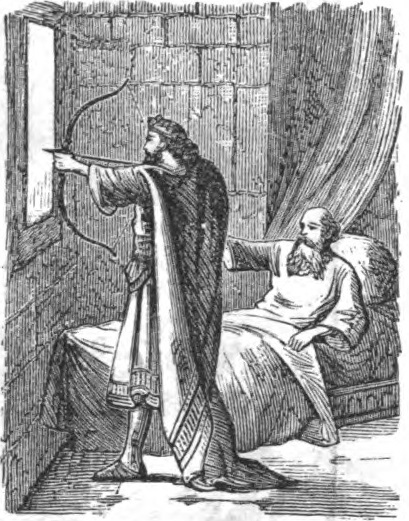
14 Now when Elisha had fallen sick with the illness of which he was to die, Joash king of Israel went down to him and wept before him, crying, “My father, my father! The chariots of Israel and its horsemen!” 15 And Elisha said to him, “Take a bow and arrows.” So he took a bow and arrows. 16 Then he said to the king of Israel, “Draw the bow,” and he drew it. And Elisha laid his hands on the king’s hands. 17 And he said, “Open the window eastward,” and he opened it. Then Elisha said, “Shoot,” and he shot. And he said, “The LORD‘s arrow of victory, the arrow of victory over Syria! For you shall fight the Syrians in Aphek until you have made an end of them.” 18 And he said, “Take the arrows,” and he took them. And he said to the king of Israel, “Strike the ground with them.” And he struck three times and stopped. 19 Then the man of God was angry with him and said, “You should have struck five or six times; then you would have struck down Syria until you had made an end of it, but now you will strike down Syria only three times.”

20 So Elisha died, and they buried him. Now bands of Moabites used to invade the land in the spring of the year. 21 And as a man was being buried, behold, a marauding band was seen and the man was thrown into the grave of Elisha, and as soon as the man touched the bones of Elisha, he revived and stood on his feet.

22 Now Hazael king of Syria oppressed Israel all the days of Jehoahaz. 23 But the LORD was gracious to them and had compassion on them, and he turned toward them, because of his covenant with Abraham, Isaac, and Jacob, and would not destroy them, nor has he cast them from his presence until now.

24 When Hazael king of Syria died, Ben-hadad his son became king in his place. 25 Then Jehoash the son of Jehoahaz took again from Ben-hadad the son of Hazael the cities that he had taken from Jehoahaz his father in war. Three times Joash defeated him and recovered the cities of Israel. 2 Kings 13:10-25 ESV

Keeping up with the revolving door of kings who reigned over Israel and Judah is hard enough as it is, but it becomes even more difficult when two kings with the same name end up ruling at the same time. That’s the case in this particular passage. Jehoash ascended to the throne of Israel after the death of his father, Jehoahaz, and it just so happened that the king of Judah bore the same name. It seems only fitting and a bit ironic that these two nations that shared the same predilection for idolatry and apostasy would end up with rulers who shared the same name. While their reigns would only intersect for a period of about two years, they shared more in common than their name. In the end, both men proved to be ungodly leaders who failed to lead their people back to the worship of Yahweh.

When Jehoash, the king of Judah, received a less-than-encouraging message from God, he ordered the stoning of the messenger. It just so happened that the man he executed was Zechariah, the son of Jehoiada the priest. This was the same Jehoiada who had saved the infant Jehoash from the hands of Queen Athaliah by providing him with sanctuary in the temple for six years. On Jehoash’s seventh birthday, Jehoiada had anointed him as the king of Judah. But years later, after Jehoiada’s death, Jehoash began to listen to the counsel of his ungodly advisors and ultimately forsake Yahweh. As a result, Judah suffered defeat at the hands of a much smaller Syrian force. He was wounded in the battle and, while recuperating from his injuries, he was assassinated by two of his own officials.

And the king of Israel, who bore the same name, shared a similar story of unfaithfulness and rebellion. The author sums up his 16-year reign with the words: “he did what was evil in the LORD’s sight. He refused to turn from the sins that Jeroboam son of Nebat had led Israel to commit” (2 Kings 13:11 NLT). He, too, forsook the LORD and led the people to continue their love affair with false gods. And it’s interesting to note that the heir to his throne was his son, Jeroboam II, whom he had named after the first king of the northern kingdom of Israel. His admiration for Jeroboam seems obvious but undeserved. After all, Jeroboam had been responsible for leading the Israelites into idolatry. When God split the nation of Israel in two after the reign of Solomon, He gave the ten northern tribes to Jeroboam as his kingdom. But Jeroboam responded to this gracious gift from God by erecting two golden calves and encouraging his people to forsake the worship of Yahweh. Yet Jehoash thought enough of this man to name his own son after him.

But sometime during his reign, Jehoash of Israel received word that the prophet Elisha was on his deathbed. Surprisingly, the king was grieved over this news and made a personal visit to see the dying prophet. While Jehoash was anything but a faithful worshiper of Yahweh, he knew that Elisha had great power and influence. This elderly prophet had proven time and time again that he spoke on behalf of God and was empowered by God. That’s why Jehoash greeted him with the somewhat cryptic statement: “My father, my father! The chariots of Israel and its horsemen!” (2 Kings 13:14 ESV). Evidently, Jehoash had heard the story of Elijah’s miraculous departure and Elisha’s role in it. Perhaps Elisha had shared with the king the details of that fateful day when God had used a whirlwind to take Elijah from the earth.

…as they still went on and talked, behold, chariots of fire and horses of fire separated the two of them. And Elijah went up by a whirlwind into heaven. And Elisha saw it and he cried, “My father, my father! The chariots of Israel and its horsemen!” And he saw him no more. – 2 Kings 2:11-12 ESV

This event followed Elisha’s request that Elijah give him a double portion of his spirit. He was to be Elijah’s replacement, and he felt ill-equipped for the task. It could be that King Jehoash hoped Elisha would pour out his spirit on him as well. He understood that Elisha possessed power and had direct access to Yahweh. With the prophet’s death, all of that might be lost. But rather than pour out his spirit on the apostate king, Elisha commanded him to take his bow and shoot an arrow out the window.

Elisha said, “Shoot,” and he shot. And he said, “The LORD‘s arrow of victory, the arrow of victory over Syria! For you shall fight the Syrians in Aphek until you have made an end of them.” – 2 Kings 13:17 ESV

Next, the prophet told the king to take his remaining arrows and strike the ground with them. Jehoash dutifully obeyed, but when he stopped after the third blow, Elisha responded in anger.

“You should have struck the ground five or six times!” he exclaimed. “Then you would have beaten Aram until it was entirely destroyed. Now you will be victorious only three times.” – 2 Kings 13:19 NLT

In a sense, Elisha had poured out his spirit on King Jehoash. He had placed his hands on those of the king and, together, they had shot the first arrow out the window. He then assured the king of his victory over the Syrians. But the extent of that victory would depend on Jehoash’s faith. By limiting the number of times he struck the ground, Jehoash was unwittingly revealing his lack of faith. The first arrow had symbolized the LORD’s victory over the Syrians. When Elisha had commanded Jehoash to take the remaining arrows and strike the ground, he should have done so until the prophet told him to stop. Each blow was meant to symbolize a victory over the enemy. But Jehoash had chosen to limit his expectations. In doing so, he inadvertently limited his chances of success over his enemy.

Having pronounced his last prophetic message, Elisha died. But the author relates a story that reveals one last miracle associated with the prophet of God. Sometime later, the body of a recently deceased man was inadvertently thrown into the cave containing Elisha’s bones. When the body of the dead man came into contact with Elisha’s remains, he was immediately restored to life. Amazingly, the author provides no further details about the story to indicate what happened to this newly resurrected man or how the story came to be known. But its inclusion in the narrative was meant to reveal that, though Elisha was dead,  Yahweh was alive and well. Elisha’s departure was not meant to be mistaken for God’s abandonment of Israel. He was still fully capable of restoring life to the lifeless. The all-powerful God of Israel used the bones of a dead prophet to restore life to a dead Israelite, a clear symbol of His desire to renew those among His chosen people who were marked by spiritual death.

The author reminds his readers that God remained faithful to His disobedient people, refusing to abandon them despite their constant rejection of Him.

the LORD was gracious and merciful to the people of Israel, and they were not totally destroyed. He pitied them because of his covenant with Abraham, Isaac, and Jacob. – 2 Kings 13:23 NLT

The author also reveals that Yahweh kept His word concerning the fate of the Syrians. Jehoash experienced three separate victories over his enemy, matching the exact number of times he struck the ground with his arrows — no more, no less. God allowed Jehoash to recover some of the territory stolen by the Syrians, but the fighting would continue throughout the rest of his reign. The sad reality is that the same God who raised a dead man back to life was fully capable of restoring a spiritually dead nation. Still, their continued stubbornness and lack of faithfulness would prevent them from experiencing the life-transformative power of Yahweh.

English Standard Version (ESV) The Holy Bible, English Standard Version. ESV® Permanent Text Edition® (2016). Copyright © 2001 by Crossway Bibles, a publishing ministry of Good News Publishers.

New Living Translation (NLT) Holy Bible, New Living Translation, copyright © 1996, 2004, 2015 by Tyndale House Foundation. Used by permission of Tyndale House Publishers Inc., Carol Stream, Illinois 60188. All rights reserved.

Faith, Famine, and Fruitfulness

24 Afterward Ben-hadad king of Syria mustered his entire army and went up and besieged Samaria. 25 And there was a great famine in Samaria, as they besieged it, until a donkey’s head was sold for eighty shekels of silver, and the fourth part of a kab of dove’s dung for five shekels of silver.’ 26 Now as the king of Israel was passing by on the wall, a woman cried out to him, saying, “Help, my lord, O king!” 27 And he said, “If the LORD will not help you, how shall I help you? From the threshing floor, or from the winepress?” 28 And the king asked her, “What is your trouble?” She answered, “This woman said to me, ‘Give your son, that we may eat him today, and we will eat my son tomorrow.’ 29 So we boiled my son and ate him. And on the next day I said to her, ‘Give your son, that we may eat him.’ But she has hidden her son.” 30 When the king heard the words of the woman, he tore his clothes—now he was passing by on the wall—and the people looked, and behold, he had sackcloth beneath on his body— 31 and he said, “May God do so to me and more also, if the head of Elisha the son of Shaphat remains on his shoulders today.”

32 Elisha was sitting in his house, and the elders were sitting with him. Now the king had dispatched a man from his presence, but before the messenger arrived Elisha said to the elders, “Do you see how this murderer has sent to take off my head? Look, when the messenger comes, shut the door and hold the door fast against him. Is not the sound of his master’s feet behind him?” 33 And while he was still speaking with them, the messenger came down to him and said, “This trouble is from the LORD! Why should I wait for the LORD any longer?” 

1 But Elisha said, “Hear the word of the LORD: thus says the LORD, Tomorrow about this time a seah of fine flour shall be sold for a shekel, and two seahs of barley for a shekel, at the gate of Samaria.” Then the captain on whose hand the king leaned said to the man of God, “If the LORD himself should make windows in heaven, could this thing be?” But he said, “You shall see it with your own eyes, but you shall not eat of it.”2 Kings 6:24-7:2 ESV

One thing that becomes painfully evident when reading God’s Word is that it often paints humanity in far-from-flattering terms. The characters found in the Bible are presented with all their flaws and foibles fully exposed. The reader gets to see the good, the bad, and the ugly aspects of human nature in all their gory details. There are examples of mankind’s more positive traits, but they seem few and far between. From the opening pages of Genesis to the closing chapters of Revelation, the fallen nature of humanity is presented with painstaking accuracy.

Throughout the book, we see a litany of vices on display, including all of the seven deadly sins: pride, greed, lust, envy, gluttony, anger, and sloth. Countless stories chronicle mankind’s stubbornness, arrogance, and selfishness, and they are intended to stand in stark contrast to the righteousness of God. Throughout the Bible, we see the sinfulness of man set against the stark backdrop of God’s incomparable holiness. The stories of mankind’s unfaithfulness, arrogance, pride, and sin are seamlessly woven together with the countless examples of God’s power and sovereignty. And today’s passage contains one such story.

For some time, Ben-hadad II, the king of Syria, had been trying to develop secret plans to invade Israel. But each time he attempted to put them into action, the Israelites were one step ahead of him. He discovered that Elisha the prophet had been receiving secret intel on all their planning sessions, and it had come directly from Yahweh, the God of Israel. Since Ben-hadad couldn’t do anything to stop the all-powerful Yahweh, he decided to capture Elisha. But, once again, his strategy failed miserably. When his troops laid siege to the city of Dothan, where Elisha was living, God blinded them. Then Elisha led them to Samaria, where the king of Israel spared their lives and hosted a feast for them. These men returned home, grateful to be alive.

But then we read, “Afterward Ben-hadad king of Syria mustered his entire army and went up and besieged Samaria” (2 Kings 6:24 ESV). We’re not told how much time transpired between Ben-hadad’s last failed attempt to attack Israel and this latest campaign. But he had not given up his intentions to conquer the nation of Israel. This man’s stubborn persistence is on full display. Despite what had happened to his troops the last time they went into Israelite territory, he was determined to carry out his latest plan.

As a result of the siege, the conditions inside Samaria quickly deteriorated. Food became scarce, and the people within the walls of the city became desperate. Price gouging was prevalent because there was nothing to eat. People were willing to pay exorbitant prices for anything that even remotely resembled food.

The siege lasted so long that a donkey’s head sold for eighty pieces of silver, and a cup of dove’s dung sold for five pieces of silver. –  2 Kings 6:25 NLT 

These were desperate times. And to make sure we understand just how bad things had become, the author reveals that the people had resorted to cannibalism. To drive home the dire nature of their circumstances, he shares the story of a mother sacrificing her infant son so that she and her friends could survive. This sickening story was told to King Jehoram as he walked along the city walls, surveying the worsening conditions of his people. What makes this incident all the more repulsive is that it involved deceit and dishonesty. Facing starvation, two mothers had agreed to kill their own children and eat their flesh just to survive. One had followed through on her commitment, but when it came time for the second mother to kill her child, she couldn’t bring herself to do it. In a desperate attempt to preserve the life of her child, the woman hid him.

The abysmal conditions within Samaria should have come as no surprise to the people of Israel because Yahweh had warned them that disobedience to His law would result in severe discipline.

“If in spite of all this you still refuse to listen and still remain hostile toward me, then I will give full vent to my hostility. I myself will punish you seven times over for your sins. Then you will eat the flesh of your own sons and daughters. – Leviticus 26:27-29 NLT

“They will attack your cities until all the fortified walls in your land—the walls you trusted to protect you—are knocked down. They will attack all the towns in the land the LORD your God has given you.

“The siege and terrible distress of the enemy’s attack will be so severe that you will eat the flesh of your own sons and daughters, whom the LORD your God has given you. – Deuteronomy 28:52-53 NLT

Upon hearing the woman’s story, King Jehoram was sickened and tore his clothes in mourning. Yet, rather than see the situation as a sign of God’s judgment against apostate Israel, the king decided to blame Elisha. After all, the prophet was Yahweh’s official spokesman and had proven to be a thorn in Jehoram’s side for some time.

“May God strike me and even kill me if I don’t separate Elisha’s head from his shoulders this very day.” – 2 Kings 6:31 NLT

Jehoram was about to make the age-old mistake of killing the messenger. He knew that Elisha spoke for God, so he assumed that if he could eliminate the prophet, the conditions in Samaria would improve. But Elisha was not the cause of his problem or the source behind the judgment Israel was experiencing. The siege and the resulting famine were the handiwork of the sovereign, all-powerful Yahweh. God had warned them what would happen if they turned their backs on Him, and now they were suffering the consequences.

Jehoram’s decision to kill God’s prophet was doomed to failure. However, fueled by anger, arrogance, and pride, the king sent a messenger to retrieve Elisha and bring him back to the palace for execution. But Elisha was one step ahead of Jehoram, having been informed by God of the king’s intentions.

“A murderer has sent a man to cut off my head. When he arrives, shut the door and keep him out. We will soon hear his master’s steps following him.” – 2 Kings 6:32 NLT

When the messenger arrived, he found the door to Elisha’s home blocked. So, he dutifully delivered his message from the king.

“All this misery is from the LORD! Why should I wait for the LORD any longer?” – 2 Kings 6:33 NLT

Jehoram acknowledged that God was behind the siege, but he also revealed his doubt that God would ever rescue them. Since he couldn’t vent his frustration on God, he was determined to take out his anger on God’s prophet. He was following the same strategy his mother Jezebel had used when Elijah defeated and killed the 450 prophets of Baal. Angered by the prophet’s unexpected victory over her false god, she ordered his death (1 Kings 19:2). Now, years later, here was her son attempting to thwart the plan of God by killing the prophet of God. Jehoram’s pride, arrogance, and anger are on full display. At no point does he take ownership of his godless leadership of the nation. He displays no remorse or repentance. Yet the prophet delivered an unexpected, seemingly inexplicable message to the king.

“Listen to this message from the LORD! This is what the LORD says: By this time tomorrow in the markets of Samaria, six quarts of choice flour will cost only one piece of silver, and twelve quarts of barley grain will cost only one piece of silver.” – 2 Kings 7:1 NLT

Things were about to take a dramatic turn for the better. In just 24 hours, God would miraculously reverse the conditions in Samaria. The long-lasting siege and the devastating famine would come to an abrupt end, and the people living inside the walls of Samaria would suddenly find food readily available and affordable. But the king’s messenger found Elisha’s prediction to be far-fetched and refused to believe a word he said.

“That couldn’t happen even if the LORD opened the windows of heaven!” – 2 Kings 7:2 NLT

This arrogant man questioned the prophet’s words, but, more importantly, he displayed his doubt in Yahweh’s power, and Elisha warned him that he would pay dearly for his mistake.

“You will see it happen with your own eyes, but you won’t be able to eat any of it!” – 2 Kings 7:2 NLT

God was about to do something incredible, but this emissary of the king refused to believe it was possible. Like his boss, he had long ago given up any belief in Yahweh’s sovereignty and power. From his godless and apostate perspective, this problem was too big, even for God. For this unbelieving, apostate servant of the king, news of Israel’s reversal of fortunes was too good to be true. He refused to believe that the Syrians would suddenly abandon their siege and that the conditions in Samaria would miraculously change overnight. His faith in Elisha’s God was too small, so he forfeited any hope of enjoying the fruits of Yahweh’s favor.

The emissary’s doubts in Elisha’s words and Yahweh’s power reflect the spiritual state of the entire nation of Israel. His reticence to believe brings to mind the words of Yahweh recorded by the prophet Micah centuries later.

You are cursed with a curse, for you are robbing me, the whole nation of you. Bring the full tithe into the storehouse, that there may be food in my house. And thereby put me to the test, says the Lord of hosts, if I will not open the windows of heaven for you and pour down for you a blessing until there is no more need. I will rebuke the devourer for you, so that it will not destroy the fruits of your soil, and your vine in the field shall not fail to bear, says the Lord of hosts. – Malachi 39-11 ESV

English Standard Version (ESV) The Holy Bible, English Standard Version. ESV® Permanent Text Edition® (2016). Copyright © 2001 by Crossway Bibles, a publishing ministry of Good News Publishers.

New Living Translation (NLT) Holy Bible, New Living Translation, copyright © 1996, 2004, 2015 by Tyndale House Foundation. Used by permission of Tyndale House Publishers Inc., Carol Stream, Illinois 60188. All rights reserved.

Why Are You Here?

But he himself went a day’s journey into the wilderness and came and sat down under a broom tree. And he asked that he might die, saying, “It is enough; now, O LORD, take away my life, for I am no better than my fathers.” And he lay down and slept under a broom tree. And behold, an angel touched him and said to him, “Arise and eat.” And he looked, and behold, there was at his head a cake baked on hot stones and a jar of water. And he ate and drank and lay down again. And the angel of the LORD came again a second time and touched him and said, “Arise and eat, for the journey is too great for you.” And he arose and ate and drank, and went in the strength of that food forty days and forty nights to Horeb, the mount of God.

There he came to a cave and lodged in it. And behold, the word of the LORD came to him, and he said to him, “What are you doing here, Elijah?” 10 He said, “I have been very jealous for the LORD, the God of hosts. For the people of Israel have forsaken your covenant, thrown down your altars, and killed your prophets with the sword, and I, even I only, am left, and they seek my life, to take it away.” 11 And he said, “Go out and stand on the mount before the LORD.” And behold, the LORD passed by, and a great and strong wind tore the mountains and broke in pieces the rocks before the LORD, but the LORD was not in the wind. And after the wind an earthquake, but the LORD was not in the earthquake. 12 And after the earthquake a fire, but the LORD was not in the fire. And after the fire the sound of a low whisper. 13 And when Elijah heard it, he wrapped his face in his cloak and went out and stood at the entrance of the cave. And behold, there came a voice to him and said, “What are you doing here, Elijah?” 14 He said, “I have been very jealous for the LORD, the God of hosts. For the people of Israel have forsaken your covenant, thrown down your altars, and killed your prophets with the sword, and I, even I only, am left, and they seek my life, to take it away.” 1 Kings 19:4-14 ESV

While everything had gone exceptionally well for Elijah on Mount Carmel, he soon found himself disappointed in how things turned out. His challenge of the false prophets of Baal had proven to be successful, and, from the immediate reaction of the people, it appeared that revival had come to the land. This spiritual renewal of the people seemed to be symbolized by the torrential rain that had brought an end to the three-and-a-half years of drought. It appeared as if the nation was headed in the right direction. As a prophet of God, Elijah longed to see the repentance and restoration of the people of God.

But upon his triumphant return to Jezreel, he was met with intense opposition from the very woman who had begun all this trouble in Israel. Queen Jezebel was incensed when she heard what Elijah had done to the 450 prophets of her god. So, she sent Elijah a life-threatening message.

“So may the gods do to me and more also, if I do not make your life as the life of one of them by this time tomorrow.” – 1 Kings 19:2 ESV

She swore an oath to her gods that she would avenge the deaths of the prophets of Baal by killing Elijah. She gave the prophet less than 24 hours to live and vowed to sacrifice her own life if she failed to take his life. Despite the abject failure of her god to defeat Yahweh on Mount Carmel, she was still very much a believer. She exhibited no remorse or repentance but instead warned Elijah that while he had won the battle on Mount Carmel, the war was far from over. She was willing to fight to the death – either his or her own.  And Elijah did not take this news well.

…he was afraid, and he arose and ran for his life and came to Beersheba, which belongs to Judah, and left his servant there. – 1 Kings 19:3 ESV

The man who had run from Mount Carmel to Jezreel after his victory over the prophets of Baal was now running for his life. But this time, he was powered by fear, not faith. And Elijah didn’t stop running until he had reached Beersheba, the last town of any size in the southernmost region of Judah. Then, leaving his servant behind in the city, Elijah traveled another day’s journey into the wilderness, where he finally stopped to rest.

In a state of deep depression and disillusionment, Elijah asked God to take his life. Since Ahab and Jezebel remained fully committed to their false gods, Elijah had concluded that his prophetic mission had been an abysmal failure. There would be no revival in Israel as long as those two wielded all the power and influence over the people. They were calling the shots and determining the nation’s religious affiliation.

Elijah had run out of faith and energy. He was physically, emotionally, and spiritually spent. In his despondent state, he cried out to God, saying, “I have had enough, LORD.…Take my life, for I am no better than my ancestors who have already died” (1 Kings 19:4 NLT). Exhausted, he fell asleep. But he was soon awakened by an angel who commanded him to eat. There beside him was a loaf of bread and a jar of water. Rather than taking Elijah’s life, Yahweh provided his faith-famished prophet with sustenance, miraculously delivered by the hand of an angel. Elijah may have decided that he was done, but God was not done with Elijah. The prophet ate and fell back asleep. 

However, his rest was disturbed yet again by a second visit from the angel, who had brought more food and a message.

“Get up and eat some more, or the journey ahead will be too much for you.” – 1 Kings 19:7 NLT

Elijah’s plan had been to die alone in the wilderness, but Yahweh informed His disillusioned prophet that he had not yet reached his final destination. He had run, but not far enough. When Elijah abruptly fled Jezreel, he did so because he thought his life was over. Since Jezebel had vowed to kill him, Elijah determined to have Yahweh take his life. But the LORD had other plans. He sent Elijah on a 40-day journey further south, all the way to Mount Sinai. The food the angel provided miraculously sustained Elijah for this long and arduous journey.

…the food gave him enough strength to travel forty days and forty nights to Mount Sinai, the mountain of God. – 1 Kings 19:8 ESV

This trip should have taken no more than 15-20 days on foot, but Elijah found himself wandering in the wilderness for 40 days and nights. This number is significant because it corresponds to the 40 years that the disobedient Israelites had spent wandering in the wilderness. When they failed to obey God and enter the land of Canaan (Numbers 13-14), He doomed them to spend the next 40 years in the wilderness of Sinai, until that disobedient generation died off.

So the Lords anger burned against Israel, and He made them wander in the wilderness for forty years, until the entire generation of those who had done evil in the sight of the Lord came to an end. – Numbers 32:13 NLT

When they had heard the report of the spies that the land of Canaan was full of giants and well-fortified cities, the people of Israel refused to trust God and made plans to return to Egypt.

“If only we had died in Egypt, or even here in the wilderness!” they complained. “Why is the LORD taking us to this country only to have us die in battle? Our wives and our little ones will be carried off as plunder! Wouldn’t it be better for us to return to Egypt?” – Numbers 14:2-3 NLT

Now, centuries later, Elijah, the prophet of God, had chosen death in the wilderness rather than face the “giants” in his day. He had determined that Jezebel was too big for God. But Yahweh ordered Elijah to go to the very place where He had revealed Himself to the people of Israel. It had been at Mount Sinai that God gave His law to Moses. It had been on Mount Sinai that God displayed His glory and demonstrated His unparalleled power.

So it came about on the third day, when it was morning, that there were thunder and lightning flashes and a thick cloud over the mountain and a very loud trumpet sound, so that all the people who were in the camp trembled. And Moses brought the people out of the camp to meet God, and they stood at the foot of the mountain. – Exodus 19:16-17 NLT

When Yahweh had safely sequestered Elijah in the recesses of a cave, He asked His doubting prophet a question: “What are you doing here, Elijah?” (1 Kings 19:9 ESV). He wanted Elijah to explain the motivation behind his most recent actions, and the prophet responded with a pitiful portrait of his Don-Quixote-like quest to defeat the enemies of God. He deemed himself the last man standing, the sole survivor of an ill-fated battle against the forces of evil.

“I have zealously served the LORD God Almighty. But the people of Israel have broken their covenant with you, torn down your altars, and killed every one of your prophets. I am the only one left, and now they are trying to kill me, too.” – 1 Kings 19:10 NLT

Elijah threw himself a pity party and invited Yahweh to attend, but the LORD was not interested in celebrating Elijah’s accomplishments or validating his woe-is-me mentality. Instead, God instructed His despondent prophet to step out of the cave and into the shadow of Mount Sinai. As Elijah stood at the base of the mountain, God revealed Himself. At first, He displayed His glory in the form of a fierce windstorm so mighty that it blew boulders off the face of the mountain. This dramatic display was followed by a massive earthquake that shook the ground under Elijah’s feet. Finally, Elijah watched as the peak of the mountain was consumed by fire. The pitiful prophet was witnessing the same jaw-dropping spectacle the Israelites had seen.

Now Mount Sinai was all in smoke because the LORD descended upon it in fire; and its smoke ascended like the smoke of a furnace, and the entire mountain quaked violently. – Exodus 19:18 NLT

But Elijah was to discover that, while these dramatic revelations of God were impressive, they were not meant to represent His presence. The text clearly states that the LORD was not in the wind, the earthquake, or the fire. Yes, they were manifestations of His greatness, but they were not how God was going to speak to His prophet. After the ear-piercing blast of the wind, the earth-shaking rumble of the earthquake, and the roar of the fire, Elijah heard “the sound of a low whisper” ( 1 Kings 19:12 ESV). Evidently, the three previous displays of God’s power had driven Elijah back into the recesses of the cave. But upon hearing the gentle sound of the whisper, he timidly made his way back outside. There, in the quiet of the moment, he heard Yahweh repeat His previous question: “What are you doing here, Elijah?” (1 Kings 19:13 NLT). 

Once again, Elijah gave the same well-rehearsed reply. He reiterated his claim to have zealously served Yahweh and re-emphasized his status as the last faithful Israelite. It was all about him. He alone had zealously served Yahweh. While everyone else in Israel had turned their backs on God, Elijah had remained faithful and fully committed. He was the last line of defense against the forces of evil, and now he was as good as dead.

But where was God? Even after the dramatic displays of divine power on Mount Sinai, Elijah had been unable to get his mind off himself. For some reason, he believed that the future of Israel had been dependent upon him, and he had failed and let God down. Despite his victory over the prophets of Baal, Ahab and Jezebel were firmly entrenched and in charge of the affairs of the nation, or so Elijah thought. From his perspective, all was lost. But God had news for Elijah, and He had plans for Ahab and Jezebel that the defeated prophet knew nothing about.

In a still, small voice, Yahweh was about to whisper His sovereign secret for Israel’s future in the ear of his self-consumed prophet. When God had asked Elijah, “What are you doing here?”, the prophet had given his answer. Now it was God’s turn. He would explain the real purpose behind Elijah’s seeming failure and his fear and flight. Elijah thought it was all over, but Yahweh was just getting started. 

English Standard Version (ESV) The Holy Bible, English Standard Version. ESV® Permanent Text Edition® (2016). Copyright © 2001 by Crossway Bibles, a publishing ministry of Good News Publishers.

New Living Translation (NLT) Holy Bible, New Living Translation, copyright © 1996, 2004, 2015 by Tyndale House Foundation. Used by permission of Tyndale House Publishers Inc., Carol Stream, Illinois 60188. All rights reserved.

The Fateful Journey From Faith to Fear

41 And Elijah said to Ahab, “Go up, eat and drink, for there is a sound of the rushing of rain.” 42 So Ahab went up to eat and to drink. And Elijah went up to the top of Mount Carmel. And he bowed himself down on the earth and put his face between his knees. 43 And he said to his servant, “Go up now, look toward the sea.” And he went up and looked and said, “There is nothing.” And he said, “Go again,” seven times. 44 And at the seventh time he said, “Behold, a little cloud like a man’s hand is rising from the sea.” And he said, “Go up, say to Ahab, ‘Prepare your chariot and go down, lest the rain stop you.’” 45 And in a little while the heavens grew black with clouds and wind, and there was a great rain. And Ahab rode and went to Jezreel. 46 And the hand of the LORD was on Elijah, and he gathered up his garment and ran before Ahab to the entrance of Jezreel. 

1 Ahab told Jezebel all that Elijah had done, and how he had killed all the prophets with the sword. Then Jezebel sent a messenger to Elijah, saying, “So may the gods do to me and more also, if I do not make your life as the life of one of them by this time tomorrow.” Then he was afraid, and he arose and ran for his life and came to Beersheba, which belongs to Judah, and left his servant there. 1 Kings 18:41-19:3 ESV

Chapter 18 opened up with the words God spoke to Elijah: “Go, show yourself to Ahab, and I will send rain upon the earth” (1 Kings 18:1 ESV). This statement contains a command as well as a promise from God. After his three-and-a-half-year absence, Elijah was to return to Israel from Sidon and confront King Ahab one more time. But while this command would likely involve significant risk to the prophet, his obedience would result in a tremendous blessing on the people. God would end the prolonged drought and restore rain to the land.

It is impossible to know if Elijah was aware of all that would have to happen before the rain returned. There is no indication as to when God divulged the rest of His plan and Elijah’s role in it. But before the physical drought could end, the spiritual drought afflicting the people would have to come to a decisive conclusion that involved a dramatic confrontation between Elijah and the 450 prophets of Baal. However, the real battle would be between Yahweh, the God of Israel, and Baal, the god of Ahab and Jezebel.

Yahweh had won the day, displaying His power by sending fire from heaven that “consumed the burnt offering and the wood and the stones and the dust, and licked up the water that was in the trench” (1 Kings 18:38 ESV). This demonstrative exhibition of God’s omnipotence brought the people to their knees in fear and worship. What they had just witnessed left them thoroughly convinced that Yahweh was the one true God, and that newly revived awareness left them crying out, “The LORD, he is God; the LORD, he is God” (1 Kings 18:39 ESV). And as if to put an exclamation point on the whole scene, Elijah ordered the capture and execution of all 450 of Baal’s so-called prophets. Their god had remained silent when they cried to him for help. Now the prophet of Yahweh silenced them for good. They would no longer deceive and mislead the people of Israel with fallacious promises concerning their false god.

But there was still one thing missing: The rain that Yahweh had promised. Baal had been discredited, his prophets had been eliminated, and the peoples’ reverence for Yahweh had been rejuvenated. But the land remained under the God-ordained drought that had turned Israel into a dust bowl where water and food were scarce and daily survival was a challenge. The land that God had once described as “flowing with milk and honey” (Exodus 33:3 ESV) had become fruitless and lifeless, reflecting the spiritual state of the people who occupied it.

Hundreds of years earlier, long before the people of Israel took possession of the land of Canaan, Moses warned what would happen if they proved unfaithful.

“And if you will indeed obey my commandments that I command you today, to love the LORD your God, and to serve him with all your heart and with all your soul, he will give the rain for your land in its season, the early rain and the later rain, that you may gather in your grain and your wine and your oil. And he will give grass in your fields for your livestock, and you shall eat and be full. Take care lest your heart be deceived, and you turn aside and serve other gods and worship them; then the anger of the LORD will be kindled against you, and he will shut up the heavens, so that there will be no rain, and the land will yield no fruit, and you will perish quickly off the good land that the LORD is giving you.” – Deuteronomy 11:13-17 ESV

Years later, when God’s people continued to display their propensity for unfaithfulness, His prophet, Joel, would offer this promise of divine restoration even in the face of their disobedience.

Surely the LORD has done great things!
    Don’t be afraid, O land.
Be glad now and rejoice,
    for the LORD has done great things.
Don’t be afraid, you animals of the field,
    for the wilderness pastures will soon be green.
The trees will again be filled with fruit;
    fig trees and grapevines will be loaded down once more.
Rejoice, you people of Jerusalem!
    Rejoice in the LORD your God!
For the rain he sends demonstrates his faithfulness.
    Once more the autumn rains will come,
    as well as the rains of spring.
The threshing floors will again be piled high with grain,
    and the presses will overflow with new wine and olive oil.

The LORD says, “I will give you back what you lost…” – Joel 2:20-25 ESV

That day on Mount Carmel, the people had seen the fire of God fall from heaven, completely consuming the altar, sacrifice, and water. But they had not yet seen or felt His blessing. As Joel stated, “the rain he sends demonstrates his faithfulness.” Their land was in desperate need of restoration and rejuvenation, and so were they. After three-and-a-half years of spiritual drought, their hearts were parched and hardened. They had lost the capacity for fruitfulness and faithfulness and needed an outpouring of God’s grace and mercy.

Elijah knew what God had in store. So, he informed the shell-shocked king to “Go get something to eat and drink, for I hear a mighty rainstorm coming!” (1 Kings 18:41 NLT). There was a blessing on the horizon. Despite Ahab and Jezebel’s wickedness, God was about to pour out His goodness on the land.

The fact that Ahab had food to eat is symbolic of his self-centered approach to leadership. His sins had brought God’s curse upon the nation, but while the people suffered severely from the lack of rain, Ahab and Jezebel lived in royal comfort and ease. God would later issue an indictment against the leaders of Israel, warning them of their blatant disregard for the care of His people.

“What sorrow awaits you shepherds who feed yourselves instead of your flocks. Shouldn’t shepherds feed their sheep?” – Ezekiel 34:2 NLT

As Ahab was busy satisfying his own needs, Elijah interceded on behalf of the people of Israel. He “climbed to the top of Mount Carmel and bowed low to the ground and prayed with his face between his knees” (1 Kings 18:42 NLT). At one point during his prayer, he stopped and sent his servant to look toward the Mediterranean Sea in the east. But the servant saw nothing. This pattern repeated itself five more times with the same disappointing result. But the seventh time, the servant returned with a different report.

“I saw a little cloud about the size of a man’s hand rising from the sea.” – 1 Kings 18:44 NLT

Out on the distant horizon, the servant saw what appeared to be a glimmer of hope. It was a small and seemingly insignificant cloud, but Elijah knew what it meant. The blessing of God was about to fall and, when it did, it would come in torrents. So, he instructed his servant to warn Ahab to leave immediately, or he may not make it back to his winter palace in Jezreel. When Elijah’s servant looked to the east, he saw only a faint possibility. But through his eyes of faith,  Elijah saw something altogether different. He perceived the imminent arrival of the outpouring of God’s blessing, and before long, that small cloud developed into a massive storm that brought strong winds and torrential rains. As Ahab tried to outrun the storm in his chariot, “the LORD gave special strength to Elijah. He tucked his cloak into his belt and ran ahead of Ahab’s chariot all the way to the entrance of Jezreel” (1 Kings 18:46 NLT).

Because Jezreel was anywhere from 10 to 20 miles east of Mount Carmel, some commentators attempt to explain this last verse by saying that Ahab’s chariot got caught in the mud and delayed his arrival. Others speculate that Elijah simply took a shortcut over the ridge of Mount Carmel. But everything about this story has been focused on the matchless power of God, and it should not seem out of the question that God might endow his prophet with a supernatural capacity to outrun the chariot of his arch-nemesis. God had defeated Baal. Now, the prophet of God had defeated the benefactor of Baal.

But while Elijah had won the victory at Mount Carmel and the race to Jezreel, he would have little time to celebrate. Upon hearing the unexpected news of all that had transpired on Mount Carmel, Jezebel was outraged and directed all her anger at Elijah.

“May the gods strike me and even kill me if by this time tomorrow I have not killed you just as you killed them.” – 1 Kings 19:2 NLT

Despite all that Ahab told her about the day’s events, she remained unconvinced of Yahweh’s power. She even called on Baal and his queen mother, Asherah, to come to her aid so that she might avenge the deaths of the prophets by killing Elijah. She was still putting her hope and trust in her false gods. Even the sudden arrival of long-awaited rain did nothing to diminish her misplaced trust in her lifeless and powerless gods. Baal, Jezebel’s beloved fertility god, had done nothing to eliminate the drought that had plagued the land.

But even more surprising than Jezebel’s stubborn belief in Baal and her resistance to God was Elijah’s sudden display of fear and doubt. This man, who had called down fire from heaven and had singlehandedly executed 450 prophets of Baal, found himself intimidated by the idle threats of this self-absorbed, idol-worshiping queen. Her vow to avenge her false god should have made Elijah laugh with scorn. Her god had proven himself to be speechless, powerless, and utterly helpless in the face of Yahweh. Yet, the formerly faithful Elijah was suddenly fearful, and this time, rather than running to the problem in the strength of God, he took flight and tried to escape it. He fled for his life, covering the 25 miles from Jezreel to Beersheba, motivated by fear and in the strength of his own flesh. Faced with the threats of Jezebel, Elijah took his eyes off God and took his fate into his own hands. 

This faithful man of God allowed the words of an idol-obsessed queen to dishearten and defeat him. He had bravely faced off against the 450 prophets of Baal, but now, with Jezebel’s words ringing in his ear, Elijah ran all the way to Beersheba, located on the southern border of Judah. From there, he would enter the Judean wilderness, the very same place where the disobedient and doubtful Israelites had wandered for 40 years when they refused to enter the promised land. And, in no time at all, the once faith-filled Elijah would find himself racked by fear and desiring death rather than face the vengeful anger of Jezebel.

English Standard Version (ESV) The Holy Bible, English Standard Version. ESV® Permanent Text Edition® (2016). Copyright © 2001 by Crossway Bibles, a publishing ministry of Good News Publishers.

New Living Translation (NLT) Holy Bible, New Living Translation, copyright © 1996, 2004, 2015 by Tyndale House Foundation. Used by permission of Tyndale House Publishers Inc., Carol Stream, Illinois 60188. All rights reserved.

Failure to Believe

36 Then the king sent and summoned Shimei and said to him, “Build yourself a house in Jerusalem and dwell there, and do not go out from there to any place whatever. 37 For on the day you go out and cross the brook Kidron, know for certain that you shall die. Your blood shall be on your own head.” 38 And Shimei said to the king, “What you say is good; as my lord the king has said, so will your servant do.” So Shimei lived in Jerusalem many days.

39 But it happened at the end of three years that two of Shimei’s servants ran away to Achish, son of Maacah, king of Gath. And when it was told Shimei, “Behold, your servants are in Gath,” 40 Shimei arose and saddled a donkey and went to Gath to Achish to seek his servants. Shimei went and brought his servants from Gath. 41 And when Solomon was told that Shimei had gone from Jerusalem to Gath and returned, 42 the king sent and summoned Shimei and said to him, “Did I not make you swear by the LORD and solemnly warn you, saying, ‘Know for certain that on the day you go out and go to any place whatever, you shall die’? And you said to me, ‘What you say is good; I will obey.’ 43 Why then have you not kept your oath to the LORD and the commandment with which I commanded you?” 44 The king also said to Shimei, “You know in your own heart all the harm that you did to David my father. So the LORD will bring back your harm on your own head. 45 But King Solomon shall be blessed, and the throne of David shall be established before the LORD forever.” 46 Then the king commanded Benaiah the son of Jehoiada, and he went out and struck him down, and he died.

So the kingdom was established in the hand of Solomon. – 1 Kings 2:36-46 ESV

There was one last piece of unfinished business that Solomon had to attend to. Just before his death, David had charged Solomon with the task of repaying Shimei for the disrespectful way he had treated him as he was evacuating Jerusalem after Absalom’s takeover of the kingdom (2 Samuel 16:5-14). This relative of David’s predecessor, King Saul, had held a grudge against David ever since he had supplanted Saul as the king of Israel. He was overjoyed to see David having to suffer the indignity of sneaking out of the capital city because his own son had stolen his kingdom. Shimei even threw stones at David, hurling insults and curses as he did so.

“Get out of here, you murderer, you scoundrel!” he shouted at David. “The LORD is paying you back for all the bloodshed in Saul’s clan. You stole his throne, and now the LORD has given it to your son Absalom. At last you will taste some of your own medicine, for you are a murderer!” – 2 Samuel 16:7-8 NLT

Shimei wrongly assumed that David’s fall was the work of Yahweh. Some of David’s faithful soldiers, who had accompanied him out of the city, offered to strike Shimei down, but David would not allow it. Instead, he told them, “My own son is trying to kill me. Doesn’t this relative of Saul have even more reason to do so? Leave him alone and let him curse, for the LORD has told him to do it. And perhaps the LORD will see that I am being wronged and will bless me because of these curses today” (2 Samuel 16:11-12 NLT).

David could empathize with Shimei’s anger and resentment. He understood why Shimei was so upset and had also concluded that God was behind it all. When Shimei called David a murderer, he had struck a very sensitive nerve. David would have immediately recalled his complicity in the death of Uriah, the husband of Bathsheba (2 Samuel 11:14-17). Shimei was right; he was a murderer, and perhaps God was still repaying him for his sinful actions against an innocent man. So, David refused to punish Shimei for his actions.

But some time later, when the attempted coup had been thwarted, and Absalom had been killed, David returned to the city of Jerusalem. And one of the first people to greet him upon his arrival was Shimei.

As the king was about to cross the river, Shimei fell down before him. “My lord the king, please forgive me,” he pleaded. “Forget the terrible thing your servant did when you left Jerusalem. May the king put it out of his mind. I know how much I sinned. That is why I have come here today, the very first person in all Israel to greet my lord the king.” – 2 Samuel 19:18-20 NLT

With the news of Absalom’s death and David’s return to Jerusalem, Shimei feared for his life. He knew he was a dead man unless he could convince David of his remorse and regret for his previous actions. Feigning sorrow for his emotionally driven display of anger, Shimei begged the king for forgiveness.

Though Shimei deserved punishment, David was unwilling to spoil the joy of the occasion by meting out judgment. He could have had Shimei executed on the spot, but instead, “the king said to Shimei, ‘You shall not die.’ And the king gave him his oath” (2 Samuel 19:23 ESV).

David kept that oath, but on his deathbed, it became clear that he had never really forgiven Shimei for what he had done. He allowed Shimei to live, but he intended to repay his accuser in the end. So, years later, as he neared death, David gave Solomon a not-so-subtle hint about what should be done with Shimei.

“And remember Shimei son of Gera, the man from Bahurim in Benjamin. He cursed me with a terrible curse as I was fleeing to Mahanaim. When he came down to meet me at the Jordan River, I swore by the LORD that I would not kill him. But that oath does not make him innocent. You are a wise man, and you will know how to arrange a bloody death for him.” – 1 Kings 2:8-9 NLT

David didn’t tell Solomon what to do. He simply reminded Solomon of what Shimei had done. He fully expected Solomon to defend his honor by having Shimei put to death. But Solomon had other plans. Rather than subjecting Shimei to capital punishment, he had him confined to the city of Jerusalem. Shimei, as a Benjamite, lived within the territory of his tribe. But Solomon ordered that he relocate within the city walls, where his actions could be carefully monitored. Shimei was given strict instructions never to venture outside the walls of the city for any reason, under penalty of death.

“Build a house here in Jerusalem and live there. But don’t step outside the city to go anywhere else. On the day you so much as cross the Kidron Valley, you will surely die; and your blood will be on your own head.” – 1 Kings 2:36-37 NLT

Solomon graciously spared Shimei’s life but placed him under house arrest. This arrangement seemed to work well for Shimei. For three years, he enjoyed a peaceful and prosperous life. But then, the unexpected happened. Two of his servants ran away and, without thinking about it, Shimei saddled a donkey and pursued his missing property. When he had recaptured his runaway servants and returned to Jerusalem, he was surprised to learn that he had been summoned to the king’s palace.

By this time, Shimei must have understood the gravity of his situation. He had violated the oath he had made, and Solomon reminded him of their agreement.

“Didn’t I make you swear by the LORD and warn you not to go anywhere else or you would surely die? And you replied, ‘The sentence is fair; I will do as you say.’ Then why haven’t you kept your oath to the LORD and obeyed my command?” – 1 Kings 2:42-43 NLT

Notice that Solomon describes Shimei’s oath as having been made to the LORD. When he agreed to the stipulations handed down by the king, he had been swearing an oath before Yahweh. Solomon had been acting as God’s appointed leader, and when Shimei agreed to the terms of the contract, he made a binding covenant with God Almighty. Now he had broken that vow and failed to keep his word, and he would have to suffer the consequences. Solomon ensured that Shimei understood the seriousness of his situation.

“You certainly remember all the wicked things you did to my father, David. May the LORD now bring that evil on your own head. But may I, King Solomon, receive the LORD’s blessings, and may one of David’s descendants always sit on this throne in the presence of the LORD.” – 1 Kings 2:44-45 NLT

David had kept his word and allowed Shimei to live. Now, Solomon was going to keep his word and have Shimei executed for the violation of his oath. Shimei’s death would not be because he had left the confines of the city of Jerusalem. The death sentence that hung over his head was due to his unlawful treatment of and rebellion against the LORD’s anointed, King David. He deserved to die because he was a rebel, but Solomon had shown him grace and mercy. The city of Jerusalem had become a city of refuge, a place where he could find release from the condemnation of death he so richly deserved. As long as he remained within the walls of the city, he would be spared. His confinement was not imprisonment, but a form of protection. As long as Shimei remained faithful to reside within the confines of the city, he would be spared the penalty of death. But as soon as he walked outside the gates, he violated his oath and forfeited his right to live.

In so many ways, this narrative foreshadows what Jesus Christ would do for guilty sinners. He would become the place of refuge, the living Jerusalem, where those condemned to death could find mercy, grace, and life. As long as Shimei remained within Jerusalem’s protective walls, he would be spared the penalty he deserved. But when he allowed himself to be distracted by the cares of this world and went in pursuit of his runaway servants, Shimei revealed his true heart. He placed a greater value on material things than he did on the gift of life he had been offered by the king.

Jesus would later remind His disciples about the necessity of abiding in Him. He would challenge them to remain faithful, recognizing that their hope of eternal life was found in Him alone.

“Those who remain in me, and I in them, will produce much fruit. For apart from me you can do nothing. Anyone who does not remain in me is thrown away like a useless branch and withers. Such branches are gathered into a pile to be burned. But if you remain in me and my words remain in you, you may ask for anything you want, and it will be granted!” – John 15:5-7 NLT

Shimei had failed to remain in Jerusalem, and it cost him his life. He had seen the walls of the city as a prison rather than a source of protection. He had seen his agreement with the king as restrictive rather than redemptive. How often do those who are offered the gift of eternal life through Jesus Christ come to see that offer as a burden rather than a blessing? They prefer the “freedom” of sin over the emancipation from death that is offered within the protective walls of God’s gracious love. Like Shimei, they ultimately forfeit their lives.

In the passage above, Jesus is not teaching the possibility of losing one’s salvation. He is calling for faith that stands the test of time. It endures the trials and temptations of this life because it is based on the hope of eternal life. The apostle John described those who give the appearance of abiding faith, but walk away at the first sign of trouble.

These people left our churches, but they never really belonged with us; otherwise they would have stayed with us. When they left, it proved that they did not belong with us. – 1 John 2:19 NLT

Jesus used agrarian imagery to describe those who will claim to have faith in Him but eventually turn away.

The seed on the rocky soil represents those who hear the message and immediately receive it with joy. But since they don’t have deep roots, they don’t last long. They fall away as soon as they have problems or are persecuted for believing God’s word. – Matthew 13:20-21 NLT

The author of Hebrews provides a powerful warning against professing a false faith that fails to stand the test of time and the inevitability of trials. He encourages his audience to seek a faith that endures to the end.

Be careful then, dear brothers and sisters. Make sure that your own hearts are not evil and unbelieving, turning you away from the living God. You must warn each other every day, while it is still “today,” so that none of you will be deceived by sin and hardened against God. For if we are faithful to the end, trusting God just as firmly as when we first believed, we will share in all that belongs to Christ. – Hebrews 3:12-14 NLT

It seems that Shimei never really believed that Solomon would put him to death. When his slaves ran away, Shimei never stopped to consider the danger he faced if he left the confines of Jerusalem. His possessions meant more to him than the threat of death. Jesus spoke of those who place a higher priority on this life than the one to come.

“If any of you wants to be my follower, you must give up your own way, take up your cross, and follow me. If you try to hang on to your life, you will lose it. But if you give up your life for my sake, you will save it. And what do you benefit if you gain the whole world but lose your own soul? Is anything worth more than your soul?” – Matthew 16:24-26 NLT

In capturing his runaway slaves, Shimei got what he was looking for, but he also got what he deserved: Death. He failed to take his oath to Yahweh seriously because he never really believed his life was on the line. He regained his slaves but lost his soul; a high price to pay.

English Standard Version (ESV) The Holy Bible, English Standard Version. ESV® Permanent Text Edition® (2016). Copyright © 2001 by Crossway Bibles, a publishing ministry of Good News Publishers.

New Living Translation (NLT) Holy Bible, New Living Translation, copyright © 1996, 2004, 2015 by Tyndale House Foundation. Used by permission of Tyndale House Publishers Inc., Carol Stream, Illinois 60188. All rights reserved.

Stop, Stand, and See

To the choirmaster: according to Jeduthun. A Psalm of Asaph.

1 I cry aloud to God,
    aloud to God, and he will hear me.
In the day of my trouble I seek the Lord;
    in the night my hand is stretched out without wearying;
    my soul refuses to be comforted.
When I remember God, I moan;
    when I meditate, my spirit faints. Selah

You hold my eyelids open;
    I am so troubled that I cannot speak.
I consider the days of old,
    the years long ago.
I said, “Let me remember my song in the night;
    let me meditate in my heart.”
    Then my spirit made a diligent search:
“Will the Lord spurn forever,
    and never again be favorable?
Has his steadfast love forever ceased?
    Are his promises at an end for all time?
Has God forgotten to be gracious?
    Has he in anger shut up his compassion?” Selah

10 Then I said, “I will appeal to this,
    to the years of the right hand of the Most High.”

11 I will remember the deeds of the LORD;
    yes, I will remember your wonders of old.
12 I will ponder all your work,
    and meditate on your mighty deeds.
13 Your way, O God, is holy.
    What god is great like our God?
14 You are the God who works wonders;
    you have made known your might among the peoples.
15 You with your arm redeemed your people,
    the children of Jacob and Joseph. Selah

16 When the waters saw you, O God,
    when the waters saw you, they were afraid;
    indeed, the deep trembled.
17 The clouds poured out water;
    the skies gave forth thunder;
    your arrows flashed on every side.
18 The crash of your thunder was in the whirlwind;
    your lightnings lighted up the world;
    the earth trembled and shook.
19 Your way was through the sea,
    your path through the great waters;
    yet your footprints were unseen.
20 You led your people like a flock
    by the hand of Moses and Aaron. Psalm 77:1-20 ESV

Asaph once again found himself facing a difficult situation that left him lying awake in his bed at night. In his suffering state, he attempted to cry out to the LORD, but received no answer. Sleep eluded him, and he had begun to lose hope. His prayers went unanswered, and his need for relief went unmet.

All night long I prayed, with hands lifted toward heaven,
    but my soul was not comforted. – Psalm 77:3 NLT

Wide awake and with the entire evening to consider his circumstance, Asaph began to question the very presence and compassion of God.

Has the Lord rejected me forever?
    Will he never again be kind to me?
Is his unfailing love gone forever?
    Have his promises permanently failed?
Has God forgotten to be gracious?
    Has he slammed the door on his compassion? – Psalm 77:7-9 NLT

Nothing made sense. His pain was real, and his cries for help were heartfelt, but God felt distant and disinterested in his plight. There seemed to be a barrier between him and God, preventing his prayers from reaching their destination and leaving him in a state of desperation and deep despair. In assessing his situation, he reached a far-from-positive conclusion.

“This is my fate;
    the Most High has turned his hand against me.” – Psalm 77:10 NLT

The NET Bible translates verse 10: “I am sickened by the thought that the Most High might become inactive.” His greatest fear was not his ongoing pain and suffering but the thought that God might not intervene. He couldn’t imagine life without God’s gracious intervention. He could recall past occasions where God answered his prayers for help quickly and compassionately. But this time, he felt as if he had been abandoned to suffer in silence and solitude, all alone and with no hope of relief.

Yet, Asaph refused to give up on God. He would not allow his current circumstances to determine his view of God’s faithfulness. His sleepless nights, unanswered prayers, and ongoing suffering were difficult but not determinative of God’s character. Sometime during his “dark night of the soul,” Asaph made a conscious decision to remember God’s past acts of deliverance rather than to dwell on His seeming absence.

I will remember the deeds of the Lord;
    yes, I will remember your wonders of old.
I will ponder all your work,
    and meditate on your mighty deeds. – Psalm 77:11-12 NLT

If Asaph couldn’t see God in the present moment, he would look for Him in the stories of the past. Raised on the epic tales of God’s deliverance of the people of Israel, Asaph had a storehouse of soul-stirring, faith-building reports of God’s power and provision. He had grown up hearing the well-documented and faithfully preserved stories of Yahweh’s faithfulness. In his next psalm, Asaph promises to tell the next generation of the wonderous works of God.

I will teach you hidden lessons from our past—
    stories we have heard and known,
    stories our ancestors handed down to us.
We will not hide these truths from our children;
    we will tell the next generation
about the glorious deeds of the Lord,
    about his power and his mighty wonders. – Psalm 78:2-4 NLT

Asaph knew that God’s past acts of deliverance were meant to remind His people of His presence in the present. Yahweh would always be with them and would never abandon them, no matter how dark and desperate things might appear.

When Moses was leading the people of Israel to the promised land, he gave them a sobering reminder to pass on the stories of God’s faithfulness to the next generation.

“For what great nation has a god as near to them as the Lord our God is near to us whenever we call on him? And what great nation has decrees and regulations as righteous and fair as this body of instructions that I am giving you today?

“But watch out! Be careful never to forget what you yourself have seen. Do not let these memories escape from your mind as long as you live! And be sure to pass them on to your children and grandchildren.” – Deuteronomy 4:7-9 NLT

As Asaph lay awake in the darkness of his despair, he reached back into the distant past to shed light on his circumstances. Recalling the familiar stories of God’s faithfulness led Asaph to conjure a more accurate image of God’s character.

O God, your ways are holy.
    Is there any god as mighty as you?
You are the God of great wonders!
    You demonstrate your awesome power among the nations.
By your strong arm, you redeemed your people,
    the descendants of Jacob and Joseph. – Psalm 77:13-16 NLT

When Asaph needed a reminder of God’s power, he recalled one of the most amazing moments in Israel’s storied past. As the waves of despair and doubt threatened to overwhelm him, Asaph imagined the scene that took place on the shores of the Red Sea centuries earlier. The recently released Israelites found themselves facing the advancing Egyptian army and trapped against the impassable waters of the Red Sea. Caught between a rock and a hard place and facing certain death, the panicked Israelites lashed out at Moses in anger and fear.

As Pharaoh approached, the people of Israel looked up and panicked when they saw the Egyptians overtaking them. They cried out to the Lord, and they said to Moses, “Why did you bring us out here to die in the wilderness? Weren’t there enough graves for us in Egypt? What have you done to us? Why did you make us leave Egypt? Didn’t we tell you this would happen while we were still in Egypt? We said, ‘Leave us alone! Let us be slaves to the Egyptians. It’s better to be a slave in Egypt than a corpse in the wilderness!’” – Exodus 14:10-12 NLT

But Moses responded with confidence and certainty, imploring them to trust in Yahweh, their deliverer.

“Don’t be afraid. Just stand still and watch the LORD [Yahweh] rescue you today. The Egyptians you see today will never be seen again. The LORD [Yahweh] himself will fight for you. Just stay calm.” – Exodus 14:13-14 NLT

And Yahweh did rescue them.

the LORD [Yahweh] opened up a path through the water with a strong east wind. The wind blew all that night, turning the seabed into dry land. So the people of Israel walked through the middle of the sea on dry ground, with walls of water on each side! – Exodus 14:21-22 NLT

It was this epic event that Asaph focused on in his darkest moment. When faced with his own Red Sea moment, Asaph recalled the people’s cries, Moses’ words, and the Almighty’s actions. Though he could see no way of escape or hear the voice of God, he could live vicariously through the lives of his ancestors and be reminded to stand firm, fear not, and see the salvation of the LORD. By looking back in time and recalling God’s past faithfulness to His covenant people, Asaph was encouraged.

When the Red Sea saw you, O God,
    its waters looked and trembled!
    The sea quaked to its very depths.
The clouds poured down rain;
    the thunder rumbled in the sky.
    Your arrows of lightning flashed.
Your thunder roared from the whirlwind;
    the lightning lit up the world!
    The earth trembled and shook.
Your road led through the sea,
    your pathway through the mighty waters—
    a pathway no one knew was there!
You led your people along that road like a flock of sheep,
    with Moses and Aaron as their shepherds. – Psalm 77:16-20 NLT

Notice Asaph’s emphasis on God’s provision of a “pathway no one knew was there” (Psalm 77:19 NLT). When the Israelites reached the shores of the Red Sea, they had no way of knowing that their salvation would be through the sea, not around it. Their path of deliverance would be through the waters of despair and doubt. What they thought would be the source of their demise would be the pathway to their salvation.

Asaph could not understand the nature of his suffering. He found it difficult to see any light in the darkness that engulfed him, but his recollection of Israel’s Red Sea experience was just the encouragement he needed to not give up.

There were so many stories Asaph could have recalled that would have bolstered his faith. The chronicles of God’s power and provision were many, and they each provided a much-needed reminder to trust and obey. Asaph could have focused his attention on the story of Abraham and Sarah when God announced their son’s pending birth.

“I will return to you about this time next year, and your wife, Sarah, will have a son!” – Genesis 18:10 NLT

They had waited six decades for this news, but when Sarah heard it, she scoffed.

…she laughed silently to herself and said, “How could a worn-out woman like me enjoy such pleasure, especially when my master—my husband—is also so old?” – Genesis 18:12 NLT

But responded to Sarah’s doubt with a question of His own.

“Is anything too hard for the Lord?” – Genesis 18:14 NLT

This rhetorical question was meant to assure Abraham and Sarah that their God was faithful, powerful, and indomitable. Barrenness and old age were no match for God. An impassable sea was no problem for the God of the impossible. Asaph’s difficulties and the seemingly impenetrable darkness of his despair would fade in the light of God’s glory and goodness. All Asaph had to do was heed Moses’ advice: “Fear not, stand firm, and see the salvation of the Lord” (Exodus 14:13 ESV).

Father, when things take a turn for the worse, I tend to allow my circumstances to distort my view of You. I let the darkness of life drown out the light of Your goodness, drawing faulty conclusions about Your love and faithfulness. This reminder from Asaph was much needed. In those moments when I can’t see You, I need to recall the countless stories of Your past provision in my life. When those become cloudy and difficult to remember, I need to turn to Your Word and recount one of the many occasions when You delivered Your people from far worse situations than anything I have ever faced. You are good, gracious, powerful, faithful, constant, and always reliable. Never let me forget that nothing is impossible with You. Amen

English Standard Version (ESV) The Holy Bible, English Standard Version. ESV® Permanent Text Edition® (2016). Copyright © 2001 by Crossway Bibles, a publishing ministry of Good News Publishers.

New Living Translation (NLT) Holy Bible, New Living Translation, copyright © 1996, 2004, 2015 by Tyndale House Foundation. Used by permission of Tyndale House Publishers Inc., Carol Stream, Illinois 60188. All rights reserved.