Our All-Knowing God Always Knows What Is Best

16 The Lord spoke to Moses, saying, 17 “These are the names of the men who shall divide the land to you for inheritance: Eleazar the priest and Joshua the son of Nun. 18 You shall take one chief from every tribe to divide the land for inheritance. 19 These are the names of the men: Of the tribe of Judah, Caleb the son of Jephunneh. 20 Of the tribe of the people of Simeon, Shemuel the son of Ammihud. 21 Of the tribe of Benjamin, Elidad the son of Chislon. 22 Of the tribe of the people of Dan a chief, Bukki the son of Jogli. 23 Of the people of Joseph: of the tribe of the people of Manasseh a chief, Hanniel the son of Ephod. 24 And of the tribe of the people of Ephraim a chief, Kemuel the son of Shiphtan. 25 Of the tribe of the people of Zebulun a chief, Elizaphan the son of Parnach. 26 Of the tribe of the people of Issachar a chief, Paltiel the son of Azzan. 27 And of the tribe of the people of Asher a chief, Ahihud the son of Shelomi. 28 Of the tribe of the people of Naphtali a chief, Pedahel the son of Ammihud.” 29 These are the men whom the Lord commanded to divide the inheritance for the people of Israel in the land of Canaan. 

1 The Lord spoke to Moses in the plains of Moab by the Jordan at Jericho, saying, “Command the people of Israel to give to the Levites some of the inheritance of their possession as cities for them to dwell in. And you shall give to the Levites pasturelands around the cities. The cities shall be theirs to dwell in, and their pasturelands shall be for their cattle and for their livestock and for all their beasts. The pasturelands of the cities, which you shall give to the Levites, shall reach from the wall of the city outward a thousand cubits all around. And you shall measure, outside the city, on the east side two thousand cubits, and on the south side two thousand cubits, and on the west side two thousand cubits, and on the north side two thousand cubits, the city being in the middle. This shall belong to them as pastureland for their cities.

“The cities that you give to the Levites shall be the six cities of refuge, where you shall permit the manslayer to flee, and in addition to them you shall give forty-two cities. All the cities that you give to the Levites shall be forty-eight, with their pasturelands. And as for the cities that you shall give from the possession of the people of Israel, from the larger tribes you shall take many, and from the smaller tribes you shall take few; each, in proportion to the inheritance that it inherits, shall give of its cities to the Levites.” Numbers 34:16-35:8 ESV

God provided Moses with the name of one man from each of the ten tribes of Israel. These men, hand-picked by God, would assist Eleazar, the high priest, and Joshua in the distribution of the land. The tribes of Gad and Reuben were not included because they had chosen to settle outside the boundaries of Canaan. These men were well-respected leaders among their respective tribes and would help to guarantee that the land was fairly apportioned and that each tribe, regardless of its size, was treated equitably and fairly. There was to be no favoritism or any form of nepotism. The larger tribes, whose numbers would be based on the recent census taken by Moses, would be allotted more extensive land allotments. But was not a guarantee that they would receive the best land. God was giving these ten men the weighty responsibility of dividing up the Israelites’ inheritance in a way that would satisfy all the parties involved, and that would not be an easy task.

The next thing on God’s agenda was to arrange for the needs of the tribe of Levi, his own tribe. He had already informed Moses that the Levites would inherit no land in Canaan. God had set apart the tribe of Levi as His special possession and had dedicated them to the care and maintenance of the Tabernacle. As a result, God promised to be their inheritance.

“Remember that the Levitical priests—that is, the whole of the tribe of Levi—will receive no allotment of land among the other tribes in Israel. Instead, the priests and Levites will eat from the special gifts given to the Lord, for that is their share. They will have no land of their own among the Israelites. The Lord himself is their special possession, just as he promised them.” – Deuteronomy 18:1-2 NLT
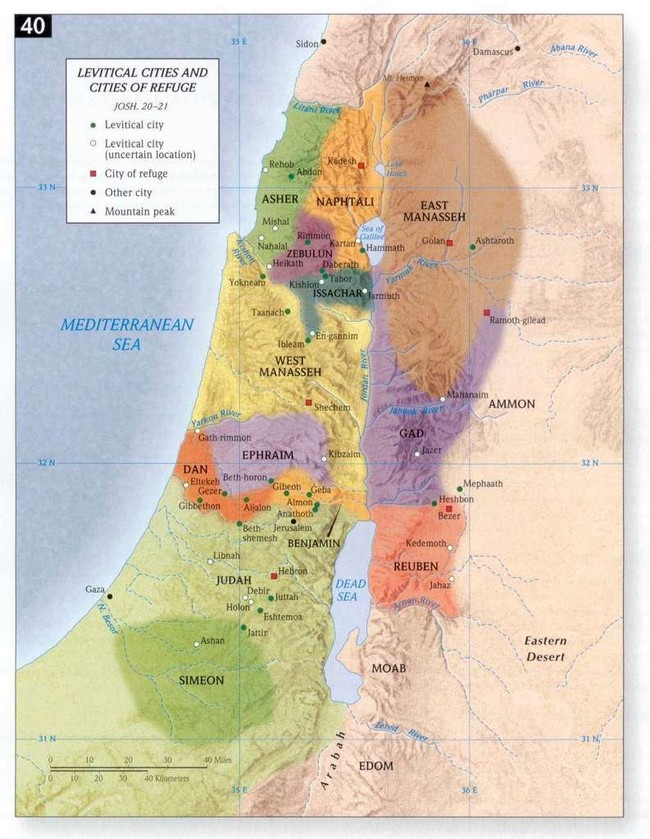
But while the Levites would be allotted no land in Canaan, they would be awarded the deeds to 48 cities located within the territories of each of the other 11 tribes (Joshua 21). Even the tribes of Gad, Reuben, and the half-tribe of Manasseh were required to provide the Levites with towns and pastureland for their flocks on the other side of the Jordan River. God had made ample accommodations for the Levites.

These Levitical cities were to be strategically located throughout the nation of Israel so that every Israelite was no more than ten miles from one of them. This helped to ensure that the people of God were never far away from a member of the Levitical priesthood, whose job was to provide instruction in the ways of God. The Levitical priests served as judges (Deuteronomy 17:8-13) and teachers of God’s law (Deuteronomy 33:10). So, it was essential that every Israelite had ready access to a Levitical town and a priest of God.

Of the 48 towns awarded to the Levites, six were to be designated as cities of refuge. These were specially sanctioned zones within the boundaries of Israel where anyone guilty of committing a non-premediated murder could seek asylum. God had already declared His ruling concerning murder (Exodus 20:13), but He had Moses present a special provision for cases involving accidental homicide.

“If someone kills another person unintentionally, without previous hostility, the slayer may flee to any of these cities to live in safety. – Deuteronomy 19:4 NLT

He even had Moses provide a potential scenario in which a city of refuge would become necessary.

“For example, suppose someone goes into the forest with a neighbor to cut wood. And suppose one of them swings an ax to chop down a tree, and the ax head flies off the handle, killing the other person. In such cases, the slayer may flee to one of the cities of refuge to live in safety.” – Deuteronomy 19:5 NLT

God knew that life would happen and that deadly accidents would be a part of the Israelites’ existence in the land. Men would be killed and justice would need to be pursued. But what He didn’t want was some form of vigilante justice running rampant through the nation. Yet God knew that the relatives of a murder victim would tend to seek revenge against the guilty party and ask questions later. The cities of refuge were intended to protect the innocent while justice was being served.

Since Israel had no professional police force, these kinds of accidents could easily turn into bloodbaths where the relatives of the victim sought to avenge their loved one’s death. So, these cities, occupied by the Levites, would provide a place where the guilty party could find solace and seek a fair judgment concerning his guilt or innocence. In His plans for the land of promise, God was leaving nothing to chance. He was creating a well-designed system for dealing with the inevitable problem of sin among His chosen people. He was going to distribute the Levitical priesthood among them to provide spiritual enlightenment and He was going to create safe havens for those who unwittingly committed even the gravest of sins. God was providing for and protecting His people.

English Standard Version (ESV) The Holy Bible, English Standard Version. ESV® Permanent Text Edition® (2016). Copyright © 2001

New Living Translation (NLT) Holy Bible, New Living Translation, copyright © 1996, 2004, 2015 by Tyndale House Foundation. Used by permission of Tyndale House Publishers Inc., Carol Stream, Illinois 60188. All rights reserved.

Zeal for the Lord

1 After the plague, the Lord said to Moses and to Eleazar the son of Aaron, the priest, “Take a census of all the congregation of the people of Israel, from twenty years old and upward, by their fathers’ houses, all in Israel who are able to go to war.” And Moses and Eleazar the priest spoke with them in the plains of Moab by the Jordan at Jericho, saying, “Take a census of the people, from twenty years old and upward,” as the Lord commanded Moses. The people of Israel who came out of the land of Egypt were:

Reuben, the firstborn of Israel; the sons of Reuben: of Hanoch, the clan of the Hanochites; of Pallu, the clan of the Palluites; of Hezron, the clan of the Hezronites; of Carmi, the clan of the Carmites. These are the clans of the Reubenites, and those listed were 43,730. And the sons of Pallu: Eliab. The sons of Eliab: Nemuel, Dathan, and Abiram. These are the Dathan and Abiram, chosen from the congregation, who contended against Moses and Aaron in the company of Korah, when they contended against the Lord 10 and the earth opened its mouth and swallowed them up together with Korah, when that company died, when the fire devoured 250 men, and they became a warning. 11 But the sons of Korah did not die.

12 The sons of Simeon according to their clans: of Nemuel, the clan of the Nemuelites; of Jamin, the clan of the Jaminites; of Jachin, the clan of the Jachinites; 13 of Zerah, the clan of the Zerahites; of Shaul, the clan of the Shaulites. 14 These are the clans of the Simeonites, 22,200.

15 The sons of Gad according to their clans: of Zephon, the clan of the Zephonites; of Haggi, the clan of the Haggites; of Shuni, the clan of the Shunites; 16 of Ozni, the clan of the Oznites; of Eri, the clan of the Erites; 17 of Arod, the clan of the Arodites; of Areli, the clan of the Arelites. 18 These are the clans of the sons of Gad as they were listed, 40,500.

19 The sons of Judah were Er and Onan; and Er and Onan died in the land of Canaan. 20 And the sons of Judah according to their clans were: of Shelah, the clan of the Shelanites; of Perez, the clan of the Perezites; of Zerah, the clan of the Zerahites. 21 And the sons of Perez were: of Hezron, the clan of the Hezronites; of Hamul, the clan of the Hamulites. 22 These are the clans of Judah as they were listed, 76,500.

23 The sons of Issachar according to their clans: of Tola, the clan of the Tolaites; of Puvah, the sclan of the Punites; 24 of Jashub, the clan of the Jashubites; of Shimron, the clan of the Shimronites. 25 These are the clans of Issachar as they were listed, 64,300.

26 The sons of Zebulun, according to their clans: of Sered, the clan of the Seredites; of Elon, the clan of the Elonites; of Jahleel, the clan of the Jahleelites. 27 These are the clans of the Zebulunites as they were listed, 60,500.

28 The sons of Joseph according to their clans: Manasseh and Ephraim. 29 The sons of Manasseh: of Machir, the clan of the Machirites; and Machir was the father of Gilead; of Gilead, the clan of the Gileadites. 30 These are the sons of Gilead: of Iezer, the clan of the Iezerites; of Helek, the clan of the Helekites; 31 and of Asriel, the clan of the Asrielites; and of Shechem, the clan of the Shechemites; 32 and of Shemida, the clan of the Shemidaites; and of Hepher, the clan of the Hepherites. 33 Now Zelophehad the son of Hepher had no sons, but daughters. And the names of the daughters of Zelophehad were Mahlah, Noah, Hoglah, Milcah, and Tirzah. 34 These are the clans of Manasseh, and those listed were 52,700.

35 These are the sons of Ephraim according to their clans: of Shuthelah, the clan of the Shuthelahites; of Becher, the clan of the Becherites; of Tahan, the clan of the Tahanites. 36 And these are the sons of Shuthelah: of Eran, the clan of the Eranites. 37 These are the clans of the sons of Ephraim as they were listed, 32,500. These are the sons of Joseph according to their clans.

38 The sons of Benjamin according to their clans: of Bela, the clan of the Belaites; of Ashbel, the clan of the Ashbelites; of Ahiram, the clan of the Ahiramites; 39 of Shephupham, the clan of the Shuphamites; of Hupham, the clan of the Huphamites. 40 And the sons of Bela were Ard and Naaman: of Ard, the clan of the Ardites; of Naaman, the clan of the Naamites. 41 These are the sons of Benjamin according to their clans, and those listed were 45,600.

42 These are the sons of Dan according to their clans: of Shuham, the clan of the Shuhamites. These are the clans of Dan according to their clans. 43 All the clans of the Shuhamites, as they were listed, were 64,400.

44 The sons of Asher according to their clans: of Imnah, the clan of the Imnites; of Ishvi, the clan of the Ishvites; of Beriah, the clan of the Beriites. 45 Of the sons of Beriah: of Heber, the clan of the Heberites; of Malchiel, the clan of the Malchielites. 46 And the name of the daughter of Asher was Serah. 47 These are the clans of the sons of Asher as they were listed, 53,400.

48 The sons of Naphtali according to their clans: of Jahzeel, the clan of the Jahzeelites; of Guni, the clan of the Gunites; 49 of Jezer, the clan of the Jezerites; of Shillem, the clan of the Shillemites. 50 These are the clans of Naphtali according to their clans, and those listed were 45,400.

51 This was the list of the people of Israel, 601,730. Numbers 26:1-51 ESV

Chapter 25 of the book of Numbers contains a watershed moment. It details a pivotal point in the lives of the Israelites and in their relationship with God. They stood on the brink of the Promised Land, after 40 years of wandering in the wilderness – their punishment for having doubted God and having listened to the negative report of the spies (Numbers 14:26-31). They were poised to enter the land of promise after years of wandering and waiting. God had just ordained a blessing on their behalf out of the mouth of Balaam, who had been hired to curse them Numbers 24). And while all this was happening, the people were busy aligning themselves with the daughters of Moab. The Expositors Bible Commentary has this to say about this important point in time:

The issue is that of apostasy from the Lord by participation in the debased, sexually centered Canaanite religious rites of Baal worship—that which would become the bane of Israel’s experience in the land. This chapter is an end and a beginning. It marks the end of the first generation; it also points to the beginning of a whole new series of wicked acts that will finally lead to Israel’s punishment…

The whole scene is reminiscent of what happened when the Law was given to Moses on Mount Sinai. While God was blessing them with the giving of the Law, the people were busy creating a golden calf that they could worship. In other words, they were turning away from God and choosing to replace Him with a god of their own making.

And Numbers 25 reveals the people of Israel doing the same thing all over again. Verse two makes it clear that this was not just about sex, it was about religion.

It started when the women invited the men to their sex-and-religion worship. They ate together and then worshiped their gods. – Numbers 25:2 NLT

Rather than remain set apart as God had commanded, the people were intimately joining themselves with the people of the land. They were violating the commands of God in order to enjoy the sensual and sexual pleasures all around them. And it’s likely that the people justified their actions.

We’re just trying to fit in!,” some probably said. “We’re just being ecumenical!,” others claimed. “We don’t want to be judgmental,” a few might have suggested. Rationalization reigned and the people brought dishonor to the name of God. So God brought a plague on them. He ordered the execution of all those who led this rebellion against His authority. But this thing was so out of hand that one of the Israelites had the audacity to bring one of the Midianite women into camp, right in front of Moses and the people as they wept in front of the tabernacle. He took her straight into his tent. No shame. No remorse. He was totally controlled by his sensual desires.

But one man took action. His name was Phinehas. With spear in hand, Phinehas followed the man into his tent and executed him and his Midianite accomplice. His actions halted the plague that God had sent on the people. And God acknowledges that it was the actions of this one man that spared the lives of the people of Israel. “Phinehas son of Eleazar and grandson of Aaron the priest has turned my anger away from the Israelites by displaying passionate zeal among them on my behalf. So I have stopped destroying all Israel as I had intended to do in my anger” (Numbers 25:11 NLT). Phinehas was motivated by a passionate zeal for God. He was not going to let the name of God get dragged through the mud. The literal translation is “he was zealous with my zeal.”

The emphasis on zeal is meant to stress his passion. The word “zeal” means a “passionate intensity to protect or preserve divine or social institutions.” Phinehas didn’t just stand by and watch. He acted. He couldn’t contain himself. And the Israelites are fortunate he couldn’t contain himself. Because it was his quick response that saved their lives. And that one man’s actions made a dramatic difference in the lives of the Israelites.

That sets up the events of chapter 26. After the plague eliminated 24,000 of the Israelites, God ordered Moses to take a census of the people.

“From the whole community of Israel, record the names of all the warriors by their families. List all the men twenty years old or older who are able to go to war.” – Numbers 26:2 NLT

God was preparing them to cross the border and begin their conquest of the land of Canaan. But he wanted them to know just how many warriors they had to work with. So, Moses and Eleazar canvassed each tribe in order to determine the size of Israel’s fighting force and the number came to 601,730 men. And it would appear that, because of the plague, that number was far less than it had been. It’s impossible to know if all 24,000 who died as a result of the plague had been males older than 20 years of age. But it seems likely that a good portion of the deceased would have been eligible for combat.

Yet, despite the disobedience of the people and the devastating results of the plague, God was providing Moses and Eleazar with the assurance they needed to move forward. If God could conquer the enemy of apostasy with the help of one man, He could certainly deliver the land of Canaan into the hands of the Israelites with more than 600,000 men.

But as will become clear, there was more to this census than determining the size of Israel’s army. These numbers would be used to determine the land allotment once the people entered Canaan. God had increased the number of Israelites dramatically since the day more than 400 years earlier when Jacob and his 70 family members had fled to Egypt to escape the famine in Canaan. God had kept His promise to Abraham and had created a great nation from his son, Isaac. Now, that nation stood poised and prepared to take possession of their inheritance. More than 600,000 strong, they were a formidable force and, with God’s help, they would conquer and dispossess all those godless nations that had taken up residence in the land of promise. But like Phinehas, they would need to display a zeal for the Lord and a willingness to obey His commands. If they did, nothing would be impossible for them.

English Standard Version (ESV) The Holy Bible, English Standard Version. ESV® Permanent Text Edition® (2016). Copyright © 2001

New Living Translation (NLT) Holy Bible, New Living Translation, copyright © 1996, 2004, 2015 by Tyndale House Foundation. Used by permission of Tyndale House Publishers Inc., Carol Stream, Illinois 60188. All rights reserved.

Death, Defilement, and Cleansing

1 Now the Lord spoke to Moses and to Aaron, saying, “This is the statute of the law that the Lord has commanded: Tell the people of Israel to bring you a red heifer without defect, in which there is no blemish, and on which a yoke has never come. And you shall give it to Eleazar the priest, and it shall be taken outside the camp and slaughtered before him. And Eleazar the priest shall take some of its blood with his finger, and sprinkle some of its blood toward the front of the tent of meeting seven times. And the heifer shall be burned in his sight. Its skin, its flesh, and its blood, with its dung, shall be burned. And the priest shall take cedarwood and hyssop and scarlet yarn, and throw them into the fire burning the heifer. Then the priest shall wash his clothes and bathe his body in water, and afterward he may come into the camp. But the priest shall be unclean until evening. The one who burns the heifer shall wash his clothes in water and bathe his body in water and shall be unclean until evening. And a man who is clean shall gather up the ashes of the heifer and deposit them outside the camp in a clean place. And they shall be kept for the water for impurity for the congregation of the people of Israel; it is a sin offering. 10 And the one who gathers the ashes of the heifer shall wash his clothes and be unclean until evening. And this shall be a perpetual statute for the people of Israel, and for the stranger who sojourns among them. Numbers 19:1-10 ESV

One of the things to keep in mind when reading these verses is the recent judgment that God had enacted upon the people of God. As a result of Korah’s rebellion, nearly 15,000 Israelites had died from a plague that God had sent among the people. This large-scale pandemic had left the survivors with a massive clean-up task. The bodies of the fallen had to be gathered and properly buried, rendering unclean all those who participated in the operation. Having come into contact with the bodies of the dead, they would have been considered defiled and in need of purification. And God had already provided clear instructions regarding the treatment of the unclean.

“Command the people of Israel that they put out of the camp everyone who is leprous or has a discharge and everyone who is unclean through contact with the dead. You shall put out both male and female, putting them outside the camp, that they may not defile their camp, in the midst of which I dwell.” And the people of Israel did so, and put them outside the camp; as the Lord said to Moses, so the people of Israel did. – Numbers 5:2-4 ESV

Due to the sheer number of volunteers necessary to dispose of nearly 15,000 corpses, the Israelites would have needed a tent city to house all those who had become defiled and ceremonially unclean. So, God instituted a new command that would bring a quick resolution to the problem.

Tell the people of Israel to bring you a red heifer, a perfect animal that has no defects and has never been yoked to a plow. Give it to Eleazar the priest, and it will be taken outside the camp and slaughtered in his presence. Eleazar will take some of its blood on his finger and sprinkle it seven times toward the front of the Tabernacle.” – Numbers 19:2-4 NLT

This was to be a corporate endeavor, with the entire congregation participating, whether they were personally unclean or not. They were to choose a red heifer that was free from defect and had never been used to pull a plow. This means it would have been a highly valuable animal in the prime of health. They were not free to bring a maimed or diseased heifer. There was no option to offer an animal well past its prime or damaged by a lifetime of hard work. This sacrifice was going to cost them something.

The whole point of this ceremony was to protect the holiness of the tabernacle. The deaths of the rebels would have ended up defiling the entire congregation. And their defilement posed a very real and present danger to the holiness of the tabernacle itself. But the death of the heifer was not meant for atonement. In other words, it’s death was not intended to cleanse from sin but to purify from defilement.

Notice the detailed instructions God provided for Aaron. First, the animal was to be slaughtered and some of its blood used as a cleansing agent.

Eleazar will take some of its blood on his finger and sprinkle it seven times toward the front of the Tabernacle. – Numbers 19:4 NLT

Eleazar was one of the four sons of Aaron and served as a priest alongside his father and brothers. His job was to supervise the entire process, ensuring that the remains of the heifer were taken outside the camp and burned. As the body was cremated, Eleazar was to add a stick of cedar, a hyssop branch, and some scarlet yarn.

“Cedar wood was not as subject to decay as most other woods and so represented the continuance of life. It was also aromatic when burnt and was probably either the common brown-berried cedar or the Phoenician juniper.[164] Hyssop stood for purification from corruption, and the priests used it to apply blood, as in the Passover ritual. Scarlet wool symbolized the strong vital energy connected with blood (cf. Lev. 14:6). All of these elements combined to signify all that strengthened life. The person in charge added these elements to the heifer ashes as the heifer was burning.” – Thomas L. Constable, Notes on Numbers

The leftover ashes were to be collected and kept in a specific location outside the camp. All those involved in the sacrifice of the heifer were required to go through a special purification process before they could return to the camp. And the ashes were to be maintained for future purification of any who became defiled through contact with the dead. The ashes were to be mixed with water and used as a purifying agent. The death of the innocent and unblemished heifer was required for the cleansing properties of the water to be effective. The ashes mixed with water would provide purification from defilement and restore the guilty to a state of holiness. They could once again enter into the camp and enjoy access to the tabernacle and all the rites associated with it.

God, in His grace and mercy, provided a means by which the guilty could be forgiven and the unclean could be purified from the devastating effects of sin and death.

English Standard Version (ESV) The Holy Bible, English Standard Version. ESV® Permanent Text Edition® (2016). Copyright © 2001

New Living Translation (NLT) Holy Bible, New Living Translation, copyright © 1996, 2004, 2015 by Tyndale House Foundation. Used by permission of Tyndale House Publishers Inc., Carol Stream, Illinois 60188. All rights reserved.