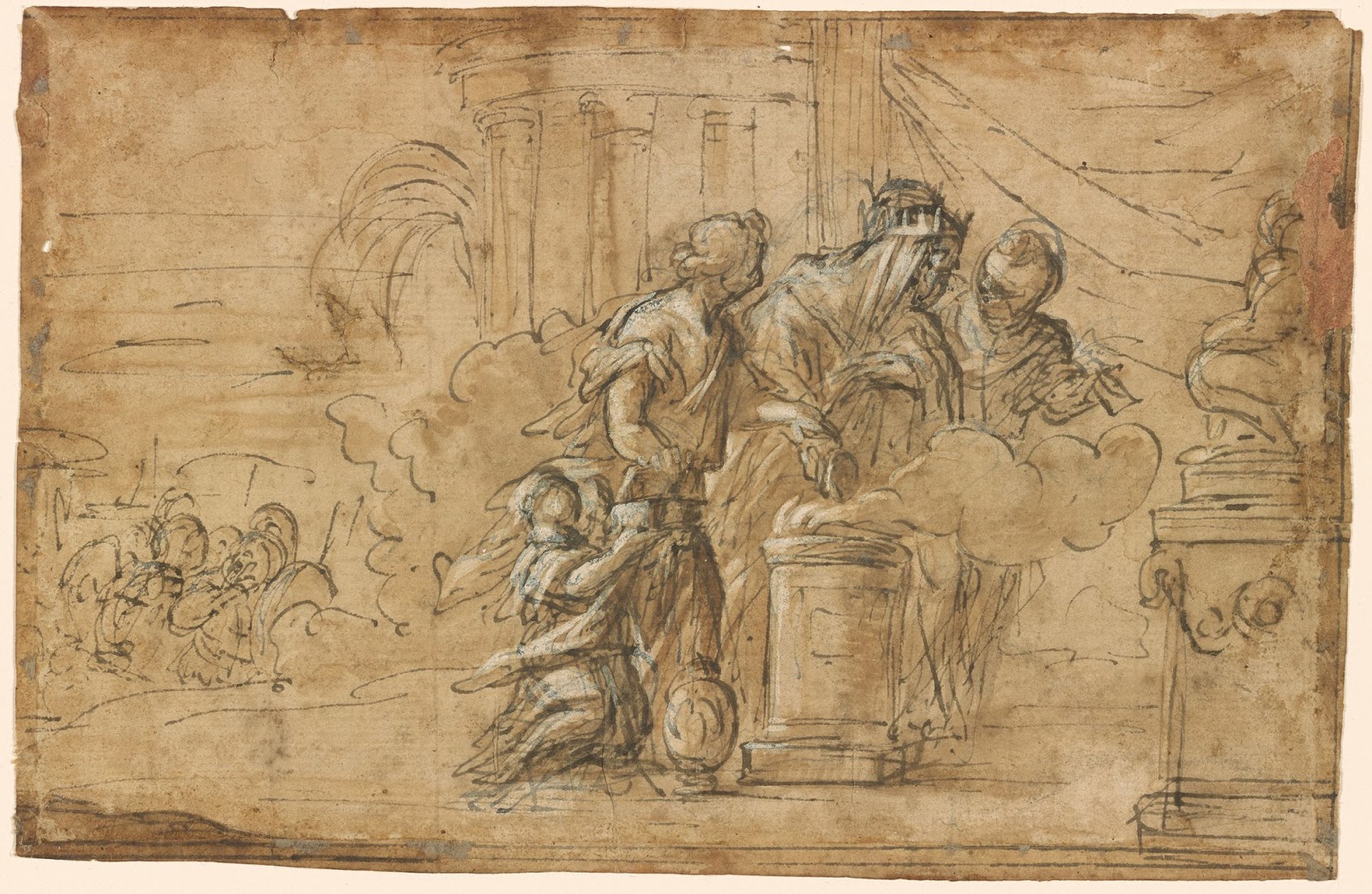
No Peace for the Wicked

And the LORD was angry with Solomon, because his heart had turned away from the LORD, the God of Israel, who had appeared to him twice 10 and had commanded him concerning this thing, that he should not go after other gods. But he did not keep what the LORD commanded. 11 Therefore the LORD said to Solomon, “Since this has been your practice and you have not kept my covenant and my statutes that I have commanded you, I will surely tear the kingdom from you and will give it to your servant. 12 Yet for the sake of David your father I will not do it in your days, but I will tear it out of the hand of your son. 13 However, I will not tear away all the kingdom, but I will give one tribe to your son, for the sake of David my servant and for the sake of Jerusalem that I have chosen.”

14 And the LORD raised up an adversary against Solomon, Hadad the Edomite. He was of the royal house in Edom. 15 For when David was in Edom, and Joab the commander of the army went up to bury the slain, he struck down every male in Edom 16 (for Joab and all Israel remained there six months, until he had cut off every male in Edom). 17 But Hadad fled to Egypt, together with certain Edomites of his father’s servants, Hadad still being a little child. 18 They set out from Midian and came to Paran and took men with them from Paran and came to Egypt, to Pharaoh king of Egypt, who gave him a house and assigned him an allowance of food and gave him land. 19 And Hadad found great favor in the sight of Pharaoh, so that he gave him in marriage the sister of his own wife, the sister of Tahpenes the queen. 20 And the sister of Tahpenes bore him Genubath his son, whom Tahpenes weaned in Pharaoh’s house. And Genubath was in Pharaoh’s house among the sons of Pharaoh. 21 But when Hadad heard in Egypt that David slept with his fathers and that Joab the commander of the army was dead, Hadad said to Pharaoh, “Let me depart, that I may go to my own country.” 22 But Pharaoh said to him, “What have you lacked with me that you are now seeking to go to your own country?” And he said to him, “Only let me depart.”

23 God also raised up as an adversary to him, Rezon the son of Eliada, who had fled from his master Hadadezer king of Zobah. 24 And he gathered men about him and became leader of a marauding band, after the killing by David. And they went to Damascus and lived there and made him king in Damascus. 25 He was an adversary of Israel all the days of Solomon, doing harm as Hadad did. And he loathed Israel and reigned over Syria. 1 Kings 11:9-25 ESV

Solomon’s name is derived from the Hebrew word shalowm, which means “peace,” and Solomon lived up to his name, delivering to his people an unprecedented time of peace and tranquility.

Solomon’s dominion extended over all the kingdoms west of the Euphrates River, from Tiphsah to Gaza. And there was peace on all his borders. During the lifetime of Solomon, all of Judah and Israel lived in peace and safety. – 1 Kings 4:24-25 NLT

While Solomon used his great wealth to purchase thousands of horses and chariots to equip his army, his investment proved unwise and unnecessary because there were no enemies to fight. He had managed to secure the peace through carefully negotiated treaties with the surrounding nations and through marital alliances with princesses from Moab, Ammon, Edom, Sidon, and among the Hittites.

However, those very same women ultimately turned Solomon’s heart away from the Lord. By choosing to align himself with these pagan princesses, Solomon exposed himself to the false gods of their home nations. Driven by his own lust for sensual pleasure, Solomon compromised his convictions and disobeyed the command of God.

“You shall not enter into marriage with them, neither shall they with you, for surely they will turn away your heart after their gods.” – 1 Kings 11:2 ESV

To say that Solomon was obsessed with women is not an exaggeration. He had managed to accumulate for himself 700 wives of royal birth, in direct violation of God’s word. The text reveals that Solomon “clung to these in love” (1 Kings 11:2 ESV). The image conveyed in the Hebrew is that Solomon was clinging to these women, like a child with a toy he refuses to give up. The Hebrew word for “love” in this passage is ‘ahab, and in the context, it carries a somewhat negative connotation.  The author appears to portray Solomon as driven by lustful, sensual motives that blinded him to the dangers of his actions. This man had the financial resources and the power to deny himself nothing his heart desired. He was like an addict with full access to his drug of choice. Solomon loved women, and he had more than 700 wives and 300 concubines to satisfy his seemingly insatiable sexual desires.

In an attempt to please his many wives, Solomon constructed altars and shrines to the various gods they worshipped.

On the Mount of Olives, east of Jerusalem, he even built a pagan shrine for Chemosh, the detestable god of Moab, and another for Molech, the detestable god of the Ammonites. Solomon built such shrines for all his foreign wives to use for burning incense and sacrificing to their gods. – 1 Kings 11:7-8 NLT

This undertaking proved costly to Solomon, and not just financially. Just as he had invested his financial resources to build a Temple to the one true God, he poured money and human resources into the construction of worship sites dedicated to the false gods of his many wives. The presence of these ubiquitous shrines became a source of temptation to the people of Israel, causing them to turn their backs on Yahweh.

God had promised to give Solomon wealth and fame, but now he was using the financial blessings of God to promote the worship of false gods. His determination to placate his wives’ religious convictions did not go unnoticed by Yahweh. God delivered a stinging rebuke to Solomon, informing him that his disobedience would have dire consequences.

“Since you have not kept my covenant and have disobeyed my decrees, I will surely tear the kingdom away from you and give it to one of your servants.” – 1 Kings 11:11 NLT

God had chosen Solomon to be the next king of Israel, following in the footsteps of his father, David. But Solomon had “refused to follow the LORD completely, as his father, David, had done” (1 Kings 11:6 NLT). Unlike David, Solomon failed to remain faithful to God. He had a divided allegiance, allowing his love for God to become diluted by his love of the world and his lust for sensual pleasures. So, God threatened to bring judgment upon Solomon by dividing his kingdom in half. The vast empire that Solomon had spent so much time, energy, and money building would be reduced to a fraction of its former glory. Not only that, the peace that Israel enjoyed would be disrupted by the arrival of “adversaries” — enemies sent by God to punish His disobedient king and people.

Out of His respect for David, God graciously allowed Solomon to complete his reign with his kingdom intact. It would be Solomon’s son who would have to suffer the consequences of his father’s sin. But, in the meantime, Solomon would have to endure the unpleasant prospect of war. The text clearly states that “the LORD raised up Hadad the Edomite, a member of Edom’s royal family, to be Solomon’s adversary” (1 Kings 11:14 NLT). This was a sovereign act of God. Hadad was chosen by God to be an instrument of His judgment against Solomon.

Hadad was a member of the Edomite royal family who had been living in exile in Egypt ever since David’s forces had conquered and occupied their land.

So David became even more famous when he returned from destroying 18,000 Edomites in the Valley of Salt. He placed army garrisons throughout Edom, and all the Edomites became David’s subjects. In fact, the LORD made David victorious wherever he went. – 2 Samuel 8:13-14 NLT

In an attempt to explain Hadad’s animosity toward Solomon, the author reveals that “Hadad and a few of his father’s royal officials escaped and headed for Egypt” (1 Kings 11:17 NLT). Joab, the commanding general over David’s armies, had remained in Edom with a contingent of troops, orchestrating a clean-up operation. They spent six months methodically and systematically eradicating every last male among the Edomites.

Having fled to Egypt for refuge, Hadad found himself welcomed by Pharaoh with open arms. He was even allowed to marry the queen’s sister. This very brief history of Hadad’s time in Egypt mirrors that of Moses. The one who would become the eventual deliverer of Israel had been born in Egypt, during a perilous time when Pharaoh had ordered the deaths of all the male children of the Hebrews. However, Moses had been miraculously delivered and ultimately became a member of Pharaoh’s household. And this young man was eventually used by God to rescue His people from their enslavement in Egypt.

Yet, in Hadad’s case, he was an Edomite who had fled to Egypt for refuge and would be used by God, not to deliver the people of Israel, but to punish them. He would return to the land of promise to bring judgment, not blessing. He would be used by God to deliver punishment, not peace, and he would not be alone in his role as God’s agent of judgment. God would also raise up Rezon, son of Eliada.

While Hadad represented the Edomites in the south, Rezon would rally the northern enemies of Israel. Essentially, God was creating a pincer movement designed to envelop the Israelites from two sides. Solomon was going to find himself surrounded by adversaries, and these two men would use their intense hatred for David and the people of Israel to fuel their ongoing and unrelenting harassment of Solomon.

Rezon was Israel’s bitter adversary for the rest of Solomon’s reign, and he made trouble, just as Hadad did. Rezon hated Israel intensely and continued to reign in Aram. – 1 Kings 11:25 NLT

Solomon’s “love” for his many wives had led him to disobey God. His unbridled lust had influenced him to make unwise decisions that resulted in ungodly behavior. And now, he was going to pay the consequences. Solomon, the king whose name meant “peace”  (shalom), would have his fairytale existence disrupted by external threats that would impact his bottom line and sow doubt and distrust among his people. The glory days were over. Solomon’s decision to disobey Yahweh came with a high price that would leave him with regrets and fill him with remorse. He would later record his thoughts in the Book of Ecclesiastes.

When you vow a vow to God, do not delay paying it, for he has no pleasure in fools. Pay what you vow. It is better that you should not vow than that you should vow and not pay. Let not your mouth lead you into sin, and do not say before the messenger that it was a mistake. Why should God be angry at your voice and destroy the work of your hands? For when dreams increase and words grow many, there is vanity; but God is the one you must fear. – Ecclesiastes 5:4-7 ESV

Solomon failed to keep his vow to Yahweh and suffered the consequences, but he learned a valuable lesson from his mistake that he chose to share for posterity.

The end of the matter; all has been heard. Fear God and keep his commandments, for this is the whole duty of man. For God will bring every deed into judgment, with every secret thing, whether good or evil. – Ecclesiastes 12:13-14 ESV

English Standard Version (ESV) The Holy Bible, English Standard Version. ESV® Permanent Text Edition® (2016). Copyright © 2001 by Crossway Bibles, a publishing ministry of Good News Publishers.

New Living Translation (NLT) Holy Bible, New Living Translation, copyright © 1996, 2004, 2015 by Tyndale House Foundation. Used by permission of Tyndale House Publishers Inc., Carol Stream, Illinois 60188. All rights reserved.

God Alone Is Just

A Psalm of Asaph.

1 God has taken his place in the divine council;
    in the midst of the gods he holds judgment:
“How long will you judge unjustly
    and show partiality to the wicked? Selah
Give justice to the weak and the fatherless;
    maintain the right of the afflicted and the destitute.
Rescue the weak and the needy;
    deliver them from the hand of the wicked.”

They have neither knowledge nor understanding,
    they walk about in darkness;
    all the foundations of the earth are shaken.

I said, “You are gods,
    sons of the Most High, all of you;
nevertheless, like men you shall die,
    and fall like any prince.”

Arise, O God, judge the earth;
    for you shall inherit all the nations! Psalm 82:1-8 ESV

While this psalm is relatively brief, its history of interpretation has been long and controversial. The opening line is where the confusion and ultimate disagreement begin. The English Standard Version reads, “God has taken his place in the divine council; in the midst of the gods he holds judgment” (Psalm 82:1 ESV). Yet, the New English Translation renders this same verse quite differently.

God stands in the assembly of El;
in the midst of the gods he renders judgment. – Psalm 82:1 NET

The NET Bible translators chose to use the Hebrew word ‘ēl because they believed it was a reference to the Canaanite god El. In the study notes that accompany their translation, the editors wrote, “The present translation assumes this is a reference to the Canaanite high god El, who presided over the Canaanite divine assembly. (See Isa 14:13, where El’s assembly is called “the stars of El.”) In the Ugaritic myths the phrase ʿdt ʾilm refers to the “assembly of the gods,” who congregate in King Kirtu’s house, where Baal asks El to bless Kirtu’s house (see G. R. Driver, Canaanite Myths and Legends, 91). If the Canaanite divine assembly is referred to here in Ps 82:1, then the psalm must be understood as a bold polemic against Canaanite religion. Israel’s God invades El’s assembly, denounces its gods as failing to uphold justice, and announces their coming demise” (NET Bible study notes).

The issue lies with the interpretation of the Hebrew word ‘ēl. It has a range of meanings and was used to refer to everything from gods to human rulers and judges. El was the name of the Canaanite god, but it was also the title used by the Israelites when referring to the God of Abraham, Isaac, and Jacob. It is commonly translated as “mighty one(s)” and is sometimes rendered as “divine council” (ESV) or “assembly (NASB). This reference to a divine council or assembly has led some interpreters to see these verses as speaking of angelic beings. Others have interpreted it as a reference to a category of lesser gods who serve as advisors to the one true God. These various interpretations are complicated by Asaph’s reference to “the gods” at the end of verse 1.

God [‘ĕlōhîm] has taken his place in the divine council;
    in the midst of the gods [‘ĕlōhîm] he holds judgment. – Psalm 82:1 ESV

Notice that Asaph uses the same Hebrew word, ‘ĕlōhîm, when referring to Israel’s God and the gods over whom he holds judgment. The key to understanding the rest of the passage lies in how one interprets Asaph’s use of the word ‘ĕlōhîm. The Israelites viewed ‘ĕlōhîm as a title more than a name. It was the word they used when referring to all gods, including their own and those of the pagan nations. The actual name they used to refer to their God was Yahweh, because that was what they had been commanded to do. Back when God commissioned Moses to deliver the people of Israel from their captivity in Egypt, He told His reluctanct servant, “Say this to the people of Israel: Yahweh, the God of your ancestors—the God of Abraham, the God of Isaac, and the God of Jacob—has sent me to you. This is my eternal name, my name to remember for all generations” (Exodus 3:15 NLT).

But in his psalm, Asaph uses God’s title ‘ĕlōhîm and states that He rules in the midst of the ‘ĕlōhîm. Once again, this Hebrew word has a variety of meanings. It is the plural form of ‘ēl and can be rendered as “gods, mighty ones, judges, or rulers. In the Hebrew Bible, it is used to refer to angels, pagan gods, human judges, and even Yahweh Himself. But the question becomes, what was Asaph’s purpose in using this word in his psalm?

The context of his psalm contains the answer. He describes God as standing as judge over some assembly of influential individuals. Are they gods, angels, kings, or judges? Is this council made up of divine beings or mere men? Based on God’s line of questioning, it would appear that He is addressing human rulers whom He views as His divinely appointed representatives on earth. These men were to serve as mediators among the people of Israel, helping to apply God’s laws in settling disputes and delivering justice. But God was not pleased with their performance.

“How long will you defend the unjust
    and show partiality to the wicked?
Defend the weak and the fatherless;
    uphold the cause of the poor and the oppressed.
Rescue the weak and the needy;
    deliver them from the hand of the wicked. – Psalm 82:2-4 NLT

God was accusing these human judges of dereliction of duty. They had failed to do their jobs, and He was not pleased. King David wrote a similar stinging indictment in Psalm 59. As king, he was responsible for the oversight of all judicial matters in Israel. As his kingdom grew, he appointed judges to adjudicate all the cases among his people. But he soon discovered that the blind were leading the blind. His judges were as sinful as the people under their care, and he was merciless in his criticism of them.

Justice—do you rulers know the meaning of the word?
    Do you judge the people fairly?
No! You plot injustice in your hearts.
    You spread violence throughout the land.
These wicked people are born sinners;
    even from birth they have lied and gone their own way.
They spit venom like deadly snakes;
    they are like cobras that refuse to listen,
ignoring the tunes of the snake charmers,
    no matter how skillfully they play. – Psalm 58:1-5 NLT

The prophet Isaiah delivered a similar rebuke to the judges of Israel, whom God found to be negligent in their duties, guilty of gross incompetence, and worthy of His wrath.

What sorrow awaits the unjust judges
    and those who issue unfair laws.
They deprive the poor of justice
    and deny the rights of the needy among my people.
They prey on widows
    and take advantage of orphans.
What will you do when I punish you,
    when I send disaster upon you from a distant land?
To whom will you turn for help?
    Where will your treasures be safe?
You will stumble along as prisoners
    or lie among the dead.
But even then the Lord’s anger will not be satisfied.
    His fist is still poised to strike. – Isaiah 10:1-4 NLT

In verse 6 of his psalm, Asaph records God referring to these judges as “gods” [‘ĕlōhîm] and “sons of the Most High,” but His compliment appears to be tongue in cheek.

“You are gods,
    sons of the Most High, all of you;
nevertheless, like men you shall die,
    and fall like any prince.” – Psalm 82:6-7 NLT

These verses reek of sarcasm as God takes these self-inflated, egotistical men to task for their overly lofty view of themselves. They have taken themselves too seriously and allowed their authority to go to their heads. Puffed up with pride, they have abused their power to take advantage of the weak and defenseless. Proverbs 24 provides insight into what these men were guilty of doing.

It is wrong to show favoritism when passing judgment.
A judge who says to the wicked, “You are innocent,”
    will be cursed by many people and denounced by the nations.
But it will go well for those who convict the guilty;
    rich blessings will be showered on them. – Proverbs 24:23-25 NLT

God cares deeply about truth and justice. He gave His Law as a guide to moral conduct and a means of adjudicating disputes among His people. But it must be applied fairly and equitably. The powerful were never to use their authority to take advantage of the weak or less fortunate. Judges were not to use positions to fleece the flock and pad their own pockets. Bribes were to be avoided at all costs. Cronyism was unacceptable.  Showing partiality for personal gain was off limits and worthy of harsh judgment. God would not tolerate injustice among those responsible for the care of His flock.

As a citizen of the kingdom of Israel, Asaph had been subjected to this unjust judicial system and was ready for God to step in and rectify the problem. He calls the ultimate Judge of the universe to remediate the problem and adjudicate the claims of the weak and defenseless.

Arise, O God, judge the earth;
    for you shall inherit all the nations! – Psalm 82:8 ESV

Asaph was willing to trust God to do the right thing. He believed that Yahweh could and would right all wrongs and ensure justice was served. It was Solomon who wrote of God’s role as judge and his belief that justice will be served in the end.

I know that whatever God does is final. Nothing can be added to it or taken from it. God’s purpose is that people should fear him. What is happening now has happened before, and what will happen in the future has happened before, because God makes the same things happen over and over again.

I also noticed that under the sun there is evil in the courtroom. Yes, even the courts of law are corrupt! I said to myself, “In due season God will judge everyone, both good and bad, for all their deeds.” – Ecclesiastes 3:14-16 NLT

Asaph and Solomon both knew that justice was up to God. Even the prophet Jeremiah understood that his desire for an equitable outcome to his grievances was up to an all-knowing, all-powerful God, whose desire for justice was matched by capacity to deliver it.

O LORD of Heaven’s Armies,
you make righteous judgments,
    and you examine the deepest thoughts and secrets.
Let me see your vengeance against them,
    for I have committed my cause to you. – Jeremiah 11:20 NLT

Father, You are just, righteous, and good – all the time. While we may have to suffer the abuse of ungodly men using their power in unfair and inequitable ways, we know we can count on You to make all things right. Living in this world can be difficult because fallen men in positions of authority use and abuse their power in ways that promote injustice and produce unfair outcomes. But You are always on Your throne and You never miss a single unjust judgment. You know all and see all. And one day, You will rectify all. Help me to trust You more. Give me the strength to endure injustice by focusing my hope on You. You are the ultimate Judge of the universe and Your verdict is the only one that matters. Amen

English Standard Version (ESV) The Holy Bible, English Standard Version. ESV® Permanent Text Edition® (2016). Copyright © 2001 by Crossway Bibles, a publishing ministry of Good News Publishers.

New Living Translation (NLT) Holy Bible, New Living Translation, copyright © 1996, 2004, 2015 by Tyndale House Foundation. Used by permission of Tyndale House Publishers Inc., Carol Stream, Illinois 60188. All rights reserved.

Surrounded by Fools

To the choirmaster: according to Mahalath. A Maskil of David.

1 The fool says in his heart, “There is no God.”
    They are corrupt, doing abominable iniquity;
    there is none who does good.

God looks down from heaven
    on the children of man
to see if there are any who understand,
    who seek after God.

They have all fallen away;
    together they have become corrupt;
there is none who does good,
    not even one.

Have those who work evil no knowledge,
    who eat up my people as they eat bread,
    and do not call upon God?

There they are, in great terror,
    where there is no terror!
For God scatters the bones of him who encamps against you;
    you put them to shame, for God has rejected them.

Oh, that salvation for Israel would come out of Zion!
    When God restores the fortunes of his people,
    let Jacob rejoice, let Israel be glad. Psalm 53:1-6 ESV

This psalm is a slight variation on Psalm 14, with David using the title ĕlōhîm when referring to God, instead of Yahweh or Jehovah.

God [ĕlōhîm] looks down from heaven
    on the children of man
to see if there are any who understand,
    who seek after God. – Psalm 53:2 ESV

The LORD [Yᵊhōvâ] looks down from heaven on the children of man,
    to see if there are any who understand,
    who seek after God. – Psalm 14:2 ESV

This amended version of his original psalm was placed between Psalms 52 and 54 to help make a point about David’s interactions with Doeg the Edomite and the Ziphites. In the case of Doeg, this godless man murdered innocent priests and their families to advance his own career. He exhibited no fear of God and no regret for his actions. His dastardly deed is recorded in 1 Samuel 22.

In the very next chapter, David is hiding in Horesh in the land of Ziph. The inhabitants of Ziph learn of his presence among them and send news to King Saul.

Then the Ziphites went up to Saul at Gibeah, saying, “Is not David hiding among us in the strongholds at Horesh, on the hill of Hachilah, which is south of Jeshimon? Now come down, O king, according to all your heart’s desire to come down, and our part shall be to surrender him into the king’s hand.” – 1 Samuel 23:19-20 ESV

To escape Saul’s wrath, David is forced to flee yet again, this time to the strongholds of Engedi.

In both cases, David had to deal with those whom he determined to be fools. His criterion for qualifying for this less-than-flattering designation was simple: they acted as if God were non-existent.

Only fools say in their hearts,
    “There is no God.”
They are corrupt, and their actions are evil;
    not one of them does good! – Psalm 53:1 NLT

Notice that David accuses them of denying God’s existence in their hearts. This was not a verbal declaration but a silent conclusion that led to their godless actions. The Hebrew word David used for “fool” is nāḇāl, which is significant when one considers the story recorded in 1 Samuel 25. Not long after being sold out by the Ziphites, David and his men sought food from a wealthy landowner named Nabal. The text describes him as “crude and mean in all his dealings” (1 Samuel 25:3 NLT). For some unknown reason, his parents had named him nāḇāl, a Hebrew word that means “wicked, impious, or foolish.” The Brown-Driver-Briggs Lexicon describes this kind of individual as “the man who has no perception of ethical and religious claims, and with collateral idea of ignoble, disgraceful.” 

David sends his men to seek provisions from Nabal in return for having protected his shepherds and sheep. But this “fool” of a man lived up to his name and sent the following message to David:

“Who is this fellow David?” Nabal sneered to the young men. “Who does this son of Jesse think he is? There are lots of servants these days who run away from their masters. Should I take my bread and my water and my meat that I’ve slaughtered for my shearers and give it to a band of outlaws who come from who knows where?” – 1 Samuel 25:10-11 NLT

Enraged by Nabal’s disrespectful and ungrateful words, David was ready to end his life. But when Nabal’s wife Abigail learned of the situation, she intervened.

“I accept all blame in this matter, my lord. Please listen to what I have to say. I know Nabal is a wicked and ill-tempered man; please don’t pay any attention to him. He is a fool, just as his name suggests. But I never even saw the young men you sent. – 1 Samuel 25:24-25 NLT

Her actions prevented David from doing something even more foolish than Nabal. He relented from his plan to wipe out Nabal’s entire clan and spared the fool’s life.

David was surrounded by fools. It seemed that everywhere he turned, there were people who acted in foolish ways, treating him with contempt, hostility, and disrespect. They never seemed to consider whether their actions were in line with God’s will. So, in that respect, they acted as if God did not exist. And by this time in his life, David’s assessment of mankind had become fairly jaded.

God looks down from heaven
    on the entire human race;
he looks to see if anyone is truly wise,
    if anyone seeks God.
But no, all have turned away;
    all have become corrupt.
No one does good,
    not a single one! – Psalm 53:2-3 NLT

Everyone was corrupt and godless, from the king all the way down to Doeg, the herdsmen, the traitorous Ziphites, and Nabal the fool. David felt all alone and under constant attack from all sides. He had difficulty understanding how these people could behave in such a way. Did they really think they would get away with their actions? David was blown away by their arrogance and seeming disinterest in God’s judgment.

Will those who do evil never learn?
    They eat up my people like bread
    and wouldn’t think of praying to God. – Psalm 53:4 NLT

Everyone David took issue with was a card-carrying Hebrew who claimed to have a relationship with Yahweh. They were supposed to be God-fearing Jews who shared his belief in Yahweh’s sovereignty. But they acted as if God were nowhere to be found.

Even those who claim to know Him act as if He either doesn’t care about what they do or is too powerless to do anything about it. Some just refuse to believe in Him altogether. These people “are corrupt, and their actions are evil; not one of them does good!” (Psalm 53:1 NLT). This is not a very promising assessment on the character or condition of mankind. It leaves little doubt, at least from God’s perspective, that man is inherently wicked and in open rebellion against Him. Yet God is still reaching out to man, offering mercy and forgiveness. He will ultimately be forced to punish all those who refuse to accept His offer of new life through His Son, but until then, He keeps providing opportunities for them to repent and return to Him.

And while the world is a less-than-ideal place, full of people obsessed with their own agendas, consumed by their own importance, and controlled by their own sin natures, David gives us a glimpse of God’s goodness as he reminds us that God is always there for us even in the midst of all the evil that surrounds us. “But God is my helper. The Lord keeps me alive!” (Psalm 54:4 NLT).

David appeals to God’s power and places himself at God’s mercy to rescue him from his enemies.

Terror will grip them,
    terror like they have never known before.
God will scatter the bones of your enemies.
    You will put them to shame, for God has rejected them. – Psalm 53:5 NLT

Those who care nothing for God were making David’s life miserable. But David knew he could call out to God, and not only be heard but answered.

Who will come from Mount Zion to rescue Israel?
    When God restores his people,
    Jacob will shout with joy, and Israel will rejoice. – Psalm 53:6 NLT

David had seen the goodness of God time and time again in his life, delivering him from troubles and trials, rescuing him from every conceivable kind of predicament. And while he firmly believed that “no one does good, not a single one,” David knew that God can and does do good for those who love Him. His response was to offer God praise and gratitude. While no one else steps in and rescues God’s people, Yahweh can be counted on to be there when needed. That is why David says, “Jacob will shout with joy, and Israel will rejoice.”

All that God does is good, even when He has to deal with those who are bad. God is righteous and always does what is right. He never does wrong. He is just in all His actions towards men and never punishes unjustly or unfairly. He is good, and it doesn’t matter whether men reject Him, ignore Him, or attempt to deny He even exists. God remains good even when things appear bad.

Father, we live in a world that is sick and dying. It is filled with people who refuse to love and serve You. Many refuse to even believe in You. And yet, You remain good. You continue to make the sun shine on all men, showering them with Your common grace. You make the crops grow, the rain to fall, and the air breathable. You constantly offer the free gift of grace available through Your Son. And You care for Your own, providing them with a listening ear and a powerful hand to rescue and restore them. You are indeed a good God. Amen

English Standard Version (ESV) The Holy Bible, English Standard Version. ESV® Permanent Text Edition® (2016). Copyright © 2001 by Crossway Bibles, a publishing ministry of Good News Publishers.

New Living Translation (NLT) Holy Bible, New Living Translation, copyright © 1996, 2004, 2015 by Tyndale House Foundation. Used by permission of Tyndale House Publishers Inc., Carol Stream, Illinois 60188. All rights reserved.

Jehovah-Elyon

1 The LORD reigns, let the earth rejoice;
    let the many coastlands be glad!
Clouds and thick darkness are all around him;
    righteousness and justice are the foundation of his throne.
Fire goes before him
    and burns up his adversaries all around.
His lightnings light up the world;
    the earth sees and trembles.
The mountains melt like wax before the LORD,
    before the LORD of all the earth.

The heavens proclaim his righteousness,
    and all the peoples see his glory.
All worshipers of images are put to shame,
    who make their boast in worthless idols;
    worship him, all you gods!

Zion hears and is glad,
    and the daughters of Judah rejoice,
    because of your judgments, O LORD.
For you, O LORD, are most high over all the earth;
    you are exalted far above all gods. – Psalm 97:1-9 ESV

YHWHʿelyôn – “The LORD Most High.” Here, the Psalmist combines two names for God designed to set Him apart from all the other “gods” (‘ĕlōhîm). This is not an admission of the existence of other gods, but a declaration that there is only one true God. All other gods are imposters, the fabrication of men’s fertile imaginations.

The ancient Hebrews used one word, ‘ĕlōhîm,  to refer to all gods, but they also used it to refer to their own deity, the God of Abraham, Isaac, and Jacob. The ubiquitous nature of this name could make things confusing because the different variations of the word ‘ĕlōhîm were widely used to refer to any and all gods. The name ‘ĕlōhîm is the plural form of ‘ĕlôha, which was commonly abbreviated to ‘ēl. Each of these names originates from the Hebrew root ‘ālā, which can be translated as “exalted one.” Two of these words are used in verse 9 alongside the personal name of Israel’s God, Yahweh or Jehovah. There is one other designation for God in this verse; elyôn or “the most high.”

For you, O LORD (Yahweh), are most high (ʿelyôn) over all the earth;
    you are exalted (‘ālā) far above all gods (‘ĕlōhîm). – Psalm 97:9 ESV

The first use of this name for God is found in Genesis 14, where Abram encounters  Melchizedek, the king of Salem. The text refers to him as a “priest of God (‘ēl) Most High (ʿelyôn). This priest-king ended up pronouncing a blessing on Abram in the name of ‘ēl ʿelyôn – God Most High.

“Blessed be Abram by God Most High,
    Possessor of heaven and earth;
and blessed be God Most High,
    who has delivered your enemies into your hand!” – Genesis 14:19-20 ESV

Melchizedek was affirming the superiority of the God who had called Abram out of Ur and led him to the land of Canaan. Prior to Abram’s first encounter with this ‘ĕlōhîm, he had worshiped other ‘ĕlōhîm. Now, Melchizedek was letting Abram know that this deity was ʿelyôn – the supreme ‘ĕlōhîm who had no equal and was worthy of Abram’s worship. According to Melchizedek, it was ‘ēl elyôn who had given Abram the victory over Chedorlaomer king of Elam, Tidal king of Goiim, Amraphel king of Shinar, and Arioch king of Ellasar. In a sense, Melchizedek was declaring that ‘ēl elyôn had defeated the ‘ĕlōhîm of these pagan kings. Their gods had been no match for God Most High.

The Psalmist picks up on this name for God but adds another important distinction. He adds the name Yahweh. Five times in nine verses, he uses the personal name of Israel’s God, the name God used to refer to Himself when He spoke to Moses from the burning bush. On this momentous occasion, Moses received a commission from God, commanding him to return to Egypt and deliver the Israelites from their captivity and lead them to the land of Canaan. Upon hearing the details of this assignment, Moses replied, “If I come to the people of Israel and say to them, ‘The God of your fathers has sent me to you,’ and they ask me, ‘What is his name?’ what shall I say to them?” (Exodus 3:13 ESV). Moses knew that the Israelites had long ago turned their backs on the ‘ĕlōhîm of Abraham, Isaac, and Jacob. They had been in Egypt for four centuries and had gradually adopted the ‘ĕlōhîm of their masters. Now, Moses was expected to show up and inform the Israelites that the ‘ĕlōhîm of their fathers expected him to lead them out of Egypt and back to Canaan. So, he asked God for a name. If he simply used the term, ‘ĕlōhîm, the Israelites might become confused and assume that he is talking about one of the many Egyptian gods they worshiped.

God’s response was simple but not exactly clear. He told Moses, I am who I am” (Exodus 3:14 ESV). In Hebrew it reads, hāyâ ‘ăšer hāyâThe word, “hāyâ” is where the name Yahweh comes from. The Hebrews did not include vowels when putting their language in writing. So, the name Yahweh became YHWH. The Latinized version became JHVH, from which the name Jehovah is derived.

When God called Himself, “I am,” He spoke of the nature of His being or existence. He is the “existing one,” which refers to His eternal, non-created state. God is, was, and ever shall be. He is self-existent, having no predecessor or creator. He is self-sufficient and dependent upon no one.

To further clarify His identity, God told Moses to inform the people of Israel, “The LORD (Yᵊhōvâ), the God (‘ĕlōhîm) of your fathers, the God (‘ĕlōhîm) of Abraham, the God (‘ĕlōhîm) of Isaac, and the God (‘ĕlōhîm) of Jacob, has sent me to you” (Exodus 3:15 ESV). In other words, this wasn’t just any ‘ĕlōhîm, it was Jehovah-God, the one true God of Abraham, Isaac, and Jacob. He was the intimate and personal God who had heard their cries and responded to their suffering by providing a means of deliverance.

This was the same God the Psalmist wrote about and each time He mentioned this God, he used the name Yᵊhōvâ or Yahweh.

The LORD (Yᵊhōvâ) reigns – vs 1

The mountains melt like wax before the LORD (Yᵊhōvâ),
    before the LORD (Yᵊhōvâ) of all the earth. – vs 5

Zion hears and is glad,
    and the daughters of Judah rejoice,
    because of your judgments, O LORD (Yᵊhōvâ).
For you, O LORD (Yᵊhōvâ), are most high over all the earth;
    you are exalted far above all gods. – vs 8-9

Yahweh is superior and supreme. He rules over all, and He does so with righteousness and justice (vs 2). The very heavens which He created declare His righteousness (vs 6). Yahweh is elevated high above all the gods (‘ĕlōhîm) of the earth. These man-made gods are impotent and no match for YHWHʿelyôn – The LORD Most High. They stand no chance against the God of Israel, the ‘ĕlōhîm of Abraham, Isaac, and Jacob. Therefore, they are unworthy of man’s adoration and attention. That’s why the Psalmist closes with a call to worship.

O you who love the LORD, hate evil!
    He preserves the lives of his saints;
    he delivers them from the hand of the wicked.
Light is sown for the righteous,
    and joy for the upright in heart.
Rejoice in the LORD, O you righteous,
    and give thanks to his holy name! – Psalm 97:10-11 ESV

He is exalted. He is high and lifted up. He is superior and without equal. And He is worthy of honor, reverence, and worship.

In his gospel account, the apostle John records a heated exchange between Jesus and the Jewish religious leaders. It began with a simple statement that Jesus delivered to a group of Jews who had “believed in Him” (John 8:30 ESV).

“If you abide in my word, you are truly my disciples, and you will know the truth, and the truth will set you free.” – John 8:31-32 ESV

This led them to respond, “We are offspring of Abraham and have never been enslaved to anyone. How is it that you say, ‘You will become free’?” (John 8:33 ESV). Jesus, knowing that the Jewish religious leaders were in the crowd and sensing their growing animosity, responded, “I know that you are offspring of Abraham; yet you seek to kill me because my word finds no place in you. I speak of what I have seen with my Father, and you do what you have heard from your father” (John 8:37-38 ESV).

His words hit their mark, incensing His adversaries and sparking a heated interchange. What they didn’t know was that Jesus’ use of the term “father” was a reference to Satan. He was accusing them of being in league with the enemy and not with Yahweh. Unaware of His slight, they declared their status as the sons of Abraham; he was their “father.” By declaring their descendence from Abraham, they claimed their status as heirs to the promises God made to Abraham’s seed. But that’s when Jesus dropped the bombshell that left them reeling and enraged.

“You are of your father the devil, and your will is to do your father’s desires. He was a murderer from the beginning, and does not stand in the truth, because there is no truth in him. When he lies, he speaks out of his own character, for he is a liar and the father of lies. But because I tell the truth, you do not believe me.” – John 8:44-45 ESV

Angered by His words, the religious leaders declared him to be demon-possessed. In doing so, they not only rejected His words but defamed His ministry. Yet Jesus calmly replied, “Your father Abraham rejoiced that he would see my day. He saw it and was glad” (John 8:56 ESV). This made no sense to them. Jesus was a young man and had not lived long enough to see or be seen by Abraham, who was long dead. 

This is when Jesus shocked them by making a claim that they would view as blasphemy and worthy of death.

Jesus said to them, “Truly, truly, I say to you, before Abraham was, I am.” – John 8:58 ESV

It’s clear how angry this statement made them because they immediately attempted to stone Him to death. But what did Jesus say that escalated their anger to such a high degree? Why were they intent on killing Him? The answer is found in those two simple words: “I am.”

They knew exactly what Jesus was saying and claiming. He used the very words that God spoke to Moses at the burning bush. He claimed to be Yahweh and, in so doing, set Himself up as YHWHʿelyôn – The LORD Most High. He wasn’t just a man, an itinerant rabbi from the backwater village of Nazareth. He was Jehovah God, the self-existent one and the most high (‘ĕlōhîm) of all.

Just minutes earlier, Jesus had made the claim, “If I glorify myself, my glory is nothing. It is my Father who glorifies me, of whom you say, ‘He is our God’” (John 8:54 ESV). With this statement, Jesus claimed His divine sonship and declared that God considered Him glorious and worthy of worship, honor, and obedience.

Everything the Psalmist said about Jehovah was true of Jesus.

you, O LORD, are most high over all the earth;
    you are exalted far above all gods. – Psalm 97:9 ESV

When John the Baptist was preparing the Israelites for the coming of Jesus, he told them, “I am the voice of one crying out in the wilderness, ‘Make straight the way of the LORD,’ as the prophet Isaiah said” (John 1:23 ESV). He claimed to be fulfilling the prophecy of Isaiah recorded in Isaiah 40:3-5.

A voice cries:
“In the wilderness prepare the way of the LORD (Yᵊhōvâ);
    make straight in the desert a highway for our God (‘ĕlōhîm).
Every valley shall be lifted up,
    and every mountain and hill be made low;
the uneven ground shall become level,
    and the rough places a plain.
And the glory of the LORD (Yᵊhōvâ) shall be revealed,
    and all flesh shall see it together,
    for the mouth of the LORD (Yᵊhōvâ) has spoken.” – Isaiah 40:3-5 ESV

Jesus was the Son of God and the Lord Most High, and after His death, burial, resurrection, and ascension, He returned to His Father’s side where He sits enthroned and awaits His return. The Book of Revelation contains a vivid description of that day when Jesus, the LORD Most High, will make His appearance and set up His Kingdom on earth.

Then I saw heaven opened, and behold, a white horse! The one sitting on it is called Faithful and True, and in righteousness he judges and makes war. His eyes are like a flame of fire, and on his head are many diadems, and he has a name written that no one knows but himself. He is clothed in a robe dipped in blood, and the name by which he is called is The Word of God. And the armies of heaven, arrayed in fine linen, white and pure, were following him on white horses. From his mouth comes a sharp sword with which to strike down the nations, and he will rule them with a rod of iron. He will tread the winepress of the fury of the wrath of God the Almighty. On his robe and on his thigh he has a name written, King of kings and Lord of lords. – Revelation 19:11-16 ESV

English Standard Version (ESV) The Holy Bible, English Standard Version. ESV® Permanent Text Edition® (2016). Copyright © 2001 by Crossway Bibles, a publishing ministry of Good News Publishers.

New Living Translation (NLT) Holy Bible, New Living Translation, copyright © 1996, 2004, 2015 by Tyndale House Foundation. Used by permission of Tyndale House Publishers Inc., Carol Stream, Illinois 60188. All rights reserved.

New English Translation (NET)NET Bible® copyright ©1996-2017 by Biblical Studies Press, L.L.C. http://netbible.com All rights reserved.

Jehovah-Kanna

10 The Lord replied, “Listen, I am making a covenant with you in the presence of all your people. I will perform miracles that have never been performed anywhere in all the earth or in any nation. And all the people around you will see the power of the Lord—the awesome power I will display for you. 11 But listen carefully to everything I command you today.…12 Be very careful never to make a treaty with the people who live in the land where you are going. If you do, you will follow their evil ways and be trapped. 13 Instead, you must break down their pagan altars, smash their sacred pillars, and cut down their Asherah poles. 14 You must worship no other gods, for the Lord, whose very name is Jealous, is a God who is jealous about his relationship with you.– Exodus 34:10-14 ESV

In Genesis 22, the story is recorded of Abraham preparing to offer up his own son as a sacrifice on a hastily constructed altar. This disconcerting tale makes for difficult reading, especially when you realize that Abraham was following the commands of Elohim, the God who had miraculously enabled his barren wife Sarah to give birth to Isaac years earlier. Yet, in obeying the command of God and trusting the future of his only son to the faithfulness of God, Abraham was given the privilege of seeing God work a miracle of redemption, delivering his son from certain death. Rather than requiring Abraham to go through with the sacrifice, God provided a ram to serve as Isaac’s substitute. This led Abraham to call the place upon which he built the altar, Jehovah-Jireh, which means something to the effect of “God sees and provides.”

Abraham had experienced this aspect of God’s character for the very first time and it led him to memorialize his newfound awareness of God’s foresight and gracious provision with an appellation worthy of God’s glory. In the Genesis account, Moses adds the note, “To this day, people still use that name as a proverb: “On the mountain of the Lord it will be provided” (Genesis 22:14 NLT). This indicates that Abraham shared this story and it was passed down from one generation to another. But, even more importantly, Moses’ aside also serves a prophetic role, foreshadowing another day when God the Father would offer up His sinless Son as the substitutionary atonement for the sins of mankind. That fateful event would take place on the very same mountain. God saw the helpless and hopeless state of humanity, enslaved and condemned by sin, and facing divine judgment, and He responded by providing a Savior. He sent His Son to serve as the Lamb of God who would take away the sins of the world (John 1:9). 

But how did humanity end up in such a sad and desperate state? It was the result of their own disobedience to God; their refusal to recognize Him as the one true God and worship Him alone. The apostle Paul describes humanity’s downward trajectory and its consequences.

…they knew God, but they wouldn’t worship him as God or even give him thanks. And they began to think up foolish ideas of what God was like. As a result, their minds became dark and confused. Claiming to be wise, they instead became utter fools. And instead of worshiping the glorious, ever-living God, they worshiped idols made to look like mere people and birds and animals and reptiles.

So God abandoned them to do whatever shameful things their hearts desired. As a result, they did vile and degrading things with each other’s bodies. They traded the truth about God for a lie. So they worshiped and served the things God created instead of the Creator himself, who is worthy of eternal praise! – Romans 1:21-25 NLT

In today’s passage, we have another name of God that describes an aspect of His character that gets often overlooked. It may even come across as an ungodly and unacceptable way to refer to God; yet, the Exodus 34 passage reveals that this is God’s self-revelation; His way of describing His divine nature to fallen mankind.

He is “the LORD, whose name is Jealous…” (Exodus 34:14 ESV). He is YHWH-qannā’. But this is more than just a name; it expresses His character. This self-designation is an extension of the commandment God gave that prohibits the worship of anyone or anything other than Himself.

“You must not make for yourself an idol of any kind or an image of anything in the heavens or on the earth or in the sea. You must not bow down to them or worship them, for I, the Lord your God, am a jealous God who will not tolerate your affection for any other gods.” – Exodus 20:4-5 NLT

Yahweh is a jealous God. This thought may sound strange to us and leave us feeling uncomfortable. In part, this is a result of our own love-hate relationship with jealousy. We tend to view jealousy in a negative light, associating it with sin. Even the apostle Paul lumped jealousy in with a list of other egregious behaviors that are the byproducts of man’s sinful nature.

When you follow the desires of your sinful nature, the results are very clear: sexual immorality, impurity, lustful pleasures, idolatry, sorcery, hostility, quarreling, jealousy, outbursts of anger, selfish ambition, dissension, division, envy, drunkenness, wild parties, and other sins like these. Let me tell you again, as I have before, that anyone living that sort of life will not inherit the Kingdom of God. – Galatians 5:19-21 NLT

It’s difficult to associate such an unflattering character quality with our Holy God. Yet, God refers to Himself as being jealous and even designates it as one of His names. It is not a reaction or a temporary trait; it is an expression of His very nature.

We tend to associate jealousy with envy and covetousness. When we read God’s command, “You must not covet your neighbor’s house. You must not covet your neighbor’s wife, male or female servant, ox or donkey, or anything else that belongs to your neighbor” (Exodus 17 NLT), we substitute jealousy for coveting. But jealousy and covetousness are two different things. To covet is to wrongly desire that which belongs to someone else. It doesn’t belong to you and you have no right to possess it. It is closely associated with stealing. When King David saw Bathsheba bathing on a nearby rooftop, he lusted after her. When he was informed that she was a married woman, his lust turned to covetousness. He knew she was off-limits but it did not stop him from sending for her so that he might commit adultery with her.

The Hebrew word, qannā’, which is translated as “jealous” is only used of God in the Bible, and it almost always associated with His judgment against the worship of false gods.

“Take care, lest you forget the covenant of the Lord your God, which he made with you, and make a carved image, the form of anything that the Lord your God has forbidden you. For the Lord your God is a consuming fire, a jealous God.” – Deuteronomy 4:23-24 ESV

You shall not go after other gods, the gods of the peoples who are around you— for the Lord your God in your midst is a jealous God—lest the anger of the Lord your God be kindled against you, and he destroy you from off the face of the earth. – Deuteronomy 6:14-15 ESV

These passages are not inferring that God is jealous of us. This does not describe the jealousy of a husband whose wife shows affection to another man. God’s jealousy is not about His need for our affection or adoration; it is about the integrity of His name. The people of Israel were His chosen possession. He had created them and they bore the responsibility of living as the children of God. Their actions and behavior were to reflect their position as His earthly representatives.

When Joshua was nearing the end of his life, he pleaded with the people of Israel to swear allegiance to Yahweh, stating, “as for me and my family, we will serve the Lord” (Joshua 24:15 NLT). The Israelites, eager to complete their conquest and occupation of the land of Canaan, declared their willingness to serve Yahweh only.

We would never abandon the Lord and serve other gods. For the Lord our God is the one who rescued us and our ancestors from slavery in the land of Egypt. He performed mighty miracles before our very eyes. As we traveled through the wilderness among our enemies, he preserved us. It was the Lord who drove out the Amorites and the other nations living here in the land. So we, too, will serve the Lord, for he alone is our God.” – Joshua 24:16-18 NLT

But Joshua wasn’t buying what they were selling. He knew them all too well and voiced doubt in their sincerity. After having served as their leader for years, he was convinced they would continue to rebel against God and face future judgment as a result

“You are not able to serve the Lord, for he is a holy and jealous God. He will not forgive your rebellion and your sins. If you abandon the Lord and serve other gods, he will turn against you and destroy you, even though he has been so good to you.” – Joshua 24:19-20 NLT

When the people assured Joshua of their sincerity, he demanded proof, instructing them to, “destroy the idols among you, and turn your hearts to the Lord, the God of Israel” (Joshua 24:23 NLT). He was not suggesting that God needed their undivided attention and affection. Yahweh is not desperate for our attention. He isn’t jealous that we share our affection with other gods. He is jealous and protective of the holiness of His name.

“Thus says the Lord God: It is not for your sake, O house of Israel, that I am about to act, but for the sake of my holy name, which you have profaned among the nations to which you came. And I will vindicate the holiness of my great name, which has been profaned among the nations, and which you have profaned among them. And the nations will know that I am the Lord…” – Ezekiel 36:22-23 NLT

Our spiritual infidelity is not about unrequited love but about the unacceptable dishonoring of God’s name and character.  In the Exodus 34 passage, Noses reminds the Israelites that Yahweh is “a God who is jealous about his relationship with you” (Exodus 34:14 ESV). That relationship was to reflect their awareness of His glory, holiness, and worthiness of their undivided worship and attention. When they devoted their time and attention to false gods, it did nothing to diminish God’s self-esteem or worthiness; it dishonored His name among the nations.

He had set His name upon the people of Israel. In the Book of Isaiah, He refers to them as His children and promises to “bring my sons from afar and my daughters from the end of the earth, everyone who is called by my name, whom I created” (Isaiah 43:6-7 ESV). Their identity was based on their identification as children of God who bore the name of God. When they showered their affections on false gods, it was not their lack of love that brought down God’s anger and judgment; it was their lack of respect for His name. That’s why God demands that their affection be accompanied by allegiance to His glory and greatness.

“…if my people who are called by my name will humble themselves and pray and seek my face and turn from their wicked ways, I will hear from heaven and will forgive their sins and restore their land. – 2 Chronicles 7:14 NLT

As the bearers of God’s name, the Israelites bore the responsibility of loving and living in keeping with their status as the sons and daughters of God. And God makes it clear that their obedience and obeisance would demonstrate to the world that they belonged to Him.

“The Lord will establish you as a people holy to himself, as he has sworn to you, if you keep the commandments of the Lord your God and walk in his ways. And all the peoples of the earth shall see that you are called by the name of the Lord… – Deuteronomy 28:9-10 ESV

God is YHWH-qannā’ – Jehovah-Kanna. He is jealous and protective of His name and, as His name-bearers, we have a non-negotiable responsibility to preserve the integrity of His name as we dedicate the entirety of our lives to His glory alone.

English Standard Version (ESV)
The Holy Bible, English Standard Version. ESV® Permanent Text Edition® (2016). Copyright © 2001 by Crossway Bibles, a publishing ministry of Good News Publishers.

New Living Translation (NLT)
Holy Bible, New Living Translation, copyright © 1996, 2004, 2015 by Tyndale House Foundation. Used by permission of Tyndale House Publishers Inc., Carol Stream, Illinois 60188. All rights reserved.

Jehovah-Jireh

13 And Abraham lifted up his eyes and looked, and behold, behind him was a ram, caught in a thicket by his horns. And Abraham went and took the ram and offered it up as a burnt offering instead of his son. 14 So Abraham called the name of that place, “The Lord will provide”; as it is said to this day, “On the mount of the Lord it shall be provided.”– Genesis  22:13-14 ESV

Genesis 22 contains the familiar and somewhat unsettling story of Abraham’s attempted sacrifice of his son Isaac. Moses records every excruciating detail surrounding this God-sanctioned event that required a loving father to offer up the life of his one-and-only son as a sacrifice. Abraham had received clear and non-negotiable instructions from ‘ĕlōhîm.

“Take your son, your only son Isaac, whom you love, and go to the land of Moriah, and offer him there as a burnt offering on one of the mountains of which I shall tell you.” – Genesis 22:2 ESV

Amazingly, the text contains no pushback from Abraham. There is no record of him arguing with or questioning God’s command. It simply states, “So Abraham rose early in the morning, saddled his donkey, and took two of his young men with him, and his son Isaac” (Genesis 22:3 ESV).

Three days into their journey to the region of Moriah, Abraham saw their final destination in the distance and decided to leave his servants behind. He and Isaac would travel alone to the place of sacrifice. Abraham, perhaps hoping to hide his true intentions from his unwitting son, told his servants, “The boy and I will travel a little farther. We will worship there, and then we will come right back” (Genesis 22:5 NLT). Some have determined this to be a statement of faith on Abraham’s part, suggesting that he was confident that God would spare his son. But it seems more likely that Abraham was waiting until the last minute to let Isaac in on the true nature of their journey. His son had no way of knowing the fate that lay in store for him.

Moses describes how Abraham took all the elements he would need for the sacrifice, including a knife, a blazing torch, and wood. Then he adds the heartwrenching notation: “And Abraham took the wood of the burnt offering and laid it on Isaac his son” (Genesis 22:6 ESV). Isaac was carrying the very wood upon which his young life would be consumed.

For those of us living on this side of the crucifixion, it should be easy to recognize the similarities between Isaac and Jesus. Both entered the world through miraculous, God-ordained births. Isaac was born to an elderly and barren woman. Jesus was born to a young virgin girl. Each of them was deeply adored by their respective fathers. And just as Abraham was facing the prospect of sacrificing his son, centuries later, God would offer up His one and only Son as the Lamb who takes away the sins of the world (John 1:29). There is even a striking similarity between Isaac bearing the wood for his own sacrifice and Jesus carrying the cross upon which He would be crucified.

But for the Jews for whom Moses recorded this story, none of these links to the future death of the Messiah would have been apparent. For them, this story would have had significance because it involved Isaac, who would later become the father of Jacob, the man whom God later renamed, Israel. And it was from this one man that they owed their very existence. To hear the story of how Jacob’s father was almost put to death by order of Yahweh must have left them appalled and confused. How could their God, the God of Abraham, Isaac, and Jacob, order such a thing? And, of course, they would have been viewing this entire scene through the lens of the Mosaic Law. They had been given clear instructions to avoid the religious rituals and customs of their pagan neighbors.

You must not worship the Lord your God the way the other nations worship their gods, for they perform for their gods every detestable act that the Lord hates. They even burn their sons and daughters as sacrifices to their gods. – Leviticus 12:31 NLT

And yet, Abraham had no written law to guide his actions. He was operating according to the spoken word of God Almighty, and His instructions had been clear.

“Take your son, your only son—yes, Isaac, whom you love so much—and go to the land of Moriah. Go and sacrifice him as a burnt offering on one of the mountains, which I will show you.” – Genesis 22:2 NLT

The disconcerting nature of this divine command must have left Abraham filled with questions. Why would God require the sacrifice of the very son whom He had miraculously provided? What possible good could come from something so seemingly wicked? But the key is found in three words found in the opening verse of this chapter: God tested Abraham.

The people of Israel were very familiar with the concept of divine testing. In fact, their ancestors had spent 40 years wandering in the wilderness, enduring ongoing tests from Yahweh that were designed to increase their dependence upon Him. The Book of Deuteronomy records Moses’ powerful words spoken to the people of Israel as they prepared to enter the land of Canaan for the first time.

“Remember how the LORD your God led you through the wilderness for these forty years, humbling you and testing you to prove your character, and to find out whether or not you would obey his commands. Yes, he humbled you by letting you go hungry and then feeding you with manna, a food previously unknown to you and your ancestors. He did it to teach you that people do not live by bread alone; rather, we live by every word that comes from the mouth of the LORD. For all these forty years your clothes didn’t wear out, and your feet didn’t blister or swell. Think about it: Just as a parent disciplines a child, the LORD your God disciplines you for your own good.” – Deuteronomy 8:2-5 NLT

So, it seems highly likely that the original readers of this book would have understood the nature of the test that Abraham was having to face. They knew that Yahweh expected obedience from His people because obedience was a sign of dependence and faith. They knew what disobedience looked like because they had grumbled and whined about their dislike for manna. During their years wandering in the wilderness, they spent more time complaining to Moses than they spent worshiping and expressing gratitude to God.

As Abraham and Isaac made their way to the site of the sacrifice, Isaac couldn’t help but notice that something was missing.

He said, “Behold, the fire and the wood, but where is the lamb for a burnt offering?” – Genesis 22:7 ESV

To the young Isaac, this was a glaring oversight. Why had his father failed to select an unblemished lamb before they left home? How were they going to find a suitable animal out in the wilderness? But Abraham calmly answered, “God will provide for himself the lamb for a burnt offering, my son” (Genesis 22:8 ESV). Once again, some believe this was an expression of Abraham’s faith. They suggest that Abraham somehow knew that God would provide a substitute. But, according to the author of Hebrews, Abraham was declaring his belief that Isaac was the lamb that God had provided. The sacrifice would take place. But Abraham still believed that God would fulfill His covenant promise, even if it meant raising Isaac from the dead.

It was by faith that Abraham offered Isaac as a sacrifice when God was testing him. Abraham, who had received God’s promises, was ready to sacrifice his only son, Isaac, even though God had told him, “Isaac is the son through whom your descendants will be counted.” Abraham reasoned that if Isaac died, God was able to bring him back to life again. And in a sense, Abraham did receive his son back from the dead. – Hebrews 11:17-19 NLT

Abraham fully intended to go through with God’s command. He did not delay, hoping for a last-minute reprieve. He did not scan the horizon, hoping for a lamb to miraculously appear. No, Moses records that “Abraham built an altar and arranged the wood on it. Then he tied his son, Isaac, and laid him on the altar on top of the wood. And Abraham picked up the knife to kill his son as a sacrifice” (Genesis 22:0-10 NLT).

One can only imagine the turmoil going on in Abraham’s mind and heart. Every fiber of his being must have been conflicted as his fatherly instincts waged war against his desire to walk before God and be blameless (Genesis 17:1). Interestingly enough, Moses provides no insight into Isaac’s reactions. The young boy appears to have remained eerily silent throughout this ordeal. He asked no further questions. He refused to put up a struggle. But just as Abraham prepared to shed the blood of his own innocent son, God intervened.

“Do not lay your hand on the boy or do anything to him, for now I know that you fear God, seeing you have not withheld your son, your only son, from me.” – Genesis 22:21 ESV

Abraham clearly loved Isaac. But he reverenced God. The Hebrew word for “fear” is יָרֵא (yārē’) and, in this context, it refers to reverent awe for God that is expressed through obedience. Abraham did not do what he did out of fear of God’s wrath, but out of reverence for God’s holiness and power. His obedience was an expression of his faith in an all-powerful and perfectly righteous God.

As the author of Hebrews suggests, “Abraham did receive his son back from the dead” (Hebrews 11:17 NLT). In Abraham’s mind, Isaac’s death was a foregone conclusion. But, at the very last second, his son’s life was spared. God provided a substitute.

Abraham lifted up his eyes and looked, and behold, behind him was a ram, caught in a thicket by his horns. And Abraham went and took the ram and offered it up as a burnt offering instead of his son. – Genesis 22:17 ESV

This verse foreshadows another sacrifice that would take place centuries later. It too would involve a loving Father and His precious Son. But this time, there would be no last-minute reprieve. There would be no substitute. In fact, the Son would serve as the substitute for sinful mankind. The apostle Paul reminds us of the tremendous cost that our Heavenly Father paid so that we might live to see another day.

He who did not spare his own Son but gave him up for us all, how will he not also with him graciously give us all things? – Romans 8:32 ESV

Abraham had his son returned to him, and out of gratitude and a growing reverence for this gracious and compassionate God, he named the place Jehovah-Jireh (YHWH-Yireh), which is most commonly translated as “the Lord will provide.” Isaac had been spared, not because he deserved it, but because God had plans to offer a far more significant and superior sacrifice. The apostle Paul declares the glory of this future gift the Lamb who would take away the sins of the world.

For everyone has sinned; we all fall short of God’s glorious standard. Yet God, in his grace, freely makes us right in his sight. He did this through Christ Jesus when he freed us from the penalty for our sins. For God presented Jesus as the sacrifice for sin. People are made right with God when they believe that Jesus sacrificed his life, shedding his blood. This sacrifice shows that God was being fair when he held back and did not punish those who sinned in times past, for he was looking ahead and including them in what he would do in this present time. God did this to demonstrate his righteousness, for he himself is fair and just, and he makes sinners right in his sight when they believe in Jesus. – Romans 3:23-26 NLT

There seems to be far more going on in this story than simply God’s provision of a substitute sacrifice. As important as that was, it paints an incomplete picture of ‘ĕlōhîm’s actions. Moses named the location YHWH yirʾe. The second half of that name is a transliteration of the Hebrew word rā’â which means “to see,” “look,” or “foresee.”

The Amplified Bible translates verse 14 as follows:

So Abraham named that place The LORD Will Provide. And it is said to this day, “On the mountain of the LORD it will be seen and provided.”

The Aramaic Bible in Plain English also weaves in the idea of seeing, adding the aspect of appearance.

And Abraham called the name of that place “LORD JEHOVAH will appear” of which it is said today, “In this mountain LORD JEHOVAH will appear.”

The Septuagint, the Greek translation of the Hebrew Bible, gives the meaning of the name as “The LORD hath seen.”

The 1917 Jewish Publication Society translation renders verse 14 this way:

And Abraham called the name of that place Adonai-jireh; as it is said to this day: “In the mount where the LORD is seen.

There seems to be far more going on here than the provision of a ram to take the place of Isaac. God saw Abraham’s faith and responded by providing a substitute. In that gracious act of mercy, Abraham saw the hand of God. And in the entire sequence of events, we can see God’s plan to send His Son as “the Lamb of God who takes away the sins of the world” (John 1:29). The same Hebrew word that is transliterated as jireh is used in verse 13 where it states, “Then Abraham looked up and saw a ram caught by its horns in a thicket. So he took the ram and sacrificed it as a burnt offering in place of his son.”

Throughout this entire scenario, sight plays a significant role. God was watching. Abraham was waiting to see what God would do. As Hebrews makes clear, he was counting on the fact that God could raise his son back to life. But then he saw the ram and experienced the grace of God. For modern-day Christians reading this account of Abraham and Isaac, we get to see that Mount Moriah was the eventual site of the Temple built by Solomon. It would also be the same area in which the sinless Son of God sacrificed His life on behalf of sinful humanity. Jehovah-Jireh sees and provides, not only a ram for the son of Abraham but His own Son for the sins of the world. He saw the need for His Son to be a Savior long before the world was made, Adam and Eve were created, or the fall took place. And we are the beneficiaries of God’s foresight and faithfulness, just as Isaac was.

English Standard Version (ESV)
The Holy Bible, English Standard Version. ESV® Permanent Text Edition® (2016). Copyright © 2001 by Crossway Bibles, a publishing ministry of Good News Publishers.

New Living Translation (NLT)
Holy Bible, New Living Translation, copyright © 1996, 2004, 2015 by Tyndale House Foundation. Used by permission of Tyndale House Publishers Inc., Carol Stream, Illinois 60188. All rights reserved.

Jehovah

13 Then Moses said to God, “If I come to the people of Israel and say to them, ‘The God of your fathers has sent me to you,’ and they ask me, ‘What is his name?’ what shall I say to them?” 14 God said to Moses, “I am who I am.” And he said, “Say this to the people of Israel: ‘I am has sent me to you.’”– Exodus 3:13-14 ESV

This blog post is the first in a series that will investigate the names of God. Throughout the Old Testament, God is referred to by a wide range of different names or appellations that provide insight into His interactions with mankind. We will be focusing our attention on the name Jehovah and its many variations. Jehovah is the name that most consider to be the proper name of God. Its first use is found in the Book of Exodus when God spoke to Moses in the wilderness.

One day Moses was tending the flock of his father-in-law, Jethro, the priest of Midian. He led the flock far into the wilderness and came to Sinai, the mountain of God. There the angel of the Lord appeared to him in a blazing fire from the middle of a bush. Moses stared in amazement. Though the bush was engulfed in flames, it didn’t burn up. – Exodus 3:1-2 NLT

As Moses approached this supernatural and inexplicable phenomenon, he was confronted by the voice of God.

When the Lord saw Moses coming to take a closer look, God called to him from the middle of the bush, “Moses! Moses!”

“Here I am!” Moses replied.

“Do not come any closer,” the Lord warned. “Take off your sandals, for you are standing on holy ground. I am the God of your father—the God of Abraham, the God of Isaac, and the God of Jacob.” When Moses heard this, he covered his face because he was afraid to look at God. – Exodus 3:4-6 NLT

In His divine encounter with Moses, God introduces Himself as ‘ĕlōhîm, the same name used throughout the early chapters of Genesis.

In the beginning, God [‘ĕlōhîm] created the heavens and the earth. – Genesis 1:1 ESV

Elohim is the plural of Eloah and is the most common name used for God in the Hebrew Bible, occurring more than 2500 times. It is sometimes abbreviated to its two-letter form of El. But in all of its forms, Elohim is a name that is used to refer both to men and false gods throughout the Hebrew Bible. Exodus 20 contains God’s proclamation to Moses of the Ten Commandments, which includes the following prohibition:

You shall have no other gods [‘ĕlōhîm] before me.” – Exodus 20:3 ESV

So the name Elohim was a common designation used by the Hebrews to refer to any deity. But throughout the Book of Genesis, it was the name used by the patriarchs when speaking of the one true God. Even in His initial encounter with Moses, God introduces Himself by the name Elohim.

“I am the God [‘ĕlōhîm] of your father—the God of Abraham, the God [‘ĕlōhîm] of Isaac, and the God [‘ĕlōhîm] of Jacob.” – Exodus 3:6 NLT

Yet, when God informs Moses that he is to be the deliverer of the people of Israel who are living as slaves in Egypt, Moses is reticent to accept his commission. Instead, he asks Elohim for further clarification.

“If I go to the people of Israel and tell them, ‘The God [‘ĕlōhîm] of your ancestors has sent me to you,’ they will ask me, ‘What is his name?’ Then what should I tell them?” – Exodus 3:13 NLT

Moses knew that his people had long ago lost interest in Elohim, the God of Abraham, Isaac, and Jacob. During their 400-year stint in Egypt, they had acclimated to the ways of their Egyptian hosts. In time, they had assimilated into the surrounding culture, adapting themselves to the local customs and even adopting the Egyptian gods as their own.

In the book of Ezekiel, God confirms that during their stay in Egypt, the Israelites had developed an unhealthy attachment to the false gods of Egypt.

“When I chose Israel—when I revealed myself to the descendants of Jacob in Egypt—I took a solemn oath that I, the Lord, would be their God. I took a solemn oath that day that I would bring them out of Egypt to a land I had discovered and explored for them—a good land, a land flowing with milk and honey, the best of all lands anywhere. Then I said to them, ‘Each of you, get rid of the vile images you are so obsessed with. Do not defile yourselves with the idols of Egypt, for I am the Lord your God.’” – Ezekiel 20:5-7 NLT

Having lived in Egypt most of his adult life, Moses was well aware of this problem and knew the people of Israel would be reluctant to obey the commands of a God they didn’t know. How were they to know that the Elohim of Abraham was any different than the Elohims of Egypt? It didn’t help that there had been a 400-year period when God seemed silent. Their increasing apostasy had led Him to cut off all communication with His people. But with His appearance at the burning bush, God broke that silence. Now, Moses wanted to know how he was supposed to reintroduce this long-forgotten God to the people of Israel.

At this point, even Moses is unsure of his visitor’s identity. While he seems to know that he is conversing with a deity, he has no way of knowing that it is the God of his forefathers. So, he seeks a name, an appellation to identify the God he is speaking to. And God responds:

“I AM that I AM.” And he said, “You must say this to the Israelites, ‘I AM has sent me to you.’” – Exodus 3:14 NLT

The answer Moses receives is not so much a name as it is a declaration of authority. God informs Moses that He is the “self-existing one,” the eternal, all-powerful creator of heaven and earth. He is uncreated and has always existed. Unlike the Elohims of the Egyptians, God is not the byproduct of man’s imagination.

“I AM is the ultimate statement of self-sufficiency, self-existence, and immediate presence. God’s existence is not contingent upon anyone else. His plans are not contingent upon any circumstances. He promises that He will be what He will be; that is, He will be the eternally constant God. He stands, ever-present and unchangeable, completely sufficient in Himself to do what He wills to do and to accomplish what He wills to accomplish.” – https://www.gotquestions.org/I-AM-WHO-I-AM-Exodus-3-14

Moses is being sent by the one true God. And to ensure that Moses fully comprehends who it is that is speaking to him, God adds:

“You must say this to the Israelites, ‘The LORD—the God of your fathers, the God of Abraham, the God of Isaac, and the God of Jacob—has sent me to you. This is my name forever, and this is my memorial from generation to generation.’” – Exodus 3:15 NLT

For the very first time, God refers to Himself as Yᵊhōvâ ‘ĕlōhîm. In ancient Hebrew, Yᵊhōvâ is rendered as YHWH because no vowels were used in their written language. The sound of the vowels was added when the text was read and the exact pronunciation of each word was clarified. But because the vowels were added verbally and passed down through oral tradition, some of the pronunciation of Hebrew words has been lost to time. The name YHWH is often referred to as a tetragrammaton and over the centuries there has been much debate as to its pronunciation.

The most common usage is “Yahweh” (YAH-way); while other variations include “Yehowah,” “Yahuweh,” or “Yahawah. ” For most Christians, the form of “Jehovah” is the most familiar and is the result of a Germanic pronunciation of the Latinized transliteration of the Hebrew YHWH. It is the letters of the tetragrammaton, Latinized into JHVH, with vowels inserted. ‘Yahweh’ or ‘Yehowah’ is far more likely to be the correct pronunciation” (“Is Jehovah the true name of God.” GotQuestions.org. https://www.gotquestions.org/jehovah.html).

But regardless of how the word is pronounced, its meaning is clear. God was letting Moses know that He was the ever-present God, who was ready, willing, and able to act on behalf of His enslaved people.

“I am that I am” means “God will reveal Himself in His actions through history.” – Charles Gianotti, “The Meaning of the Divine Name YHWH,” Bibliotheca Sacra 142:565 (January-March 1985):45.

Yahweh was not distant or disinterested; He had not been absent or uninformed as to their suffering. In fact, He clearly states that He had been fully aware of all that had been going on over the last four centuries.

“I have certainly seen the oppression of my people in Egypt. I have heard their cries of distress because of their harsh slave drivers. Yes, I am aware of their suffering. So I have come down to rescue them from the power of the Egyptians and lead them out of Egypt into their own fertile and spacious land. It is a land flowing with milk and honey…” – Exodus 3:7-8 NLT

Yahweh was ready to intervene on their behalf and He was informing Moses of the role he would play.

“Now go, for I am sending you to Pharaoh. You must lead my people Israel out of Egypt.” – Exodus 3:10 NLT

Moses was getting the unexpected news that the people of Israel were about to be set free and he was Yahweh’s designated choice to serve as their deliverer. Though Moses attempted to get out of this God-ordained assignment, he eventually recognized that Yahweh’s call was non-negotiable, and God once again communicated the message Moses was to deliver to the captive Israelites.

“Say this to the people of Israel: Yahweh, the God of your ancestors—the God of Abraham, the God of Isaac, and the God of Jacob—has sent me to you.

This is my eternal name,
    my name to remember for all generations. – Exodus 3:15 NLT

The name Yahweh (Jehovah) was to become the Israelite’s primary designation for their God. This personal name would help to set Him apart and would soon be attached to a variety of other names that further helped to enhance the nature of His character and their unique relationship with Him.

Jehovah-Rohi – The LORD My Shepherd

Jehovah-Jireh – The LORD Shall Provide

Jehovah-Rapha – The LORD Who Heals

Jehovah-Nissi – The LORD Is My Banner

Jehovah–M’Kaddesh – The LORD Who Sanctifies

Over the next few weeks, we will explore each of these names and others as we attempt to learn the nature of God by investigating the names of God. These appellations provide insight into His character and provide a well-rounded understanding of who He is and how He interfaces with His people.

When Moses returned to Israel, he stood before Pharaoh and declared, “This is what the LORD [Jehovah], the God of Israel, says: Let my people go so they may hold a festival in my honor in the wilderness” (Exodus 5:12 NLT). But Pharaoh, the self-proclaimed deity and ruler of the Egyptian people was not impressed. He boldly proclaimed, “Is that so? And who is the LORD [Jehovah]? Why should I listen to him and let Israel go? I don’t know the LORD [Jehovah], and I will not let Israel go” (Exodus 5:2 NLT).

But Pharaoh would eventually have a change of heart. In time and after a series of devastating plagues, this pride-filled potentate would recognize that Jehovah was the one true God. Pharaoh would discover that the God of the Israelites was the “self-existing one” who was the eternal, all-powerful creator of heaven and earth. He had no equal and Pharaoh had no chance of standing against Him.

English Standard Version (ESV)
The Holy Bible, English Standard Version. ESV® Permanent Text Edition® (2016). Copyright © 2001 by Crossway Bibles, a publishing ministry of Good News Publishers.

New Living Translation (NLT)
Holy Bible, New Living Translation, copyright © 1996, 2004, 2015 by Tyndale House Foundation. Used by permission of Tyndale House Publishers Inc., Carol Stream, Illinois 60188. All rights reserved.

The God of Israel

1 And Jacob lifted up his eyes and looked, and behold, Esau was coming, and four hundred men with him. So he divided the children among Leah and Rachel and the two female servants. And he put the servants with their children in front, then Leah with her children, and Rachel and Joseph last of all. He himself went on before them, bowing himself to the ground seven times, until he came near to his brother.

But Esau ran to meet him and embraced him and fell on his neck and kissed him, and they wept. And when Esau lifted up his eyes and saw the women and children, he said, “Who are these with you?” Jacob said, “The children whom God has graciously given your servant.” Then the servants drew near, they and their children, and bowed down. Leah likewise and her children drew near and bowed down. And last Joseph and Rachel drew near, and they bowed down. Esau said, “What do you mean by all this company that I met?” Jacob answered, “To find favor in the sight of my lord.” But Esau said, “I have enough, my brother; keep what you have for yourself.” 10 Jacob said, “No, please, if I have found favor in your sight, then accept my present from my hand. For I have seen your face, which is like seeing the face of God, and you have accepted me. 11 Please accept my blessing that is brought to you, because God has dealt graciously with me, and because I have enough.” Thus he urged him, and he took it.

12 Then Esau said, “Let us journey on our way, and I will go ahead of you.” 13 But Jacob said to him, “My lord knows that the children are frail, and that the nursing flocks and herds are a care to me. If they are driven hard for one day, all the flocks will die. 14 Let my lord pass on ahead of his servant, and I will lead on slowly, at the pace of the livestock that are ahead of me and at the pace of the children, until I come to my lord in Seir.”

15 So Esau said, “Let me leave with you some of the people who are with me.” But he said, “What need is there? Let me find favor in the sight of my lord.” 16 So Esau returned that day on his way to Seir. 17 But Jacob journeyed to Succoth, and built himself a house and made booths for his livestock. Therefore the name of the place is called Succoth.

18 And Jacob came safely to the city of Shechem, which is in the land of Canaan, on his way from Paddan-aram, and he camped before the city. 19 And from the sons of Hamor, Shechem’s father, he bought for a hundred pieces of money the piece of land on which he had pitched his tent. 20 There he erected an altar and called it El-Elohe-Israel. Genesis 33:1-20 ESV

The fateful moment Jacob had been dreading for 20 years had finally arrived. His return to the land of Canaan would have to begin with an uncomfortable and potentially dangerous reunion between him and the brother he had wrongfully deceived so many years earlier. It was payback time and Jacob had no idea what to expect when Esau arrived on the scene. So, when he looked up and saw Esau headed his way with a large force of 400 men, Jacob assumed the worst. All his attempts to win Esau’s favor with gifts of livestock appeared to have failed. The horde headed his way did not appear to be a welcoming party. So, he prepared for the worst.

Revealing the order of importance that Jacob placed on his wives and their children,  organized his family into three separate groups. Bilhah and Zilpah, the two slave women through whom he had fathered four sons, were placed in the first group along with their children. Leah came next, accompanied by her seven children. Then, forming the final group was Rachel and her only son, Joseph.

It seems that Jacob harbored hopes that, by placing Rachel and Joseph in the back of the line, they might be spared if Esau was out for revenge. Perhaps his anger would be assuaged long before he made it to them. Jacob was not expecting a happy reunion with Esau. The best he could hope for was some form of leniency and mercy. And he still had the option of placating his brother’s anger with additional payments in livestock.

Having taken his place at the front of the line, Jacob nervously waited to see what was going to happen. When his brother rode and dismounted, Jacob held his breath.

But Esau ran to meet him and embraced him and fell on his neck and kissed him, and they wept. – Genesis 33:4 ESV

Jacob must have been shocked and relieved by this unexpected display of affection from Esau. And an audible sigh of relief must have come from the lips of the nervous retinue standing behind Jacob. They would be spared. And when Esau looked at the long line of four women and 12 children, he asked his brother for introductions. And Jacob replied, “These are the children God has graciously given to me, your servant” (Genesis 33:5 NLT).

Jacob was a clever man and even his words reveal his penchant for cleverness and resourcefulness. Notice how he includes the name of God in his introduction of his children. By referring to them as gifts from God, Jacob was letting Esau know that they were under divine protection. It seems he was still a tad suspicious of his brother’s true intentions. And then, in another subtle, but equally adroit move, Jacob refers to himself as Esau’s servant. The Hebrew term he used is עֶבֶד (ʿeḇeḏ) and it literally means “slave.” Jacob was verbally submitting himself as a bondservant to his older brother. What makes this particularly interesting is that Jacob had worked very hard to cheat Esau out of his birthright and blessing so that he could be the head of the family and the inheritor of all their father’s possessions. But, at this point, Jacob was willing to sacrifice it all to restore his relationship with Esau.

After meeting all of Jacob’s wives and children, Esau revealed his curiosity about all the livestock that Jacob had sent his way.

“And what were all the flocks and herds I met as I came?” – Genesis 33:8 NLT

Jacob explained that they had been intended as gifts for Esau, but his brother politely refused to accept them.

“My brother, I have plenty,” Esau answered. “Keep what you have for yourself.” – Genesis 33:9 NLT

There appears to be a bit of bartering going on in this exchange. Esau is playing the generous host who refuses any thought of reciprocity for his hospitality. And Jacob is the guest who insists on rewarding Esau for his kindness. So, the two brothers continued to barter over the gifts, with Jacob finally winning the day. He wanted Esau to know how grateful he was for the gracious greeting he received and told his brother, “I have seen your face, which is like seeing the face of God, and you have accepted me” (Genesis 33:10 ESV). 

Jacob expresses his sincere desire to bless his brother. He assures Esau that God has greatly blessed him and he desires to share divide up his blessing with him. Once again, it is important to consider how much time and energy Jacob had spent attempting to steal away his brother’s birthright and blessing. But now, he is ready to share all that he has with the very one he had defrauded. The last 20 years have produced a dramatic change in Jacob.

Having successfully reunited with his brother, Jacob was determined to continue his journey to Canaan. But Esau was excited to host Jacob in his home in Seir, which was located in the land of Edom. But God had commanded Jacob to return to Canaan, the land he had promised to give him as his possession. So, when Esau offered to escort Jacob and his family to Seir, Jacob politely declined. He suggested that Esau and his men go on ahead because his flocks would need to travel at a much slower and time-consuming pace. Esau agreed to this plan and left Jacob and his retinue to continue the journey on their own.

But Jacob had no intentions of traveling to the land of Edom. He knew his destiny lie on the western side of the Jordan River in Canaan. His first stop was in Succoth, on the eastern side of the Jordan. Once there, he built a temporary dwelling place and shelters for his flocks. But his stay would not be permanent. He knew that his real home was in Canaan so, after some undisclosed time, he set out for the city of Shechem. But like his grandfather before him, Jacob didn’t take up residence in the city. Instead “he camped before the city” (Genesis 33:18 ESV). In time, he purchased the land on which he had pitched his tent, securing for himself and his family a permanent home in Canaan. And there he erected an altar and called it El-Elohe-Israel, which means “God, the God of Israel.”

In purchasing the land and erecting an altar to God, Jacob was staking his claim to Canaan and declaring his commitment to Yahweh. This was a watershed moment in Jacob’s life. And to commemorate it, he proudly used the new name given to him by God.

“Your name shall no longer be called Jacob, but Israel, for you have striven with God and with men, and have prevailed.” – Genesis 32:28 ESV

The fortunes and the future of Jacob were about to undergo a remarkable change. Along with a new name and a new home, Jacob was about to experience a brand new way of relating to and relying upon God. He had managed to escape a potential landmine with his brother, but that did not mean his stay in Canaan was going to be a cakewalk. And, as chapter 34 will reveal, things are about to heat up for Jacob.

English Standard Version (ESV) The Holy Bible, English Standard Version. ESV® Permanent Text Edition® (2016). Copyright © 2001 by Crossway Bibles, a publishing ministry of Good News Publishers.

New Living Translation (NLT) Holy Bible, New Living Translation, copyright © 1996, 2004, 2015 by Tyndale House Foundation. Used by permission of Tyndale House Publishers Inc., Carol Stream, Illinois 60188. All rights reserved.

New English Translation (NET)NET Bible® copyright ©1996-2017 by Biblical Studies Press, L.L.C. http://netbible.com All rights reserved.

What Luck!

And behold, Boaz came from Bethlehem. And he said to the reapers, “The Lord be with you!” And they answered, “The Lord bless you.” Then Boaz said to his young man who was in charge of the reapers, “Whose young woman is this?” And the servant who was in charge of the reapers answered, “She is the young Moabite woman, who came back with Naomi from the country of Moab. She said, ‘Please let me glean and gather among the sheaves after the reapers.’ So she came, and she has continued from early morning until now, except for a short rest.”

Then Boaz said to Ruth, “Now, listen, my daughter, do not go to glean in another field or leave this one, but keep close to my young women. Let your eyes be on the field that they are reaping, and go after them. Have I not charged the young men not to touch you? And when you are thirsty, go to the vessels and drink what the young men have drawn.” 10 Then she fell on her face, bowing to the ground, and said to him, “Why have I found favor in your eyes, that you should take notice of me, since I am a foreigner?” 11 But Boaz answered her, “All that you have done for your mother-in-law since the death of your husband has been fully told to me, and how you left your father and mother and your native land and came to a people that you did not know before. 12 The Lord repay you for what you have done, and a full reward be given you by the Lord, the God of Israel, under whose wings you have come to take refuge!” 13 Then she said, “I have found favor in your eyes, my lord, for you have comforted me and spoken kindly to your servant, though I am not one of your servants.” – Ruth 2:4-13 ESV

Into the scene and into the life of Ruth enters Boaz. Since the death of her husband and her arrival in Bethlehem, this will be the first Hebrew man with whom Ruth will have and interactions. And unbeknownst to her, this particular man will prove to be far more than just the owner of the field in which she has been gleaning barley grain.

With the arrival of Boaz on the scene, the story of Ruth and Naomi is poised to take a dramatic turn for the better. But like Ruth, the reader knows little about this man, other than the brief description that opened up this chapter.

Now Naomi had a relative of her husband’s, a worthy man of the clan of Elimelech, whose name was Boaz. – Ruth 2:1 ESV

While those of us familiar with the story will tend to jump ahead because we already know what is going to happen, those who read this story for the first time did not have that advantage. But because the original audience was Jewish, they would have picked up on the hint concerning the familial relationship between Naomi and Boaz revealed in the opening verse of the chapter. And while the designation of Boaz as the kinsman-redeemer will not be revealed until verse 20 0f this chapter, they would have immediately assumed it. The would read this section of the chapter with an eager expectation that Ruth was about to get far more than permission to glean grain from Boaz’s field.

With the author’s record of the greeting between Boaz and his servants, we have the first mention of God in the book.

And behold, Boaz came from Bethlehem. And he said to the reapers, “The Lord be with you!” And they answered, “The Lord bless you.” – Ruth 2:4 ESV

The term they use for God is Jehovah, the proper name of the one true God, which means “the existing One.” The two-fold introduction of Jehovah’s name at this point in the story serves to illustrate the godliness of Boaz and the sovereignty of God. This simple greeting between a landowner and his workers provides a reminder to the readers that God is central to this entire story. While what they had to say to one another was probably their normal, everyday exchange, it had special significance on this particular day. The Lord was going to let Ruth and Naomi know that He was with them. And they were about to find out how much He was going to bless them.

Upon discovering Ruth in his field, Boaz made inquiries as to her identity and was informed, “She is the young Moabite woman, who came back with Naomi from the country of Moab” (Ruth 2:6 ESV). It will become readily apparent that Boaz was already familiar with Ruth’s back story because he had been informed of her arrival in Bethlehem. But he had not yet met her and it appears that, until this moment, he had not had any interactions with Naomi.

When Boaz realized that Ruth was the daughter-in-law of Naomi, the widowed wife of his relative, he greeted her warmly and offered her provision and protection.

“Listen, my daughter. Stay right here with us when you gather grain; don’t go to any other fields. Stay right behind the young women working in my field. See which part of the field they are harvesting, and then follow them. I have warned the young men not to treat you roughly. And when you are thirsty, help yourself to the water they have drawn from the well.” – Ruth 2:8-9 NLT

At this point in the story, there is no indication that Ruth had any idea who Boaz was. She would have had no way of knowing the connection between him and Naomi. And, even if she had known, as a Moabitess, Ruth would have been oblivious to the kinsman-redeemer relationship and what it might have meant. All she knew was that she had met a kind and gracious man who had offered full access to the barley grain in his fields. And Ruth expressed her deep appreciation to Boaz for his unmerited kindness.

Ruth fell at his feet and thanked him warmly. “What have I done to deserve such kindness?” she asked. “I am only a foreigner.” – Ruth 2:10 NLT

And to Ruth’s great surprise, Boaz revealed that he knew more about her than she would have ever imagined.

“Yes, I know,” Boaz replied. “But I also know about everything you have done for your mother-in-law since the death of your husband. I have heard how you left your father and mother and your own land to live here among complete strangers. – Ruth 2:11 NLT

Boaz was intimately familiar with Ruth’s story. With Naomi’s arrival back in Bethlehem, news had spread regarding all that had happened to her while she was in Moab. He had been informed about the death of Elimelech, the marriages of her sons, Mahlon and Chilion, and the sad report of their subsequent deaths. And he was well aware of the personal sacrifices Ruth had made in order to accompany Naomi back to Bethlehem. He was impressed. But Ruth must have been shocked and a little bit embarrassed that this stranger knew so much about her.

And Boaz expressed not only his admiration for Ruth’s actions, but he pronounced a blessing upon her, asking that Jehovah reward her abundantly.

“May the Lord, the God of Israel, under whose wings you have come to take refuge, reward you fully for what you have done.” – Ruth 2:12 NLT

It is not clear whether Boaz knew the role he was about to play in Ruth’s story. But it seems likely that he was unaware that he would be God’s chosen means of fulfilling the blessing he had just requested. Boaz would be the instrument in the Redeemer’s hand to reward the actions of Ruth.

It is interesting to note how Boaz communicated the blessing of God to Ruth. He first refers to God by His personal name of Jehovah. But then he adds the more generic designation of ‘elohiym. This term would have been familiar to Ruth, even as a Moabitess because it would have been the same word used of Baal, the god of her own people. But Boaz says that Jehovah is the ‘elohiym Yisra’el, the God of Israel. With this description, Boaz introduces Ruth, the Moabitess, to the God of Israel. And he lets her know that this God, unlike Baal, was anything but distant and dispassionate about her circumstances. Her decision to care for Naomi, a daughter of Jehovah, had placed her under the care and protection of Naomi’s God: Yĕhovah ‘elohiym Yisra’el.

Yet, it’s clear that Naomi does not fully appreciate Boaz’s introduction to his God. She has no way of understanding the import of Boaz’s blessing and the incredible reward that God has in store for her. So, she simply expresses her gratitude to her new patron.

“I hope I continue to please you, sir,” she replied. “You have comforted me by speaking so kindly to me, even though I am not one of your workers.” – Ruth 2:13 NLT

She is hopeful and grateful. But she is also totally unmindful of all that is going to happen to her in the days ahead. Ruth will continue to glean, loading up as much grain as she can physically carry. And she will be ecstatic at her good fortune. In her mind, her luck could not have been any better. Of all the fields outside of Bethlehem in which to glean, she had chosen the perfect one. And even after a full day of back-breaking labor, Ruth must have felt an extra boost of energy as she made her way back to Naomi, eagerly anxious to share their good fortune.

English Standard Version (ESV)
The Holy Bible, English Standard Version. ESV® Permanent Text Edition® (2016). Copyright © 2001 by Crossway Bibles, a publishing ministry of Good News Publishers.

New Living Translation (NLT)
Holy Bible, New Living Translation, copyright © 1996, 2004, 2015 by Tyndale House Foundation. Used by permission of Tyndale House Publishers Inc., Carol Stream, Illinois 60188. All rights reserved.

The Message (MSG)Copyright © 1993, 1994, 1995, 1996, 2000, 2001, 2002 by Eugene H. Peterson