God Is Not Yet Done

22 And over the people who remained in the land of Judah, whom Nebuchadnezzar king of Babylon had left, he appointed Gedaliah the son of Ahikam, son of Shaphan, governor. 23 Now when all the captains and their men heard that the king of Babylon had appointed Gedaliah governor, they came with their men to Gedaliah at Mizpah, namely, Ishmael the son of Nethaniah, and Johanan the son of Kareah, and Seraiah the son of Tanhumeth the Netophathite, and Jaazaniah the son of the Maacathite. 24 And Gedaliah swore to them and their men, saying, “Do not be afraid because of the Chaldean officials. Live in the land and serve the king of Babylon, and it shall be well with you.” 25 But in the seventh month, Ishmael the son of Nethaniah, son of Elishama, of the royal family, came with ten men and struck down Gedaliah and put him to death along with the Jews and the Chaldeans who were with him at Mizpah. 26 Then all the people, both small and great, and the captains of the forces arose and went to Egypt, for they were afraid of the Chaldeans.

27 And in the thirty-seventh year of the exile of Jehoiachin king of Judah, in the twelfth month, on the twenty-seventh day of the month, Evil-merodach king of Babylon, in the year that he began to reign, graciously freed Jehoiachin king of Judah from prison. 28 And he spoke kindly to him and gave him a seat above the seats of the kings who were with him in Babylon. 29 So Jehoiachin put off his prison garments. And every day of his life he dined regularly at the king’s table, 30 and for his allowance, a regular allowance was given him by the king, according to his daily needs, as long as he lived. – 2 Kings 25:22-30 ESV

The scene in Jerusalem was one of utter destruction and devastation. The once-formidable city walls had been reduced to rubble. The massive doors that hung at the gates into Jerusalem had been torn from their hinges and burned. The homes of both the rich and the poor had been destroyed, leaving the city virtually uninhabitable. Even the king’s royal palace had been ransacked and turned into a smoldering ruin, and the Babylonians had not spared the house of God either. It had become a place of refuge for many trying to flee from the bloodthirsty Babylonians, but they found no help or hope within the walls of the Temple they had long neglected.

The Babylonians killed Judah’s young men, even chasing after them into the Temple. They had no pity on the people, killing both young men and young women, the old and the infirm. – 2 Chronicles 36:17 NLT

The grand house that Solomon had constructed, the long-standing symbol of God’s presence and power among His people, was desecrated and then destroyed.

The king took home to Babylon all the articles, large and small, used in the Temple of God, and the treasures from both the LORD’s Temple and from the palace of the king and his officials. Then his army burned the Temple of God… – 2 Chronicles 36:18 NLT

And none of this should have come as a surprise to the people of Judah. On the very day that Solomon had consecrated the newly opened Temple, God had warned him:

“I have answered your prayer and your request for help that you made to me. I have consecrated this temple you built by making it my permanent home; I will be constantly present there. You must serve me with integrity and sincerity, just as your father David did. Do everything I commanded and obey my rules and regulations. Then I will allow your dynasty to rule over Israel permanently, just as I promised your father David, ‘You will not fail to have a successor on the throne of Israel.’

“But if you or your sons ever turn away from me, fail to obey the regulations and rules I instructed you to keep, and decide to serve and worship other gods, then I will remove Israel from the land I have given them, I will abandon this temple I have consecrated with my presence, and Israel will be mocked and ridiculed among all the nations. This temple will become a heap of ruins; everyone who passes by it will be shocked and will hiss out their scorn, saying, ‘Why did the LORD do this to this land and this temple?’ Others will then answer, ‘Because they abandoned the LORD their God, who led their ancestors out of Egypt. They embraced other gods whom they worshiped and served. That is why the LORD has brought all this disaster down on them.’” – 2 Kings 9:3-9 NLT
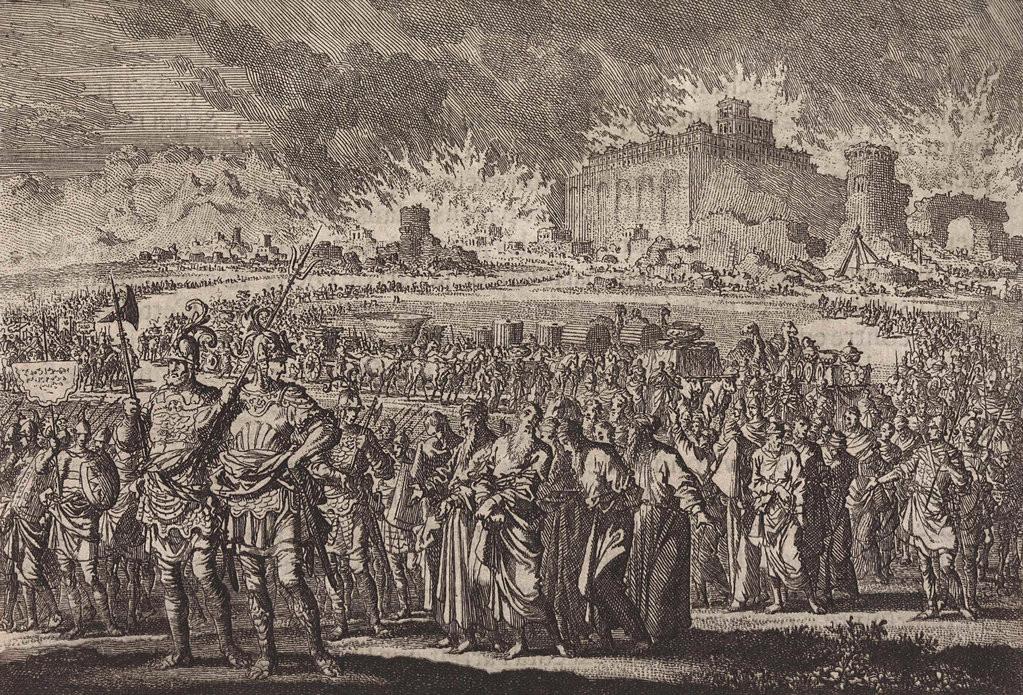
More than three-and-a-half centuries had passed since Yahweh issued that warning to King Solomon. During that time, the majority of the kings of Judah had chosen to abandon Yahweh for the false gods of the nations around them. They led the nation into idolatry and apostasy, and now, as the people of Judah made their way in chains to Babylon, they could look over their shoulders and see the fiery fulfillment of God’s words to Solomon.

As Nebuchadnezzar and his forces departed Judah, they left a destroyed city and a decimated populace behind.

King Nebuchadnezzar took all of Jerusalem captive, including all the commanders and the best of the soldiers, craftsmen, and artisans—10,000 in all. Only the poorest people were left in the land. – 2 Kings 24:14 NLT

Nebuchadnezzar appointed a man named Gedaliah to serve as governor over the greatly diminished and demoralized citizenry of Jerusalem. They would no longer have a king to rule over them. Gedaliah was a Jew, but not a descendant of Solomon. He had no royal blood and would wield no kingly authority. He served at the behest of Nebuchadnezzar and was under the watchful eye of the ever-present Babylonian garrison. His was a thankless job that was more managerial than magisterial. In time, he would come to be seen as nothing more than a puppet of the occupying Babylonian forces.

The commanders of Judah’s army who had fled from the city of Jerusalem when the walls were breached returned when they heard that Gedaliah had been appointed governor. But they didn’t like the pro-Babylonian rhetoric that Gedaliah was spouting.

Gedaliah vowed to them that the Babylonian officials meant them no harm. “Don’t be afraid of them. Live in the land and serve the king of Babylon, and all will go well for you,” he promised. – 2 Kings 25:24 NLT

This compromising stance ultimately cost Gedaliah his life. Ishmael, one of Judah’s former military commanders, orchestrated the assassination of Gedaliah. It’s not clear what Ishmael hoped to accomplish by the murder of the Babylonian-appointed governor, but it seems obvious that this was an act of rebellion against the occupying forces. Ishmael murdered Gedaliah and his Jewish officials, along with members of the Babylonian garrison, and this resulted in a swift reprisal from Nebuchadnezzar. Ishmael’s attempt to drive the Babylonians out of Judah backfired on him. Instead, “all the people of Judah, from the least to the greatest, as well as the army commanders, fled in panic to Egypt, for they were afraid of what the Babylonians would do to them” (2 Kings 25:26 NLT).

This scene is intended to convey a strong sense of irony. The disobedient people of God were returning to the very place from which He had freed them centuries earlier. While some of their friends and family members had been deported to Babylon as slaves, this remnant of God’s chosen people would seek refuge in the land where their forefathers had been served as slaves for more than 400 years.

Once again, all of this had been predicted by God. Centuries earlier, as the people of Israel stood on the shore of the River Jordan, preparing to enter the Land of Promise, He had told them that if they would faithfully obey Him, they would experience His blessings. But if they chose to disobey Him, they would experience “long-lasting afflictions and severe, enduring illnesses” (Deuteronomy 28:59 NLT). Moses went on to warn them, “He will afflict you with all the diseases of Egypt that you feared so much, and you will have no relief. The LORD will afflict you with every sickness and plague there is, even those not mentioned in this Book of Instruction, until you are destroyed.” (Deuteronomy 28:60-61 NLT).

And Moses had been very specific when outlining the devastating nature of the curses they would encounter should they fail to “fear the glorious and awesome name of the LORD your God” (Deuteronomy 28:58 NLT).

The LORD will scatter you among all nations, from one end of the earth to the other. There you will worship other gods that neither you nor your ancestors have known, gods of wood and stone. Among those nations you will have no rest, nor will there be a place of peaceful rest for the soles of your feet, for there the Lord will give you an anxious heart, failing eyesight, and a spirit of despair. Your life will hang in doubt before you; you will be terrified by night and day and will have no certainty of surviving from one day to the next. In the morning you will say, ‘If only it were evening!’ And in the evening you will say, ‘I wish it were morning!’ because of the things you will fear and the things you will see. Then the LORD will make you return to Egypt by ship, over a route I said to you that you would never see again. There you will sell yourselves to your enemies as male and female slaves, but no one will buy you.” – Deuteronomy 28:64-68 NLT

Some 850 years after God had redeemed the people of Israel from their captivity in Egypt, a remnant of their still rebellious descendants would return. But it’s interesting to note that these poor, disheveled exiles would find no hope in Egypt. They won’t even be able to sell themselves as slaves. They will become paupers and aliens living outside the Land of Promise and under the curse of the God they chose to reject.

But despite all the dire imagery portrayed in this closing chapter of the book of 2 Kings, there is a silver lining on the dark cloud of Judah’s history. The author ends his book with a new king ascending to the throne of Babylon. These closing verses seem to be a mirror image of the scene found in the book of Genesis that preceded Israel’s 400-year enslavement in Egypt. Exodus 1:8 records, “Now there arose a new king over Egypt, who did not know Joseph.” This new Pharaoh came to power and, having no first-hand knowledge of Joseph and the people of Israel, decided that they were a threat to his administration. So, he launched a campaign to afflict and enslave them. This would lead to four centuries’ worth of unprecedented misery and maltreatment.

But when Evil-merodach replaced Nebuchadnezzar as the ruler over the Babylonian empire, he made a decision to release King Jehoiachin of Judah from his enslavement. He released him from prison and “spoke kindly to Jehoiachin and gave him a higher place than all the other exiled kings in Babylon” (2 Kings 25:28 NLT). For the remainder of his life in Babylon, Jehoiachin lived like a king. He was given royal robes to wear and was allowed to dine at Evil-merodach’s table.

But why is this important? It foreshadows something highly significant. Back in the book that bears his name, the prophet Jeremiah pronounced a curse on Jehoiachin, who was also known as Coniah.

“Why is this man Jehoiachin like a discarded, broken jar?
    Why are he and his children to be exiled to a foreign land?
O earth, earth, earth!
    Listen to this message from the LORD!
This is what the LORD says:
‘Let the record show that this man Jehoiachin was childless.
    He is a failure,
for none of his children will succeed him on the throne of David
    to rule over Judah.’”– Jeremiah 22:28-30 NLT

And yet, if we fast-forward to the gospel of Matthew, we find the following words in his genealogy of Jesus.

Josiah was the father of Jehoiachin and his brothers (born at the time of the exile to Babylon).
After the Babylonian exile:
Jehoiachin was the father of Shealtiel.
Shealtiel was the father of Zerubbabel.
Zerubbabel was the father of Abiud.
Abiud was the father of Eliakim.
Eliakim was the father of Azor.
Azor was the father of Zadok.
Zadok was the father of Akim.
Akim was the father of Eliud.
Eliud was the father of Eleazar.
Eleazar was the father of Matthan.
Matthan was the father of Jacob.
Jacob was the father of Joseph, the husband of Mary.
Mary gave birth to Jesus, who is called the Messiah. – Matthew 1:11-16 NLT

Here, in the genealogy of Jesus, we find Jehoiachin’s name. The very man who was told that none of his children would succeed him as king is listed as a progenitor of the King of kings. Of Jehoiachin’s seven sons, not one of them would ascend to the throne of David, but Jesus would. Yahweh would graciously reverse the curse, producing a royal heir who would reign in righteousness and deliver His people from their enslavement to sin and death.

Notice one more name in the lineage of Jesus: Zerubbabel. This descendant of Jehoiachin would later become the governor of Judea when the exiles returned from their captivity in Babylon. The prophet Haggai would pronounce a blessing from God on Zerubbabel that foreshadowed a great reversal of fortunes for His chosen people.

“Speak to Zerubbabel, governor of Judah, saying, I am about to shake the heavens and the earth, and to overthrow the throne of kingdoms. I am about to destroy the strength of the kingdoms of the nations, and overthrow the chariots and their riders. And the horses and their riders shall go down, every one by the sword of his brother. On that day, declares the LORD of hosts, I will take you, O Zerubbabel my servant, the son of Shealtiel, declares the LORD, and make you like a signet ring, for I have chosen you, declares the LORD of hosts.” – Haggai 2:21-23 NLT

The Book of 2 Kings ends on a positive note because God’s will concerning the people of Israel was far from done. The story of the redemption of His chosen people and the restoration of the world He created was not yet over. The Messiah, the Savior of the world, would one day come, and His arrival would usher in a new day and a new hope for the people of God and the nations of the world.

English Standard Version (ESV) The Holy Bible, English Standard Version. ESV® Permanent Text Edition® (2016). Copyright © 2001 by Crossway Bibles, a publishing ministry of Good News Publishers.

New Living Translation (NLT) Holy Bible, New Living Translation, copyright © 1996, 2004, 2015 by Tyndale House Foundation. Used by permission of Tyndale House Publishers Inc., Carol Stream, Illinois 60188. All rights reserved.

The LORD Has Done Great Things

A Song of Ascents.

1 When the LORD restored the fortunes of Zion,
    we were like those who dream.
Then our mouth was filled with laughter,
    and our tongue with shouts of joy;
then they said among the nations,
    “The LORD has done great things for them.”
The LORD has done great things for us;
    we are glad.

Restore our fortunes, O LORD,
    like streams in the Negeb!
Those who sow in tears
    shall reap with shouts of joy!
He who goes out weeping,
    bearing the seed for sowing,
shall come home with shouts of joy,
    bringing his sheaves with him. Psalm 126:1-6 ESV

This psalm appears to have been written sometime after the Israelites returned from their captivity in Babylon under the leadership of Ezra and Nehemiah. After conquering the Babylonians in 539 B.C., the Persian King Cyrus issued a decree allowing the former citizens of Judah to return to Jerusalem and rebuild the Temple.

“Thus says Cyrus king of Persia: The LORD, the God of heaven, has given me all the kingdoms of the earth, and he has charged me to build him a house at Jerusalem, which is in Judah. Whoever is among you of all his people, may his God be with him, and let him go up to Jerusalem, which is in Judah, and rebuild the house of the Lord, the God of Israel—he is the God who is in Jerusalem. And let each survivor, in whatever place he sojourns, be assisted by the men of his place with silver and gold, with goods and with beasts, besides freewill offerings for the house of God that is in Jerusalem.” – Ezra 1:2-4 ESV

As the Persian king acknowledges, his decision was divinely ordained by “the LORD, the God of heaven.” Seventy years earlier, Yahweh had told his people that their captivity was imminent but that it would be followed by their return to the land.

“For thus says the Lord: When seventy years are completed for Babylon, I will visit you, and I will fulfill to you my promise and bring you back to this place. For I know the plans I have for you, declares the Lord, plans for welfare and not for evil, to give you a future and a hope. – Jeremiah 29:10-11 ESV

Yahweh kept His word and influenced Cyrus to use his royal powers not only to command the release of the Israelites but also to return all the plundered items taken from the Temple.

King Cyrus himself brought out the articles that King Nebuchadnezzar had taken from the LORD’s Temple in Jerusalem and had placed in the temple of his own gods. Cyrus directed Mithredath, the treasurer of Persia, to count these items and present them to Sheshbazzar, the leader of the exiles returning to Judah. – Ezra 1:7-8 NLT

Yahweh also “stirred the hearts of the priests and Levites and the leaders of the tribes of Judah and Benjamin to go to Jerusalem to rebuild the Temple of the LORD” (Ezra 7:5 NLT). The small remnant of Israelites who were moved by God to make the arduous journey back to Judah were assisted by their neighbors, who donated silver, gold, food, supplies, and livestock to support them on the journey. It is estimated that Zerubabbel led 50,000 Israelites back to Judah to begin the process of rebuilding the Temple and repopulating the city of Jerusalem. 

In 458 B.C., Ezra, a scribe and an expert in the Mosaic Law, led another contingent of 5,000 Jews back to Judah. By this time, the Temple had been rebuilt, but the people were unfamiliar with Yahweh’s laws and the sacrificial system. 

Ezra arrived in Jerusalem in August of that year. He had arranged to leave Babylon on April 8, the first day of the new year, and he arrived at Jerusalem on August 4, for the gracious hand of his God was on him. This was because Ezra had determined to study and obey the Law of the LORD and to teach those decrees and regulations to the people of Israel. – Ezra 7:8-10 NLT  

In 445 B.C., Nehemiah, who was serving as the cupbearer to the new Persian king, Artaxerxes, received a disturbing report about the state of affairs in Jerusalem.

“Things are not going well for those who returned to the province of Judah. They are in great trouble and disgrace. The wall of Jerusalem has been torn down, and the gates have been destroyed by fire.” – Nehemiah 1:3 NLT

Moved by this news, Nehemiah appealed to Yahweh for His divine intervention.

“Please remember what you told your servant Moses: ‘If you are unfaithful to me, I will scatter you among the nations. But if you return to me and obey my commands and live by them, then even if you are exiled to the ends of the earth, I will bring you back to the place I have chosen for my name to be honored.’

“The people you rescued by your great power and strong hand are your servants. O Lord, please hear my prayer! Listen to the prayers of those of us who delight in honoring you. Please grant me success today by making the king favorable to me. Put it into his heart to be kind to me.” – Nehemiah 1:8-11 NLT

Yahweh heard and answered Nehemiah’s prayer, and prompted King Artaxerxes to sanction the rebuilding of the walls of Jerusalem.

It is unclear at what point during this nearly 100-year period the psalmist wrote his song of ascent, but he describes the initial return of the exiles as a dream-like experience. After 70 years in captivity, it must have been a surreal experience to enter the gates of Jerusalem. For many of them, this would have been their first time seeing the City of David, as they had been born in captivity. And despite the dilapidated conditions of the walls and buildings, they were filled with laughter and sang for joy (Psalm 126:2). Even the surrounding nations were stunned by the unexpected repatriation of Judah by the Israelites and recognized it as a divinely ordained event. “The LORD has done great things for them,” they exclaimed. 

But the psalmist recognizes that all is not well. The initial wave of enthusiasm gave way to concern over the less-than-ideal conditions in the land. While some of their neighbors praised Yahweh for His divine deliverance of His people, others were not so happy to have the Israelites back in the land. During the 70 years the people of Judah had been in exile, their lands, homes, and properties had been taken over by neighboring nations. Fearful that the Israelites would prosper and repopulate the land, their enemies sent a letter to King Artaxerxes, accusing the Israelites of insurrection.

“The king should know that the Jews who came here to Jerusalem from Babylon are rebuilding this rebellious and evil city. They have already laid the foundation and will soon finish its walls. And the king should know that if this city is rebuilt and its walls are completed, it will be much to your disadvantage, for the Jews will then refuse to pay their tribute, customs, and tolls to you. – Ezra 4:12-13 NLT

These very same people had stringently opposed all the rebuilding efforts instituted by Zerrubabel and Nehemiah. But nothing they did curtailed the rebuilding of the Temple or the walls and gates of the city. This led them to seek Artaxerxes’ intervention.

Their ploy worked because the king issued a decree ordering all rebuilding efforts to cease. This work stoppage would remain in effect until Darius ascended the throne in 520 B.C. He reinstituted Cyrus’ original decree and authorized the Jews to continue their restoration of the Temple and the city.

The psalmist’s words seem to reflect the sadness that accompanied the initial joy of returning to the land. He prays, “Restore our fortunes, O LORD, like streams in the Negeb!” (Psalm 126:4 NLT). Their return had been met with opposition, and the taunts and accusations of their enemies had turned their joys to tears. But he continued to trust in Yahweh’s faithfulness.

Those who sow in tears
    shall reap with shouts of joy! – Psalm 126:5 NLT

He acknowledges that the days ahead will be difficult, but he expresses his conviction that Yahweh will have the final say. Their enemies can shout, scream, threaten, and write letters of accusation, but Yahweh is sovereign over all. The same God who moved the hearts of Cyrus, Artaxerxes, and Darius would ensure their success and secure their future.

They weep as they go to plant their seed,
    but they sing as they return with the harvest. – Psalm 126:6 NLT

It is easy to see why this psalm was one of the songs of ascent. It expresses a confidence in Yahweh that every generation of Israelites needed to hear and embrace. The enemies of Israel would always be there. The opposition to Yahweh’s power and the existence of His people would never dissipate. The Israelites’ return to the land had been a wonderful, God-ordained experience. It was a joy to no longer be in exile, but that did not mean the troubles and trials of life were over.

One of the things the Israelites had to contend with was their own culpability for their suffering. They couldn’t blame all their problems on their enemies. The whole reason they had gone into exile in the first place was because of their sinfulness. Now that Yahweh had returned them to the land, they would need to do more than rebuild the house of God; they would need to clean house. Ezra recognized the seriousness of the problem and called the people to repentance.

“But now we have been given a brief moment of grace, for the Lord our God has allowed a few of us to survive as a remnant. He has given us security in this holy place. Our God has brightened our eyes and granted us some relief from our slavery. For we were slaves, but in his unfailing love our God did not abandon us in our slavery. Instead, he caused the kings of Persia to treat us favorably. He revived us so we could rebuild the Temple of our God and repair its ruins. He has given us a protective wall in Judah and Jerusalem.

“And now, O our God, what can we say after all of this? For once again we have abandoned your commands! – Ezra 9:8-10 NLT

They were back in the land and had rebuilt the Temple, but they were still living in open rebellion against Yahweh. Seventy years had passed, but nothing had changed. Ezra knew that the blessings of God would mean little if the people refused to change their ways.

“O LORD, God of Israel, you are just. We come before you in our guilt as nothing but an escaped remnant, though in such a condition none of us can stand in your presence.” – Ezra 9:15 NLT

Any attempts to renovate the Temple and restore the city would be futile if the people refused to repent and return to the LORD. The dream would turn into a nightmare if God’s people failed to learn the lessons of the past. However, Ezra’s prayer had a profound impact on the people. They responded appropriately, saying, “We have been unfaithful to our God, for we have married these pagan women of the land. But in spite of this there is hope for Israel” (Ezra 10:2 NLT).

There is always hope because Yahweh is faithful. He is loving, gracious, patient, and forgiving. But He requires repentant hearts and a willingness to submit to His will. All the way back at the dedication of the Temple, God had made a promise to Solomon.

If my people who are called by my name will humble themselves and pray and seek my face and turn from their wicked ways, I will hear from heaven and will forgive their sins and restore their land.” – 2 Chronicles 7:14 NLT

And that promise still stood. The LORD would forgive their sins and restore their fortunes if they would only return to Him in repentance and humility.

Father, You are the same yesterday, today, and forever. You never change and You never fail to keep Your promises. Thank You for this reminder that I can trust You at all times. And thank You for reminding me that You still expect obedience, humility, and faithfulness from Your covenant people. Forgive me for demanding restoration and reward without repentance. I confess that, far too often, I cheapen Your amazing grace by treating it with contempt and taking it for granted. Help me live in keeping with who You are and who You have called me to be. Amen

English Standard Version (ESV) The Holy Bible, English Standard Version. ESV® Permanent Text Edition® (2016). Copyright © 2001 by Crossway Bibles, a publishing ministry of Good News Publishers.

New Living Translation (NLT) Holy Bible, New Living Translation, copyright © 1996, 2004, 2015 by Tyndale House Foundation. Used by permission of Tyndale House Publishers Inc., Carol Stream, Illinois 60188. All rights reserved.

Our Gracious God

To the choirmaster: according to Lilies. A Testimony. Of Asaph, a Psalm.

1 Give ear, O Shepherd of Israel,
    you who lead Joseph like a flock.
You who are enthroned upon the cherubim, shine forth.
    Before Ephraim and Benjamin and Manasseh,
stir up your might
    and come to save us!

Restore us, O God;
    let your face shine, that we may be saved!

O LORD God of hosts,
    how long will you be angry with your people’s prayers?
You have fed them with the bread of tears
    and given them tears to drink in full measure.
You make us an object of contention for our neighbors,
    and our enemies laugh among themselves.

Restore us, O God of hosts;
    let your face shine, that we may be saved!

You brought a vine out of Egypt;
    you drove out the nations and planted it.
You cleared the ground for it;
    it took deep root and filled the land.
10 The mountains were covered with its shade,
    the mighty cedars with its branches.
11 It sent out its branches to the sea
    and its shoots to the River.
12 Why then have you broken down its walls,
    so that all who pass along the way pluck its fruit?
13 The boar from the forest ravages it,
    and all that move in the field feed on it.

14 Turn again, O God of hosts!
    Look down from heaven, and see;
have regard for this vine,
15     the stock that your right hand planted,
    and for the son whom you made strong for yourself.
16 They have burned it with fire; they have cut it down;
    may they perish at the rebuke of your face!
17 But let your hand be on the man of your right hand,
    the son of man whom you have made strong for yourself!
18 Then we shall not turn back from you;
    give us life, and we will call upon your name!

19 Restore us, O LORD God of hosts!
    Let your face shine, that we may be saved! Psalm 80:1-19 ESV

Like the psalm that precedes it, this is a national psalm of lament, but it is difficult to determine the exact context surrounding its message. Some scholars believe Asaph is addressing the fall of the northern kingdom of Israel in 722 BC. But if Asaph was a resident of the southern kingdom of Judah, his prayer in verse 3 would appear to place the timing of this psalm after the fall of Jerusalem in 586 BC.

Before Ephraim and Benjamin and Manasseh,
stir up your might
    and come to save us! – Psalm 80:3 ESV

Asaph seems to indicate that something has happened to the people of Judah, the residents of the southern kingdom. In verses 5 and 6, he describes the extent of their suffering, which he attributes to God’s divine punishment.

You have fed us with sorrow
    and made us drink tears by the bucketful.
You have made us the scorn of neighboring nations.
    Our enemies treat us as a joke. – Psalm 80:5-6 NLT

Asaph’s reference to Ephraim, Benjamin, and Manasseh is intended as a not-so-subtle reminder that the nation of Israel used to be a unified whole. There had been a time under the reigns of David and Solomon when the 12 tribes of Israel were unified and dominated the political landscape of Canaan. Ephraim was the primary tribe in the north, the Benjamites lived in the south, and the tribe of Manasseh was located east of the Jordan River in the Transjordan. So it makes more sense to see this psalm lamenting Israel’s abysmal condition after the northern and southern kingdoms had fallen to the Assyrians and Babylonians.

It is interesting to note that Asaph opens his psalm with a reference to Joseph, the son of Jacob, who had been sold into slavery by his brothers. Under God’s sovereign hand, this young man ended up in Egypt and rose to the second-highest position in the land. His miraculous and meteoric rise to prominence was God-ordained and for the sole purpose of providing a place of refuge for his family when a famine struck the land of Canaan.

Asaph opens his psalm by addressing Yahweh as the “Shepherd of Israel” (Psalm 80:1 ESV), who leads Joseph like a flock. Joseph’s two sons, born to him in Egypt, were adopted by his father Jacob, and their descendants became heirs of the land of promise. Ephraim and Manasseh, two of the tribes mentioned in verse 2, were the descendants of Joseph’s two sons and, at one time, enjoyed a place within the unified nation of Israel alongside the tribe of Benjamin.

But sin had disrupted Israel’s peace and prosperity. King Solomon, the wisest man who ever lived, behaved like a fool by fostering idolatry and apostasy in the kingdom. His actions resulted in God splitting the kingdom in half. From that point, the downward spiritual spiral continued in the north, south, and east, as all the tribes exhibited a penchant for unfaithfulness and a stubborn refusal to repent and return to Yahweh.

So, Asaph calls on God to step in and fix the problem.

Show us your mighty power.
    Come to rescue us! – Psalm 80:3 NLT

Asaph attributes their fate to God’s displeasure with them, but he never acknowledges their complicity and guilt. At no point does Asaph attempt to confess the sins of his fellow Israelites. Instead, he questions why God remains so angry and unwilling to answer their prayers for deliverance.

Asaph attempts to remind God of His past acts of kindness by chronicling how He had delivered the Israelites from their slavery in Egypt and established them in the land of Canaan.

You brought us from Egypt like a grapevine;
    you drove away the pagan nations and transplanted us into your land.
You cleared the ground for us,
    and we took root and filled the land.
Our shade covered the mountains;
    our branches covered the mighty cedars.
We spread our branches west to the Mediterranean Sea;
    our shoots spread east to the Euphrates River. – Psalm 80:8-11 NLT

Those were the good old days, when the Israelites enjoyed the blessings of God. They had been fruitful and filled the land of Canaan. Under the leadership of David and Solomon, their numbers grew and their kingdom spread, making them a force to be reckoned with in the region. But all that had changed. The conditions in Israel were markedly different when Asaph penned this psalm because sin had brought the judgment of God.

Yet, Asaph never mentions their sin. He fails to acknowledge their complicity in their own demise, choosing instead to blame God.

But now, why have you broken down our walls
    so that all who pass by may steal our fruit?
The wild boar from the forest devours it,
    and the wild animals feed on it. – Psalm 80:12-13 NLT

While God had brought judgment upon the people of Israel, it had been as a result of their rebellion against Him. Asaph obsesses over the consequences they suffered and demands remediation, but he refuses to confess their guilt. He begs God to intervene and appears to try to shame God into action.

Take care of this grapevine
    that you yourself have planted,
    this son you have raised for yourself. – Psalm 80:14-15 NLT

Asaph freely admits that God had chosen Israel to be His treasured possession, but he couldn’t understand why they were suffering so greatly. It made no sense. As the nation that bore His name, the Israelites should have been prospering and enjoying all the benefits of their privileged position. But, according to Asaph, they were like a vineyard that had been “chopped up and burned by” (Psalm 80:16 NLT) by their enemies.

So, Asaph asks God to reverse the trend and restore His people to greatness.

May you give support to the one you have chosen,
to the one whom you raised up for yourself.
Psalm 80:17 NET

In response to God’s miraculous deliverance, Asaph promises the renewed allegiance of the people of Israel.

Then we will never abandon you again.
    Revive us so we can call on your name once more. – Psalm  80:17 NLT

By referring to God’s name, Asaph appeals to God’s reputation. He knows that Yahweh holds His name in high regard and will not allow it to be tarnished by those privileged to bear it. He had warned the Israelites that their behavior reflected on His character.

“You must worship no other gods, for the Lord, whose very name is Jealous, is a God who is jealous about his relationship with you.” – Exodus 34:14 NLT

He would not allow them to drag His name through the mud by their repeated acts of apostasy and idolatry, and that is the reason for their current state of deprivation and despair. All 12 tribes were guilty of worshiping other gods and had angered Yahweh with their refusal to heed His warnings and repent of their sins. But Asaph longs to see God redeem and restore them.

Turn us again to yourself, O Lord God of Heaven’s Armies.
    Make your face shine down upon us.
    Only then will we be saved. – Psalm 80:19 NLT

He was right. God was the only solution to their problem. Their cities lay in ruins, and their economy was devastated. They had no king or army and no hope of improving their fortunes unless God stepped in. Asaph’s reliance upon God was commendable, but he failed to recognize the corporate need for repentance. The prophets made it clear that redemption and restoration were available but required repentance.

Seek the Lord while you can find him.
    Call on him now while he is near.
Let the wicked change their ways
    and banish the very thought of doing wrong.
Let them turn to the Lord that he may have mercy on them.
    Yes, turn to our God, for he will forgive generously. – Isaiah 55:6-7 NLT

God would later inspire Jeremiah to deliver the following message to the Israelites living in exile in Babylon. He wanted them to know that their captivity had an expiration date, but to enjoy His deliverance, they must exhibit repentant hearts.

“For I know the plans I have for you,” says the Lord. “They are plans for good and not for disaster, to give you a future and a hope. In those days when you pray, I will listen. If you look for me wholeheartedly, you will find me. I will be found by you,” says the Lord. “I will end your captivity and restore your fortunes. I will gather you out of the nations where I sent you and will bring you home again to your own land.” – Jeremiah 29:11-14 NLT

Asaph was right to call on God, but neglected to call the people to repentance. God had promised to hear their prayers and restore their fortunes, but He required that they look for him “wholeheartedly.” God demanded their sold-out devotion to Him alone, instead of their usual brand of half-hearted, going-through-the-motions, on-again-off-again worship.

Yet, despite their failure to repent and return to Him in wholehearted devotion, God eventually released them from their exile in Babylon and restored them to the land of Canaan. Their covenant-keeping God graciously ended their captivity and arranged for a remnant to return to Jerusalem under the leadership of Ezra and Nehemiah. Yahweh proved to be faithful even when His people refused to keep their end of the covenant agreement. And, according to the Book of Ezekiel, God is far from done with His chosen people. The day is coming when He will perform a miracle of transformation that will ensure their unwavering devotion to Him.

“For I will gather you up from all the nations and bring you home again to your land.

“Then I will sprinkle clean water on you, and you will be clean. Your filth will be washed away, and you will no longer worship idols. And I will give you a new heart, and I will put a new spirit in you. I will take out your stony, stubborn heart and give you a tender, responsive heart. And I will put my Spirit in you so that you will follow my decrees and be careful to obey my regulations.

“And you will live in Israel, the land I gave your ancestors long ago. You will be my people, and I will be your God. I will cleanse you of your filthy behavior.” – Ezekiel 36:24-29 NLT

Father, You truly are amazing. Your love never fails. You always keep Your word. Your grace is always undeserved. Your mercy never runs out. Your patience is inexhaustible. And Your plan for Your people is unstoppable. Despite us, You continually pour out Your blessings through Jesus Christ. You have made a way where there was no way. You do the impossible and accomplish the improbable. And we don’t deserve it. Amen

English Standard Version (ESV) The Holy Bible, English Standard Version. ESV® Permanent Text Edition® (2016). Copyright © 2001 by Crossway Bibles, a publishing ministry of Good News Publishers.

New Living Translation (NLT) Holy Bible, New Living Translation, copyright © 1996, 2004, 2015 by Tyndale House Foundation. Used by permission of Tyndale House Publishers Inc., Carol Stream, Illinois 60188. All rights reserved.

A Divine Decree

1 In the first year of Cyrus king of Persia, that the word of the Lord by the mouth of Jeremiah might be fulfilled, the Lord stirred up the spirit of Cyrus king of Persia, so that he made a proclamation throughout all his kingdom and also put it in writing:

“Thus says Cyrus king of Persia: The Lord, the God of heaven, has given me all the kingdoms of the earth, and he has charged me to build him a house at Jerusalem, which is in Judah. Whoever is among you of all his people, may his God be with him, and let him go up to Jerusalem, which is in Judah, and rebuild the house of the Lord, the God of Israel—he is the God who is in Jerusalem. And let each survivor, in whatever place he sojourns, be assisted by the men of his place with silver and gold, with goods and with beasts, besides freewill offerings for the house of God that is in Jerusalem.” Ezra 1:1-4 ESV

The book opens in the first year of Cyrus’ reign as the king of Persia, 538 B.C., and the people of Israel have been in exile in Babylon for 70 years. It is unclear when the book was written or who the author was. Tradition places Ezra as its author, but his name is not mentioned until chapter seven.

Now after this, in the reign of Artaxerxes king of Persia, Ezra the son of Seraiah, son of Azariah, son of Hilkiah, son of Shallum, son of Zadok, son of Ahitub, son of Amariah, son of Azariah, son of Meraioth, son of Zerahiah, son of Uzzi, son of Bukki, son of Abishua, son of Phinehas, son of Eleazar, son of Aaron the chief priest—this Ezra went up from Babylonia. He was a scribe skilled in the Law of Moses that the Lord, the God of Israel, had given, and the king granted him all that he asked, for the hand of the Lord his God was on him. – Ezra 7:1-6 ESV

This has led some scholars to divide the book into two halves, the first featuring chapters 1-6 and the second, chapters 7-10. They suggest that this composite book was written by two authors and then compiled by a “chronicler” at a much later date. Those who hold to Ezra as the sole author of the book that bears his name put the date of its writing at around 446 B.C., nearly 100 years after the events recorded in the opening chapter. This later date is based on the mention of a decree issued by King Artaxerxes in chapter 4.

I made a decree, and search has been made, and it has been found that this city from of old has risen against kings, and that rebellion and sedition have been made in it. And mighty kings have been over Jerusalem, who ruled over the whole province Beyond the River, to whom tribute, custom, and toll were paid. Therefore make a decree that these men be made to cease, and that this city be not rebuilt, until a decree is made by me. – Ezra 4:19-21 ESV

This later decree by King Artaxerxes stands in stark contrast to the one made by his predecessor and recorded in chapter one. King Cyrus had made a royal proclamation authorizing the rebuilding of the Temple in Jerusalem, which had been destroyed by the Babylonians in 586 B.C., just 48 years earlier. Cyrus claims to have received direct orders from the God of the Israelites.

“The LORD, the God of heaven, has given me all the kingdoms of the earth. He has appointed me to build him a Temple at Jerusalem, which is in Judah.” – Ezra 1:2 NLT

Cyrus’ decree was implemented and a remnant of the people of God made the long journey back to Judah to begin rebuilding Jerusalem and the Temple. However, upon their arrival, they encountered opposition from those who had occupied the land in their absence. A diverse amalgam of disparate people groups had made the land their own and greeted the arrival of the Israelites with less than open arms. The Israelite’s ongoing efforts to regain their ancestral homeland and rebuild their holy site eventually resulted in a letter of protest to the new king, threatening civil unrest or worse, if the project was put on hold. Artaxerxes succumbed to their demands and issued his decree.

As the book opens, things are looking up. Unlike his successor, Cyrus extends mercy to the long-suffering Israelites, outlining a government-sanctioned program for their repatriation of Judah.

“The message is addressed to the post-exilic community of Jews who wonder if there is any hope of political and religious restoration. Its central thrust is that there indeed is hope but that hope must be incarnated in the rebuilding of the Temple, the cultus, and the priesthood. Only as the remnant people became the theocratic nation, founded on and faithful to the covenant Yahweh made with their fathers, could they revive the Davidic house and anticipate the resumption of their mediatorial role among the nations of the earth. Ezra and Nehemiah are therefore burdened to clarify (1) the Person and works of God, (2) Israel’s own identity and function as a covenant people, and (3) the nature of that covenant in postexilic times.” – Eugene H. Merrill, “A Theology of Ezra-Nehemiah and Esther,” in A Biblical Theology of the Old Testament, p. 190

God is about to lift His hand of judgment and restore the people to the land and back into His favor. The amazing thing is how God chooses to bring this all about. When He punished the people 70 years earlier, He had used Nebuchadnezzar, the king of Babylon, to accomplish His will. This Babylonian king was like a puppet in the hand of Almighty God – accomplishing His will and fulfilling His plans for the people of Judah. Now, 70 years later, Cyrus, the king of the Medo-Persian Empire which had defeated Babylon, becomes the next pawn in the hands of God. This powerful leader has his heart stirred by the Spirit of God and issues a decree allowing the Jews to return to the land of Israel. Not only that, he recognized that God had given him the responsibility of rebuilding the Temple in Jerusalem.

God used Babylon to defeat Judah, demolish Jerusalem, and destroy the Temple. Now He was going to use Persia to return the people to the land, restore Jerusalem, and rebuild the Temple. What an amazing God. This powerful pagan king will be an instrument in the hands of God to accomplish His will and fulfill His promises to the people of God. What a wonderful reminder that God is in control.

So Cyrus issued his decree, commanding those who chose not to return to financially support the remnant who would be making the trip back to Jerusalem. As will become evident, Cyrus would also return all the items plundered from the Temple during the days of Nebuchadnezzar. Thousands of bowls, basins, incense burners, and other articles will be placed in the hands of God’s people, so they might be restored to their original purpose: the worship of God. All of these items had at one time been dedicated to the worship of God through the sacrificial system. Now they were going to be restored to their original intent. They had been set aside for a time due to the sins of the people, but now they were being restored. The same thing could be said of the people of God. They had one time been set apart for the glory of God, but sin led to their being set aside. They were God’s chosen people, His instruments, dedicated to His use and designed to bring Him glory among the other nations of the world. But they had been set aside for 70 long years. Now they were being restored. They were being given a second chance by God. What incredible grace. What amazing love. What an unforgettable reminder of how much God loves us and desires to restore us to fellowship with Him when we stray. God had told the people that if they failed to serve Him faithfully, He would be forced to punish them, and He did. But He had also promised to restore them, and now He was. Just as He said He would.

In the future, when you experience all these blessings and curses I have listed for you, and when you are living among the nations to which the Lord your God has exiled you, take to heart all these instructions. If at that time you and your children return to the Lord your God, and if you obey with all your heart and all your soul all the commands I have given you today, then the Lord your God will restore your fortunes. He will have mercy on you and gather you back from all the nations where he has scattered you. Even though you are banished to the ends of the earth, the Lord your God will gather you from there and bring you back again. The Lord your God will return you to the land that belonged to your ancestors, and you will possess that land again. Then he will make you even more prosperous and numerous than your ancestors! – Deuteronomy 30:1-5 NLT

English Standard Version (ESV)
The Holy Bible, English Standard Version. ESV® Permanent Text Edition® (2016). Copyright © 2001 by Crossway Bibles, a publishing ministry of Good News Publishers.

New Living Translation (NLT)
Holy Bible, New Living Translation, copyright © 1996, 2004, 2015 by Tyndale House Foundation. Used by permission of Tyndale House Publishers Inc., Carol Stream, Illinois 60188. All rights reserved.

The Message (MSG)Copyright © 1993, 1994, 1995, 1996, 2000, 2001, 2002 by Eugene H. Peterson

For Your Own Sake, O Lord

1 In the first year of Darius the son of Ahasuerus, by descent a Mede, who was made king over the realm of the Chaldeans— in the first year of his reign, I, Daniel, perceived in the books the number of years that, according to the word of the Lord to Jeremiah the prophet, must pass before the end of the desolations of Jerusalem, namely, seventy years.

Then I turned my face to the Lord God, seeking him by prayer and pleas for mercy with fasting and sackcloth and ashes. I prayed to the Lord my God and made confession, saying, “O Lord, the great and awesome God, who keeps covenant and steadfast love with those who love him and keep his commandments, we have sinned and done wrong and acted wickedly and rebelled, turning aside from your commandments and rules. We have not listened to your servants the prophets, who spoke in your name to our kings, our princes, and our fathers, and to all the people of the land. To you, O Lord, belongs righteousness, but to us open shame, as at this day, to the men of Judah, to the inhabitants of Jerusalem, and to all Israel, those who are near and those who are far away, in all the lands to which you have driven them, because of the treachery that they have committed against you. To us, O Lord, belongs open shame, to our kings, to our princes, and to our fathers, because we have sinned against you. To the Lord our God belong mercy and forgiveness, for we have rebelled against him 10 and have not obeyed the voice of the Lord our God by walking in his laws, which he set before us by his servants the prophets. 11 All Israel has transgressed your law and turned aside, refusing to obey your voice. And the curse and oath that are written in the Law of Moses the servant of God have been poured out upon us, because we have sinned against him. 12 He has confirmed his words, which he spoke against us and against our rulers who ruled us, by bringing upon us a great calamity. For under the whole heaven there has not been done anything like what has been done against Jerusalem. 13 As it is written in the Law of Moses, all this calamity has come upon us; yet we have not entreated the favor of the Lord our God, turning from our iniquities and gaining insight by your truth. 14 Therefore the Lord has kept ready the calamity and has brought it upon us, for the Lord our God is righteous in all the works that he has done, and we have not obeyed his voice. 15 And now, O Lord our God, who brought your people out of the land of Egypt with a mighty hand, and have made a name for yourself, as at this day, we have sinned, we have done wickedly.

16 “O Lord, according to all your righteous acts, let your anger and your wrath turn away from your city Jerusalem, your holy hill, because for our sins, and for the iniquities of our fathers, Jerusalem and your people have become a byword among all who are around us. 17 Now therefore, O our God, listen to the prayer of your servant and to his pleas for mercy, and for your own sake, O Lord, make your face to shine upon your sanctuary, which is desolate. 18 O my God, incline your ear and hear. Open your eyes and see our desolations, and the city that is called by your name. For we do not present our pleas before you because of our righteousness, but because of your great mercy. 19 O Lord, hear; O Lord, forgive. O Lord, pay attention and act. Delay not, for your own sake, O my God, because your city and your people are called by your name.” – Daniel 9:1-19 ESV

This chapter opens with a second mention of Darius the Mede ruling over the kingdom of the Chaldeans. His name first appeared in chapter six in reference to an earlier event in Daniel’s life. He is the one who made a decree that for 30 days all the citizens of his kingdom must pray to him alone. His fateful decision had been at the prompting of his counselors who were jealous of Daniel and hoping to get rid of him. They were the ones who suggested that the penalty for disobeying the king’s order would be death by being fed to the lion.

There has been much debate as to the identity of Darius because no extra-biblical records contain any mention of a Babylonian or Medo-Persian king by that name. As was stated in our discussion of the events in chapter six, the simplest solution to this problem may lie in the meaning of the name “Darius.” It is of Aramaic origin and translates as “lord.” It was likely a title rather than a proper name. It seems that the author purposefully chose to leave out the name of the king involved in the story. He also provides scant details to help determine the date of the events recorded in this chapter. It is as if Darius was intended to represent all the “lords” who ruled over the kingdom of Babylon and its successor, the Medo-Persian empire.

But regardless of who Darius was, the events recorded in this chapter most likely happened toward the end of Daniel’s life when he was in his early 80s. Even in his latter years, Daniel remains faithful to Yahweh. Somehow he had received a copy of the letters that Jeremiah the prophet had written to the exiles living in Babylon. Jeremiah remained in Jerusalem but was commissioned by God to deliver a message to all those who had been taken captive by the Babylonians at the fall of Jerusalem. The letter was intended for “the elders, priests, prophets, and all the people who had been exiled to Babylon by King Nebuchadnezzar” (Jeremiah 29:1 NLT), and here is what it said:

This is what the Lord of Heaven’s Armies, the God of Israel, says to all the captives he has exiled to Babylon from Jerusalem: “Build homes, and plan to stay. Plant gardens, and eat the food they produce. Marry and have children. Then find spouses for them so that you may have many grandchildren. Multiply! Do not dwindle away! And work for the peace and prosperity of the city where I sent you into exile. Pray to the Lord for it, for its welfare will determine your welfare.” – Jeremiah 29:4-7 NLT

Daniel had managed to get his hands on some of the correspondence between Jeremiah and the Hebrew people living in Babylon. It also seems apparent that he had access to some of Jeremiah’s other writings. This faithful and aging servant of Yahweh remained uncompromised in his convictions despite his long tenure in the Babylonian administration. One of the reasons for his undiminished faith was that he stayed in touch with his God. He was obviously a man of prayer. But he was also a man of the Word. This chapter reveals that Daniel was reading from the writings of Jeremiah the prophet.

Under God’s direction, Jeremiah had faithfully sent letters reminding the Israelites to make the most of their time in Babylon but to never forget that there would be an end to their exile. God had told Jeremiah that their period of suffering would last 70 years and then they would be restored to the land.

When Daniel pens the words of this chapter, the people of Israel have been in captivity for about 67 years. He has spent most of his adult life in Babylon and upon reading the words of Jeremiah, he discovers that the fulfillment of God’s promise is drawing near. But rather than sit back, Daniel prays. What prompted this reaction was what he found written in Jeremiah’s prophesy:

This is what the Lord says: “You will be in Babylon for seventy years. But then I will come and do for you all the good things I have promised, and I will bring you home again. For I know the plans I have for you,” says the Lord. “They are plans for good and not for disaster, to give you a future and a hope. In those days when you pray, I will listen. If you look for me wholeheartedly, you will find me. I will be found by you,” says the Lord. “I will end your captivity and restore your fortunes. I will gather you out of the nations where I sent you and will bring you home again to your own land.” – Jeremiah 29:10-14 NLT

It seems likely that he also read Jeremiah’s reaction when God commanded him to buy a field just before the Babylonians invaded Judah.

“O Sovereign Lord, you have told me to buy the field – paying good money for it before these witnesses – even though the city will soon be handed over to the Babylonians.” – Jeremiah 32:25 NLT

God’s command made no sense to Jeremiah. It was a bad time to be investing in land but Jeremiah did as the Lord commanded because he understood God’s unfailing love and believed that God would fulfill His promise to restore Israel to the land one day. Jeremiah’s investment was based on the integrity of God.

Daniel read the words of Jeremiah and his response was one of prayer and fasting. His prayer was full of repentance on behalf of the people, and he included himself in their guilt. He appealed to God’s mercy. He praised God for His unfailing love and unwavering commitment to keep His promises. He acknowledged that their restoration would have nothing to do with their own merit; it would be for God’s sake and the honor of His name. Despite their years of rebellion and sin, God would forgive and restore them.

This entire chapter is reminiscent of the words God spoke at the dedication of the Temple that Solomon built for God’s glory. Yahweh told them that if they failed to be faithful, He would bring punishment. But if they repented, He would restore them.

“Then if my people who are called by my name will humble themselves and pray and seek my face and turn from their wicked ways, I will hear from heaven and will forgive their sins and restore their land.” – 2 Chronicles 7:14 NLT

Now, centuries later, Daniel is reminded of God’s promise of restoration and challenged by the need for humility, repentance, and prayer. So, he takes it upon himself to step up and do what God commanded. Even after all the decades of living in Babylon, Daniel longed to go home to Judah. Yet, he knew that God expected a change of heart among His people. Repentance must precede restoration.

Daniel was not bitter with God. He did not shake his fist in the face of God and demand an explanation or compensation for damages done. Instead, he openly confessed the sins of his people and justified God’s actions.

“You have kept your word and done to us and our rulers exactly as you warned. Never has there been such a disaster as happened in Jerusalem. Every curse written against us in the Law of Moses has come true. Yet we have refused to seek mercy from the Lord our God by turning from our sins and recognizing his truth.” – Daniel 9:12-13 NLT

Despite their exile, the people of Israel remained defiant and unrepentant. But not Daniel. He was ready to see God work and so he was ready to confess and call out for God’s mercy. He reminds God of His previous rescue of the people from their captivity in Egypt. He believes that God can do it again but knows that God is looking for repentant hearts among His people. This leads Daniel to cry out, “O my God, lean down and listen to me. Open your eyes and see our despair. See how your city—the city that bears your name—lies in ruins. We make this plea, not because we deserve help, but because of your mercy” (Daniel 9:18 NLT).

He knew they didn’t deserve God’s favor so he called on God to preserve the integrity of His own name. Daniel realized he was asking a lot but believed Yahweh to be a covenant-keeping God who always kept His word.

English Standard Version (ESV) The Holy Bible, English Standard Version. ESV® Permanent Text Edition® (2016). Copyright © 2001 by Crossway Bibles, a publishing ministry of Good News Publishers.

New Living Translation (NLT) Holy Bible, New Living Translation, copyright © 1996, 2004, 2015 by Tyndale House Foundation. Used by permission of Tyndale House Publishers Inc., Carol Stream, Illinois 60188. All rights reserved.

New English Translation (NET)NET Bible® copyright ©1996-2017 by Biblical Studies Press, L.L.C. http://netbible.com All rights reserved.

There Is a God In Heaven

17 Then Daniel went to his house and made the matter known to Hananiah, Mishael, and Azariah, his companions, 18 and told them to seek mercy from the God of heaven concerning this mystery, so that Daniel and his companions might not be destroyed with the rest of the wise men of Babylon. 19 Then the mystery was revealed to Daniel in a vision of the night. Then Daniel blessed the God of heaven. 20 Daniel answered and said:

“Blessed be the name of God forever and ever,
    to whom belong wisdom and might.
21 He changes times and seasons;
    he removes kings and sets up kings;
he gives wisdom to the wise
    and knowledge to those who have understanding;
22 he reveals deep and hidden things;
    he knows what is in the darkness,
    and the light dwells with him.
23 To you, O God of my fathers,
    I give thanks and praise,
for you have given me wisdom and might,
    and have now made known to me what we asked of you,
    for you have made known to us the king’s matter.”

24 Therefore Daniel went in to Arioch, whom the king had appointed to destroy the wise men of Babylon. He went and said thus to him: “Do not destroy the wise men of Babylon; bring me in before the king, and I will show the king the interpretation.”

25 Then Arioch brought in Daniel before the king in haste and said thus to him: “I have found among the exiles from Judah a man who will make known to the king the interpretation.” 26 The king declared to Daniel, whose name was Belteshazzar, “Are you able to make known to me the dream that I have seen and its interpretation?” 27 Daniel answered the king and said, “No wise men, enchanters, magicians, or astrologers can show to the king the mystery that the king has asked, 28 but there is a God in heaven who reveals mysteries, and he has made known to King Nebuchadnezzar what will be in the latter days. Your dream and the visions of your head as you lay in bed are these: 29 To you, O king, as you lay in bed came thoughts of what would be after this, and he who reveals mysteries made known to you what is to be. 30 But as for me, this mystery has been revealed to me, not because of any wisdom that I have more than all the living, but in order that the interpretation may be made known to the king, and that you may know the thoughts of your mind. – Daniel 2:17-30 ESV

Upon hearing that he and his companions were facing death because of the king’s recent edict, Daniel responded with deep concern but never panicked. Instead, he appealed for a brief reprieve to seek out the meaning of the king’s dream. Desperate to have his disturbing dream explained, Nebuchadnezzar granted Daniel’s request. No longer under the immediate threat of death, Daniel gathered his three Hebrew friends and encouraged them to take the matter before Yahweh.

Faced with death at the hands of a psychologically disturbed pagan king, Daniel took the matter to the God of heaven. He did what Nebuchadezzar’s magicians, astrologers, and Chaldeans failed to do; he appealed to a higher power. Those men had assured the king that his demand that they interpret his dream was impossible because “no one can show it to the king except the gods, whose dwelling is not with flesh” (Daniel 1:11 ESV).

These celebrated soothsayers and fortune-tellers could read the stars and predict the future but were powerless to decipher the king’s dream, let alone its meaning. But faced with an impossible task, they never sought the aid of Marduk, the chief Babylonian god. Even with a death sentence hanging over their heads, the magicians failed to take their dire situation to Enki, the Babylonian god of magic. Either they believed their gods were distant and disinterested in the affairs of mortal men or they had no faith in their existence at all.

But Daniel and his friends believed in Yahweh and took their predicament to the only one who could do anything about it. And though Yahweh’s “dwelling is not with flesh,” He answered their prayers. Sometime during the night, Daniel received a divinely inspired vision that disclosed the content of the king’s dreams. But Yahweh didn’t stop there; He also provided Daniel with the interpretation. This entire sequence of events reveals God’s sovereignty over the affairs of men. He is the one who ordained that Nebuchadnezzar would invade Judah and take its people captive.

“Raise a signal flag as a warning for Jerusalem:
    ‘Flee now! Do not delay!’
For I am bringing terrible destruction upon you
    from the north.” – Jeremiah 4:6 ESV

His chariots are like whirlwinds.
His horses are swifter than eagles. – Jeremiah 4:13 ESV

He had sovereignly orchestrated the capture and deportation of Daniel and his three friends. He had planned their meteoric rise to prominence within Nebuchadnezzar’s administration. He is the one who exposed the king’s wise men as frauds but also gave Daniel and his friends wisdom and discernment. sleep with disturbing dreams. He is also the one who endowed Daniel with the ability to interpret dreams and visions. It had all been His doing from start to finish.

And Yahweh could reveal Nebuchadnezzar’s dream because He was its author. He could discern its meaning because He had determined its content. None of this had been a matter of chance or blind fate; it had been part of the sovereign plan of God Almighty. And Daniel recognized it as such and offered Yahweh the praise He justly deserved.

Praise the name of God forever and ever,
    for he has all wisdom and power.
He controls the course of world events;
    he removes kings and sets up other kings.
He gives wisdom to the wise
    and knowledge to the scholars.
He reveals deep and mysterious things
    and knows what lies hidden in darkness,
    though he is surrounded by light. – Daniel 2:20-22 NLT

Daniel responds in praise and thanksgiving for the wisdom, power, and omniscience of God. While the gods of the Babylonians did “not live here among people,” the God of Daniel did, and He heard Daniel’s prayer and did the seemingly impossible. Daniel knew what Jesus Himself would later express, “What is impossible for people is possible with God” (Luke 18:27 NLT).

Daniel was living in the most powerful nation in the world and serving in the court of its king. Yet he recognized that Nebuchadnezzar ruled at the behest of God. Yahweh even referred to the Babylonian king as “my servant Nebuchadnezzar” (Jeremiah 43:10 NLT). Daniel was not impressed by Nebuchadnezzar’s power or threatened by his edict because Yahweh “controls the course of human events” (Daniel 2:21 NLT). Daniel’s God was superior and sovereign over all things.

Daniel and his friends had sought God’s help and He had graciously responded. Their prayers had not informed God about the day’s events because He was already intimately knowledgeable and completely responsible for all that had happened. But in taking their need to God, they became aware of His plan and His intention to use them in it. There is no indication in the text that Daniel had ever utilized his gift of interpreting visions. It isn’t even clear that he was aware he had the gift. This was all new territory for Daniel, but not for God. Daniel was likely familiar with the story of how God gave Joseph the ability to interpret the dreams of Pharaoh. If Daniel had been aware of his God-given gift, he would have availed himself of it. But instead, he encouraged his friends to join him in praying for God’s intervention and interpretation. And they got what they asked for. In response to God’s gracious answer, Daniel offered praise and thanksgiving.

“I thank and praise you, God of my ancestors,
    for you have given me wisdom and strength.
You have told me what we asked of you
    and revealed to us what the king demanded.” – Daniel 2:23 NLT

Now, with the dream’s interpretation in hand, Daniel’s next assignment was to share it with the king. Arioch, the king’s captain, rushed Daniel to the palace and informed Nebuchadnezzar of the good news.

“I have found one of the captives from Judah who will tell the king the meaning of his dream!” – Daniel 2:25 NLT

Arioch’s announcement comes across as a blatant attempt to score brownie points with the king. He claimed credit for solving the king’s dilemma, but Nebuchadnezzar was reticent to believe the good news, asking Daniel, “Is this true? Can you tell me what my dream was and what it means?” (Daniel 2:26 NLT). In a display of humility and reverence for Yahweh, Daniel announced, ““There are no wise men, enchanters, magicians, or fortune-tellers who can reveal the king’s secret. But there is a God in heaven who reveals secrets, and he has shown King Nebuchadnezzar what will happen in the future” (Daniel 2:27-28 NLT).

This entire exchange likely took place in front of all the other astrologers, magicians, and Chaldeans who had failed to discern the king’s dream and its meaning. Daniel’s statement must have infuriated them, but it only validated the conclusion they had already reached.

“No one on earth can tell the king his dream! And no king, however great and powerful, has ever asked such a thing of any magician, enchanter, or astrologer! The king’s demand is impossible. No one except the gods can tell you your dream, and they do not live here among people.” – Daniel 2:10-11 NLT

In a real sense, their lives were in Daniel’s hands. If his God had revealed the dream and its interpretation, the king’s wrath might be assuaged and his death sentence lifted. But their professional reputations were also at risk. If Daniel succeeded, their value to the king would be greatly diminished. So, they listened with rapt attention as Daniel made his announcement to the king.

“While Your Majesty was sleeping, you dreamed about coming events. He who reveals secrets has shown you what is going to happen. And it is not because I am wiser than anyone else that I know the secret of your dream, but because God wants you to understand what was in your heart.” – Daniel 2:29-30 NLT

Daniel could have used this moment to his own advantage but, instead, he gave full credit to God. He humbly acknowledged that the message he was about to reveal was not the result of his own wisdom; he was just an instrument. The dream was a divinely ordained message from Yahweh and Daniel was simply the messenger. What he was about to share was a word from his God that would reveal the future of Nebuchadnezzar’s kingdom. And with that announcement, he had his audience in the palm of his hand.

English Standard Version (ESV) The Holy Bible, English Standard Version. ESV® Permanent Text Edition® (2016). Copyright © 2001 by Crossway Bibles, a publishing ministry of Good News Publishers.

New Living Translation (NLT) Holy Bible, New Living Translation, copyright © 1996, 2004, 2015 by Tyndale House Foundation. Used by permission of Tyndale House Publishers Inc., Carol Stream, Illinois 60188. All rights reserved.

New English Translation (NET)NET Bible® copyright ©1996-2017 by Biblical Studies Press, L.L.C. http://netbible.com All rights reserved.

Jehovah-Go’el

24 Who can snatch the plunder of war from the hands of a warrior?
    Who can demand that a tyrant let his captives go?
25 But the Lord says,
“The captives of warriors will be released,
    and the plunder of tyrants will be retrieved.
For I will fight those who fight you,
    and I will save your children.
26 I will feed your enemies with their own flesh.
    They will be drunk with rivers of their own blood.
All the world will know that I, the Lord,
    am your Savior and your Redeemer,
    the Mighty One of Israel.”
– Isaiah 49:24-26 NLT

YHWHGā’al – The LORD Your Redeemer.” These verses are part of an extended section within the Book of Isaiah that reveals God’s plan to return Israel from their captivity in Babylon and restore them to the land of Canaan. Their exile as slaves in a foreign land had been the result of God’s judgment for their apostasy and spiritual adultery. He had warned them repeatedly, using prophets like Isaiah and Jeremiah to carry His message of repentance. But His chosen people had proved too stubborn and unwilling to give up their love affair with false gods and the pleasures of this world. Over the centuries, they had compromised their convictions and grown complacent regarding their status as God’s treasured possession. They had violated their covenant commitment to Him and, as a result, had suffered the consequences of their disobedience.

God had made clear His intentions to bless them if they obeyed.

“If you fully obey the Lord your God and carefully keep all his commands that I am giving you today, the Lord your God will set you high above all the nations of the world. You will experience all these blessings if you obey the Lord your God…” – Deuteronomy 28:1-2 NLT

But He had also warned them of the dire consequences of their disobedience.

“But if you refuse to listen to the Lord your God and do not obey all the commands and decrees I am giving you today, all these curses will come and overwhelm you…” – Deuteronomy 28:15 NLT

God provided a list of devastating outcomes for their refusal to live according to His will and in keeping with His commands, including their defeat at the hands of a foreign power and their forced removal from the Land of Promise.

“The Lord will exile you and your king to a nation unknown to you and your ancestors. There in exile you will worship gods of wood and stone! You will become an object of horror, ridicule, and mockery among all the nations to which the Lord sends you. – Deuteronomy 28:36-37 NLT

By the time Isaiah penned the words found in Isaiah 49, the Babylonians had already defeated the Israelites living in the southern kingdom of Judah, destroying the capital city of Jerusalem and its glorious Temple.

But in chapters 49-52, God reveals His plans for Israel’s future redemption and restoration, and declares His intentions to do so through the aid of His “Servant.” First, He promises a day when He, Jehovah-Go’el will transform Israel’s fate.

The LORD, the Redeemer
    and Holy One of Israel,
says to the one who is despised and rejected by the nations,
    to the one who is the servant of rulers:
“Kings will stand at attention when you pass by.
    Princes will also bow low
because of the Lord, the faithful one,
    the Holy One of Israel, who has chosen you.” – Isaiah 49:7 NLT

Despite Israel’s rebellion and refusal to keep their covenant commitments, God would reject those He had chosen as His own. He had punished them justly and appropriately, but He would also restore them graciously and mercifully. They did not deserve to be saved. In fact, the prophet Ezekiel records God’s indictment of their unfaithfulness even while in exile.

“Therefore, give the people of Israel this message from the Sovereign Lord: I am bringing you back, but not because you deserve it. I am doing it to protect my holy name, on which you brought shame while you were scattered among the nations. I will show how holy my great name is—the name on which you brought shame among the nations. And when I reveal my holiness through you before their very eyes, says the Sovereign Lord, then the nations will know that I am the Lord. For I will gather you up from all the nations and bring you home again to your land. – Ezekiel 36:22-24 NLT

Yet, God was determined to keep His covenant promises and see that His people were restored to the land He had given them as their inheritance. For anyone familiar with the history of Israel, it would be easy to assume that the Isaiah 49 passage addresses Israel’s return from captivity under the leadership of Ezra and Nehemiah. As God had promised, the exiled Israelites began returning to Judah in 538 B.C.E. Through a series of God-ordained events, a remnant of the Israelites were given permission to make the long journey home so that they might restore Jerusalem, rebuild the Temple, and repopulate the land of Judah.

But Isaiah seems to have something far more significant in mind. In chapters 49-52, he describes a restoration that exceeds anything Israel experienced under the leadership of Ezra and Nehemiah. In chapter 52, he writes of a day when only the pure and godly will enter the gates of Jerusalem.

Wake up, wake up, O Zion!
Clothe yourself with strength.
Put on your beautiful clothes, O holy city of Jerusalem,
for unclean and godless people will enter your gates no longer.
Rise from the dust, O Jerusalem.
Sit in a place of honor.
Remove the chains of slavery from your neck,
O captive daughter of Zion.
For this is what the Lord says:
“When I sold you into exile,
I received no payment.
Now I can redeem you
without having to pay for you.”
– Isaiah 52:1-3 NLT

These verses describe a different restoration with far-reaching implications for Israel and the world. Isaiah describes a far-distant day when God will redeem and restore Israel once and for all.

Let the ruins of Jerusalem break into joyful song,
    for the Lord has comforted his people.
    He has redeemed Jerusalem.
The Lord has demonstrated his holy power
    before the eyes of all the nations.
All the ends of the earth will see
    the victory of our God. – Isaiah 52:9-10 NLT

What Ezra and Nehemiah accomplished in leading the exiles back to the land of Judah cannot be overlooked. They took on the gargantuan task of rebuilding the ruins of Jerusalem under great duress and significant opposition. However, their efforts, while ultimately successful, do not match what Isaiah describes.

After their return to Judah, the Israelites were surrounded by enemies and under constant threat of annihilation. They had no king and no standing army, making them an easy target for any nation that coveted their fertile and well-watered land. It would not be long before they found themselves under the thumb of yet another world power when the Romans invaded the land and became their overlords. Their occupation began in 68 B.C.E. and was still going on when Jesus appeared on the scene.

But Jesus’ arrival adds another important element to the prophecies of Isaiah because He is the “servant” of whom Isaiah wrote. The descriptions of this coming servant mirror the life of Jesus, both in His incarnation but also in His future return.

“The Sovereign Lord has given me his words of wisdom,
    so that I know how to comfort the weary.
Morning by morning he wakens me
    and opens my understanding to his will.
The Sovereign Lord has spoken to me,
    and I have listened.
    I have not rebelled or turned away.
I offered my back to those who beat me
    and my cheeks to those who pulled out my beard.
I did not hide my face
    from mockery and spitting.

“Because the Sovereign Lord helps me,
    I will not be disgraced.
Therefore, I have set my face like a stone,
    determined to do his will.
    And I know that I will not be put to shame. – Isaiah 50:4-7 NLT

These verses are mirrored by the gospel writers when they describe the abuse Jesus suffered during His trials before the Sanhedrin and the Roman governor Pilate. Jesus confessed His unflinching determination to do His Father’s will when He said, “For I have come down from heaven, not to do my own will but the will of him who sent me” (John 6:38 ESV). Though He knew what would happen when He arrived in Jerusalem, Jesus set His face like a stone and made the journey anyway (Luke 9:51).

Jesus was the servant whom God promised to send. He came to seek and to save that which was lost. He came to redeem all those who were enslaved to sin and condemned to death. He was Jehovah-Go’el, the LORD Our Redeemer. According the Isaiah, it was always God’s plan to send His Servant to redeem what was lost and, as Paul states, “because of him, you are in Christ Jesus, who became to us wisdom from God, righteousness and sanctification and redemption” (1 Corinthians 1:30 ESV).

But Jesus is not yet done. While He has finished His atoning work on the cross, He has not completed the mission God gave Him. He will one day return and fulfill His role as Jehovah-Go’el. the Savior and Redeemer of God’s chosen people, the Israelites. Every covenant promise God made to them will be fulfilled – in Christ.

”For I will gather you up from all the nations and bring you home again to your land.

“Then I will sprinkle clean water on you, and you will be clean. Your filth will be washed away, and you will no longer worship idols. And I will give you a new heart, and I will put a new spirit in you. I will take out your stony, stubborn heart and give you a tender, responsive heart. And I will put my Spirit in you so that you will follow my decrees and be careful to obey my regulations.

“And you will live in Israel, the land I gave your ancestors long ago. You will be my people, and I will be your God.” – Ezekiel 36:24-28 NLT

God is a redeeming God. From the moment Adam and Eve disobeyed His divine directive in the garden, He has been on a relentless quest to restore what was damaged by the fall. But this quest is not some sort of Don Quixote-esque ill-fated hope for a non-existent future; it is based on a pre-ordained outcome that was established before the foundation of the world. In other words, the fall was not a fly in the ointment for God. It did not come as a surprise to God or require Him to formulate a Plan B to replace His obviously flawed and failed Plan A.

No, the redemption of Israel and the redemption of sinful humanity was always a part of God’s strategic plan, and you see it mapped out in these chapters of Isaiah. Redemption has always been part of God’s sovereign, providential will. Israel’s rebellion and subsequent punishment was not an unscheduled detour in God’s road map of redemption; it was a pre-planned, pre-scheduled stop along the way. God had always planned to redeem Israel because He had always intended for His “Servant” to be an Israelite. He had to be born of the seed of Abraham and come from the lineage of David so that He could one day sit on the throne of David and rule over the redeemed and restored nation of Israel. As Isaiah wrote in an earlier portion of his book, Jesus is the fulfillment of God’s promise to send a redeemer for His rebellious people, including both Jews and Gentiles.

For a child is born to us,
    a son is given to us.
The government will rest on his shoulders.
    And he will be called:
Wonderful Counselor, Mighty God,
    Everlasting Father, Prince of Peace.
His government and its peace
    will never end.
He will rule with fairness and justice from the throne of his ancestor David
    for all eternity.
The passionate commitment of the Lord of Heaven’s Armies
    will make this happen! – Isaiah 9:6-7 NLT

English Standard Version (ESV)
The Holy Bible, English Standard Version. ESV® Permanent Text Edition® (2016). Copyright © 2001 by Crossway Bibles, a publishing ministry of Good News Publishers.

New Living Translation (NLT)
Holy Bible, New Living Translation, copyright © 1996, 2004, 2015 by Tyndale House Foundation. Used by permission of Tyndale House Publishers Inc., Carol Stream, Illinois 60188. All rights reserved.

Some Things Never Change

33 These are the men who served and their sons. Of the sons of the Kohathites: Heman the singer the son of Joel, son of Samuel, 34 son of Elkanah, son of Jeroham, son of Eliel, son of Toah, 35 son of Zuph, son of Elkanah, son of Mahath, son of Amasai, 36 son of Elkanah, son of Joel, son of Azariah, son of Zephaniah, 37 son of Tahath, son of Assir, son of Ebiasaph, son of Korah, 38 son of Izhar, son of Kohath, son of Levi, son of Israel; 39 and his brother Asaph, who stood on his right hand, namely, Asaph the son of Berechiah, son of Shimea, 40 son of Michael, son of Baaseiah, son of Malchijah, 41 son of Ethni, son of Zerah, son of Adaiah, 42 son of Ethan, son of Zimmah, son of Shimei, 43 son of Jahath, son of Gershom, son of Levi. 44 On the left hand were their brothers, the sons of Merari: Ethan the son of Kishi, son of Abdi, son of Malluch, 45 son of Hashabiah, son of Amaziah, son of Hilkiah, 46 son of Amzi, son of Bani, son of Shemer, 47 son of Mahli, son of Mushi, son of Merari, son of Levi. 48 And their brothers the Levites were appointed for all the service of the tabernacle of the house of God.

49 But Aaron and his sons made offerings on the altar of burnt offering and on the altar of incense for all the work of the Most Holy Place, and to make atonement for Israel, according to all that Moses the servant of God had commanded. 50 These are the sons of Aaron: Eleazar his son, Phinehas his son, Abishua his son, 51 Bukki his son, Uzzi his son, Zerahiah his son, 52 Meraioth his son, Amariah his son, Ahitub his son, 53 Zadok his son, Ahimaaz his son. – 1 Chronicles 6:33-53 ESV

The sons of Levi were responsible for the Tabernacle and the sacrificial system that accompanied it. These same duties were transferred to the Temple upon its completion by Solomon and were based on God’s detailed instructions regarding the various Levitical clans and their roles in the care of His earthly dwelling place. There were three clans within the tribe of Levi that shared the responsibility for the Temple complex and the sacrificial system: The Kohathites, the Gershonites, and the Merarites. Each clan was assigned a different role to play and they could not work outside their God-ordained duties, under penalty of death.

Aaron and his sons, who were Kohathites, were given responsibility for the holy objects within God’s house and for overseeing the sacrificial system. During the days when Israel was wandering through the wilderness on their way to the promised land, the Kohathites were responsible for two kinds of service related to the Tabernacle. In Numbers 4, God refers to “the work” to be conducted in the Tabernacle. The Hebrew word is מְלָאכָה (mᵊlā’ḵâ), and it refers to the “business” or “occupation” of these men concerning God’s house. God goes on to describe the actual duties they were instructed to carry out that would require them to enter the inner recesses of the Tabernacle and interface with the holy objects contained within. Their responsibilities would require them to touch “the most holy things” (Numbers 4:4 ESV) to prepare them for transport from one place to another when the Israelites were commanded by God to break camp.

All of the Kohathites from 30 to 50 years old were required to care for “the most holy things” within the Tabernacle. While Kohath was not the eldest son of Levi, he is mentioned first because the role assigned to his family and clan was the most important of all. They were responsible for all of the items located within the Holy Place and the Holy of Holies of the Tabernacle, and these sacred objects required special attention and handling.

Any time that the Israelites were ordered by God to break camp, the first order of business was to disassemble the Tabernacle, but this required careful planning and laser-focused attention to detail. Any failure to follow God’s instructions could be devastating, even deadly. It all began with the removal of the inner curtain that separated the Holy Place from the Holy of Holies. This task was assigned to Aaron, the high priest, and his sons. Only the priests were allowed to enter the sacred spaces and prepare the holy furniture for transport. Once Aaron and his sons had finished the preparatory phase of the operation, the Kohathites could enter the Tabernacle and begin the removal of the sacred objects.

God had designed the Tabernacle to be portable because He knew that it would have to accompany the Israelites all the way from Mount Sinai to Canaan. Because of His omnipotence, He also knew that there would be a 40-year period in which the Israelites wandered through the wilderness because they refused to enter the land the first time they arrived at its borders. For four decades they would be required to transport God’s house from one location to another. His presence was directly tied to the Tabernacle and the maintenance of the Tabernacle’s holiness was essential if He was to remain among His people. So, God provided Moses and the Israelites with strict instructions for protecting the sacredness of His house and preserving the promise of His abiding presence, and the Kohathites would play an integral and irreplaceable role in the entire process.

The two remaining clans had their roles to play as well. Since the Kohathites had been given responsibility for the holy objects that were located in the Tabernacle proper, it was up to the Gershonites and Merarites to deal with the rest of the structure. Under the direction of Aaron and his sons, these two groups of families and clans were to assist in the disassembly of the structure and then they were to carry the pieces to the next destination. For the Gershonites, their primary responsibility covered the structure of the Tabernacle itself.

“They must carry the curtains of the Tabernacle, the Tabernacle itself with its coverings, the outer covering of fine goatskin leather, and the curtain for the Tabernacle entrance. They are also to carry the curtains for the courtyard walls that surround the Tabernacle and altar, the curtain across the courtyard entrance, the ropes, and all the equipment related to their use. The Gershonites are responsible for all these items.” – Numbers 4:25-26 NLT

In a sense, the Gershonites were little more than professional movers, tasked with taking down the Tabernacle structure and carefully transporting the pieces. But what made their task more than a bit stressful was that the “owner” of this house was none other than God Almighty. While they were not responsible for the sacred objects, such as the ark of the covenant and the altar of incense, they could not take their role any less seriously. The various curtains, partitions, cords, and clasps that comprised the walls of the Tabernacle were to be treated with reverence and protected from contamination or damage.

The Gershonites were responsible for the “guts” of the Tabernacle. It was their task to ensure that its massive woven curtains were carefully folded and protected from the hot desert sun and the grit and grime associated with travel through the wilderness terrain. Without these items, there would be no Tabernacle in which to place the holy objects and therefore, no place for the glory of God to dwell. The ark of the covenant and the mercy seat that sat on top of it could not be unpacked and uncovered until the walls of the Tabernacle were fully assembled and the Holy of Holies was properly prepared. Until then, the ark would remain hidden under its protective coverings, and the glory of God could not come to rest on the mercy seat.

So, the Gershonites could not afford to view their role as inferior or less important than that of their Kohathite brothers. Each group had its role to play and everyone needed to fulfill their particular part faithfully and in strict compliance with God’s will.

This included the Merarites, who were assigned what appears to be the lowest and least important task of all.

“Their only duty at the Tabernacle will be to carry loads. They will carry the frames of the Tabernacle, the crossbars, the posts, and the bases; also the posts for the courtyard walls with their bases, pegs, and ropes; and all the accessories and everything else related to their use. Assign the various loads to each man by name. – Numbers 4:31-32 NLT

One might say that the Merarites were tasked with doing the “grunt work” of the project. To accomplish their part, all they needed was a strong back and a willing heart. But their role was essential because they were caring for the literal foundation of the Tabernacle. The intricate, interlocking timber framework of the Tabernacle served as the skeleton upon which the fabric “skin” that comprised the walls was placed. This entire design had been ordained by God and was intended to serve as the infrastructure of the Tabernacle.

The massive wooden beams that formed the Tabernacle’s “skeleton” were just as integral to its holiness as the sacred objects that sat within the walls they formed. Without the beams, there would be no place to hang the curtains, and without the curtains, there would be no walls to form the Holy Place and the Holy of Holies. That would result in no inner sanctum in which to place the ark of the covenant and, therefore, no mercy seat over which the glory of God could dwell.

This picture of interdependence and cooperation is vital to understanding how God views His chosen people. He designed them to serve in a spirit of unity that accentuated their differences but enhanced their overall spiritual success as a nation. There were 12 tribes, but God viewed them as one people. Moses was the designated leader, but Aaron had his role to play. All of the Israelites were considered children of God, but the Levites had been set apart to serve in a special capacity as intermediaries between the people and God. Even within the tribe of Levi, various families and clans had been assigned different tasks to ensure that God’s house was protected so God’s presence could be preserved.

This same division of responsibilities held true under the reigns of David and Solomon. Later in 1 Chronicles, the author provides some details regarding David’s preparation for the eventual construction of the Temple. While it had been his dream to provide God with a proper dwelling place, God had passed that honor on to Solomon. But as David neared the end of his reign and life, he did everything he could to ensure that the Temple would be built. This included providing assignments to the Levitical clans for their future roles in God’s new house.

When David was an old man, he appointed his son Solomon to be king over Israel. David summoned all the leaders of Israel, together with the priests and Levites. All the Levites who were thirty years old or older were counted, and the total came to 38,000. Then David said, “From all the Levites, 24,000 will supervise the work at the Temple of the Lord. Another 6,000 will serve as officials and judges. Another 4,000 will work as gatekeepers, and 4,000 will praise the Lord with the musical instruments I have made.” Then David divided the Levites into divisions named after the clans descended from the three sons of Levi—Gershon, Kohath, and Merari. – 1 Chronicles 23:1-6 NLT

Nothing was left to chance. As this chapter makes clear, David even assigned a specific group of Levites with the responsibility of serving as musicians in God’s house.

These are the men whom David put in charge of the service of song in the house of the Lord after the ark rested there. They ministered with song before the tabernacle of the tent of meeting until Solomon built the house of the Lord in Jerusalem, and they performed their service according to their order. – 1 Chronicles 6:31-32 NLT

The Israelites who had returned to Judah from their captivity in Babylon were expected to honor God by restoring the roles of the Levitical priesthood. Under the direction of Ezra and Nehemiah, the Temple had been rebuilt, but it would be useless without the sons of Aaron to serve as priests. The sacrificial system could not be implemented without a high priest to make atonement for the sins of the people. Without the Kohathites, Gershonites, and Merarites, the Temple itself would be nothing more than just another building. God had returned the Israelites to the land, but it was up to them to reestablish their commitment to living according to God’s will and ways.

Seventy years of exile had not diminished God’s holiness or nullified His laws. The Israelites may have been starting over but they had a well-defined set of regulations to follow, provided for them by God. There was a clear delineation of roles and responsibilities. God expected the Temple to be rebuilt but He also expected His laws to be obeyed. We have no way of knowing what the descendants of Levi did while they were living in exile. Without the Temple, their entire purpose for being was missing. But when they returned to the land, their roles were to be reinstated and the will of God was to be followed to the letter.

English Standard Version (ESV)
The Holy Bible, English Standard Version. ESV® Permanent Text Edition® (2016). Copyright © 2001 by Crossway Bibles, a publishing ministry of Good News Publishers.

New Living Translation (NLT)
Holy Bible, New Living Translation, copyright © 1996, 2004, 2015 by Tyndale House Foundation. Used by permission of Tyndale House Publishers Inc., Carol Stream, Illinois 60188. All rights reserved.

No Detail Left Out

1 The sons of Levi: Gershon, Kohath, and Merari. The sons of Kohath: Amram, Izhar, Hebron, and Uzziel. The children of Amram: Aaron, Moses, and Miriam. The sons of Aaron: Nadab, Abihu, Eleazar, and Ithamar. Eleazar fathered Phinehas, Phinehas fathered Abishua, Abishua fathered Bukki, Bukki fathered Uzzi, Uzzi fathered Zerahiah, Zerahiah fathered Meraioth, Meraioth fathered Amariah, Amariah fathered Ahitub, Ahitub fathered Zadok, Zadok fathered Ahimaaz, Ahimaaz fathered Azariah, Azariah fathered Johanan, 10 and Johanan fathered Azariah (it was he who served as priest in the house that Solomon built in Jerusalem). 11 Azariah fathered Amariah, Amariah fathered Ahitub, 12 Ahitub fathered Zadok, Zadok fathered Shallum, 13 Shallum fathered Hilkiah, Hilkiah fathered Azariah, 14 Azariah fathered Seraiah, Seraiah fathered Jehozadak; 15 and Jehozadak went into exile when the Lord sent Judah and Jerusalem into exile by the hand of Nebuchadnezzar.

16 The sons of Levi: Gershom, Kohath, and Merari. 17 And these are the names of the sons of Gershom: Libni and Shimei. 18 The sons of Kohath: Amram, Izhar, Hebron and Uzziel. 19 The sons of Merari: Mahli and Mushi. These are the clans of the Levites according to their fathers. 20 Of Gershom: Libni his son, Jahath his son, Zimmah his son, 21 Joah his son, Iddo his son, Zerah his son, Jeatherai his son. 22 The sons of Kohath: Amminadab his son, Korah his son, Assir his son, 23 Elkanah his son, Ebiasaph his son, Assir his son, 24 Tahath his son, Uriel his son, Uzziah his son, and Shaul his son. 25 The sons of Elkanah: Amasai and Ahimoth, 26 Elkanah his son, Zophai his son, Nahath his son, 27 Eliab his son, Jeroham his son, Elkanah his son. 28 The sons of Samuel: Joel his firstborn, the second Abijah. 29 The sons of Merari: Mahli, Libni his son, Shimei his son, Uzzah his son, 30 Shimea his son, Haggiah his son, and Asaiah his son.

31 These are the men whom David put in charge of the service of song in the house of the Lord after the ark rested there. 32 They ministered with song before the tabernacle of the tent of meeting until Solomon built the house of the Lord in Jerusalem, and they performed their service according to their order. – 1 Chronicles 6:1-32 ESV

This chapter marks the center point of the chronicler’s genealogical record. In it, he details the lineage of Levi, whose tribe had been set apart by God to serve as ministers in the Tabernacle. The Book of Numbers records God’s appointment of the Levites, along with Aaron, a grandson of Levi and the brother of Moses.

Then the Lord said to Moses, “Call forward the tribe of Levi, and present them to Aaron the priest to serve as his assistants. They will serve Aaron and the whole community, performing their sacred duties in and around the Tabernacle. They will also maintain all the furnishings of the sacred tent, serving in the Tabernacle on behalf of all the Israelites. Assign the Levites to Aaron and his sons. They have been given from among all the people of Israel to serve as their assistants. Appoint Aaron and his sons to carry out the duties of the priesthood. But any unauthorized person who goes too near the sanctuary must be put to death.” – Numbers 3:5-10 NLT

This one tribe had been given the sacred responsibility of caring for the Tabernacle, God’s earthly dwelling place. God had commanded Moses to build the Tabernacle and provided the plans for its construction.

“Have the people of Israel build me a holy sanctuary so I can live among them. You must build this Tabernacle and its furnishings exactly according to the pattern I will show you. – Exodus 25:8-9 NLT

But this sacred space would require special care and attention, a duty given solely to the tribe of Levi. They alone had been chosen by God to serve as priests and caretakers of His house.

Then the Lord said to Aaron: “You, your sons, and your relatives from the tribe of Levi will be held responsible for any offenses related to the sanctuary. But you and your sons alone will be held responsible for violations connected with the priesthood. Bring your relatives of the tribe of Levi—your ancestral tribe—to assist you and your sons as you perform the sacred duties in front of the Tabernacle of the Covenant.” – Numbers 18:1-2 NLT

The sons of Aaron were designated to serve as priests and only they could interact with the holy objects located within the Holy Place and the Holy of Holies, They alone could “perform the sacred duties inside the sanctuary and at the altar” (Numbers 18:5 NLT). The rest of the Levites served as assistants to Aaron and his son, performing the various duties assigned to them by God.

The duties of the Levites continued all throughout the years Israel wandered in the wilderness on their way to the promised land. Even after conquering and occupying Canaan, the Tabernacle continued to serve as the central place of sacrifice and worship, where the Levites continued to perform their God-appointed duties. When Solomon constructed the Temple in Jerusalem, modeled after the Tabernacle, the Ark of the Covenant was moved into the Holy of Holies and the Levites transitioned their allegiance from the Tabernacle to the new-and-improved Temple.

The chronicler is reminding his audience of the sacredness of God’s house and the set-apart nature of the Levitical priesthood. When the remnant of Israelites returned to Jerusalem after their 70 years of bondage in Babylon, they found the city in a dismal state and the once-glorious Temple completely destroyed. Yet, under the leadership of Ezra and Nehemiah, they eventually restored the former capital and rebuilt the house of God. But without the Levitical priesthood, the newly reconstructed Temple would be of no use to the people of Israel. God had made it clear: “Any unauthorized person who comes too near the sanctuary will be put to death” (Numbers 18:7 NLT).

So, as the people of Israel stood once again on the land that God had promised and provided for them, the author of Chronicles wanted to remind them of two important facts: The role of the king and the importance of the priesthood to their lives. In his careful, if not boring, list of genealogies, he spent a great deal of time outlining the lineage of Judah, the tribe through which not only David the king and his descendants came, but through which the Messiah would come. In this chapter, he methodically presents the lineage of the tribe of Levi, the tribe appointed by God to serve as priests to Him. While the people were in exile, the priesthood had effectively been suspended. The Levites could serve only as long as Israel remained in the promised land and the Temple remained standing. The Holy of Holies within the Temple was the dwelling place for God’s Shekinah glory. When the Temple had been destroyed, the presence of God had vacated the premises.

At the dedication of the original Temple, God told Solomon, “I have set this Temple apart to be holy—this place you have built where my name will be honored forever. I will always watch over it, for it is dear to my heart” (1 Kings 9:3 NLT). But God also gave Solomon a solemn warning:

“But if you or your descendants abandon me and disobey the commands and decrees I have given you, and if you serve and worship other gods, then I will uproot Israel from this land that I have given them. I will reject this Temple that I have made holy to honor my name. I will make Israel an object of mockery and ridicule among the nations. And though this Temple is impressive now, all who pass by will be appalled and will gasp in horror. They will ask, ‘Why did the Lord do such terrible things to this land and to this Temple?’” – 1 Kings 9:6-8 NLT

And God kept His word. The day came when He sent the Babylonians to punish His people for their sins against Him. The returning exiles knew only too well the details of that sad story; they had lived it for seven decades. Now they were being given a God-ordained chance to begin again. But they would need to do everything God’s way, including reinstituting the Levitical priesthood and the sacrificial system.

This would serve as one of the most significant benefits of their return to the land. During their years in exile, the sacrificial system would have been suspended, which means they would have had no way of receiving atonement for sin. With their return to Israel and the rebuilding of the Temple, that would all change. But it was essential that they do things God’s way. The priesthood was essential to the restoration of community life and the people’s covenant relationship with God. The priests and the Temple were central to life in Israel and had been missing for more than 70 years. This chapter reemphasizes their importance.

This list also reminds the people that it was God who had chosen Aaron and his sons to serve Him as priests. When God rescued the people out of captivity in Egypt, He claimed the firstborn son as His by right. They were to be dedicated to His service for their lifetimes. But instead, God had chosen to allow the Levites to serve in their place. They were His hand-picked representatives and this chapter clearly indicates their importance in the covenant community.

Remember, this book was written to a people returning from Exile. Many, if not most, had been born in Babylon and were ignorant of the history and unique relationship that God had with the people of Israel. This is the author’s attempt to remind them of their uniqueness as God’s people. God had been intimately involved in the history and daily life of the people of Israel and these newly released exiles needed to be reminded of that fact. As they surveyed the landscape of Judah and the less-than-ideal nature of their circumstances, it would have been easy for them to lose hope. They would have been tempted to cut corners and make compromises. But when it came to God’s house and the sacrificial system that took place within its gates, there was no room for concessions and quick fixes. The Temple had always been intended to remind the people of God’s presence. He was never confined to a building or relegated to operating within the walls of the Holy of Holies, but He had agreed to provide them with tangible and visible proof of His presence so they would honor and obey Him. Now that they were back in the land, God was willing to renew His relationship with them but it would require that they recognize His power and remember the weight of their calling as His chosen people.

Sometimes we need a refresher course on just how unique we are as the people of God. Tainted by the world and numbed by constant contact with the things of the world, we lose sight of the reality of our unique position as God’s chosen people. Christ is to serve as priest and king in our lives. He is our Savior and sovereign Lord. He is the one we are to worship and obey. We are not like any other people group on earth. We have a High Priest who has offered the ultimate sacrifice for our sins – His own life. We have a King who rules and reigns from His throne in heaven and who is one day going to return to reestablish His rule here on earth. Those two facts should change the way we live and think.

The Israelites had been given a second chance. God had graciously rescued them from captivity in Babylon and restored them to the land He had promised them. He had provided them with leadership, resources, and the assurance of His presence. He would be with them and He would continue to care for them. But they would need to live in accordance with His will.

Decades earlier, when Solomon dedicated the newly-constructed Temple, he prayed a prayer that was prophetic in nature. Speaking hypothetically, he spoke of a day when the people of Israel might so offend God with their sins that they incur His wrath and suffer defeat at the hands of their enemy. He describes a time of forced exile but then he portrays the people calling out to God in repentance.

“If they sin against you—and who has never sinned?—you might become angry with them and let their enemies conquer them and take them captive to their land far away or near. But in that land of exile, they might turn to you in repentance and pray, ‘We have sinned, done evil, and acted wickedly.’ If they turn to you with their whole heart and soul in the land of their enemies and pray toward the land you gave to their ancestors—toward this city you have chosen, and toward this Temple I have built to honor your name— then hear their prayers and their petition from heaven where you live, and uphold their cause. Forgive your people who have sinned against you. Forgive all the offenses they have committed against you. Make their captors merciful to them, for they are your people—your special possession—whom you brought out of the iron-smelting furnace of Egypt. – 1 Kings 8:46-51 NLT

Little did Solomon know that his hypothetical scenario would become a painful reality. But his prayer had been answered. God had done exactly what Solomon had requested. He heard the cries of His people and showed them mercy. He graciously restored them to the land. He kept a remnant of the Levites alive. He allowed them to rebuild the Temple. Now, they would need to live in obedience to His will and worship Him in a way that honored His name and reflected their status as His chosen people.

English Standard Version (ESV)
The Holy Bible, English Standard Version. ESV® Permanent Text Edition® (2016). Copyright © 2001 by Crossway Bibles, a publishing ministry of Good News Publishers.

New Living Translation (NLT)
Holy Bible, New Living Translation, copyright © 1996, 2004, 2015 by Tyndale House Foundation. Used by permission of Tyndale House Publishers Inc., Carol Stream, Illinois 60188. All rights reserved.

The Relentless Will of God

1 These are the sons of David who were born to him in Hebron: the firstborn, Amnon, by Ahinoam the Jezreelite; the second, Daniel, by Abigail the Carmelite, the third, Absalom, whose mother was Maacah, the daughter of Talmai, king of Geshur; the fourth, Adonijah, whose mother was Haggith; the fifth, Shephatiah, by Abital; the sixth, Ithream, by his wife Eglah; six were born to him in Hebron, where he reigned for seven years and six months. And he reigned thirty-three years in Jerusalem. These were born to him in Jerusalem: Shimea, Shobab, Nathan and Solomon, four by Bath-shua, the daughter of Ammiel; then Ibhar, Elishama, Eliphelet, Nogah, Nepheg, Japhia, Elishama, Eliada, and Eliphelet, nine. All these were David’s sons, besides the sons of the concubines, and Tamar was their sister.

10 The son of Solomon was Rehoboam, Abijah his son, Asa his son, Jehoshaphat his son, 11 Joram his son, Ahaziah his son, Joash his son, 12 Amaziah his son, Azariah his son, Jotham his son, 13 Ahaz his son, Hezekiah his son, Manasseh his son, 14 Amon his son, Josiah his son. 15 The sons of Josiah: Johanan the firstborn, the second Jehoiakim, the third Zedekiah, the fourth Shallum. 16 The descendants of Jehoiakim: Jeconiah his son, Zedekiah his son; 17 and the sons of Jeconiah, the captive: Shealtiel his son, 18 Malchiram, Pedaiah, Shenazzar, Jekamiah, Hoshama and Nedabiah; 19 and the sons of Pedaiah: Zerubbabel and Shimei; and the sons of Zerubbabel: Meshullam and Hananiah, and Shelomith was their sister; 20 and Hashubah, Ohel, Berechiah, Hasadiah, and Jushab-hesed, five. 21 The sons of Hananiah: Pelatiah and Jeshaiah, his son Rephaiah, his son Arnan, his son Obadiah, his son Shecaniah. 22 The son of Shecaniah: Shemaiah. And the sons of Shemaiah: Hattush, Igal, Bariah, Neariah, and Shaphat, six. 23 The sons of Neariah: Elioenai, Hizkiah, and Azrikam, three. 24 The sons of Elioenai: Hodaviah, Eliashib, Pelaiah, Akkub, Johanan, Delaiah, and Anani, seven. – 1 Chronicles 3:1-24 ESV

At this point, the chronicler picks up his genealogical record with the line of David and takes it all through way through the post-exilic period. This chapter provides important details concerning God’s miraculous preservation of the Davidic line despite the nation’s seven-decades-long exile in Babylon. God had made a covenant promise to David and nothing, including the fall of the kingdom of Judah and the deportation of its people to Babylon, would prevent Him from keeping His word.

“‘Furthermore, the Lord declares that he will make a house for you—a dynasty of kings! For when you die and are buried with your ancestors, I will raise up one of your descendants, your own offspring, and I will make his kingdom strong. He is the one who will build a house—a temple—for my name. And I will secure his royal throne forever. I will be his father, and he will be my son. If he sins, I will correct and discipline him with the rod, like any father would do. But my favor will not be taken from him as I took it from Saul, whom I removed from your sight. Your house and your kingdom will continue before me for all time, and your throne will be secure forever.’” – 2 Samuel 7:11-16 NLT

After the people of Israel returned to Judah under the leadership of Ezra and Nehemiah, they had to wonder whether God was going to be able to keep David’s line alive. As they assessed their situation, it was not difficult to see that they had no king, Davidic or otherwise. God’s promise to secure David’s throne forever seems to have come to an abrupt and ignominious end when Zedekiah was dethroned and blinded by King Nebuchadnezzar of Babylon. The Book of 2 Kings provides the sordid details.

So on January 15, during the ninth year of Zedekiah’s reign, King Nebuchadnezzar of Babylon led his entire army against Jerusalem. They surrounded the city and built siege ramps against its walls. Jerusalem was kept under siege until the eleventh year of King Zedekiah’s reign. – 2 Kings 25:1-12 NLT

They captured the king and took him to the king of Babylon at Riblah, where they pronounced judgment upon Zedekiah. They made Zedekiah watch as they slaughtered his sons. Then they gouged out Zedekiah’s eyes, bound him in bronze chains, and led him away to Babylon. – 2 Kings 25:6-7 NLT

Yet, the chronicler wanted his readers to know that God had not forgotten His promise and had preserved the line of David all throughout their years in exile. Verses 17-24 of 1 Chronicles contain the David line as traced through Jehoiachin. His reign preceded that of Zedekiah and was short-lived. Ascending the throne of David at the age of 18, Jehoiachin reigned for only three months and “did what was evil in the Lord’s sight, just as his father had done” (2 Kings 24:9 NLT). It was during Jehoiachin’s reign that Nebuchadnezzar began his siege of Jerusalem and it didn’t take long for the young king to lose hope and surrender.

Nebuchadnezzar led King Jehoiachin away as a captive to Babylon, along with the queen mother, his wives and officials, and all Jerusalem’s elite. He also exiled 7,000 of the best troops and 1,000 craftsmen and artisans, all of whom were strong and fit for war. Then the king of Babylon installed Mattaniah, Jehoiachin’s uncle, as the next king, and he changed Mattaniah’s name to Zedekiah. – 2 Kings 24:15-17 NLT

It’s interesting to note that Jehoiachin (also known as Jeconiah and Coniah) had received a prophecy from Jeremiah that detailed his eventual capture by Nebuchadnezzar.

“As surely as I live,” says the Lord, “I will abandon you, Jehoiachin son of Jehoiakim, king of Judah. Even if you were the signet ring on my right hand, I would pull you off. I will hand you over to those who seek to kill you, those you so desperately fear—to King Nebuchadnezzar of Babylon and the mighty Babylonian army. I will expel you and your mother from this land, and you will die in a foreign country, not in your native land. You will never again return to the land you yearn for.

“Why is this man Jehoiachin like a discarded, broken jar?
    Why are he and his children to be exiled to a foreign land?
O earth, earth, earth!
    Listen to this message from the Lord!
This is what the Lord says:
‘Let the record show that this man Jehoiachin was childless.
    He is a failure,
for none of his children will succeed him on the throne of David
    to rule over Judah.’ – Jeremiah 22:24-30 NLT

According to Jeremiah, God decreed that Jehoiachin would be childless, yet the chronicler states that seven sons were born to him during his exile in Babylon.

The sons of Jehoiachin, who was taken prisoner by the Babylonians, were Shealtiel, Malkiram, Pedaiah, Shenazzar, Jekamiah, Hoshama, and Nedabiah. – 1 Chronicles 3:17-18 NLT

This isn’t a typo or a so-called contradiction in Scripture, it was God’s way of saying that none of Jehoiachin’s sons would become heirs to his throne. Jeremiah makes that point quite clear when he writes that “none of his children will succeed him on the throne of David to rule over Judah” (Jeremiah 22:30 NLT). Yet, the chronicler states that Pedaiah, one of Jehoiachin’s sons, fathered two boys named Zerubbabel and Shimei. The first of these sons would end up playing an important role in the return of the exiles to Judah.

Here is the list of the Jewish exiles of the provinces who returned from their captivity. King Nebuchadnezzar had deported them to Babylon, but now they returned to Jerusalem and the other towns in Judah where they originally lived. Their leaders were Zerubbabel, Jeshua, Nehemiah, Seraiah, Reelaiah, Mordecai, Bilshan, Mispar, Bigvai, Rehum, and Baanah. – Ezra 2:1-2 NLT

According to the prophet Haggai, Zerubbabel went on to become the governor of Judah (Haggai 2:21). So, while he did not inherit his grandfather’s throne, he did play an important role in providing leadership within the restored kingdom of Judah. More importantly, Zerubbabel’s name appears in the lineage of Jesus.

After the Babylonian exile:
Jehoiachin was the father of Shealtiel.
Shealtiel was the father of Zerubbabel.
Zerubbabel was the father of Abiud.
Abiud was the father of Eliakim.
Eliakim was the father of Azor.
Azor was the father of Zadok.
Zadok was the father of Akim.
Akim was the father of Eliud.
Eliud was the father of Eleazar.
Eleazar was the father of Matthan.
Matthan was the father of Jacob.
Jacob was the father of Joseph, the husband of Mary.
Mary gave birth to Jesus, who is called the Messiah. – Matthew 1:12-16 NLT

Of course, this passage presents another seeming contradiction. It lists Zerubbabel as the son of Shealtiel, while the chronicler states that Pedaiah was his father. The books of Haggai, Nehemiah, Ezra, Matthew, and Luke also list Shealtiel as the father. So, was the chronicler mistaken? While it would be easy to write this off as a scribal error, it makes more sense to consider the possibility that Zerubbabel was the byproduct of levirate marriage. If Shealtiel died without having a son, his brother Pedaiah would have been obligated by law to take Shealtiel’s widow as his wife so that she could bear an heir to her deceased husband’s line. Shealthiel would have been Zerubbabel’s legal father, while Pedaiah was his biological father. During their exile in Babylon, Shealtiel served as the second Exilarch (or king-in-exile). With the return to Judah, Zerubbabel assumed his father’s leadership role, serving as governor.

But the most important detail to consider is that Zerubbabel is included in the line of Jesus, the Messiah. God would use this descendant of David and the grandson of the discredited Jehoiachin to bring about the birth of the Messiah. Not only that, Zerubbabel would be used by God to rebuild the destroyed Temple in Jerusalem.

“This is what the Lord says to Zerubbabel: It is not by force nor by strength, but by my Spirit, says the Lord of Heaven’s Armies. Nothing, not even a mighty mountain, will stand in Zerubbabel’s way; it will become a level plain before him! And when Zerubbabel sets the final stone of the Temple in place, the people will shout: ‘May God bless it! May God bless it!’” – Zechariah 4:6-7 NLT

Zechariah went on to say, “Zerubbabel is the one who laid the foundation of this Temple, and he will complete it. Then you will know that the Lord of Heaven’s Armies has sent me. Do not despise these small beginnings, for the Lord rejoices to see the work begin, to see the plumb line in Zerubbabel’s hand” (Zechariah 4:9-10 NLT).

The Temple would be rebuilt and the sacrificial system would be reinstituted. God had taken His rebellious people and restored them to the land and graciously allowed them to renew their relationship with Him. But He was far from done. From those small beginnings, God would accomplish greater things than they could ever imagine. Even while they were in exile, God spoke to His people through the prophet Jeremiah, assuring them of His unwavering love and unstoppable plans for them.

“You will be in Babylon for seventy years. But then I will come and do for you all the good things I have promised, and I will bring you home again. For I know the plans I have for you,” says the Lord. “They are plans for good and not for disaster, to give you a future and a hope. In those days when you pray, I will listen. If you look for me wholeheartedly, you will find me. I will be found by you,” says the Lord. “I will end your captivity and restore your fortunes. I will gather you out of the nations where I sent you and will bring you home again to your own land.” – Jeremiah 29:10-14 NLT

Little did the returned exiles know the extent of the plans God had in store for them. They had no way of knowing that their temporary governor, who happened to be the grandson of the evil and discredited Jehoiachin, would be used by God to bring about their long-awaited Messiah. Zerubbabel would be instrumental in rebuilding the Temple so that the people of Israel could enjoy a restored relationship with God. But it would be Zerubbabel’s descendant, Jesus, who would become the living Temple and provide the final sacrifice needed to restore sinful men to a right relationship with the Father. Jesus alluded to this in His message to the religious leaders of His day.

So the Jews said to him, “What sign do you show us for doing these things?” Jesus answered them, “Destroy this temple, and in three days I will raise it up.” The Jews then said, “It has taken forty-six years to build this temple, and will you raise it up in three days?” But he was speaking about the temple of his body. When therefore he was raised from the dead, his disciples remembered that he had said this, and they believed the Scripture and the word that Jesus had spoken. – John 2:18-22 NLT

From this lengthy and somewhat boring list of names comes a stunning reminder that God is sovereign over all things. He is all-powerful, all-knowing, and in complete control over the affairs of men. Wicked kings cannot thwart His plans. The deportation of an entire nation cannot alter His will or derail His intentions. His will will be done. And as the Book of Revelation reminds us, the Messiah, the descendant of Zerubbabel, will one day become the true and everlasting Temple of God on earth.

I saw no temple in the city, for the Lord God Almighty and the Lamb are its temple. And the city has no need of sun or moon, for the glory of God illuminates the city, and the Lamb is its light. The nations will walk in its light, and the kings of the world will enter the city in all their glory. Its gates will never be closed at the end of day because there is no night there. And all the nations will bring their glory and honor into the city. Nothing evil will be allowed to enter, nor anyone who practices shameful idolatry and dishonesty—but only those whose names are written in the Lamb’s Book of Life. – Revelation 21:22-27 NLT

English Standard Version (ESV)
The Holy Bible, English Standard Version. ESV® Permanent Text Edition® (2016). Copyright © 2001 by Crossway Bibles, a publishing ministry of Good News Publishers.

New Living Translation (NLT)
Holy Bible, New Living Translation, copyright © 1996, 2004, 2015 by Tyndale House Foundation. Used by permission of Tyndale House Publishers Inc., Carol Stream, Illinois 60188. All rights reserved.