No Other Gods

Do not be idolaters as some of them were; as it is written, “The people sat down to eat and drink and rose up to play.” We must not indulge in sexual immorality as some of them did, and twenty-three thousand fell in a single day. We must not put Christ to the test, as some of them did and were destroyed by serpents, 10 nor grumble, as some of them did and were destroyed by the Destroyer. 11 Now these things happened to them as an example, but they were written down for our instruction, on whom the end of the ages has come. 12 Therefore let anyone who thinks that he stands take heed lest he fall. 13 No temptation has overtaken you that is not common to man. God is faithful, and he will not let you be tempted beyond your ability, but with the temptation he will also provide the way of escape, that you may be able to endure it.

14 Therefore, my beloved, flee from idolatry. 1 Corinthians 10:7-14 ESV

As far as Paul was concerned, the Corinthians had a far too casual approach to sin. He has already chastised them for their laissez-faire approach to the sexual sin that was taking place in their midst.

It is actually reported that there is sexual immorality among you, and of a kind that is not tolerated even among pagans. – 1 Corinthians 5:1 ESV

It appears that they were overly tolerant and dangerously permissive when it came to sin, even among members of their own fellowship. Not only that, but they had developed an unhealthy arrogance regarding their own spirituality and standing before God. Which is what led Paul to warn them, “If you think you are standing strong, be careful not to fall” (1 Corinthians 10:12 NLT). In an attempt to get their attention, Paul resorted to using the Israelites as an object lesson. Their status as God’s chosen people had not prevented them from sinning or protected them from God’s punishment. They had enjoyed all the privileges and blessings of God’s favor, but had proven to be unfaithful in the end. So, Paul warns the Corinthians, “Do not be idolaters as some of them were” (1 Corinthians 10:7a ESV).

Like the Corinthians, the Israelites had been redeemed from a culture in which idol worship was commonplace. In Egypt, the Israelites had been surrounded by a plethora of false gods, and the ten plagues were directed against many of them. In His outpouring of the plagues, God had proven Himself superior to the false gods of Egypt, providing convincing evidence to the Israelites that He was the one true God. But in the end, even after their miraculous deliverance from captivity in Egypt, they resorted to idol worship. They went back to what they found familiar and comfortable. 

The Corinthians found themselves in similar circumstances. Most, if not all of them, had pagan backgrounds. They had been idol worshipers when Paul and others had brought the good news of Jesus Christ to their city. As a result of God’s grace, they had been redeemed from slavery to sin and delivered from their hopeless worship of false gods. However, some in the congregation continued to dabble in idolatry. They were eating meat that had been sacrificed to idols, and some were attending the feasts where this high-quality fare was served. This is what led Paul to say, “flee from idolatry” (1 Corinthians 10:14b ESV). When it came to idolatry, they were not to dabble with it, cozy up to it, or have anything to do with it. That included attending any feasts associated with the worship of false gods.

Paul knew the Corinthians had a problem with compromise. They had already compromised their moral convictions, and it was not impossible to think that they might compromise their worship of Yahweh through their continued association with idols and justifying their actions as harmless.

Again, Paul uses the Israelites as an example.

The people celebrated with feasting and drinking, and they indulged in pagan revelry. – 1 Corinthians 10:7 NLT).

This refers to the time when Moses was on the mountain receiving the Ten Commandments from God and, in his absence, the Israelites forced Aaron to make a golden calf for them to worship. Moses recorded the events surrounding that infamous day.

So all the people took off the rings of gold that were in their ears and brought them to Aaron. And he received the gold from their hand and fashioned it with a graving tool and made a golden calf. And they said, “These are your gods, O Israel, who brought you up out of the land of Egypt!” When Aaron saw this, he built an altar before it. And Aaron made a proclamation and said, “Tomorrow shall be a feast to the Lord.” And they rose up early the next day and offered burnt offerings and brought peace offerings. And the people sat down to eat and drink and rose up to play. – Exodus 32:3-6 ESV

God was angered by their actions and told Moses, “I have seen this people, and behold, it is a stiff-necked people. Now therefore let me alone, that my wrath may burn hot against them and I may consume them, in order that I may make a great nation of you” (Exodus 32:9-10 ESV).

They were arrogant, prideful, and lacked any fear of God. They failed to honor and revere Him despite all He had done for them. They demanded that Aaron fashion a new version of Yahweh in a form that was more approachable and controllable. In doing so, they turned their backs on the one and only God of the universe. At the end of the day, that is what idolatry really is; it is turning to something other than God as our source of provision, power, significance, and security. It doesn’t have to be a golden calf.; we can end up worshiping our career, family, finances, talents, or even our status as God’s chosen people. In other words, we can easily resort to worshiping our salvation instead of our Savior. We can put our hope in our eternal security rather than in the one who made eternal life possible. 

Paul warns us against developing a casual attitude toward idolatry because idol worship is nothing less than unfaithfulness to God. It is a form of spiritual adultery, making more of something or someone else other than God. Tim Kellerprovide a succinct definition of idolatry in his book, Counterfeit Gods.

“What is an idol? It is anything more important to you than God, anything that absorbs your heart and imagination more than God, anything you seek to give you what only God can give…

“An idol is whatever you look at and say, in your heart of hearts, “If I have that, then I’ll feel my life has meaning, then I’ll know I have value, then I’ll feel significant and secure.” There are many ways to describe that kind of relationship to something, but perhaps the best one is worship.” – Tim Keller, Countefeit Gods

The Israelites were disciplined by God for their unfaithfulness. They put God to the test, “and twenty-three thousand fell in a single day” (1 Corinthians 10:8 ESV). And Paul warns us, “We must not put Christ to the test, as some of them did and were destroyed by serpents, nor grumble, as some of them did and were destroyed by the Destroyer” (1 Corinthians 10:9-10 ESV).

Just because we are in Christ, doesn’t mean we have the right to insult Christ by giving our affections and attentions to something or someone other than Him. We are to flee from idolatry in all its forms. The Corinthians were worshiping their right to eat meat sacrificed to idols. It wasn’t that they were worshiping the idols to whom the meat was sacrificed. They were elevating their freedom to enjoy the pleasures of this life over their submission to the will of God for their life. We cannot afford to get cocky or comfortable. Which is why Paul warns us, “Therefore let anyone who thinks that he stands take heed lest he fall” (1 Corinthians 10:12 ESV).

We each face the constant temptation to worship something other than God. But, “God is faithful, and he will not let you be tempted beyond your ability, but with the temptation he will also provide the way of escape, that you may be able to endure it” (1 Corinthians 10:13 ESV). Fleeing idolatry is a form of faithfulness. It shows God that we refuse to worship anything or anyone other than him. We would rather run from idolatry, in all its forms, than run the risk of offending a holy and righteous God.

Father, sometimes we think idolatry is not a problem for us because we don’t have figurines of false deities sitting on our fireplace mantle. But as Tim Keller pointed out, idolatry is “anything that absorbs your heart and imagination more than God, anything you seek to give you what only God can give.” According to that definition, we all have god replacements or stand-ins that we turn to for hope, help, happiness, contentment, or significance. Our careers, families, finances, and health can all becomes gods we turn to other than You. We worship them by giving them far more attention and time than we dedicate to You. They are where we turn in times of trouble. They are the source of our assurance when times are tough and our faith is wavering. But Paul tells us to run, not walk, from these subtle forms of idolatry because they are deceptive and deadly. You made it clear when You said, ““You must not have any other god but me” (Exodus 20:3 NLT). But we still have the tendency to replace the one true God with false gods that will never deliver what they promise. Help us keep our eyes and our hopes set on You alone. Amen

English Standard Version (ESV) The Holy Bible, English Standard Version. ESV® Permanent Text Edition® (2016). Copyright © 2001 by Crossway Bibles, a publishing ministry of Good News Publishers.

New Living Translation (NLT) Holy Bible, New Living Translation, copyright © 1996, 2004, 2015 by Tyndale House Foundation. Used by permission of Tyndale House Publishers Inc., Carol Stream, Illinois 60188. All rights reserved.
No Detail Too Small

13 And King Solomon sent and brought Hiram from Tyre. 14 He was the son of a widow of the tribe of Naphtali, and his father was a man of Tyre, a worker in bronze. And he was full of wisdom, understanding, and skill for making any work in bronze. He came to King Solomon and did all his work.

15 He cast two pillars of bronze. Eighteen cubits was the height of one pillar, and a line of twelve cubits measured its circumference. It was hollow, and its thickness was four fingers. The second pillar was the same. 16 He also made two capitals of cast bronze to set on the tops of the pillars. The height of the one capital was five cubits, and the height of the other capital was five cubits. 17 There were lattices of checker work with wreaths of chain work for the capitals on the tops of the pillars, a lattice for the one capital and a lattice for the other capital. 18 Likewise he made pomegranates in two rows around the one latticework to cover the capital that was on the top of the pillar, and he did the same with the other capital. 19 Now the capitals that were on the tops of the pillars in the vestibule were of lily-work, four cubits. 20 The capitals were on the two pillars and also above the rounded projection which was beside the latticework. There were two hundred pomegranates in two rows all around, and so with the other capital. 21 He set up the pillars at the vestibule of the Temple. He set up the pillar on the south and called its name Jachin, and he set up the pillar on the north and called its name Boaz. 22 And on the tops of the pillars was lily-work. Thus the work of the pillars was finished.

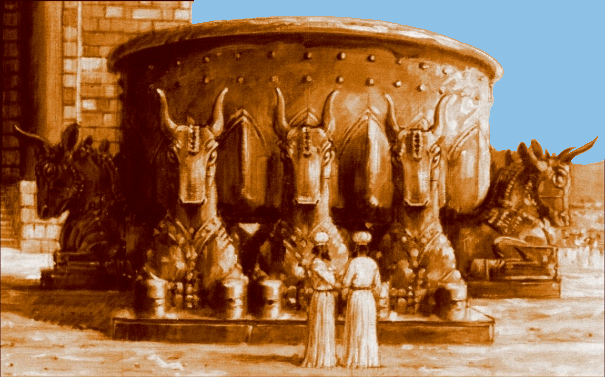
23 Then he made the sea of cast metal. It was round, ten cubits from brim to brim, and five cubits high, and a line of thirty cubits measured its circumference. 24 Under its brim were gourds, for ten cubits, compassing the sea all around. The gourds were in two rows, cast with it when it was cast. 25 It stood on twelve oxen, three facing north, three facing west, three facing south, and three facing east. The sea was set on them, and all their rear parts were inward. 26 Its thickness was a handbreadth, and its brim was made like the brim of a cup, like the flower of a lily. It held two thousand baths.

27 He also made the ten stands of bronze. Each stand was four cubits long, four cubits wide, and three cubits high. 28 This was the construction of the stands: they had panels, and the panels were set in the frames, 29 and on the panels that were set in the frames were lions, oxen, and cherubim. On the frames, both above and below the lions and oxen, there were wreaths of beveled work. 30 Moreover, each stand had four bronze wheels and axles of bronze, and at the four corners were supports for a basin. The supports were cast with wreaths at the side of each. 31 Its opening was within a crown that projected upward one cubit. Its opening was round, as a pedestal is made, a cubit and a half deep. At its opening there were carvings, and its panels were square, not round. 32 And the four wheels were underneath the panels. The axles of the wheels were of one piece with the stands, and the height of a wheel was a cubit and a half. 33 The wheels were made like a chariot wheel; their axles, their rims, their spokes, and their hubs were all cast. 34 There were four supports at the four corners of each stand. The supports were of one piece with the stands. 35 And on the top of the stand there was a round band half a cubit high; and on the top of the stand its stays and its panels were of one piece with it. 36 And on the surfaces of its stays and on its panels, he carved cherubim, lions, and palm trees, according to the space of each, with wreaths all around. 37 After this manner he made the ten stands. All of them were cast alike, of the same measure and the same form.

38 And he made ten basins of bronze. Each basin held forty baths, each basin measured four cubits, and there was a basin for each of the ten stands. 39 And he set the stands, five on the south side of the house, and five on the north side of the house. And he set the sea at the southeast corner of the house. 1 Kings 7:13-39 ESV

The first question that comes to mind when reading this section of Chapter Seven is why the author took such great pains to describe each and every item in such precise detail. The amount of information is almost overwhelming, and even with all the helpful descriptions, it’s virtually impossible to determine what each item actually looked like.  So, why dedicate so much time and space to their description?

In a sense, the author is telling his readers that Solomon was a man who took a keen interest in every phase of the massive construction project he had commissioned. His father had left him with the overwhelming responsibility to create a house worthy of the God of Israel, and that was not something he took lightly. Solomon was a hands-on construction manager who cared deeply about every detail concerning this once-in-a-lifetime undertaking. While he delegated much of the work, there was never a moment when Solomon was not intimately and personally involved in it. He cared deeply about this project and wanted to ensure that the finished product was both beautiful and functional. When completed, the Temple would become the focal point of Israel’s worship of Yahweh. So, Solomon intended for every item associated with its construction and its ultimate operation to be of the finest craftsmanship.

From the quarrying of the massive stones used to build the temple to the carving of the intricate reliefs that adorned the bronze stands, Solomon oversaw everything. To ensure that the workmanship was of the highest quality, Solomon hired the finest craftsman money could buy.

Verse 13 states that Solomon sought out the services of a skilled craftsman from the city of Tyre, a gifted worker in bronze. But notice the additional details concerning Hiram’s qualifications:

And he was full of wisdom, understanding, and skill for making any work in bronze. – 1 Kings 7:1 ESV

This brings to mind a passage from the book of Exodus where God provided Moses with the identity of another man who would assist in the construction of the Tabernacle.

The LORD said to Moses, “See, I have called by name Bezalel the son of Uri, son of Hur, of the tribe of Judah, and I have filled him with the Spirit of God, with ability and intelligence, with knowledge and all craftsmanship, to devise artistic designs, to work in gold, silver, and bronze, in cutting stones for setting, and in carving wood, to work in every craft.” – Exodus 31:1-5 ESV

As was the case with Moses, it seems that Solomon was receiving divine assistance in procuring the services of the right people to help him complete this one-of-a-kind project. Hiram came highly recommended and divinely gifted for the job.

Once he arrived in Jerusalem, Hiram set to work casting the two bronze pillars that would grace the entrance to the Temple. At 27 feet in height, these two immense pillars were likely more decorative than functional. Since they were cast from a relatively soft metal like bronze and featured hollow interiors, they would have been incapable of providing support to the Temple’s roof.

These pillars were intended to frame the entrance to the Temple and provide symbolic significance to the One who dwelt within. Each pillar had a name. One was called Boaz, which means “In Him is strength.” The other was named Jachin, which means “He shall establish.” Both names were explicit references to the God of Israel. Every detail that adorned these pillars, from the water lilies to the pomegranates, was intended to illustrate the goodness and greatness of God. The Israelites served a God who provided them with everything they needed, including fertility and fruitfulness.

Next, Hiram crafted “the sea,” a large bronze basin that would sit outside the Temple’s entrance. This massive bowl was designed to replace the bronze laver that God had prescribed for the Tabernacle, while serving the same function as the original. According to Exodus 30, the first laver was used by the priests to purify themselves before offering sacrifices to God.

“You shall also make a basin of bronze, with its stand of bronze, for washing. You shall put it between the tent of meeting and the altar, and you shall put water in it, with which Aaron and his sons shall wash their hands and their feet. When they go into the tent of meeting, or when they come near the altar to minister, to burn a food offering to the Lord, they shall wash with water, so that they may not die. They shall wash their hands and their feet, so that they may not die. It shall be a statute forever to them, even to him and to his offspring throughout their generations.” – Exodus 30:18-21 ESV

The new basin was 15 feet in diameter, 47 feet in circumference, with a depth of 7.5 feet. It could hold up to 18,000 gallons of water, and its large size appears to have been designed to allow priests to completely immerse themselves, rather than just washing their hands and feet. It rested on the backs of 12 bronze oxen, arranged in groups of three, with each group facing a different direction on the compass. These bronze bulls may have been intended to represent the 12 tribes of Israel. But regardless, they were clearly symbols of strength.

Hiram then crafted ten mobile carts, each equipped with a large bronze basin. They featured wheels that allowed them to be moved about the Temple courtyard.

He also made ten basins in which to wash, and set five on the south side, and five on the north side. In these they were to rinse off what was used for the burnt offering, and the sea was for the priests to wash in. – 2 Chronicles 4:6 ESV

Each cart was six feet square and five and one-half feet high, and it held a bronze basin that could hold up to 240 gallons of water. As the Chronicles passage indicates, they were strategically located around the Temple courtyard and used by the priests to cleanse the blood from the sacrificial animals before they were offered to God.

You can almost sense that Solomon was attempting to improve on every item used in the original Tabernacle. He was making significant upgrades. Every item Hiram created was bigger and better than the original. Solomon was obsessed with making the house of God a grand and glorious structure, with every detail reflecting the majesty of its divine occupant. He could have saved himself a lot of time and money by reusing the original items, but Solomon would not settle for anything less than the best. So, he poured countless hours and resources into creating a Temple worthy of his great God, down to the last detail.

Solomon was following the instructions Yahweh gave to Moses from Mount Sinai when He ordered the creation of the original Tabernacle.

“Have the people of Israel build me a holy sanctuary so I can live among them. You must build this Tabernacle and its furnishings exactly according to the pattern I will show you.” – Exodus 25:8-9 NLT

Moses received detailed plans for the construction of the LORD’s house, with nothing left to the imagination. God was explicit in describing every facet of the Tabernacle’s design, and ordered Moses, “Be sure that you make everything according to the pattern I have shown you here on the mountain” (Exodus 25:40 NLT). Evidently, Moses received a vision of what the completed Tabernacle should look like, and he was to ensure that the finished product was an accurate facsimile. He was not to cut corners, leave out any detail, or make alterations to its design. No expense was to be spared, no shortcuts taken, and no cost-cutting measures considered because this was to be the house of Yahweh. The God of the universe deserved nothing but the best. If the people of Israel expected Him to dwell among them, they would need to build a house worthy of housing His presence. 

“I will meet the people of Israel there, in the place made holy by my glorious presence. Yes, I will consecrate the Tabernacle and the altar, and I will consecrate Aaron and his sons to serve me as priests. Then I will live among the people of Israel and be their God, and they will know that I am the LORD their God. I am the one who brought them out of the land of Egypt so that I could live among them. I am the LORD their God. – Exodus 29:43-46 NLT

Solomon shared Moses’ commitment to build a house that Yahweh would deem worthy of bearing His name and containing His glory. So, he went out of his way to ensure that this house met Yahweh’s exacting standards, because he longed for the assurance of Yahweh’s presence and power.

English Standard Version (ESV) The Holy Bible, English Standard Version. ESV® Permanent Text Edition® (2016). Copyright © 2001 by Crossway Bibles, a publishing ministry of Good News Publishers.

New Living Translation (NLT) Holy Bible, New Living Translation, copyright © 1996, 2004, 2015 by Tyndale House Foundation. Used by permission of Tyndale House Publishers Inc., Carol Stream, Illinois 60188. All rights reserved.

Jehovah-Rapha

22 Then Moses made Israel set out from the Red Sea, and they went into the wilderness of Shur. They went three days in the wilderness and found no water. 23 When they came to Marah, they could not drink the water of Marah because it was bitter; therefore it was named Marah. 24 And the people grumbled against Moses, saying, “What shall we drink?” 25 And he cried to the Lord, and the Lord showed him a log, and he threw it into the water, and the water became sweet.

There the Lord made for them a statute and a rule, and there he tested them, 26 saying, “If you will diligently listen to the voice of the Lord your God, and do that which is right in his eyes, and give ear to his commandments and keep all his statutes, I will put none of the diseases on you that I put on the Egyptians, for I am the Lord, your healer.”

27 Then they came to Elim, where there were twelve springs of water and seventy palm trees, and they encamped there by the water. – Exodus 15:22-27 ESV

YHWHrāp̄ā’ – “The LORD Who Heals.”The Hebrew word, rāp̄ā’ has many connotations, including “rāp̄ā’ “to cause to cure, heal, physician, repair, make whole” (Strong’s Exhaustive Concordance). Throughout the Old Testament, it is used in a variety of ways. In Genesis 20, Moses describes the occasion when the prayer of Abraham resulted in the healing of a pagan king named Abimelech.

Then Abraham prayed to God, and God healed [rāp̄ā’] Abimelech, and also healed [rāp̄ā’] his wife and female slaves so that they bore children. For the LORD had closed all the wombs of the house of Abimelech because of Sarah, Abraham’s wife. – Genesis 20:17-18 ESV

The context is important because Abraham had “ journeyed toward the territory of the Negeb and lived between Kadesh and Shur, and he sojourned in Gerar” (Genesis 20:1 ESV). While in Gerar, Abraham convinced his wife Sarah to pass herself off as his sister. His reasoning was simple. He believed that if it was discovered Sarah was his wife, one of the polygamous Gerarites might kill him so he could claim her as his own. Abraham had tried this ploy before and it had failed miserably (Genesis 13:10-20).

This instance did not fair any better. Abimelech, the king of Gerar, believing Sarah to be a single, unmarried woman, took her to be his wife. But that night he had a dream in which God threatened him with death.

“Behold, you are a dead man because of the woman whom you have taken, for she is a man’s wife.” – Genesis 20:3 ESV

The Gerarites, while polygamous, did respect the sanctity of marriage. So, Abimelech was appalled to hear that he had taken a married man’s wife into his harem. He was also petrified to hear a disembodied voice warn him of his pending death and that of all his people. Abimelech pleaded his innocence, claiming to have acted on the words of Abraham. He had been told that the woman was unmarried and, fortunately, had not yet touched her. God assured Abimelech that He was aware of the circumstances and had a way for the king to make things right.

“Yes, I know that you have done this in the integrity of your heart, and it was I who kept you from sinning against me. Therefore I did not let you touch her. Now then, return the man’s wife, for he is a prophet, so that he will pray for you, and you shall live. But if you do not return her, know that you shall surely die, you and all who are yours.” – Genesis 20:6-7 ESV

There is no indication that Abimelech was suffering any kind of malady. God did not strike him with a deadly disease or life-threatening illness. But he was facing the loss of his life and he would not be alone. The fate of his entire family and, possibly, that of his nation, was in the hands of the very man who had lied to him.

When Abimelech approached Abraham, he expressed his consternation at having been put in this predicament by Abraham’s deceitfulness. He begged to know what had possessed Abraham to do such a thing. Faced with the blunt-force anger of Abimelech, Abraham didn’t sugarcoat his answer.

I did it because I thought, ‘There is no fear of God at all in this place, and they will kill me because of my wife.’ Besides, she is indeed my sister, the daughter of my father though not the daughter of my mother, and she became my wife.” – Genesis 20:11-12 ESV

Abraham had been in the wrong. Not only was he guilty of deceitfulness but he had failed to trust the faithfulness of Yahweh. For the second time in his life, Abraham displayed his distrust of Yahweh’s protection and provision. But God was watching over His disobedient and distrustful servant. He protected Sarah and preserved the purity of the woman who would ultimately bear Abraham the son who would fulfill all the covenant promises (Genesis 12:1-3).

There is so much going on in this story. In an effort to assuage God’s anger and persuade Abraham to pray for him, Abimelech showered Abraham with 1,000 pieces of silver, as well as sheep, oxen, and male and female servants. Abraham was going to walk away a rich man. But not only that. Abraham would leave the scene with his marriage and his wife’s purity intact. God had healed what was on the verge of being broken. He had graciously repaired what Abraham had damaged. Had God not intervened and interrupted Abimelech’s sleep with a dream, the king would have ultimately consummated his relationship with Sarah. It was just a matter of time. But Jehovah-Rapha stepped in and made whole that which was fractured and falling apart. God cleaned up the mess that Abraham had made.

But God also “healed” [rāp̄ā’] Abimelech and his family. God graciously called off His plan to take Abimelech’s life. Abimelech was not sick, but he was under a curse. His fate was sealed unless he obeyed the words of Yahweh. But because he did, he experienced wholeness instead of brokenness. He was given the gift of life rather than death. God had protected Sarah from being sexually violated by a pagan. He had protected Abraham from becoming a single man with no hope of seeing the promises of God fulfilled. He had protected Abimelech from touching Sarah and from having to suffer death for a sin he had committed in ignorance.

Throughout this story, God’s grace and mercy are on full display. None of the actors in this dark drama deserved what they received. But the LORD Who Heals stepped in and remedied the situation and preserved the integrity of His own plan and the lives of those who were integral to its fulfillment.

Back to the story in Exodus. Moses was attempting to lead the people of Israel from Egypt to the Promised Land. But along the way, they experienced various trials and difficulties. One of the first took place at Marah, an oasis in the desert that contained bitter, undrinkable water. The people had been walking for three days and the joy of their miraculous deliverance from the Egyptians and their inexplicable crossing of the Red Sea on dry ground had worn off. They were tired, thirsty, and in a far-from-happy mood. They complained to Moses and he took the issue to God, who quickly responded and gave Moses a solution.

the Lord showed him a log, and he threw it into the water, and the water became sweet. – Exodus 15:25 ESV

God “healed” the waters. He performed another miracle and transformed the bitter water into sweet, refreshing, life-giving water. But the water was not the only thing that was bitter. The Hebrew word is mar and it can also refer to discontentment. The people of Israel were bitter about their circumstances; they didn’t like the way things were turning out. Their miraculous crossing of the Red Sea had turned into an unpleasant and weariness-producing crossing of a trackless and waterless desert, and they were not in a good mood.

God’s solution to the problem was a simple one. He instructed Moses to take an ʿēṣ and throw it into the water. The Hebrew word is fascinating because it is the same word used in the opening chapters of the Book of Genesis.

…out of the ground the Lord God made to spring up every tree [ʿēṣ] that is pleasant to the sight and good for food. The tree [ʿēṣ] of life was in the midst of the garden, and the tree [ʿēṣ] of the knowledge of good and evil. – Genesis 2:9 ESV

More than a 162 times in the Old Testament, the word ʿēṣ is translated as “tree.” There is no reason not to translate it the same way here. The text doesn’t give the variety of tree that was used, but the outcome is quite clear. When Moses threw the tree in the water, it produced life. The bitter water was transformed. What had been undrinkable and incapable of sustaining life was divinely altered and imbued with life-giving properties. That which was unacceptable became acceptable.

There was more to this miraculous transformation than the Israelites realized. They were content to have their thirst quenched but God had so much more He wanted them to see. Moses writes, “It was there at Marah that the Lord set before them the following decree as a standard to test their faithfulness to him” (Exodus 15:25 NLT).

God wasn’t content to satisfy their craving for water. He wanted to teach them a lesson about faithfulness and trust. He knew they would get thirsty again. Temporary solutions to temporal problems never produce eternal results. As long as they focused their attention on their physical needs they would never learn the spiritual lessons God wanted them to learn. So, along with the water, God gave Moses a message to deliver to his bitterness-prone people.

“If you will listen carefully to the voice of the Lord your God and do what is right in his sight, obeying his commands and keeping all his decrees, then I will not make you suffer any of the diseases I sent on the Egyptians; for I am the Lord who heals you.” – Exodus 15:26 NLT

It’s important to note that God threatens His people with disease if they fail to obey while referring to Himself as their healer. At this moment, they are healthy, whole, and no longer suffering from thirst. But He is warning them that a fate worse than thirst awaits them if they refuse to “do what is right in His sight.” This would not be the last time they complained about a lack of water. There would also be occasions when they grumbled about their less-than-satisfactory diet and their unhappiness with the manna that God provided for them.

What they failed to realize was that their complaining was a source of disobedience. They didn’t trust God. They allowed their circumstances to determine their view of God and dictate the degree of their adoration toward Him.

What’s important to note in this story is that there was water, but it was undrinkable. Their problem wasn’t a lack of something, but it was that the solution to their need was “bitter.” It was plentiful but undrinkable. It wasn’t that the water was non-existent but that it was worthless in its current condition. And this non-potable water contained a powerful lesson for the Israelites.

The Hebrew word translated as “bitter” is מַר (mar), which can also be translated as “angry” or “discontented.” Little did the Israelites know that the water was a symbol of their own spiritual condition. Despite all God had done to set them free from their bondage in Egypt, they were a bitter and discontented people. In a sense, they were unusable. Instead of displaying gratitude for all that God had done, they quickly resorted to anger and blame, and their blatant displays of dissatisfaction were evidence that their hearts were bitter and in need of change.

So, God took this opportunity to teach the Israelites a much-needed lesson on how He was going to transform the bitter condition of their hearts. Hundreds of years later, the prophet Ezekiel would record the following promise that God made to His people.

“I will give you a new heart, and I will put a new spirit in you. I will take out your stony, stubborn heart and give you a tender, responsive heart. And I will put my Spirit in you so that you will follow my decrees and be careful to obey my regulations.” – Ezekiel 3626-27 NLT

From the very beginning, God revealed His desire to transform the hearts of His people. Their real problem had never been slavery; they suffered from a heart condition that left them bitter, angry, and discontented. Their 400-year separation from God had reduced them to a state of spiritual stagnation and impurity. They had become polluted by the culture and robbed of their ability to be a source of life to the nations around them. So, God was going to intervene and, over time, begin His miraculous plan of heart transformation.

God used a tree to transform bitter water into a life-giving source of sustenance. He had just proven, yet again, that He could meet all their needs. Thousands of years later, God would use another tree to heal the sins of mankind. The apostle Peter spoke of the life-transforming and spiritual-healing properties of this tree when he addressed the religious leaders of Israel.

“The God of our fathers raised Jesus, whom you killed by hanging him on a tree. God exalted him at his right hand as Leader and Savior, to give repentance to Israel and forgiveness of sins.” – Acts 5:30-31 ESV

Peter would later deliver the same message to a gathering of Gentiles.

“They put him to death by hanging him on a tree, but God raised him on the third day and made him to appear, not to all the people but to us who had been chosen by God as witnesses, who ate and drank with him after he rose from the dead. And he commanded us to preach to the people and to testify that he is the one appointed by God to be judge of the living and the dead. To him all the prophets bear witness that everyone who believes in him receives forgiveness of sins through his name.” – Acts 10:39-43 ESV

Jehovah-Rapha is The LORD Who Heals. But He wants to do far more than heal our temporal and physical problems. He can provide for all our needs and is more than willing to do so, but His greatest desire is to heal our hearts and restore us to a relationship with Him so that will satisfy our thirst for true life and meaning.

“If anyone thirsts, let him come to me and drink. Whoever believes in me, as the Scripture has said, ‘Out of his heart will flow rivers of living water.’” – John 7:37-38 ESV

English Standard Version (ESV) The Holy Bible, English Standard Version. ESV® Permanent Text Edition® (2016). Copyright © 2001 by Crossway Bibles, a publishing ministry of Good News Publishers.

New Living Translation (NLT) Holy Bible, New Living Translation, copyright © 1996, 2004, 2015 by Tyndale House Foundation. Used by permission of Tyndale House Publishers Inc., Carol Stream, Illinois 60188. All rights reserved.

New English Translation (NET)NET Bible® copyright ©1996-2017 by Biblical Studies Press, L.L.C. http://netbible.com All rights reserved.

Jehovah-Go’el

24 Who can snatch the plunder of war from the hands of a warrior?
    Who can demand that a tyrant let his captives go?
25 But the Lord says,
“The captives of warriors will be released,
    and the plunder of tyrants will be retrieved.
For I will fight those who fight you,
    and I will save your children.
26 I will feed your enemies with their own flesh.
    They will be drunk with rivers of their own blood.
All the world will know that I, the Lord,
    am your Savior and your Redeemer,
    the Mighty One of Israel.”
– Isaiah 49:24-26 NLT

YHWHGā’al – The LORD Your Redeemer.” These verses are part of an extended section within the Book of Isaiah that reveals God’s plan to return Israel from their captivity in Babylon and restore them to the land of Canaan. Their exile as slaves in a foreign land had been the result of God’s judgment for their apostasy and spiritual adultery. He had warned them repeatedly, using prophets like Isaiah and Jeremiah to carry His message of repentance. But His chosen people had proved too stubborn and unwilling to give up their love affair with false gods and the pleasures of this world. Over the centuries, they had compromised their convictions and grown complacent regarding their status as God’s treasured possession. They had violated their covenant commitment to Him and, as a result, had suffered the consequences of their disobedience.

God had made clear His intentions to bless them if they obeyed.

“If you fully obey the Lord your God and carefully keep all his commands that I am giving you today, the Lord your God will set you high above all the nations of the world. You will experience all these blessings if you obey the Lord your God…” – Deuteronomy 28:1-2 NLT

But He had also warned them of the dire consequences of their disobedience.

“But if you refuse to listen to the Lord your God and do not obey all the commands and decrees I am giving you today, all these curses will come and overwhelm you…” – Deuteronomy 28:15 NLT

God provided a list of devastating outcomes for their refusal to live according to His will and in keeping with His commands, including their defeat at the hands of a foreign power and their forced removal from the Land of Promise.

“The Lord will exile you and your king to a nation unknown to you and your ancestors. There in exile you will worship gods of wood and stone! You will become an object of horror, ridicule, and mockery among all the nations to which the Lord sends you. – Deuteronomy 28:36-37 NLT

By the time Isaiah penned the words found in Isaiah 49, the Babylonians had already defeated the Israelites living in the southern kingdom of Judah, destroying the capital city of Jerusalem and its glorious Temple.

But in chapters 49-52, God reveals His plans for Israel’s future redemption and restoration, and declares His intentions to do so through the aid of His “Servant.” First, He promises a day when He, Jehovah-Go’el will transform Israel’s fate.

The LORD, the Redeemer
    and Holy One of Israel,
says to the one who is despised and rejected by the nations,
    to the one who is the servant of rulers:
“Kings will stand at attention when you pass by.
    Princes will also bow low
because of the Lord, the faithful one,
    the Holy One of Israel, who has chosen you.” – Isaiah 49:7 NLT

Despite Israel’s rebellion and refusal to keep their covenant commitments, God would reject those He had chosen as His own. He had punished them justly and appropriately, but He would also restore them graciously and mercifully. They did not deserve to be saved. In fact, the prophet Ezekiel records God’s indictment of their unfaithfulness even while in exile.

“Therefore, give the people of Israel this message from the Sovereign Lord: I am bringing you back, but not because you deserve it. I am doing it to protect my holy name, on which you brought shame while you were scattered among the nations. I will show how holy my great name is—the name on which you brought shame among the nations. And when I reveal my holiness through you before their very eyes, says the Sovereign Lord, then the nations will know that I am the Lord. For I will gather you up from all the nations and bring you home again to your land. – Ezekiel 36:22-24 NLT

Yet, God was determined to keep His covenant promises and see that His people were restored to the land He had given them as their inheritance. For anyone familiar with the history of Israel, it would be easy to assume that the Isaiah 49 passage addresses Israel’s return from captivity under the leadership of Ezra and Nehemiah. As God had promised, the exiled Israelites began returning to Judah in 538 B.C.E. Through a series of God-ordained events, a remnant of the Israelites were given permission to make the long journey home so that they might restore Jerusalem, rebuild the Temple, and repopulate the land of Judah.

But Isaiah seems to have something far more significant in mind. In chapters 49-52, he describes a restoration that exceeds anything Israel experienced under the leadership of Ezra and Nehemiah. In chapter 52, he writes of a day when only the pure and godly will enter the gates of Jerusalem.

Wake up, wake up, O Zion!
Clothe yourself with strength.
Put on your beautiful clothes, O holy city of Jerusalem,
for unclean and godless people will enter your gates no longer.
Rise from the dust, O Jerusalem.
Sit in a place of honor.
Remove the chains of slavery from your neck,
O captive daughter of Zion.
For this is what the Lord says:
“When I sold you into exile,
I received no payment.
Now I can redeem you
without having to pay for you.”
– Isaiah 52:1-3 NLT

These verses describe a different restoration with far-reaching implications for Israel and the world. Isaiah describes a far-distant day when God will redeem and restore Israel once and for all.

Let the ruins of Jerusalem break into joyful song,
    for the Lord has comforted his people.
    He has redeemed Jerusalem.
The Lord has demonstrated his holy power
    before the eyes of all the nations.
All the ends of the earth will see
    the victory of our God. – Isaiah 52:9-10 NLT

What Ezra and Nehemiah accomplished in leading the exiles back to the land of Judah cannot be overlooked. They took on the gargantuan task of rebuilding the ruins of Jerusalem under great duress and significant opposition. However, their efforts, while ultimately successful, do not match what Isaiah describes.

After their return to Judah, the Israelites were surrounded by enemies and under constant threat of annihilation. They had no king and no standing army, making them an easy target for any nation that coveted their fertile and well-watered land. It would not be long before they found themselves under the thumb of yet another world power when the Romans invaded the land and became their overlords. Their occupation began in 68 B.C.E. and was still going on when Jesus appeared on the scene.

But Jesus’ arrival adds another important element to the prophecies of Isaiah because He is the “servant” of whom Isaiah wrote. The descriptions of this coming servant mirror the life of Jesus, both in His incarnation but also in His future return.

“The Sovereign Lord has given me his words of wisdom,
    so that I know how to comfort the weary.
Morning by morning he wakens me
    and opens my understanding to his will.
The Sovereign Lord has spoken to me,
    and I have listened.
    I have not rebelled or turned away.
I offered my back to those who beat me
    and my cheeks to those who pulled out my beard.
I did not hide my face
    from mockery and spitting.

“Because the Sovereign Lord helps me,
    I will not be disgraced.
Therefore, I have set my face like a stone,
    determined to do his will.
    And I know that I will not be put to shame. – Isaiah 50:4-7 NLT

These verses are mirrored by the gospel writers when they describe the abuse Jesus suffered during His trials before the Sanhedrin and the Roman governor Pilate. Jesus confessed His unflinching determination to do His Father’s will when He said, “For I have come down from heaven, not to do my own will but the will of him who sent me” (John 6:38 ESV). Though He knew what would happen when He arrived in Jerusalem, Jesus set His face like a stone and made the journey anyway (Luke 9:51).

Jesus was the servant whom God promised to send. He came to seek and to save that which was lost. He came to redeem all those who were enslaved to sin and condemned to death. He was Jehovah-Go’el, the LORD Our Redeemer. According the Isaiah, it was always God’s plan to send His Servant to redeem what was lost and, as Paul states, “because of him, you are in Christ Jesus, who became to us wisdom from God, righteousness and sanctification and redemption” (1 Corinthians 1:30 ESV).

But Jesus is not yet done. While He has finished His atoning work on the cross, He has not completed the mission God gave Him. He will one day return and fulfill His role as Jehovah-Go’el. the Savior and Redeemer of God’s chosen people, the Israelites. Every covenant promise God made to them will be fulfilled – in Christ.

”For I will gather you up from all the nations and bring you home again to your land.

“Then I will sprinkle clean water on you, and you will be clean. Your filth will be washed away, and you will no longer worship idols. And I will give you a new heart, and I will put a new spirit in you. I will take out your stony, stubborn heart and give you a tender, responsive heart. And I will put my Spirit in you so that you will follow my decrees and be careful to obey my regulations.

“And you will live in Israel, the land I gave your ancestors long ago. You will be my people, and I will be your God.” – Ezekiel 36:24-28 NLT

God is a redeeming God. From the moment Adam and Eve disobeyed His divine directive in the garden, He has been on a relentless quest to restore what was damaged by the fall. But this quest is not some sort of Don Quixote-esque ill-fated hope for a non-existent future; it is based on a pre-ordained outcome that was established before the foundation of the world. In other words, the fall was not a fly in the ointment for God. It did not come as a surprise to God or require Him to formulate a Plan B to replace His obviously flawed and failed Plan A.

No, the redemption of Israel and the redemption of sinful humanity was always a part of God’s strategic plan, and you see it mapped out in these chapters of Isaiah. Redemption has always been part of God’s sovereign, providential will. Israel’s rebellion and subsequent punishment was not an unscheduled detour in God’s road map of redemption; it was a pre-planned, pre-scheduled stop along the way. God had always planned to redeem Israel because He had always intended for His “Servant” to be an Israelite. He had to be born of the seed of Abraham and come from the lineage of David so that He could one day sit on the throne of David and rule over the redeemed and restored nation of Israel. As Isaiah wrote in an earlier portion of his book, Jesus is the fulfillment of God’s promise to send a redeemer for His rebellious people, including both Jews and Gentiles.

For a child is born to us,
    a son is given to us.
The government will rest on his shoulders.
    And he will be called:
Wonderful Counselor, Mighty God,
    Everlasting Father, Prince of Peace.
His government and its peace
    will never end.
He will rule with fairness and justice from the throne of his ancestor David
    for all eternity.
The passionate commitment of the Lord of Heaven’s Armies
    will make this happen! – Isaiah 9:6-7 NLT

English Standard Version (ESV)
The Holy Bible, English Standard Version. ESV® Permanent Text Edition® (2016). Copyright © 2001 by Crossway Bibles, a publishing ministry of Good News Publishers.

New Living Translation (NLT)
Holy Bible, New Living Translation, copyright © 1996, 2004, 2015 by Tyndale House Foundation. Used by permission of Tyndale House Publishers Inc., Carol Stream, Illinois 60188. All rights reserved.

The Glory of the Lord

34 Then the cloud covered the tent of meeting, and the glory of the Lord filled the tabernacle. 35 And Moses was not able to enter the tent of meeting because the cloud settled on it, and the glory of the Lord filled the tabernacle. 36 Throughout all their journeys, whenever the cloud was taken up from over the tabernacle, the people of Israel would set out. 37 But if the cloud was not taken up, then they did not set out till the day that it was taken up. 38 For the cloud of the Lord was on the tabernacle by day, and fire was in it by night, in the sight of all the house of Israel throughout all their journeys. – Exodus 40:34-38 ESV

The book of Exodus ends with a somewhat small but highly significant section of verses that provide the conclusion to the Israelite’s Sinai experience. They had been camped at this location for more than a year and, during that time, much had taken place. And this region had a special significance to Moses because it was at this same spot that he had received his commission from God to serve as the deliverer of Israel. Long before he had taken on this formidable responsibility to lead the Israelites from captivity in Egypt to the land of Canaan, Moses had been shepherding his father-in-law’s sheep near Mount Sinai. On one occasion, Moses’ attention was drawn to a strange and inexplicable sight.

He looked, and behold, the bush was burning, yet it was not consumed. And Moses said, “I will turn aside to see this great sight, why the bush is not burned.” When the Lord saw that he turned aside to see, God called to him out of the bush, “Moses, Moses!” – Exodus 3:2-4 ESV

Much to Moses’ surprise, the bush spoke to him, and little did he know at the moment that the voice he heard was that of Yahweh, the God of Abraham, Isaac, and Jacob.

“Do not come near; take your sandals off your feet, for the place on which you are standing is holy ground.” – Exodus 3:5 ESV

Moses had entered a holy place because God Almighty had graced it with His presence. His divine glory appeared in tongues of flame that engulfed an ordinary bush but left it fully intact and unharmed. In a sense, that bush had become an earthly sanctuary for God – if just for a moment. Its original purpose had been dramatically altered as it was transformed into a temporary repository for God’s holy presence.

For a brief moment in time, God had turned a common and otherwise insignificant bush into a sanctuary in which Moses might commune with Him. By God’s grace, that remote desert location had become a place of worship and intimate fellowship with Him. It was holy ground and, from that spot, God spoke to Moses.

“I have surely seen the affliction of my people who are in Egypt and have heard their cry because of their taskmasters. I know their sufferings, and I have come down to deliver them out of the hand of the Egyptians and to bring them up out of that land to a good and broad land, a land flowing with milk and honey, to the place of the Canaanites, the Hittites, the Amorites, the Perizzites, the Hivites, and the Jebusites. – Exodus 3:7-8 ESV

Yahweh revealed His glory and His will to Moses. And now, more than a year later, God was going to reenact this divine encounter yet again. But this time, the place of meeting would be the newly erected Tabernacle and not a burning bush. With the Tabernacle now complete, it was time for God to fulfill His promise and take up residence within it. During his initial encounter with Yahweh at the burning bush, Moses had received the following promise.

“I will be with you, and this shall be the sign for you, that I have sent you: when you have brought the people out of Egypt, you shall serve God on this mountain.” – Exodus 3:12 ESV

God had kept His word. Moses had served God on Mount Sinai. It was there, on the top of the mountain, that God had revealed His glory once again.

All of Mount Sinai was covered with smoke because the Lord had descended on it in the form of fire. The smoke billowed into the sky like smoke from a brick kiln, and the whole mountain shook violently. – Exodus 19:18 NLT

The Lord came down on the top of Mount Sinai and called Moses to the top of the mountain. So Moses climbed the mountain. – Exodus 19:20 NLT

God called and Moses obeyed. He climbed to the top of the mountain and entered into God’s presence, where he received God’s laws and His plans for the Tabernacle.

“Have the people of Israel build me a holy sanctuary so I can live among them. You must build this Tabernacle and its furnishings exactly according to the pattern I will show you.” – Exodus 25:8-9 NLT

Moses had kept his end of the agreement, having successfully overseen the fashioning and erecting of the Tabernacle. He had inspected every facet of the project and given it his approval. But now, it was up to God to give His Good Housekeeping Seal of Approval by blessing the Tabernacle with His presence. And Moses rather matter-of-factly records, “the cloud covered the tent of meeting, and the glory of the Lord filled the tabernacle” (Exodus 40:34 ESV).

It was as if the glory of God had descended from the top of Mount Sinai and settled upon the Tabernacle. The same manifestation of His divine presence that had guided the Israelites ever since they left Egypt had now come to rest over the Tabernacle. The pillar of cloud and the pillar of fire would appear over the top of the Tabernacle, providing the Israelites with a visual reminder that God was home and dwelling in their midst. Moses states that “the glory of the Lord filled the tabernacle” (Exodus 40:35 ESV). He was unable to provide an explanation as to how this glory manifested itself, because he was not allowed to enter the Holy of Holies where God’s glory rested above the Mercy Seat on top of the Ark of the Covenant. But all the people were given a clear and unmistakable sign of God’s presence in the Tabernacle. As long as the pillar of cloud or the pillar of fire appeared over the Tabernacle, they would know that their God was near. He had not left or forsaken them. 

But as soon as the pillar lifted up from the Tabernacle, they knew it was time to pack up and prepare to go.

Throughout all their journeys, whenever the cloud was taken up from over the tabernacle, the people of Israel would set out. But if the cloud was not taken up, then they did not set out till the day that it was taken up. – Exodus 40:36-37 ESV

The Tabernacle had been designed and constructed to ensure its portability. It was to be a temporary and transportable structure that could be moved from place to place. But once God’s glory settled at a new location, the people were to stop and immediately reassemble the Tabernacle. God’s house was to be their highest priority because God’s presence was their greatest need. Without Him, they were hopeless, helpless, directionless, and powerless. Any hopes they had of making it to the land of promise and conquering the nations that lived there would be dashed if the Lord ever left them. His presence wasn’t a pleasant perk but a life-or-death necessity. The only thing that set them apart from the other nations was the presence and power of God. Without Him, they were no different than the many pagan people groups that occupied the land of Canaan.

The book of Exodus ends with the Tabernacle completed, the law given, the priesthood established, the sacrificial system inaugurated, and God’s presence in place. Everything was just as God had planned it. His will had been obeyed and He had blessed His people with the reality of His divine presence among them. Now, it was time to complete the rest of their journey to the promised land. The Tabernacle and Sinai were not their final destination. God had more in store for them, and the best was yet to come.

English Standard Version (ESV) The Holy Bible, English Standard Version. ESV® Permanent Text Edition® (2016). Copyright © 2001

New Living Translation (NLT) Holy Bible, New Living Translation, copyright © 1996, 2004, 2015 by Tyndale House Foundation. Used by permission of Tyndale House Publishers Inc., Carol Stream, Illinois 60188. All rights reserved.

Move-In Day

1 The Lord spoke to Moses, saying, “On the first day of the first month you shall erect the tabernacle of the tent of meeting. And you shall put in it the ark of the testimony, and you shall screen the ark with the veil. And you shall bring in the table and arrange it, and you shall bring in the lampstand and set up its lamps. And you shall put the golden altar for incense before the ark of the testimony, and set up the screen for the door of the tabernacle. You shall set the altar of burnt offering before the door of the tabernacle of the tent of meeting, and place the basin between the tent of meeting and the altar, and put water in it. And you shall set up the court all around, and hang up the screen for the gate of the court.

“Then you shall take the anointing oil and anoint the tabernacle and all that is in it, and consecrate it and all its furniture, so that it may become holy. 10 You shall also anoint the altar of burnt offering and all its utensils, and consecrate the altar, so that the altar may become most holy. 11 You shall also anoint the basin and its stand, and consecrate it. 12 Then you shall bring Aaron and his sons to the entrance of the tent of meeting and shall wash them with water 13 and put on Aaron the holy garments. And you shall anoint him and consecrate him, that he may serve me as priest. 14 You shall bring his sons also and put coats on them, 15 and anoint them, as you anointed their father, that they may serve me as priests. And their anointing shall admit them to a perpetual priesthood throughout their generations.”

16 This Moses did; according to all that the Lord commanded him, so he did. 17 In the first month in the second year, on the first day of the month, the tabernacle was erected. 18 Moses erected the tabernacle. He laid its bases, and set up its frames, and put in its poles, and raised up its pillars. 19 And he spread the tent over the tabernacle and put the covering of the tent over it, as the Lord had commanded Moses. 20 He took the testimony and put it into the ark, and put the poles on the ark and set the mercy seat above on the ark. 21 And he brought the ark into the tabernacle and set up the veil of the screen, and screened the ark of the testimony, as the Lord had commanded Moses. 22 He put the table in the tent of meeting, on the north side of the tabernacle, outside the veil, 23 and arranged the bread on it before the Lord, as the Lord had commanded Moses. 24 He put the lampstand in the tent of meeting, opposite the table on the south side of the tabernacle, 25 and set up the lamps before the Lord, as the Lord had commanded Moses. 26 He put the golden altar in the tent of meeting before the veil, 27 and burned fragrant incense on it, as the Lord had commanded Moses. 28 He put in place the screen for the door of the tabernacle. 29 And he set the altar of burnt offering at the entrance of the tabernacle of the tent of meeting, and offered on it the burnt offering and the grain offering, as the Lord had commanded Moses. 30 He set the basin between the tent of meeting and the altar, and put water in it for washing, 31 with which Moses and Aaron and his sons washed their hands and their feet. 32 When they went into the tent of meeting, and when they approached the altar, they washed, as the Lord commanded Moses. 33 And he erected the court around the tabernacle and the altar, and set up the screen of the gate of the court. So Moses finished the work. – Exodus 40:1-33 ESV

To say that the roughly nine months the Israelites spent at Mount Sinai had been eventful would be an understatement. During their stay in the shadow of Sinai’s peak, they received a divine visit from Yahweh, as He displayed His glory on the mountaintop. Lightning, thunder, smoke, and earthquakes accompanied His presence. And on multiple occasions, they watched as their intrepid leader, Moses, ascended the mountain to speak with God. During those encounters, he received the Decalogue and the Book of the Covenant. God gave him the plans for the Tabernacle and the sacrificial system.

But during one of his more lengthy sessions with the Almighty, the people became impatient and doubtful of his return. So, they demanded that Aaron, his brother and temporary proxy, take over leadership and begin by finding them a new god to worship. Sadly, Aaron had agreed with their demands. This led to a strong rebuke from Moses and the deaths of thousands of Israelites. But God continued to extend grace and mercy to the people of Israel, assuring them of His continued care and protection. But to guarantee His ongoing presence among them, they would have to build the Tabernacle He had designed.

Now, on the first day of the first month, almost exactly one year after the Israelites left Egypt, Moses oversaw the construction of God’s house. After months of laborious work and painstaking craftsmanship, the people were able to see the Tabernacle rise up from the valley floor.  This beautiful structure, designed by God Himself, gradually took form before their eyes. From its vantage point in the middle of the Israelite camp, the building site would have been hard to miss, and the people must have watched the project’s progress with eager anticipation. Slowly and with great care, the timber framework was erected. Then, the two heavy layers of the animal-skin outer covering were put in place. Next, the various pieces of furniture that Bezalel had crafted were moved into their proper positions within the inner recesses of the Tabernacle. The Ark of the Covenant was placed in the Holy of Holies. The Table of Shewbread, the Golden Candlestick, and the Altar of Incense were carefully situated in the Holy Place.  And everything was done according to the plan given to Moses by God.

This Moses did; according to all that the Lord commanded him, so he did. – Exodus 40:16 ESV

At this point, God was taking no chances. He provided Moses with detailed instructions that outlined the exact order of the entire construction and move-in process. There was a proper sequence for everything, and Moses followed God’s instructions to the letter. And his obedient fulfillment of God’s plan was key to ensuring God’s presence. The Tabernacle was intended to be God’s house and, therefore, it must be perfect and up to His exacting standards. Built by human hands, it was to be the earthly dwelling place of the God of the Universe.

One can only imagine the stress that Moses felt as he oversaw the build-out and move-in process. He must have second-guessed himself a thousand times and questioned whether he had left anything out. And during his inspections of all the various elements that made up the Tabernacle, he must have had a great deal of concern that everything would meet God’s expectations. There was a great deal riding on this project. If anything was unacceptable or incomplete, it could end up postponing or permanently canceling God’s move-in plans. And that would be catastrophic.

But Moses proved to be a worthy project manager. Eight different times the text states that Moses followed God’s instructions flawlessly, doing everything “just as the Lord had commanded him” (16, 19, 21, 23, 25, 27, 29, 32). He took his responsibilities seriously because he knew that any failure to meet God’s expectations would be catastrophic. The Tabernacle was meant to illustrate the holiness of God. Everything about it was designed to reflect God’s glory and greatness. The flawless God of the universe required a residence worthy of His glorious status.

And after careful oversight of the entire project, the day came when the last piece of the puzzle was put in place and the Tabernacle stood completed. Moses and the rest of the Israelites must have stood back and viewed their work with awe and admiration. They had put a great deal of time, effort, and personal resources into this project. Now, it stood complete, but there was still one thing missing: The presence of God. His house was done, but if He failed to move in, the Tabernacle would end up being just another tent in the wilderness. Moses knew that there was one more vital step for the entire process to be deemed a success. God must take up residence in the Tabernacle. But would He be satisfied with their work? Would He give His Good Housekeeping seal of approval?

As the Israelites prepared to begin their second year since leaving Egypt, they were forced to wait on pins and needles to see if God would grace the Tabernacle with His divine presence. But they wouldn’t have to wait long.

English Standard Version (ESV) The Holy Bible, English Standard Version. ESV® Permanent Text Edition® (2016). Copyright © 2001

New Living Translation (NLT) Holy Bible, New Living Translation, copyright © 1996, 2004, 2015 by Tyndale House Foundation. Used by permission of Tyndale House Publishers Inc., Carol Stream, Illinois 60188. All rights reserved.

Mission Accomplished

32 Thus all the work of the tabernacle of the tent of meeting was finished, and the people of Israel did according to all that the Lord had commanded Moses; so they did. 33 Then they brought the tabernacle to Moses, the tent and all its utensils, its hooks, its frames, its bars, its pillars, and its bases; 34 the covering of tanned rams’ skins and goatskins, and the veil of the screen; 35 the ark of the testimony with its poles and the mercy seat; 36 the table with all its utensils, and the bread of the Presence; 37 the lampstand of pure gold and its lamps with the lamps set and all its utensils, and the oil for the light; 38 the golden altar, the anointing oil and the fragrant incense, and the screen for the entrance of the tent; 39 the bronze altar, and its grating of bronze, its poles, and all its utensils; the basin and its stand; 40 the hangings of the court, its pillars, and its bases, and the screen for the gate of the court, its cords, and its pegs; and all the utensils for the service of the tabernacle, for the tent of meeting; 41 the finely worked garments for ministering in the Holy Place, the holy garments for Aaron the priest, and the garments of his sons for their service as priests. 42 According to all that the Lord had commanded Moses, so the people of Israel had done all the work. 43 And Moses saw all the work, and behold, they had done it; as the Lord had commanded, so had they done it. Then Moses blessed them. – Exodus 39:32-43 ESV

Moses fast-forwards the narrative and compresses the timeline to reflect the completion day of the Tabernacle. He provides no details as to how long it took Bezalel and the other craftsmen to wrap up this massive project, but the day came when their work was done. God’s house was complete.

The next step was to present every single item to Moses for his inspection. While Bezalel had served as the project’s foreman and primary craftsman, Moses had managed the entire process from start to finish, communicating every detail concerning the Tabernacle’s construction that he had received from God on Mount Sinai. With the work completed, it was time to determine whether the finished product met God’s exacting standards. And Moses reflects his satisfaction with their efforts by blessing them. They had done everything according to the plan he had provided. Nothing had been left out, scrimped on, or compromised. Every board, yard of fabric, utensil, or piece of sacred furniture received Moses’ seal of approval.

The Israelites had done everything just as the Lord had commanded Moses. – Exodus 39:32 NLT

This statement conveys the obedience of Bezalel’s team. Regardless of the scope of the project and the pressure to complete it on time and on budget, they did everything according to God’s plan. There were no corners cut and not even the smallest alteration was made to the design. Somehow, without the benefit of CAD drawings and blueprints, these men were able to successfully manufacture a vast array of individual elements that would seamlessly fit together to form the completed Tabernacle.

As Moses stood looking over the stockpile of completed building materials, he must have felt a sense of relief mixed with joy. He understood the importance of this day. No matter how long it took to complete the fabrication of all these elements, he could still vividly recall the day he had come down off the mountain and found the people of Israel worshiping a false God. At that moment, he had feared the worst because God had told him, “I have seen how stubborn and rebellious these people are. Now leave me alone so my fierce anger can blaze against them, and I will destroy them. Then I will make you, Moses, into a great nation” (Exodus 32:9-10 NLT). God had threatened to destroy the people of Israel for their disobedience and unfaithfulness.

That had been a dark chapter in Moses’ life. He had begged God to forgive the people for their sin, but God had responded, “No, I will erase the name of everyone who has sinned against me. Now go, lead the people to the place I told you about” (Exodus 32:33-34 NLT). God held the guilty responsible for their actions but allowed the majority of the Israelites to live. Then He commanded Moses to complete the task of leading the people of Israel to the promised land. But before they could leave their camp at Mount Sinai, Moses had to oversee the construction of the Tabernacle, the portable structure that would serve as God’s dwelling place among the people.

Now, it was done. And the piles of completed building materials were a reminder to Moses that his God was still with them. Despite what they had done, Yahweh had not abandoned them. And once the pieces of the Tabernacle were painstakingly fitted together, God would keep His promise and take up residence above the Mercy Seat within the Holy of Holies.

Moses must have felt a sense of eager anticipation as he thought about the next step. With everything ready and approved, it was time to begin the assembly of the Tabernacle. All the pieces were there, but now they must be carefully placed in their proper position so that, together, they could form God’s sanctuary.

The apostle Paul used a construction metaphor as a way to remind the Gentile believers in Ephesus of their rightful place in God’s house.

…you are fellow citizens with the saints and members of the household of God, built on the foundation of the apostles and prophets, Christ Jesus himself being the cornerstone, in whom the whole structure, being joined together, grows into a holy temple in the Lord. In him you also are being built together into a dwelling place for God by the Spirit. – Ephesians 2:19-22 NLT

From the smallest golden bell that would adorn the hem of the high priest’s robe to the heaviest beam that would hold up the roof of the Tabernacle itself, every piece was essential to the whole. No part was insignificant or could be left out if the Tabernacle was going to serve as the holy dwelling of Yahweh. Every single part had been designed by God Himself and they each had purpose and meaning. Paul used the analogy of the human body to convey God’s divine plan for His ultimate temple: the Church.

He makes the whole body fit together perfectly. As each part does its own special work, it helps the other parts grow, so that the whole body is healthy and growing and full of love. – Ephesians 4:16 NLT

The most exciting part of the entire project was about to begin. Moses and the people of Israel were going to watch as the pieces were placed together, slowly transforming the parts into the whole. And soon, on the barren plains of the Sinai wilderness, the house of God would take form. The dream would become a reality. And once the Tabernacle was complete, the next step in the journey to the promised land could begin again.

English Standard Version (ESV) The Holy Bible, English Standard Version. ESV® Permanent Text Edition® (2016). Copyright © 2001

New Living Translation (NLT) Holy Bible, New Living Translation, copyright © 1996, 2004, 2015 by Tyndale House Foundation. Used by permission of Tyndale House Publishers Inc., Carol Stream, Illinois 60188. All rights reserved.

Robed in Righteousness

1 From the blue and purple and scarlet yarns they made finely woven garments, for ministering in the Holy Place. They made the holy garments for Aaron, as the Lord had commanded Moses.

He made the ephod of gold, blue and purple and scarlet yarns, and fine twined linen. And they hammered out gold leaf, and he cut it into threads to work into the blue and purple and the scarlet yarns, and into the fine twined linen, in skilled design. They made for the ephod attaching shoulder pieces, joined to it at its two edges. And the skillfully woven band on it was of one piece with it and made like it, of gold, blue and purple and scarlet yarns, and fine twined linen, as the Lord had commanded Moses.

They made the onyx stones, enclosed in settings of gold filigree, and engraved like the engravings of a signet, according to the names of the sons of Israel. And he set them on the shoulder pieces of the ephod to be stones of remembrance for the sons of Israel, as the Lord had commanded Moses.

He made the breastpiece, in skilled work, in the style of the ephod, of gold, blue and purple and scarlet yarns, and fine twined linen. It was square. They made the breastpiece doubled, a span its length and a span its breadth when doubled. 10 And they set in it four rows of stones. A row of sardius, topaz, and carbuncle was the first row; 11 and the second row, an emerald, a sapphire, and a diamond; 12 and the third row, a jacinth, an agate, and an amethyst; 13 and the fourth row, a beryl, an onyx, and a jasper. They were enclosed in settings of gold filigree. 14 There were twelve stones with their names according to the names of the sons of Israel. They were like signets, each engraved with its name, for the twelve tribes. 15 And they made on the breastpiece twisted chains like cords, of pure gold. 16 And they made two settings of gold filigree and two gold rings, and put the two rings on the two edges of the breastpiece. 17 And they put the two cords of gold in the two rings at the edges of the breastpiece. 18 They attached the two ends of the two cords to the two settings of filigree. Thus they attached it in front to the shoulder pieces of the ephod. 19 Then they made two rings of gold, and put them at the two ends of the breastpiece, on its inside edge next to the ephod. 20 And they made two rings of gold, and attached them in front to the lower part of the two shoulder pieces of the ephod, at its seam above the skillfully woven band of the ephod. 21 And they bound the breastpiece by its rings to the rings of the ephod with a lace of blue, so that it should lie on the skillfully woven band of the ephod, and that the breastpiece should not come loose from the ephod, as the Lord had commanded Moses.

22 He also made the robe of the ephod woven all of blue, 23 and the opening of the robe in it was like the opening in a garment, with a binding around the opening, so that it might not tear. 24 On the hem of the robe they made pomegranates of blue and purple and scarlet yarns and fine twined linen. 25 They also made bells of pure gold, and put the bells between the pomegranates all around the hem of the robe, between the pomegranates— 26 a bell and a pomegranate, a bell and a pomegranate around the hem of the robe for ministering, as the Lord had commanded Moses.

27 They also made the coats, woven of fine linen, for Aaron and his sons, 28 and the turban of fine linen, and the caps of fine linen, and the linen undergarments of fine twined linen, 29 and the sash of fine twined linen and of blue and purple and scarlet yarns, embroidered with needlework, as the Lord had commanded Moses.

30 They made the plate of the holy crown of pure gold, and wrote on it an inscription, like the engraving of a signet, “Holy to the Lord.” 31 And they tied to it a cord of blue to fasten it on the turban above, as the Lord had commanded Moses. – Exodus 39:1-31 ESV

In this passage, Moses virtually repeats the instructions God had given him for the design of the high priest’s sacred robes. Chapter 28 contains the conversation that took place between God and Moses that set apart Aaron and his sons to serve as priests in God’s house.

“Then bring near to you Aaron your brother, and his sons with him, from among the people of Israel, to serve me as priests—Aaron and Aaron’s sons, Nadab and Abihu, Eleazar and Ithamar. And you shall make holy garments for Aaron your brother, for glory and for beauty. You shall speak to all the skillful, whom I have filled with a spirit of skill, that they make Aaron’s garments to consecrate him for my priesthood. – Exodus 28:1-3 ESV

Now, in chapter 39, Moses is describing Bezalel’s creation of those “holy garments” for Aaron and his sons. But something significant had taken place between these two chapters. Not long after God had given His blueprints for the Tabernacle and chosen Moses’ brother, Aaron to serve as high priest, the Israelites had chosen to turn their backs on God by demanding that Aaron make them replacements gods.

When the people saw how long it was taking Moses to come back down the mountain, they gathered around Aaron. “Come on,” they said, “make us some gods who can lead us. We don’t know what happened to this fellow Moses, who brought us here from the land of Egypt.”

So Aaron said, “Take the gold rings from the ears of your wives and sons and daughters, and bring them to me.”

All the people took the gold rings from their ears and brought them to Aaron. Then Aaron took the gold, melted it down, and molded it into the shape of a calf. – Exodus 32:1-4 NLT

Rather than rebuke the Israelites for their rash and ungodly demand, Aaron obliged them by taking up an unsanctioned offering. He personally collected gold from the people and then hand-crafted it into an idol fashioned in the form of a calf. This “golden calf” was likely crafted in the likeness of the Egyptian god, Apis. The cult of Apis sanctioned the worship of a living bull that was worshiped during its lifetime and then mummified after death. Upon its death, the search began for a new calf that would take its place. The Egyptians believed the dead Apis bull reincarnated as a new calf and perpetuated its own line. They believed this “god” had been created by a bolt of lightning from heaven and by careful study of its behavior, the priests of the Apis cult could divine omens and declare sacred oracles.

Whether Aaron used this particular Egyptian god as the model for his golden calf idol is unclear. But in fashioning this false god, Aaron led the people into idolatry and away from worshiping Yahweh. When Moses came down from Mount Sinai and discovered what had happened in his absence, he immediately confronted his brother.

“What did these people do to you to make you bring such terrible sin upon them?” – Exodus 32:21 NLT

Rather than own up to his role in the matter, Aaron tried to persuade Moses that he had been an unwilling pawn in the hands of the insurgents.

“Don’t get so upset, my lord,” Aaron replied. “You yourself know how evil these people are. They said to me, ‘Make us gods who will lead us. We don’t know what happened to this fellow Moses, who brought us here from the land of Egypt.’ So I told them, ‘Whoever has gold jewelry, take it off.’ When they brought it to me, I simply threw it into the fire—and out came this calf!” – Exodus 32:22-24 NLT

He attempted to absolve himself from any responsibility in the affair. While 3,000 Israelites died for their roles in the rebellion, Aaron somehow escaped with his life. And when God sent a plague among the people of Israel as punishment for their idolatry, Aaron was spared once again. And amazingly, chapter 39 states that Bezalel and his craftsmen “made the holy garments for Aaron” (Exodus 39:1 ESV).

How could God allow this man to serve as the high priest over the nation of Israel? Had he not forfeited the right to wear the sacred garments and enter into the Holy of Holies where the presence of God was to dwell? Aaron had willingly and blatantly violated God’s commands.

“You shall have no other gods before me. You shall not make for yourself a carved image, or any likeness of anything that is in heaven above, or that is in the earth beneath, or that is in the water under the earth. You shall not bow down to them or serve them, for I the Lord your God am a jealous God…” – Exodus 20:3-5 ESV

And yet, this man would be allowed to wear the exquisitely crafted garments described in chapter 39, including “the ephod of gold, blue and purple and scarlet yarns, and fine twined linen” (Exodus 39:2 ESV). On his chest, he would wear the breastplate containing the “stones of remembrance for the sons of Israel” (Exodus 39:7 ESV). He would be adorned in a rich blue robe made from fine linen and hemmed with bells of pure gold and pomegranates made from blue, purple, and scarlet yarns. And on his head would be placed a turban with a golden plate that bore the inscription: “Holy to the Lord.”

Everything about this chapter seems wrong. It appears as if God has made an unwise and unjust decision by letting this man enjoy the privilege and honor of serving as the high priest. But God was not overlooking Aaron’s flaws and failures. He was not making concessions or compromising His holiness by appointing this obviously fallen man to such a lofty and sacred position. In a sense, Aaron was the perfect person for the role. He was a sinner who had been shown grace and mercy from God. He had deserved death for his actions but had been allowed to live so that he might offer atonement for the people of Israel.

As high priest, Aaron would serve on behalf of the people, but he would do so as one who struggled with sin just as they did. And because of his sinful nature, Aaron would be required to go through a ritual of purification before he would stand before God. He would also have to offer sacrifices on his own behalf before he could make atonement for the people. He too would have to experience the grace, mercy, and forgiveness of God before he could serve as the people’s mediator. And the author of Hebrews reminds us that Aaron, in his role, was a foreshadowing of the greater high priest to come.

He [Jesus] is the kind of high priest we need because he is holy and blameless, unstained by sin. He has been set apart from sinners and has been given the highest place of honor in heaven. Unlike those other high priests, he does not need to offer sacrifices every day. They did this for their own sins first and then for the sins of the people. But Jesus did this once for all when he offered himself as the sacrifice for the people’s sins. The law appointed high priests who were limited by human weakness. But after the law was given, God appointed his Son with an oath, and his Son has been made the perfect High Priest forever. – Hebrews 7:26-28 NLT

Aaron would have to be made holy by God before he could serve. But Jesus was holy because He was God. In his humanity, Jesus was the visible image of the invisible God and His sinlessness made Him the perfect high priest. Jesus needed no purification. He required no robes to make Him holy. He had no sins of His own that demanded atonement. Unlike Aaron, Jesus was robed in perfect righteousness. He was the sinless Son of God who became the perfect high priest.

Aaron’s robes could only symbolize righteousness. But Jesus was righteousness incarnate.

English Standard Version (ESV) The Holy Bible, English Standard Version. ESV® Permanent Text Edition® (2016). Copyright © 2001

New Living Translation (NLT) Holy Bible, New Living Translation, copyright © 1996, 2004, 2015 by Tyndale House Foundation. Used by permission of Tyndale House Publishers Inc., Carol Stream, Illinois 60188. All rights reserved.

The Providence and Provision of God

21 These are the records of the tabernacle, the tabernacle of the testimony, as they were recorded at the commandment of Moses, the responsibility of the Levites under the direction of Ithamar the son of Aaron the priest. 22 Bezalel the son of Uri, son of Hur, of the tribe of Judah, made all that the Lord commanded Moses; 23 and with him was Oholiab the son of Ahisamach, of the tribe of Dan, an engraver and designer and embroiderer in blue and purple and scarlet yarns and fine twined linen.

24 All the gold that was used for the work, in all the construction of the sanctuary, the gold from the offering, was twenty-nine talents and 730 shekels, by the shekel of the sanctuary. 25 The silver from those of the congregation who were recorded was a hundred talents and 1,775 shekels, by the shekel of the sanctuary: 26 a beka a head (that is, half a shekel, by the shekel of the sanctuary), for everyone who was listed in the records, from twenty years old and upward, for 603,550 men. 27 The hundred talents of silver were for casting the bases of the sanctuary and the bases of the veil; a hundred bases for the hundred talents, a talent a base. 28 And of the 1,775 shekels he made hooks for the pillars and overlaid their capitals and made fillets for them. 29 The bronze that was offered was seventy talents and 2,400 shekels; 30 with it he made the bases for the entrance of the tent of meeting, the bronze altar and the bronze grating for it and all the utensils of the altar, 31 the bases around the court, and the bases of the gate of the court, all the pegs of the tabernacle, and all the pegs around the court. – Exodus 38:21-31 ESV

The Tabernacle was the work of Bezalel and his team of skilled artisans and craftsmen, but the material used to construct this one-of-a-kind structure had been donated by the Israelites. In other words, it was a community-wide effort, and it had all been under the direction of Yahweh. This entire project had been His idea and its completion had been made possible because He had deemed it so. God had been the one to order the collection of all the building materials so that His house could become a reality, and the willing participation of the people would play a vital role in bringing His sanctuary to completion.

The Lord said to Moses, “Speak to the people of Israel, that they take for me a contribution. From every man whose heart moves him you shall receive the contribution for me. And this is the contribution that you shall receive from them: gold, silver, and bronze, blue and purple and scarlet yarns and fine twined linen, goats’ hair, tanned rams’ skins, goatskins, acacia wood, oil for the lamps, spices for the anointing oil and for the fragrant incense, onyx stones, and stones for setting, for the ephod and for the breastpiece. And let them make me a sanctuary, that I may dwell in their midst. Exactly as I show you concerning the pattern of the tabernacle, and of all its furniture, so you shall make it.” – Exodus 25:1-9 ESV

The inventory Moses provides helps to give a sense of scale to this massive project. In a rather matter-of-fact way, Moses records the staggering amount of gold, silver, and bronze required to complete God’s house. And it would seem that the people of Israel supplied every single ounce that God had called for in His design. More than a ton of gold was donated by the Israelites. Their bracelets, amulets, rings, and necklaces were melted down so that Bezalel and his associates could adorn the Tabernacle and its furniture just as God had commanded. According to Moses’ inventory, the Israelites contributed an additional 3.75 tons of silver and nearly 3 tons of bronze for use in the construction of the Tabernacle.

For a nation of former slave laborers and sheepherders, this represents an amazing amount of wealth. But they had neither earned nor worked for it. According to the early chapters of Exodus, God had preordained a massive wealth exchange between the Egyptians and the Israelites. In His original call to Moses, God had revealed His plan to provide the Israelites with the resources they would later need to fulfill His request for donations to build His Tabernacle.

“So I will stretch out my hand and strike Egypt with all the wonders that I will do in it; after that he will let you go. And I will give this people favor in the sight of the Egyptians; and when you go, you shall not go empty, but each woman shall ask of her neighbor, and any woman who lives in her house, for silver and gold jewelry, and for clothing. You shall put them on your sons and on your daughters. So you shall plunder the Egyptians.” – Exodus 3:20-22 ESV

And God had delivered on this promise. When the time came for the Israelites to leave Egypt, they followed God’s instructions and asked their Egyptian neighbors for a parting gift.

The people of Israel had also done as Moses told them, for they had asked the Egyptians for silver and gold jewelry and for clothing. And the Lord had given the people favor in the sight of the Egyptians, so that they let them have what they asked. Thus they plundered the Egyptians. – Exodus 12:35-36 ESV

After watching the Egyptians suffer under the ten plagues brought upon them by God, the Israelites must have felt a bit strange asking these devastated people to hand over their gold, silver, and bronze. After all, every household in Egypt had just suffered the loss of their firstborn. For the tenth and final plague, God sent His death angel throughout the land of Egypt, so “there was a great cry in Egypt, for there was not a house where someone was not dead” ( Exodus 12:30 ESV). The staggering loss of life associated with this last plague left the Egyptians stunned and eager to see the Israelites leave their land.

The Egyptians were urgent with the people to send them out of the land in haste. For they said, “We shall all be dead.” – Exodus 12:33 ESV

So, when the Israelites made their rather bold request for parting gifts, the Egyptians eagerly complied. No doubt, the Egyptians viewed their gifts as offerings to the God of the Israelites. By this time, they feared and were eager to appease the wrath of this powerful and death-delivering deity. So, they willingly turned over their valuables to the parting Israelites. And it is likely that many of these pieces of jewelry bore the images of their false gods. Egyptian amulets, rings, and pendants were often adorned with depictions of their diverse assortment of deities and it seems likely that these trinkets made their way into the plunder that the Israelites took with them from Egypt.

Little did the Israelites know that their sudden windfall would later be used to prepare a dwelling place for Yahweh. And when they departed Egypt, they led their extensive herds and flocks. During their 400-year stay in Egypt, they had served as shepherds and herdsmen for Pharaoh, and over time, they had seen their own livestock increase greatly in number. So that by the time they left, they did so “with great flocks and herds of livestock” (Exodus 12:38 ESV). And, once again, they had no way of knowing that these animals had been providentially provided by God so that they might have ample sources of animals once His sacrificial system was instituted. God had provided all that they would need to build the Tabernacle and fulfill His command for blood sacrifices.

Amazingly, during the fifth plague, God had brought death to all the livestock of the Egyptians, but had spared the flocks and herds of the Israelites.

Then the Lord said to Moses, “Go in to Pharaoh and say to him, ‘Thus says the Lord, the God of the Hebrews, “Let my people go, that they may serve me. For if you refuse to let them go and still hold them, behold, the hand of the Lord will fall with a very severe plague upon your livestock that are in the field, the horses, the donkeys, the camels, the herds, and the flocks. But the Lord will make a distinction between the livestock of Israel and the livestock of Egypt, so that nothing of all that belongs to the people of Israel shall die.”’”  And the Lord set a time, saying, “Tomorrow the Lord will do this thing in the land.” And the next day the Lord did this thing. All the livestock of the Egyptians died, but not one of the livestock of the people of Israel died. – Exodus 9:1-6 ESV

God had protected the assets of His people, and when it come time for them to leave the land, God had provided them with gold, silver, and bronze – in abundance. The Almighty had providentially planned ahead for the future. Every animal they would eventually sacrifice in the wilderness had been provided by God. Every ounce of gold, silver, and bronze they would need to construct the Tabernacle had been provided for in advance and at the expense of the Egyptians. In a sense, the Egyptians bankrolled the construction of a house for Israel’s God. Their gold adorned the Mercy Seat upon which Yahweh would sit in the Holy of Holies. Their bronze necklaces would be melted down and hammered into sheets that would be affixed to the Bronze Altar. And on that altar, the Israelites would offer the livestock that God had spared in the land of Goshen. The Egyptian gold, silver, and bronze would be used to build a sanctuary to the God of the Israelites. The jewelry that had once adorned the bodies of pagan Egyptians would be used to glorify Yahweh, the all-powerful and unparalleled God of Israel.

English Standard Version (ESV) The Holy Bible, English Standard Version. ESV® Permanent Text Edition® (2016). Copyright © 2001

New Living Translation (NLT) Holy Bible, New Living Translation, copyright © 1996, 2004, 2015 by Tyndale House Foundation. Used by permission of Tyndale House Publishers Inc., Carol Stream, Illinois 60188. All rights reserved.

Entrance Into God’s Presence

1 He made the altar of burnt offering of acacia wood. Five cubits was its length, and five cubits its breadth. It was square, and three cubits was its height. He made horns for it on its four corners. Its horns were of one piece with it, and he overlaid it with bronze. And he made all the utensils of the altar, the pots, the shovels, the basins, the forks, and the fire pans. He made all its utensils of bronze. And he made for the altar a grating, a network of bronze, under its ledge, extending halfway down. He cast four rings on the four corners of the bronze grating as holders for the poles. He made the poles of acacia wood and overlaid them with bronze. And he put the poles through the rings on the sides of the altar to carry it with them. He made it hollow, with boards.

He made the basin of bronze and its stand of bronze, from the mirrors of the ministering women who ministered in the entrance of the tent of meeting.

And he made the court. For the south side the hangings of the court were of fine twined linen, a hundred cubits; 10 their twenty pillars and their twenty bases were of bronze, but the hooks of the pillars and their fillets were of silver. 11 And for the north side there were hangings of a hundred cubits; their twenty pillars and their twenty bases were of bronze, but the hooks of the pillars and their fillets were of silver. 12 And for the west side were hangings of fifty cubits, their ten pillars, and their ten bases; the hooks of the pillars and their fillets were of silver. 13 And for the front to the east, fifty cubits. 14 The hangings for one side of the gate were fifteen cubits, with their three pillars and three bases. 15 And so for the other side. On both sides of the gate of the court were hangings of fifteen cubits, with their three pillars and their three bases. 16 All the hangings around the court were of fine twined linen. 17 And the bases for the pillars were of bronze, but the hooks of the pillars and their fillets were of silver. The overlaying of their capitals was also of silver, and all the pillars of the court were filleted with silver. 18 And the screen for the gate of the court was embroidered with needlework in blue and purple and scarlet yarns and fine twined linen. It was twenty cubits long and five cubits high in its breadth, corresponding to the hangings of the court. 19 And their pillars were four in number. Their four bases were of bronze, their hooks of silver, and the overlaying of their capitals and their fillets of silver. 20 And all the pegs for the tabernacle and for the court all around were of bronze. – Exodus 38:1-20 ESV

God’s house had a yard. Surrounding the Tabernacle was a large fenced enclosure referred to as the courtyard. The perimeter of this roughly 75-foot by 150-foot space was marked by a fence made of linen fabric hung between 56 wooden posts. Each of these wooden posts featured a bronze base and a top overlaid with silver. The east side of the enclosure, which always faced the rising sun, had a screen that served as a gate and was “embroidered with needlework in blue and purple and scarlet yarns and fine twined linen” (Exodus 38:18 ESV).

Even the fence which surrounded the Tabernacle was intended to reflect the glory of God and serve as a barrier to keep out prying eyes and all those who were unworthy to enter God’s presence. God’s house was at the same time both accessible and off-limits. There was a gate through which entrance into God’s courtyard could be gained, but its use was restricted to the priests only. The rest of the Israelites were required to remain outside the fence, which was high enough to keep anyone from seeing what took place inside. God had agreed to dwell in the midst of His people but access to His presence would be highly restricted and regulated by stringent ceremonial laws. In a sense, the fence served the same purpose as the boundary that God had Moses place around Mount Sinai.

“Mark off a boundary all around the mountain. Warn the people, ‘Be careful! Do not go up on the mountain or even touch its boundaries. Anyone who touches the mountain will certainly be put to death. No hand may touch the person or animal that crosses the boundary; instead, stone them or shoot them with arrows. They must be put to death. – Exodus 19:12-13 NLT

God had just told the Israelites, “Now if you will obey me and keep my covenant, you will be my own special treasure from among all the peoples on earth; for all the earth belongs to me. And you will be my kingdom of priests, my holy nation” (Exodus 19:5-6 NLT). Yet, their status as God’s chosen people and His special treasure came with restrictions. They could not enter into His presence flippantly or inappropriately. There were conditions. He was holy and they were not. That is why God instructed Moses to have the people of Israel go through a purification process before they came anywhere near the mountain.

“Go down and prepare the people for my arrival. Consecrate them today and tomorrow, and have them wash their clothing. Be sure they are ready on the third day, for on that day the Lord will come down on Mount Sinai as all the people watch. – Exodus 19:10-11 NLT

Mount Sinai was immovable, so it served as a temporary meeting spot between God and His people. The Tabernacle was designed to be movable so that God could have a permanent, yet portable place in which to dwell among His people. Yet, wherever His presence came to rest, that place became holy and inaccessible to all those who were marked by the impurity of sin. That’s why Aaron and his son had to go through their own purification ritual before they could pass through the gates of the courtyard and enter God’s house. Even their clothing had to meet God’s exacting standard before they could pass through the gate and perform their priestly functions.

“Clothe your brother, Aaron, and his sons with these garments, and then anoint and ordain them. Consecrate them so they can serve as my priests. Also make linen undergarments for them, to be worn next to their bodies, reaching from their hips to their thighs. These must be worn whenever Aaron and his sons enter the Tabernacle or approach the altar in the Holy Place to perform their priestly duties. Then they will not incur guilt and die.” – Exodus 28:41-43 NLT

And when they entered God’s courtyard, their first responsibility was to offer sacrifices on behalf of the people. There in the center of the courtyard stood the Bronze Altar. This 8-foot wide by 5-foot tall structure was built by Bezalel and his team of craftsmen. It was made from acacia wood and then covered in beaten bronze. This metallic layer made it fireproof so that it could withstand the constant heat of the perpetual flames that burned day and night.

The fire on the altar shall be kept burning on it; it shall not go out. The priest shall burn wood on it every morning, and he shall arrange the burnt offering on it and shall burn on it the fat of the peace offerings. Fire shall be kept burning on the altar continually; it shall not go out. – Leviticus 6:12-13 ESV

The altar that Bezalel made was second in importance only to the Ark of the Covenant. This one sacred object would receive almost constant use as the priests offered up the countless sacrifices and offerings provided by the people of Israel. It was the Bronze Altar where the priests placed the whole burnt offerings of the people. These offerings could be “livestock from the herd or from the flock” (Leviticus 1:2 ESV).  These were sacrifices of atonement, where the animal served as a substitute for the sins of the people. The priests also offered up sacrifices to restore fellowship with God, atone for specific sins, and atone for guilt. And once a year, on the Day of Atonement, the high priest would offer sacrifices for his own sins and those of the people.

The Bronze Altar would prove to be a well-used and vitally important part of the Tabernacle’s ritual service. Its location in the courtyard of God’s house provided a much-needed means by which the Israelites could receive cleansing, atonement, and forgiveness. This was to be the place of reconciliation and purification.

“It dominated the entrance, reminding them of the wages of their sin and offering them a way to get right with God. Only a blood sacrifice could save them. As they came to offer their sacrifices, again and again they learned that blood was the way to God.” – Philip Graham Ryken, Exodus

It is impossible to miss the juxtaposition between the opulent splendor of the Tabernacle and the gruesome nature of the sacrificial system that accompanied it. The courtyard of the Tabernacle would have been a place of slaughter with the blood of countless animals soaking the ground around the altar. The immaculate garments of the priests would have been covered in blood by day’s end. So, God provided a large basin of bronze in which the priests could cleanse themselves. Before they could enter the Holy Place to minister to God, they had to be cleansed from all the impurities they had taken upon themselves as they offered sacrifices on behalf of the sins of the people. In a sense, they had taken upon themselves the sins of the people and required purification before they could enter into God’s presence. The bronze basis served that purpose.

“They must wash with water whenever they go into the Tabernacle to appear before the Lord and when they approach the altar to burn up their special gifts to the Lord—or they will die!” – Exodus 30:20 NLT

Everything about the Tabernacle was intended to illustrate the glory and holiness of God. But there was a constant contrast between God’s holiness and man’s sinfulness. The courtyard would have been a place of death and blood. It was there that the atonement for Israel’s sins would have taken place. And the priests of God, having offered up sacrifices on behalf of the people, would have been required to go through their own purification process before they could enter into God’s presence. Sin separates people from God. Unrighteousness cannot dwell in the presence of perfect righteousness. So, God made a way for sinful men and women to come before Him, and it involved the shedding of blood. But, like so much about the Tabernacle, it was a shadow of something far greater to come. As the author of Hebrews points out.

Under the old covenant, the priest stands and ministers before the altar day after day, offering the same sacrifices again and again, which can never take away sins. But our High Priest offered himself to God as a single sacrifice for sins, good for all time. Then he sat down in the place of honor at God’s right hand. – Hebrews 10:11-12 NLT

Jesus was the great high priest who offered the final atoning sacrifice that fully satisfied the just demands of a holy and righteous God. He offered His life as the final payment for the sins of mankind, providing a permanent means of forgiveness “and when sins have been forgiven, there is no need to offer any more sacrifices”(Hebrews 10:18 NLT).

English Standard Version (ESV) The Holy Bible, English Standard Version. ESV® Permanent Text Edition® (2016). Copyright © 2001

New Living Translation (NLT) Holy Bible, New Living Translation, copyright © 1996, 2004, 2015 by Tyndale House Foundation. Used by permission of Tyndale House Publishers Inc., Carol Stream, Illinois 60188. All rights reserved.