Speak When Spoken To

16 And at the end of seven days, the word of the Lord came to me: 17 “Son of man, I have made you a watchman for the house of Israel. Whenever you hear a word from my mouth, you shall give them warning from me. 18 If I say to the wicked, ‘You shall surely die,’ and you give him no warning, nor speak to warn the wicked from his wicked way, in order to save his life, that wicked person shall die for his iniquity, but his blood I will require at your hand. 19 But if you warn the wicked, and he does not turn from his wickedness, or from his wicked way, he shall die for his iniquity, but you will have delivered your soul. 20 Again, if a righteous person turns from his righteousness and commits injustice, and I lay a stumbling block before him, he shall die. Because you have not warned him, he shall die for his sin, and his righteous deeds that he has done shall not be remembered, but his blood I will require at your hand. 21 But if you warn the righteous person not to sin, and he does not sin, he shall surely live, because he took warning, and you will have delivered your soul.”

22 And the hand of the Lord was upon me there. And he said to me, “Arise, go out into the valley, and there I will speak with you.” 23 So I arose and went out into the valley, and behold, the glory of the Lord stood there, like the glory that I had seen by the Chebar canal, and I fell on my face. 24 But the Spirit entered into me and set me on my feet, and he spoke with me and said to me, “Go, shut yourself within your house. 25 And you, O son of man, behold, cords will be placed upon you, and you shall be bound with them, so that you cannot go out among the people. 26 And I will make your tongue cling to the roof of your mouth, so that you shall be mute and unable to reprove them, for they are a rebellious house. 27 But when I speak with you, I will open your mouth, and you shall say to them, ‘Thus says the Lord God.’ He who will hear, let him hear; and he who will refuse to hear, let him refuse, for they are a rebellious house. – Ezekiel 3:16-27 ESV

Ezekiel had been handpicked by God to serve as His spokesman or prophet to the people of Israel living in the land of Babylon. And after receiving the details of his commission from the Almighty, Ezekiel spent a solid week in a virtual state of shock as he considered the gravity of his divine assignment.

And I came to the exiles at Tel-abib, who were dwelling by the Chebar canal, and I sat where they were dwelling. And I sat there overwhelmed among them seven days. – Ezekiel 3:15 ESV

But God disrupted Ezekiel’s listless period of stupefaction with another important message concerning his new role.

“Son of man, I have appointed you as a watchman for Israel. Whenever you receive a message from me, warn people immediately. – Ezekiel 3:17 NLT

God declared Ezekiel to be His צָפָה (ṣāp̄â) or watchman. In Hebrew, the word refers to a lookout or spy. It was often used to describe the role of a guard or sentry who patrolled the walls of a city at night, looking for any threats to the community’s safety. If he saw enemy movements outside the wall, he was to sound the alarm, warning the inhabitants to take appropriate action.

And that was the point behind God’s message to Ezekiel. He was to wait, watch, and warn. Whenever God spoke, Ezekiel was to pass on His message to the people of Israel. The inference is that the message Ezekiel must share will be one of God’s pending judgment upon the rebellious people of Israel. Even though they were already living in captivity because of their sins, they were not free to continue their disobedient and disrespectful treatment of God. He was watching and He still expected them to repent from their sins and return to Him in faithful obedience to His will.

And God warned Ezekiel that his role as watchman would require obedience on his part. If he failed to do his job well, he would pay dearly for it.

“If I warn the wicked, saying, ‘You are under the penalty of death,’ but you fail to deliver the warning, they will die in their sins. And I will hold you responsible for their deaths. If you warn them and they refuse to repent and keep on sinning, they will die in their sins. But you will have saved yourself because you obeyed me.” – Ezekiel 3:18-19 NLT

As God’s prophet, Ezekiel was the sole source of divine communication for the people of Israel. They had no way of hearing from God except through the mouth of God’s spokesman. So, if Ezekiel failed to deliver God’s warning of judgment and the people remained unrepentant, he would be held accountable for their deaths. They would die in their sins because God’s prophet had failed to warn them.

But if Ezekiel faithfully fulfilled his commission and passed on God’s warning to the people, he would be declared innocent of their deaths should they fail to repent. In other words, Ezekiel was only required to communicate the message, not convert the hearers. His only responsibility was to deliver the message accurately and leave the results up to God.

Ezekiel had two primary audiences: The wicked and the righteous. He was to warn the former to turn from their wicked ways so that they might escape the coming judgment of God. But he was also to warn the righteous to remain faithful to God and refrain from pursuing a life of wickedness. In both cases, Ezekiel’s responsibility was to clearly communicate the words given to him by God. Nothing more, nothing less.

It seems that God wanted His newly appointed prophet to understand the gravity of the situation. Ezekiel had spent the last seven days contemplating his new role and had likely come up with a list of objections and questions. So, God wanted Ezekiel to know that his commission was non-optional and came with a high price tag.

Immediately after delivering this call to faithfulness, God sent Ezekiel into the valley of the River Kebar, where He allowed the prophet to witness His glory once again.

“Get up and go out into the valley, and I will speak to you there.” So I got up and went, and there I saw the glory of the Lord, just as I had seen in my first vision by the Kebar River. And I fell face down on the ground. – Ezekiel 3:22-23 NLT

What happens next is fascinating, considering what God just said to Ezekiel. He had commanded His servant to faithfully deliver His words regardless of the response of the people. Yet, the first thing God commanded Ezekiel to do was to return to his own home.

“Go to your house and shut yourself in. There, son of man, you will be tied with ropes so you cannot go out among the people. And I will make your tongue stick to the roof of your mouth so that you will be speechless and unable to rebuke them, for they are rebels. – Ezekiel 3:24-26 NLT

God put Ezekiel in solitary confinement. Not only that, He had the prophet constrained with ropes. It is unclear who did the restraining, but it would appear that this was a supernatural event that involved angelic beings and not men. However God did it, Ezekiel found himself bound within the walls of his home and unable to venture out. The prophet was a prisoner. And to make matters worse, God made Ezekiel mute.

At first glance, none of this makes much sense. Why would God restrict the actions of His newly appointed prophet and remove his capacity to speak? How was Ezekiel to warn the people? What good was a prophet who couldn’t talk? How was he to call the people to repentance if he was under house arrest?

But God was actually protecting Ezekiel – from himself.  God knew Ezekiel well and understood that this young man would be quick to take up an offense for His glory. Once Ezekiel began his mission among the people, he would see the stubbornness and rebellion of the people firsthand and become angry at their refusal to heed his words.

For Ezekiel’s own protection, God secluded him away until the moment he was needed. Ezekiel was restricted from ministering or speaking until God had given him something to say. God had made it perfectly clear, the only time Ezekiel was to speak was when he could say, “Thus says the Lord God…” (Ezekiel 3:11 ESV).

God was not interested in Ezekiel’s opinion. He did not need His prophet to give his two cents worth. The only time he was to speak was when he was declaring the message given to him by God. That is why God said, “you will be speechless and unable to rebuke them, for they are rebels” (Ezekiel 3:26 NLT). God knew that Ezekiel would become increasingly frustrated with the sinful dispositions of his fellow exiles. Their failure to listen to God’s warning would prompt him to lash out in anger and say things he would ultimately regret.

The longer Ezekiel did his job, the angrier he would become about the sins of the people. He would come to share God’s hatred for their rebellion and failure to repent. So, at the outset of his ministry, Ezekiel found himself bound and gagged by God, so that he might learn to speak only when spoken to.

If God had not prevented him from speaking, Ezekiel would probably have had plenty to say to and about his less-than-righteous neighbors. He would have been more than happy to give the people a piece of his mind, read them the riot act, and chew them out for their sinful lifestyles and rebellion against God. After all, he was God’s spokesman. But God was not going to allow Ezekiel to say anything at all until He had given him something to say. Ezekiel was going to have to shut up until God spoke up. Any words that came out of his mouth were going to have to be God’s and not his own.

What if we approached our relationships with others the same way? What if we decided to keep our mouths shut until we knew we had heard from God? Too often, we decide that we have something that others need to hear, yet the content of our message didn’t come from God. We boldly and confidently attribute it to Him, when all the while, we are the source. We give God credit for a message that we came up with. But God wants us to speak at His command, not on His behalf. As His messengers, we don’t get to make up the message, we simply get to communicate it. But too often, we end up sharing our opinion instead of declaring God’s Word. We give it our slant. We put our words in God’s mouth.

God knew Ezekiel was going to be prone to the same problem, so He did him a favor and made him mute – until it was time for him to speak. For some of us, that might be the best thing that ever happened to us. But in the meantime, let’s see if we can’t learn to speak less and listen more. So that when we do speak, we are confident that what we say is from God and not us.

English Standard Version (ESV) The Holy Bible, English Standard Version. ESV® Permanent Text Edition® (2016). Copyright © 2001

New Living Translation (NLT) Holy Bible, New Living Translation, copyright © 1996, 2004, 2015 by Tyndale House Foundation. Used by permission of Tyndale House Publishers Inc., Carol Stream, Illinois 60188. All rights reserved.
 

A Difficult Calling

And he said to me, “Son of man, go to the house of Israel and speak with my words to them. For you are not sent to a people of foreign speech and a hard language, but to the house of Israel— not to many peoples of foreign speech and a hard language, whose words you cannot understand. Surely, if I sent you to such, they would listen to you. But the house of Israel will not be willing to listen to you, for they are not willing to listen to me: because all the house of Israel have a hard forehead and a stubborn heart. Behold, I have made your face as hard as their faces, and your forehead as hard as their foreheads. Like emery harder than flint have I made your forehead. Fear them not, nor be dismayed at their looks, for they are a rebellious house.” 10 Moreover, he said to me, “Son of man, all my words that I shall speak to you receive in your heart, and hear with your ears. 11 And go to the exiles, to your people, and speak to them and say to them, ‘Thus says the Lord God,’ whether they hear or refuse to hear.”

12 Then the Spirit lifted me up, and I heard behind me the voice of a great earthquake: “Blessed be the glory of the Lord from its place!” 13 It was the sound of the wings of the living creatures as they touched one another, and the sound of the wheels beside them, and the sound of a great earthquake. 14 The Spirit lifted me up and took me away, and I went in bitterness in the heat of my spirit, the hand of the Lord being strong upon me. 15 And I came to the exiles at Tel-abib, who were dwelling by the Chebar canal, and I sat where they were dwelling. And I sat there overwhelmed among them seven days. – Ezekiel 3:4-15 ESV

After consuming the scroll that God had given him, Ezekiel was commanded to regurgitate its content to his fellow captives living in the land of Babylon. While the message contained in the scroll was filled with words of “lamentation and mourning and woe” (Ezekiel 2:10 ESV), Ezekiel found it to taste “as sweet as honey” (Ezekiel 3:3 ESV). Ezekiel had discovered the truth behind the psalm.

How sweet are your words to my taste, sweeter than honey to my mouth! – Psalm 119:103 ESV).

And the prophet Jeremiah also learned to develop a hunger and delight for the word of the Lord.

Your words were found, and I ate them, and your words became to me a joy and the delight of my heart, for I am called by your name, O LORD, God of hosts. – Jeremiah 15:16 ESV

God’s Word may be difficult to hear but, when obeyed, it always proves to be a delight to the soul because it is filled with wisdom and truth. Ezekiel had feasted on the Word of God and found it to be both pleasant and filling. But the difficulty would come when he tried to share that message with his fellow exiles. This young priest-turned-prophet was going to have to share what he had learned with the rest of the Jews living along the Kebar River in Babylon, and God warned him that they would not be a receptive audience.

“…the people of Israel won’t listen to you any more than they listen to me! For the whole lot of them are hard-hearted and stubborn.” – Ezekiel 3:7 NLT

The Almighty God had chosen to reveal Himself to Ezekiel in the middle of a Judaen refuge camp in the land of Babylon, and He had delivered to Ezekiel a message that was intended solely for the people of God. The words contained on the scroll had been directed at His chosen people and not the Babylonians. God was not above delivering words of warning to foreign countries. He had used Isaiah to pronounce a powerful message of future destruction to the Babylonians.

Babylon, the most glorious of kingdoms,
    the flower of Chaldean pride,
will be devastated like Sodom and Gomorrah
    when God destroyed them.
Babylon will never be inhabited again.
    It will remain empty for generation after generation.
Nomads will refuse to camp there,
    and shepherds will not bed down their sheep. – Isaiah 13:19-20 NLT

But the message God had given Ezekiel was for the people of Judah alone. And God seems to infer that Ezekiel’s task would have been much easier if his audience was made up of foreigners who spoke a completely different language.

I am not sending you to a foreign people whose language you cannot understand. No, I am not sending you to people with strange and difficult speech. If I did, they would listen! – Ezekiel 3:5 NLT

The problem Ezekiel was going to encounter would not be that of a language barrier. No, his audience would hear and understand every word he said, but their stubborn and sin-hardened hearts would prevent them from responding in repentance. The same words that Ezekiel found to be as sweet as honey would be bitter and distasteful to the rebellious people of God.

But Ezekiel was not to be afraid or disheartened. In fact, God declared that he would be divinely equipped for the task. The people of Israel would meet their match in Ezekiel.

“I have made you as obstinate and hard-hearted as they are. I have made your forehead as hard as the hardest rock! So don’t be afraid of them or fear their angry looks, even though they are rebels.” – Ezekiel 3:8-9 NLT

God was going to equip Ezekiel with a supernatural source of stamina and determination that would allow him to stay strong even in the face of repeated rejection and the evident failure of his mission. God knew that there would be days when Ezekiel felt as if his task was ill-fated and his ministry was doomed to defeat. He would be tempted to throw in the towel and abandon his mission. That’s why God encouraged him to take time and meditate on the words he was about to deliver. He was to think long and hard about the content of God’s message long before he began to deliver it.

“Son of man, let all my words sink deep into your own heart first. Listen to them carefully for yourself. Then go to your people in exile and say to them, ‘This is what the Sovereign Lord says!’ Do this whether they listen to you or not.” – Ezekiel 3:10-11 NLT

Ezekiel was to be more than just a conduit through which the words of God flowed. He had been commanded to ingest the words of God so that they might flow from his heart and not just his lips. It was essential that the messenger believe the words of the message and trust the One who had delivered it. God wanted Ezekiel to learn the truth found in Psalm 119.

I will meditate on your precepts
    and fix my eyes on your ways.
I will delight in your statutes;
    I will not forget your word. – Psalm 119:15-16 ESV

The Lord knew that Ezekiel would need endurance in the days ahead. The ministry to which he was being called would prove difficult and disheartening. His message would fall on deaf ears. His calls to repentance would be rejected. And the psalmist seemed to have presaged Ezekiel’s pending predicament.

My soul longs for your salvation;
    I hope in your word.
My eyes long for your promise;
    I ask, “When will you comfort me?”
For I have become like a wineskin in the smoke,
    yet I have not forgotten your statutes.
How long must your servant endure?
    When will you judge those who persecute me?
The insolent have dug pitfalls for me;
    they do not live according to your law.
All your commandments are sure;
    they persecute me with falsehood; help me!
They have almost made an end of me on earth,
    but I have not forsaken your precepts.
In your steadfast love give me life,
    that I may keep the testimonies of your mouth. – Psalm 119:81-88 ESV

And, as if to provide Ezekiel with one more tangible form of encouragement, God allowed him to hear a thunderous proclamation from heaven.

“Blessed be the glory of the Lord from its place!” – Ezekiel 3:12 ESV

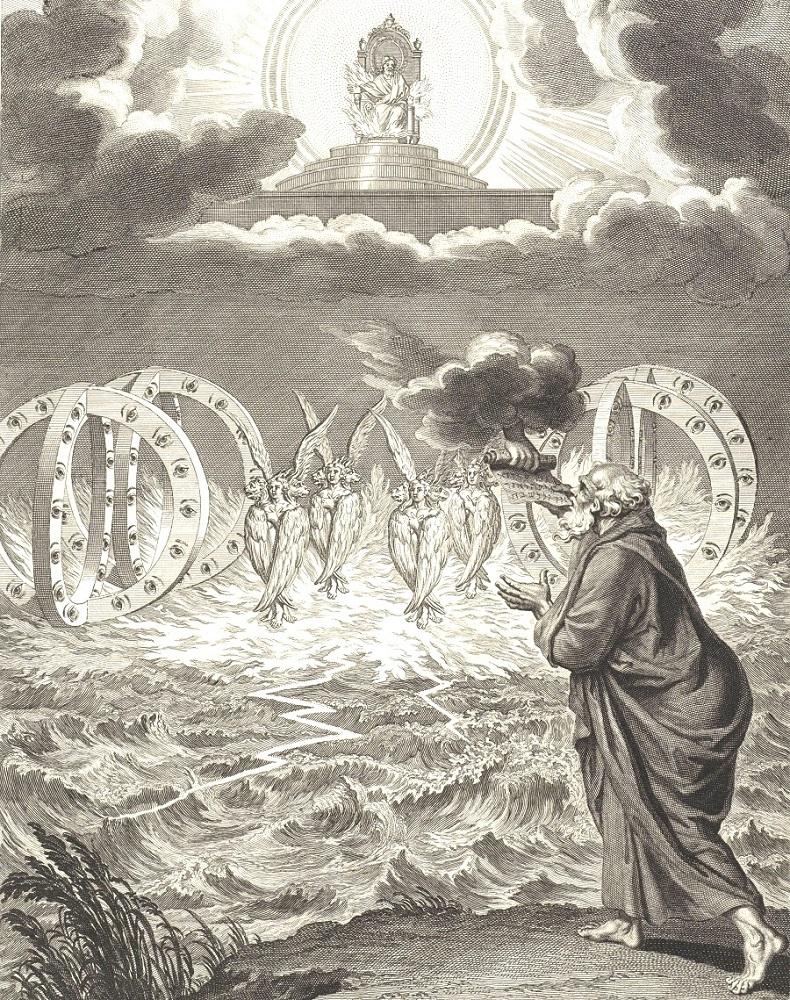
The entire vision Ezekiel had been given the privilege of seeing had been a dramatic display of God’s glory, and now a voice from heaven confirmed it. And Ezekiel saw and heard the wings of the four living creatures flapping in unison and the wheels within wheels turning as the glory of God began to move. This was not a static scene in which Ezekiel could remain and worship the glory of God forever. He had a job to do. And the Spirit of God lifted Ezekiel up and took him away. The vision had ended but his mission had just begun, and Ezekiel expressed his dismay by stating, “I went in bitterness and turmoil” (Ezekiel 3:14a NLT). He was struggling with doubt and fear. The mission before him was overwhelming and he felt underqualified for the task. And yet, he declared, “the Lord’s hold on me was strong” (Ezekiel 3:14b NLT).

Ezekiel had received a commission from God Almighty, and while he wrestled with doubt and feelings of inadequacy, he could not resist the calling. He must obey. So, with the vision completed, Ezekiel returned to his mission field among the exiles from Judah. And for seven days, he continued to struggle with an overwhelming sense of fear and foreboding as he contemplated his new assignment. His life had been radically altered by God and he would no longer be able to enjoy the same relationship he had once had with his friends and neighbors. He had been set apart by God and his life would never be the same.

English Standard Version (ESV) The Holy Bible, English Standard Version. ESV® Permanent Text Edition® (2016). Copyright © 2001

New Living Translation (NLT) Holy Bible, New Living Translation, copyright © 1996, 2004, 2015 by Tyndale House Foundation. Used by permission of Tyndale House Publishers Inc., Carol Stream, Illinois 60188. All rights reserved.

A Bitter-Sweet Assignment

1 And he said to me, “Son of man, stand on your feet, and I will speak with you.” And as he spoke to me, the Spirit entered into me and set me on my feet, and I heard him speaking to me. And he said to me, “Son of man, I send you to the people of Israel, to nations of rebels, who have rebelled against me. They and their fathers have transgressed against me to this very day. The descendants also are impudent and stubborn: I send you to them, and you shall say to them, ‘Thus says the Lord God.’ And whether they hear or refuse to hear (for they are a rebellious house) they will know that a prophet has been among them. And you, son of man, be not afraid of them, nor be afraid of their words, though briers and thorns are with you and you sit on scorpions. Be not afraid of their words, nor be dismayed at their looks, for they are a rebellious house. And you shall speak my words to them, whether they hear or refuse to hear, for they are a rebellious house.

“But you, son of man, hear what I say to you. Be not rebellious like that rebellious house; open your mouth and eat what I give you.” And when I looked, behold, a hand was stretched out to me, and behold, a scroll of a book was in it. 10 And he spread it before me. And it had writing on the front and on the back, and there were written on it words of lamentation and mourning and woe.

1 And he said to me, “Son of man, eat whatever you find here. Eat this scroll, and go, speak to the house of Israel.” So I opened my mouth, and he gave me this scroll to eat. And he said to me, “Son of man, feed your belly with this scroll that I give you and fill your stomach with it.” Then I ate it, and it was in my mouth as sweet as honey. – Ezekiel 2:1-3:3 ESV

Ezekiel had been given a vision of God’s glory, and it left him face down on the ground in reverential fear and wonder. As this exiled young priest stood by the banks of the Kebar River in Babylon, the God of the universe made an unexpected and highly spectacular appearance.

Above this surface was something that looked like a throne made of blue lapis lazuli. And on this throne high above was a figure whose appearance resembled a man. From what appeared to be his waist up, he looked like gleaming amber, flickering like a fire. And from his waist down, he looked like a burning flame, shining with splendor. All around him was a glowing halo, like a rainbow shining in the clouds on a rainy day. This is what the glory of the Lord looked like to me. – Ezekiel 1:26-28 NLT

It is safe to assume that this was a once-in-a-lifetime experience for Ezekiel. He had never seen anything like this before, and to have the God of Abraham, Isaac, and Jacob appear to him in the remote recesses of the land of Babylon must have been a shock to his system. He was just a lowly priest who had been taken captive just like all the other residents of Jerusalem when the city had fallen to King Nebuchadnezzar’s forces.  Jehoiachin was the king of Judah at the time and, according to 2 Kings 12:9, “He did evil in the sight of the Lord as his ancestors had done.” Like most of his predecessors, Jehoiachin chose to use his royal power to promote idolatry that fostered unfaithfulness to God, and he suffered greatly for his refusal to honor the Almighty.

At that time the generals of King Nebuchadnezzar of Babylon marched to Jerusalem and besieged the city. King Nebuchadnezzar of Babylon came to the city while his generals were besieging it. King Jehoiachin of Judah, along with his mother, his servants, his officials, and his eunuchs surrendered to the king of Babylon. The king of Babylon, in the eighth year of his reign, took Jehoiachin prisoner. Nebuchadnezzar took from there all the riches in the treasuries of the Lord’s temple and of the royal palace. He removed all the gold items that King Solomon of Israel had made for the Lord’s temple, just as the Lord had warned. He deported all the residents of Jerusalem, including all the officials and all the soldiers (10,000 people in all). This included all the craftsmen and those who worked with metal. No one was left except for the poorest among the people of the land. – 2 Kings 12:10-14 NLT

Living amongst the exiled people of God, Ezekiel had firsthand experience with the apathy and complacency that had taken hold of them. A long way from home and no longer able to avail themselves of the temple and the sacrificial system, they had begun to lose interest in the things of God. Their circumstances had left them feeling abandoned by God and distraught over the far-from-ideal conditions of their captivity. With the passage of time, God had become out of sight, out of mind. They simply assumed He had turned His back on them and so, in time, they gave up hope and determined to make the most of their situation in Babylon.

But God had other plans that included appointing Ezekiel as the one who would deliver His message to the exiles. He had not forgotten about them. They had not been abandoned. Their exile had been intended to get their attention and to bring them to a point of repentance. Now, Ezekiel was going to be commissioned to serve as God’s spokesperson, delivering His call to repentance.

Having gotten Ezekiel’s full attention through the grand display of His glory, God delivered the details of his new assignment.

“I am sending you to the nation of Israel, a rebellious nation that has rebelled against me. They and their ancestors have been rebelling against me to this very day. They are a stubborn and hard-hearted people. But I am sending you to say to them, ‘This is what the Sovereign Lord says!’” – Ezekiel 2:3-4 NLT

God makes it painfully clear that Ezekiel’s new task would not be easy. He would have to deliver a message from God to a people who had a track record of stubbornness and insubordination. And God warns Ezekiel that his audience may not receive his message with open arms.

“And whether they listen or refuse to listen—for remember, they are rebels—at least they will know they have had a prophet among them.” – Ezekiel 2:5 NLT

There was no guarantee that Ezekiel would experience success. Despite the fact that he would be speaking the words of God, he had no way of knowing how the people would respond. In fact, God made it sound like his mission was doomed to certain failure.

What would you do if God called you to a task that He knew you were going to fail at? What if He even told you your efforts would be fruitless and non-productive? Most of us would bail. We would give up long before we got going. Because we’re wired with one thing in mind – success – and failure is not an acceptable alternative. But when Ezekiel got his marching orders from God, he was also given the not-so-great news that his ministry would be unsuccessful because his audience was going to be unresponsive.  God even told Ezekiel to expect threats and animosity. This was going to be one difficult job assignment.

In a sense, God was foreshadowing failure, but demanding obedience. Ezekiel’s success would not be measured by the number of callous, carnal Israelites he converted, but on his willingness to carry out God’s assignment faithfully, even in the face of rejection, ridicule, and poor results.

Even the message God gave Ezekiel to share was anything but good news. In his vision, Ezekiel was given a scroll that was covered with writing front and back, from edge to edge. It’s content?

“Funeral songs, words of sorrows, and pronouncements of doom.” – Ezekiel 2:9b NLT

It was a veritable compendium of bad news. So, not only would Ezekiel have a non-responsive audience, he was given an unappealing message. But God fully understood the foreboding nature of Ezekiel’s assignment, and he knew that Ezekiel was already wrestling with whether to follow through with His command. The young priest was afraid of how he and his message might be received by the people, but God encouraged him to have faith.

“Do not fear them or their words. Don’t be afraid even though their threats surround you like nettles and briars and stinging scorpions. Do not be dismayed by their dark scowls, even though they are rebels.” – Ezekiel 2:6 NLT

God was telling Ezekiel not to be frightened by the things they would threaten to do to him, the harsh words they might say about him, or the negative reaction they would inevitably have to him.

“Son of man, do not fear them or their words. Don’t be afraid even though their threats surround you like nettles and briers and stinging scorpions. Do not be dismayed by their dark scowls, even though they are rebels. You must give them my messages whether they listen or not. But they won’t listen, for they are completely rebellious!” – Ezekiel 2:6-7 NLT

Ezekiel was going to experience resistance. His message would not be well-received and the people would hold him responsible for its content. It was only a matter of time before they sought to kill the messenger. That’s why God warned Ezekiel to refrain from emulating the rebellious nature of his audience. He was not to reject God’s assignment just because it sounded difficult and more than a bit dangerous. God was open and above board as to the difficulty of the mission. He didn’t attempt to sugarcoat the assignment or paint a rosy picture of its outcome. Instead, God gave His newly appointed prophet all he would need to succeed.

“Son of man, listen to what I say to you. Do not join them in their rebellion. Open your mouth, and eat what I give you.” – Ezekiel 2:8 NLT

God held out a scroll, upon which were written lamentations, mourning, and woes. In other words, it was filled with bad news. The sheer volume of disheartening content was so great that it covered both sides of the scroll. God’s indictment against His people was great and He commanded Ezekiel to consume every last bit of it. He was to take it all in so that he might regurgitate it, word for word, to the disobedient people of God.

“Son of man, eat whatever you find here. Eat this scroll, and go, speak to the house of Israel.” – Ezekiel 3:1 ESV

But much to his surprise, Ezekiel found the less-than-appealing content of the scroll to be “sweet as honey.” (Ezekiel 3:3 ESV). There is a similar scene described in the book of Revelation. In it, the apostle John is given a vision of an angel who descends from heaven with a scroll in his hand. He presents the scroll to John and commands him to eat it.

“Yes, take it and eat it,” he said. “It will be sweet as honey in your mouth, but it will turn sour in your stomach!” So I took the small scroll from the hand of the angel, and I ate it! It was sweet in my mouth, but when I swallowed it, it turned sour in my stomach.

Then I was told, “You must prophesy again about many peoples, nations, languages, and kings.” – Revelation 10:9-11 NLT

Both John and Ezekiel would find the words of God to be both sweet and bitter. When the truth of God is consumed, it is pleasant and life-giving, but it can also result in conviction and condemnation.

For the word of God is alive and powerful. It is sharper than the sharpest two-edged sword, cutting between soul and spirit, between joint and marrow. It exposes our innermost thoughts and desires. – Hebrews 4:12 NLT

All Scripture is inspired by God and is useful to teach us what is true and to make us realize what is wrong in our lives. It corrects us when we are wrong and teaches us to do what is right. – 2 Timothy 3:16 NLT

For Ezekiel, consuming God’s word was sweet to the taste, but declaring it to the people would be a bitter experience. They would find it distasteful and difficult to swallow. But God was calling Ezekiel to be faithful and fearless in declaring its truth regardless of the outcome.

English Standard Version (ESV) The Holy Bible, English Standard Version. ESV® Permanent Text Edition® (2016). Copyright © 2001

New Living Translation (NLT) Holy Bible, New Living Translation, copyright © 1996, 2004, 2015 by Tyndale House Foundation. Used by permission of Tyndale House Publishers Inc., Carol Stream, Illinois 60188. All rights reserved.