The Lamb for Sinners Slain

13 “These are the measurements of the altar by cubits (the cubit being a cubit and a handbreadth): its base shall be one cubit high and one cubit broad, with a rim of one span around its edge. And this shall be the height of the altar: 14 from the base on the ground to the lower ledge, two cubits, with a breadth of one cubit; and from the smaller ledge to the larger ledge, four cubits, with a breadth of one cubit; 15 and the altar hearth, four cubits; and from the altar hearth projecting upward, four horns. 16 The altar hearth shall be square, twelve cubits long by twelve broad. 17 The ledge also shall be square, fourteen cubits long by fourteen broad, with a rim around it half a cubit broad, and its base one cubit all around. The steps of the altar shall face east.”

18 And he said to me, “Son of man, thus says the Lord God: These are the ordinances for the altar: On the day when it is erected for offering burnt offerings upon it and for throwing blood against it, 19 you shall give to the Levitical priests of the family of Zadok, who draw near to me to minister to me, declares the Lord God, a bull from the herd for a sin offering. 20 And you shall take some of its blood and put it on the four horns of the altar and on the four corners of the ledge and upon the rim all around. Thus you shall purify the altar and make atonement for it. 21 You shall also take the bull of the sin offering, and it shall be burned in the appointed place belonging to the temple, outside the sacred area. 22 And on the second day you shall offer a male goat without blemish for a sin offering; and the altar shall be purified, as it was purified with the bull. 23 When you have finished purifying it, you shall offer a bull from the herd without blemish and a ram from the flock without blemish. 24 You shall present them before the Lord, and the priests shall sprinkle salt on them and offer them up as a burnt offering to the Lord. 25 For seven days you shall provide daily a male goat for a sin offering; also, a bull from the herd and a ram from the flock, without blemish, shall be provided. 26 Seven days shall they make atonement for the altar and cleanse it, and so consecrate it. 27 And when they have completed these days, then from the eighth day onward the priests shall offer on the altar your burnt offerings and your peace offerings, and I will accept you, declares the Lord God.” Ezekiel 43:13-27 ESV

It should be no surprise that the focus of everything in the Millennial Kingdom will be holiness. At that moment in human history, everything will be set apart unto God. His Son will rule over all the earth from His throne in Jerusalem, just as the angel had promised to his mother, Mary.

“You will conceive and give birth to a son, and you will name him Jesus. He will be very great and will be called the Son of the Most High. The Lord God will give him the throne of his ancestor David. And he will reign over Israel forever; his Kingdom will never end!” – Luke 1:31-33 NLT

This will be in fulfillment of the promise that God made to King David.

“And I will provide a homeland for my people Israel, planting them in a secure place where they will never be disturbed. Evil nations won’t oppress them as they’ve done in the past, starting from the time I appointed judges to rule my people Israel. And I will give you rest from all your enemies.…Your house and your kingdom will continue before me for all time, and your throne will be secure forever.” – 2 Samuel 7:10-11, 16 NLT

In this future kingdom, Jesus Christ, the Son of God, will be the King of kings and Lord of lords. He will rule supreme and His status as the Holy One of God will allow Him to mete out perfect righteousness as the sovereign head of state. With His sacrificial death and resurrection, Jesus earned the right to sit on David’s throne. Paul speaks of Jesus’ elevation to this highest honor because “he humbled himself in obedience to God and died a criminal’s death on a cross” (Philippians 2:8 NLT).

And because Jesus faithfully fulfilled the will of His Heavenly Father, He was rewarded with a return to His rightful place at His Father’s side.

God elevated him to the place of highest honor
    and gave him the name above all other names,
that at the name of Jesus every knee should bow,
    in heaven and on earth and under the earth,
and every tongue declare that Jesus Christ is Lord,
    to the glory of God the Father. – Philippians 2:9-11 NLT

But the latter part of this passage has yet to be fulfilled. We live in an age where the majority of people on earth refuse to honor the name of Christ or bow in submission to His will. They do not acknowledge Him as Lord. Yet, God’s redemptive plan includes a day when all that will change. The prophet, Micah, refers to this future restoration of the Kingdom of Israel and Christ’s reign as King.

In the last days, the mountain of the Lord’s house
    will be the highest of all—
    the most important place on earth.
It will be raised above the other hills,
    and people from all over the world will stream there to worship.
People from many nations will come and say,
“Come, let us go up to the mountain of the Lord,
    to the house of Jacob’s God.
There he will teach us his ways,
    and we will walk in his paths.”
For the Lord’s teaching will go out from Zion;
    his word will go out from Jerusalem.
The Lord will mediate between peoples
    and will settle disputes between strong nations far away. – Micah 4:1-3 NLT

Isaiah prophesied about the future earthly reign of Christ, declaring that “the government will rest on his shoulders” (Isaiah 9:6 NLT), and that government will be marked by peace.

His government and its peace
    will never end.
He will rule with fairness and justice from the throne of his ancestor David
    for all eternity. – Isaiah 9:7 NLT

Justice will rule in the wilderness
    and righteousness in the fertile field.
And this righteousness will bring peace.
    Yes, it will bring quietness and confidence forever.
My people will live in safety, quietly at home.
    They will be at rest. – Isaiah 32:16-18 NLT

So, why does God reveal to Ezekiel that this same Millennial Kingdom will be marked by a reinstitution of the sacrificial system? If Jesus’ paid the final debt for all sins and accomplished what the blood of bulls and goats could never do, why would God bring back the temple, the altar, and the practice of blood sacrifice?

“The existence of the millennial temple and the reinstatement of the sacrificial system [though not necessarily the reinstatement of the Mosaic Covenant] is not only understandable but predictable. Ezekiel’s vision of a restored sacrificial system was really not so amazing after all. The millennium will afford Israel the opportunity for the first time in its history to use the symbols of their covenant with Jesus as Messiah in view. It will be their first time to be a kingdom of priests and a holy nation showing forth to the world the redemptive work of Yahweh in the person of Jesus Christ the Messiah (Isa 53:7; 61:1-3; Zech 4:1 [sic 3:10]; John 1:29; Acts 8:32-35; 1 Pet 1:19; Rev 7:13-14; 5:9; 13:8; 15:3).” – L. E. Cooper Sr., Ezekiel

The author of Hebrews reminds us that the old sacrificial system functioned as a symbol or representation of something far greater to come.

The old system under the law of Moses was only a shadow, a dim preview of the good things to come, not the good things themselves. The sacrifices under that system were repeated again and again, year after year, but they were never able to provide perfect cleansing for those who came to worship. If they could have provided perfect cleansing, the sacrifices would have stopped, for the worshipers would have been purified once for all time, and their feelings of guilt would have disappeared.

But instead, those sacrifices actually reminded them of their sins year after year. For it is not possible for the blood of bulls and goats to take away sins. – Hebrews 10:1-4 NLT

According to this passage, the main purpose behind the Old Testament sacrificial system was to remind God’s people of their sins. It could never provide full and complete atonement. That’s why the sacrifices were perpetual and never-ending. The people lived in an endless cycle of sin-sacrifice-atonement-forgiveness. With their sins forgiven, they would simply repeat the cycle again, year after year. But Jesus came to be the “Lamb of God who takes away the sins of the world” (John 1:29). With His death on the cross, Jesus broke that endless cycle of sacrifice for sins.

So, why bring it back? It seems that the future sacrificial system described in Ezekiel has a distinctly different purpose. Rather than providing atonement for sins, it will point to the ultimate atoning sacrifice: Jesus Christ. The blood offered up on the Millennial Altar will commemorate “the precious blood of Christ, the sinless, spotless Lamb of God” (1 Peter 1:19 NLT).

When Christians partake of the elements of the Lord’s Table, they are not literally breaking the body of Christ or spilling His blood. They are practicing a symbolic rite designed to remind them of what Christ has done on their behalf. That’s why, on the night Jesus instituted the Lord’s Table, He told His disciples “do this in remembrance of me” (1 Corinthians 11:25).
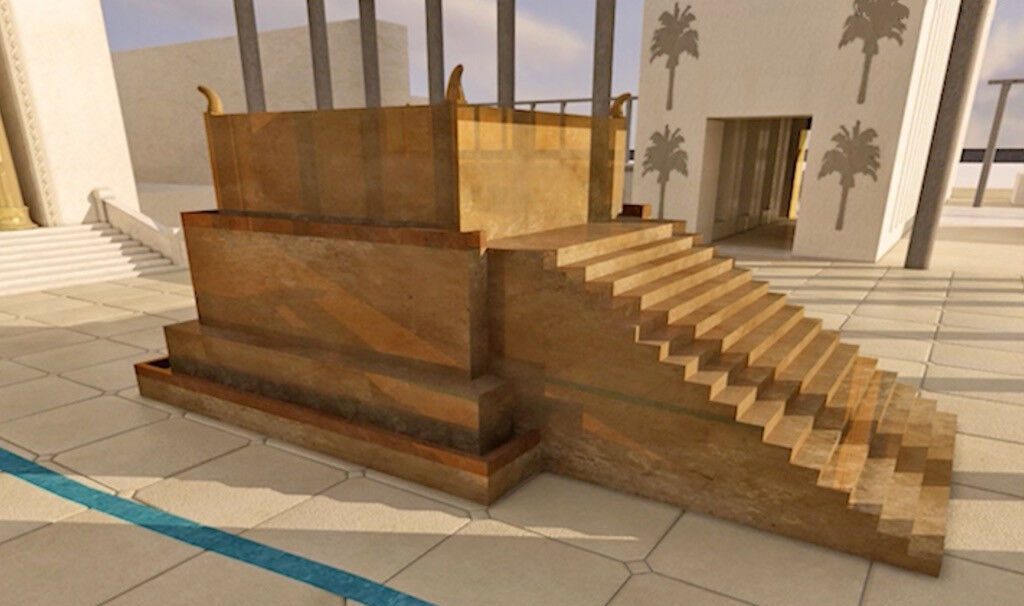
God gives Ezekiel the dimensions for the altar of sacrifice. Then He provides very clear instructions regarding the ritual cleansing of the altar and the preparation of the sacrifices to be offered on it. This entire process is similar to that given by God to Moses when He first instituted the sacrificial system in the Judean wilderness. For the Israelites living in the Millennial Kingdom, this entire process of ceremonial cleansing and purification will be highly familiar, and it will serve as a powerful reminder of their past sins as a nation. But it will point them to the all-sufficient sacrifice of Jesus, whose blood has cleansed them from all their sins (1 John 1:7).

“The offerings presented thereon were meant to be memorials, much as the Lord’s Supper is no efficacious sacrifice but a memorial of a blessedly adequate and all-sufficient sacrifice for all time. Thus, whereas the sacrifices of the Old Testament economy were prospective, these are retrospective.” – Charles Lee Feinberg, The Prophecy of Ezekiel

The focus of this chapter is holiness – the holiness of God, His people, His Kingdom, and His Son. Everything in the Millennial Kingdom will be set apart for His glory. It will all be dedicated to His name and exist to point all people to Him alone. In a remarkable blending of old and new imagery, God provides Ezekiel a glimpse of a future age when the Old Testament sacrificial system will exist in perfect harmony with the resurrected and enthroned Lamb of God. During His thousand-year reign on earth, there will be believers and unbelievers living under His righteous rule. All those who survived the seven years of the Tribulation will have the pleasure of living as citizens of Christ’s earthly kingdom, but not all will worship Him as Lord. Perhaps this renewed sacrificial system will serve as a means of purification for all those who wish to enter the presence of the King of kings. Holiness will reign supreme in the Millennial Kingdom, and God has ordained a place and purpose for the sacrificial system in that time.

English Standard Version (ESV) The Holy Bible, English Standard Version. ESV® Permanent Text Edition® (2016). Copyright © 2001

New Living Translation (NLT) Holy Bible, New Living Translation, copyright © 1996, 2004, 2015 by Tyndale House Foundation. Used by permission of Tyndale House Publishers Inc., Carol Stream, Illinois 60188. All rights reserved.

The Gravity and Glory of God’s Grace

Then he led me to the gate, the gate facing east. And behold, the glory of the God of Israel was coming from the east. And the sound of his coming was like the sound of many waters, and the earth shone with his glory. And the vision I saw was just like the vision that I had seen when he came to destroy the city, and just like the vision that I had seen by the Chebar canal. And I fell on my face. As the glory of the Lord entered the temple by the gate facing east, the Spirit lifted me up and brought me into the inner court; and behold, the glory of the Lord filled the temple.

While the man was standing beside me, I heard one speaking to me out of the temple, and he said to me, “Son of man, this is the place of my throne and the place of the soles of my feet, where I will dwell in the midst of the people of Israel forever. And the house of Israel shall no more defile my holy name, neither they, nor their kings, by their whoring and by the dead bodies of their kings at their high places, by setting their threshold by my threshold and their doorposts beside my doorposts, with only a wall between me and them. They have defiled my holy name by their abominations that they have committed, so I have consumed them in my anger. Now let them put away their whoring and the dead bodies of their kings far from me, and I will dwell in their midst forever.

10 “As for you, son of man, describe to the house of Israel the temple, that they may be ashamed of their iniquities; and they shall measure the plan. 11 And if they are ashamed of all that they have done, make known to them the design of the temple, its arrangement, its exits and its entrances, that is, its whole design; and make known to them as well all its statutes and its whole design and all its laws, and write it down in their sight, so that they may observe all its laws and all its statutes and carry them out. 12 This is the law of the temple: the whole territory on the top of the mountain all around shall be most holy. Behold, this is the law of the temple. Ezekiel 43:1-12 ESV

“Son of man, describe to the people of Israel the Temple I have shown you, so they will be ashamed of all their sins. Let them study its plan, and they will be ashamed of what they have done. Describe to them all the specifications of the Temple—including its entrances and exits—and everything else about it. Tell them about its decrees and laws. Write down all these specifications and decrees as they watch so they will be sure to remember and follow them.” – Ezekiel 43:10-11 NLT

After completing his tour of the future temple, Ezekiel was given a glimpse of God’s majestic glory returning to the very site it had vacated in his earlier vision. He describes seeing the glory of the Lord coming from the east and recalls having seen it before.

This vision was just like the others I had seen, first by the Kebar River and then when he came to destroy Jerusalem. – Ezekiel 43:3 NLT

Ezekiel opened his book with his vivid, out-of-this-world description of God’s glory arriving in Babylon by the Kebar River. It began as a storm cloud with flashing lightning and rolling peals of thunder. But upon close examination, Ezekiel saw that “From the center of the cloud came four living beings that looked human, except that each had four faces and four wings” (Ezekiel 1:5-6 NLT).

Each of these living beings “had a human face in the front, the face of a lion on the right side, the face of an ox on the left side, and the face of an eagle at the back” (Ezekiel 1:10 NLT). They were equipped with wings and glowed like bright coals of fire or brilliant torches, and lightning seemed to flash back and forth among them” (Ezekiel 1:13 NLT).

But the most important part of this vision was the presence of “a figure whose appearance resembled a man” (Ezekiel 1:26 NLT), who sat on a throne made of blue lapis lazuli. Ezekiel provided great detail in describing this royal figure.

From what appeared to be his waist up, he looked like gleaming amber, flickering like a fire. And from his waist down, he looked like a burning flame, shining with splendor. All around him was a glowing halo, like a rainbow shining in the clouds on a rainy day. This is what the glory of the Lord looked like to me. – Ezekiel 1:27-28 NLT

Ezekiel was certain as to the figure’s identity. It was none other than Yahweh, God Almighty, who had come to distant Babylon to reveal Himself to Ezekiel and to commission him as His prophet.

In a later vision Ezekiel received, he saw the very same representation of God’s glory, but this time it appeared in Jerusalem, hovering over the temple.

In my vision I saw what appeared to be a throne of blue lapis lazuli above the crystal surface over the heads of the cherubim. – Ezekiel 10:1 NLT

Ezekiel recognized the cherubim as the four living beings he had seen in his earlier vision.

These were the same living beings I had seen beside the Kebar River. – Ezekiel 10:15 NLT

As Ezekiel continued to watch this spectacular display of God’s glory, he must have been shocked to see it begin to make its way from the temple itself and towards the eastern gate of the temple complex.

Then the glory of the Lord moved out from the entrance of the Temple and hovered above the cherubim. And as I watched, the cherubim flew with their wheels to the east gate of the Lord’s Temple. And the glory of the God of Israel hovered above them. – Ezekiel 10:18-19 NLT

But God’s glory didn’t stop there. It went beyond the eastern gate, across the Kidron Valley, and onto the Mount of Olives. Then it disappeared altogether.

Then the cherubim lifted up their wings, with the wheels beside them, and the glory of the God of Israel was over them. And the glory of the Lord went up from the midst of the city and stood on the mountain that is on the east side of the city. And the Spirit lifted me up and brought me in the vision by the Spirit of God into Chaldea, to the exiles. Then the vision that I had seen went up from me. – Ezekiel 10:22-24 NLT

The significance of this vision did not escape Ezekiel. He had just witnessed the glory of God departing the temple and vacating the city of Jerusalem. Yahweh was symbolically abandoning His house and His chosen people. But years later, Ezekiel was given the privilege of seeing the glory of God return. After taking Ezekiel on a whirlwind tour of the Millennial Temple, “the man” took the prophet to the very same spot where he had seen the glory of God depart.

…he led me to the gate, the gate facing east. And behold, the glory of the God of Israel was coming from the east. And the sound of his coming was like the sound of many waters, and the earth shone with his glory. – Ezekiel 43:1-2 ESV

Blown away by what he saw, Ezekiel fell on his face in awe and gratitude. But as God’s glory reentered the temple and took up residence once again in the Holy of Holies, Ezekiel was there to witness the entire scene. And in a state of stupified wonder, all Ezekiel could say was “and behold, the glory of the Lord filled the temple” (Ezekiel 43:5 ESV). God had returned. He had not abandoned His people after all. And God confirmed the permanence of His return by stating, “Son of man, this is the place of my throne and the place where I will rest my feet. I will live here forever among the people of Israel” (Ezekiel 43:7 NLT).

God had left, but had returned and, this time, it was to stay. This was a new temple and a new era, and God had promised to give His chosen people new hearts so they could worship Him faithfully and fully. To quote the apostle Paul, “The old has passed away; behold, the new has come” (2 Corinthians 5:17 ESV).

God wanted Ezekiel to know that the day was coming when all things would be made new. There would be a new temple but there would also be a renewed people of God. Their sins had resulted in God’s judgment. Their rebellion against Him had led to His departure from among them. But Ezekiel was being given a glimpse of the future when God would miraculously restore His people to a right relationship with Himself. And He states that, on that day, things will be radically different. God commands Ezekiel to tell his fellow exiles all that he has seen and to give them this sobering reminder concerning that coming day.

And this is the basic law of the Temple: absolute holiness! The entire top of the mountain where the Temple is built is holy. Yes, this is the basic law of the Temple.” – Ezekiel 43:12 NLT

What an amazing picture of God’s grace. He was declaring His intention to restore His apostate people and return them to a life of holiness and sanctification. No more sin. No more rebellion. Instead, they would enjoy permanent fellowship with God in His eternal kingdom.

I sometimes think we take grace for granted. I love what Dallas Willard says: “We have a problem today in Evangelical circles. We’re not only saved by grace, we’re paralyzed by it.” We have allowed grace to become a one-dimensional concept that is tied solely to our salvation. We talk about the idea of being saved by grace. It is a priceless gift, unearned and undeserved. But the grace of God should have a long-lasting influence on our lives. There is a future element to God’s grace that I must never lose sight of because the reality is that I can no more earn my coming glorification than I could my salvation. A day is coming when I will be made complete and whole. I will be like Christ, with no sin nature and an ability to live righteously – completely and permanently. Future grace is a great motivator for present behavior. The reality of my guaranteed place in His presence for eternity should have a tremendous impact on the way I live my life now.

The same was true for the people of God in Ezekiel’s day. God had given Ezekiel a glimpse of His future kingdom, complete with a newly constructed temple, occupied by God Himself. God instructed Ezekiel to describe to the people the details of the future temple. They were to study its plans and go over every specification. Why? Because it was going to be a real place that was going to exist in real-time in the future. It was a picture of God’s future grace and His promise to reestablish His presence among the people of Israel. In spite of all they had done to offend Him, He was going to extend them grace, and the proof of it was this vision of His glory filling the rebuilt temple.

As Christians, we can easily allow the “grace alone” message to lull us into a sense of spiritual stupor or laziness. God does it all, so we have nothing to do. But grace is opposed to earning, not effort. The knowledge of God’s grace reminds me that I can do nothing to earn His favor. But awareness of His grace should cause me to make every effort to serve Him gratefully and joyfully. By hearing the detailed descriptions of the future Temple, the people of God were to be shamed for their own unfaithfulness as opposed to God’s faithfulness.

The reality that I have a place reserved for me in heaven should make me want to live my life differently here on earth. During their lifetimes, the people of God had desecrated the temple of God time and time again. And ultimately, God had it destroyed. Today there is no temple in Jerusalem. In its place sits a mosque. But God has promised that the day is coming when the temple will be rebuilt; not because the people of God deserve it, but because God has promised it.

Its presence will be proof of God’s grace. He will restore the people of Israel – in spite of themselves. And that future reality should have changed their present behavior. And one day God is going complete His work of sanctification in our lives – glorifying us and transforming us into the likeness of His Son – completely and permanently. Awareness of that future grace should shame me when I consider my present behavior. He has done so much for me and has promised to do so much. How can I live in disobedience and sin when God has such an undeserved future reserved for me?

English Standard Version (ESV) The Holy Bible, English Standard Version. ESV® Permanent Text Edition® (2016). Copyright © 2001

New Living Translation (NLT) Holy Bible, New Living Translation, copyright © 1996, 2004, 2015 by Tyndale House Foundation. Used by permission of Tyndale House Publishers Inc., Carol Stream, Illinois 60188. All rights reserved.

Set Apart

1 Then he led me out into the outer court, toward the north, and he brought me to the chambers that were opposite the separate yard and opposite the building on the north. The length of the building whose door faced north was a hundred cubits, and the breadth fifty cubits. Facing the twenty cubits that belonged to the inner court, and facing the pavement that belonged to the outer court, was gallery against gallery in three stories. And before the chambers was a passage inward, ten cubits wide and a hundred cubits long, and their doors were on the north. Now the upper chambers were narrower, for the galleries took more away from them than from the lower and middle chambers of the building. For they were in three stories, and they had no pillars like the pillars of the courts. Thus the upper chambers were set back from the ground more than the lower and the middle ones. And there was a wall outside parallel to the chambers, toward the outer court, opposite the chambers, fifty cubits long. For the chambers on the outer court were fifty cubits long, while those opposite the nave were a hundred cubits long. Below these chambers was an entrance on the east side, as one enters them from the outer court.

10 In the thickness of the wall of the court, on the south also, opposite the yard and opposite the building, there were chambers 11 with a passage in front of them. They were similar to the chambers on the north, of the same length and breadth, with the same exits and arrangements and doors, 12 as were the entrances of the chambers on the south. There was an entrance at the beginning of the passage, the passage before the corresponding wall on the east as one enters them.

13 Then he said to me, “The north chambers and the south chambers opposite the yard are the holy chambers, where the priests who approach the Lord shall eat the most holy offerings. There they shall put the most holy offerings—the grain offering, the sin offering, and the guilt offering—for the place is holy. 14 When the priests enter the Holy Place, they shall not go out of it into the outer court without laying there the garments in which they minister, for these are holy. They shall put on other garments before they go near to that which is for the people.”

15 Now when he had finished measuring the interior of the temple area, he led me out by the gate that faced east, and measured the temple area all around. 16 He measured the east side with the measuring reed, 500 cubits by the measuring reed all around. 17 He measured the north side, 500 cubits by the measuring reed all around. 18 He measured the south side, 500 cubits by the measuring reed. 19 Then he turned to the west side and measured, 500 cubits by the measuring reed. 20 He measured it on the four sides. It had a wall around it, 500 cubits long and 500 cubits broad, to make a separation between the holy and the common. Ezekiel 42:1-20 ESV

I find it interesting that in the middle of all the detailed descriptions of the layout of the future temple complex, Ezekiel’s “guide” pointed to a set of rooms and designated them as being “holy.”

Then he said to me, “The north and south rooms adjacent to the open area are holy rooms where the priests who come before GOD eat the holy offerings. There they place the holy offerings–grain offerings, sin offerings, and guilt offerings. These are set-apart rooms, holy space. After the priests have entered the Sanctuary, they must not return to the outside courtyard and mingle among the people until they change the sacred garments in which they minister and put on their regular clothes.” – Ezekiel 42:13-14 MSG

Wouldn’t the entire temple be holy? Since the whole structure would be dedicated to the worship of God, wouldn’t every room, wall, hallway, courtyard, and gateway be considered holy? Well, in a sense, yes. But the use of the word “holy” in this context gives us another important aspect of its meaning. It simply means to be “set-apart or separated.”

These rooms were dedicated or set apart for a distinct purpose.

“Here the priests who offer sacrifices to the Lord will eat the most holy offerings.” – Ezekiel 42:13 NLT

According to Ezekiel’s divine tour guide, these rooms would also be used for storage of the elements used in the various offerings.

“…because these rooms are holy, they will be used to store the sacred offerings—the grain offerings, sin offerings, and guilt offerings.” – Ezekiel 42:13 NLT

Even within this future temple complex, there will be places that are “set apart” and distinctive from all others. These rooms will be dedicated to a specific purpose and will not be available for any others use.

When the priests complete their job of ministering in the sanctuary, they will be required to leave their “holy” garments in one of these “holy” rooms, and change into their “street” clothes.  The robes they wear in the sanctuary will be dedicated solely to use within that area of the temple. The book of Exodus describes these sacred garments.

“Make sacred garments for Aaron that are glorious and beautiful. Instruct all the skilled craftsmen whom I have filled with the spirit of wisdom. Have them make garments for Aaron that will distinguish him as a priest set apart for my service.” – Exodus 28:2-3 NLT

These would not be ordinary, run-of-the-mill clothes, but acquisitive garments of great beauty and detail.

“These are the garments they are to make: a chestpiece, an ephod, a robe, a patterned tunic, a turban, and a sash. They are to make these sacred garments for your brother, Aaron, and his sons to wear when they serve me as priests. So give them fine linen cloth, gold thread, and blue, purple, and scarlet thread.” – Exodus 28:4-5 NLT

Even when ministering within the far smaller and less opulent tabernacle, the priests were required to wear God-ordained and designed garments that set them apart for His service.

For Aaron’s sons, make tunics, sashes, and special head coverings that are glorious and beautiful. Clothe your brother, Aaron, and his sons with these garments, and then anoint and ordain them. Consecrate them so they can serve as my priests. Also make linen undergarments for them, to be worn next to their bodies, reaching from their hips to their thighs. These must be worn whenever Aaron and his sons enter the Tabernacle or approach the altar in the Holy Place to perform their priestly duties. Then they will not incur guilt and die.” – Exodus 28:41-43 NLT

Holiness was important to God. It’s why He told His people, “You must be holy because I, the Lord your God, am holy” (Leviticus 19:2 NLT). He had chosen them and set them apart as His own. They were His special possession and their lives were to reflect their unique status as His children. And every area of this future temple will be set apart for God’s glory and use. Each brick, decorative accent, room, doorway, wall, and ceiling will exist for one purpose only: To bring glory to God Almighty.

Even the garments the priests wore were to be considered as holy or set apart. Before they could enter the rest of the temple or go into the more public or common areas, they had to remove their “holy” clothes, because those clothes had been dedicated to God.

All this makes me think about how we have been set apart by God for His use. We are His people. We have been made holy or set apart by the indwelling presence of the Spirit of God. We belong to God. The apostle Paul reminds us of this unique status as His holy people.

Since God chose you to be the holy people he loves, you must clothe yourselves with tenderhearted mercy, kindness, humility, gentleness, and patience. – Colossians 3:12 NLT

God set us apart for a purpose. We are now dedicated to Him and for His use. Our lives no longer belong to us, but to him and we should be used only in the way that He sees fit. The priests could not use the holy garments for any other purpose. They were not free to use those holy rooms for any other reason than the one that God had prescribed for them. In fact, the book of Nehemiah records an incident in which one of the priests violated this very command.

Eliashib the priest, who had been appointed as supervisor of the storerooms of the Temple of our God and who was also a relative of Tobiah, had converted a large storage room and placed it at Tobiah’s disposal. The room had previously been used for storing the grain offerings, the frankincense, various articles for the Temple, and the tithes of grain, new wine, and olive oil (which were prescribed for the Levites, the singers, and the gatekeepers), as well as the offerings for the priests. – Nehemiah 4:4-5 NLT

Notice that Eliashib had taken one of the “holy” rooms and turned it into an apartment for one of his relatives. When Nehemiah got wind of what had happened, he was furious and took immediate action.

When I arrived back in Jerusalem, I learned about Eliashib’s evil deed in providing Tobiah with a room in the courtyards of the Temple of God. I became very upset and threw all of Tobiah’s belongings out of the room. Then I demanded that the rooms be purified, and I brought back the articles for God’s Temple, the grain offerings, and the frankincense. – Nehemiah 4:7-9 NLT

Eliashib had taken liberties with that which belonged to God. He had the audacity to assign a new and totally different use for that which God had set apart. And, in doing so, he desecrated what God had deemed as wholly for His use.

And we can be guilty of the same thing. As God’s children, we have been set apart for His service. When God commands, “You must be holy because I am holy” (1 Peter 1:16 NLT), He is telling us that we must be set apart, distinct, and different, just as He is. We must reflect His holiness. We must remain dedicated to His use. When we take what He has set apart (our bodies) and use it for some other purpose, we profane it. When we use our bodies for purposes other than those for which God has set them apart, we denigrate their God-given value. That is why Peter provides a sobering warning to live as who we are and for the purpose we have been assigned.

And you are living stones that God is building into his spiritual temple. What’s more, you are his holy priests. Through the mediation of Jesus Christ, you offer spiritual sacrifices that please God. – 1 Peter 2:5 NLT

And the apostle Paul echoes Peter’s sentiments when he writes:

Don’t you realize that your body is the temple of the Holy Spirit, who lives in you and was given to you by God? You do not belong to yourself, for God bought you with a high price. So you must honor God with your body. – 1 Corinthians 6:19-20 NLT

English Standard Version (ESV) The Holy Bible, English Standard Version. ESV® Permanent Text Edition® (2016). Copyright © 2001

New Living Translation (NLT) Holy Bible, New Living Translation, copyright © 1996, 2004, 2015 by Tyndale House Foundation. Used by permission of Tyndale House Publishers Inc., Carol Stream, Illinois 60188. All rights reserved.

The Dwelling Place of God

Then he measured the wall of the temple, six cubits thick, and the breadth of the side chambers, four cubits, all around the temple. And the side chambers were in three stories, one over another, thirty in each story. There were offsets all around the wall of the temple to serve as supports for the side chambers, so that they should not be supported by the wall of the temple. And it became broader as it wound upward to the side chambers, because the temple was enclosed upward all around the temple. Thus the temple had a broad area upward, and so one went up from the lowest story to the top story through the middle story. I saw also that the temple had a raised platform all around; the foundations of the side chambers measured a full reed of six long cubits. The thickness of the outer wall of the side chambers was five cubits. The free space between the side chambers of the temple and the 10 other chambers was a breadth of twenty cubits all around the temple on every side. 11 And the doors of the side chambers opened on the free space, one door toward the north, and another door toward the south. And the breadth of the free space was five cubits all around.

12 The building that was facing the separate yard on the west side was seventy cubits broad, and the wall of the building was five cubits thick all around, and its length ninety cubits.

13 Then he measured the temple, a hundred cubits long; and the yard and the building with its walls, a hundred cubits long; 14 also the breadth of the east front of the temple and the yard, a hundred cubits.

15 Then he measured the length of the building facing the yard that was at the back and its galleries on either side, a hundred cubits.

The inside of the nave and the vestibules of the court, 16 the thresholds and the narrow windows and the galleries all around the three of them, opposite the threshold, were paneled with wood all around, from the floor up to the windows (now the windows were covered), 17 to the space above the door, even to the inner room, and on the outside. And on all the walls all around, inside and outside, was a measured pattern. 18 It was carved of cherubim and palm trees, a palm tree between cherub and cherub. Every cherub had two faces: 19 a human face toward the palm tree on the one side, and the face of a young lion toward the palm tree on the other side. They were carved on the whole temple all around. 20 From the floor to above the door, cherubim and palm trees were carved; similarly the wall of the nave.

21 The doorposts of the nave were squared, and in front of the Holy Place was something resembling 22 an altar of wood, three cubits high, two cubits long, and two cubits broad. Its corners, its base, and its walls were of wood. He said to me, “This is the table that is before the Lord.” 23 The nave and the Holy Place had each a double door. 24 The double doors had two leaves apiece, two swinging leaves for each door. 25 And on the doors of the nave were carved cherubim and palm trees, such as were carved on the walls. And there was a canopy[j] of wood in front of the vestibule outside. 26 And there were narrow windows and palm trees on either side, on the sidewalls of the vestibule, the side chambers of the temple, and the canopies. Ezekiel 41:5-26 ESV

The level of detail in Ezekiel’s vision is staggering. His guided tour of the Millennial Temple was conducted by “man whose face shone like bronze” (Ezekiel 40:3 NLT), who held “a linen measuring cord and a measuring rod” (Ezekiel 40:3 NLT) in his hand. Each time they entered a new area of the temple complex, “the man” provided detailed measurements to indicate the exact dimensions involved. The temple itself, which was the focal point of the entire compound, was an elaborate, multi-storied structure surrounded by three rows of antechambers. There were 90 of these small rooms stacked three stories high along three different sides of the temple. There is no information given regarding their purpose but they would have formed the outer wall of the temple itself. It seems that with each successive story, the rooms became slightly larger in size. 

To the west of the temple was another free-standing building that was roughly 116 feet deep and 150 feet wide. There is no indication as to the nature or purpose of this structure. But from all the details provided, it is clear that this future temple complex is far larger and more complex than any of the previous iterations of the temple. And its dimensions dwarf the original tabernacle used by the Israelites during their wilderness wanderings.

In verses 16-26, Ezekiel records the dimensions and decorative embellishments of the temple’s interior. The walls are paneled in wood and “decorated with carved cherubim and palm trees” (Ezekiel 41:25 NLT).  These images are meant to convey a powerful message regarding the temple’s occupant.

“In these figures aspirations of life and prosperity (palm) and security (cherubim) coalesce. In Israelite thought, the divine resident of this house was the source of both. – Daniel I. Block, The Book of Ezekiel

God is the giver of all life and the sole source of man’s prosperity and protection. God had already told Ezekiel that the day would come when He would restore His people to their land and take up residence among them once again.

“I will set them in their land and multiply them, and will set my sanctuary in their midst forevermore. My dwelling place shall be with them, and I will be their God, and they shall be my people.” – Ezekiel 37:26-27 ESV

God’s house will be of immense proportions and feature beautifully ornate architectural embellishments designed to reflect His divine glory and greatness. Everything about the temple and its surrounding grounds will be striking and attention-getting. This beautiful building will be a showcase of God Almighty and serve as a permanent reminder of His presence and power.

English Standard Version (ESV) The Holy Bible, English Standard Version. ESV® Permanent Text Edition® (2016). Copyright © 2001

New Living Translation (NLT) Holy Bible, New Living Translation, copyright © 1996, 2004, 2015 by Tyndale House Foundation. Used by permission of Tyndale House Publishers Inc., Carol Stream, Illinois 60188. All rights reserved.

The Most Holy Place

44 On the outside of the inner gateway there were two chambers in the inner court, one at the side of the north gate facing south, the other at the side of the south gate facing north. 45 And he said to me, “This chamber that faces south is for the priests who have charge of the temple, 46 and the chamber that faces north is for the priests who have charge of the altar. These are the sons of Zadok, who alone among the sons of Levi may come near to the Lord to minister to him.” 47 And he measured the court, a hundred cubits long and a hundred cubits broad, a square. And the altar was in front of the temple.

48 Then he brought me to the vestibule of the temple and measured the jambs of the vestibule, five cubits on either side. And the breadth of the gate was fourteen cubits, and the sidewalls of the gate were three cubits on either side. 49 The length of the vestibule was twenty cubits, and the breadth twelve cubits, and people would go up to it by ten steps. And there were pillars beside the jambs, one on either side.

1 Then he brought me to the nave and measured the jambs. On each side six cubits was the breadth of the jambs. And the breadth of the entrance was ten cubits, and the sidewalls of the entrance were five cubits on either side. And he measured the length of the nave, forty cubits, and its breadth, twenty cubits. Then he went into the inner room and measured the jambs of the entrance, two cubits; and the entrance, six cubits; and the sidewalls on either side of the entrance, seven cubits. And he measured the length of the room, twenty cubits, and its breadth, twenty cubits, across the nave. And he said to me, “This is the Most Holy Place.” Ezekiel 40:44-41:4 ESV

Ezekiel’s vision of the Millennial Temple included a view of two chambers located just outside the northern and southern inner gates. In Hebrew, these rooms are described as liškâ šîr, which might best be translated as “the chambers of the singing men.”

These would have been members of the tribe of Levi who served as priests in the temple but also functioned as musicians as part of their service to God. The book of 2 Chronicles mentions these men.

And the Levites who were musicians—Asaph, Heman, Jeduthun, and all their sons and brothers—were dressed in fine linen robes and stood at the east side of the altar playing cymbals, lyres, and harps. They were joined by 120 priests who were playing trumpets. The trumpeters and singers performed together in unison to praise and give thanks to the Lord. – 2 Chronicles 5:12-13 NLT

These men were responsible for providing musical praise to God as part of peoples’ worship.

Accompanied by trumpets, cymbals, and other instruments, they raised their voices and praised the Lord with these words:

“He is good!
    His faithful love endures forever!”  – 2 Chronicles 5:14 NLT

And the book of 1 Chronicles states that they lived in special rooms dedicated to their use in the temple.

The musicians, all prominent Levites, lived at the Temple. They were exempt from other responsibilities since they were on duty at all hours. All these men lived in Jerusalem. They were the heads of Levite families and were listed as prominent leaders in their genealogical records. – 1 Chronicles 9:33-34 NLT

The Psalms are filled with descriptions of music as a form of worship and singing as a means of praising God for all He has done.

Come, let us sing to the Lord!
    Let us shout joyfully to the Rock of our salvation.
Let us come to him with thanksgiving.
    Let us sing psalms of praise to him. – Psalm 95:1-2 NLT

Shout to the Lord, all the earth;
    break out in praise and sing for joy!
Sing your praise to the Lord with the harp,
    with the harp and melodious song,
with trumpets and the sound of the ram’s horn.
    Make a joyful symphony before the Lord, the King! – Psalm 98:4-6 NLT

And, according to Ezekiel’s vision, this musical expression of praise and glory for God’s goodness and greatness will continue into the Millennial Kingdom.

The praise of God will never cease in the Millennial Kingdom as God’s people express their heartfelt gratitude for all that He has done. And these priests will be accompanied by others who be responsible for maintaining the temple itself as well as all the elements associated with the altar and the sacrificial system. Each priest will perform his duties with joy and gladness so that the temple may function seamlessly and in full compliance with God’s decrees.

And Ezekiel is told that these men will be the descendants of Zadok, who served as a priest during the reigns of David and Solomon. This ensures the prophet that God will miraculously maintain the line of Zadok so that they may serve Him in this future temple.

As the vision unfolds before Ezekiel’s eyes, he is escorted into the actual doorway of the temple itself, through a portico or inner room that opens into the temple proper. As he moves forward into the recesses of the temple, Ezekiel passes through the Holy Place and into the Holy of Holies. With each step, he moves into a progressively smaller space that is meant to focus his attention on the significance of his final destination: The most holy place.  This was the innermost room of the temple where God’s presence was said to dwell above the mercy seat. In Solomon’s temple, this room was highly restricted and off-limits to anyone but the high priest, who could only enter one day out of the entire year, on the Day of Atonement. God had told Moses to warn his brother, Aaron, the high priest, not to venture into the Holy of Holies on any other day or he would face certain death.

The Lord said to Moses, “Warn your brother, Aaron, not to enter the Most Holy Place behind the inner curtain whenever he chooses; if he does, he will die. For the Ark’s cover—the place of atonement—is there, and I myself am present in the cloud above the atonement cover.” – Leviticus 16:2 NLT

Aaron was given a series of ceremonial tasks to perform so that he might offer a sacrifice on behalf of the people. It all began with his personal purification and included cleansing of the Holy of Holies, the altar, priests, the congregation, and the tabernacle itself. It all concluded with the release of the scapegoat.

“He will lay both of his hands on the goat’s head and confess over it all the wickedness, rebellion, and sins of the people of Israel. In this way, he will transfer the people’s sins to the head of the goat. Then a man specially chosen for the task will drive the goat into the wilderness. As the goat goes into the wilderness, it will carry all the people’s sins upon itself into a desolate land.” – Leviticus 16:21-22 NLT

What makes this so important is that, in the future Millennial Kingdom, there will be no need for the scapegoat because of Jesus’ once-for-all sacrifice. He bore the sins of mankind with His death on the cross and provided a permanent means of forgiveness for all those who place their faith in Him. Yet, God told Moses and the people of Israel that His commands concerning the Day of Atonement would be permanent.

“This is a permanent law for you. In future generations, the purification ceremony will be performed by the priest who has been anointed and ordained to serve as high priest in place of his ancestor Aaron. He will put on the holy linen garments and purify the Most Holy Place, the Tabernacle, the altar, the priests, and the entire congregation. This is a permanent law for you, to purify the people of Israel from their sins, making them right with the Lord once each year.” – Leviticus 16:31-34 NLT

But what makes the future temple so unique is that it will exist as part of the Millennial Kingdom of Jesus Christ, who will reign as King over Jerusalem, the land of Israel, and the rest of the world. Because of His sacrificial death, resurrection, ascension, and ultimate return as the King of kings and Lord of lords, there will be no need for future purification of the temple. The scapegoat will be unnecessary. Cleansing from sin will no longer be needed.

The Most Holy Place will be permanently holy. The people of God will be eternally righteous, cleansed, and forgiven. Because God and His Son will take up permanent residence with His people.

English Standard Version (ESV) The Holy Bible, English Standard Version. ESV® Permanent Text Edition® (2016). Copyright © 2001

New Living Translation (NLT) Holy Bible, New Living Translation, copyright © 1996, 2004, 2015 by Tyndale House Foundation. Used by permission of Tyndale House Publishers Inc., Carol Stream, Illinois 60188. All rights reserved.

Nothing But the Blood of Jesus

17 Then he brought me into the outer court. And behold, there were chambers and a pavement, all around the court. Thirty chambers faced the pavement. 18 And the pavement ran along the side of the gates, corresponding to the length of the gates. This was the lower pavement. 19 Then he measured the distance from the inner front of the lower gate to the outer front of the inner court, a hundred cubits on the east side and on the north side.

20 As for the gate that faced toward the north, belonging to the outer court, he measured its length and its breadth. 21 Its side rooms, three on either side, and its jambs and its vestibule were of the same size as those of the first gate. Its length was fifty cubits, and its breadth twenty-five cubits. 22 And its windows, its vestibule, and its palm trees were of the same size as those of the gate that faced toward the east. And by seven steps people would go up to it, and find its vestibule before them. 23 And opposite the gate on the north, as on the east, was a gate to the inner court. And he measured from gate to gate, a hundred cubits.

24 And he led me toward the south, and behold, there was a gate on the south. And he measured its jambs and its vestibule; they had the same size as the others. 25 Both it and its vestibule had windows all around, like the windows of the others. Its length was fifty cubits, and its breadth twenty-five cubits. 26 And there were seven steps leading up to it, and its vestibule was before them, and it had palm trees on its jambs, one on either side. 27 And there was a gate on the south of the inner court. And he measured from gate to gate toward the south, a hundred cubits.

28 Then he brought me to the inner court through the south gate, and he measured the south gate. It was of the same size as the others. 29 Its side rooms, its jambs, and its vestibule were of the same size as the others, and both it and its vestibule had windows all around. Its length was fifty cubits, and its breadth twenty-five cubits. 30 And there were vestibules all around, twenty-five cubits long and five cubits broad. 31 Its vestibule faced the outer court, and palm trees were on its jambs, and its stairway had eight steps.

32 Then he brought me to the inner court on the east side, and he measured the gate. It was of the same size as the others. 33 Its side rooms, its jambs, and its vestibule were of the same size as the others, and both it and its vestibule had windows all around. Its length was fifty cubits, and its breadth twenty-five cubits. 34 Its vestibule faced the outer court, and it had palm trees on its jambs, on either side, and its stairway had eight steps.

35 Then he brought me to the north gate, and he measured it. It had the same size as the others. 36 Its side rooms, its jambs, and its vestibule were of the same size as the others, and it had windows all around. Its length was fifty cubits, and its breadth twenty-five cubits. 37 Its vestibule faced the outer court, and it had palm trees on its jambs, on either side, and its stairway had eight steps.

38 There was a chamber with its door in the vestibule of the gate, where the burnt offering was to be washed. 39 And in the vestibule of the gate were two tables on either side, on which the burnt offering and the sin offering and the guilt offering were to be slaughtered. 40 And off to the side, on the outside as one goes up to the entrance of the north gate, were two tables; and off to the other side of the vestibule of the gate were two tables. 41 Four tables were on either side of the gate, eight tables, on which to slaughter. 42 And there were four tables of hewn stone for the burnt offering, a cubit and a half long, and a cubit and a half broad, and one cubit high, on which the instruments were to be laid with which the burnt offerings and the sacrifices were slaughtered. 43 And hooks, a handbreadth long, were fastened all around within. And on the tables the flesh of the offering was to be laid. Ezekiel 40:17-43 ESV

The temple complex in Ezekiel’s vision revealed an outer wall with three gates or entrances; one to the north, another to the east, and a final one to the south. The wall surrounding the temple was over ten feet wide and ten feet tall. The eastern gate, which faced the Kidron Valley across from the Mount of Olives, had a set of steps leading up to its gate. This was the main entry point to the temple complex and led to an outer court. On the perimeter of the wall’s interior were a series of rooms that lined its northern. eastern, and southern sides. No explanation is given for the purpose of these rooms.

The distance between the outer eastern gate and the inner eastern gate that led to the inner court was 166 feet. This expanse formed the outer court. In Solomon’s temple, this would have been called The Court of the Women. But in his vision, Ezekiel is provided with no designation for this expansive space.

Upon entering the outer court, the three entrances to the inner court came into view. These three inner gate complexes were similar in size and design to the outer gates and provided access to the temple itself. There is a repeated pattern or design intended to regulate entrance into God’s presence. And upon passing through one of these three gates, one would find themself inside the inner court and the place of sacrifice. A room was dedicated to the washing of the animals planned for sacrifice. The priests would purify each animal before offering it up to God as a burnt offering. On the outside of this room were eight stone tables, where the sacrificial animals were slaughtered for the burnt offerings, sin offerings, and guilt offerings. Four additional stone tables held the priests’ butchering implements and were where the prepared meat was placed before being offered as a sacrifice.

Ezekiel was also shown two rooms, one was “for the priests who supervise the Temple maintenance” (Ezekiel 40:45 NLT) and the other was for the priests in charge of the altar” (Ezekiel 40:46 NLT). And Ezekiel was informed that these priests are “the descendants of Zadok—for they alone of all the Levites may approach the Lord to minister to him” (Ezekiel 40:46 NLT). In other words, this future temple will be administered according to God’s original command. He had ordained that the tribe of Levi would serve as keepers of the tabernacle and later, the temple.

…the Lord your God chose the tribe of Levi out of all your tribes to minister in the Lord’s name forever. – Deuteronomy 18:5 NLT

From among the Levites would come the priests who were tasked with offering the sacrifices on behalf of the people. Zadok was a descendant of Levi and had served during the reign of King David. It will be the priestly descendants of Zadok who serve in this future millennial temple. This is another sign that God will restore everything to the way He had intended it to be from the beginning.

But there is one question that comes to mind when considering the presence of the temple, priests, and blood sacrifices in the millennial kingdom. Why would God reinstitute this ritual when the book of Hebrews states that Jesus offered His life as a final, once-for-all sacrifice for the sins of mankind?

So Christ has now become the High Priest over all the good things that have come. He has entered that greater, more perfect Tabernacle in heaven, which was not made by human hands and is not part of this created world. With his own blood—not the blood of goats and calves—he entered the Most Holy Place once for all time and secured our redemption forever. – Hebrews 9:11-12 NLT

The original sacrificial system was intended to purify the ungodly, including the priests themselves, making them worthy of coming into God’s presence and capable of receiving His forgiveness.

For without the shedding of blood, there is no forgiveness.

That is why the Tabernacle and everything in it, which were copies of things in heaven, had to be purified by the blood of animals. But the real things in heaven had to be purified with far better sacrifices than the blood of animals. – Hebrews 9:22-23 NLT

Jesus provided a better sacrifice, a new-and-improved way of being made right with God. He offered His own life, shedding His own blood, in order that sinful men and women might receive new life and a restored relationship with God.

Christ was offered once for all time as a sacrifice to take away the sins of many people. – Hebrews 9:28 NLT

So, why is Ezekiel given a vision of what appears to be a renewed sacrificial system in the millennial temple? The author of Hebrews provides insight into this seeming contradiction. He states that the Old Testament priests served “in a system of worship that is only a copy, a shadow of the real one in heaven” (Hebrews 8:5 NLT). In other words, their priestly duties, including the blood sacrifices they offered as atonement for the sins of the people, were a foreshadowing of Jesus’ ultimate and final sacrifice. They pointed forward to something far greater. It seems that in the Millennial temple, these sacrifices will look back, commemorating the atoning work of Jesus. Rather than redemptive in nature, they will be commemorative. Much like the New Testament Church celebrates the death of Christ through the ordinance of the Lord’s Table.

The author of Hebrews goes on to state that the blood sacrifices “actually reminded them of their sins year after year. For it is not possible for the blood of bulls and goats to take away sins” (Hebrews 10:3-4 NLT). But in the future, those very same sacrifices will be used to remind people of their Savior.

Again, the author of Hebrews provides helpful insight into this future scene that Ezekiel was privileged to see.

“This is the new covenant I will make
    with my people on that day, says the Lord:
I will put my laws in their hearts,
    and I will write them on their minds.”

Then he says,

“I will never again remember
    their sins and lawless deeds.”

And when sins have been forgiven, there is no need to offer any more sacrifices. – Hebrews 10:16-18 NLT

There will no longer be any need to offer sacrifices for the forgiveness of sins because Christ has paid the full and final price for those sins. Yet, there will be ample reason for people to offer sacrifices of praise and thanksgiving for the gracious gift of eternal life they have received.

As the author of Hebrews makes clear, “it is not possible for the blood of bulls and goats to take away sins” (Hebrews 10:4 NLT). But in Ezekiel’s vision, he is shown that the blood of bulls and goats can do what it was always intended to do: Point to the blood of Christ that made possible mankind’s full and complete redemption and restoration to God. As the apostle, John reminds us, “the blood of Jesus his Son cleanses us from all sin” (1 John 2:17 ESV).

English Standard Version (ESV) The Holy Bible, English Standard Version. ESV® Permanent Text Edition® (2016). Copyright © 2001

New Living Translation (NLT) Holy Bible, New Living Translation, copyright © 1996, 2004, 2015 by Tyndale House Foundation. Used by permission of Tyndale House Publishers Inc., Carol Stream, Illinois 60188. All rights reserved.

I Will Put My Temple Among Them

1 In the twenty-fifth year of our exile, at the beginning of the year, on the tenth day of the month, in the fourteenth year after the city was struck down, on that very day, the hand of the Lord was upon me, and he brought me to the city. In visions of God he brought me to the land of Israel, and set me down on a very high mountain, on which was a structure like a city to the south. When he brought me there, behold, there was a man whose appearance was like bronze, with a linen cord and a measuring reed in his hand. And he was standing in the gateway. And the man said to me, “Son of man, look with your eyes, and hear with your ears, and set your heart upon all that I shall show you, for you were brought here in order that I might show it to you. Declare all that you see to the house of Israel.”

And behold, there was a wall all around the outside of the temple area, and the length of the measuring reed in the man’s hand was six long cubits, each being a cubit and a handbreadth in length. So he measured the thickness of the wall, one reed; and the height, one reed. Then he went into the gateway facing east, going up its steps, and measured the threshold of the gate, one reed deep. And the side rooms, one reed long and one reed broad; and the space between the side rooms, five cubits; and the threshold of the gate by the vestibule of the gate at the inner end, one reed. Then he measured the vestibule of the gateway, on the inside, one reed. Then he measured the vestibule of the gateway, eight cubits; and its jambs, two cubits; and the vestibule of the gate was at the inner end. 10 And there were three side rooms on either side of the east gate. The three were of the same size, and the jambs on either side were of the same size. 11 Then he measured the width of the opening of the gateway, ten cubits; and the length of the gateway, thirteen cubits. 12 There was a barrier before the side rooms, one cubit on either side. And the side rooms were six cubits on either side. 13 Then he measured the gate from the ceiling of the one side room to the ceiling of the other, a breadth of twenty-five cubits; the openings faced each other. 14 He measured also the vestibule, sixty cubits. And around the vestibule of the gateway was the court. 15 From the front of the gate at the entrance to the front of the inner vestibule of the gate was fifty cubits. 16 And the gateway had windows all around, narrowing inwards toward the side rooms and toward their jambs, and likewise the vestibule had windows all around inside, and on the jambs were palm trees. Ezekiel 40:1-16 ESV

Over the next nine chapters, Ezekiel is going to describe a vision given to him by God. The length of this vision rivals the one that the apostle John experienced and recorded in the book of Revelation. Ezekiel’s vision came not long after God’s declaration of His future plans to restore Israel to the land of Canaan and renew His covenant relationship with them. Part of that plan was to rebuild the temple and reintroduce the sacrificial system.

“…I will put my Temple among them forever. I will make my home among them. I will be their God, and they will be my people. And when my Temple is among them forever, the nations will know that I am the Lord, who makes Israel holy.”– Ezekiel 37:26-28 NLT

Ezekiel was given a vision of that future temple in all its glory and majesty, and it would be nothing like the temple that the Babylonians had destroyed. According to Ezekiel’s dating, he was given this vision 12 years after having received news of the fall of Jerusalem and the original temple’s destruction.

In the twelfth year of our exile, in the tenth month, on the fifth day of the month, a fugitive from Jerusalem came to me and said, “The city has been struck down.”– Ezekiel 33:21 ESV

Now, more than a decade later, he records, “In the twenty-fifth year of our exile, at the beginning of the year, on the tenth day of the month, in the fourteenth year after the city was struck down, on that very day, the hand of the Lord was upon me, and he brought me to the city” (Ezekiel 40:1 ESV).

But rather than finding the temple in a state of disrepair and decay, he sees “a structure like a city to the south” (Ezekiel 40:2 ESV). Before his eyes lay a massive complex of buildings and walls that appears more like a city than a temple. In his vision, Ezekiel receives a guided tour of the temple complex by a divine guide. And this is not the first time Ezekiel has met this individual. Back in chapter 8, he records a previous encounter with what appears to be the same “man whose appearance was like bronze, with a linen cord and a measuring reed in his hand” (Ezekiel 40:3 ESV).

Then I looked, and behold, a form that had the appearance of a man. Below what appeared to be his waist was fire, and above his waist was something like the appearance of brightness, like gleaming metal.He put out the form of a hand and took me by a lock of my head, and the Spirit lifted me up between earth and heaven and brought me in visions of God to Jerusalem, to the entrance of the gateway of the inner court… – Ezekiel 8:2-3 ESV

But in Ezekiel’s prior vision, what he saw taking place in the temple was disturbing and disconcerting.

“Son of man, do you see what they are doing, the great abominations that the house of Israel are committing here, to drive me far from my sanctuary? But you will see still greater abominations.” – Ezekiel 8:6 ESV

In that vision, Ezekiel was given a glimpse into the temple in Jerusalem where the priests and leaders of Judah were committing idolatry and apostasy. They had denigrated the name of God by worshiping false gods in the very temple that had been dedicated to Him alone.

But that vision had taken plan two decades earlier and now the temple was a pile of rubble. Nebuchadnezzar’s forces had completely destroyed the once-glorious house built by King Solomon for the glory of God. Yet, God provided Ezekiel with a telescopic view into the distant future so that He could see a rebuilt and more magnificent temple that far exceeded Solomon’s temple in glory and grandeur. And the whole purpose for this second visit to the temple in Jerusalem was so that Ezekiel might tell his fellow exiles what he saw.

Son of man, watch and listen. Pay close attention to everything I show you. You have been brought here so I can show you many things. Then you will return to the people of Israel and tell them everything you have seen.”– Ezekiel 40:4 NLT

In interpreting the meaning behind this vision, it is important to consider the audience to whom it was given. Ezekiel is specifically told to give this message to “the people of Israel.” Some have concluded that this vision is purely spiritual in nature and is not to be taken literally. They posit that everything Ezekiel saw was predicting the coming of the church after the resurrection and ascension of Jesus. Therefore, the images are figurative and not literal. But this view does not explain the great details found in the vision regarding the temple’s size and structure. It is impossible to spiritualize all that Ezekiel sees.

Another view is that this vision was fulfilled when the Israelites returned to the promised land under the leadership of Ezra and Nehemiah. But the temple they rebuilt had no resemblance to what is described in Ezekiel’s vision. And the later expansions to the temple under King Herod would still lack any similarities to what Ezekiel saw in his vision.

The most logical explanation is that Ezekiel was given a view of a literal, eschatological temple that will exist during the millennial reign of Christ. God had already promised Ezekiel that the day was coming when He would put His temple among them forever. Therefore, it cannot be a temporary structure built with human hands. It must be of a supernatural design and built to last throughout eternity.

“Why did Ezekiel take so much space to describe the millennial temple? Here are two reasons: (1) The sanctuary was the visible symbol of God’s presence among His people. The prelude to Israel’s judgment began when God’s glory departed from Solomon’s temple in Jerusalem (Ezek. 8-11). The climax to her restoration as a nation will come when God’s glory reenters the new temple in Jerusalem (43:1-5). (2) The new temple will become the visible reminder of Israel’s relationship to God through His New Covenant. Since God gave detailed instructions for building the tabernacle to accompany His inauguration of the Mosaic Covenant (cf. Ez. 25-40), it is not unusual that He would also supply detailed plans for His new center of worship to accompany the implementation of the New Covenant. This temple will be the focal point for the visible manifestation of Israel’s new relationship with her God.” – Charles H. Dyer, Ezekiel

What Ezekiel receives is a literal blueprint for the millennial temple complex. When Noah received God’s blueprint instructions for the ark, God expected him to build it. But that is not the case here. Ezekiel was not expected to use these detailed measurements to construct this future temple. That would be the work of God. But God wanted Ezekiel to be able to describe in minute detail what he saw in the vision. It would have been next to impossible for Ezekiel to put into words what he saw. And it would have been difficult for his audience to grasp the glory of this eschatological temple without the measurements to provide some idea of its scope and size. And God left nothing out.

From the height of the surrounding wall to the threshold of each gate, God provided Ezekiel with precise measurements for each part of the temple complex. Guard rooms, alcoves, courtyards,  and gateways were all included in the guided tour. And the amount of emphasis on gates and guard rooms suggests that the future temple will have restricted access. God will prevent anyone who is unclean or unworthy from entering His holy temple. It will once again be a place of righteousness where God’s presence dwells and God’s people can gather to offer their sacrifices of praise and thanksgiving.

English Standard Version (ESV) The Holy Bible, English Standard Version. ESV® Permanent Text Edition® (2016). Copyright © 2001

New Living Translation (NLT) Holy Bible, New Living Translation, copyright © 1996, 2004, 2015 by Tyndale House Foundation. Used by permission of Tyndale House Publishers Inc., Carol Stream, Illinois 60188. All rights reserved.

Never Again

25 “Therefore thus says the Lord God: Now I will restore the fortunes of Jacob and have mercy on the whole house of Israel, and I will be jealous for my holy name. 26 They shall forget their shame and all the treachery they have practiced against me, when they dwell securely in their land with none to make them afraid, 27 when I have brought them back from the peoples and gathered them from their enemies’ lands, and through them have vindicated my holiness in the sight of many nations. 28 Then they shall know that I am the Lord their God, because I sent them into exile among the nations and then assembled them into their own land. I will leave none of them remaining among the nations anymore. 29 And I will not hide my face anymore from them, when I pour out my Spirit upon the house of Israel, declares the Lord God.” Ezekiel 39:25-29 ESV

In verse 25, God singles out the patriarch, Jacob, for special attention, and God makes it a point to use Jacob’s old name. Jacob was the son of Isaac and the grandson of Abraham, whose name (yaʿăqōḇ) means “heel-holder” or “supplanter.” According to the Gesenius’ Hebrew-Chaldee Lexicon, it can also mean “layer of snares.” And Jacob lived up to his name. He was a deceiver, an old-fashioned con artist who repeatedly used his uncanny ability to manipulate others for self-promotion. He somehow convinced his slightly older twin brother, Esau, to sell his birthright for a bowl of stew. Later on, with advice from his mother, Jacob tricked his own father into giving him the blessing of the firstborn that rightfully belonged to Esau. Years later, Jacob would use further subterfuge against his unsuspecting father-in-law in order to build his own flock while decimating the flock of Laban.

It was not long after leaving the land of Haran where he had lived as part of Laban’s family for 20 years, that Jacob received his new name from God.

“Your name shall no longer be called Jacob, but Israel, for you have striven with God and with men, and have prevailed.” – Genesis 32:28 ESV

At this encounter with God, Jacob received far more than a new name; he was given a new identity. Just moments earlier, he had been engaged in a wrestling match with an unidentified “man” who he later recognized as none other than God.

I have seen God face to face, and yet my life has been delivered.” – Genesis 32:30 ESV

Jacob had literally wrestled with God, who had appeared to him in human form. But Jacob had not bested God. There was no cry of “uncle” from the lips of God. Jacob had tried to manipulate God by demanding a blessing from Him, but the blessing had been Jacob’s all along. No manipulation was necessary. Jacob didn’t need to try and manhandle God to get what he wanted. It was already his. So, based on the context, Jacob’s new name, Israel, would be best translated “let God rule.” The Almighty was placing on Jacob an expectation of willful submission to His sovereign authority.

The new name given to Jacob is Israel, and the explanation following is that Jacob has struggled with God, and with men have succeeded. There is a play on sound in yiśrā’ēl (“Israel”) and śāritā (“you have struggled”). The original meaning of Israel is much debated (“God rules?”, “God heals?”, “God judges?”), as is the relationship between yiśrā’ēl and the verb śārâ (“struggled”). Uncertaintly about the meaning of śārâ is engendered by the fact that it occurs only one other time in the OT, Hos. 12:4. Hosea’s reference to Jacob, “he strove with [śārâ ‘et] God.” The ancient versions disagreed on the meaning of śāritā in Gen. 32:29. LXX, Vulg., and Pesh. derive it from srr (Aramaic), “be strong.” Aquila and Symm. derive it from śārâr, “to rule.” As already noted, Targ. Onqelos attempts to eliminate the idea of a mortal engaged in combat with God: “For you are great [or: ‘a prince,’ reading sar for śāritā] before the Lord and among men, therefore you have prevailed.

It seems that in Gen. 32 one must interpret Israel as “El will rule or strive,” or “Let El rule,” rather than as “he has striven with El. For one thing, it is very unusual for the theophoric element in a personal name to serve as anything but subject. Up to this point in Jacob’s life Jacob may well have been called “Israjacob,” “Jacob shall rule” or “let Jacob rule.” In every confrontation he has emerged as the victor; over Esau, over Isaac, over Laban, and even more startingly over this “man.” – Victor P. Hamilton, Genesis

In verse 25 of Ezekiel 39, God uses both names to drive home an important point.

“Now I will restore the fortunes of Jacob and have mercy on the whole house of Israel.” – Ezekiel 39:25 ESV

The “fortunes of Jacob” refers to God’s promise of a land, a seed, and a blessing. It was the same promise given to Abraham and Isaac.

“I am the Lord, the God of your grandfather Abraham, and the God of your father, Isaac. The ground you are lying on belongs to you. I am giving it to you and your descendants. Your descendants will be as numerous as the dust of the earth! They will spread out in all directions—to the west and the east, to the north and the south. And all the families of the earth will be blessed through you and your descendants. – Genesis 28:13-14 NLT

Jacob, the deceiver, and manipulator, had been graciously given the promise of the inheritance offered to Abraham and Isaac, and he had done nothing to deserve it. In fact, his progeny had continued to follow his deceptive practices, living in open rebellion against God. They feigned obedience through the observance of His required feasts and festivals but, all the while, their lives were marked by idolatry and immorality. Yet, God promises to restore their fortunes by returning them to the land and restoring them to a right relationship with Himself.

And God states that He will “have mercy on the whole house of Israel.” By using Jacob’s new name, God is including all 12 tribes of Israel, the descendants of Jacob’s 12 sons. Even though the kingdom of Israel was divided immediately after the reign of King Solomon and remained two separate kingdoms for centuries, God announces that there will be a grand reunion and reunification of His chosen people. He will show mercy to them all and, for the first time since their inception as a nation, they will “let God rule.”

“For I will gather you up from all the nations and bring you home again to your land.

“Then I will sprinkle clean water on you, and you will be clean. Your filth will be washed away, and you will no longer worship idols. And I will give you a new heart, and I will put a new spirit in you. I will take out your stony, stubborn heart and give you a tender, responsive heart. And I will put my Spirit in you so that you will follow my decrees and be careful to obey my regulations.” – Ezekiel 36:24-27 NLT

“I will give them hearts that recognize me as the LORD. They will be my people, and I will be their God, for they will return to me wholeheartedly.” – Jeremiah 24:7 NLT

God has punished His people for their sins. The audience to whom Ezekiel spoke and for whom he penned the words of this book were experiencing the reality of God’s judgment. They were living as exiles in Babylon, as divine punishment for their failure to “let God rule.” And even when future generations of Israelites find themselves graciously relocated and restored to the land of promise, they will fully recognize how undeserving they are of this marvelous act of mercy from God.

They will accept responsibility for their past shame and unfaithfulness after they come home to live in peace in their own land, with no one to bother them. – Ezekiel 39:26 NLT

God states that He will vindicate His holiness in the sight of many nations. How does He intend to do that? By making the unholy holy. By transforming His unrighteous and disobedient children into faithful sons and daughters of God. And this miraculous transformation of His people will allow Him to take up residence among them – for eternity.

“I will unify them into one nation on the mountains of Israel. One king will rule them all; no longer will they be divided into two nations or into two kingdoms. They will never again pollute themselves with their idols and vile images and rebellion, for I will save them from their sinful apostasy. I will cleanse them. Then they will truly be my people, and I will be their God.” – Ezekiel 37:22-23 NLT

“I will make a covenant of peace with them, an everlasting covenant. I will give them their land and increase their numbers, and I will put my Temple among them forever. I will make my home among them. I will be their God, and they will be my people. And when my Temple is among them forever, the nations will know that I am the LORD, who makes Israel holy.” – Ezekiel 37:26-28 NLT

There is a day coming when God will restore the fortunes of Jacob and have mercy on the whole house of Israel. God’s people will no longer suffer division, dispersion, attack, or mistreatment. They will no longer be apostate, idolatrous, and immoral. And they will never have to fear falling from God’s grace again.

“And I will never again turn my face from them, for I will pour out my Spirit upon the people of Israel. I, the Sovereign Lord, have spoken!” – Ezekiel 39:29 NLT

English Standard Version (ESV) The Holy Bible, English Standard Version. ESV® Permanent Text Edition® (2016). Copyright © 2001

New Living Translation (NLT) Holy Bible, New Living Translation, copyright © 1996, 2004, 2015 by Tyndale House Foundation. Used by permission of Tyndale House Publishers Inc., Carol Stream, Illinois 60188. All rights reserved.

A Vision of Two Valleys

1 “And you, son of man, prophesy against Gog and say, Thus says the Lord God: Behold, I am against you, O Gog, chief prince of Meshech and Tubal. And I will turn you about and drive you forward, and bring you up from the uttermost parts of the north, and lead you against the mountains of Israel. Then I will strike your bow from your left hand, and will make your arrows drop out of your right hand. You shall fall on the mountains of Israel, you and all your hordes and the peoples who are with you. I will give you to birds of prey of every sort and to the beasts of the field to be devoured. You shall fall in the open field, for I have spoken, declares the Lord God. I will send fire on Magog and on those who dwell securely in the coastlands, and they shall know that I am the Lord.

“And my holy name I will make known in the midst of my people Israel, and I will not let my holy name be profaned anymore. And the nations shall know that I am the Lord, the Holy One in Israel. Behold, it is coming and it will be brought about, declares the Lord God. That is the day of which I have spoken.

“Then those who dwell in the cities of Israel will go out and make fires of the weapons and burn them, shields and bucklers, bow and arrows, clubs and spears; and they will make fires of them for seven years, 10 so that they will not need to take wood out of the field or cut down any out of the forests, for they will make their fires of the weapons. They will seize the spoil of those who despoiled them, and plunder those who plundered them, declares the Lord God.

11 “On that day I will give to Gog a place for burial in Israel, the Valley of the Travelers, east of the sea. It will block the travelers, for there Gog and all his multitude will be buried. It will be called the Valley of Hamon-gog. 12 For seven months the house of Israel will be burying them, in order to cleanse the land. 13 All the people of the land will bury them, and it will bring them renown on the day that I show my glory, declares the Lord God. 14 They will set apart men to travel through the land regularly and bury those travelers remaining on the face of the land, so as to cleanse it. At the end of seven months they will make their search. 15 And when these travel through the land and anyone sees a human bone, then he shall set up a sign by it, till the buriers have buried it in the Valley of Hamon-gog. 16 (Hamonah is also the name of the city.) Thus shall they cleanse the land.

17 “As for you, son of man, thus says the Lord God: Speak to the birds of every sort and to all beasts of the field: ‘Assemble and come, gather from all around to the sacrificial feast that I am preparing for you, a great sacrificial feast on the mountains of Israel, and you shall eat flesh and drink blood. 18 You shall eat the flesh of the mighty, and drink the blood of the princes of the earth—of rams, of lambs, and of he-goats, of bulls, all of them fat beasts of Bashan. 19 And you shall eat fat till you are filled, and drink blood till you are drunk, at the sacrificial feast that I am preparing for you. 20 And you shall be filled at my table with horses and charioteers, with mighty men and all kinds of warriors,’ declares the Lord God.

21 “And I will set my glory among the nations, and all the nations shall see my judgment that I have executed, and my hand that I have laid on them. 22 The house of Israel shall know that I am the Lord their God, from that day forward. 23 And the nations shall know that the house of Israel went into captivity for their iniquity, because they dealt so treacherously with me that I hid my face from them and gave them into the hand of their adversaries, and they all fell by the sword. 24 I dealt with them according to their uncleanness and their transgressions, and hid my face from them. Ezekiel 39:1-24 ESV

Gog, this future world leader, who will form an alliance of nations to attack the reestablished nation of Israel, will find himself with a very powerful enemy: God Himself. So, God has Ezekiel write down a message for this as-yet-to-be-born, self-appointed conqueror of Israel.

I am your enemy, O Gog, ruler of the nations of Meshech and Tubal. I will turn you around and drive you toward the mountains of Israel, bringing you from the distant north. – Ezekiel 39:2-3 NLT

From this point forward, God makes it clear that everything Gog does will be according to His plan. Repeatedly, God states, “I will…,” declaring His sovereign plan to use Gog as a means of accomplishing His preferred and predetermined end. Having Ezekiel record this message in written form ensures that it will last long after the prophet’s death. As a divinely inspired portion of Scripture, the message is eternal as well as reliable. What God has said will actually happen. And whether this man, Gog, ever receives this message from God, all those who read it over the centuries will know that both his ambition and ultimate annihilation are the work of God.

God will be the driving force behind this entire end times event. The participants will not be unthinking pawns in His hands, operating like automatons or robots. They will be acting out their own selfish desires and operating according to what they believe is their own free will. But God will be using them to accomplish His predetermined will. When Gog and his allies make the fateful decision to come against the defenseless people of Israel, they will find themselves in a battle with God Almighty.

I will knock the bow from your left hand and the arrows from your right hand, and I will leave you helpless. You and your army and your allies will all die on the mountains. I will feed you to the vultures and wild animals. You will fall in the open fields, for I have spoken, says the Sovereign Lord. And I will rain down fire on Magog and on all your allies who live safely on the coasts. Then they will know that I am the Lord. – Ezekiel 39:3-6 NLT

This will be a lopsided battle ending in the total annihilation of the enemy’s army and the divine destruction of their homeland. This day of judgment will deliver a powerful message to every person who happens to be alive at the time. Even at this late date in human history, the world will be filled with idolatrous and unrighteous people who have refused to acknowledge Yahweh as the one true god. The apostle Paul provided Timothy with a description of the spiritual climate in those days.

…in the last days there will be very difficult times. For people will love only themselves and their money. They will be boastful and proud, scoffing at God, disobedient to their parents, and ungrateful. They will consider nothing sacred. They will be unloving and unforgiving; they will slander others and have no self-control. They will be cruel and hate what is good. They will betray their friends, be reckless, be puffed up with pride, and love pleasure rather than God. They will act religious, but they will reject the power that could make them godly. – 2 Timothy 3:1-5 NLT

But with His utter destruction of Gog and Magog, God will send a message to the world.

I will make known my holy name among my people of Israel. I will not let anyone bring shame on it. And the nations, too, will know that I am the Lord, the Holy One of Israel. – Ezekiel 39:7 NLT

It will be painfully clear that this display of supernatural destruction is the work of God, just like the judgments of the seven trumpets and seven bowls recorded in the book of Revelation. No one will be able to miss the message God is sending. He is God alone and no one can resist His sovereign will.

In verses 9-16, Ezekiel records the horrific aftermath of this one-sided battle. The bodies of the slain will cover the ground as far as the eye can see, and it will take seven months to bury all the dead. The size of Gog’s fallen army is so great that the Israelites will be able to use the wood from their shields, spears, bows, and arrows as fuel for a period of seven years. The valley in which the bodies of the fallen will be buried will be called, “The Valley of the Multitude of Gog.” And for seven months after the last body has been interred, a special team of men will scour the land looking for any last bones that may have been missed, marking their location so the burial detail can complete their grisly work.

This imagery stands in stark contrast to that found in Ezekiel 37. There Ezekiel describes his vision of the valley of dry bones. He sees a landscape covered in dry, scattered bones that are intended to represent the spiritual state of God’s people. But in this case, rather than burial, the bones are miraculously rejoined together.

The bones of each body came together and attached themselves as complete skeletons. Then as I watched, muscles and flesh formed over the bones. Then skin formed to cover their bodies… – Ezekiel 37:7-8 NLT

Then Ezekiel watched as God breathed new life into the newly formed bodies of His people.

breath came into their bodies. They all came to life and stood up on their feet—a great army. – Ezekiel 37:10 NLT

What a glaring contrast between these two scenes. One is a prediction of a literal event that will take place in human history. The other is a vision of a spiritual transformation that will take place among God’s chosen people. Both are real and guaranteed to take place. But where Gog and his allies will suffer defeat, death, and the dishonor of burial in a mass grave, the people of Israel will enjoy the blessings of a revitalized relationship with Yahweh made possible by His gracious transformation of their hearts.

God reveals the details of this end times event to His prophet so that he can share it with the exiled people of Judah. This entire section of Ezekiel’s book was meant to provide the helpless and hopeless people of God with encouragement by reminding them that He had not forgotten or forsaken them. God assures them, “I will demonstrate my glory to the nations. Everyone will see the punishment I have inflicted on them and the power of my fist when I strike. And from that time on the people of Israel will know that I am the Lord their God” (Ezekiel 39:21-22 NLT).

Yes, they had been punished for their sin. Their status as exiles was proof of that fact. But God wanted them to remember that He was not yet done. Their judgment would be followed by their justification. He would one day redeem and restore them, cleansing them from all their impurities and providing them with new hearts that will allow them to worship Him alone.

English Standard Version (ESV) The Holy Bible, English Standard Version. ESV® Permanent Text Edition® (2016). Copyright © 2001

New Living Translation (NLT) Holy Bible, New Living Translation, copyright © 1996, 2004, 2015 by Tyndale House Foundation. Used by permission of Tyndale House Publishers Inc., Carol Stream, Illinois 60188. All rights reserved.

God versus Gog

17 “Thus says the Lord God: Are you he of whom I spoke in former days by my servants the prophets of Israel, who in those days prophesied for years that I would bring you against them? 18 But on that day, the day that Gog shall come against the land of Israel, declares the Lord God, my wrath will be roused in my anger. 19 For in my jealousy and in my blazing wrath I declare, On that day there shall be a great earthquake in the land of Israel. 20 The fish of the sea and the birds of the heavens and the beasts of the field and all creeping things that creep on the ground, and all the people who are on the face of the earth, shall quake at my presence. And the mountains shall be thrown down, and the cliffs shall fall, and every wall shall tumble to the ground. 21 I will summon a sword against Gog on all my mountains, declares the Lord God. Every man’s sword will be against his brother. 22 With pestilence and bloodshed I will enter into judgment with him, and I will rain upon him and his hordes and the many peoples who are with him torrential rains and hailstones, fire and sulfur. 23 So I will show my greatness and my holiness and make myself known in the eyes of many nations. Then they will know that I am the Lord.” Ezekiel 38:17-23 ESV

Far too often, we read the Old Testament as if it was simply a record of ancient history. We tend to look at books like Ezekiel as prophetic only in the sense that they contain detailed descriptions of what God was going to do against Israel and her enemies, and that He has already done. We view them as past tense, filled with old news about already fulfilled events that have little impact on us today, except for any insights they may provide regarding God’s character.

But in Ezekiel 38 we are given a prophecy that has yet to be fulfilled. This enigmatic passage describes a situation in which Israel finds itself back in the land of promise, experiencing God’s rich blessings, and prospering in an atmosphere of peace and abundance. God says that in that day, which has yet to happen, a mighty nation will rise up with thoughts of plunder and plans to take advantage of the seemingly defenseless people of God.

“On that day when my people Israel are living securely, you will take notice and come from your place, from the remote parts of the north, you and many peoples with you, all of them riding on horses, a great company and a vast army. You will advance against my people Israel like a cloud covering the earth.” – Ezekiel 38:14-16 NET

They will rise up against Israel but are totally unaware that God is about to use them as a visual lesson of His holiness and wrath. God then describes a scene filled with cataclysmic, end-of-the-world-like supernatural disasters.

“I will punish you and your armies with disease and bloodshed; I will send torrential rain, hailstones, fire, and burning sulfur!” – Ezekiel 38:22 NLT

It is a vivid description of God’s final judgment on all those who oppose Him and His people here on this earth. And He makes it clear that this devastating, lopsided victory has a purpose.

“In this way, I will show my greatness and holiness, and I will make myself known to all the nations of the world. Then they will know that I am the Lord.” – Ezekiel 38:23 NLT

But when will all this take place? When will this event finally be fulfilled? There have been many views proposed over the years, but the one that seems to make the most sense is based on the book of Revelation. In it, the apostle John describes a final battle that will take place at the end of Christ’s millennial reign on earth. For a period of 1,000 years, Christ will rule as the righteous King of kings and Lord of lords over all the nations of the earth. He will mete out perfect justice and administer righteousness from the throne of David for all the citizens of earth. And, according to John’s vision, at the beginning of Christ’s earthly rule, Satan will be imprisoned and prevented from using his powers to influence the nations of the world.

The angel threw him into the bottomless pit, which he then shut and locked so Satan could not deceive the nations anymore until the thousand years were finished. Afterward he must be released for a little while. – Revelation 20:3 NLT

Imagine a period of 1,000 years without the presence of the enemy whose soul “purpose is to steal and kill and destroy” (John 10:10 NLT). The great deceiver will be out of commission all during those days and the people on earth will experience what it is like to live under the godly rule of a sinless and perfectly righteous leader. Yet, John describes what happens when Satan is released from his imprisonment at the end of Christ’s 1,000-year reign.

Now when the thousand years are finished, Satan will be released from his prison and will go out to deceive the nations at the four corners of the earth, Gog and Magog, to bring them together for the battle. They are as numerous as the grains of sand in the sea. They went upon the broad plain of the earth and encircled the camp of the saints and the beloved city, but fire came down from heaven and devoured them completely. And the devil who deceived them was thrown into the lake of fire and sulfur, where the beast and the false prophet are too, and they will be tormented there day and night forever and ever. – Revelation 20:7-10 NET

Christ will have returned as the conquering King and set up His kingdom in Jerusalem, sitting on the throne of David. He will have fulfilled God’s promise to give David a descendant who would sit on his throne and rule in righteousness forever – for a period of 1,000 years. At the end of that time, Satan will be released and wage one last war against God. He will deceive the nations and cause them to rise up against God in an attempt to remove Christ from the throne. This vast army will attack Israel, but fail miserably. God will defeat them once and for all, making Himself known to all the nations of the world through His infinite, unmatchable power. When the dust settles from this last epic battle, everyone will know that He alone is God. Case closed.

In the message God gave to Ezekiel, He addressed Gog directly, asking this future world leader, “Are you the one I was talking about long ago, when I announced through Israel’s prophets that in the future I would bring you against my people?” (Ezekiel 38:17 NLT). This rhetorical question is meant to remind Ezekiel and his audience that all history is the fulfillment of God’s sovereign will. His Word is filled with messages that pronounce future events well in advance of their actual occurrence. The rise and fall of Gog will not be left to chance or be a byproduct of blind fate. God has ordained it and declared its eventual inevitability. It is all part of His divine redemptive plan.

The truth is, there have been many “Gogs” in the world. Over the centuries, countless rulers have shown up on the historical timeline who have exhibited Gog-like characteristics. They have all shared a common trait: their disdain for God and their hatred for His chosen people. But the events described in this chapter foretell a future world leader who will rise up against a recently revitalized Israel living in perfect peace and tranquility within the borders of the promised land. This “Gog” will dare to come against the people of God in a vain attempt to wipe them off the face of the earth. But he will fail.

“…this is what the Sovereign Lord says: When Gog invades the land of Israel, my fury will boil over! In my jealousy and blazing anger, I promise a mighty shaking in the land of Israel on that day. – Ezekiel 38:18-19 NLT

The book of Ezekiel is not ancient history. It is a glimpse into the eternal plan of the Sovereign God of the universe. His plan is not yet complete. His work is not yet done. But that day is coming because His Son will one day return, and the certainty of that coming event assures us that the victory is certain.

God is not a man, so he does not lie. He is not human, so he does not change his mind. Has he ever spoken and failed to act? Has he ever promised and not carried it through? – Numbers 23:19 NLT

He has declared His intentions and He will carry them out. This assurance of God’s sovereign will was meant to encourage Ezekiel and his fellow exiles. They had no reason to worry about the future because God has all things under control. The Babylonians, Assyrians, Egyptians, Moabites, Edomites, Ammonites, and even the nations of Meshech and Tubal would prove no match for God Almighty. Satan himself will eventually discover the painful truth regarding God’s unequaled greatness and holiness.

“I will show my greatness and holiness, and I will make myself known to all the nations of the world. Then they will know that I am the Lord.” – Ezekiel 38:23 NLT

English Standard Version (ESV) The Holy Bible, English Standard Version. ESV® Permanent Text Edition® (2016). Copyright © 2001

New Living Translation (NLT) Holy Bible, New Living Translation, copyright © 1996, 2004, 2015 by Tyndale House Foundation. Used by permission of Tyndale House Publishers Inc., Carol Stream, Illinois 60188. All rights reserved.