Nothing Is Too Difficult for God

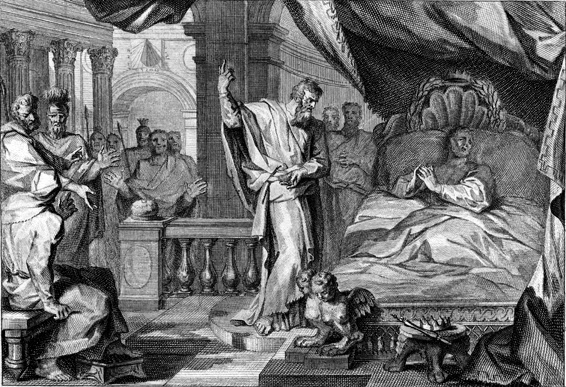
1 In those days Hezekiah became sick and was at the point of death. And Isaiah the prophet the son of Amoz came to him and said to him, “Thus says the LORD, ‘Set your house in order, for you shall die; you shall not recover.’” Then Hezekiah turned his face to the wall and prayed to the LORD, saying, “Now, O LORD, please remember how I have walked before you in faithfulness and with a whole heart, and have done what is good in your sight.” And Hezekiah wept bitterly. And before Isaiah had gone out of the middle court, the word of the LORD came to him: “Turn back, and say to Hezekiah the leader of my people, Thus says the LORD, the God of David your father: I have heard your prayer; I have seen your tears. Behold, I will heal you. On the third day you shall go up to the house of the LORD, and I will add fifteen years to your life. I will deliver you and this city out of the hand of the king of Assyria, and I will defend this city for my own sake and for my servant David’s sake.” And Isaiah said, “Bring a cake of figs. And let them take and lay it on the boil, that he may recover.”

And Hezekiah said to Isaiah, “What shall be the sign that the LORD will heal me, and that I shall go up to the house of the LORD on the third day?” And Isaiah said, “This shall be the sign to you from the LORD, that the LORD will do the thing that he has promised: shall the shadow go forward ten steps, or go back ten steps?” 10 And Hezekiah answered, “It is an easy thing for the shadow to lengthen ten steps. Rather let the shadow go back ten steps.” 11 And Isaiah the prophet called to the LORD, and he brought the shadow back ten steps, by which it had gone down on the steps of Ahaz. 2 Kings 20:1-11 ESV

Hezekiah was a good man who remained faithful to Yahweh throughout his tenure as Judah’s king. This made him a rather rare commodity among the other kings of Judah and Israel. Most of these men displayed a passion for idols and a propensity for godless behavior that brought God’s judgment upon them. Many of Hezekiah’s peers and predecessors had been nothing more than apostate idol worshipers. Yet, the author of 2 Kings saved his most glowing assessment for King Hezekiah.

He trusted in the LORD, the God of Israel, so that there was none like him among all the kings of Judah after him, nor among those who were before him. – 2 Kings 18:5 ESV

Hezekiah had instituted a series of religious reforms in Judah that were meant to restore the people’s devotion to and confidence in Yahweh. He repaired and cleansed the Temple of God that had been allowed to fall into a state of disrepair. He reinstituted Temple worship by recommissioning the priests and Levites. He also called for the reinstatement of the Feast of Unleavened Bread and the celebration of Passover,  both of which had long been neglected. These annual celebrations had been commissioned by God and were intended to be reminders of God’s deliverance of the people of Israel from their captivity in Egypt. But when Hezekiah issued a royal decree that the nation of Judah gather in Jerusalem to re-commemorate these two God-ordained festivals, some of the people responded with derision and refused to attend. Many of those who did come to Jerusalem had failed to follow God’s requirements concerning purification.

Most of those who came from Ephraim, Manasseh, Issachar, and Zebulun had not purified themselves. But King Hezekiah prayed for them, and they were allowed to eat the Passover meal anyway, even though this was contrary to the requirements of the Law. For Hezekiah said, “May the LORD, who is good, pardon those who decide to follow the LORD, the God of their ancestors, even though they are not properly cleansed for the ceremony.” And the LORD listened to Hezekiah’s prayer and healed the people. – 2 Chronicles 30:18-20 NLT

Yet all of Hezekiah’s reforms and his determination to restore the nation’s dedication to Yahweh did not prevent him from encountering difficulties during his reign. His faithfulness to God did not inoculate his kingship from potential trials or guarantee him a trouble-free kingdom. In fact, even this godly and faithful king found himself having to deal with the threat of destruction at the hands of the Assyrians.

However, when the enemy showed up outside the gates of Jerusalem, Hezekiah didn’t rail against God, accusing the Almighty of having abandoned His people. The king didn’t waste time listing all of his reforms or recounting all his efforts to restore the worship of Yahweh to Judah. No, he simply prayed that God would intervene on their behalf, and He did. God had not prevented the enemy from showing up, but He did miraculously cause them to go away. In the midst of their greatest trial, when all looked hopeless and they found themselves helpless, Hezekiah and the people of Judah had their faith reinvigorated by the power and presence of God.

While God miraculously delivered His people from the threat of annihilation by the Assyrians, that was not the only difficulty Hezekiah faced. The author states that “in those days” or around the same time that the Assyrian threat was taking place, the king of Judah became deathly ill. Just when the kingdom was facing its most difficult trial, Hezekiah was given devastating news from the prophet of God: “Set your affairs in order, for you are going to die. You will not recover from this illness” (2 Kings 20:1 NLT).

Once again, Hezekiah didn’t respond in anger or resentment. He didn’t lash out at God in disappointment or hurl accusations of divine dereliction of duty. He simply prayed, turning his face to the wall and calling out to his God: “Remember, O LORD, how I have always been faithful to you and have served you single-mindedly, always doing what pleases you” (2 Kings 20:3 NLT). Then he simply wept. 

Hezekiah wasn’t bragging or boasting. He wasn’t insinuating that God was somehow obligated to heal him. He was simply asking that God not forget his efforts to remain faithful. Hezekiah did not ask to be restored; he begged to be remembered. Due to the nature of his illness and God’s decree that it was terminal, he probably had his eternal state in mind when asking God to remember him. He was hoping that he had done enough to earn God’s favor and to secure entrance into His Kingdom. But his cries for Yahweh’s mercy did not go unheard or unheeded. He received an immediate and encouraging response.

“I have heard your prayer and seen your tears. I will heal you, and three days from now you will get out of bed and go to the Temple of the LORD. I will add fifteen years to your life, and I will rescue you and this city from the king of Assyria. I will defend this city for my own honor and for the sake of my servant David.” – 2 Kings 20:5-6 NLT

God gave Hezekiah an additional 15 years to lead the people of Judah. On top of that, God assured Hezekiah that He would protect the city of Jerusalem from the Assyrian threat. He would miraculously eliminate the enemy outside the gates of the city and the illness inside Hezekiah’s body. And when the king asked Isaiah if he could provide any proof that these things would actually take place, God graciously obliged by providing a miracle.

he brought the shadow back ten steps, by which it had gone down on the steps of Ahaz. – 2 Kings 20:11 ESV

Evidently, right before the eyes of the king and all those in his royal bedroom, the sun appeared to reverse itself. The shadow that had advanced ten steps suddenly went in the opposite direction, in direct violation of natural order. God’s particular choice of this sign was intended to demonstrate His ability to do the impossible. If He could cause the shadow to reverse its course, He could also reverse the effects of Hezekiah’s illness and the outcome of the Assyrian siege.

Nothing is too difficult for God. The one who spoke light into existence (Genesis 1:3) could command it to do His bidding. The one who created the sun was fully capable of controlling its shadow. The one who gave Hezekiah life could prolong it. And the one who gave kings the authority to conceive and implement plans could easily redirect or reverse those plans to suit His sovereign will. The shadow reversed. The king was healed. The Assyrians gave up their siege of Jerusalem.

God graciously displayed His power over sickness, nature, and the nations of the world, and Hezekiah was given 15 more years to prove his faithfulness to Yahweh. But as will soon become evident, his new lease on life will produce some unexpected outcomes. The glory of his former faithfulness will see its shadow reversed as the king struggles with pride and the seductive influence of success.

English Standard Version (ESV) The Holy Bible, English Standard Version. ESV® Permanent Text Edition® (2016). Copyright © 2001 by Crossway Bibles, a publishing ministry of Good News Publishers.

New Living Translation (NLT) Holy Bible, New Living Translation, copyright © 1996, 2004, 2015 by Tyndale House Foundation. Used by permission of Tyndale House Publishers Inc., Carol Stream, Illinois 60188. All rights reserved.

Meanwhile, Back In Judah

1 In the third year of Hoshea son of Elah, king of Israel, Hezekiah the son of Ahaz, king of Judah, began to reign. He was twenty-five years old when he began to reign, and he reigned twenty-nine years in Jerusalem. His mother’s name was Abi the daughter of Zechariah. And he did what was right in the eyes of the LORD, according to all that David his father had done. He removed the high places and broke the pillars and cut down the Asherah. And he broke in pieces the bronze serpent that Moses had made, for until those days the people of Israel had made offerings to it (it was called Nehushtan). He trusted in the LORD, the God of Israel, so that there was none like him among all the kings of Judah after him, nor among those who were before him. For he held fast to the LORD. He did not depart from following him, but kept the commandments that the LORD commanded Moses. And the LORD was with him; wherever he went out, he prospered. He rebelled against the king of Assyria and would not serve him. He struck down the Philistines as far as Gaza and its territory, from watchtower to fortified city.

In the fourth year of King Hezekiah, which was the seventh year of Hoshea son of Elah, king of Israel, Shalmaneser king of Assyria came up against Samaria and besieged it, 10 and at the end of three years he took it. In the sixth year of Hezekiah, which was the ninth year of Hoshea king of Israel, Samaria was taken. 11 The king of Assyria carried the Israelites away to Assyria and put them in Halah, and on the Habor, the river of Gozan, and in the cities of the Medes, 12 because they did not obey the voice of the LORD their God but transgressed his covenant, even all that Moses the servant of the Lord commanded. They neither listened nor obeyed. 2 Kings 18:1-12 ESV

Things were not going well in the northern kingdom of Israel. In the ninth year of King Hoshea’s reign, Samaria fell, and the people of Israel were exiled to Assyria; the land was soon occupied by foreigners resettled by King Shalmaneser. Soon, these pagan idolaters were assimilated by the Israelites who had been left behind. Marriages between the Israelites and these idolatrous outsiders produced a new wave of apostasy within the land of promise, and Yahweh was not pleased. When “the LORD sent lions among them, which killed some of them” (2 Kings 17:25 NLT), King Shalmaneser attempted to remedy the problem by sending a captured Israelite priest back to Israel with orders to instruct the people in the proper ways of worshiping Yahweh. But while this lone priest did as he was commanded, his effort proved futile because the polytheistic occupants of the land simply added Yahweh to their growing number of gods. And the author ends chapter 17 with the sad assessment, “So while these new residents worshiped the Lord, they also worshiped their idols. And to this day their descendants do the same” (2 Kings 17:41 NLT). 

But meanwhile, back in Judah, a new king had ascended the throne of David, who proved to be a welcome light in the darkness that had pervaded the land of promise for so long. In a rare statement of positivity, the author declares that Hezekiah “did what was pleasing in the LORD’s sight, just as his ancestor David had done” (2 Kings 18:3 NLT). This 25-year-old, newly appointed king wasted no time in implementing much-needed reforms within the kingdom of Judah.

He removed the pagan shrines, smashed the sacred pillars, and cut down the Asherah poles. He broke up the bronze serpent that Moses had made, because the people of Israel had been offering sacrifices to it. The bronze serpent was called Nehushtan. – 2 Kings 18:4 NLT

Hezekiah had his work cut out for him, and the nature of his reforms reflects the nation’s sad moral and spiritual state. The people of Judah had become so idolatrous that they seemed to turn everything into a false god. As proof of their seemingly uncontrollable urge to worship other gods, the author states that they had even begun to offer sacrifices to “the bronze serpent that Moses made” (2 Kings 18:4 NLT). When the people of Israel were making their way from Egypt to the land of Canaan, they grew impatient with the length of the journey and the suffering it entailed. In a fit of discontentment, they called out to Moses, “Why have you brought us out of Egypt to die here in the wilderness? There is nothing to eat here and nothing to drink. And we hate this horrible manna!” (Numbers 21:5 NLT). In response to their ingratitude and disrespect, “the LORD sent poisonous snakes among the people, and many were bitten and died” (Numbers 21:6 NLT).

This plague of poisonous serpents got their attention, and “the people came to Moses and cried out, ‘We have sinned by speaking against the LORD and against you. Pray that the Lord will take away the snakes.’ So Moses prayed for the people” (Numbers 21:7 NLT). And the LORD heard that prayer and gave Moses the following instructions:

“Make a replica of a poisonous snake and attach it to a pole. All who are bitten will live if they simply look at it!” – Numbers 21:8 NLT

Moses followed the LORD’s instructions, crafting a snake out of bronze and attaching it to a pole. “Then anyone who was bitten by a snake could look at the bronze snake and be healed!” (Numbers 21:9 NLT). But centuries later, this icon from Israel’s past had been turned into just another false god to be worshiped in place of Yahweh. They even gave it a name: Nehushtan. Rather than allowing this symbol from Israel’s past to serve as a reminder of Yahweh’s holiness, judgment, and gracious deliverance, they transformed it into a false god. 

This was the spiritual cesspool into which Hezekiah began his reign. But Yahweh had prepared this young man for just such a time. The author states, “Hezekiah trusted in the LORD, the God of Israel. There was no one like him among all the kings of Judah, either before or after his time” (2 Kings 18:5 NLT). He was the right man for the job and had come along at just the right time. As many of the citizens of the northern kingdom languished in captivity and their neighbors and friends wallowed in spiritual apathy and apostasy back in the land, Yahweh was using a newly appointed king to institute a series of reforms in Judah.

The author wastes no time in establishing the secret to Hezekiah’s success.

He remained faithful to the LORD in everything, and he carefully obeyed all the commands the LORD had given Moses. So the LORD was with him, and Hezekiah was successful in everything he did. He revolted against the king of Assyria and refused to pay him tribute. He also conquered the Philistines as far distant as Gaza and its territory, from their smallest outpost to their largest walled city. – 2 Kings 18:6-8 NLT 

The LORD was with him because, unlike most of his predecessors, Hezekiah remained faithful and obedient. He refused to turn his back on Yahweh and did everything in his power to call the people to repentance and revitalize their commitment to the one true God. He instituted a series of significant reforms, beginning with a restoration of the Temple itself and involving the recalcitrant Levitical priesthood.

“Listen to me, you Levites! Purify yourselves, and purify the Temple of the Lord, the God of your ancestors. Remove all the defiled things from the sanctuary. Our ancestors were unfaithful and did what was evil in the sight of the LORD our God. They abandoned the LORD and his dwelling place; they turned their backs on him. They also shut the doors to the Temple’s entry room, and they snuffed out the lamps. They stopped burning incense and presenting burnt offerings at the sanctuary of the God of Israel.” – 2 Chronicles 29:5-7 NLT

His pep talk to the priests motivated them into action and prompted a thorough physical and spiritual cleansing of the LORD’s house.

Then they began to cleanse the Temple of the Lord, just as the king had commanded. They were careful to follow all the Lord’s instructions in their work. The priests went into the sanctuary of the Temple of the Lord to cleanse it, and they took out to the Temple courtyard all the defiled things they found. – 2 Chronicles 29:15-16 NLT

With the Temple properly reconsecrated and purified, the once-neglected sacrificial system was restored, and the people brought so many offerings that “there were too few priests to prepare all the burnt offerings…There was an abundance of burnt offerings, along with the usual liquid offerings, and a great deal of fat from the many peace offerings (2 Chronicles 29:34, 35 NLT).

Hezekiah’s reign actually began four years before the fall of Samaria and the deportation of the people of Israel to Assyria. While King Hoshea of Israel had been busy paying tribute to King Shalmaneser of Assyria in a vain attempt to stave off further assaults and the possibility of total annihilation, Hezekiah “revolted against the king of Assyria and refused to pay him tribute” (2 Kings 18:7 NLT). Unfazed by the presence of this powerful enemy, Hezekiah set his sights on another perennial foe of Judah, the Philistines. He refused to allow the 800-pound gorilla in the room to distract him from his duties as the king of Judah, choosing instead to encourage his people to recommit themselves to the worship of Yahweh.

Six years into his reign, Samaria fell, and the northern kingdom became a vassal state of Assyria. Hezekiah was smart enough to know that King Shalmaneser was far from done and would soon turn his sights on Judah. But Hezekiah “remained faithful to the LORD in everything” (2 Kings 18:6 NLT). He had watched the fall of his northern neighbors and knew precisely what had caused their demise. For his part, he was going to do everything in his power to prevent the same thing from happening under his watch in the kingdom of Judah.

As the rest of 2 Kings 18 will reveal, Hezekiah was about to be tested in ways he could have never imagined. His faith in Yahweh was going to be stretched to the extreme as Sennacherib set in motion his plan to invade Judah.

After these things and these acts of faithfulness, Sennacherib king of Assyria came and invaded Judah and encamped against the fortified cities, thinking to win them for himself. – 2 Chronicles 32:1 NLT

Hezekiah had done all the right things, but that did not mean the enemy had gone away or lost interest in subjugating the people of Judah. When the Assyrian army showed up on Hezekiah’s doorstep, he would have a choice to make: Trust in the power and presence of Yahweh or allow the enemy to determine his next steps.

English Standard Version (ESV) The Holy Bible, English Standard Version. ESV® Permanent Text Edition® (2016). Copyright © 2001 by Crossway Bibles, a publishing ministry of Good News Publishers.

New Living Translation (NLT) Holy Bible, New Living Translation, copyright © 1996, 2004, 2015 by Tyndale House Foundation. Used by permission of Tyndale House Publishers Inc., Carol Stream, Illinois 60188. All rights reserved.