The Discipline of God.

1 An oracle concerning Egypt.

Behold, the Lord is riding on a swift cloud
    and comes to Egypt;
and the idols of Egypt will tremble at his presence,
    and the heart of the Egyptians will melt within them.
2 And I will stir up Egyptians against Egyptians,
    and they will fight, each against another
    and each against his neighbor,
    city against city, kingdom against kingdom;
3 and the spirit of the Egyptians within them will be emptied out,
    and I will confound their counsel;
and they will inquire of the idols and the sorcerers,
    and the mediums and the necromancers;
4 and I will give over the Egyptians
    into the hand of a hard master,
and a fierce king will rule over them,
    declares the Lord God of hosts.

5 And the waters of the sea will be dried up,
    and the river will be dry and parched,
6 and its canals will become foul,
    and the branches of Egypt’s Nile will diminish and dry up,
    reeds and rushes will rot away.
7 There will be bare places by the Nile,
    on the brink of the Nile,
and all that is sown by the Nile will be parched,
    will be driven away, and will be no more.
8 The fishermen will mourn and lament,
    all who cast a hook in the Nile;
and they will languish
    who spread nets on the water.
9 The workers in combed flax will be in despair,
    and the weavers of white cotton.
10 Those who are the pillars of the land will be crushed,
    and all who work for pay will be grieved.

11 The princes of Zoan are utterly foolish;
    the wisest counselors of Pharaoh give stupid counsel.
How can you say to Pharaoh,
    “I am a son of the wise,
    a son of ancient kings”?
12 Where then are your wise men?
    Let them tell you
    that they might know what the Lord of hosts has purposed against Egypt.
13 The princes of Zoan have become fools,
    and the princes of Memphis are deluded;
those who are the cornerstones of her tribes
    have made Egypt stagger.
14 The Lord has mingled within her a spirit of confusion,
and they will make Egypt stagger in all its deeds,
    as a drunken man staggers in his vomit.
15 And there will be nothing for Egypt
    that head or tail, palm branch or reed, may do. – Isaiah 19:1-15 ESV

Cush.pngNow, God turns His attention to the land of Egypt. Located in close proximity to the land of Cush, Egypt was another potential ally for Judah in their efforts to forestall God’s judgment at the hands of the Assyrians. But, as before, God makes it quite clear that neither Cush or Egypt could prevent what God had planned for Judah. The only thing that could prevent their destruction was repentance, and they showed no interest in changing their ways.

So, God lets the people of Judah know just how helpful Egypt will prove to be as an ally. This powerful nation will find itself experiencing devastating destruction on all fronts. Their economy will suffer. Their ancient way of life will be radically altered. And their once-powerful political structure will collapse.

And the first 15 verses of this oracle are bracketed by statements describing the source of their fall.

Behold, the Lord is riding on a swift cloud
    and comes to Egypt;
and the idols of Egypt will tremble at his presence,
    and the heart of the Egyptians will melt within them. – Isaiah 19:1 ESV

The Lord has mingled within her a spirit of confusion,
and they will make Egypt stagger in all its deeds,
    as a drunken man staggers in his vomit. – Isaiah 19:14 ESV

All that Isaiah describes in this oracle will be the direct result of God’s actions. This is a not-so-subtle reminder to Judah that they need not fear the Assyrians. They needed to fear God. He was calling them to repentance. He was demanding that they return to Him and honor Him as the one and only God. What the people of Judah needed to realize was that the Assyrians were nothing more than instruments in God’s hands. He was using them as His rod of discipline against His wayward children. But rather than accept the loving discipline of God, the people of Judah were looking for a way of escape. They were attempting to find a savior to rescue them from all that God had planned for them.

God knew their hearts, and He was well aware that they would seek a way of escape. They would turn to one of the surrounding nations to rescue them from the very discipline of God. But God wanted them to know that their efforts would prove futile and pointless. Judah’s real adversary was the Lord. And there was nothing they could do to stop His coming judgment, short of repentance. There was no nation strong enough to stay His hand.

What the people of Judah needed to know was that their seeking of salvation in someone or something other than God would prove pointless. Their only source of help and hope was God Himself. Their plans to turn to other nations for assistance was nothing less than turning away from God. They would be refusing His will as manifested in the form of His loving discipline. And yet, that is exactly what they were planning to do. And when the Assyrians eventually arrived at the gates of Jerusalem, even King Sennacherib knew their intentions.

Then the Assyrian king’s chief of staff told them to give this message to Hezekiah:

“This is what the great king of Assyria says: What are you trusting in that makes you so confident? Do you think that mere words can substitute for military skill and strength? Who are you counting on, that you have rebelled against me? On Egypt? If you lean on Egypt, it will be like a reed that splinters beneath your weight and pierces your hand. Pharaoh, the king of Egypt, is completely unreliable!” – 2 Kings 18:19-21 NLT

Even this pagan king knew that Egypt would be no match for the forces of Assyria. But what King Sennacherib didn’t know was that he would prove no match for God. All of these prideful, powerful and self-inflated nations were nothing more than tools in the hands of God. He could and would do with them as He wished.

And God describes the Egyptians as devolving into a nation marred by civil war and inner turmoil. Their circumstances will leave them confused and in search of answers. So, they will “inquire of the idols and the sorcerers, and the mediums and the necromancers” (Isaiah 19:3 ESV). They will seek help from their litany of false gods, but find themselves short on answers and void of solutions. Instead, they will fall to a stronger, more powerful nation. The economy of Egypt will suffer greatly.

And in the midst of it all, the Pharaoh and his counselors will be at a loss as to why any of this is happening. God even mocks Pharaoh, telling him to ask his wise men as to the source of their misery.

Where then are your wise men?
    Let them tell you
    that they might know what the Lord of hosts has purposed against Egypt. – Isaiah 19:12 ESV

All that is described in these verses is the handiwork of God. And He wants His people to understand that their propensity to turn to a nation like Egypt for help and hope will prove futile. God is going to do what He has planned to do, and there is nothing anyone can do about it, including Egypt. Judah can make all the alliances it wants, but there is no nation strong enough to thwart the will of God. And He makes that point painfully clear.

And there will be nothing for Egypt
    that head or tail, palm branch or reed, may do. – Isaiah 19:15 ESV

Whenever the people of God reject Him and place their hope and trust in the things of this world, they will find themselves highly disappointed with the outcome of their strategy. In the case of Judah, they were considering Egypt as a source of rescue. But what they were failing to understand was that the very thing they were trying to escape was the sovereign will of God for them. God’s coming judgment was not intended to be merely punitive, but restorative in nature. He was going to break them so that He might heal them. He was going to chastise them, but only because He loved them.

For the LORD disciplines those he loves, and he punishes each one he accepts as his child. – Hebrews 12:6 NLT

Long before the author of Hebrews penned those words, Moses shared a similar sentiment with the people of Israel as they prepared to enter the promised land.

Think about it: Just as a parent disciplines a child, the LORD your God disciplines you for your own good. – Deuteronomy 8:5 NLT

No one likes discipline, even when done in love. In fact, we do everything we can to avoid or escape it. But, as followers of God, we must understand that His discipline is always intended for our good and fully backed by His love. The people of Judah needed to open their eyes and see that their rejection of God was the source of all their problems. Their failure to honor God had brought upon them the loving discipline of God. And, while not enjoyable in the moment, God’s discipline always proves profitable, resulting in our holiness. And the author of Hebrews puts the benefits of God’s loving discipline in terms we can understand and must wholeheartedly believe.

“My child, don’t make light of the Lord’s discipline and don’t give up when he corrects you. For the Lord disciplines those he loves, and he punishes each one he accepts as his child.”

As you endure this divine discipline, remember that God is treating you as his own children. Who ever heard of a child who is never disciplined by its father? If God doesn’t discipline you as he does all of his children, it means that you are illegitimate and are not really his children at all. Since we respected our earthly fathers who disciplined us, shouldn’t we submit even more to the discipline of the Father of our spirits, and live forever?

For our earthly fathers disciplined us for a few years, doing the best they knew how. But God’s discipline is always good for us, so that we might share in his holiness. No discipline is enjoyable while it is happening—it’s painful! But afterward there will be a peaceful harvest of right living for those who are trained in this way. – Hebrews 12:5-11 NLT

English Standard Version (ESV)
The Holy Bible, English Standard Version. ESV® Permanent Text Edition® (2016). Copyright © 2001 by Crossway Bibles, a publishing ministry of Good News Publishers.

New Living Translation (NLT)
Holy Bible, New Living Translation, copyright © 1996, 2004, 2015 by Tyndale House Foundation. Used by permission of Tyndale House Publishers Inc., Carol Stream, Illinois 60188. All rights reserved.

The Message (MSG)
Copyright © 1993, 1994, 1995, 1996, 2000, 2001, 2002 by Eugene H. Peterson

Seek God Now, Not Later.

1 An oracle concerning Damascus.

Behold, Damascus will cease to be a city
    and will become a heap of ruins.
2 The cities of Aroer are deserted;
    they will be for flocks,
    which will lie down, and none will make them afraid.
3 The fortress will disappear from Ephraim,
    and the kingdom from Damascus;
and the remnant of Syria will be
    like the glory of the children of Israel,
declares the Lord of hosts.

4 And in that day the glory of Jacob will be brought low,
    and the fat of his flesh will grow lean.
5 And it shall be as when the reaper gathers standing grain
    and his arm harvests the ears,
and as when one gleans the ears of grain
    in the Valley of Rephaim.
6 Gleanings will be left in it,
    as when an olive tree is beaten—
two or three berries
    in the top of the highest bough,
four or five
    on the branches of a fruit tree,
declares the Lord God of Israel.

7 In that day man will look to his Maker, and his eyes will look on the Holy One of Israel. 8 He will not look to the altars, the work of his hands, and he will not look on what his own fingers have made, either the Asherim or the altars of incense. – Isaiah 17:1-8 ESV

DamascusWith the opening of chapter 17, Isaiah delivers God’s oracle against Damascus, the capital city of Syria. As verse three reveals, Israel is included in this oracle, referred to by the name of Ephraim, the largest of the ten tribes that made up the northern kingdom. Israel had formed an alliance with Syria in order to attack the southern kingdom of Judah (see chapter seven).

As has been the case with each of the other oracles, God is speaking a word of warning aimed directly at His own people, the divided nations of Israel and Judah. Their repeated attempts to seek help from foreign nations rather than trust in Him were going to bring His judgment. He has already told what will happen to Babylon, Philistia, Moab and Assyria. Now, He turns His attention to Syria, located to the northeast of Israel. And He cuts to the chase, describing the Syrian capital as “a heap of ruins.” He predicts the utter devastation of the fortified cities of Syria and Ephraim, which would include the Israelite capital of Samaria.

The fortress will disappear from Ephraim,
    and the kingdom from Damascus;
and the remnant of Syria will be
    like the glory of the children of Israel,
declares the Lord of hosts. – Isaiah 17:3 ESV

Syria would share Israel’s fate. Both nations, because of their arrogance, would suffer greatly under the hand of God Almighty. But God’s primary judgment seems to be directed at the children of Israel. He states that their former glory will be greatly diminished, and He describes it is stark terms:

…in that day the glory of Jacob will be brought low,
    and the fat of his flesh will grow lean. – Isaiah 17:4 ESV

Once again, we see God promising to humble the proud and destroy bring low the self-sufficient. Israel had reached the point in their downward spiritual spiral where they no longer believed they needed God. Under the leadership of their king, Jeroboam, they had long ago created their own gods and set up their own places of worship.

Jeroboam then built up the city of Shechem in the hill country of Ephraim, and it became his capital. Later he went and built up the town of Peniel.

Jeroboam thought to himself, “Unless I am careful, the kingdom will return to the dynasty of David. When these people go to Jerusalem to offer sacrifices at the Temple of the Lord, they will again give their allegiance to King Rehoboam of Judah. They will kill me and make him their king instead.”

So on the advice of his counselors, the king made two gold calves. He said to the people, “It is too much trouble for you to worship in Jerusalem. Look, Israel, these are the gods who brought you out of Egypt!”

He placed these calf idols in Bethel and in Dan—at either end of his kingdom. But this became a great sin, for the people worshiped the idols, traveling as far north as Dan to worship the one there. – 1 Kings 12:25-30 NLT

And a long line of kings who succeeded Jeroboam continued the idolatrous trend, leading the people of Israel further and further away from God. But God does not leave sin unpunished. He cannot and will not overlook the rebellion of His people. So in 732 BC, the Assyrians fulfilled God’s word by destroying Damascus. And then years later, they would destroy Samaria, the capital city of Israel.

And the aftermath of the Assyrian conquest will leave the land looking “like a grainfield after the harvesters have gathered the grain. It will be desolate, like the fields in the valley of Rephaim after the harvest” (Isaiah 17:5 NLT). It is a picture of desolation and devastation. All the glory is gone. Everything the people had placed their hope in and based their pride upon would be gone. Only a remnant of the people of Israel would remain in the land.

“Only a few of its people will be left,
    like stray olives left on a tree after the harvest.
Only two or three remain in the highest branches,
    four or five scattered here and there on the limbs,”
    declares the Lord, the God of Israel. – Isaiah 17:6 NLT

This image stands in stark contrast to the promise God had made to Abraham.

“Look toward heaven, and number the stars, if you are able to number them.” Then he said to him, “So shall your offspring be.” – Genesis 15:5 ESV

God had kept His promise to Abraham and had made of him a great nation. While the Israelites had lived in Egypt for 400 years, their numbers had grown to such a degree that the Pharaoh had become fearful of their presence in the land. So he began to treat them as slaves, keeping them under intense subjection so that they might not rise up against the Egyptians. But God had delivered them from their slavery and had brought them to the land of Canaan, where He had given them victory over their enemies and provided them with land, villages and houses in which to live.

But the people of Israel had proved unfaithful to God. Over the centuries, they had repeatedly disobeyed God by worshiping the false gods of the Canaanites. They had intermarried with the nations, failing to maintain their ethnic purity but, more importantly, their spiritual identity as the chosen people of God. They had been set apart by God and commanded to live according to His laws. They were to be a living example of how sinful man can live in covenant community with a holy God. But they had failed.

And the core issue here is not the litany of sins the people of Israel committed, but their lack of belief in God. The goal of Satan is not so much to get mankind to commit sins as it is to get them to doubt God. That’s the tactic he took in the garden with Adam and Eve. He came to the woman in the guise of a beautiful serpent and said, “Did God really say you must not eat the fruit from any of the trees in the garden?” (Genesis 3:1 NLT). Notice that he raised doubts about God’s command. And Eve correctly responded, “It’s only the fruit from the tree in the middle of the garden that we are not allowed to eat. God said, ‘You must not eat it or even touch it; if you do, you will die’” (Genesis 3:3 NLT). Then Satan did what he always does, he contradicted the very word of God. “You won’t die!” (Genesis 3:4 NLT). And he followed that up with a compelling lie: “God knows that your eyes will be opened as soon as you eat it, and you will be like God, knowing both good and evil” (Genesis 3:5 NLT).

Eve and her husband listened to the lies of the enemy. But it was not the eating of the fruit that was the cause of their fall. It was their rejection of the word of God. They failed to believe what God had said. The enemy replaced the truth of God with a lie, and they accepted it. They took the bait. Satan’s promise sounded more plausible and appealing than God’s offer of life in the garden with Him. And mankind has been taking the bait of Satan ever since.

The fellowship with God that Adam and Eve had once enjoyed came to an abrupt end. Sin broke the bond. It severed the relationship they had enjoyed. They were cast out of the garden and away from the presence of God. And, as time passed, they and their descendants would find themselves moving further and further away from God – physically, as they journeyed away from the garden, and spiritually, as they allowed sin to separate them from Him.

But God describes a day when the fall of Israel would leave His people calling out to Him once again. In their devastated and demoralized state, they would find themselves without hope and devoid of any other source of help.

Then at last the people will look to their Creator
    and turn their eyes to the Holy One of Israel.
They will no longer look to their idols for help
    or worship what their own hands have made.
They will never again bow down to their Asherah poles
    or worship at the pagan shrines they have built. – Isaiah 17:7-8 NLT

It is amazing how easy it is for the people of God to turn their backs on Him until they find themselves in a state of hopelessness and helplessness. In those moments of trial and trouble, when they no longer have any other options or tricks up their sleeves, they tend to turn back to God for help. When their man-made gods no longer come through for them, they decide to give God one more try.

And the same is true of us as God’s people. While our false gods to be more sophisticated, they are still man-made and poor substitutes for the one true God. Yet, we find it so easy to place our trust in anything and everything but God, until those things fail to come through for us. When all the money in the world can’t heal us from cancer, we turn to God. When our intelligence proves insufficient for the crisis we face, we turn to God. When all our possessions fail to bring us the happiness they promised to deliver, we turn to God. And while it is true that “God is our refuge and strength, always ready to help in times of trouble” (Psalm 46:1 NLT), He longs for us to seek Him at all times. He desires that we make Him our first and only option. Which is why Jesus said, “Seek the Kingdom of God above all else, and live righteously, and he will give you everything you need” (Matthew 6:33 NLT).

English Standard Version (ESV)
The Holy Bible, English Standard Version. ESV® Permanent Text Edition® (2016). Copyright © 2001 by Crossway Bibles, a publishing ministry of Good News Publishers.

New Living Translation (NLT)
Holy Bible, New Living Translation, copyright © 1996, 2004, 2015 by Tyndale House Foundation. Used by permission of Tyndale House Publishers Inc., Carol Stream, Illinois 60188. All rights reserved.

The Message (MSG)
Copyright © 1993, 1994, 1995, 1996, 2000, 2001, 2002 by Eugene H. Peterson

No Match For God.

1 An oracle concerning Moab.

Because Ar of Moab is laid waste in a night,
    Moab is undone;
because Kir of Moab is laid waste in a night,
    Moab is undone.
2 He has gone up to the temple, and to Dibon,
    to the high places to weep;
over Nebo and over Medeba
    Moab wails.
On every head is baldness;
    every beard is shorn;
3 in the streets they wear sackcloth;
    on the housetops and in the squares
    everyone wails and melts in tears.
4 Heshbon and Elealeh cry out;
    their voice is heard as far as Jahaz;
therefore the armed men of Moab cry aloud;
    his soul trembles.
5 My heart cries out for Moab;
    her fugitives flee to Zoar,
    to Eglath-shelishiyah.
For at the ascent of Luhith
    they go up weeping;
on the road to Horonaim
    they raise a cry of destruction;
6 the waters of Nimrim
    are a desolation;
the grass is withered, the vegetation fails,
    the greenery is no more.
7 Therefore the abundance they have gained
    and what they have laid up
they carry away
    over the Brook of the Willows.
8 For a cry has gone
    around the land of Moab;
her wailing reaches to Eglaim;
    her wailing reaches to Beer-elim.
9 For the waters of Dibon are full of blood;
    for I will bring upon Dibon even more,
a lion for those of Moab who escape,
    for the remnant of the land. – Isaiah 15:1-9 ESV

ruth_moabNow, God turns His attention to the land of Moab. Slowly and systematically, God is addressing all the people groups that have had anything to do with Israel and Judah. In the first two oracles, He dealt with Assyrian and Philistia, two nations located outside the borders of Canaan, that would both pose a threat to the people of God. The Moabites, while a relatively small nation, and one that had proven to be particularly hostile to the people of God, would hear from God as well. Located to the east of the Dead Sea, the Moabites were the descendants of Moab, the son born to Lot and his oldest daughter. This incestuous relationship is recorded in the book of Genesis and took place immediately after Lot and his family had been rescued from Sodom just before the city’s destruction by God.

When the people of Israel had begun their conquest of the land promised to them by God, the Moabites had become concerned over their sheer numbers and their relatively easy defeat of the neighboring Ammorites.

And Balak the son of Zippor saw all that Israel had done to the Amorites. And Moab was in great dread of the people, because they were many. Moab was overcome with fear of the people of Israel. – Numbers 22:2-3 ESV

King Balak ended up sending for a well-known diviner named Balaam, whom he offered a fee if he would curse the Israelites.

“Behold, a people has come out of Egypt. They cover the face of the earth, and they are dwelling opposite me. Come now, curse this people for me, since they are too mighty for me. Perhaps I shall be able to defeat them and drive them from the land, for I know that he whom you bless is blessed, and he whom you curse is cursed.” – Numbers 22:5-6 ESV

But God would not allow Balaam to do as the king had requested. He was prevented from cursing Israel. So, instead, he came up with an alternative and ingenuous plan to defeat the people of God. He recommended to King Balak that the Moabite women entice the Israelite men into having immoral relationships with them. And his plan worked.

While the Israelites were camped at Acacia Grove, some of the men defiled themselves by having sexual relations with local Moabite women. These women invited them to attend sacrifices to their gods, so the Israelites feasted with them and worshiped the gods of Moab. In this way, Israel joined in the worship of Baal of Peor, causing the Lord’s anger to blaze against his people. – Numbers 25:1-3 NLT

God ended up sending a plague on the people of Israel, resulting in 24,000 deaths. But this oracle makes it clear that God would deal with the Moabites as well. Their role in Israel’s moral and spiritual adultery would be avenged. And the prophet, Zephaniah, reiterates God’s plans for the people of Moab.

“Now, as surely as I live,”
    says the Lord of Heaven’s Armies, the God of Israel,
“Moab and Ammon will be destroyed—
    destroyed as completely as Sodom and Gomorrah.
Their land will become a place of stinging nettles,
    salt pits, and eternal desolation.
The remnant of my people will plunder them
    and take their land.” – Zephaniah 2:9 NLT

Isaiah warns of Moab’s pending fall. Its two main cities, Ar and Kir, would end up destroyed, “laid waste in a night.” In other words, their destruction would be quick and complete. Isaiah pictures the people weeping in Dibon, where the temple to Chemosh, the Moabite god was located. But rather than praying to their false god for aid, they are shown crying over the fall of their cities. Chemosh has proven ineffectual and impotent against God Almighty.

As a sign of mourning, everyone has shaved their heads and beards. They are wearing sackcloth and crying out in sorrow over their great loss. Even the soldiers join in the dirge over the loss of their cities, lands, and people. It is a scene of abject destruction and unrelenting sorrow.

It is impossible to know exactly when this prophecy was fulfilled. Some believe it took place in 718 BC when Sargon and the Assyrians moved across the land. Others have speculated that the fall of Moab happened under Tiglath-pilesar 732 BC or even Sennacherib in 701 BC. But the important point is that Moab did fall, just as God said that it would.

One of the important things to remember is that this oracle, like all the others, was aimed at the people of Judah. It was intended to remind them that their God was in complete control. The nations of the earth were under His divine authority, including Assyrian, Philistia, and Moab. They had no reason to fear these nations unless they failed to fear God – which they had. They had no business putting their trust in these nations, rather than trusting God – but they had. The sins of Judah were many. They were guilty of idolatry and immorality. They had placed their hope and trust in false gods and pagan nations. When warned of God’s pending judgment, rather than repent, they had sought aid from others. Faced with news of the coming wrath of God, they always seemed to have one more trick up their sleeve, an alternative source of rescue.

But God wanted them to know that everyone, from the powerful Assyrians and Babylonians to the relatively helpless Moabites, would prove to be no match for Him. And God makes it clear that, even after all the mourning and weeping in Moab, He will not yet be done.

“I will bring upon Dibon even more…” – Isaiah 15:9 ESV

Dibon, the home of the Moabite’s false god, Chemosh, would experience additional destruction. The gods of the nations would prove no match for God Almighty. The armies of the pagan nations would be powerless in the face of the Lord of Heaven’s Armies. And all of this was meant to remind the people of Judah of the greatness of their God.

The following proverb reminds us that the fear of man is dangerous because it illustrates our lack of faith in God.

Fearing people is a dangerous trap, but trusting the LORD means safety. – Proverbs 29:25 NLT

And Jesus Himself provided a much-needed reminder of our need to trust God rather than fearing man

“Don’t be afraid of those who want to kill your body; they cannot touch your soul. Fear only God, who can destroy both soul and body in hell.” – Matthew 10:28 NLT

Judah had lost its fear of God. In the face of all the turmoil surrounding them, the people of God had taken their eyes off of Him and had started trusting in human kings and man-made gods to protect them. But as God has made perfectly clear, there is no one or nothing that can provide protection from His judgment. Human kings fail. Mighty nations fall. And man-made idols prove to be false forms of salvation.

English Standard Version (ESV)
The Holy Bible, English Standard Version. ESV® Permanent Text Edition® (2016). Copyright © 2001 by Crossway Bibles, a publishing ministry of Good News Publishers.

New Living Translation (NLT)
Holy Bible, New Living Translation, copyright © 1996, 2004, 2015 by Tyndale House Foundation. Used by permission of Tyndale House Publishers Inc., Carol Stream, Illinois 60188. All rights reserved.

The Message (MSG)
Copyright © 1993, 1994, 1995, 1996, 2000, 2001, 2002 by Eugene H. Peterson

A Stone of Witness.

14 “Now therefore fear the Lord and serve him in sincerity and in faithfulness. Put away the gods that your fathers served beyond the River and in Egypt, and serve the Lord. 15 And if it is evil in your eyes to serve the Lord, choose this day whom you will serve, whether the gods your fathers served in the region beyond the River, or the gods of the Amorites in whose land you dwell. But as for me and my house, we will serve the Lord.”

16 Then the people answered, “Far be it from us that we should forsake the Lord to serve other gods, 17 for it is the Lord our God who brought us and our fathers up from the land of Egypt, out of the house of slavery, and who did those great signs in our sight and preserved us in all the way that we went, and among all the peoples through whom we passed. 18 And the Lord drove out before us all the peoples, the Amorites who lived in the land. Therefore we also will serve the Lord, for he is our God.”

19 But Joshua said to the people, “You are not able to serve the Lord, for he is a holy God. He is a jealous God; he will not forgive your transgressions or your sins. 20 If you forsake the Lord and serve foreign gods, then he will turn and do you harm and consume you, after having done you good.” 21 And the people said to Joshua, “No, but we will serve the Lord.” 22 Then Joshua said to the people, “You are witnesses against yourselves that you have chosen the Lord, to serve him.” And they said, “We are witnesses.” 23 He said, “Then put away the foreign gods that are among you, and incline your heart to the Lord, the God of Israel.” 24 And the people said to Joshua, “The Lord our God we will serve, and his voice we will obey.” 25 So Joshua made a covenant with the people that day, and put in place statutes and rules for them at Shechem. 26 And Joshua wrote these words in the Book of the Law of God. And he took a large stone and set it up there under the terebinth that was by the sanctuary of the Lord. 27 And Joshua said to all the people, “Behold, this stone shall be a witness against us, for it has heard all the words of the Lord that he spoke to us. Therefore it shall be a witness against you, lest you deal falsely with your God.” 28 So Joshua sent the people away, every man to his inheritance.  – Joshua 24:14-28 ESV

the-stone-of-witness.jpgJoshua was nearing the end of his life and, therefore, the end of his tenure as Israel’s spiritual leader. He had enjoyed a long and successful career after having assumed the mantel of leadership from Moses. During his rule, the people had finally crossed over the Jordan River and entered the land of promise. He had led them in their very first victory over the inhabitants of the land as they destroyed the city of Jericho. And he had followed God’s lead and dealt with the sin of Achan that had prevented the people from defeating the much-smaller city of Ai. In battle after battle, Joshua had been there, leading the way and fighting alongside the people of God. He had overseen the apportioning of the land between the 12 tribes, ensuring that each of the tribes received their fair share of the inheritance promised by God to Abraham, Isaac and Jacob. And all along the way, he had repeatedly reminded the people of their need to remain faithful to God. God demanded obedience and had forbidden them to intermarry with the inhabitants of the land. Why? Because He knew that they would end up worshiping their false gods. And there were plenty of false gods in abundance among the nations living in the land of promise.
So, as Joshua neared the end of his life, he felt compelled to provide his people with one last challenge. He calls them to “fear the Lord and serve him in sincerity and in faithfulness” (Joshua 24:14 ESV). He used two very important Hebrew words to describe the character of their service to God: tamiym and ’emeth. The first word has to do with the idea of wholeness or entirety. It is translated as “integrity” in this passage, but might be better understood as “wholeheartedness.” It carries the idea of bringing the entirety of your being to the matter – no compartmentalization. In other words, Joshua was calling the people to serve God with a “whole” heart. No hidden affections for other gods. No undisclosed love affairs with the things of this world. Jesus would one day put this concept into words that we can readily and easily understand.

37 “You shall love the Lord your God with all your heart and with all your soul and with all your mind. 38 This is the great and first commandment.” – Matthew 22:37-38 NLT

The prophet Jeremiah would later record the words of God, calling His people to this idea of tamiym.

13 “When you seek me in prayer and worship, you will find me available to you. If you seek me with all your heart and soul, 14 I will make myself available to you,’ says the Lord.” – Jeremiah 29:13-14 NLT

But along with wholeheartedness, Joshua emphasized their need for ’emeth. This Hebrew word has to do with “truth” or, better yet, “faithfulness.” It carries the idea of stability or continuity of character. It is faithfulness displayed over the long-haul. Joshua was calling the people to a long-term, unending commitment of their entire lives to God. This was to include every area of their lives for the entire length of their lives – both as individuals and as the corporate community of God.

And we should not miss the significance of Joshua’s next challenge to the people of Israel:

“Put away the gods that your fathers served beyond the River and in Egypt, and serve the Lord.” – Joshua 24:14 ESV

Their life-long commitment to wholeness of heart and holiness of character was going to have to start with a turning away from the false gods of Egypt to which they were still clinging. Even after all that God had done for them, there were those within the community of Israel who were holding on to their false gods. And Joshua was demanding that they let them go – once and for all. It is impossible to be wholehearted in your love for God if you have a heart that is divided in its affections. Joshua knew that the divided allegiance produced by the presence of false gods would ultimately lead the people away from the one true God. They would become half-hearted in their love and short-term in their commitment to Him.

And Joshua placed himself as a model of spiritual integrity and truth, claiming his allegiance to God.

“…as for me and my house, we will serve the Lord.” – Joshua 24:15 ESV

He was verbally committing himself and his family to serve God alone. He was placing a stake in the ground and declaring his unwavering, undivided allegiance to God. And the people responded with enthusiastic agreement, shouting, “we also will serve the Lord, for he is our God” (Joshua 24:18 ESV). Good answer. Right answer. But was it a truthful answer? Did they really mean what they were saying or were they simply responding based on the excitement of the moment? Only time would tell.

And Joshua seems to have had his doubts about not only the sincerity of their answer, but also the potentiality of their follow-through. He boldly predicted, “You are not able to serve the Lord, for he is a holy God. He is a jealous God; he will not forgive your transgressions or your sins” (Joshua 24:19 ESV). Joshua seemed to have realized that the people were making their commitment to serve God with their whole hearts throughout their whole lives, in ignorance. They failed to recognize their own insufficiency to pull this off. Joshua was simply reminding them that what God was calling them to do was impossible – on their own. They would not be able to pull it off on their own strength, any more than they could have conquered the land of Canaan without God’s help. They were completely dependent upon God for everything, including the capacity to remain faithful and true to Him.

Joshua warned them that if they failed to keep their commitment to God, they would find themselves on the receiving end of His wrath and judgment. The God who had done so much to bless and prosper them would turn against them. But, once again, the people responded unanimously and enthusiastically, “No, but we will serve the Lord” (Joshua 24:21 ESV).

Then Joshua makes an interesting and highly revealing statement to the people of Israel:

“Then put away the foreign gods that are among you, and incline your heart to the Lord, the God of Israel.” – Joshua 24:23 ESV

It’s as if Joshua was challenging their commitment. He was demanding that they prove their enthusiastic verbal commitment with a realistic display of action. Words would not be enough. God would not tolerate lip-service. He wanted wholehearted devotion. God would later accuse the people of Israel of the very thing Joshua feared.

“These people say they are mine. They honor me with their lips, but their hearts are far from me. And their worship of me is nothing but man-made rules learned by rote.” – Isaiah 29:13 NLT

And it’s interesting to note that the response of the people was another verbal expression of commitment, but without any form of visible action. They simply stated, “The Lord our God we will serve, and his voice we will obey” (Joshua 24:24 ESV). Again, the right answer was given, but it was lacking any tangible evidence of sincerity. So, Joshua took their verbal commitment and gave it a visual expression. He set up a stone, a witness stone, that would be a constant, timeless reminder of the commitment they had made to God that day. The stone would serve several purposes. First, it would act as a memorial commemorating the day they had renewed their covenant commitment to God. On the very same spot where Abraham had first built an altar to God after having arrived in the land of Canaan, they were setting up a stone to remind them of their expressed faith to God. But the stone would also serve as a witness against them, silently testifying of their unanimous commitment to serve God alone. Joshua made this point perfectly clear.

“Therefore it shall be a witness against you, lest you deal falsely with your God.” – Joshua 24:27 ESV

And the chapter ends with each of the tribes returning to their respective inheritance. They had made a verbal commitment to God. They had solemnly sworn to rid themselves of their false gods and to serve the Lord alone. They had made it to the land of promise. They had conquered many of the inhabitants of the land and were enjoying the fruit of their labors and the results of God’s blessings. God had been faithful to them. He had kept His covenant commitments to them. But would they remain true to their word? Would they serve Him alone? Would their lives be marked by wholehearted love and devotion over the whole length of their days? Only time would tell.

English Standard Version (ESV) The Holy Bible, English Standard Version. ESV® Permanent Text Edition® (2016). Copyright © 2001

New Living Translation (NLT) Holy Bible, New Living Translation, copyright © 1996, 2004, 2015 by Tyndale House Foundation. Used by permission of Tyndale House Publishers Inc., Carol Stream, Illinois 60188. All rights reserved.

The Message (MSG)  Copyright © 1993, 1994, 1995, 1996, 2000, 2001, 2002 by Eugene H. Peterson

No More.

21 Then a mighty angel took up a stone like a great millstone and threw it into the sea, saying,

“So will Babylon the great city be thrown down with violence,
    and will be found no more;
22 and the sound of harpists and musicians, of flute players and trumpeters,
    will be heard in you no more,
and a craftsman of any craft
    will be found in you no more,
and the sound of the mill
    will be heard in you no more,
23 and the light of a lamp
    will shine in you no more,
and the voice of bridegroom and bride
    will be heard in you no more,
for your merchants were the great ones of the earth,
    and all nations were deceived by your sorcery.
24 And in her was found the blood of prophets and of saints,
    and of all who have been slain on earth.”  – Revelation 18:21-24 ESV


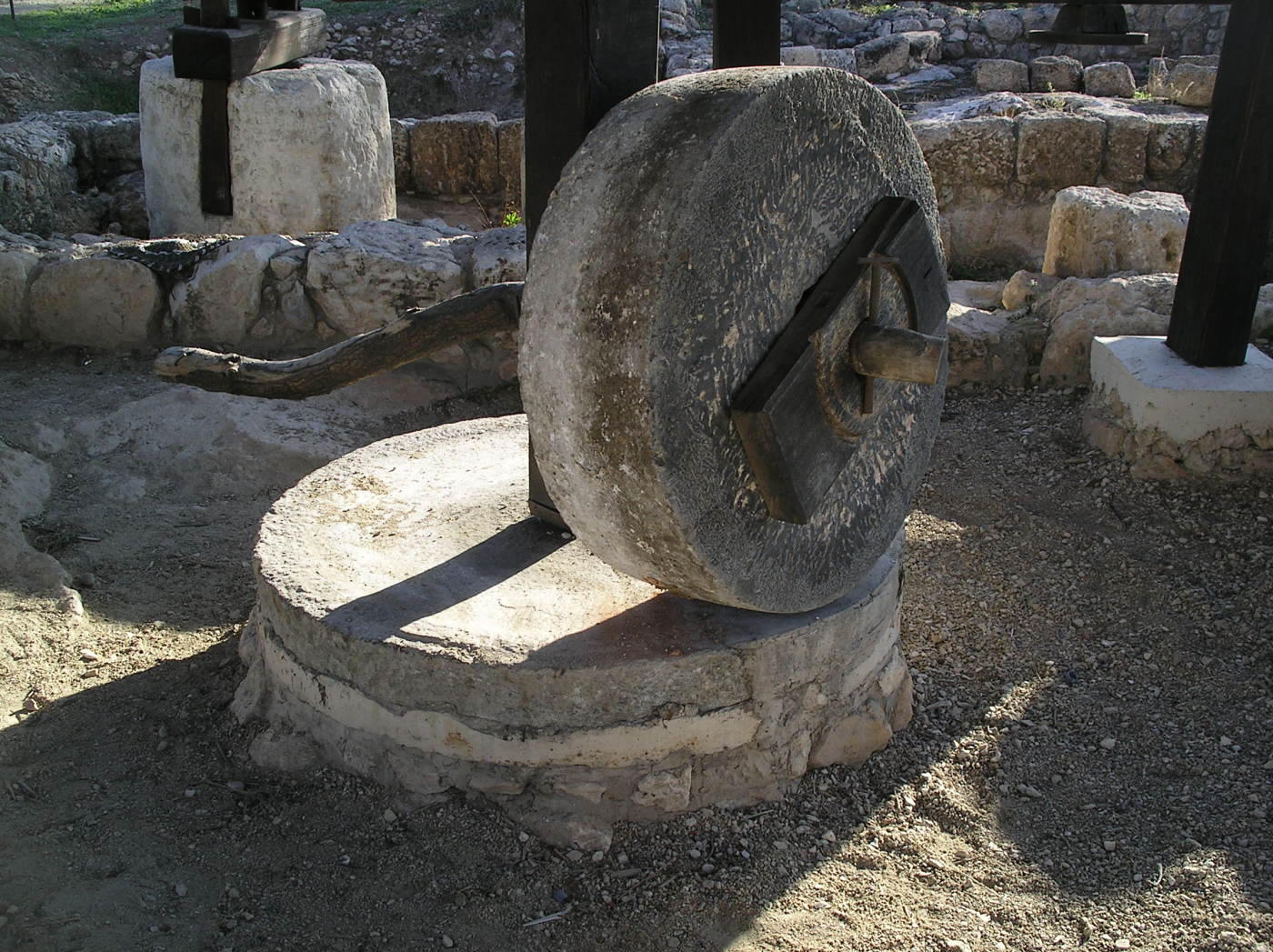
millstone2John is shown yet another mighty angel. Or perhaps it is the same angel he saw before. But this time, the angel took a large stone, similar to a millstone, and threw it into the sea.The imagery of this vision is very similar to a scene from the book of Jeremiah, in which the prophet sent a prince named Seraiah to Babylon with instructions to read the words from a scroll containing all the judgments against Babylon. Then, he was to “tie a stone to it and cast it into the midst of the Euphrates, and say, ‘Thus shall Babylon sink, to rise no more, because of the disaster that I am bringing upon her, and they shall become exhausted’” (Jeremiah 51:63-64 ESV). Jeremiah was pronouncing judgment against Babylon for her role in the fall of Jerusalem and the deportation of her people as captives. Even though Babylon had been used by God to bring about this punishment upon the people of Judah because of their rebellion against Him, the would suffer for the part they played in Judah’s fall. In a similar way, John sees the angel take the large stone and throw it into the sea, and he hears the angel call out, “So will Babylon the great city be thrown down with violence, and will be found no more” (Revelation 18:21 ESV). As the heavy stone disappears into the sea, never to be seen again, so will Babylon disappear off the face of the earth, never to rise again to power or prominence. John’s use of the term, “millstone” to describe the stone he saw the angel hurl into the sea, has important implications. A millstone was a large, round stone that was used to grind grain, nuts and other food elements. Also known as a grinding stone, it provides an apt description for Babylon, because as a nation, they had been grinding other nations under their power, eventually crushing and consuming them. And the Babylon represented in chapters 17 and 18 of Revelation will be the ultimate grinding stone of Satan, used to crush and defeat the people of God and the saints during the days of the tribulation. But God will bring a sudden and abrupt end to Babylon’s world domination and remove its ability to persecute the people of God once and for all time.

And the angel describes the impact of God’s judgment against the city of Babylon. Six different times, the angel is heard to repeat the words, “no more,” expressing the full and irreversible fall of this once-great city. There will be no more music played within its walls. There will be no more craftsmen selling their wares. The sound of wheat being ground at the mill will cease. There will be no one to light a lamp. And there will be no more marriage celebrations taking place. The usual affairs of life will be no more. And it is no coincidence that the words the angel speaks are very similar to those spoken by God to the people of Israel, just before He gave them over to the Babylonians thousands of years earlier.

8 “Therefore thus says the Lord of hosts: Because you have not obeyed my words, 9 behold, I will send for all the tribes of the north, declares the Lord, and for Nebuchadnezzar the king of Babylon, my servant, and I will bring them against this land and its inhabitants, and against all these surrounding nations. I will devote them to destruction, and make them a horror, a hissing, and an everlasting desolation. 10 Moreover, I will banish from them the voice of mirth and the voice of gladness, the voice of the bridegroom and the voice of the bride, the grinding of the millstones and the light of the lamp. 11 This whole land shall become a ruin and a waste, and these nations shall serve the king of Babylon seventy years. – Jeremiah 25:8-11 ESV

God is now going to bring this same degree of destruction on the nation of Babylon, the dominion of the Antichrist and the symbol of mankind’s rebellion against Him. God punished the people of Israel, but eventually restored them to the land. After 70 years in captivity, He faithfully kept His promise to place a remnant of them back in Canaan, allowing them to rebuild the city of Jerusalem and the temple. But there will be no rebuilding or repopulating of Babylon. Its destruction will be final.

The angel provides three reasons for Babylon’s fall. First, it will be because her “merchants were the great ones of the earth” (Revelation 18:23 ESV). There is a sense in which Babylon and the businessmen who grow rich as a result of her power and prominence, will represent the pride of human achievement. The commercial success of this fallen, godless kingdom will be great and its influence will be felt around the globe. The pride and self-sufficiency that this kind of material success breeds, will become infectious, spreading like a cancer throughout the world. Secondly, Babylon will fall because it deceived the nations by means of sorcery. This metaphor is often used to describe the deceptions and seductions of idolatry. The worship of Antichrist will deceive many, leading them to succumb to his power and influence. They will see him as their savior, offering them everything they think they want and need, including joy, security, honor, and meaning in life. Babylon will become the source of all their wants and wishes. But they will be deceived. And finally, God will hold Babylon responsible for “the blood of prophets and of saints, and of all who have been slain on earth” (Revelation 18:24 ESV). This wicked world system, under the control of Antichrist, will be brought to an end because of its undeniable role in the death of God’s people. The Babylon of Revelation 18 clearly represents the city that will be in existence at that time, but it also represents the world system that has stood against God and His people for all time. Even during the days of Jeremiah, God had harsh words to say to the Babylon of his day, regarding their treatment of the people of Israel and His plan to repay them for their actions.

Babylon must fall for the slain of Israel,
    just as for Babylon have fallen the slain of all the earth. – Jeremiah 51:49 ESV

As the book of Revelation moves to its concluding chapters, John is seeing the days of the tribulation coming to a close. The time of the Gentiles is quickly coming to its final end. And this period of time, which has been in place for centuries, has been marked by false religions and a love affair with money and commercial success. Mankind has been deceived and distracted by countless false gods, offering themselves up as alternatives to the one true God. And the materialism and financial success marked by modernity has caused mankind to seek independence from God, thinking that money and the power it buys, can provide us with all we need to enjoy life. But false religions and a faulty dependence upon worldly possessions have never and will never satisfy. They are what the Bible describes as broken cisterns – man-made alternatives to God, which are designed to provide what only God can provide, but fail to do so. Once again, in the book of Jeremiah, we have the words of God spoken against the people of God. He accuses them of abandoning Him and of turning to false and faulty replacements for Him. And that is the primary problem with the age of the Gentiles, represented by the rise of Babylon during the days of the tribulation.

12 Be appalled, O heavens, at this;
    be shocked, be utterly desolate,
declares the Lord,
13 for my people have committed two evils:
they have forsaken me,
    the fountain of living waters,
and hewed out cisterns for themselves,
    broken cisterns that can hold no water. – Jeremiah 2:12-13 ESV

Self-sufficiency, pride and a refusal to place our hope in God. Those are the characteristics of our age and they will only become more pronounced during the dark days of the tribulation. They will come to a head and manifest themselves in the city occupied by Antichrist. But God will bring all of this to an end. He will destroy the false idols and all man-made institutions, set up as alternative sources of joy, happiness, contentment and fulfillment. They will be no more.

English Standard Version (ESV) The Holy Bible, English Standard Version. ESV® Permanent Text Edition® (2016). Copyright © 2001

New Living Translation (NLT) Holy Bible, New Living Translation, copyright © 1996, 2004, 2015 by Tyndale House Foundation. Used by permission of Tyndale House Publishers Inc., Carol Stream, Illinois 60188. All rights reserved.

The Message (MSG)  Copyright © 1993, 1994, 1995, 1996, 2000, 2001, 2002 by Eugene H. Peterson


Take Courage.

21 Since they had been without food for a long time, Paul stood up among them and said, “Men, you should have listened to me and not have set sail from Crete and incurred this injury and loss. 22 Yet now I urge you to take heart, for there will be no loss of life among you, but only of the ship. 23 For this very night there stood before me an angel of the God to whom I belong and whom I worship, 24 and he said, ‘Do not be afraid, Paul; you must stand before Caesar. And behold, God has granted you all those who sail with you.’ 25 So take heart, men, for I have faith in God that it will be exactly as I have been told. 26 But we must run aground on some island.”

27 When the fourteenth night had come, as we were being driven across the Adriatic Sea, about midnight the sailors suspected that they were nearing land. 28 So they took a sounding and found twenty fathoms. A little farther on they took a sounding again and found fifteen fathoms. 29 And fearing that we might run on the rocks, they let down four anchors from the stern and prayed for day to come. 30 And as the sailors were seeking to escape from the ship, and had lowered the ship’s boat into the sea under pretense of laying out anchors from the bow, 31 Paul said to the centurion and the soldiers, “Unless these men stay in the ship, you cannot be saved.” 32 Then the soldiers cut away the ropes of the ship’s boat and let it go.

33 As day was about to dawn, Paul urged them all to take some food, saying, “Today is the fourteenth day that you have continued in suspense and without food, having taken nothing. 34 Therefore I urge you to take some food. For it will give you strength, for not a hair is to perish from the head of any of you.” 35 And when he had said these things, he took bread, and giving thanks to God in the presence of all he broke it and began to eat. 36 Then they all were encouraged and ate some food themselves. 37 (We were in all 276 persons in the ship.) 38 And when they had eaten enough, they lightened the ship, throwing out the wheat into the sea. – Acts 27:21-38 ESV

pauls-journey-to-rome

Earlier in the voyage. Paul had warned the ship’s officers of a bad premonition he had regarding the outcome of their voyage if they proceeded. And Paul had minced no words, saying, “I believe there is trouble ahead if we go on—shipwreck, loss of cargo, and danger to our lives as well” (Acts 27:10 NLT). But the soldier in charge of Paul and the rest of the prisoners on board had listened to the advice of the ship’s captain and crew, who had all agreed to keep sailing, in search of a safer port. Now, they found themselves in a predicament. They had sailed for days in violent seas, their ship battered by the waves and wind. The storm was so intense that it blocked out the sun during the day, thrusting Paul and his 275 shipmates into a perpetual state of darkness. For days on end, the sailors had battled the storm, unable to eat or sleep, and Luke indicates that they finally abandoned all hope. 

But in the heat of the storm, Paul addressed the crew, reminding them that they should have heeded his initial advice. All that he had predicted had come true, and now they were on the brink of disaster. Things were out of their control. They had done all they could do, but the storm had proven too great and their attempts to save themselves, too small. Yet, this wasn’t a case of Paul telling them, “I told you so.” He wasn’t rubbing their noses in their failure to heed his advice. He was letting them know that His God was greater than the storm.

22 “But take courage! None of you will lose your lives, even though the ship will go down. 23 For last night an angel of the God to whom I belong and whom I serve stood beside me, 24 and he said, ‘Don’t be afraid, Paul, for you will surely stand trial before Caesar! What’s more, God in his goodness has granted safety to everyone sailing with you.’ 25 So take courage! For I believe God. It will be just as he said. 26 But we will be shipwrecked on an island.” – Acts 27:22-26 NLT

Right in the middle of what was probably the worst storm any of these sea-hardened sailors had ever experienced, Paul stood up and told them to take courage. He encouraged them not to fear. Can you imagine how ludicrous his words must have sounded to those men? Here was some Jewish prisoner and landlubber, attempting to calm their fears and assure them that none of them would die. All would turn out well. And, even more incredibly, this man was basing his words on a dream he had received from his God.

Paul had faith, and his faith would prove contagious. He had heard from God and he believed what he had been told. So, he told the men, “euthymeō” – take courage. They were to be of good cheer. Now think about what Paul was saying. The storm was still raging. The waves were still crashing against the side of the boat. The rain was still pouring down. The noise must have been deafening. But Paul was telling them to take courage and he clearly stated why they should. “For I believe God. It will be just as he said” (Acts 27:25 NLT). Paul trusted God. Even in the midst of the storm. Nothing had changed. Their circumstances had not improved. Paul was telling them to trust a God they didn’t know and couldn’t see, while everything was crashing down around them. Paul had learned not to focus his attention on immediate circumstances. What was happening around them was not proof of what was going to happen to them. While they had abandoned all hope, they had not been abandoned by God, and Paul told them as much. “God in his goodness has granted safety to everyone sailing with you” (Acts 27:24 NLT).

This story reminds me of a poem written in 1774 by William Cowper.  

God moves in a mysterious way
His wonders to perform;
He plants His footsteps in the sea
And rides upon the storm.

Deep in unfathomable mines
Of never failing skill
He treasures up His bright designs
And works His sov’reign will.

Ye fearful saints, fresh courage take;
The clouds ye so much dread
Are big with mercy and shall break
In blessings on your head.

Judge not the Lord by feeble sense,
But trust Him for His grace;
Behind a frowning providence
He hides a smiling face.

His purposes will ripen fast,
Unfolding every hour;
The bud may have a bitter taste,
But sweet will be the flow’r.

Blind unbelief is sure to err
And scan His work in vain;
God is His own interpreter,
And He will make it plain.

All the sailors could see was the storm raging around them. They were drenched from the incessant rain and weakened from going for days without food. They had lost all hope. They had probably called out to their various gods, begging for salvation. They had thought about their wives and children at home and the likelihood of never seeing them again. They had exhausted all their mental and physical resources trying to save themselves. And now, Paul was telling them that his God had everything under control. They would be safe. There would be a shipwreck, but not a single man would be lost.

As the storm progressed, the sailors determined that their best hope of salvation was to abandon ship. Under the pretext of setting out additional anchors to keep the ship from running aground on the rocks, these men attempted to lower the ship’s skiff or lifeboat. But Paul warned the guards who were watching he and the other prisoners, that if the sailors did not stay on board, everyone would die. So, the soldiers cut the ropes to the lifeboat, allowing it to drift away in the storm. Now, they had to trust God. There were no other options. For the sailors, the lifeboat had become an idol, a false hope of salvation. But Paul knew that it would have failed them. They would not have survived the storm in a boat so small. Their best hope for salvation was to remain in the ship and under the watchful care of God Almighty. But their actions reflect those of every human being who, when caught in the storms of life, attempts to find a way out. They seek a way of salvation and escape. Rather than place their trust in a God they can’t see, they rely on something more tangible in nature. When the Israelites had been set free from slavery in Egypt and found themselves in the wilderness, they began to wonder about this God of Moses. While Moses was up on the mountain talking to God, the people determined to make their own god, an idol made of precious metal. They sought to create a god of their own making, something they could see. Their leader had disappeared. He had gone to the top of the mountain and they had assumed he was not returning. And the God that had rescued them seemed to have bailed on them. So, they took matters into their own hands and fabricated their own source of salvation.

Paul wanted everyone to know that the best course of action was to remain right where they were. They were to stay on the boat, not to abandon ship. What they believed was going to be the source of their death, would actually play a vital role in their salvation. They were going to have to trust Paul, who had placed his trust in God. And Paul was so confident, that he encouraged the men to eat so that they could regain their strength, assuring them, “For not a hair of your heads will perish” (Acts 27:34 NLT). Then, Luke tells us, “everyone was encouraged and began to eat—all 276 of us who were on board” (Acts 27:36-37 NLT). The faith of Paul had infected the entire ship. When everyone else on board had abandoned hope and the sailors had tried to abandon ship, Paul had remained confident in the faithfulness of God. Instead of fear, he had exhibited faith. When everyone else was panicking, he was trusting. While the crew had grown weak and abandoned all hope, Paul had remained strong. He was exhibiting the very characteristics he had encouraged the Corinthians to have. “Be watchful, stand firm in the faith, act like men, be strong” (1 Corinthians 16:13 ESV). And his courage had made an impact on all those around him.


English Standard Version (ESV) The Holy Bible, English Standard Version. ESV® Permanent Text Edition® (2016). Copyright © 2001

New Living Translation (NLT) Holy Bible, New Living Translation, copyright © 1996, 2004, 2015 by Tyndale House Foundation. Used by permission of Tyndale House Publishers Inc., Carol Stream, Illinois 60188. All rights reserved.

The Message (MSG)  Copyright © 1993, 1994, 1995, 1996, 2000, 2001, 2002 by Eugene H. Peterson

Worthless Things.

8 Now at Lystra there was a man sitting who could not use his feet. He was crippled from birth and had never walked. 9 He listened to Paul speaking. And Paul, looking intently at him and seeing that he had faith to be made well, 10 said in a loud voice, “Stand upright on your feet.” And he sprang up and began walking. 11 And when the crowds saw what Paul had done, they lifted up their voices, saying in Lycaonian, “The gods have come down to us in the likeness of men!” 12 Barnabas they called Zeus, and Paul, Hermes, because he was the chief speaker. 13 And the priest of Zeus, whose temple was at the entrance to the city, brought oxen and garlands to the gates and wanted to offer sacrifice with the crowds. 14 But when the apostles Barnabas and Paul heard of it, they tore their garments and rushed out into the crowd, crying out, 15 “Men, why are you doing these things? We also are men, of like nature with you, and we bring you good news, that you should turn from these vain things to a living God, who made the heaven and the earth and the sea and all that is in them. 16 In past generations he allowed all the nations to walk in their own ways. 17 Yet he did not leave himself without witness, for he did good by giving you rains from heaven and fruitful seasons, satisfying your hearts with food and gladness.” 18 Even with these words they scarcely restrained the people from offering sacrifice to them. – Acts 14:8-18 ESV

acts-pauls-first-missionary-journey

After having to leave Iconium due to the Jews stirring up a mob against them, Paul and Barnabas made their way to Lystra, another Roman colony about 20 miles or a day’s journey away. Upon their arrival in Lystra, Paul and Barnabas had another one of those “chance” encounters that were becoming an everyday part of their lives. They were speaking somewhere in Lystra to a crowd that had gathered. There is no mention of them attending the synagogue, as had become their custom. So, it may be that there were not enough Jews in Lystra to warrant a synagogue. But, as usual, Paul and Barnabas had no problem attracting attention to themselves. They simply began to speak to any who would listen. And, in the crowd that day, there happened to be a man who had been lame since birth.
Luke makes note of the fact that the man was listening to what Paul was saying, and that Paul, spotting the man in the crowd, could tell that the man “had faith to be made well” (Acts 14:9 ESV). Luke provides no insight into how Paul knew this. Most likely, Paul was given a kind of spiritual intuition from the Holy Spirit. He was somehow able to see into the man’s heart and perceive in his eyes that this man had faith that God could heal him. He believed. We are not told what Paul said to the crowd, but whatever it was, it produced in this man a believing faith that the God of whom Paul spoke was powerful enough to restore the use of his limbs. Now, it is important that we consider not only why this event was included by Luke, but why this man was in the crowd. By this time in the story, we should be recognizing that nothing that is taking place is happenstance or the result of fate. This man’s presence in the crowd was according to the sovereign will of God. The very fact that Paul made eye-contact with this man was not a byproduct of chance. God had been the one to orchestrate the entire situation. Either God had directed Paul and Barnabas to the very spot where this man was sitting, or this man was able to find help in being carried to where the two men were speaking. God had preordained that this encounter would take place. But why? Because Paul and Barnabas were now entering the frontier, the furthest edges of the world as they knew it. They were in uncharted territory, speaking to people who were primarily Gentiles and who had no knowledge of Jesus at all. They most likely had heard nothing about the events that had taken place in Jerusalem back during the Feast of Pentecost. These two men, Paul and Barnabas, were strangers to them and, their message about Jesus as the Messiah and Savior, would have been alien and foreign to them. So, God arranged for a way to validate the message of His two messengers. They had been given sign gifts, just as Peter and the other apostles had received. These gifts allowed them to perform signs and miracles, providing their message with credibility and their claim to be speaking for God with visible, tangible proof. This man’s presence was going to prove critical. You can almost sense the building sense of anticipation that precede Luke’s description of what happened next. Luke records that Paul, speaking in a very loud voice, cried out, “Stand upright on your feet.” The crowd had no idea what was about to happen, but we do. We have seen this kind of thing happen before. All the way back in chapter three, we have the story of Peter saying to the lame beggar, “In the name of Jesus Christ of Nazareth, rise up and walk!” (Acts 3:6 ESV). And the man did, leaving the crowds looking on in wonder and amazement. That had happened all the way back in Jerusalem. Now, we find Paul and Barnabas hundreds of miles away, ministering in a far-flung Roman colony, filled with pagans who knew nothing of Yahweh, had no idea who Jesus was or any reason to believe that what these two men had to say was true. And that was where the lame man came in.
His healing by God would validate Paul and Barnabas’ claims to be speaking for God. And not only that, it would go a long way in establishing Paul as a co-equal with Peter, the recognized spiritual leader of the church at that time. Paul had been a late-comer to the party. He had not been one of the original 12 disciples, but had come to faith in Jesus long after Jesus’ death, burial and resurrection, having had a one-on-one encounter with the risen Christ along the road to Damascus. For the rest of his life, Paul would battle with those who would try to question the validity of his apostleship. They would continually attempt to paint him as a charlatan, questioning his authority and raising doubts about his teaching. But here on this occasion, God sovereignly revealed Paul’s impeccable credentials as one of His messengers by providing Paul with the very same powers Peter possessed.
And to say that Paul’s actions got the attention of the crowd would be an understatement. Luke writes that the people cried out, “The gods have come down to us in the likeness of men!” (Acts 14:11 ESV). They knew no better than to attribute what they had just seen to the work of gods – the gods with which they were familiar. They called Barnabas, Zeus, and Paul, Hermes. The Greeks had a pantheon of gods they worshiped, so we can only speculate why they happened to choose these two particular gods as being the ones standing before them. But whatever their reasoning, these people were strong enough in their convictions that they were dealing with deities, that the priest of the local temple, dedicated to Zeus, showed up with oxen and garlands to make a sacrifice. We are left to imagine what this seen must have looked like. Try and picture the confusion and chaos going on as these people shouted out their praises to Paul and Barnabas, bowing in reverence before them. And just imagine what was going through the minds of these two men as they found themselves the mistaken, but unmistakable focus of the crowd’s worship.
We do know that Paul and Barnabas were appalled at what they experienced, because Luke tells us they tore their clothes in a outward display of grief and remorse. They wanted no part of what was going on. And Paul spoke up, saying, “Friends, why are you doing this? We are merely human beings—just like you! We have come to bring you the Good News that you should turn from these worthless things and turn to the living God, who made heaven and earth, the sea, and everything in them” (Acts 14:15 NLT). What Paul said here was dangerous and risky. He was blatantly denying any claim to deity. But more than that, he was attacking their worship of false gods. When he mentioned “worthless things”, he was speaking of Zeus and Hermes. He compared them to the living God, the one true Creator of heaven and earth. Paul was treading on very thin ice. He was surrounded by a crowd of very passionate devotees to the Greek gods. They were excited and convinced that their deities had come to visit them. And Paul was not only shattering any notion that Zeus and Hermes had come to earth, he was describing two of their most revered gods as worthless.
And Paul made it perfectly clear that it was Yahweh, the God of the Jews, who was the source of any and all things they enjoyed in life, not the Greek gods. It was He who  provided them with food, crops, rain and joyful hearts. This would have been unexpected and unwanted news to the people of Lystra. It would have been seen as a case of slander and blasphemy, treating their gods with disdain and disrespect. But, surprisingly, instead of infuriating the crowd, the words of Paul and Barnabas seemed to have the opposite effect. The people tried to worship them all the more.
What we seem to have here is a clear example of the spiritual hunger of lost mankind. These people were spiritually starving to death. They had plenty of gods, but no real proof that their gods actually existed. Like all false gods, theirs were distant and disconnected from everyday life. They never really knew if their gods were engaged with or even interested in their daily lives. Which might explain why they were so excited when they thought that Paul and Barnabas were gods come to earth. They greatly desired an intimate relationship with their gods, but to date, their experience had been the same as every other people group who has set its desires and affections on “worthless things.” Years later, Paul would write to believers living in nearby Galatia, reminding them of their former love affair with false gods: “you were slaves to so-called gods that do not even exist” (Galatians 4:8 NLT). The people in the crowd that day had no idea that their gods were false. They were blind to the fact that their gods were helpless and hopeless to assist them, and could do nothing to save or protect them. In fact, the psalmist eloquently and unapologetically described the true nature of false gods when he wrote:

4 Their idols are merely things of silver and gold,
    shaped by human hands.
5 They have mouths but cannot speak,
    and eyes but cannot see.
6 They have ears but cannot hear,
    and noses but cannot smell.
7 They have hands but cannot feel,
    and feet but cannot walk,
    and throats but cannot make a sound.
8 And those who make idols are just like them,
    as are all who trust in them. – Psalm 115:4-8 NLT

Paul and Barnabas had struck a nerve. They had performed a sign among a people who were desperately in search of proof that their religion was relevant and their gods were real. The world, then as now, was cloaked in deep darkness, and filled with spiritually blind people staggering about looking for any glimmer of hope and help. They were deceived. And Paul would later write to the believers in Corinth, clarifying the source of the world’s deception, and the only means of hope.

4 Satan, who is the god of this world, has blinded the minds of those who don’t believe. They are unable to see the glorious light of the Good News. They don’t understand this message about the glory of Christ, who is the exact likeness of God.

5 You see, we don’t go around preaching about ourselves. We preach that Jesus Christ is Lord, and we ourselves are your servants for Jesus’ sake. 6 For God, who said, “Let there be light in the darkness,” has made this light shine in our hearts so we could know the glory of God that is seen in the face of Jesus Christ. – 2 Corinthians 4:4-6 NLT

The light was spreading. But as we will see, the darkness was great. The enemy had blinded the spiritual eyes of those living in Lystra, leaving them in a state of perpetual darkness, desperately longing for relief and redemption, but unable to see the truth when it stood right in front of them.


The Holy Bible, English Standard Version. ESV® Permanent Text Edition® (2016). Copyright © 2001

New Living Translation (NLT)
Holy Bible, New Living Translation, copyright © 1996, 2004, 2015 by Tyndale House Foundation. Used by permission of Tyndale House Publishers Inc., Carol Stream, Illinois 60188. All rights reserved.

The Message (MSG)  Copyright © 1993, 1994, 1995, 1996, 2000, 2001, 2002 by Eugene H. Peterson

Our Incomparable God.

“It is he who made the earth by his power,
    who established the world by his wisdom,
and by his understanding stretched out the heavens.
When he utters his voice there is a tumult of waters in the heavens,
    and he makes the mist rise from the ends of the earth.
He makes lightning for the rain,
    and he brings forth the wind from his storehouses.
Every man is stupid and without knowledge;
    every goldsmith is put to shame by his idols,
for his images are false,
    and there is no breath in them.
They are worthless, a work of delusion;
    at the time of their punishment they shall perish.
Not like these is he who is the portion of Jacob,
    for he is the one who formed all things,
and Israel is the tribe of his inheritance;
    the Lord of hosts is his name.”
–
Jeremiah 51:15-19 ESV

In these verses, the prophet writes what amounts to be a hymn of praise to Yahweh, God Almighty, the Lord of Hosts. In the first few verses, God is referred to in the third person. His name remains unmentioned, but His deeds are outlines in great detail. He made the earth and preserves it through His wisdom. It was God who laid out the heavens and all they contain: The sun, stars, planets, galaxies, asteroids, nebula, black holes, and all that stretches out into the universe for millions of light years. And He created it with understand and gave it a precise order and structure. Nothing is out of place. Nothing is the result of chance or exists without God’s approval and creative power. And Marduk, the creator-god of the Babylonians played no part in any of it, because he is non-existent.

Jeremiah goes on to describe Yahweh as not only the creator, but the instigator and sustainer of all things.

When he speaks in the thunder,
    the heavens roar with rain.
He causes the clouds to rise over the earth.
    He sends the lightning with the rain
    and releases the wind from his storehouses. – Jeremiah 51:16 NLT

God’s voice carries weight. When He speaks, things happen. He declares that it should rain and it does. He calls the clouds to appear and they do so. The wind is at His beck and call. All nature is subservient to His sovereign will. Bel, the Babylonians storm god was not the one responsible for the weather. He was not the source behind the storms that brought wind, rain, thunder and lightning to the earth. It was all the handiwork of God Almighty. And yet, as obvious as all of this may be, the majority of the people who live on this planet are too ignorant to recognize the unmistakable attributes of God in the world around them. And Jeremiah describes mankind in less-than-flattering terms: “The whole human race is foolish and has no knowledge!” (Jeremiah 51:17 NLT). Rather than attribute the mighty works found it nature to Yahweh, they give the credit to lifeless, man-made idols made of wood and stone.

The craftsmen are disgraced by the idols they make,
for their carefully shaped works are a fraud.
    These idols have no breath or power.
Idols are worthless; they are ridiculous lies! – Jeremiah 51:17-18 NLT

How ridiculous it is for someone to make an idol with their own hands and then step back and claim that this block of wood or carved stone is a deity with powers to rescue them from danger, protect them from harm, bless then for their worship, and sustain them throughout life. The prophet Isaiah echoes the sentiments of Jeremiah.

How foolish are those who manufacture idols.
    These prized objects are really worthless.
The people who worship idols don’t know this,
    so they are all put to shame.
Who but a fool would make his own god—
    an idol that cannot help him one bit? – Isaiah 44:9-10 NLT

And he’s not done.

The blacksmith stands at his forge to make a sharp tool,
    pounding and shaping it with all his might.
His work makes him hungry and weak.
    It makes him thirsty and faint.
Then the wood-carver measures a block of wood
    and draws a pattern on it.
He works with chisel and plane
    and carves it into a human figure.
He gives it human beauty
    and puts it in a little shrine.
He cuts down cedars;
    he selects the cypress and the oak;
he plants the pine in the forest
    to be nourished by the rain.
Then he uses part of the wood to make a fire.
    With it he warms himself and bakes his bread.
Then—yes, it’s true—he takes the rest of it
    and makes himself a god to worship! – Isaiah 44:12-15 NLT

It’s so pathetic, it’s sad. How silly it all comes across when you see it written down in black and white. How ludicrous the whole idea appears, and yet, man has made a habit of manufacturing his own gods for generations. The apostle Paul describes it in stark terms: “they worshiped and served the things God created instead of the Creator himself, who is worthy of eternal praise” (Romans 1:25 NLT).

And Isaiah goes on to paint the idiocy of idols in embarrassingly silly terms.

He makes an idol
    and bows down in front of it!
He burns part of the tree to roast his meat
    and to keep himself warm.
    He says, “Ah, that fire feels good.”
Then he takes what’s left
    and makes his god: a carved idol!
He falls down in front of it,
    worshiping and praying to it.
“Rescue me!” he says.
    “You are my god!” – Isaiah 44:15-17 NLT

And Jeremiah provides us with a vivid juxtaposition between these lifeless, helpless idols and the one true God.

But the God of Israel is no idol!
    He is the Creator of everything that exists,
including his people, his own special possession.
    The Lord of Heaven’s Armies is his name! – Jeremiah 51:19 NLT

That statement should bring us joy and create in us a sense of quiet confidence and growing trust. Our God is real. He is not the byproduct of man’s fertile imagination. He is not created. He is the creator! Everything that exists is due to Him. Even the wood that sinful, foolish men use to make false gods. Even the precious metals and stones they use to decorate their lifeless deities. He is unmade, eternal, all-powerful, and in complete control of all things. The Lord of Heaven’s Armies is his name! He is incomparable. He is without peer. And, once again, the prophet Isaiah provides us with God’s declaration of His unmatched, unequaled status as the one and only God of the universe.

“To whom will you compare me?
    Who is my equal?
Some people pour out their silver and gold
    and hire a craftsman to make a god from it.
    Then they bow down and worship it!
They carry it around on their shoulders,
    and when they set it down, it stays there.
    It can’t even move!
And when someone prays to it, there is no answer.
    It can’t rescue anyone from trouble.” – Isaiah 46:5-7 NLT

Idols can’t answer prayers. Idols can’t rescue those in trouble. Idols can’t move from one place to another without human help. Idols can’t do anything. But God can. He is incomparable, totally reliable and completely without equal.


English Standard Version (ESV)
The Holy Bible, English Standard Version. ESV® Permanent Text Edition® (2016). Copyright © 2001 by Crossway Bibles, a publishing ministry of Good News Publishers.

New Living Translation (NLT)
Holy Bible, New Living Translation, copyright © 1996, 2004, 2015 by Tyndale House Foundation. Used by permission of Tyndale House Publishers Inc., Carol Stream, Illinois 60188. All rights reserved.

Copyright © 1993, 1994, 1995, 1996, 2000, 2001, 2002 by Eugene H. Peterson

Emptied From Vessel to Vessel.

“Cursed is he who does the work of the Lord with slackness, and cursed is he who keeps back his sword from bloodshed.

“Moab has been at ease from his youth
    and has settled on his dregs;
he has not been emptied from vessel to vessel,
    nor has he gone into exile;
so his taste remains in him,
    and his scent is not changed.

“Therefore, behold, the days are coming, declares the Lord, when I shall send to him pourers who will pour him, and empty his vessels and break his jars in pieces. Then Moab shall be ashamed of Chemosh, as the house of Israel was ashamed of Bethel, their confidence.

“How do you say, ‘We are heroes
    and mighty men of war’?
The destroyer of Moab and his cities has come up,
    and the choicest of his young men have gone down to slaughter,
    declares the King, whose name is the Lord of hosts.
The calamity of Moab is near at hand,
    and his affliction hastens swiftly.
Grieve for him, all you who are around him,
    and all who know his name;
say, ‘How the mighty scepter is broken,
    the glorious staff.’

“Come down from your glory,
    and sit on the parched ground,
    O inhabitant of Dibon!
For the destroyer of Moab has come up against you;
    he has destroyed your strongholds.
Stand by the way and watch,
    O inhabitant of Aroer!
Ask him who flees and her who escapes;
    say, ‘What has happened?’
Moab is put to shame, for it is broken;
    wail and cry!
Tell it beside the Arnon,
    that Moab is laid waste.” – Jeremiah 48:10-20 ESV

The heading of this particular blog post comes from a line found within God’s expanded oracle against Moab.

“Moab has been at ease from his youth
    and has settled on his dregs;
he has not been emptied from vessel to vessel…” – Jeremiah 48:11 ESV

This somewhat obscure lines is a reference to the very common practice in that day of pouring wine from one container into another in order to remove the sediments. The object was to allow the wine to sit undisturbed for a period of time, causing the sediment to settle to the bottom of the vessel. Then the contents were carefully poured into yet another vessel, allowing the impurities and dregs to remain behind. All the effort was expended in order to arrive at a sediment-free product. That is the image that God uses to describe Moab, a city known for its wine production. The wine has been allowed to settle, but there has been no one to disturb the vessel and pour its contents. In other words, God had allowed Moab to remain trouble-free for a prolonged period of time. Their geographic location had kept them off the radar screen of the various nations that had invaded Canaan over the centuries. The city of Moab was like a young child who had gotten away with all kinds of chicanery, receiving no punishment or discipline for any of the evil things they had done. But all that was about to change. The judgment of God was going to catch up with them.

Their days of complacency and casual comfort were going to come to a screeching halt.

“But the time is coming soon,” says the Lord,
    “when I will send men to pour him from his jar.
They will pour him out,
    then shatter the jar!” – Jeremiah 48:12 NLT

The jar was going to be smashed, contents and all. Over the centuries, the people of Moab had grown comfortable and complacent, trusting in their false god, Chemosh. They had been no reason to doubt that their god was all-powerful and had done a great job of protecting them from their enemies. But God had bad news for them.

“At last Moab will be ashamed of his idol Chemosh,
    as the people of Israel were ashamed of their gold calf at Bethel.” – Jeremiah 48:13 NLT

Here, God refers to an event from Israel’s history. After King Solomon had proven to be unfaithful to God, the nation of Israel was split in two, with the northern tribes forming the nation of Israel, and two of the southern tribes forming the nation of Judah. King Jeroboam, who had been the newly appointed king of Israel, out of fear that the people of Israel would want to return to Jerusalem in order to worship Yahweh at the temple, decided to make his own gods, build his own shrines, and appoint his own priests.

So on the advice of his counselors, the king made two gold calves. He said to the people, “It is too much trouble for you to worship in Jerusalem. Look, Israel, these are the gods who brought you out of Egypt!”

He placed these calf idols in Bethel and in Dan—at either end of his kingdom. But this became a great sin, for the people worshiped the idols, traveling as far north as Dan to worship the one there. – 1 Kings 12:28-30 NLT

That shrine would remain in place for generations, until King Josiah of Judah, during many of his ongoing reforms, had it destroyed.

The king also tore down the altar at Bethel—the pagan shrine that Jeroboam son of Nebat had made when he caused Israel to sin. He burned down the shrine and ground it to dust… – 2 Kings 23:15 NLT

But from the time of Jeroboam until Josiah, the people of Israel had worshiped the golden calves that Jeroboam had erected there. And it had taken the intervention of God to bring this idolatrous practice to a close. Now, He was going to do the same thing to the god of the Moabites. They were going to learn that their much-beloved god was not match for Yahweh, the God of Israel. Chemosh would be hauled off as just another piece of booty by the Babylonian troops.

And not only would the Moabites be ashamed by the ineptitude of their god, they would find out that their once mighty army was also no match for the judgment of God.

“You used to boast, ‘We are heroes,
    mighty men of war.’
But now Moab and his towns will be destroyed.
    His most promising youth are doomed to slaughter,” – Jeremiah 48:14-15 NLT

The cities of Moab would fall. The god of Moab would be taken as property. The mighty men of Moab would be scattered and slaughtered. And the allies of Moab would be left to cry over the fate of their former neighbor. And God sarcastically taunts the people of Dibon as well, telling them:

“Come down from your glory
    and sit in the dust, you people of Dibon,
for those who destroy Moab will shatter Dibon, too.” – Jeremiah 48:18 NLT

They would be humbled and humiliated by God. Every city in Moab and all the surrounding regions would feel the full force of God’s wrath and judgment. And the devastation would be so comprehensive and complete that it would leave everyone simply asking, “What has happened there?” It will be beyond belief, like nothing anyone could have ever imagined. But God will provide the answer to the question:

“Moab lies in ruins, disgraced;
    weep and wail!
Tell it by the banks of the Arnon River:
    Moab has been destroyed!” – Jeremiah 48:20 NLT

Moab would be emptied of people, possessions and pride. Like wine poured out and its vessel smashed, Moab would find the hand of the Lord heavy and their treatment by Him devastatingly complete. God would hold nothing back. His justice and judgment would be fully meted out and no one, including the might warriors of Moab or their almighty god, Chemosh would stand in His way.

English Standard Version (ESV)
The Holy Bible, English Standard Version. ESV® Permanent Text Edition® (2016). Copyright © 2001 by Crossway Bibles, a publishing ministry of Good News Publishers.

New Living Translation (NLT)
Holy Bible, New Living Translation, copyright © 1996, 2004, 2015 by Tyndale House Foundation. Used by permission of Tyndale House Publishers Inc., Carol Stream, Illinois 60188. All rights reserved.

Copyright © 1993, 1994, 1995, 1996, 2000, 2001, 2002 by Eugene H. Peterson

Justice and Mercy.

“And to the house of the king of Judah say, ‘Hear the word of the Lord, O house of David! Thus says the Lord:

“‘Execute justice in the morning,
    and deliver from the hand of the oppressor
    him who has been robbed,
lest my wrath go forth like fire,
    and burn with none to quench it,
    because of your evil deeds.’”

“Behold, I am against you, O inhabitant of the valley,
    O rock of the plain,
declares the Lord;
you who say, ‘Who shall come down against us,
    or who shall enter our habitations?’
I will punish you according to the fruit of your deeds,
declares the Lord;
    I will kindle a fire in her forest,
    and it shall devour all that is around her.” – Jeremiah 21:11-14 ESV

God gave Jeremiah a message to deliver to the king of Judah. Actually, it was addressed to the house of David, signifying that this was intended for any and all kings who sat on the throne of David. They were to be men who administered justice, just as God does. They were to operate on His behalf, dispensing justice and mercy to the people of God. They were to care for the oppressed and needy, to protect the innocent and punish the wicked. God had ordained them to stand in His place, holding positions of power and authority, but doing so in righteousness and holiness. These men, like David, Solomon, Josiah, and Zedekiah, were to have been icons of virtue. They occupied their places of authority because God had made it possible. But they were to have represented His desires and mirrored His character.

As for the Rock, his work is perfect,
for all his ways are just.
He is a reliable God who is never unjust,
he is fair and upright. – Deuteronomy 32:4 NLT

The King in his might loves justice.
    You have established equity;
you have executed justice
    and righteousness in Jacob.
Exalt the Lord our God;
    worship at his footstool!
    Holy is he! – Psalm 99:4-5 ESV

Blessed is he whose help is the God of Jacob,
    whose hope is in the Lord his God,
who made heaven and earth,
    the sea, and all that is in them,
who keeps faith forever;
    who executes justice for the oppressed,
    who gives food to the hungry.

The Lord sets the prisoners free;
   the Lord opens the eyes of the blind.
The Lord lifts up those who are bowed down;
    the Lord loves the righteous.
The Lord watches over the sojourners;
    he upholds the widow and the fatherless,
    but the way of the wicked he brings to ruin. – Psalm 146:5-9 ESV

But the kings of Judah were not the only ones whom God expected to dispense justice. Through the prophet Micah, He had given the people of God a clear indication of His expectation of them.

“With what shall I come before the Lord,
and bow myself before God on high?
Shall I come before him with burnt offerings,
with calves a year old?
Will the Lord be pleased with thousands of rams,
with ten thousands of rivers of oil?
Shall I give my firstborn for my transgression,
the fruit of my body for the sin of my soul?”
He has told you, O man, what is good;
and what does the Lord require of you
but to do justice, and to love kindness,
and to walk humbly with your God?” – Micah 6:6-8 ESV

For God, the sacrifices and offerings they made to Him meant nothing if those who made them did not do justice, love kindness and walk in humility before Him. Going through the motions of offering sacrifices to God were meaningless if your daily actions did not reflect a love for Him as evidenced by your love for His people. The apostle John is quite blunt about those who claim to love God but fail to love others. “If someone says, ‘I love God,’ but hates a Christian brother or sister, that person is a liar; for if we don’t love people we can see, how can we love God, whom we cannot see?” (1 John 4:20 NLT). And in His Sermon on the Mount, Jesus gave a similar admonition. “So if you are presenting a sacrifice at the altar in the Temple and you suddenly remember that someone has something against you, leave your sacrifice there at the altar. Go and be reconciled to that person. Then come and offer your sacrifice to God” (Matthew 5:23-24 NLT).

What good did it do to offer sacrifices to God if you were living out of step with His will? God wanted to see a change in their behavior. He wanted more than just ritualistic obedience. He wanted to see behavior in keeping with their faith. And when His people showed justice and mercy to one another, they were living as He would have them live. They were acting as His children, giving outward evidence of their relationship with Him as His sons and daughters.

But the kings of Judah had failed to obey God’s command. They had not dispensed justice. They had not cared for the oppressed. And their disobedience had been infectious, spreading throughout the nation and creating an epidemic of injustice among the people. So, God warned them, “my anger will burn like an unquenchable fire because of all your sins” (Jeremiah 21:12 NLT). The pride and arrogance of the people had become unbearable and God could no longer allow it to increase. They had become cocky, believing that their great walled city, occupying a prominent place on Mount Zion, was impenetrable and unconquerable. They believed they were divinely protected from defeat because they were God’s people living in the city that bore God’s name and held God’s temple. “No one can touch us here. No one can break in here” (Jeremiah 21:13 NLT).

But God had news for them. He said, “I myself will punish you for your sinfulness” (Jeremiah 21:14 NLT). He would personally oversee their destruction. And while idolatry and immorality would be major contributing factors to their demise, it was really a case of their injustice and refusal to care for the poor and needy that sealed their fate. They had become an overly religious people, but lacked a tangible expression of having been changed by their religion. They worshiped all kinds of gods, but failed to love their fellow men. Their lives did not reflect the character of God. They didn’t love like He loved. They failed to show mercy as He did. They refused to dispense justice to the poor, needy and oppressed. And their failure to do so led to their ultimate destruction by God.

It was the great king David who wrote:

“With the merciful you show yourself merciful;
with the blameless man you show yourself blameless;
with the purified you deal purely,
and with the crooked you make yourself seem tortuous.
You save a humble people,
but your eyes are on the haughty to bring them down.” – 2 Samuel 22:26-28 ESV

God expects His people to emulate His ways. They are to express His character and reflect His heart in the way they live their lives. As His children, we are His representative on this earth, modeling and exhibiting His love, grace, mercy and justice to all those around us. We are to love others as we have been loved. We are to show mercy to others as He has shown mercy to us. We are to love justice as He does. Because we are His children.

English Standard Version (ESV)
The Holy Bible, English Standard Version. ESV® Permanent Text Edition® (2016). Copyright © 2001 by Crossway Bibles, a publishing ministry of Good News Publishers.

New Living Translation (NLT)
Holy Bible, New Living Translation, copyright © 1996, 2004, 2015 by Tyndale House Foundation. Used by permission of Tyndale House Publishers Inc., Carol Stream, Illinois 60188. All rights reserved.

The Message (MSG)Copyright © 1993, 1994, 1995, 1996, 2000, 2001, 2002 by Eugene H. Peterson