The Truth About Falsehood

I robbed other churches by accepting support from them in order to serve you. And when I was with you and was in need, I did not burden anyone, for the brothers who came from Macedonia supplied my need. So I refrained and will refrain from burdening you in any way. 10 As the truth of Christ is in me, this boasting of mine will not be silenced in the regions of Achaia. 11 And why? Because I do not love you? God knows I do!

12 And what I am doing I will continue to do, in order to undermine the claim of those who would like to claim that in their boasted mission they work on the same terms as we do. 13 For such men are false apostles, deceitful workmen, disguising themselves as apostles of Christ. 14 And no wonder, for even Satan disguises himself as an angel of light. 15 So it is no surprise if his servants, also, disguise themselves as servants of righteousness. Their end will correspond to their deeds. – 2 Corinthians 11:8-15 ESV

In his first letter to the Corinthians, Paul had been forced to argue in defense of his apostleship. He had once again found himself under attack by individuals who questioned the validity of his claim to be an apostle of Jesus, and he strongly defended himself.

Am I not an apostle? Have I not seen Jesus our Lord? Are not you my workmanship in the Lord? If to others I am not an apostle, at least I am to you, for you are the seal of my apostleship in the Lord. – 1 Corinthians 9:1-2 ESV

The believers in Corinth were all the evidence he needed to prove he had been sent by the Lord. He was an authentic messenger of Jesus Christ, and yet, while living among the Corinthians, Paul chose not to exercise the rights of an apostle. He reminded them, “the Lord commanded that those who proclaim the gospel should get their living by the gospel” (1 Corinthians 9:14 ESV). However, he had not asked them to fund his stay or help him in any way financially. But he insisted on his right to do so. 

This is my answer to those who question my authority. Don’t we have the right to live in your homes and share your meals? Don’t we have the right to bring a believing wife with us as the other apostles and the Lord’s brothers do, and as Peter does? Or is it only Barnabas and I who have to work to support ourselves?

What soldier has to pay his own expenses? What farmer plants a vineyard and doesn’t have the right to eat some of its fruit? What shepherd cares for a flock of sheep and isn’t allowed to drink some of the milk? – 1 Corinthians 9:3-7 NLT

In the book of Acts, Luke records how Paul sustained himself while living in Corinth.

Then Paul left Athens and went to Corinth. There he became acquainted with a Jew named Aquila, born in Pontus, who had recently arrived from Italy with his wife, Priscilla. They had left Italy when Claudius Caesar deported all Jews from Rome. Paul lived and worked with them, for they were tentmakers just as he was. – Acts 18:1-3 NLT

Paul had paid his own way and had been aided by others who willingly chose to fund his work in Corinth. He had not burdened the Corinthians by asking them to provide for any of his ministry among them. Which is what led Paul to make the following dramatic claim:

I “robbed” other churches by accepting their contributions so I could serve you at no cost. And when I was with you and didn’t have enough to live on, I did not become a financial burden to anyone. For the brothers who came from Macedonia brought me all that I needed. I have never been a burden to you, and I never will be. – 2 Corinthians 11:8-9 NLT

Paul’s claim to have “robbed” the other churches by taking their aid was based on his not having ministered to them in return. He took their money but used it to fund his ministry elsewhere, something they perfectly understood and approved. But it obviously bothered Paul. He felt an obligation to return their generosity by ministering to them as well. However, he was grateful that their gift had allowed him to stop working and concentrate all his efforts on sharing the gospel while in Corinth.

It seems that Paul’s critics were accusing him of duplicity. He had at one time refused to accept support, but then had accepted the gift from the Macedonians. They saw this as a sign of Paul’s hypocrisy. And yet, these false teachers had evidently been accepting support for themselves.

Paul was not going to apologize for his actions. In fact, he said, “what I am doing I will continue to do, in order to undermine the claim of those who would like to claim that in their boasted mission they work on the same terms as we do” (2 Corinthians 11:12 ESV). He would not stoop to their level, and he would not allow them to compare themselves to him. He had already accused them of preaching a different gospel and a different Jesus. So, Paul pulled no punches, accusing these men of being “false apostles, deceitful workmen, disguising themselves as apostles of Christ” (2 Corinthians 11:13 ESV).

Paul had taken the gloves off, claiming these men to be in league with Satan himself. This was not a gentlemanly debate, but all-out war. Paul was not just defending his ministry, but the integrity of the gospel itself. And like a shepherd, he was protecting his flock by fending off the attacks of dangerous predators. What made these men particularly deadly was that they were like sheep in wolves’ clothing. They were cunningly deceptive and had won the confidence of the Corinthians by appearing as something other than what they really were. Jesus had warned about these kinds of men.

Beware of false prophets who come disguised as harmless sheep but are really vicious wolves. You can identify them by their fruit, that is, by the way they act. Can you pick grapes from thornbushes, or figs from thistles? A good tree produces good fruit, and a bad tree produces bad fruit. A good tree can’t produce bad fruit, and a bad tree can’t produce good fruit. So every tree that does not produce good fruit is chopped down and thrown into the fire. Yes, just as you can identify a tree by its fruit, so you can identify people by their actions. – Matthew 7:15-20 NLT

These men had disguised themselves as “servants of righteousness,” but they intended to harm God’s people. Their messages sounded safe and in line with what Paul had taught, but there were dangerously subtle differences based on a carefully crafted mixture of truth and falsehood. They were teaching Jesus, but it was a slightly variant version. They were teaching grace alone, but with a dose of good deeds mixed in.

There will always be those who infiltrate the church, disguising themselves as servants of righteousness, but who are actually servants of Satan. Their words are deceptive, and their outward appearance is convincing, but their fruit is deadly. The book of Jude describes them in stark, but realistic terms.

…they are like dangerous reefs that can shipwreck you. They are like shameless shepherds who care only for themselves. They are like clouds blowing over the land without giving any rain. They are like trees in autumn that are doubly dead, for they bear no fruit and have been pulled up by the roots. They are like wild waves of the sea, churning up the foam of their shameful deeds. They are like wandering stars, doomed forever to blackest darkness. – Jude 1:12-13 NLT

Be on the alert for them and don’t be deceived by their subtle lies masquerading as truth. Have nothing to do with them because their deeds are deadly.

Father, our enemy is dangerous because he operates as an “angel of light,” disguising and delivering his message in subtle ways that make it difficult to discern where the lie stops and the truth begins. As he did with Eve in the garden, he always mixes just enough truth with his falsehoods to make it sound palatable and acceptable. Yet, he remains the father of lies and the great deceiver. However, You have given us Your Word and the indwelling Holy Spirit to make sure we can recognize the real thing from the counterfeit. But it is easy to get lulled into a sense of overconfidence and complacency and forget that our enemy “prowls around like a roaring lion, looking for someone to devour ” (1 Peter 5:8 NLT). Keep us on the alert and ever vigilant so that we are never caught by surprise. Help us to stand strong against him and firm in our faith because, as John wrote, “greater is He who is in you than he who is in the world” (1 John 4:4 BSB).
 Amen

English Standard Version (ESV) The Holy Bible, English Standard Version. ESV® Permanent Text Edition® (2016). Copyright © 2001 by Crossway Bibles, a publishing ministry of Good News Publishers.

New Living Translation (NLT) Holy Bible, New Living Translation, copyright © 1996, 2004, 2015 by Tyndale House Foundation. Used by permission of Tyndale House Publishers Inc., Carol Stream, Illinois 60188. All rights reserved.
Failure to Feed the Flock of God

15 And when he had come to the king, the king said to him, “Micaiah, shall we go to Ramoth-gilead to battle, or shall we refrain?” And he answered him, “Go up and triumph; the LORD will give it into the hand of the king.” 16 But the king said to him, “How many times shall I make you swear that you speak to me nothing but the truth in the name of the LORD?” 17 And he said, “I saw all Israel scattered on the mountains, as sheep that have no shepherd. And the LORD said, ‘These have no master; let each return to his home in peace.’” 18 And the king of Israel said to Jehoshaphat, “Did I not tell you that he would not prophesy good concerning me, but evil?” 19 And Micaiah said, “Therefore hear the word of the LORD: I saw the LORD sitting on his throne, and all the host of heaven standing beside him on his right hand and on his left; 20 and the LORD said, ‘Who will entice Ahab, that he may go up and fall at Ramoth-gilead?’ And one said one thing, and another said another. 21 Then a spirit came forward and stood before the LORD, saying, ‘I will entice him.’ 22 And the LORD said to him, ‘By what means?’ And he said, ‘I will go out, and will be a lying spirit in the mouth of all his prophets.’ And he said, ‘You are to entice him, and you shall succeed; go out and do so.’ 23 Now therefore behold, the LORD has put a lying spirit in the mouth of all these your prophets; the LORD has declared disaster for you.”

24 Then Zedekiah the son of Chenaanah came near and struck Micaiah on the cheek and said, “How did the Spirit of the LORD go from me to speak to you?” 25 And Micaiah said, “Behold, you shall see on that day when you go into an inner chamber to hide yourself.” 26 And the king of Israel said, “Seize Micaiah, and take him back to Amon the governor of the city and to Joash the king’s son, 27 and say, ‘Thus says the king, “Put this fellow in prison and feed him meager rations of bread and water, until I come in peace.”’” 28 And Micaiah said, “If you return in peace, the LORD has not spoken by me.” And he said, “Hear, all you peoples!” 1 Kings 22:15-28 ESV

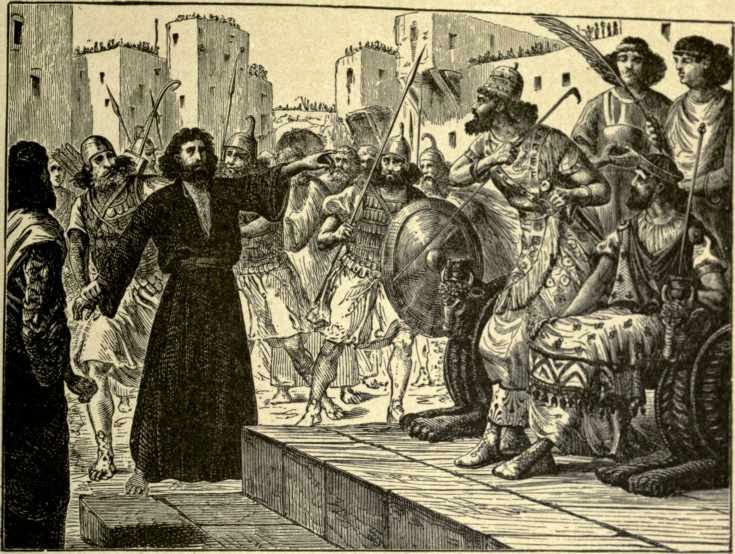
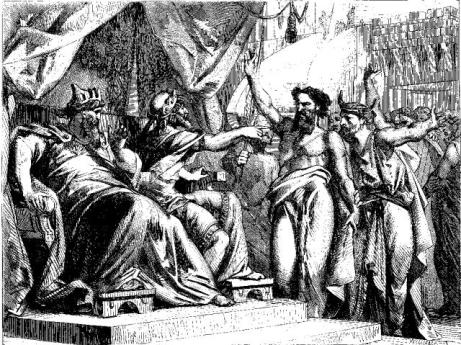
Imagine the scene. Micaiah, the prophet, has been forcibly dragged before King Ahab, who is seated on the dais with his guest, King Jehoshaphat of Judah. Surrounding the two potentates are 400 prophets of Baal, each taking turns declaring their version of the truth. For hours, they have been telling King Ahab exactly what he wants to hear: “Go up to Ramoth-gilead and triumph; the LORD will give it into the hand of the king” (1 Kings 22:12 ESV). One of them, a man named Zedekiah, had even crafted a pair of iron horns and used them as a prop to support his message to the king: “Thus says the LORD, ‘With these you shall push the Syrians until they are destroyed’” (1 Kings 22:11 ESV).

Then Micaiah shows up. Unlike the 400 yes-men who have been masquerading as spokesmen for the false god, Baal, Micaiah was a prophet of Yahweh. As such, he was obligated to speak only those words given to him by God. Which is precisely what Micaiah told the man who had come to fetch him.

As the LORD lives, what the LORD says to me, that I will speak.” – 1 Kings 22:14 ESV

Yet, when King Ahab asked Micaiah to reveal what his God thought about the planned attack of Ramoth-gilead, Micaiah simply repeated the words of the false prophets. He basically told the king, “Go for it!” But Ahab sensed the thinly veiled sarcasm behind Micaiah’s answer and demanded that he tell him the truth. Ahab knew from past experience that Micaiah and his God would oppose his plans. He had even revealed to King Jehoshaphat just how much he loathed Micaiah, telling him, “He never prophesies anything but trouble for me!” (1 Kings 22:8 NLT).

Micaiah knew that it really didn’t matter what he told Ahab, because the king would do as he wanted. Ahab’s stubbornness and arrogance would prevent him from hearing and heeding the message of Yahweh. But Micaiah shared it anyway.

“In a vision I saw all Israel scattered on the mountains, like sheep without a shepherd. And the LORD said, ‘Their master has been killed. Send them home in peace.’” – 1 Kings 22:17 NLT

Ahab was infuriated because Micaiah had just predicted Israel’s defeat and the king’s own death. But this less-than-encouraging message was just what Ahab had expected from the prophet of Yahweh. Just like Elijah, Micaiah proved to be a messenger of doom and gloom, bent on delivering nothing but bad news concerning Ahab’s kingly aspirations.

But Micaiah was not done. He next revealed how God had chosen to implement His plan for Ahab’s demise.

“Listen to what the LORD says! I saw the LORD sitting on his throne with all the armies of heaven around him, on his right and on his left. And the LORD said, ‘Who can entice Ahab to go into battle against Ramoth-gilead so he can be killed?’

“There were many suggestions, and finally a spirit approached the LORD and said, ‘I can do it!’

“‘How will you do this?’ the LORD asked.

“And the spirit replied, ‘I will go out and inspire all of Ahab’s prophets to speak lies.’

“‘You will succeed,’ said the LORD. ‘Go ahead and do it.’” – 1 Kings 22:19-22 NLT

Micaiah was given a vision of a conversation that took place in the throne room of God Almighty. In the vision, Yahweh is portrayed as a king surrounded by his advisors and his army. He is soliciting input from the heavenly host, asking for their counsel on the best way to get Ahab to proceed with his attack on Ramoth-gilead, which will result in his death. A spirit speaks up and offers to deceive the prophets of Baal by giving them a false message of victory. God approves the plan and sends the spirit on its way. Then Micaiah informs Ahab that this is precisely what has happened.

“So you see, the LORD has put a lying spirit in the mouths of all your prophets. For the LORD has pronounced your doom.” – 1 Kings 22:23 NLT

Amazingly, Micaiah tells Ahab the stark reality of all that had just transpired. The 400 prophets had unwittingly declared a lie, enticing Ahab to proceed with his plan to attack Ramoth-gilead and, inadvertently, bringing about his own demise. The identity of this “lying spirit” is unclear. Some view this as an angelic being who visited the king’s prophets and gave them a false message to deliver to the king. Others have determined this to have been a demonic spirit or Satan himself. But the text only indicates that this spirit was authorized by Yahweh to deceive the pseudo-prophets with a false message that would entice Ahab to attack Ramoth-gilead. Their answer, influenced by the spirit sent by Yahweh, was consistent and convincing.

“Yes, go right ahead! The LORD will give the king victory.” – 1 Kings 22:6 NLT 

Yet, even when Micaiah disclosed the truth to Ahab, the king stubbornly refused to give up his plan. He ordered Micaiah’s arrest and imprisonment and commanded that he be given nothing but bread and water until he had returned safely from his battle for Ramoth-gilead. But before being hauled off to prison, Micaiah made one final pronouncement to the king and all those who stood within earshot.

“If you return safely, it will mean that the LORD has not spoken through me!” Then he added to those standing around, “Everyone mark my words!” – 1 Kings 22:28 NLT

The problem with Ahab was not just his stubbornness and idolatry; it was his refusal to shepherd the people of Israel. All his self-centered acts of self-promotion had done irreparable damage to the nation of Israel. He had led the people into apostasy and idolatry, and, as a king over God’s chosen people, he would be held responsible for his failure to care for Yahweh’s flock. Hundreds of years later, the prophet Ezekiel would declare a foreboding message from God concerning all those kings who, like Ahab, had left the people of God like sheep without a shepherd.

Then this message came to me from the LORD: “Son of man, prophesy against the shepherds, the leaders of Israel. Give them this message from the Sovereign LORD: What sorrow awaits you shepherds who feed yourselves instead of your flocks. Shouldn’t shepherds feed their sheep? You drink the milk, wear the wool, and butcher the best animals, but you let your flocks starve. You have not taken care of the weak. You have not tended the sick or bound up the injured. You have not gone looking for those who have wandered away and are lost. Instead, you have ruled them with harshness and cruelty. So my sheep have been scattered without a shepherd, and they are easy prey for any wild animal. They have wandered through all the mountains and all the hills, across the face of the earth, yet no one has gone to search for them.” – Ezekiel 34:1-6 NLT

This motif of shepherdless sheep dates back to the time of Moses. When the great deliverer of Israel was nearing the end of his life, he appealed to God, asking Him to provide the people of Israel with a new shepherd.

Then Moses said to the LORD, “O LORD, you are the God who gives breath to all creatures. Please appoint a new man as leader for the community. Give them someone who will guide them wherever they go and will lead them into battle, so the community of the LORD will not be like sheep without a shepherd.” – Numbers 27:15-17 NLT

Centuries later, long after Ahab had died, Jesus appeared on the scene, offering His own assessment of the spiritual state of the people of Israel.

Jesus traveled through all the towns and villages of that area, teaching in the synagogues and announcing the Good News about the Kingdom. And he healed every kind of disease and illness. When he saw the crowds, he had compassion on them because they were confused and helpless, like sheep without a shepherd. – Matthew 9:35-36 NLT

The Good Shepherd couldn’t help but look at His own people and see them as shepherdless sheep, wandering about confused and helpless. For centuries, they had been misled and mistreated. Their political and spiritual leaders had used and abused them. Those who should have been feeding and caring for them had ended up taking advantage of them, following the example of Ahab. But Jesus arrived on the scene as the Son of David, emulating the example of the man after God’s own heart. Jesus was the quintessential shepherd, the Good Shepherd, who would lay down His life for the sheep. Jesus would shepherd the flock of God with care and compassion, just as His forefather did.

He [Gpd] chose David his servant
    and took him from the sheepfolds;
from following the nursing ewes he brought him
    to shepherd Jacob his people,
    Israel his inheritance.
With upright heart he shepherded them
    and guided them with his skillful hand. – Psalm 78:70-72 ESV

At the end of the day, Ahab’s most significant problem was that he was a lousy shepherd. His chief sin was that he had failed to care for God’s flock and had made his own needs a higher priority than the needs of the people. Like most of the kings of Israel and Judah, Ahab had abused his divinely ordained power and position, and he would have to answer to the Great Shepherd of Israel. But despite Ahab’s egocentric ambitions and his physical and spiritual mistreatment of those whom God had placed under his care, Yahweh would personally ensure that His chosen people received the care and compassion He had promised them.

He will feed his flock like a shepherd. He will carry the lambs in his arms, holding them close to his heart. He will gently lead the mother sheep with their young. – Isaiah 40:11 NLT

English Standard Version (ESV) The Holy Bible, English Standard Version. ESV® Permanent Text Edition® (2016). Copyright © 2001 by Crossway Bibles, a publishing ministry of Good News Publishers.

New Living Translation (NLT) Holy Bible, New Living Translation, copyright © 1996, 2004, 2015 by Tyndale House Foundation. Used by permission of Tyndale House Publishers Inc., Carol Stream, Illinois 60188. All rights reserved.

Be Wise As Serpents and Innocent As Doves

16 “Behold, I am sending you out as sheep in the midst of wolves, so be wise as serpents and innocent as doves. 17 Beware of men, for they will deliver you over to courts and flog you in their synagogues, 18 and you will be dragged before governors and kings for my sake, to bear witness before them and the Gentiles. 19 When they deliver you over, do not be anxious how you are to speak or what you are to say, for what you are to say will be given to you in that hour. 20 For it is not you who speak, but the Spirit of your Father speaking through you. 21 Brother will deliver brother over to death, and the father his child, and children will rise against parents and have them put to death, 22 and you will be hated by all for my name’s sake. But the one who endures to the end will be saved. 23 When they persecute you in one town, flee to the next, for truly, I say to you, you will not have gone through all the towns of Israel before the Son of Man comes.” Matthew 10:16-23 ESV

Try to put yourself in the sandals of the disciples. It was still early in their relationship with Jesus, and He had just told them that He was going to send them out on their own with the responsibility of sharing the news of His Kingdom with their fellow Jews. Not only that, He has informed them that they will be able to perform the same incredible miracles He has done. All of this must have sounded strange but also a bit exciting. They were being commissioned by the Messiah and given a level of responsibility that must have seemed way above their pay grade. After all, they were simple fishermen, laborers, and tax collectors. Yet, Jesus had chosen to send them, and this assignment must have left them with a sense of pride. However, Jesus was about to tap the brakes on their enthusiasm.

He could probably tell from the looks in their eyes that they were thrilled with the prospect of being able to perform miracles. They couldn’t hide their excitement at being able to pronounce blessings and curses on those to whom they spoke. That kind of power and authority would make anyone’s head swim. So, He threw a bit of cold water on their enthusiasm by telling them, “I am sending you out as sheep in the midst of wolves” (Matthew 10:16 ESV). He had just described the people of Israel as “lost sheep” (Matthew 10:6). Now, He compares the disciples to sheep, a reference they would have well understood. Sheep are innocent and highly vulnerable animals. They are virtually defenseless, lacking the capacity to protect themselves from harm. Which made Jesus’ next warning even more distressing. These men would be as vulnerable as innocent, unprotected sheep grazing among wolves. – not exactly an encouraging picture. Then He followed this up with a warning that borrows from two other creatures of the animal kingdom. 

“…be wise as serpents and innocent as doves.” – Matthew 10:16 ESV

The Greek word translated as “wise” implies prudence or shrewdness. This kind of street savvy would allow them to survive in a very difficult environment. The phrase, “Be wise as serpents,” was likely a common proverbial statement familiar to the disciples that needed no explanation. They understood that snakes avoided danger at all costs. They were well-adapted creatures adept at concealment and the avoidance of confrontation. But to prevent them from becoming jaded and ruthless in their behavior, Jesus warned them to maintain a sense of innocence. They were not to mimic the defensive posture of a cornered snake, lashing out at those who threatened or opposed them. They were also to avoid the temptation of mirroring the behavior of wolves. Jesus didn’t want His disciples to become predatory or ruthless in the face of cancer. Rather, they were to be aware of the enemy’s wiles without emulating his ways.

Earlier, Jesus warned His disciples about false prophets “who come disguised as harmless sheep but are really vicious wolves” (Matthew 7:15 NLT). This thinly veiled reference to the religious leaders of the day was intended to expose their hypocrisy and duplicity. Jesus said, “You can identify them by their fruit, that is, by the way they act” (Matthew 7:16 NLT). The disciples would need shrewdness to discern the actions of the Jewish religious leaders who would oppose them in their efforts to share the good news.

The prophet Ezekiel recorded God’s indictment of such men.

“What sorrow awaits you shepherds who feed yourselves instead of your flocks. Shouldn’t shepherds feed their sheep? You drink the milk, wear the wool, and butcher the best animals, but you let your flocks starve. You have not taken care of the weak. You have not tended the sick or bound up the injured. You have not gone looking for those who have wandered away and are lost. Instead, you have ruled them with harshness and cruelty. So my sheep have been scattered without a shepherd, and they are easy prey for any wild animal. They have wandered through all the mountains and all the hills, across the face of the earth, yet no one has gone to search for them.” – Ezekiel 34:2-6 NLT

The disciples were called to minister in that environment. What they didn’t realize at the time was that Jesus was preparing them for the days after His death, resurrection, and ascension. He knew that when He returned to His Father’s side in heaven, the focus of the religious leaders’ wrath would fall on His disciples. But even when confronted by the hatred of the Pharisees, the disciples were to remain innocent as doves. This was a call to remain pure and guileless in the face of persecution. Jesus talked about this very thing in His Sermon on the Mount.

“Blessed are you when others revile you and persecute you and utter all kinds of evil against you falsely on my account. Rejoice and be glad, for your reward is great in heaven, for so they persecuted the prophets who were before you. – Matthew 5;11-12 ESV

Jesus’ command to be innocent as doves was not a call to gullibility or weakness. It was a reminder that purity and holiness must mark the life of a true disciple. That is why Jesus told them to love their enemies and to pray for those who persecute them. Vengeance and retribution have no place in the life of a Christ follower. Innocence is also not a call to ignorance. He wanted His disciples to be fully informed of the dangers they faced. That’s why He refused to withhold the sinister nature of their future ministry.

Beware of men, for they will deliver you over to courts and flog you in their synagogues, and you will be dragged before governors and kings for my sake, to bear witness before them and the Gentiles. – Matthew 10:17-18 ESV

What the disciples didn’t know was that Jesus was talking about the future. He was addressing events that would take place after His death, resurrection and ascension. At this point in their relationship with Jesus, they had no way of knowing that His earthly ministry would end in His violent death by crucifixion. He had yet to break that news to them. They were oblivious to the fact that, upon His return to heaven, they would find themselves serving as His ambassadors and earthly representatives, tasked with the responsibility of taking the good news of His sacrificial death on the cross to the world. They would be His witnesses “in Jerusalem and in all Judea and Samaria, and to the end of the earth” (Acts 1:8 ESV). And they would find themselves facing stiff resistance in the form of persecution and even death.

This disconcerting news must have left the disciples slack-jawed and dumbfounded. All this talk of courts, floggings, and death must have left them shaking their heads in confusion. Their eager enthusiasm would have turned to abject fear and revulsion at the thought of enduring such things. But Jesus gave them some good news, informing them that the Spirit of God would be with them, so they had no reason to be anxious. The Holy Spirit would give them the words they needed to defend themselves when standing before the courts. And even if their own families turned against them and they found themselves facing the hatred of those who once claimed to love them, they could rest in knowing that God would be with them. They would be saved. This doesn’t mean they would escape death, but that they would ultimately be delivered to eternal life.

None of this would have sounded like good news to the disciples. They must have been staring at one another in disbelief and confusion, trying to comprehend all that Jesus told them. It’s important to remember that they believed Jesus to be the Messiah, but their understanding was that He had come to set up His Kingdom on earth NOW. They were looking for a new day to dawn for the people of Israel. They had joined up with Jesus because they thought He would restore Israel to its place of power and prominence, and they hoped to get in on the ground floor of His new administration.

But now, Jesus had clouded their vision of the future. In essence, Jesus was revealing that God’s agenda was far different than their own. There was a divine plan in place that would include not only Jesus’ first coming, but a second one that would finalize God’s plan for the redemption of mankind and the recreation of the world. But in the meantime, some important events would have to take place, including Jesus’ death on the cross, His return to heaven, the Rapture of the church, and His Second Coming at the end of the Tribulation.

The disciples lived with a here-and-now mentality that focused all their attention on the time in which they lived. They weren’t thinking about the distant future and were unconcerned about things that might happen after they were gone. But Jesus was trying to expand their understanding and open their eyes to the reality that His mission was far greater than they imagined. The redemptive plan of God went beyond the physical restoration of the nation of Israel as a political force on earth.

The Son of Man had come, but He would have to come again. And it would be at His second coming that Jesus would accomplish many of the things the disciples were expecting. They would be long gone by that time, but they were the first of many who would spread the good news about Jesus to the world. They would start with the Jews, but after Jesus’ death, they would be told to take the gospel to the nations. After the disciples were gone, the offer of salvation through Christ would be carried around the world by future disciples who would face persecution, rejection, and even death. But one day Jesus will return to complete the mission He has been given by God.

In the meantime, we are called to be like our Teacher. We are to serve as He served, love as He loved, share as He shared. As a result, we will suffer as He has suffered. We will be falsely accused and maligned just as He was. But we have the knowledge and reassurance that one day He is coming back. We also rest in the fact that our destiny is secure and our eternal state guaranteed by His death and resurrection. We have nothing to fear and everything to look forward to. In the meantime, we must be wise as serpents and gentle as doves.

English Standard Version (ESV)
The Holy Bible, English Standard Version. ESV® Permanent Text Edition® (2016). Copyright © 2001 by Crossway Bibles, a publishing ministry of Good News Publishers.

New Living Translation (NLT)
Holy Bible, New Living Translation, copyright © 1996, 2004, 2015 by Tyndale House Foundation. Used by permission of Tyndale House Publishers Inc., Carol Stream, Illinois 60188. All rights reserved.

Applying Divine Doctrine Without Divine Authorization

20 “Because he knew no contentment in his belly,
    he will not let anything in which he delights escape him.
21 There was nothing left after he had eaten;
    therefore his prosperity will not endure.
22 In the fullness of his sufficiency he will be in distress;
    the hand of everyone in misery will come against him.
23 To fill his belly to the full,
    God will send his burning anger against him
    and rain it upon him into his body.
24 He will flee from an iron weapon;
    a bronze arrow will strike him through.
25 It is drawn forth and comes out of his body;
    the glittering point comes out of his gallbladder;
    terrors come upon him.
26 Utter darkness is laid up for his treasures;
    a fire not fanned will devour him;
    what is left in his tent will be consumed.
27 The heavens will reveal his iniquity,
    and the earth will rise up against him.
28 The possessions of his house will be carried away,
    dragged off in the day of God’s wrath.
29 This is the wicked man’s portion from God,
    the heritage decreed for him by God.” – Job 20:20-29 ESV

The longer Zophar talks, the darker his rhetoric becomes. He is on a roll and believes he has Job on the ropes. According to Zophar, not only is Job wicked and ungodly, but he is greedy and a glutton whose voracious appetite for evil will destroy him. It is somewhat shocking to remember that this man was supposed to be Job’s friend and had shown up in Uz with the intent of providing comfort and support. But when Job refused to accept the dark and condemning assessment of his situation from his three “comforters,” they turned on him. His defiant resistance to their calls for confession and repentance was met with resentment and incredulity. Zophar and his companions couldn’t believe their ears. How could this miserable wretch of a man dare to contradict their words of wisdom?

In his frustration with Job, Zophar resorts to blame and belittlement. He compares Job to a self-indulgent glutton who can’t control his appetite and ends up eating himself out of house and home.

“Nothing is left after they finish gorging themselves.
    Therefore, their prosperity will not endure.” – Job 20:21 NLT

To Zophar, Job is nothing more than a money-hungry, thrill-seeking, materialistic, and hedonistic fool who has reaped the results of his out-of-control lifestyle. His assessment of Job sounds similar to Paul’s description of the “enemies of the cross” who had infiltrated the church in Philippi.

They are headed for destruction. Their god is their appetite, they brag about shameful things, and they think only about this life here on earth. – Philippians 3:19 NLT

But the problem with Zophar’s less-than-flattering assessment of Job is that it directly contradicts what God had to say about His faithful servant.

“Have you noticed my servant Job? He is the finest man in all the earth. He is blameless—a man of complete integrity. He fears God and stays away from evil.” – Job 1:8 NLT

It seems obvious that Zophar had not sought or received insight from God on Job’s situation. He was simply making judgments based on external circumstances and his personal opinion. He is right in stressing God’s hatred for sin and the inevitable judgment that awaits those who refuse to repent. But his quick-to-judge mentality had placed him in a precarious position, where he found himself falsely accusing the Lord’s anointed and spouting accusations and opinions that were anything but godly.

But in his over-confident zeal, Zophar charged full steam ahead, barraging his poor victim with further insults disguised as insights. He even resorts to praying for Job’s eventual destruction by God.

“May God give them a bellyful of trouble.
    May God rain down his anger upon them.” – Job 20:23 NLT

Of course, he’s kind enough not to address Job by name but his intentions are clear, and the not-so-subtle message didn’t escape Job. It would have been difficult to miss what Zophar was inferring by his graphic depiction of an arrow piercing human flesh and dripping with blood.

“When they try to escape an iron weapon,
    a bronze-tipped arrow will pierce them.
The arrow is pulled from their back,
    and the arrowhead glistens with blood.” – Job 20:24-25 NLT

According to Zophar, the archer is God and the victim is Job. God, the righteous warrior, has rained down his anger on the wicked and well-deserving Job. There was nowhere Job could run from God’s wrath. He could continue to deny his guilt but God would eventually expose him for what he really was: a guilty and unrepentant sinner.

But again, Zophar is attempting to apply truth based on false assumptions. While much of what he says is accurate, he has mistakenly misapplied the doctrine concerning God’s judgment. There is nothing wrong with his portrayal of God as a vengeful judge who metes out wrath on the wicked. The Scriptures fully support Zophar’s understanding of divine judgment upon those who perpetrate evil.

For the wicked will be destroyed,
    but those who trust in the Lord will possess the land.

Soon the wicked will disappear.
    Though you look for them, they will be gone. – Psalm 37:9-10 NLT

The wicked plot against the godly;
    they snarl at them in defiance.
But the Lord just laughs,
    for he sees their day of judgment coming. – Psalm 37:12-13 NLT

Though the wicked sprout like weeds
    and evildoers flourish,
    they will be destroyed forever. – Psalm 92:7 NLT

The problem was how Zophar had assumed the worst when it came to Job’s predicament. He wrongly assessed Job’s fall as evidence of wickedness and proof of God’s displeasure. From what he could gather, Job had screwed up and God had rained down His righteous anger in just retribution.

But he was wrong.

Zophar didn’t have all the facts, so he ended up making wrong assumptions and drawing faulty conclusions. He spoke with self-assumed certainty and an over-confident assurance in his own assessment of the facts.

But he was wrong; categorically and catastrophically wrong.

Yet, he got one thing right. He boldly claimed, “The heavens will reveal their guilt, and the earth will testify against them” (Job 20:27 NLT). That one statement drips with truth and reflects the reality that only God knows the hearts of men and only He is authorized to stand in judgment as to their guilt or innocence.

The one thing Zophar, Bildad, and Eliphaz got consistently right was their call to repentance. All men are required to come to God, confessing their sins and repenting of their open rebellion against His righteous rule and reign. But where these three men got off the rails was in their assumption of Job’s wickedness and their assertion that all of Job’s pain and suffering was the handiwork of God.

“Was Zophar correct in his assessment of the wicked person’s fate? He was correct in saying that God judges sin, but he was wrong in claiming that God’s judgment always takes place during our earthly lifetime. He was also inaccurate in saying that Job was the type of person he described.” – Dr. Thomas L. Constable, Notes on Job

Zophar was right when he stated, “This is the reward that God gives the wicked. It is the inheritance decreed by God” (Job 20:29 NLT), but he was wrong in applying it to Job. The doctrines of God are righteous, just, and true, but they must be wielded carefully and judiciously. They should never be used as hammers to beat down the defenseless or to win a war of words with an opponent.

Paul told his young protégé, Timothy, “Be a good worker, one who does not need to be ashamed and who correctly explains the word of truth. Avoid worthless, foolish talk that only leads to more godless behavior” (2 Timothy 2:15-16 NLT). Knowing doctrine is not enough; you also have to know when and how to apply it. Paul also told Timothy that an overseer or leader in the church “must be able to teach” (1 Timothy 3:2 NLT). That phrase carries the idea that a godly leader must be equipped “to teach God’s Word with skill.”

Verses quoted out of context, doctrines used as weapons, and godly truths misappropriated and misapplied are all to be avoided like the plague. Zophar was a veritable fountain of doctrine but he had used it to deluge Job and leave him drowning in despair. If only Zophar had understood that God’s Word, rightly divided, was fully capable of exposing and excising sin. It alone can reveal the condition of the heart and bring about either conviction or comfort. As the author of Hebrews so eloquently put it, “…the word of God is alive and powerful. It is sharper than the sharpest two-edged sword, cutting between soul and spirit, between joint and marrow. It exposes our innermost thoughts and desires” (Hebrews 4:12 NLT).

But before you dare to speak on behalf of God, it pays to have heard from God. These men had chosen to address Job’s circumstances as self-appointed spokesmen for God. but they had failed to seek the will of God. Their arrogant appropriation of divine doctrine without divine authorization placed them in dangerous company. Without knowing it, they had become false prophets guilty of propagating false messages from God, and this is not something God takes lightly.

“I have not sent these prophets,
    yet they run around claiming to speak for me.
I have given them no message,
    yet they go on prophesying.
If they had stood before me and listened to me,
    they would have spoken my words,
and they would have turned my people
    from their evil ways and deeds. – Jeremiah 23:21-22 NLT

English Standard Version (ESV) The Holy Bible, English Standard Version. ESV® Permanent Text Edition® (2016). Copyright © 2001

New Living Translation (NLT) Holy Bible, New Living Translation, copyright © 1996, 2004, 2015 by Tyndale House Foundation. Used by permission of Tyndale House Publishers Inc., Carol Stream, Illinois 60188. All rights reserved.

A False Bill of Sales

17 “And you, son of man, set your face against the daughters of your people, who prophesy out of their own hearts. Prophesy against them 18 and say, Thus says the Lord God: Woe to the women who sew magic bands upon all wrists, and make veils for the heads of persons of every stature, in the hunt for souls! Will you hunt down souls belonging to my people and keep your own souls alive? 19 You have profaned me among my people for handfuls of barley and for pieces of bread, putting to death souls who should not die and keeping alive souls who should not live, by your lying to my people, who listen to lies.

20 “Therefore thus says the Lord God: Behold, I am against your magic bands with which you hunt the souls like birds, and I will tear them from your arms, and I will let the souls whom you hunt go free, the souls like birds. 21 Your veils also I will tear off and deliver my people out of your hand, and they shall be no more in your hand as prey, and you shall know that I am the Lord. 22 Because you have disheartened the righteous falsely, although I have not grieved him, and you have encouraged the wicked, that he should not turn from his evil way to save his life, 23 therefore you shall no more see false visions nor practice divination. I will deliver my people out of your hand. And you shall know that I am the Lord.”  Ezekiel 13:17-23 ESV

Contrary to popular opinion the prophet fraternity was not a male-only club. While men were the primary members of this elite group of divinely commissioned messengers, the Old Testament does indicate that women also served as prophets. In Exodus 15:20, Miriam, the sister of Moses and Aaron, is listed as a prophetess. According to Judges 4:4, Deborah was a prophetess who also served as a judge over Israel. In 2 Kings 22:14, Hilkiah the priest, and a number of royal officials in King Josiah’s court, consulted the prophetess Huldah, who gave them a message from the Lord. Finally, Nehemiah 6:14 provides the name of Noadiah the prophetess. Each of these women was recognized as an official spokesperson for God and treated with the same respect and honor as their male counterparts, but it would appear that the number of female prophets was relatively small.

Yet, while they may have represented a tiny segment of the overall population, this didn’t stop them from populating the ranks of the false prophets who were leading the people of Judah astray. For those living in Judah during Ezekiel’s day, the presence of a female prophet would not have been unexpected. But God found these women to be unacceptable and intolerable because what they were doing was deceptive and deadly. So, He gave Ezekiel a message aimed directly at them.

“…son of man, speak out against the women who prophesy from their own imaginations…” – Ezekiel 13:17 NLT

God makes it clear that they were not acting on His behalf. Their words were their own and had not come from the Lord. And He exposes their so-called prophecies as a form of witchcraft or sorcery.

What sorrow awaits you women who are ensnaring the souls of my people, young and old alike. You tie magic charms on their wrists and furnish them with magic veils.” – Ezekiel 13:18 NLT

God accuses these women of hunting the souls of His people. It’s unclear just exactly what this phrase means or what role the “magic” wristbands and veils played in their actions, but it would seem to involve some sort of occult practices. Whether they were using these magical items to bring others under their control or in an attempt to cast spells is uncertain.

But what is clear is that these women were offering their services in exchange for payment. They were making a profit from prophesying.

“You have profaned me among my people for handfuls of barley and for pieces of bread, putting to death souls who should not die and keeping alive souls who should not live, by your lying to my people, who listen to lies.” – Ezekiel 13:19 ESV

It may be that these women were promoting their magical trinkets as talismans that could ward off evil or protect their wearer from harm. Perhaps they were marketing their products as a way to escape the coming judgment of God. In doing so, they were offering people the false hope of salvation. Rather than repent of their sins, their customers could simply rely on the prophylactic effects of their magic wristband or veil.

Whatever it was that they were doing was leading the people of Judah astray. Instead of listening to the warnings of Ezekiel, the true prophet of God, the people were buying into the lies of these women. They were selling hope in the form of magic. They were assuring their customers that they were safe from harm and free from worry. But in doing so, they were condemning these people to certain death and destruction. No piece of cloth was going to stay God’s hand, and no magic spell was going to protect anyone from His wrath.

So, God declares that He will expose their true identity as charlatans. He will rip the wristbands and veils off the arms and heads of His people, setting them free from their captivity to these false forms of hope.

“I will tear them from your arms, setting my people free like birds set free from a cage. I will tear off the magic veils and save my people from your grasp. They will no longer be your victims. Then you will know that I am the Lord.” – Ezekiel 13:20-21 NLT

The actions of these women had changed nothing about God’s plans for Judah and Jerusalem. The Babylonians were still going to destroy the city and take captive thousands of its inhabitants. The temple would be destroyed. Many would die of starvation during the siege. Others would fall by the sword when the Babylonians entered the city.

These self-proclaimed prophetesses were guilty of false advertising. They were telling their customers that they were safe and secure. And they were assuring all those who refused to buy their products that they were condemned to certain death. But God assures Ezekiel that these women had no power and their products offered no lasting benefits. The only thing these women had managed to accomplish was to lead the people astray. Their efforts had produced discouragement and disillusionment among the godly because they refused to buy their products. And those who purchased their magic clothing lived under a false delusion of invincibility, inducing them to continue their sinful lifestyles unabated and unafraid.

“You have discouraged the righteous with your lies, but I didn’t want them to be sad. And you have encouraged the wicked by promising them life, even though they continue in their sins.” – Ezekiel 13:22 NLT

Whatever these women were doing had left God extremely displeased. He had seen enough and was going to deal with their behavior once and for all.

“Because of all this, you will no longer talk of seeing visions that you never saw, nor will you make predictions. For I will rescue my people from your grasp. Then you will know that I am the Lord.” – Ezekiel 13:23 NLT

When God states that they will no longer talk of seeing visions they never saw, He is predicting their deaths. He would no longer tolerate their aberrant behavior. The problem inherent with all false prophets is the fact that their prophecies are untrue and, therefore, unreliable. They talk a good game and promote a product with a long list of attractive benefits, but they can’t ever produce what they promise. Their ad copy doesn’t ever add up. Their sales pitch never quite delivers. Because they don’t speak on behalf of God. Like all the other false prophets, they are selling lies. They offer peace instead of warning about God’s punishment. They promise deliverance from His discipline. They encourage a false sense of hope when God is demanding true repentance and a spirit of humility among His people.

It didn’t matter whether the false prophets were male or female. They all faced the same stinging indictment from God because they were all guilty of the same thing.

“They have done nothing to repair the breaks in the walls around the nation. They have not helped it to stand firm in battle on the day of the Lord.” – Ezekiel 13:5 NLT

They had failed to do the job of a prophet. Rather than call the people to repentance, they had encouraged further rebellion. Instead of standing on the walls and warning the people of coming judgment, they had promoted the status quo. Judgment was coming and they did everything in their power to refute it and convince the people to ignore it. But in the end, they would know that Yahweh was Lord.

English Standard Version (ESV) The Holy Bible, English Standard Version. ESV® Permanent Text Edition® (2016). Copyright © 2001

New Living Translation (NLT) Holy Bible, New Living Translation, copyright © 1996, 2004, 2015 by Tyndale House Foundation. Used by permission of Tyndale House Publishers Inc., Carol Stream, Illinois 60188. All rights reserved.

The Fallacy of False Hope

1 The word of the Lord came to me: “Son of man, prophesy against the prophets of Israel, who are prophesying, and say to those who prophesy from their own hearts: ‘Hear the word of the Lord!’ Thus says the Lord God, Woe to the foolish prophets who follow their own spirit, and have seen nothing! Your prophets have been like jackals among ruins, O Israel. You have not gone up into the breaches, or built up a wall for the house of Israel, that it might stand in battle in the day of the Lord. They have seen false visions and lying divinations. They say, ‘Declares the Lord,’ when the Lord has not sent them, and yet they expect him to fulfill their word. Have you not seen a false vision and uttered a lying divination, whenever you have said, ‘Declares the Lord,’ although I have not spoken?”

Therefore thus says the Lord God: “Because you have uttered falsehood and seen lying visions, therefore behold, I am against you, declares the Lord God. My hand will be against the prophets who see false visions and who give lying divinations. They shall not be in the council of my people, nor be enrolled in the register of the house of Israel, nor shall they enter the land of Israel. And you shall know that I am the Lord God. 10 Precisely because they have misled my people, saying, ‘Peace,’ when there is no peace, and because, when the people build a wall, these prophets smear it with whitewash, 11 say to those who smear it with whitewash that it shall fall! There will be a deluge of rain, and you, O great hailstones, will fall, and a stormy wind break out. 12 And when the wall falls, will it not be said to you, ‘Where is the coating with which you smeared it?’ 13 Therefore thus says the Lord God: I will make a stormy wind break out in my wrath, and there shall be a deluge of rain in my anger, and great hailstones in wrath to make a full end. 14 And I will break down the wall that you have smeared with whitewash, and bring it down to the ground, so that its foundation will be laid bare. When it falls, you shall perish in the midst of it, and you shall know that I am the Lord. 15 Thus will I spend my wrath upon the wall and upon those who have smeared it with whitewash, and I will say to you, The wall is no more, nor those who smeared it, 16 the prophets of Israel who prophesied concerning Jerusalem and saw visions of peace for her, when there was no peace, declares the Lord God. Ezekiel 13:1-16 ESV

The citizens of Judah wrongly assumed that nothing bad was going to happen to their great city of Jerusalem. After all, as far as they could tell, none of God’s prophecies had come to fruition, so they had nothing to worry about. He had warned of destruction but the walls still stood and the temple was fully intact. And, even if God’s judgments were to come, the common opinion was that they would happen any time soon. Any destruction that God might bring upon Judah and its capital city was reserved for some future generation. As far as they could tell, there were safe and sound.

But where did the people get their over-confident and somewhat complacent view of God’s judgment? How did they come up with these faulty conclusions concerning the prophecies that God had pronounced? Well, God provides the answers to those questions by calling out the men who were responsible for the nation’s continued disobedience.

“Son of man, prophesy against the false prophets of Israel who are inventing their own prophecies. – Ezekiel 13:2 NLT

God accused these self-proclaimed prophets of “following their own imaginations” (Ezekiel 13:3 NLT) but claimed to be speaking on behalf of God. Yet, God had neither commissioned them nor given them any message to deliver. They were freelancers, operating in the name of God but without His permission or blessing. And the messages they were sharing were doing far more damage than good.

“They have done nothing to repair the breaks in the walls around the nation. They have not helped it to stand firm in battle on the day of the Lord. Instead, they have told lies and made false predictions.” – Ezekiel 13:5-6 NLT

Judah was in trouble. They were about to experience the righteous wrath of God because of the centuries-worth of rebellion and apostasy that characterized them as a nation. They had a track record of disobedience and had displayed a stubborn resistance to the calls of God’s prophets that they repent and return to Him in humility and brokenness.

And one of the key factors behind their long history of disobedience was the presence of false prophets, and this was not a new problem. For as long as God had been appointing men to speak on His behalf, there had been another group of individuals who claimed membership in that elite group. But they were charlatans and pretenders. God had neither sent them nor spoken to them. And yet…

“They say, ‘This message is from the Lord,’ even though the Lord never sent them. And yet they expect him to fulfill their prophecies! Can your visions be anything but false if you claim, ‘This message is from the Lord,’ when I have not even spoken to you?” – Ezekiel 13:6-7 NLT

What made these men so popular with the people was that their messages were more palatable and acceptable than the ones given by God’s true prophets. While men like Ezekiel were declaring the pending judgment of God, these individuals were promoting a contrary narrative that provided the people with false hope. In a sense, they were telling the people what they wanted to hear. “Everything’s going to be okay,” they claimed. “You’ve got nothing to worry about,” they confidently boasted. And, the citizens of Judah must have found these claims to be like music to their ears when compared with Ezekiel’s messages of doom and gloom.

The apostle Paul warned his young protégé, Timothy, that people will always have a partiality for those who tell them what they want to hear.

For a time is coming when people will no longer listen to sound and wholesome teaching. They will follow their own desires and will look for teachers who will tell them whatever their itching ears want to hear. They will reject the truth and chase after myths. – 2 Timothy 4:3-4 NLT

While Ezekiel was busy telling the people the truth of God – there were plenty of false prophets happy to provide the people with reassuring words and comforting, yet contradictory messages of hope. These men blatantly repudiated Ezekiel’s prophecies, declaring them to be nothing but lies but God had a different opinion.

“They were lying prophets who claimed peace would come to Jerusalem when there was no peace.” – Ezekiel 13:16 NLT

They were deceiving the people by promoting a false sense of calm and assurance when calamity was right around the corner. They were putting words in God’s mouth when they hadn’t heard from God at all. Rather than call the people to repentance, they promoted a lifestyle of continuing decadence, immorality, and idolatry.

But God’s indictment of them was severe. He was no longer going to tolerate their deceitful masquerade as His messengers. These self-proclaimed prophets of God were going to find themselves on the receiving end of God’s wrath.

“Because what you say is false and your visions are a lie, I will stand against you, says the Sovereign Lord. I will raise my fist against all the prophets who see false visions and make lying predictions, and they will be banished from the community of Israel. I will blot their names from Israel’s record books, and they will never again set foot in their own land.” – Ezekiel 13:9-10 NLT

They would pay dearly for their penchant for popularity and fame. While the people loved to listen to what they had to say, God had heard enough. Their false claims of peace and safety were highly appealing and caused the people to reject Ezekiel’s less-attractive message of pending judgment.

The people had manufactured unstable walls of security based on wishful thinking, and these pseudo-prophets had validated those false hopes with pleasant-sounding words of affirmation. They concealed the lies with white-washed words of false assurance, like pouring white paint on a poorly constructed wall, in the hopes that it would appear more stable and secure. But in the end, they would find their wall of lies destroyed and their 15 minutes of fame brought to an ignominious end.

“At last my anger against the wall and those who covered it with whitewash will be satisfied. Then I will say to you: ‘The wall and those who whitewashed it are both gone.’” – Ezekiel 13:15 NLT

God’s Word can be difficult to understand and even harder to obey. It’s not always easy to comprehend how a loving God can come across as demanding and judgmental. We struggle to deal with the stories in the Old Testament that seem to reveal a God who is quick to anger and not afraid to destroy those who don’t measure up to His high standards. Concepts like hell and judgment seem uncharacteristically unloving and therefore, unacceptable to us. So we try to come up with ways to reject or replace them.

We create our own versions of God’s message. We dumb it down, soften it up, make it more palatable, and in the end, spread a false message that is easy on the ears, but destructive to the soul.

Yes, God is love. But His love does not diminish His holiness. He cannot overlook sin or leave it unpunished. That is why He sent His Son to offer His life as payment for the sins of mankind. But if men ignore God’s call to righteousness and reject the reality of His coming judgment on all mankind, they will miss out on His offer of salvation through faith in Christ. Men who see no need for salvation because there is no judgment will see no need for a savior.

In Ezekiel’s day, there were plenty of false prophets proclaiming that “all is peaceful.” Today, there are those who prefer to claim that “God is love,” while ignoring the truth of His holiness and His hatred for sin. May we never stop speaking the truth of God so that others might receive the grace of God through the free gift of salvation provided by the Son of God.

English Standard Version (ESV) The Holy Bible, English Standard Version. ESV® Permanent Text Edition® (2016). Copyright © 2001

New Living Translation (NLT) Holy Bible, New Living Translation, copyright © 1996, 2004, 2015 by Tyndale House Foundation. Used by permission of Tyndale House Publishers Inc., Carol Stream, Illinois 60188. All rights reserved.

An Ever-Present Danger

1 But false prophets also arose among the people, just as there will be false teachers among you, who will secretly bring in destructive heresies, even denying the Master who bought them, bringing upon themselves swift destruction. And many will follow their sensuality, and because of them the way of truth will be blasphemed. And in their greed they will exploit you with false words. Their condemnation from long ago is not idle, and their destruction is not asleep. 2 Peter 2:1-3 ESV

Peter has just stressed the superiority of the Old Testament prophets and the God-ordained nature of their messages.

…no prophecy of Scripture comes from someone’s own interpretation. For no prophecy was ever produced by the will of man, but men spoke from God as they were carried along by the Holy Spirit. – 2 Peter 1:20-21 ESV

And Peter has confirmed that he and his fellow apostles had seen the validity of their words confirmed in the life of Jesus. In fact, Peter and his companions had received a personal lesson on Messianic prophecies from the lips of Jesus Himself. In one of His many post-resurrection appearances, Jesus surprised His followers by showing up unexpectedly in the room where they had gathered behind locked doors.

Then he said, “When I was with you before, I told you that everything written about me in the law of Moses and the prophets and in the Psalms must be fulfilled.” Then he opened their minds to understand the Scriptures. And he said, “Yes, it was written long ago that the Messiah would suffer and die and rise from the dead on the third day. It was also written that this message would be proclaimed in the authority of his name to all the nations, beginning in Jerusalem: ‘There is forgiveness of sins for all who repent.’ You are witnesses of all these things.” – Luke 24:44-48 NLT

Jesus opened their minds to understand the Scriptures, using books of the law, the prophets, and even the Psalms, revealing every passage that had been written about the coming Messiah and how He had fulfilled each of them.

The prophecies found in God’s Word could be trusted because they had been proven true. But even during the days of Jeremiah, Isaiah, and the other prophets of old, there had been other men who claimed to be speaking on behalf of God. They had declared themselves to be divinely-appointed messengers but their words were contradictory to those of God’s chosen prophets. And the prophet Ezekiel delivered God’s stinging indictment against these charlatans.

Then this message came to me from the Lord: “Son of man, prophesy against the false prophets of Israel who are inventing their own prophecies. Say to them, ‘Listen to the word of the Lord. This is what the Sovereign Lord says: What sorrow awaits the false prophets who are following their own imaginations and have seen nothing at all!’” – Ezekiel 13:1-3 NLT

God exposed them as fakes and frauds. Their messages may have been clever, creative, and even convincing, but they were not from God. In fact, God went on to declare that their messages had been detrimental rather than helpful.

“They have done nothing to repair the breaks in the walls around the nation. They have not helped it to stand firm in battle on the day of the Lord. Instead, they have told lies and made false predictions.” – Ezekiel 13:5-6 NLT

These men were nothing more than liars and deceivers, and their false prophecies were giving the people of Israel false hope. While God’s true prophets were warning the people of Israel of pending judgment for their unfaithfulness and calling for repentance, the false prophets were declaring, “all is peaceful” (Ezekiel 13:10 NLT). God accused them of “whitewashing” the wall of rebellion that the people had built against Him. In other words, they were guilty of trying to put a positive spin on a very negative situation. And God warned them that they would suffer severely for their lies.

“Because what you say is false and your visions are a lie, I will stand against you, says the Sovereign Lord. I will raise my fist against all the prophets who see false visions and make lying predictions, and they will be banished from the community of Israel. I will blot their names from Israel’s record books, and they will never again set foot in their own land. Then you will know that I am the Sovereign Lord.” – Ezekiel 13:8-9 NLT

With all that as a backdrop, Peter’s words take on a much more forceful tone. Just as God had not tolerated the lies and deception of the false prophets, Peter was not about to put up with the fakes and frauds of his day. He knew that whenever the truth of God was proclaimed, it would be accompanied by lies. Yet those who propagated the lies would claim to be speaking the truth.

But there were also false prophets in Israel, just as there will be false teachers among you. They will cleverly teach destructive heresies and even deny the Master who bought them. – 2 Peter 2:1 NLT

It wasn’t a matter of if, but only when. Peter knew that when the truth of God was opposed or contradicted by lies, Satan was behind it all. He could still remember the words that Jesus had spoken to the religious leaders of Israel.

“…you are the children of your father the devil, and you love to do the evil things he does. He was a murderer from the beginning. He has always hated the truth, because there is no truth in him. When he lies, it is consistent with his character; for he is a liar and the father of lies.” – John 8:44 NLT

The enemy hates the truth and will do everything in his power to refute it with cleverly-worded counterclaims that are meant to confuse and mislead. That’s why Peter warns that these self-proclaimed truth-tellers “will cleverly teach destructive heresies” (2 Peter 2:1 NLT). They will promote ideas that are inconsistent with the gospel of the Kingdom, as preached by Peter, Paul, and the rest of the apostles. But they won’t stop there. They will even “deny the Master who bought them” (2 Peter 2:1 NLT). For Peter, this was the most egregious aspect of their deceitful plan. During Peter’s lifetime, he would hear of heretical teaching infiltrating the church that denied the deity of Jesus. These people taught that Jesus had been a man and nothing more. He simply lived an exemplary life that could be easily emulated by His followers. Others taught that Jesus had been divine and had only appeared to be a man. So, according to this teaching, His suffering and death had been simulated and not real.

All of these heresies were attempts to explain away Jesus’ claim to be the God-man, a truly unique individual who was 100 percent God and, at the same time, 100 percent human. Because men found it difficult to resolve this seeming contradiction, they began to use their imaginations to develop more feasible explanations. But in doing so, they were denying the clear teachings of the Word of God, and they were contradicting what Jesus had claimed about Himself.

In essence, they were teaching “a different Jesus,” which is exactly what the apostle Paul had warned the believers in Corinth about.

You happily put up with whatever anyone tells you, even if they preach a different Jesus than the one we preach, or a different kind of Spirit than the one you received, or a different kind of gospel than the one you believed. – 2 Corinthians 11:4 NLT

And Paul was appalled to find out that the churches in Galatia had fallen prey to the same heretical teaching.

I am shocked that you are turning away so soon from God, who called you to himself through the loving mercy of Christ. You are following a different way that pretends to be the Good News but is not the Good News at all. You are being fooled by those who deliberately twist the truth concerning Christ.

Let God’s curse fall on anyone, including us or even an angel from heaven, who preaches a different kind of Good News than the one we preached to you. I say again what we have said before: If anyone preaches any other Good News than the one you welcomed, let that person be cursed. – Galatians 1:6-9 NLT

The enemy had been busy. Satan had raised up a host of false teachers who were disseminating his imaginative but wholly fictitious version of the truth. And Peter expressed his concern that “Many will follow their evil teaching and shameful immorality” (2 Peter 2:2 NLT). He knew these false teachers would find a ready and willing audience to embrace their heretical ideas. The early church was filled with immature believers who were easily susceptible to falsehood. As Peter revealed in his first letter, many of these people were suffering persecution for their faith and struggling with doubts and fears concerning the gospel. Following Christ had turned out to be far more difficult than they had expected. So, when these self-proclaimed apostles or messengers showed up with their more reasonable and acceptable version of the truth, they were all ears. 

But Peter warned that these men were motivated by greed, not the gospel. They were marketing their pseudo-gospel for what they could get out of it. These prophets of profit were users and abusers, and Peter warned thatGod would hold them accountable for their actions.

In their greed they will make up clever lies to get hold of your money. But God condemned them long ago, and their destruction will not be delayed. – 2 Peter 2:3 NLT

But it was not just the false teachers who would suffer. Peter wanted his readers to know that buying into their lies would lead to apostasy, a sin that has always resulted in serious and even deadly consequences. This matter was not to be taken lightly, and false teachers were not to be treated politely.

English Standard Version (ESV) The Holy Bible, English Standard Version. ESV® Permanent Text Edition® (2016). Copyright © 2001 by Crossway Bibles, a publishing ministry of Good News Publishers.

New Living Translation (NLT) Holy Bible, New Living Translation, copyright © 1996, 2004, 2015 by Tyndale House Foundation. Used by permission of Tyndale House Publishers Inc., Carol Stream, Illinois 60188. All rights reserved.

New English Translation (NET)NET Bible® copyright ©1996-2017 by Biblical Studies Press, L.L.C. http://netbible.com All rights reserved.

The Blind Leading the Blind

Yet let no one contend,
    and let none accuse,
    for with you is my contention, O priest.
You shall stumble by day;
    the prophet also shall stumble with you by night;
    and I will destroy your mother.
My people are destroyed for lack of knowledge;
    because you have rejected knowledge,
    I reject you from being a priest to me.
And since you have forgotten the law of your God,
    I also will forget your children.

The more they increased,
    the more they sinned against me;
    I will change their glory into shame.
They feed on the sin of my people;
    they are greedy for their iniquity.
And it shall be like people, like priest;
    I will punish them for their ways
    and repay them for their deeds.
10 They shall eat, but not be satisfied;
    they shall play the whore, but not multiply,
because they have forsaken the Lord
    to cherish 11 whoredom, wine, and new wine,
    which take away the understanding. Hosea 4:4-11 ESV

When the northern kingdom of Israel was formed, shortly after God had split Solomon’s kingdom in two, Jeroboam, the newly appointed king of Israel, made the fateful decision to create his own religion. He ordered the creation of two idols made to resemble a calf and set up shrines and temples dedicated to their worship in the towns of Dan and Bethel. And to assist his people in their worship of their new gods, Jeroboam created his own priesthood, sacrificial system, and calendar of annual religious festivals. All of this was intended to keep the people of Israel from returning to Jerusalem and worshiping Yahweh.

Now, God focuses His anger on these false priests, charging them for their complicity in the spiritual decline of the nation. While everyone else would be casting blame and pointing the finger of accusation against one another, God made it clear that He was holding these pseudo-spiritual leaders responsible for the sorry state of affairs in Israel.

Don’t point your finger at someone else
    and try to pass the blame!
My complaint, you priests,
    is with you. – Hosea 4:4 NLT

None of these were qualified to be priests in Israel, because they did not meet the requirements established by God.

Jeroboam … ordained priests from the common people—those who were not from the priestly tribe of Levi. – 1 Kings 12:31 NLT

God had ordained that every man who served as a priest over Israel was to be from the tribe of Levi. God had established the Levitical priesthood with His appointment of Aaron, the older brother of Moses, as the first high priest (Exodus 28:1–3). Aaron’s sons served alongside him as the priests in Israel during the 40 years they were in the wilderness. But their priestly role was carried on by their descendants, long after the Israelites settled in the land of Canaan. After Solomon completed the construction of the temple in Jerusalem, he relocated the Ark of the Covenant from the tabernacle to the new holy of holies. And with it came the entire sacrificial system established by God, overseen by the Levitical priesthood.

But the priests Jeroboam had set up in Israel were not Levites. Not only that, they did not worship and offer sacrifices to Yahweh. In God’s eyes, they were nothing more than fake priests worshiping false gods and leading the people of Israel to commit spiritual adultery. God warns these men that they will regret the role they have played in Israel’s downfall.

“So you will stumble in broad daylight,
    and your false prophets will fall with you in the night.” – Hosea 4:5 NLT

They, along with the equally guilty false prophets, would pay dearly for their sins. They would become like blind men stumbling around in the daylight. Once revered for their spiritual insight, they would find themselves living in a world of spiritual darkness, incapable of seeing or understanding anything. Their companions, the false prophets, who had set themselves up as the spokesmen for their false gods, would be equally inept and incapacitated. Rather than their nights being filled with dreams and visions from their false gods, these men would simply stumble around in spiritual blindness. And Jesus leveled a similarly stinging rebuke to the religious leaders of His day.

“They are blind guides leading the blind, and if one blind person guides another, they will both fall into a ditch.” – Matthew 15:14 NLT

The priests and prophets of Israel did not represent God because they had not been sent by God. And these men were guilty of placing more emphasis and importance on the nation of Israel than they did on the God of Israel. Hosea refers to Israel as “your mother,” a direct reference to a statement by God in chapter 2.

“But now bring charges against Israel—your mother—
    for she is no longer my wife,
    and I am no longer her husband. – Hosea 2:2 NLT

The religious leaders of Israel had led the people to believe that the nation (their mother) was all that was important. The significance of their identity was to be found in their existence as a nation. But they failed to recognize and remember that they been created by God for His glory. It was God who had made of them a great nation, in fulfillment of His promise to Abraham (Genesis 12:1-3). Yet, these false priests had promoted a form of nationalism that replaced the sovereignty of God with the sanctity of the state. Yet, God told them, “I will destroy Israel, your mother” (Hosea 4:5 NLT). 

The bottom line was that the entire nation had forgotten and, as a result, had forsaken God. They no longer recognized Him as their God. In fact, they had no knowledge of God because the priests and prophets of Israel were too busy promoting the worship of false gods. True priests were supposed to acts as mediators between God and the people. They were to offer sacrifices to God on behalf of the people and administer His atonement and forgiveness in exchange. But these men had been too busy offering sacrifices to non-existent gods that were powerless to provide forgiveness for sin or protection from God’s pending judgment.

God makes it clear that He is holding these false priests and prophets responsible. They will be held accountable for the destruction of the nation.

“My people are being destroyed
    because they don’t know me.
Since you priests refuse to know me,
    I refuse to recognize you as my priests.” – Hosea 4:6 NLT

The reason the people were ignorant of God was that the priests and prophets had no relationship with Him. Of all people, they should have recognized that their idols were nothing more than figments of their own feeble imaginations. They knew their gods were lifeless and powerless. They were fully aware that their prayers and religious rituals produced no tangible results because the gods to whom they prayed and offered sacrifices were statues made by human hands. But they willingly kept up the charade because they enjoyed the power and prestige that came with their roles as priests and prophets.

When King Jeroboam had established his false religion and set up his counterfeit priesthood, it had all been intended to mirror the system originally ordained by God. There were temples, altars, sacrifices, festivals, feasts, and priests. But what was missing was God Almighty. They had all the trappings of a religious system but had neglected to include the one thing that could set them apart from all the other pagan religions in the world: The worship of Yahweh.

God cannot be replicated or replaced. And yet, that was exactly what they had tried to do.

“They have exchanged the glory of God
    for the shame of idols.” – Hosea 4:7 NLT

When you take God out of religion, all you are left with is a man-centered set of rituals that end up benefiting no one but those in charge. And that is exactly the accusation God levels against the priests of Israel.

“When the people bring their sin offerings, the priests get fed.
    So the priests are glad when the people sin! – Hosea 4:8 NLT

Guilty people need forgiveness. Forgiveness requires sacrifice. Sacrifice involves the offering of lambs and bulls. And the priests get to eat was leftover. But because the sacrifices were being offered to false gods, the only ones benefiting from the entire process were the priests. They got fat and happy while they allowed the people to live under the false delusion that their sins had been forgiven.

And these men who should have been setting an example of righteous living were actually encouraging a lifestyle of immorality and spiritual infidelity. They used the sacrificial system like a get-out-of-jail-free card. Any sin could be atoned for by offering sacrifices. And this cavalier attitude toward sin fostered a sense of complacency among the people that led to an increase in transgressions and an intensification of God’s condemnation. And the priests led the way.

“…what the priests do, the people also do.” – Hosea 4:9 NLT

And God lets them know that everyone will end up paying for their sins.

“So now I will punish both priests and people
    for their wicked deeds.” – Hosea 4:9 NLT

All their sacrifices and prayers will do them no good because “they have deserted the Lord to worship other gods” (Hosea 4:11 NLT). Priests, prophets, princes, and paupers will all pay the same price. Each will suffer the consequences for their abandonment of God. But God will hold the religious leaders to a higher standard and place on them a greater burden of guilt because they should have known better. 

English Standard Version (ESV) The Holy Bible, English Standard Version. ESV® Permanent Text Edition® (2016). Copyright © 2001 by Crossway Bibles, a publishing ministry of Good News Publishers.

New Living Translation (NLT) Holy Bible, New Living Translation, copyright © 1996, 2004, 2015 by Tyndale House Foundation. Used by permission of Tyndale House Publishers Inc., Carol Stream, Illinois 60188. All rights reserved.

The Message (MSG)Copyright © 1993, 1994, 1995, 1996, 2000, 2001, 2002 by Eugene H. Peterson

The Pressure to Compromise Your Convictions

1 For three years Syria and Israel continued without war. But in the third year Jehoshaphat the king of Judah came down to the king of Israel. And the king of Israel said to his servants, “Do you know that Ramoth-gilead belongs to us, and we keep quiet and do not take it out of the hand of the king of Syria?” And he said to Jehoshaphat, “Will you go with me to battle at Ramoth-gilead?” And Jehoshaphat said to the king of Israel, “I am as you are, my people as your people, my horses as your horses.”

And Jehoshaphat said to the king of Israel, “Inquire first for the word of the Lord.” Then the king of Israel gathered the prophets together, about four hundred men, and said to them, “Shall I go to battle against Ramoth-gilead, or shall I refrain?” And they said, “Go up, for the Lord will give it into the hand of the king.” But Jehoshaphat said, “Is there not here another prophet of the Lord of whom we may inquire?” And the king of Israel said to Jehoshaphat, “There is yet one man by whom we may inquire of the Lord, Micaiah the son of Imlah, but I hate him, for he never prophesies good concerning me, but evil.” And Jehoshaphat said, “Let not the king say so.” Then the king of Israel summoned an officer and said, “Bring quickly Micaiah the son of Imlah.” 10 Now the king of Israel and Jehoshaphat the king of Judah were sitting on their thrones, arrayed in their robes, at the threshing floor at the entrance of the gate of Samaria, and all the prophets were prophesying before them. 11 And Zedekiah the son of Chenaanah made for himself horns of iron and said, “Thus says the Lord, ‘With these you shall push the Syrians until they are destroyed.’” 12 And all the prophets prophesied so and said, “Go up to Ramoth-gilead and triumph; the Lord will give it into the hand of the king.”

13 And the messenger who went to summon Micaiah said to him, “Behold, the words of the prophets with one accord are favorable to the king. Let your word be like the word of one of them, and speak favorably.” 14 But Micaiah said, “As the Lord lives, what the Lord says to me, that I will speak.” 1 Kings 22:1-14 ESV

King Ahab had been placed under a curse from God for having spared the life of Ben-hadad, the king of Syria. Rather than obey God’s command to put his enemy to death, Ahab had chosen to sign a peace treaty with him that would allow Israel to profit from Syria’s lucrative trading business. Yet, despite the judgment leveled against him by God, Ahab’s decision seems to have produced positive results.

The treaty that Ahab had brokered produced three years of peace and prosperity between the two nations. Israel and Syria had become allies and trading partners. According to an inscription on an Assyrian tablet discovered in 1861, Ahab and Ben-hadad had been part of a 12-nation confederation that faced Emperor Shalmaneser and the Assyrians in the battle of Qarqar in 853 BC. So, while God had decreed that Ahab’s dynasty would come to an end with his death, the king of Israel continued to enjoy a small measure of success. And his insatiable desire for glory and self-aggrandizement would eventually drive him to jeopardize his peaceful and prosperous relationship with Syria.

During the time in which Ahab had been on the throne of Israel, Jehoshaphat had become the king of Judah. He had succeeded his father, Asa. And according to the book of 2 Chronicles, Jehoshaphat had proven to be a good king.

The Lord was with Jehoshaphat, because he walked in the earlier ways of his father David. He did not seek the Baals, but sought the God of his father and walked in his commandments, and not according to the practices of Israel. Therefore the Lord established the kingdom in his hand. And all Judah brought tribute to Jehoshaphat, and he had great riches and honor. His heart was courageous in the ways of the Lord. And furthermore, he took the high places and the Asherim out of Judah. – 2 Chronicles 17:3-6 ESV

Because Jehoshaphat chose to remove all the false gods and restore the worship of the one true God, his reign was blessed, and the southern kingdom of Judah became a powerful force in the region. But Jehoshaphat, like his father before him, made the mistake of placing his trust in the Syrians. When King Baasha of Israel had begun to build a fortified city on the border between Israel and Judah, King Asa had sought the help of Ben-hadad and the Syrians. Asa “took silver and gold from the treasures of the house of the Lord and the king’s house and sent them to Ben-hadad king of Syria” (2 Chronicles 16:2 ESV). He used these funds to convince Ben-hadad to break his covenant with Israel and join forces with him. His ploy worked, and Baasha stopped construction on his military outpost. But God condemned Asa for his alliance with Ben-hadad, warning that Judah would face non-stop war during the rest of his reign. Rather than trust God, Asa had placed his hope in a foreign king who worshiped false gods.

And while his son Jehoshaphat would prove to be faithful to God, he would also make an alliance with an ungodly, idol-worshiping king.

Now Jehoshaphat had great riches and honor, and he made a marriage alliance with Ahab. After some years he went down to Ahab in Samaria. And Ahab killed an abundance of sheep and oxen for him and for the people who were with him, and induced him to go up against Ramoth-gilead. – 2 Chronicles 18:1-2 ESV

This marital alliance ended up putting Jehoshaphat in an awkward situation. While visiting Israel’s capital city of Samaria, Jehoshaphat was presented with an official request from Ahab for military assistance in recapturing the city of Ramoth-gilead from the Syrians. It galled Ahab that the Syrians had stolen a city that had once belonged to Israel, and nothing had been done about it.

“Do you know that Ramoth-gilead belongs to us, and we keep quiet and do not take it out of the hand of the king of Syria?” – 1 Kings 22:3 ESV

So, he called on Jehoshaphat to help him right this apparent wrong. And Jehoshaphat quickly and readily agreed.

“I am as you are, my people as your people, my horses as your horses.” – 1 Kings 22:4 ESV

But Jehoshaphat, anxious to remain obedient to God, asked Ahab to seek the Lord’s counsel. And it’s important to understand that Jehoshaphat wanted to know what the “Lord” (Yahweh) would have them do. But when Ahab commissioned his 400 prophets to seek the will of the gods, they came back with the answer:

“Go up, for the Lord (ăḏōnāy) will give it into the hand of the king.” – 1 Kings 22:6 ESV

These men do not mention the name of Yahweh, and Jehoshaphat seems to have immediately recognized that these were false prophets who had been seeking the will of their false god. So, he asked Ahab if there were no prophets of the one true God left in Israel. And Ahab confessed that there was one, a man named Micaiah, who he hated with a passion.

“He never prophesies anything but trouble for me!” – 1 Kings 22:8 NLT

Micaiah never told Ahab what he wanted to hear, so the king avoided him like the plague. But Jehoshaphat insisted that Micaiah be consulted before any action was taken against the Syrians.  So, reluctantly, Ahab sent someone to fetch his least-favorite prophet. In the meantime, his 400 false prophets bombarded Jehoshaphat with their cheery predictions of success.

“Go up to Ramoth-gilead and triumph; the Lord will give it into the hand of the king.” – 1 Kings 22:12 ESV

We’re not told how long it took for Micaiah to be located and brought to Samaria. But during the delay, Jehoshaphat found himself pressured to listen to the false prophets and throw in his lot with Ahab. The temptation to compromise his convictions was great. He could have easily given in and listened to the popular opinions of the crowd, but instead, Jehoshaphat waited to hear a word from Yahweh.

Even Micaiah found himself pressured to follow the party line. The messenger who located him delivered a not-so-subtle warning that there was only one answer King Ahab wanted to hear.

“Look, all the prophets are promising victory for the king. Be sure that you agree with them and promise success.” – 1 Kings 22: 13 NLT

But Micaiah would not be bullied into submission. He knew how much Ahab hated him, and he would be risking his life to disobey a direct order from the king. But his allegiance to Yahweh was greater than his fear of Ahab. So, he told the messenger, “As surely as the Lord lives, I will say only what the Lord tells me to say” (1 Kings 22:14 NLT).

That must have been a long and awkward trip back to Samaria for the messenger. He probably feared for his own life because he knew the prophet would give the king bad news. Everyone who worked for Ahab and all the people who lived in Israel knew that their king had no love affair with Yahweh. He had spent his entire reign promoting the worship of false gods like Baal and Asherah. And he had done everything he could do to ignore and even eliminate the prophets of God. Ahab knew exactly what Micaiah was going to say when he showed up, and it would not be what he wanted to hear. Ahab needed Jehoshaphat’s help, and he knew that Jehoshaphat’s God would stand opposed to his ambitious plans to recapture Ramoth-gilead. Ahab didn’t want to hear from God because he was not willing to do the will of God.

English Standard Version (ESV) The Holy Bible, English Standard Version. ESV® Permanent Text Edition® (2016). Copyright © 2001 by Crossway Bibles, a publishing ministry of Good News Publishers.

New Living Translation (NLT) Holy Bible, New Living Translation, copyright © 1996, 2004, 2015 by Tyndale House Foundation. Used by permission of Tyndale House Publishers Inc., Carol Stream, Illinois 60188. All rights reserved.

The Message (MSG)Copyright © 1993, 1994, 1995, 1996, 2000, 2001, 2002 by Eugene H. Peterson

Truth-Tellers Vs Ear-Ticklers

Thus says the Lord concerning the prophets
    who lead my people astray,
who cry “Peace”
    when they have something to eat,
but declare war against him
    who puts nothing into their mouths.
Therefore it shall be night to you, without vision,
    and darkness to you, without divination.
The sun shall go down on the prophets,
    and the day shall be black over them;
the seers shall be disgraced,
    and the diviners put to shame;
they shall all cover their lips,
    for there is no answer from God.
But as for me, I am filled with power,
    with the Spirit of the Lord,
    and with justice and might,
to declare to Jacob his transgression
    and to Israel his sin. – Micah 3:5-8 ESV

In these verses, you can almost sense Micah’s anger as he addresses his adversaries – those individuals who had chosen to deliver a different message to the people of Judah. Micah’s job was hard enough without having to deal with the constant presence of those who contradicted his words by offering the people false promises of hope. These men were responsible for the attitude of arrogant pride that pervaded the nation of Judah. They were willing to tell the people what they wanted to hear– in return for personal gain and popularity. But their attempts to paint a rosy picture of the future was in direct conflict with the message God had given Micah, Isaiah, and the other prophets.

And while their message that all would be well in Judah won them plenty of friends and made Micah persona non grata in the community, they were not speaking for God.

Your prophets have said
    so many foolish things, false to the core.
They did not save you from exile
    by pointing out your sins.
Instead, they painted false pictures,
    filling you with false hope. – Lamentations 2:14 NLT

“From the least to the greatest,
    their lives are ruled by greed.
From prophets to priests,
    they are all frauds.
14 They offer superficial treatments
    for my people’s mortal wound.
They give assurances of peace
    when there is no peace. – Jeremiah 6:13-14 NLT

These men were using their perceived position as prophets of God for personal gain. Micah accuses them of telling people what they wanted to hear as long as they got something in return.

You promise peace for those who give you food,
    but you declare war on those who refuse to feed you. – Micah 3:5 NLT

They didn’t care about the well-being of the people and they didn’t speak for God. They were fabricating tales designed to make people feel good. Rather than calling the people to repentance, they were encouraging them to continue doing the very things that God had promised to judge. And the people were drawn to these false prophets with their pleasant-sounding, ear-tickling lies disguised as messages from God.

The apostle Paul warned Timothy to expect this same kind of behavior in his day. Wherever and whenever the people of God gather, they will attract charlatans and frauds posing as pastors, teachers, and prophets of God.

For a time is coming when people will no longer listen to sound and wholesome teaching. They will follow their own desires and will look for teachers who will tell them whatever their itching ears want to hear. They will reject the truth and chase after myths. – 2 Timothy 4:3-4 NLT

And the primary danger of these posers and fakers is that their message is always designed to appeal to the sinful nature of men. Rather than convict of sin, they will encourage compromise with the world. Instead of calling God’s people to repentance, they will lead them into further sin, by promoting and condoning behavior that is not in keeping with God’s will.

But while these false prophets will always find a ready and willing audience, they will also discover that God stands opposed to all that they do. Deeming themselves to be shepherds of God’s sheep, the Great Shepherd was going to repay them for the damage they had done to His flock.

“What sorrow awaits the leaders of my people—the shepherds of my sheep—for they have destroyed and scattered the very ones they were expected to care for,” says the LORD.

Therefore, this is what the LORD, the God of Israel, says to these shepherds: “Instead of caring for my flock and leading them to safety, you have deserted them and driven them to destruction. Now I will pour out judgment on you for the evil you have done to them.” – Jeremiah 23:1-12 NLT

Therefore, you shepherds, hear the word of the LORD. This is what the Sovereign LORD says: I now consider these shepherds my enemies, and I will hold them responsible for what has happened to my flock. I will take away their right to feed the flock, and I will stop them from feeding themselves. I will rescue my flock from their mouths; the sheep will no longer be their prey. – Ezekiel 34:9-10 NLT

Micah has strong words for those who were misleading the sheep of Judah. And, addressing their claim to be speaking on behalf of God, he warns that their days of prophecy and divination were coming to an end. Micah knew that he was speaking for God and that all the judgments he had been warning about were going to take place. When they did, these false prophets would themselves plunged into the darkness of ignorance, unable to explain away the suffering and sorrow taking place all around them.

When the destruction of Judah and Jerusalem finally came, these false prophets would be exposed for what they really were: Liars. Their 15-minutes of fame would come to an abrupt and painful end. It will be difficult to sell a message of “peace” and “all will be well” when the Babylonians are destroying your city and taking your friends and neighbors captive.

Anyone can claim to speak for God but, ultimately, they will have to answer to Him for all that they have said on His behalf and in His name. No matter how attractive their message may have been and despite the number of people it may have fooled, God will be the one who repays them for the lies they have spread in His name.

The sun will set for you prophets,
    and your day will come to an end.
Then you seers will be put to shame,
    and you fortune-tellers will be disgraced.
And you will cover your faces
    because there is no answer from God. – Micah 3:6-7 NLT

But Micah boldly proclaims his confidence in who he is and in all that he has said.

But as for me, I am filled with power—
    with the Spirit of the Lord.
I am filled with justice and strength
    to boldly declare Israel’s sin and rebellion. – Micah 3:8 NLT

As a messenger of God, Micah had the full backing and support of the Spirit God. His message, while unappealing and unpopular, was true. When Micah spoke, he did so with God’s blessing. His message was just and right because it came from the lips of God Himself. He could speak confidently and powerfully, boldly declaring the sins of the people of Judah, even when they rejected his words and resisted his efforts.

They didn’t have to listen to him, but it would be in their best interest if they did. They could continue to pay the false prophets to tell them what they wanted to hear, but it would prove to be a poor investment. They could deny the warnings of Micah and refuse to believe that judgment was coming, but it wouldn’t change a thing. The truth of God is not always easy to hear. His condemnation of our sin and His call to repentance is intended to bring about conviction and to promote confession. But our sin natures inflate our pride by encouraging a belief in our own self-righteousness. We refuse to believe we’re as bad as God says we are. And so, we seek out teachers, preachers, authors, and speakers who will promote and encourage our sense of self-worth and assuage any feelings of guilt or conviction we may be feeling.

But self-deceit and false teaching will never produce fruit in keeping with true repentance (Matthew 3:8). Trying to convince yourself that you’re inherently good and surrounding yourself with those who will support that conclusion will only lead to disappointment. That’s why the people of God need to seek out those who will speak the truth of God boldly and unapologetically – men and women who share the conviction of Micah and who stand side-by-side with the apostle Paul in his conviction to preach the gospel faithfully, regardless of the cost.

Yet our God gave us the courage to declare his Good News to you boldly, in spite of great opposition. So you can see we were not preaching with any deceit or impure motives or trickery.

For we speak as messengers approved by God to be entrusted with the Good News. Our purpose is to please God, not people. He alone examines the motives of our hearts. Never once did we try to win you with flattery, as you well know. And God is our witness that we were not pretending to be your friends just to get your money! As for human praise, we have never sought it from you or anyone else. – 1 Thessalonians 2:2-6 NLT

English Standard Version (ESV)
The Holy Bible, English Standard Version. ESV® Permanent Text Edition® (2016). Copyright © 2001 by Crossway Bibles, a publishing ministry of Good News Publishers.

New Living Translation (NLT)
Holy Bible, New Living Translation, copyright © 1996, 2004, 2015 by Tyndale House Foundation. Used by permission of Tyndale House Publishers Inc., Carol Stream, Illinois 60188. All rights reserved.

The Message (MSG)Copyright © 1993, 1994, 1995, 1996, 2000, 2001, 2002 by Eugene H. Peterson