When Life Doesn’t Make Sense

Yodh

73 You made me; you created me.
    Now give me the sense to follow your commands.
74 May all who fear you find in me a cause for joy,
    for I have put my hope in your word.
75 I know, O LORD, that your regulations are fair;
    you disciplined me because I needed it.
76 Now let your unfailing love comfort me,
    just as you promised me, your servant.
77 Surround me with your tender mercies so I may live,
    for your instructions are my delight.
78 Bring disgrace upon the arrogant people who lied about me;
    meanwhile, I will concentrate on your commandments.
79 Let me be united with all who fear you,
    with those who know your laws.
80 May I be blameless in keeping your decrees;
    then I will never be ashamed.

Kaph

81 I am worn out waiting for your rescue,
    but I have put my hope in your word.
82 My eyes are straining to see your promises come true.
    When will you comfort me?
83 I am shriveled like a wineskin in the smoke,
    but I have not forgotten to obey your decrees.
84 How long must I wait?
    When will you punish those who persecute me?
85 These arrogant people who hate your instructions
    have dug deep pits to trap me.
86 All your commands are trustworthy.
    Protect me from those who hunt me down without cause.
87 They almost finished me off,
    but I refused to abandon your commandments.
88 In your unfailing love, spare my life;
    then I can continue to obey your laws.

Lamedh

89 Your eternal word, O LORD,
    stands firm in heaven.
90 Your faithfulness extends to every generation,
    as enduring as the earth you created.
91 Your regulations remain true to this day,
    for everything serves your plans.
92 If your instructions hadn’t sustained me with joy,
    I would have died in my misery.
93 I will never forget your commandments,
    for by them you give me life.
94 I am yours; rescue me!
    For I have worked hard at obeying your commandments.
95 Though the wicked hide along the way to kill me,
    I will quietly keep my mind on your laws.
96 Even perfection has its limits,
    but your commands have no limit. Psalm 119:73-96 ESV

The psalmist continues to describe his less-than-ideal circumstances, using descriptive imagery to heighten the tension and emphasize his reliance upon Yahweh. Whatever was going on in his life, he saw Yahweh as the only solution, and he viewed his love for Yahweh’s word as the basis for his hope. In verse 78, he describes the “arrogant people” spreading lies about him. These unidentified individuals were making his life miserable, and the only thing worse than their slanderous words was the stress-inducing delay waiting for Yahweh’s deliverance.

I am worn out waiting for your rescue,
but I have put my hope in your word.
My eyes are straining to see your promises come true.
When will you comfort me? – Psalm 119:81-82 NLT

He describes himself as “shriveled like a wineskin in the smoke” (Psalm 119:83 NLT). This rather cryptic-sounding imagery suggests that his life quality had been radically altered by his circumstances. A wineskin was usually filled with life-giving liquid “that gladdens the heart of man” (Psalm 104:15 BSB). But as a result of the unrelenting attacks of his enemies, the psalmist’s life was empty and void of joy. He was a dried-up, smoke-infused shell of his former self and in great need of Yahweh’s help and healing.

How long must I wait?
When will you punish those who persecute me?
These arrogant people who hate your instructions
have dug deep pits to trap me.– Psalm 119:84-85 NLT

But despite the difficulty of his situation and the disappointing delay in Yahweh’s response, the psalmist declares his unwavering trust in Yahweh’s promises as found in His word.

I have put my hope in your word… – vs 74 NLT

let your unfailing love comfort me,
just as you promised me – vs 76 NLT

your instructions are my delight…  – vs 77 NLT

My eyes are straining to see your promises come true. – vs 82 NLT

I have not forgotten to obey your decrees.– vs 83 NLT

I refused to abandon your commandments.– vs 87 NLT

His persistence was fueled by his understanding of Yahweh’s character. He knew the LORD was trustworthy, faithful, and reliable. As the Creator and sustainer of all things, Yahweh was all-powerful and sovereign over all that happens on earth. In verse 73, the psalmist acknowledges that he was the byproduct of Yahweh’s creative power. He echoes David’s words found in Psalm 139.

For you formed my inward parts;
    you knitted me together in my mother’s womb.
I praise you, for I am fearfully and wonderfully made.
Wonderful are your works;
    my soul knows it very well. – Psalm 139:13-14 ESV

But while the psalmist gratefully acknowledged Yahweh’s role in giving him life, he wanted more.

…give me understanding that I may learn your commandments. – Psalm 119:73 ESV 

In a sense, he was saying, “You created me, now equip me with understanding.” He prayed for divine enlightenment to better comprehend God’s ways because much of his experience made no sense. He viewed his predicament as having come through the hands of God, but that didn’t mean he understood the why behind it.

I know, O Lord, that your regulations are fair;
    you disciplined me because I needed it.
Now let your unfailing love comfort me,
    just as you promised me, your servant. – Psalm 119:75-76 NLT

The psalmist was willing to trust that the attacks of his enemies were part of Yahweh’s plan for his life. He viewed their assaults as disciplinary in nature because he believed Yahweh had sent them. He just didn’t understand why and wrestled with knowing how long his suffering would last. His attitude reflects a healthy confidence in God’s sovereignty. The One who made him could also enlighten him.

“He only who gave life to our bodies can give light to our minds, and if our minds are enlightened by His Spirit, His word will teach us how to do His will.” – Thomas Cobbin

Verses 81-88 honestly portray the psalmist’s confusion and frustration over his situation. He believes in Yahweh, but is wrestling with the prolonged nature of his suffering. Whether the psalmist was familiar with Psalm 22 is unclear, but his words echo David’s pain.

My God, my God, why have you abandoned me?
    Why are you so far away when I groan for help?
Every day I call to you, my God, but you do not answer.
Every night I lift my voice, but I find no relief. – Psalm 22:1-2 NLT

But as bad as things seemed, David didn’t lose hope.

Yet you are holy,
    enthroned on the praises of Israel.
Our ancestors trusted in you,
    and you rescued them.
They cried out to you and were saved.
    They trusted in you and were never disgraced. – Psalm 22:1-5 NLT

Like his ancient ancestors, the psalmist cries out to God, begging to understand what He is doing.

How long must I wait?
    When will you punish those who persecute me? – Psalm 119:84 NLT

He pleads for divine intervention so that he might continue to live a life of obedient submission to the word and will of God.

In your unfailing love, spare my life;
    then I can continue to obey your laws. – Psalm 119:88 NLT

These verses and Psalm 22 could have been written by Jesus Himself. In fact, Jesus quoted the words of David during His final moments on the cross.

The leading priests, the teachers of religious law, and the elders also mocked Jesus. “He saved others,” they scoffed, “but he can’t save himself! So he is the King of Israel, is he? Let him come down from the cross right now, and we will believe in him! He trusted God, so let God rescue him now if he wants him! For he said, ‘I am the Son of God.’” Even the revolutionaries who were crucified with him ridiculed him in the same way.

At noon, darkness fell across the whole land until three o’clock. At about three o’clock, Jesus called out with a loud voice, “Eli, Eli, lema sabachthani?” which means “My God, my God, why have you abandoned me?” – Matthew 27:41-46 NLT

Just hours earlier, when Jesus and His disciples gathered in the Garden of Gethsemane on the Mount of Olives, Jesus prayed the following prayer: “Father, if you are willing, please take this cup of suffering away from me. Yet I want your will to be done, not mine” (Luke 22:42 NLT). Facing the reality of His pending death by crucifixion, Jesus displayed his human nature by declaring His desire to escape such a gruesome and painful end. But He was committed to doing His Father’s will. 

When he appeared in human form,
    he humbled himself in obedience to God
    and died a criminal’s death on a cross. – Philippians 2:7-8 NLT 

Jesus was willing to suffer and die to fulfill His Father’s will. He trusted His Father’s plan and wholeheartedly committed Himself to carrying it out. And the psalmist reflects the same determination and dedication to trusting Yahweh’s will for his life.

Your eternal word, O LORD,
    stands firm in heaven.
Your faithfulness extends to every generation,
    as enduring as the earth you created.
Your regulations remain true to this day,
    for everything serves your plans. – Psalm 119:89-91 NLT

He may not have liked what was happening in his life, and he certainly didn’t understand it. But he was willing to trust Yahweh with it. This was a man who wrestled with the uncertainties of life. He loved the LORD with all his heart and tried to live in keeping with His Word, but things didn’t always turn out as expected. But he kept trusting and remained hopeful. His God was eternal and faithful. The words of God were non-negotiable but also reliable. Things might not go as planned. Life could be difficult and disappointing. But he remained faithfully committed to Yahweh’s words, will, and ways.

Though the wicked hide along the way to kill me,
    I will quietly keep my mind on your laws.
Even perfection has its limits,
    but your commands have no limit. – Psalm 119:95-96 NLT

For the psalmist, a life of perfect peace and tranquility was wishful thinking. Nothing in this life will last. Nothing man makes will endure. Everything has its limits, except the word of God. No matter what the future held, he knew that Yahweh held his future.

Father, we all want the good life and, as believers, we somehow think it’s guaranteed because of our faith in Jesus. When He said, “I came that they may have life and have it abundantly” (John 10:10 ESV), we hear Him promising our best life now. We conjure up images of a trouble-free, blessing-filled life that looks a lot more like heaven than earth. We want to define the “abundant life” on our terms and then demand that You deliver it. But, like the psalmist, we end up discovering that this life is not always easy and things don’t always turn out the way we want. Yet You are always faithful and reliable. You are unchanging and unwavering in Your love for us and Your willingness to mold us into the likeness of Your Son. Give me endurance to suffer well and to never lose hope in Your sovereignty plan for my life. Amen.

English Standard Version (ESV) The Holy Bible, English Standard Version. ESV® Permanent Text Edition® (2016). Copyright © 2001 by Crossway Bibles, a publishing ministry of Good News Publishers.

New Living Translation (NLT) Holy Bible, New Living Translation, copyright © 1996, 2004, 2015 by Tyndale House Foundation. Used by permission of Tyndale House Publishers Inc., Carol Stream, Illinois 60188. All rights reserved.
Your Will Be Done

36 Then Jesus went with them to a place called Gethsemane, and he said to his disciples, “Sit here, while I go over there and pray.” 37 And taking with him Peter and the two sons of Zebedee, he began to be sorrowful and troubled. 38 Then he said to them, “My soul is very sorrowful, even to death; remain here, and watch with me.” 39 And going a little farther he fell on his face and prayed, saying, “My Father, if it be possible, let this cup pass from me; nevertheless, not as I will, but as you will.” 40 And he came to the disciples and found them sleeping. And he said to Peter, “So, could you not watch with me one hour? 41 Watch and pray that you may not enter into temptation. The spirit indeed is willing, but the flesh is weak.” 42 Again, for the second time, he went away and prayed, “My Father, if this cannot pass unless I drink it, your will be done.” 43 And again he came and found them sleeping, for their eyes were heavy. 44 So, leaving them again, he went away and prayed for the third time, saying the same words again. 45 Then he came to the disciples and said to them, “Sleep and take your rest later on. See, the hour is at hand, and the Son of Man is betrayed into the hands of sinners. 46 Rise, let us be going; see, my betrayer is at hand.” – Matthew 26:36-46 ESV

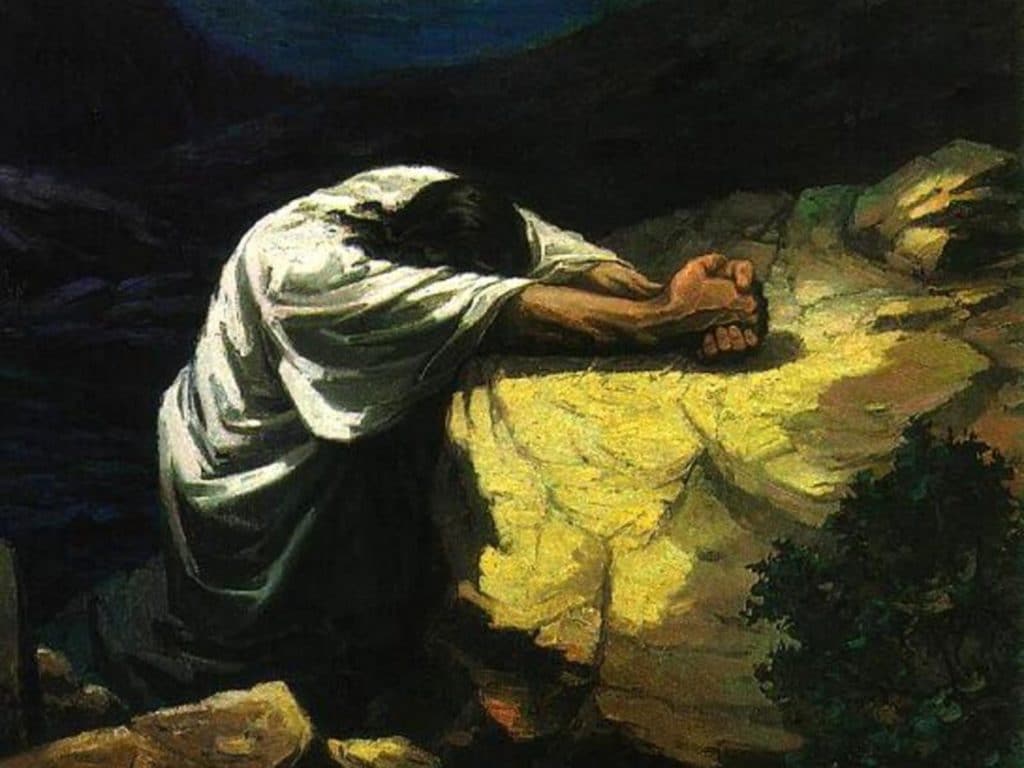
agony-in-the-garden-1-1024x768.jpgHaving completed the Passover meal, Jesus and His disciples made their way through the city of Jerusalem, out the eastern gate, and onto the Mount of Olives. They stopped at a place called Gethsemane, which means “an olive press.” Here, Jesus took three of His disciples, Peter, James and John, and found a secluded place where He could pray. These are the same three men who had accompanied Him and been eyewitnesses to His transfiguration. But on this occasion, rather than seeing Jesus in His glorified state, they would watch as He agonized over His coming trials.

Jesus described to them His state of mind: “My soul is very sorrowful, even to death” (Matthew 26:38 ESV). His emotional state was one of deep and overwhelming sadness over what was about to happen. His sorrow alone was enough to kill Him. But what was it that caused such a drastic state of deep melancholy in Jesus? Was He afraid to die? Did He regret His decision to sacrifice Himself on behalf of sinful mankind? Was He having second thoughts? The text, along with the words and actions of Jesus, provide us with the answers.

Matthew relates that Jesus went off by Himself and immediately fell on His face before His Father in a state of prayer. He pleaded, “My Father, if it be possible, let this cup pass from me” (Matthew 26:39 ESV).

One of the things this passage reveals is the human side of Jesus’ nature. He was 100 percent God, but also 100 percent human – a state often referred to as the hypostatic union. At His incarnation, Jesus, the eternal, second person of the Trinity, became the God-man. His assumption of a human nature was essential to the role He would play as the Savior of mankind. The author of Hebrews explains:

Because God’s children are human beings – made of flesh and blood – the Son also became flesh and blood. For only as a human being could he die, and only by dying could he break the power of the devil, who had the power of death. – Hebrews 2:14 NLT

The apostle Paul would put it this way:

[God] sent his own Son in a body like the bodies we sinners have. And in that body God declared an end to sin’s control over us by giving his Son as a sacrifice for our sins. – Romans 8:3 NLT

Jesus never relinquished any of His divine attributes, but, in becoming a man, He combined His human and divine natures into one person. And as a man, Jesus felt pain, experienced hunger, grew tired, and, as we will see, became susceptible to death.

In His humanity, Jesus knew that what He was about to endure would be excruciatingly painful. He would be scourged mercilessly with a flagellum, a whip featuring multiple leather strands, each weighted with lead balls or pieces of bone. He would be beaten, spit upon, slapped, and degraded. And eventually, He would be nailed to a wooden cross and left to die by exposure and suffocation. Jesus’ human nature was repulsed by the prospect of facing such a painful and gruesome death. He longed for another way, a plan B.

But, in His divinity, He knew that this was all part of His Father’s sovereign will. This is why He stated, “nevertheless, not as I will, but as you will” (Matthew 26:39 ESV).

But there is a second explanation behind Jesus’ intense sorrow and His cry for an alternative plan. He was fully aware that, upon the cross, He would be taking on the sin debt of the entire world. He who never committed a single sin would bear the full brunt of God’s wrath against all the sins of men for all time.

For God made Christ, who never sinned, to be the offering for our sin, so that we could be made right with God through Christ. – 2 Corinthians 5:21 NLT

Sin separates mankind from God. And Jesus knew that when He took on the sin debt of mankind, He would become separated from His Father for the first time in all of eternity. Their fellowship would be broken. And, in His divine nature, that prospect was unfathomable and unthinkable to Jesus. Yet again, He knew it was all part of God’s plan and, therefore, necessary.

Jesus longed for this “cup of wrath” to pass. If you recall, back in chapter 20, Matthew recorded an encounter between Jesus and the mother of James and John, the two brothers who were with Him in Gethsemane that night. She had asked Jesus to allow her two sons to sit on His right and on His left when He established His kingdom on earth. But Jesus had responded to her two sons, “You don’t know what you are asking! Are you able to drink from the bitter cup of suffering I am about to drink?” (Matthew 20:22 NLT).

Only He was worthy to suffer for the sins of mankind. He alone could meet God’s demanding criteria for an acceptable sacrifice – an unblemished, sinless Lamb.

And it’s interesting to note that when Jesus stopped to check on Peter, James, and John, He had found them asleep. While He had been agonizing over His coming death, these three were obviously unconcerned with and unsympathetic to His pain. They slept while Jesus wept. And Jesus made an interesting observation, stating, “The spirit indeed is willing, but the flesh is weak” (Matthew 26:41 ESV). This was most likely aimed at Peter, who had been the one who had vehemently denied Jesus prediction that they would all bail on Him in His time of greatest need.

“Though they all fall away because of you, I will never fall away.” – Matthew 26:33 ESV).

And yet, here was Peter finding it difficult even to stay awake while His master suffered under the weight of His pending death.

Three separate times Jesus expressed His feelings to His heavenly Father, and three times He communicated His willingness to do His Father’s will. He was committed. Every ounce of His humanity longed to escape what was to come, but His divinity provided the strength He needed to do what He had been called to do.

In his commentary on the book of Matthew, D.A. Carson writes:

“In the first garden ‘Not your will but mine’ changed Paradise to desert and brought man from Eden to Gethsemane. Now ‘Not my will but yours’ brings anguish to the man who prays it but transforms the desert into the kingdom and brings man from Gethsemane to the gates of glory.” – D.A. Carson, Matthew, p. 545.

Jesus was willing to face the fate God had planned for Him because He trusted His heavenly Father. He knew there was no other way. Salvation was only possible through His obedient submission to the sovereign will of God the Father. And the hour had come for Him to begin His journey from Gethsemane to Golgotha. Having finished His prayer time with the Father, Jesus turned to His disciples and said, “the hour is at hand, and the Son of Man is betrayed into the hands of sinners” (Matthew 26:45 ESV).

Judas was on his way, bringing with him the guards of the high priest. The darkness of that night was about to deepen as the forces of evil began their ill-fated attempt to snuff out the Light of the world. But as John would later write:

The light shines in the darkness, and the darkness can never extinguish it. – John 1:5 NLT

God’s light came into the world, but people loved the darkness more than the light, for their actions were evil. All who do evil hate the light and refuse to go near it for fear their sins will be exposed. But those who do what is right come to the light so others can see that they are doing what God wants. – John 3:19-21 NLT

Jesus would end up buried in the darkness of a borrowed tomb. His life would be forcefully taken from Him, but as He had predicted, it would be on His terms.

“No one can take my life from me. I sacrifice it voluntarily. For I have the authority to lay it down when I want to and also to take it up again. For this is what my Father has commanded.” – John 10:18 NLT

Jesus lived to do the will of His Father. And He died in obedience to the will of His Father. When Jesus had stated, “I and the Father are one” (John 10:30 ESV), He had meant it. Their wills were united, and their love for sinful mankind was unified around the sole solution to man’s problem: The sacrificial death of the sinless Son of God.

English Standard Version (ESV)
The Holy Bible, English Standard Version. ESV® Permanent Text Edition® (2016). Copyright © 2001 by Crossway Bibles, a publishing ministry of Good News Publishers.

New Living Translation (NLT)
Holy Bible, New Living Translation, copyright © 1996, 2004, 2015 by Tyndale House Foundation. Used by permission of Tyndale House Publishers Inc., Carol Stream, Illinois 60188. All rights reserved.

The Message (MSG)Copyright © 1993, 1994, 1995, 1996, 2000, 2001, 2002 by Eugene H. Peterson

It Must Be So!

47 While he was still speaking, Judas came, one of the twelve, and with him a great crowd with swords and clubs, from the chief priests and the elders of the people. 48 Now the betrayer had given them a sign, saying, “The one I will kiss is the man; seize him.” 49 And he came up to Jesus at once and said, “Greetings, Rabbi!” And he kissed him. 50 Jesus said to him, “Friend, do what you came to do.” Then they came up and laid hands on Jesus and seized him. 51 And behold, one of those who were with Jesus stretched out his hand and drew his sword and struck the servant of the high priest and cut off his ear. 52 Then Jesus said to him, “Put your sword back into its place. For all who take the sword will perish by the sword. 53 Do you think that I cannot appeal to my Father, and he will at once send me more than twelve legions of angels? 54 But how then should the Scriptures be fulfilled, that it must be so?” 55 At that hour Jesus said to the crowds, “Have you come out as against a robber, with swords and clubs to capture me? Day after day I sat in the temple teaching, and you did not seize me. 56 But all this has taken place that the Scriptures of the prophets might be fulfilled.” Then all the disciples left him and fled. – Matthew 26:47-56 ESV

BetrayalWhile Jesus had prayed, the disciples had slept. Except for one of them whose night had been filled with plans of betrayal. Judas, after having been exposed by Jesus as the one who would betray Him, had left the upper room and gone straight to the home of the high priest, intent on following through with his plan to profit from his relationship with Jesus. And before long, he arrived on the scene, accompanied by a crowd consisting of Roman soldiers and a contingent of the high priest’s guards.

Judas, having been an intimate follower of Jesus, knew that He would likely be on the Mount of Olives that night. John tells us that Jesus “often met there with his disciples” (John 18:2 ESV). And Judas appeared just as Jesus told His disciples:

“See, the hour is at hand, and the Son of Man is betrayed into the hands of sinners. Rise, let us be going; see, my betrayer is at hand.” – Matthew 26:45-46 ESV

This scene is filled with tension and emotion. Jesus, having just poured out His heart to His heavenly Father, had fully committed Himself to accomplish what He had come to do. The disciples, having been awakened from their sleep, suddenly found themselves startled by the arrival of Judas and a large group of armed guards. They were surprised and scared. And Judas had to have been a jumble of raw nerves as he prepared to betray Jesus as well as the rest of the disciples with whom he had spent three years of his life.

The guards, carrying their swords and clubs, would have been on edge, not knowing what they would encounter when they attempted to arrest Jesus. Would His disciples put up a fight? Would there be a large crowd of His followers there, ready to defend Him at all costs?

And in the midst of this chaotic and potentially volatile scene, a strange moment of intimacy took place. Judas stepped forward and kissed Jesus on the cheek. This had been the pre-agreed-upon sign that would mark Jesus as the one they had come to arrest. One has to ask why Judas chose to betray the Lord in this particular way. He could have simply pointed to Jesus. But it’s almost as if Judas wanted to defuse the tension of the moment and to fool the rest of the disciples into thinking he was still a faithful follower of Jesus.

Each of the gospel writers provides their own recollections of what happened next. Matthew tells us that Judas walked up to Jesus and said, “Greetings, Rabbi!” and then kissed Him. Luke records that Jesus responded to this act of betrayal by asking, “Judas, would you betray the Son of Man with a kiss?” (Luke 22:48 ESV). John paints a slightly different picture, saying that “Jesus, knowing all that would happen to him, came forward and said to the soldiers, “Whom do you seek?’” (John 18:4 ESV). These are not discrepancies, but simply the personal recollections of those who witnessed these events firsthand. In the case of Luke, he was recording what he had gleaned from his interviews of the disciples themselves. This scene is far from static but is filled with energy, confusion, and fear. Each of the disciples saw and heard different things. And in the midst of the chaos, the ever-impulsive Peter drew a sword and attacked one of those who had come to arrest Jesus. It was as if Peter was attempting to live up to the rash vow he had made earlier that evening:

“Even if I must die with you, I will not deny you! – Matthew 26:35 ESV

This is the same man who, upon hearing Jesus announce that He was going to die in Jerusalem, had rebuked Him, saying, “Heaven forbid, Lord, this will never happen to you!” (Matthew 16:22 NLT). Peter was trying to prevent the inevitable. More than that, he was trying to frustrate the expressed will of God. This is why Jesus had said to him, “Get away from me, Satan! You are a dangerous trap to me. You are seeing things merely from a human point of view, not from God’s” (Matthew 16:23 ESV).

Peter, like the rest of the disciples, could not believe this was happening. In spite of all Jesus had told them, they could not bring themselves to accept that this was God’s will concerning the Messiah. It was not what they had been taught. It was not the fulfillment of their hopes and dreams.

And the scene provides us with a dramatic dichotomy between the angry, impulsive actions of Peter and the peace-filled, submissive response of Jesus. He turned to Peter and said, “Put your sword back into its place. For all who take the sword will perish by the sword” (Matthew 26:52 ESV). This is an interesting statement and seems to conflict with one Jesus had made earlier in His ministry.

“Don’t imagine that I came to bring peace to the earth! I came not to bring peace, but a sword. – Matthew 16:34 ESV

But on that occasion, Jesus had been talking about the future, after His death, resurrection, and ascension. His act of redemption would put all those who believed in Him at odds with the world around them. Some would express faith in Jesus, while others would reject Him, creating conflict and division even within families.

“I have come to set a man against his father, a daughter against her mother, and a daughter-in-law against her mother-in-law. Your enemies will be right in your own household!” – Matthew 16:35-36 ESV

Jesus had not been advocating armed conflict between Christians and non-Christians. He was simply warning His disciples that following Him would be costly and accompanied by relational conflict.

But the garden of Gethsemane was not the place to stage a revolt against the authorities. Peter’s battle would not be with the armed guards of the Sanhedrin, but “against the rulers, against the authorities, against the cosmic powers over this present darkness, against the spiritual forces of evil in the heavenly places” (Ephesians 6:12 ESV).

On this night, the actions of Judas and the guards who accompanied him were part of the sovereign will of God Almighty. It was all taking place according to the divine plan prescribed by God before the foundation of the world. These events were inevitable, unavoidable, and ordained by God. Jesus let Peter know that if God had not wanted this to happen, He was more than equipped to do something about it. If He deemed necessary, God could have sent 72,000 angels from heaven to defend His Son. But Jesus made it perfectly clear that all of this was necessary.

“But how then should the Scriptures be fulfilled, that it must be so?” – Matthew 26:54 ESV

This was all happening in direct fulfillment of prophecy. Things were taking place just as God had planned. And nothing and no one was going to be able to stand in His way. The will of God would not be delayed, detoured, or derailed. The armed soldiers, equipped with swords and clubs, may have believed that they were in control of the situation, but Jesus knew better. They were simply pawns in the hands of a sovereign God. In fact, John records that when Jesus had asked them, “Whom do you seek?,” they had responded, “Jesus of Nazareth.” And as soon as Jesus had said, “I am he,” John states, “they drew back and fell to the ground” (John 18:6 ESV).

Jesus was in control of the situation, not Peter, the guards, or the soldiers. And Jesus revealed that this entire scene was in fulfillment of God’s prophetic promises.

“…all this has taken place that the Scriptures of the prophets might be fulfilled.” – Matthew 26:56 ESV

And, as if to drive home that point, Matthew records that upon Jesus’ arrest, “all the disciples left him and fled” (Matthew 26:56 ESV). Over in the book of Zechariah, we have a prophetic pronouncement concerning the Messiah that forewarned of this very thing.

“Strike the shepherd, and the sheep will be scattered;
    I will turn my hand against the little ones. – Zechariah 13:7 ESV

Jesus was on His own. The disciples had abandoned Him. Judas had done his dastardly deed and departed the scene. But Jesus, while devoid of any companionship from His followers, was far from alone. His heavenly Father was with Him. He would go through the next hours of suffering knowing that He was doing His Father’s will and was well within the divine grasp of His Father’s love. What Jesus was about to do, He did willingly. Because it had to happen. It was why He had come to earth. His incarnation would be meaningless without His crucifixion. His having taken on human flesh would be pointless if He did not become the sacrifice for the sins of mankind. It must be so. The journey to Calvary had begun and God’s plan for the redemption of man was well on its way.

English Standard Version (ESV)
The Holy Bible, English Standard Version. ESV® Permanent Text Edition® (2016). Copyright © 2001 by Crossway Bibles, a publishing ministry of Good News Publishers.

New Living Translation (NLT)
Holy Bible, New Living Translation, copyright © 1996, 2004, 2015 by Tyndale House Foundation. Used by permission of Tyndale House Publishers Inc., Carol Stream, Illinois 60188. All rights reserved.

The Message (MSG)Copyright © 1993, 1994, 1995, 1996, 2000, 2001, 2002 by Eugene H. Peterson

Faithful In the Face of Death.

36 Then Jesus went with them to a place called Gethsemane, and he said to his disciples, “Sit here, while I go over there and pray.” 37 And taking with him Peter and the two sons of Zebedee, he began to be sorrowful and troubled. 38 Then he said to them, “My soul is very sorrowful, even to death; remain here, and watch with me.” 39 And going a little farther he fell on his face and prayed, saying, “My Father, if it be possible, let this cup pass from me; nevertheless, not as I will, but as you will.” 40 And he came to the disciples and found them sleeping. And he said to Peter, “So, could you not watch with me one hour? 41 Watch and pray that you may not enter into temptation. The spirit indeed is willing, but the flesh is weak.” 42 Again, for the second time, he went away and prayed, “My Father, if this cannot pass unless I drink it, your will be done.” 43 And again he came and found them sleeping, for their eyes were heavy. 44 So, leaving them again, he went away and prayed for the third time, saying the same words again. 45 Then he came to the disciples and said to them, “Sleep and take your rest later on. See, the hour is at hand, and the Son of Man is betrayed into the hands of sinners. 46 Rise, let us be going; see, my betrayer is at hand.” – Matthew 26:36-46 ESV

agony-in-the-garden-1-1024x768.jpgHaving completed the Passover meal, Jesus and His disciples made their way through the city of Jerusalem, out the eastern gate, and onto the Mount of Olives. They stopped at a place called Gethsemane, which means “an olive press.” Here, Jesus took three of His disciples, Peter, James and John, and found a secluded place where He could pray. These are the same three men who had accompanied Him and been eyewitnesses to His transfiguration. But on this occasion, rather than seeing Jesus in His glorified state, they would watch as He agonized over His coming trials.

Jesus described to them His state of mind: “My soul is very sorrowful, even to death” (Matthew 26:38 ESV). His emotional state was one of deep and overwhelming sadness over what was about to happen. His sorrow alone was enough to kill Him. But what was it that caused such a drastic state of deep melancholy in Jesus? Was He afraid to die? Did He regret His decision to sacrifice Himself on behalf of sinful mankind? Was He having second thoughts? The text, along with the words and actions of Jesus, provide us with the answers.

Matthew relates that Jesus went off by Himself and immediately fell on His face before His Father in a state of prayer. He pleaded, “My Father, if it be possible, let this cup pass from me” (Matthew 26:39 ESV).

One of the things this passage reveals is the human side of Jesus’ nature. He was 100 percent God, but also 100 percent human – a state often referred to as the hypostatic union. At His incarnation, Jesus, the eternal, second person of the Trinity, became the God-man. His assumption of a human nature was essential to the role He would play as the Savior of mankind. The author of Hebrews explains:

Because God’s children are human beings – made of flesh and blood – the Son also became flesh and blood. For only as a human being could he die, and only by dying could he break the power of the devil, who had the power of death. – Hebrews 2:14 NLT

The apostle Paul would put it this way:

[God] sent his own Son in a body like the bodies we sinners have. And in that body God declared an end to sin’s control over us by giving his Son as a sacrifice for our sins. – Romans 8:3 NLT

Jesus never relinquished any of His divine attributes, but, in becoming a man, He combined His human and divine natures into one person. And as a man, Jesus felt pain, experienced hunger, grew tired, and, as we will see, became susceptible to death.

In His humanity, Jesus knew that what He was about to endure would be excruciatingly painful. He would be scourged mercilessly with a flagellum, a whip featuring multiple leather strands, each weighted with lead balls or pieces of bone. He would be beaten, spit upon, slapped, and degraded. And eventually, He would be nailed to a wooden cross and left to die by exposure and suffocation. Jesus’ human nature was repulsed by the prospect of facing such a painful and gruesome death. He longed for another way, a plan B.

But, in His divinity, He knew that this was all part of His Father’s sovereign will. This is why He stated, “nevertheless, not as I will, but as you will” (Matthew 26:39 ESV).

But there is a second explanation behind Jesus’ intense sorrow and His cry for an alternative plan. He was fully aware that, upon the cross, He would be taking on the sin debt of the entire world. He who never committed a single sin would bear the full brunt of God’s wrath against all the sins of men for all time.

For God made Christ, who never sinned, to be the offering for our sin, so that we could be made right with God through Christ. – 2 Corinthians 5:21 NLT

Sin separates mankind from God. And Jesus knew that when He took on the sin debt of mankind, He would become separated from His Father for the first time in all of eternity. Their fellowship would be broken. And, in His divine nature, that prospect was unfathomable and unthinkable to Jesus. Yet again, He knew it was all part of God’s plan and, therefore, necessary.

Jesus longed for this “cup of wrath” to pass. If you recall, back in chapter 20, Matthew recorded an encounter between Jesus and the mother of James and John, the two brothers who were with Him in Gethsemane that night. She had asked Jesus to allow her two sons to sit on His right and on His left when He established His kingdom on earth. But Jesus had responded to her two sons, “You don’t know what you are asking! Are you able to drink from the bitter cup of suffering I am about to drink?” (Matthew 20:22 NLT).

Only He was worthy to suffer for the sins of mankind. He alone could meet God’s demanding criteria for an acceptable sacrifice – an unblemished, sinless Lamb.

And it’s interesting to note that when Jesus stopped to check on Peter, James, and John, He had found them asleep. While He had been agonizing over His coming death, these three were obviously unconcerned with and unsympathetic to His pain. They slept while Jesus wept. And Jesus made an interesting observation, stating, “The spirit indeed is willing, but the flesh is weak” (Matthew 26:41 ESV). This was most likely aimed at Peter, who had been the one who had vehemently denied Jesus prediction that they would all bail on Him in His time of greatest need.

“Though they all fall away because of you, I will never fall away.” – Matthew 26:33 ESV).

And yet, here was Peter finding it difficult even to stay awake while His master suffered under the weight of His pending death.

Three separate times Jesus expressed His feelings to His heavenly Father, and three times He communicated His willingness to do His Father’s will. He was committed. Every ounce of His humanity longed to escape what was to come, but His divinity provided the strength He needed to do what He had been called to do.

In his commentary on the book of Matthew, D.A. Carson writes:

“In the first garden ‘Not your will but mine’ changed Paradise to desert and brought man from Eden to Gethsemane. Now ‘Not my will but yours’ brings anguish to the man who prays it but transforms the desert into the kingdom and brings man from Gethsemane to the gates of glory.” – D.A. Carson, Matthew, p. 545.

Jesus was willing to face the fate God had planned for Him because He trusted His heavenly Father. He knew there was no other way. Salvation was only possible through His obedient submission to the sovereign will of God the Father. And the hour had come for Him to begin His journey from Gethsemane to Golgotha. Having finished His prayer time with the Father, Jesus turned to His disciples and said, “the hour is at hand, and the Son of Man is betrayed into the hands of sinners” (Matthew 26:45 ESV).

Judas was on his way, bringing with him the guards of the high priest. The darkness of that night was about to deepen as the forces of evil began their ill-fated attempt to snuff out the Light of the world. But as John would later write:

The light shines in the darkness, and the darkness can never extinguish it. – John 1:5 NLT

God’s light came into the world, but people loved the darkness more than the light, for their actions were evil. All who do evil hate the light and refuse to go near it for fear their sins will be exposed. But those who do what is right come to the light so others can see that they are doing what God wants. – John 3:19-21 NLT

Jesus would end up buried in the darkness of a borrowed tomb. His life would be forcefully taken from Him, but as He had predicted, it would be on His terms.

“No one can take my life from me. I sacrifice it voluntarily. For I have the authority to lay it down when I want to and also to take it up again. For this is what my Father has commanded.” – John 10:18 NLT

Jesus lived to do the will of His Father. And He died in obedience to the will of His Father. When Jesus had stated, “I and the Father are one” (John 10:30 ESV), He had meant it. Their wills were united, and their love for sinful mankind was unified around the sole solution to man’s problem: The sacrificial death of the sinless Son of God.

English Standard Version (ESV)
The Holy Bible, English Standard Version. ESV® Permanent Text Edition® (2016). Copyright © 2001 by Crossway Bibles, a publishing ministry of Good News Publishers.

New Living Translation (NLT)
Holy Bible, New Living Translation, copyright © 1996, 2004, 2015 by Tyndale House Foundation. Used by permission of Tyndale House Publishers Inc., Carol Stream, Illinois 60188. All rights reserved.

The Message (MSG)Copyright © 1993, 1994, 1995, 1996, 2000, 2001, 2002 by Eugene H. Peterson