God of the Impossible

1 The oracle of the word of the LORD is against the land of Hadrach
    and Damascus is its resting place.
For the Lord has an eye on mankind
    and on all the tribes of Israel,
and on Hamath also, which borders on it,
    Tyre and Sidon, though they are very wise.
Tyre has built herself a rampart
    and heaped up silver like dust,
    and fine gold like the mud of the streets.
But behold, the Lord will strip her of her possessions
    and strike down her power on the sea,
    and she shall be devoured by fire.

Ashkelon shall see it, and be afraid;
    Gaza too, and shall writhe in anguish;
    Ekron also, because its hopes are confounded.
The king shall perish from Gaza;
    Ashkelon shall be uninhabited;
a mixed people shall dwell in Ashdod,
    and I will cut off the pride of Philistia.
I will take away its blood from its mouth,
    and its abominations from between its teeth;
it too shall be a remnant for our God;
    it shall be like a clan in Judah,
    and Ekron shall be like the Jebusites.
Then I will encamp at my house as a guard,
    so that none shall march to and fro;
no oppressor shall again march over them,
    for now I see with my own eyes. – Zechariah 9:1-8 ESV

Yahweh now delivers an oracle to Zechariah. The Hebrew word translated as “oracle” is maśśā’, which means “to lift up” or “to bear up.” Figuratively, it could refer to a pronouncement or prophecy that had a “burden” or “weight” associated with it. In this case, Yahweh is predicting the coming destruction of Israel’s many enemies. At the same time, He is announcing the coming of Israel’s long-awaited King and Messiah. The first eight verses paint a bleak and inescapable future for the nations that have stood opposed to Israel’s well-being for centuries. Zechariah is informed that each of these pagan nations will suffer the consequences for their treatment of God’s chosen people.
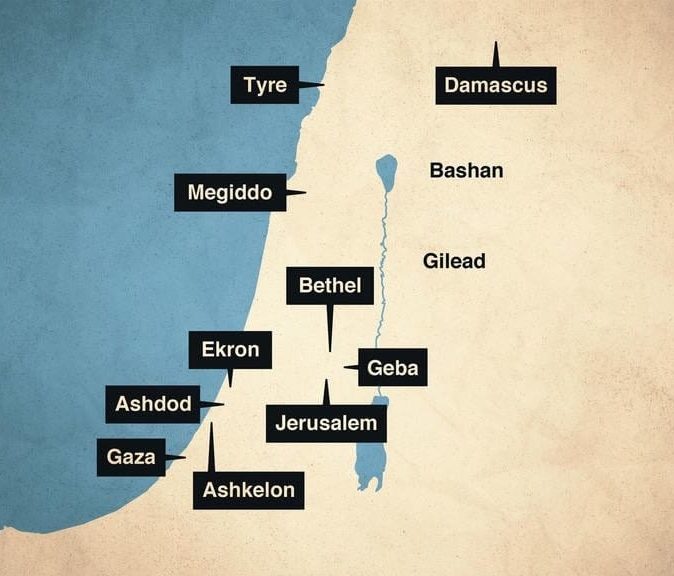
Yahweh lists a variety of cities surrounding Jerusalem, from Damascus in the north to Ashkelon in the south. He begins His list in the north in the region known as Hadrach, but He focuses His oracle on the city of Damascus. From there, Yahweh moves south, listing the names of additional doomed cities as He makes His way to Ashdod, Ashkelon, and Gaza. This north-to-south route is significant because it mirrors the path the Assyrians and Babylonians took when they conquered Israel and Judah. Earlier prophets had predicted the coming destruction of the northern and southern kingdoms by these two nations, a fate ordained by God for His people’s continued rebellion against Him.

“But I have stirred up a leader who will approach from the north.
From the east he will call on my name.
I will give him victory over kings and princes.
He will trample them as a potter treads on clay. – Isaiah 41:25 NLT

“Yes,” the Lord said, “for terror from the north will boil out on the people of this land. Listen! I am calling the armies of the kingdoms of the north to come to Jerusalem. I, the Lord, have spoken!

“They will set their thrones
at the gates of the city.
They will attack its walls
and all the other towns of Judah.
I will pronounce judgment
on my people for all their evil—
for deserting me and burning incense to other gods.
Yes, they worship idols made with their own hands! – Jeremiah 1:14-16 NLT

“This is what the Sovereign Lord says: From the north I will bring King Nebuchadnezzar of Babylon against Tyre. He is king of kings and brings his horses, chariots, charioteers, and great army. First he will destroy your mainland villages. Then he will attack you by building a siege wall, constructing a ramp, and raising a roof of shields against you.He will pound your walls with battering rams and demolish your towers with sledgehammers. The hooves of his horses will choke the city with dust, and the noise of the charioteers and chariot wheels will shake your walls as they storm through your broken gates. His horsemen will trample through every street in the city. They will butcher your people, and your strong pillars will topple. – Ezekiel 7:7-11 NLT

Yahweh is announcing His intention to take the same path of destruction to mete out judgment upon the enemies of His people. He will begin in the north with Damascus and work His way down the coast to the land of the Philistines.

This prophecy was partially fulfilled in 333 B.C. when Alexander the Great passed through the region on his way to Egypt. He focused his attention on the coastal cities, destroying all ports used by the Achaemenid Empire but leaving the Jews relatively undisturbed. Alexander’s march to the south left many of these same cities destroyed but they would eventually rise from the ashes and continue their mistreatment of the people of Israel. What Yahweh has in store for them will be far more destructive and permanent than anything they suffered at the hands of the Greeks.

The English Standard Version translates verse 1 as “the LORD has an eye on mankind and on all the tribes of Israel.” While it is obvious that the all-knowing, all-seeing Yahweh is always watching over the affairs of men, most translators render this verse differently.

…the eyes of humanity, including all the tribes of Israel, are on the LORD. – NLT

…the eyes of men and of all the tribes of Israel are upon the LORD. – BSB

…for the eyes of mankind, especially of all the tribes of Israel, are toward the LORD. – NASB

This human-based perspective is important because it indicates that all will know and understand that this future judgment is the work of Yahweh. Everyone will comprehend the divine nature of the destruction. This won’t be the work of some world super-power, it will be the hand of Adonai, the LORD of Hosts.

the Lord will strip away Tyre’s possessions
and hurl its fortifications into the sea,
and it will be burned to the ground.– Zechariah 9:4 NLT

The city of Ashkelon will see Tyre fall
and will be filled with fear.
Gaza will shake with terror,
as will Ekron, for their hopes will be dashed.
Gaza’s king will be killed,
and Ashkelon will be deserted.– Zechariah 9:4 NLT

These powerful, wealthy, and influential cities will suffer fear, humiliation, and elimination at the hands of Israel’s God. Their wealth will do them no good. Their armies will be impotent and unable to defend them. The once-great Philistine empire that had plagued the people of Israel for centuries would fall, never to rise again. The oracle even predicts the conversion of any Philistines who manage to make it out alive.

Then the surviving Philistines will worship our God
    and become like a clan in Judah.
The Philistines of Ekron will join my people,
    as the ancient Jebusites once did. – Zechariah 9:7 NLT

The content of this oracle must have been difficult for Zechariah to get his head around. It was good news but it all sounded so far-fetched and impossible. It didn’t get any more believable when God claimed, “I will guard my Temple and protect it from invading armies. I am watching closely to ensure that no more foreign oppressors overrun my people’s land” (Zechariah 9:8 NLT).

God was telling Zechariah incredible news regarding Israel’s future. Not only will Israel be restored, Jerusalem rebuilt, and the Temple completed, but the people of Israel will prosper, filling the land, and serving Him faithfully. Things were going to be radically different. Instead of punishing His people as He had done in the past, God was going to bless them abundantly and restore them to favor. This news had to be difficult for Zechariah to comprehend as he looked around at a partially completed foundation on the Temple, the broken-down walls, and the demoralized remnant who struggled to fulfill the task God had given them due to the scope of the project and the presence of opposition. Yet, Yahweh had assured Zechariah that He was the God of the impossible.

“This is what the Lord of Heaven’s Armies says: All this may seem impossible to you now, a small remnant of God’s people. But is it impossible for me? says the Lord of Heaven’s Armies.” – Zechariah 8:6 NLT

It’s as if God said, “I know this doesn’t look so good right now, but don’t judge Me based on what you see.” Yahweh wanted Zechariah to focus on His promises, not the pressing problems that seemed to never go away.

Yahweh knew that Zechariah and the beleaguered people of Judah were struggling to keep the faith. They were growing weary and questioning whether all their hard work would be worth it. So, God pointed them to the future. He predicted a brighter tomorrow that was beyond their powers of comprehension. But He had proven Himself faithful in the past and could be trusted to fulfill His plans for the future.

Yet, God’s people have always struggled with doubt and the inability to take God at His word. Even today, those who claim to believe in an all-powerful, promise-keeping God, find themselves wondering where He is and what He is doing. They take a look at their current circumstances and make sweeping judgments regarding everything from God’s faithfulness and presence to His love and power. When things don’t go well, God’s people automatically assume that He is either angry or oblivious to their needs. He is upset and punishing them. He is out of touch and ignorant of them. Their prayers don’t get answered, so they conclude He does not hear or does not care.

In time, their view of life begins to influence their view of God. In a sense, Yahweh tells Zechariah, “I know this all seems impossible to you right now. After all, there’s just a handful of you and the job is far from complete. BUT THIS ISN’T ABOUT YOU!”

The point of it all was that God could do the impossible. He knew what was going on and was well aware of the situation taking place in Jerusalem. He had a full grasp of the facts regarding the status of the Temple, the presence of opposition, the size of the workforce, and the condition of their hearts. Which explains the depth and detail of His message to Zechariah.

He told Zechariah, “Be strong and finish the task!” (Zechariah 8:9 NLT) and “Don’t be afraid. Be strong, and get on with rebuilding the Temple” (Zechariah 8:13 NLT). It wasn’t about their strength and ability to get things done, it was about their faith and trust in a God who could do ANYTHING. They just needed to do what He had called them to do and leave the rest up to Him. God had returned them to the promised land, provided a royal edict to secure their work, and secured the funds to pay for the entire restoration project. He had done His part but they had failed to complete theirs. It was far too easy for them to look at their relative lack of success and the overwhelming size of the task and become disillusioned.

The same thing can be true of us. We get overwhelmed by circumstances and begin to feel we are in over our heads. We start to wonder if God is with us at all. But whenever we think it’s all up to us, we miss the point. Nothing is impossible for God. There is nothing He can’t handle. There is nothing we face that is outside of His sovereign control and divine will. Like Zechariah and the people of Judah, we must constantly remind ourselves that nothing is impossible for God. That’s the message we need to hear. There is nothing that He can’t do. There is not a single circumstance that is out of His ability or power to handle. And not only that, but nothing is impossible for God. That’s the message of the Bible. It is all about God, not us. It is about His power, His will, His promises, His faithfulness, His salvation, His Kingdom, and His ability to finish what He has begun and restore what is broken. Nothing is impossible for Him.

English Standard Version (ESV)
The Holy Bible, English Standard Version. ESV® Permanent Text Edition® (2016). Copyright © 2001 by Crossway Bibles, a publishing ministry of Good News Publishers.

New Living Translation (NLT)
Holy Bible, New Living Translation, copyright © 1996, 2004, 2015 by Tyndale House Foundation. Used by permission of Tyndale House Publishers Inc., Carol Stream, Illinois 60188. All rights reserved.

The Constant Danger of Unbelief

1 Now the prophets, Haggai and Zechariah the son of Iddo, prophesied to the Jews who were in Judah and Jerusalem, in the name of the God of Israel who was over them. Then Zerubbabel the son of Shealtiel and Jeshua the son of Jozadak arose and began to rebuild the house of God that is in Jerusalem, and the prophets of God were with them, supporting them.

At the same time Tattenai the governor of the province Beyond the River and Shethar-bozenai and their associates came to them and spoke to them thus: “Who gave you a decree to build this house and to finish this structure?” They also asked them this: “What are the names of the men who are building this building?” But the eye of their God was on the elders of the Jews, and they did not stop them until the report should reach Darius and then an answer be returned by letter concerning it.

This is a copy of the letter that Tattenai the governor of the province Beyond the River and Shethar-bozenai and his associates, the governors who were in the province Beyond the River, sent to Darius the king. They sent him a report, in which was written as follows: “To Darius the king, all peace. Be it known to the king that we went to the province of Judah, to the house of the great God. It is being built with huge stones, and timber is laid in the walls. This work goes on diligently and prospers in their hands. Then we asked those elders and spoke to them thus: ‘Who gave you a decree to build this house and to finish this structure?’ 10 We also asked them their names, for your information, that we might write down the names of their leaders. 11 And this was their reply to us: ‘We are the servants of the God of heaven and earth, and we are rebuilding the house that was built many years ago, which a great king of Israel built and finished. 12 But because our fathers had angered the God of heaven, he gave them into the hand of Nebuchadnezzar king of Babylon, the Chaldean, who destroyed this house and carried away the people to Babylonia. 13 However, in the first year of Cyrus king of Babylon, Cyrus the king made a decree that this house of God should be rebuilt. 14 And the gold and silver vessels of the house of God, which Nebuchadnezzar had taken out of the temple that was in Jerusalem and brought into the temple of Babylon, these Cyrus the king took out of the temple of Babylon, and they were delivered to one whose name was Sheshbazzar, whom he had made governor; 15 and he said to him, “Take these vessels, go and put them in the temple that is in Jerusalem, and let the house of God be rebuilt on its site.” 16 Then this Sheshbazzar came and laid the foundations of the house of God that is in Jerusalem, and from that time until now it has been in building, and it is not yet finished.’ 17 Therefore, if it seems good to the king, let search be made in the royal archives there in Babylon, to see whether a decree was issued by Cyrus the king for the rebuilding of this house of God in Jerusalem. And let the king send us his pleasure in this matter.” Ezra 5:1-17 ESV

Unbelief is a constant reality – even for the believer. But how can you be a believer and yet not believe? It’s simple. Belief is a state of mind that must always be accompanied by action. In other words, belief must be visibly tied to faith. During the days of Ezra, the returned exiles were attempting to rebuild the Temple in Jerusalem, according to the decree issued by Cyrus the Persian king. But because of local opposition, the Jews abandoned their efforts “all the days of Cyrus king of Persia, even until the reign of Darius king of Persia” (Ezra 4:5 ESV. For 16 years, all construction activity on the Temple stopped, even though God had miraculously arranged their return to the land and even prompted King Cyrus to fund their efforts.

What happened? The people stopped believing. Rather than stepping out in faith and trusting that God would protect them, they simply gave in and shut down all construction until the prophets of God intervened. God prompted Haggai and Zechariah to write letters to the Jews in Judah encouraging them to stop fearing and take action.

“This is what the Lord of Heaven’s Armies says: Look at what’s happening to you! Now go up into the hills, bring down timber, and rebuild my house. Then I will take pleasure in it and be honored, says the Lord. You hoped for rich harvests, but they were poor. And when you brought your harvest home, I blew it away. Why? Because my house lies in ruins, says the Lord of Heaven’s Armies, while all of you are busy building your own fine houses. – Haggai 1:7-9 NLT

“This is what the Lord of Heaven’s Armies says: Be strong and finish the task! Ever since the laying of the foundation of the Temple of the Lord of Heaven’s Armies, you have heard what the prophets have been saying about completing the building. Before the work on the Temple began, there were no jobs and no money to hire people or animals. No traveler was safe from the enemy, for there were enemies on all sides. I had turned everyone against each other.

“But no longer! Now I will rescue you and make you both a symbol and a source of blessing. So don’t be afraid. Be strong, and get on with rebuilding the Temple! – Zechariah 1:9-10, 12 NLT

These words of encouragement had a powerful impact on the defeated and disillusioned remnant in Judah.

Then Zerubbabel son of Shealtiel, and Jeshua son of Jehozadak, the high priest, and the whole remnant of God’s people began to obey the message from the Lord their God. When they heard the words of the prophet Haggai, whom the Lord their God had sent, the people feared the Lord. Then Haggai, the Lord’s messenger, gave the people this message from the Lord: “I am with you, says the Lord!” – Haggai 1:12-13 NLT

Under the leadership of Zerubbabel, the grandson of King Jehoiachin, the people put their faith in action and began to build once again, despite the opposition. Yet, they were immediately confronted by their enemies who questioned where they had received the authority to restart the construction. Tattenai, Shethar-bozenai, and their associates tried to frighten the Jews but, rather than giving in to the pressure, the workers continued to believe and build.

Unhappy with the renewed building efforts, the local authorities sent a letter to the king requesting that he search the royal archives for evidence of any past decrees authorizing the construction of the Temple. Their letter opened with a first-hand description of the revitalized and energetic actions of the returned exiles.

“The king should know that we went to the construction site of the Temple of the great God in the province of Judah. It is being rebuilt with specially prepared stones, and timber is being laid in its walls. The work is going forward with great energy and success. – Ezra 5:8 NLT

The letter also outlined the interrogation of Judah’s leadership, who explained their actions as being ordained by God and authorized by King Cyrus.

We are the servants of the God of heaven and earth, and we are rebuilding the Temple that was built here many years ago by a great king of Israel. – Ezra 5:11 NLT

“King Cyrus of Babylon, during the first year of his reign, issued a decree that the Temple of God should be rebuilt.” – Ezra 5:13 NLT

Tattenai, the Persian-appointed governor of the province was unconvinced that the Jews were telling the truth, which prompted the letter to the king. He was hoping that the Jews would be proven to be liars and that the king would take action against them. 

But in the meantime, the people of God needed to believe in their God. He had told them to rebuild and provided everything they needed to make it happen, including the assistance of a pagan king. The problem came when the people started facing opposition. Doubt began to creep in and doubt almost always leads to disbelief. Then disbelief leads to disobedience. And disobedience inevitably results in a lack of God’s rest.

Throughout the history of the Hebrew nation, God kept trying to prove to His people just how trustworthy He was. He bailed them out time and time again. He provided miracle after miracle. He defeated their enemies for them. He clothed and fed them. He made them a mighty nation. But they continually struggled with unbelief. They lacked faith. They could claim to believe in God, but their actions proved otherwise. And yet, God still wanted to prove His trustworthiness to them.

When Haggai and Zechariah encouraged the people to keep on building and they obeyed, despite the opposition, it was an act of faith. They had no idea how the king would respond to the letter. They had no guarantee that the king would act favorably. But faith doesn’t dwell on possibilities. It focuses on the God of the impossible. Jesus said of His Heavenly Father, “With God all things are possible” (Matthew 19:26 ESV). When faced with a test of his faith, Moses was reminded by God, “Is the LORD’s hand shortened? Now you shall see whether my word will come true for you or not” (Numbers 11:23 ESV). The prophet Isaiah told the people of Israel, “Behold, the LORD’s hand is not shortened, that it cannot save, or his ear dull, that it cannot hear” (Isaiah 59:1 ESV).

God is the God of the impossible, but we must not only believe it cognitively; we must put shoe leather to our belief and act on it in faith.

English Standard Version (ESV)
The Holy Bible, English Standard Version. ESV® Permanent Text Edition® (2016). Copyright © 2001 by Crossway Bibles, a publishing ministry of Good News Publishers.

New Living Translation (NLT)
Holy Bible, New Living Translation, copyright © 1996, 2004, 2015 by Tyndale House Foundation. Used by permission of Tyndale House Publishers Inc., Carol Stream, Illinois 60188. All rights reserved.

The Message (MSG)Copyright © 1993, 1994, 1995, 1996, 2000, 2001, 2002 by Eugene H. Peterson

And the Lord Did As He Had Promised

The Lord visited Sarah as he had said, and the Lord did to Sarah as he had promised. And Sarah conceived and bore Abraham a son in his old age at the time of which God had spoken to him. Abraham called the name of his son who was born to him, whom Sarah bore him, Isaac. And Abraham circumcised his son Isaac when he was eight days old, as God had commanded him. Abraham was a hundred years old when his son Isaac was born to him. And Sarah said, “God has made laughter for me; everyone who hears will laugh over me.” And she said, “Who would have said to Abraham that Sarah would nurse children? Yet I have borne him a son in his old age.” Genesis 21:1-7 ESV

Moses opens this epic chapter with the simple, yet profound words, “the Lord visited Sarah.” After all that has transpired in the preceding chapters, they come across as rather anticlimactic. This is the moment for which Abraham and Sarah have long-awaited and about which they had their fair share of doubts. God had repeatedly promised that Sarah would bear a son, and now the time had come. The long wait was over. The promise was to be fulfilled. And while Moses’ words may lack an air of excitement, they display a strong sense of God’s sovereignty and faithfulness. And three separate times in the first two verses, Moses emphasizes the faithfulness of God.

The Lord visited Sarah as he had said

…the Lord did to Sarah as he had promised

And Sarah conceived and bore Abraham a son…of which God had spoken to him

That simple statement, “and Sarah conceived” is (excuse the pun) pregnant with meaning. God had done the impossible. He had performed a miracle by creating life in Sarah’s lifeless womb. The odds had been against Sarah. When Moses first introduced her in chapter 11, he had declared her unfortunate condition.

Now Sarai was barren; she had no child. – Genesis 11:30 ESV

Yet, in the very next chapter, God had issued His call to Abraham and announced His promise to produce through him and Sarah a great nation. Abraham was 75 and Sarah was 65 at the time. And 25 years later, God had reconfirmed His promise to Abraham.

Then Abraham bowed down to the ground, but he laughed to himself in disbelief. “How could I become a father at the age of 100?” he thought. “And how can Sarah have a baby when she is ninety years old?” – Genesis 17:17 NLT

So, now Sarah’s barrenness was complicated by the curse of fruitlessness that accompanies old age.

Abraham and Sarah were both very old by this time, and Sarah was long past the age of having children. – Genesis 18:11 NLT

And Sarah seemed to believe that her long struggle with infertility had been God’s doing.

So Sarai said to Abram, “The Lord has prevented me from having children.” – Genesis 16:2 NLT

Yet, at just the right moment, according to God’s sovereign plan, Sarah conceived and bore a son. Against all odds and contrary to everything we know about human anatomy and physiology, a 90-year-old barren woman became impregnated by her 100-year-old husband and carried that baby for nine months. And Moses makes it clear that this pregnancy was the work of God. He had done what He had promised to do and He had done it according to His divine timeline. The 25-year delay had been a part of the plan. At no point along the way had God been exasperated by Sarah’s inability to get pregnant. He had not made a mistake in choosing Abraham. Sarah’s barrenness had not been an oversight on God’s part. Even when Sarah and Abraham kept attempting to come up with alternate plans to fulfill God’s promise, He kept reiterating His intentions to use the two of them.

God displayed His power and confirmed His covenant faithfulness through the miracle of Sarah’s pregnancy and her baby’s eventual birth. A year earlier, God had predicted that this moment would come and He had even provided a name for the son who would be born to Abraham and Sarah.

“Sarah your wife shall bear you a son, and you shall call his name Isaac. I will establish my covenant with him as an everlasting covenant for his offspring after him.” – Genesis 17:19 ESV

When Sarah had heard this promise from God, she had reacted with disbelief and scorn, saying, “How could a worn-out woman like me enjoy such pleasure, especially when my master—my husband—is also so old?” (Genesis 18:12 NLT). And God had calmly and patiently responded, “Is anything too hard for the Lord?” (Genesis 18:14 NLT).

Now, God had answered His own question with an irrefutable demonstration of His power that should have clearly ended all speculation regarding His faithfulness. Sarah’s barrenness proved to be no problem for God. Yes, it had caused Sarah great pain and left her questioning the faithfulness and trustworthiness of God. It had frustrated Abraham, causing him to consider and, at times, implement other strategies for becoming the father of a multitude of nations. Both Sarah and Abraham wanted what God had promised, but her barrenness seemed to be an insurmountable barrier to achieving their desire. And a quarter-century of waiting only made matters worse.

But at just the right moment, according to God’s sovereign timeline, the Creator spoke into the darkness of Sarah’s despair and brought about life. And with that life, a light broke into the darkness that permeated Abraham’s world. It would be through this child that God would fulfill His promise to Abraham.

“I will make of you a great nation, and I will bless you and make your name great, so that you will be a blessing.” – Genesis 12:2 ESV

God had clearly promised to do something significant through the offspring of Abraham. He had added, “in you all the families of the earth shall be blessed” (Genesis 12:3 ESV). This boy was destined for great things. And while he would bring great joy and comfort to Abraham and Sarah, he would become the hope of the nations. Through Isaac would come another son, whose birth would also come about through miraculous means. Centuries later, the prophet Isaiah would predict the coming of this child.

Therefore the Lord himself will give you a sign. Behold, the virgin shall conceive and bear a son, and shall call his name Immanuel. – Isaiah 7:14 ESV

And Isaiah would go on to describe the circumstances in which this child would be born.

The people who walked in darkness
    have seen a great light;
those who dwelt in a land of deep darkness,
    on them has light shone.
You have multiplied the nation;
    you have increased its joy;
they rejoice before you
    as with joy at the harvest,
    as they are glad when they divide the spoil. – Isaiah 9:2-3 ESV

The birth of Isaac brought great joy and hope to Abraham and Sarah. And in a similar, yet even more significant way, the birth of this future offspring of Abraham would bring joy to the entire world.

For to us a child is born,
    to us a son is given;
and the government shall be upon his shoulder,
    and his name shall be called
Wonderful Counselor, Mighty God,
    Everlasting Father, Prince of Peace.
Of the increase of his government and of peace
    there will be no end,
on the throne of David and over his kingdom,
    to establish it and to uphold it
with justice and with righteousness
    from this time forth and forevermore.
The zeal of the Lord of hosts will do this. – Isaiah 9:6-7 ESV

At the moment of Isaac’s miraculous birth, the 90-year-old Sarah and her 100-year-old husband found themselves basking in the joy of that momentous and long-awaited occasion. Sarah’s derisive and scornful laughter had been transformed into joyful hilarity at the sight of her miracle baby. As she held her bundle of joy in her arms, she exclaimed, “God has brought me laughter. All who hear about this will laugh with me. Who would have said to Abraham that Sarah would nurse a baby? Yet I have given Abraham a son in his old age!” (Genesis 21:6-7 NLT). And the grin on Abraham’s face must have stretched from ear to ear.

What a sense of relief and gratitude this elderly couple must have felt. And you can sense Abraham’s thankfulness in the way he faithfully subjected his newborn son to the God-ordained rite of circumcision.

Abraham circumcised his son Isaac when he was eight days old, as God had commanded him. – Genesis 21:4 ESV

God had done His part, now it was Abraham’s turn. In circumcising Isaac, Abraham was dedicating his son to God. This rite was meant to be a sign of the covenant relationship between God and Abraham’s descendants.

“This is the covenant that you and your descendants must keep: Each male among you must be circumcised. You must cut off the flesh of your foreskin as a sign of the covenant between me and you.” – Genesis 17:10-11 NLT

And God had made it clear that all those who remained uncircumcised would have no part in His future blessings.

“All must be circumcised. Your bodies will bear the mark of my everlasting covenant. Any male who fails to be circumcised will be cut off from the covenant family for breaking the covenant.” – Genesis 17:13-14 NLT

Abraham wasn’t taking any chances. He wasn’t about to curse his newborn son to a lifetime of alienation from God. He had waited too long for this moment and he knew that Isaac was the key to all that God had promised.

“I will make you extremely fruitful. Your descendants will become many nations, and kings will be among them!” – Genesis 17:6 NLT

And though Abraham had no way to comprehend the significance of this promise, the gospel of Matthew provides the future fulfillment to which it pointed.

The book of the genealogy of Jesus Christ, the son of David, the son of Abraham. Matthew 1:1 ESV

Isaac would be a means to an end. He would be the conduit through which God would bring the ultimate blessing to the nations: Jesus Christ.

English Standard Version (ESV) The Holy Bible, English Standard Version. ESV® Permanent Text Edition® (2016). Copyright © 2001 by Crossway Bibles, a publishing ministry of Good News Publishers.

New Living Translation (NLT) Holy Bible, New Living Translation, copyright © 1996, 2004, 2015 by Tyndale House Foundation. Used by permission of Tyndale House Publishers Inc., Carol Stream, Illinois 60188. All rights reserved.

New English Translation (NET)NET Bible® copyright ©1996-2017 by Biblical Studies Press, L.L.C. http://netbible.com All rights reserved.

Life Under the Gracious Gaze of Almighty God

1 When Abram was ninety-nine years old the Lord appeared to Abram and said to him, “I am God Almighty; walk before me, and be blameless, that I may make my covenant between me and you, and may multiply you greatly.” Then Abram fell on his face. And God said to him, “Behold, my covenant is with you, and you shall be the father of a multitude of nations. No longer shall your name be called Abram, but your name shall be Abraham, for I have made you the father of a multitude of nations. I will make you exceedingly fruitful, and I will make you into nations, and kings shall come from you. And I will establish my covenant between me and you and your offspring after you throughout their generations for an everlasting covenant, to be God to you and to your offspring after you. And I will give to you and to your offspring after you the land of your sojournings, all the land of Canaan, for an everlasting possession, and I will be their God.”  Genesis 17:1-8 ESV

Hagar eventually obeyed God, leaving the wilderness behind and returning to the household of Abram. In due time, God fulfilled His promise to the slave girl and she gave birth to a son, whom she name Ishmael, in keeping with God’s command.

“Behold, you are pregnant
    and shall bear a son.
You shall call his name Ishmael,
    because the Lord has listened to your affliction.” – Genesis 16:11 ESV

Yet, just a few verses later, Moses seems to indicate that it was Abram who named the boy.

So Hagar gave Abram a son, and Abram named him Ishmael. Abram was eighty-six years old when Ishmael was born. – Genesis 16:15-16 NLT

Rather than considering this as some sort of biblical contradiction, it makes more sense to view it as an example of God’s sovereign, behind-the-scenes activity. It was He who had decreed that the boy would be born, and it was he had selected his name. And whether God used Hagar as the instrument through which He communicated His divine wishes to Abram, or He visited Abram in a dream, He ensured that His decree would be followed. The boy’s name would be Ishmael (God hears).

The birth and naming of Ishmael were meant to send a message to Abram. That God had heard the cries of the abandoned Hagar in the wilderness should restore Abram’s confidence in God’s ability to hear his cries of fear and doubt. Abram and his wife Sarai were God’s chosen couple, and He had clearly indicated His intentions to use them as the vessels through whom He would make a great nation and shower blessings on the rest of the world. But the whole reason Ishmael existed was that Sarai had doubted God’s ability to pull off His promise through her. She was old and beyond child-bearing age. And to make matters worse, she was barren. So, she had decided that the only way the promise could be fulfilled was if Abram fathered a child with her Egyptian maidservant.

Sarai’s plan had accomplished her goal but had failed to fulfill God’s promise. Abram had a son but, according to God, he was still lacking a divinely approved heir. Ishmael would end up siring a multitude of descendants (Genesis 15:10), but they would not be the ones through whom God would bless the nations. In fact, according to God’s message to Hagar, Ishmael’s descendants would “live in open hostility against all his relatives” (Genesis 16:12 NLT).

So, Abram had a son, but he was still waiting for the fulfillment of God’s promise. And, as Abram watched Ishmael grow from infancy to adolescence, he would continue to wait – 13 long years. At the ripe old age of 99, Abram received a message from God.

“I am El-Shaddai—‘God Almighty.’ Serve me faithfully and live a blameless life. I will make a covenant with you, by which I will guarantee to give you countless descendants.” – Genesis 17:1-2 NLT

This encounter with God would prove to be a watershed moment in the life of Abram. While this was not the first time he had heard from God, it would be the one occasion that left the deepest impression on his life. For 13 years, he had most likely been assuming that Ishmael would be his heir. From his perspective, Hagar’s return from the wilderness was a sign from God that Ishmael was to be the long-awaited offspring through whom God would work. Abram had received no divine message to the contrary.

So, after what appears to be 13 years of divine silence, Abram receives a visit from God. For the first time in their lengthy relationship, God introduces Himself to Abram as ʾel shadday, (El Shaddai), a name that is most often translated as “God Almighty.” In using this divine appellation, God was letting Abram know that He was fully capable of accomplishing His will and fulfilling His promises without human assistance. He was the almighty, all-powerful God of the universe. He had created the heavens and the earth. He held all things together. And God wanted Abram to know that old age and barrenness would prove to be no problem for Him.

At 13 years of age, Ishmael was on the cusp of becoming a man. And in His omniscience, God knew exactly what Abram was thinking. This 99-year-old father of a teenager had made the assumption that Ishmael would be his heir.  But he was about to discover just how wrong he was and just how great God is.

Back in chapter 15, God had made a covenant with Abram. It had been a unilateral and unconditional covenant. In other words, God had declared His intentions but had placed no requirements on Abram. On this particular occasion, Abram had expressed his disappointment with God’s plan.

“You have given me no descendants of my own, so one of my servants will be my heir.” – Genesis 15:3 NLT

He had already decided that he was going to have to make Eliezer, his manservant, his adopted son, and heir. But God had rejected that option and reiterated His plan.

“No, your servant will not be your heir, for you will have a son of your own who will be your heir.” – Genesis 15:4 NLT

God had reconfirmed His commitment to give Abram a son but He would do it on His terms. That son would not be adopted. He would be the biological offspring of Abram. And God had let Abram know that, from that one son, He would provide Abram with more descendants than there are stars in the sky (Genesis 15:5).

God had sealed His covenant commitment to Abram by walking through the divided carcasses of the animals that Abram had sacrificed. He had made a blood commitment to fulfill the promise He had made. But He had demanded nothing of Abram. Now, years later, God once again confirmed His commitment to multiply Abram greatly. But this time, He includes an interesting addendum to the agreement.

“I am God Almighty; walk before me, and be blameless, that I may make my covenant between me and you, and may multiply you greatly.” – Genesis 17:1-2 ESV

This statement from God must have left the 99-year-old Abram stunned and shaking in his sandals. The almighty God seemed to be placing a condition on the covenant He had made with Abram. And this condition was anything but easy. God was demanding that Abram live a blameless life. And the impossible nature of this command did not escape Abram. As soon as he heard them, he fell on his face. He knew he was completely incapable of pulling off this divine demand. But he failed to grasp what God was really saying to him.

God was not demanding sinless perfection from His fallen and flawed servant. He was not placing a condition on the covenant that required Abram to live in unwavering obedience and moral purity. But, based on Abram’s reaction, that’s likely how he interpreted it. And sadly, that’s how many Christians view this passage today. We hear in God’s words a requirement that we live without sin and in perfect obedience to all His commands. And we wrongly assume that, if we don’t, we will miss out on His blessings for us. We make His promises to us and love for us conditional.

That’s why it is essential that we understand what God was saying to Abram. The Hebrew word for “walk” is הָלַךְ (hālaḵ) and it means to “to walk back and forth; to walk about; to live out one’s life.” Abram is being encouraged to conduct his life with the constant awareness that Almighty God is watching. Nothing escapes His notice. He is the all-seeing, all-knowing God. Abram was to have a constant awareness of God’s presence that would influence every area of his life.

But what about God’s demand that Abram “be blameless?” Was He requiring sinless perfection? Once again, the Hebrew language sheds some light on these questions. God demanded that Abram be תָּמִים (tāmîm), a word that is rich in meaning. It conveys the idea of completeness, wholeness, and integrity. God is not requiring Abram to live a life free from all sin. He is demanding that Abram recognize the wholeness of his calling. God wanted all of Abram. He had not chosen him simply as a biological vessel through whom He would create a mighty nation. No, God wanted every area of Abram’s life: body, mind, soul, and spirit. There was to be no compartmentalization. Abram was not free to hold back any area of his life from God’s control or use. In other words, Abram was being told to live the entirety of his life before God’s all-seeing eyes. There was nothing that God could not see. There was no area of Abram’s life that he was to consider as off-limits to God’s control.

And as Abram lay prostrate on the ground, God reiterated His covenant and His promise.

“This is my covenant with you: I will make you the father of a multitude of nations! What’s more, I am changing your name. It will no longer be Abram. Instead, you will be called Abraham, for you will be the father of many nations. I will make you extremely fruitful. Your descendants will become many nations, and kings will be among them!” – Genesis 17:4-6 NLT

Abram received a confirmation of the original covenant, as well as a new name. And that new name carried powerful significance.

“…its significance is in the wordplay with אַב־הֲמוֹן (ʾav hamon, “the father of a multitude,” which sounds like אַבְרָהָם, ʾavraham, “Abraham”). The new name would be a reminder of God’s intention to make Abraham the father of a multitude.” – NET Bible Study Notes

God was letting Abram know that the promise still stood firm but it would not be fulfilled through Ishmael. Sarai’s plan had not accomplished God’s will. There would be another son, and through him, God would fulfill every aspect of the covenant He had made with Abram. As proof of His commitment, God promised to give Abram a sign to go along with his new name. And that sign would be perpetual and permanent, passed down from generation to generation, long after Abram was gone. And once again, God reassures His doubting and sometimes disobedient servant of the incredible nature of the covenant and the promise attached to it.

“This is the everlasting covenant: I will always be your God and the God of your descendants after you. And I will give the entire land of Canaan, where you now live as a foreigner, to you and your descendants. It will be their possession forever, and I will be their God.” – Genesis 17:7-8 NLT

God wasn’t requiring Abram to live a sinless life in order to receive the covenant promises. Abram was being invited to conduct every aspect of his life under the watchful, loving, and covenant-keeping eyes of God Almighty.

English Standard Version (ESV) The Holy Bible, English Standard Version. ESV® Permanent Text Edition® (2016). Copyright © 2001 by Crossway Bibles, a publishing ministry of Good News Publishers.

New Living Translation (NLT) Holy Bible, New Living Translation, copyright © 1996, 2004, 2015 by Tyndale House Foundation. Used by permission of Tyndale House Publishers Inc., Carol Stream, Illinois 60188. All rights reserved.

New English Translation (NET)NET Bible® copyright ©1996-2017 by Biblical Studies Press, L.L.C. http://netbible.com All rights reserved.

God of the Impossible

And he said to him, “I am the Lord who brought you out from Ur of the Chaldeans to give you this land to possess.” But he said, “O Lord God, how am I to know that I shall possess it?” He said to him, “Bring me a heifer three years old, a female goat three years old, a ram three years old, a turtledove, and a young pigeon.” 10 And he brought him all these, cut them in half, and laid each half over against the other. But he did not cut the birds in half. 11 And when birds of prey came down on the carcasses, Abram drove them away.

12 As the sun was going down, a deep sleep fell on Abram. And behold, dreadful and great darkness fell upon him. 13 Then the Lord said to Abram, “Know for certain that your offspring will be sojourners in a land that is not theirs and will be servants there, and they will be afflicted for four hundred years. 14 But I will bring judgment on the nation that they serve, and afterward they shall come out with great possessions. 15 As for you, you shall go to your fathers in peace; you shall be buried in a good old age. 16 And they shall come back here in the fourth generation, for the iniquity of the Amorites is not yet complete.”

17 When the sun had gone down and it was dark, behold, a smoking fire pot and a flaming torch passed between these pieces. 18 On that day the Lord made a covenant with Abram, saying, “To your offspring I give this land, from the river of Egypt to the great river, the river Euphrates, 19 the land of the Kenites, the Kenizzites, the Kadmonites, 20 the Hittites, the Perizzites, the Rephaim, 21 the Amorites, the Canaanites, the Girgashites and the Jebusites.”  Genesis 15:7-21 ESV

Abram “believed the Lord” (Genesis 15:6 ESV). In other words, he trusted that God would fulfill the promise He had made. Abram’s attempt to number the stars in the night sky had been quickly followed by God’s bold assertion, “So shall your offspring be” (Genesis 15:5 ESV).  And Abram had taken God at His word.

Then, after declaring His plan to give Abram innumerable descendants, God reiterated His promise to provide Canaan as their future homeland.

“I am the Lord who brought you out from Ur of the Chaldeans to give you this land to possess.” – Genesis 15:7 ESV

God was simply reminding Abram of the promise that He had earlier made.

“Look as far as you can see in every direction—north and south, east and west. I am giving all this land, as far as you can see, to you and your descendants as a permanent possession. And I will give you so many descendants that, like the dust of the earth, they cannot be counted! Go and walk through the land in every direction, for I am giving it to you.” – Genesis 13:14-17 NLT

But while Abram believed that God could and would fulfill those promises, he was still filled with apprehension and nagging doubts. As a finite human being, he couldn’t help but look at the circumstances surrounding his life and wonder how God was going to pull off what appeared to be an impossible feat. From Abram’s limited perspective, it appeared as if the odds were against him. He was old and his wife was barren. And, while he had successfully defeated the armies of the four kings of Mesopotamia, he knew the land of Canaan was occupied by more nations than he could ever hope to defeat with his small militia. In fact, God would even accentuate the impossible odds that Abram faced when He later declared, “To your offspring I will give this land…the land of the Kenites, the Kenizzites, the Kadmonites, the Hittites, the Perizzites, the Rephaim, the Amorites, the Canaanites, the Girgashites and the Jebusites” (Genesis 15:19-21 ESV). 

That’s a formidable list of potential foes that will have to be defeated before Abram can occupy the land. And, according to Genesis 14:14, Abram had only 318 trained fighters at his disposal. The deck was stacked against him. And add to that the problem of Sarai’s infertility, and it is no wonder that Abram had questions for God.

“O Sovereign Lord, how can I be sure that I will actually possess it?” – Genesis 15:8 NLT

Abram needed proof. It wasn’t that he no longer believed God, it was just that he desperately needed a tangible sign to help fortify and solidify his belief. Abram’s struggle was normal and natural, and he was not the only God-follower who needed a sign to bolster their faith. Moses, the man who was recording the life of Abram, knew what it was like to struggle with doubts. When he had received his call to deliver the people of Israel from their captivity in Egypt, Moses had declared his doubts that the people would believe he had been sent by God.

“What if they won’t believe me or listen to me? What if they say, ‘The Lord never appeared to you’?” – Exodus 4:1 NLT

In response, God told had Moses to take his shepherd’s staff and throw it on the ground. When Abram obeyed, the staff transformed into a snake. Then, God told Moses to pick the snake up by the tail. Once again, Moses did as he was told.

So Moses reached out and grabbed it, and it turned back into a shepherd’s staff in his hand.” – Exodus 4:4 NLT

This “sign” was meant to provide Moses with faith and it was to serve as proof to the people of Israel that Moses had been sent by God.

“Perform this sign,” the Lord told him. “Then they will believe that the Lord, the God of their ancestors—the God of Abraham, the God of Isaac, and the God of Jacob—really has appeared to you.” – Exodus 4:5 NLT

Belief and unbelief can actually coexist at the same time. And nowhere is this idea better illustrated than in the gospel of Mark. He records an encounter between Jesus and a man whose son was possessed by a demon. In Jesus’ absence, the disciples had attempted to cast out the demon but had failed. So, Jesus asked the father how long the boy had been possessed. To which the father replied, “From childhood…it has often cast him into fire and into water, to destroy him. But if you can do anything, have compassion on us and help us” (Mark 9:21-22 NLT). This man was desperate. He wanted to see his boy set free from this devastating and life-threatening disorder. And he hoped that Jesus might be able to do what the disciples had failed to do.

While the man had sought out the rabbi from Nazareth, believing that He had the power to heal and cast out demons, Jesus sensed the man’s lingering doubt. In earshot of the man, the disciples, and the rest of the crowd that had assembled, Jesus declared, “All things are possible for one who believes” (Mark 9:23 NLT). To which the father immediately responded, “I believe; help my unbelief! (Mark 9:24 NLT).

This honest statement from a grieving father represents the heart cry of every child of God. Saddled by a finite perspective and equipped with a faith that is burdened down by a sinful nature that is predisposed to doubt and disobey God, every believer finds himself struggling with unbelief. But God the Father, just like God the Son, is always willing to bolster unbelief. And so, rather than chastising Abram for his request for a sign, God patiently and powerfully obliged His reluctant servant.

But God didn’t simply perform a miracle like He had with Moses. Instead, He involved Abram in the process, by ordering him to gather “a three-year-old heifer, a three-year-old female goat, a three-year-old ram, a turtledove, and a young pigeon” (Genesis 15:9 NLT). After checking off all the items on his God-ordained shopping list, Abram brought the animals to God and proceeded to prepare them for sacrifice.

God was commanding Abram to prepare a covenant ceremony. This would have been a common occurrence in Abram’s day that was meant to seal a bilateral covenant between two parties. The animals were killed then split down the middle. The two halves were then separated, forming a pathway between them. To seal their agreement, the two parties would walk together between the lifeless bodies of the sacrificed animals, signifying their commitment to remain faithful to the covenant agreement or face the same fate as the animals. It was a blood covenant.

But after completing his assignment, Abram had to spend the next hours fending off the birds of prey that were attempting to consume the carcasses of the sacrificed animals. Exhausted by the effort, Abram eventually fell asleep. His attempts to drive off the “unclean” scavengers proved too much for him. And this failure to preserve the sacrifice was meant to reveal Abram’s complete dependence upon God. As Abram slept, “a terrifying darkness came down over him” (Genesis 15:12 NLT). Even in his unconscious state, Abram sensed a feeling of dread. Something terrible was about to happen. He had fallen asleep with the disturbing image of the dismembered animals being attacked by ravenous birds seared in his brain. And this seemed to conjure up a foreboding sense of dread.

“…Abram driving off the birds of prey from the dismembered pieces portrays him defending his descendants from the attacks of foreign nations. Genesis itself tells of a number of attacks by foreigners against the children of Abraham and it already looks forward to the sojourn in Egypt.” – Thomas L. Constable, Notes on Genesis

In the midst of Abram’s fitful and fearful sleep, God spoke to him, affirming that his feelings of dread were well justified. There were difficult days in store for His descendants. God’s fulfillment of the promise to give the land of Canaan to Abram’s descendants would be delayed by a seeming tragedy.

“You can be sure that your descendants will be strangers in a foreign land, where they will be oppressed as slaves for 400 years. – Genesis 15:13 NLT

This was probably not the sign Abram had been seeking. It only seemed to confirm his lingering doubts and fears about the promises of God. But God followed this dose of bad news with a confident assurance of a glorious outcome.

But I will punish the nation that enslaves them, and in the end they will come away with great wealth. (As for you, you will die in peace and be buried at a ripe old age.) After four generations your descendants will return here to this land, for the sins of the Amorites do not yet warrant their destruction.” – Genesis 15:14-16 NLT

God was letting Abram know that His plans and His promise were long-term in nature, and their fulfillment was not up to Abram. In fact, as Abram slept, God ratified the covenant between them. In a normal covenant ceremony, both parties would have walked together between the carcasses, forming a bilateral agreement. But this covenant was unilateral in nature. When the sun went down and darkness descended on the land, “a smoking fire pot and a flaming torch passed between these pieces” (Genesis 15:17 ESV). The presence of God, symbolized by smoke and fire, passed along the pathway and ratified the covenant. God was holding Himself accountable to keep the covenant He was making with Abram and his descendants. And this imagery of smoke and fire would become a recurring theme for the Israelites as God led them from Egypt to the promised land by a pillar of fire by night and a pillar of smoke by day (Exodus 13:21).

God gave Abram a glimpse into the future. And while it would have its fair share of dark days, Abram could rest in the knowledge that God was in full control of the outcome. It would all happen according to His sovereign will and by virtue of His unwavering faithfulness. None of it hinged on Abram’s faith. God was going to do what He promised to do. His plan was perfect and infallible. The promise of a seed and an inheritance would be fulfilled, whether Abram believed or not. The covenant ceremony was intended to assure Abram that the outcome was completely up to God, and He would not disappoint. Yes, the future would be filled with dark days and disappointing setbacks, but they were all part of God’s plan. A barren wife, a 400-year delay, and the presence of powerful foes would not be enough to thwart the plans of God.

English Standard Version (ESV) The Holy Bible, English Standard Version. ESV® Permanent Text Edition® (2016). Copyright © 2001 by Crossway Bibles, a publishing ministry of Good News Publishers.

New Living Translation (NLT) Holy Bible, New Living Translation, copyright © 1996, 2004, 2015 by Tyndale House Foundation. Used by permission of Tyndale House Publishers Inc., Carol Stream, Illinois 60188. All rights reserved.

New English Translation (NET)NET Bible® copyright ©1996-2017 by Biblical Studies Press, L.L.C. http://netbible.com All rights reserved.

Numbers 5-6, Luke 18

All Things Are Possible With God.

Numbers 5-6, Luke 18

But he said, “What is impossible with man is possible with God.” – Luke 18:27 ESV

It was literally impossible for the Israelites to maintain their holiness and purity before God. Sin and sickness, both inevitable outcomes of living in a fallen world, were going to be a constant part of their lives. And because God dwelt in their midst, the ramifications of their sinfulness and sickness were serious. Disease and disobedience both separated the people from God. The very existence of disease was a direct result of the entrance of sin into the world. Ultimately, disease and decay would lead to death. God gave Moses strict instructions about what to do with those who found themselves suffering from sickness or disease. They had to be removed from the camp. This was not an indication that their sickness was due to a specific sin they had committed, but a recognition that sickness was the inevitable byproduct of sin’s presence in the world. God expected His people to remain pure, both spiritually and physically, if they wanted to enter into His presence. But as always, God provided a means by which they could be restored to a right relationship with Him, in spite of sickness or sin.

God even expected the marriages of His people to be pure and above reproach. He provided Moses with detailed instructions regarding how to determine whether a woman was guilty of adultery. It is interesting that in the “test” God provided, the hidden sin of the woman, when revealed, would result in sickness. In this case, her sickness would be proof of her sin. It is also interesting to note that the resulting sickness attacked the very organs that had been used to commit the sin in the first place. There is much about this passage that is inexplicable, but it is clear that God was dealing with sin among His people in a powerful and pronounced way. This “test”, when witnessed by others, would more than likely prove to be an effective deterrent to further adultery in the camp.

In the closing part of chapter 6, God gives Moses a blessing to pronounce over the people. “The Lord bless you and keep you;the Lord make his face to shine upon you and be gracious to you;the Lord lift up his countenance upon you and give you peace” (Numbers 6:24-26 ESV). This simple, yet profound blessing reminds us that, ultimately, it was up to God to bless the people. It was up to God to maintain His presence among them by dealing justly with the sins committed by them. It was up to God to provide them with peace, when their repeated sins and inevitable exposures to sickness would leave them alienated from God.

What does this passage reveal about God?

God alone is the instigator, arbiter and maintainer of the relationship He has with mankind. It is He who seeks us and not the other way around. Left to our own devices, man will always seek a god of his own choosing. Man will tend to make his relationship with his god based on his own performance and acts of self-righteousness. In His dealings with the rich young ruler, Jesus clarifies that obedience to a set of rules is not enough. God is more interested in the heart than any human efforts aimed at good behavior. The rich ruler was convinced that he could somehow earn favor with God (i.e. eternal life) through some form of works. Of his own admission, he was a rule-follower and a commandment-keeper. But Jesus knew that he had a love affair with wealth. His money had become his god. So when Jesus challenged him to see all that he had and give the proceeds to the poor, the man walked away sad and dejected. Luke clarifies that the “was extremely rich.” Then Jesus drops the bomb shell that “it is easier for a camel to go through the eye of a needle than for a rich person to enter the kingdom of God” (Luke 18:25 ESV). This went against everything the disciples believed. In their society, wealth was thought to be a sign of God’s blessing. So the disciples were shocked to hear Jesus’ words and asked, “Then who can be saved?” (Luke 18:26 ESV). Jesus gives them an answer they would have never expected. “What is impossible with man is possible with God” (Luke 18:27 ESV).

It is God who saves, not man. It is God who does for man what man could never do for himself. Jesus was the solution to man’s persistent problem regarding sin, sickness and death. Jesus came to deal with the ramifications of sin, replacing the punishment for sin with peace with God, turning the inevitable outcome of death into the unbelievable reality of eternal life. God would do the impossible.

What does this passage reveal about man?

Man has always lived with the delusion that life can be lived apart from God. Even those who long for God, believe that He is little more than an objective to be pursued, a giver of gifts whose favor must be earned. They make God the means rather than the end. He becomes the resource to get what they really want: peace, prosperity, contentment, happiness, fulfillment, and significance. It is why man can make a god out of anything that even remotely seems to promise those things. But we can’t earn favor with God. And we can’t turn God into some kind of divine lottery ticket that we hope will grant us our heart’s wildest desires. In the parable of the Pharisee and the tax collector, Jesus paints a picture of two individuals who represent much of mankind. One is the self-righteous Pharisee who views himself as above reproach and head-and-shoulders above his contemporaries in terms of his spirituality. The other is the humble tax collector who, painfully aware of his sin, calls on God to show him mercy.

It was impossible for the people of Israel to live up to God’s exacting standards. They would and did continually fail. But God had provided a means of atoning for their inevitable sins and dealing with the inescapable reality of sickness. It is interesting to think about the fact that sickness was hard to hide. Skin disorders and diseases would inevitably reveal themselves to the rest of the faith community. And as soon as the sickness became apparent, it had to be dealt with. But sin can remain hidden for a long time, unobserved and not obvious to the faith community. Sin was like a cancer that was hidden, undetected among the people of God, slowly spreading and infecting the body over time.

How would I apply what I’ve read to my own life?

God’s call to holiness is impossible – without His help. I cannot save myself. But not only that, I can’t sanctify myself. I can’t live up to God’s exacting standards and high expectations – if I try to do it in my own strength or if I attempt to rely on my own self-manufactured righteousness. Reading through the book of Numbers simply reminds just how holy our God really is. It reminds me just how far each of us falls short of His goal of holiness and righteousness. But with God, all things are possible. He can do for us what we could never have done on our own. He provided a Savior when I couldn’t save myself. He provided the Holy Spirit to empower and guide me, when my strength was inadequate and my sense of direction was nowhere to be found. I was blind and He opened my eyes. I was sick and He healed me. I was sin-ridden and He cleansed me. I was condemned to death and He has given me eternal life. All things are possible with Him.

Father, thank You for being a God of the impossible. Nothing is too difficult for You. My life is a testament to Your goodness and grace. Any good that I do and any righteousness I display are Your doing, not mine. Like Paul, I say, “I can do all things through him who strengthens me” (Philippians 4:13 ESV). Amen

Ken Miller
Grow Pastor & Minister to Men
kenm@christchapelbc.org