23 In the fifteenth year of Amaziah the son of Joash, king of Judah, Jeroboam the son of Joash, king of Israel, began to reign in Samaria, and he reigned forty-one years. 24 And he did what was evil in the sight of the Lord. He did not depart from all the sins of Jeroboam the son of Nebat, which he made Israel to sin. 25 He restored the border of Israel from Lebo-hamath as far as the Sea of the Arabah, according to the word of the Lord, the God of Israel, which he spoke by his servant Jonah the son of Amittai, the prophet, who was from Gath-hepher. 26 For the Lord saw that the affliction of Israel was very bitter, for there was none left, bond or free, and there was none to help Israel. 27 But the Lord had not said that he would blot out the name of Israel from under heaven, so he saved them by the hand of Jeroboam the son of Joash.
28 Now the rest of the acts of Jeroboam and all that he did, and his might, how he fought, and how he restored Damascus and Hamath to Judah in Israel, are they not written in the Book of the Chronicles of the Kings of Israel? 29 And Jeroboam slept with his fathers, the kings of Israel, and Zechariah his son reigned in his place. – 2 Kings 14:23-29 ESV
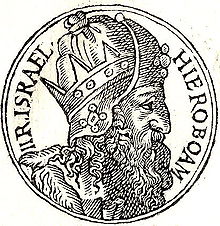 Sometime during the reign of King Jehoash of Judah, the other King Jehoash of Israel made his son, Jeroboam II, his co-regent. He was named after the very first king who ruled over the northern kingdom after God had divided the nation of Israel in half. This division of Solomon’s kingdom was done as a punishment for his idolatry and apostasy. In the latter years of his reign, Solomon had begun to worship the false gods of his many foreign wives.
So Solomon did what was evil in the sight of the Lord and did not wholly follow the Lord, as David his father had done. Then Solomon built a high place for Chemosh the abomination of Moab, and for Molech the abomination of the Ammonites, on the mountain east of Jerusalem. And so he did for all his foreign wives, who made offerings and sacrificed to their gods. – 1 Kings 11:6-8 ESV
As punishment for Solomon’s unfaithfulness, God raised up Jeroboam and placed him over the ten northern tribes of Israel. But Jeroboam proved to be just as unfaithful as Solomon. One of his first official acts as king was to establish his own religion, complete with golden calf idols erected in the cities of Dan and Bethel. He even created his own priesthood and sacrificial system so that the ten northern tribes would have no reason to go to Jerusalem to worship at the temple of Yahweh.
And it reveals a lot about the character of King Jehoash of Israel that he chose to name his son after this man. But the author seems to assure his readers that this decision was fitting because Jeroboam II lived up to the reputation of his infamous predecessor.
And he did what was evil in the sight of the Lord. He did not depart from all the sins of Jeroboam the son of Nebat, which he made Israel to sin. – 2 Kings 14:24 ESV
At his father’s death, Jeroboam II transitioned from his position as co-regent to that of king over all the northern tribes, a title he would hold for 41 years. He would become the longest-reigning king in the history of Israel, outlasting the monarchy of King Jehoash of Judah and that of his son, Amaziah. But other than the note describing the sinful disposition of Jeroboam’s reign, the author provides few other details about his accomplishments. There is a brief mention of his expansion of the territorial boundaries of Israel but it would appear that this was the work of God and not Jeroboam.
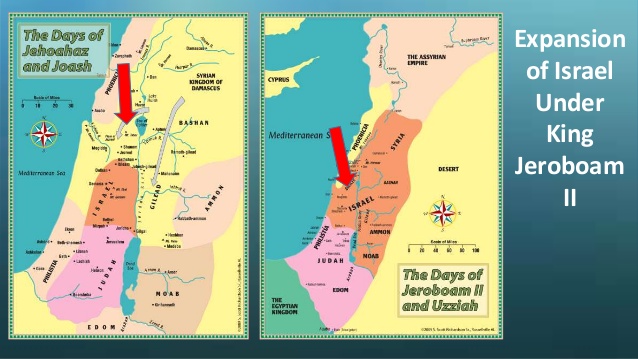 Verse 25 mentions the name of Jonah. He was one of three prophets, including Hosea and Amos, who ministered to the ten northern tribes of Israel. This is the same Jonah who would later receive a divine commission from God to call the pagan people of Ninevah to repentance (Jonah 1:1-2). But long before Jonah was sent to the Assyrians, his responsibility was to act as God’s spokesman to the kings and the people of Israel. It would appear from the text that Jonah gave King Jeroboam a word from Yahweh, commanding him to expand the borders of Israel, and the king obeyed.
He restored the border of Israel from Lebo-hamath as far as the Sea of the Arabah, according to the word of the Lord, the God of Israel, which he spoke by his servant Jonah the son of Amittai, the prophet, who was from Gath-hepher. – 2 Kings 14:25 ESV
 By faithfully fulfilling this divine mandate, Jeroboam II was able to restore the borders of Israel close to where they had been during the reign of King Solomon. While Jeroboam was anything but a godly king, he did prove to be an accomplished leader who helped reestablish Israel’s power and prominence. In fact, both the northern and southern kingdoms would experience unprecedented prosperity during this period of time. This fact seems difficult to reconcile when you consider that both kingdoms were being ruled over by godless kings who promoted idolatry and apostasy. Yet, the author reveals that God was at work, behind the scenes, protecting and preserving His people.
…the Lord had not said that he would blot out the name of Israel from under heaven, so he saved them by the hand of Jeroboam the son of Joash. – 2 Kings 14:27 ESV
God had made a covenant commitment to preserve His people. Despite their repeated demonstrations of disobedience and unfaithfulness, He had never allowed them to suffer the full and well-deserved consequences of their sin. He had stepped in and rescued them time and time again. Long before they ever entered the land of Canaan or established themselves as a nation, God had clearly communicated His expectations to them.
If you fully obey the Lord your God and carefully keep all his commands that I am giving you today, the Lord your God will set you high above all the nations of the world. You will experience all these blessings if you obey the Lord your God… – Deuteronomy 28:1-2 NLT
Then God outlined all the blessings they could expect if they lived in obedience to His will. But He had also warned them that disobedience would bring curses.
But if you refuse to listen to the Lord your God and do not obey all the commands and decrees I am giving you today, all these curses will come and overwhelm you… – Deuteronomy 28:15 NLT
The list of potential curses that followed was intense and terrifying and ended with the warning: “The Lord will exile you and your king to a nation unknown to you and your ancestors. There in exile you will worship gods of wood and stone! You will become an object of horror, ridicule, and mockery among all the nations to which the Lord sends you[ (Deuteronomy 28:36-37 NLT).
There would be dire and devastating consequences should they choose to disobey. But as the author of 2 Kings reveals, “the Lord had not said that he would blot out the name of Israel from under heaven” (2 Kings 14:27 ESV). While God had warned of destruction and even eventual deportation, He had never spoken of Israel’s obliteration. He was committed to keeping the promise He had made to Abraham, Isaac, and Jacob. And it was Jacob whom God had renamed Israel.
“Your name is Jacob, but you will not be called Jacob any longer. From now on your name will be Israel.” So God renamed him Israel.
Then God said, “I am El-Shaddai—‘God Almighty.’ Be fruitful and multiply. You will become a great nation, even many nations. Kings will be among your descendants! And I will give you the land I once gave to Abraham and Isaac. Yes, I will give it to you and your descendants after you.” – Genesis 35:10-12 NLT
This scene took place in Bethel, and it just so happens that Bethel became one of the towns in which the original Jeroboam set up a golden calf idol. The very place where God had promised to make of Jacob (Israel) a great nation, Jeroboam I had erected an idol that would lead the people away from Yahweh. He had promoted disobedience and, in doing so, had brought upon the people of Israel the curses of God. And yet, the author of 2 Kings reveals that God chose to show His rebellious people compassion.
…the Lord saw the bitter suffering of everyone in Israel, and that there was no one in Israel, slave or free, to help them. – 2 Kings 14:26 NLT
Yes, they were rebellious. The people of Israel had forsaken Him time and time again. But God looked on His chosen people and saw them as helpless and hopeless. They had no one to save them. Their kings had proven themselves unwilling and incapable of providing godly leadership. Jeroboam II was no different than his namesake. And yet, God chose to use this godless king to protect His chosen people.
…because the Lord had not said he would blot out the name of Israel completely, he used Jeroboam II, the son of Jehoash, to save them. – 2 Kings 14:27 NLT
God was preserving His people. Not because they deserved it, but because He had a plan that required their continued existence. Hundreds of years earlier, God had made a promise to the patriarch, Abraham:
“I will certainly bless you. I will multiply your descendants beyond number, like the stars in the sky and the sand on the seashore. Your descendants will conquer the cities of their enemies. And through your descendants all the nations of the earth will be blessed—all because you have obeyed me.” – Genesis 22:17-18 NLT
God had made a commitment to bless the nations of the earth through Abraham’s descendants. Yet, as we have seen, the seed of Abraham had proven to be anything but a blessing. They had brought shame to the name of God through their repeated demonstrations of unfaithfulness. But God was choosing to preserve them because He had a plan in place that would bring about the blessing of the nations. And He would do it through the “seed” of Abraham. And the apostle Paul tells us exactly how God fulfilled that promise.
Now the promises were made to Abraham and to his offspring. It does not say, “And to offsprings,” referring to many, but referring to one, “And to your offspring,” who is Christ. – Galatians 3:16 NLT
God preserved the Israelites so that Jesus, who was born a descendant of Abraham, might become the ultimate fulfillment of God’s promise to bless the nations. And Paul goes on to describe how God’s commitment to protect and preserve the nation of Israel has impacted all the nations of the earth.
There is neither Jew nor Greek, there is neither slave nor free, there is no male and female, for you are all one in Christ Jesus. And if you are Christ’s, then you are Abraham’s offspring, heirs according to promise. – Galatians 3:28-29 NLT
All along the way, God had been watching out for His chosen people because He had set them apart for a reason. They were to be the conduit through which He brought the blessing of salvation to a lost and dying world. And that is why, even after He eventually sent them into exile in Babylon, God restored them to the land of promise.
“I myself will tend my sheep and give them a place to lie down in peace, says the Sovereign Lord. I will search for my lost ones who strayed away, and I will bring them safely home again. I will bandage the injured and strengthen the weak. But I will destroy those who are fat and powerful. I will feed them, yes—feed them justice!” – Ezekiel 34:15-16 NLT
God was faithful to keep His promise and preserve His people so that, one day, He might send His Son as the Messiah of Israel and the Savior of the world.
English Standard Version (ESV) The Holy Bible, English Standard Version. ESV® Permanent Text Edition® (2016). Copyright © 2001 by Crossway Bibles, a publishing ministry of Good News Publishers.
New Living Translation (NLT) Holy Bible, New Living Translation, copyright © 1996, 2004, 2015 by Tyndale House Foundation. Used by permission of Tyndale House Publishers Inc., Carol Stream, Illinois 60188. All rights reserved.
The Message (MSG)Copyright © 1993, 1994, 1995, 1996, 2000, 2001, 2002 by Eugene H. Peterson