God’s Indestructible and Unstoppable Plan

27 And there came a man of God to Eli and said to him, “Thus says the Lord, ‘Did I indeed reveal myself to the house of your father when they were in Egypt subject to the house of Pharaoh? 28 Did I choose him out of all the tribes of Israel to be my priest, to go up to my altar, to burn incense, to wear an ephod before me? I gave to the house of your father all my offerings by fire from the people of Israel. 29 Why then do you scorn my sacrifices and my offerings that I commanded for my dwelling, and honor your sons above me by fattening yourselves on the choicest parts of every offering of my people Israel?’ 30 Therefore the Lord, the God of Israel, declares: ‘I promised that your house and the house of your father should go in and out before me forever,’ but now the Lord declares: ‘Far be it from me, for those who honor me I will honor, and those who despise me shall be lightly esteemed. 31 Behold, the days are coming when I will cut off your strength and the strength of your father’s house, so that there will not be an old man in your house. 32 Then in distress you will look with envious eye on all the prosperity that shall be bestowed on Israel, and there shall not be an old man in your house forever. 33 The only one of you whom I shall not cut off from my altar shall be spared to weep his eyes out to grieve his heart, and all the descendants of your house shall die by the sword of men. 34 And this that shall come upon your two sons, Hophni and Phinehas, shall be the sign to you: both of them shall die on the same day. 35 And I will raise up for myself a faithful priest, who shall do according to what is in my heart and in my mind. And I will build him a sure house, and he shall go in and out before my anointed forever. 36 And everyone who is left in your house shall come to implore him for a piece of silver or a loaf of bread and shall say, “Please put me in one of the priests’ places, that I may eat a morsel of bread.”’” – 1 Samuel 2:27-36 ESV

Eli had heard the reports concerning the behavior of his sons and he had confronted and warned them but his words had fallen on deaf ears. His adult sons displayed no fear of God and a stubborn unwillingness to repent from their blasphemous actions. As their father and priestly superior, Eli was ultimately responsible for their behavior. He was the high priest of Israel and was tasked with maintaining the holiness of God’s dwelling place, the Tabernacle. Yet, by their actions, his own sons were desecrating God’s house and treating their priestly role with contempt.

God had set apart the tribe of Levi to be the caretakers of the Tabernacle and the custodians of the Mosaic Law, and He had warned them: “You must faithfully keep all my commands by putting them into practice, for I am the Lord. Do not bring shame on my holy name, for I will display my holiness among the people of Israel. I am the Lord who makes you holy” (Leviticus 22:31-32 NLT).

But Hophni and Phinehas had defamed God’s name and their father failed to deal with them appropriately. So, God stepped in and declared His intention to mete out justice. But first, He confronted Eli about his negligence in handling the problem.

“I chose your ancestor Aaron from among all the tribes of Israel to be my priest, to offer sacrifices on my altar, to burn incense, and to wear the priestly vest as he served me. And I assigned the sacrificial offerings to you priests. So why do you scorn my sacrifices and offerings? Why do you give your sons more honor than you give me—for you and they have become fat from the best offerings of my people Israel!” – 1 Samuel 2:28-29 NLT

God reminded Eli of the distinctive nature of the Levitical priesthood. Aaron, the brother of Moses, had not earned his role as the first high priest, and the tribe of Levi had done nothing to deserve their set-apart status as God’s priestly caste. God had graciously chosen them and designated them as His personal servants.

And the Lord spoke to Moses, saying, “Bring the tribe of Levi near, and set them before Aaron the priest, that they may minister to him. They shall keep guard over him and over the whole congregation before the tent of meeting, as they minister at the tabernacle. They shall guard all the furnishings of the tent of meeting, and keep guard over the people of Israel as they minister at the tabernacle. And you shall give the Levites to Aaron and his sons; they are wholly given to him from among the people of Israel. And you shall appoint Aaron and his sons, and they shall guard their priesthood.” – Numbers 3:5-10 NLT

But these men had blatantly violated their divine commission and failed to guard their priesthood. And when Eli neglected his duties as the high priest by allowing this egregious behavior to continue unchecked, God was obligated to protect the integrity of His name.

“I will show how holy my great name is—the name on which you brought shame…” – Ezekiel 36:23 NLT

God warned Eli that judgment was coming.

I promised that your branch of the tribe of Levi would always be my priests. But I will honor those who honor me, and I will despise those who think lightly of me. – 1 Samuel 2:30 ESV

The role of priest was a privilege but it came with conditions. Only members of the tribe of Levi could serve in this distinctive capacity but their uniqueness as God’s servants required faithfulness and a commitment to honor Him at all costs. While all the tribes of Israel were important to God, He had placed a special emphasis on this one tribe and had promised to protect and provide for them.

“Behold, I have taken the Levites from among the people of Israel instead of every firstborn who opens the womb among the people of Israel. The Levites shall be mine, for all the firstborn are mine. On the day that I struck down all the firstborn in the land of Egypt, I consecrated for my own all the firstborn in Israel, both of man and of beast. They shall be mine: I am the Lord.” – Numbers 3:12-13 ESV

“You shall have no inheritance in their land, neither shall you have any portion among them. I am your portion and your inheritance among the people of Israel. – Numbers 18:20 ESV

The elderly Eli must have been stunned by the divine pronouncement delivered by the prophet of God.

The time is coming when I will put an end to your family, so it will no longer serve as my priests. All the members of your family will die before their time. None will reach old age. – 1 Samuel 2:31 ESV

The consequences were far worse than anything Eli could have imagined. Not only would his sons receive divine judgment for their sins, but his entire line would suffer early and untimely deaths. It would not be enough for them to lose their rights to serve as priests; they must suffer the just and righteous consequences for their actions.

This punishment may seem overly severe to our modern sensibilities, but it reflects the weighty nature of the sin of Hophne and Phinehas. They had dishonored not only their priestly position but also the name of God. And it would appear that their actions had already infected the rest of their clan. Sin never operates in a vacuum; it tends to spread and infect others. So, it is likely that the actions of Hophne and Phinehas, while the prime focus of this passage, were far from isolated or unique. The entire clan of Eli had become corrupt and unworthy of serving as God’s servants.

The intensity of God’s pronouncement must not be overlooked. Eli needed to fully understand the weight of his sons’ actions. God was making a powerful and unforgettable statement about sin and its consequences, and to drive home His message, God informs Eli that both of his sons will suffer death on the very same day. Their lives of decadence and disobedience will come to a quick and ignominious end.

The final paragraph of this chapter contains a glimmer of hope surrounding a dark cloud of sorrow for Eli. With the death of Eli’s sons, God promises to raise up their replacement.

“Then I will raise up a faithful priest who will serve me and do what I desire. I will establish his family, and they will be priests to my anointed kings forever. – 1 Samuel 2:35 NLT

This would not have come across as good news to Eli. But it was God’s way of promoting His providential and sovereign will. Despite what Hophne and Phinehas had done, God’s plan would prevail. While the clan of Eli would lose their priestly rights and die untimely deaths, God had another line of Levites who could serve in their place.

God was informing Eli that His will would still be done. The sins of Hophne and Phinehas and the negligence of Eli could not alter God’s divine plan. And this prophetic promise from God is meant to highlight the immediate as well as the distant future. As the following chapters of this book will reveal, Samuel will fulfill this promise – in part. But centuries later, during the reign of King Solomon, Zadok became the high priest, replacing Abiathar, a descendant of Eli. From that point forward, no other member of Eli’s clan will serve in that capacity.

But the final fulfillment of God’s promise will take place with the coming of Jesus, who served as the final high priest even though He was not of the tribe of Levi. The author of the Book of Hebrews spells out how Jesus, a member of the tribe of Judah, became the great high priest and fulfilled the promise of God.

So if the priesthood of Levi, on which the law was based, could have achieved the perfection God intended, why did God need to establish a different priesthood, with a priest in the order of Melchizedek instead of the order of Levi and Aaron?

And if the priesthood is changed, the law must also be changed to permit it. For the priest we are talking about belongs to a different tribe, whose members have never served at the altar as priests. What I mean is, our Lord came from the tribe of Judah, and Moses never mentioned priests coming from that tribe.

This change has been made very clear since a different priest, who is like Melchizedek, has appeared. Jesus became a priest, not by meeting the physical requirement of belonging to the tribe of Levi, but by the power of a life that cannot be destroyed. – Hebrews 7:11-16 NLT

Hophne and Phinehas had blown it, and Eli had refused to deal with it. But God was not done yet. His plan is indestructible and unstoppable. The entire clan of Eli could drop the ball and God would not miss a beat. He already had Samuel in place and, in time, the guilty would suffer the consequences for their sins and the next step in God’s divine plan would unfold. And the opening line of the very next chapter sets the tone for all that is to come.

Now the boy Samuel was ministering to the Lord in the presence of Eli. – 1 Samuel 3:1 ESV

English Standard Version (ESV) The Holy Bible, English Standard Version. ESV® Permanent Text Edition® (2016). Copyright © 2001 by Crossway Bibles, a publishing ministry of Good News Publishers.

New Living Translation (NLT) Holy Bible, New Living Translation, copyright © 1996, 2004, 2015 by Tyndale House Foundation. Used by permission of Tyndale House Publishers Inc., Carol Stream, Illinois 60188. All rights reserved.
Getting to Know God the Hard Way

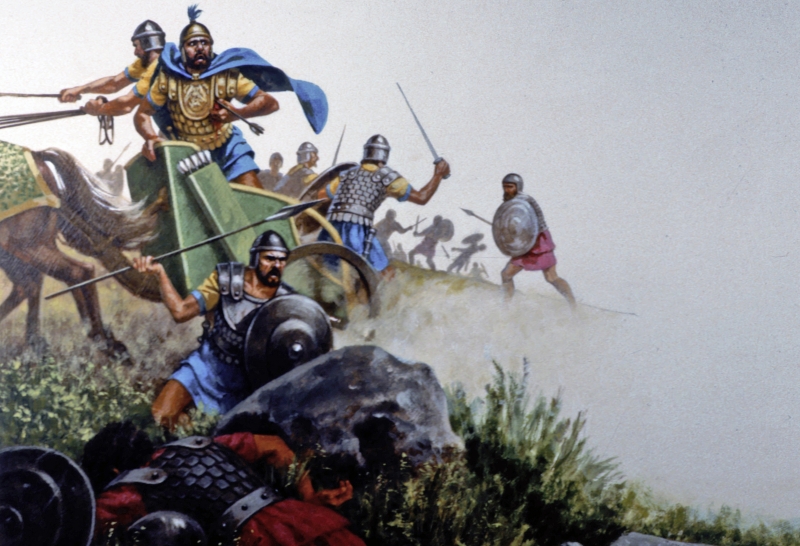
16 And they went out at noon, while Ben-hadad was drinking himself drunk in the booths, he and the thirty-two kings who helped him. 17 The servants of the governors of the districts went out first. And Ben-hadad sent out scouts, and they reported to him, “Men are coming out from Samaria.” 18 He said, “If they have come out for peace, take them alive. Or if they have come out for war, take them alive.”

19 So these went out of the city, the servants of the governors of the districts and the army that followed them. 20 And each struck down his man. The Syrians fled, and Israel pursued them, but Ben-hadad king of Syria escaped on a horse with horsemen. 21 And the king of Israel went out and struck the horses and chariots, and struck the Syrians with a great blow.

22 Then the prophet came near to the king of Israel and said to him, “Come, strengthen yourself, and consider well what you have to do, for in the spring the king of Syria will come up against you.”

23 And the servants of the king of Syria said to him, “Their gods are gods of the hills, and so they were stronger than we. But let us fight against them in the plain, and surely we shall be stronger than they. 24 And do this: remove the kings, each from his post, and put commanders in their places, 25 and muster an army like the army that you have lost, horse for horse, and chariot for chariot. Then we will fight against them in the plain, and surely we shall be stronger than they.” And he listened to their voice and did so. 

26 In the spring, Ben-hadad mustered the Syrians and went up to Aphek to fight against Israel. 27 And the people of Israel were mustered and were provisioned and went against them. The people of Israel encamped before them like two little flocks of goats, but the Syrians filled the country.

28 And a man of God came near and said to the king of Israel, “Thus says the Lord, ‘Because the Syrians have said, “The Lord is a god of the hills but he is not a god of the valleys,” therefore I will give all this great multitude into your hand, and you shall know that I am the Lord.’”1 Kings 20:16-28 ESV

King Ahab found himself in a strange predicament. His capital city, Samaria, was under attack by a confederation of 32 kings, led by King Ben-hadad of Syria. But much to Ahab’s surprise, a prophet of Yahweh had appeared with a plan for Israel’s deliverance.

“Thus says the Lord, Have you seen all this great multitude? Behold, I will give it into your hand this day, and you shall know that I am the Lord.” – 1 Kings 20:13 ESV

The very God whom Ahab and Jezebel had attempted to replace with their false gods had announced that He was going to rescue His disobedient and unfaithful people. And God had told Ahab exactly how the victory would take place.

By the servants of the governors of the districts.” – 1 Kings 20:14 ESV

God was not going to utilize Ahab’s army to fight the Syrians. This is significant because Ahab, like all his predecessors, had assembled a large military force. There is even evidence to that fact, found on an ancient Assyrian stone tablet. It bears an inscription describing the battle of Qarqar between Ahab and his enemy King Shalmaneser III of Assyria. The tablet records the size of the army that assembled to do battle that day: “2,000 chariots and 10,000 men of Ahab king of Israel.”

But on this occasion, God chose to place Ahab’s formidable resources in a secondary position, choosing instead to use “servants” – a group of common people who, when assembled, amounted to only 7,000 in number.

Confident that he would defeat the Israelites, Ben-hadad and his vassal kings were drinking themselves drunk in a pre-victory celebration. So, when scouts arrived with a report that Israelite forces had been seen leaving the city, Beh-hadad had assumed they were bringing news of Israel’s surrender or their decision to continue the battle. While he and his military commanders continued to toast their inevitable victory, the 7,000 servants made their way to the Syrian camp, followed by Ahab and his army.

This surprise attack caught the Syrian forces completely unawares and unable to respond. Led by the 7,000 servants, Ahab’s army quickly routed the Syrians, forcing them to abandon camp and run for their lives. Quickly sobered by this unexpected reversal of fortunes, Beh-hadad managed to escape. But the rest of his forces didn’t fare as well.

And the king of Israel went out and struck the horses and chariots, and struck the Syrians with a great blow. – 1 Kings 20:21 ESV

Notice that the author conveniently eliminates any mention of Ahab’s name. He simply refers to him as “the king of Israel.” He repeats this obvious slight in the very next verse, refusing to give Ahab any credit for the victory. He simply warns him that the battle may be done, but the war is from over.

“Come, strengthen yourself, and consider well what you have to do, for in the spring the king of Syria will come up against you.” – 1 Kings 20:22 ESV

Ben-hadad would be back. He had suffered a devastating defeat, but once he had time to assess what had happened that day, the Syrian king would return, more determined than ever to avenge his loss by destroying the Israelites. And his advisors encouraged his plans by suggesting that his loss had been divinely ordained. In their pagan way of thinking, the only thing that could explain a loss of this magnitude was the intervention of the gods. They rationalized away their defeat by concluding that they had chosen the wrong place to do battle.  They absolved Beh-hadad of any responsibility for the loss by assuring him, “Their gods are gods of the hills, and so they were stronger than we. But let us fight against them in the plain, and surely we shall be stronger than they” (1 Kings 20:23 ESV).

Little did they know how right they were. Their defeat had been the result of divine intervention, but geographic location had played no role in it. Yahweh was the God of the hills and the valleys. He was sovereign over all the earth. Unlike their false gods, Yahweh was unbound by time and space. The extent of His power was limitless. To the God of Israel, the location and the size of the opposing army made no difference. And so, when Ben-hadad’s advisors counseled him to rebuild his army and restructure his military command, it would prove to be futile advice. They had no idea what they were dealing with and their ignorance led them to make some very dangerous assumptions. First, they assumed that the God of Israel was similar to their own gods – limited in power and vulnerable to defeat. After all, their gods had failed to deliver them. So, if they could find Yahweh’s weak spots, the next battle would go their way.

And Ben-hadad, eager to avenge his loss, took their advice and spent the winter rebuilding his army. He replaced the 32 kings with seasoned military commanders. He ordered the construction of new chariots. And he made plans to take the fight to the valley, where the God of Israel would have no power and play no role in the outcome of the battle.

It is fascinating to consider that all of this was in the sovereign will of God. He had orchestrated all the details concerning the original battle, including Ben-hadad’s escape. God had even told Ahab that the Syrians would return. Ben-hadad’s rebuilding and reconfiguring of his army had been part of God’s plan. The original battle had been intended to restore the Israelites’ belief in God. Prior to their victory, God had told them, “I will give it into your hand this day, and you shall know that I am the Lord” (1 Kings 20:13 ESV).

But God knew that little had changed in Israel. Even after their miraculous defeat of the Syrians, the people still remained unconvinced of Yahweh’s status as the one true God. When spring rolled around, they found themselves facing their former foe again. This time, Beh-hadad showed up with a much larger and better-equipped army than before, and rather than laying siege to the city, they gathered in the Valley of Aphek. Ben-hadad had brought a bigger, better army and had chosen a battleground that was outside the reach of Yahweh’s power. Or so he thought.

The stage was set. The enemy of Israel had returned. And the author paints a rather bleak and foreboding picture of the situation.

Israel then mustered its army, set up supply lines, and marched out for battle. But the Israelite army looked like two little flocks of goats in comparison to the vast Aramean forces that filled the countryside! – 1 Kings 20:27 NLT

Here was Israel, outnumbered and underequipped yet again. They were no match for the Syrians. And this time, they would not have the walls of the city to protect them. They would be fighting on open terrain, facing an army equipped with chariots and horses and motivated by revenge.

But God sent another prophet with a promise of His presence and power.

“Thus says the Lord, ‘Because the Syrians have said, “The Lord is a god of the hills but he is not a god of the valleys,” therefore I will give all this great multitude into your hand, and you shall know that I am the Lord.’” – 1 Kings 20:28 ESV

Despite the overwhelming odds, God would provide another victory over their enemy. By the time this day was over, they would know that He was the one true God. But notice that in verse 28, the author leaves out Ahab’s name again. He simply refers to him as “the king of Israel.” God was going to deliver this victory despite Ahab, not because of him. Not only did Ahab deserve to lose this battle, but he also deserved to die for his blatant rebellion against God. But God was acting on behalf of His covenant people. He was doing this to protect the integrity and honor of His name. He had made covenant promises to Abraham, Isaac, and Jacob. He had given His word to Moses and David. And while Ahab had failed to use his position as the shepherd of Israel to lead them in faithful obedience, God would prove Himself true to His word and committed to His covenant promises.

English Standard Version (ESV) The Holy Bible, English Standard Version. ESV® Permanent Text Edition® (2016). Copyright © 2001 by Crossway Bibles, a publishing ministry of Good News Publishers.

New Living Translation (NLT) Holy Bible, New Living Translation, copyright © 1996, 2004, 2015 by Tyndale House Foundation. Used by permission of Tyndale House Publishers Inc., Carol Stream, Illinois 60188. All rights reserved.

The Message (MSG)Copyright © 1993, 1994, 1995, 1996, 2000, 2001, 2002 by Eugene H. Peterson

Living By Faith, Not Sight

1 I will take my stand at my watchpost
    and station myself on the tower,
and look out to see what he will say to me,
    and what I will answer concerning my complaint.

And the Lord answered me:

“Write the vision;
    make it plain on tablets,
    so he may run who reads it.
For still the vision awaits its appointed time;
    it hastens to the end—it will not lie.
If it seems slow, wait for it;
    it will surely come; it will not delay.

“Behold, his soul is puffed up; it is not upright within him,
    but the righteous shall live by his faith.

“Moreover, wine is a traitor,
    an arrogant man who is never at rest.
His greed is as wide as Sheol;
    like death he has never enough.
He gathers for himself all nations
    and collects as his own all peoples.” Habakkuk 2:1-5 ESV

With the opening of chapter two, there can be little doubt as to whether Habakkuk is unhappy with conditions in Judah and far from pleased that God’s solution was to bring judgment on Judah through the use of the Babylonians. Continuing his dialogue with the Almighty, Habakkuk declares that he is going to stand his ground, like a watchman on a tower, waiting to hear what God has to say to his latest round of questions.

Habakkuk was confident that God would respond and he fully expected it to come in the form of a rebuke. The Hebrew word he used is towkechah and it conveys the idea of a verbal reproof or correction. He saw himself in the middle of an argument with God and was already thinking about how he was going to respond when God was done defending His actions.

The various translations of the Bible have taken slightly different tacts when interpreting the exact thought expressed by Habakkuk in verse one. The ESV translates it as follows:

I will take my stand at my watchpost and station myself on the tower, and look out to see what he will say to me, and what I will answer concerning my complaint.

The New Living Translation puts the emphasis on God, not Habakkuk. The prophet was expecting an answer to his second round of complaints.

I will climb up to my watchtower and stand at my guardpost. There I will wait to see what the LORD says and how he will answer my complaint.

The New American Standard Version takes a similar approach, portraying Habakkuk as waiting to be rebuked by God and already formulating his response.

I will stand on my guard post And station myself on the rampart; And I will keep watch to see what He will speak to me, And how I may reply when I am reproved.

It seems that the prophet fully expected his dialogue or debate with God to continue in some form or fashion. He was not going to relent or give up easily. And he was willing to wait, describing himself as a watchman on the wall of a city, scanning the horizon for any glimpse of a possible adversary. Habakkuk saw himself in a war of words with God. But his motive was not anger. He was sincerely concerned for the well-being of his people and was asking for clarification. What he had heard so far had left him confused and struggling to understand how this plan of God was in keeping with His covenant commitment to the people of Judah.

This whole exchange is similar to the one Abraham had with God concerning the fate of Sodom and Gomorrah. When God had announced that He was bringing destruction to those two wicked cities, Abraham had intervened, realizing that his nephew, Lot, and his family were living in Sodom. Abraham had presented God with a question.

“Will you sweep away both the righteous and the wicked? Suppose you find fifty righteous people living there in the city—will you still sweep it away and not spare it for their sakes? Surely you wouldn’t do such a thing, destroying the righteous along with the wicked. Why, you would be treating the righteous and the wicked exactly the same! Surely you wouldn’t do that! Should not the Judge of all the earth do what is right?”  – Genesis 18:23-25 NLT

In response to Abraham’s plea, God agreed to spare the city if He could find 50 righteous people residing within it. And this led Abraham to boldly counter with a slight change to his initial request:

“Since I have begun, let me speak further to my Lord, even though I am but dust and ashes. Suppose there are only forty-five righteous people rather than fifty? Will you destroy the whole city for lack of five?” – Genesis 18:27-28 NLT

And again, God agreed to the new conditions. But Abraham was not done. The passage said, “Abraham pressed his request further” (Genesis 18:29 NLT). He continued to lower the requisite number of righteous residents in the hope that he could somehow assure the rescue of Lot and his family. Abraham even begged God to forgive his rather presumptuous and argumentative methodology.  “Lord, please don’t be angry with me if I speak one more time” (Genesis 18:32 NLT). But despite Abraham’s pestering persistence, God continued to acquiesce to his requests. And all of this was motivated by Abraham’s desire for God to spare Lot and his family.

As was the case with Abraham, Habakkuk was not arrogantly attempting to pick a fight with God. He was not arguing for argument’s sake. He had a legitimate concern for the people of Judah. His original petition to God concerned the dire conditions of those in Judah who found themselves surrounded by wickedness. Like Abraham, Habakkuk was concerned for the faithful remnant of God – those righteous few who were suffering in the Sodom-like conditions of Judah.

And Habakkuk, the self-ascribed “watchman on the wall,” got the answer he was looking for. He matter-of-factly states: “And the Lord answered me” (Habakkuk 2:2 ESV).

The first thing God told Habakkuk was to write down what he was about to hear. He was to make a permanent record of God’s response so that it could be disseminated among the people of Judah.

“Write my answer plainly on tablets,
    so that a runner can carry the correct message to others.
This vision is for a future time.
    It describes the end, and it will be fulfilled.
If it seems slow in coming, wait patiently,
    for it will surely take place.
    It will not be delayed.” – Habakkuk 2:2-3 NLT

And God informs Habakkuk that the content of this vision or message was concerning future events. God was answering Habakkuk’s questions, but the prophet needed to understand that the fulfillment of God’s plan was going to be long-term in nature. Habakkuk needed to know that there would not be a quick-fix to Judah’s problem. A solution was on its way, but it would be a long time in coming. And Habakkuk and the people of Judah were going to have to prepare themselves for a lengthy delay.

And God makes it clear that the delay was going to require faith on the part of the people of God. They were going to have to trust Yahweh, ignoring the conditions that clouded their view and keeping their eyes focused on the faithfulness of their God. Unlike the proud, who “trust in themselves, and their lives are crooked” (Habakkuk 2:4 NLT), the people of Judah were to trust in God.

“…the righteous will live by their faithfulness to God.” – Habakkuk 2:4 NLT

Things were going to get worse before they got better. The situation in Judah would not improve any time soon. In fact, the Babylonians would eventually arrive on the scene, destroying the city of Jerusalem and transporting its citizens as captives back to Babylon. They would remain there for 70 long years, suffering the humiliation of slavery and subjugation to their pagan overlords. But God encouraged the righteous to have faith. Even when all looked lost, He was not yet done. His plan was not yet complete.

This theme of faith in the face of adversity was picked up by the New Testament authors and used to encourage the righteous remnant in their day to remain faithful to the end. Paul told the beleaguered Christians in Rome:

For I am not ashamed of the gospel, for it is the power of God for salvation to everyone who believes, to the Jew first and also to the Greek. For in it the righteousness of God is revealed from faith for faith, as it is written, “The righteous shall live by faith.” – Romans 1:16-17 ESV

He wrote to the believers in Galatia, reminding them that salvation was not based on human effort or through some form of self-righteousness achieved through adherence to the law of God. Instead, it was based on faith.

Now it is evident that no one is justified before God by the law, for “The righteous shall live by faith.” – Galatians 3:11 ESV

Their right standing with God was based on their belief in the redemptive work of Christ. And yet, they were constantly being bombarded with lies that suggested their salvation required effort on their part. False teachers were claiming that faith alone in Christ alone was not enough. But Paul kept going back to the reality of the message of God: The righteous shall live by faith.

And the author of Hebrews picked up on God’s promise to Habakkuk, utilizing His call to faith, even in the midst of difficulty

“And my righteous ones will live by faith.
    But I will take no pleasure in anyone who turns away.”

But we are not like those who turn away from God to their own destruction. We are the faithful ones, whose souls will be saved. – Hebrews 10:38-29 NLT

The context in Hebrews is that of believers who are facing difficulty but who must keep their faith focused on the promise of God.

So do not throw away this confident trust in the Lord. Remember the great reward it brings you! Patient endurance is what you need now, so that you will continue to do God’s will. – Hebrews 10:35-26 NLT

For Habakkuk, the immediate future looked bleak and foreboding. God’s pronouncement that He was sending the Babylonians as His instruments of judgment had left Habakkuk stunned. But God was calling His prophet to remain faithful, trusting that the divine plan would have a happy ending.

But God knew that Habakkuk was having a difficult time getting his mind off of the thought that the Babylonians were going to come out as victors over God’s people. That was more than he could handle. Which is why God assured him:

Wealth is treacherous,
    and the arrogant are never at rest.
They open their mouths as wide as the grave,
    and like death, they are never satisfied.
In their greed they have gathered up many nations
    and swallowed many peoples. – Habakkuk 2:5 NLT

Things are not always as they seem. The success of the wicked, while difficult to understand and even harder to witness, is not the final chapter in the story. The Babylonians would become wealthy and powerful. They would conquer many nations and enrich themselves with the spoils of war. But God wanted Habakkuk to know that He had already written the final chapter of their story. And in the following verses, God will provide Habakkuk with a glimpse into Babylon’s fate.

As bad as things appeared to be, all was not lost. God had a plan. And the futures of Babylon and Judah were part of that plan. But when the coming days became filled with darkness and despair, the righteous would need to live by faith, not fear.

English Standard Version (ESV)
The Holy Bible, English Standard Version. ESV® Permanent Text Edition® (2016). Copyright © 2001 by Crossway Bibles, a publishing ministry of Good News Publishers.

New Living Translation (NLT)
Holy Bible, New Living Translation, copyright © 1996, 2004, 2015 by Tyndale House Foundation. Used by permission of Tyndale House Publishers Inc., Carol Stream, Illinois 60188. All rights reserved.

The Message (MSG)Copyright © 1993, 1994, 1995, 1996, 2000, 2001, 2002 by Eugene H. Peterson

The Hand of God.

Then Hushai said to Zadok and Abiathar the priests, “Thus and so did Ahithophel counsel Absalom and the elders of Israel, and thus and so have I counseled. Now therefore send quickly and tell David, ‘Do not stay tonight at the fords of the wilderness, but by all means pass over, lest the king and all the people who are with him be swallowed up.’” Now Jonathan and Ahimaaz were waiting at En-rogel. A female servant was to go and tell them, and they were to go and tell King David, for they were not to be seen entering the city. But a young man saw them and told Absalom. So both of them went away quickly and came to the house of a man at Bahurim, who had a well in his courtyard. And they went down into it. And the woman took and spread a covering over the well’s mouth and scattered grain on it, and nothing was known of it. When Absalom’s servants came to the woman at the house, they said, “Where are Ahimaaz and Jonathan?” And the woman said to them, “They have gone over the brook of water.” And when they had sought and could not find them, they returned to Jerusalem.

After they had gone, the men came up out of the well, and went and told King David. They said to David, “Arise, and go quickly over the water, for thus and so has Ahithophel counseled against you.” Then David arose, and all the people who were with him, and they crossed the Jordan. By daybreak not one was left who had not crossed the Jordan.

When Ahithophel saw that his counsel was not followed, he saddled his donkey and went off home to his own city. He set his house in order and hanged himself, and he died and was buried in the tomb of his father.

Then David came to Mahanaim. And Absalom crossed the Jordan with all the men of Israel. Now Absalom had set Amasa over the army instead of Joab. Amasa was the son of a man named Ithra the Ishmaelite, who had married Abigal the daughter of Nahash, sister of Zeruiah, Joab’s mother. And Israel and Absalom encamped in the land of Gilead.

When David came to Mahanaim, Shobi the son of Nahash from Rabbah of the Ammonites, and Machir the son of Ammiel from Lo-debar, and Barzillai the Gileadite from Rogelim, brought beds, basins, and earthen vessels, wheat, barley, flour, parched grain, beans and lentils, honey and curds and sheep and cheese from the herd, for David and the people with him to eat, for they said, “The people are hungry and weary and thirsty in the wilderness.” – 2 Samuel 17:15-29 ESV

The will of God begins to reveal itself as the story unfolds. His divine strategy becomes increasingly clearer as each detail of the narrative takes place. David had sent Hushai, one of his counselors, back to Jerusalem, with instructions to act as his spy in the court of Absalom. Specifically, Hushai was to act as a counselor to Absalom, countering any advice given by Ahithophel, another one of David’s former counselors who had betrayed him. Hushai had done as David asked and had been able to refute the counsel given by Ahithophel. Had Hushai not been there, Absalom would have listened to the advice of Ahithophel and sent 12,000 men to hunt David down. David would have been severely outmanned, exhausted by his quick departure from Jerusalem, and burdened by the presence of many defenseless women and children. Had Hushai not been there to provide alternative counsel to Absalom, things could have turned out very badly for David. But God was in control. He gave Hushai the exact words to speak that would appeal to the ego of Absalom and do the most damage to the heart of Ahithophel.

Part of Hushai’s advice to Absalom was that he assemble a massive army in order to fight one epic battle with David, and that he personally lead this army. Hushai, under the divine inspiration of God, gave counsel that stroked the massive ego of Absalom and caused him to reject the counsel of Ahithophel. And Ahithophel took this rejection very hard. So much so, that he went out and hung himself. There are those who believe that he did not do so until after the battle between David and Absalom actually took place and he knew that his days were numbered. But the text does not indicate that kind of a delay. It would appear that Ahithophel had betrayed David so that he could be the one and only counselor to the new king. He had helped Absalom plan his coup. He had gone out of his way to ingratiate himself to David’s rebellious son, because he craved power and influence. And when Hushai showed up and proved himself capable of winning over Absalom’s favor, Ahithophel couldn’t take it. So, he killed himself. Once again, God was working behind the scenes, orchestrating events in such a way that the outcomes were in David’s favor.

Even when Hushai attempted to send news to David through their network of spies, and Absalom found out, God stepped in and provided protection Jonathan and Ahimaaz. They were able to find sanctuary in the house of someone favorable to David. And, when Absalom’s men could not locate them, they were able to escape and warn David of Absalom’s plans.

David would have time to prepare for the upcoming battle with Absalom, and one of the first things he had to do was to amass enough men to field an army of his own. But God was on his side and before David knew it, the necessary forces began to show up, unannounced and uninvited. The text lists the names of Shobi, Machir, and Barzillai. These three men come alongside David, providing him with food and support. David was not alone. These men brought David physical refreshment in the form of food, but more important than that, they brought him moral support. They offered him their friendship in one of the darkest moments of his life. God was letting David know that all was not lost. This seemingly bleak period of David’s life was going to have a bright outcome. David did not know what fate the next day held, but he was confident that God was with him. Sometimes, God reveals Himself to us in the little “miracles” of life. Hushai’s counsel had been accepted by Absalom. David’s spy network had worked and God had protected Jonathan and Ahimaaz, so that they could bring David news. Food and moral support had shown up unexpectedly, but at just the right time. And, as we will see in the very next chapter, many others would lend their support to David’s cause, allowing him to field an army that numbered in the thousands.

God was at work. He is not mentioned in this section of Scripture, but His presence and power can be felt. He is at work, unseen by human eyes, but clearly evident in the way the events unfold. You can almost sense the tide turning and the momentum shifting. Absalom has been on a role. Up until this point, everything had been going his way. He could do nothing wrong. He had taken the city of Jerusalem without a fight and stolen his father’s kingdom in a bloodless coup. He had the hearts of the people and the future looked bright. But he could not see the hand of God. He was oblivious to what God was doing and what God had in store for him. Little did he know that his co-conspirator and primary counselor had hung himself. And before long, Absalom would find himself hanging by his hair from a tree. Because the hand of God is greater than the armies of man.

You can make many plans, but the LORD’s purpose will prevail. – Proverbs 19:21 NLT

English Standard Version (ESV)
The Holy Bible, English Standard Version. ESV® Permanent Text Edition® (2016). Copyright © 2001 by Crossway Bibles, a publishing ministry of Good News Publishers.

New Living Translation (NLT)
Holy Bible, New Living Translation, copyright © 1996, 2004, 2015 by Tyndale House Foundation. Used by permission of Tyndale House Publishers Inc., Carol Stream, Illinois 60188. All rights reserved.
The Message (MSG)Copyright © 1993, 1994, 1995, 1996, 2000, 2001, 2002 by Eugene H. Peterson

The Transfer of Power.

After the death of Saul, when David had returned from striking down the Amalekites, David remained two days in Ziklag. And on the third day, behold, a man came from Saul’s camp, with his clothes torn and dirt on his head. And when he came to David, he fell to the ground and paid homage. David said to him, “Where do you come from?” And he said to him, “I have escaped from the camp of Israel.” And David said to him, “How did it go? Tell me.” And he answered, “The people fled from the battle, and also many of the people have fallen and are dead, and Saul and his son Jonathan are also dead.” Then David said to the young man who told him, “How do you know that Saul and his son Jonathan are dead?” And the young man who told him said, “By chance I happened to be on Mount Gilboa, and there was Saul leaning on his spear, and behold, the chariots and the horsemen were close upon him. And when he looked behind him, he saw me, and called to me. And I answered, ‘Here I am.’ And he said to me, ‘Who are you?’ I answered him, ‘I am an Amalekite.’ And he said to me, ‘Stand beside me and kill me, for anguish has seized me, and yet my life still lingers.’ So I stood beside him and killed him, because I was sure that he could not live after he had fallen. And I took the crown that was on his head and the armlet that was on his arm, and I have brought them here to my lord.”

Then David took hold of his clothes and tore them, and so did all the men who were with him. And they mourned and wept and fasted until evening for Saul and for Jonathan his son and for the people of the Lord and for the house of Israel, because they had fallen by the sword. And David said to the young man who told him, “Where do you come from?” And he answered, “I am the son of a sojourner, an Amalekite.” David said to him, “How is it you were not afraid to put out your hand to destroy the Lord‘s anointed?” Then David called one of the young men and said, “Go, execute him.” And he struck him down so that he died. And David said to him, “Your blood be on your head, for your own mouth has testified against you, saying, ‘I have killed the Lord‘s anointed.’” – 2 Samuel 1:1-16 ESV

The Bible is full of irony, and this story is a case in point. Saul, having taken his own life by falling on his own sword, was left on the field of battle, his body unprotected and easy pickings for the Philistines soldiers to find. But according to this story, an Amalekite got to Saul before the Philistines did. He took Saul’s crown and armlet and made his way to Ziklag, having concocted a false version of the events surrounding Saul’s death, in hopes that David would reward him for having killed Saul. But the irony in all of this is that this man, who falsely took credit for Saul’s death and stole his crown and armlet, was an Amalekite. All the way back in 1 Samuel 13, Saul was commanded by God to destroy the Amalekites, completely wiping out every man, woman and child. But Saul was disobedient to God. He failed to do what God had commanded him to do. And as a result the Amalekites were alive and well. In fact, the second point of irony is that this man made his way to David, proudly proclaiming his Amalekite ethnicity, totally unaware that David had just defeated and plundered his countrymen for having raided his city and capturing its inhabitants. In other words, this young man picked a bad time to be an Amalekite and to brag about killing the king of Israel with his own hands.

The fact that the account of chapter one of 2 Samuel differs slightly from that of chapter 31 of 1 Samuel has caused some consternation over the years. But it is not a case of a discrepancy in the Bible. It is simply the facts related to the events. Chapter 31 of 1 Samuel records what actually happened as it relates to Saul’s death and the aftermath. Nowhere does it mention his crown or armlet. Only his head, decapitated body and armor were taken by the Philistines. Had they found something as significant as his crown, it would probably been mentioned. But according to the story in chapter one of 2 Samuel, the crown had been taken by an Amalekite who was plundering the bodies of the fallen. And he was not mentioned in the closing chapter of 1 Samuel, because it was a record of Saul’s death, not David’s reaction to it. The author reserved the events surrounding the Amalekite and his plundering of Saul’s crown and amulet until later.

And the Amalekite mercenary’s arrival in David’s camp and his news of Saul’s death were not received with the joy and gratitude he had imagined.

David and his men tore their clothes in sorrow when they heard the news. They mourned and wept and fasted all day for Saul and his son Jonathan, and for the Lord’s army and the nation of Israel, because they had died by the sword that day. – 2 Samuel 1:11-12 NLT

This was not what the young man had expected. Instead of David reacting with joy and offering the Amalekite a reward for his claim of having killed David’s archenemy, he went into mourning, weeping over the death of the Lord’s anointed. There was no celebration, no gloating, no dance of victory over Saul’s well-deserved death. And the idea that an Amalekite had been the one to take the king’s life was too much for David to handle. Based on the young man’s bold claim, David had him executed. Not exactly the reward he had been seeking.

What is interesting to note in this story is the sovereign hand of God at work. These two chapters provide a turning point in the story of David’s life. Between them, we see a transition of power taking place between Saul and David. It is fascinating to consider that this unsuspecting Amalekite was used by God to bring the very crown of Saul and hand it to the man whom God had appointed and anointed to be the next king of Israel. It was a tangible symbol of what was taking place within the story – all part of God’s strategic plan for David’s rise to the throne of Israel.

David’s path to the throne had been a long and arduous one. From the day he had been anointed by Samuel the prophet, until the moment Saul fell on his sword, taking his own life, David had experienced a lengthy, pain-filled journey filled with ups and downs, twists and turns, and moments of doubt and despair. David’s faith had been tested. He had been oftentimes confused by the events surrounding his life. He didn’t always understand what was going on or enjoy the manner in which God had chosen to direct his life. But he kept trusting. He kept waiting. And while he had been given two different opportunities to take Saul’s life, he had refused. In both cases he had considered Saul the Lord’s anointed and was unwilling to raise his hand against him. Up until the very end, David had showed honor and respect for the Lord’s anointed, even mourning the death of the very man who had dedicated years of his life to the David’s destruction.

Saul was defeated by the Philistines. He took his own life. An Amalekite plundered the crown from his dead body and claimed responsibility for his death. He expected a reward from David. But David mourned and rewarded the Amalekite with death. Saul’s crown, the symbol of his power, had been handed over to David by an unlikely source and in an unexpected manner. Saul’s short-lived dynasty had come to an abrupt and ignominious end. And with his death, the transfer of power had begun. David was poised to become the next king of Israel. God’s hand-picked successor was about to ascend the throne of Israel and assume the responsibility of leading the people of Israel on behalf of God. The man who had repeatedly shown honor and respect for the Lord’s anointed was about to become the Lord’s anointed. And every single event and circumstance up until this point had all been part of God’s sovereign plan for David’s life. The timing was perfect. The plan was unfolding just as God had ordained it.

English Standard Version (ESV)
The Holy Bible, English Standard Version. ESV® Permanent Text Edition® (2016). Copyright © 2001 by Crossway Bibles, a publishing ministry of Good News Publishers.

New Living Translation (NLT)
Holy Bible, New Living Translation, copyright © 1996, 2004, 2015 by Tyndale House Foundation. Used by permission of Tyndale House Publishers Inc., Carol Stream, Illinois 60188. All rights reserved.

The Message (MSG)Copyright © 1993, 1994, 1995, 1996, 2000, 2001, 2002 by Eugene H. Peterson

Israel: God Fights.

Now the famine was severe in the land. And when they had eaten the grain that they had brought from Egypt, their father said to them, “Go again, buy us a little food.” But Judah said to him, “The man solemnly warned us, saying, ‘You shall not see my face unless your brother is with you.’ If you will send our brother with us, we will go down and buy you food. But if you will not send him, we will not go down, for the man said to us, ‘You shall not see my face, unless your brother is with you.’” Israel said, “Why did you treat me so badly as to tell the man that you had another brother?” They replied, “The man questioned us carefully about ourselves and our kindred, saying, ‘Is your father still alive? Do you have another brother?’ What we told him was in answer to these questions. Could we in any way know that he would say, ‘Bring your brother down’?” And Judah said to Israel his father, “Send the boy with me, and we will arise and go, that we may live and not die, both we and you and also our little ones. I will be a pledge of his safety. From my hand you shall require him. If I do not bring him back to you and set him before you, then let me bear the blame forever. If we had not delayed, we would now have returned twice.” – Genesis 43:1-10 ESV

Two names become more prominent in this section of the story. First of all, Jacob is mentioned by name in verse three, but then just three verses later he is referred to as “Israel.” This is the name God gave Jacob after their wresting match at the Jabbok River.

“Your name will no longer be Jacob. From now on you will be called Israel, because you have fought with God and with men and have won.” – Genesis 32:28 NLT

The name, Israel, means “God fights” and was an apt name for the man who wrestled with God until he received a blessing from God. Jacob walked away or, better yet, limped away, from that encounter with God with a damaged hip – a painful reminder of his confrontation with the Almighty.

Jacob named the place Peniel (which means “face of God”), for he said, “I have seen God face to face, yet my life has been spared.” – Genesis 32:30 NLT

Jacob would become the father of the Israelites. And this story is all about God’s sovereign plan for the nation of Israel, not just the immediate family of Jacob. There is far more going on in this narrative than the story of one son of a single man and their restoration as a family. It is about the word of God to Abraham and His promise to give him more descendants than there are grains of sand on the seashore or stars in the heavens. But not only that, God would raise up a descendant who would be a blessing to all the nations. Paul refers to this very promise in his letter to the Galatian believers, providing them with a Spirit-inspired interpretation of God’s meaning.

Now the promises were made to Abraham and to his offspring. It does not say, “And to offsprings,” referring to many, but referring to one, “And to your offspring,” who is Christ. – Galatians 3:16 ESV

That is where the second name in this portion of the narrative comes in. Up until this point in the story, the two oldest brothers, Reuben and Simeon, have played the most significant roles. It was Reuben who had tried to prevent his brothers from killing Joseph and suggested they throw him in a pit and let him die. But in reality, he was planning to come back later and rescue Joseph. It would be Simeon, the second-oldest who would be chosen by Joseph to remain as his hostage while the brothers returned home to fetch Benjamin. But now, the name of Judah comes to the forefront. This is significant because it will be through the tribe of Judah that the Messiah will come. In the genealogy of Jesus, recorded in Matthew 1, the name of Judah take a prominent place because of the part he played in God’s plan for Jesus’ birth and incarnation.

Abraham was the father of Isaac.
Isaac was the father of Jacob.
Jacob was the father of Judah and his brothers. – Matthew 1:2 NLT

It would be Judah who finally convinced their father to allow them to take Benjamin back with them to Egypt.

Judah said to his father, “Send the boy with me, and we will be on our way. Otherwise we will all die of starvation — and not only we, but you and our little ones. I personally guarantee his safety. You may hold me responsible if I don’t bring him back to you. Then let me bear the blame forever.” – Genesis 43:8-9 NLT

Why is all this so important? It is a turning point in the story. Whether he realizes it or not, Jacob (Israel) is wrestling with God again. Just as he had at the Jabbok River, Jacob is fearing the future. He is doubting God’s sovereignty and questioning His word. The famine and the threat of losing yet another son have clouded his thinking and caused him to fear. So in the middle of this portion of the narrative, Moses, the author, suddenly refers to Jacob as Israel – God fights. God was not going to let Jacob get away with remaining in Canaan. The unrelenting famine was taking its toll. The return to Egypt was inevitable and unavoidable. God had promised years ago to be with Jacob wherever he went.

“Your descendants will be as numerous as the dust of the earth! They will spread out in all directions—to the west and the east, to the north and the south. And all the families of the earth will be blessed through you and your descendants. What’s more, I am with you, and I will protect you wherever you go. One day I will bring you back to this land. I will not leave you until I have finished giving you everything I have promised you.” – Genesis 28:14-15 NLT

God had promised to give Jacob descendants, not take them away. From Jacob’s limited perspective, all he could see was the loss of Joseph and Simeon and the threat of losing Benjamin. Leaving Canaan and moving to Egypt made no sense in his mind. It would be heading in the wrong direction – away from the very land God had promised to give him. But all of this was part of God’s plan. The loss of Joseph, the famine, the arrest of Simeon, the threat of losing Benjamin, the rising prominence of Judah, the availability of grain in Egypt – all of this was divinely ordained. While Jacob was willing to settle for buying a little food from Egypt to extend their lives a bit longer, God was wanting to bless them beyond their wildest dreams. While Jacob was willing to eke out an existence in the land of Canaan, God was bringing about His divine plan for the salvation of mankind. As men, we are notoriously short-sighted and temporally-focused. God is eternal in nature and always focused on the final fulfillment of His promises. Paul would have us constantly remember to keep our eyes on the future, trusting God for what He has promised.

For this light momentary affliction is preparing for us an eternal weight of glory beyond all comparison, as we look not to the things that are seen but to the things that are unseen. For the things that are seen are transient, but the things that are unseen are eternal. – 2 Corinthians 4:17-18 ESV

God Is Ready, Willing and Able.

Lest you be wise in your own sight, I do not want you to be unaware of this mystery, brothers: a partial hardening has come upon Israel, until the fullness of the Gentiles has come in. And in this way all Israel will be saved, as it is written, “The Deliverer will come from Zion, he will banish ungodliness from Jacob; and this will be my covenant with them when I take away their sins.” – Romans 11:25-27 ESV

Paul has been establishing the fact that God is not yet done with Israel. While the majority of Jews have rejected Jesus as their Messiah, a remnant have been shown mercy by God and placed their faith in His Son as their Savior. Paul was living proof of that reality and there were other believing Jews in the church in Rome. And the Gentile believers have much to grateful for to the Hebrew nation. It was through the Jews that their Savior had come. Jesus was a descendant of Abraham and born into the line of King David – all in keeping with the promises made to both men. And while those Jews who refused to accept Jesus as their Savior were “broken off because of their unbelief” (Romans 11:20 ESV) and the Gentiles were grafted in, that does not mean that God is through with them. If He is able to take Gentiles and graciously and mercifully graft them into the root of Abraham, can He not do so with the Jews? Paul asks the very same question. “And even they, if they do not continue in their unbelief, will be grafted in, for God has the power to graft them in again” (Romans 11:23 ESV).

The key word here is belief. It is faith in Christ that is necessary for anyone, whether Jew or Gentile to be grafted into the root of Abraham. Paul told the Galatian church, “The real children of Abraham, then, are those who put their faith in God. What’s more, the Scriptures looked forward to this time when God would declare the Gentiles to be righteous because of their faith. God proclaimed this good news to Abraham long ago when he said, ‘All nations will be blessed through you.’ So all who put their faith in Christ share the same blessing Abraham received because of his faith” (Galatians 3:7-9 NLT). He went on to clarify, “Through Christ Jesus, God has blessed the Gentiles with the same blessing he promised to Abraham, so that we who are believers might receive the promised Holy Spirit through faith” (Galatians 3:14 NLT). It is through faith, our belief in the saving power of Jesus Christ that we inherit the promises made to Abraham. We become part of God’s family through belief in His Son. And the same thing will be true for God’s chosen people, the Jews. But Paul indicates that a “partial hardening has come upon Israel” (Romans 11:25 ESV). The term Paul used is an interesting one. It is pōrōsis and it means “obtrusiveness of mental discernment, dulled perception” (Outline of Biblical Usage). The root word from which it comes means “to grow hard, callous, become dull, lose the power of understanding.” For the time being, the Jews, individually and collectively, are experiencing a callousness to the gospel message. This was all part of God’s divine plan. As Paul wrote earlier, “their rejection means the reconciliation of the world” (Romans 11:15 ESV). It was their rejection of Christ that led to the gospel being taken to the rest of the nations of the world. But Paul indicates that there will be a point at which “the fullness of the Gentiles has come in” (Romans 11:25 ESV). Thomas L. Constable explains what this phrase means:

When all the Gentiles whom God has chosen for salvation during the present age of Jewish rejection (setting aside) have experienced salvation, God will precipitate a revival of faith among the Jews. Even though some Jews trust Christ now, God is not presently working through them as Israel as He will in the future (i.e., in the Millennium), after multitudes of them turn to faith in Christ. He is now working through the church. – Dr. Thomas L. Constable, Notes on Romans, 2009 Edition.

Quoting from Isaiah 59, Paul writes, “The Deliverer will come from Zion, he will banish ungodliness from Jacob and this will be my covenant with them when I take away their sins” (Romans 11:26-27 ESV). God is going to do a work among the Jewish people. But it will not take place until He has completed His work among the Gentiles. There is a day coming when the number of Gentiles or non-Jews to be saved will be complete. Not ALL Gentiles will be saved. There is a limited number of those who will place their faith in Christ, and when that number has been reached, God’s work among the Gentiles will have been fulfilled. He will then turn His attention to the Jews. But when Paul says that “all Israel will be saved,” he most certainly does not mean that every single Israelite who has ever lived will become a believer in Jesus Christ. As not all Gentiles will come to saving knowledge of Jesus Christ, neither will all Jews. But when compared to the relatively small believing remnant of Jews that currently exists, the number that will come to faith in the future will be large. The prophet Zechariah predicted that future day when God will do a mighty work among the people of Israel. God promised His people that on that day, “I will pour out a spirit of grace and prayer on the family of David and on the people of Jerusalem. They will look on me whom they have pierced and mourn for him as for an only son. They will grieve bitterly for him as for a firstborn son who has died” (Zechariah 12:10 NLT). Zechariah continued to write the words of the Lord, promising, “On that day a fountain will be opened for the dynasty of David and for the people of Jerusalem, a fountain to cleanse them from all their sins and impurity” (Zechariah 13:1 NLT). The prophet went on to say, “‘Two-thirds of the people in the land will be cut off and die,’ says the Lord.But one-third will be left in the land. I will bring that group through the fire and make them pure. I will refine them like silver and purify them like gold. They will call on my name, and I will answer them. I will say, “These are my people,” and they will say, “The Lord is our God”’” (Zechariah 13:8-9 NLT).

God is ready, willing and able to redeem Israel. He is not yet done with His chosen people. He has not fully rejected them. He is simply waiting until the full number of Gentiles have come to faith in His Son, then He will turn His attention to the Jews. His plan is perfect. His timeline is right on schedule. We don’t know when these things will take place, but we are to trust that they will, because our God is faithful, just, righteous, powerful, and fully capable of completing what He has started and fulfilling all that He has promised – to us and to Israel.

Godly Jealousy.

So I ask, did they stumble in order that they might fall? By no means! Rather through their trespass salvation has come to the Gentiles, so as to make Israel jealous. Now if their trespass means riches for the world, and if their failure means riches for the Gentiles, how much more will their full inclusion mean! Now I am speaking to you Gentiles. Inasmuch then as I am an apostle to the Gentiles, I magnify my ministry in order somehow to make my fellow Jews jealous, and thus save some of them. For if their rejection means the reconciliation of the world, what will their acceptance mean but life from the dead? If the dough offered as firstfruits is holy, so is the whole lump, and if the root is holy, so are the branches. – Romans 11:11-16 ESV

At one time, the Jewish people had been the apple of God’s eye, His chosen possession and the sole recipients of His favor. He even sovereignly ordained for His Son and their Messiah to be born as one of them, a descendant of Abraham and David. But when Jesus came, His own rejected Him. “He came to his own people, and even they rejected him. But to all who believed him and accepted him, he gave the right to become children of God” (John 1:11-12 NLT). As Paul has already illustrated with his own life, there had been a small remnant of Jews who had accepted Jesus as their Messiah and Savior. But the vast majority of Jews had chosen to reject Him, refusing to acknowledge Him as having been sent by God and unwilling to admit their need for a Savior to rescue them from their sins.

We see this scenario illustrated by Jesus Himself in His parable about the two sons. In Luke 15, Jesus told the story of a rich man who had two sons. One day, the younger of the two brothers came to his father and demanded his inheritance. Graciously, his father gave the son what he asked for and, immediately, the younger son “packed all his belongings and moved to a distant land, and there he wasted all his money in wild living” (Luke 15:13 NLT). In time, he found himself living in abject poverty, attempting to make ends meet with his job feeding pigs. But ultimately, the young man came to his senses and recognized the gravity of what he had done. “…he said to himself, ‘At home even the hired servants have food enough to spare, and here I am dying of hunger! I will go home to my father and say, “Father, I have sinned against both heaven and you, and I am no longer worthy of being called your son. Please take me on as a hired servant”’” (Luke 15:17-19 NLT). Upon his return home, he received an unexpected welcome. His father ran to him with open arms, embraced him and welcomed back with joy. His return was met with joy, love and forgiveness from his father. The father responded, “We must celebrate with a feast, for this son of mine was dead and has now returned to life. He was lost, but now he is found’” (Luke 15:23-24 NLT).  There was no anger. No recriminations. No retribution.

But the reception he received from his brother was quite different. He responded in jealousy and anger. He refused to join in the festivities, and when his father begged him to come and celebrate alongside them, the older son angrily responded, “All these years I’ve slaved for you and never once refused to do a single thing you told me to. And in all that time you never gave me even one young goat for a feast with my friends. Yet when this son of yours comes back after squandering your money on prostitutes, you celebrate by killing the fattened calf!” (Luke 15:29-30 NLT). His response revealed his self-righteous attitude and his jealousy at seeing his rebellious younger brother treated with forgiveness and mercy. His father assured him, “Look, dear son, you have always stayed by me, and everything I have is yours. We had to celebrate this happy day. For your brother was dead and has come back to life! He was lost, but now he is found!” (Luke 15:31-32 NLT).

In Jesus’ story, we do not see what happens to the older brother. We know he represents the Jewish people who were determined to place their hope in their own self-righteousness. They saw themselves as sinless and therefore, in no need of a Savior. The only response the older brother had was jealousy and indignation. The same kind of response Paul refers to in his letter to the Romans. In this case, Paul is saying that the rejection of Jesus by the Jews was necessary for God to take the gospel to the Gentiles. “They were disobedient, so God made salvation available to the Gentiles. But he wanted his own people to become jealous and claim it for themselves” (Romans 11:11 NLT). For generations, the Jews had lived with the idea that they were God’s chosen people, blessed because they were descendants of Abraham. They belonged to God and He belonged to them. They viewed themselves as privileged and protected because of their unique relationship with God. But when Jesus came, He called them to repent. Repent of what? That word in the Greek is metanoeō and it means “to change one’s mind.” Jesus was demanding that they change their minds regarding God and how they viewed Him. They had long lost their fear of God and an awe for His holiness. Jesus was also calling them to change their minds about their view of sin and their own self-righteousness. They saw themselves as in no need of a Savior because they thought they were perfectly right with God just like they were. Jesus said of them, “Healthy people don’t need a doctor–sick people do. I have come to call not those who think they are righteous, but those who know they are sinners” (Mark 2:17 NLT).

So when the “healthy” Jews rejected Jesus, crucifying Him on the cross, God sent His message of redemption to the Gentiles. And, as Paul has shared, some Jews embraced the good news of Jesus Christ as well. But the real objective behind God’s embracing of repentant Gentiles was to bring His people to the point of  jealousy – godly jealousy. Even Paul said that in his ministry to the Gentiles, he had an ulterior motive – “in order somehow to make my fellow Jews jealous, and thus save some of them” (Romans 11:14 ESV). Paul will go on in this chapter to explain how the God-produced jealousy among His chosen people will  turn out in the end. As usual, God has a plan. He has a purpose behind all that He does. His efforts are never in vain. Which led Paul to say, “ Oh, how great are God’s riches and wisdom and knowledge! How impossible it is for us to understand his decisions and his ways!” (Romans 11:33 NLT).

God’s Amazing Grace.

I ask, then, has God rejected his people? By no means! For I myself am an Israelite, a descendant of Abraham, a member of the tribe of Benjamin. God has not rejected his people whom he foreknew. Do you not know what the Scripture says of Elijah, how he appeals to God against Israel? “Lord, they have killed your prophets, they have demolished your altars, and I alone am left, and they seek my life.” But what is God’s reply to him? “I have kept for myself seven thousand men who have not bowed the knee to Baal.” So too at the present time there is a remnant, chosen by grace. But if it is by grace, it is no longer on the basis of works; otherwise grace would no longer be grace. – Romans 11:1-6 ESV

Is God done with Israel? Has their rejection of His Son as their Messiah put them on His permanent “naughty” list and denied them of any opportunity to be restored to a right relationship with Him? Paul would say confidently and emphatically, “No!” And he used himself as living proof. If God was done with Israel, Paul would never have come to know Christ as His Savior. And Paul goes on to argue that he and the other believing Jews in his audience were not the last of their kind. He used the story of the prophet, Elijah to drive home his point. Elijah had defeated the prophets of Baal and, as a result, come under the wrath of the wicked queen, Jezebel. She put a bounty on his head and Elijah was forced to run for his life. When God confronted Elijah and asked him what he was doing, Elijah responded: “I have been very jealous for the Lord, the God of hosts. For the people of Israel have forsaken your covenant, thrown down your altars, and killed your prophets with the sword, and I, even I only, am left, and they seek my life, to take it away” (1 Kings 19:10 ESV). Two times in the narrative, Elijah and God had this conversation. Then God informed him, “Yet I will leave seven thousand in Israel, all the knees that have not bowed to Baal, and every mouth that has not kissed him” (1 Kings 19:18 ESV). In other words, God knew something Elijah didn’t know. He was not the last man standing. He was not alone. There were others who, like Elijah, had refused to abandon God.  

And Paul’s conclusion was, “So too at the present time there is a remnant, chosen by grace” (Romans 11:5 ESV). While the majority of Israel had rejected Jesus as their Messiah, there were some who had chosen to not only recognize Him, but accept Him as their Savior. And Paul couldn’t help but reemphasize that their salvation was the result of grace, not works. The very existence of this faithful remnant in Paul’s day was proof that God had not abandoned His people. He was not done with them yet. And Paul will go on in this chapter to explain what God has planned for His people in the future. Chapters 9-11 go hand in hand. In chapter nine, Paul revealed God’s past grace in dealing with Israel by His sovereign selection of them as His people. In chapter ten, Paul dealt with the present reality of Israel’s refusal to respond to God’s provision of grace as revealed through His Son’s death. And finally, in chapter eleven, Paul outlined God’s future plans for Israel.

The picture Paul paints is one of God’s grace. While the people of Israel never deserved God’s favor, He showered them with it nonetheless. Over the centuries, they proved to be unfaithful and disobedient time and time again, but God never fully abandoned them. Even after sending them into exile for their rebellion, He graciously and mercifully restored them to the land. He kept a remnant alive and placed them back in Jerusalem so that He might one day fulfill His promise to bring forth a descendant of David and place Him on the throne of Israel. There are future plans concerning Israel that have yet to be fulfilled. At the present time, they are experiencing a temporary state of rejection or by God. But as Paul will explain later in this same chapter, that will one day change. Their rejection of Christ as their Messiah opened up the door for the gospel to be shared with non-Jews, “those who are not a nation” (Romans 10:19 ESV). God made the good news regarding salvation in Jesus available to “those who did not seek me” (Romans 10:20 ESV).

And those of us who have discovered the grace of God made possible through the death of Christ have much to be grateful for. We were totally undeserving of God’s favor, and yet He provided a way for us to be made right with Him. Paul emphasized this incredible reality to the believers in Ephesus when he wrote, “Don’t forget that you Gentiles used to be outsiders. You were called ‘uncircumcised heathens’ by the Jews, who were proud of their circumcision, even though it affected only their bodies and not their hearts. In those days you were living apart from Christ. You were excluded from citizenship among the people of Israel, and you did not know the covenant promises God had made to them. You lived in this world without God and without hope. But now you have been united with Christ Jesus. Once you were far away from God, but now you have been brought near to him through the blood of Christ” (Ephesians 2:11-13 NLT).

Paul told the believers in the city of Colossae, “you who were once far away from God. You were his enemies, separated from him by your evil thoughts and actions. Yet now he has reconciled you to himself through the death of Christ in his physical body. As a result, he has brought you into his own presence, and you are holy and blameless as you stand before him without a single fault” (Colossians 1:21-22 NLT). As Gentiles or non-Jews, we have much to be grateful for. And we must never forget that if God had not chosen Abraham and given him Isaac as his son, if He had not chosen Jacob over Esau, if He had not chosen David over Saul, and if He had not chosen to send His Son through the nation of Israel – we would not be here. God is good and God is gracious. He is sovereign over all. He knows what He is doing and He is not yet done with Israel. Their rejection of Him has not caused Him to reject them, because He is faithful, loving and true. He will accomplish all that He has promised for them. In His time and according to His plan.

Despised and Rejected.

But I ask, have they not heard? Indeed they have, for “Their voice has gone out to all the earth, and their words to the ends of the world.” But I ask, did Israel not understand? First Moses says, “I will make you jealous of those who are not a nation; with a foolish nation I will make you angry.” Then Isaiah is so bold as to say, “I have been found by those who did not seek me; I have shown myself to those who did not ask for me.” But of Israel he says, “All day long I have held out my hands to a disobedient and contrary people.” – Romans 10:19-21 ESV

So did the Jews never hear to good news regarding Jesus Christ? Was their failure to accept Him as Messiah because they had not heard? Paul would answer those questions with a resounding and confident, “No!” The Jews were without excuse. Quoting from Psalm 19, he holds them accountable to the same standard he established in the opening chapter of his letter. The psalmist wrote,“The heavens declare the glory of God, and the sky above proclaims his handiwork. Day to day pours out speech, and night to night reveals knowledge. There is no speech, nor are there words, whose voice is not heard. Their voice goes out through all the earth, and their words to the end of the world” (Psalm 19:1-4 ESV). Nature itself declares God’s glory. “For what can be known about God is plain to them. For his invisible attributes, namely, his eternal power and divine nature, have been clearly perceived, ever since the creation of the world…so they are without excuse” (Romans 1:19-20 ESV). Israel was doubly guilty, because they had God’s general revelation of Himself in nature AND they had the privilege of His special revelation, spoken through His prophets and declaring the coming of the Messiah. But when Jesus came, they rejected Him.

So, if they had heard about the coming Messiah through the prophets, was their rejection of Him as case of misunderstanding? Again, Paul is emphatic in his answer. He declares that they fully understood and he uses the Old Testament Scriptures to prove it. Quoting from the book of Deuteronomy, Paul writes, “I will make you jealous of those who are not a nation; with a foolish nation I will make you angry.” The context in the book of Deuteronomy is that God had become fed up with Israel’s repeated unfaithfulness. He said, “They have made me jealous with that is no god, they have provoked me to anger with their idols. So I will make them jealous with those who are no people; I will provoke them to anger with a foolish nation” (Deuteronomy 32:21 ESV). Paul takes this Old Testament prophetic passage and applies it the current circumstances of his day. Centuries after Moses wrote the words found in Deuteronomy, the people of Israel were still worshiping false gods. Their view of God was skewed and based on their own faulty perceptions. They put more faith in their own abilities to keep the law than they did in God’s ability to save them. They rejected Jesus as Savior because they didn’t think they needed one. They worshiped the law more than they did the law-Giver. They worshiped the temple more than the One who supposedly occupied it. So Paul says, God took the good news regarding His Son to another nation. He made it available to the Gentiles. God opened the doors to a people who at one time were not a people.

“for you are a chosen people. You are royal priests, a holy nation, God’s very own possession. As a result, you can show others the goodness of God, for he called you out of the darkness into his wonderful light.Once you had no identity as a people; now you are God’s people. Once you received no mercy; now you have received God’s mercy’” (1 Peter 2:9-10 NLT).

And quoting the words of God found in the Old Testament book of Isaiah, Paul writes, “I was ready to respond, but no one asked for help. I was ready to be found, but no one was looking for me. I said, ‘Here I am, here I am!’ to a nation that did not call on my name” (Isaiah 65:1 NLT). God had warned Israel that this day was coming. Their stubbornness and rebellion were going to one day result in their rejection by God and His blessing of the Gentiles. In his letter to the Corinthian church, Paul emphasizes how foolish all this appeared. God was taking His message of salvation to a people who had no relationship with Him. Remember, dear brothers and sisters, that few of you were wise in the world’s eyes or powerful or wealthy when God called you. Instead, God chose things the world considers foolish in order to shame those who think they are wise. And he chose things that are powerless to shame those who are powerful. God chose things despised by the world, things counted as nothing at all, and used them to bring to nothing what the world considers important” (1 Corinthians 1:26-28 NLT).

The rejection of Jesus by His own people did not surprise God. It did not catch Him off guard. This had been His plan from the very beginning. It was in fulfillment of His promise to Abraham, that through him and his “offspring” all the nations of the earth would be blessed. It was through Christ, the descendant of Abraham, that God had chosen to bless the nations of the world by offering salvation from sin and death – “so that in Christ Jesus the blessing of Abraham might come to the Gentiles so that we might receive the promised Spirit through faith” (Galatians 3:14 ESV).

As a result, the Church represents a new nation and a new people, made up of individuals from all walks of life and every conceivable ethnic background. As Paul told the believers in Galatia:

For you are all children of God through faith in Christ Jesus. And all who have been united with Christ in baptism have put on Christ, like putting on new clothes. There is no longer Jew or Gentile, slave or free, male and female. For you are all one in Christ Jesus. And now that you belong to Christ, you are the true children of Abraham. You are his heirs, and God’s promise to Abraham belongs to you. – Galatians 3:26-29 NLT

Paul wraps up this chapter with another quote from the book of Isaiah. “All day long I opened my arms to a rebellious people. But they follow their own evil paths and their own crooked schemes” (Isaiah 65:2 NLT). The rejection of Jesus by His own people was part of God’s divine plan. But as Paul will clarify in the very next chapter, God is not done with Israel. He has not abandoned them. He has not given up on them. He will faithfully fulfill His promises to them.